FTC RED FLAG RULE Any account that a financial institution or creditor offers or maintains for which there is a reasonably foreseeable risk to customers or to the safety and soundness of the financial institution or creditor from identity
"FTC RED FLAG RULE Any account that a financial" is the property of its rightful owner. Permission is granted to
download and print the materials on this website for personal, non-commercial use only, and to display it
on your personal computer provided you do not modify the materials and that you retain all copyright
notices contained in the materials. By downloading content from our website, you accept the terms of this
agreement.
Presentation Transcript
01
FTC RED FLAG RULE Any account that a financial institution or creditor offers or maintains for which there is a reasonably foreseeable risk to customers or to the safety and soundness of the financial institution or creditor from identity theft, including financial, operational, compliance, reputation, or litigation risks.<br>
02
As many as nine million Americans have their identities stolen each year. Identity thieves may drain their accounts, damage their credit, and even endanger their medical treatment.
The “Red Flags” Rule, in effect since January 1, 2008, requires many businesses and organizations to implement a written Identity Theft Prevention Program designed to detect the warning signs – or “red flags” – of identity theft in their day-to-day operations, take steps to prevent the crime, and mitigate the damage it inflicts.<br>
03
What Departments on Campus are Affected?
ALL DEPARTMENTS
Business Services
Student Accounts/Accounts Receivable
Perkins
Procurement Cards
Admission and Records
Student Records
Campus ID Systems
Financial Aid
Human Resources
Payroll<br>
04
Preventing identity theft requires a 360° approach. Data security plays an essential role in keeping people’s sensitive information from falling into the wrong hands. Protect what you have a legitimate business reason to keep and securely dispose of what you no longer need.
WHAT ARE WE CURRENTLY DOING TO PREVENT IDENTITY THEFT?
FERPA - Federal Family Educational Rights and Privacy Act
GLB – Gramm/Leach/Bliley Act
PCI DSS – Payment Card Industry Data Security Standards
And since October of 2011
Identity Theft Prevention Program<br>
05
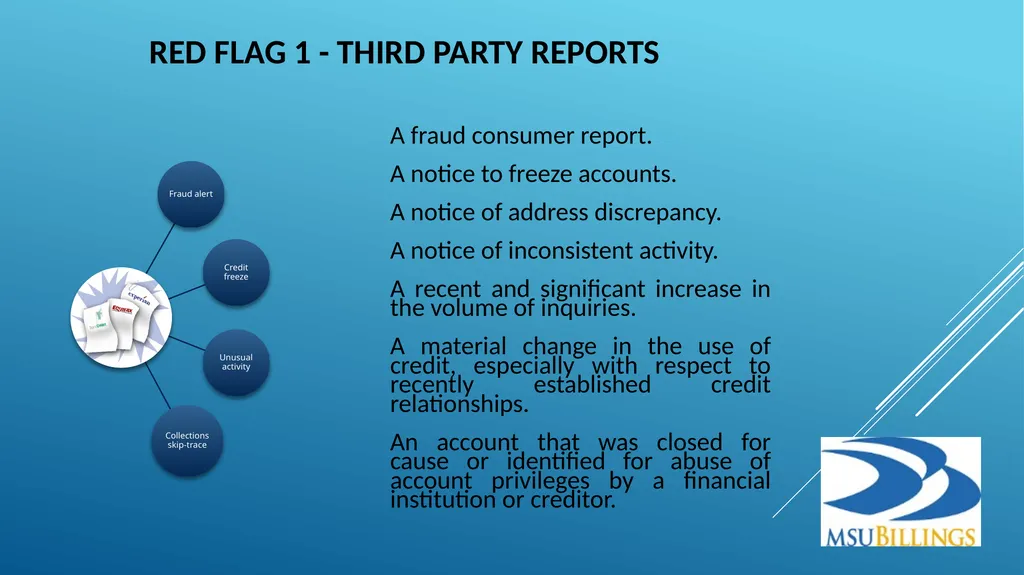
A fraud consumer report.
A notice to freeze accounts.
A notice of address discrepancy.
A notice of inconsistent activity.
A recent and significant increase in the volume of inquiries.
A material change in the use of credit, especially with respect to recently established credit relationships.
An account that was closed for cause or identified for abuse of account privileges by a financial institution or creditor. RED FLAG 1 - THIRD PARTY REPORTS<br>
06
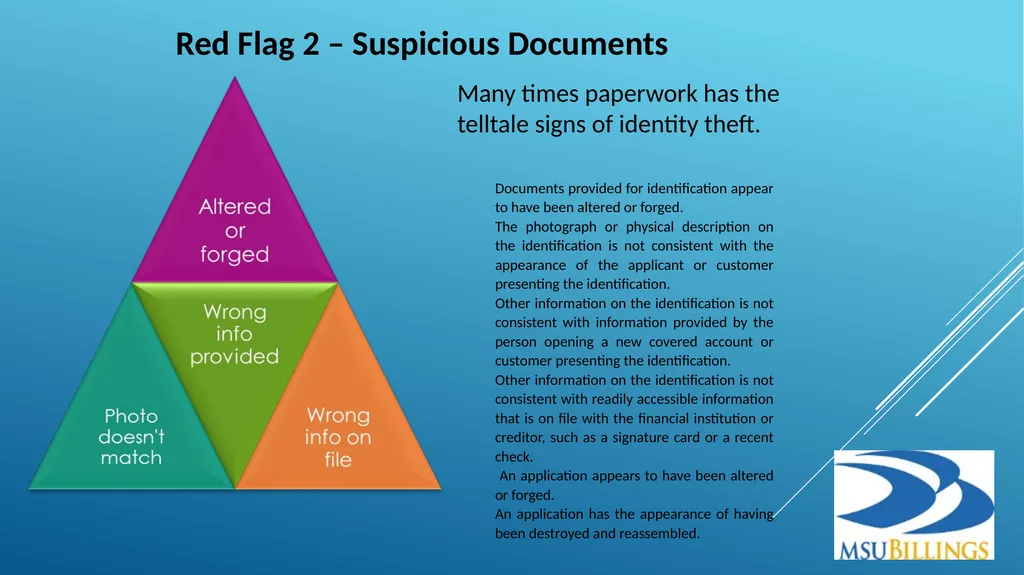
Many times paperwork has the
telltale signs of identity theft. Documents provided for identification appear to have been altered or forged.
The photograph or physical description on the identification is not consistent with the appearance of the applicant or customer presenting the identification.
Other information on the identification is not consistent with information provided by the person opening a new covered account or customer presenting the identification.
Other information on the identification is not consistent with readily accessible information that is on file with the financial institution or creditor, such as a signature card or a recent check.
An application appears to have been altered or forged.
An application has the appearance of having been destroyed and reassembled. Red Flag 2 – Suspicious Documents<br>
07
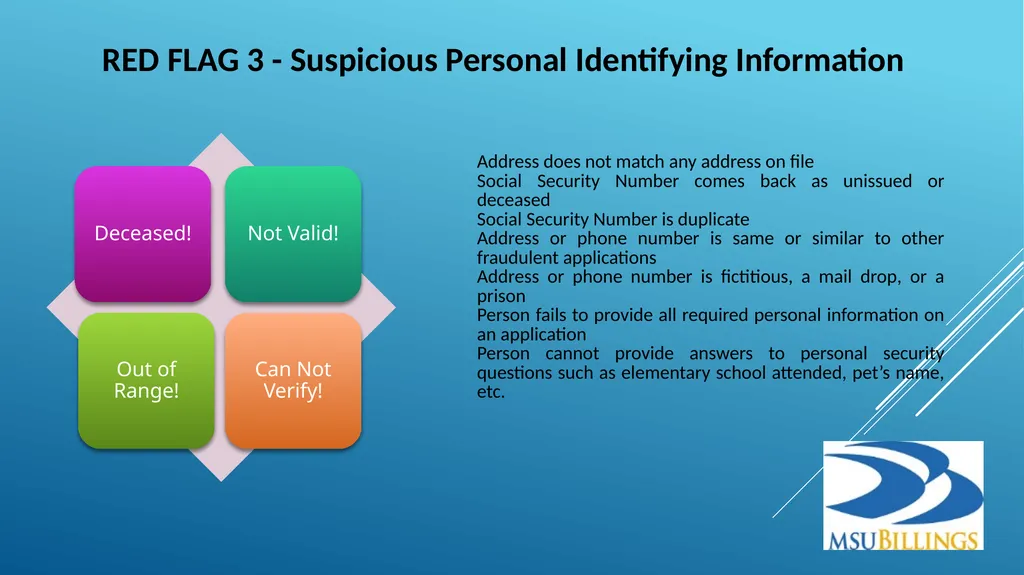
Address does not match any address on file
Social Security Number comes back as unissued or deceased
Social Security Number is duplicate
Address or phone number is same or similar to other fraudulent applications
Address or phone number is fictitious, a mail drop, or a prison
Person fails to provide all required personal information on an application
Person cannot provide answers to personal security questions such as elementary school attended, pet’s name, etc. RED FLAG 3 - Suspicious Personal Identifying Information<br>
08
Shortly following the notice of a change of address for a covered account, receives a request for new, additional, or replacement goods or services, or for the addition of authorized users on the account.
A new revolving credit account is used in a manner commonly associated with known patterns of fraud patterns. For example:
The customer fails to make the first payment, or
Makes an initial payment but no subsequent payments.
A covered account is used in a manner that is not consistent with established patterns of activity on the account.
There is, for example:
Nonpayment when there is no history of late or missed payments;
A material change in purchasing or usage patterns;
A covered account that has been inactive for a reasonably lengthy period of time is used (taking into consideration the type of account, the expected pattern of usage and other relevant factors).
Mail sent to the customer is returned repeatedly as undeliverable although transactions continue to be conducted in connection with the covered account.
The University is notified that the customer is not receiving documents.
The University is notified of unauthorized charges or transactions in connection with a covered account. RED FLAG 4 - Suspicious Account Activity<br>
09
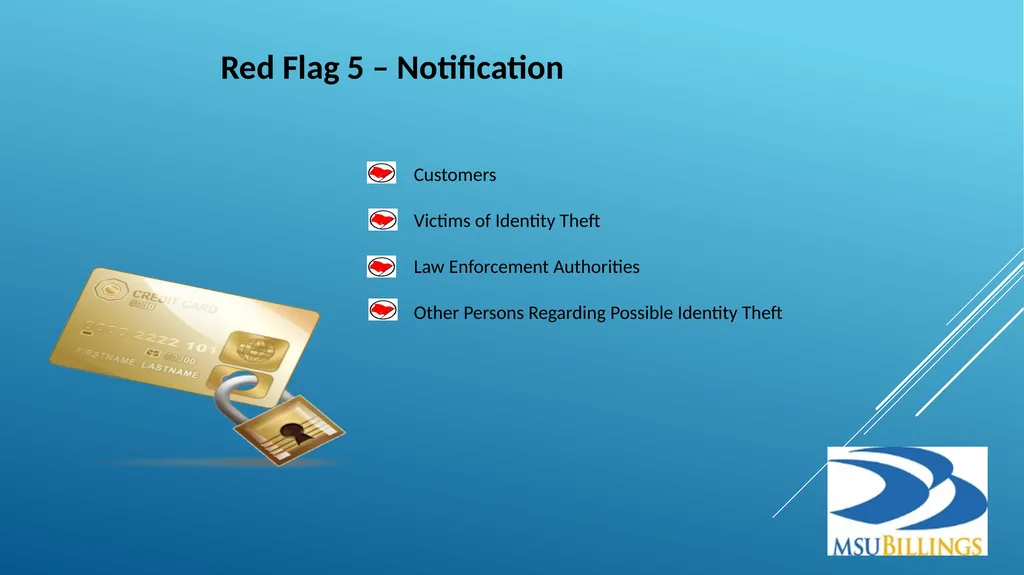
Red Flag 5 – Notification Customers
Victims of Identity Theft
Law Enforcement Authorities
Other Persons Regarding Possible Identity Theft<br>
10
WHO DO YOU REPORT SUSPECTED RED FLAG VIOLATIONS?
Report immediately to your supervisor any suspected violations of the RED FLAG RULE.
Per MSU policy the most senior financial administrator for each campus is
responsible for the administration and reporting of the program.
Currently that is the ADMINISTRATIVE SERVICES VICE CHANCELLOR at MSUB. REPORTING VIOLATIONS<br>