
Full-Scale Testing Overload Update REDAC
SB
Published · 28 slides · 0 views
1 / 1
Description
Full-Scale Testing Overload Update REDAC Subcommittee on Airports David R. Brill, P.E., Ph.D. March 15, 2016 Review - Current ICAO Overload Criteria ICAO Annex 14, Aerodrome Design and Operations, defines the following overload criteria:
Related Topics
Share
Embed code
Download this presentation From Below
"Full-Scale Testing Overload Update REDAC" is the property of its rightful owner. Permission is granted to download and print the materials on this website for personal, non-commercial use only, and to display it on your personal computer provided you do not modify the materials and that you retain all copyright notices contained in the materials. By downloading content from our website, you accept the terms of this agreement.
Presentation Transcript
01
Full-Scale Testing Overload Update REDAC Subcommittee on Airports David R. Brill, P.E., Ph.D. March 15, 2016<br>
02
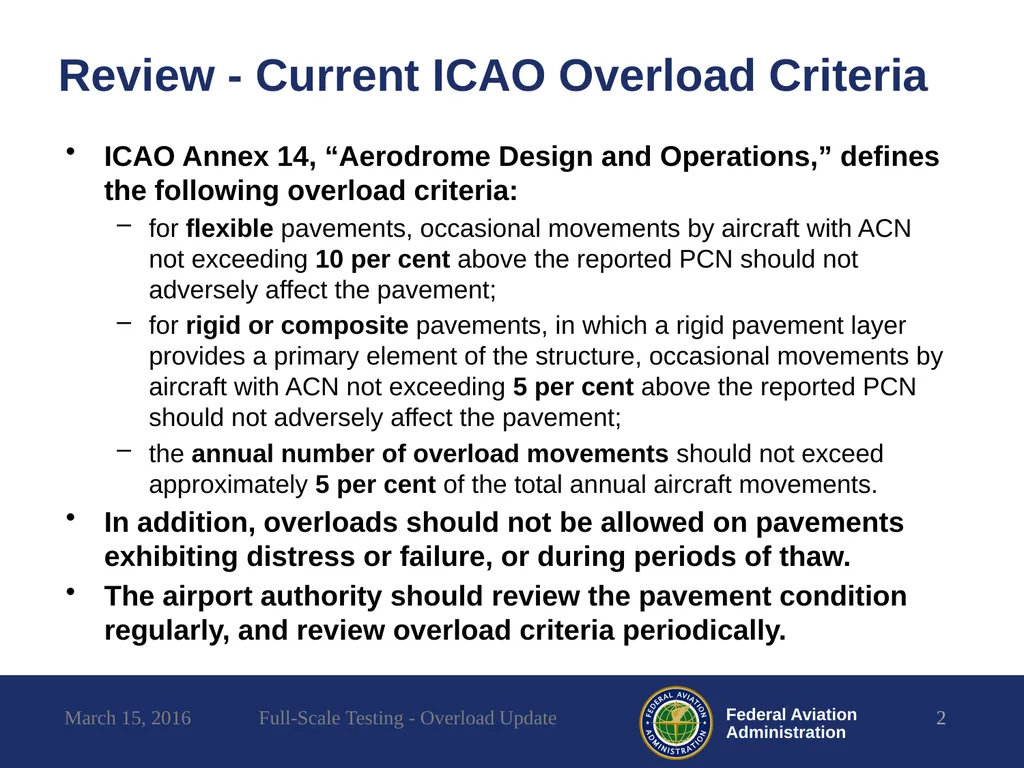
Review - Current ICAO Overload Criteria ICAO Annex 14, “Aerodrome Design and Operations,” defines the following overload criteria:
for flexible pavements, occasional movements by aircraft with ACN not exceeding 10 per cent above the reported PCN should not adversely affect the pavement;
for rigid or composite pavements, in which a rigid pavement layer provides a primary element of the structure, occasional movements by aircraft with ACN not exceeding 5 per cent above the reported PCN should not adversely affect the pavement;
the annual number of overload movements should not exceed approximately 5 per cent of the total annual aircraft movements.
In addition, overloads should not be allowed on pavements exhibiting distress or failure, or during periods of thaw.
The airport authority should review the pavement condition regularly, and review overload criteria periodically. 2 March 15, 2016 Full-Scale Testing - Overload Update<br>
for flexible pavements, occasional movements by aircraft with ACN not exceeding 10 per cent above the reported PCN should not adversely affect the pavement;
for rigid or composite pavements, in which a rigid pavement layer provides a primary element of the structure, occasional movements by aircraft with ACN not exceeding 5 per cent above the reported PCN should not adversely affect the pavement;
the annual number of overload movements should not exceed approximately 5 per cent of the total annual aircraft movements.
In addition, overloads should not be allowed on pavements exhibiting distress or failure, or during periods of thaw.
The airport authority should review the pavement condition regularly, and review overload criteria periodically. 2 March 15, 2016 Full-Scale Testing - Overload Update<br>
03
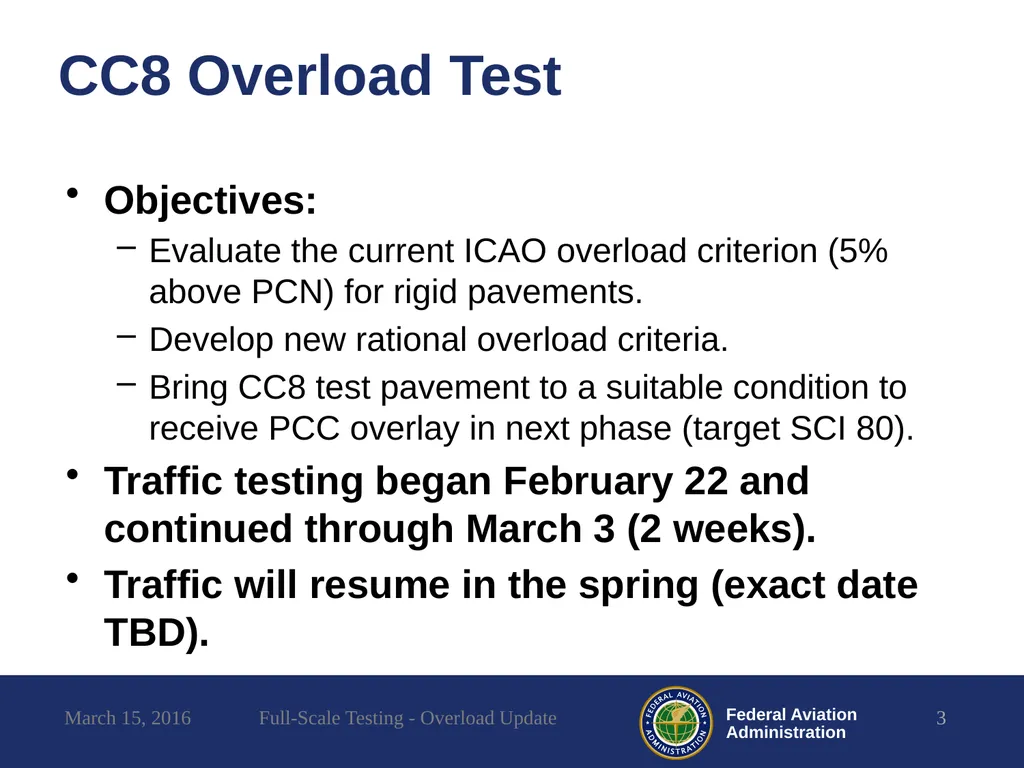
CC8 Overload Test Objectives:
Evaluate the current ICAO overload criterion (5% above PCN) for rigid pavements.
Develop new rational overload criteria.
Bring CC8 test pavement to a suitable condition to receive PCC overlay in next phase (target SCI 80).
Traffic testing began February 22 and continued through March 3 (2 weeks).
Traffic will resume in the spring (exact date TBD). March 15, 2016 Full-Scale Testing - Overload Update 3<br>
Evaluate the current ICAO overload criterion (5% above PCN) for rigid pavements.
Develop new rational overload criteria.
Bring CC8 test pavement to a suitable condition to receive PCC overlay in next phase (target SCI 80).
Traffic testing began February 22 and continued through March 3 (2 weeks).
Traffic will resume in the spring (exact date TBD). March 15, 2016 Full-Scale Testing - Overload Update 3<br>
04
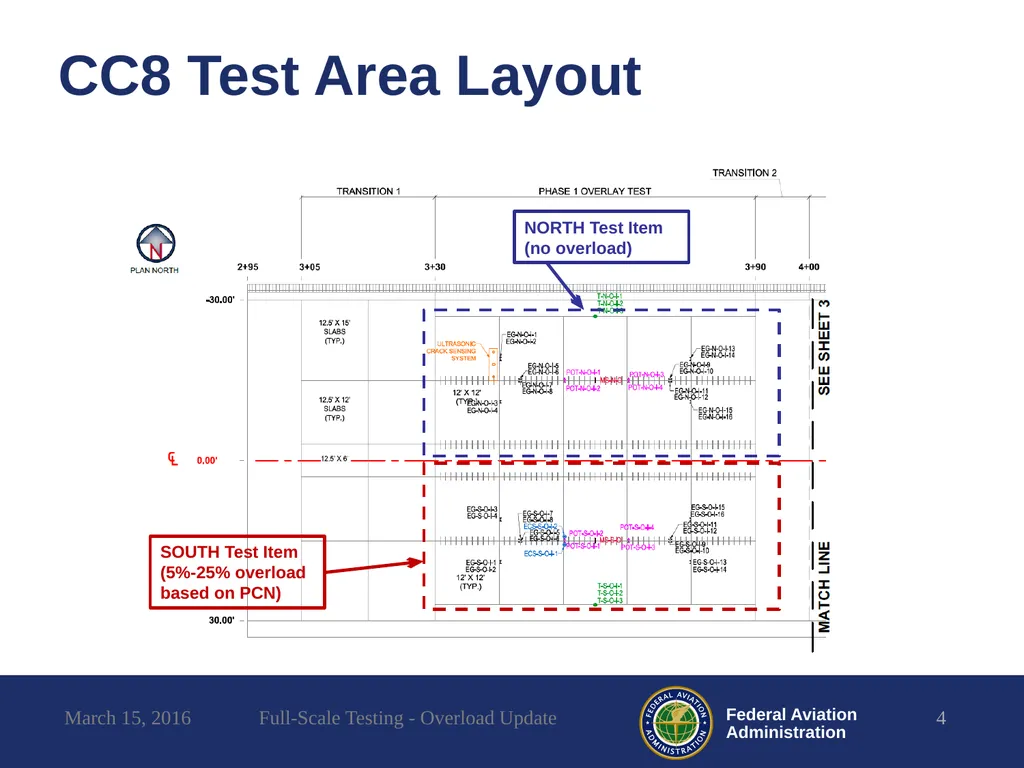
CC8 Test Area Layout March 15, 2016 Full-Scale Testing - Overload Update 4 SOUTH Test Item (5%-25% overload based on PCN)<br>
05
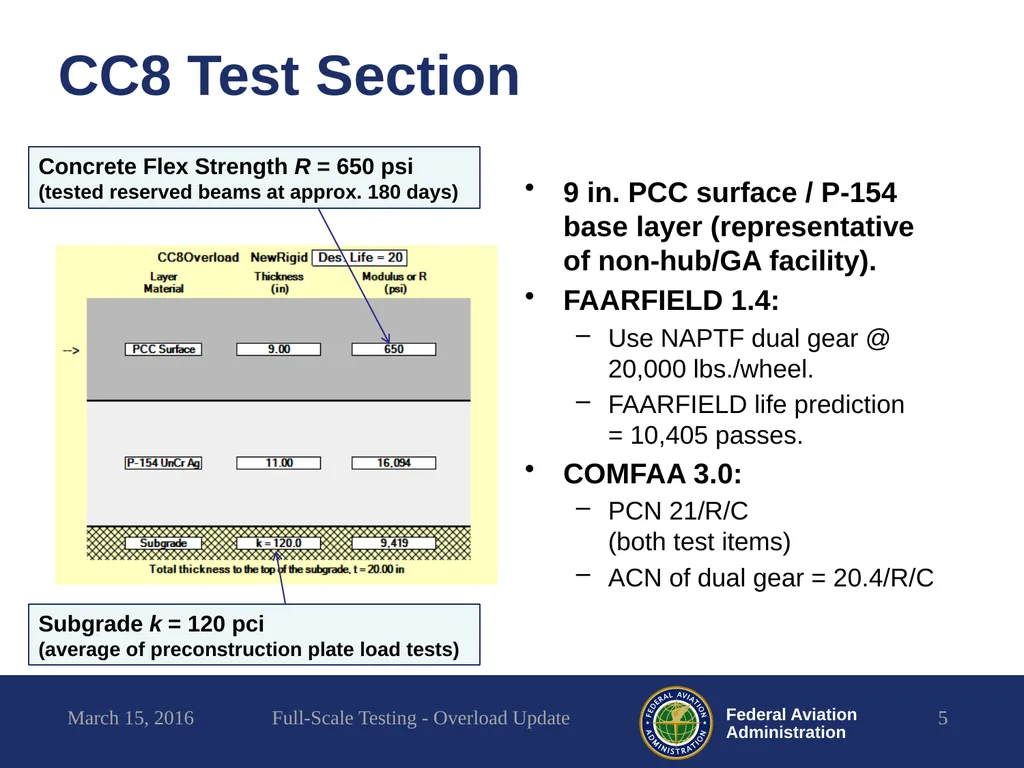
CC8 Test Section 9 in. PCC surface / P-154 base layer (representative of non-hub/GA facility).
FAARFIELD 1.4:
Use NAPTF dual gear @ 20,000 lbs./wheel.
FAARFIELD life prediction = 10,405 passes.
COMFAA 3.0:
PCN 21/R/C (both test items)
ACN of dual gear = 20.4/R/C March 15, 2016 Full-Scale Testing - Overload Update 5 Concrete Flex Strength R = 650 psi (tested reserved beams at approx. 180 days) Subgrade k = 120 pci (average of preconstruction plate load tests)<br>
FAARFIELD 1.4:
Use NAPTF dual gear @ 20,000 lbs./wheel.
FAARFIELD life prediction = 10,405 passes.
COMFAA 3.0:
PCN 21/R/C (both test items)
ACN of dual gear = 20.4/R/C March 15, 2016 Full-Scale Testing - Overload Update 5 Concrete Flex Strength R = 650 psi (tested reserved beams at approx. 180 days) Subgrade k = 120 pci (average of preconstruction plate load tests)<br>
06
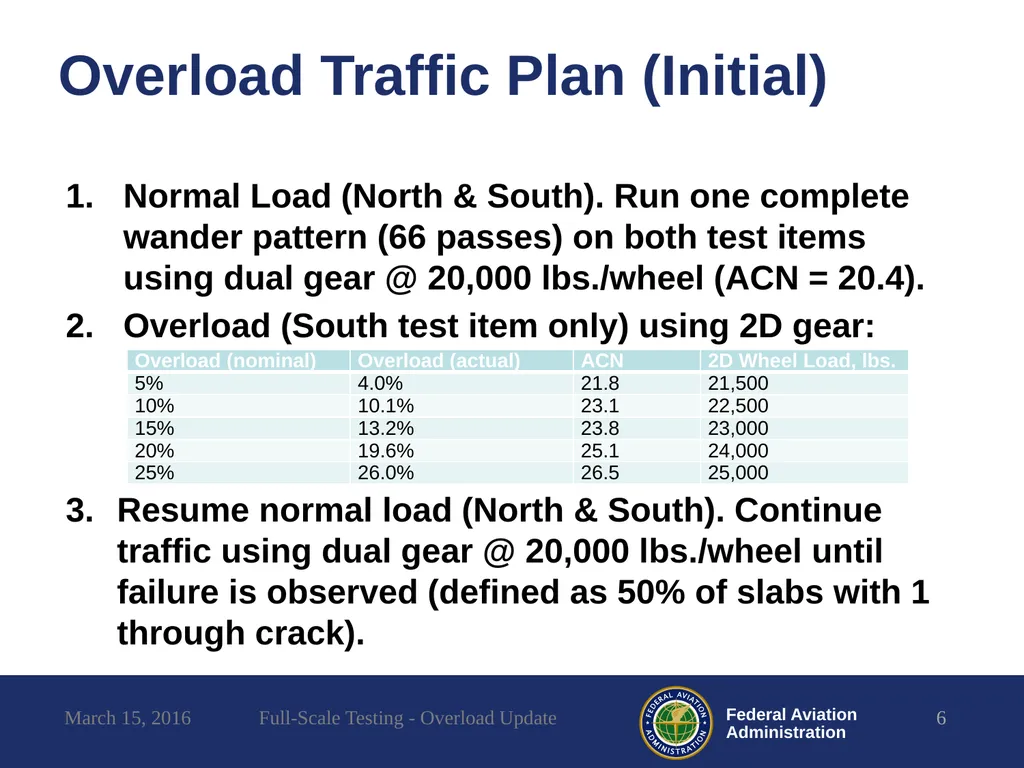
Overload Traffic Plan (Initial) Normal Load (North & South). Run one complete wander pattern (66 passes) on both test items using dual gear @ 20,000 lbs./wheel (ACN = 20.4).
Overload (South test item only) using 2D gear:
Resume normal load (North & South). Continue traffic using dual gear @ 20,000 lbs./wheel until failure is observed (defined as 50% of slabs with 1 through crack). March 15, 2016 Full-Scale Testing - Overload Update 6<br>
Overload (South test item only) using 2D gear:
Resume normal load (North & South). Continue traffic using dual gear @ 20,000 lbs./wheel until failure is observed (defined as 50% of slabs with 1 through crack). March 15, 2016 Full-Scale Testing - Overload Update 6<br>
07
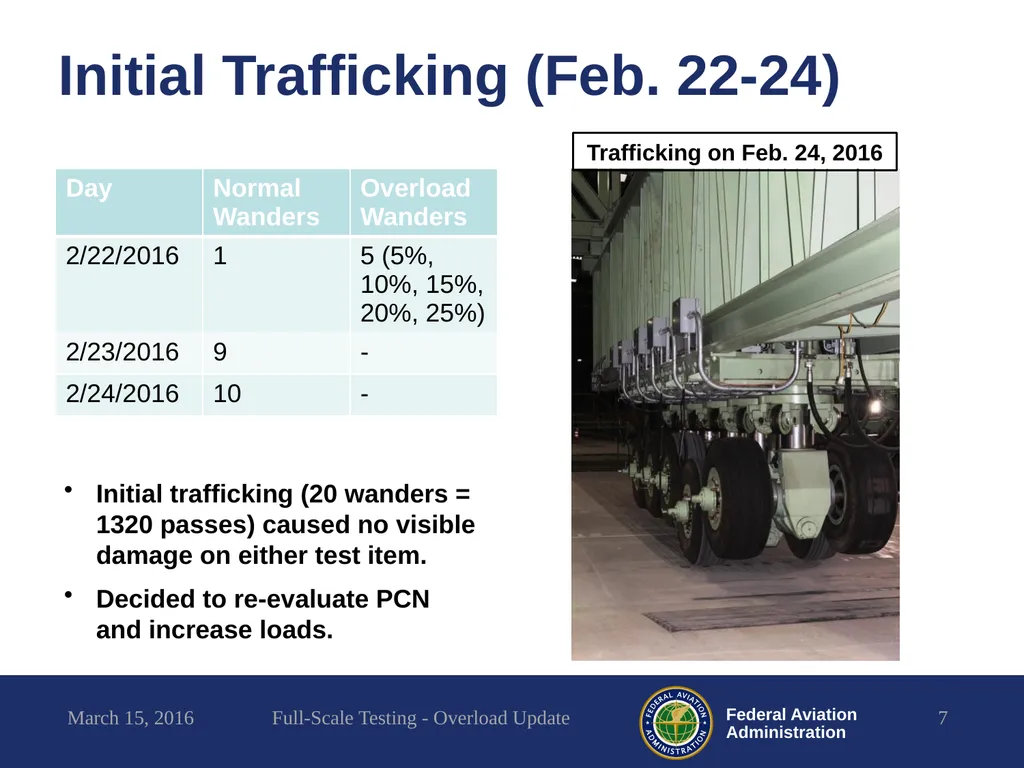
Initial Trafficking (Feb. 22-24) March 15, 2016 Full-Scale Testing - Overload Update 7 Initial trafficking (20 wanders = 1320 passes) caused no visible damage on either test item.
Decided to re-evaluate PCN and increase loads. Trafficking on Feb. 24, 2016<br>
Decided to re-evaluate PCN and increase loads. Trafficking on Feb. 24, 2016<br>
08
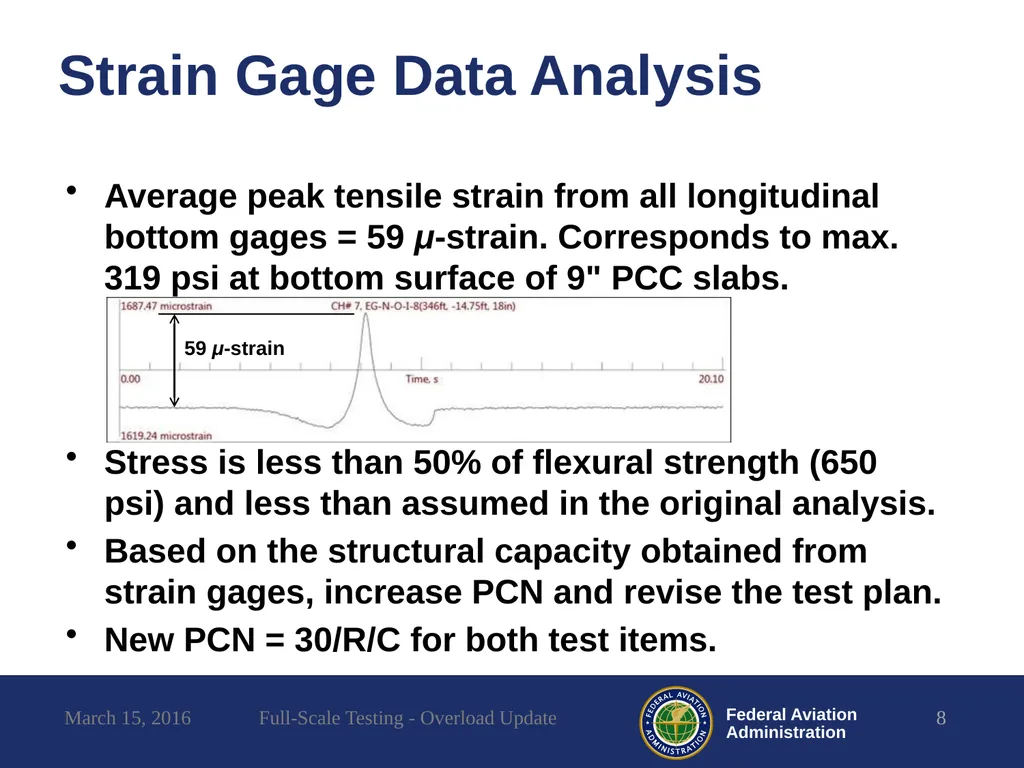
Strain Gage Data Analysis Average peak tensile strain from all longitudinal bottom gages = 59 μ-strain. Corresponds to max. 319 psi at bottom surface of 9" PCC slabs.
Stress is less than 50% of flexural strength (650 psi) and less than assumed in the original analysis.
Based on the structural capacity obtained from strain gages, increase PCN and revise the test plan.
New PCN = 30/R/C for both test items. March 15, 2016 Full-Scale Testing - Overload Update 8 59 μ-strain<br>
Stress is less than 50% of flexural strength (650 psi) and less than assumed in the original analysis.
Based on the structural capacity obtained from strain gages, increase PCN and revise the test plan.
New PCN = 30/R/C for both test items. March 15, 2016 Full-Scale Testing - Overload Update 8 59 μ-strain<br>
09
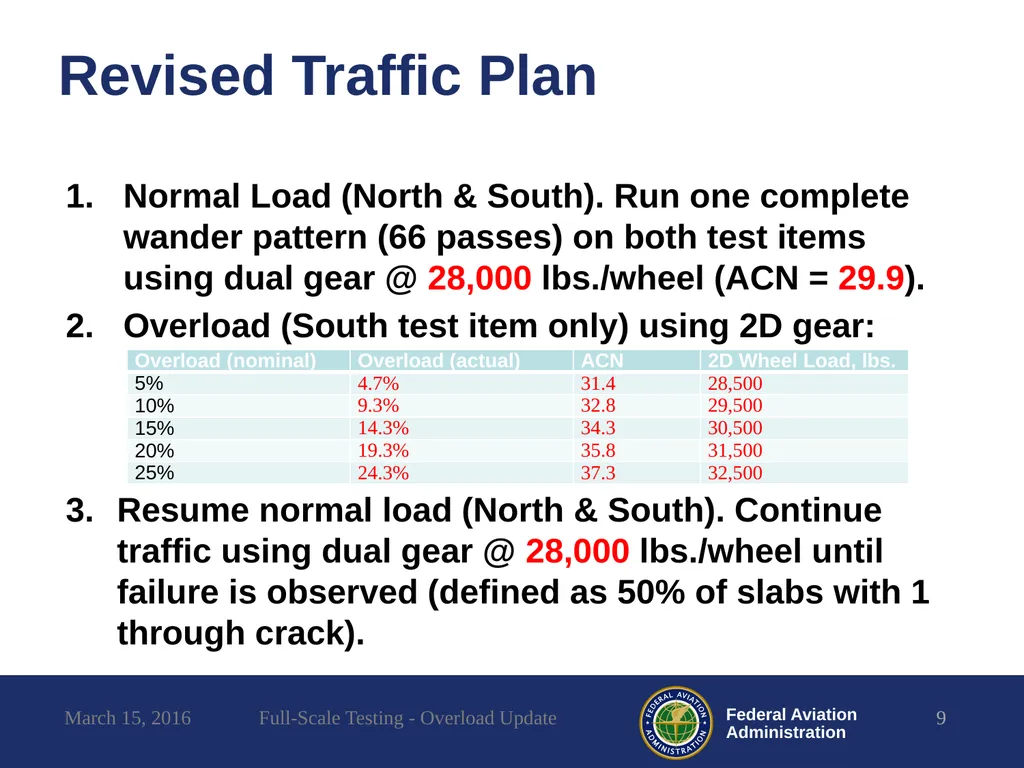
Revised Traffic Plan Normal Load (North & South). Run one complete wander pattern (66 passes) on both test items using dual gear @ 28,000 lbs./wheel (ACN = 29.9).
Overload (South test item only) using 2D gear:
Resume normal load (North & South). Continue traffic using dual gear @ 28,000 lbs./wheel until failure is observed (defined as 50% of slabs with 1 through crack). March 15, 2016 Full-Scale Testing - Overload Update 9<br>
Overload (South test item only) using 2D gear:
Resume normal load (North & South). Continue traffic using dual gear @ 28,000 lbs./wheel until failure is observed (defined as 50% of slabs with 1 through crack). March 15, 2016 Full-Scale Testing - Overload Update 9<br>
10
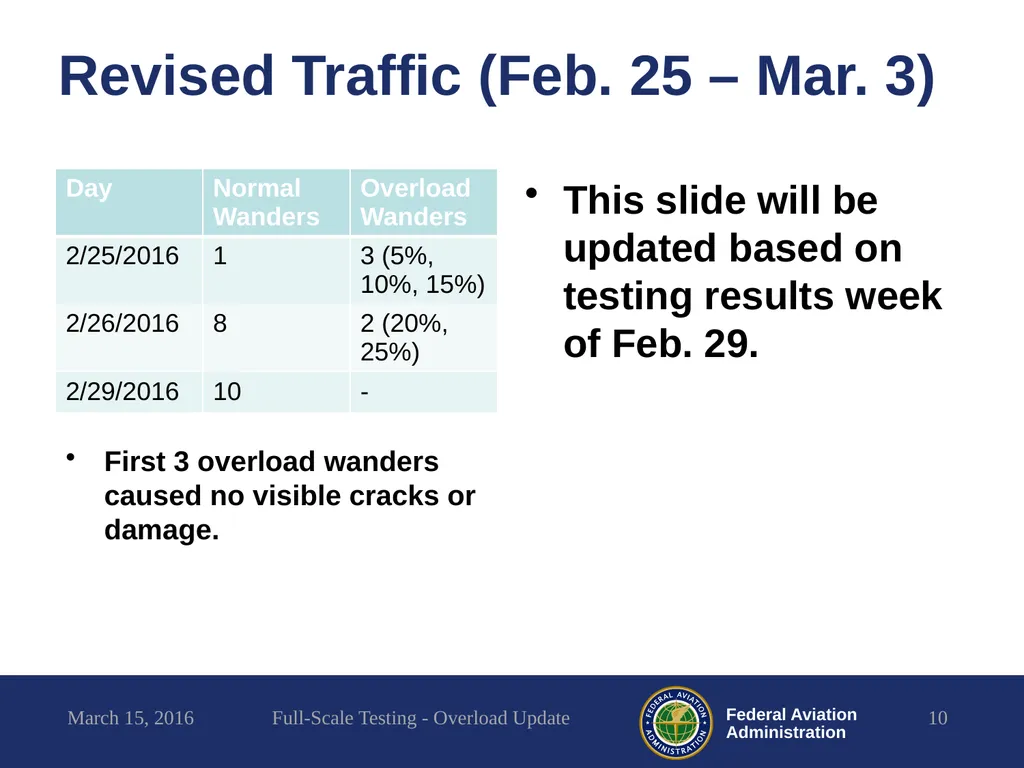
Revised Traffic (Feb. 25 – Mar. 3) This slide will be updated based on testing results week of Feb. 29. March 15, 2016 Full-Scale Testing - Overload Update 10 First 3 overload wanders caused no visible cracks or damage.<br>
11
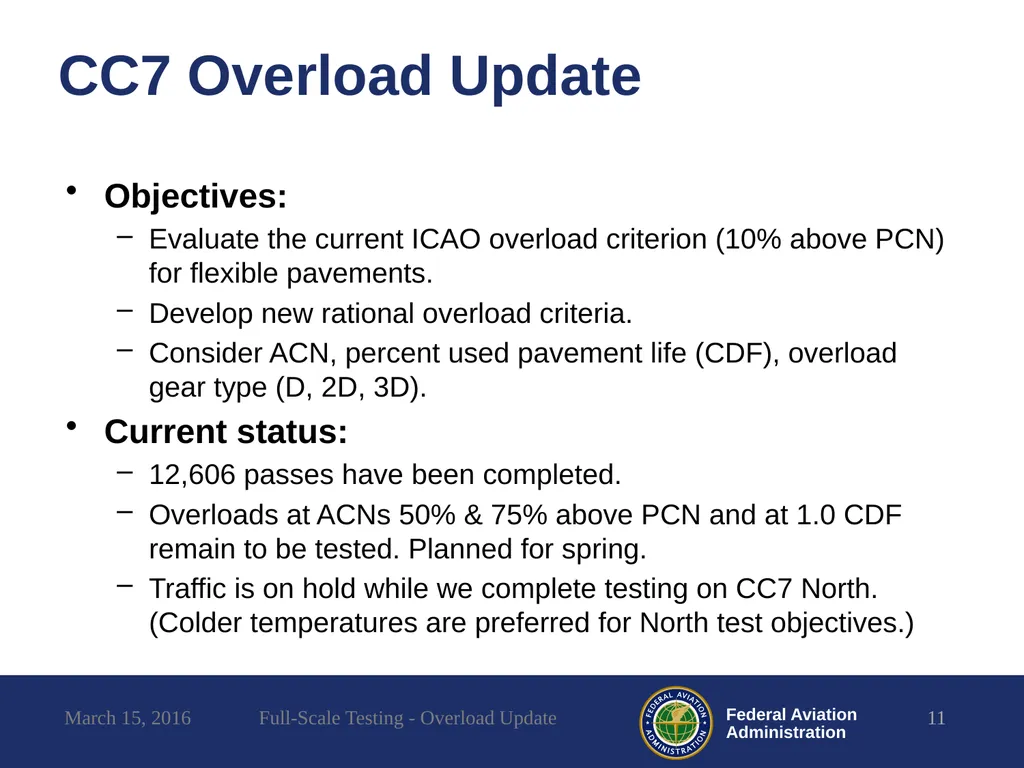
CC7 Overload Update Objectives:
Evaluate the current ICAO overload criterion (10% above PCN) for flexible pavements.
Develop new rational overload criteria.
Consider ACN, percent used pavement life (CDF), overload gear type (D, 2D, 3D).
Current status:
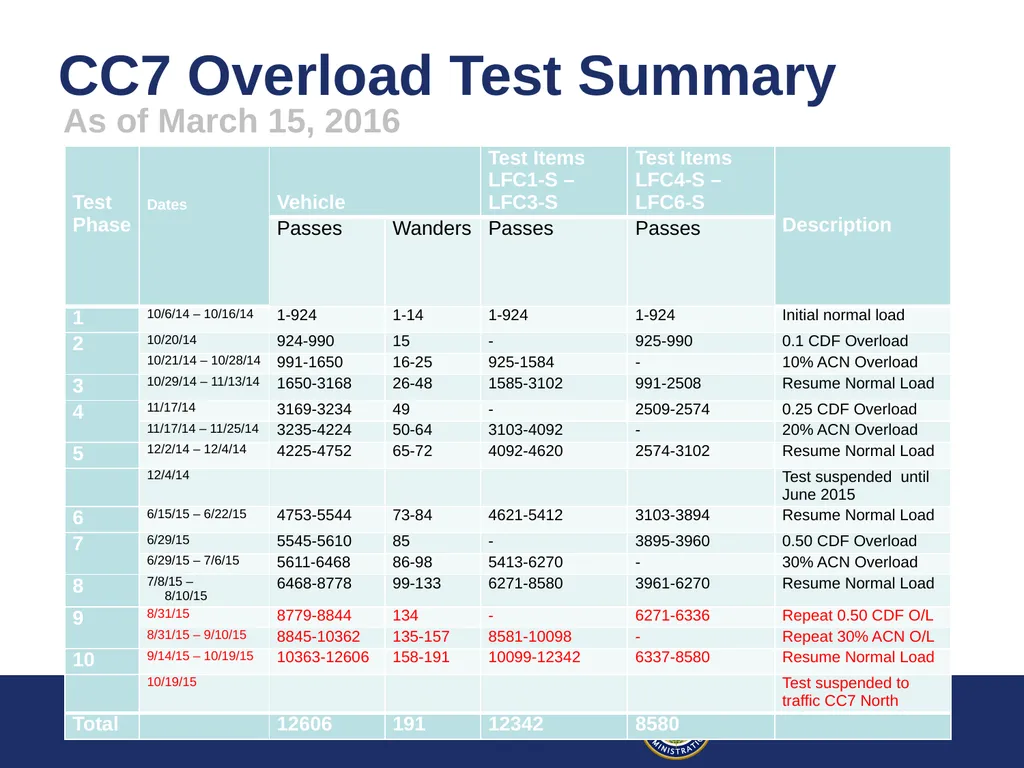
12,606 passes have been completed.
Overloads at ACNs 50% & 75% above PCN and at 1.0 CDF remain to be tested. Planned for spring.
Traffic is on hold while we complete testing on CC7 North. (Colder temperatures are preferred for North test objectives.) 11 March 15, 2016 Full-Scale Testing - Overload Update<br>
Evaluate the current ICAO overload criterion (10% above PCN) for flexible pavements.
Develop new rational overload criteria.
Consider ACN, percent used pavement life (CDF), overload gear type (D, 2D, 3D).
Current status:
12,606 passes have been completed.
Overloads at ACNs 50% & 75% above PCN and at 1.0 CDF remain to be tested. Planned for spring.
Traffic is on hold while we complete testing on CC7 North. (Colder temperatures are preferred for North test objectives.) 11 March 15, 2016 Full-Scale Testing - Overload Update<br>
12
Preliminary Observations
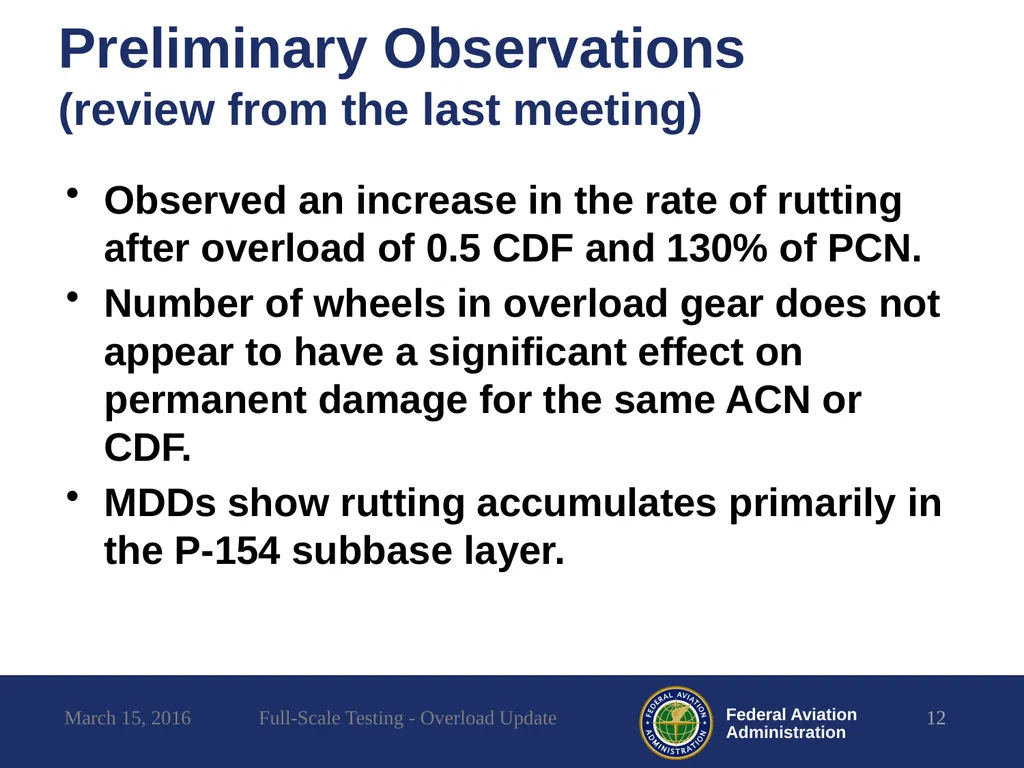
(review from the last meeting) Observed an increase in the rate of rutting after overload of 0.5 CDF and 130% of PCN.
Number of wheels in overload gear does not appear to have a significant effect on permanent damage for the same ACN or CDF.
MDDs show rutting accumulates primarily in the P-154 subbase layer. March 15, 2016 Full-Scale Testing - Overload Update 12<br>
Number of wheels in overload gear does not appear to have a significant effect on permanent damage for the same ACN or CDF.
MDDs show rutting accumulates primarily in the P-154 subbase layer. March 15, 2016 Full-Scale Testing - Overload Update 12<br>
13
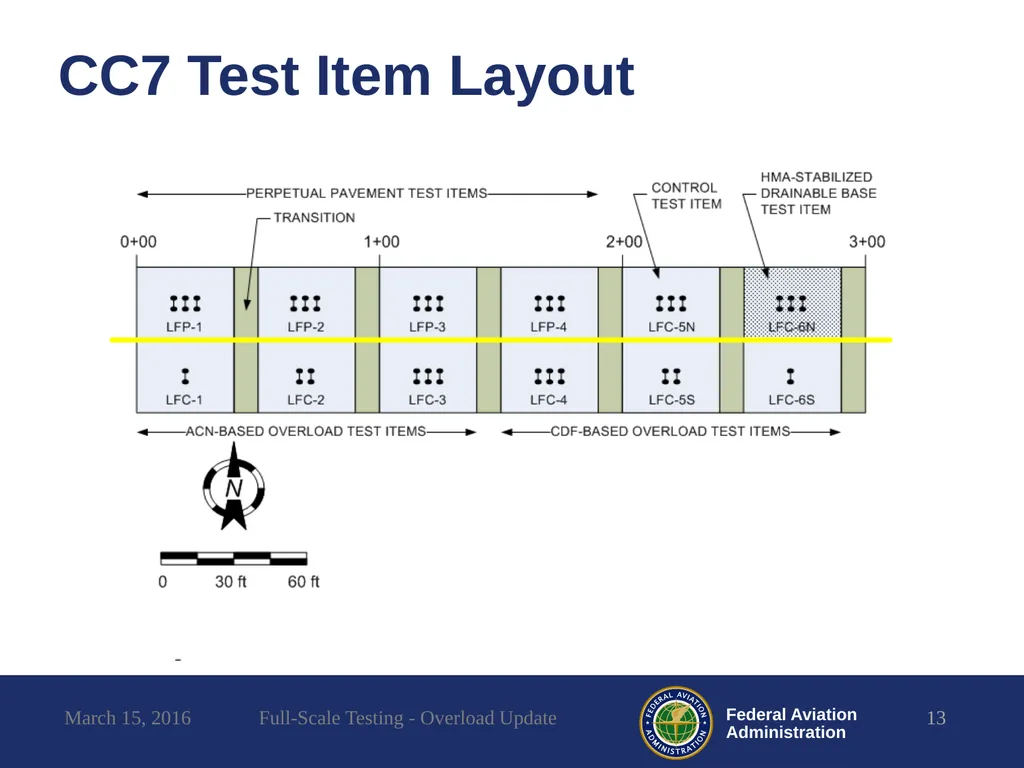
CC7 Test Item Layout March 15, 2016 Full-Scale Testing - Overload Update 13<br>
14
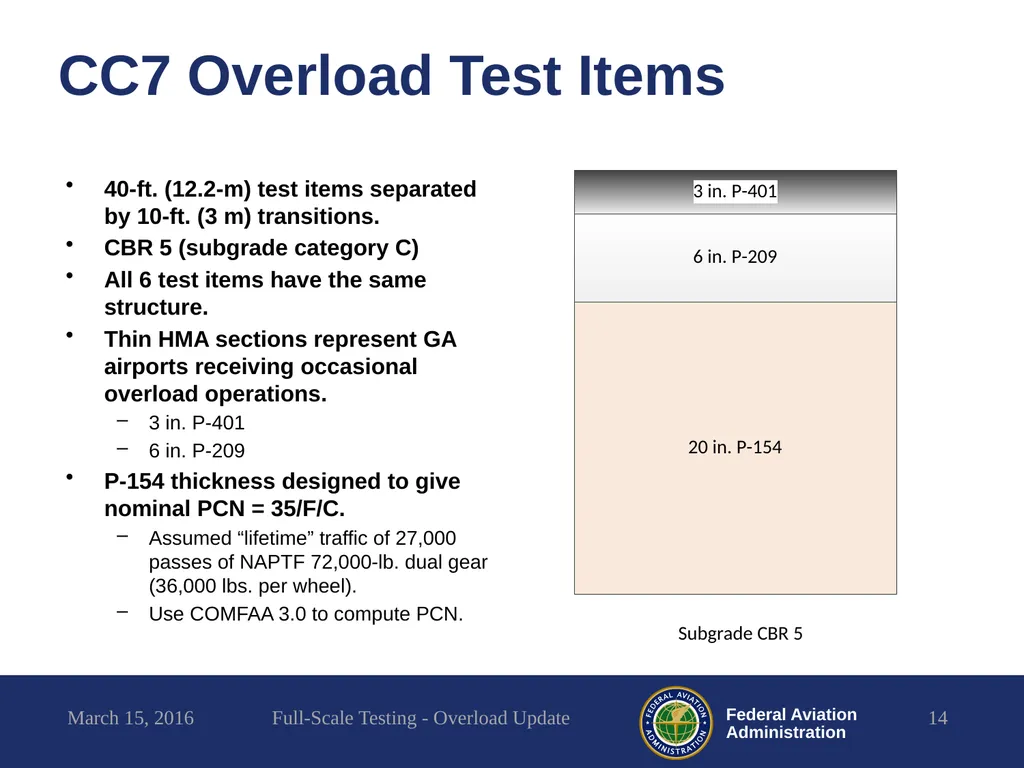
CC7 Overload Test Items 40-ft. (12.2-m) test items separated by 10-ft. (3 m) transitions.
CBR 5 (subgrade category C)
All 6 test items have the same structure.
Thin HMA sections represent GA airports receiving occasional overload operations.
3 in. P-401
6 in. P-209
P-154 thickness designed to give nominal PCN = 35/F/C.
Assumed “lifetime” traffic of 27,000 passes of NAPTF 72,000-lb. dual gear (36,000 lbs. per wheel).
Use COMFAA 3.0 to compute PCN. 14 March 15, 2016 Full-Scale Testing - Overload Update<br>
CBR 5 (subgrade category C)
All 6 test items have the same structure.
Thin HMA sections represent GA airports receiving occasional overload operations.
3 in. P-401
6 in. P-209
P-154 thickness designed to give nominal PCN = 35/F/C.
Assumed “lifetime” traffic of 27,000 passes of NAPTF 72,000-lb. dual gear (36,000 lbs. per wheel).
Use COMFAA 3.0 to compute PCN. 14 March 15, 2016 Full-Scale Testing - Overload Update<br>
15
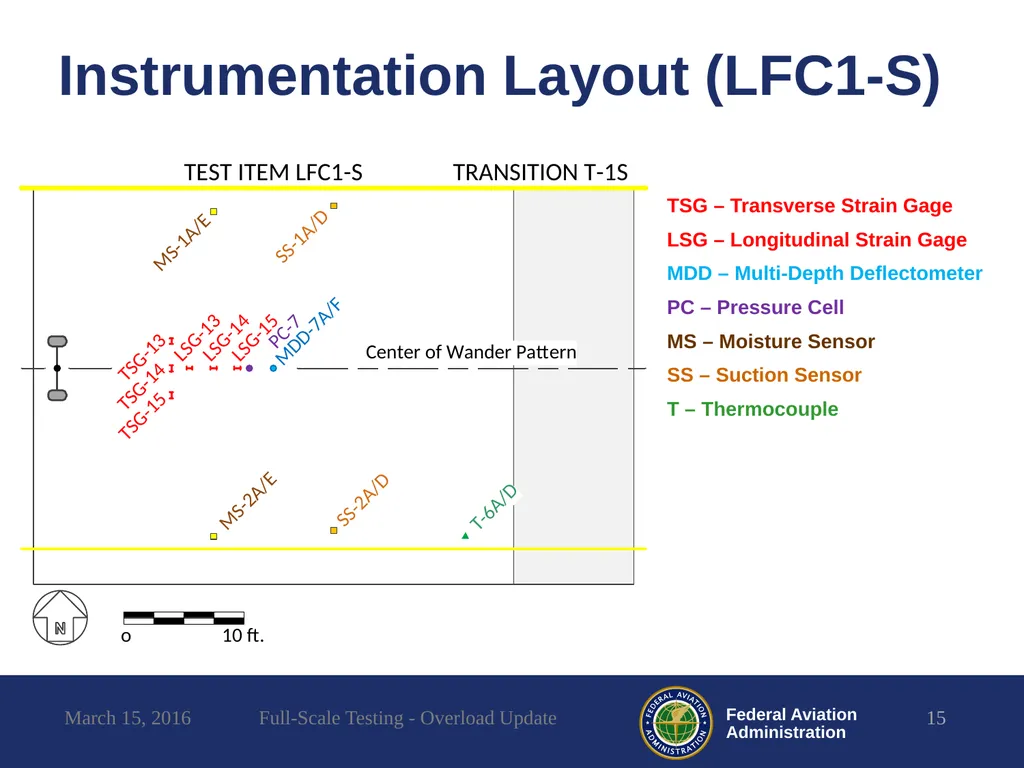
Instrumentation Layout (LFC1-S) 15 TSG – Transverse Strain Gage
LSG – Longitudinal Strain Gage
MDD – Multi-Depth Deflectometer
PC – Pressure Cell
MS – Moisture Sensor
SS – Suction Sensor
T – Thermocouple March 15, 2016 Full-Scale Testing - Overload Update<br>
LSG – Longitudinal Strain Gage
MDD – Multi-Depth Deflectometer
PC – Pressure Cell
MS – Moisture Sensor
SS – Suction Sensor
T – Thermocouple March 15, 2016 Full-Scale Testing - Overload Update<br>
16
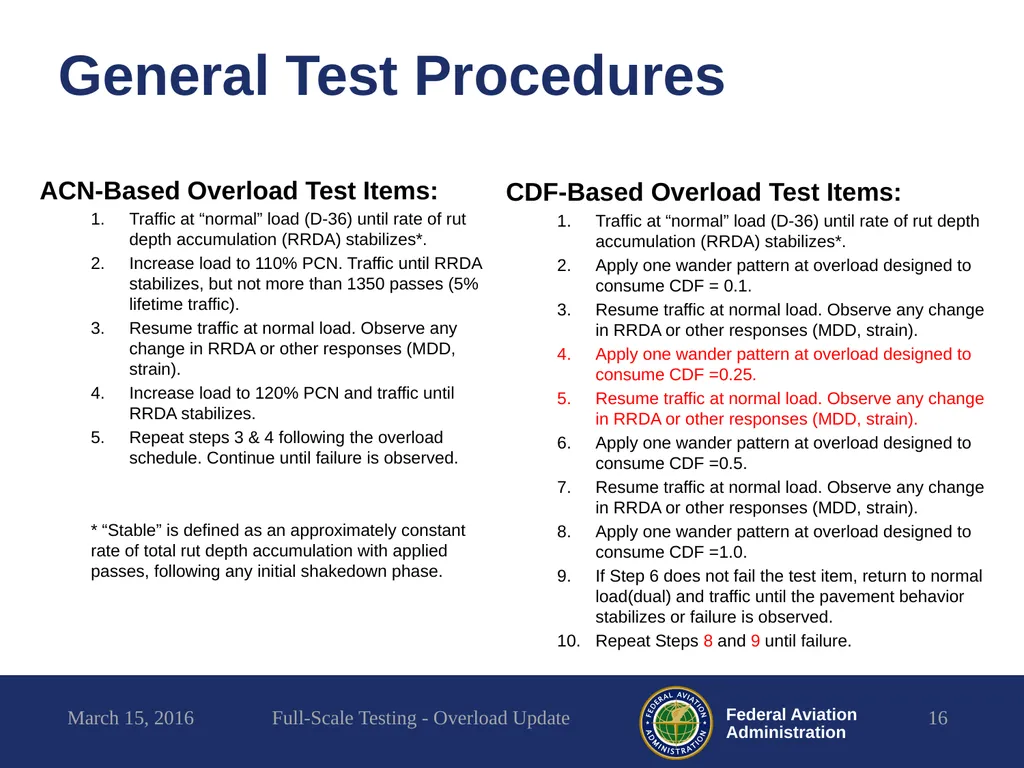
General Test Procedures ACN-Based Overload Test Items:
Traffic at “normal” load (D-36) until rate of rut depth accumulation (RRDA) stabilizes*.
Increase load to 110% PCN. Traffic until RRDA stabilizes, but not more than 1350 passes (5% lifetime traffic).
Resume traffic at normal load. Observe any change in RRDA or other responses (MDD, strain).
Increase load to 120% PCN and traffic until RRDA stabilizes.
Repeat steps 3 & 4 following the overload schedule. Continue until failure is observed.
* “Stable” is defined as an approximately constant rate of total rut depth accumulation with applied passes, following any initial shakedown phase. CDF-Based Overload Test Items:
Traffic at “normal” load (D-36) until rate of rut depth accumulation (RRDA) stabilizes*.
Apply one wander pattern at overload designed to consume CDF = 0.1.
Resume traffic at normal load. Observe any change in RRDA or other responses (MDD, strain).
Apply one wander pattern at overload designed to consume CDF =0.25.
Resume traffic at normal load. Observe any change in RRDA or other responses (MDD, strain).
Apply one wander pattern at overload designed to consume CDF =0.5.
Resume traffic at normal load. Observe any change in RRDA or other responses (MDD, strain).
Apply one wander pattern at overload designed to consume CDF =1.0.
If Step 6 does not fail the test item, return to normal load(dual) and traffic until the pavement behavior stabilizes or failure is observed.
Repeat Steps 8 and 9 until failure. 16 March 15, 2016 Full-Scale Testing - Overload Update<br>
Traffic at “normal” load (D-36) until rate of rut depth accumulation (RRDA) stabilizes*.
Increase load to 110% PCN. Traffic until RRDA stabilizes, but not more than 1350 passes (5% lifetime traffic).
Resume traffic at normal load. Observe any change in RRDA or other responses (MDD, strain).
Increase load to 120% PCN and traffic until RRDA stabilizes.
Repeat steps 3 & 4 following the overload schedule. Continue until failure is observed.
* “Stable” is defined as an approximately constant rate of total rut depth accumulation with applied passes, following any initial shakedown phase. CDF-Based Overload Test Items:
Traffic at “normal” load (D-36) until rate of rut depth accumulation (RRDA) stabilizes*.
Apply one wander pattern at overload designed to consume CDF = 0.1.
Resume traffic at normal load. Observe any change in RRDA or other responses (MDD, strain).
Apply one wander pattern at overload designed to consume CDF =0.25.
Resume traffic at normal load. Observe any change in RRDA or other responses (MDD, strain).
Apply one wander pattern at overload designed to consume CDF =0.5.
Resume traffic at normal load. Observe any change in RRDA or other responses (MDD, strain).
Apply one wander pattern at overload designed to consume CDF =1.0.
If Step 6 does not fail the test item, return to normal load(dual) and traffic until the pavement behavior stabilizes or failure is observed.
Repeat Steps 8 and 9 until failure. 16 March 15, 2016 Full-Scale Testing - Overload Update<br>
17
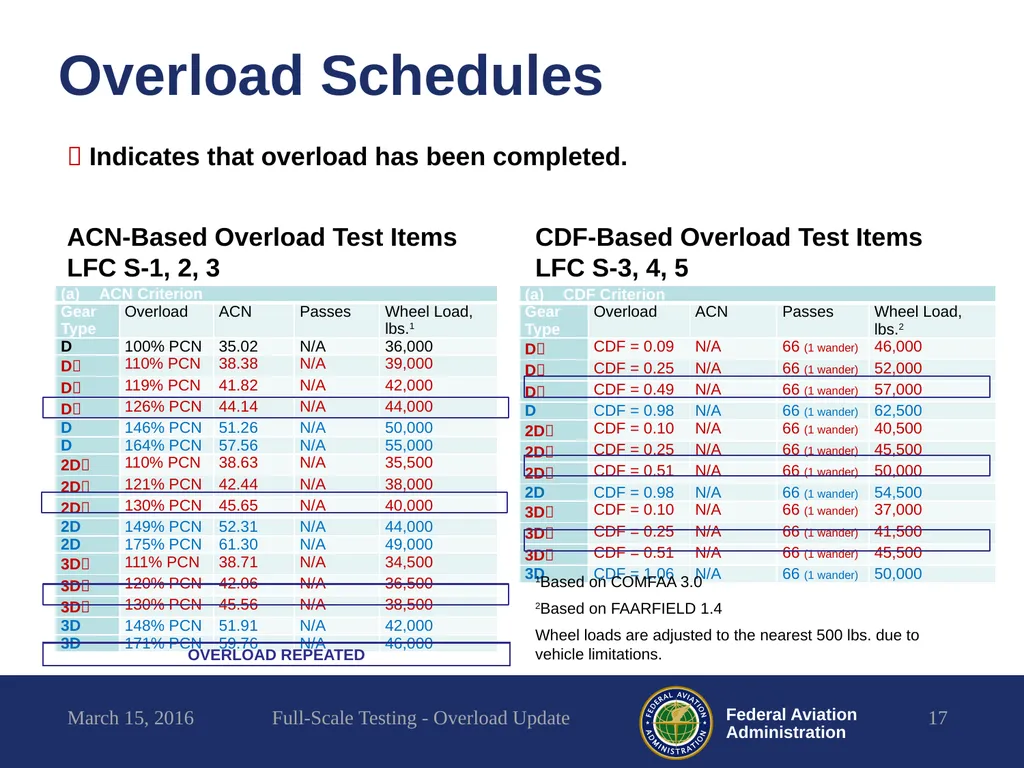
Overload Schedules 17 ACN-Based Overload Test Items LFC S-1, 2, 3 CDF-Based Overload Test Items LFC S-3, 4, 5 1Based on COMFAA 3.0
2Based on FAARFIELD 1.4
Wheel loads are adjusted to the nearest 500 lbs. due to vehicle limitations. March 15, 2016 Full-Scale Testing - Overload Update Indicates that overload has been completed. OVERLOAD REPEATED<br>
2Based on FAARFIELD 1.4
Wheel loads are adjusted to the nearest 500 lbs. due to vehicle limitations. March 15, 2016 Full-Scale Testing - Overload Update Indicates that overload has been completed. OVERLOAD REPEATED<br>
18
CC7 Overload Test Summary March 15, 2016 Full-Scale Testing - Overload Update 18 As of March 15, 2016<br>
19
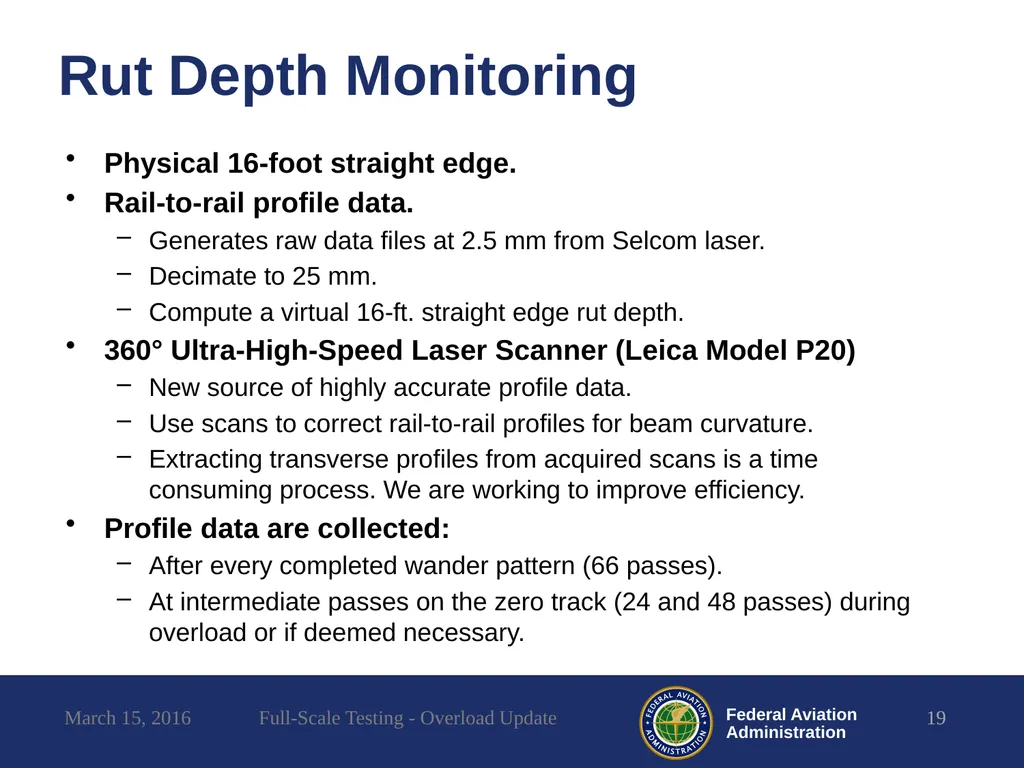
Rut Depth Monitoring Physical 16-foot straight edge.
Rail-to-rail profile data.
Generates raw data files at 2.5 mm from Selcom laser.
Decimate to 25 mm.
Compute a virtual 16-ft. straight edge rut depth.
360° Ultra-High-Speed Laser Scanner (Leica Model P20)
New source of highly accurate profile data.
Use scans to correct rail-to-rail profiles for beam curvature.
Extracting transverse profiles from acquired scans is a time consuming process. We are working to improve efficiency.
Profile data are collected:
After every completed wander pattern (66 passes).
At intermediate passes on the zero track (24 and 48 passes) during overload or if deemed necessary. 19 March 15, 2016 Full-Scale Testing - Overload Update<br>
Rail-to-rail profile data.
Generates raw data files at 2.5 mm from Selcom laser.
Decimate to 25 mm.
Compute a virtual 16-ft. straight edge rut depth.
360° Ultra-High-Speed Laser Scanner (Leica Model P20)
New source of highly accurate profile data.
Use scans to correct rail-to-rail profiles for beam curvature.
Extracting transverse profiles from acquired scans is a time consuming process. We are working to improve efficiency.
Profile data are collected:
After every completed wander pattern (66 passes).
At intermediate passes on the zero track (24 and 48 passes) during overload or if deemed necessary. 19 March 15, 2016 Full-Scale Testing - Overload Update<br>
20
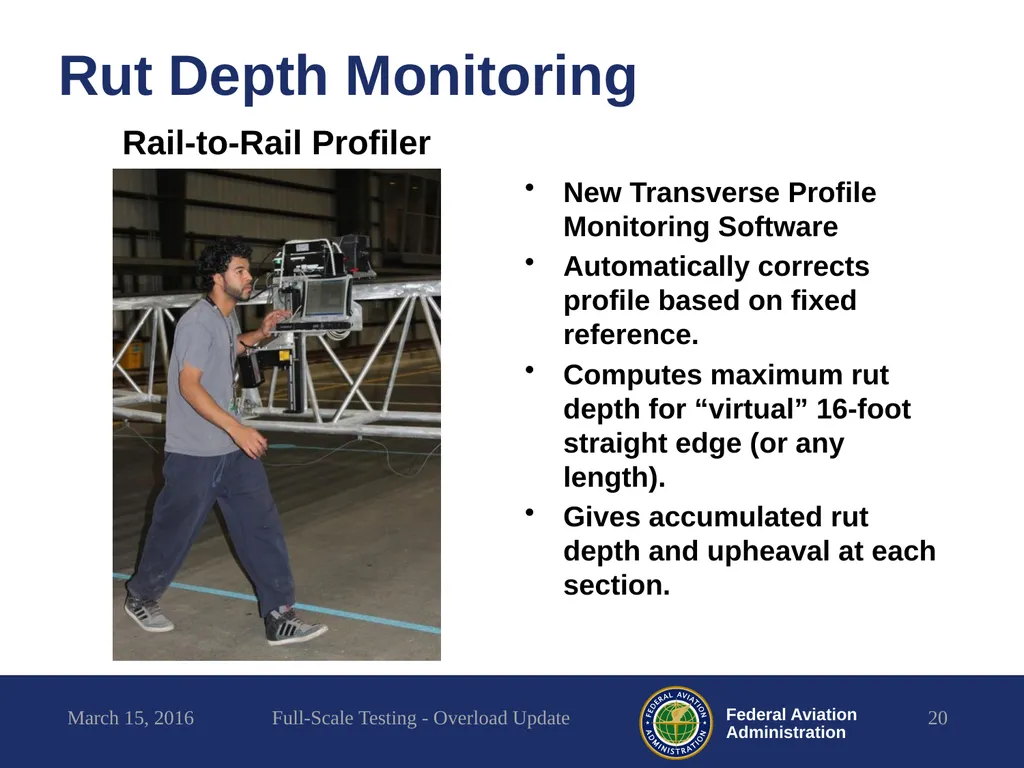
Rut Depth Monitoring New Transverse Profile Monitoring Software
Automatically corrects profile based on fixed reference.
Computes maximum rut depth for “virtual” 16-foot straight edge (or any length).
Gives accumulated rut depth and upheaval at each section. March 15, 2016 Full-Scale Testing - Overload Update 20 Rail-to-Rail Profiler<br>
Automatically corrects profile based on fixed reference.
Computes maximum rut depth for “virtual” 16-foot straight edge (or any length).
Gives accumulated rut depth and upheaval at each section. March 15, 2016 Full-Scale Testing - Overload Update 20 Rail-to-Rail Profiler<br>
21
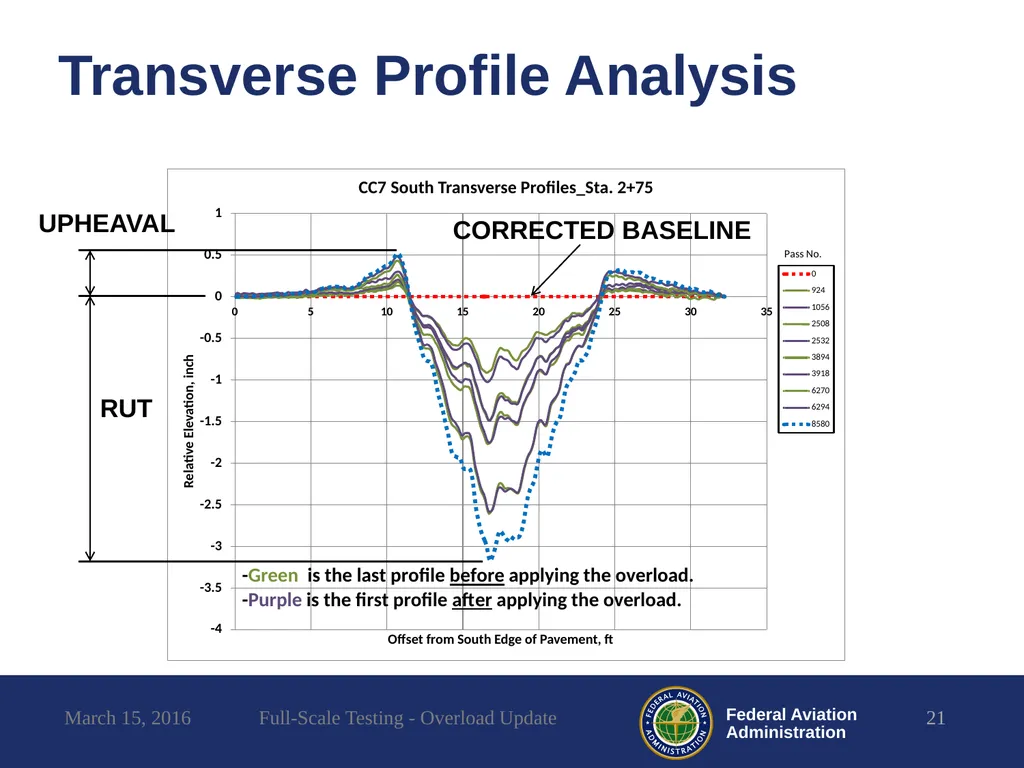
Transverse Profile Analysis March 15, 2016 Full-Scale Testing - Overload Update 21 UPHEAVAL RUT CORRECTED BASELINE<br>
22
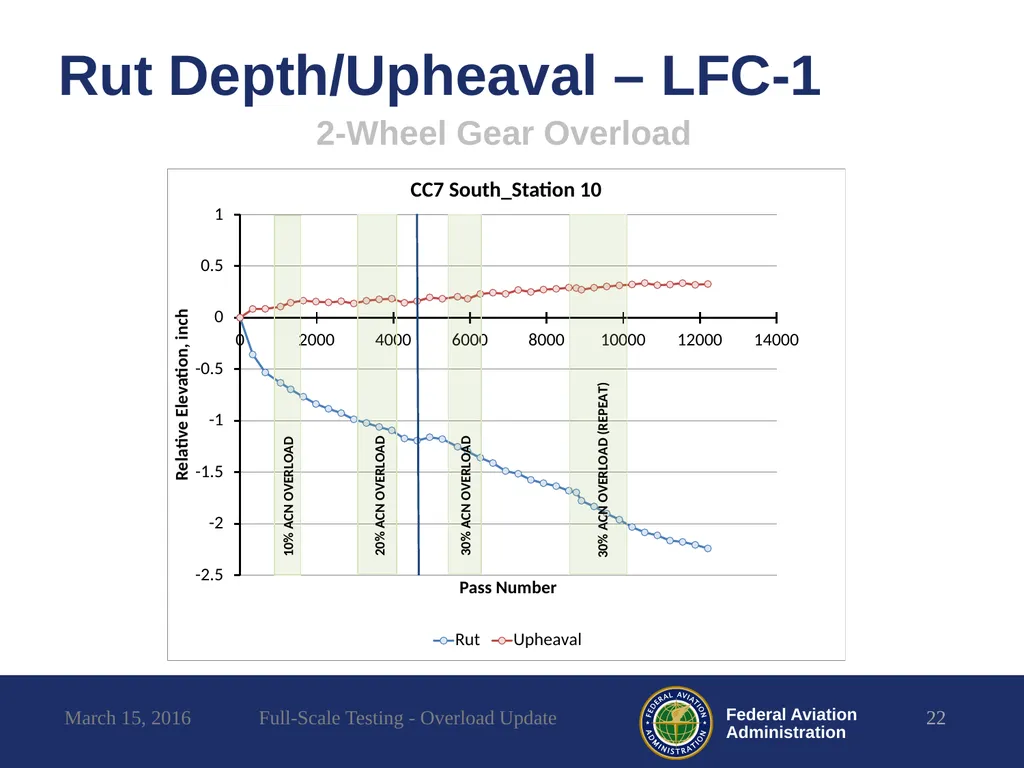
Rut Depth/Upheaval – LFC-1 March 15, 2016 Full-Scale Testing - Overload Update 22 2-Wheel Gear Overload<br>
23
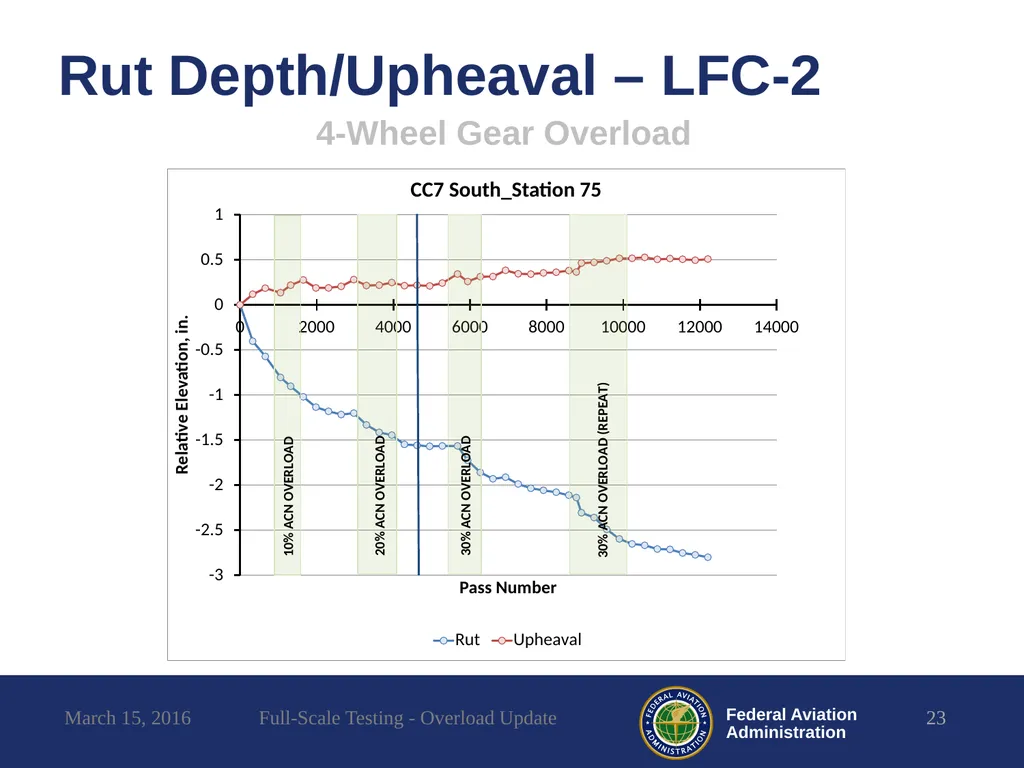
Rut Depth/Upheaval – LFC-2 March 15, 2016 Full-Scale Testing - Overload Update 23 4-Wheel Gear Overload<br>
24
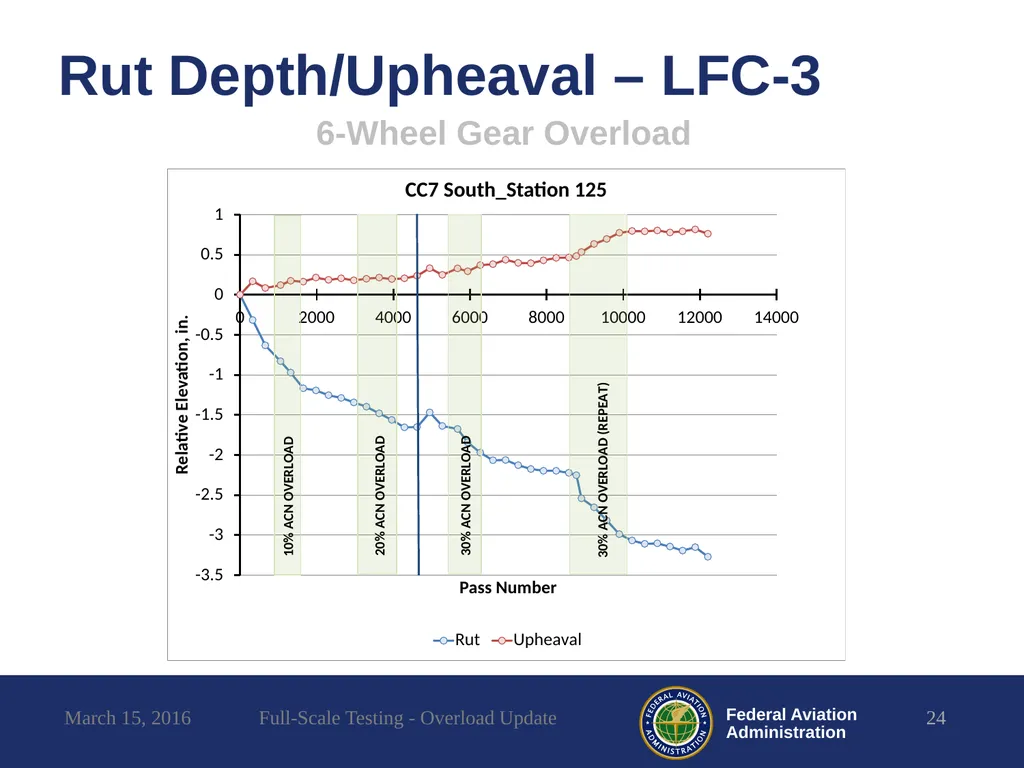
Rut Depth/Upheaval – LFC-3 March 15, 2016 Full-Scale Testing - Overload Update 24 6-Wheel Gear Overload<br>
25
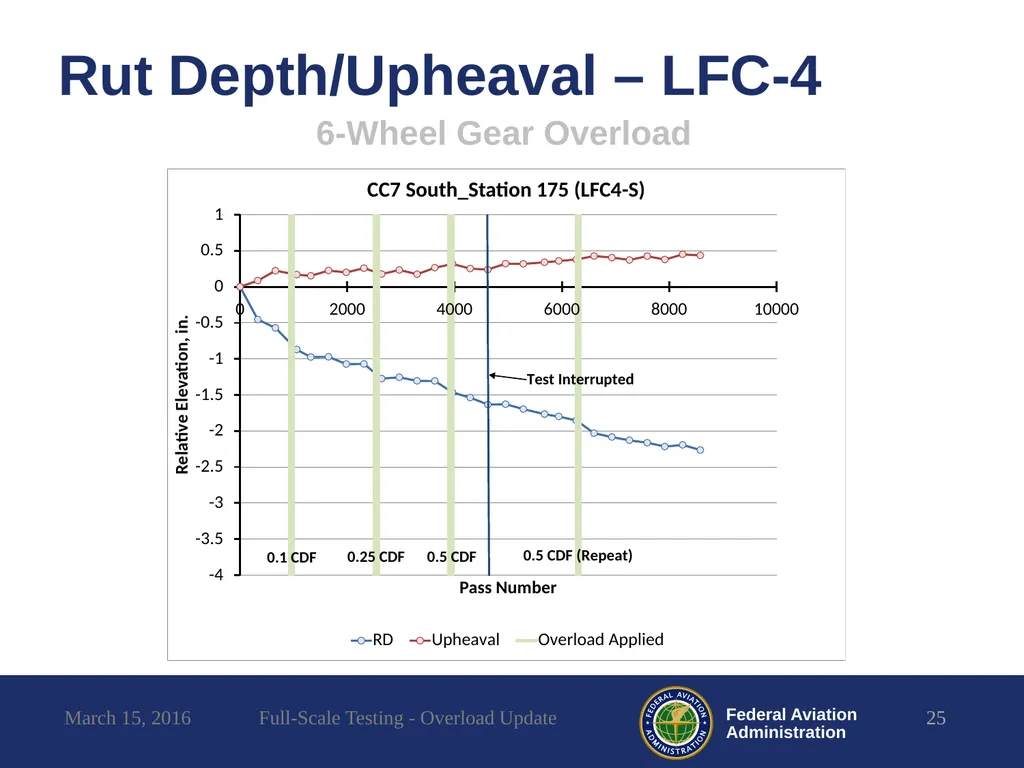
Rut Depth/Upheaval – LFC-4 March 15, 2016 Full-Scale Testing - Overload Update 25 6-Wheel Gear Overload<br>
26
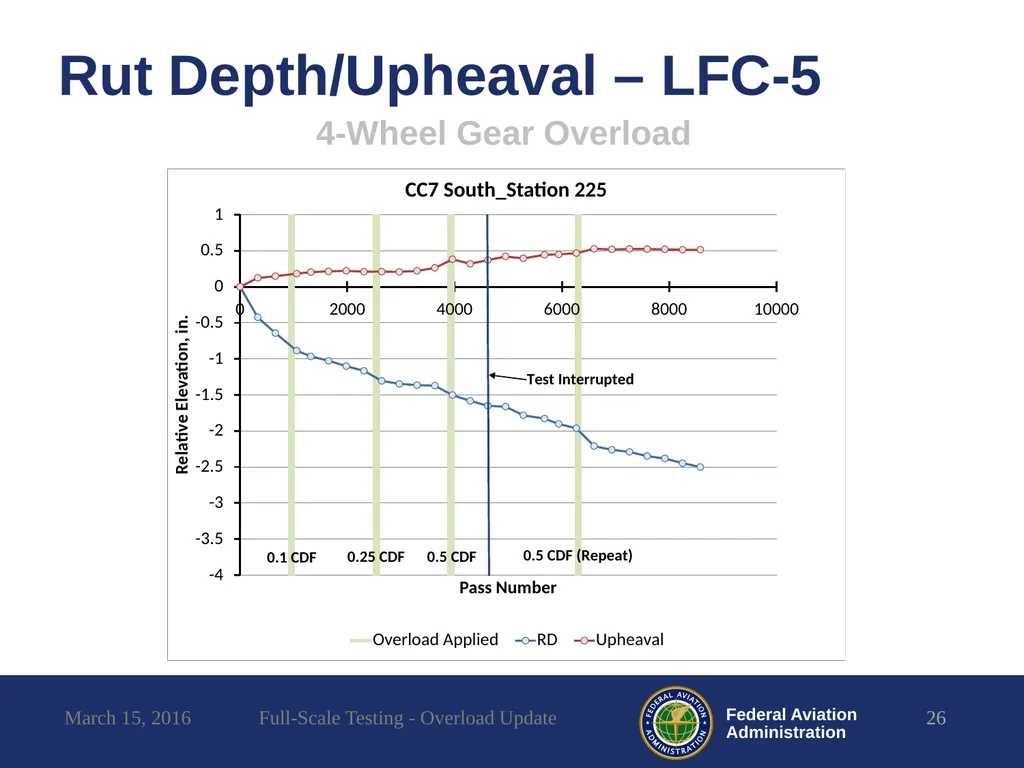
Rut Depth/Upheaval – LFC-5 March 15, 2016 Full-Scale Testing - Overload Update 26 4-Wheel Gear Overload<br>
27
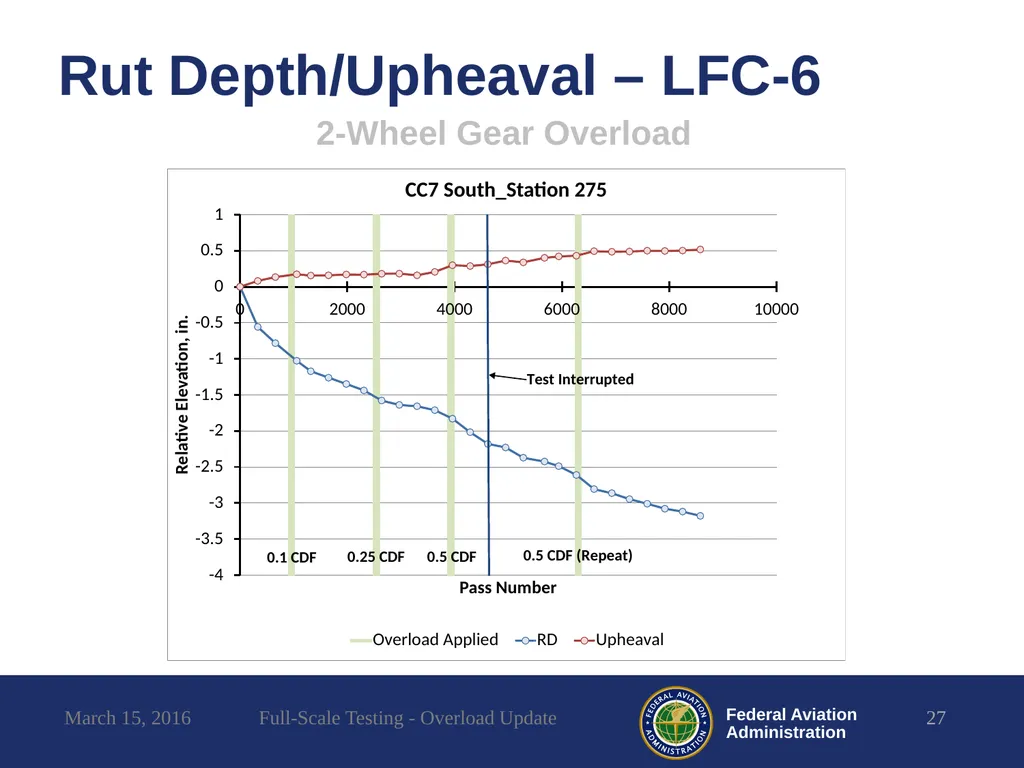
Rut Depth/Upheaval – LFC-6 March 15, 2016 Full-Scale Testing - Overload Update 27 2-Wheel Gear Overload<br>
28
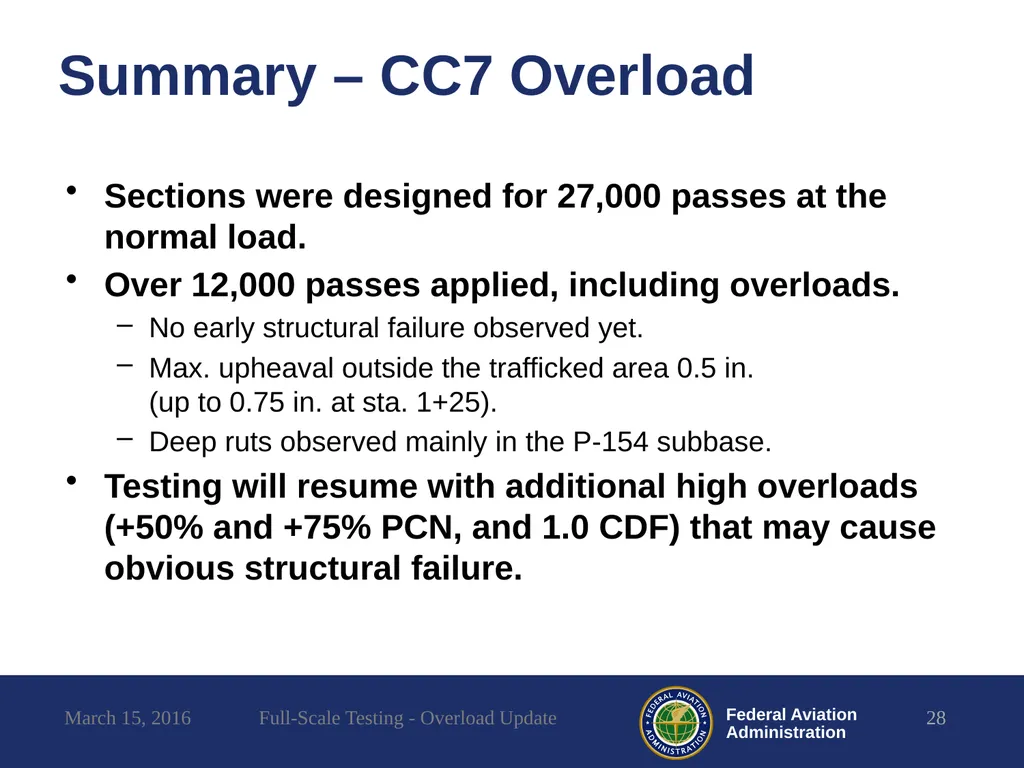
Summary – CC7 Overload Sections were designed for 27,000 passes at the normal load.
Over 12,000 passes applied, including overloads.
No early structural failure observed yet.
Max. upheaval outside the trafficked area 0.5 in. (up to 0.75 in. at sta. 1+25).
Deep ruts observed mainly in the P-154 subbase.
Testing will resume with additional high overloads (+50% and +75% PCN, and 1.0 CDF) that may cause obvious structural failure. March 15, 2016 Full-Scale Testing - Overload Update 28<br>
Over 12,000 passes applied, including overloads.
No early structural failure observed yet.
Max. upheaval outside the trafficked area 0.5 in. (up to 0.75 in. at sta. 1+25).
Deep ruts observed mainly in the P-154 subbase.
Testing will resume with additional high overloads (+50% and +75% PCN, and 1.0 CDF) that may cause obvious structural failure. March 15, 2016 Full-Scale Testing - Overload Update 28<br>