Noise Research Roadmap and Update REDAC EE Subcommittee Rebecca Cointin, Manager, AEE-100 August 6, 2015 Noise Goal Reduce the number of people exposed to significant noise around U.S. airports in absolute terms, notwithstanding aviation
Related Topics
Share
Embed code
Download this presentation From Below
"Noise Research Roadmap and Update REDAC – E&E" is the property of its rightful owner. Permission is granted to
download and print the materials on this website for personal, non-commercial use only, and to display it
on your personal computer provided you do not modify the materials and that you retain all copyright
notices contained in the materials. By downloading content from our website, you accept the terms of this
agreement.
Presentation Transcript
01
Noise Research Roadmap and Update REDAC – E&E Subcommittee Rebecca Cointin, Manager, AEE-100 August 6, 2015<br>
02
Noise Goal Reduce the number of people exposed to significant noise around U.S. airports in absolute terms, notwithstanding aviation growth, and provide additional measures to protect public health and welfare and our national resources.
Specifically, by 2018, have the U.S. population exposed to significant aircraft noise around airports have been reduced to less than 300,000 persons
Research is examining the appropriateness of the level of significance, potential for other metrics and evaluating the long-term goal 2<br>
03
Drivers of Research Observation:
Even though the number of people in the U.S. exposed to significant aircraft noise since 1975 has dropped by 95 percent, complaints, opposition and challenges continue to be an issue
Needs:
Gather data to determine if there has been a significant change in the public perception of noise
Gather supplemental data to develop strong scientific support for any policy decisions regarding aviation noise 3<br>
04
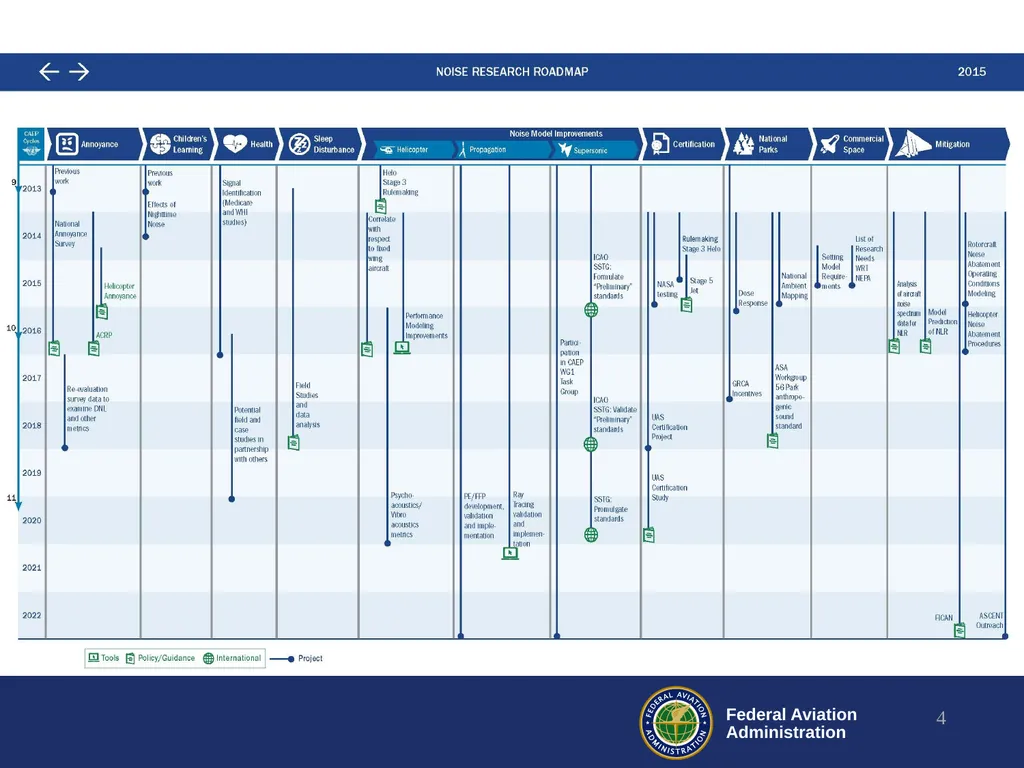
4<br>
05
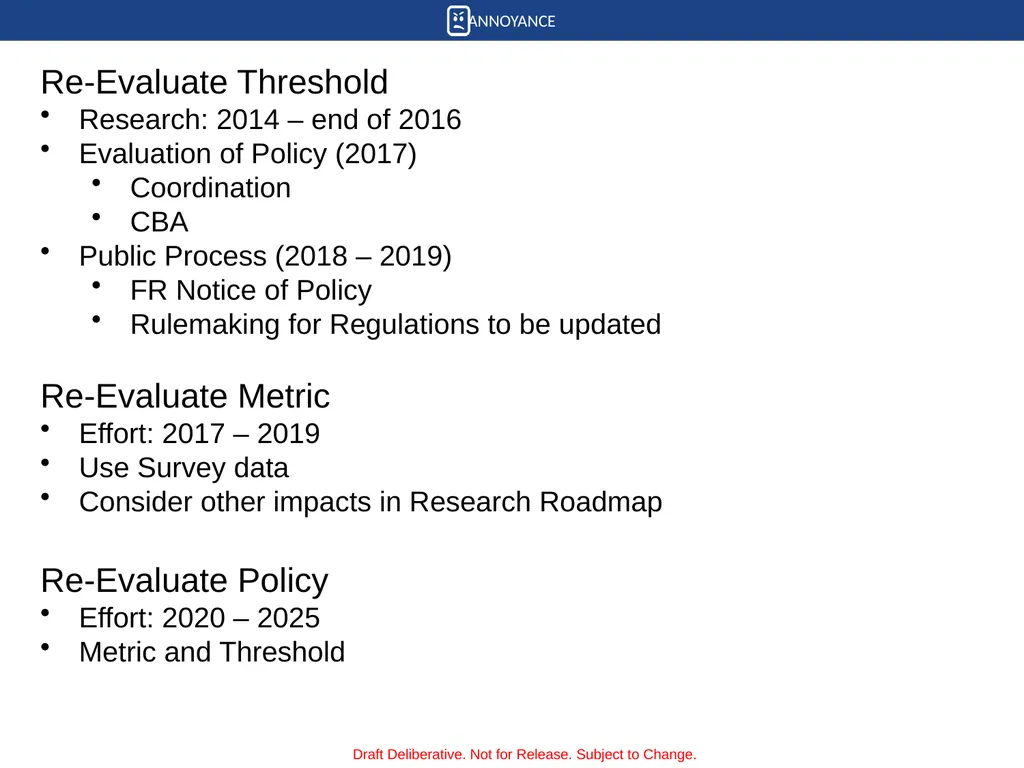
ANNOYANCE Draft Deliberative. Not for Release. Subject to Change. Re-Evaluate Threshold
Research: 2014 – end of 2016
Evaluation of Policy (2017)
Coordination
CBA
Public Process (2018 – 2019)
FR Notice of Policy
Rulemaking for Regulations to be updated
Re-Evaluate Metric
Effort: 2017 – 2019
Use Survey data
Consider other impacts in Research Roadmap
Re-Evaluate Policy
Effort: 2020 – 2025
Metric and Threshold<br>
06
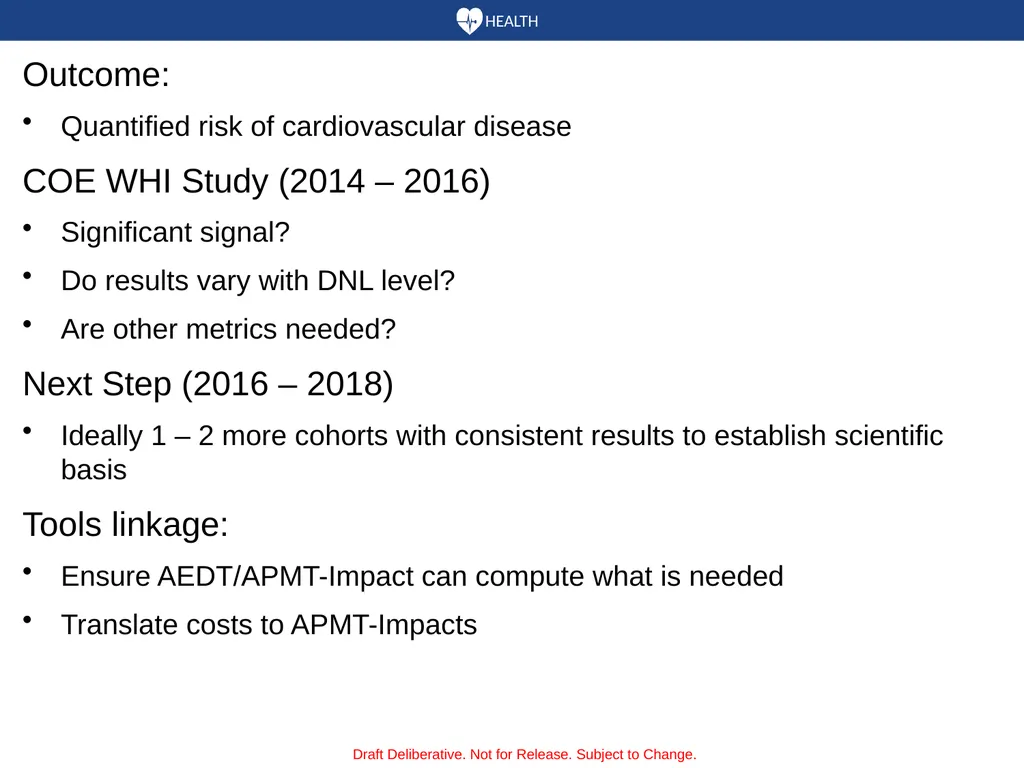
HEALTH Draft Deliberative. Not for Release. Subject to Change. Outcome:
Quantified risk of cardiovascular disease
COE WHI Study (2014 – 2016)
Significant signal?
Do results vary with DNL level?
Are other metrics needed?
Next Step (2016 – 2018)
Ideally 1 – 2 more cohorts with consistent results to establish scientific basis
Tools linkage:
Ensure AEDT/APMT-Impact can compute what is needed
Translate costs to APMT-Impacts<br>
07
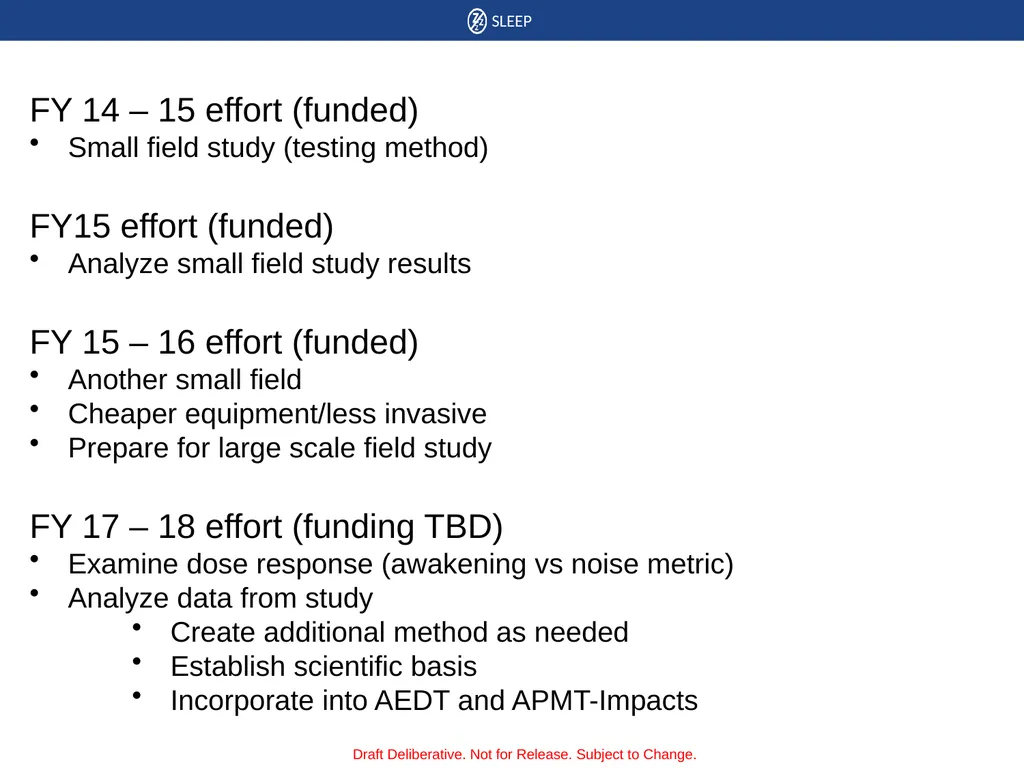
SLEEP Draft Deliberative. Not for Release. Subject to Change. FY 14 – 15 effort (funded)
Small field study (testing method)
FY15 effort (funded)
Analyze small field study results
FY 15 – 16 effort (funded)
Another small field
Cheaper equipment/less invasive
Prepare for large scale field study
FY 17 – 18 effort (funding TBD)
Examine dose response (awakening vs noise metric)
Analyze data from study
Create additional method as needed
Establish scientific basis
Incorporate into AEDT and APMT-Impacts<br>
08
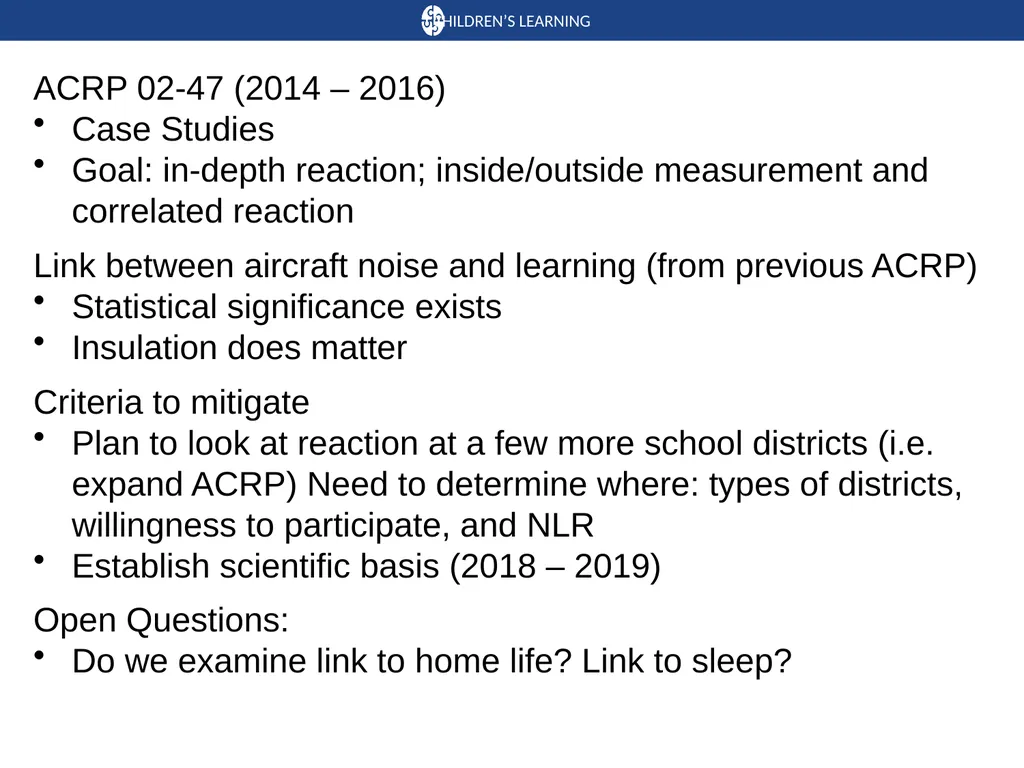
CHILDREN’S LEARNING ACRP 02-47 (2014 – 2016)
Case Studies
Goal: in-depth reaction; inside/outside measurement and correlated reaction
Link between aircraft noise and learning (from previous ACRP)
Statistical significance exists
Insulation does matter
Criteria to mitigate
Plan to look at reaction at a few more school districts (i.e. expand ACRP) Need to determine where: types of districts, willingness to participate, and NLR
Establish scientific basis (2018 – 2019)
Open Questions:
Do we examine link to home life? Link to sleep?<br>
09
Project Status Updates 9<br>
10
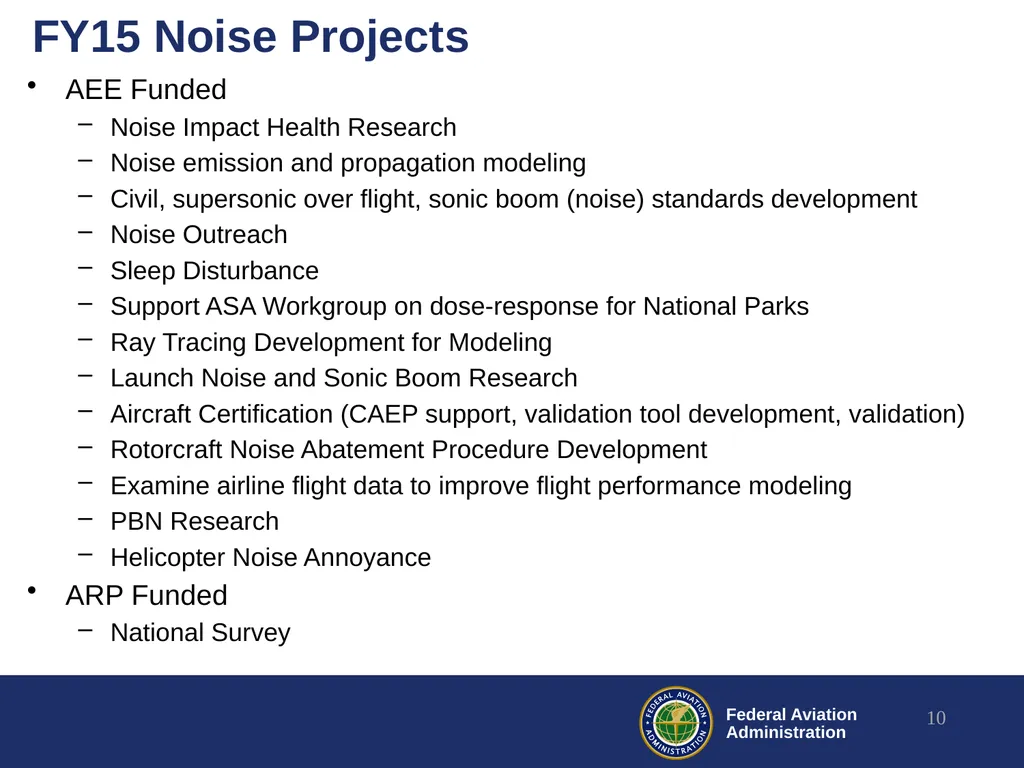
FY15 Noise Projects AEE Funded
Noise Impact Health Research
Noise emission and propagation modeling
Civil, supersonic over flight, sonic boom (noise) standards development
Noise Outreach
Sleep Disturbance
Support ASA Workgroup on dose-response for National Parks
Ray Tracing Development for Modeling
Launch Noise and Sonic Boom Research
Aircraft Certification (CAEP support, validation tool development, validation)
Rotorcraft Noise Abatement Procedure Development
Examine airline flight data to improve flight performance modeling
PBN Research
Helicopter Noise Annoyance
ARP Funded
National Survey 10<br>
11
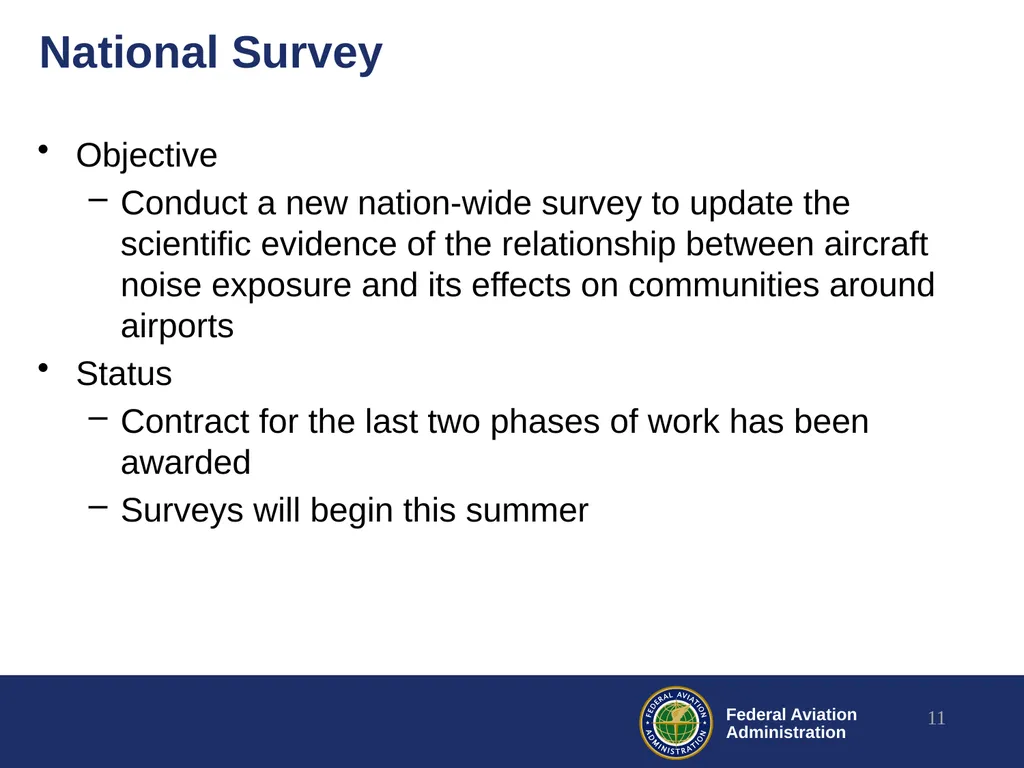
National Survey Objective
Conduct a new nation-wide survey to update the scientific evidence of the relationship between aircraft noise exposure and its effects on communities around airports
Status
Contract for the last two phases of work has been awarded
Surveys will begin this summer 11<br>
12
Performance Based Navigation Research Examining the effects of PBN procedures which may focus of noise on populations
Research on Metrics just kicked off
Compute multiple metrics to determine the best metrics that correlate the effects of PBN procedures with public perception
Goal: Identify potential supplemental metrics for PBN analysis
Project team includes members of AJV-114 (part of ATO) 12<br>
13
Impacts Research Health
Working with the Women’s Health Initiative Database
Noise data for certain individuals around airports in the database from 2000 – 2014 will be provided to the team
Analysis of potential health impacts will begin once noise data is provided to the team
Sleep
Finishing pilot study around single US airport
Beginning to explore another pilot study with a methodology aimed to be less invasive (mailing of equipment and self-administered) 13<br>
14
Helicopter Projects Rotorcraft Noise Abatement Procedure Development
Successful integration of noise prediction code, rotor loads and wake prediction model, and flight control model
System validated using Bell 430 flight test data - good agreement
Predictions have been made for various flight conditions: altitudes, airspeeds, and climb/descent slopes
Helicopter Noise Annoyance
Test plan was developed to conduct a helicopter noise annoyance survey in the LA basis, which included development of a Smart Phone App to log complaints and selection of volunteers for the test
Testing occurred with five volunteers for ten days with monitoring
Goals:
Test whether these subject reactions and noise levels can be accurately collected and combined into a useful database.
Use the database to test whether some noise measures other than the ones now commonly used to assess fixed wing noise annoyance should be considered for predicting helicopter. 14<br>
15
Noise Complaint Initiative Representatives from across the lines of business and staff offices
Two Goals:
Identify a consistent agency-wide process for addressing noise complaints
Identify actions the FAA might take to better address the underlying issues raised by the complaints, including increased community engagement and further minimizing noise impacts where possible
Team recommendations are being finalized and will be presented to FAA executives in the Fall 15<br>
16
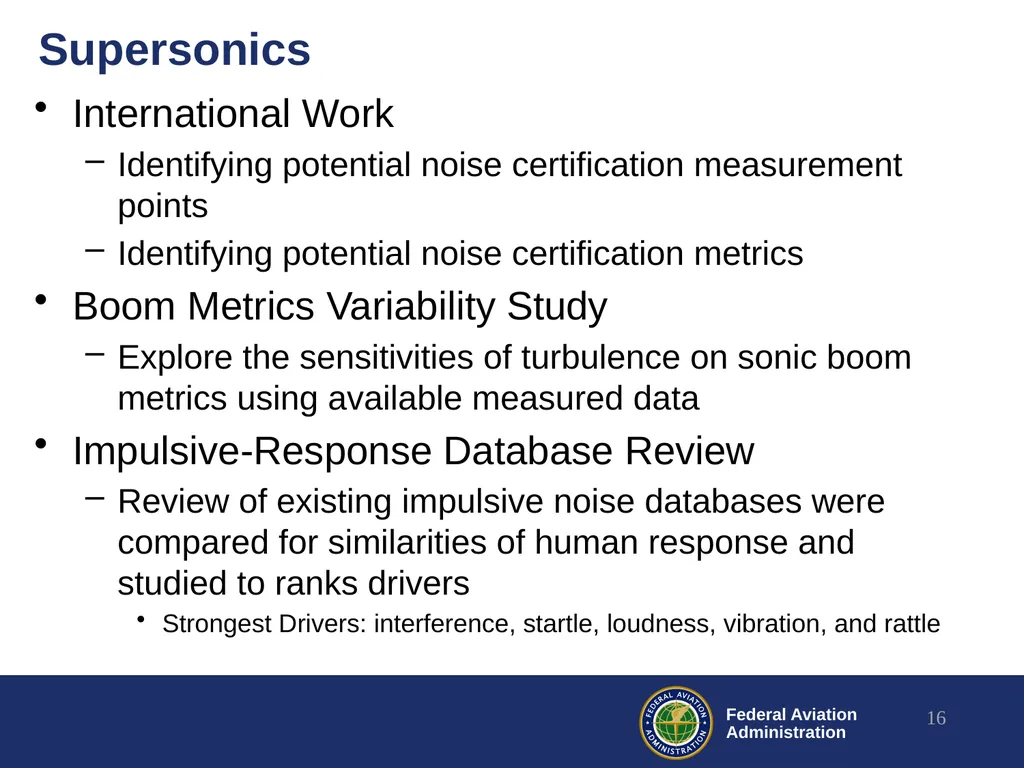
Supersonics International Work
Identifying potential noise certification measurement points
Identifying potential noise certification metrics
Boom Metrics Variability Study
Explore the sensitivities of turbulence on sonic boom metrics using available measured data
Impulsive-Response Database Review
Review of existing impulsive noise databases were compared for similarities of human response and studied to ranks drivers
Strongest Drivers: interference, startle, loudness, vibration, and rattle 16<br>
17
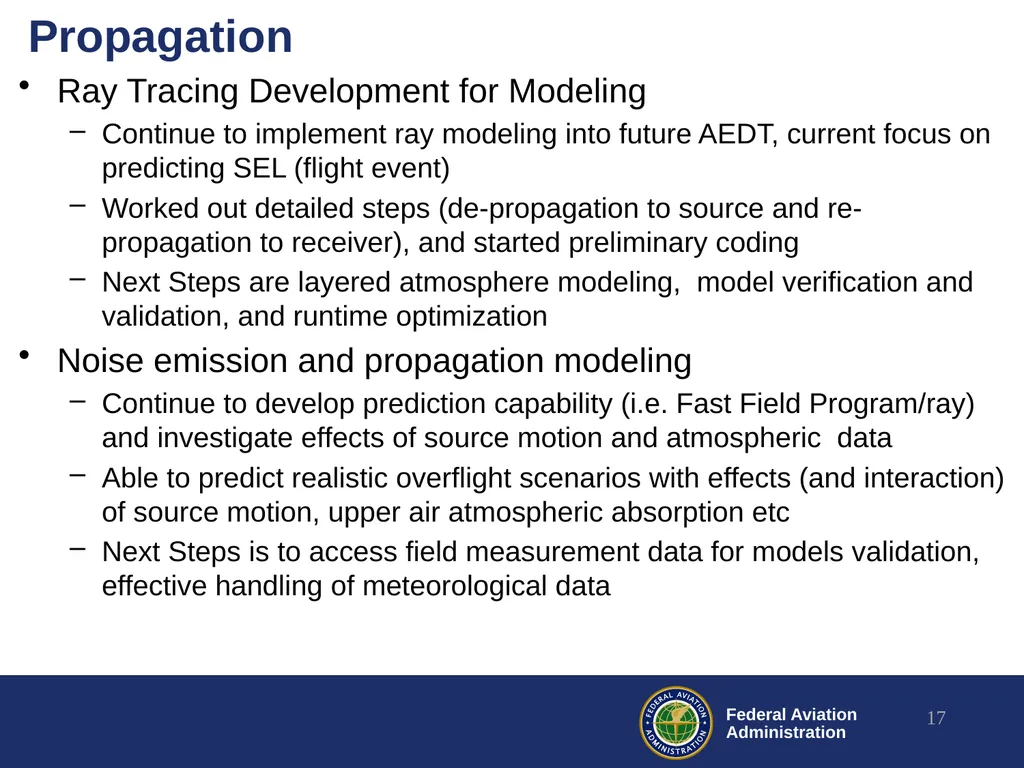
Propagation Ray Tracing Development for Modeling
Continue to implement ray modeling into future AEDT, current focus on predicting SEL (flight event)
Worked out detailed steps (de-propagation to source and re-propagation to receiver), and started preliminary coding
Next Steps are layered atmosphere modeling, model verification and validation, and runtime optimization
Noise emission and propagation modeling
Continue to develop prediction capability (i.e. Fast Field Program/ray) and investigate effects of source motion and atmospheric data
Able to predict realistic overflight scenarios with effects (and interaction) of source motion, upper air atmospheric absorption etc
Next Steps is to access field measurement data for models validation, effective handling of meteorological data 17<br>