
Functional Grammar Al-Mustansiriya University
EM
Published · 20 slides · 0 views

1 / 1

Description
Functional Grammar Al-Mustansiriya University College of Arts Department of Translation M.A. Degree Studies Course tutor: Prof. Ahmed Qadoury Abed Ph. D Prepared by: Ibraheem Yousif Introduction We use language in everyday life interaction
Related Topics
Share
Embed code
Download this presentation From Below
"Functional Grammar Al-Mustansiriya University" is the property of its rightful owner. Permission is granted to download and print the materials on this website for personal, non-commercial use only, and to display it on your personal computer provided you do not modify the materials and that you retain all copyright notices contained in the materials. By downloading content from our website, you accept the terms of this agreement.
Presentation Transcript
01
Functional Grammar Al-Mustansiriya University
College of Arts
Department of Translation
M.A. Degree Studies Course tutor: Prof. Ahmed Qadoury Abed Ph. D
Prepared by: Ibraheem Yousif<br>
College of Arts
Department of Translation
M.A. Degree Studies Course tutor: Prof. Ahmed Qadoury Abed Ph. D
Prepared by: Ibraheem Yousif<br>
02
Introduction
We use language in everyday life interaction we chat with family members read a booklet surf the internet, talk to our pets, write our diaries, song, work online and send e-mails…etc.
In contemporary life we are required to produce bits of languages or negotiate texts.
Systemic Functional Linguistics
- In the 20th C, main focus of theorists was towards texts.
- How do texts work on us?
- How do we produce texts?
- How texts have different meaning to different readers?
- How do culture and texts interact?
Literary theory and cultural studies answered such questions<br>
03
Systemic linguists advanced four main theoretical claims about language:
1. language use is functional
2. its function is to make meanings
3. these meanings are influenced by the social and cultural context in which they are exchanged
4. the process of using language is a semiotic process, a process of making meanings by choosing.
In the 1990s discourse analysis came to prominence in translation studies.
While text analysis normally concentrates on describing the way in which texts are organized (sentence structure, cohesion, etc.), discourse analysis looks at the way language communicates meaning and social and power relations.
The model of discourse analysis that has had the greatest influence is Halliday's systemic functional model.<br>
04
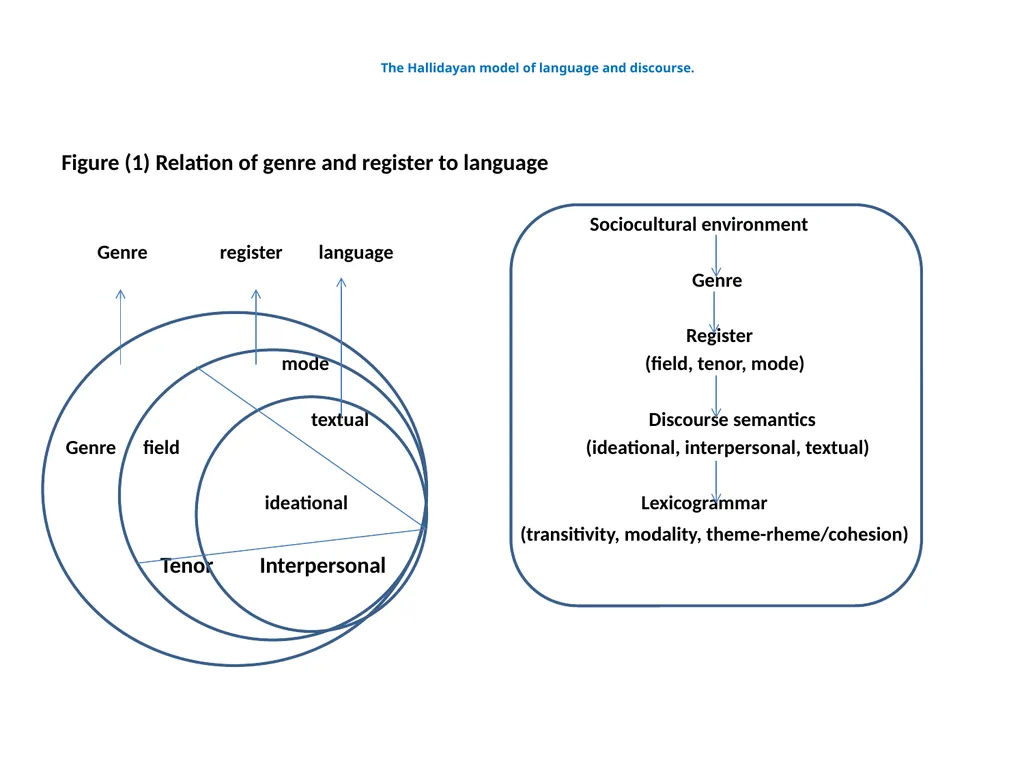
The Hallidayan model of language and discourse. Figure (1) Relation of genre and register to language
Sociocultural environment
Genre register language
Genre
Register
mode (field, tenor, mode)
textual Discourse semantics
Genre field (ideational, interpersonal, textual)
ideational Lexicogrammar
(transitivity, modality, theme-rheme/cohesion)
Tenor Interpersonal<br>
Sociocultural environment
Genre register language
Genre
Register
mode (field, tenor, mode)
textual Discourse semantics
Genre field (ideational, interpersonal, textual)
ideational Lexicogrammar
(transitivity, modality, theme-rheme/cohesion)
Tenor Interpersonal<br>
05
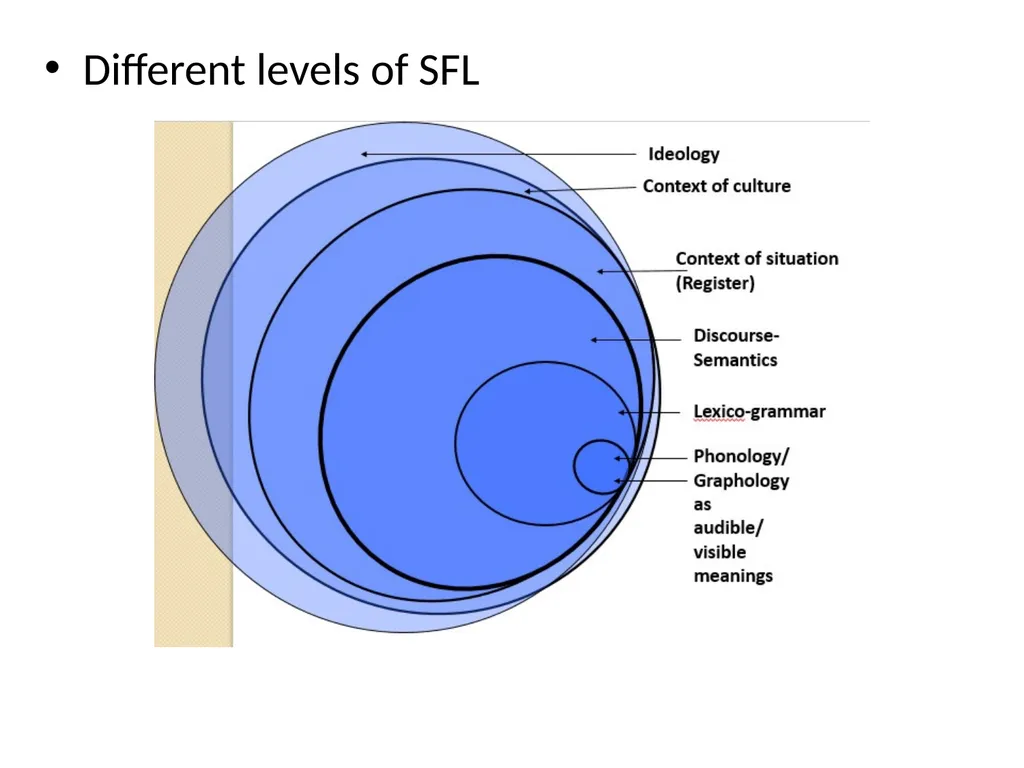
Different levels of SFL<br>
06
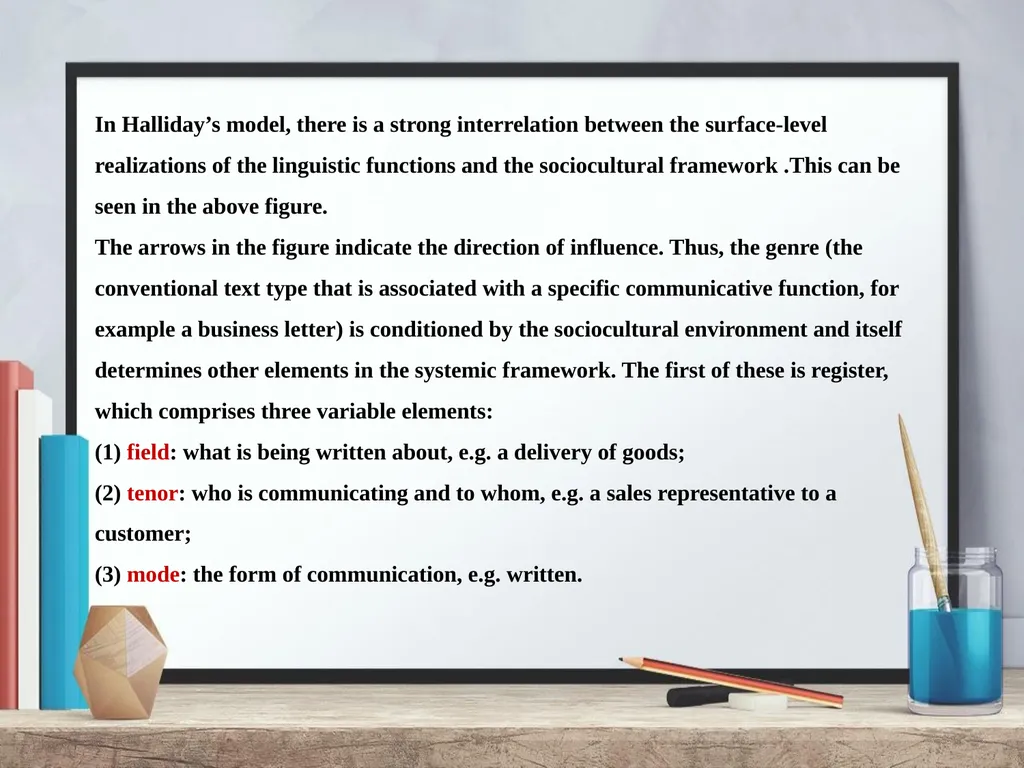
In Halliday’s model, there is a strong interrelation between the surface-level realizations of the linguistic functions and the sociocultural framework .This can be seen in the above figure.
The arrows in the figure indicate the direction of influence. Thus, the genre (the conventional text type that is associated with a specific communicative function, for example a business letter) is conditioned by the sociocultural environment and itself determines other elements in the systemic framework. The first of these is register, which comprises three variable elements:
(1) field: what is being written about, e.g. a delivery of goods;
(2) tenor: who is communicating and to whom, e.g. a sales representative to a customer;
(3) mode: the form of communication, e.g. written.<br>
07
Theme/rheme and functional sentence perspective The semantic organization of the sentence or clause into two parts, the 'theme' (what we are talking about) and the 'rheme ' (what we say about the theme), would seem to be a matter of common sense. However, this notion of 'new' versus' old' (or 'given ' as it is also called) is rather less obvious than it appears. As Diller and Kornelius (1978 :50-51) point out, deciding precisely what is new information in a sentence by looking at a statement (Cain killed Abel) and asking a question (Who does Cain kill?) falls foul of a simple fact: we could also have asked What does Cain do to Abel?, What does Cain do?, or Who killed Abel?
Theme-Rheme has also been explained as Topic -Comment. Theme is
what we are talking about (topic) and Rheme is what we are saying about it (comment). 7<br>
Theme-Rheme has also been explained as Topic -Comment. Theme is
what we are talking about (topic) and Rheme is what we are saying about it (comment). 7<br>
08
Although the concepts of theme and Rheme are useful to translators, more useful still is being able to interpret the reasons why things are put where they are in the sentence (focus, emphasis, contrast, presupposed knowledge, narrative presentation, sentence rhythm, etc.) and the various means for achieving those effects in the target language. Equally useful is the ability to decide whether or not, in a given translation situation, such things are worth attention. 8<br>
09
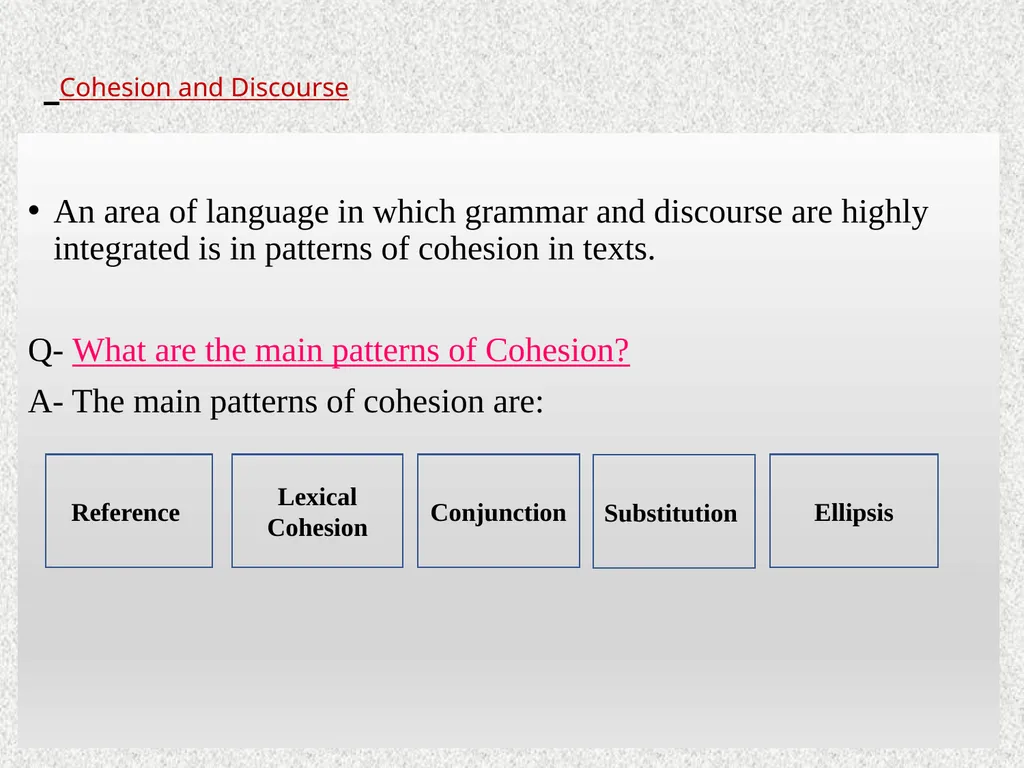
Cohesion and Discourse An area of language in which grammar and discourse are highly integrated is in patterns of cohesion in texts.
Q- What are the main patterns of Cohesion?
A- The main patterns of cohesion are: Reference Lexical Cohesion Conjunction Substitution Ellipsis<br>
Q- What are the main patterns of Cohesion?
A- The main patterns of cohesion are: Reference Lexical Cohesion Conjunction Substitution Ellipsis<br>
10
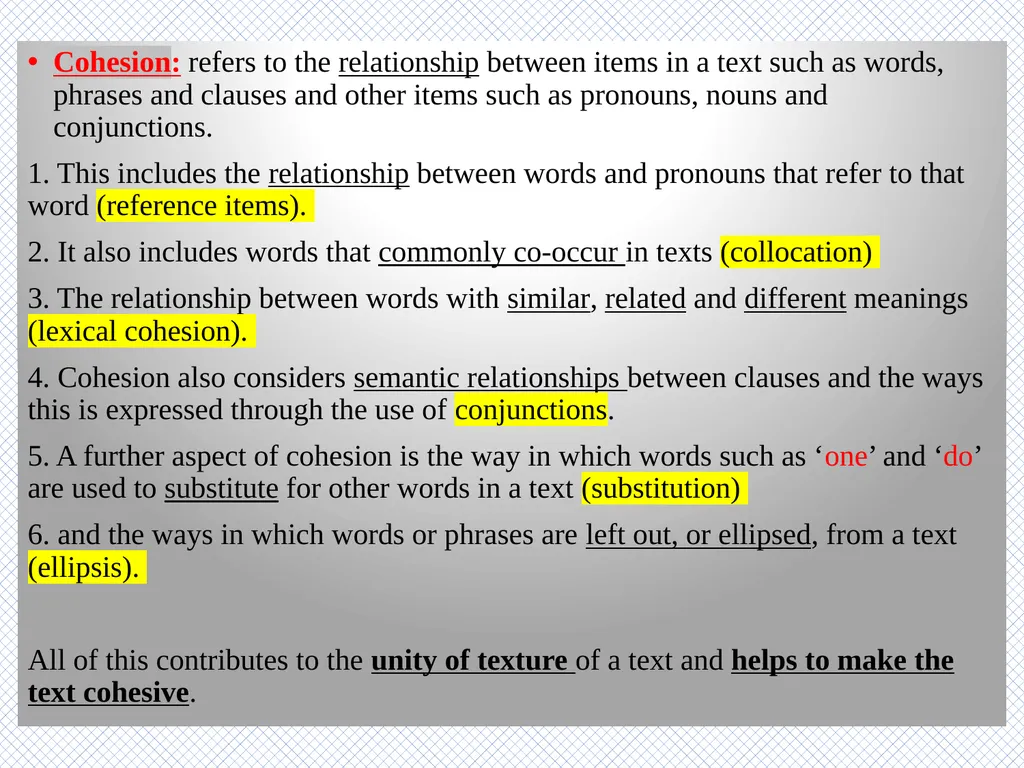
Cohesion: refers to the relationship between items in a text such as words, phrases and clauses and other items such as pronouns, nouns and conjunctions.
1. This includes the relationship between words and pronouns that refer to that word (reference items).
2. It also includes words that commonly co-occur in texts (collocation)
3. The relationship between words with similar, related and different meanings (lexical cohesion).
4. Cohesion also considers semantic relationships between clauses and the ways this is expressed through the use of conjunctions.
5. A further aspect of cohesion is the way in which words such as ‘one’ and ‘do’ are used to substitute for other words in a text (substitution)
6. and the ways in which words or phrases are left out, or ellipsed, from a text (ellipsis).
All of this contributes to the unity of texture of a text and helps to make the text cohesive.<br>
1. This includes the relationship between words and pronouns that refer to that word (reference items).
2. It also includes words that commonly co-occur in texts (collocation)
3. The relationship between words with similar, related and different meanings (lexical cohesion).
4. Cohesion also considers semantic relationships between clauses and the ways this is expressed through the use of conjunctions.
5. A further aspect of cohesion is the way in which words such as ‘one’ and ‘do’ are used to substitute for other words in a text (substitution)
6. and the ways in which words or phrases are left out, or ellipsed, from a text (ellipsis).
All of this contributes to the unity of texture of a text and helps to make the text cohesive.<br>
11
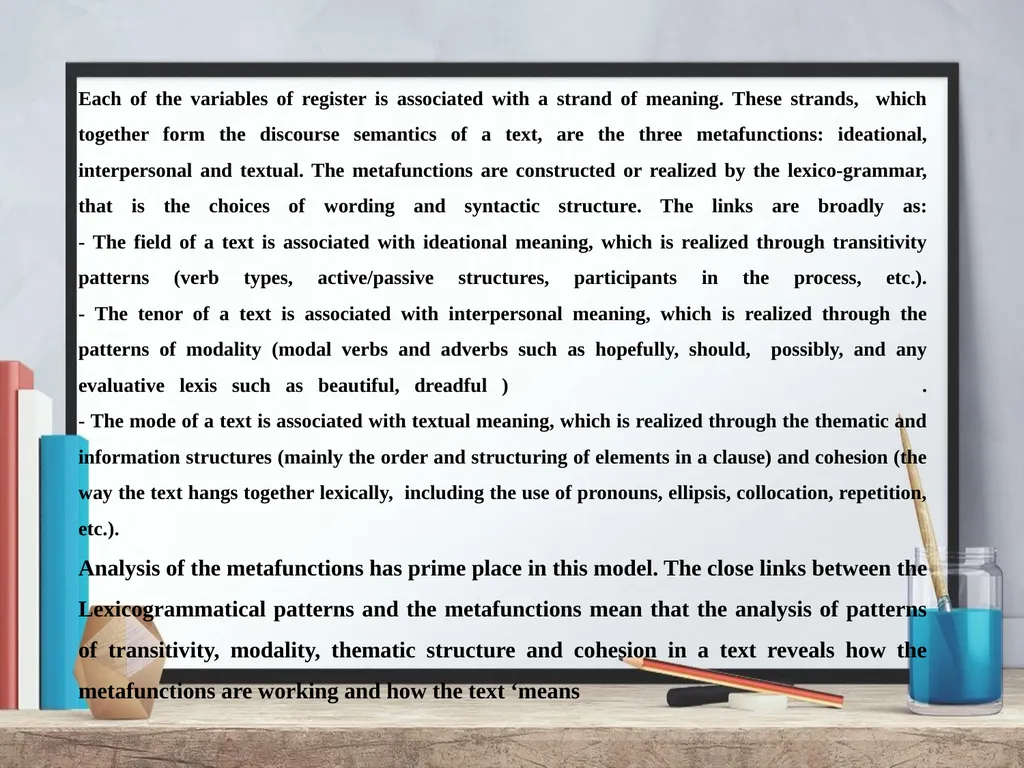
Each of the variables of register is associated with a strand of meaning. These strands, which together form the discourse semantics of a text, are the three metafunctions: ideational, interpersonal and textual. The metafunctions are constructed or realized by the lexico-grammar, that is the choices of wording and syntactic structure. The links are broadly as:
- The field of a text is associated with ideational meaning, which is realized through transitivity patterns (verb types, active/passive structures, participants in the process, etc.).
- The tenor of a text is associated with interpersonal meaning, which is realized through the patterns of modality (modal verbs and adverbs such as hopefully, should, possibly, and any evaluative lexis such as beautiful, dreadful ) .
- The mode of a text is associated with textual meaning, which is realized through the thematic and information structures (mainly the order and structuring of elements in a clause) and cohesion (the way the text hangs together lexically, including the use of pronouns, ellipsis, collocation, repetition, etc.).
Analysis of the metafunctions has prime place in this model. The close links between the Lexicogrammatical patterns and the metafunctions mean that the analysis of patterns of transitivity, modality, thematic structure and cohesion in a text reveals how the metafunctions are working and how the text ‘means<br>
12
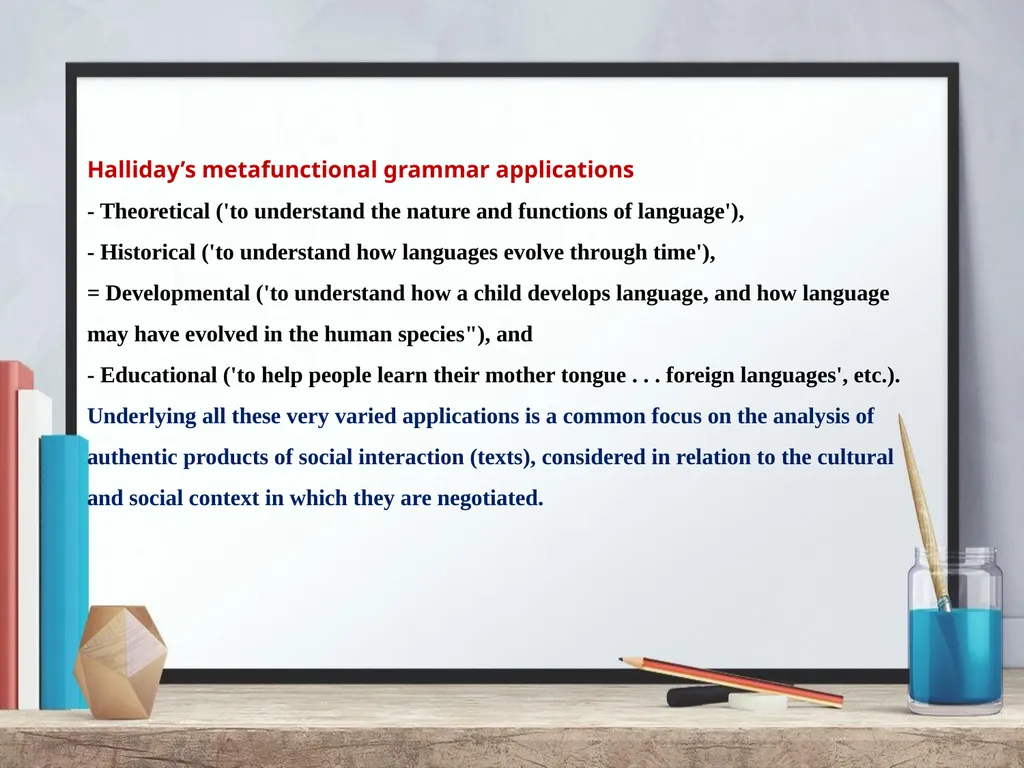
Halliday’s metafunctional grammar applications
- Theoretical ('to understand the nature and functions of language'),
- Historical ('to understand how languages evolve through time'),
= Developmental ('to understand how a child develops language, and how language may have evolved in the human species"), and
- Educational ('to help people learn their mother tongue . . . foreign languages', etc.).
Underlying all these very varied applications is a common focus on the analysis of authentic products of social interaction (texts), considered in relation to the cultural and social context in which they are negotiated.<br>
13
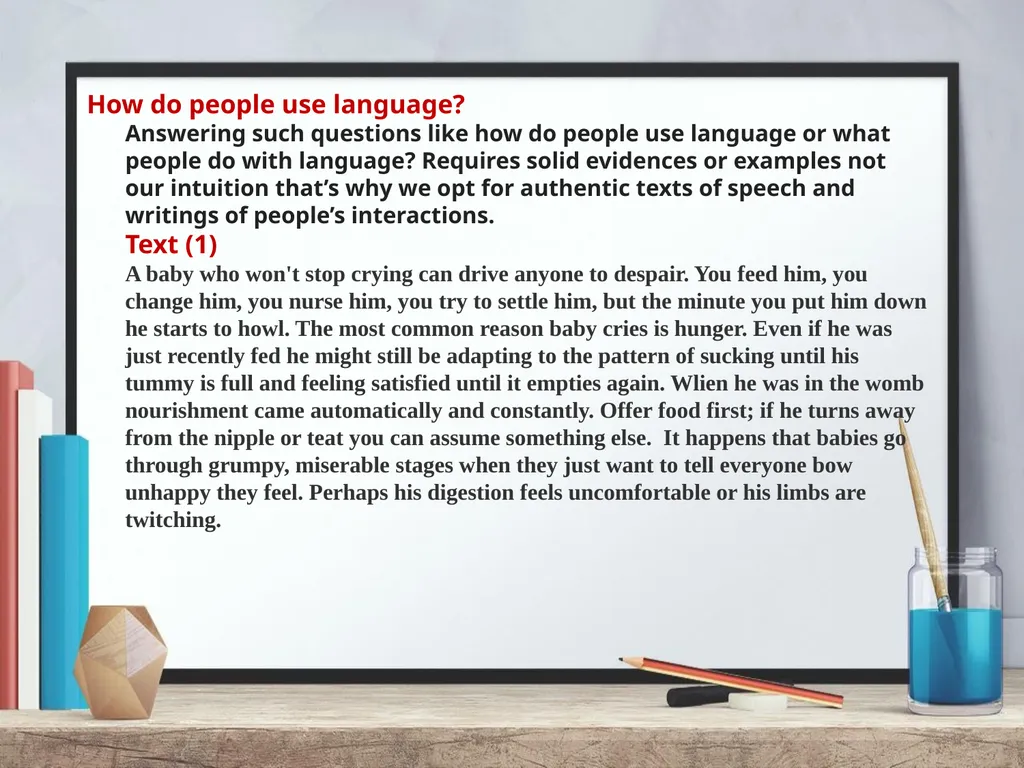
How do people use language?
Answering such questions like how do people use language or what people do with language? Requires solid evidences or examples not our intuition that’s why we opt for authentic texts of speech and writings of people’s interactions.
Text (1)
A baby who won't stop crying can drive anyone to despair. You feed him, you change him, you nurse him, you try to settle him, but the minute you put him down he starts to howl. The most common reason baby cries is hunger. Even if he was just recently fed he might still be adapting to the pattern of sucking until his tummy is full and feeling satisfied until it empties again. Wlien he was in the womb nourishment came automatically and constantly. Offer food first; if he turns away from the nipple or teat you can assume something else. It happens that babies go through grumpy, miserable stages when they just want to tell everyone bow unhappy they feel. Perhaps his digestion feels uncomfortable or his limbs are twitching.<br>
14
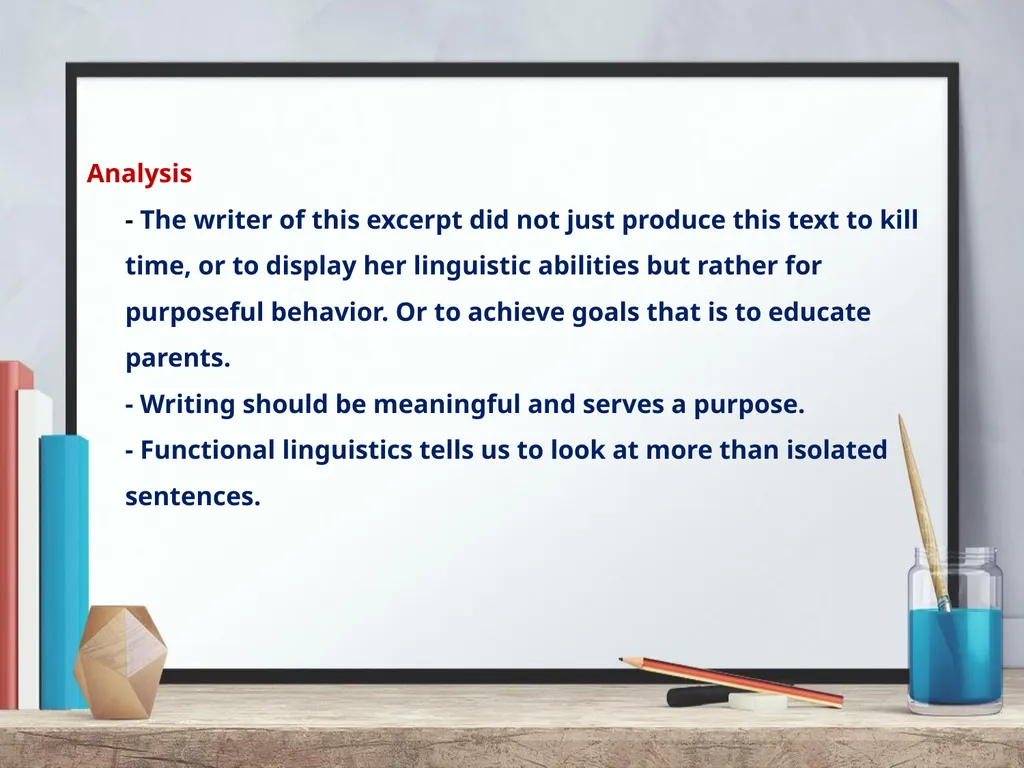
Analysis
- The writer of this excerpt did not just produce this text to kill time, or to display her linguistic abilities but rather for purposeful behavior. Or to achieve goals that is to educate parents.
- Writing should be meaningful and serves a purpose.
- Functional linguistics tells us to look at more than isolated sentences.<br>
15
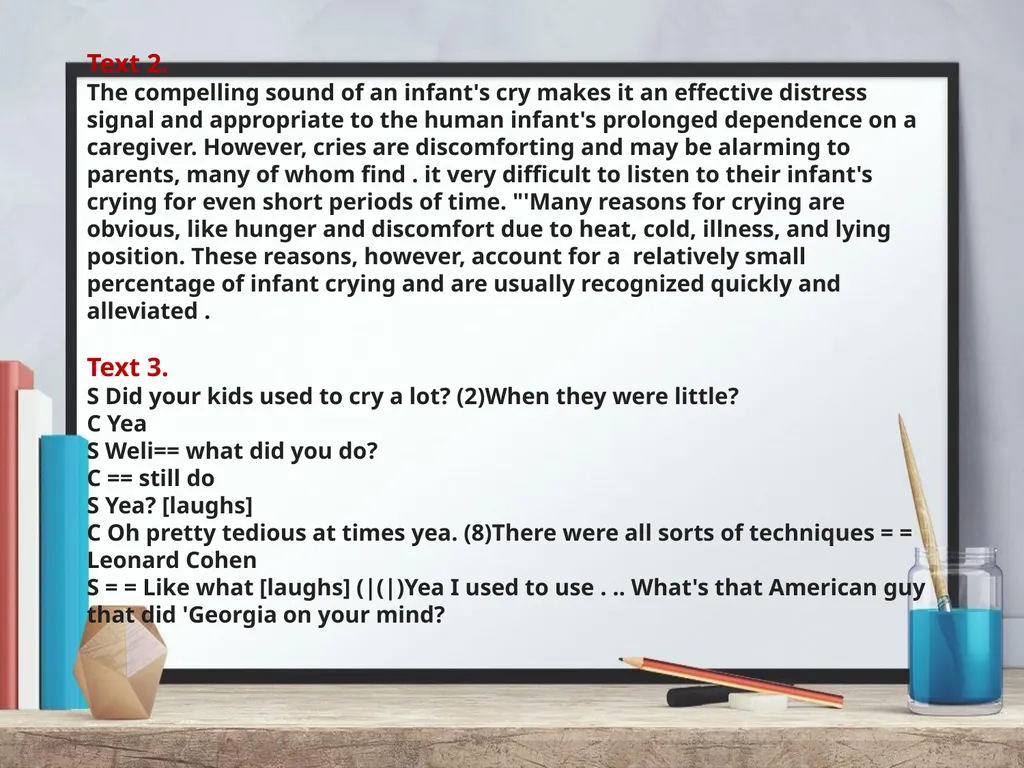
Text 2.
The compelling sound of an infant's cry makes it an effective distress signal and appropriate to the human infant's prolonged dependence on a caregiver. However, cries are discomforting and may be alarming to parents, many of whom find . it very difficult to listen to their infant's crying for even short periods of time. "'Many reasons for crying are obvious, like hunger and discomfort due to heat, cold, illness, and lying position. These reasons, however, account for a relatively small percentage of infant crying and are usually recognized quickly and alleviated .
Text 3.
S Did your kids used to cry a lot? (2)When they were little?
C Yea
S Weli== what did you do?
C == still do
S Yea? [laughs]
C Oh pretty tedious at times yea. (8)There were all sorts of techniques = = Leonard Cohen
S = = Like what [laughs] (|(|)Yea I used to use . .. What's that American guy that did 'Georgia on your mind?<br>
16
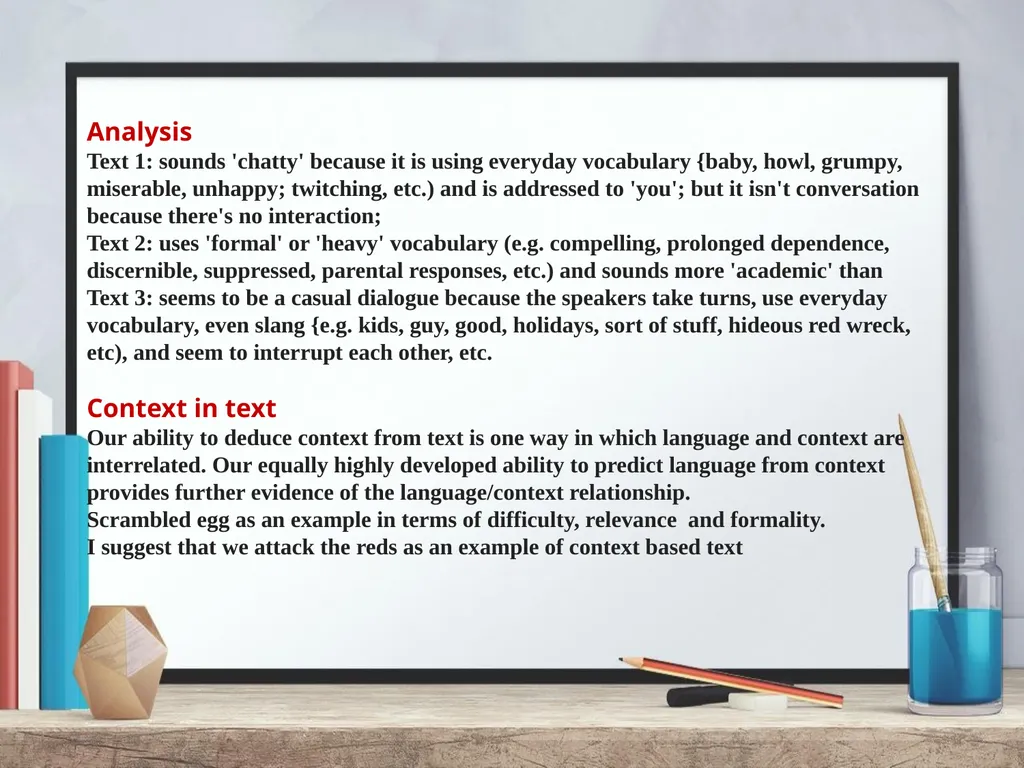
Analysis
Text 1: sounds 'chatty' because it is using everyday vocabulary {baby, howl, grumpy, miserable, unhappy; twitching, etc.) and is addressed to 'you'; but it isn't conversation because there's no interaction;
Text 2: uses 'formal' or 'heavy' vocabulary (e.g. compelling, prolonged dependence, discernible, suppressed, parental responses, etc.) and sounds more 'academic' than Text 3: seems to be a casual dialogue because the speakers take turns, use everyday vocabulary, even slang {e.g. kids, guy, good, holidays, sort of stuff, hideous red wreck, etc), and seem to interrupt each other, etc.
Context in text
Our ability to deduce context from text is one way in which language and context are interrelated. Our equally highly developed ability to predict language from context provides further evidence of the language/context relationship.
Scrambled egg as an example in terms of difficulty, relevance and formality.
I suggest that we attack the reds as an example of context based text<br>
17
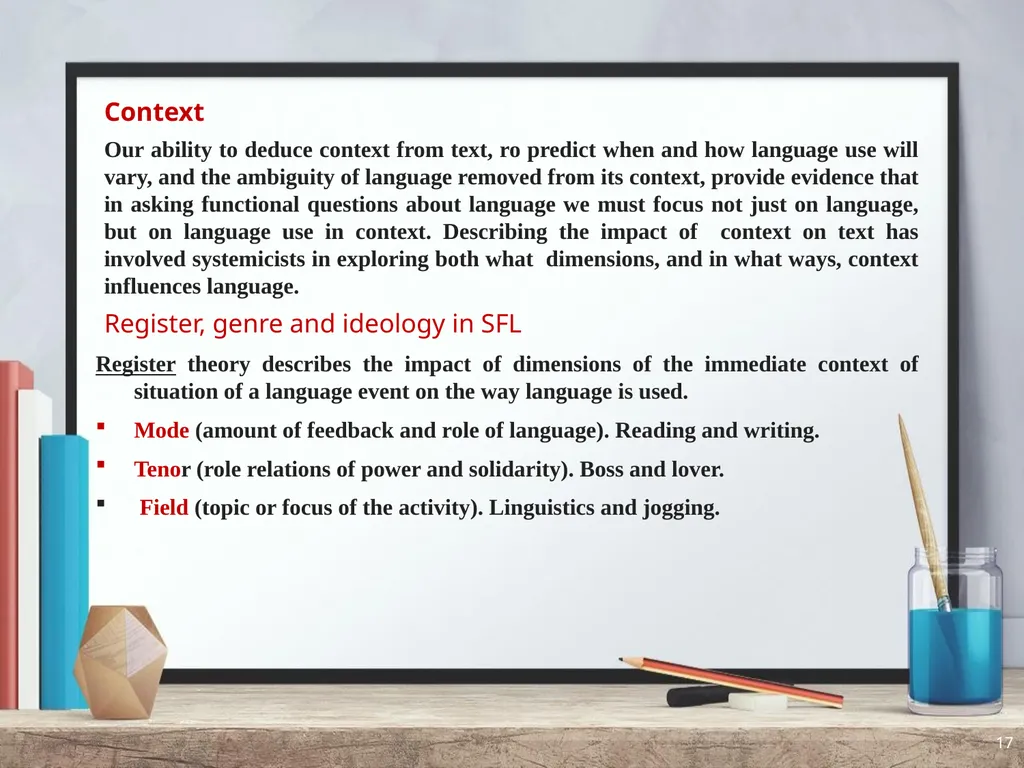
Context
Our ability to deduce context from text, ro predict when and how language use will vary, and the ambiguity of language removed from its context, provide evidence that in asking functional questions about language we must focus not just on language, but on language use in context. Describing the impact of context on text has involved systemicists in exploring both what dimensions, and in what ways, context influences language.
Register, genre and ideology in SFL
Register theory describes the impact of dimensions of the immediate context of situation of a language event on the way language is used.
Mode (amount of feedback and role of language). Reading and writing.
Tenor (role relations of power and solidarity). Boss and lover.
Field (topic or focus of the activity). Linguistics and jogging. 17<br>
Our ability to deduce context from text, ro predict when and how language use will vary, and the ambiguity of language removed from its context, provide evidence that in asking functional questions about language we must focus not just on language, but on language use in context. Describing the impact of context on text has involved systemicists in exploring both what dimensions, and in what ways, context influences language.
Register, genre and ideology in SFL
Register theory describes the impact of dimensions of the immediate context of situation of a language event on the way language is used.
Mode (amount of feedback and role of language). Reading and writing.
Tenor (role relations of power and solidarity). Boss and lover.
Field (topic or focus of the activity). Linguistics and jogging. 17<br>
18
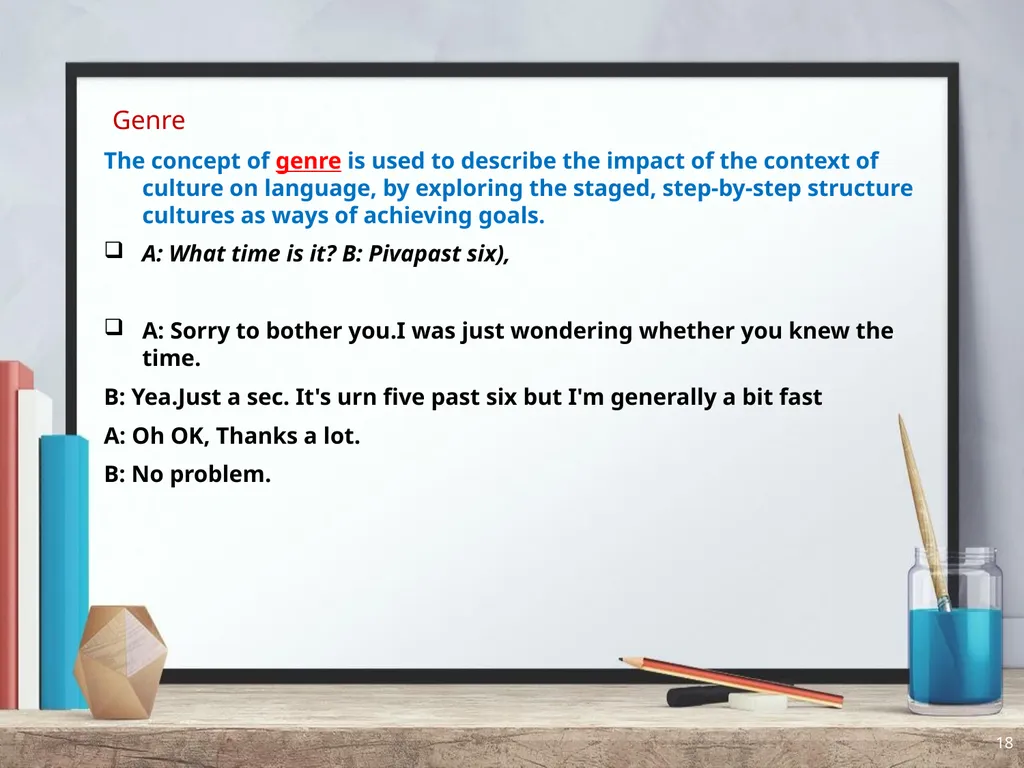
Genre
The concept of genre is used to describe the impact of the context of culture on language, by exploring the staged, step-by-step structure cultures as ways of achieving goals.
A: What time is it? B: Pivapast six),
A: Sorry to bother you.I was just wondering whether you knew the time.
B: Yea.Just a sec. It's urn five past six but I'm generally a bit fast
A: Oh OK, Thanks a lot.
B: No problem. 18<br>
The concept of genre is used to describe the impact of the context of culture on language, by exploring the staged, step-by-step structure cultures as ways of achieving goals.
A: What time is it? B: Pivapast six),
A: Sorry to bother you.I was just wondering whether you knew the time.
B: Yea.Just a sec. It's urn five past six but I'm generally a bit fast
A: Oh OK, Thanks a lot.
B: No problem. 18<br>
19
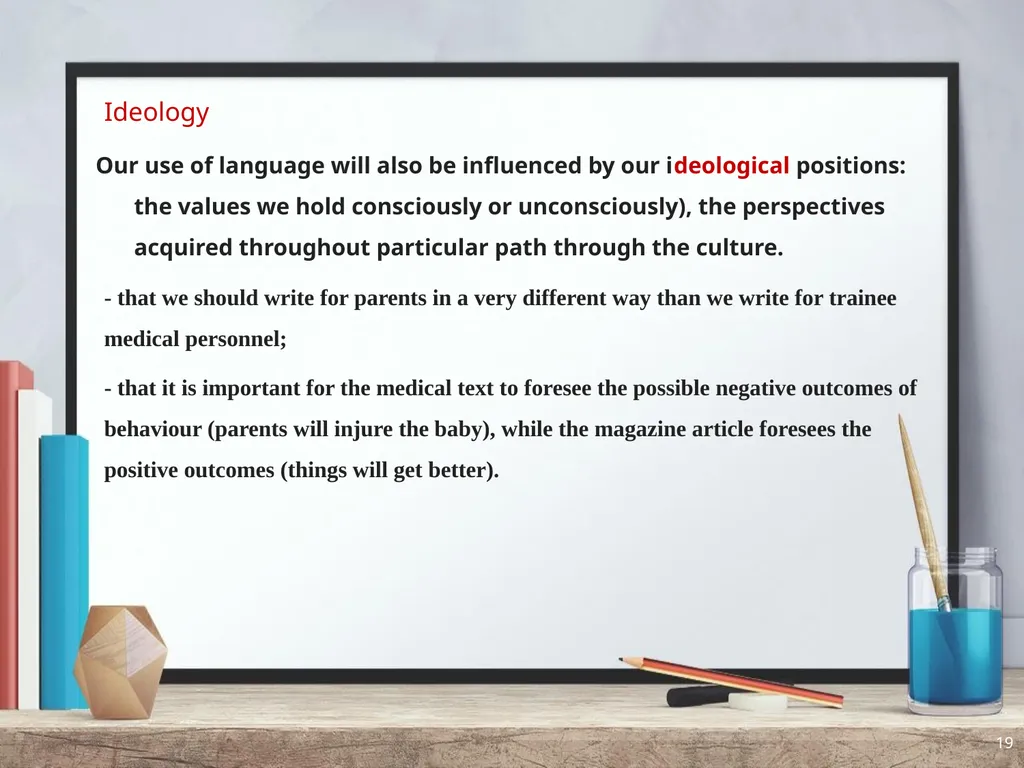
Ideology
Our use of language will also be influenced by our ideological positions: the values we hold consciously or unconsciously), the perspectives acquired throughout particular path through the culture.
- that we should write for parents in a very different way than we write for trainee medical personnel;
- that it is important for the medical text to foresee the possible negative outcomes of behaviour (parents will injure the baby), while the magazine article foresees the positive outcomes (things will get better). 19<br>
Our use of language will also be influenced by our ideological positions: the values we hold consciously or unconsciously), the perspectives acquired throughout particular path through the culture.
- that we should write for parents in a very different way than we write for trainee medical personnel;
- that it is important for the medical text to foresee the possible negative outcomes of behaviour (parents will injure the baby), while the magazine article foresees the positive outcomes (things will get better). 19<br>
20
Thanks! Any questions? 20<br>