
FY23/24 Annual Performance Plan Presentation to
Description: FY2324 Annual Performance Plan Presentation to Portfolio Committee on Tourism 23 May 2023 Contents 2 1 LEGISLATIVE AND POLICY OVERVIEW 2 Environmental Analysis 3 MARKETING PRIORITISATION INVESTMENT FRAMEWORK 4 INTERNAL ENVIRONMENT 5
Related Topics
Download Presentation
"FY23/24 Annual Performance Plan Presentation to" is the property of its rightful owner. Permission is granted to download and print the materials on this website for personal, non-commercial use only, and to display it on your personal computer provided you do not modify the materials and that you retain all copyright notices contained in the materials. By downloading content from our website, you accept the terms of this agreement.
Presentation Transcript
slide1. FY23/24 Annual Performance Plan
Presentation to Portfolio Committee on Tourism
23 May 2023<br>
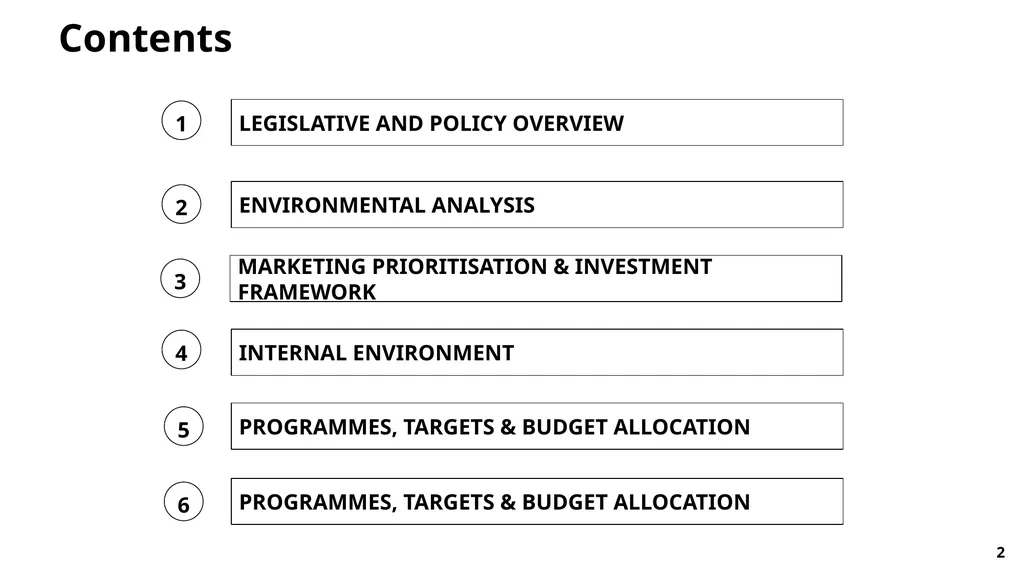
slide2. Contents 2 1 LEGISLATIVE AND POLICY OVERVIEW 2 Environmental Analysis 3 MARKETING PRIORITISATION & INVESTMENT FRAMEWORK 4 INTERNAL ENVIRONMENT 5 PROGRAMMES, TARGETS & BUDGET ALLOCATION 6 PROGRAMMES, TARGETS & BUDGET ALLOCATION<br>
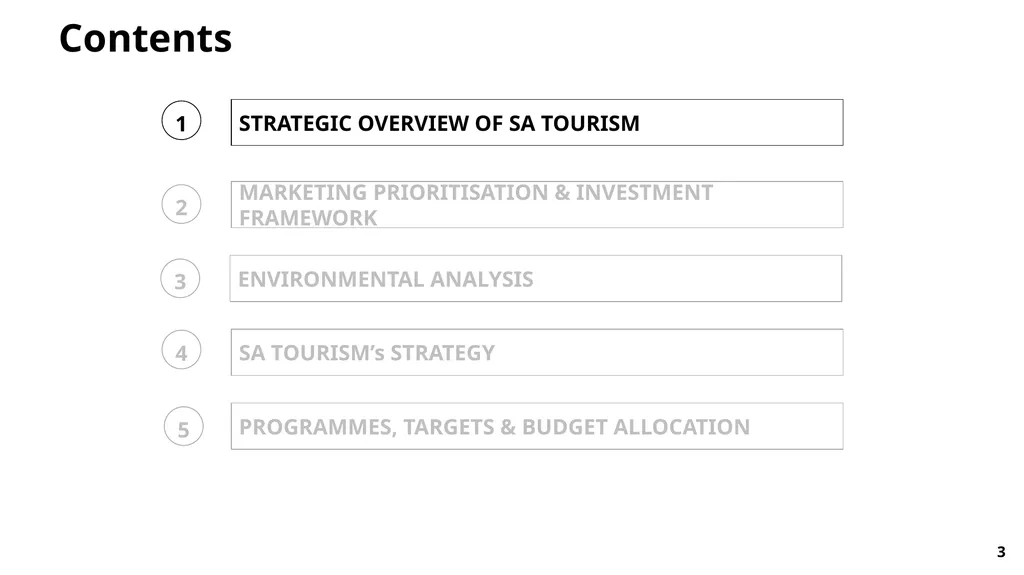
slide3. Contents 1 STRATEGIC OVERVIEW OF SA TOURISM 2 MARKETING PRIORITISATION & INVESTMENT FRAMEWORK 3 Environmental Analysis 4 SA TOURISM’s STRATEGY 5 PROGRAMMES, TARGETS & BUDGET ALLOCATION 3<br>
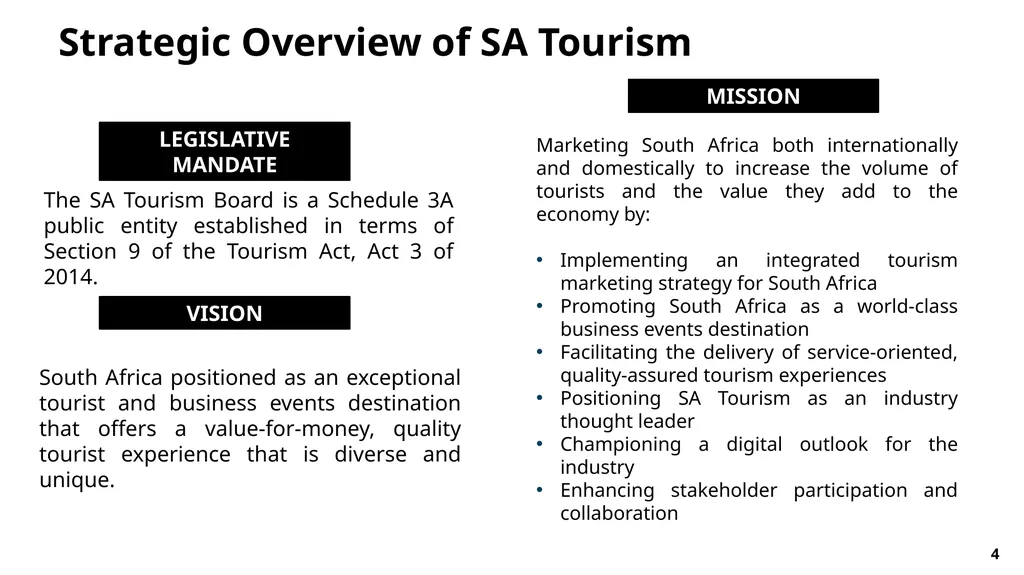
slide4. Strategic Overview of SA Tourism MISSION The SA Tourism Board is a Schedule 3A public entity established in terms of Section 9 of the Tourism Act, Act 3 of 2014. LEGISLATIVE MANDATE Marketing South Africa both internationally and domestically to increase the volume of tourists and the value they add to the economy by:
Implementing an integrated tourism marketing strategy for South Africa
Promoting South Africa as a world-class business events destination
Facilitating the delivery of service-oriented, quality-assured tourism experiences
Positioning SA Tourism as an industry thought leader
Championing a digital outlook for the industry
Enhancing stakeholder participation and collaboration South Africa positioned as an exceptional tourist and business events destination that offers a value-for-money, quality tourist experience that is diverse and unique. VISION 4<br>
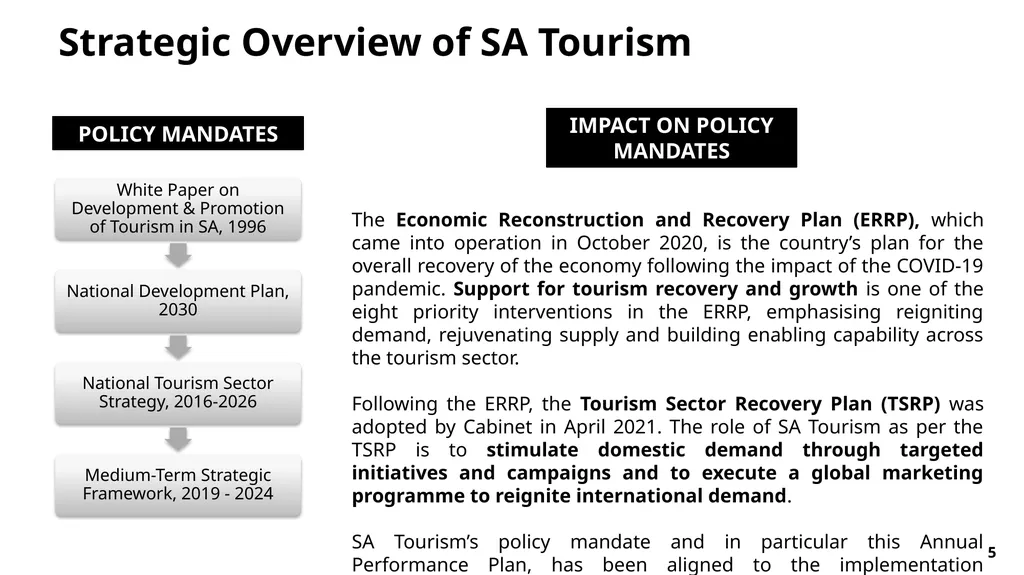
slide5. Strategic Overview of SA Tourism IMPACT ON POLICY MANDATES POLICY MANDATES The Economic Reconstruction and Recovery Plan (ERRP), which came into operation in October 2020, is the country’s plan for the overall recovery of the economy following the impact of the COVID-19 pandemic. Support for tourism recovery and growth is one of the eight priority interventions in the ERRP, emphasising reigniting demand, rejuvenating supply and building enabling capability across the tourism sector.
Following the ERRP, the Tourism Sector Recovery Plan (TSRP) was adopted by Cabinet in April 2021. The role of SA Tourism as per the TSRP is to stimulate domestic demand through targeted initiatives and campaigns and to execute a global marketing programme to reignite international demand.
SA Tourism’s policy mandate and in particular this Annual Performance Plan, has been aligned to the implementation requirements of the TSRP. 5<br>
slide6. Contents 1 STRATEGIC OVERVIEW OF SA TOURISM 2 MARKETING PRIORITISATION & INVESTMENT FRAMEWORK 3 Environmental Analysis 4 SA TOURISM’s STRATEGY 5 PROGRAMMES, TARGETS & BUDGET ALLOCATION 6<br>
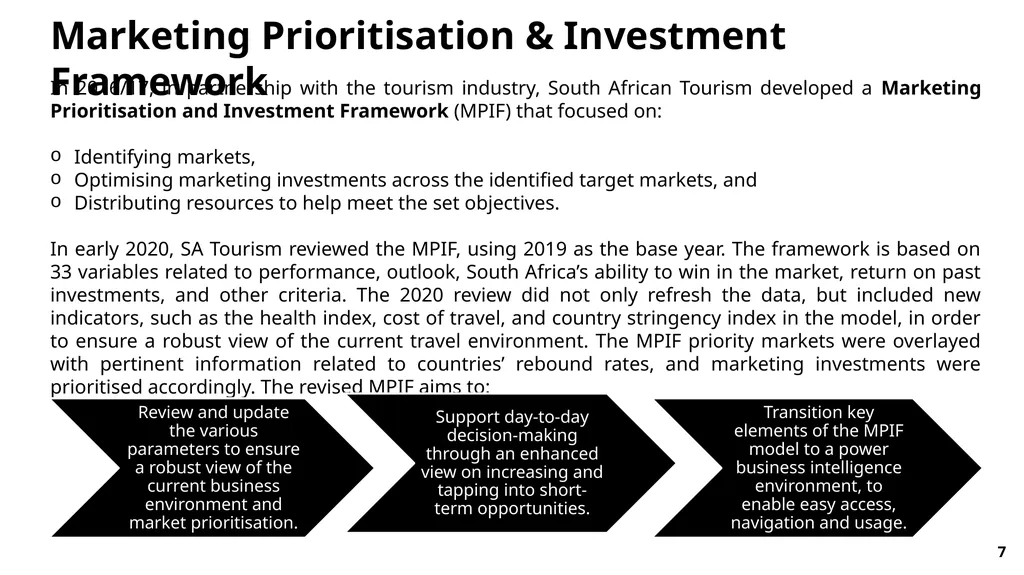
slide7. 7 Marketing Prioritisation & Investment Framework In 2016/17, in partnership with the tourism industry, South African Tourism developed a Marketing Prioritisation and Investment Framework (MPIF) that focused on:
Identifying markets,
Optimising marketing investments across the identified target markets, and
Distributing resources to help meet the set objectives.
In early 2020, SA Tourism reviewed the MPIF, using 2019 as the base year. The framework is based on 33 variables related to performance, outlook, South Africa’s ability to win in the market, return on past investments, and other criteria. The 2020 review did not only refresh the data, but included new indicators, such as the health index, cost of travel, and country stringency index in the model, in order to ensure a robust view of the current travel environment. The MPIF priority markets were overlayed with pertinent information related to countries’ rebound rates, and marketing investments were prioritised accordingly. The revised MPIF aims to: 7<br>
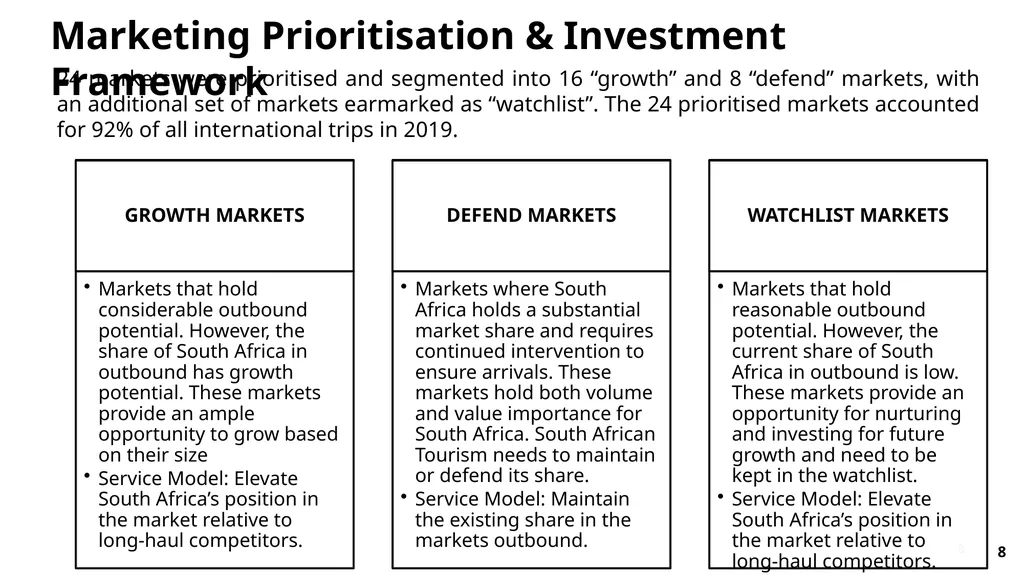
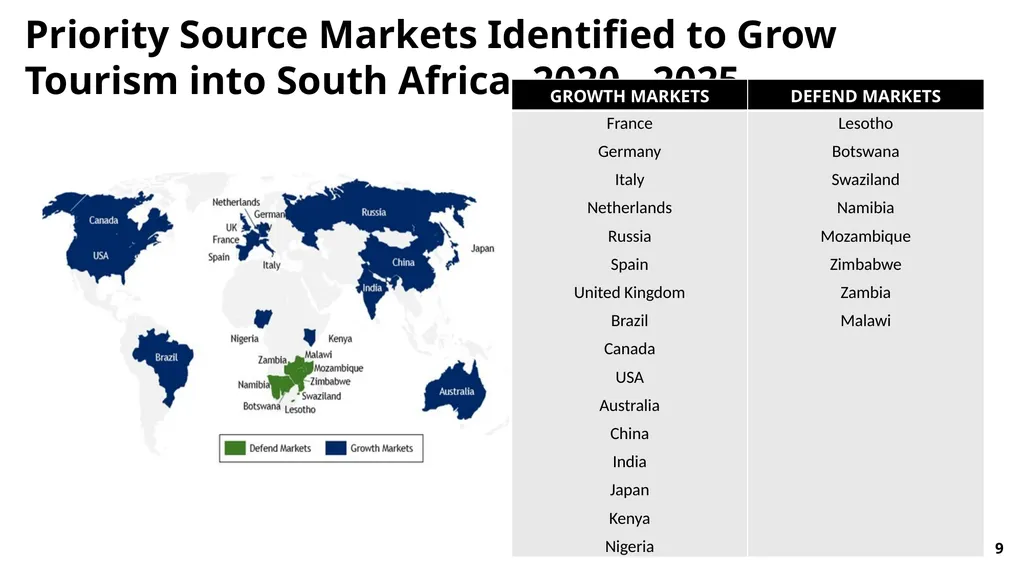
slide8. 8 Marketing Prioritisation & Investment Framework 24 markets were prioritised and segmented into 16 “growth” and 8 “defend” markets, with an additional set of markets earmarked as “watchlist”. The 24 prioritised markets accounted for 92% of all international trips in 2019. 8<br>
slide9. Priority Source Markets Identified to Grow Tourism into South Africa, 2020 - 2025 9<br>
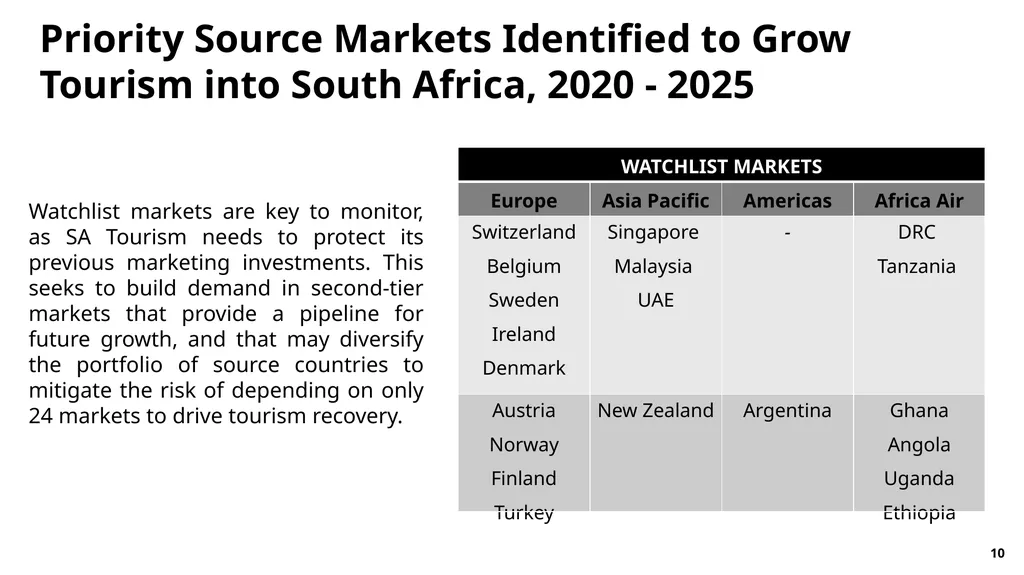
slide10. Priority Source Markets Identified to Grow Tourism into South Africa, 2020 - 2025 Watchlist markets are key to monitor, as SA Tourism needs to protect its previous marketing investments. This seeks to build demand in second-tier markets that provide a pipeline for future growth, and that may diversify the portfolio of source countries to mitigate the risk of depending on only 24 markets to drive tourism recovery. 10<br>
slide11. Contents 1 STRATEGIC OVERVIEW OF SA TOURISM 2 MARKETING PRIORITISATION & INVESTMENT FRAMEWORK 3 Environmental Analysis 4 SA TOURISM’s STRATEGY 5 PROGRAMMES, TARGETS & BUDGET ALLOCATION 11<br>
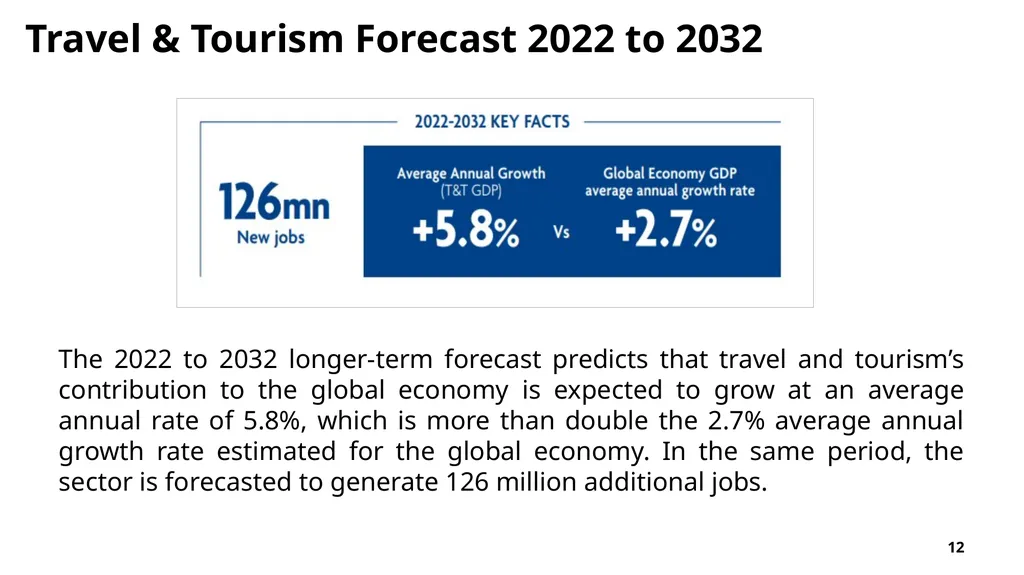
slide12. Travel & Tourism Forecast 2022 to 2032 The 2022 to 2032 longer-term forecast predicts that travel and tourism’s contribution to the global economy is expected to grow at an average annual rate of 5.8%, which is more than double the 2.7% average annual growth rate estimated for the global economy. In the same period, the sector is forecasted to generate 126 million additional jobs. 12<br>
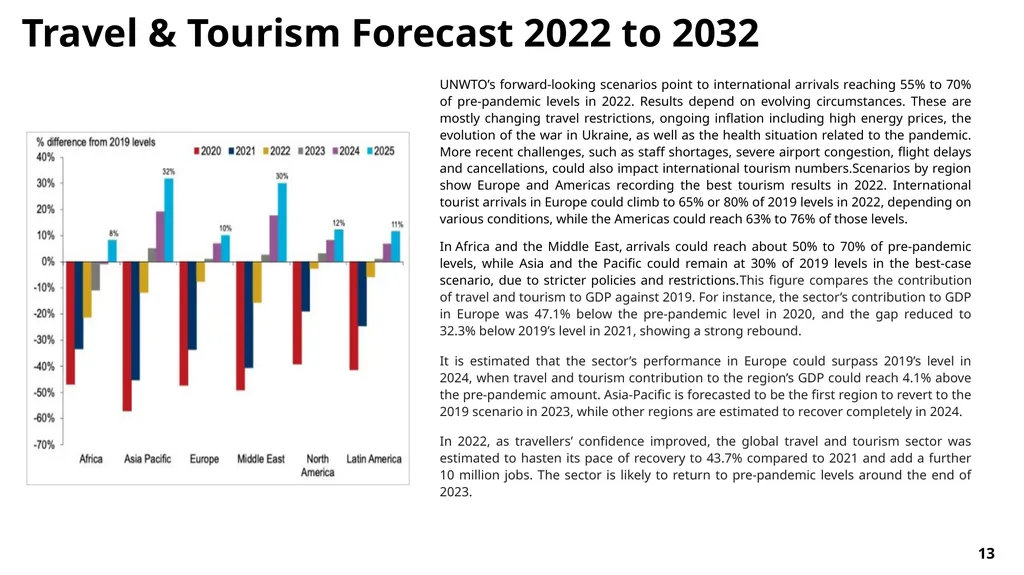
slide13. Travel & Tourism Forecast 2022 to 2032 UNWTO’s forward-looking scenarios point to international arrivals reaching 55% to 70% of pre-pandemic levels in 2022. Results depend on evolving circumstances. These are mostly changing travel restrictions, ongoing inflation including high energy prices, the evolution of the war in Ukraine, as well as the health situation related to the pandemic. More recent challenges, such as staff shortages, severe airport congestion, flight delays and cancellations, could also impact international tourism numbers.Scenarios by region show Europe and Americas recording the best tourism results in 2022. International tourist arrivals in Europe could climb to 65% or 80% of 2019 levels in 2022, depending on various conditions, while the Americas could reach 63% to 76% of those levels.
In Africa and the Middle East, arrivals could reach about 50% to 70% of pre-pandemic levels, while Asia and the Pacific could remain at 30% of 2019 levels in the best-case scenario, due to stricter policies and restrictions.This figure compares the contribution of travel and tourism to GDP against 2019. For instance, the sector’s contribution to GDP in Europe was 47.1% below the pre-pandemic level in 2020, and the gap reduced to 32.3% below 2019’s level in 2021, showing a strong rebound.
It is estimated that the sector’s performance in Europe could surpass 2019’s level in 2024, when travel and tourism contribution to the region’s GDP could reach 4.1% above the pre-pandemic amount. Asia-Pacific is forecasted to be the first region to revert to the 2019 scenario in 2023, while other regions are estimated to recover completely in 2024.
In 2022, as travellers’ confidence improved, the global travel and tourism sector was estimated to hasten its pace of recovery to 43.7% compared to 2021 and add a further 10 million jobs. The sector is likely to return to pre-pandemic levels around the end of 2023. 13<br>
slide14. Contents 1 STRATEGIC OVERVIEW OF SA TOURISM 2 MARKETING PRIORITISATION & INVESTMENT FRAMEWORK 3 Environmental Analysis 4 SA TOURISM’s STRATEGY 5 PROGRAMMES, TARGETS & BUDGET ALLOCATION 14<br>
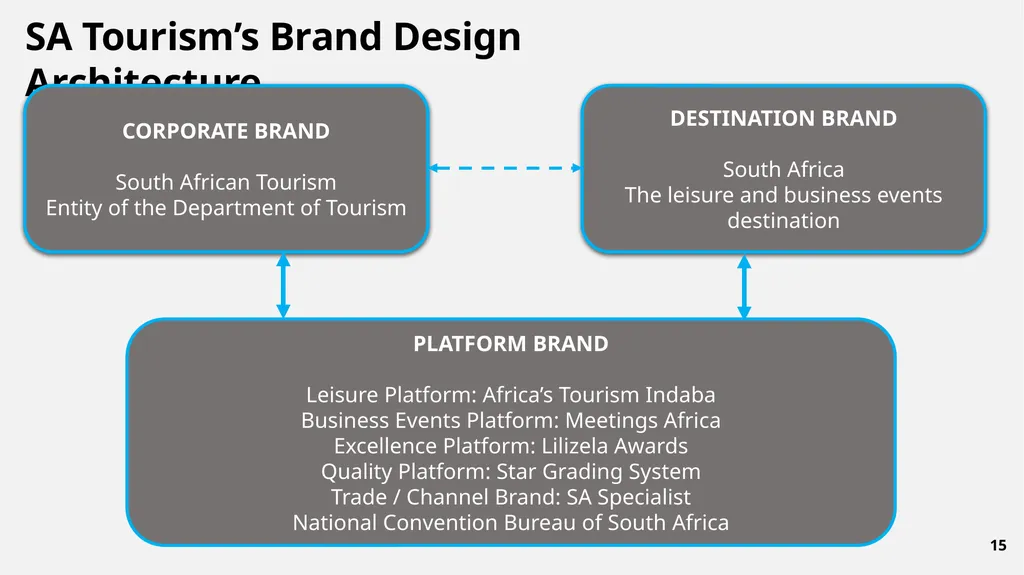
slide15. SA Tourism’s Brand Design Architecture CORPORATE BRAND
South African Tourism
Entity of the Department of Tourism PLATFORM BRAND
Leisure Platform: Africa’s Tourism Indaba
Business Events Platform: Meetings Africa
Excellence Platform: Lilizela Awards
Quality Platform: Star Grading System
Trade / Channel Brand: SA Specialist
National Convention Bureau of South Africa DESTINATION BRAND
South Africa
The leisure and business events destination 15<br>
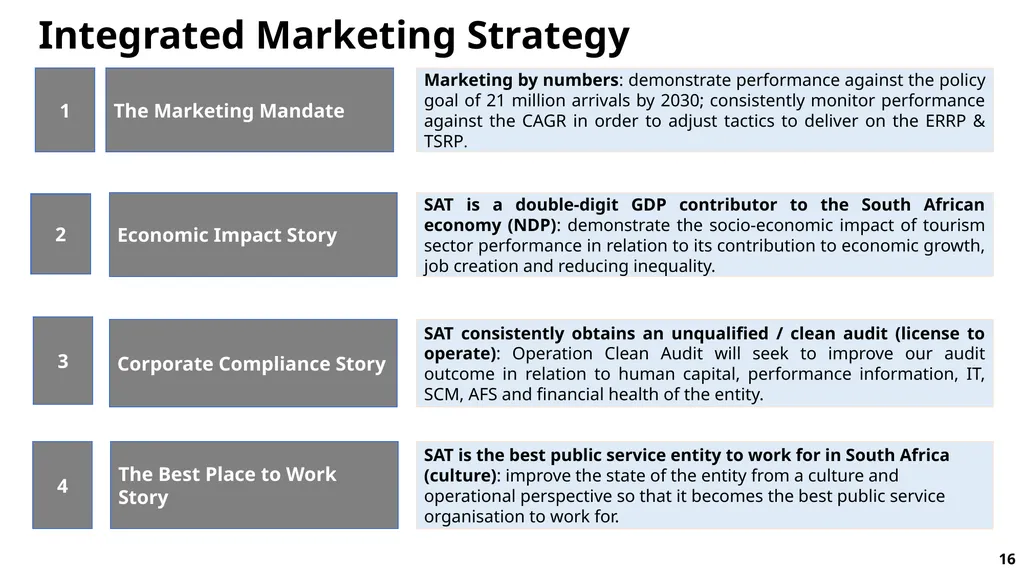
slide16. Economic Impact Story The Marketing Mandate Corporate Compliance Story The Best Place to Work Story Marketing by numbers: demonstrate performance against the policy goal of 21 million arrivals by 2030; consistently monitor performance against the CAGR in order to adjust tactics to deliver on the ERRP & TSRP. SAT is a double-digit GDP contributor to the South African economy (NDP): demonstrate the socio-economic impact of tourism sector performance in relation to its contribution to economic growth, job creation and reducing inequality. SAT consistently obtains an unqualified / clean audit (license to operate): Operation Clean Audit will seek to improve our audit outcome in relation to human capital, performance information, IT, SCM, AFS and financial health of the entity. SAT is the best public service entity to work for in South Africa (culture): improve the state of the entity from a culture and operational perspective so that it becomes the best public service organisation to work for. 1 2 3 4 Integrated Marketing Strategy 16<br>
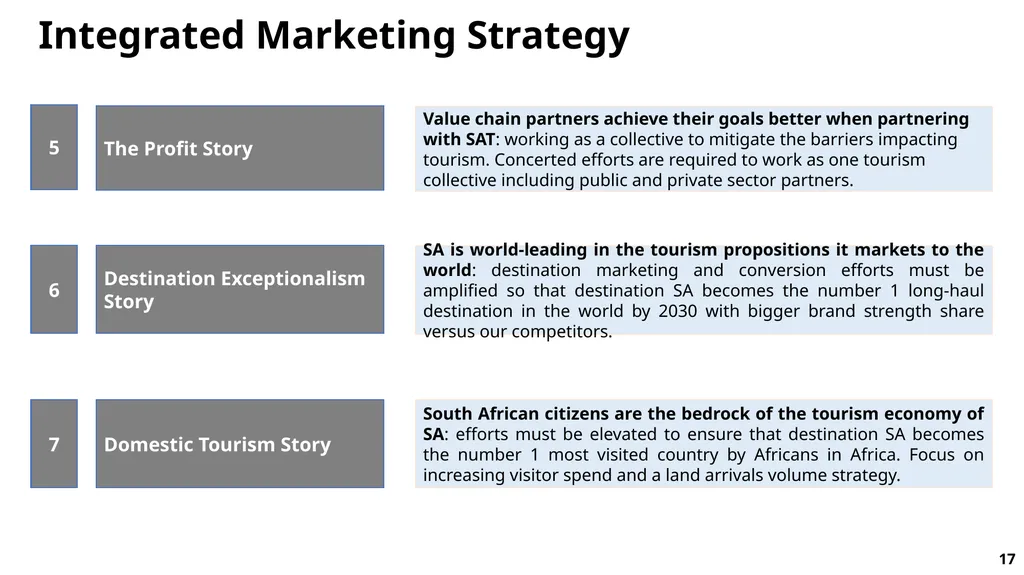
slide17. The Profit Story Destination Exceptionalism Story Domestic Tourism Story Value chain partners achieve their goals better when partnering with SAT: working as a collective to mitigate the barriers impacting tourism. Concerted efforts are required to work as one tourism collective including public and private sector partners. SA is world-leading in the tourism propositions it markets to the world: destination marketing and conversion efforts must be amplified so that destination SA becomes the number 1 long-haul destination in the world by 2030 with bigger brand strength share versus our competitors. South African citizens are the bedrock of the tourism economy of SA: efforts must be elevated to ensure that destination SA becomes the number 1 most visited country by Africans in Africa. Focus on increasing visitor spend and a land arrivals volume strategy. 5 6 7 Integrated Marketing Strategy 17<br>
slide18. Contents 1 STRATEGIC OVERVIEW OF SA TOURISM 2 MARKETING PRIORITISATION & INVESTMENT FRAMEWORK 3 Environmental Analysis 4 SA TOURISM’s STRATEGY 5 PROGRAMMES, TARGETS & BUDGET ALLOCATION 18<br>
slide19. 19<br>
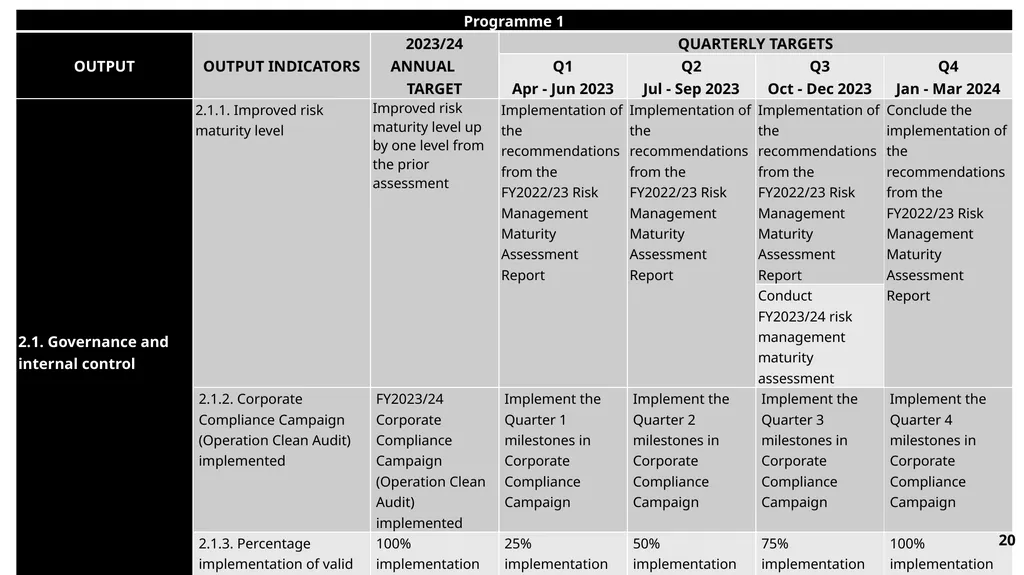
slide20. 20<br>
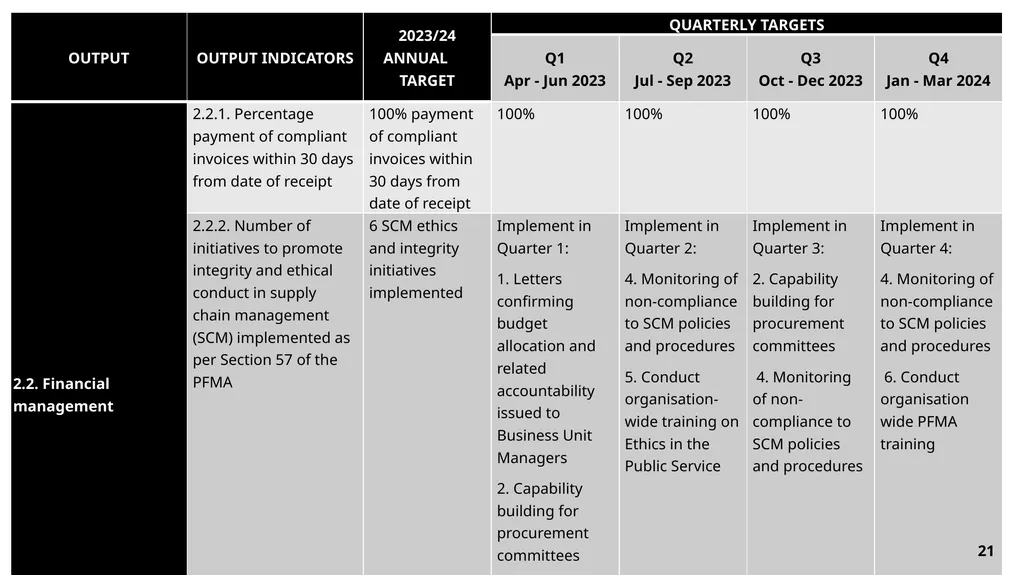
slide21. 21<br>
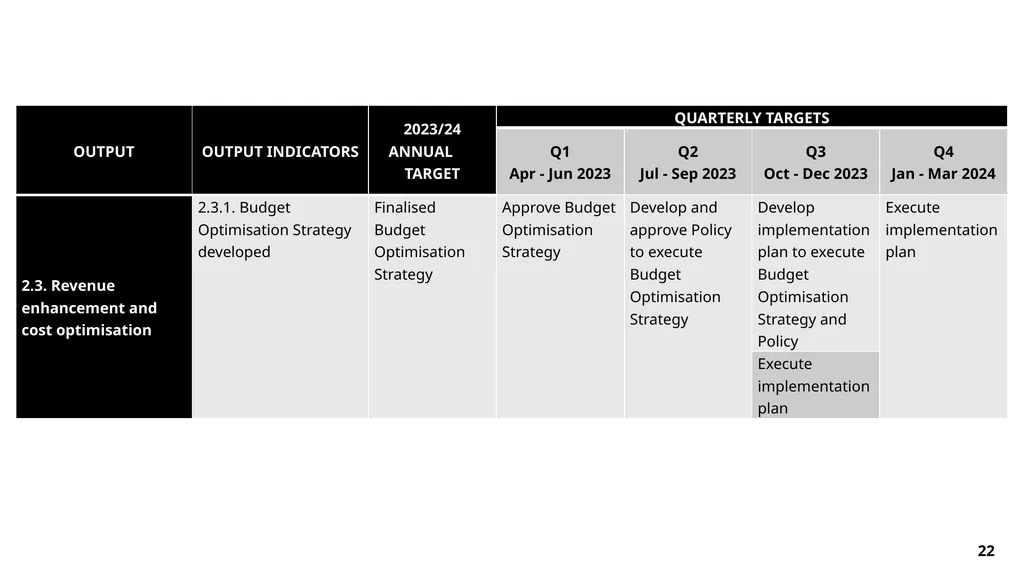
slide22. 22<br>
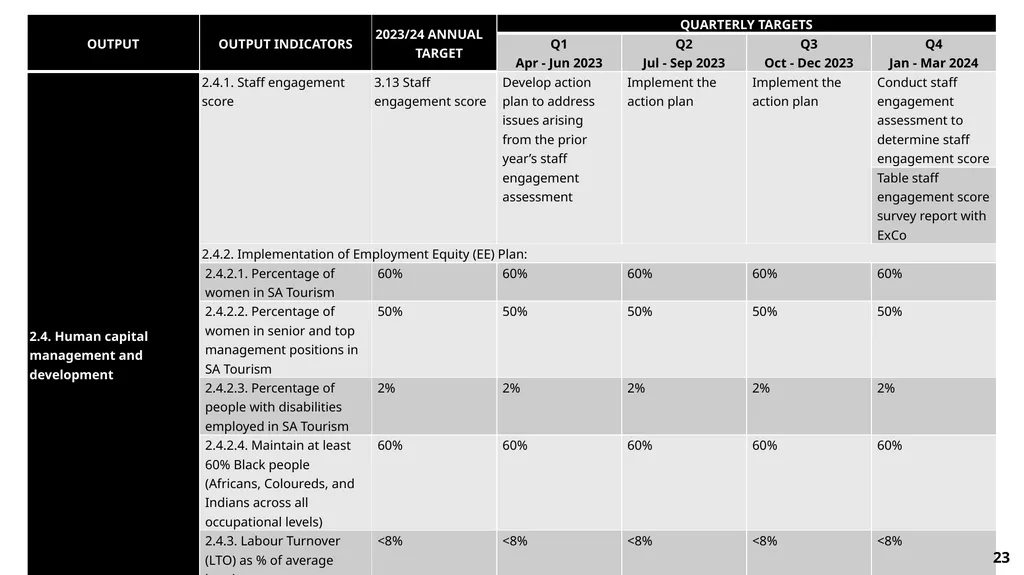
slide23. 23<br>
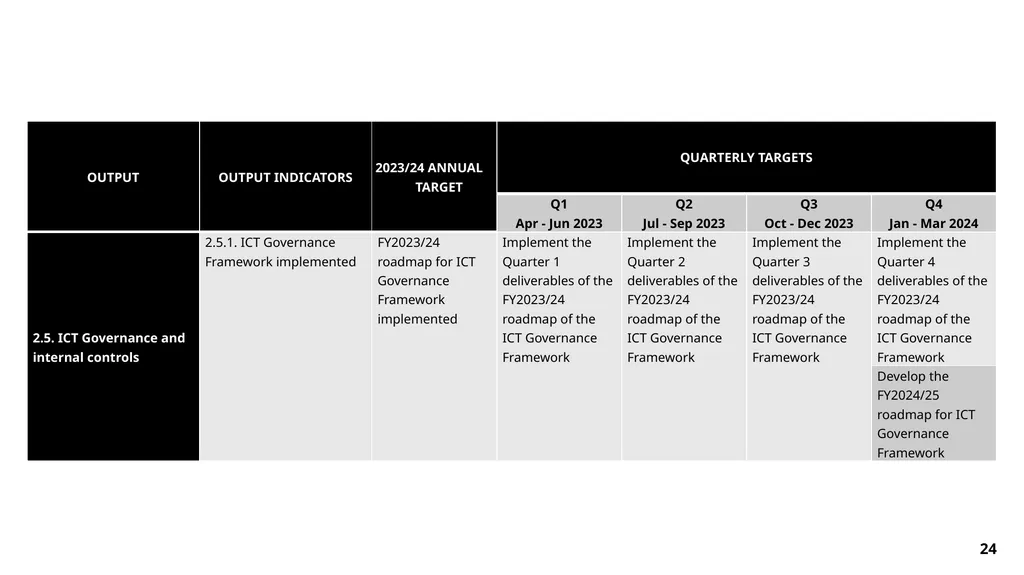
slide24. 24<br>
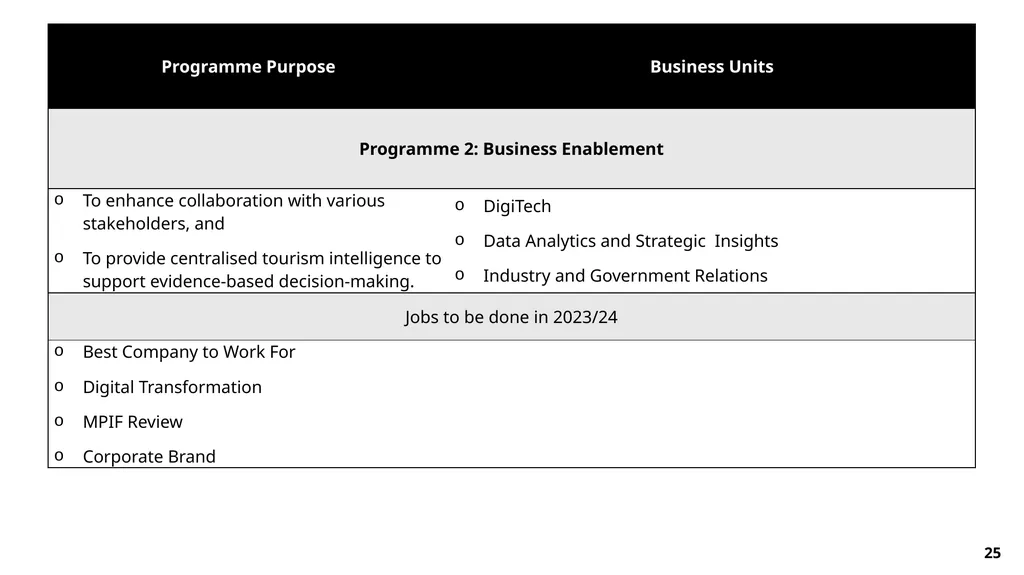
slide25. 25<br>
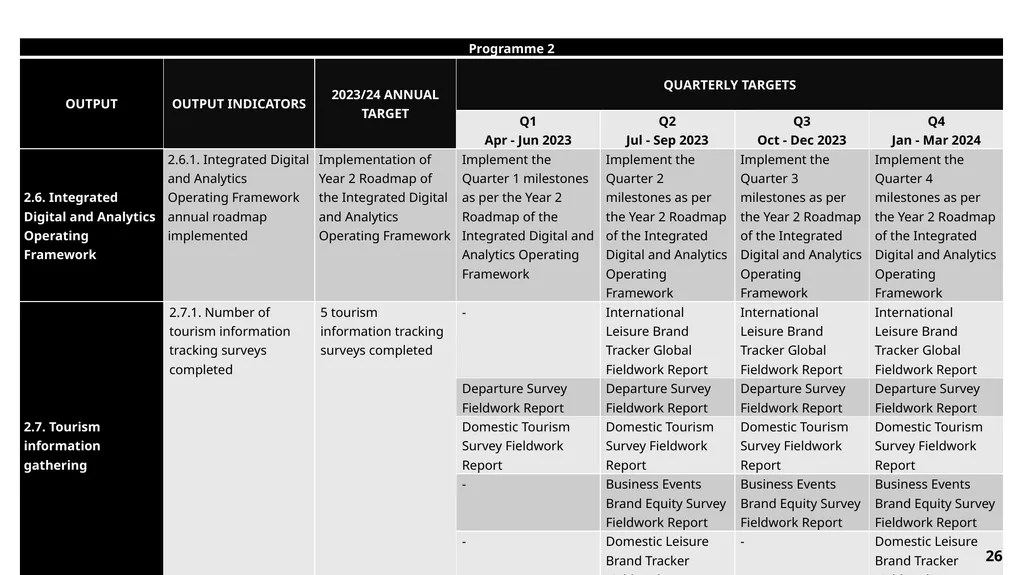
slide26. 26<br>
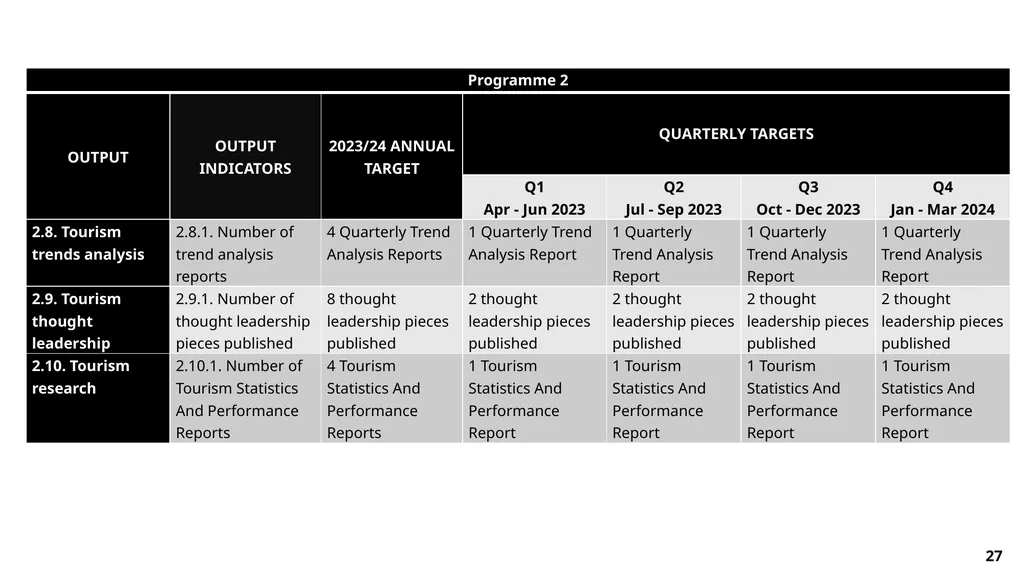
slide27. 27<br>
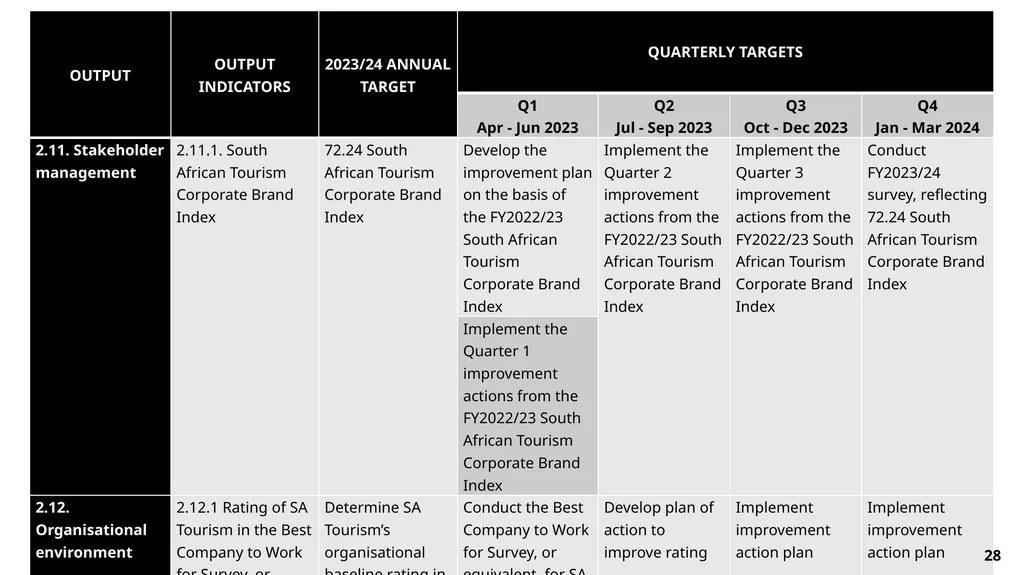
slide28. 28<br>
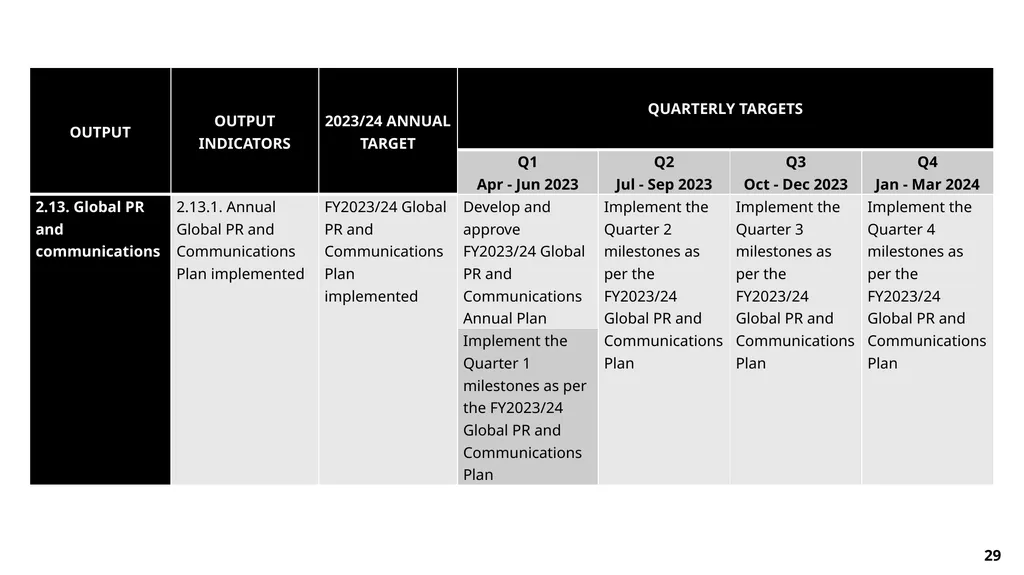
slide29. 29<br>
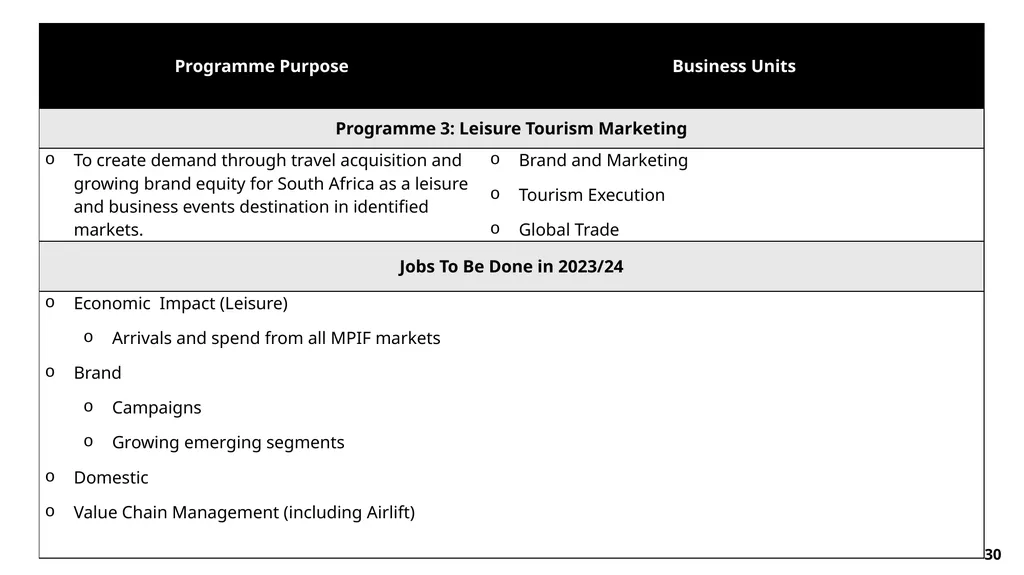
slide30. 30<br>
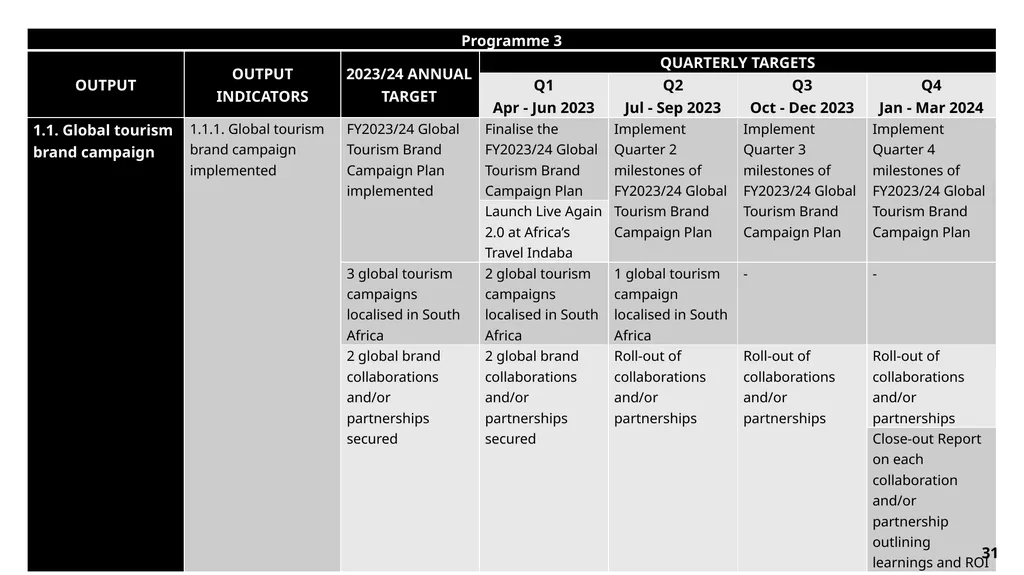
slide31. 31<br>
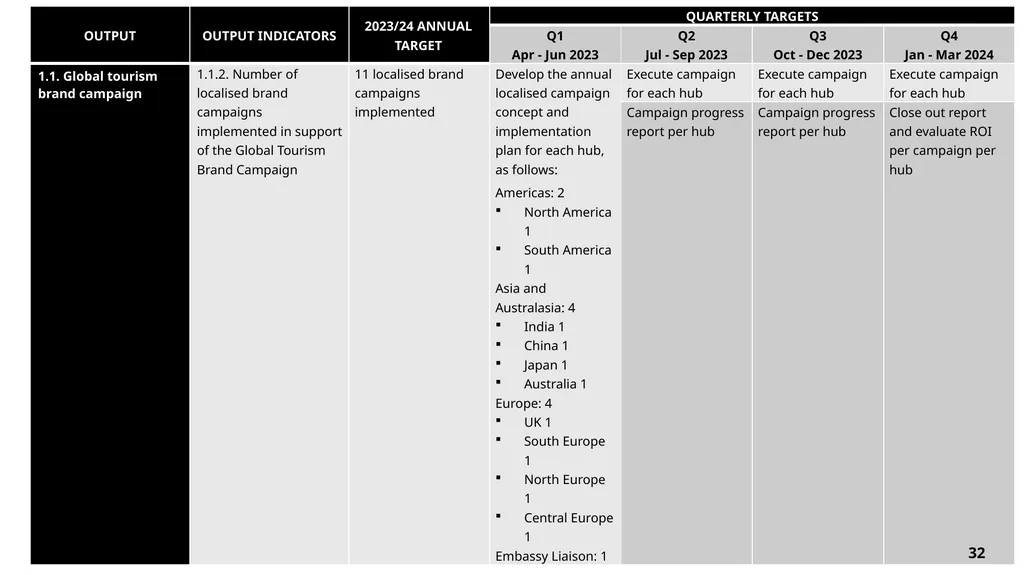
slide32. 32<br>
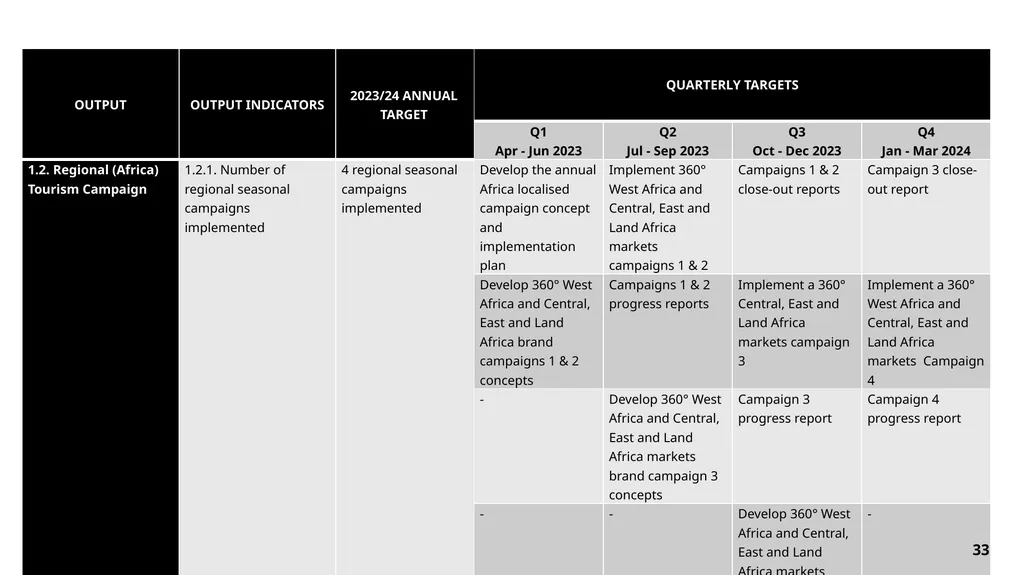
slide33. 33<br>
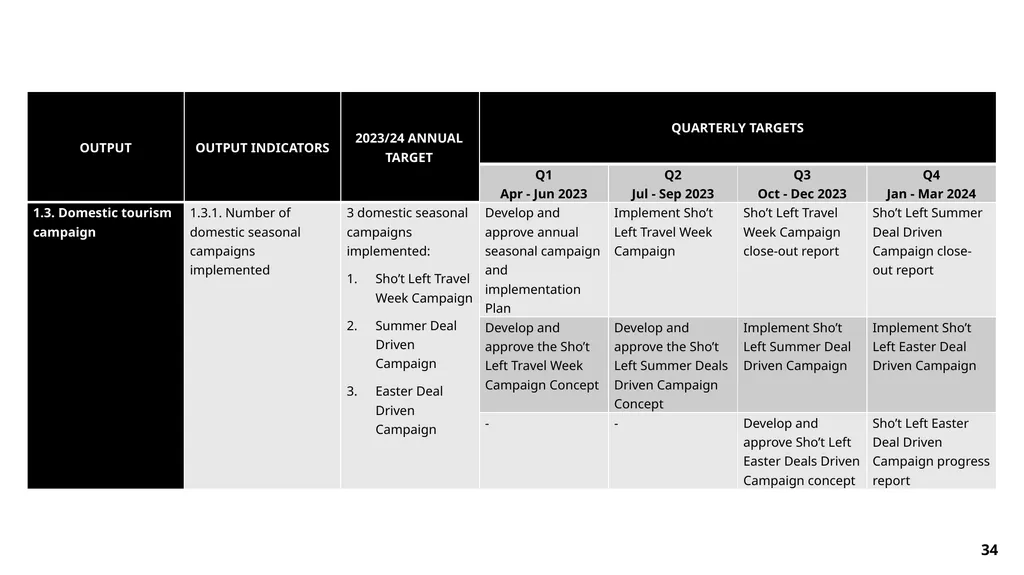
slide34. 34<br>
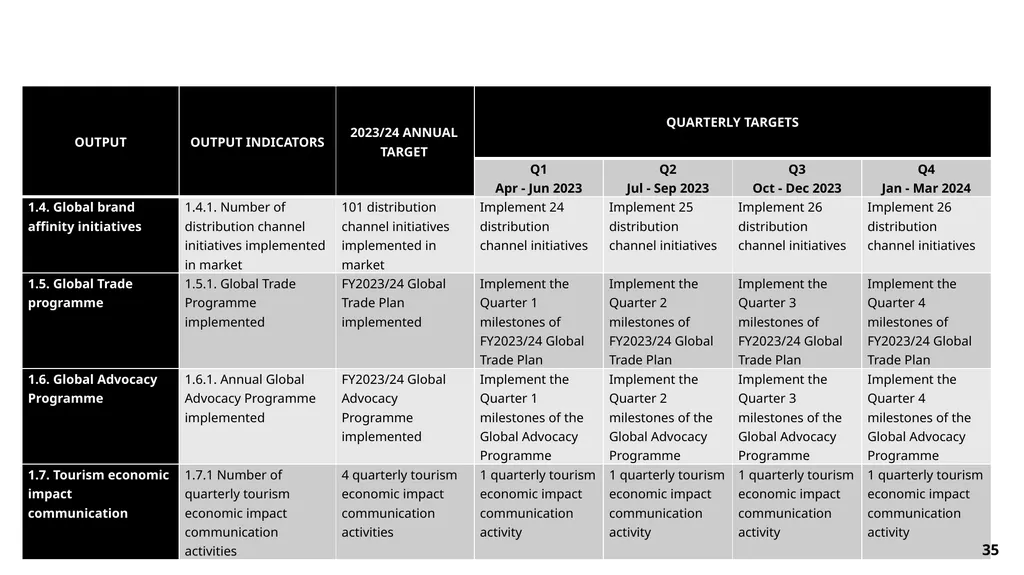
slide35. 35<br>
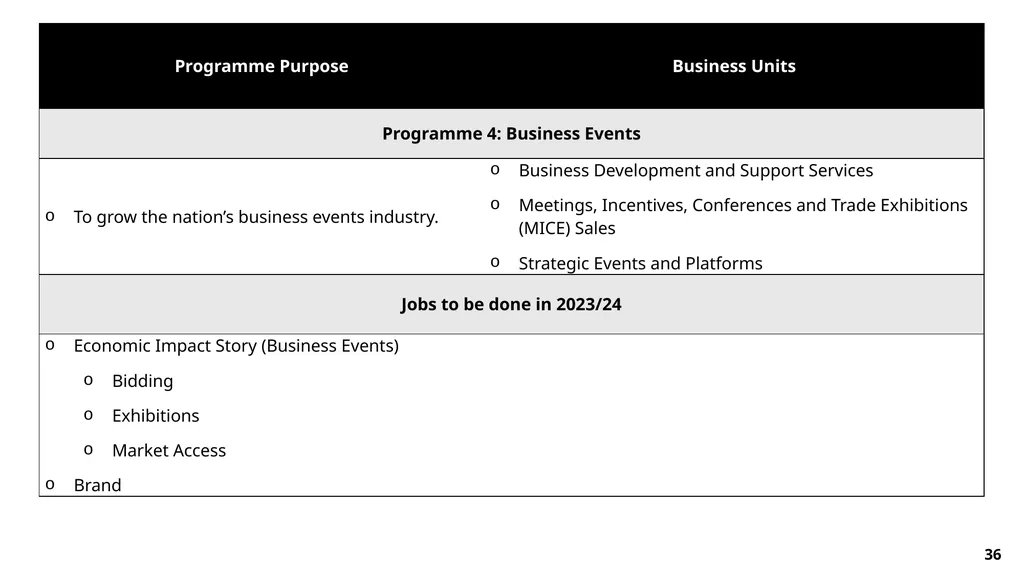
slide36. 36<br>
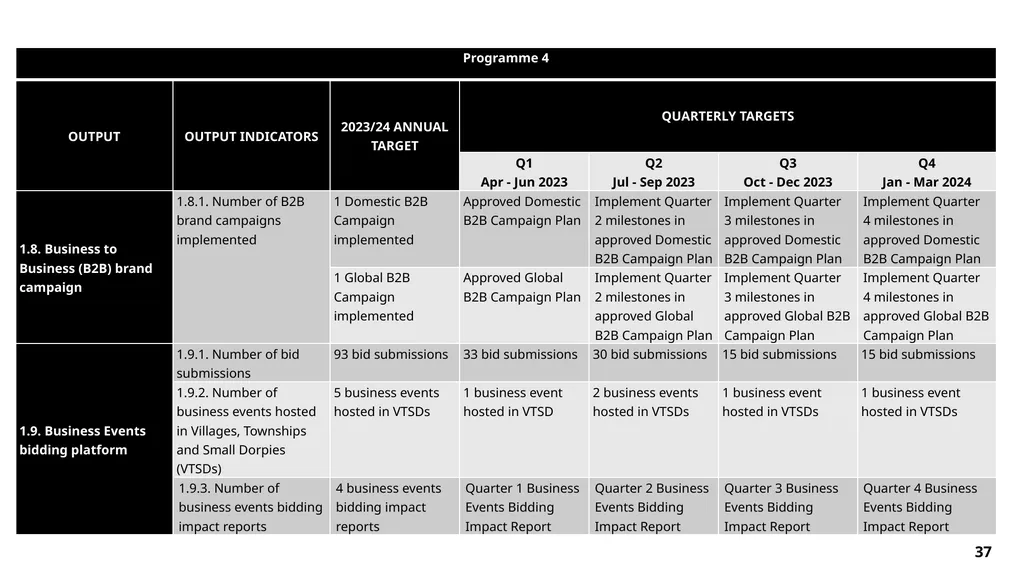
slide37. 37<br>
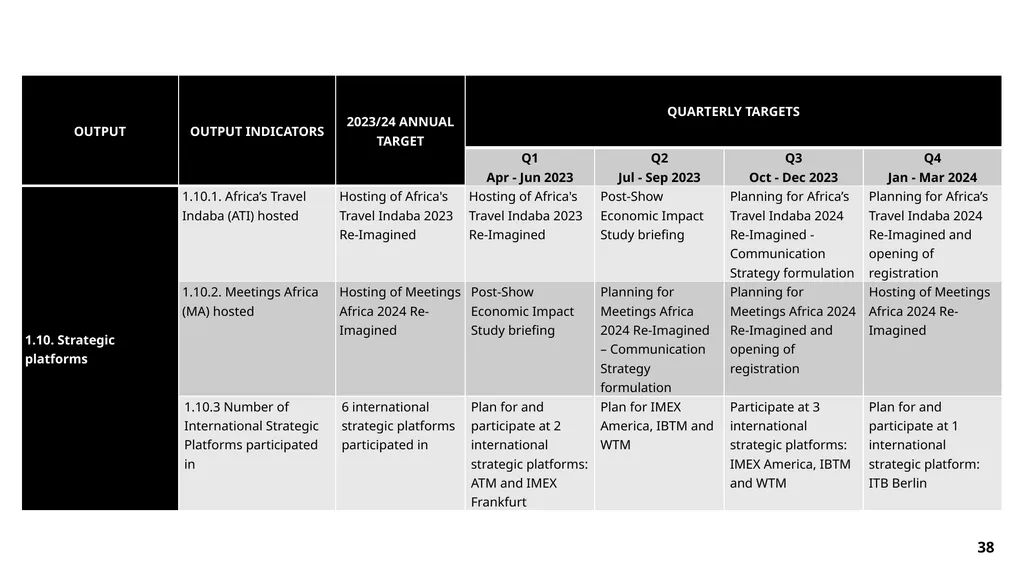
slide38. 38<br>
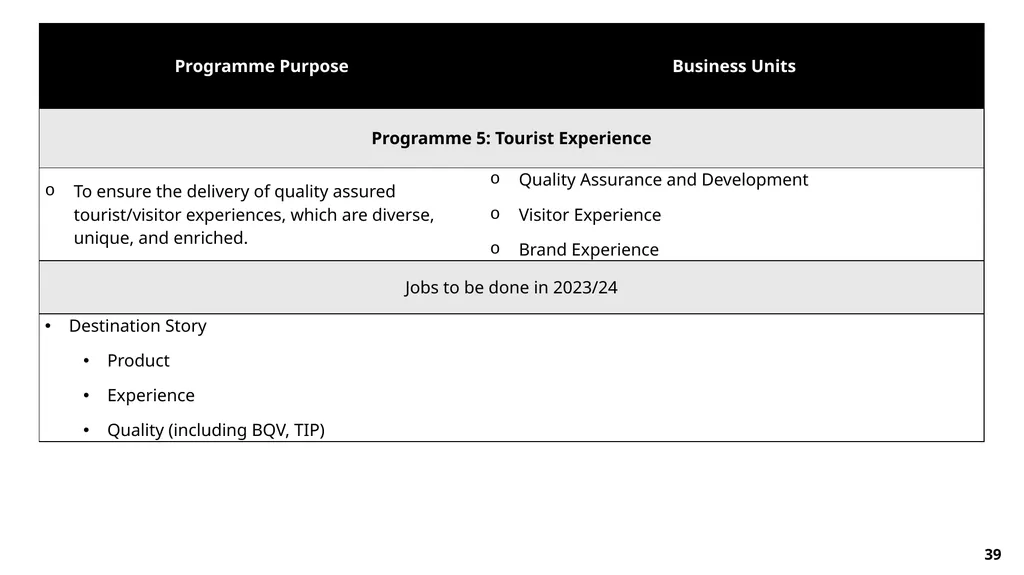
slide39. 39<br>
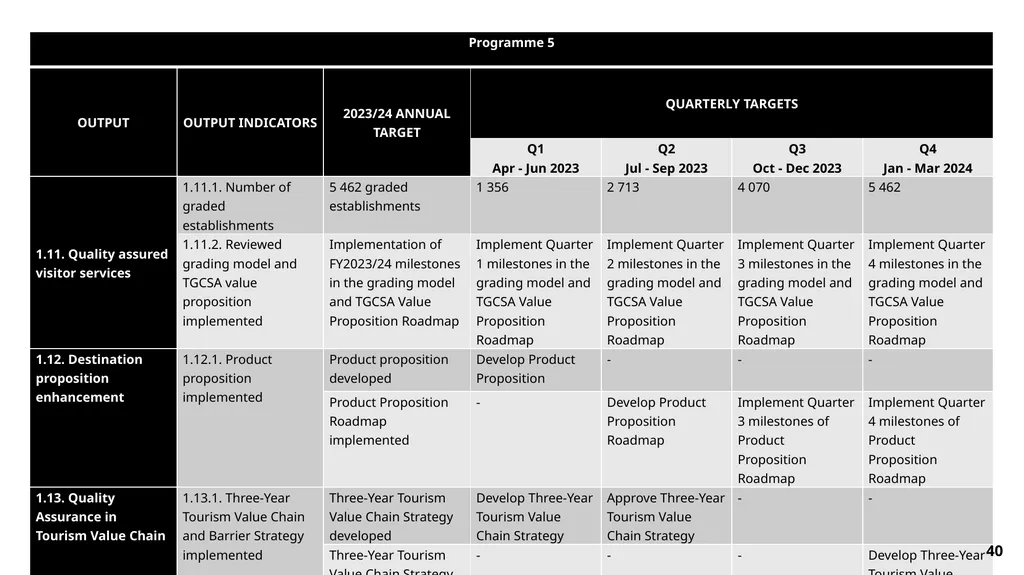
slide40. 40<br>
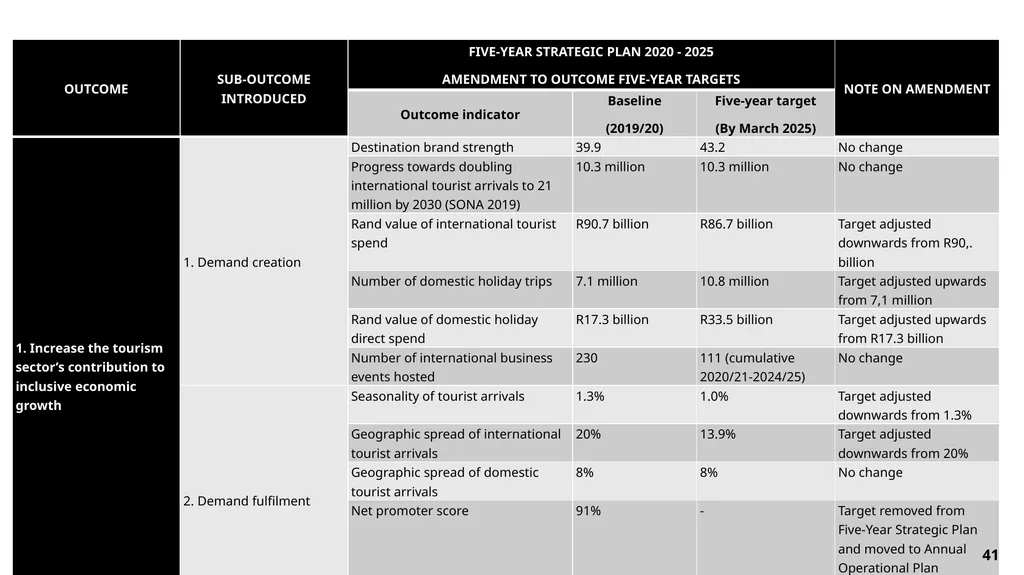
slide41. 41<br>
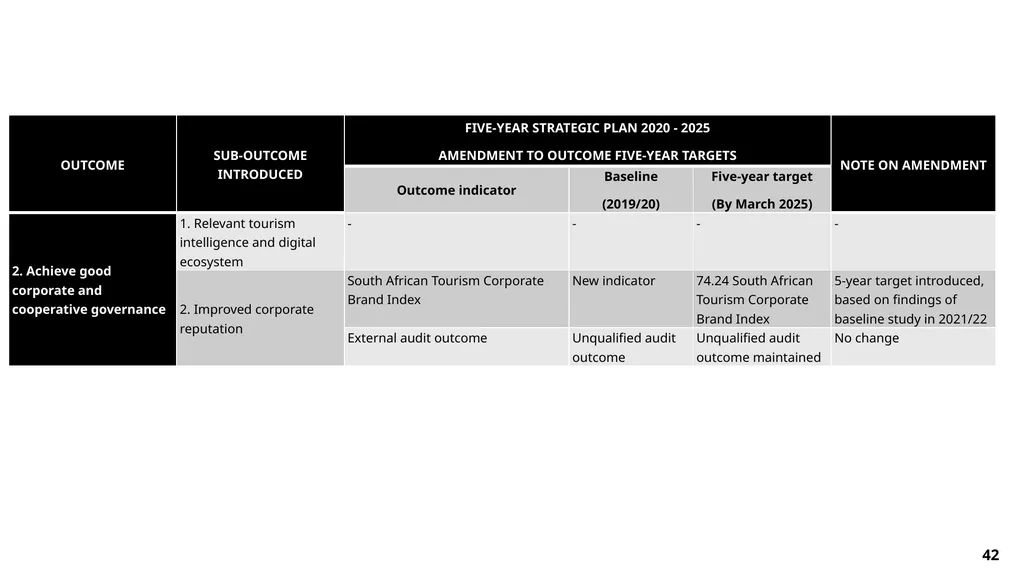
slide42. 42<br>
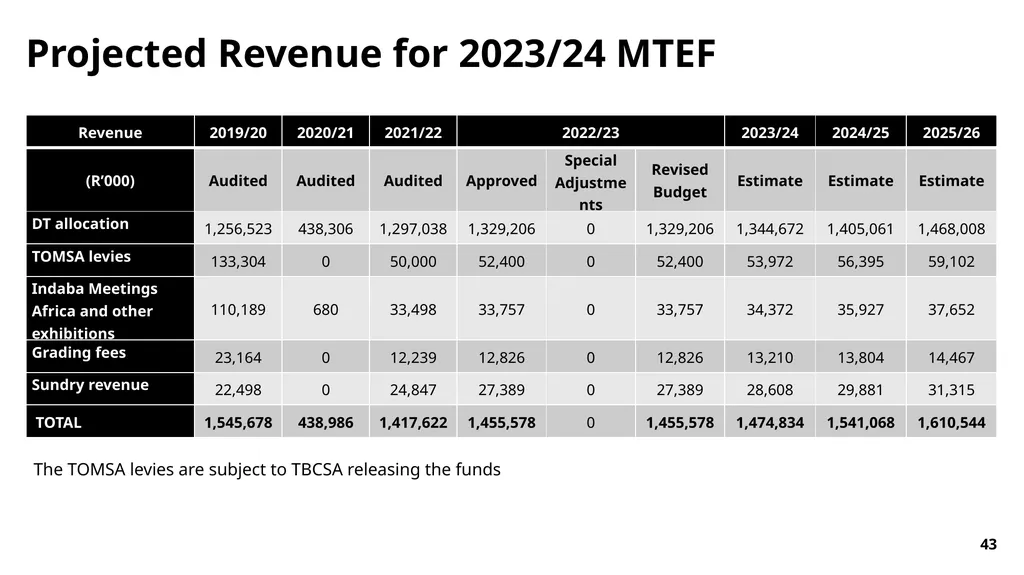
slide43. Projected Revenue for 2023/24 MTEF 43 The TOMSA levies are subject to TBCSA releasing the funds<br>
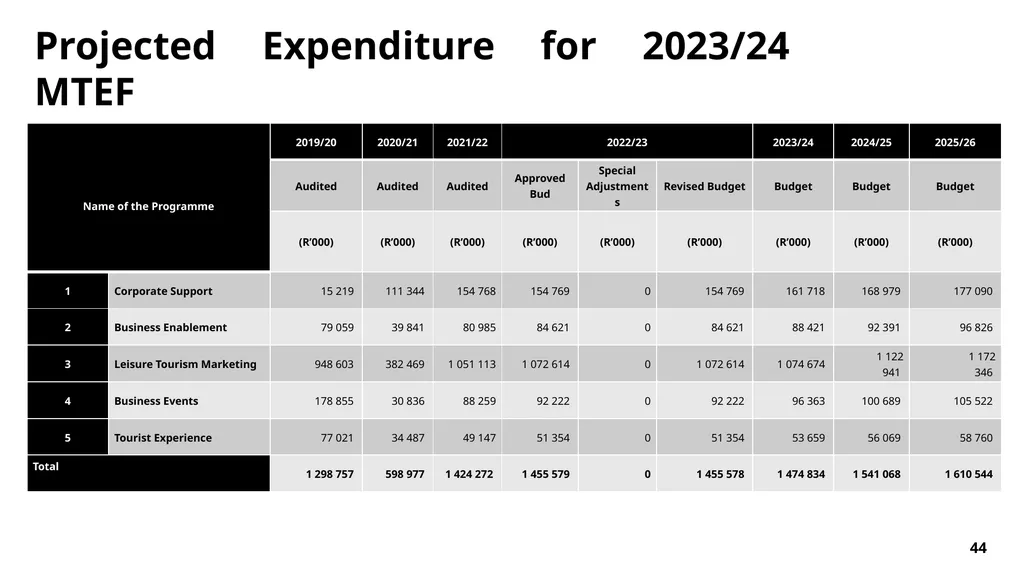
slide44. Projected Expenditure for 2023/24 MTEF 44<br>
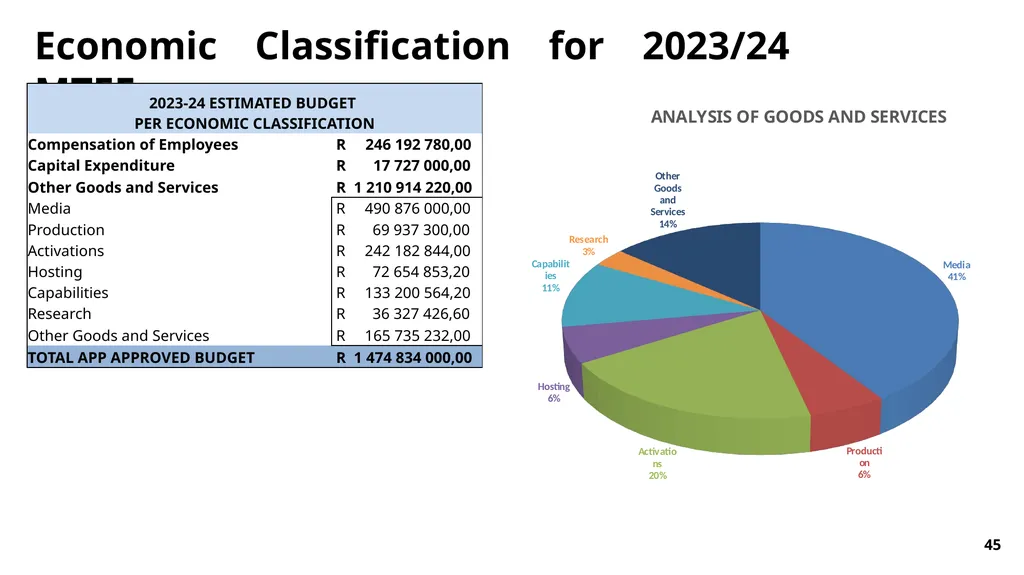
slide45. Economic Classification for 2023/24 MTEF 45<br>
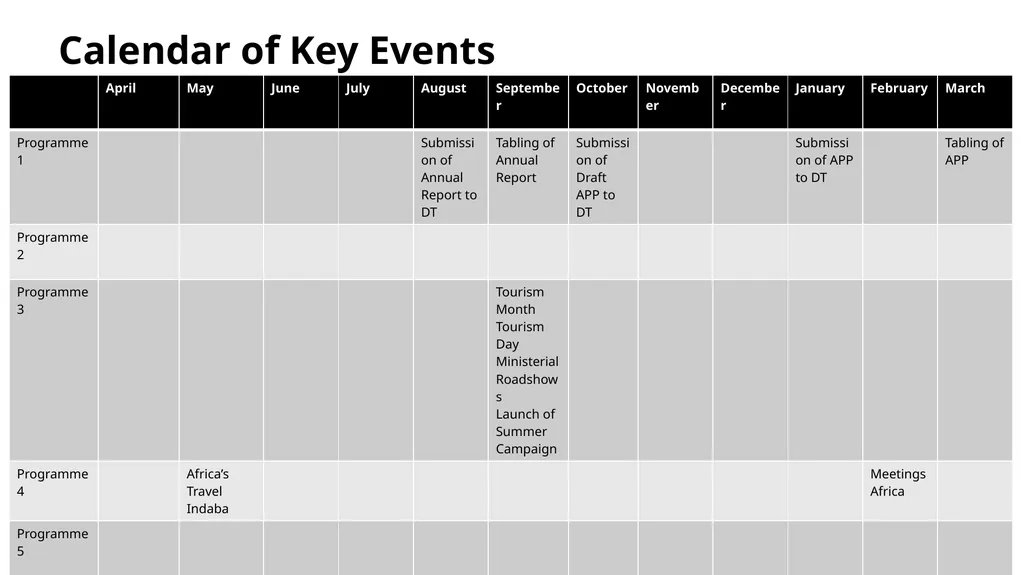
slide46. Calendar of Key Events 46<br>
slide47. Thank You.<br>
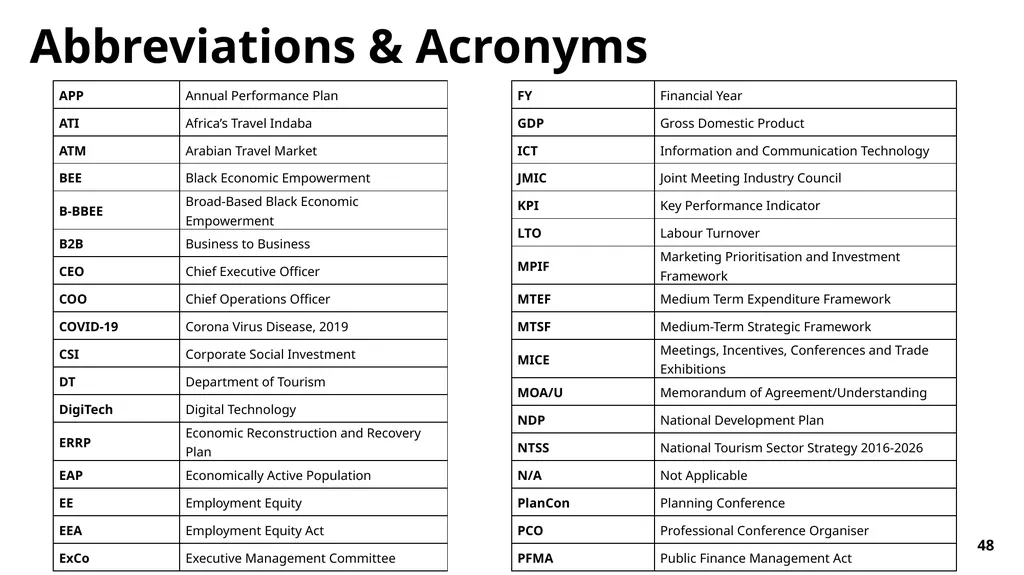
slide48. 48 Abbreviations & Acronyms<br>
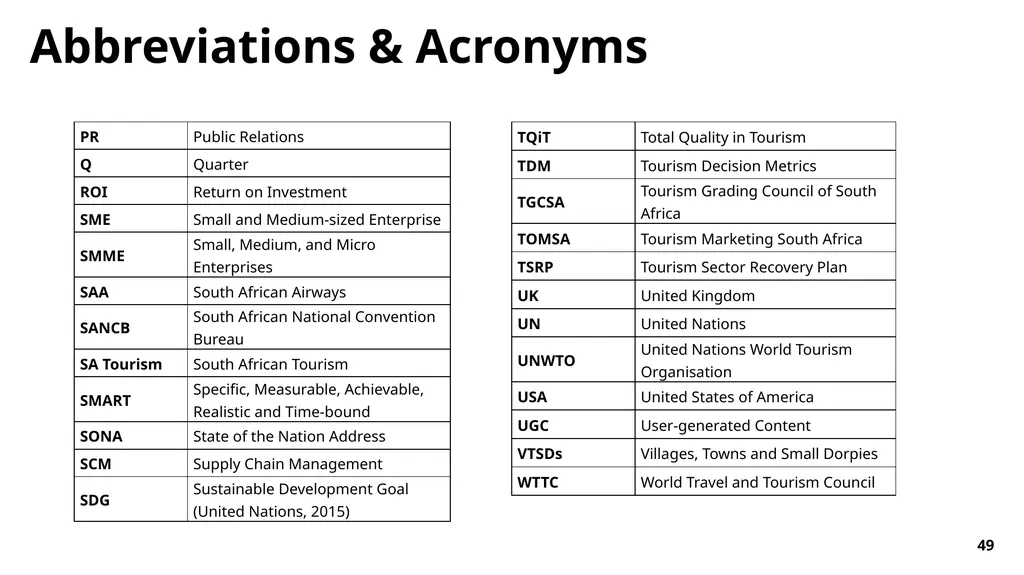
slide49. 49 Abbreviations & Acronyms<br>
slide2. Contents 2 1 LEGISLATIVE AND POLICY OVERVIEW 2 Environmental Analysis 3 MARKETING PRIORITISATION & INVESTMENT FRAMEWORK 4 INTERNAL ENVIRONMENT 5 PROGRAMMES, TARGETS & BUDGET ALLOCATION 6 PROGRAMMES, TARGETS & BUDGET ALLOCATION<br>
slide3. Contents 1 STRATEGIC OVERVIEW OF SA TOURISM 2 MARKETING PRIORITISATION & INVESTMENT FRAMEWORK 3 Environmental Analysis 4 SA TOURISM’s STRATEGY 5 PROGRAMMES, TARGETS & BUDGET ALLOCATION 3<br>
slide4. Strategic Overview of SA Tourism MISSION The SA Tourism Board is a Schedule 3A public entity established in terms of Section 9 of the Tourism Act, Act 3 of 2014. LEGISLATIVE MANDATE Marketing South Africa both internationally and domestically to increase the volume of tourists and the value they add to the economy by:
Implementing an integrated tourism marketing strategy for South Africa
Promoting South Africa as a world-class business events destination
Facilitating the delivery of service-oriented, quality-assured tourism experiences
Positioning SA Tourism as an industry thought leader
Championing a digital outlook for the industry
Enhancing stakeholder participation and collaboration South Africa positioned as an exceptional tourist and business events destination that offers a value-for-money, quality tourist experience that is diverse and unique. VISION 4<br>
slide5. Strategic Overview of SA Tourism IMPACT ON POLICY MANDATES POLICY MANDATES The Economic Reconstruction and Recovery Plan (ERRP), which came into operation in October 2020, is the country’s plan for the overall recovery of the economy following the impact of the COVID-19 pandemic. Support for tourism recovery and growth is one of the eight priority interventions in the ERRP, emphasising reigniting demand, rejuvenating supply and building enabling capability across the tourism sector.
Following the ERRP, the Tourism Sector Recovery Plan (TSRP) was adopted by Cabinet in April 2021. The role of SA Tourism as per the TSRP is to stimulate domestic demand through targeted initiatives and campaigns and to execute a global marketing programme to reignite international demand.
SA Tourism’s policy mandate and in particular this Annual Performance Plan, has been aligned to the implementation requirements of the TSRP. 5<br>
slide6. Contents 1 STRATEGIC OVERVIEW OF SA TOURISM 2 MARKETING PRIORITISATION & INVESTMENT FRAMEWORK 3 Environmental Analysis 4 SA TOURISM’s STRATEGY 5 PROGRAMMES, TARGETS & BUDGET ALLOCATION 6<br>
slide7. 7 Marketing Prioritisation & Investment Framework In 2016/17, in partnership with the tourism industry, South African Tourism developed a Marketing Prioritisation and Investment Framework (MPIF) that focused on:
Identifying markets,
Optimising marketing investments across the identified target markets, and
Distributing resources to help meet the set objectives.
In early 2020, SA Tourism reviewed the MPIF, using 2019 as the base year. The framework is based on 33 variables related to performance, outlook, South Africa’s ability to win in the market, return on past investments, and other criteria. The 2020 review did not only refresh the data, but included new indicators, such as the health index, cost of travel, and country stringency index in the model, in order to ensure a robust view of the current travel environment. The MPIF priority markets were overlayed with pertinent information related to countries’ rebound rates, and marketing investments were prioritised accordingly. The revised MPIF aims to: 7<br>
slide8. 8 Marketing Prioritisation & Investment Framework 24 markets were prioritised and segmented into 16 “growth” and 8 “defend” markets, with an additional set of markets earmarked as “watchlist”. The 24 prioritised markets accounted for 92% of all international trips in 2019. 8<br>
slide9. Priority Source Markets Identified to Grow Tourism into South Africa, 2020 - 2025 9<br>
slide10. Priority Source Markets Identified to Grow Tourism into South Africa, 2020 - 2025 Watchlist markets are key to monitor, as SA Tourism needs to protect its previous marketing investments. This seeks to build demand in second-tier markets that provide a pipeline for future growth, and that may diversify the portfolio of source countries to mitigate the risk of depending on only 24 markets to drive tourism recovery. 10<br>
slide11. Contents 1 STRATEGIC OVERVIEW OF SA TOURISM 2 MARKETING PRIORITISATION & INVESTMENT FRAMEWORK 3 Environmental Analysis 4 SA TOURISM’s STRATEGY 5 PROGRAMMES, TARGETS & BUDGET ALLOCATION 11<br>
slide12. Travel & Tourism Forecast 2022 to 2032 The 2022 to 2032 longer-term forecast predicts that travel and tourism’s contribution to the global economy is expected to grow at an average annual rate of 5.8%, which is more than double the 2.7% average annual growth rate estimated for the global economy. In the same period, the sector is forecasted to generate 126 million additional jobs. 12<br>
slide13. Travel & Tourism Forecast 2022 to 2032 UNWTO’s forward-looking scenarios point to international arrivals reaching 55% to 70% of pre-pandemic levels in 2022. Results depend on evolving circumstances. These are mostly changing travel restrictions, ongoing inflation including high energy prices, the evolution of the war in Ukraine, as well as the health situation related to the pandemic. More recent challenges, such as staff shortages, severe airport congestion, flight delays and cancellations, could also impact international tourism numbers.Scenarios by region show Europe and Americas recording the best tourism results in 2022. International tourist arrivals in Europe could climb to 65% or 80% of 2019 levels in 2022, depending on various conditions, while the Americas could reach 63% to 76% of those levels.
In Africa and the Middle East, arrivals could reach about 50% to 70% of pre-pandemic levels, while Asia and the Pacific could remain at 30% of 2019 levels in the best-case scenario, due to stricter policies and restrictions.This figure compares the contribution of travel and tourism to GDP against 2019. For instance, the sector’s contribution to GDP in Europe was 47.1% below the pre-pandemic level in 2020, and the gap reduced to 32.3% below 2019’s level in 2021, showing a strong rebound.
It is estimated that the sector’s performance in Europe could surpass 2019’s level in 2024, when travel and tourism contribution to the region’s GDP could reach 4.1% above the pre-pandemic amount. Asia-Pacific is forecasted to be the first region to revert to the 2019 scenario in 2023, while other regions are estimated to recover completely in 2024.
In 2022, as travellers’ confidence improved, the global travel and tourism sector was estimated to hasten its pace of recovery to 43.7% compared to 2021 and add a further 10 million jobs. The sector is likely to return to pre-pandemic levels around the end of 2023. 13<br>
slide14. Contents 1 STRATEGIC OVERVIEW OF SA TOURISM 2 MARKETING PRIORITISATION & INVESTMENT FRAMEWORK 3 Environmental Analysis 4 SA TOURISM’s STRATEGY 5 PROGRAMMES, TARGETS & BUDGET ALLOCATION 14<br>
slide15. SA Tourism’s Brand Design Architecture CORPORATE BRAND
South African Tourism
Entity of the Department of Tourism PLATFORM BRAND
Leisure Platform: Africa’s Tourism Indaba
Business Events Platform: Meetings Africa
Excellence Platform: Lilizela Awards
Quality Platform: Star Grading System
Trade / Channel Brand: SA Specialist
National Convention Bureau of South Africa DESTINATION BRAND
South Africa
The leisure and business events destination 15<br>
slide16. Economic Impact Story The Marketing Mandate Corporate Compliance Story The Best Place to Work Story Marketing by numbers: demonstrate performance against the policy goal of 21 million arrivals by 2030; consistently monitor performance against the CAGR in order to adjust tactics to deliver on the ERRP & TSRP. SAT is a double-digit GDP contributor to the South African economy (NDP): demonstrate the socio-economic impact of tourism sector performance in relation to its contribution to economic growth, job creation and reducing inequality. SAT consistently obtains an unqualified / clean audit (license to operate): Operation Clean Audit will seek to improve our audit outcome in relation to human capital, performance information, IT, SCM, AFS and financial health of the entity. SAT is the best public service entity to work for in South Africa (culture): improve the state of the entity from a culture and operational perspective so that it becomes the best public service organisation to work for. 1 2 3 4 Integrated Marketing Strategy 16<br>
slide17. The Profit Story Destination Exceptionalism Story Domestic Tourism Story Value chain partners achieve their goals better when partnering with SAT: working as a collective to mitigate the barriers impacting tourism. Concerted efforts are required to work as one tourism collective including public and private sector partners. SA is world-leading in the tourism propositions it markets to the world: destination marketing and conversion efforts must be amplified so that destination SA becomes the number 1 long-haul destination in the world by 2030 with bigger brand strength share versus our competitors. South African citizens are the bedrock of the tourism economy of SA: efforts must be elevated to ensure that destination SA becomes the number 1 most visited country by Africans in Africa. Focus on increasing visitor spend and a land arrivals volume strategy. 5 6 7 Integrated Marketing Strategy 17<br>
slide18. Contents 1 STRATEGIC OVERVIEW OF SA TOURISM 2 MARKETING PRIORITISATION & INVESTMENT FRAMEWORK 3 Environmental Analysis 4 SA TOURISM’s STRATEGY 5 PROGRAMMES, TARGETS & BUDGET ALLOCATION 18<br>
slide19. 19<br>
slide20. 20<br>
slide21. 21<br>
slide22. 22<br>
slide23. 23<br>
slide24. 24<br>
slide25. 25<br>
slide26. 26<br>
slide27. 27<br>
slide28. 28<br>
slide29. 29<br>
slide30. 30<br>
slide31. 31<br>
slide32. 32<br>
slide33. 33<br>
slide34. 34<br>
slide35. 35<br>
slide36. 36<br>
slide37. 37<br>
slide38. 38<br>
slide39. 39<br>
slide40. 40<br>
slide41. 41<br>
slide42. 42<br>
slide43. Projected Revenue for 2023/24 MTEF 43 The TOMSA levies are subject to TBCSA releasing the funds<br>
slide44. Projected Expenditure for 2023/24 MTEF 44<br>
slide45. Economic Classification for 2023/24 MTEF 45<br>
slide46. Calendar of Key Events 46<br>
slide47. Thank You.<br>
slide48. 48 Abbreviations & Acronyms<br>
slide49. 49 Abbreviations & Acronyms<br>