
GARY DESSLER HUMAN RESOURCE MANAGEMENT Global
PT
Published · 56 slides · 0 views

1 / 1

Description
GARY DESSLER HUMAN RESOURCE MANAGEMENT Global Edition 12e Chapter 4 Ethics, Justice, And Fair Treatment in HR Management PowerPoint Presentation by Charlie Cook The University of West Alabama Copyright 2011 Pearson Education Part 5
Related Topics
Share
Embed code
Download this presentation From Below
"GARY DESSLER HUMAN RESOURCE MANAGEMENT Global" is the property of its rightful owner. Permission is granted to download and print the materials on this website for personal, non-commercial use only, and to display it on your personal computer provided you do not modify the materials and that you retain all copyright notices contained in the materials. By downloading content from our website, you accept the terms of this agreement.
Presentation Transcript
01
GARY DESSLER HUMAN RESOURCE MANAGEMENT
Global Edition 12e Chapter 4
Ethics, Justice, And Fair Treatment in HR Management PowerPoint Presentation by Charlie Cook The University of West Alabama Copyright © 2011 Pearson Education Part 5 Employee Relations<br>
Global Edition 12e Chapter 4
Ethics, Justice, And Fair Treatment in HR Management PowerPoint Presentation by Charlie Cook The University of West Alabama Copyright © 2011 Pearson Education Part 5 Employee Relations<br>
02
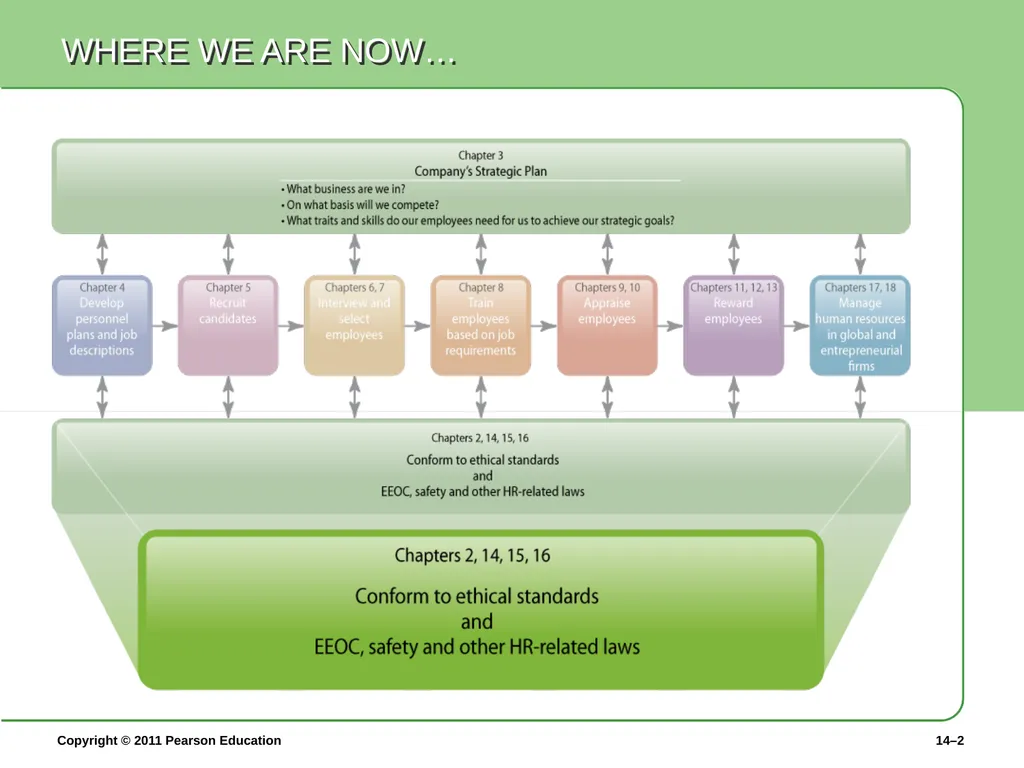
Copyright © 2011 Pearson Education 14–2 WHERE WE ARE NOW…<br>
03
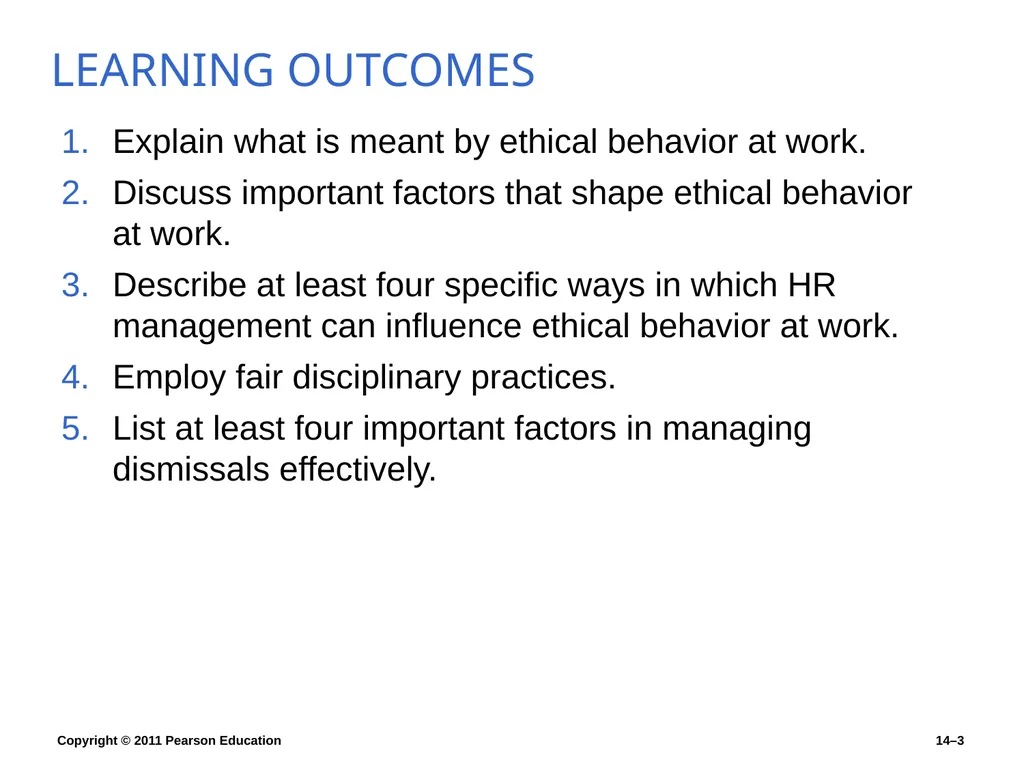
Copyright © 2011 Pearson Education 14–3 Explain what is meant by ethical behavior at work.
Discuss important factors that shape ethical behavior at work.
Describe at least four specific ways in which HR management can influence ethical behavior at work.
Employ fair disciplinary practices.
List at least four important factors in managing dismissals effectively. LEARNING OUTCOMES<br>
Discuss important factors that shape ethical behavior at work.
Describe at least four specific ways in which HR management can influence ethical behavior at work.
Employ fair disciplinary practices.
List at least four important factors in managing dismissals effectively. LEARNING OUTCOMES<br>
04
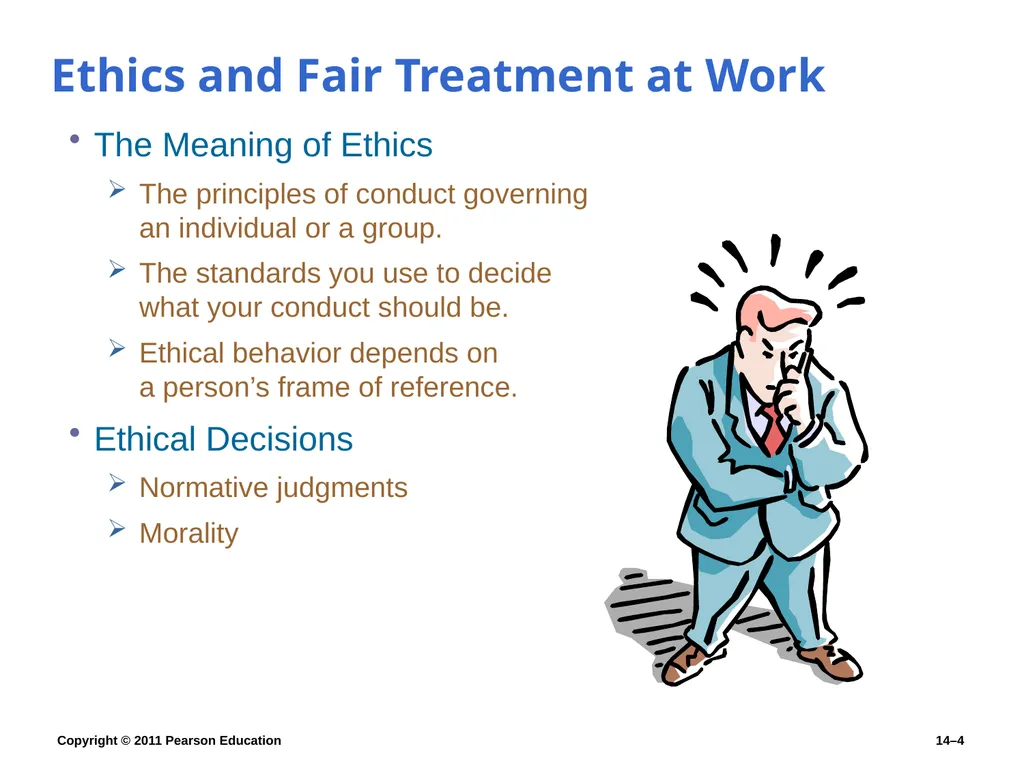
Copyright © 2011 Pearson Education 14–4 Ethics and Fair Treatment at Work The Meaning of Ethics
The principles of conduct governing an individual or a group.
The standards you use to decide what your conduct should be.
Ethical behavior depends on a person’s frame of reference.
Ethical Decisions
Normative judgments
Morality<br>
The principles of conduct governing an individual or a group.
The standards you use to decide what your conduct should be.
Ethical behavior depends on a person’s frame of reference.
Ethical Decisions
Normative judgments
Morality<br>
05
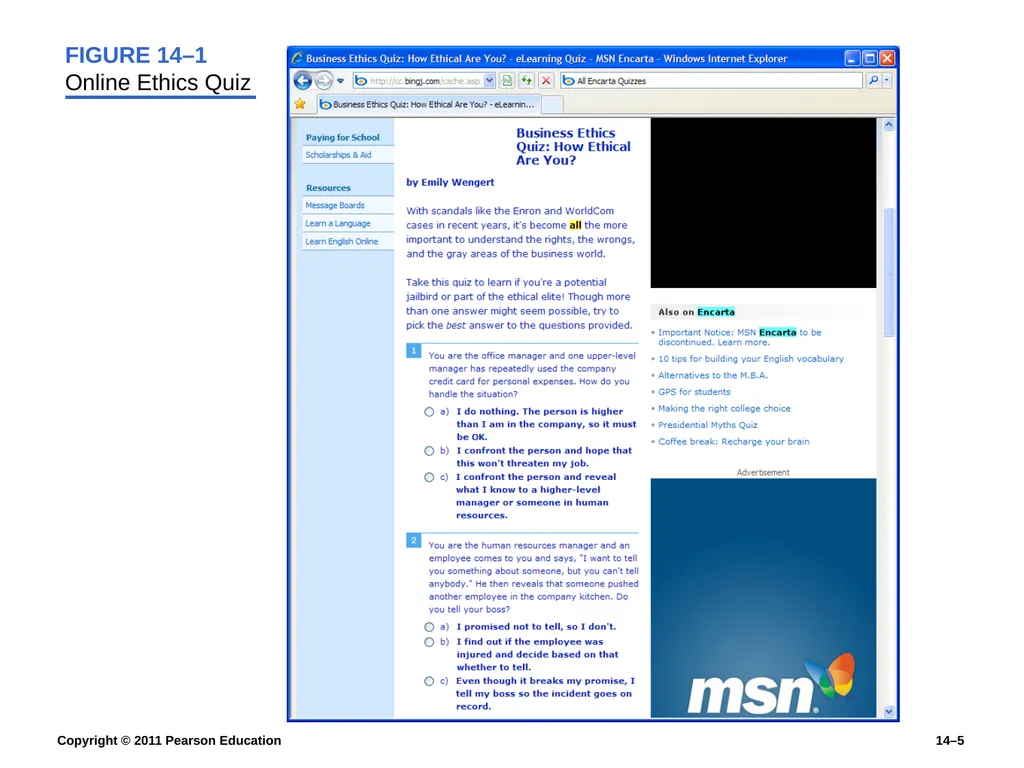
Copyright © 2011 Pearson Education 14–5 FIGURE 14–1
Online Ethics Quiz<br>
06
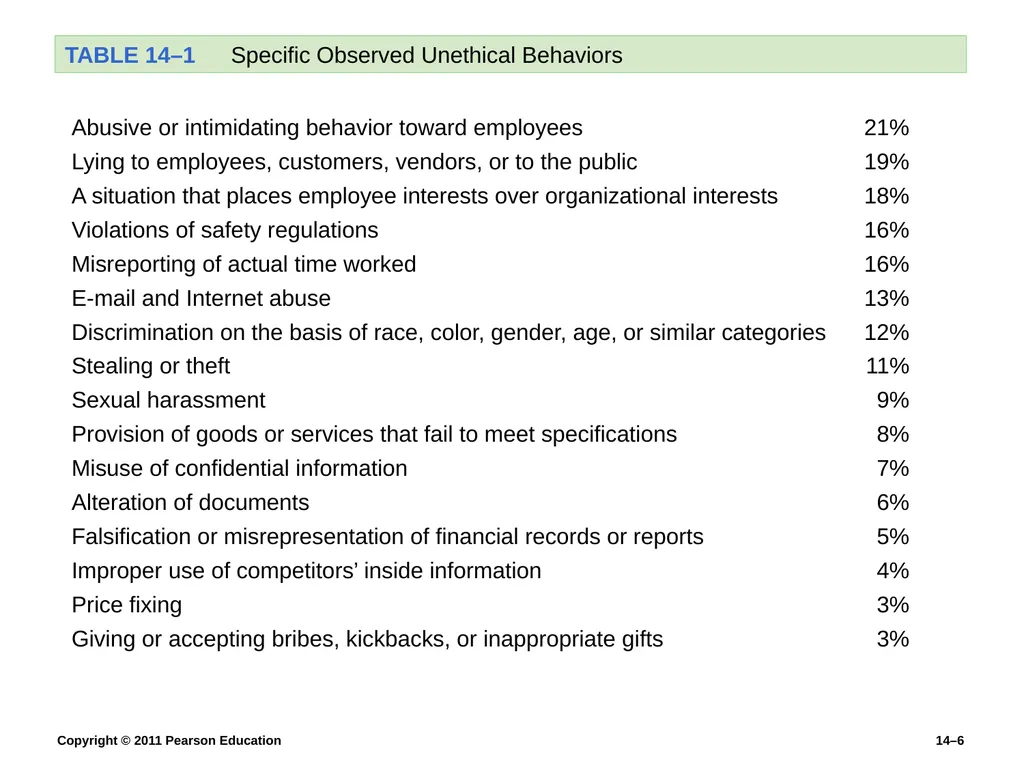
Copyright © 2011 Pearson Education 14–6 TABLE 14–1 Specific Observed Unethical Behaviors Abusive or intimidating behavior toward employees 21%
Lying to employees, customers, vendors, or to the public 19%
A situation that places employee interests over organizational interests 18%
Violations of safety regulations 16%
Misreporting of actual time worked 16%
E-mail and Internet abuse 13%
Discrimination on the basis of race, color, gender, age, or similar categories 12%
Stealing or theft 11%
Sexual harassment 9%
Provision of goods or services that fail to meet specifications 8%
Misuse of confidential information 7%
Alteration of documents 6%
Falsification or misrepresentation of financial records or reports 5%
Improper use of competitors’ inside information 4%
Price fixing 3%
Giving or accepting bribes, kickbacks, or inappropriate gifts 3%<br>
07
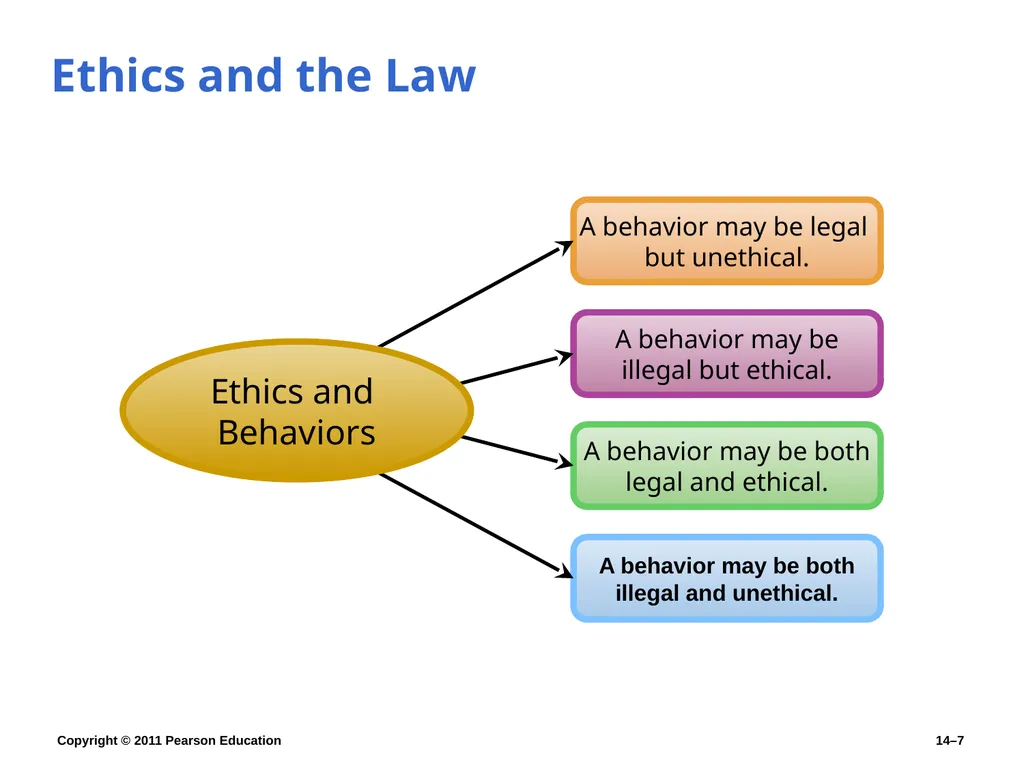
Copyright © 2011 Pearson Education 14–7 Ethics and the Law<br>
08
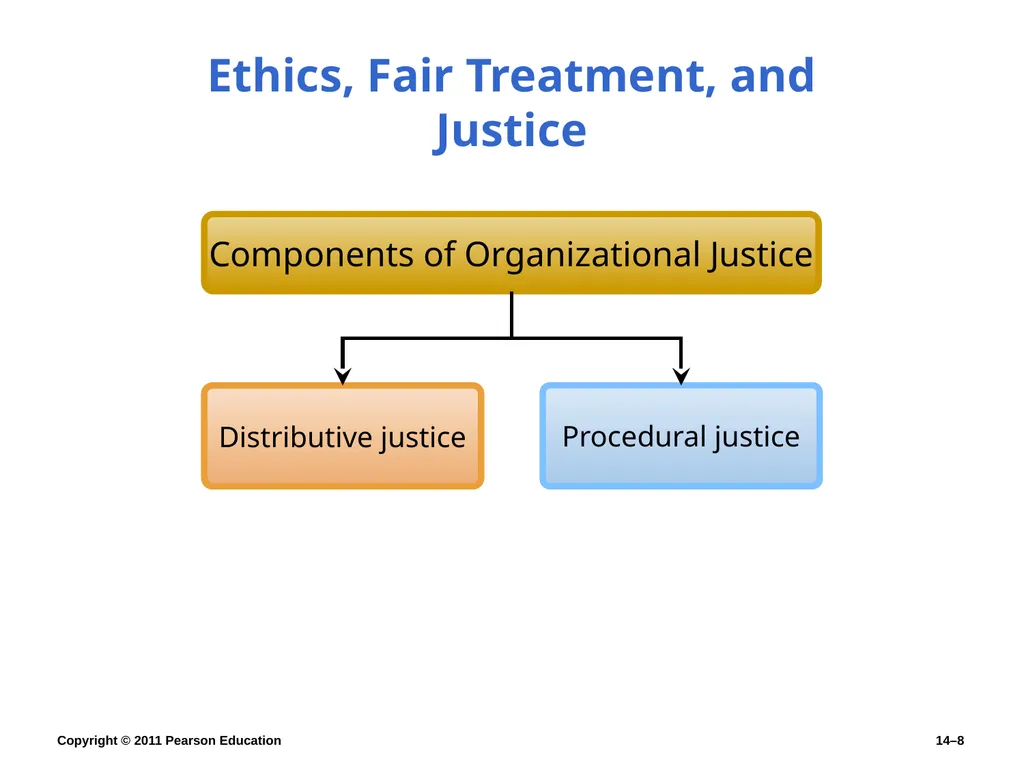
Copyright © 2011 Pearson Education 14–8 Ethics, Fair Treatment, and Justice<br>
09
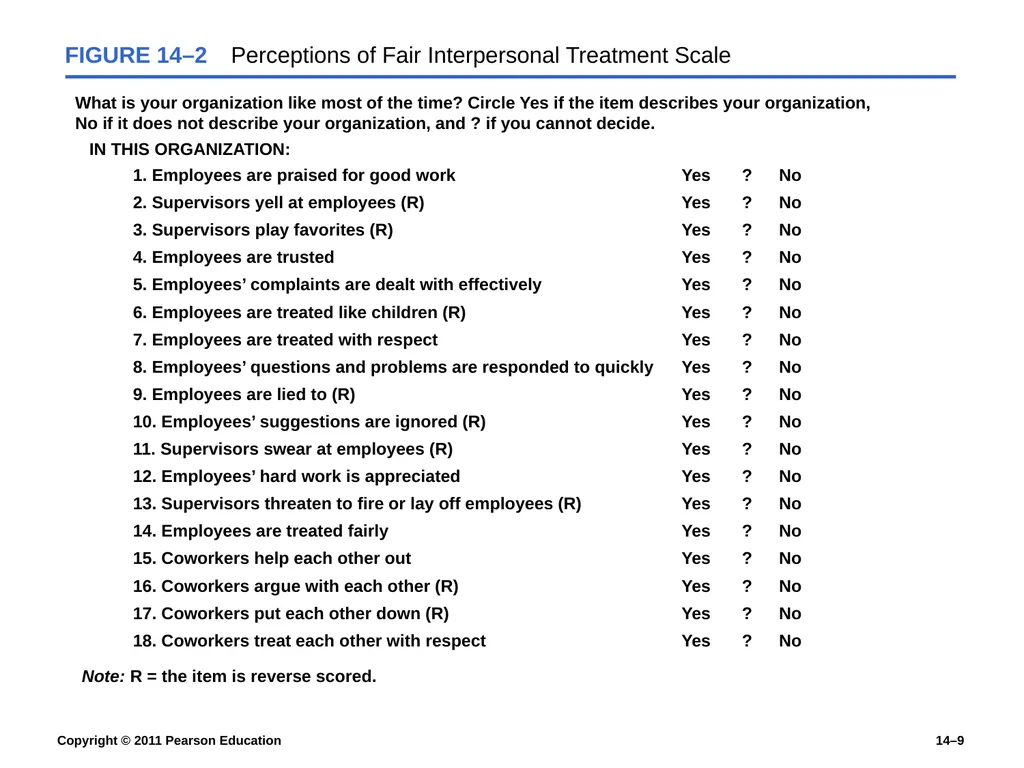
Copyright © 2011 Pearson Education 14–9 FIGURE 14–2 Perceptions of Fair Interpersonal Treatment Scale What is your organization like most of the time? Circle Yes if the item describes your organization,
No if it does not describe your organization, and ? if you cannot decide.
IN THIS ORGANIZATION: Note: R = the item is reverse scored.<br>
IN THIS ORGANIZATION: Note: R = the item is reverse scored.<br>
10
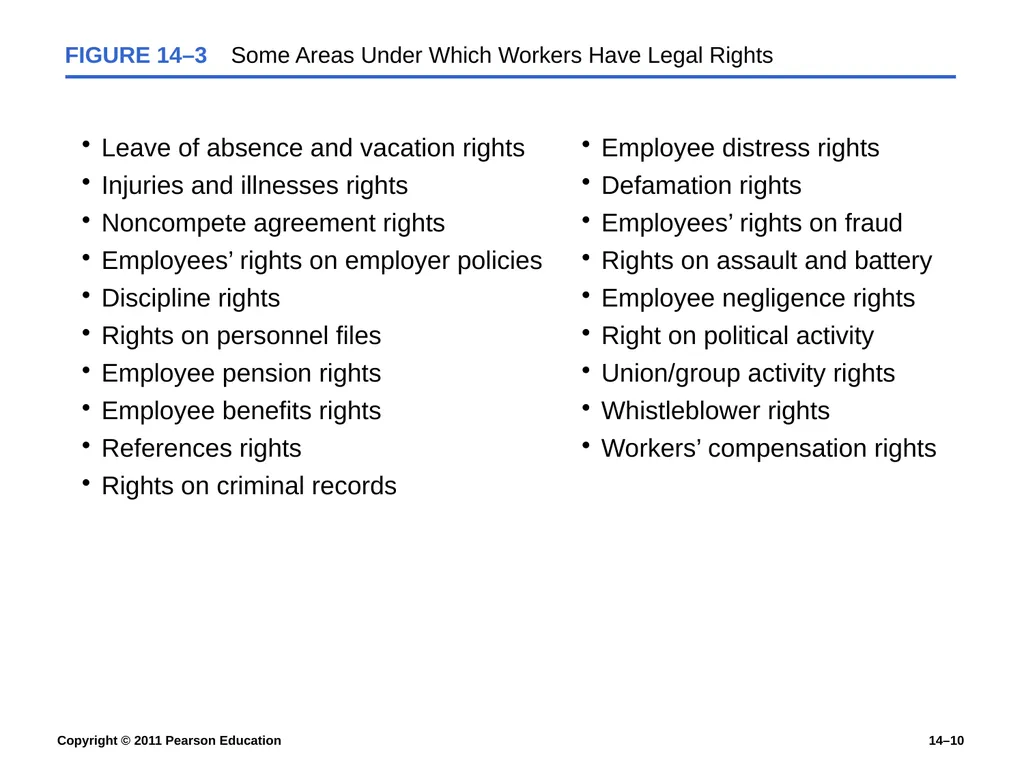
Copyright © 2011 Pearson Education 14–10 FIGURE 14–3 Some Areas Under Which Workers Have Legal Rights<br>
11
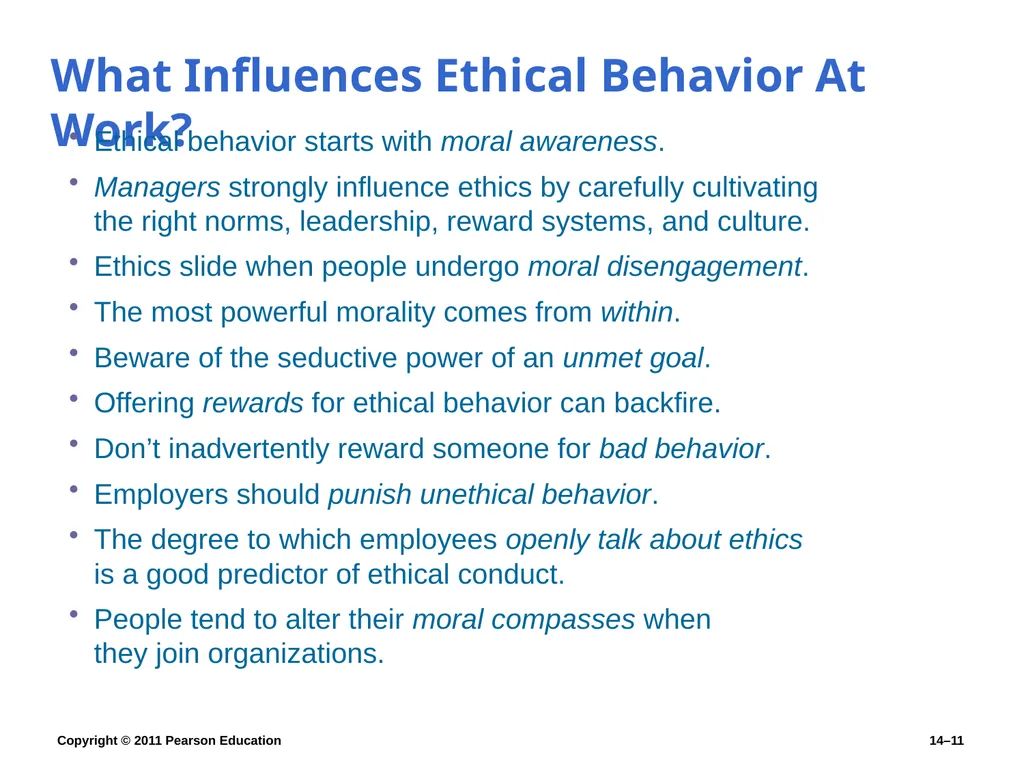
Copyright © 2011 Pearson Education 14–11 What Influences Ethical Behavior At Work? Ethical behavior starts with moral awareness.
Managers strongly influence ethics by carefully cultivating the right norms, leadership, reward systems, and culture.
Ethics slide when people undergo moral disengagement.
The most powerful morality comes from within.
Beware of the seductive power of an unmet goal.
Offering rewards for ethical behavior can backfire.
Don’t inadvertently reward someone for bad behavior.
Employers should punish unethical behavior.
The degree to which employees openly talk about ethics is a good predictor of ethical conduct.
People tend to alter their moral compasses when they join organizations.<br>
12
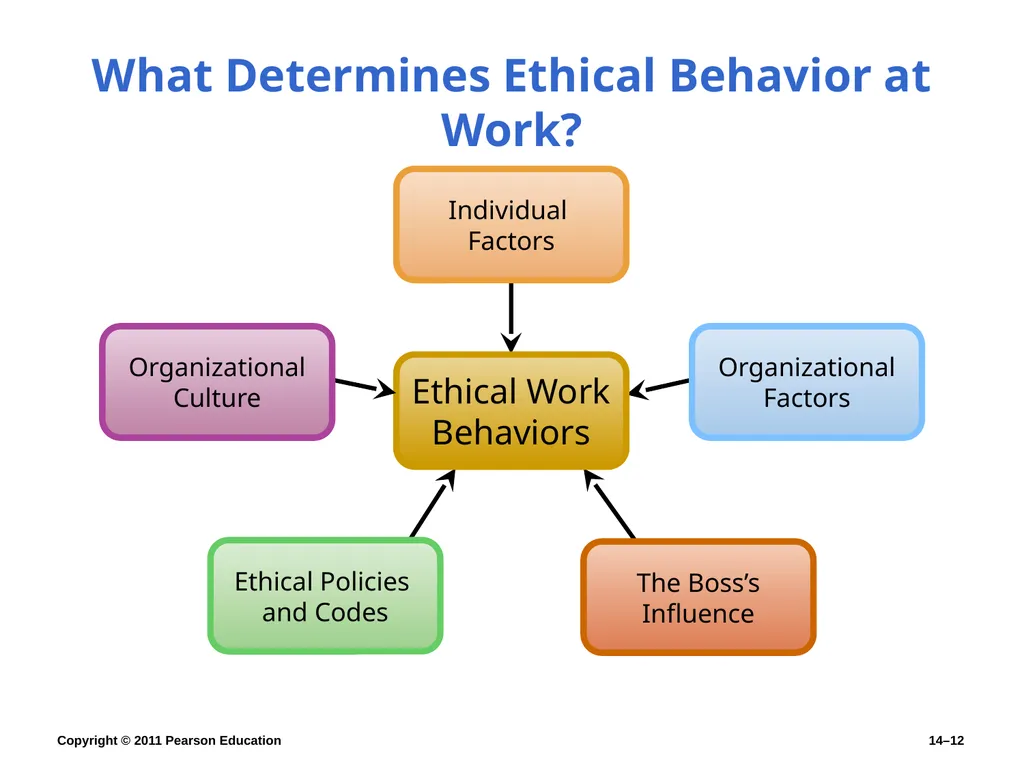
Copyright © 2011 Pearson Education 14–12 What Determines Ethical Behavior at Work?<br>
13
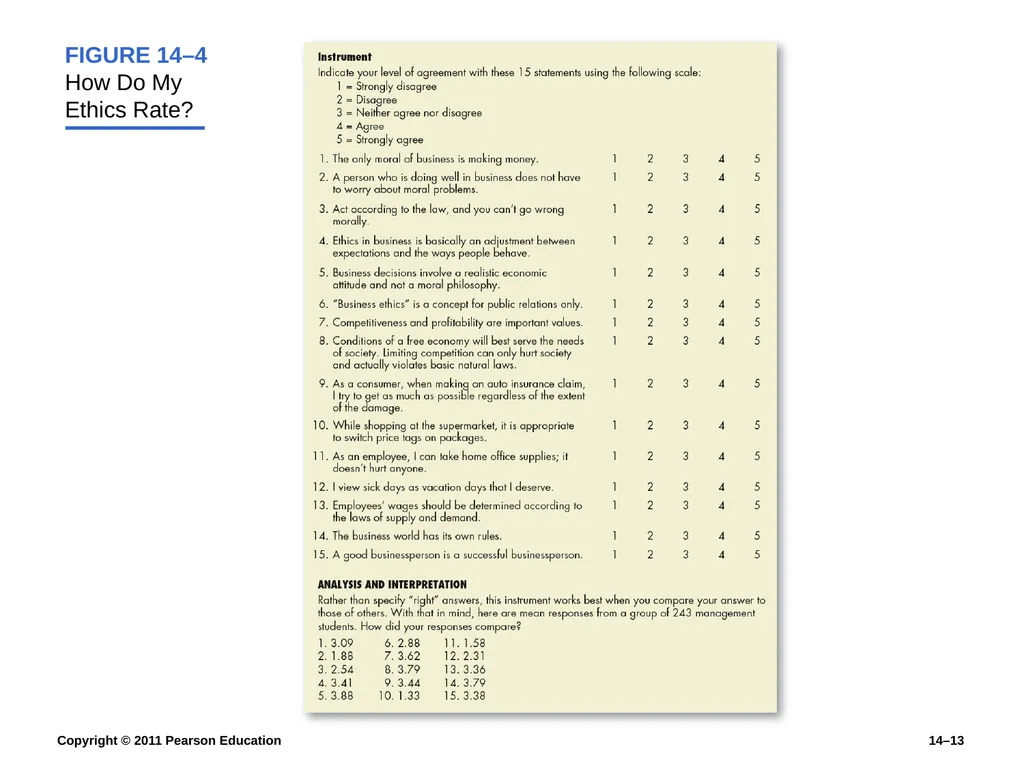
Copyright © 2011 Pearson Education 14–13 FIGURE 14–4
How Do My
Ethics Rate?<br>
14
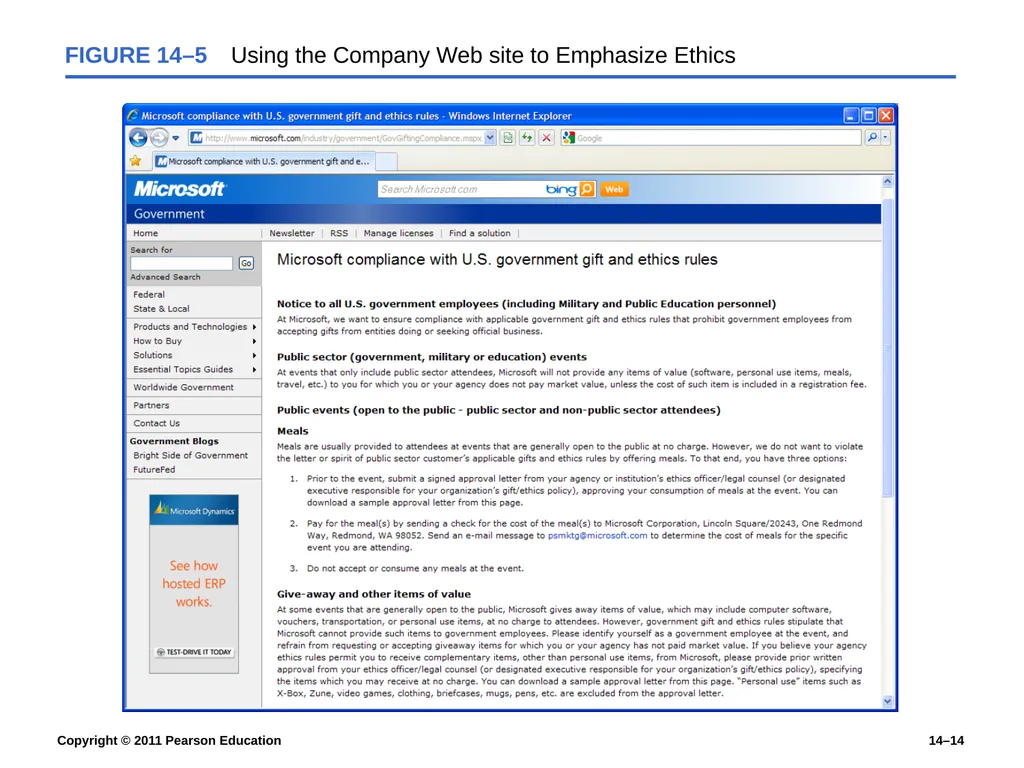
Copyright © 2011 Pearson Education 14–14 FIGURE 14–5 Using the Company Web site to Emphasize Ethics<br>
15
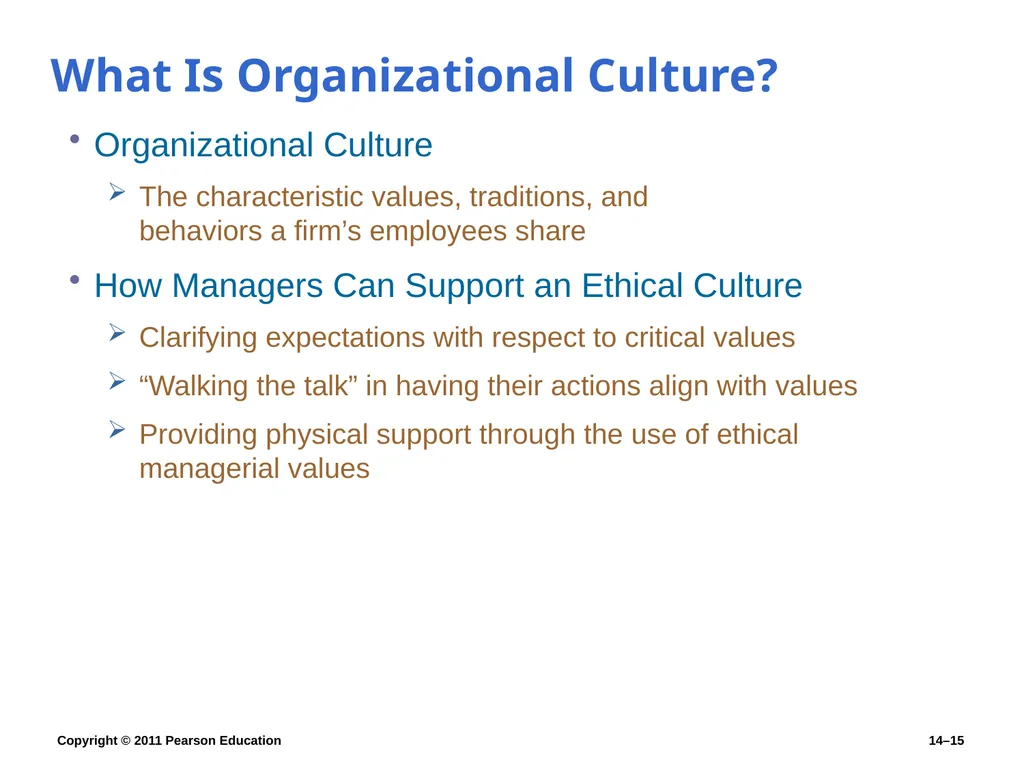
Copyright © 2011 Pearson Education 14–15 What Is Organizational Culture? Organizational Culture
The characteristic values, traditions, and behaviors a firm’s employees share
How Managers Can Support an Ethical Culture
Clarifying expectations with respect to critical values
“Walking the talk” in having their actions align with values
Providing physical support through the use of ethical managerial values<br>
16
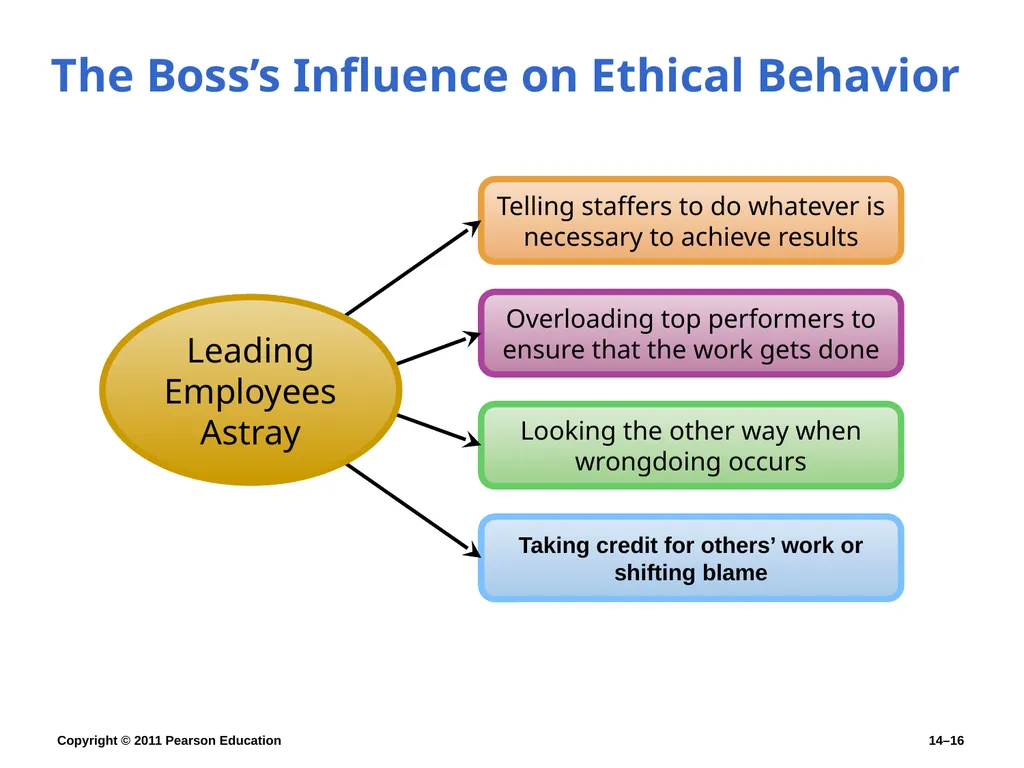
Copyright © 2011 Pearson Education 14–16 The Boss’s Influence on Ethical Behavior<br>
17
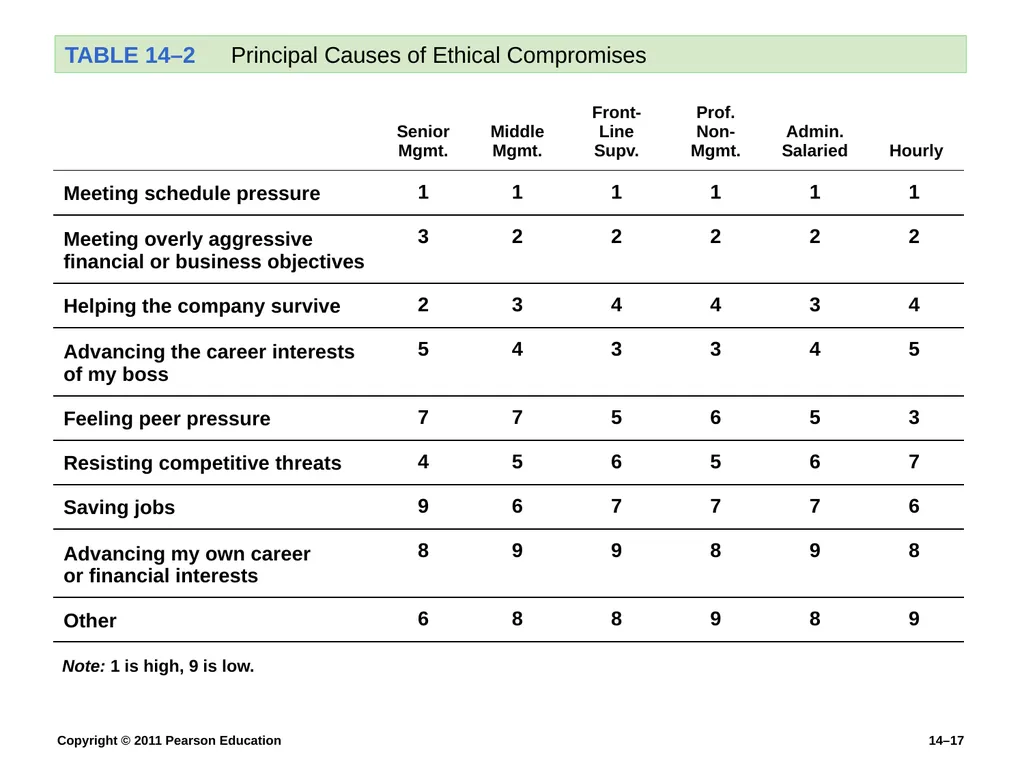
Copyright © 2011 Pearson Education 14–17 TABLE 14–2 Principal Causes of Ethical Compromises Note: 1 is high, 9 is low.<br>
18
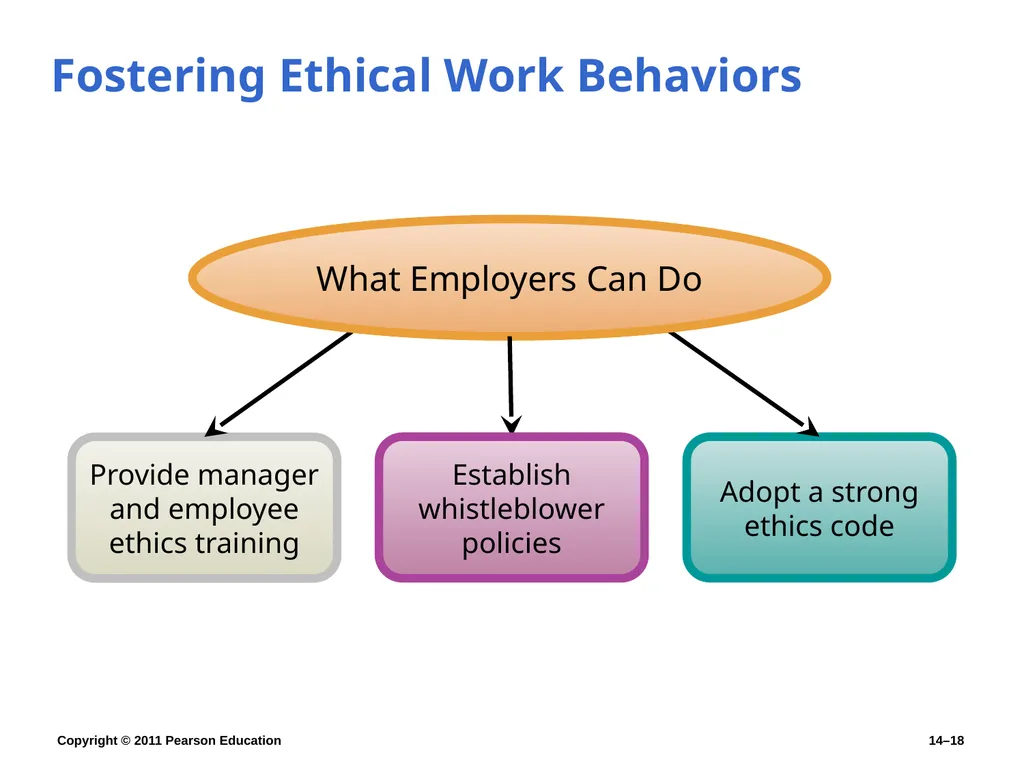
Copyright © 2011 Pearson Education 14–18 Fostering Ethical Work Behaviors<br>
19
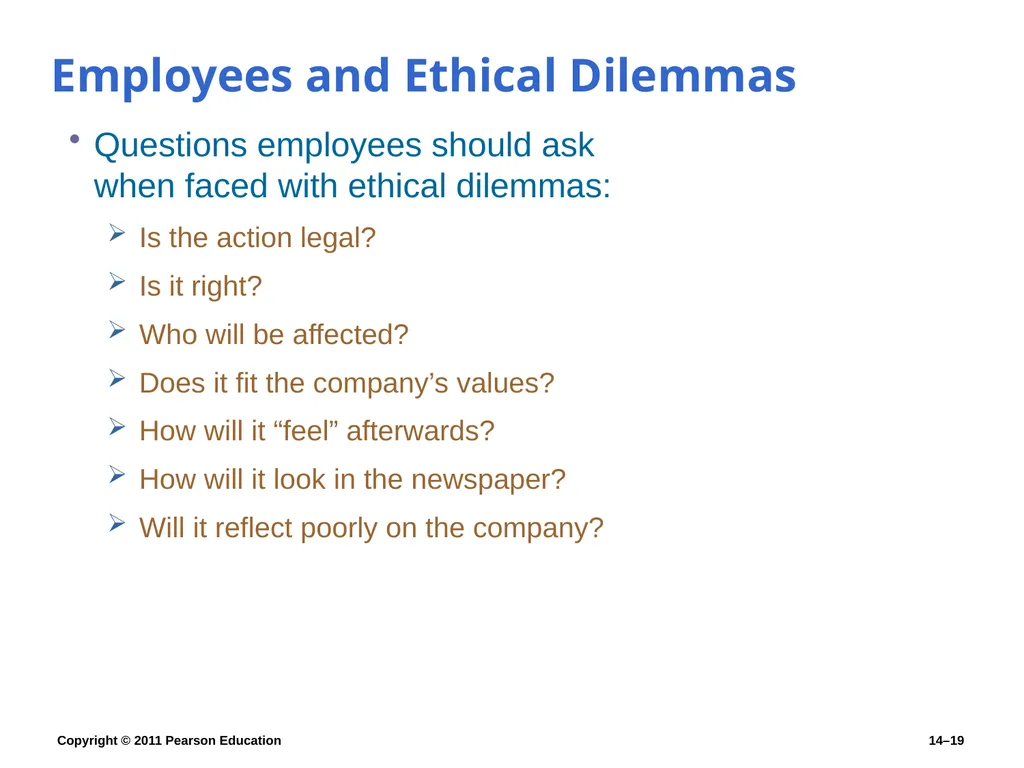
Copyright © 2011 Pearson Education 14–19 Employees and Ethical Dilemmas Questions employees should ask when faced with ethical dilemmas:
Is the action legal?
Is it right?
Who will be affected?
Does it fit the company’s values?
How will it “feel” afterwards?
How will it look in the newspaper?
Will it reflect poorly on the company?<br>
Is the action legal?
Is it right?
Who will be affected?
Does it fit the company’s values?
How will it “feel” afterwards?
How will it look in the newspaper?
Will it reflect poorly on the company?<br>
20
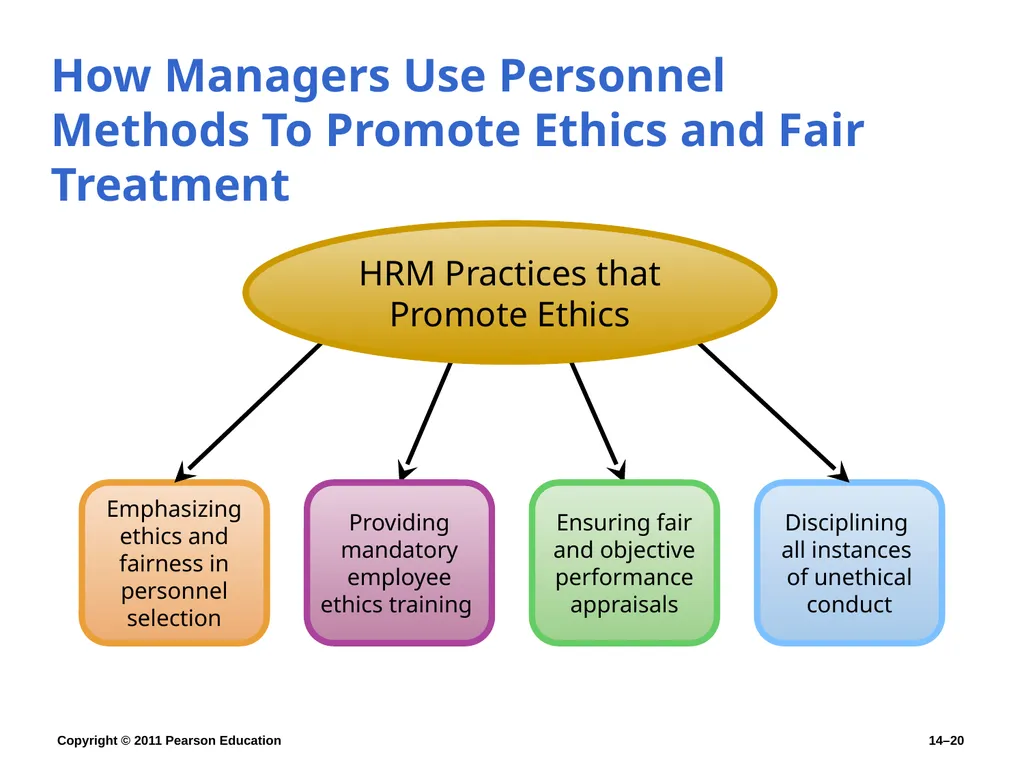
Copyright © 2011 Pearson Education 14–20 How Managers Use Personnel Methods To Promote Ethics and Fair Treatment<br>
21
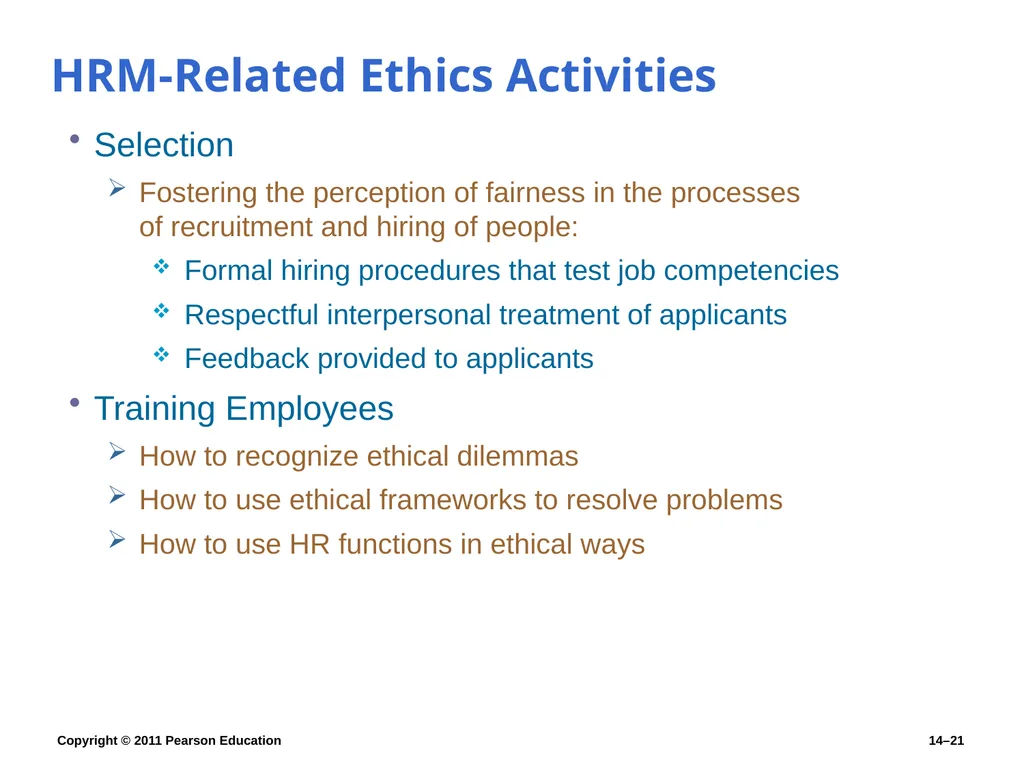
Copyright © 2011 Pearson Education 14–21 HRM-Related Ethics Activities Selection
Fostering the perception of fairness in the processes of recruitment and hiring of people:
Formal hiring procedures that test job competencies
Respectful interpersonal treatment of applicants
Feedback provided to applicants
Training Employees
How to recognize ethical dilemmas
How to use ethical frameworks to resolve problems
How to use HR functions in ethical ways<br>
22
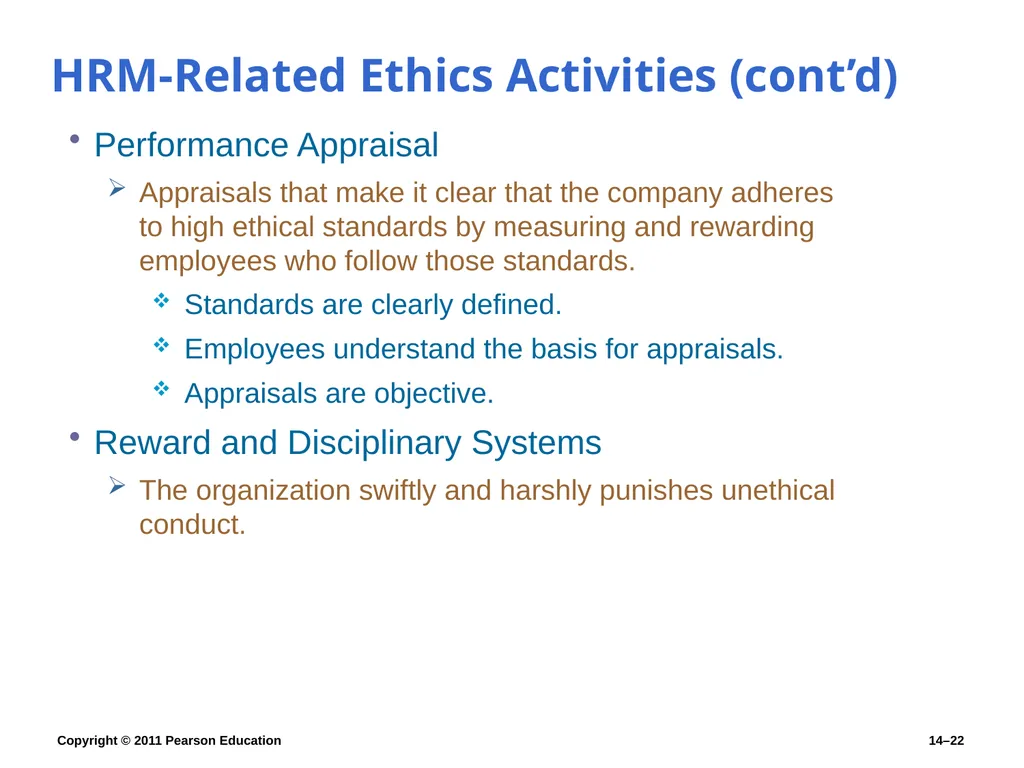
Copyright © 2011 Pearson Education 14–22 HRM-Related Ethics Activities (cont’d) Performance Appraisal
Appraisals that make it clear that the company adheres to high ethical standards by measuring and rewarding employees who follow those standards.
Standards are clearly defined.
Employees understand the basis for appraisals.
Appraisals are objective.
Reward and Disciplinary Systems
The organization swiftly and harshly punishes unethical conduct.<br>
23
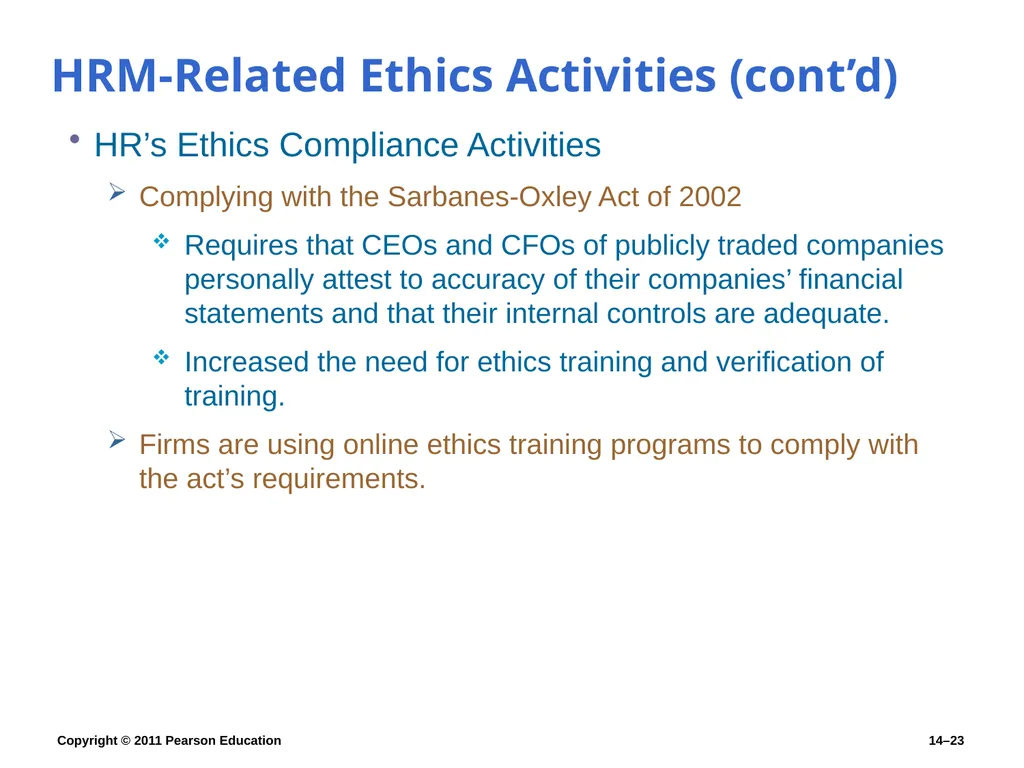
Copyright © 2011 Pearson Education 14–23 HRM-Related Ethics Activities (cont’d) HR’s Ethics Compliance Activities
Complying with the Sarbanes-Oxley Act of 2002
Requires that CEOs and CFOs of publicly traded companies personally attest to accuracy of their companies’ financial statements and that their internal controls are adequate.
Increased the need for ethics training and verification of training.
Firms are using online ethics training programs to comply with the act’s requirements.<br>
24
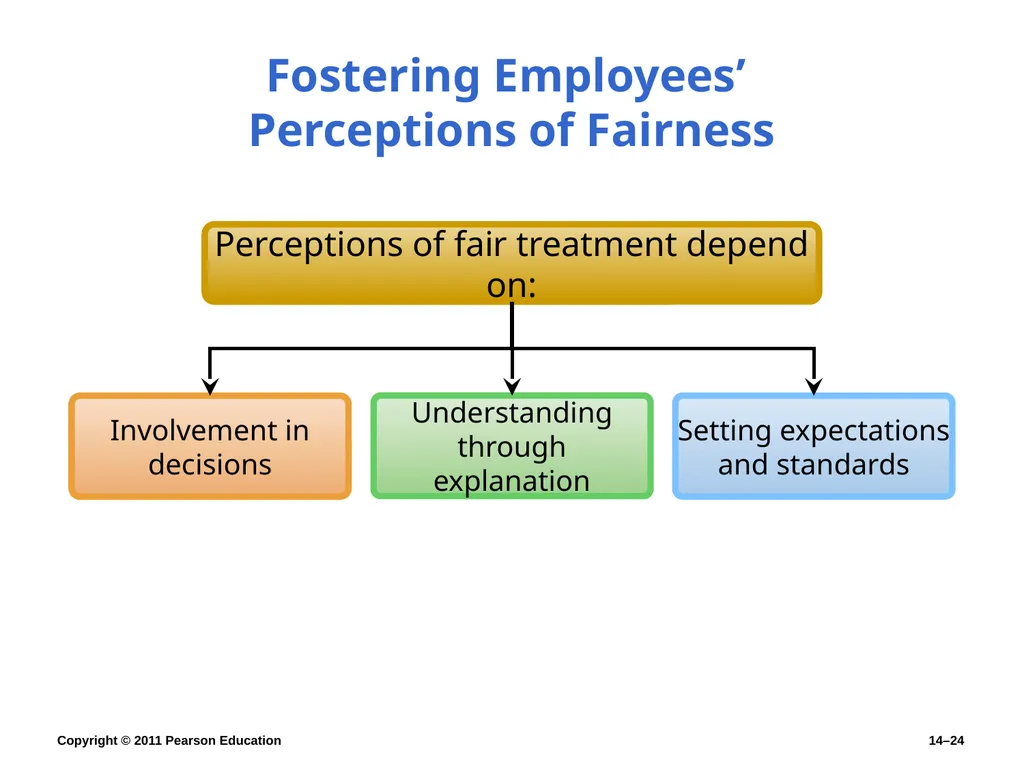
Copyright © 2011 Pearson Education 14–24 Fostering Employees’
Perceptions of Fairness<br>
25
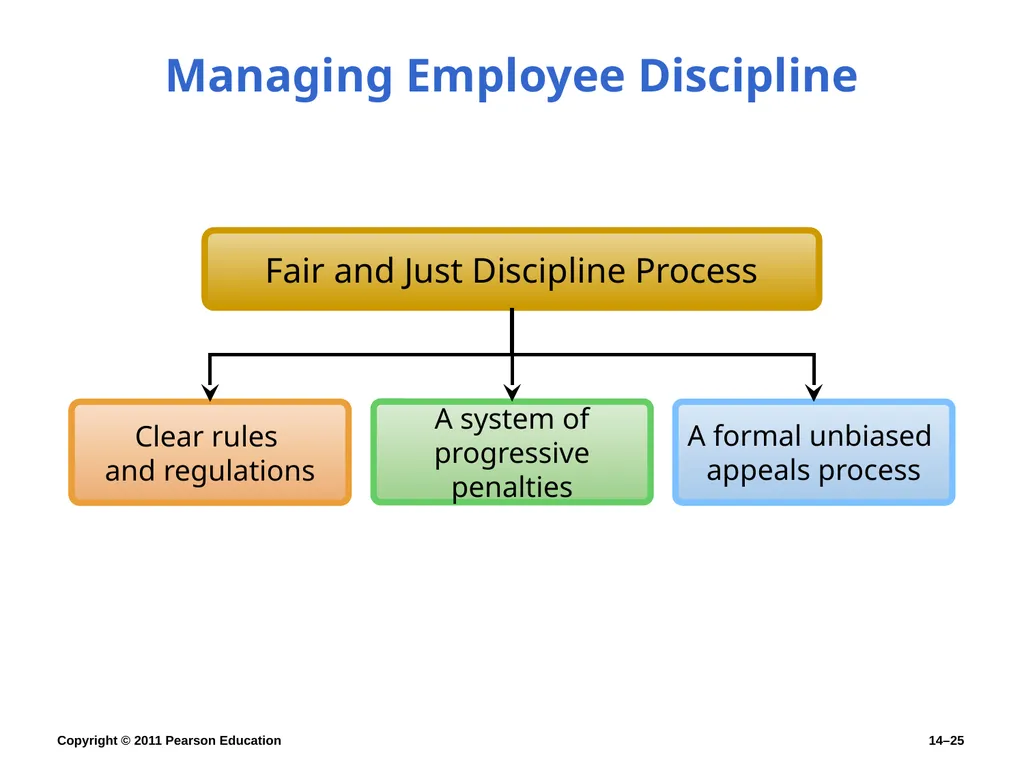
Copyright © 2011 Pearson Education 14–25 Managing Employee Discipline<br>
26
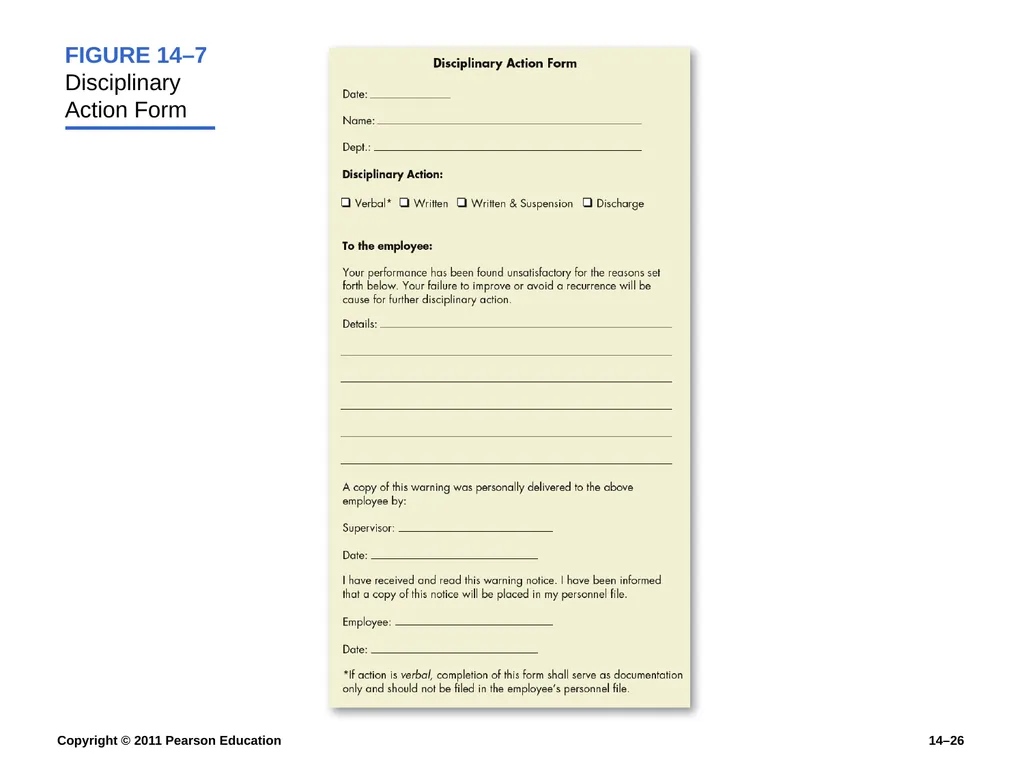
Copyright © 2011 Pearson Education 14–26 FIGURE 14–7
Disciplinary
Action Form<br>
27
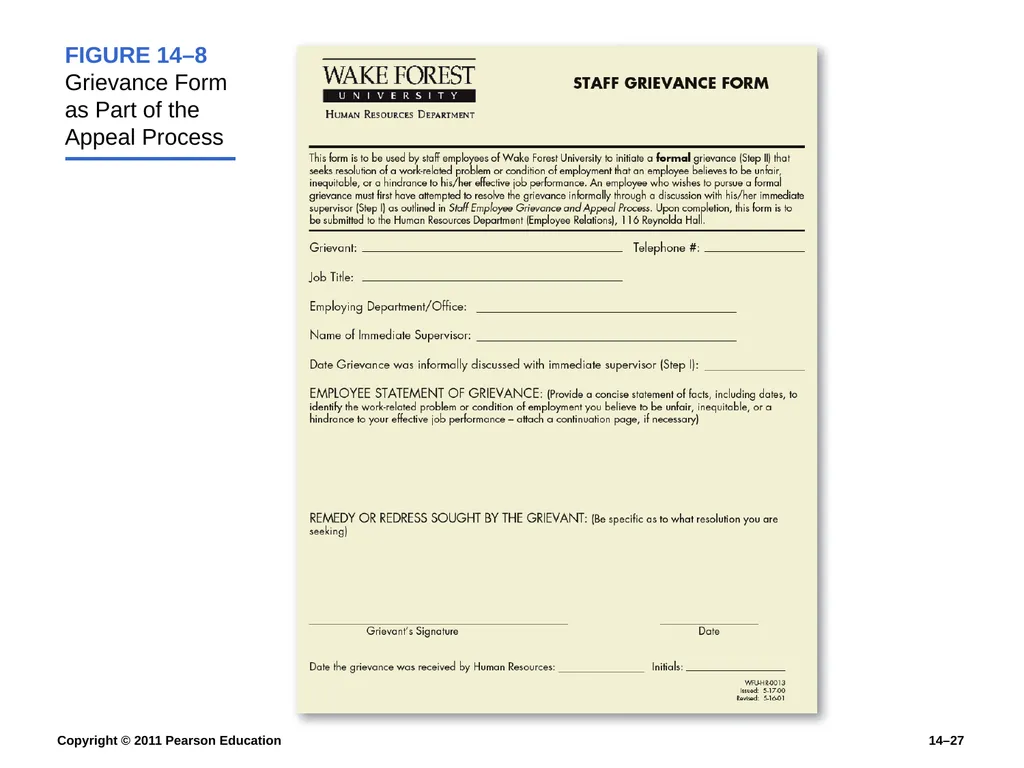
Copyright © 2011 Pearson Education 14–27 FIGURE 14–8
Grievance Form as Part of the Appeal Process<br>
28
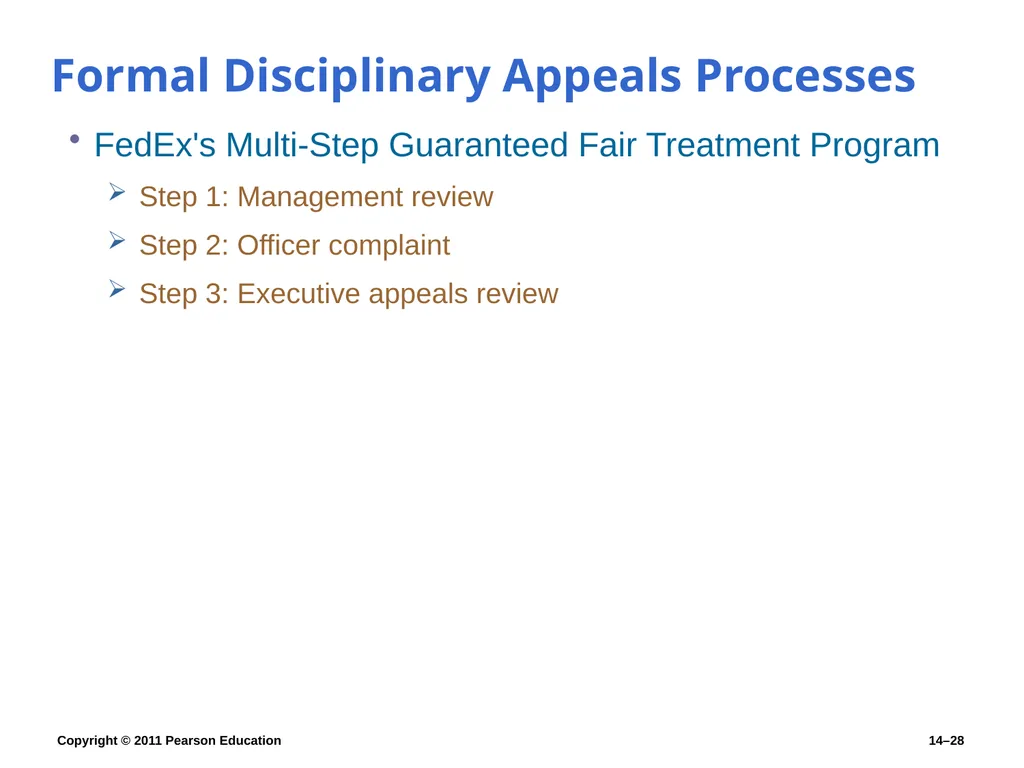
Copyright © 2011 Pearson Education 14–28 Formal Disciplinary Appeals Processes FedEx's Multi-Step Guaranteed Fair Treatment Program
Step 1: Management review
Step 2: Officer complaint
Step 3: Executive appeals review<br>
Step 1: Management review
Step 2: Officer complaint
Step 3: Executive appeals review<br>
29
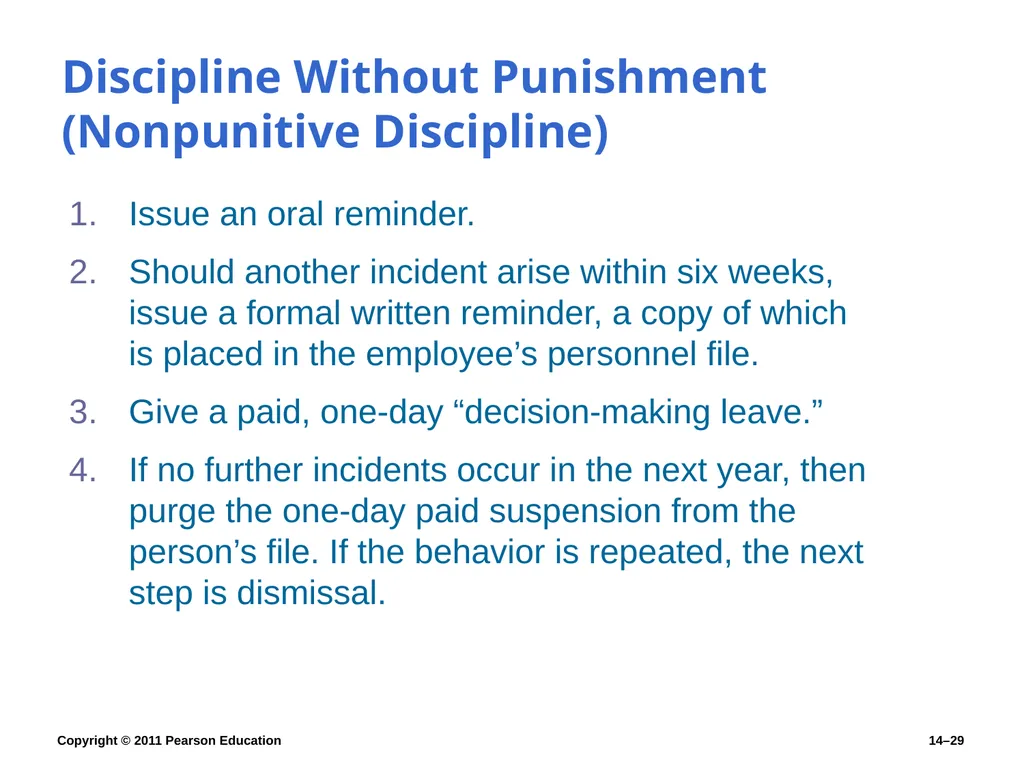
Copyright © 2011 Pearson Education 14–29 Discipline Without Punishment
(Nonpunitive Discipline) Issue an oral reminder.
Should another incident arise within six weeks, issue a formal written reminder, a copy of which is placed in the employee’s personnel file.
Give a paid, one-day “decision-making leave.”
If no further incidents occur in the next year, then purge the one-day paid suspension from the person’s file. If the behavior is repeated, the next step is dismissal.<br>
30
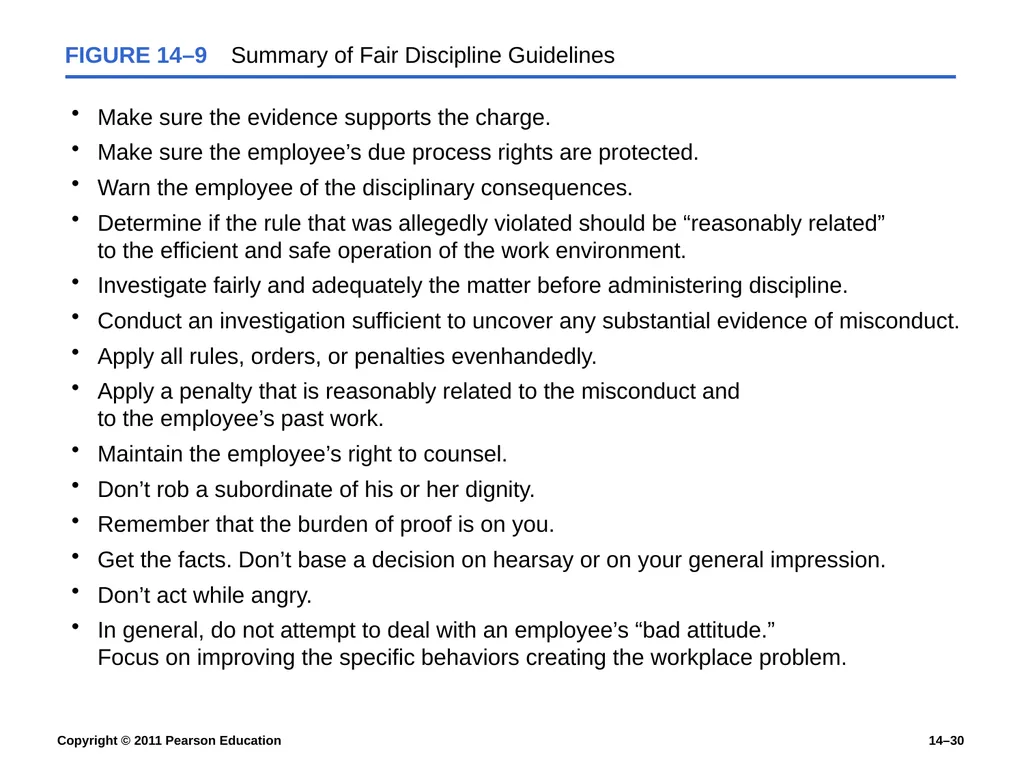
Copyright © 2011 Pearson Education 14–30 FIGURE 14–9 Summary of Fair Discipline Guidelines Make sure the evidence supports the charge.
Make sure the employee’s due process rights are protected.
Warn the employee of the disciplinary consequences.
Determine if the rule that was allegedly violated should be “reasonably related” to the efficient and safe operation of the work environment.
Investigate fairly and adequately the matter before administering discipline.
Conduct an investigation sufficient to uncover any substantial evidence of misconduct.
Apply all rules, orders, or penalties evenhandedly.
Apply a penalty that is reasonably related to the misconduct and to the employee’s past work.
Maintain the employee’s right to counsel.
Don’t rob a subordinate of his or her dignity.
Remember that the burden of proof is on you.
Get the facts. Don’t base a decision on hearsay or on your general impression.
Don’t act while angry.
In general, do not attempt to deal with an employee’s “bad attitude.” Focus on improving the specific behaviors creating the workplace problem.<br>
31
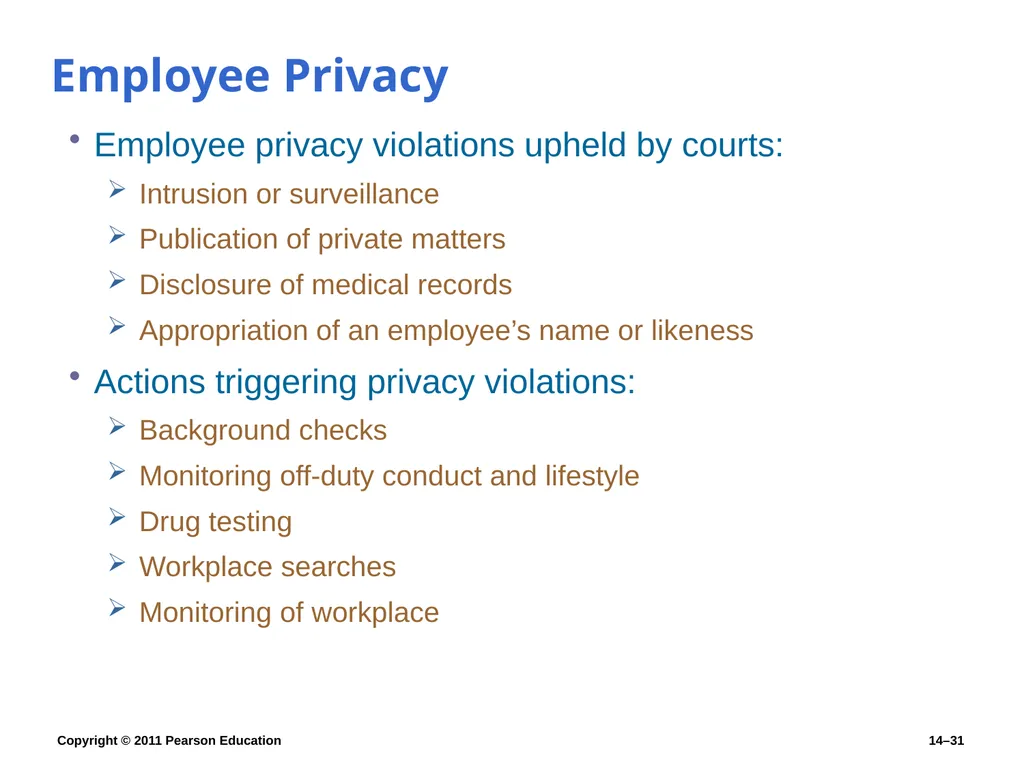
Copyright © 2011 Pearson Education 14–31 Employee Privacy Employee privacy violations upheld by courts:
Intrusion or surveillance
Publication of private matters
Disclosure of medical records
Appropriation of an employee’s name or likeness
Actions triggering privacy violations:
Background checks
Monitoring off-duty conduct and lifestyle
Drug testing
Workplace searches
Monitoring of workplace<br>
Intrusion or surveillance
Publication of private matters
Disclosure of medical records
Appropriation of an employee’s name or likeness
Actions triggering privacy violations:
Background checks
Monitoring off-duty conduct and lifestyle
Drug testing
Workplace searches
Monitoring of workplace<br>
32
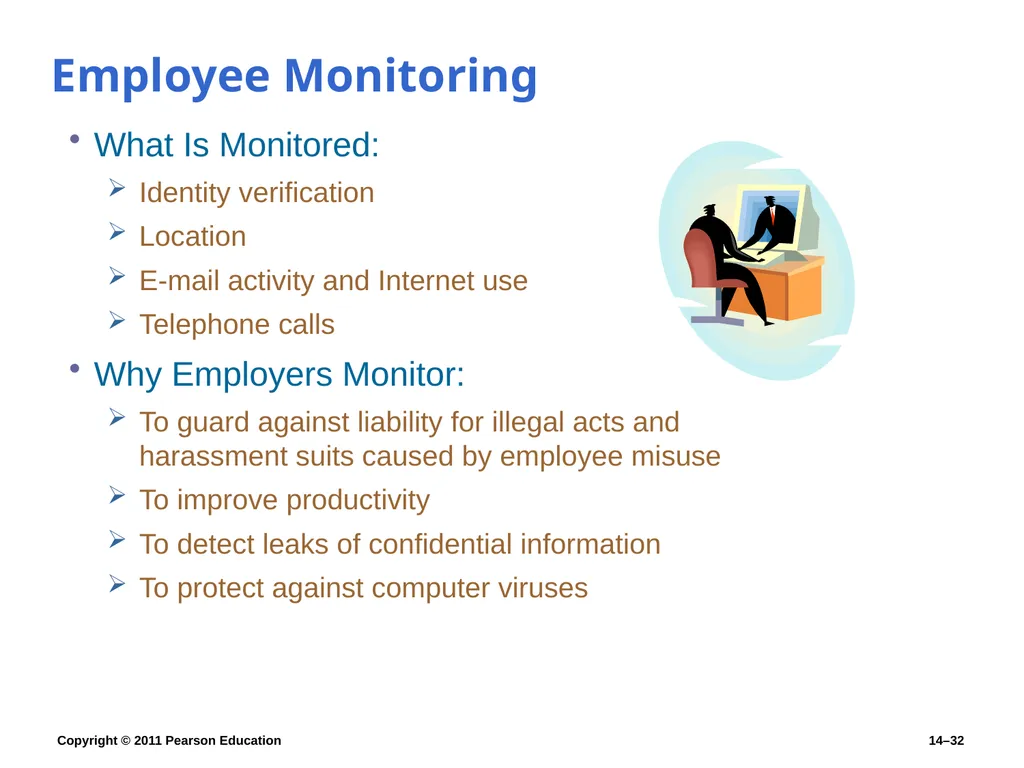
Copyright © 2011 Pearson Education 14–32 Employee Monitoring What Is Monitored:
Identity verification
Location
E-mail activity and Internet use
Telephone calls
Why Employers Monitor:
To guard against liability for illegal acts and harassment suits caused by employee misuse
To improve productivity
To detect leaks of confidential information
To protect against computer viruses<br>
33
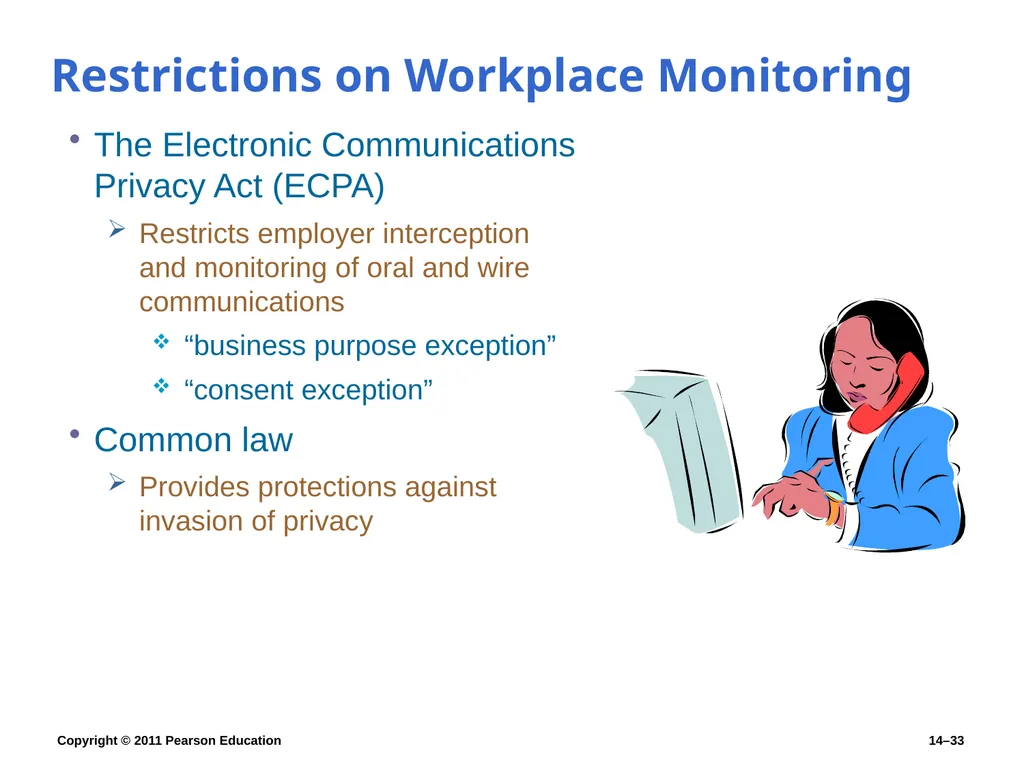
Copyright © 2011 Pearson Education 14–33 Restrictions on Workplace Monitoring The Electronic Communications Privacy Act (ECPA)
Restricts employer interception and monitoring of oral and wire communications
“business purpose exception”
“consent exception”
Common law
Provides protections against invasion of privacy<br>
Restricts employer interception and monitoring of oral and wire communications
“business purpose exception”
“consent exception”
Common law
Provides protections against invasion of privacy<br>
34
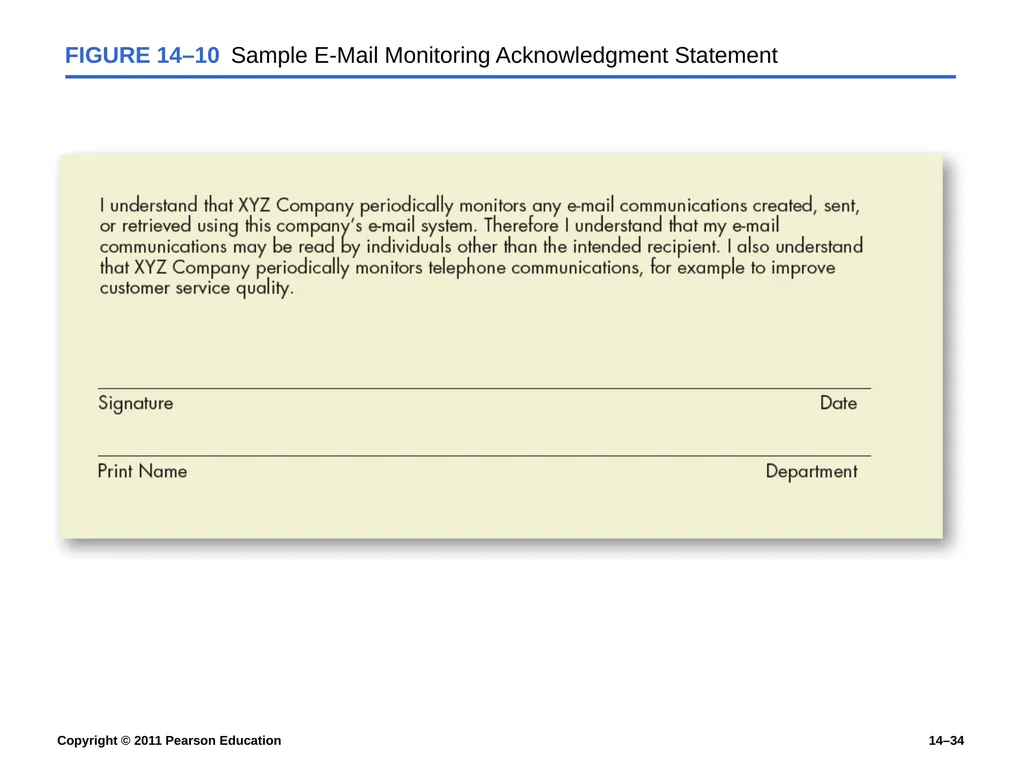
Copyright © 2011 Pearson Education 14–34 FIGURE 14–10 Sample E-Mail Monitoring Acknowledgment Statement<br>
35
Copyright © 2011 Pearson Education 14–35 Managing Dismissals Dismissal
Involuntary termination of an employee’s employment with the firm.
Terminate-at-Will Rule
Without a contract, the employee can resign for any reason, at will, and the employer can similarly dismiss the employee for any reason (or no reason), at will.
Wrongful Discharge
An employee dismissal that does not comply with the law or does not comply with the contractual arrangement stated or implied by the firm via its employment application forms, employee manuals, or other promises.<br>
36
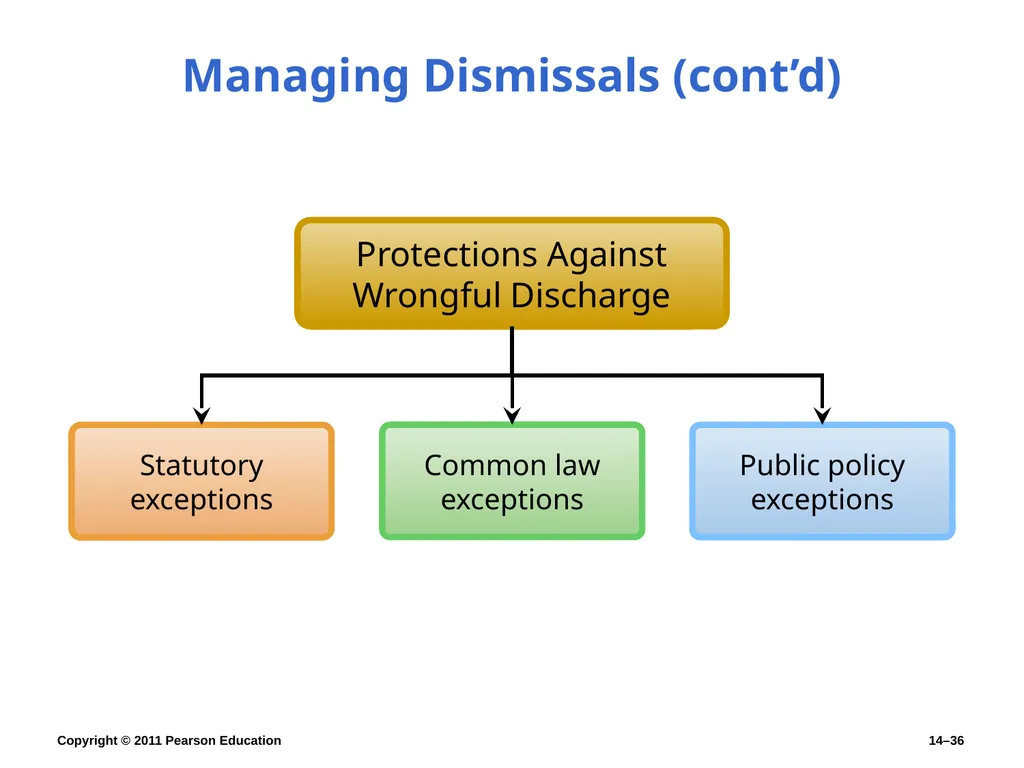
Copyright © 2011 Pearson Education 14–36 Managing Dismissals (cont’d)<br>
37
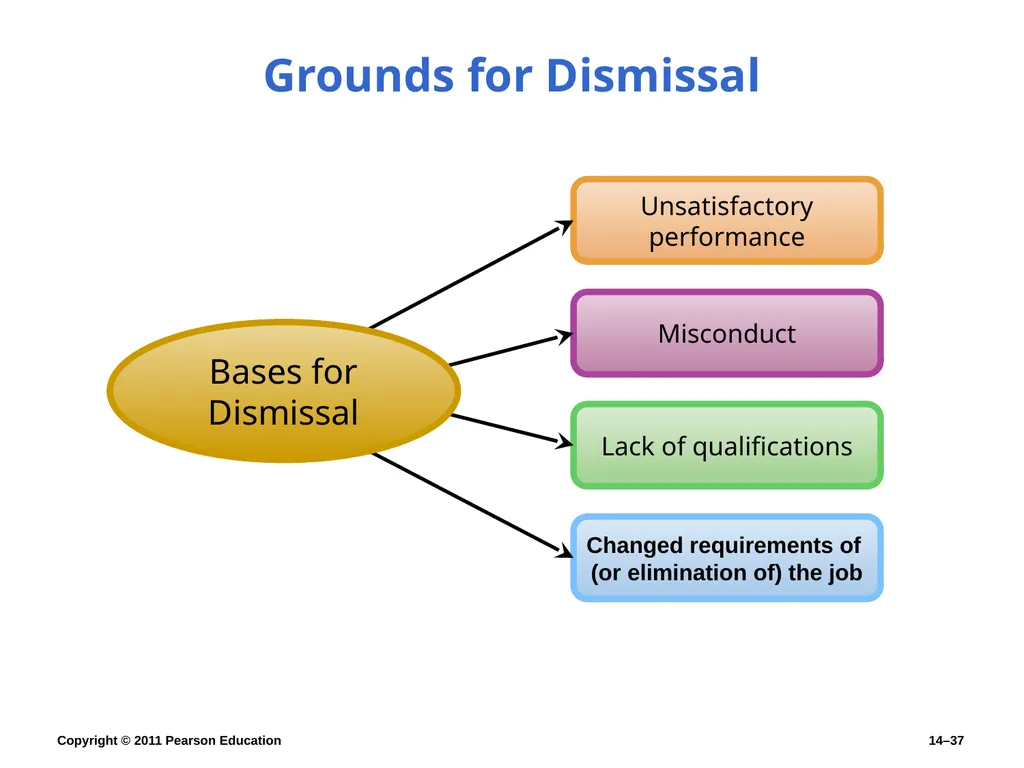
Copyright © 2011 Pearson Education 14–37 Grounds for Dismissal<br>
38
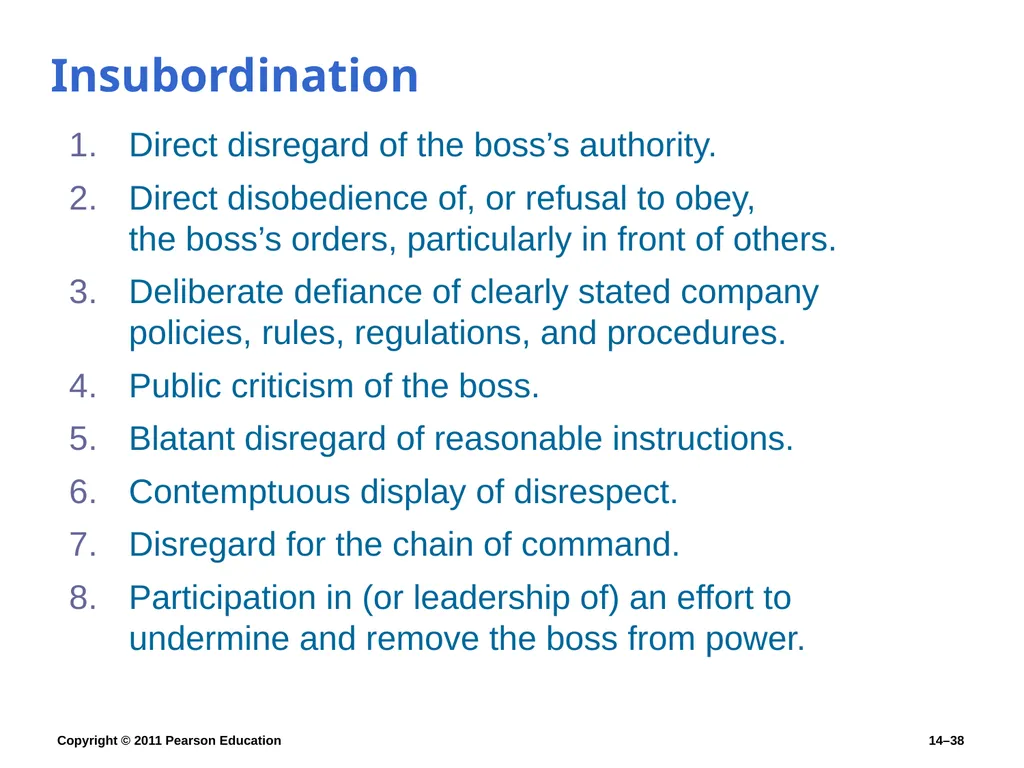
Copyright © 2011 Pearson Education 14–38 Insubordination Direct disregard of the boss’s authority.
Direct disobedience of, or refusal to obey, the boss’s orders, particularly in front of others.
Deliberate defiance of clearly stated company policies, rules, regulations, and procedures.
Public criticism of the boss.
Blatant disregard of reasonable instructions.
Contemptuous display of disrespect.
Disregard for the chain of command.
Participation in (or leadership of) an effort to undermine and remove the boss from power.<br>
39
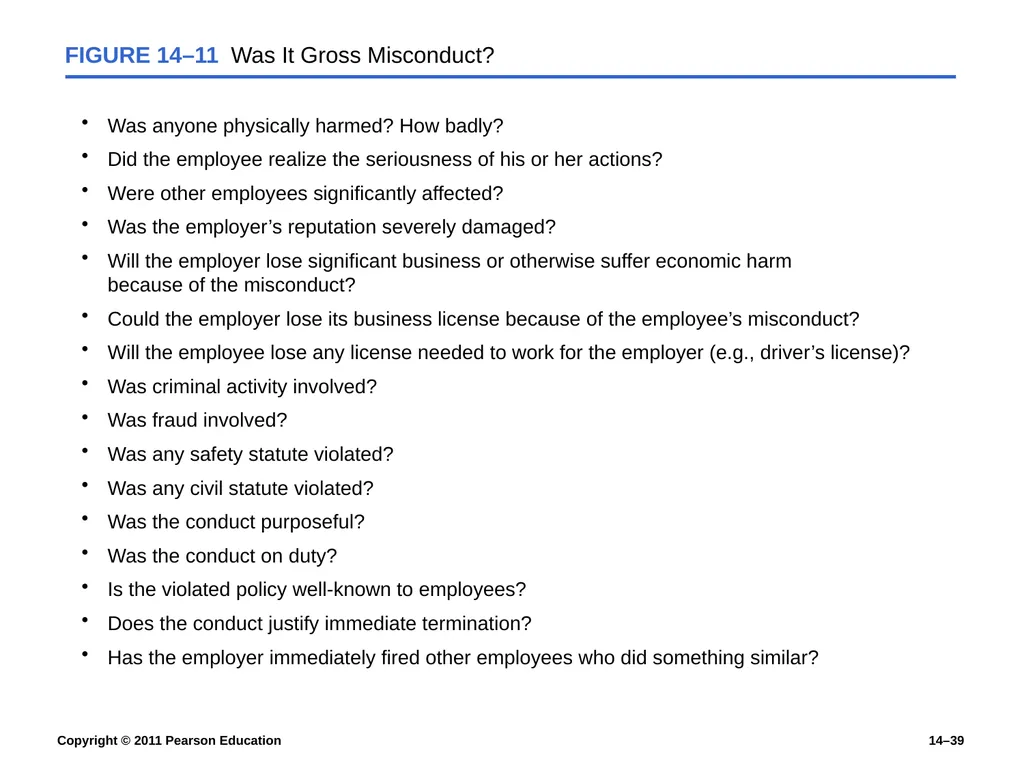
Copyright © 2011 Pearson Education 14–39 FIGURE 14–11 Was It Gross Misconduct? Was anyone physically harmed? How badly?
Did the employee realize the seriousness of his or her actions?
Were other employees significantly affected?
Was the employer’s reputation severely damaged?
Will the employer lose significant business or otherwise suffer economic harm because of the misconduct?
Could the employer lose its business license because of the employee’s misconduct?
Will the employee lose any license needed to work for the employer (e.g., driver’s license)?
Was criminal activity involved?
Was fraud involved?
Was any safety statute violated?
Was any civil statute violated?
Was the conduct purposeful?
Was the conduct on duty?
Is the violated policy well-known to employees?
Does the conduct justify immediate termination?
Has the employer immediately fired other employees who did something similar?<br>
40
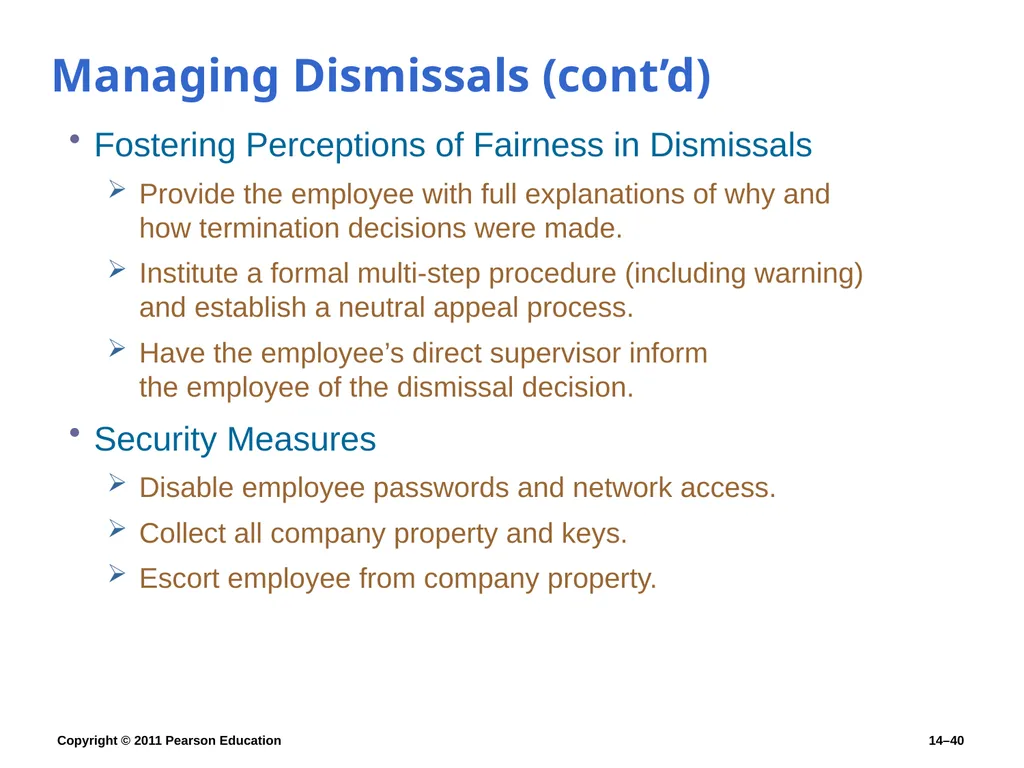
Copyright © 2011 Pearson Education 14–40 Managing Dismissals (cont’d) Fostering Perceptions of Fairness in Dismissals
Provide the employee with full explanations of why and how termination decisions were made.
Institute a formal multi-step procedure (including warning) and establish a neutral appeal process.
Have the employee’s direct supervisor inform the employee of the dismissal decision.
Security Measures
Disable employee passwords and network access.
Collect all company property and keys.
Escort employee from company property.<br>
41
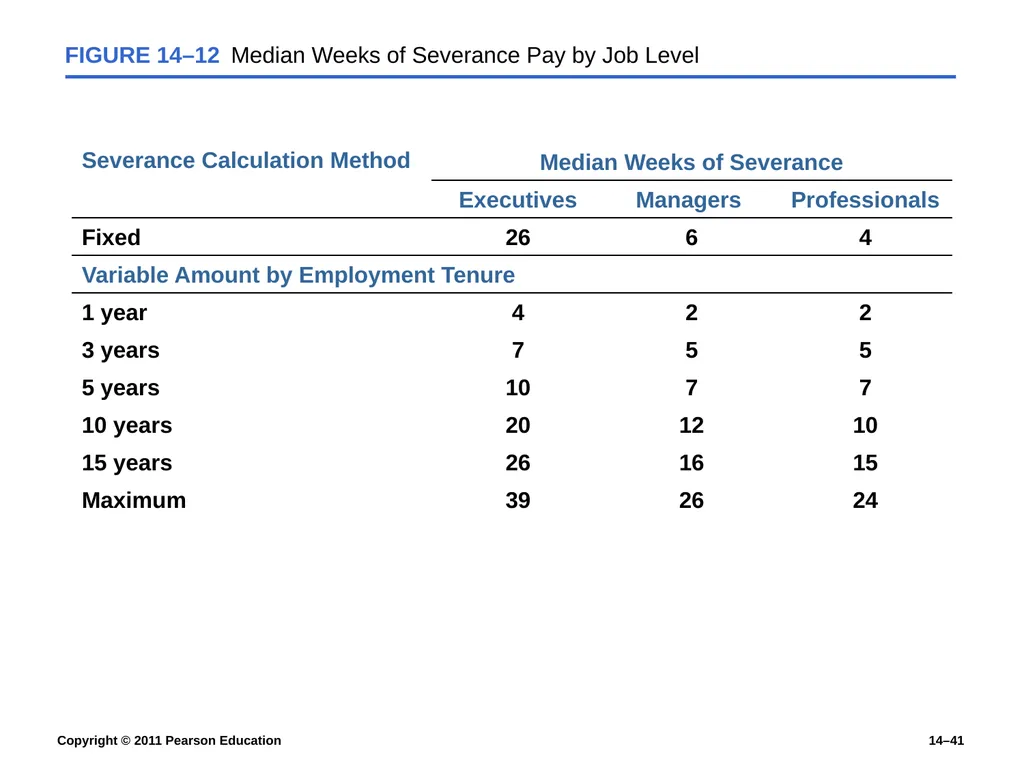
Copyright © 2011 Pearson Education 14–41 FIGURE 14–12 Median Weeks of Severance Pay by Job Level<br>
42
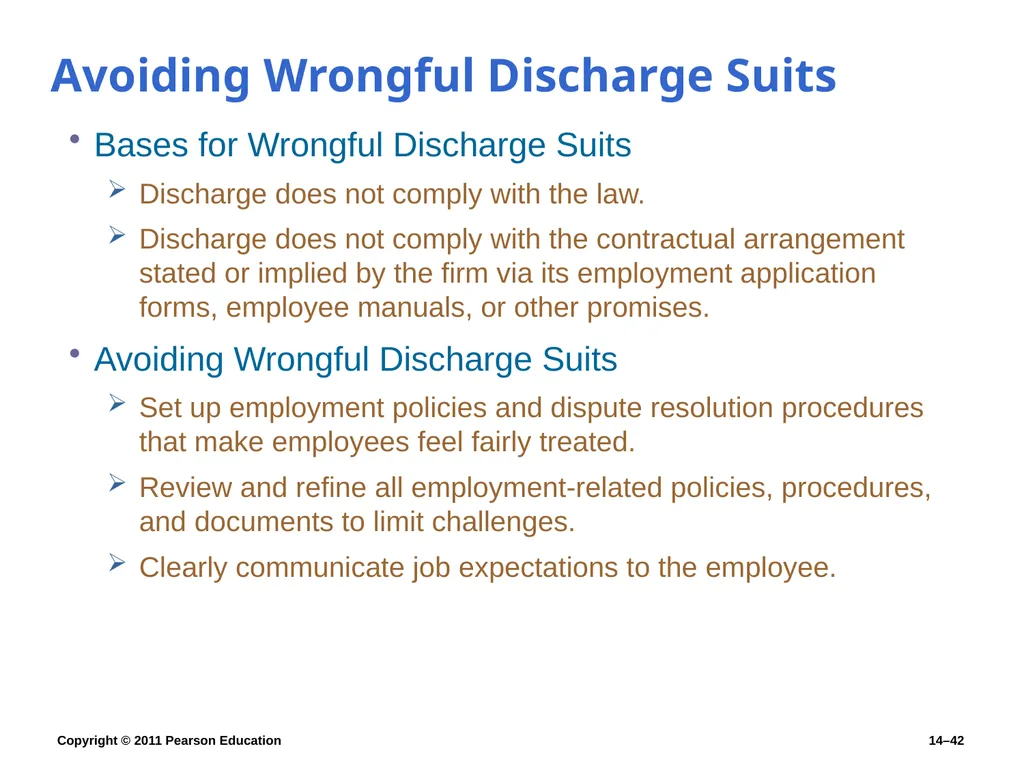
Copyright © 2011 Pearson Education 14–42 Avoiding Wrongful Discharge Suits Bases for Wrongful Discharge Suits
Discharge does not comply with the law.
Discharge does not comply with the contractual arrangement stated or implied by the firm via its employment application forms, employee manuals, or other promises.
Avoiding Wrongful Discharge Suits
Set up employment policies and dispute resolution procedures that make employees feel fairly treated.
Review and refine all employment-related policies, procedures, and documents to limit challenges.
Clearly communicate job expectations to the employee.<br>
43
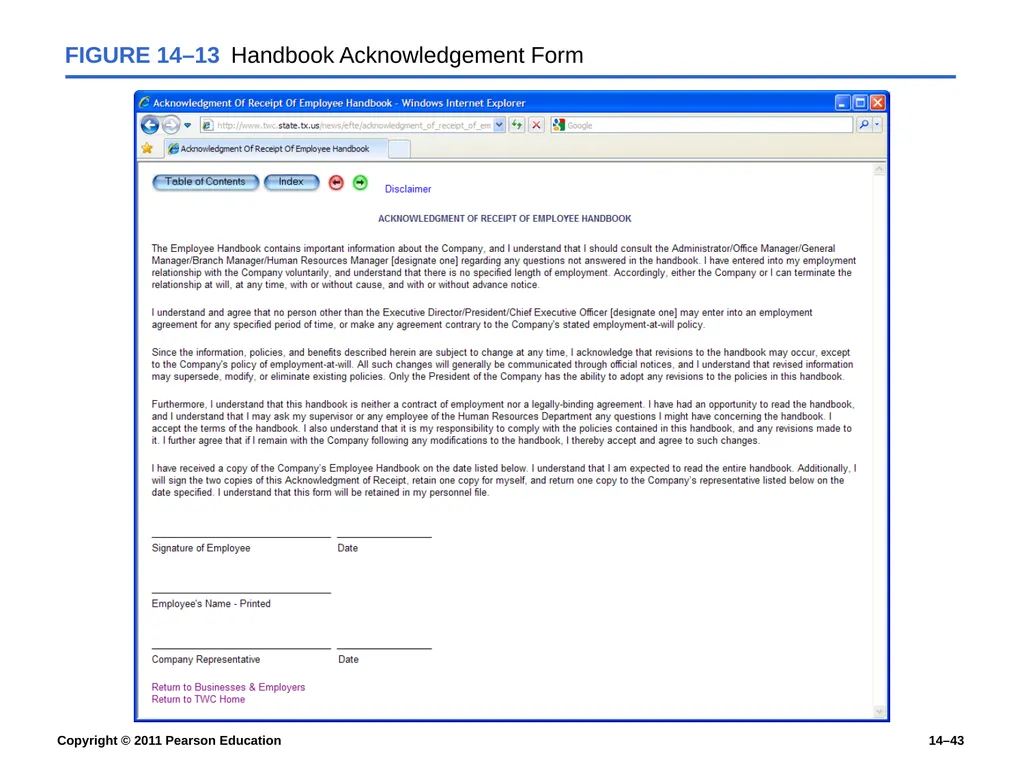
Copyright © 2011 Pearson Education 14–43 FIGURE 14–13 Handbook Acknowledgement Form<br>
44
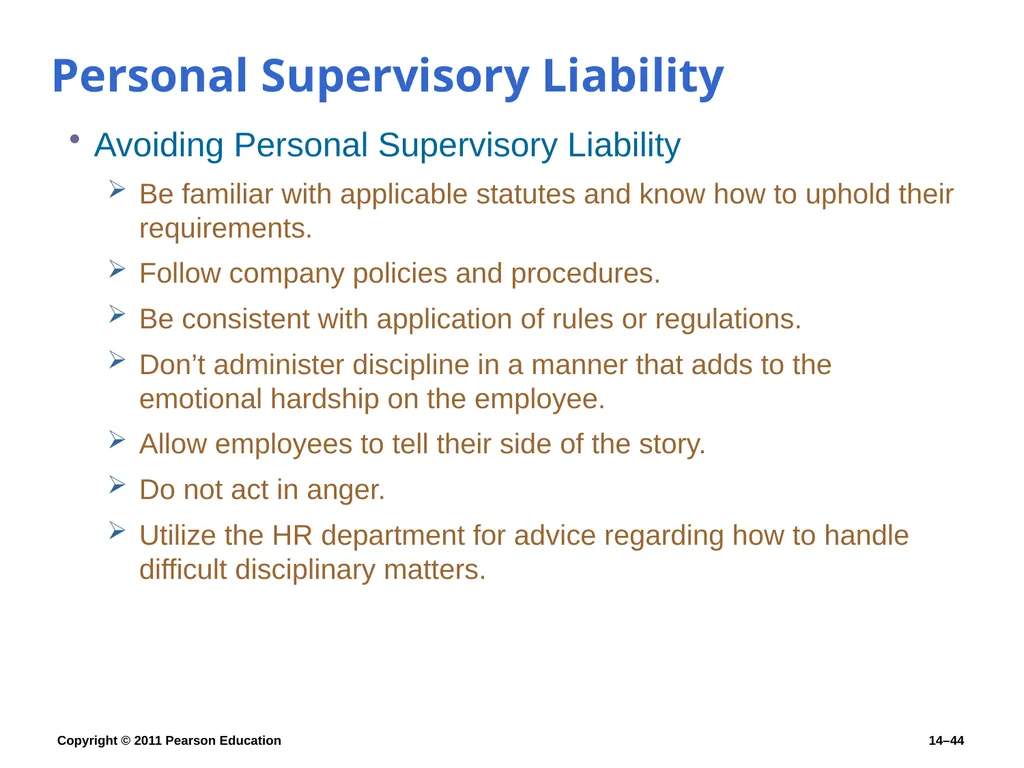
Copyright © 2011 Pearson Education 14–44 Personal Supervisory Liability Avoiding Personal Supervisory Liability
Be familiar with applicable statutes and know how to uphold their requirements.
Follow company policies and procedures.
Be consistent with application of rules or regulations.
Don’t administer discipline in a manner that adds to the emotional hardship on the employee.
Allow employees to tell their side of the story.
Do not act in anger.
Utilize the HR department for advice regarding how to handle difficult disciplinary matters.<br>
45
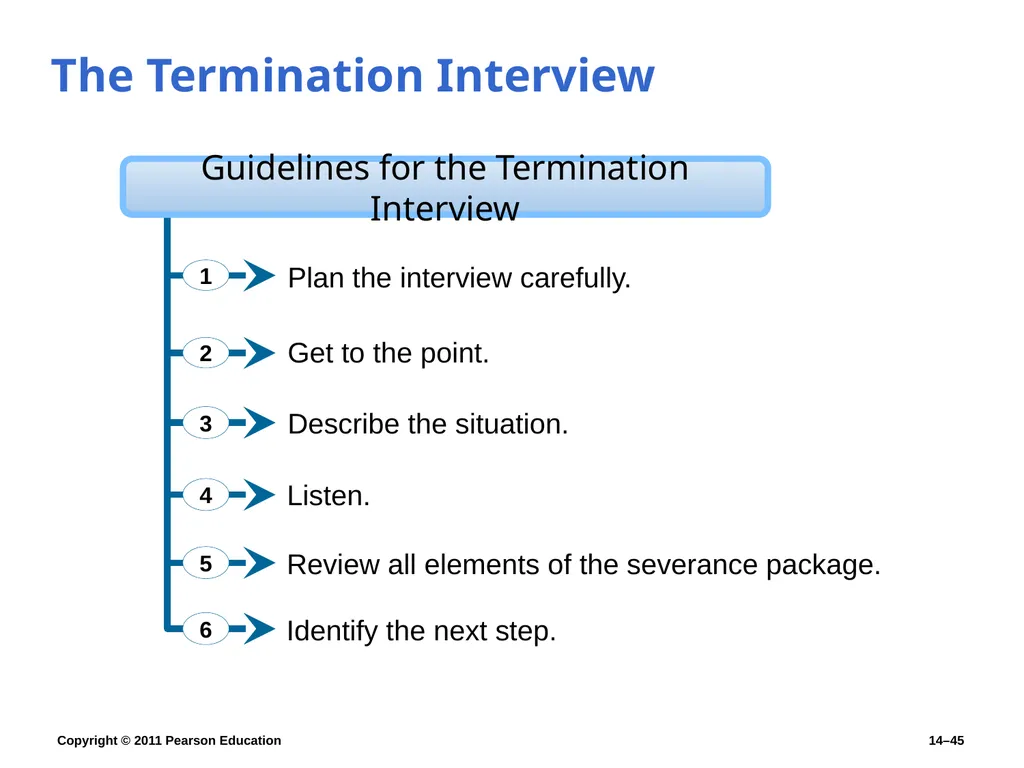
Copyright © 2011 Pearson Education 14–45 The Termination Interview Guidelines for the Termination Interview Get to the point. Plan the interview carefully. Describe the situation. Listen. Review all elements of the severance package. Identify the next step.<br>
46
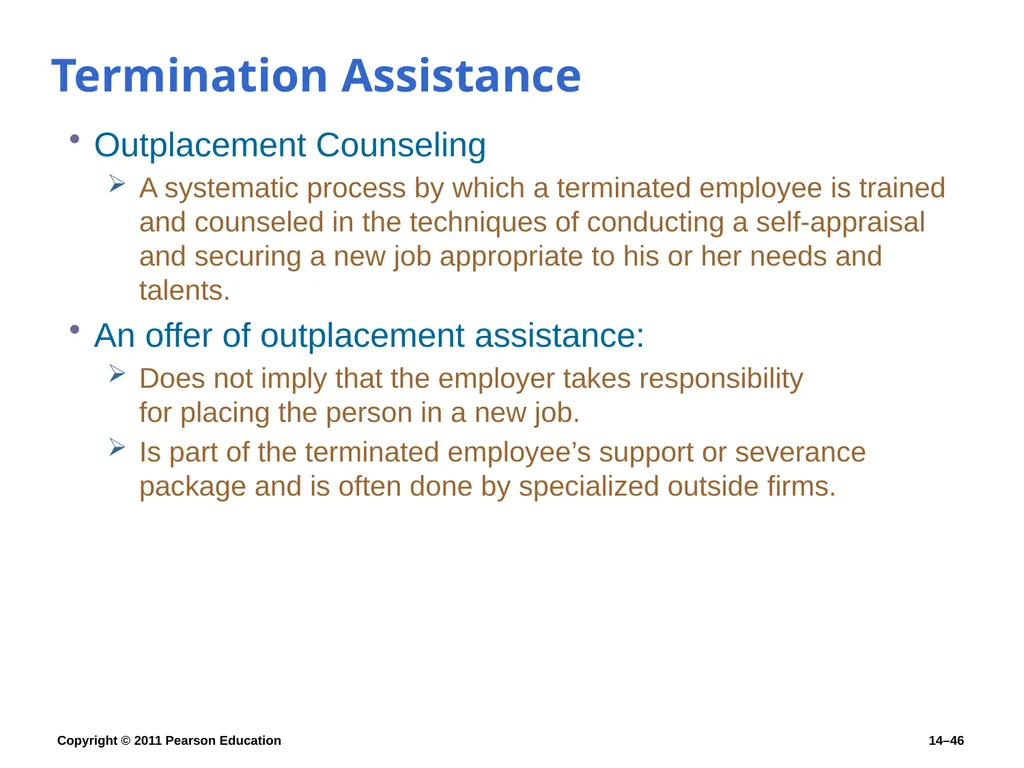
Copyright © 2011 Pearson Education 14–46 Termination Assistance Outplacement Counseling
A systematic process by which a terminated employee is trained and counseled in the techniques of conducting a self-appraisal and securing a new job appropriate to his or her needs and talents.
An offer of outplacement assistance:
Does not imply that the employer takes responsibility for placing the person in a new job.
Is part of the terminated employee’s support or severance package and is often done by specialized outside firms.<br>
47
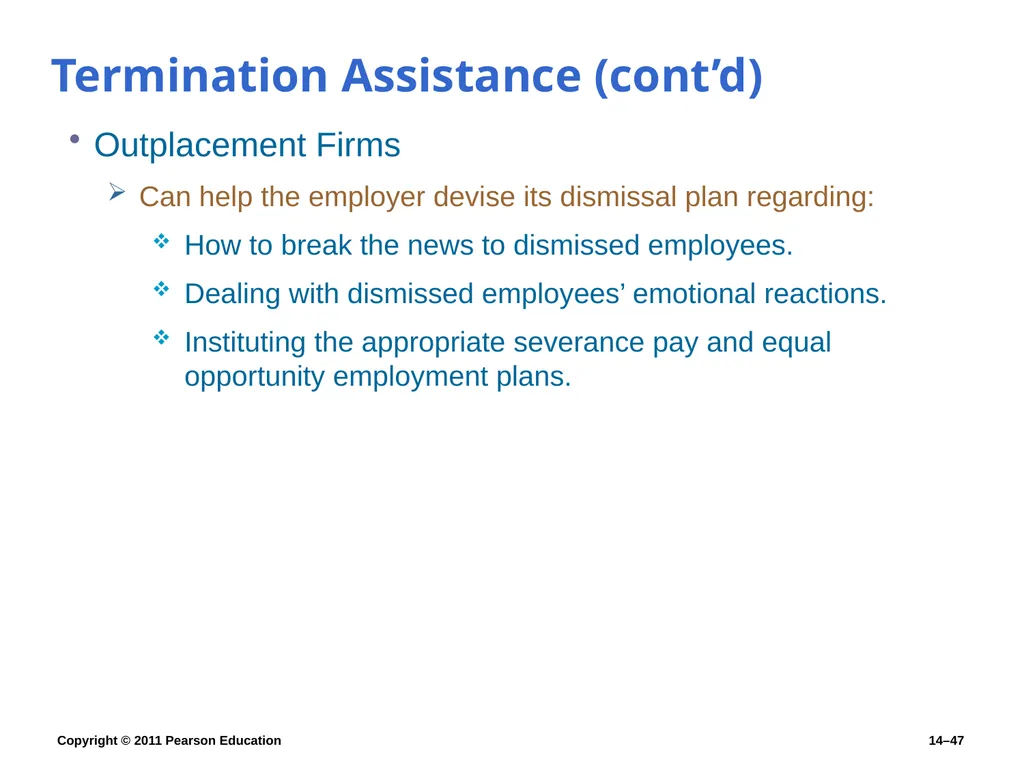
Copyright © 2011 Pearson Education 14–47 Termination Assistance (cont’d) Outplacement Firms
Can help the employer devise its dismissal plan regarding:
How to break the news to dismissed employees.
Dealing with dismissed employees’ emotional reactions.
Instituting the appropriate severance pay and equal opportunity employment plans.<br>
Can help the employer devise its dismissal plan regarding:
How to break the news to dismissed employees.
Dealing with dismissed employees’ emotional reactions.
Instituting the appropriate severance pay and equal opportunity employment plans.<br>
48
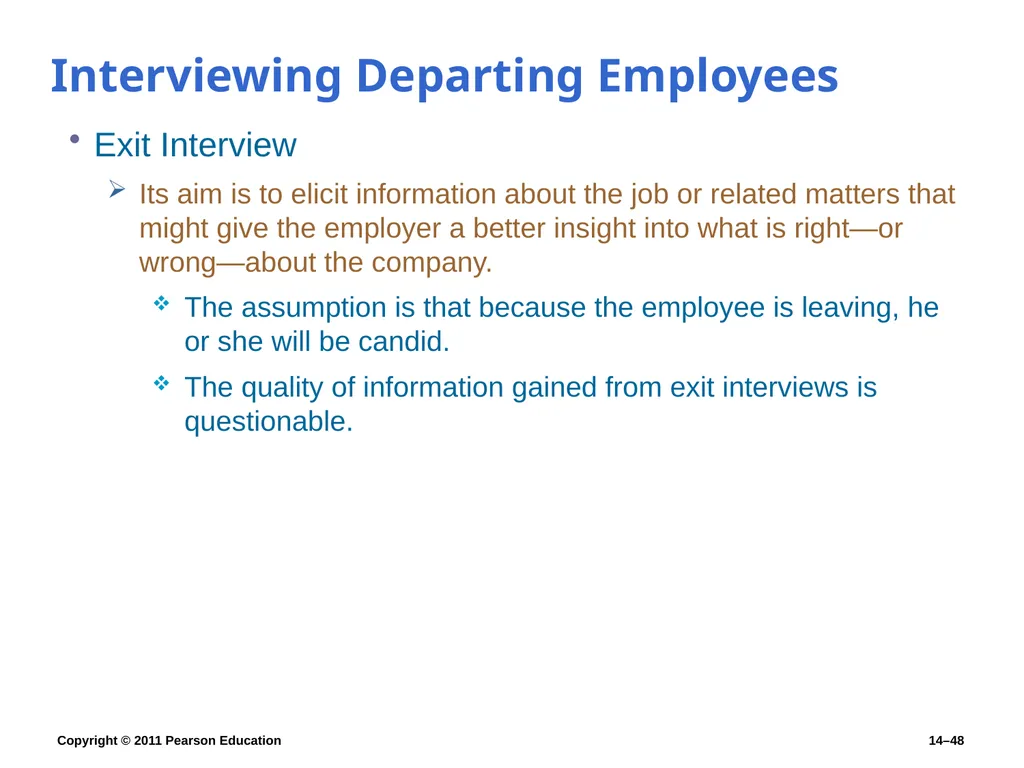
Copyright © 2011 Pearson Education 14–48 Interviewing Departing Employees Exit Interview
Its aim is to elicit information about the job or related matters that might give the employer a better insight into what is right—or wrong—about the company.
The assumption is that because the employee is leaving, he or she will be candid.
The quality of information gained from exit interviews is questionable.<br>
49
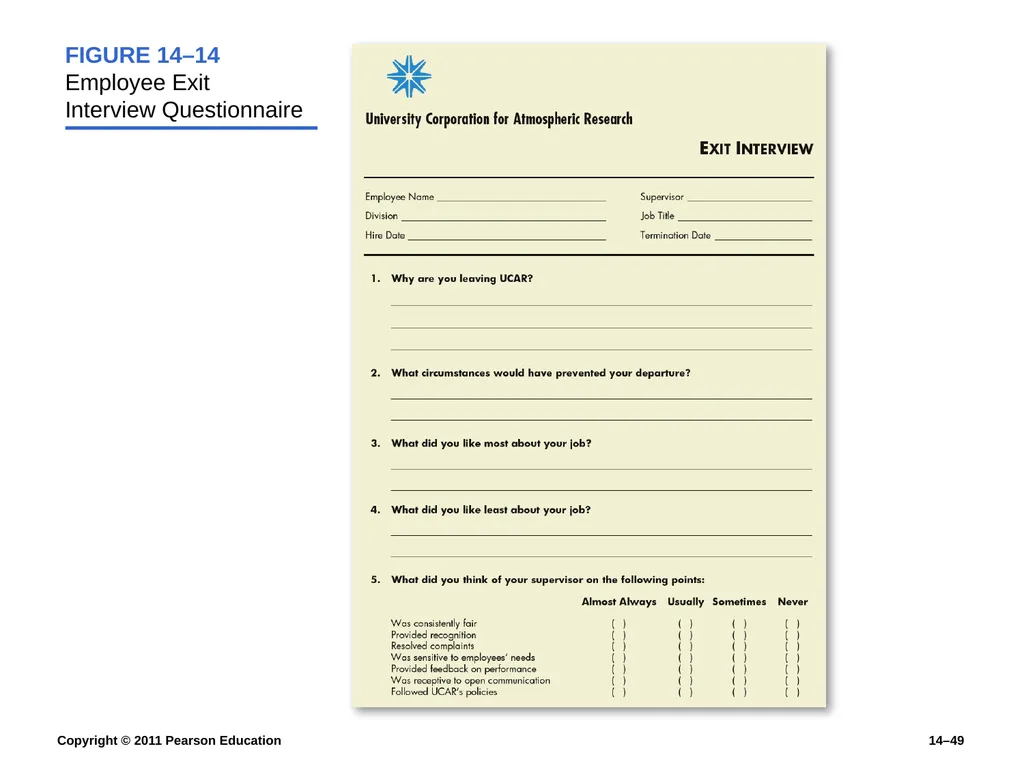
Copyright © 2011 Pearson Education 14–49 FIGURE 14–14
Employee Exit
Interview Questionnaire<br>
50
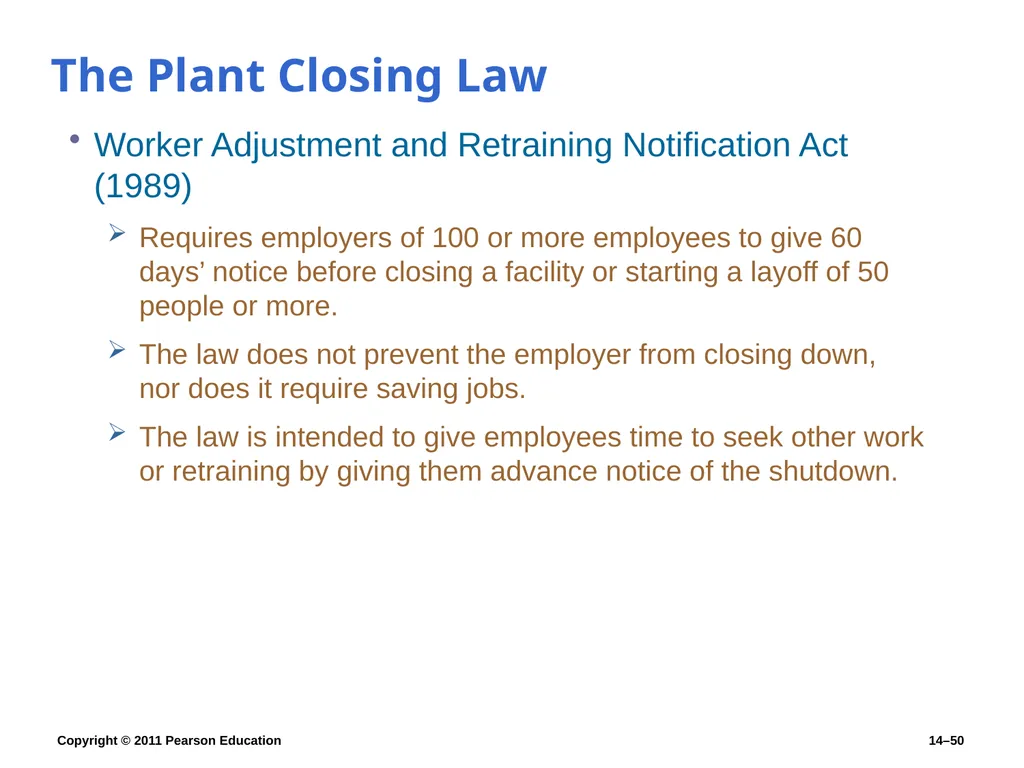
Copyright © 2011 Pearson Education 14–50 The Plant Closing Law Worker Adjustment and Retraining Notification Act (1989)
Requires employers of 100 or more employees to give 60 days’ notice before closing a facility or starting a layoff of 50 people or more.
The law does not prevent the employer from closing down, nor does it require saving jobs.
The law is intended to give employees time to seek other work or retraining by giving them advance notice of the shutdown.<br>
51
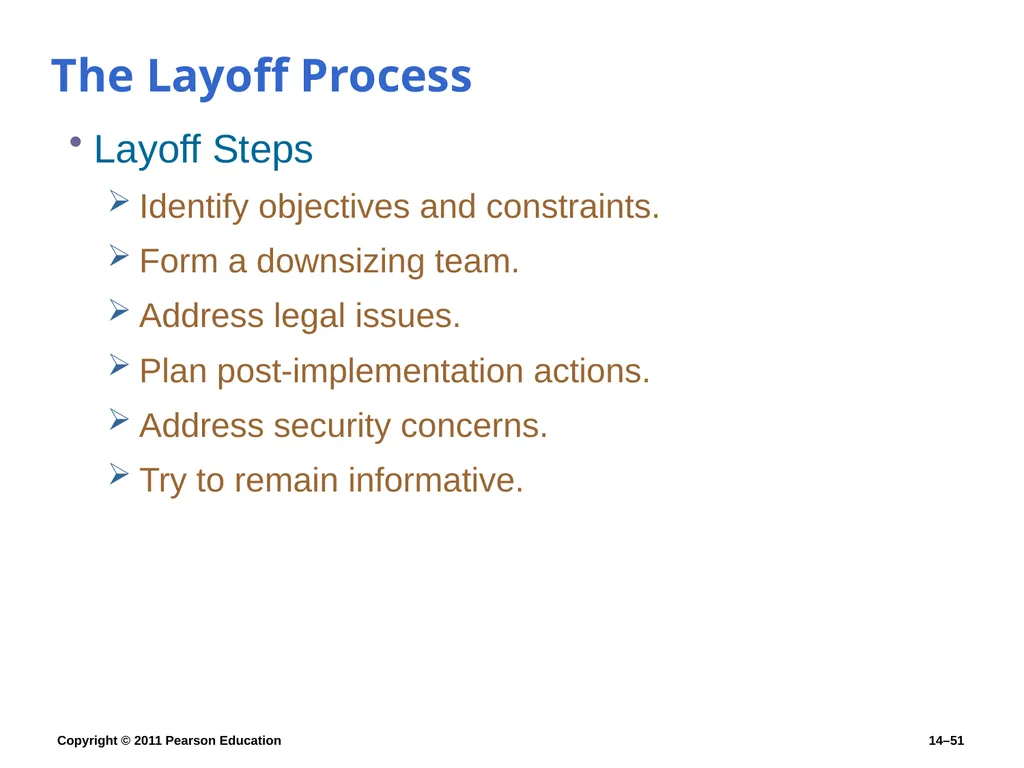
Copyright © 2011 Pearson Education 14–51 The Layoff Process Layoff Steps
Identify objectives and constraints.
Form a downsizing team.
Address legal issues.
Plan post-implementation actions.
Address security concerns.
Try to remain informative.<br>
Identify objectives and constraints.
Form a downsizing team.
Address legal issues.
Plan post-implementation actions.
Address security concerns.
Try to remain informative.<br>
52
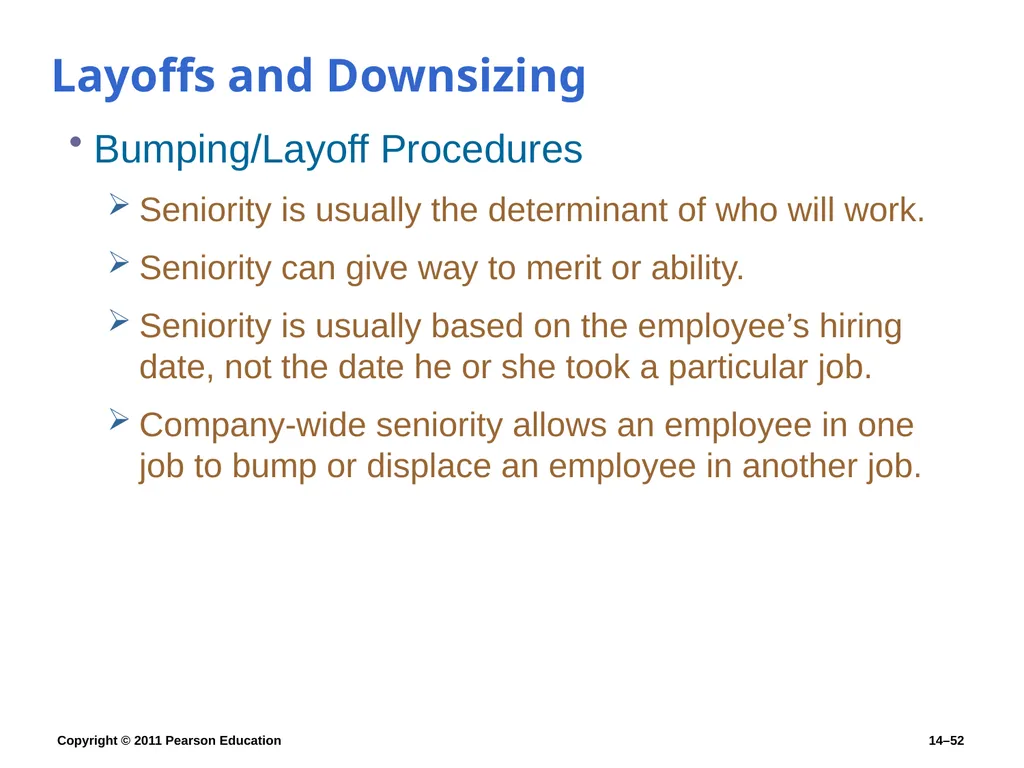
Copyright © 2011 Pearson Education 14–52 Layoffs and Downsizing Bumping/Layoff Procedures
Seniority is usually the determinant of who will work.
Seniority can give way to merit or ability.
Seniority is usually based on the employee’s hiring date, not the date he or she took a particular job.
Company-wide seniority allows an employee in one job to bump or displace an employee in another job.<br>
53
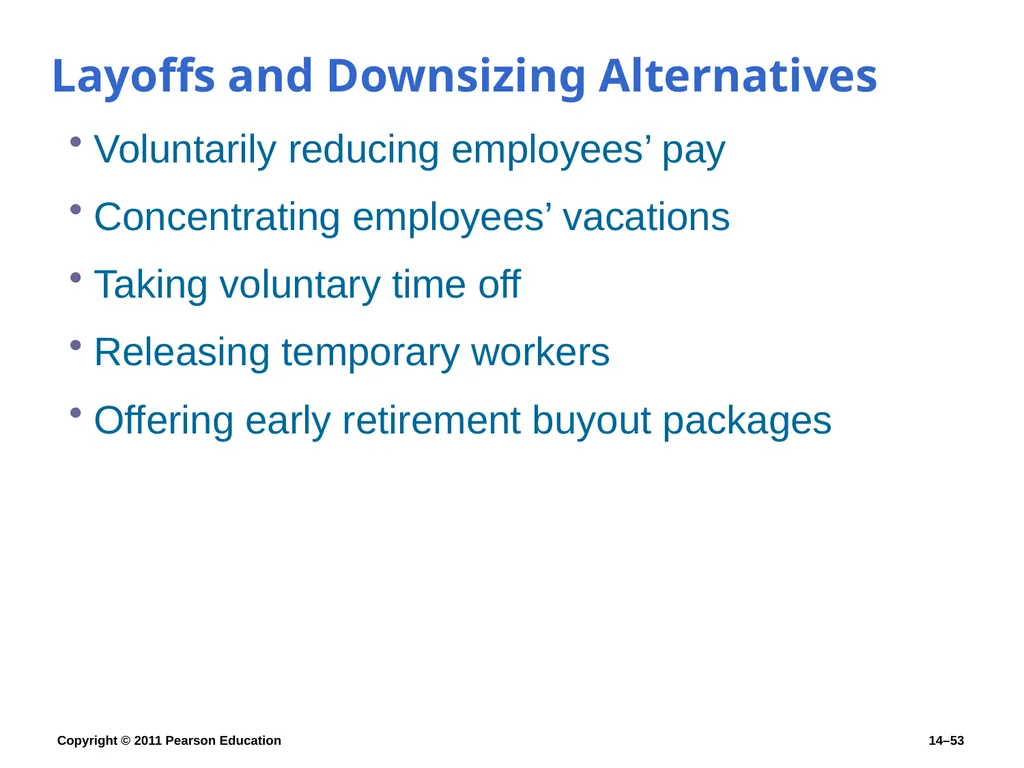
Copyright © 2011 Pearson Education 14–53 Layoffs and Downsizing Alternatives Voluntarily reducing employees’ pay
Concentrating employees’ vacations
Taking voluntary time off
Releasing temporary workers
Offering early retirement buyout packages<br>
Concentrating employees’ vacations
Taking voluntary time off
Releasing temporary workers
Offering early retirement buyout packages<br>
54
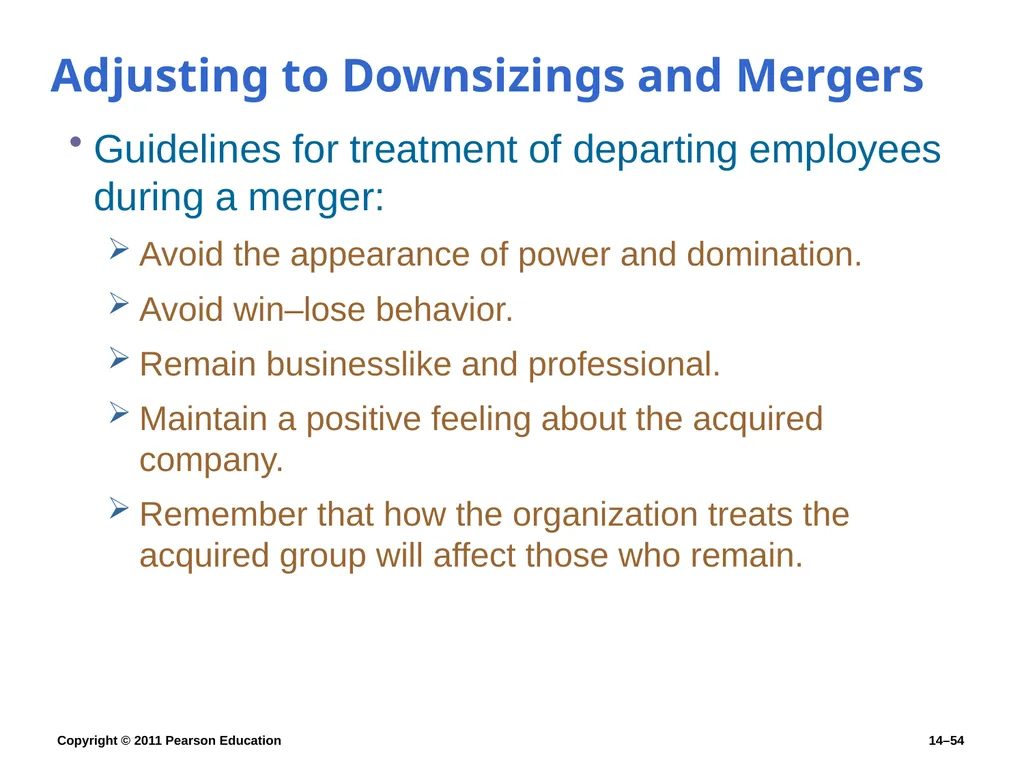
Copyright © 2011 Pearson Education 14–54 Adjusting to Downsizings and Mergers Guidelines for treatment of departing employees during a merger:
Avoid the appearance of power and domination.
Avoid win–lose behavior.
Remain businesslike and professional.
Maintain a positive feeling about the acquired company.
Remember that how the organization treats the acquired group will affect those who remain.<br>
Avoid the appearance of power and domination.
Avoid win–lose behavior.
Remain businesslike and professional.
Maintain a positive feeling about the acquired company.
Remember that how the organization treats the acquired group will affect those who remain.<br>
55
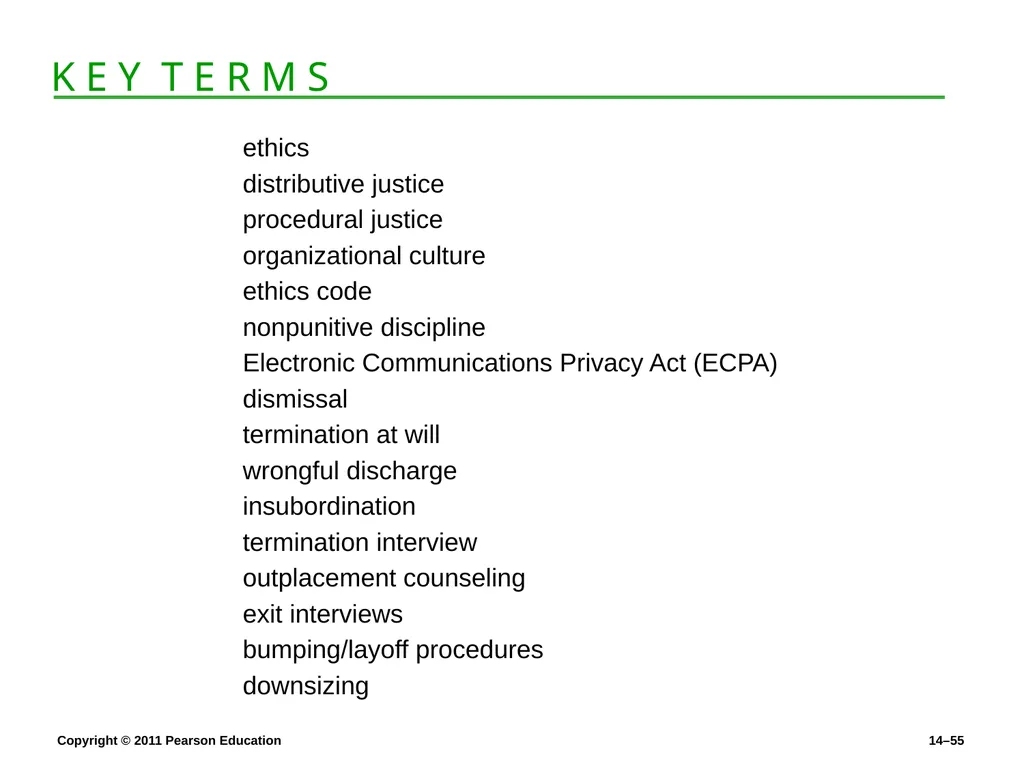
Copyright © 2011 Pearson Education 14–55 K E Y T E R M S ethics
distributive justice
procedural justice
organizational culture
ethics code
nonpunitive discipline
Electronic Communications Privacy Act (ECPA)
dismissal
termination at will
wrongful discharge
insubordination
termination interview
outplacement counseling
exit interviews
bumping/layoff procedures
downsizing<br>
56
Copyright © 2011 Pearson Education 14–56 All rights reserved. No part of this publication may be reproduced, stored in a retrieval system, or transmitted, in any form or by any means, electronic, mechanical, photocopying, recording, or otherwise, without the prior written permission of the publisher. Printed in the United States of America.<br>