
GCIS: Presentation to Portfolio Committee on
GB
Published · 37 slides · 0 views

1 / 1
Description
GCIS: Presentation to Portfolio Committee on Communications 06 March 2018 2 Presentation Outline (1) SEGMENTATION MODEL (Public Awareness: Social Grants and Water Crisis) The GSM is a population segmentation was created by the GCIS to
Related Topics
Download this presentation From Below
"GCIS: Presentation to Portfolio Committee on" is the property of its rightful owner. Permission is granted to download and print the materials on this website for personal, non-commercial use only, and to display it on your personal computer provided you do not modify the materials and that you retain all copyright notices contained in the materials. By downloading content from our website, you accept the terms of this agreement.
Share
Embed code
Presentation Transcript
01
GCIS: Presentation to Portfolio Committee on Communications
06 March 2018<br>
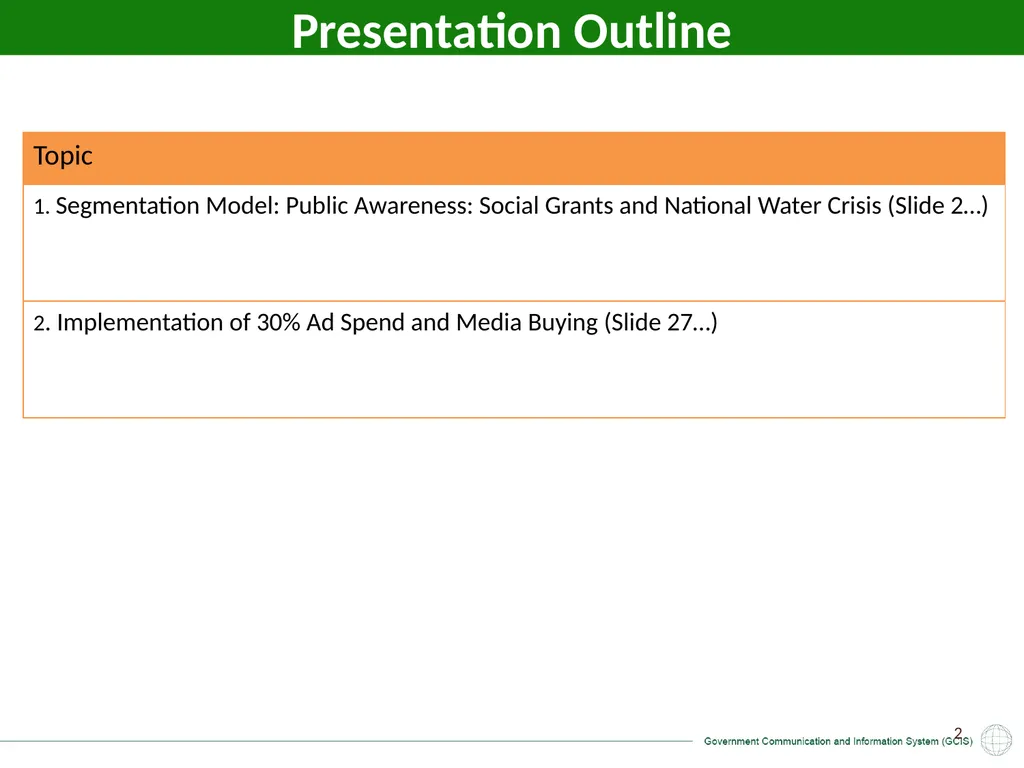
02
2 Presentation Outline<br>
03
(1) SEGMENTATION MODEL
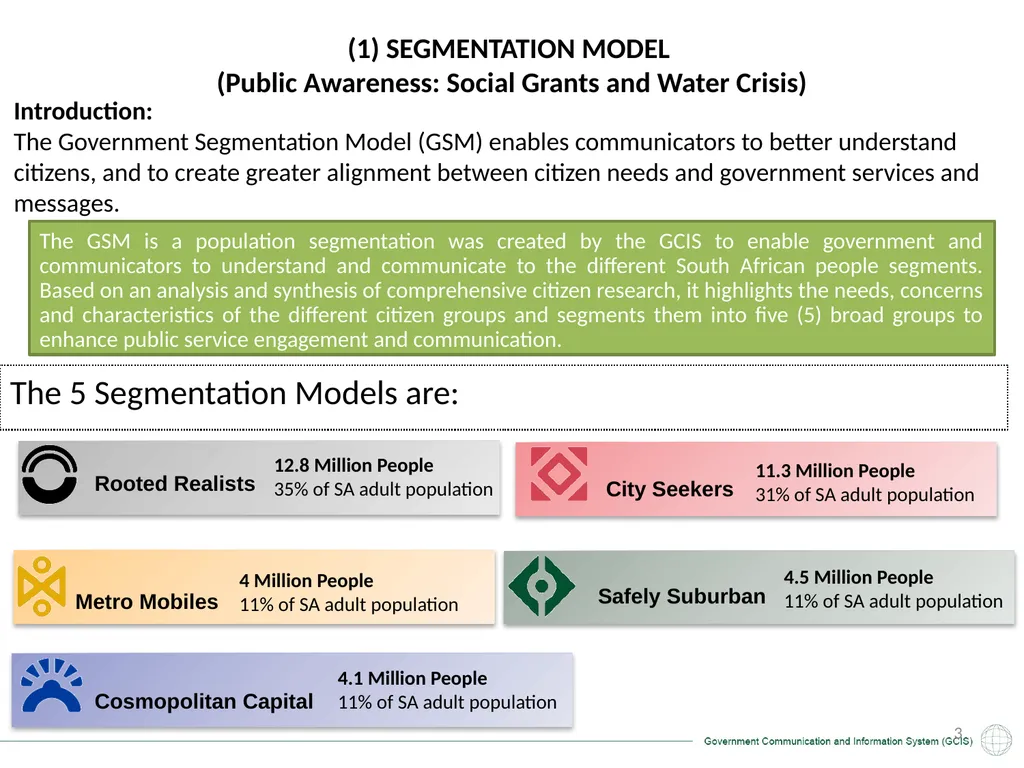
(Public Awareness: Social Grants and Water Crisis) The GSM is a population segmentation was created by the GCIS to enable government and communicators to understand and communicate to the different South African people segments. Based on an analysis and synthesis of comprehensive citizen research, it highlights the needs, concerns and characteristics of the different citizen groups and segments them into five (5) broad groups to enhance public service engagement and communication. 3 Introduction:
The Government Segmentation Model (GSM) enables communicators to better understand citizens, and to create greater alignment between citizen needs and government services and messages. The 5 Segmentation Models are:<br>
The Government Segmentation Model (GSM) enables communicators to better understand citizens, and to create greater alignment between citizen needs and government services and messages. The 5 Segmentation Models are:<br>
04
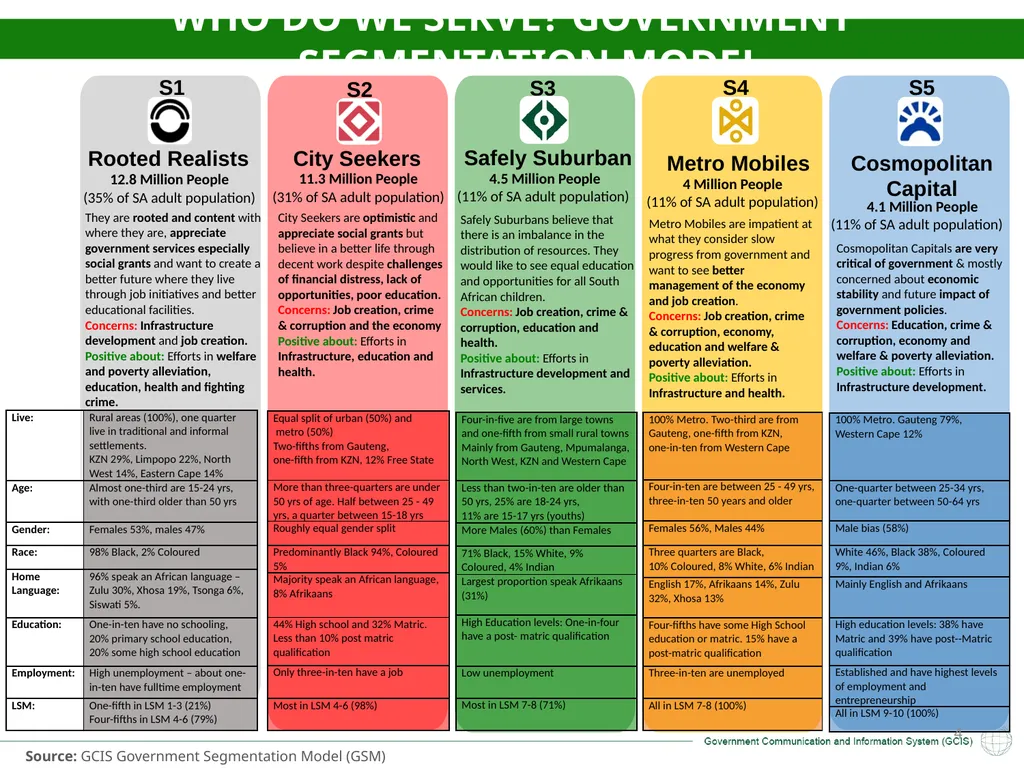
WHO DO WE SERVE? GOVERNMENT SEGMENTATION MODEL S1 S2 S3 S4 S5 Cosmopolitan Capital Safely Suburban 12.8 Million People
(35% of SA adult population) 11.3 Million People
(31% of SA adult population) 4.5 Million People
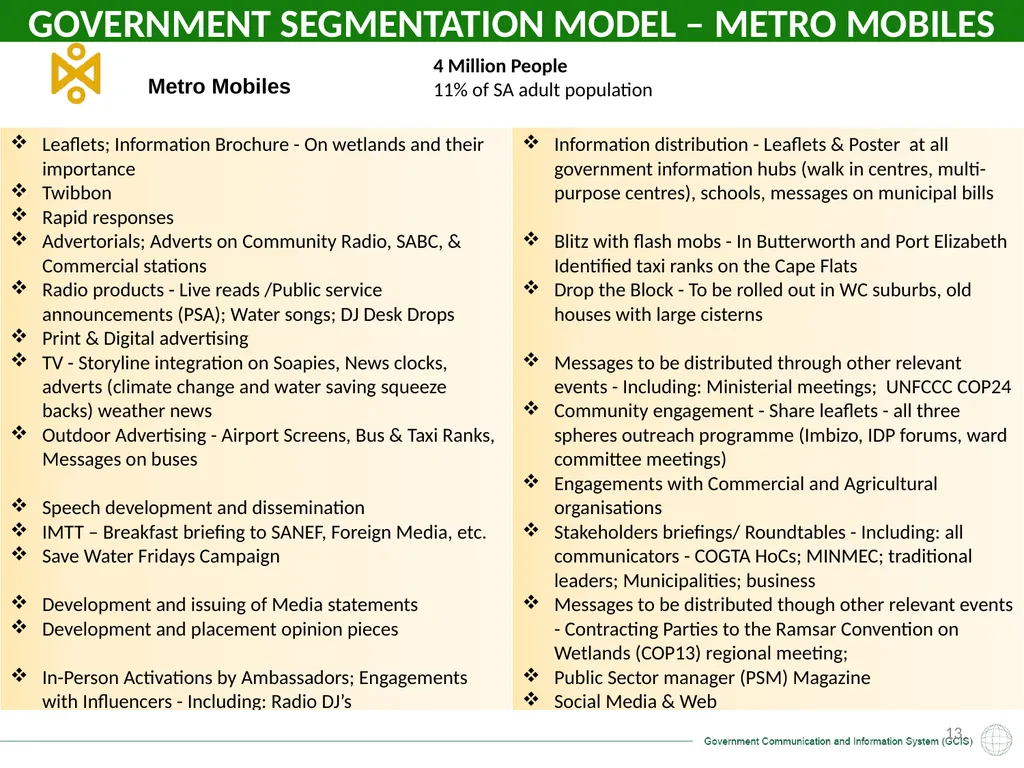
(11% of SA adult population) 4 Million People
(11% of SA adult population) 4.1 Million People
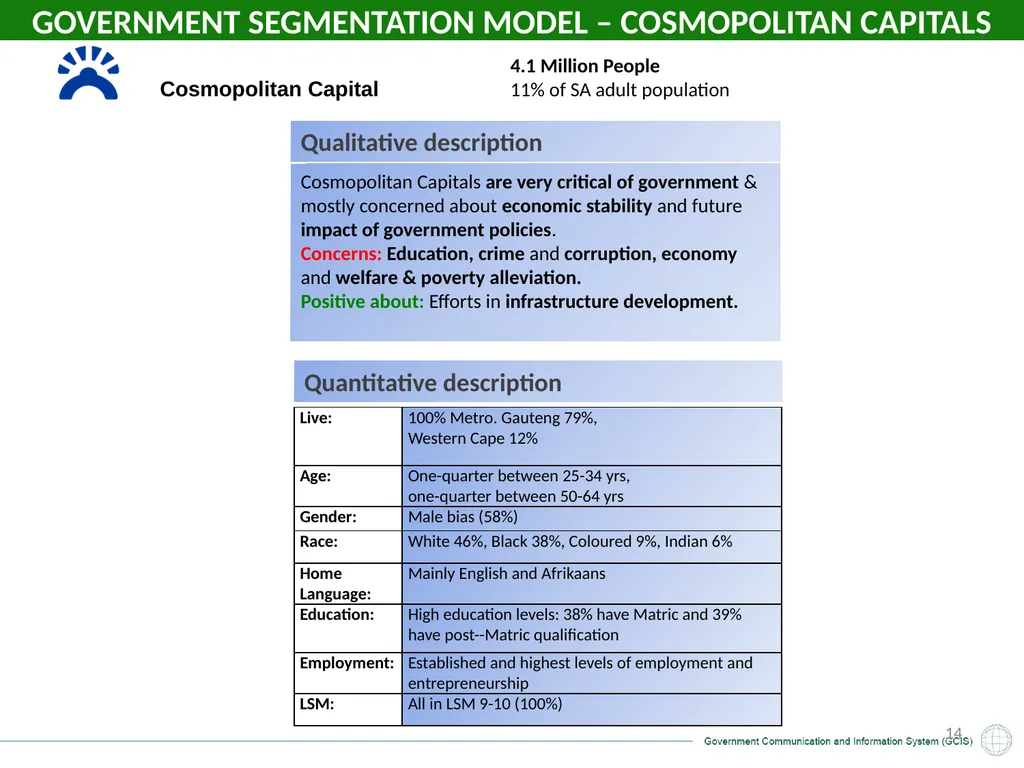
(11% of SA adult population) Cosmopolitan Capitals are very critical of government & mostly concerned about economic stability and future impact of government policies.
Concerns: Education, crime & corruption, economy and welfare & poverty alleviation.
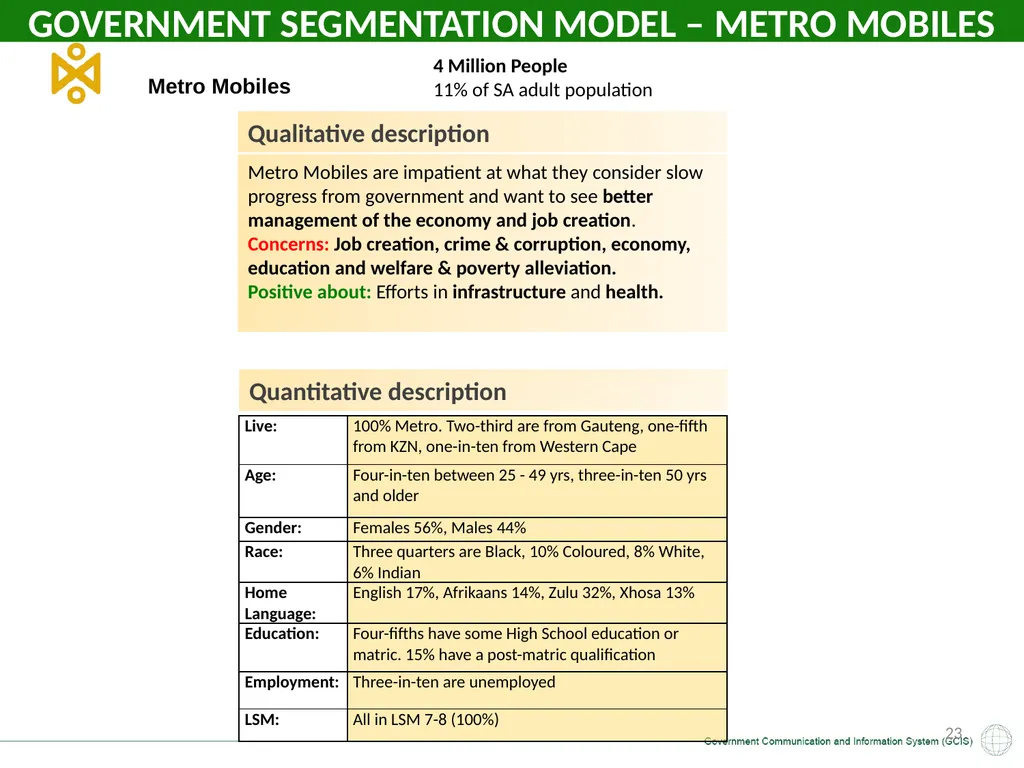
Positive about: Efforts in Infrastructure development. Metro Mobiles are impatient at what they consider slow progress from government and want to see better management of the economy and job creation.
Concerns: Job creation, crime & corruption, economy, education and welfare & poverty alleviation.
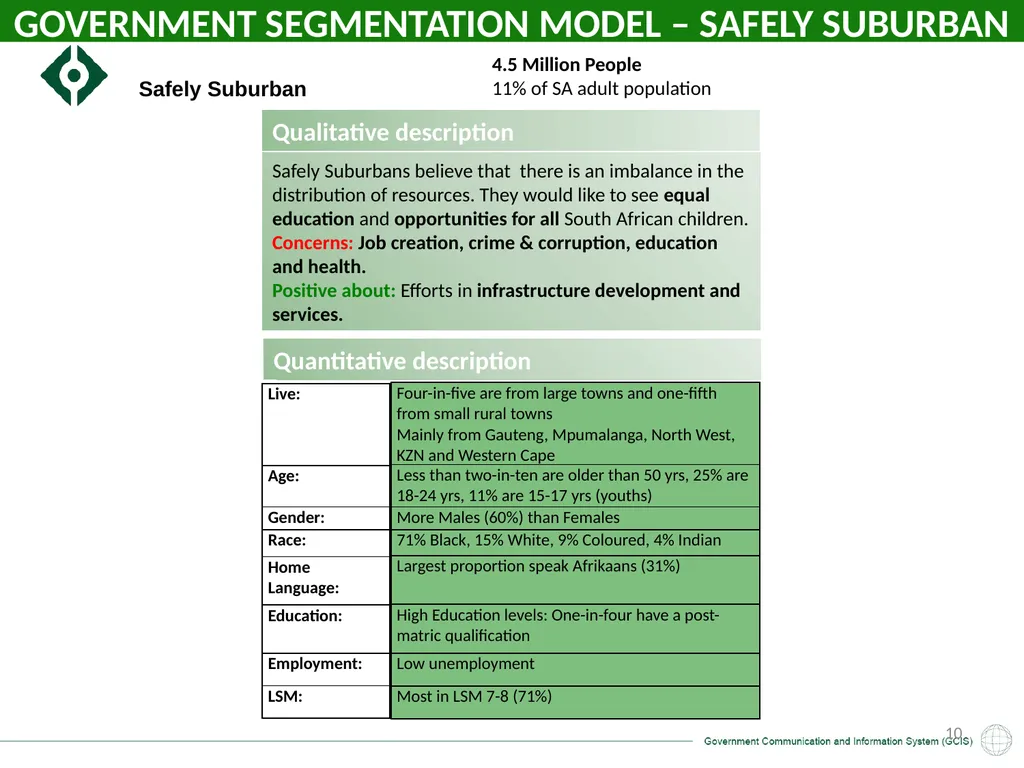
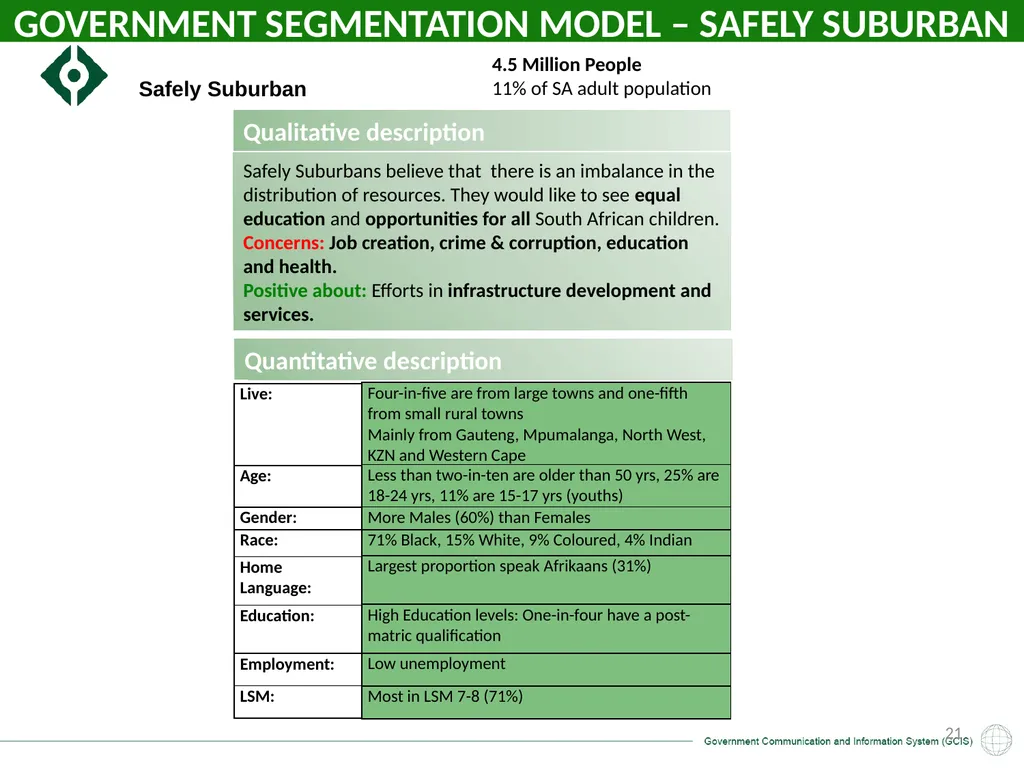
Positive about: Efforts in Infrastructure and health. Safely Suburbans believe that there is an imbalance in the distribution of resources. They would like to see equal education and opportunities for all South African children.
Concerns: Job creation, crime & corruption, education and health.
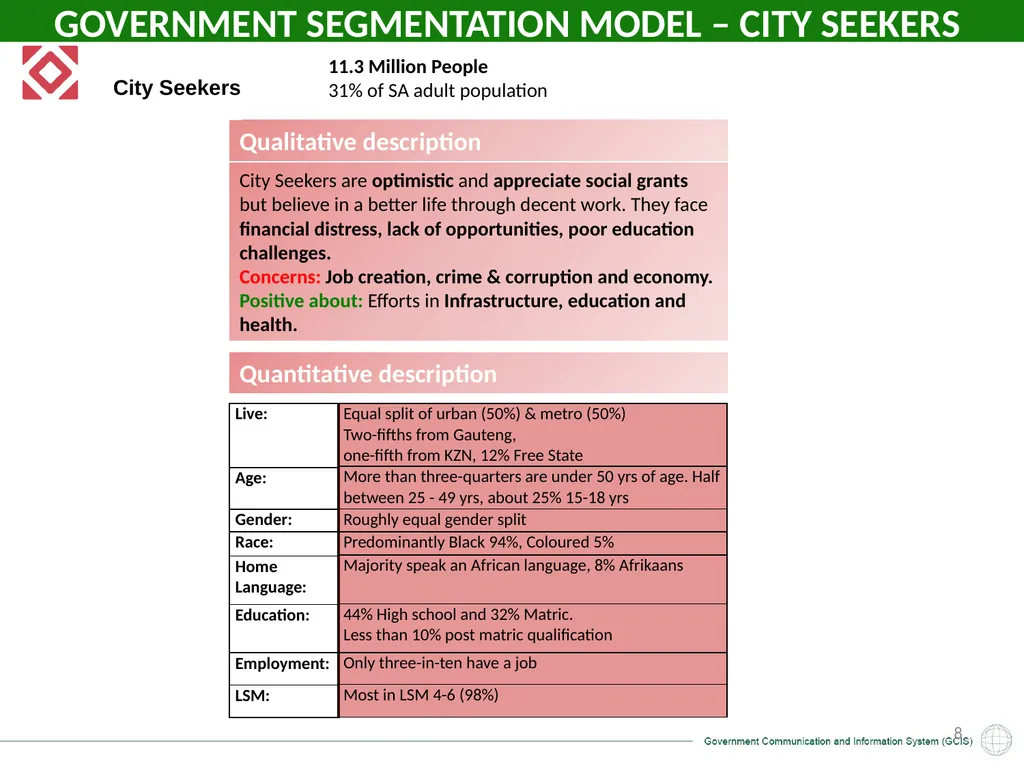
Positive about: Efforts in Infrastructure development and services. City Seekers are optimistic and appreciate social grants but believe in a better life through decent work despite challenges of financial distress, lack of opportunities, poor education.
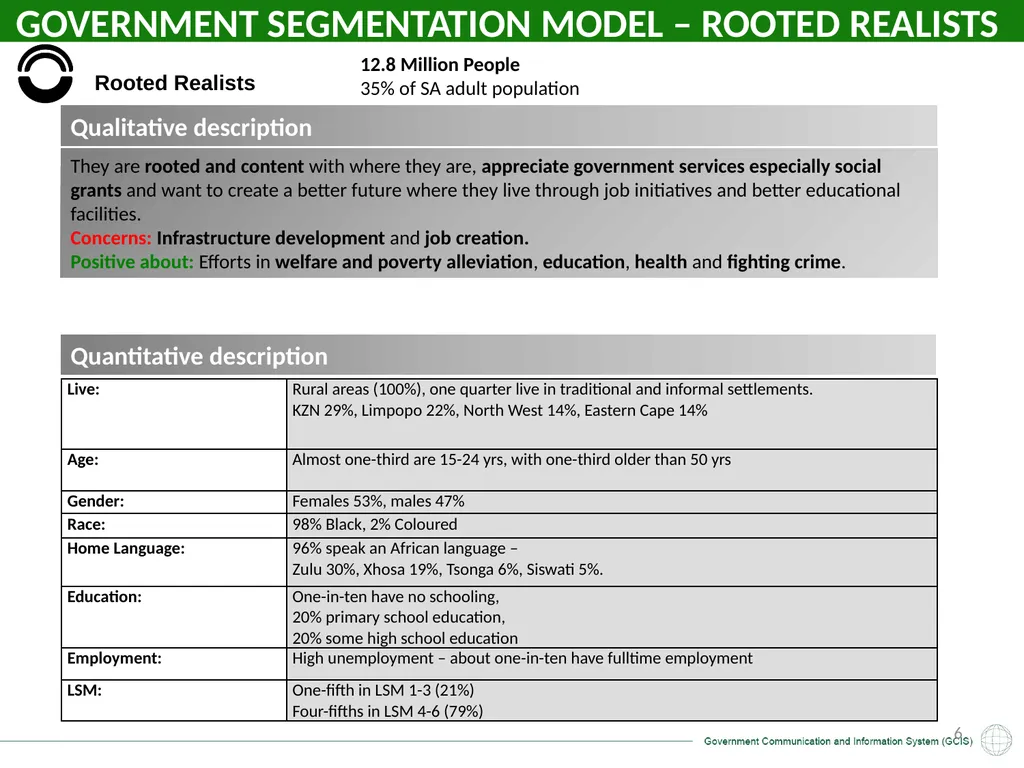
Concerns: Job creation, crime & corruption and the economy Positive about: Efforts in Infrastructure, education and health. They are rooted and content with where they are, appreciate government services especially social grants and want to create a better future where they live through job initiatives and better educational facilities.
Concerns: Infrastructure development and job creation. Positive about: Efforts in welfare and poverty alleviation, education, health and fighting crime. Source: GCIS Government Segmentation Model (GSM) 4<br>
(35% of SA adult population) 11.3 Million People
(31% of SA adult population) 4.5 Million People
(11% of SA adult population) 4 Million People
(11% of SA adult population) 4.1 Million People
(11% of SA adult population) Cosmopolitan Capitals are very critical of government & mostly concerned about economic stability and future impact of government policies.
Concerns: Education, crime & corruption, economy and welfare & poverty alleviation.
Positive about: Efforts in Infrastructure development. Metro Mobiles are impatient at what they consider slow progress from government and want to see better management of the economy and job creation.
Concerns: Job creation, crime & corruption, economy, education and welfare & poverty alleviation.
Positive about: Efforts in Infrastructure and health. Safely Suburbans believe that there is an imbalance in the distribution of resources. They would like to see equal education and opportunities for all South African children.
Concerns: Job creation, crime & corruption, education and health.
Positive about: Efforts in Infrastructure development and services. City Seekers are optimistic and appreciate social grants but believe in a better life through decent work despite challenges of financial distress, lack of opportunities, poor education.
Concerns: Job creation, crime & corruption and the economy Positive about: Efforts in Infrastructure, education and health. They are rooted and content with where they are, appreciate government services especially social grants and want to create a better future where they live through job initiatives and better educational facilities.
Concerns: Infrastructure development and job creation. Positive about: Efforts in welfare and poverty alleviation, education, health and fighting crime. Source: GCIS Government Segmentation Model (GSM) 4<br>
05
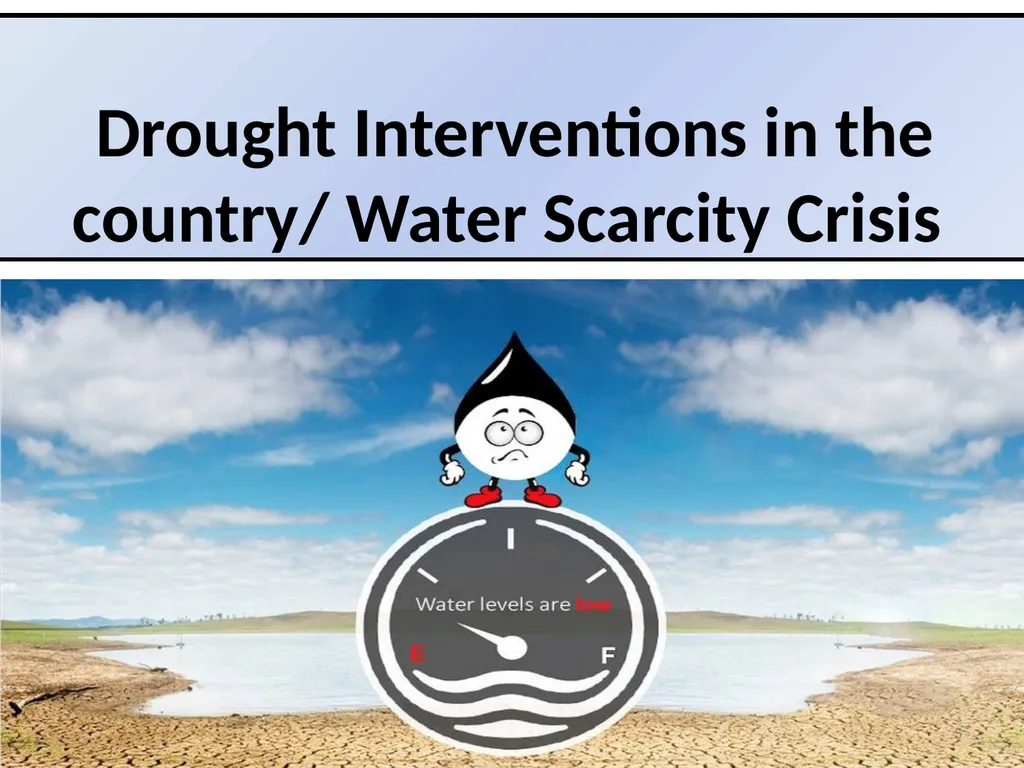
5 Drought Interventions in the country/ Water Scarcity Crisis<br>
06
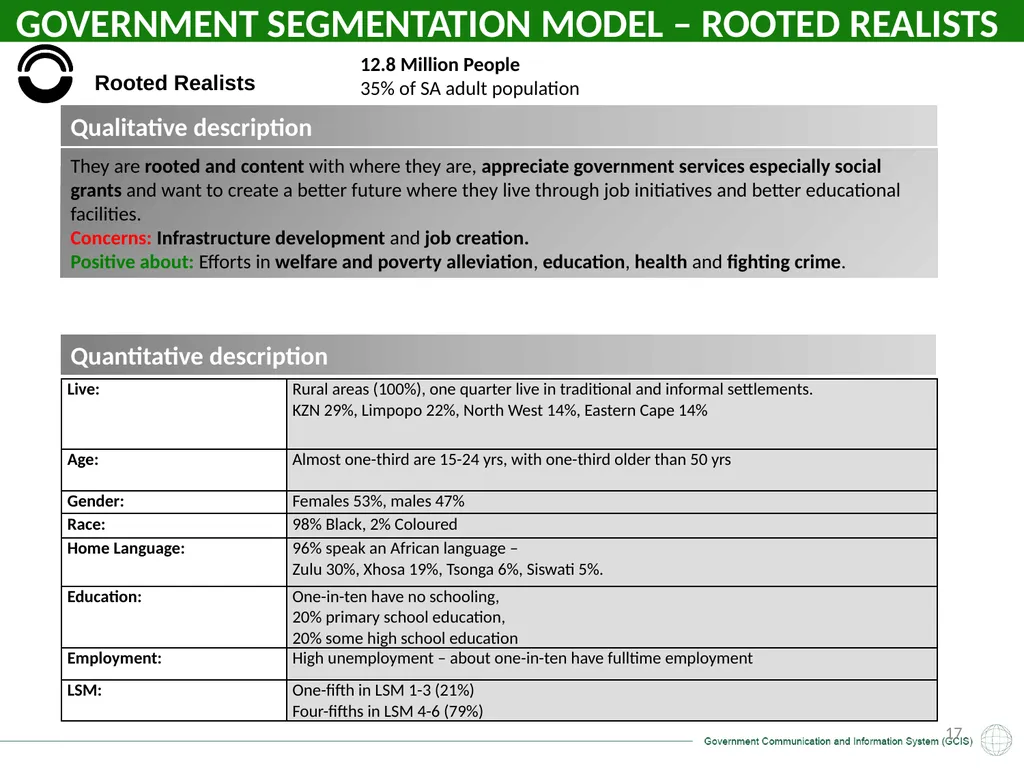
6 GOVERNMENT SEGMENTATION MODEL – ROOTED REALISTS Quantitative description<br>
07
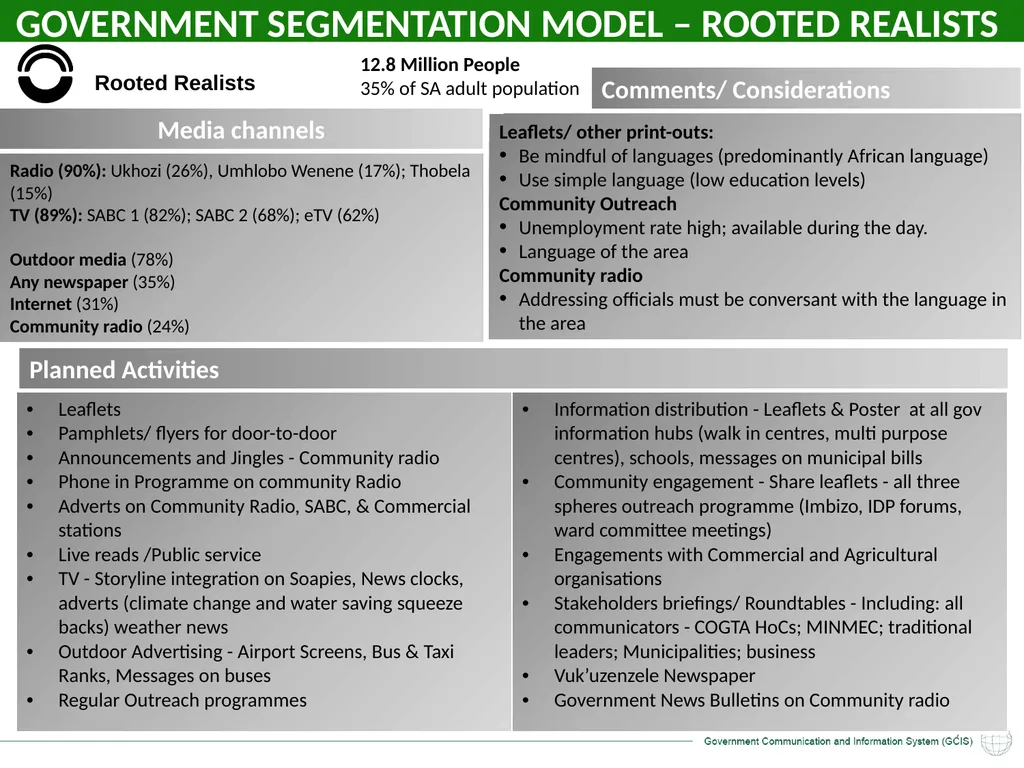
7 GOVERNMENT SEGMENTATION MODEL – ROOTED REALISTS Radio (90%): Ukhozi (26%), Umhlobo Wenene (17%); Thobela (15%)
TV (89%): SABC 1 (82%); SABC 2 (68%); eTV (62%)
Outdoor media (78%)
Any newspaper (35%)
Internet (31%)
Community radio (24%) Media channels Comments/ Considerations Planned Activities Leaflets/ other print-outs:
Be mindful of languages (predominantly African language)
Use simple language (low education levels)
Community Outreach
Unemployment rate high; available during the day.
Language of the area
Community radio
Addressing officials must be conversant with the language in the area<br>
TV (89%): SABC 1 (82%); SABC 2 (68%); eTV (62%)
Outdoor media (78%)
Any newspaper (35%)
Internet (31%)
Community radio (24%) Media channels Comments/ Considerations Planned Activities Leaflets/ other print-outs:
Be mindful of languages (predominantly African language)
Use simple language (low education levels)
Community Outreach
Unemployment rate high; available during the day.
Language of the area
Community radio
Addressing officials must be conversant with the language in the area<br>
08
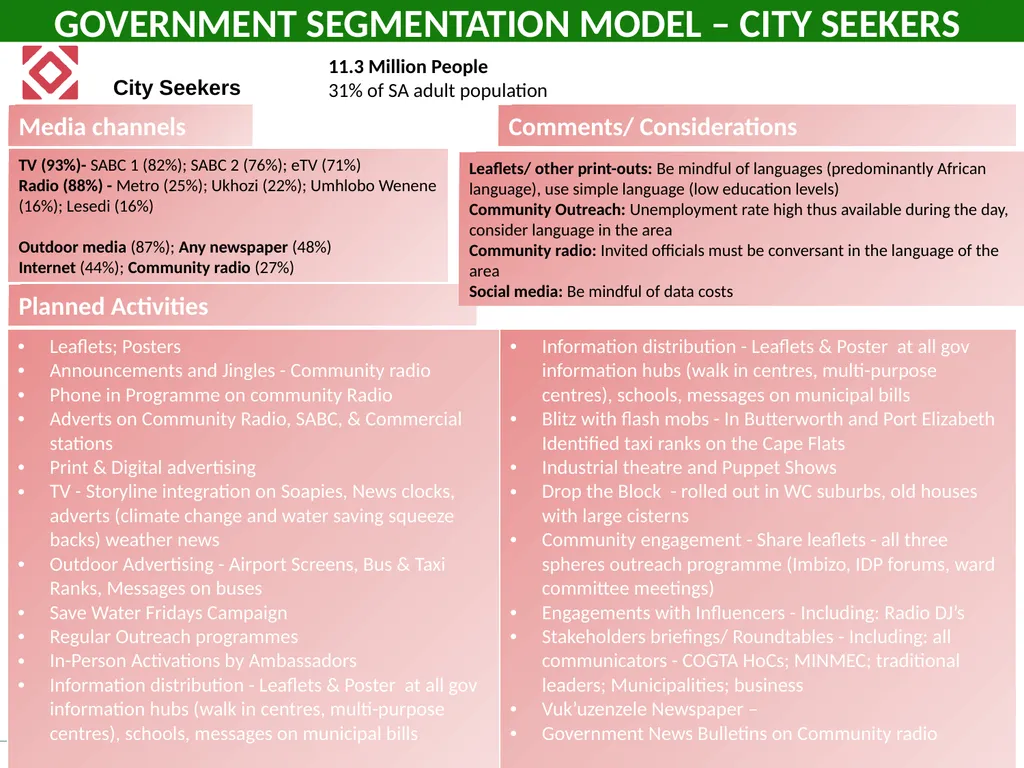
8 GOVERNMENT SEGMENTATION MODEL – CITY SEEKERS Quantitative description City Seekers 11.3 Million People
31% of SA adult population<br>
31% of SA adult population<br>
09
9 GOVERNMENT SEGMENTATION MODEL – CITY SEEKERS TV (93%)- SABC 1 (82%); SABC 2 (76%); eTV (71%)
Radio (88%) - Metro (25%); Ukhozi (22%); Umhlobo Wenene (16%); Lesedi (16%)
Outdoor media (87%); Any newspaper (48%)
Internet (44%); Community radio (27%) Media channels Comments/ Considerations Planned Activities Leaflets/ other print-outs: Be mindful of languages (predominantly African language), use simple language (low education levels)
Community Outreach: Unemployment rate high thus available during the day, consider language in the area
Community radio: Invited officials must be conversant in the language of the area
Social media: Be mindful of data costs City Seekers 11.3 Million People
31% of SA adult population<br>
Radio (88%) - Metro (25%); Ukhozi (22%); Umhlobo Wenene (16%); Lesedi (16%)
Outdoor media (87%); Any newspaper (48%)
Internet (44%); Community radio (27%) Media channels Comments/ Considerations Planned Activities Leaflets/ other print-outs: Be mindful of languages (predominantly African language), use simple language (low education levels)
Community Outreach: Unemployment rate high thus available during the day, consider language in the area
Community radio: Invited officials must be conversant in the language of the area
Social media: Be mindful of data costs City Seekers 11.3 Million People
31% of SA adult population<br>
10
10 GOVERNMENT SEGMENTATION MODEL – SAFELY SUBURBAN Quantitative description<br>
11
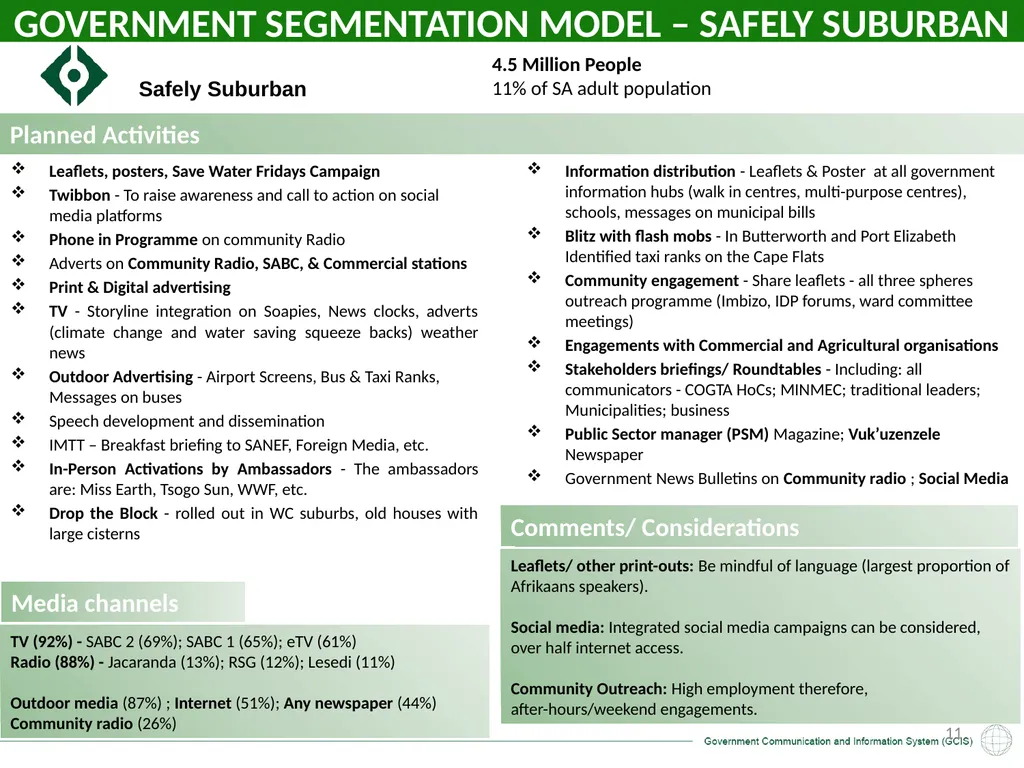
11 GOVERNMENT SEGMENTATION MODEL – SAFELY SUBURBAN TV (92%) - SABC 2 (69%); SABC 1 (65%); eTV (61%)
Radio (88%) - Jacaranda (13%); RSG (12%); Lesedi (11%)
Outdoor media (87%) ; Internet (51%); Any newspaper (44%)
Community radio (26%) Media channels Comments/ Considerations Planned Activities Leaflets/ other print-outs: Be mindful of language (largest proportion of Afrikaans speakers).
Social media: Integrated social media campaigns can be considered, over half internet access.
Community Outreach: High employment therefore, after-hours/weekend engagements. Leaflets, posters, Save Water Fridays Campaign
Twibbon - To raise awareness and call to action on social media platforms
Phone in Programme on community Radio
Adverts on Community Radio, SABC, & Commercial stations
Print & Digital advertising
TV - Storyline integration on Soapies, News clocks, adverts (climate change and water saving squeeze backs) weather news
Outdoor Advertising - Airport Screens, Bus & Taxi Ranks, Messages on buses
Speech development and dissemination
IMTT – Breakfast briefing to SANEF, Foreign Media, etc.
In-Person Activations by Ambassadors - The ambassadors are: Miss Earth, Tsogo Sun, WWF, etc.
Drop the Block - rolled out in WC suburbs, old houses with large cisterns Information distribution - Leaflets & Poster at all government information hubs (walk in centres, multi-purpose centres), schools, messages on municipal bills
Blitz with flash mobs - In Butterworth and Port Elizabeth Identified taxi ranks on the Cape Flats
Community engagement - Share leaflets - all three spheres outreach programme (Imbizo, IDP forums, ward committee meetings)
Engagements with Commercial and Agricultural organisations
Stakeholders briefings/ Roundtables - Including: all communicators - COGTA HoCs; MINMEC; traditional leaders; Municipalities; business
Public Sector manager (PSM) Magazine; Vuk’uzenzele Newspaper
Government News Bulletins on Community radio ; Social Media<br>
Radio (88%) - Jacaranda (13%); RSG (12%); Lesedi (11%)
Outdoor media (87%) ; Internet (51%); Any newspaper (44%)
Community radio (26%) Media channels Comments/ Considerations Planned Activities Leaflets/ other print-outs: Be mindful of language (largest proportion of Afrikaans speakers).
Social media: Integrated social media campaigns can be considered, over half internet access.
Community Outreach: High employment therefore, after-hours/weekend engagements. Leaflets, posters, Save Water Fridays Campaign
Twibbon - To raise awareness and call to action on social media platforms
Phone in Programme on community Radio
Adverts on Community Radio, SABC, & Commercial stations
Print & Digital advertising
TV - Storyline integration on Soapies, News clocks, adverts (climate change and water saving squeeze backs) weather news
Outdoor Advertising - Airport Screens, Bus & Taxi Ranks, Messages on buses
Speech development and dissemination
IMTT – Breakfast briefing to SANEF, Foreign Media, etc.
In-Person Activations by Ambassadors - The ambassadors are: Miss Earth, Tsogo Sun, WWF, etc.
Drop the Block - rolled out in WC suburbs, old houses with large cisterns Information distribution - Leaflets & Poster at all government information hubs (walk in centres, multi-purpose centres), schools, messages on municipal bills
Blitz with flash mobs - In Butterworth and Port Elizabeth Identified taxi ranks on the Cape Flats
Community engagement - Share leaflets - all three spheres outreach programme (Imbizo, IDP forums, ward committee meetings)
Engagements with Commercial and Agricultural organisations
Stakeholders briefings/ Roundtables - Including: all communicators - COGTA HoCs; MINMEC; traditional leaders; Municipalities; business
Public Sector manager (PSM) Magazine; Vuk’uzenzele Newspaper
Government News Bulletins on Community radio ; Social Media<br>
12
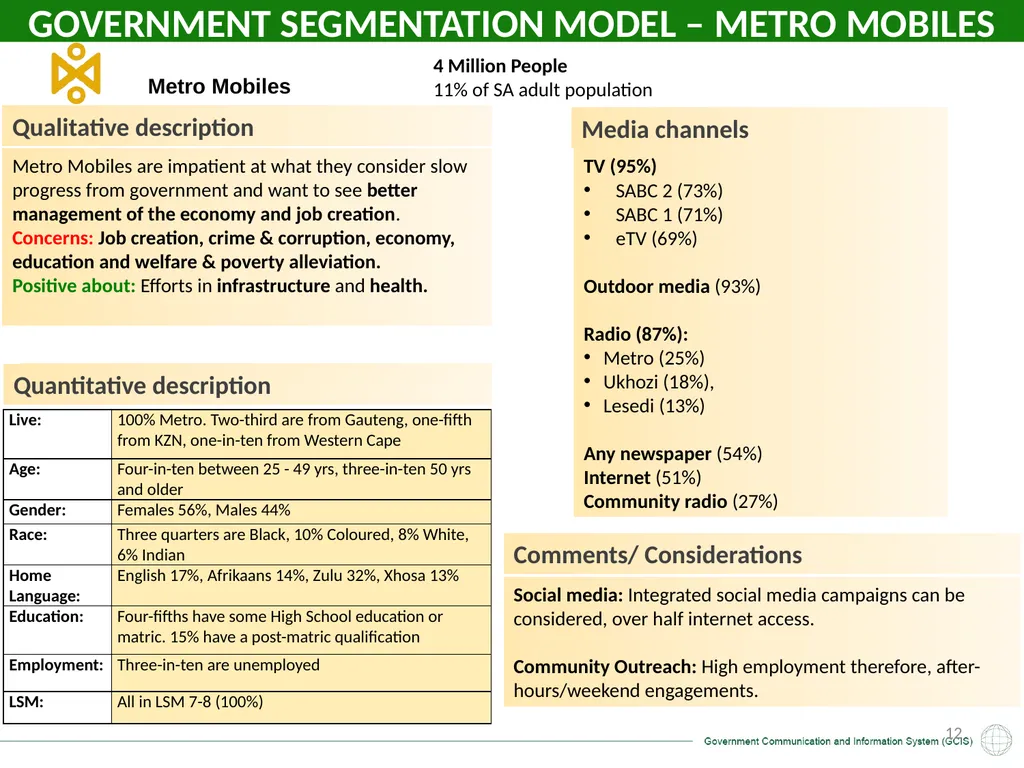
12 GOVERNMENT SEGMENTATION MODEL – METRO MOBILES Quantitative description TV (95%)
SABC 2 (73%)
SABC 1 (71%)
eTV (69%)
Outdoor media (93%)
Radio (87%):
Metro (25%)
Ukhozi (18%),
Lesedi (13%)
Any newspaper (54%)
Internet (51%)
Community radio (27%) Media channels Comments/ Considerations Social media: Integrated social media campaigns can be considered, over half internet access.
Community Outreach: High employment therefore, after-hours/weekend engagements. Metro Mobiles 4 Million People
11% of SA adult population<br>
SABC 2 (73%)
SABC 1 (71%)
eTV (69%)
Outdoor media (93%)
Radio (87%):
Metro (25%)
Ukhozi (18%),
Lesedi (13%)
Any newspaper (54%)
Internet (51%)
Community radio (27%) Media channels Comments/ Considerations Social media: Integrated social media campaigns can be considered, over half internet access.
Community Outreach: High employment therefore, after-hours/weekend engagements. Metro Mobiles 4 Million People
11% of SA adult population<br>
13
13 GOVERNMENT SEGMENTATION MODEL – METRO MOBILES Metro Mobiles 4 Million People
11% of SA adult population<br>
11% of SA adult population<br>
14
14 GOVERNMENT SEGMENTATION MODEL – COSMOPOLITAN CAPITALS Quantitative description Cosmopolitan Capital 4.1 Million People
11% of SA adult population<br>
11% of SA adult population<br>
15
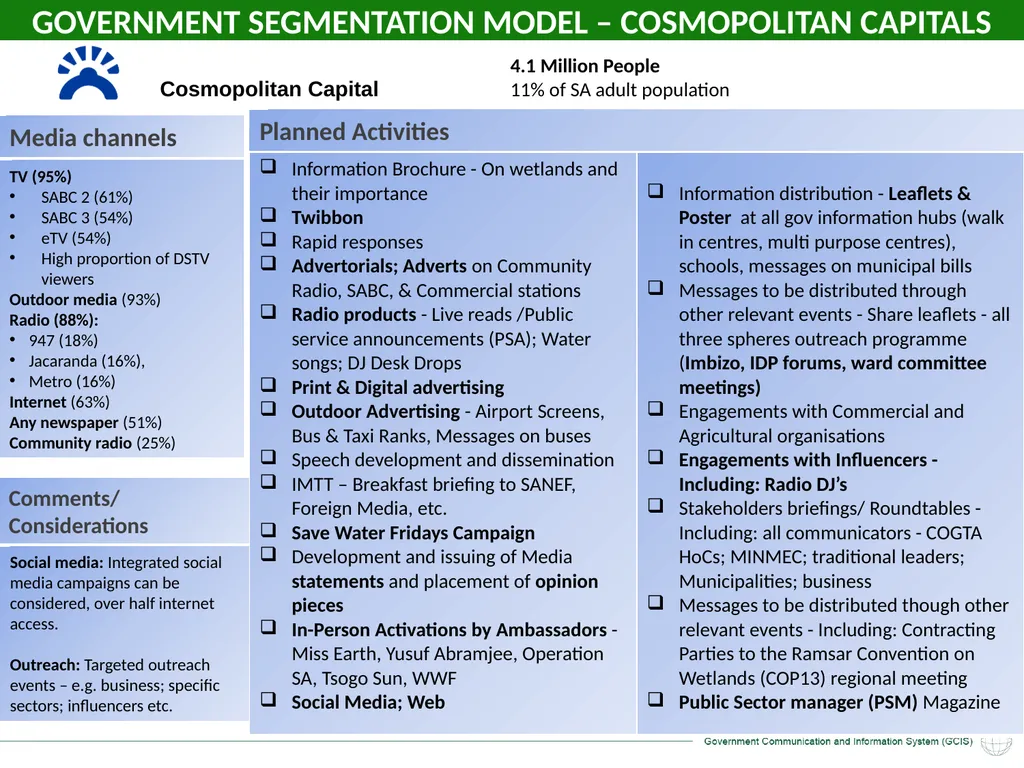
15 GOVERNMENT SEGMENTATION MODEL – COSMOPOLITAN CAPITALS TV (95%)
SABC 2 (61%)
SABC 3 (54%)
eTV (54%)
High proportion of DSTV viewers
Outdoor media (93%)
Radio (88%):
947 (18%)
Jacaranda (16%),
Metro (16%)
Internet (63%)
Any newspaper (51%)
Community radio (25%) Media channels Comments/ Considerations Planned Activities Social media: Integrated social media campaigns can be considered, over half internet access.
Outreach: Targeted outreach events – e.g. business; specific sectors; influencers etc. Cosmopolitan Capital 4.1 Million People
11% of SA adult population<br>
SABC 2 (61%)
SABC 3 (54%)
eTV (54%)
High proportion of DSTV viewers
Outdoor media (93%)
Radio (88%):
947 (18%)
Jacaranda (16%),
Metro (16%)
Internet (63%)
Any newspaper (51%)
Community radio (25%) Media channels Comments/ Considerations Planned Activities Social media: Integrated social media campaigns can be considered, over half internet access.
Outreach: Targeted outreach events – e.g. business; specific sectors; influencers etc. Cosmopolitan Capital 4.1 Million People
11% of SA adult population<br>
16
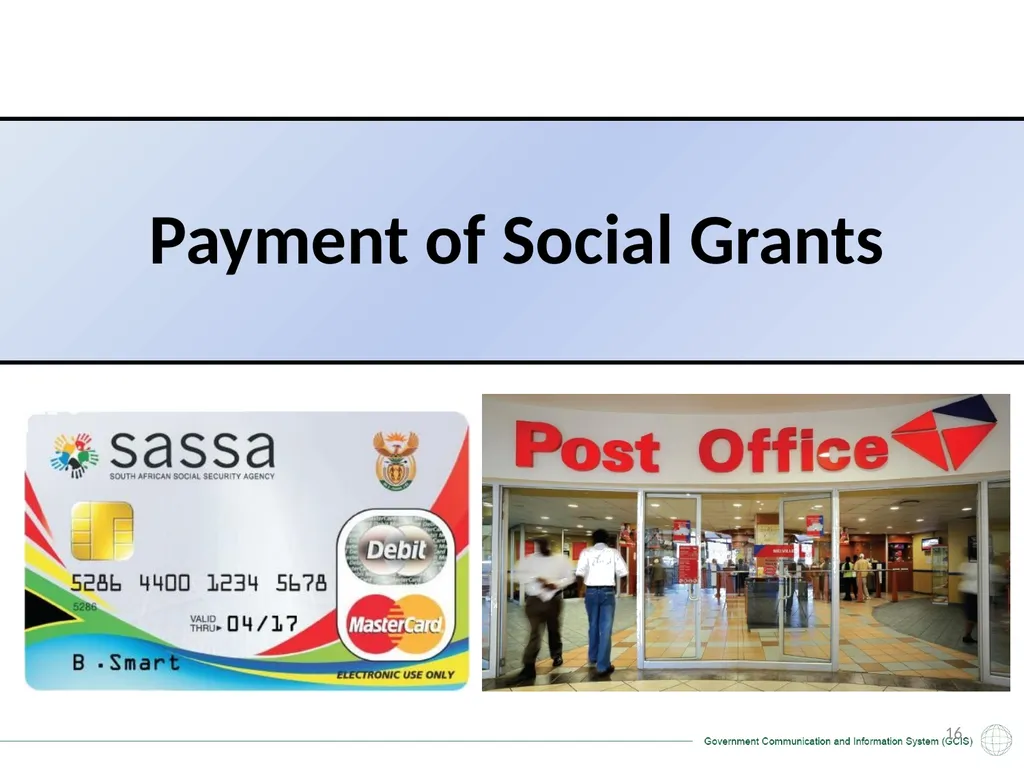
Payment of Social Grants 16<br>
17
17 GOVERNMENT SEGMENTATION MODEL – ROOTED REALISTS Quantitative description<br>
18
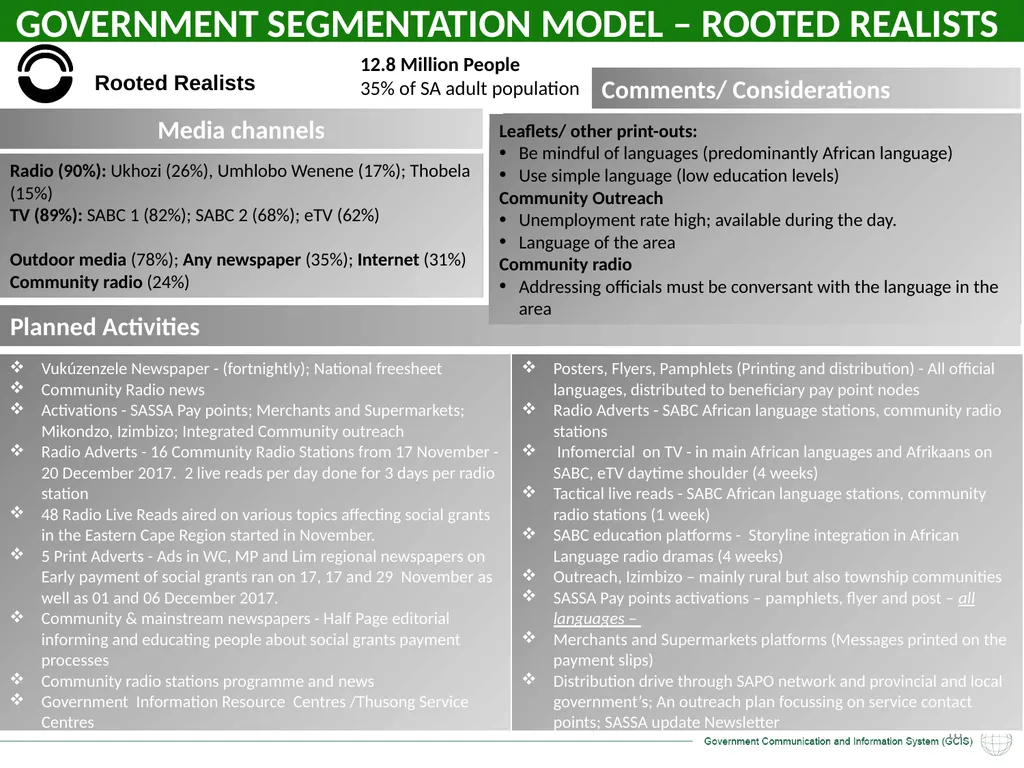
18 GOVERNMENT SEGMENTATION MODEL – ROOTED REALISTS Radio (90%): Ukhozi (26%), Umhlobo Wenene (17%); Thobela (15%)
TV (89%): SABC 1 (82%); SABC 2 (68%); eTV (62%)
Outdoor media (78%); Any newspaper (35%); Internet (31%)
Community radio (24%) Media channels Comments/ Considerations Planned Activities Leaflets/ other print-outs:
Be mindful of languages (predominantly African language)
Use simple language (low education levels)
Community Outreach
Unemployment rate high; available during the day.
Language of the area
Community radio
Addressing officials must be conversant with the language in the area<br>
TV (89%): SABC 1 (82%); SABC 2 (68%); eTV (62%)
Outdoor media (78%); Any newspaper (35%); Internet (31%)
Community radio (24%) Media channels Comments/ Considerations Planned Activities Leaflets/ other print-outs:
Be mindful of languages (predominantly African language)
Use simple language (low education levels)
Community Outreach
Unemployment rate high; available during the day.
Language of the area
Community radio
Addressing officials must be conversant with the language in the area<br>
19
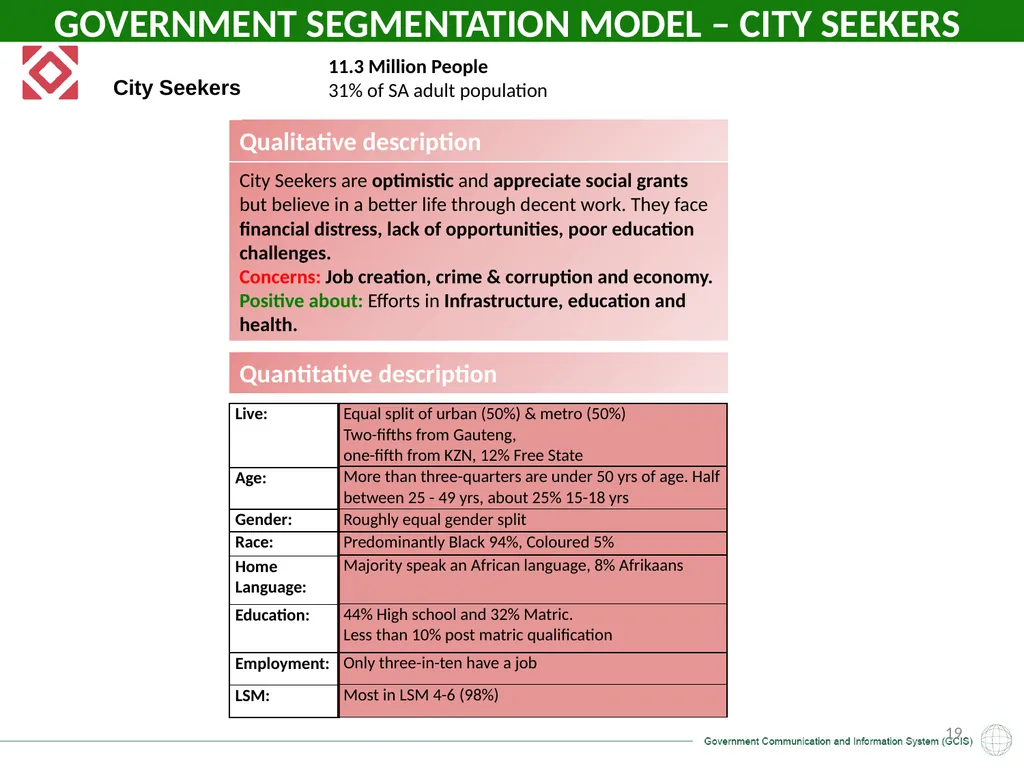
19 GOVERNMENT SEGMENTATION MODEL – CITY SEEKERS Quantitative description City Seekers 11.3 Million People
31% of SA adult population<br>
31% of SA adult population<br>
20
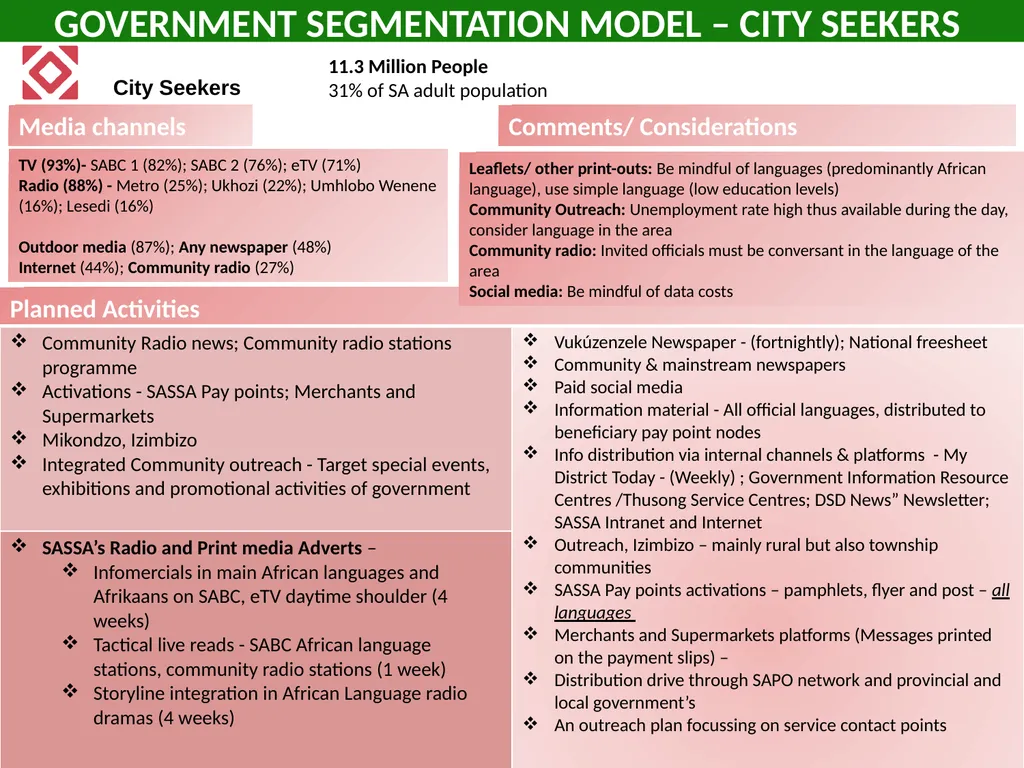
20 GOVERNMENT SEGMENTATION MODEL – CITY SEEKERS TV (93%)- SABC 1 (82%); SABC 2 (76%); eTV (71%)
Radio (88%) - Metro (25%); Ukhozi (22%); Umhlobo Wenene (16%); Lesedi (16%)
Outdoor media (87%); Any newspaper (48%)
Internet (44%); Community radio (27%) Media channels Comments/ Considerations Planned Activities Leaflets/ other print-outs: Be mindful of languages (predominantly African language), use simple language (low education levels)
Community Outreach: Unemployment rate high thus available during the day, consider language in the area
Community radio: Invited officials must be conversant in the language of the area
Social media: Be mindful of data costs City Seekers 11.3 Million People
31% of SA adult population<br>
Radio (88%) - Metro (25%); Ukhozi (22%); Umhlobo Wenene (16%); Lesedi (16%)
Outdoor media (87%); Any newspaper (48%)
Internet (44%); Community radio (27%) Media channels Comments/ Considerations Planned Activities Leaflets/ other print-outs: Be mindful of languages (predominantly African language), use simple language (low education levels)
Community Outreach: Unemployment rate high thus available during the day, consider language in the area
Community radio: Invited officials must be conversant in the language of the area
Social media: Be mindful of data costs City Seekers 11.3 Million People
31% of SA adult population<br>
21
21 GOVERNMENT SEGMENTATION MODEL – SAFELY SUBURBAN Quantitative description<br>
22
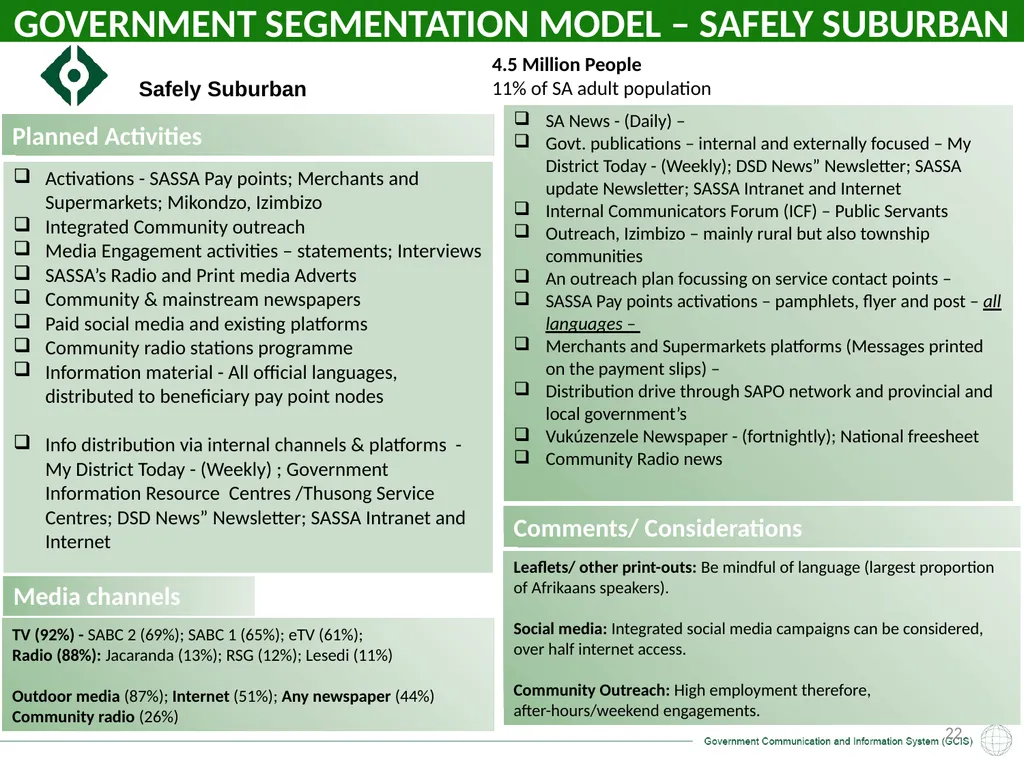
22 GOVERNMENT SEGMENTATION MODEL – SAFELY SUBURBAN TV (92%) - SABC 2 (69%); SABC 1 (65%); eTV (61%);
Radio (88%): Jacaranda (13%); RSG (12%); Lesedi (11%)
Outdoor media (87%); Internet (51%); Any newspaper (44%)
Community radio (26%) Media channels Comments/ Considerations Planned Activities Leaflets/ other print-outs: Be mindful of language (largest proportion of Afrikaans speakers).
Social media: Integrated social media campaigns can be considered, over half internet access.
Community Outreach: High employment therefore, after-hours/weekend engagements.<br>
Radio (88%): Jacaranda (13%); RSG (12%); Lesedi (11%)
Outdoor media (87%); Internet (51%); Any newspaper (44%)
Community radio (26%) Media channels Comments/ Considerations Planned Activities Leaflets/ other print-outs: Be mindful of language (largest proportion of Afrikaans speakers).
Social media: Integrated social media campaigns can be considered, over half internet access.
Community Outreach: High employment therefore, after-hours/weekend engagements.<br>
23
23 GOVERNMENT SEGMENTATION MODEL – METRO MOBILES Quantitative description Metro Mobiles 4 Million People
11% of SA adult population<br>
11% of SA adult population<br>
24
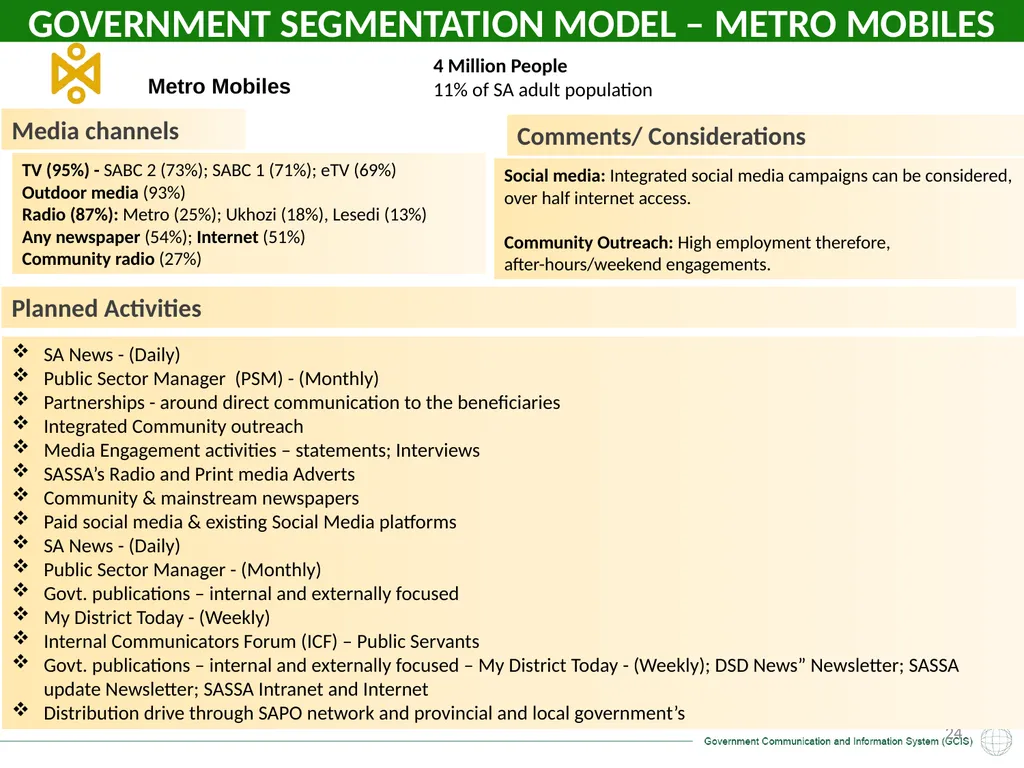
24 GOVERNMENT SEGMENTATION MODEL – METRO MOBILES TV (95%) - SABC 2 (73%); SABC 1 (71%); eTV (69%)
Outdoor media (93%)
Radio (87%): Metro (25%); Ukhozi (18%), Lesedi (13%)
Any newspaper (54%); Internet (51%)
Community radio (27%) Media channels SA News - (Daily)
Public Sector Manager (PSM) - (Monthly)
Partnerships - around direct communication to the beneficiaries
Integrated Community outreach
Media Engagement activities – statements; Interviews
SASSA’s Radio and Print media Adverts
Community & mainstream newspapers
Paid social media & existing Social Media platforms
SA News - (Daily)
Public Sector Manager - (Monthly)
Govt. publications – internal and externally focused
My District Today - (Weekly)
Internal Communicators Forum (ICF) – Public Servants
Govt. publications – internal and externally focused – My District Today - (Weekly); DSD News” Newsletter; SASSA update Newsletter; SASSA Intranet and Internet
Distribution drive through SAPO network and provincial and local government’s Comments/ Considerations Planned Activities Social media: Integrated social media campaigns can be considered, over half internet access.
Community Outreach: High employment therefore, after-hours/weekend engagements. Metro Mobiles 4 Million People
11% of SA adult population<br>
Outdoor media (93%)
Radio (87%): Metro (25%); Ukhozi (18%), Lesedi (13%)
Any newspaper (54%); Internet (51%)
Community radio (27%) Media channels SA News - (Daily)
Public Sector Manager (PSM) - (Monthly)
Partnerships - around direct communication to the beneficiaries
Integrated Community outreach
Media Engagement activities – statements; Interviews
SASSA’s Radio and Print media Adverts
Community & mainstream newspapers
Paid social media & existing Social Media platforms
SA News - (Daily)
Public Sector Manager - (Monthly)
Govt. publications – internal and externally focused
My District Today - (Weekly)
Internal Communicators Forum (ICF) – Public Servants
Govt. publications – internal and externally focused – My District Today - (Weekly); DSD News” Newsletter; SASSA update Newsletter; SASSA Intranet and Internet
Distribution drive through SAPO network and provincial and local government’s Comments/ Considerations Planned Activities Social media: Integrated social media campaigns can be considered, over half internet access.
Community Outreach: High employment therefore, after-hours/weekend engagements. Metro Mobiles 4 Million People
11% of SA adult population<br>
25
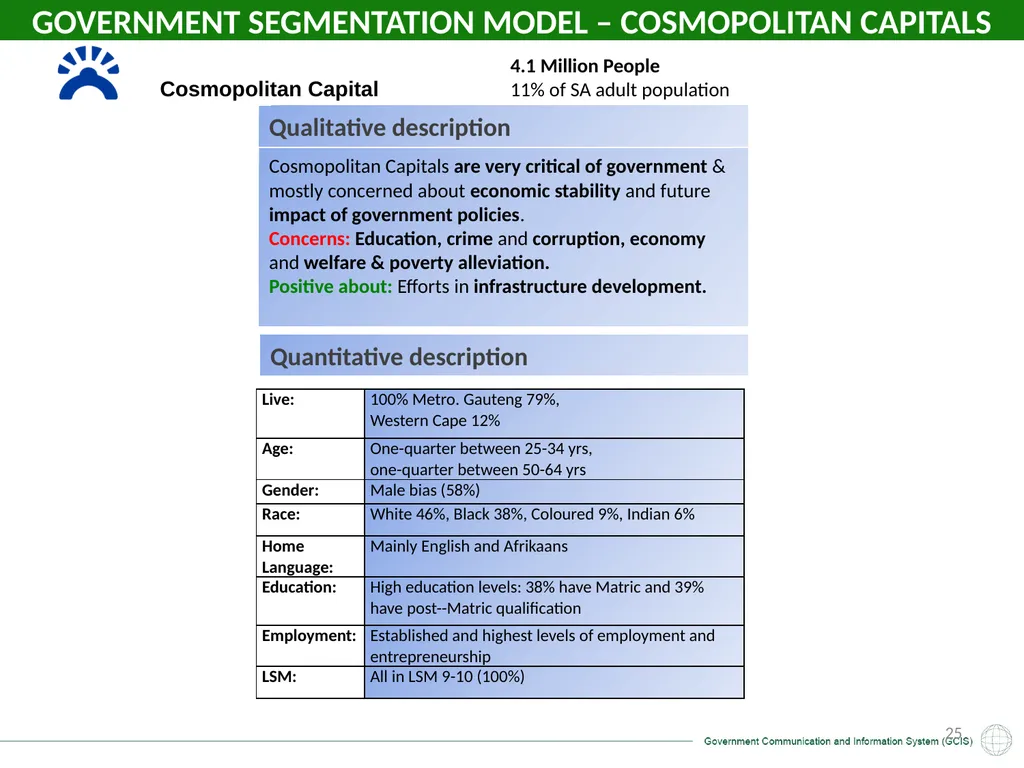
25 GOVERNMENT SEGMENTATION MODEL – COSMOPOLITAN CAPITALS Quantitative description Cosmopolitan Capital 4.1 Million People
11% of SA adult population<br>
11% of SA adult population<br>
26
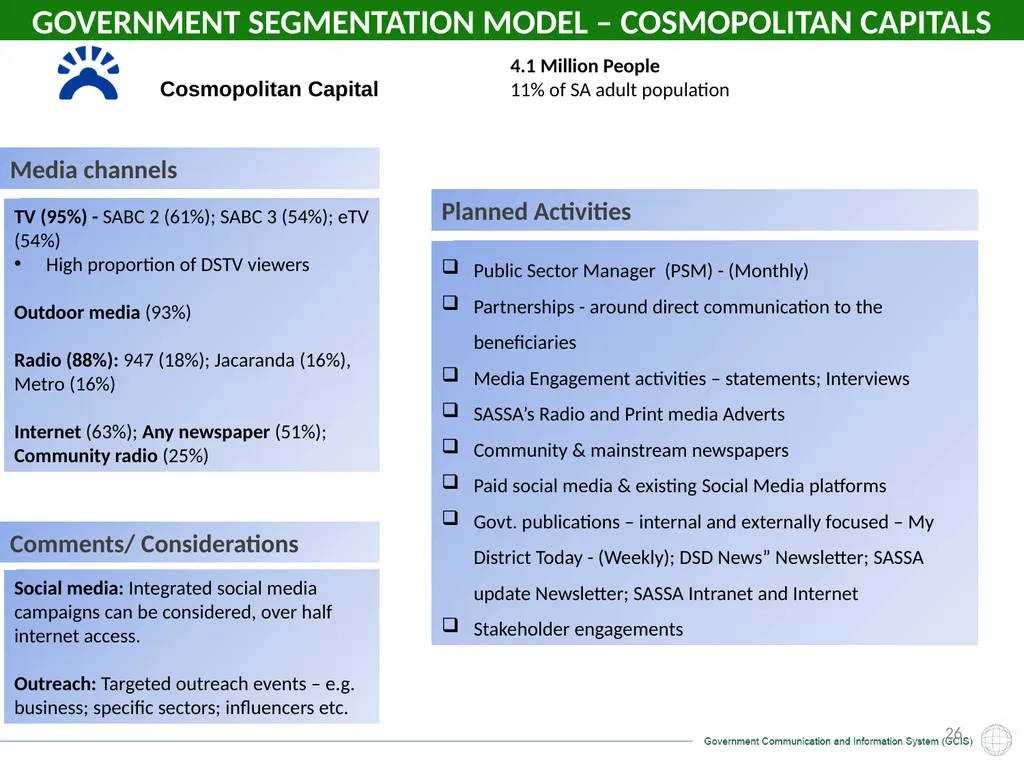
26 GOVERNMENT SEGMENTATION MODEL – COSMOPOLITAN CAPITALS TV (95%) - SABC 2 (61%); SABC 3 (54%); eTV (54%)
High proportion of DSTV viewers
Outdoor media (93%)
Radio (88%): 947 (18%); Jacaranda (16%), Metro (16%)
Internet (63%); Any newspaper (51%); Community radio (25%) Media channels Public Sector Manager (PSM) - (Monthly)
Partnerships - around direct communication to the beneficiaries
Media Engagement activities – statements; Interviews
SASSA’s Radio and Print media Adverts
Community & mainstream newspapers
Paid social media & existing Social Media platforms
Govt. publications – internal and externally focused – My District Today - (Weekly); DSD News” Newsletter; SASSA update Newsletter; SASSA Intranet and Internet
Stakeholder engagements Comments/ Considerations Planned Activities Social media: Integrated social media campaigns can be considered, over half internet access.
Outreach: Targeted outreach events – e.g. business; specific sectors; influencers etc. Cosmopolitan Capital 4.1 Million People
11% of SA adult population<br>
High proportion of DSTV viewers
Outdoor media (93%)
Radio (88%): 947 (18%); Jacaranda (16%), Metro (16%)
Internet (63%); Any newspaper (51%); Community radio (25%) Media channels Public Sector Manager (PSM) - (Monthly)
Partnerships - around direct communication to the beneficiaries
Media Engagement activities – statements; Interviews
SASSA’s Radio and Print media Adverts
Community & mainstream newspapers
Paid social media & existing Social Media platforms
Govt. publications – internal and externally focused – My District Today - (Weekly); DSD News” Newsletter; SASSA update Newsletter; SASSA Intranet and Internet
Stakeholder engagements Comments/ Considerations Planned Activities Social media: Integrated social media campaigns can be considered, over half internet access.
Outreach: Targeted outreach events – e.g. business; specific sectors; influencers etc. Cosmopolitan Capital 4.1 Million People
11% of SA adult population<br>
27
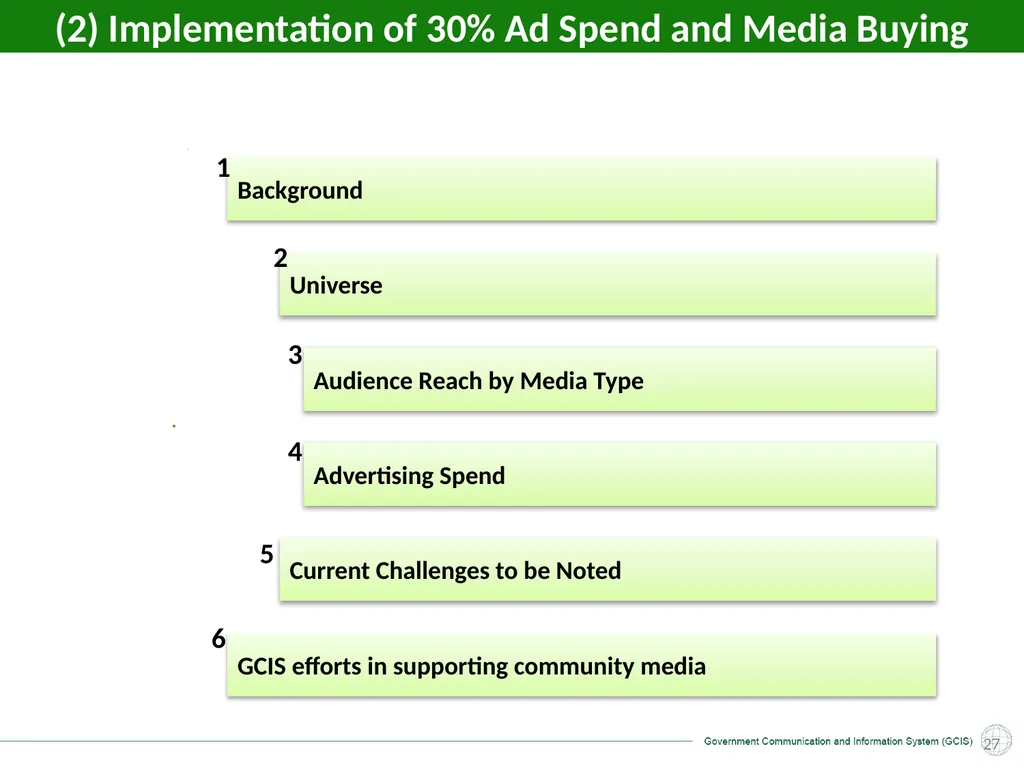
(2) Implementation of 30% Ad Spend and Media Buying 1 2 3 4 5 27 6<br>
28
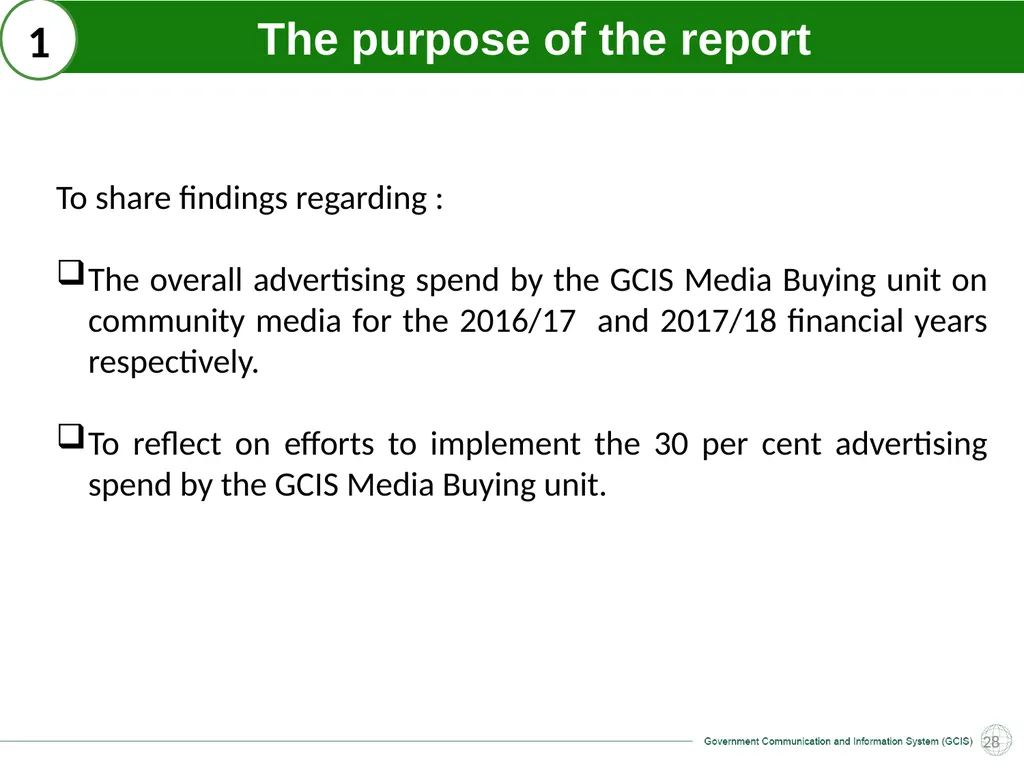
To share findings regarding :
The overall advertising spend by the GCIS Media Buying unit on community media for the 2016/17 and 2017/18 financial years respectively.
To reflect on efforts to implement the 30 per cent advertising spend by the GCIS Media Buying unit. 28 1<br>
The overall advertising spend by the GCIS Media Buying unit on community media for the 2016/17 and 2017/18 financial years respectively.
To reflect on efforts to implement the 30 per cent advertising spend by the GCIS Media Buying unit. 28 1<br>
29
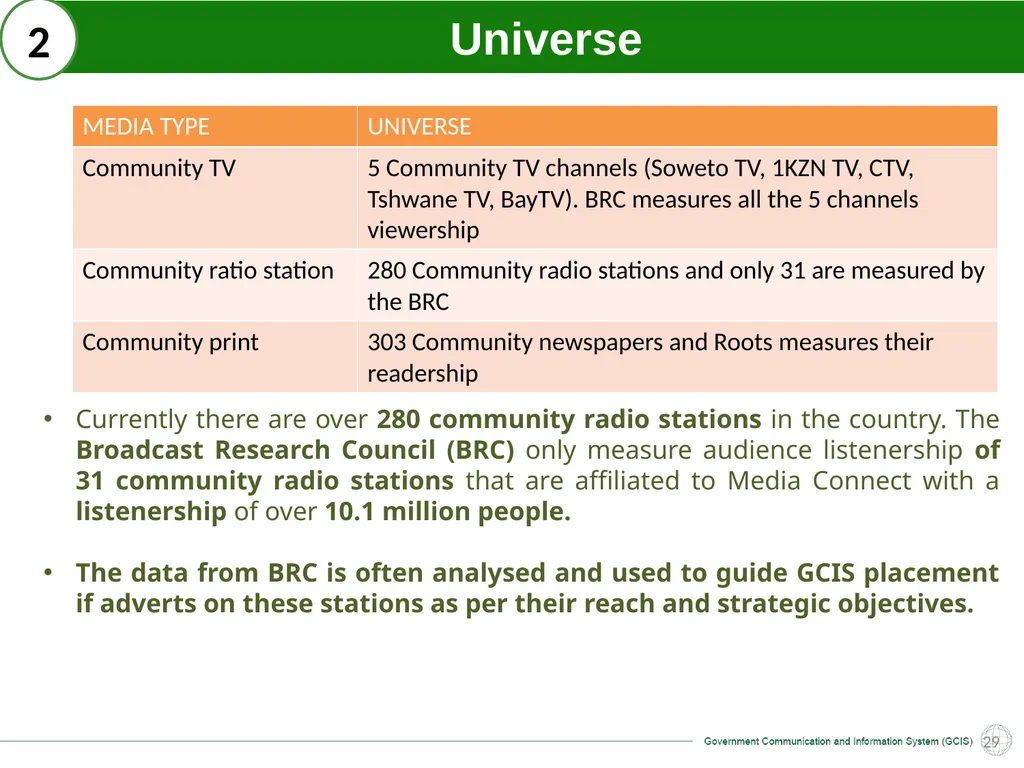
Currently there are over 280 community radio stations in the country. The Broadcast Research Council (BRC) only measure audience listenership of 31 community radio stations that are affiliated to Media Connect with a listenership of over 10.1 million people.
The data from BRC is often analysed and used to guide GCIS placement if adverts on these stations as per their reach and strategic objectives. 29 2<br>
The data from BRC is often analysed and used to guide GCIS placement if adverts on these stations as per their reach and strategic objectives. 29 2<br>
30
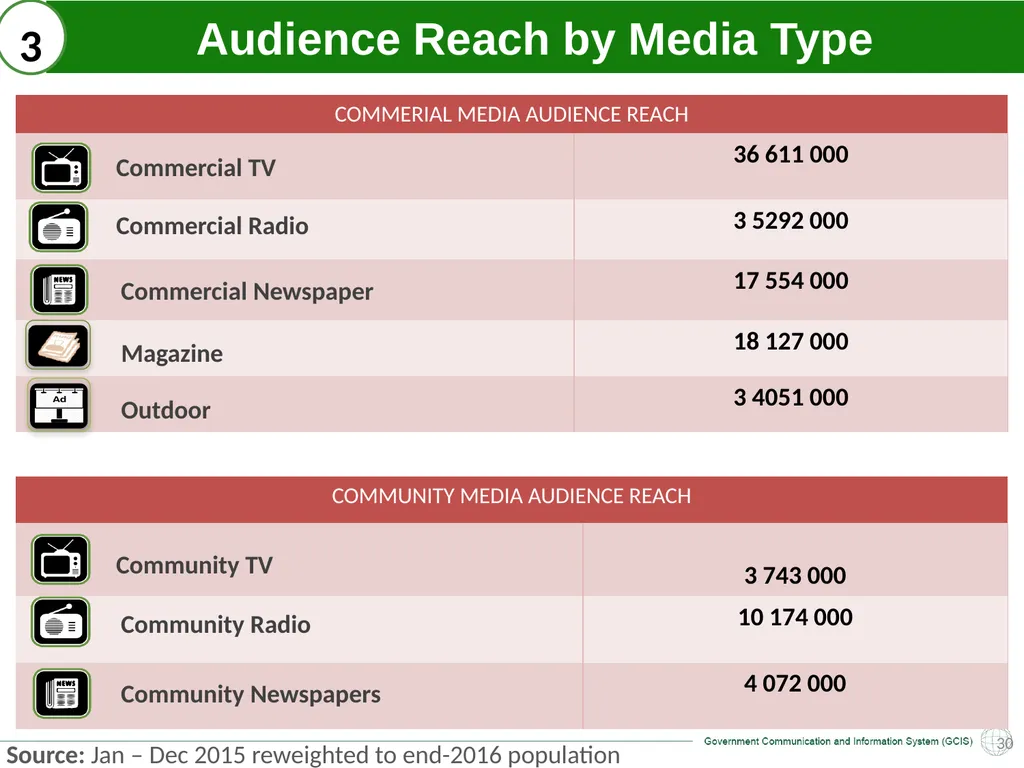
Magazine Audience Reach by Media Type 3 Source: Jan – Dec 2015 reweighted to end-2016 population 30<br>
31
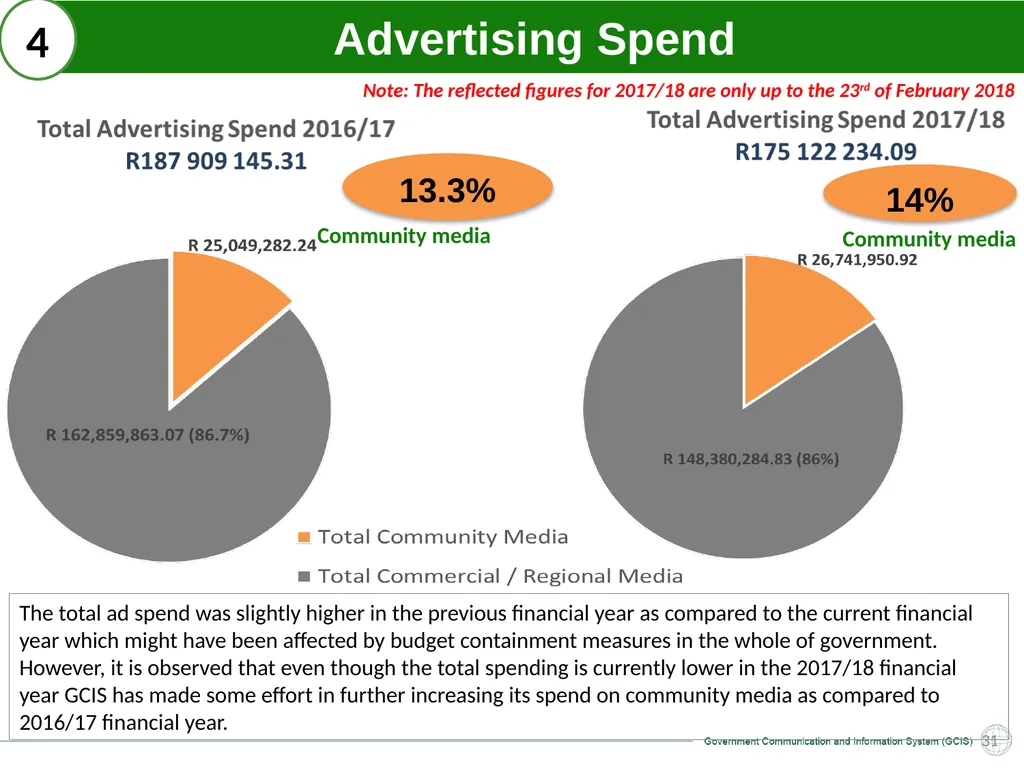
31 4 The total ad spend was slightly higher in the previous financial year as compared to the current financial year which might have been affected by budget containment measures in the whole of government. However, it is observed that even though the total spending is currently lower in the 2017/18 financial year GCIS has made some effort in further increasing its spend on community media as compared to 2016/17 financial year.<br>
32
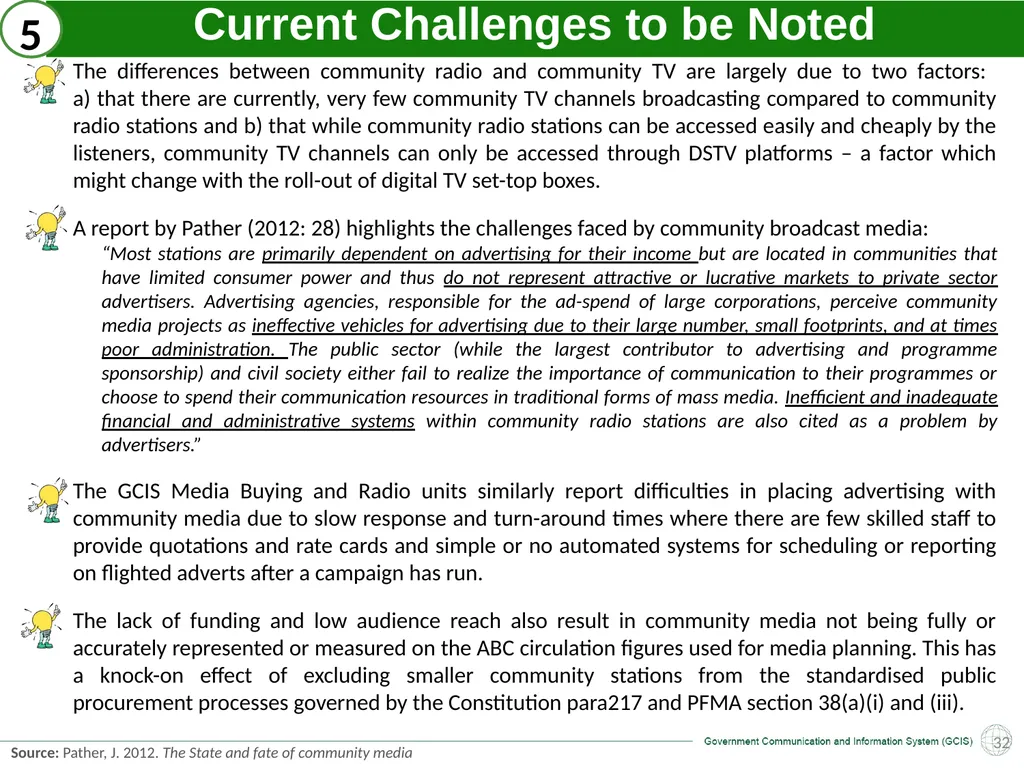
The differences between community radio and community TV are largely due to two factors:
a) that there are currently, very few community TV channels broadcasting compared to community radio stations and b) that while community radio stations can be accessed easily and cheaply by the listeners, community TV channels can only be accessed through DSTV platforms – a factor which might change with the roll-out of digital TV set-top boxes.
A report by Pather (2012: 28) highlights the challenges faced by community broadcast media:
“Most stations are primarily dependent on advertising for their income but are located in communities that have limited consumer power and thus do not represent attractive or lucrative markets to private sector advertisers. Advertising agencies, responsible for the ad-spend of large corporations, perceive community media projects as ineffective vehicles for advertising due to their large number, small footprints, and at times poor administration. The public sector (while the largest contributor to advertising and programme sponsorship) and civil society either fail to realize the importance of communication to their programmes or choose to spend their communication resources in traditional forms of mass media. Inefficient and inadequate financial and administrative systems within community radio stations are also cited as a problem by advertisers.”
The GCIS Media Buying and Radio units similarly report difficulties in placing advertising with community media due to slow response and turn-around times where there are few skilled staff to provide quotations and rate cards and simple or no automated systems for scheduling or reporting on flighted adverts after a campaign has run.
The lack of funding and low audience reach also result in community media not being fully or accurately represented or measured on the ABC circulation figures used for media planning. This has a knock-on effect of excluding smaller community stations from the standardised public procurement processes governed by the Constitution para217 and PFMA section 38(a)(i) and (iii). 32 Source: Pather, J. 2012. The State and fate of community media 5<br>
A report by Pather (2012: 28) highlights the challenges faced by community broadcast media:
“Most stations are primarily dependent on advertising for their income but are located in communities that have limited consumer power and thus do not represent attractive or lucrative markets to private sector advertisers. Advertising agencies, responsible for the ad-spend of large corporations, perceive community media projects as ineffective vehicles for advertising due to their large number, small footprints, and at times poor administration. The public sector (while the largest contributor to advertising and programme sponsorship) and civil society either fail to realize the importance of communication to their programmes or choose to spend their communication resources in traditional forms of mass media. Inefficient and inadequate financial and administrative systems within community radio stations are also cited as a problem by advertisers.”
The GCIS Media Buying and Radio units similarly report difficulties in placing advertising with community media due to slow response and turn-around times where there are few skilled staff to provide quotations and rate cards and simple or no automated systems for scheduling or reporting on flighted adverts after a campaign has run.
The lack of funding and low audience reach also result in community media not being fully or accurately represented or measured on the ABC circulation figures used for media planning. This has a knock-on effect of excluding smaller community stations from the standardised public procurement processes governed by the Constitution para217 and PFMA section 38(a)(i) and (iii). 32 Source: Pather, J. 2012. The State and fate of community media 5<br>
33
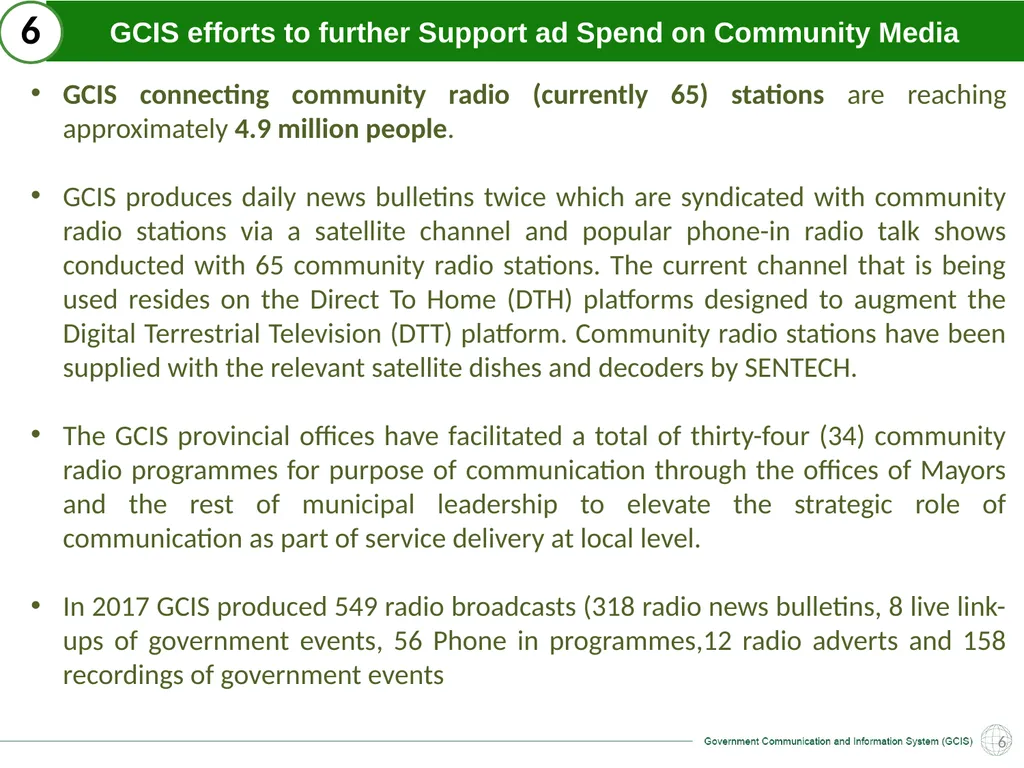
6 GCIS connecting community radio (currently 65) stations are reaching approximately 4.9 million people.
GCIS produces daily news bulletins twice which are syndicated with community radio stations via a satellite channel and popular phone-in radio talk shows conducted with 65 community radio stations. The current channel that is being used resides on the Direct To Home (DTH) platforms designed to augment the Digital Terrestrial Television (DTT) platform. Community radio stations have been supplied with the relevant satellite dishes and decoders by SENTECH.
The GCIS provincial offices have facilitated a total of thirty-four (34) community radio programmes for purpose of communication through the offices of Mayors and the rest of municipal leadership to elevate the strategic role of communication as part of service delivery at local level.
In 2017 GCIS produced 549 radio broadcasts (318 radio news bulletins, 8 live link-ups of government events, 56 Phone in programmes,12 radio adverts and 158 recordings of government events GCIS efforts to further Support ad Spend on Community Media 6<br>
GCIS produces daily news bulletins twice which are syndicated with community radio stations via a satellite channel and popular phone-in radio talk shows conducted with 65 community radio stations. The current channel that is being used resides on the Direct To Home (DTH) platforms designed to augment the Digital Terrestrial Television (DTT) platform. Community radio stations have been supplied with the relevant satellite dishes and decoders by SENTECH.
The GCIS provincial offices have facilitated a total of thirty-four (34) community radio programmes for purpose of communication through the offices of Mayors and the rest of municipal leadership to elevate the strategic role of communication as part of service delivery at local level.
In 2017 GCIS produced 549 radio broadcasts (318 radio news bulletins, 8 live link-ups of government events, 56 Phone in programmes,12 radio adverts and 158 recordings of government events GCIS efforts to further Support ad Spend on Community Media 6<br>
34
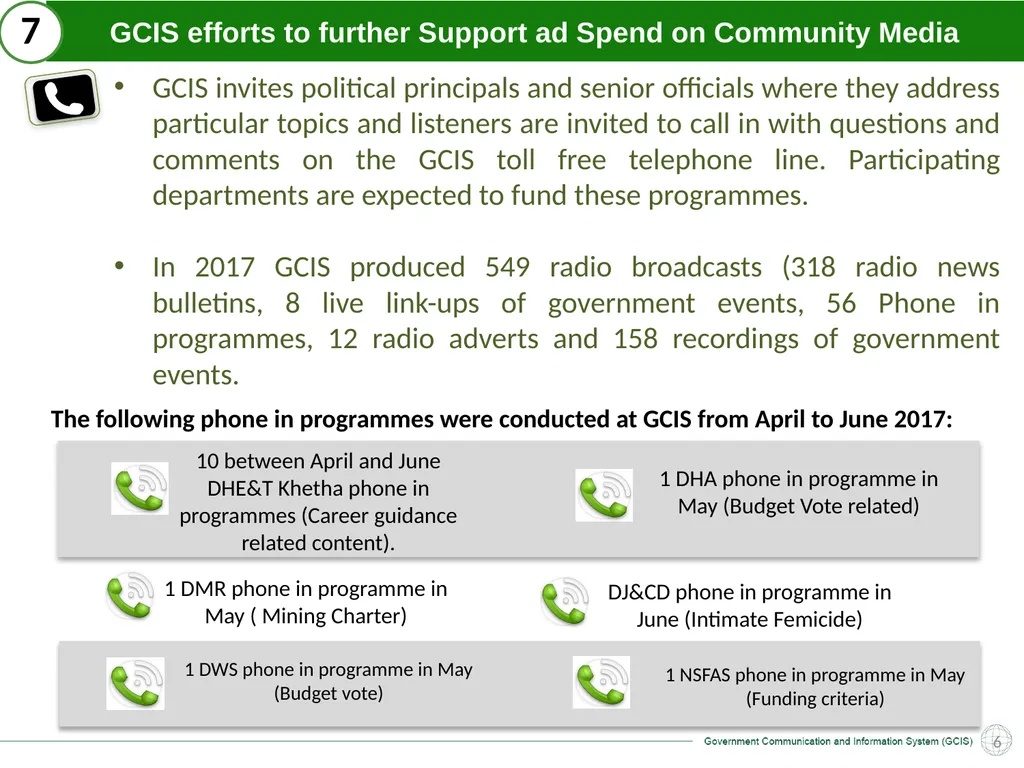
6 GCIS invites political principals and senior officials where they address particular topics and listeners are invited to call in with questions and comments on the GCIS toll free telephone line. Participating departments are expected to fund these programmes.
In 2017 GCIS produced 549 radio broadcasts (318 radio news bulletins, 8 live link-ups of government events, 56 Phone in programmes, 12 radio adverts and 158 recordings of government events. GCIS efforts to further Support ad Spend on Community Media 7 The following phone in programmes were conducted at GCIS from April to June 2017:<br>
In 2017 GCIS produced 549 radio broadcasts (318 radio news bulletins, 8 live link-ups of government events, 56 Phone in programmes, 12 radio adverts and 158 recordings of government events. GCIS efforts to further Support ad Spend on Community Media 7 The following phone in programmes were conducted at GCIS from April to June 2017:<br>
35
6 GCIS efforts to further Support ad Spend on Community Media 8 The GCIS video units continues to provide video products to all community stations around the country. In past 3 years the unit has provided community television stations with over 15 products ranging from Public Service Announcements , documentaries and events videos.<br>
36
6 Through the radio unit – GCIS has assisted various stations to apply for broadcasting licenses from ICASA enabling them to secure spots for advertising.
The unit also assisted stations in registering at the National Treasury Central Supplier Database.
GCIS is currently putting in place a panel of community print for ease of government doing business with community print. This will aid in minimizing the number of non compliant providers and other challenges experienced while trying to procure such platform.
Noting that within the basket of community media – radio attracts more audience as compared to other platforms, it would be of benefit given the cost cutting measures to channel more ad-spend to community radio for government to get more mileage. GCIS efforts to further Support ad Spend on Community Media 9<br>
The unit also assisted stations in registering at the National Treasury Central Supplier Database.
GCIS is currently putting in place a panel of community print for ease of government doing business with community print. This will aid in minimizing the number of non compliant providers and other challenges experienced while trying to procure such platform.
Noting that within the basket of community media – radio attracts more audience as compared to other platforms, it would be of benefit given the cost cutting measures to channel more ad-spend to community radio for government to get more mileage. GCIS efforts to further Support ad Spend on Community Media 9<br>
37
THANK YOU……
End. 37<br>