
GCSE Language Paper 1 Section B (Creative Writing)
PM
Published · 49 slides · 0 views
1 / 1


Description
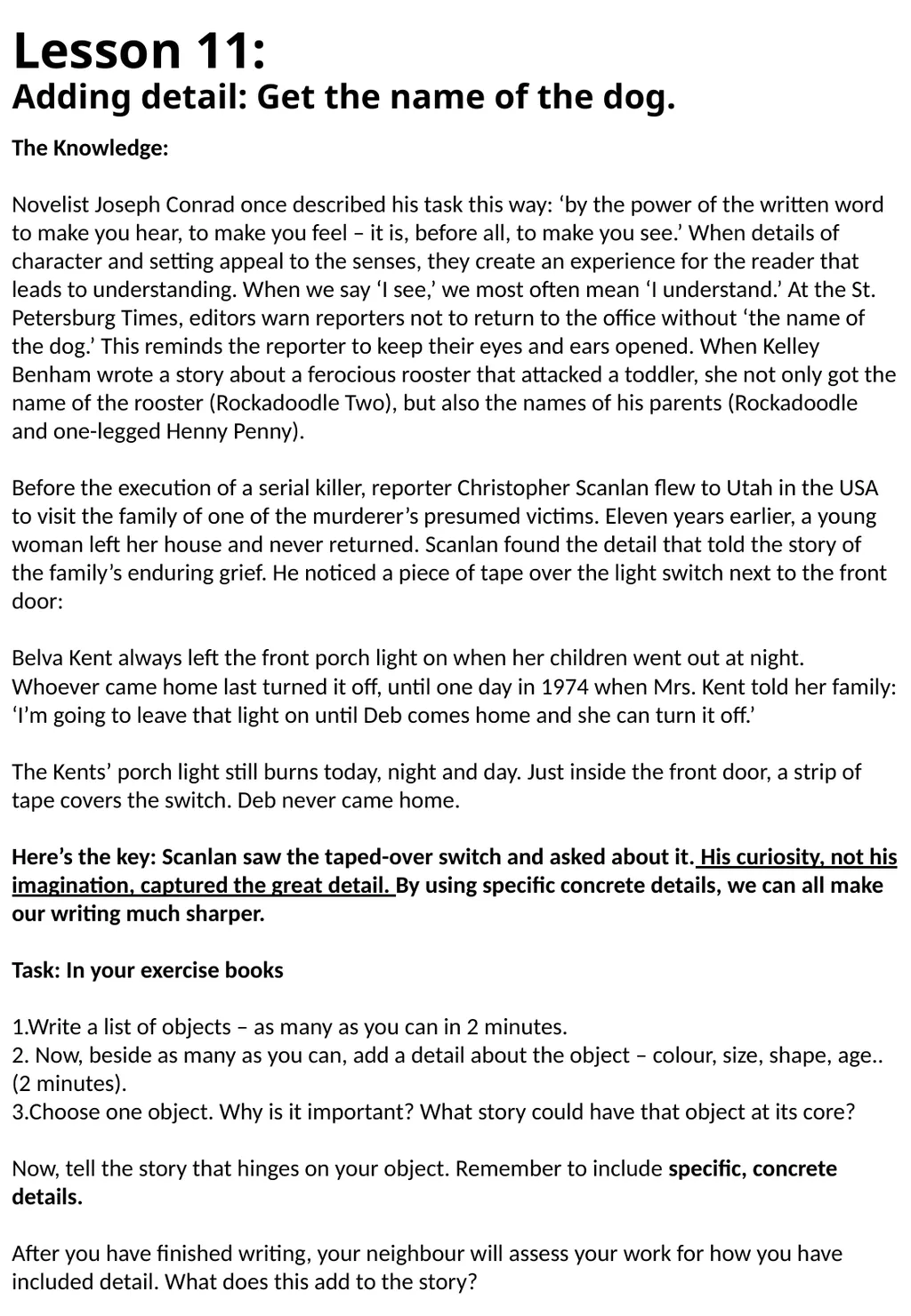
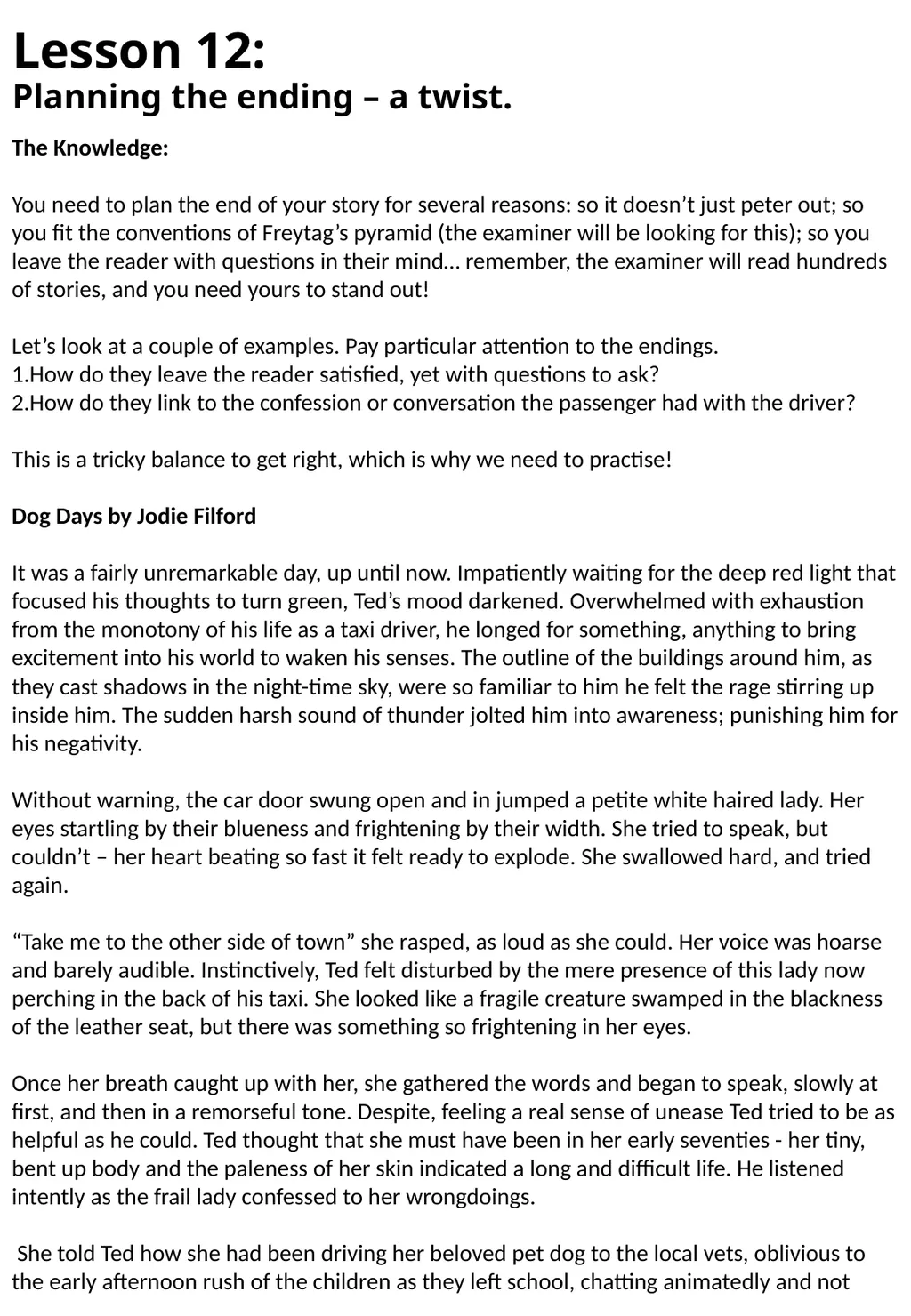
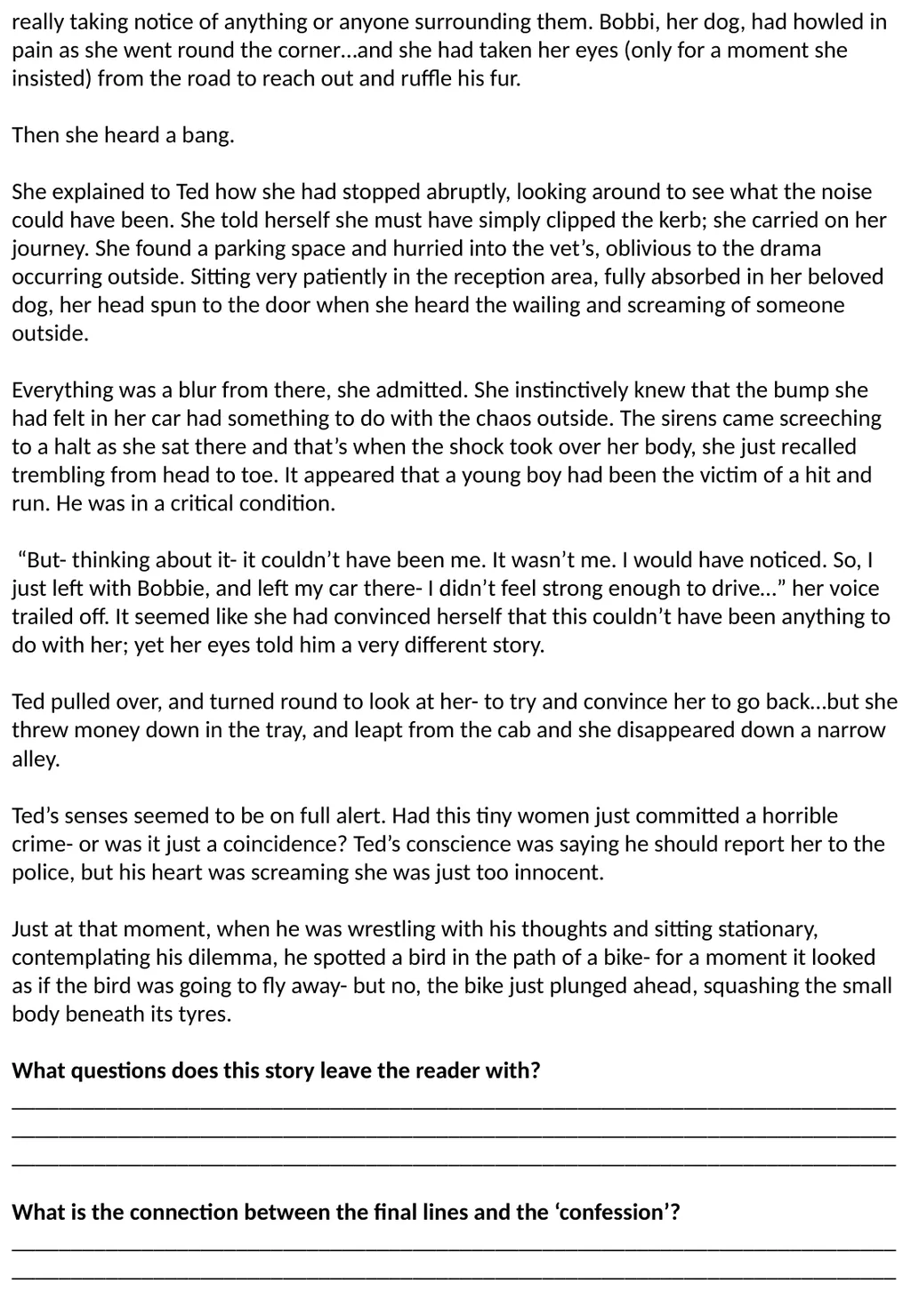
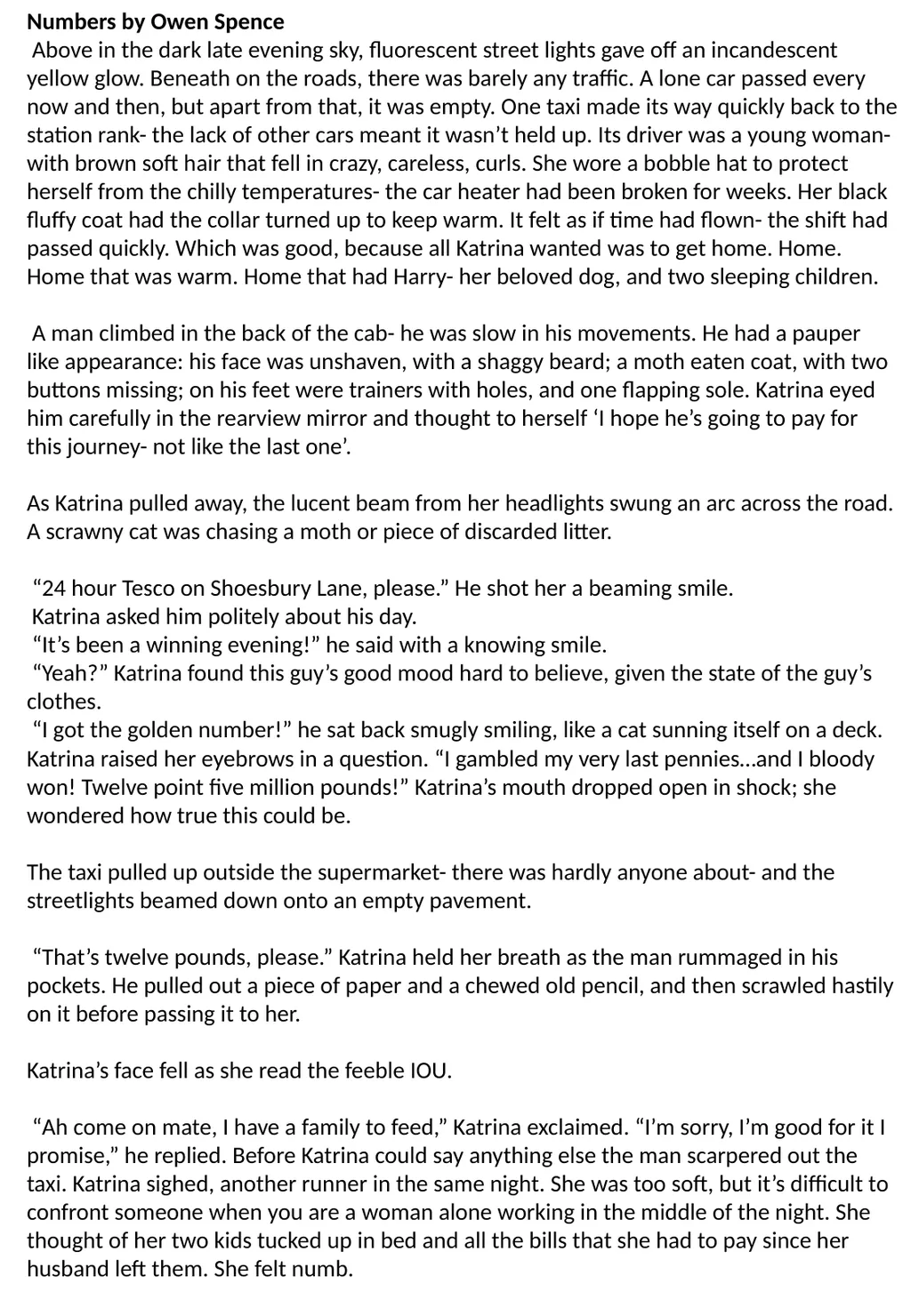
GCSE Language Paper 1 Section B (Creative Writing) Exam-ready booklet Name: .. Class:.. Lesson 1: Recap Section B: Question 5 (40 marker) 2 Section B: Question 5 (40 marker) Top of the Mark Scheme for AO5 Top
Related Topics
Share
Embed code
Download this presentation From Below
"GCSE Language Paper 1 Section B (Creative Writing)" is the property of its rightful owner. Permission is granted to download and print the materials on this website for personal, non-commercial use only, and to display it on your personal computer provided you do not modify the materials and that you retain all copyright notices contained in the materials. By downloading content from our website, you accept the terms of this agreement.
Presentation Transcript
01
GCSE Language
Paper 1 Section B
(Creative Writing)
Exam-ready booklet Name: …………………………………………..
Class:…………………………………………..<br>
Class:…………………………………………..<br>
02
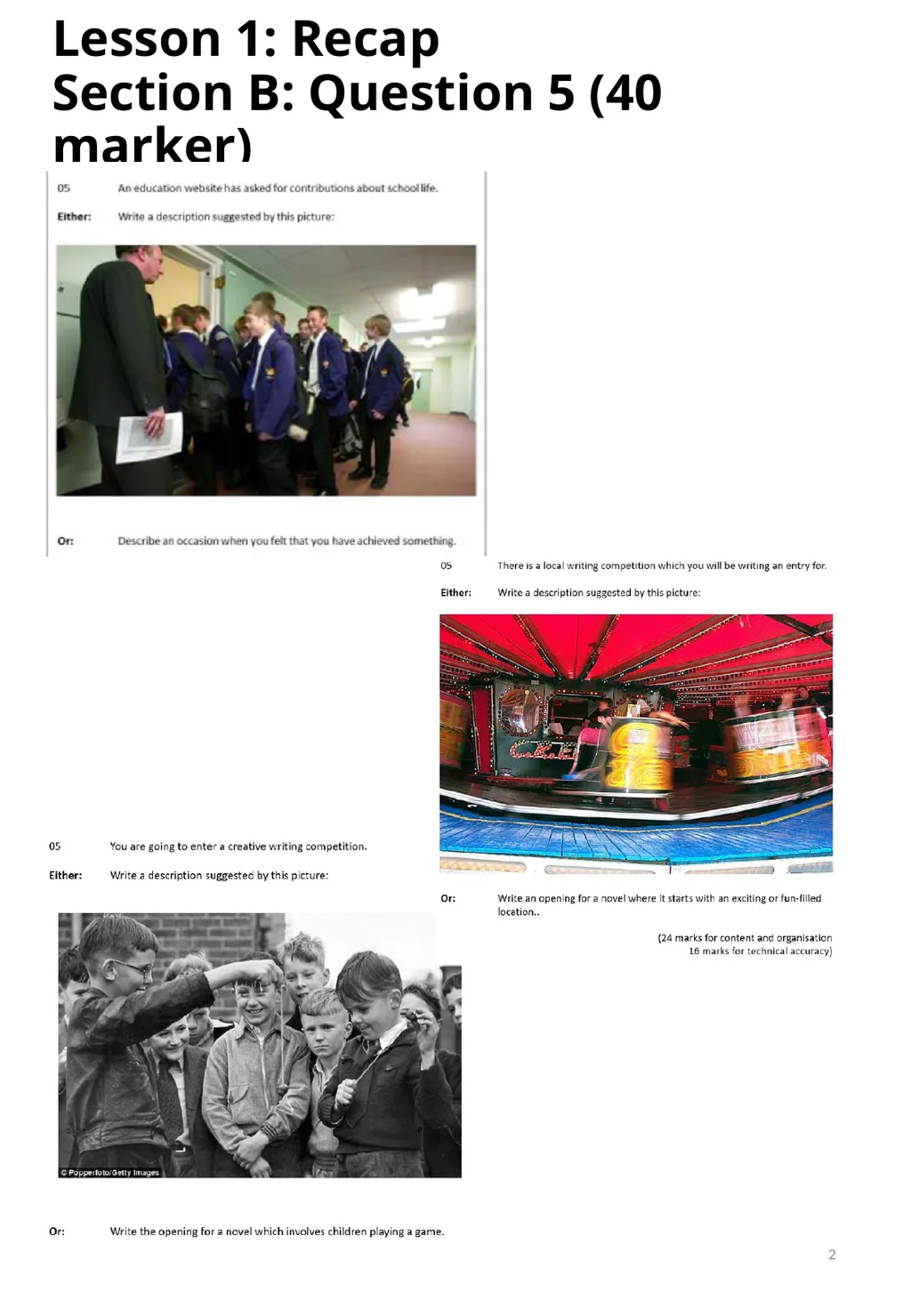
Lesson 1: Recap
Section B: Question 5 (40 marker) 2<br>
03
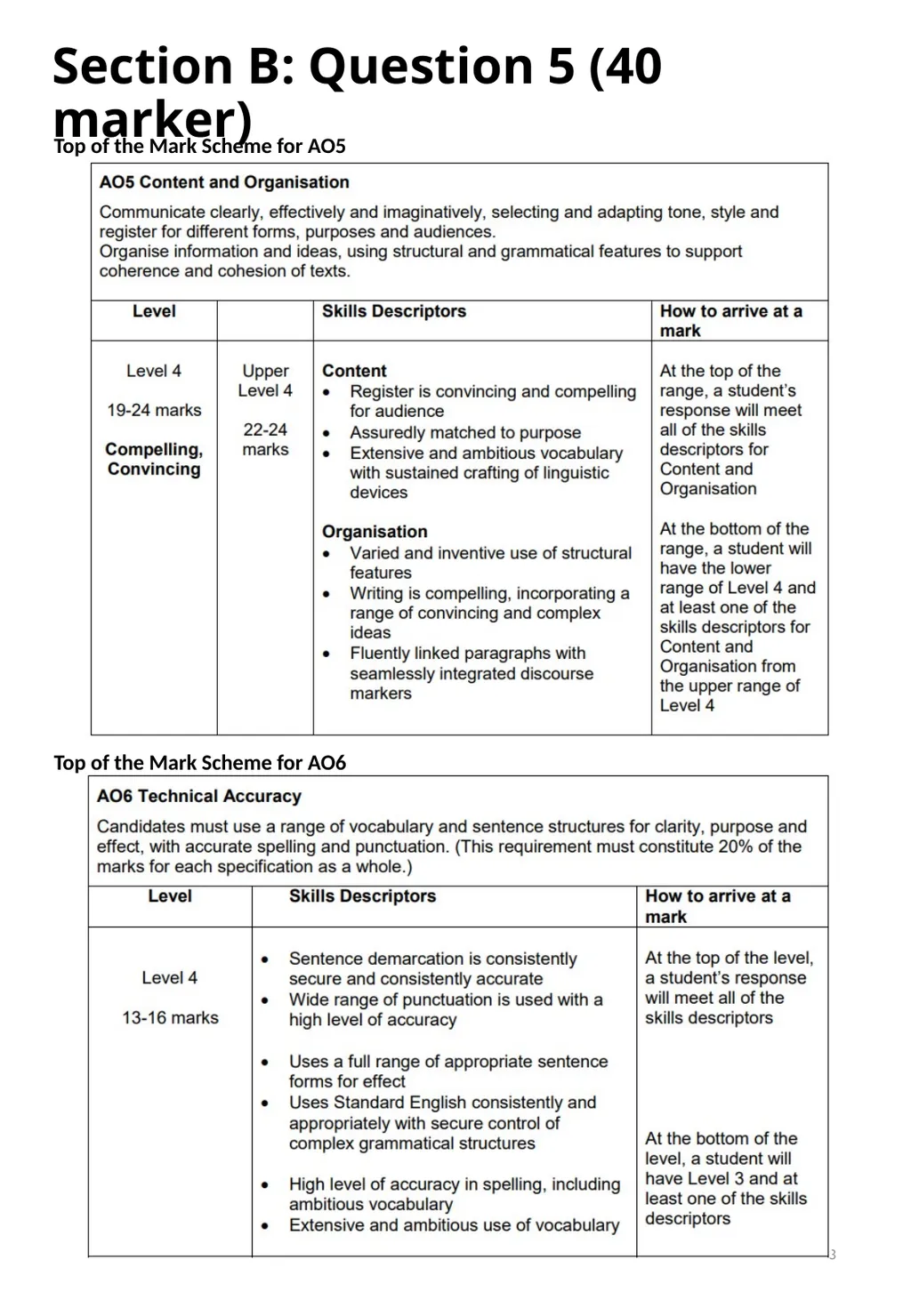
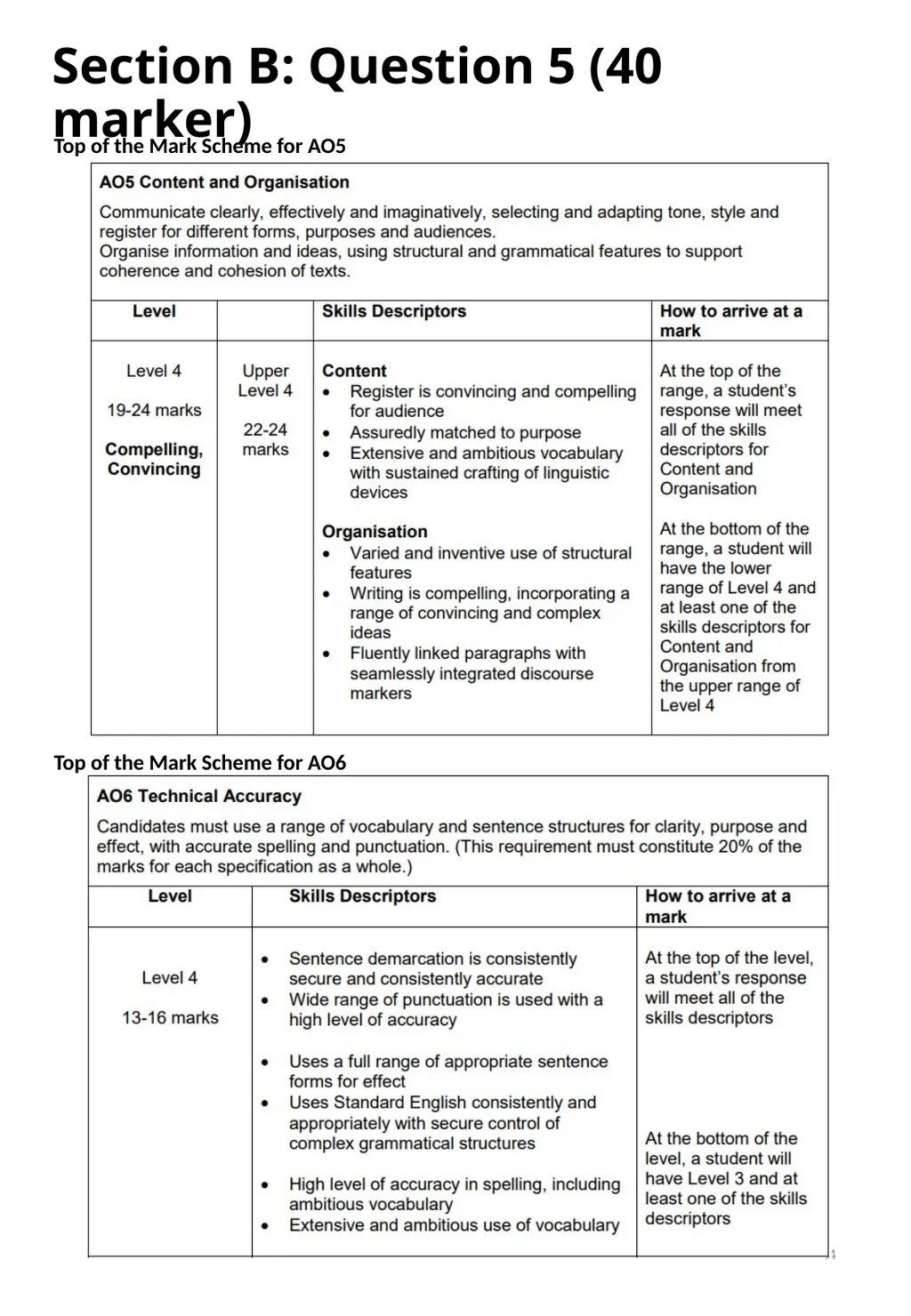
Section B: Question 5 (40 marker) Top of the Mark Scheme for AO5 Top of the Mark Scheme for AO6 3<br>
04
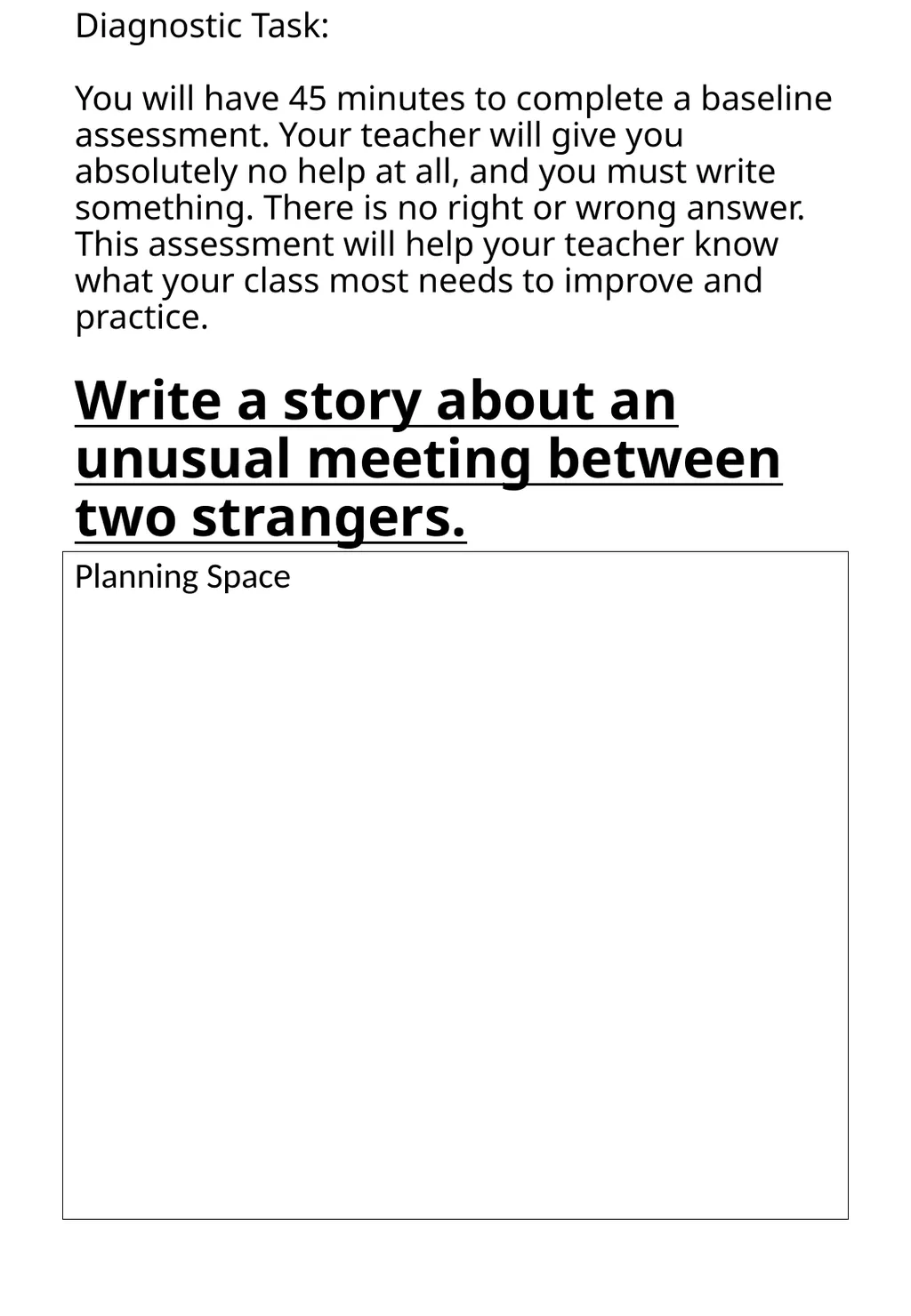
Diagnostic Task:
You will have 45 minutes to complete a baseline assessment. Your teacher will give you absolutely no help at all, and you must write something. There is no right or wrong answer. This assessment will help your teacher know what your class most needs to improve and practice.
Write a story about an unusual meeting between two strangers. Planning Space<br>
05
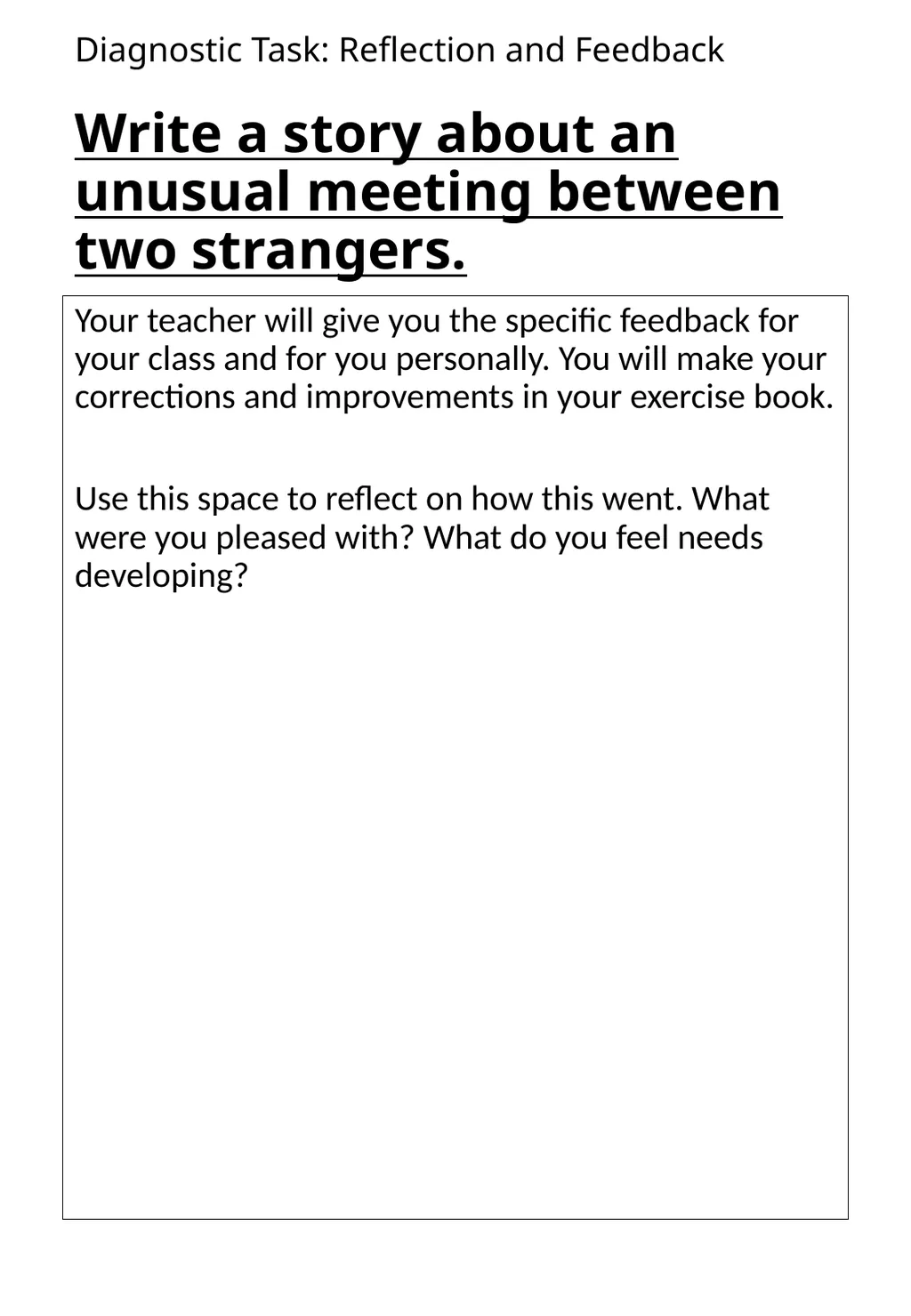
Diagnostic Task: Reflection and Feedback
Write a story about an unusual meeting between two strangers. Your teacher will give you the specific feedback for your class and for you personally. You will make your corrections and improvements in your exercise book.
Use this space to reflect on how this went. What were you pleased with? What do you feel needs developing?<br>
Use this space to reflect on how this went. What were you pleased with? What do you feel needs developing?<br>
06
The Knowledge:
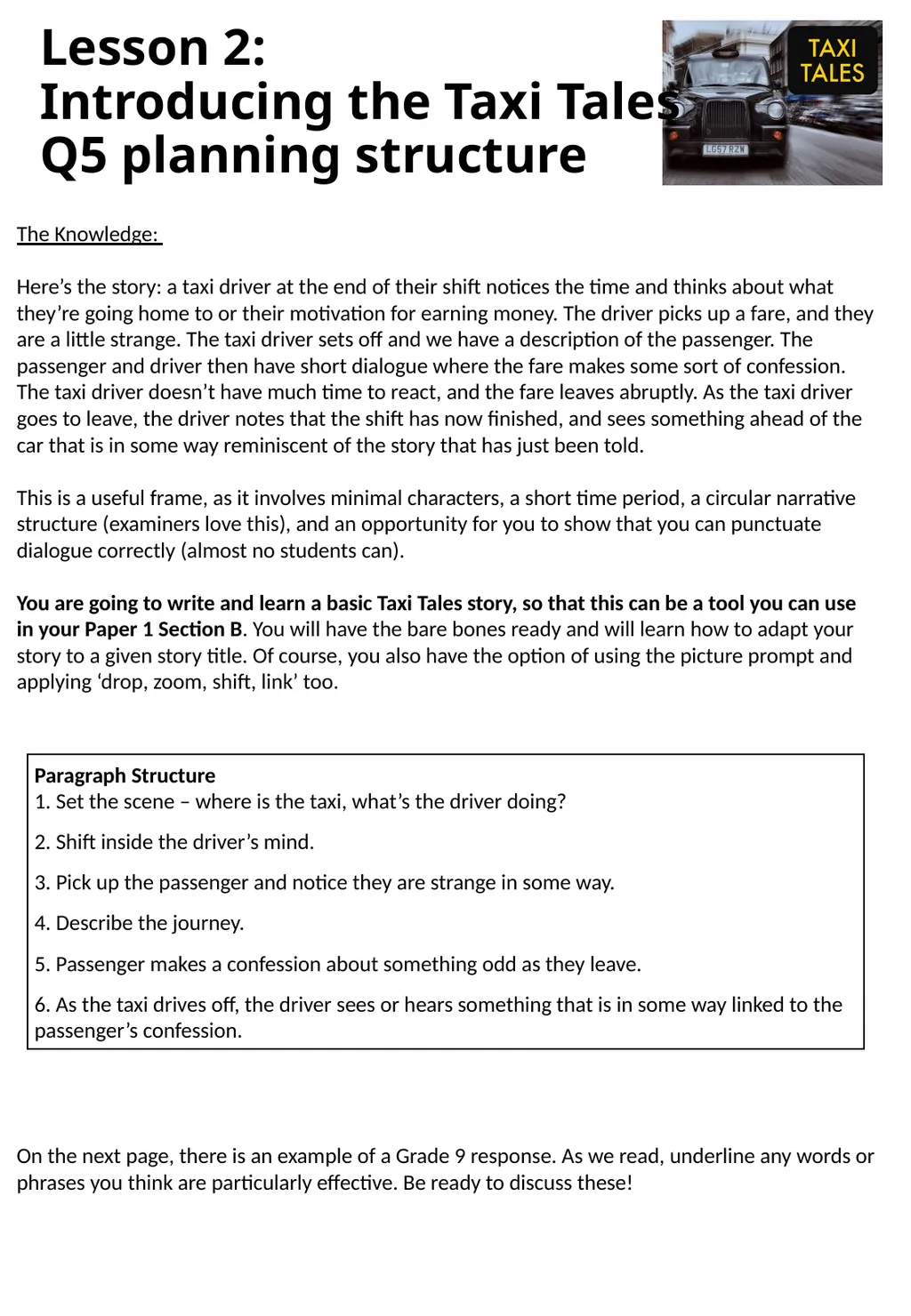
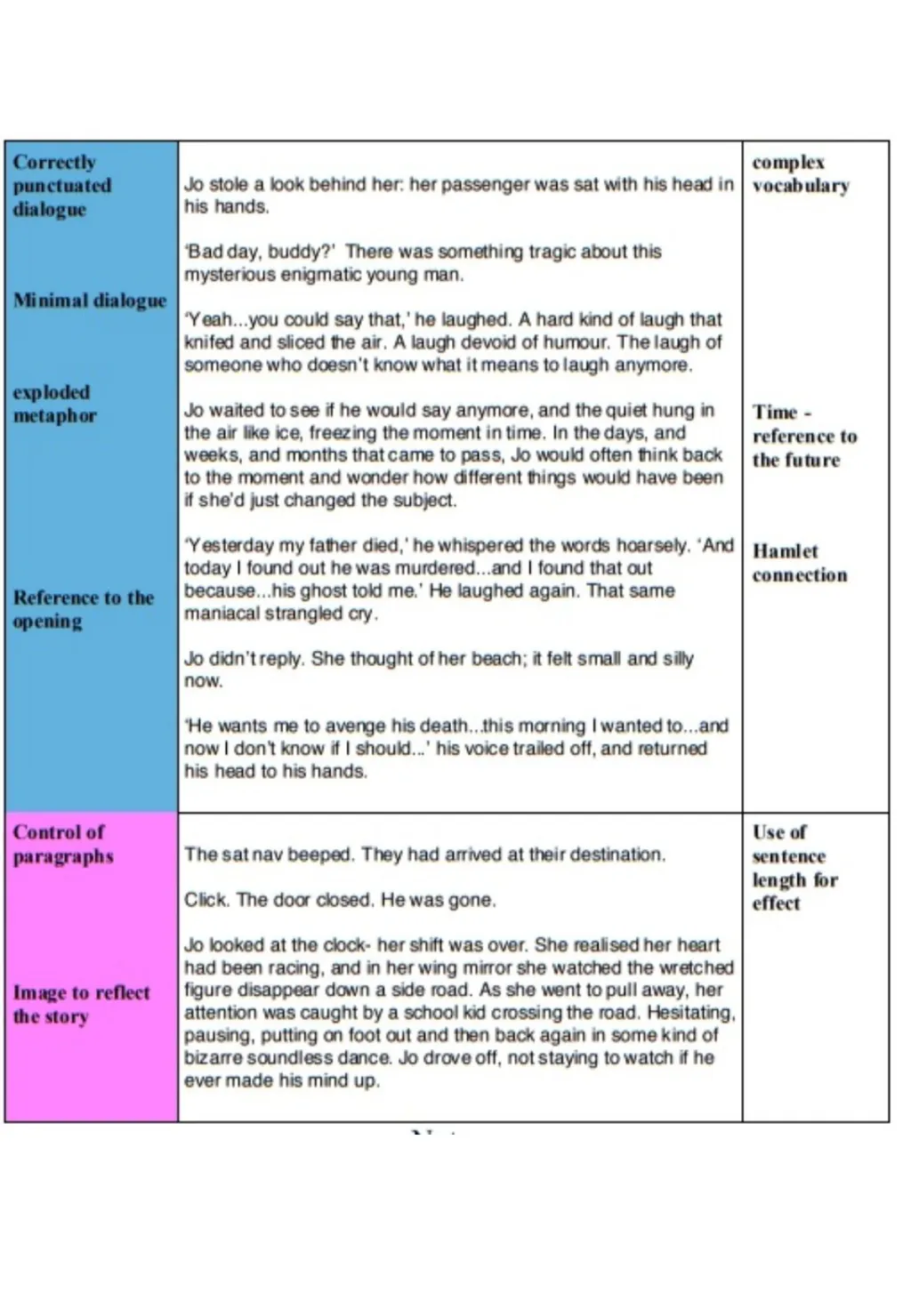
Here’s the story: a taxi driver at the end of their shift notices the time and thinks about what they’re going home to or their motivation for earning money. The driver picks up a fare, and they are a little strange. The taxi driver sets off and we have a description of the passenger. The passenger and driver then have short dialogue where the fare makes some sort of confession. The taxi driver doesn’t have much time to react, and the fare leaves abruptly. As the taxi driver goes to leave, the driver notes that the shift has now finished, and sees something ahead of the car that is in some way reminiscent of the story that has just been told.
This is a useful frame, as it involves minimal characters, a short time period, a circular narrative structure (examiners love this), and an opportunity for you to show that you can punctuate dialogue correctly (almost no students can).
You are going to write and learn a basic Taxi Tales story, so that this can be a tool you can use in your Paper 1 Section B. You will have the bare bones ready and will learn how to adapt your story to a given story title. Of course, you also have the option of using the picture prompt and applying ‘drop, zoom, shift, link’ too.
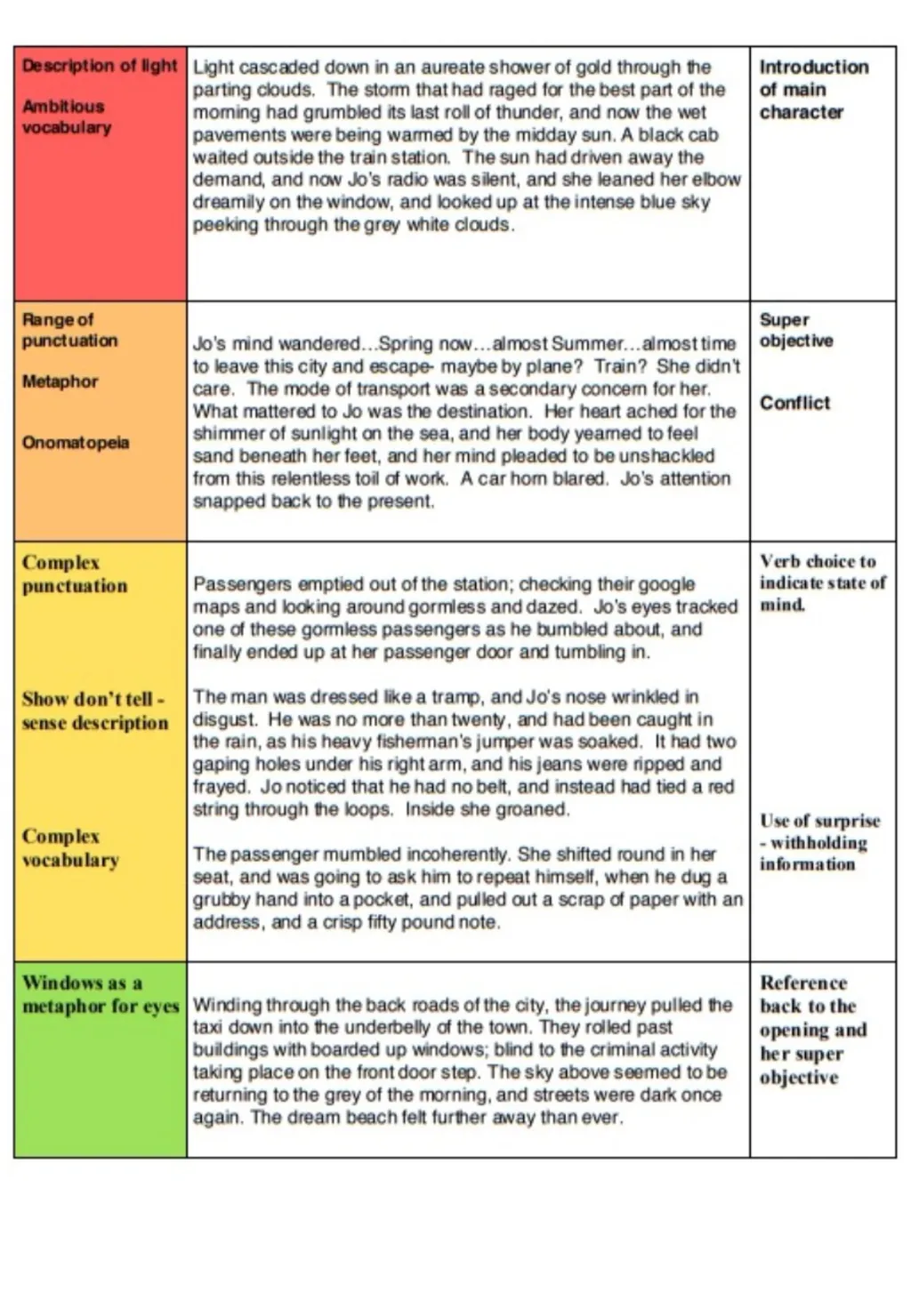
On the next page, there is an example of a Grade 9 response. As we read, underline any words or phrases you think are particularly effective. Be ready to discuss these! Lesson 2:
Introducing the Taxi Tales
Q5 planning structure Paragraph Structure
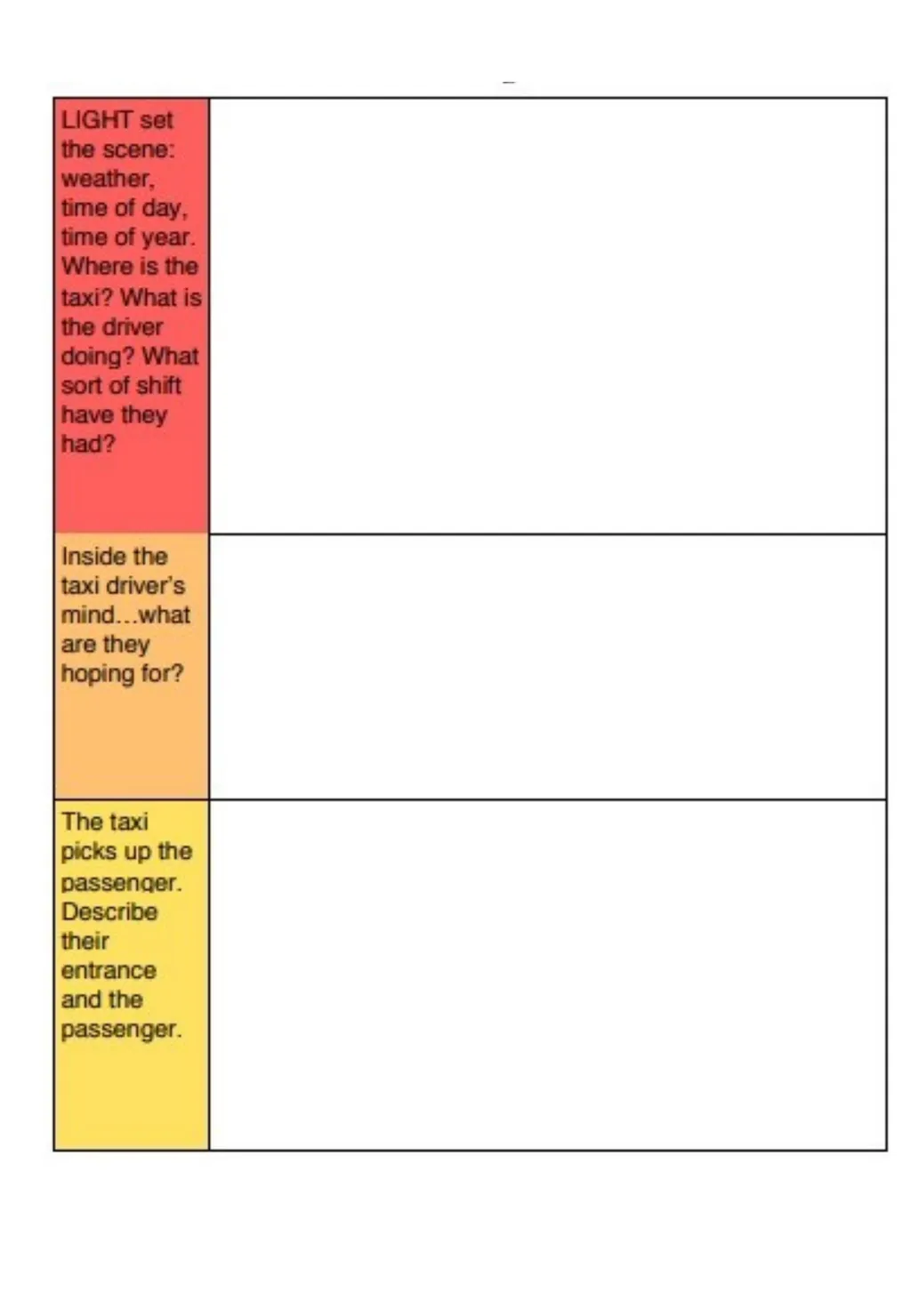
1. Set the scene – where is the taxi, what’s the driver doing?
2. Shift inside the driver’s mind.
3. Pick up the passenger and notice they are strange in some way.
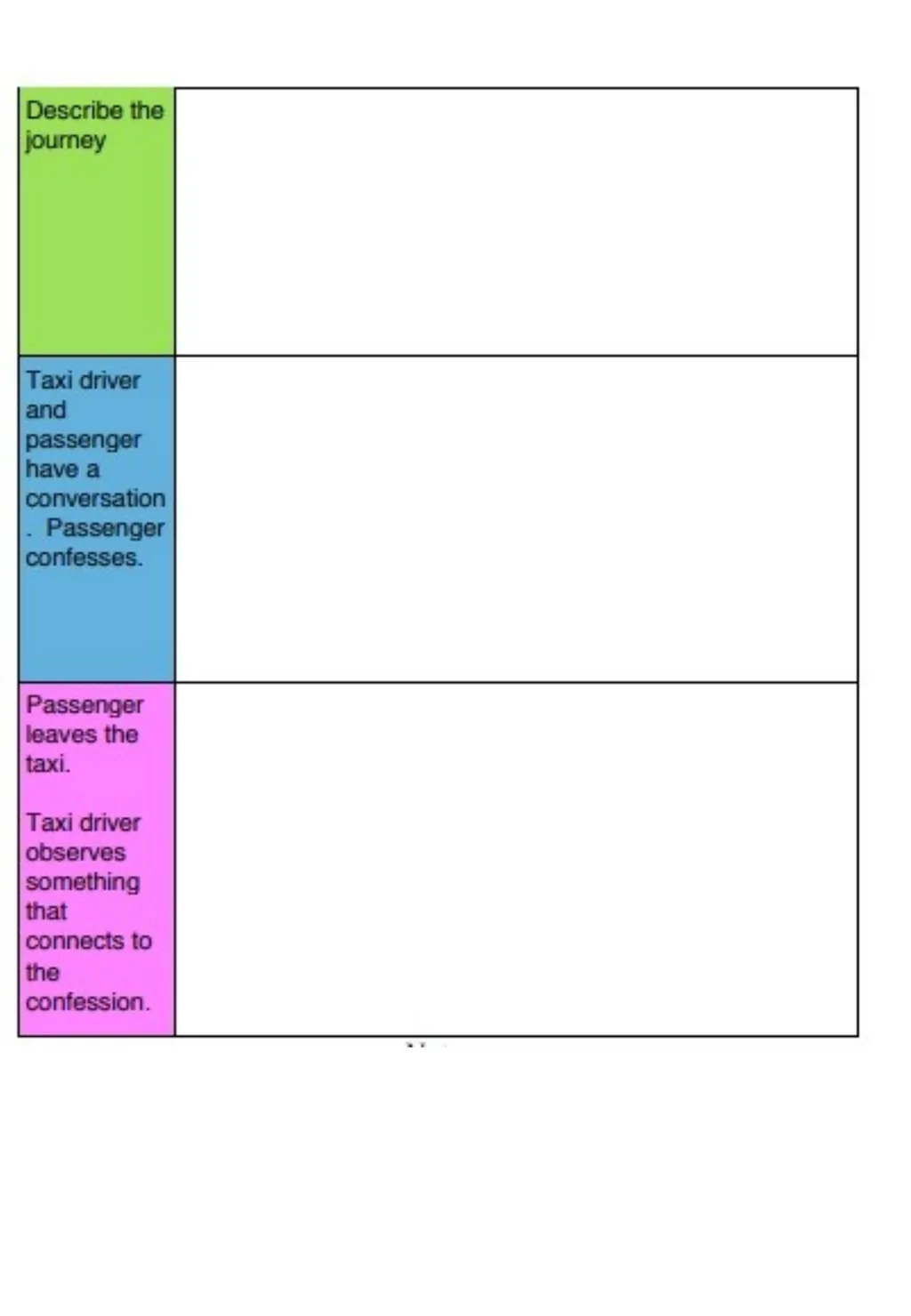
4. Describe the journey.
5. Passenger makes a confession about something odd as they leave.
6. As the taxi drives off, the driver sees or hears something that is in some way linked to the passenger’s confession.<br>
Here’s the story: a taxi driver at the end of their shift notices the time and thinks about what they’re going home to or their motivation for earning money. The driver picks up a fare, and they are a little strange. The taxi driver sets off and we have a description of the passenger. The passenger and driver then have short dialogue where the fare makes some sort of confession. The taxi driver doesn’t have much time to react, and the fare leaves abruptly. As the taxi driver goes to leave, the driver notes that the shift has now finished, and sees something ahead of the car that is in some way reminiscent of the story that has just been told.
This is a useful frame, as it involves minimal characters, a short time period, a circular narrative structure (examiners love this), and an opportunity for you to show that you can punctuate dialogue correctly (almost no students can).
You are going to write and learn a basic Taxi Tales story, so that this can be a tool you can use in your Paper 1 Section B. You will have the bare bones ready and will learn how to adapt your story to a given story title. Of course, you also have the option of using the picture prompt and applying ‘drop, zoom, shift, link’ too.
On the next page, there is an example of a Grade 9 response. As we read, underline any words or phrases you think are particularly effective. Be ready to discuss these! Lesson 2:
Introducing the Taxi Tales
Q5 planning structure Paragraph Structure
1. Set the scene – where is the taxi, what’s the driver doing?
2. Shift inside the driver’s mind.
3. Pick up the passenger and notice they are strange in some way.
4. Describe the journey.
5. Passenger makes a confession about something odd as they leave.
6. As the taxi drives off, the driver sees or hears something that is in some way linked to the passenger’s confession.<br>
07
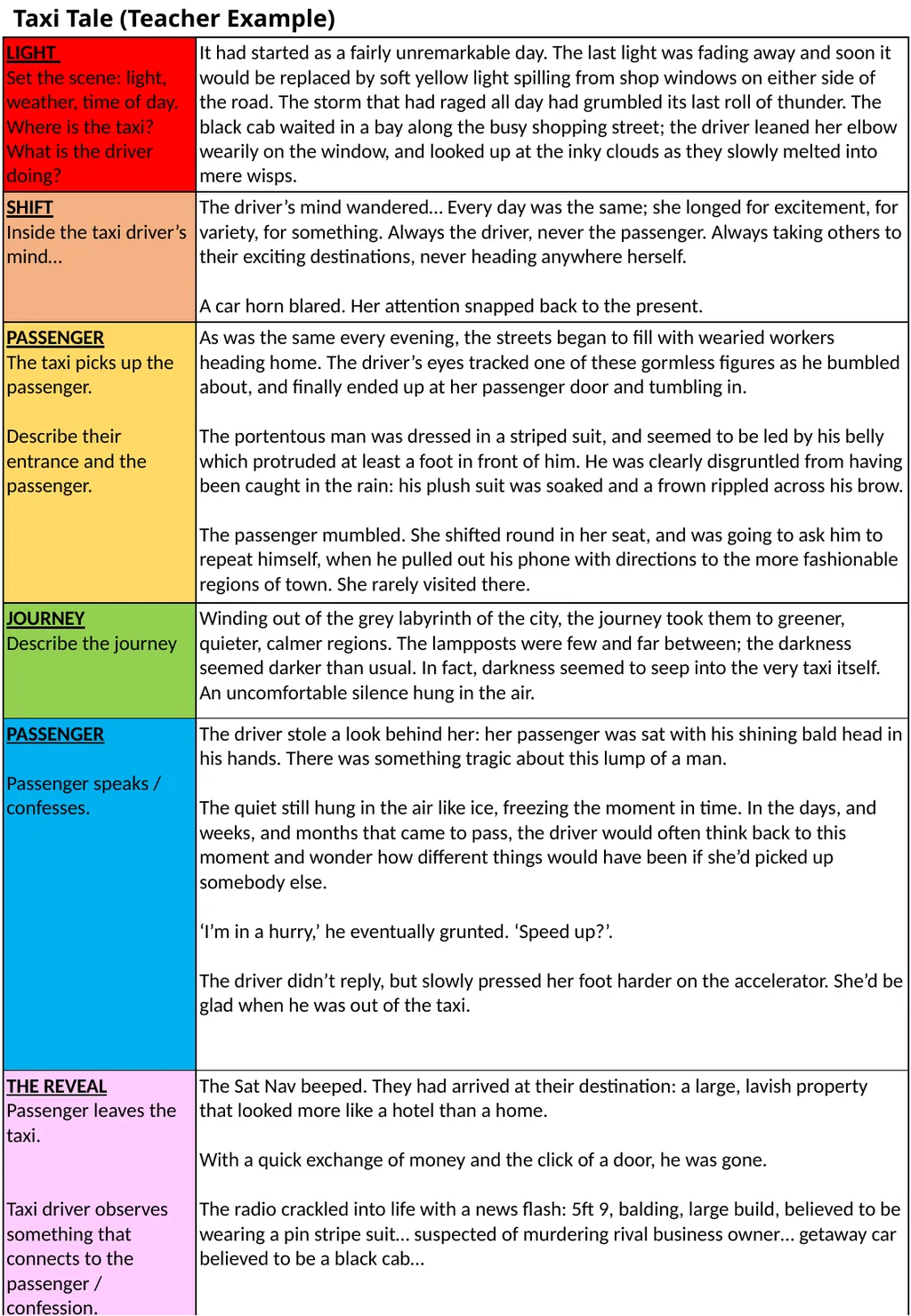
Taxi Tale (Teacher Example)<br>
08
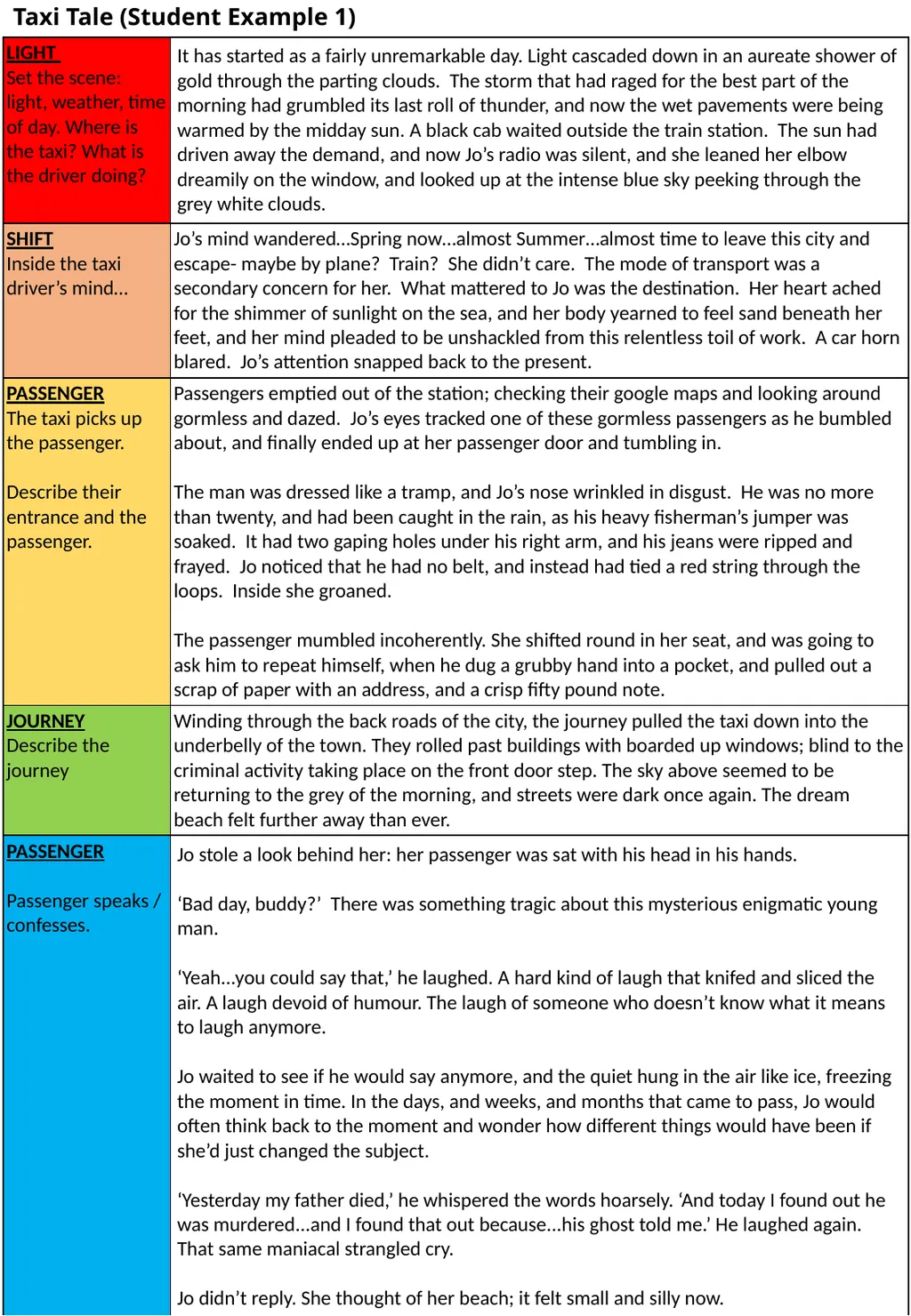
Taxi Tale (Student Example 1)<br>
09
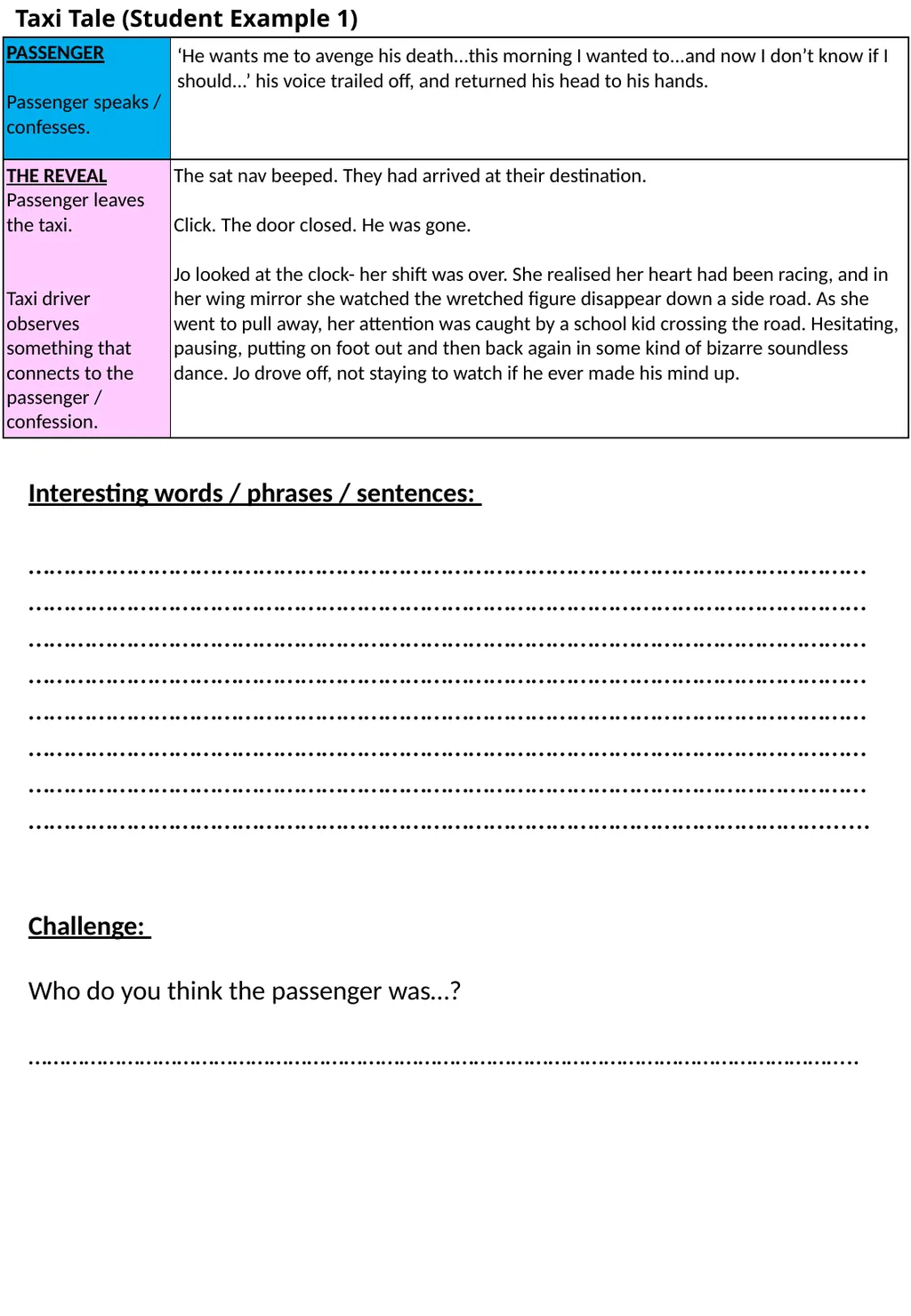
Taxi Tale (Student Example 1) Interesting words / phrases / sentences:
………………………………………………………………………………………………………………………………………………………………………………………………………………………………………………………………………………………………………………………………………………………………………………………………………………………………………………………………………………………………………………………………………………………………………………………………………………………………………………………………………………………………………………………………………………………………………………………………………………………………………………………………………………......
Challenge:
Who do you think the passenger was…?
……………………………………………………………………………………………………………………..<br>
………………………………………………………………………………………………………………………………………………………………………………………………………………………………………………………………………………………………………………………………………………………………………………………………………………………………………………………………………………………………………………………………………………………………………………………………………………………………………………………………………………………………………………………………………………………………………………………………………………………………………………………………………………......
Challenge:
Who do you think the passenger was…?
……………………………………………………………………………………………………………………..<br>
10
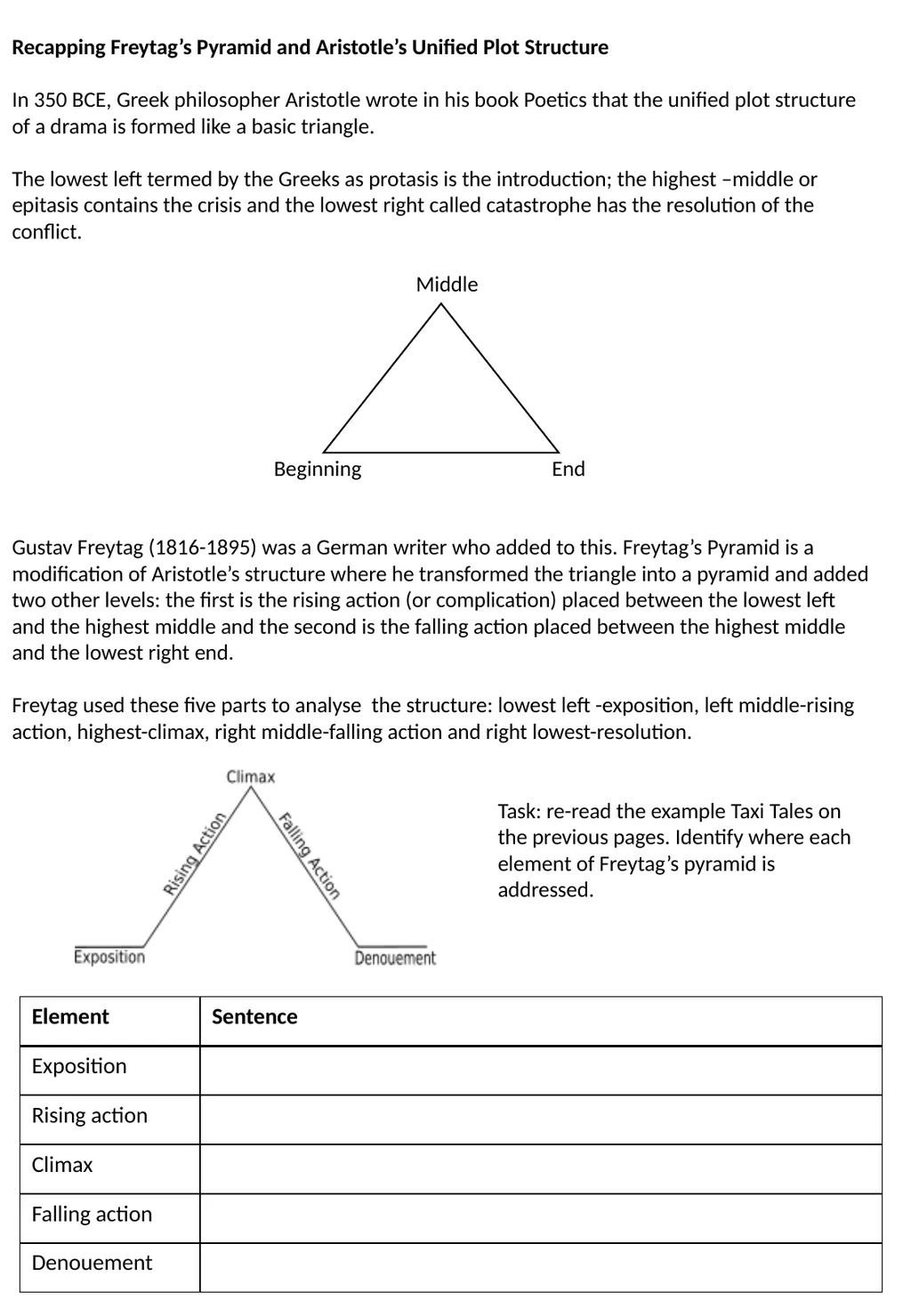
Recapping Freytag’s Pyramid and Aristotle’s Unified Plot Structure
In 350 BCE, Greek philosopher Aristotle wrote in his book Poetics that the unified plot structure of a drama is formed like a basic triangle.
The lowest left termed by the Greeks as protasis is the introduction; the highest –middle or epitasis contains the crisis and the lowest right called catastrophe has the resolution of the conflict.
Middle
Beginning End
Gustav Freytag (1816-1895) was a German writer who added to this. Freytag’s Pyramid is a modification of Aristotle’s structure where he transformed the triangle into a pyramid and added two other levels: the first is the rising action (or complication) placed between the lowest left and the highest middle and the second is the falling action placed between the highest middle and the lowest right end.
Freytag used these five parts to analyse the structure: lowest left -exposition, left middle-rising action, highest-climax, right middle-falling action and right lowest-resolution.
Task: re-read the example Taxi Tales on
the previous pages. Identify where each element of Freytag’s pyramid is addressed.<br>
In 350 BCE, Greek philosopher Aristotle wrote in his book Poetics that the unified plot structure of a drama is formed like a basic triangle.
The lowest left termed by the Greeks as protasis is the introduction; the highest –middle or epitasis contains the crisis and the lowest right called catastrophe has the resolution of the conflict.
Middle
Beginning End
Gustav Freytag (1816-1895) was a German writer who added to this. Freytag’s Pyramid is a modification of Aristotle’s structure where he transformed the triangle into a pyramid and added two other levels: the first is the rising action (or complication) placed between the lowest left and the highest middle and the second is the falling action placed between the highest middle and the lowest right end.
Freytag used these five parts to analyse the structure: lowest left -exposition, left middle-rising action, highest-climax, right middle-falling action and right lowest-resolution.
Task: re-read the example Taxi Tales on
the previous pages. Identify where each element of Freytag’s pyramid is addressed.<br>
11
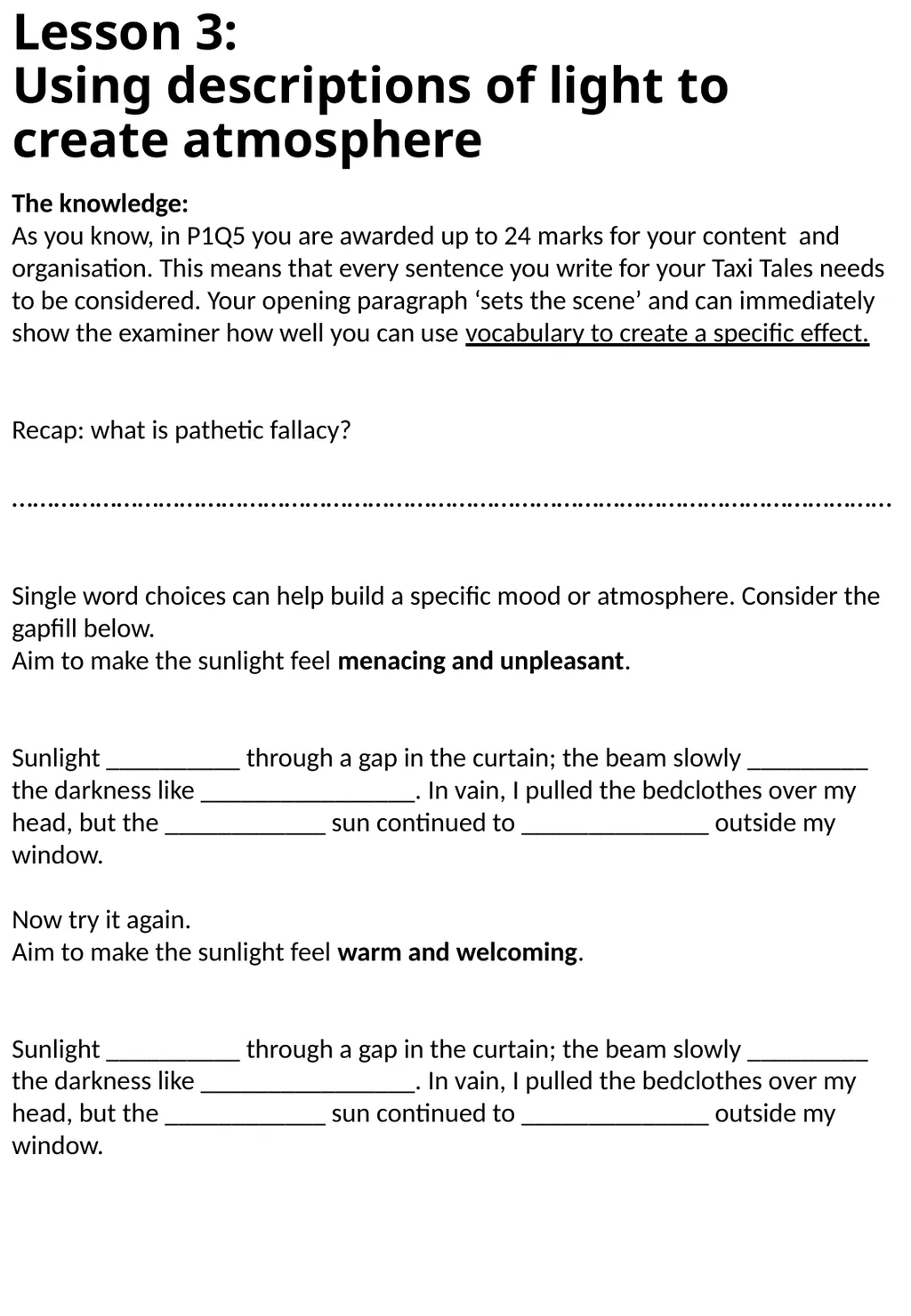
Lesson 3:
Using descriptions of light to create atmosphere The knowledge:
As you know, in P1Q5 you are awarded up to 24 marks for your content and organisation. This means that every sentence you write for your Taxi Tales needs to be considered. Your opening paragraph ‘sets the scene’ and can immediately show the examiner how well you can use vocabulary to create a specific effect.
Recap: what is pathetic fallacy?
………………………………………………………………………………………………………………
Single word choices can help build a specific mood or atmosphere. Consider the gapfill below.
Aim to make the sunlight feel menacing and unpleasant.
Sunlight __________ through a gap in the curtain; the beam slowly _________ the darkness like ________________. In vain, I pulled the bedclothes over my head, but the ____________ sun continued to ______________ outside my window.
Now try it again.
Aim to make the sunlight feel warm and welcoming.
Sunlight __________ through a gap in the curtain; the beam slowly _________ the darkness like ________________. In vain, I pulled the bedclothes over my head, but the ____________ sun continued to ______________ outside my window.<br>
As you know, in P1Q5 you are awarded up to 24 marks for your content and organisation. This means that every sentence you write for your Taxi Tales needs to be considered. Your opening paragraph ‘sets the scene’ and can immediately show the examiner how well you can use vocabulary to create a specific effect.
Recap: what is pathetic fallacy?
………………………………………………………………………………………………………………
Single word choices can help build a specific mood or atmosphere. Consider the gapfill below.
Aim to make the sunlight feel menacing and unpleasant.
Sunlight __________ through a gap in the curtain; the beam slowly _________ the darkness like ________________. In vain, I pulled the bedclothes over my head, but the ____________ sun continued to ______________ outside my window.
Now try it again.
Aim to make the sunlight feel warm and welcoming.
Sunlight __________ through a gap in the curtain; the beam slowly _________ the darkness like ________________. In vain, I pulled the bedclothes over my head, but the ____________ sun continued to ______________ outside my window.<br>
12
Powerful vocabulary to describe light
Below is a list of powerful adjectives which you can learn and apply in your descriptive writing – whether you choose to complete Taxi Tales or the descriptive writing in your final exam. Read the words and look up any you don’t know. Then add them to the correct box below. Aureate: brilliantly golden
Blinding: so bright as to obscure vision
Coruscating: flashing, or sparkling; also, brilliant or showy
Crepuscular: dim, or resembling twilight; also, said of animals active during twilight
Dappled: marked by spotted or patchy light; also, marks of this kind on a surface
Fluorescent: giving off light produced by another source of illumination
Glancing: intermittently flashing or gleaming
Gleaming: shining, radiant
Incandescent: warm, glowing
Iridescent: rainbow colored
Lucent: bright, clear, or shining
Lucifugal: shunning light, as in the case of nocturnal animal. Can also be Lucifugous
Luminescent: shining by chemical or physiological means
Luminous: full of light
Lustrous: smooth, evenly lit; also, brilliant or eminent
Opaque: blocking light; also, obtuse, or difficult to understand
Opalescent: see iridescent
Penumbral: partially shaded
Radiant: glowing, or radiating light
Resplendent: brilliant or glowing
Spectral: made by a range of colours of the spectrum; also, ghostly
Translucent: diffused, or transparent<br>
Below is a list of powerful adjectives which you can learn and apply in your descriptive writing – whether you choose to complete Taxi Tales or the descriptive writing in your final exam. Read the words and look up any you don’t know. Then add them to the correct box below. Aureate: brilliantly golden
Blinding: so bright as to obscure vision
Coruscating: flashing, or sparkling; also, brilliant or showy
Crepuscular: dim, or resembling twilight; also, said of animals active during twilight
Dappled: marked by spotted or patchy light; also, marks of this kind on a surface
Fluorescent: giving off light produced by another source of illumination
Glancing: intermittently flashing or gleaming
Gleaming: shining, radiant
Incandescent: warm, glowing
Iridescent: rainbow colored
Lucent: bright, clear, or shining
Lucifugal: shunning light, as in the case of nocturnal animal. Can also be Lucifugous
Luminescent: shining by chemical or physiological means
Luminous: full of light
Lustrous: smooth, evenly lit; also, brilliant or eminent
Opaque: blocking light; also, obtuse, or difficult to understand
Opalescent: see iridescent
Penumbral: partially shaded
Radiant: glowing, or radiating light
Resplendent: brilliant or glowing
Spectral: made by a range of colours of the spectrum; also, ghostly
Translucent: diffused, or transparent<br>
13
Descriptions of light from an ex-Year 11s’ Taxi Tale: Example 1
People flooded the cold November streets for the black Friday sale. Shopping bags masked the alluring setting behind them. A pleasing morning hung over the frantic oblivious shoppers as they dashed between stores; light rays emerged between the white fluffy clouds warming the pavement surface. A black cab sat outside the station waiting to be filled with vast amounts of shopping bags- and then just a squeezed space for the actual passengers
Underline words connected with light.
Consider the atmosphere created – be ready to discuss
Descriptions of light from an ex-Year 11s’ Taxi Tale: Example 2
Ten thirty three. Night fell long ago. It’s winter, so it never really felt like day. The clock on the dash illuminated the time in hard yellow digits- unforgiving. What a night. Thick sheets of rain had pummelled the cab in a relentless assault from the start of his shift. The orange glow of the street lamps threw odd flat light onto the wet road as he sat waiting for the lights to change.
1. Underline words connected with light.
2. Consider the atmosphere created – be ready to discuss
Intra v extradiegetic narrative voice
Put simply, this means whether the story is written in the first person perspective (using ‘I’) or the third person perspective (They/he/she/it). For the purposes of writing today, you will be using the extradiegetic narrative voice.<br>
People flooded the cold November streets for the black Friday sale. Shopping bags masked the alluring setting behind them. A pleasing morning hung over the frantic oblivious shoppers as they dashed between stores; light rays emerged between the white fluffy clouds warming the pavement surface. A black cab sat outside the station waiting to be filled with vast amounts of shopping bags- and then just a squeezed space for the actual passengers
Underline words connected with light.
Consider the atmosphere created – be ready to discuss
Descriptions of light from an ex-Year 11s’ Taxi Tale: Example 2
Ten thirty three. Night fell long ago. It’s winter, so it never really felt like day. The clock on the dash illuminated the time in hard yellow digits- unforgiving. What a night. Thick sheets of rain had pummelled the cab in a relentless assault from the start of his shift. The orange glow of the street lamps threw odd flat light onto the wet road as he sat waiting for the lights to change.
1. Underline words connected with light.
2. Consider the atmosphere created – be ready to discuss
Intra v extradiegetic narrative voice
Put simply, this means whether the story is written in the first person perspective (using ‘I’) or the third person perspective (They/he/she/it). For the purposes of writing today, you will be using the extradiegetic narrative voice.<br>
14
Applying vocabulary to create a crafted paragraph.
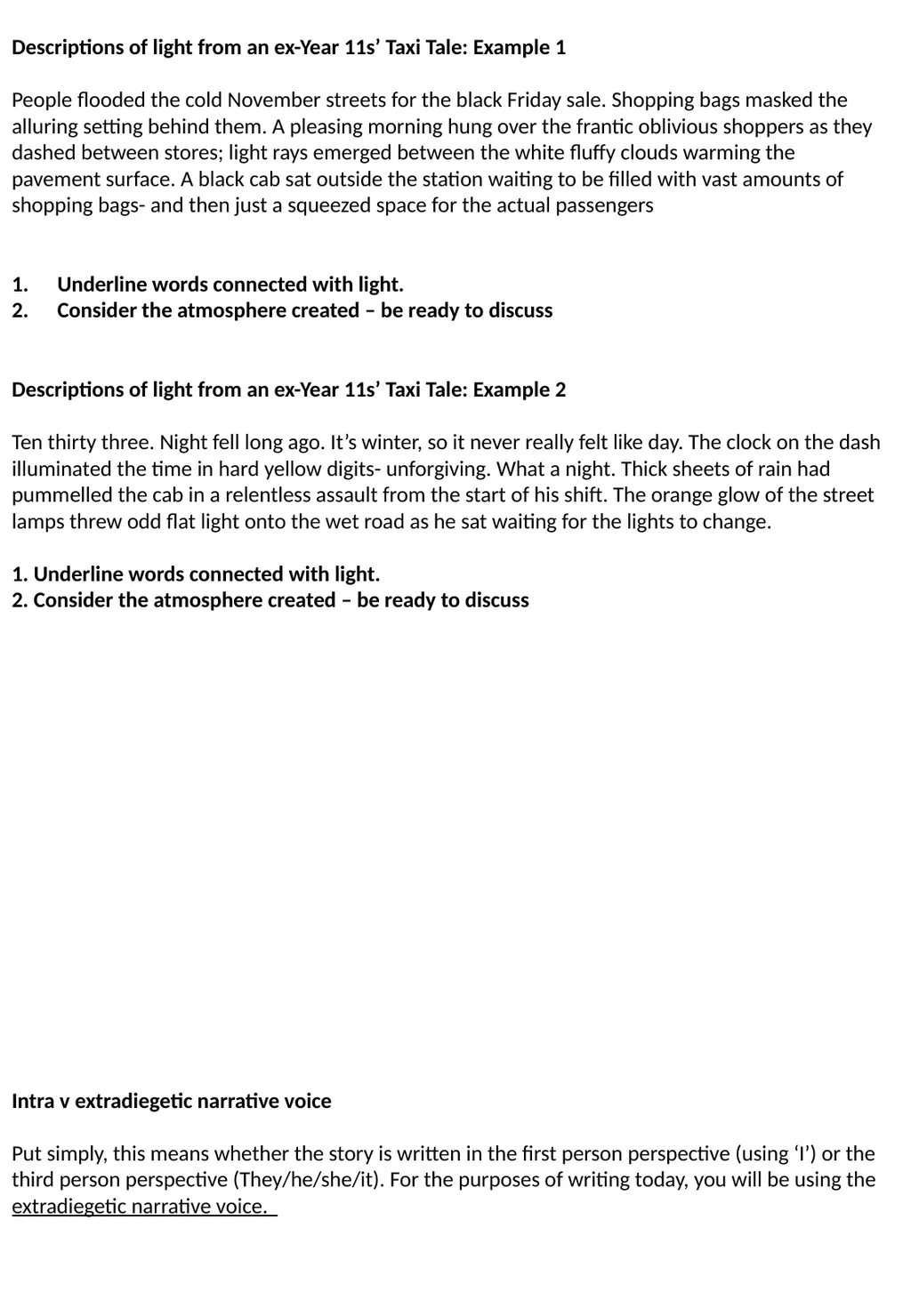
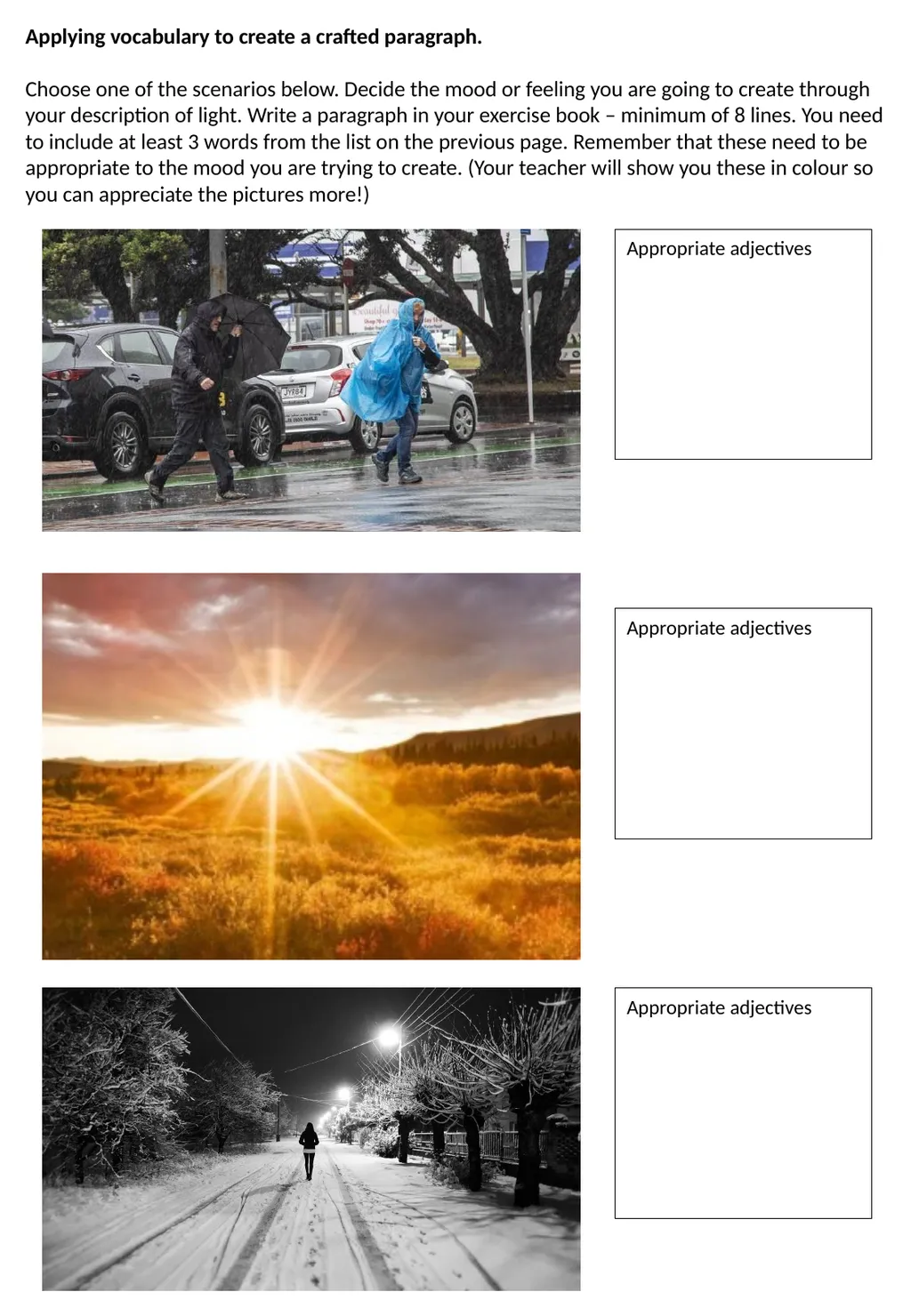
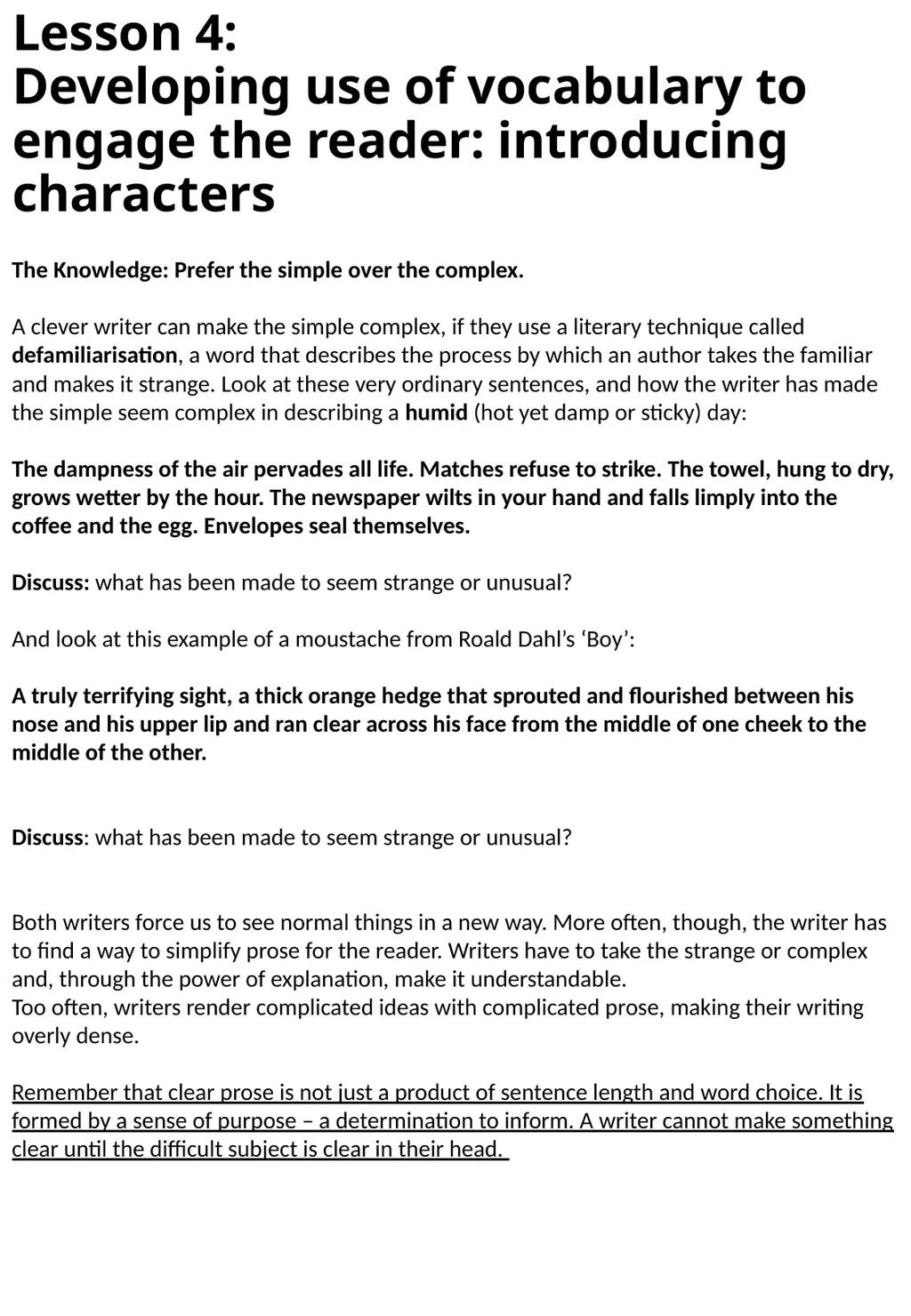
Choose one of the scenarios below. Decide the mood or feeling you are going to create through your description of light. Write a paragraph in your exercise book – minimum of 8 lines. You need to include at least 3 words from the list on the previous page. Remember that these need to be appropriate to the mood you are trying to create. (Your teacher will show you these in colour so you can appreciate the pictures more!) Appropriate adjectives Appropriate adjectives Appropriate adjectives<br>
Choose one of the scenarios below. Decide the mood or feeling you are going to create through your description of light. Write a paragraph in your exercise book – minimum of 8 lines. You need to include at least 3 words from the list on the previous page. Remember that these need to be appropriate to the mood you are trying to create. (Your teacher will show you these in colour so you can appreciate the pictures more!) Appropriate adjectives Appropriate adjectives Appropriate adjectives<br>
15
Lesson 4:
Developing use of vocabulary to engage the reader: introducing characters The Knowledge: Prefer the simple over the complex.
A clever writer can make the simple complex, if they use a literary technique called defamiliarisation, a word that describes the process by which an author takes the familiar and makes it strange. Look at these very ordinary sentences, and how the writer has made the simple seem complex in describing a humid (hot yet damp or sticky) day:
The dampness of the air pervades all life. Matches refuse to strike. The towel, hung to dry, grows wetter by the hour. The newspaper wilts in your hand and falls limply into the coffee and the egg. Envelopes seal themselves.
Discuss: what has been made to seem strange or unusual?
And look at this example of a moustache from Roald Dahl’s ‘Boy’:
A truly terrifying sight, a thick orange hedge that sprouted and flourished between his nose and his upper lip and ran clear across his face from the middle of one cheek to the middle of the other.
Discuss: what has been made to seem strange or unusual?
Both writers force us to see normal things in a new way. More often, though, the writer has to find a way to simplify prose for the reader. Writers have to take the strange or complex and, through the power of explanation, make it understandable.
Too often, writers render complicated ideas with complicated prose, making their writing overly dense.
Remember that clear prose is not just a product of sentence length and word choice. It is formed by a sense of purpose – a determination to inform. A writer cannot make something clear until the difficult subject is clear in their head.<br>
A clever writer can make the simple complex, if they use a literary technique called defamiliarisation, a word that describes the process by which an author takes the familiar and makes it strange. Look at these very ordinary sentences, and how the writer has made the simple seem complex in describing a humid (hot yet damp or sticky) day:
The dampness of the air pervades all life. Matches refuse to strike. The towel, hung to dry, grows wetter by the hour. The newspaper wilts in your hand and falls limply into the coffee and the egg. Envelopes seal themselves.
Discuss: what has been made to seem strange or unusual?
And look at this example of a moustache from Roald Dahl’s ‘Boy’:
A truly terrifying sight, a thick orange hedge that sprouted and flourished between his nose and his upper lip and ran clear across his face from the middle of one cheek to the middle of the other.
Discuss: what has been made to seem strange or unusual?
Both writers force us to see normal things in a new way. More often, though, the writer has to find a way to simplify prose for the reader. Writers have to take the strange or complex and, through the power of explanation, make it understandable.
Too often, writers render complicated ideas with complicated prose, making their writing overly dense.
Remember that clear prose is not just a product of sentence length and word choice. It is formed by a sense of purpose – a determination to inform. A writer cannot make something clear until the difficult subject is clear in their head.<br>
16
Creating a character
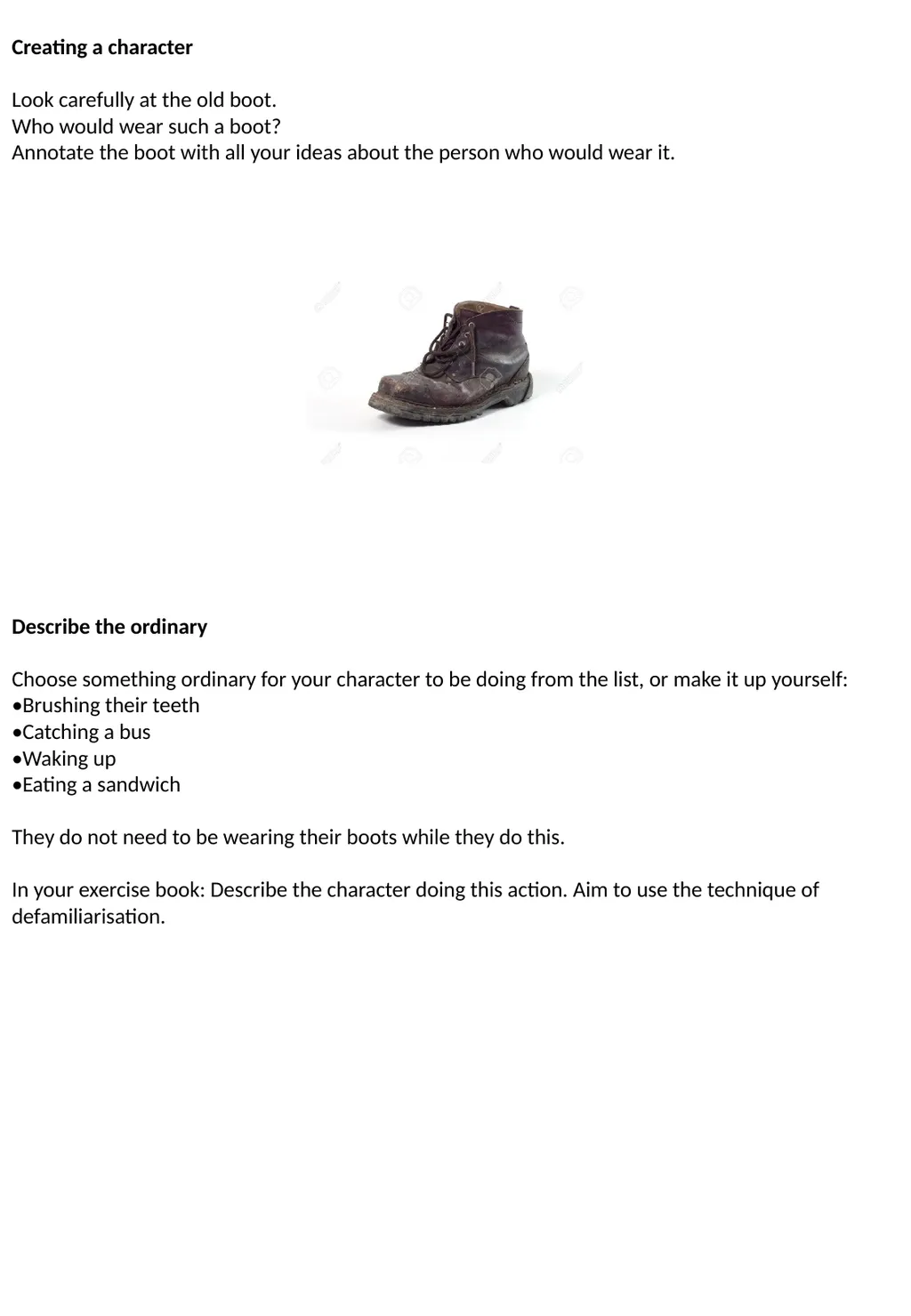
Look carefully at the old boot.
Who would wear such a boot?
Annotate the boot with all your ideas about the person who would wear it.
Describe the ordinary
Choose something ordinary for your character to be doing from the list, or make it up yourself:
•Brushing their teeth
•Catching a bus
•Waking up
•Eating a sandwich
They do not need to be wearing their boots while they do this.
In your exercise book: Describe the character doing this action. Aim to use the technique of defamiliarisation.<br>
Look carefully at the old boot.
Who would wear such a boot?
Annotate the boot with all your ideas about the person who would wear it.
Describe the ordinary
Choose something ordinary for your character to be doing from the list, or make it up yourself:
•Brushing their teeth
•Catching a bus
•Waking up
•Eating a sandwich
They do not need to be wearing their boots while they do this.
In your exercise book: Describe the character doing this action. Aim to use the technique of defamiliarisation.<br>
17
Lesson 5:
Zooming in on characterisation:
The Taxi Driver The Knowledge:
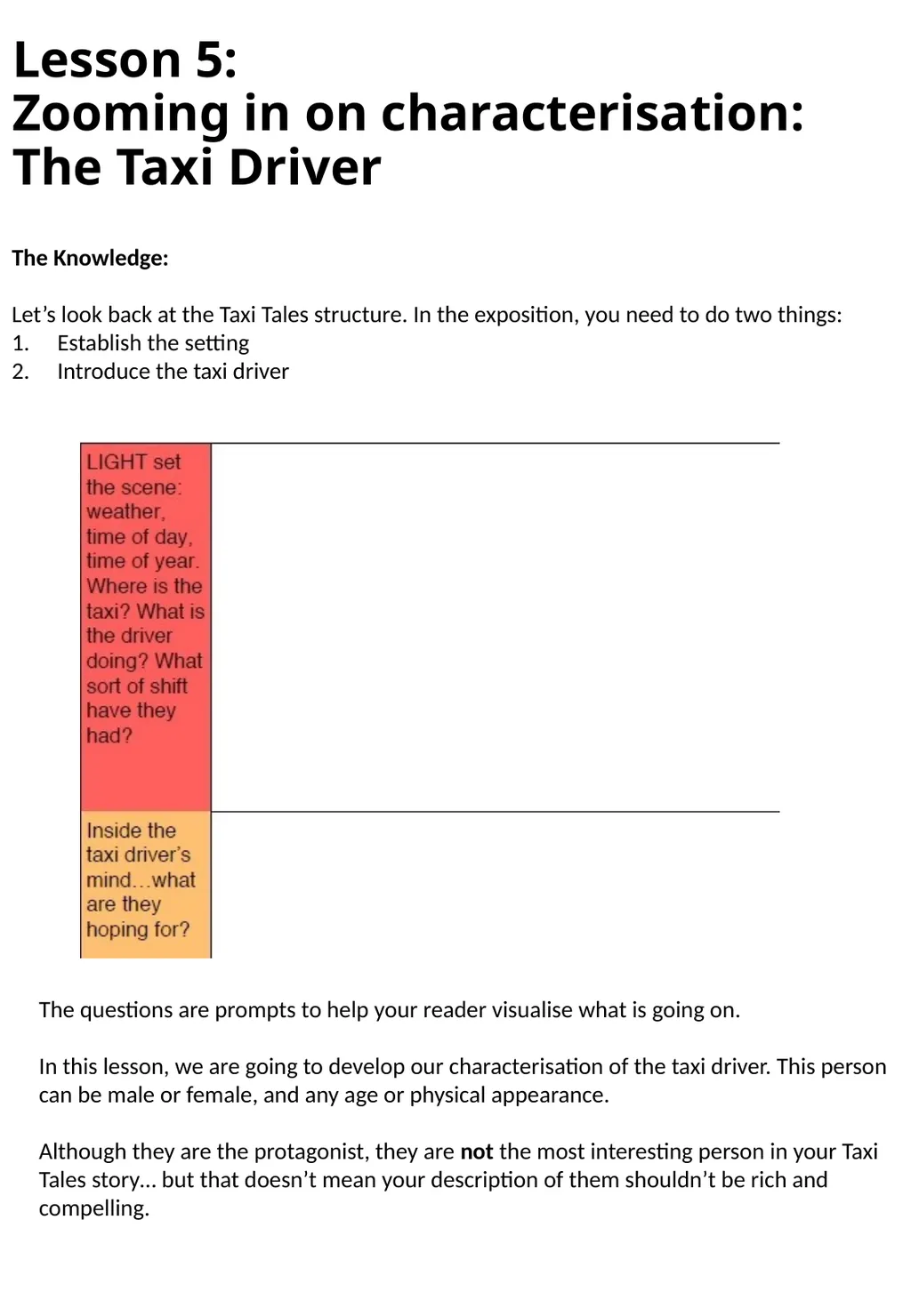
Let’s look back at the Taxi Tales structure. In the exposition, you need to do two things:
Establish the setting
Introduce the taxi driver The questions are prompts to help your reader visualise what is going on.
In this lesson, we are going to develop our characterisation of the taxi driver. This person can be male or female, and any age or physical appearance.
Although they are the protagonist, they are not the most interesting person in your Taxi Tales story… but that doesn’t mean your description of them shouldn’t be rich and compelling.<br>
Let’s look back at the Taxi Tales structure. In the exposition, you need to do two things:
Establish the setting
Introduce the taxi driver The questions are prompts to help your reader visualise what is going on.
In this lesson, we are going to develop our characterisation of the taxi driver. This person can be male or female, and any age or physical appearance.
Although they are the protagonist, they are not the most interesting person in your Taxi Tales story… but that doesn’t mean your description of them shouldn’t be rich and compelling.<br>
18
The taxi driver:
Discuss: What kind of character do you envisage a ‘typical’ taxi driver being? Chatty? Taciturn (this word is an antonym of chatty)? What leads people into this job? Can there be more to the story?
Read: Below is a light-hearted article about taxi drivers by Steph Dyson, who left her job as an English teacher in the UK to travel the world in 2014. Think about how she has created an image of each driver through her language choices.
……………………………………………………………………………………………………………………………………………………….
The taxi driver: it’s an unwritten rule of travelling that taxi drivers – and their many eccentricities – will leave their mark on any trip.
Whether it’s their universal delight in telling you all about their political leanings, or those belonging to the school of “No, of course I’m not lost”, taxi drivers remain an entertaining and undoubtedly memorable part of travelling the globe.
It doesn’t matter where in the world you’ve travelled; chances are you’ve met these taxi drivers before.
Type: Thinks he should be running for President.
Usually found: Globally. Probably even on Mars.
For Brits, this is the stereotypical black cabbie, but you soon learn that all taxi drivers are more than willing to embark upon that normally off-limits topic of conversation: politics.
Perhaps this is unique to the taxi business because you’re a captive audience. They’re sure to regale you with their thoughts on the political situation in their home country – whether it’s a conversation you want to be having or not.
If you’re desperate to steer back to safer topics, make sure to mention the merits of a rival country’s football team: that’s guaranteed to move you rapidly onto a new subject.
Type: Tuk tuk speed demon
Usually found: Thailand & South-East Asia, remote villages in South America
Tuk tuk drivers are in a league of their own when it comes to their insatiable need for speed. They’re driven by an inflexible belief that instead of owning a flimsy, snail-shell plastic casing attached to a 950cc scooter, it’s in fact a gas-guzzling BMW K 1200. Thanks to this, they fling it in front of all passing traffic with scant regard for whether it really can dodge past the oncoming vehicles. Owing to the lack of sides, you spend half the journey clinging desperately to any available plastic to avoid being flung out at every corner. For safety purposes, you quickly learn that the rule of thumb is to choose an older looking tuk tuk driver – it’s your only guarantee that he’s had some previous luck at escaping accidents unscathed.
Type: The “No, I’m not lost”
Usually found: Globally
Another universal treat of the taxi world, and probably most traveller’s utmost favourite, the “No, I’m not lost” driver has a startlingly capacity for picking you up at those moments when you really do just need to get to your destination on time. Have a flight in an hour? This taxi driver will confirm he definitely does know where the airport is, before looping the city multiple times and finally admitting defeat, ten minutes before check-in closes. He drops you off on the side of the road with an apologetic shrug, speeding away in search of his next unlucky passenger and leaving you to swear loudly in as many of the local words as you can manage.<br>
Discuss: What kind of character do you envisage a ‘typical’ taxi driver being? Chatty? Taciturn (this word is an antonym of chatty)? What leads people into this job? Can there be more to the story?
Read: Below is a light-hearted article about taxi drivers by Steph Dyson, who left her job as an English teacher in the UK to travel the world in 2014. Think about how she has created an image of each driver through her language choices.
……………………………………………………………………………………………………………………………………………………….
The taxi driver: it’s an unwritten rule of travelling that taxi drivers – and their many eccentricities – will leave their mark on any trip.
Whether it’s their universal delight in telling you all about their political leanings, or those belonging to the school of “No, of course I’m not lost”, taxi drivers remain an entertaining and undoubtedly memorable part of travelling the globe.
It doesn’t matter where in the world you’ve travelled; chances are you’ve met these taxi drivers before.
Type: Thinks he should be running for President.
Usually found: Globally. Probably even on Mars.
For Brits, this is the stereotypical black cabbie, but you soon learn that all taxi drivers are more than willing to embark upon that normally off-limits topic of conversation: politics.
Perhaps this is unique to the taxi business because you’re a captive audience. They’re sure to regale you with their thoughts on the political situation in their home country – whether it’s a conversation you want to be having or not.
If you’re desperate to steer back to safer topics, make sure to mention the merits of a rival country’s football team: that’s guaranteed to move you rapidly onto a new subject.
Type: Tuk tuk speed demon
Usually found: Thailand & South-East Asia, remote villages in South America
Tuk tuk drivers are in a league of their own when it comes to their insatiable need for speed. They’re driven by an inflexible belief that instead of owning a flimsy, snail-shell plastic casing attached to a 950cc scooter, it’s in fact a gas-guzzling BMW K 1200. Thanks to this, they fling it in front of all passing traffic with scant regard for whether it really can dodge past the oncoming vehicles. Owing to the lack of sides, you spend half the journey clinging desperately to any available plastic to avoid being flung out at every corner. For safety purposes, you quickly learn that the rule of thumb is to choose an older looking tuk tuk driver – it’s your only guarantee that he’s had some previous luck at escaping accidents unscathed.
Type: The “No, I’m not lost”
Usually found: Globally
Another universal treat of the taxi world, and probably most traveller’s utmost favourite, the “No, I’m not lost” driver has a startlingly capacity for picking you up at those moments when you really do just need to get to your destination on time. Have a flight in an hour? This taxi driver will confirm he definitely does know where the airport is, before looping the city multiple times and finally admitting defeat, ten minutes before check-in closes. He drops you off on the side of the road with an apologetic shrug, speeding away in search of his next unlucky passenger and leaving you to swear loudly in as many of the local words as you can manage.<br>
19
Type: Convinced he owns a Tardis
Usually found: Parts of South America, China
As far as this guy’s concerned, the number of fitted seats in a vehicle is not a concrete limit on actual capacity. Got ten passengers and only five seats? Never fear, you can cram at least six in the back if you start stacking bodies, and there’s always space in the boot. As we’ve all experienced on holiday, you can keep loading in suitcases (or, in this instance, people) just as long as you slam the door down quickly enough so that they don’t escape.
Not got enough passengers? This doesn’t bother this breed of driver either. In China, any space is waiting to be filled, and it doesn’t matter with what: you’ll find yourself surrounded by increasing quantities of flowers, livestock, or fruit and vegetables as you stop every few miles to pick up a whole range of new ‘passengers’ to squeeze in.
Type: Will do anything to defend your honour
Usually found: Albania
We’ve all been there: you’re getting unwanted attention from a group of local guys across the street. A kindly taxi driver, noticing your problem, revs up his engine and attempts to run the men over as a way of protecting your honour… wait, what? Yes, this happens. This type of taxi driver wants you to appreciate the warmth of his people, even if that means other locals end up splattered on the front of his car.
Type: Will do anything to protect their own honour
Usually found: China
Be careful not to mess with your taxi driver when travelling in China. While guilty of complete obliviousness to the rules of the road or traffic management (bearing in mind this is a country that once installed twenty traffic lights on a single pole for “decorative purposes”), they’ve also been known to keep a spare crowbar in the passenger seat just for those moments when another taxi driver pisses them off.
Friendly advice for when faced with this situation: don’t ask for your money back. Just open the door, climb out and walk away quickly.
Type: PARTAAAY TAXI!!!
Usually found: The best parts of the UK
If you’re sensible, you’ll have this guy on speed dial, ready for those cold winter nights when all you want is to rock up to a club in style. Yes, we’re talking about the legendry Party Taxi.
Want the experience of hallucination without the need for those pesky (and illegal) drugs? The Party Taxi is guaranteed to make even the soberest of nights feel like you’ve unwittingly wandered into Fear and Loathing in Las Vegas: a van decked out in fairy lights and more inflatable penguins than you really know what to do with. Topped off with a mirror ball and ‘90s pop music, the next morning you’re left seriously questioning what the hell happened last night?<br>
Usually found: Parts of South America, China
As far as this guy’s concerned, the number of fitted seats in a vehicle is not a concrete limit on actual capacity. Got ten passengers and only five seats? Never fear, you can cram at least six in the back if you start stacking bodies, and there’s always space in the boot. As we’ve all experienced on holiday, you can keep loading in suitcases (or, in this instance, people) just as long as you slam the door down quickly enough so that they don’t escape.
Not got enough passengers? This doesn’t bother this breed of driver either. In China, any space is waiting to be filled, and it doesn’t matter with what: you’ll find yourself surrounded by increasing quantities of flowers, livestock, or fruit and vegetables as you stop every few miles to pick up a whole range of new ‘passengers’ to squeeze in.
Type: Will do anything to defend your honour
Usually found: Albania
We’ve all been there: you’re getting unwanted attention from a group of local guys across the street. A kindly taxi driver, noticing your problem, revs up his engine and attempts to run the men over as a way of protecting your honour… wait, what? Yes, this happens. This type of taxi driver wants you to appreciate the warmth of his people, even if that means other locals end up splattered on the front of his car.
Type: Will do anything to protect their own honour
Usually found: China
Be careful not to mess with your taxi driver when travelling in China. While guilty of complete obliviousness to the rules of the road or traffic management (bearing in mind this is a country that once installed twenty traffic lights on a single pole for “decorative purposes”), they’ve also been known to keep a spare crowbar in the passenger seat just for those moments when another taxi driver pisses them off.
Friendly advice for when faced with this situation: don’t ask for your money back. Just open the door, climb out and walk away quickly.
Type: PARTAAAY TAXI!!!
Usually found: The best parts of the UK
If you’re sensible, you’ll have this guy on speed dial, ready for those cold winter nights when all you want is to rock up to a club in style. Yes, we’re talking about the legendry Party Taxi.
Want the experience of hallucination without the need for those pesky (and illegal) drugs? The Party Taxi is guaranteed to make even the soberest of nights feel like you’ve unwittingly wandered into Fear and Loathing in Las Vegas: a van decked out in fairy lights and more inflatable penguins than you really know what to do with. Topped off with a mirror ball and ‘90s pop music, the next morning you’re left seriously questioning what the hell happened last night?<br>
20
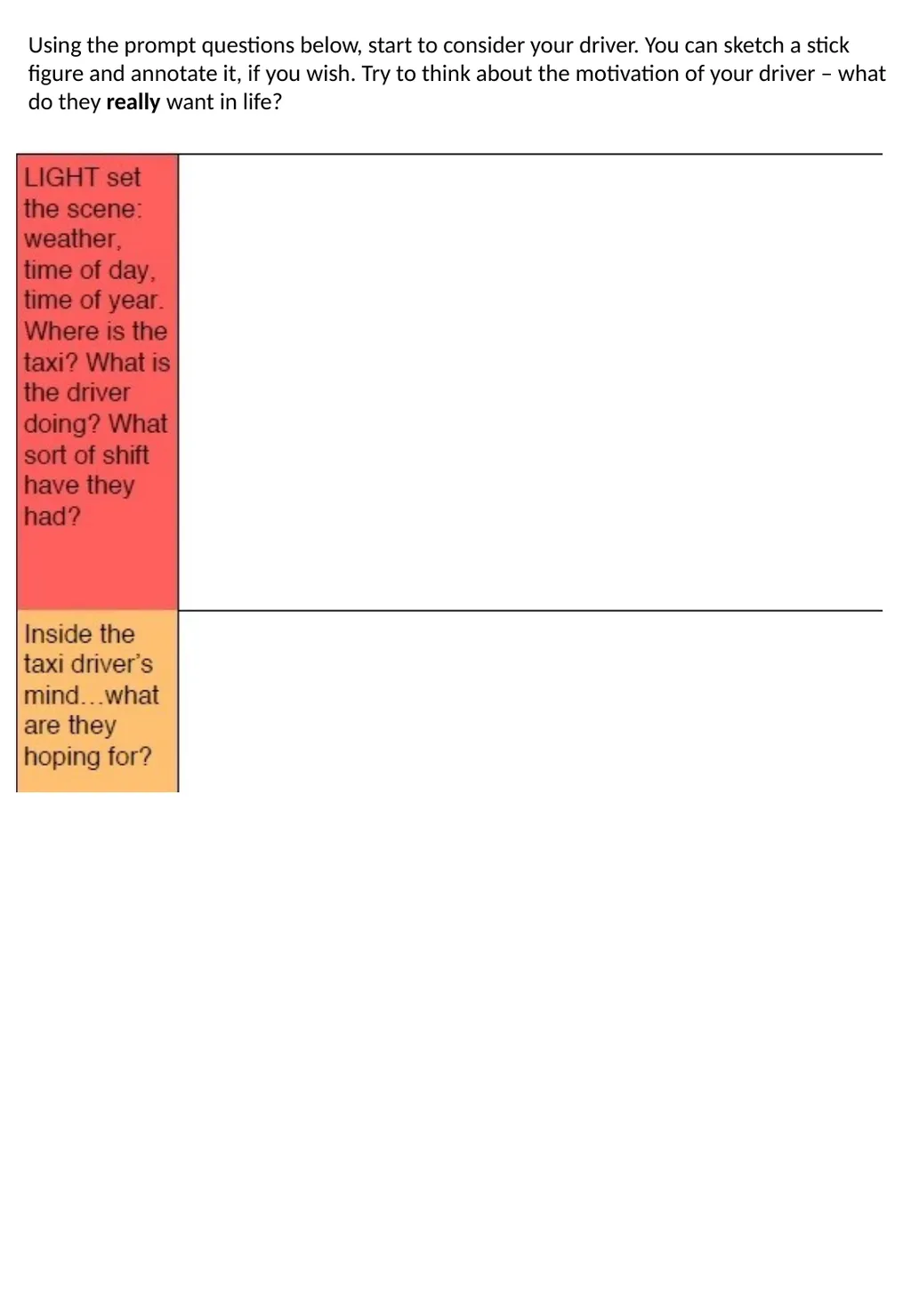
Using the prompt questions below, start to consider your driver. You can sketch a stick figure and annotate it, if you wish. Try to think about the motivation of your driver – what do they really want in life?<br>
21
Lesson 6:
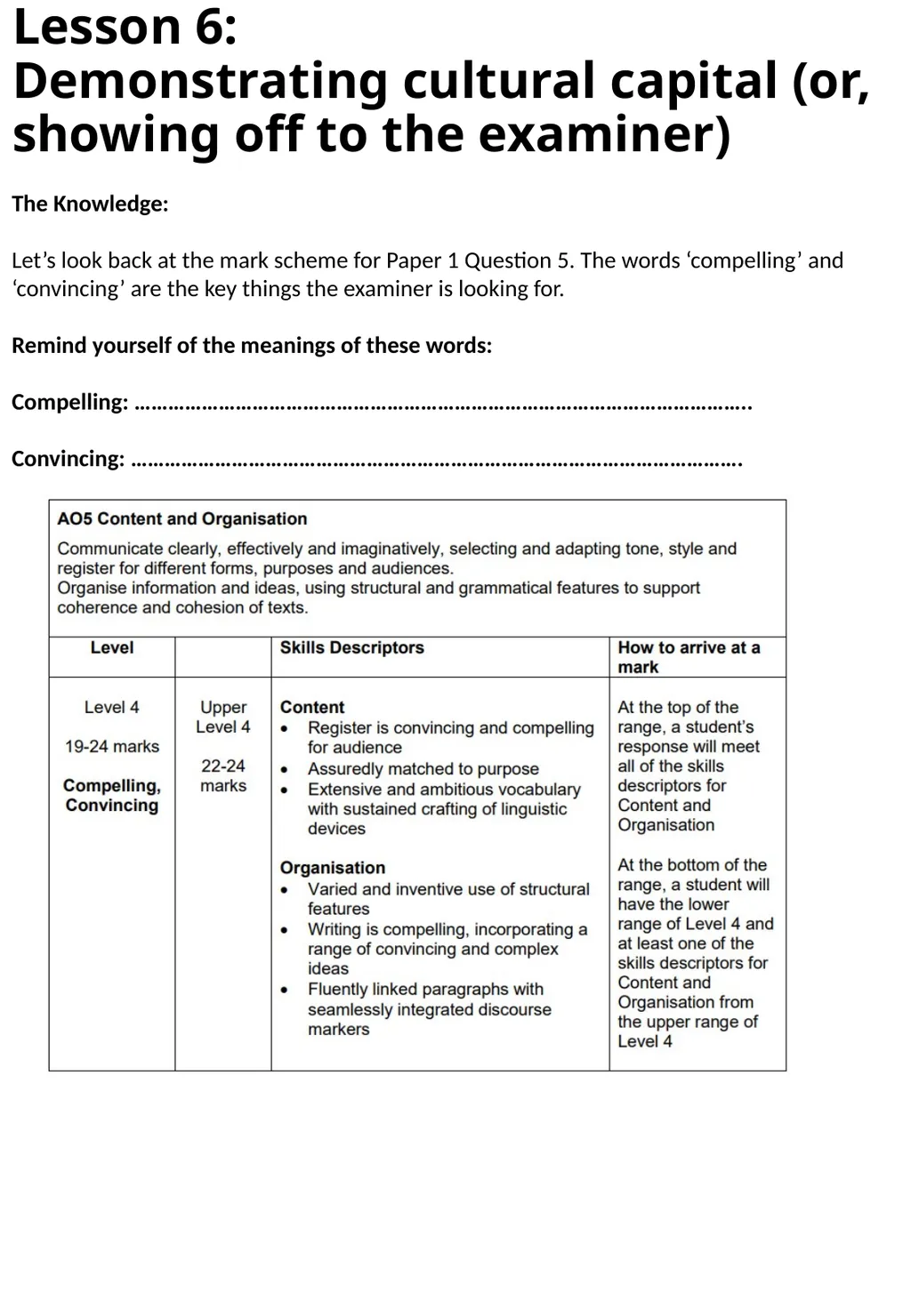
Demonstrating cultural capital (or, showing off to the examiner) The Knowledge:
Let’s look back at the mark scheme for Paper 1 Question 5. The words ‘compelling’ and ‘convincing’ are the key things the examiner is looking for.
Remind yourself of the meanings of these words:
Compelling: ………………………………………………………………………………………………..
Convincing: ……………………………………………………………………………………………….<br>
Let’s look back at the mark scheme for Paper 1 Question 5. The words ‘compelling’ and ‘convincing’ are the key things the examiner is looking for.
Remind yourself of the meanings of these words:
Compelling: ………………………………………………………………………………………………..
Convincing: ……………………………………………………………………………………………….<br>
22
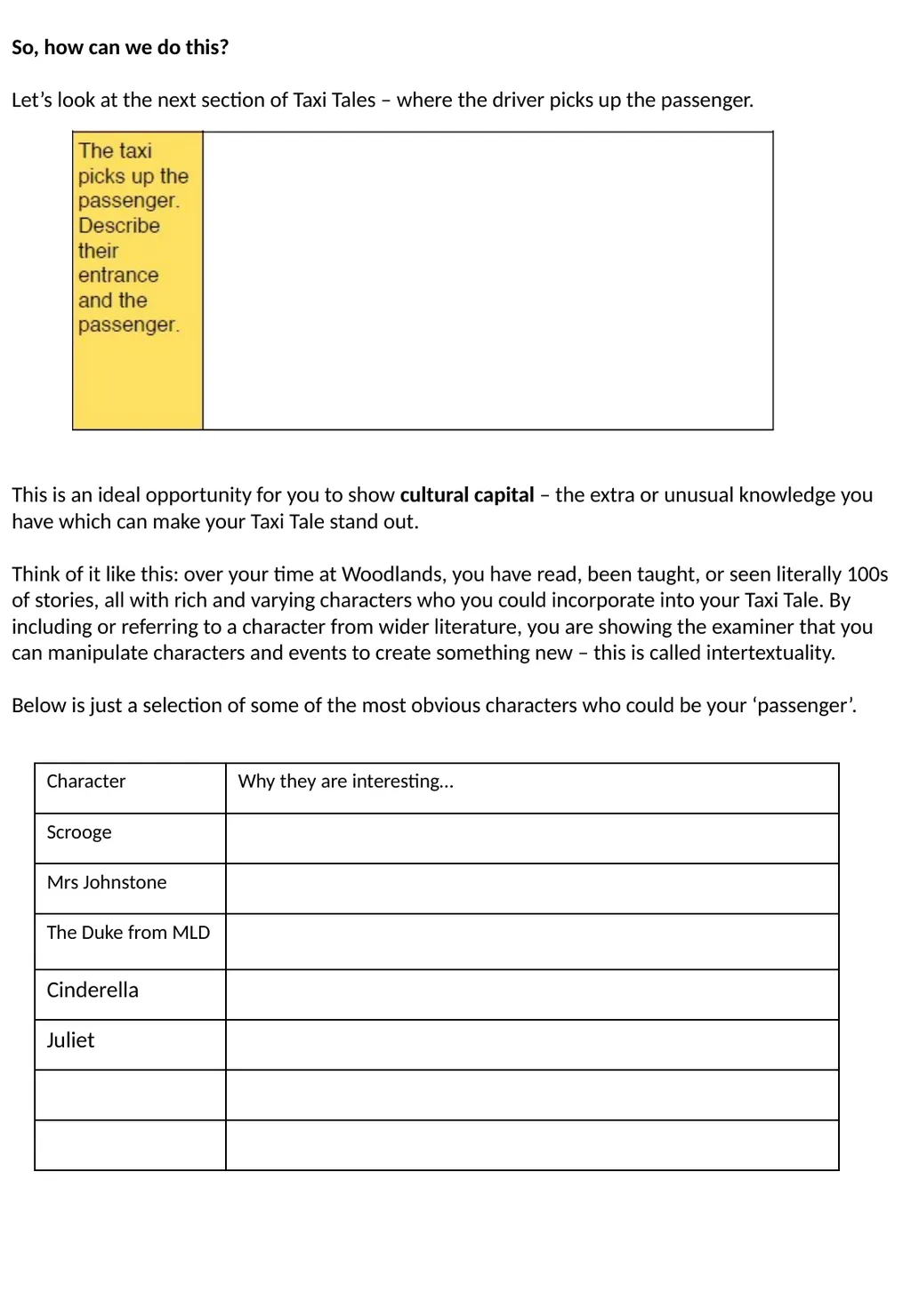
So, how can we do this?
Let’s look at the next section of Taxi Tales – where the driver picks up the passenger.
This is an ideal opportunity for you to show cultural capital – the extra or unusual knowledge you have which can make your Taxi Tale stand out.
Think of it like this: over your time at Woodlands, you have read, been taught, or seen literally 100s of stories, all with rich and varying characters who you could incorporate into your Taxi Tale. By including or referring to a character from wider literature, you are showing the examiner that you can manipulate characters and events to create something new – this is called intertextuality.
Below is just a selection of some of the most obvious characters who could be your ‘passenger’.<br>
Let’s look at the next section of Taxi Tales – where the driver picks up the passenger.
This is an ideal opportunity for you to show cultural capital – the extra or unusual knowledge you have which can make your Taxi Tale stand out.
Think of it like this: over your time at Woodlands, you have read, been taught, or seen literally 100s of stories, all with rich and varying characters who you could incorporate into your Taxi Tale. By including or referring to a character from wider literature, you are showing the examiner that you can manipulate characters and events to create something new – this is called intertextuality.
Below is just a selection of some of the most obvious characters who could be your ‘passenger’.<br>
23
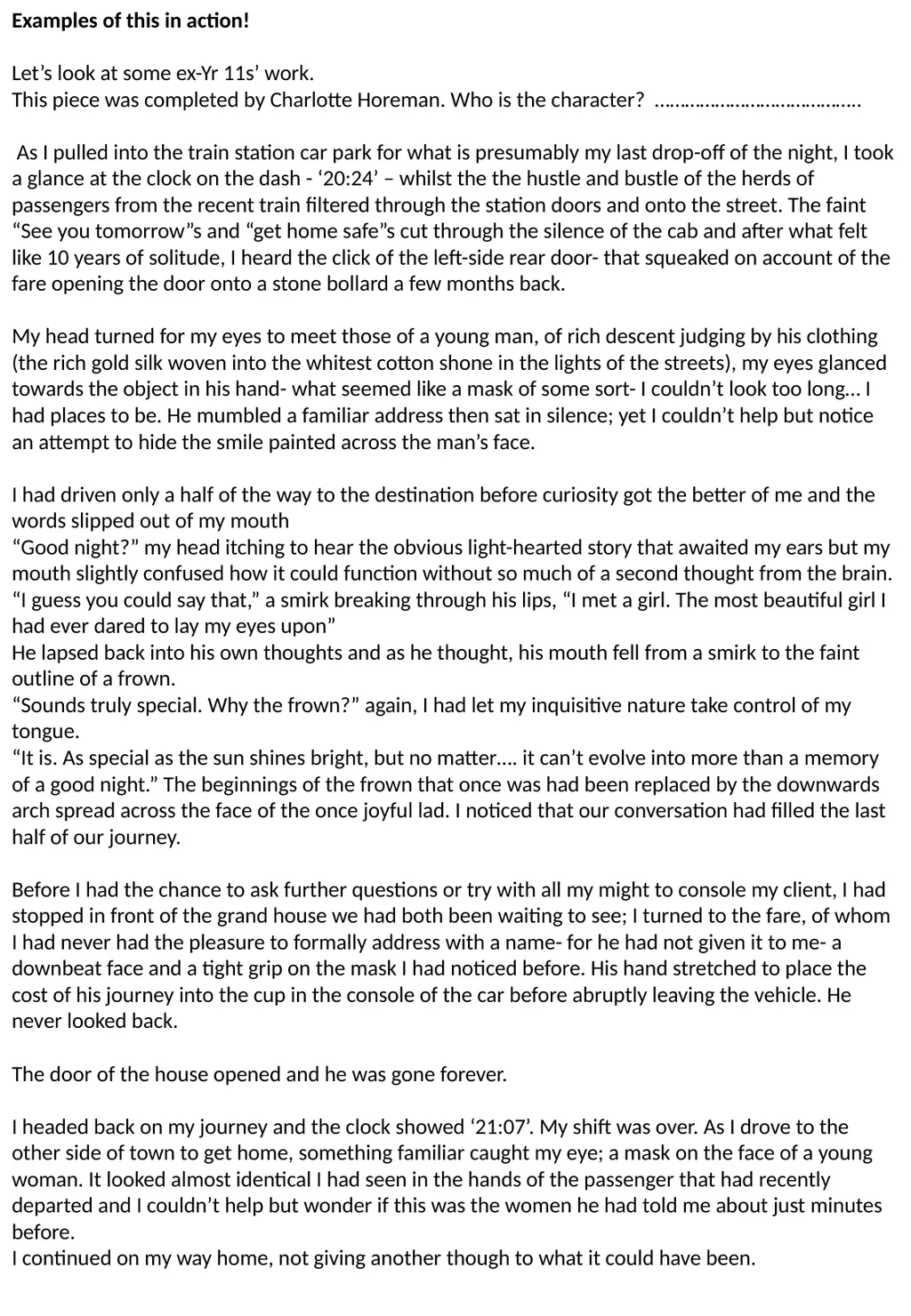
Examples of this in action!
Let’s look at some ex-Yr 11s’ work.
This piece was completed by Charlotte Horeman. Who is the character? …………………………………..
As I pulled into the train station car park for what is presumably my last drop-off of the night, I took a glance at the clock on the dash - ‘20:24’ – whilst the the hustle and bustle of the herds of passengers from the recent train filtered through the station doors and onto the street. The faint “See you tomorrow”s and “get home safe”s cut through the silence of the cab and after what felt like 10 years of solitude, I heard the click of the left-side rear door- that squeaked on account of the fare opening the door onto a stone bollard a few months back.
My head turned for my eyes to meet those of a young man, of rich descent judging by his clothing (the rich gold silk woven into the whitest cotton shone in the lights of the streets), my eyes glanced towards the object in his hand- what seemed like a mask of some sort- I couldn’t look too long… I had places to be. He mumbled a familiar address then sat in silence; yet I couldn’t help but notice an attempt to hide the smile painted across the man’s face.
I had driven only a half of the way to the destination before curiosity got the better of me and the words slipped out of my mouth
“Good night?” my head itching to hear the obvious light-hearted story that awaited my ears but my mouth slightly confused how it could function without so much of a second thought from the brain.
“I guess you could say that,” a smirk breaking through his lips, “I met a girl. The most beautiful girl I had ever dared to lay my eyes upon”
He lapsed back into his own thoughts and as he thought, his mouth fell from a smirk to the faint outline of a frown.
“Sounds truly special. Why the frown?” again, I had let my inquisitive nature take control of my tongue.
“It is. As special as the sun shines bright, but no matter…. it can’t evolve into more than a memory of a good night.” The beginnings of the frown that once was had been replaced by the downwards arch spread across the face of the once joyful lad. I noticed that our conversation had filled the last half of our journey.
Before I had the chance to ask further questions or try with all my might to console my client, I had stopped in front of the grand house we had both been waiting to see; I turned to the fare, of whom I had never had the pleasure to formally address with a name- for he had not given it to me- a downbeat face and a tight grip on the mask I had noticed before. His hand stretched to place the cost of his journey into the cup in the console of the car before abruptly leaving the vehicle. He never looked back.
The door of the house opened and he was gone forever.
I headed back on my journey and the clock showed ‘21:07’. My shift was over. As I drove to the other side of town to get home, something familiar caught my eye; a mask on the face of a young woman. It looked almost identical I had seen in the hands of the passenger that had recently departed and I couldn’t help but wonder if this was the women he had told me about just minutes before.
I continued on my way home, not giving another though to what it could have been.<br>
Let’s look at some ex-Yr 11s’ work.
This piece was completed by Charlotte Horeman. Who is the character? …………………………………..
As I pulled into the train station car park for what is presumably my last drop-off of the night, I took a glance at the clock on the dash - ‘20:24’ – whilst the the hustle and bustle of the herds of passengers from the recent train filtered through the station doors and onto the street. The faint “See you tomorrow”s and “get home safe”s cut through the silence of the cab and after what felt like 10 years of solitude, I heard the click of the left-side rear door- that squeaked on account of the fare opening the door onto a stone bollard a few months back.
My head turned for my eyes to meet those of a young man, of rich descent judging by his clothing (the rich gold silk woven into the whitest cotton shone in the lights of the streets), my eyes glanced towards the object in his hand- what seemed like a mask of some sort- I couldn’t look too long… I had places to be. He mumbled a familiar address then sat in silence; yet I couldn’t help but notice an attempt to hide the smile painted across the man’s face.
I had driven only a half of the way to the destination before curiosity got the better of me and the words slipped out of my mouth
“Good night?” my head itching to hear the obvious light-hearted story that awaited my ears but my mouth slightly confused how it could function without so much of a second thought from the brain.
“I guess you could say that,” a smirk breaking through his lips, “I met a girl. The most beautiful girl I had ever dared to lay my eyes upon”
He lapsed back into his own thoughts and as he thought, his mouth fell from a smirk to the faint outline of a frown.
“Sounds truly special. Why the frown?” again, I had let my inquisitive nature take control of my tongue.
“It is. As special as the sun shines bright, but no matter…. it can’t evolve into more than a memory of a good night.” The beginnings of the frown that once was had been replaced by the downwards arch spread across the face of the once joyful lad. I noticed that our conversation had filled the last half of our journey.
Before I had the chance to ask further questions or try with all my might to console my client, I had stopped in front of the grand house we had both been waiting to see; I turned to the fare, of whom I had never had the pleasure to formally address with a name- for he had not given it to me- a downbeat face and a tight grip on the mask I had noticed before. His hand stretched to place the cost of his journey into the cup in the console of the car before abruptly leaving the vehicle. He never looked back.
The door of the house opened and he was gone forever.
I headed back on my journey and the clock showed ‘21:07’. My shift was over. As I drove to the other side of town to get home, something familiar caught my eye; a mask on the face of a young woman. It looked almost identical I had seen in the hands of the passenger that had recently departed and I couldn’t help but wonder if this was the women he had told me about just minutes before.
I continued on my way home, not giving another though to what it could have been.<br>
24
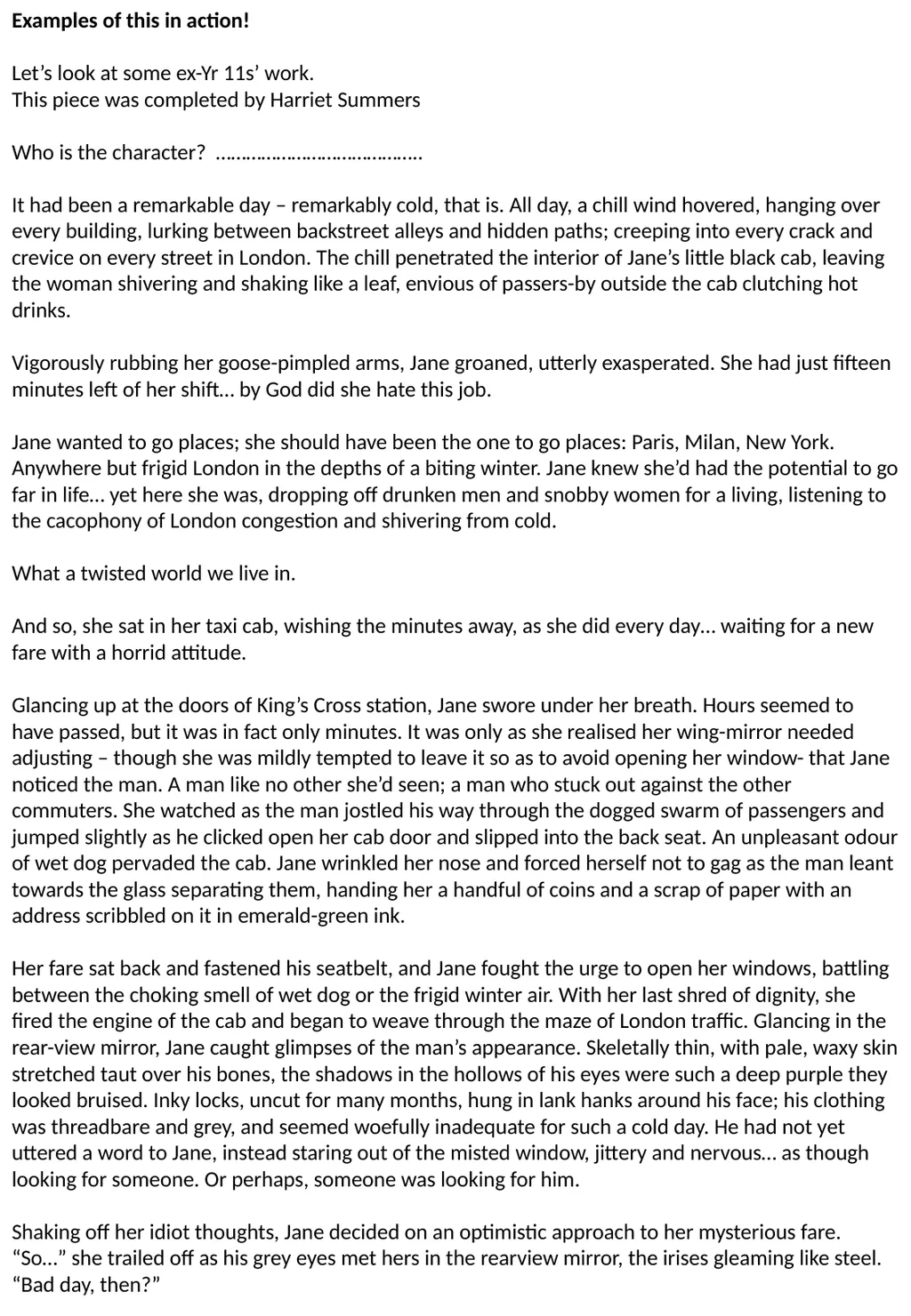
Examples of this in action!
Let’s look at some ex-Yr 11s’ work.
This piece was completed by Harriet Summers
Who is the character? …………………………………..
It had been a remarkable day – remarkably cold, that is. All day, a chill wind hovered, hanging over every building, lurking between backstreet alleys and hidden paths; creeping into every crack and crevice on every street in London. The chill penetrated the interior of Jane’s little black cab, leaving the woman shivering and shaking like a leaf, envious of passers-by outside the cab clutching hot drinks.
Vigorously rubbing her goose-pimpled arms, Jane groaned, utterly exasperated. She had just fifteen minutes left of her shift… by God did she hate this job.
Jane wanted to go places; she should have been the one to go places: Paris, Milan, New York. Anywhere but frigid London in the depths of a biting winter. Jane knew she’d had the potential to go far in life… yet here she was, dropping off drunken men and snobby women for a living, listening to the cacophony of London congestion and shivering from cold.
What a twisted world we live in.
And so, she sat in her taxi cab, wishing the minutes away, as she did every day… waiting for a new fare with a horrid attitude.
Glancing up at the doors of King’s Cross station, Jane swore under her breath. Hours seemed to have passed, but it was in fact only minutes. It was only as she realised her wing-mirror needed adjusting – though she was mildly tempted to leave it so as to avoid opening her window- that Jane noticed the man. A man like no other she’d seen; a man who stuck out against the other commuters. She watched as the man jostled his way through the dogged swarm of passengers and jumped slightly as he clicked open her cab door and slipped into the back seat. An unpleasant odour of wet dog pervaded the cab. Jane wrinkled her nose and forced herself not to gag as the man leant towards the glass separating them, handing her a handful of coins and a scrap of paper with an address scribbled on it in emerald-green ink.
Her fare sat back and fastened his seatbelt, and Jane fought the urge to open her windows, battling between the choking smell of wet dog or the frigid winter air. With her last shred of dignity, she fired the engine of the cab and began to weave through the maze of London traffic. Glancing in the rear-view mirror, Jane caught glimpses of the man’s appearance. Skeletally thin, with pale, waxy skin stretched taut over his bones, the shadows in the hollows of his eyes were such a deep purple they looked bruised. Inky locks, uncut for many months, hung in lank hanks around his face; his clothing was threadbare and grey, and seemed woefully inadequate for such a cold day. He had not yet uttered a word to Jane, instead staring out of the misted window, jittery and nervous… as though looking for someone. Or perhaps, someone was looking for him.
Shaking off her idiot thoughts, Jane decided on an optimistic approach to her mysterious fare.
“So…” she trailed off as his grey eyes met hers in the rearview mirror, the irises gleaming like steel.
“Bad day, then?”<br>
Let’s look at some ex-Yr 11s’ work.
This piece was completed by Harriet Summers
Who is the character? …………………………………..
It had been a remarkable day – remarkably cold, that is. All day, a chill wind hovered, hanging over every building, lurking between backstreet alleys and hidden paths; creeping into every crack and crevice on every street in London. The chill penetrated the interior of Jane’s little black cab, leaving the woman shivering and shaking like a leaf, envious of passers-by outside the cab clutching hot drinks.
Vigorously rubbing her goose-pimpled arms, Jane groaned, utterly exasperated. She had just fifteen minutes left of her shift… by God did she hate this job.
Jane wanted to go places; she should have been the one to go places: Paris, Milan, New York. Anywhere but frigid London in the depths of a biting winter. Jane knew she’d had the potential to go far in life… yet here she was, dropping off drunken men and snobby women for a living, listening to the cacophony of London congestion and shivering from cold.
What a twisted world we live in.
And so, she sat in her taxi cab, wishing the minutes away, as she did every day… waiting for a new fare with a horrid attitude.
Glancing up at the doors of King’s Cross station, Jane swore under her breath. Hours seemed to have passed, but it was in fact only minutes. It was only as she realised her wing-mirror needed adjusting – though she was mildly tempted to leave it so as to avoid opening her window- that Jane noticed the man. A man like no other she’d seen; a man who stuck out against the other commuters. She watched as the man jostled his way through the dogged swarm of passengers and jumped slightly as he clicked open her cab door and slipped into the back seat. An unpleasant odour of wet dog pervaded the cab. Jane wrinkled her nose and forced herself not to gag as the man leant towards the glass separating them, handing her a handful of coins and a scrap of paper with an address scribbled on it in emerald-green ink.
Her fare sat back and fastened his seatbelt, and Jane fought the urge to open her windows, battling between the choking smell of wet dog or the frigid winter air. With her last shred of dignity, she fired the engine of the cab and began to weave through the maze of London traffic. Glancing in the rear-view mirror, Jane caught glimpses of the man’s appearance. Skeletally thin, with pale, waxy skin stretched taut over his bones, the shadows in the hollows of his eyes were such a deep purple they looked bruised. Inky locks, uncut for many months, hung in lank hanks around his face; his clothing was threadbare and grey, and seemed woefully inadequate for such a cold day. He had not yet uttered a word to Jane, instead staring out of the misted window, jittery and nervous… as though looking for someone. Or perhaps, someone was looking for him.
Shaking off her idiot thoughts, Jane decided on an optimistic approach to her mysterious fare.
“So…” she trailed off as his grey eyes met hers in the rearview mirror, the irises gleaming like steel.
“Bad day, then?”<br>
25
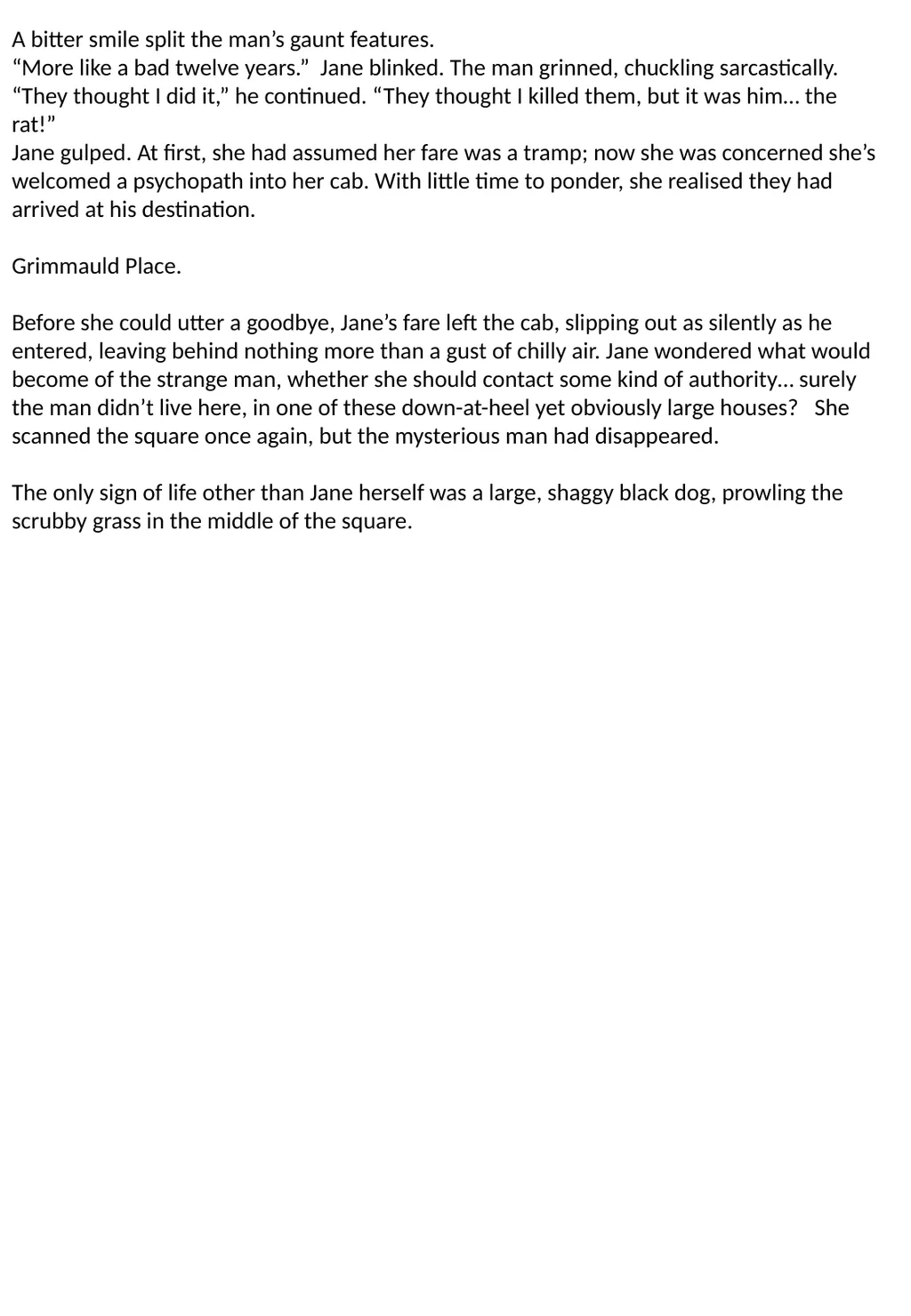
A bitter smile split the man’s gaunt features.
“More like a bad twelve years.” Jane blinked. The man grinned, chuckling sarcastically.
“They thought I did it,” he continued. “They thought I killed them, but it was him… the rat!”
Jane gulped. At first, she had assumed her fare was a tramp; now she was concerned she’s welcomed a psychopath into her cab. With little time to ponder, she realised they had arrived at his destination.
Grimmauld Place.
Before she could utter a goodbye, Jane’s fare left the cab, slipping out as silently as he entered, leaving behind nothing more than a gust of chilly air. Jane wondered what would become of the strange man, whether she should contact some kind of authority… surely the man didn’t live here, in one of these down-at-heel yet obviously large houses? She scanned the square once again, but the mysterious man had disappeared.
The only sign of life other than Jane herself was a large, shaggy black dog, prowling the scrubby grass in the middle of the square.<br>
“More like a bad twelve years.” Jane blinked. The man grinned, chuckling sarcastically.
“They thought I did it,” he continued. “They thought I killed them, but it was him… the rat!”
Jane gulped. At first, she had assumed her fare was a tramp; now she was concerned she’s welcomed a psychopath into her cab. With little time to ponder, she realised they had arrived at his destination.
Grimmauld Place.
Before she could utter a goodbye, Jane’s fare left the cab, slipping out as silently as he entered, leaving behind nothing more than a gust of chilly air. Jane wondered what would become of the strange man, whether she should contact some kind of authority… surely the man didn’t live here, in one of these down-at-heel yet obviously large houses? She scanned the square once again, but the mysterious man had disappeared.
The only sign of life other than Jane herself was a large, shaggy black dog, prowling the scrubby grass in the middle of the square.<br>
26
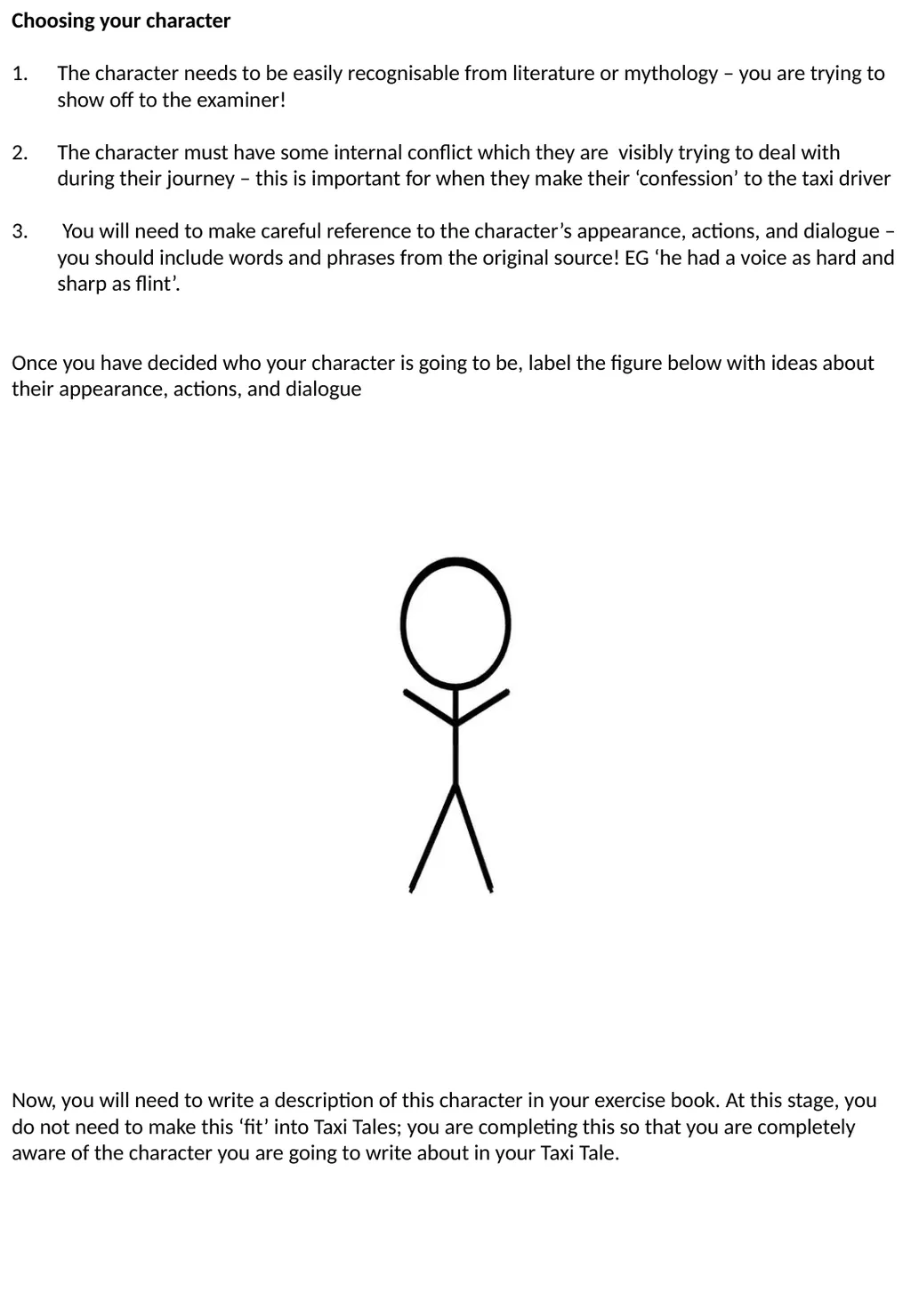
Choosing your character
The character needs to be easily recognisable from literature or mythology – you are trying to show off to the examiner!
The character must have some internal conflict which they are visibly trying to deal with during their journey – this is important for when they make their ‘confession’ to the taxi driver
You will need to make careful reference to the character’s appearance, actions, and dialogue – you should include words and phrases from the original source! EG ‘he had a voice as hard and sharp as flint’.
Once you have decided who your character is going to be, label the figure below with ideas about their appearance, actions, and dialogue
Now, you will need to write a description of this character in your exercise book. At this stage, you do not need to make this ‘fit’ into Taxi Tales; you are completing this so that you are completely aware of the character you are going to write about in your Taxi Tale.<br>
The character needs to be easily recognisable from literature or mythology – you are trying to show off to the examiner!
The character must have some internal conflict which they are visibly trying to deal with during their journey – this is important for when they make their ‘confession’ to the taxi driver
You will need to make careful reference to the character’s appearance, actions, and dialogue – you should include words and phrases from the original source! EG ‘he had a voice as hard and sharp as flint’.
Once you have decided who your character is going to be, label the figure below with ideas about their appearance, actions, and dialogue
Now, you will need to write a description of this character in your exercise book. At this stage, you do not need to make this ‘fit’ into Taxi Tales; you are completing this so that you are completely aware of the character you are going to write about in your Taxi Tale.<br>
27
Lesson 7:
Effective use of speech marks The Knowledge:
Dialogue is the action of speech between characters in a story. Good dialogue can make interaction between characters more believable and help to develop the storyline. This lesson will help you understand how to write good dialogue, following the rules of direct speech.
William Sloane, author of The Craft of Writing, argues:
‘There is a tentative rule that pertains to all fiction dialogue. It must do more than one thing at a time or it is too inert for the purposes of fiction. This may sound harsh, but I consider it an essential discipline.’
Discuss this statement and rewrite it in a way which makes sense to you:
…………………………………………………………………………………………………………………………………………………………………………………………………………………………………………………………………………………………………………………………………………………………………………………………………………………………………………………………………………………………………………………..
Now read this example of dialogue:
‘I think that pupils are rubbish at writing dialogue,’ exclaimed the teacher.
‘Do you really think so?’ Replied his colleague.
‘I honestly do,’ he responded honestly.
‘Why do you think that’s the case?’ Asked his colleague
‘Oh, it’s not just pupils. You’ll find that most people – even established writers – are quite useless at writing dialogue.’ He said, scratching his head with bemusement.
Thinking about what Sloane says about dialogue, is this a good example of it? Discuss this with the person next to you.
Note your thoughts down here:
……………………………………………………………………………………………………………………………………………………………………………………………………………………………………………………………………………………………………………………………………………………………………………………………………………………………………………………………………………………………………………………<br>
Dialogue is the action of speech between characters in a story. Good dialogue can make interaction between characters more believable and help to develop the storyline. This lesson will help you understand how to write good dialogue, following the rules of direct speech.
William Sloane, author of The Craft of Writing, argues:
‘There is a tentative rule that pertains to all fiction dialogue. It must do more than one thing at a time or it is too inert for the purposes of fiction. This may sound harsh, but I consider it an essential discipline.’
Discuss this statement and rewrite it in a way which makes sense to you:
…………………………………………………………………………………………………………………………………………………………………………………………………………………………………………………………………………………………………………………………………………………………………………………………………………………………………………………………………………………………………………………..
Now read this example of dialogue:
‘I think that pupils are rubbish at writing dialogue,’ exclaimed the teacher.
‘Do you really think so?’ Replied his colleague.
‘I honestly do,’ he responded honestly.
‘Why do you think that’s the case?’ Asked his colleague
‘Oh, it’s not just pupils. You’ll find that most people – even established writers – are quite useless at writing dialogue.’ He said, scratching his head with bemusement.
Thinking about what Sloane says about dialogue, is this a good example of it? Discuss this with the person next to you.
Note your thoughts down here:
……………………………………………………………………………………………………………………………………………………………………………………………………………………………………………………………………………………………………………………………………………………………………………………………………………………………………………………………………………………………………………………<br>
28
There are a strict set of rules to follow when writing direct speech. Remind yourself of them: Rule One
For each different speaker you begin a new line.
e.g.
“Mark? Do you want some tea?” his dad called again.
“No,” he shouted, trying to make his voice sound sad.
Rule Two
You must use inverted commas to show the words actually spoken. It doesn’t matter if you use “ or ‘ , just as long as you use the same right the way through.
e.g. “Mark? Do you want some tea?” his dad called again.
Rule Three
The first word spoken always has a capital letter.
e.g. “Mark? Do you want some tea?” his dad called again.
Rule Four
There must always be a comma or a full stop or an exclamation mark or a question mark before you close your inverted commas.
e.g. “Mark? Do you want some tea?” his dad called again
“No,” he shouted, trying to make his voice sound sad.
Rule Five
The word after the inverted commas – provided you haven’t used a full stop before them – is always a small letter (unless it’s a name).
e.g. “Mark? Do you want some tea?” his dad called again
“No,” said Mark.
Why is this important?
In your Taxi Tale, you will need to make some use of direct speech to demonstrate the conversation which takes place between the driver and the passenger. Most students fall down on punctuating direct speech – which is why it is important that you know, and regularly practise, the rules above.<br>
For each different speaker you begin a new line.
e.g.
“Mark? Do you want some tea?” his dad called again.
“No,” he shouted, trying to make his voice sound sad.
Rule Two
You must use inverted commas to show the words actually spoken. It doesn’t matter if you use “ or ‘ , just as long as you use the same right the way through.
e.g. “Mark? Do you want some tea?” his dad called again.
Rule Three
The first word spoken always has a capital letter.
e.g. “Mark? Do you want some tea?” his dad called again.
Rule Four
There must always be a comma or a full stop or an exclamation mark or a question mark before you close your inverted commas.
e.g. “Mark? Do you want some tea?” his dad called again
“No,” he shouted, trying to make his voice sound sad.
Rule Five
The word after the inverted commas – provided you haven’t used a full stop before them – is always a small letter (unless it’s a name).
e.g. “Mark? Do you want some tea?” his dad called again
“No,” said Mark.
Why is this important?
In your Taxi Tale, you will need to make some use of direct speech to demonstrate the conversation which takes place between the driver and the passenger. Most students fall down on punctuating direct speech – which is why it is important that you know, and regularly practise, the rules above.<br>
29
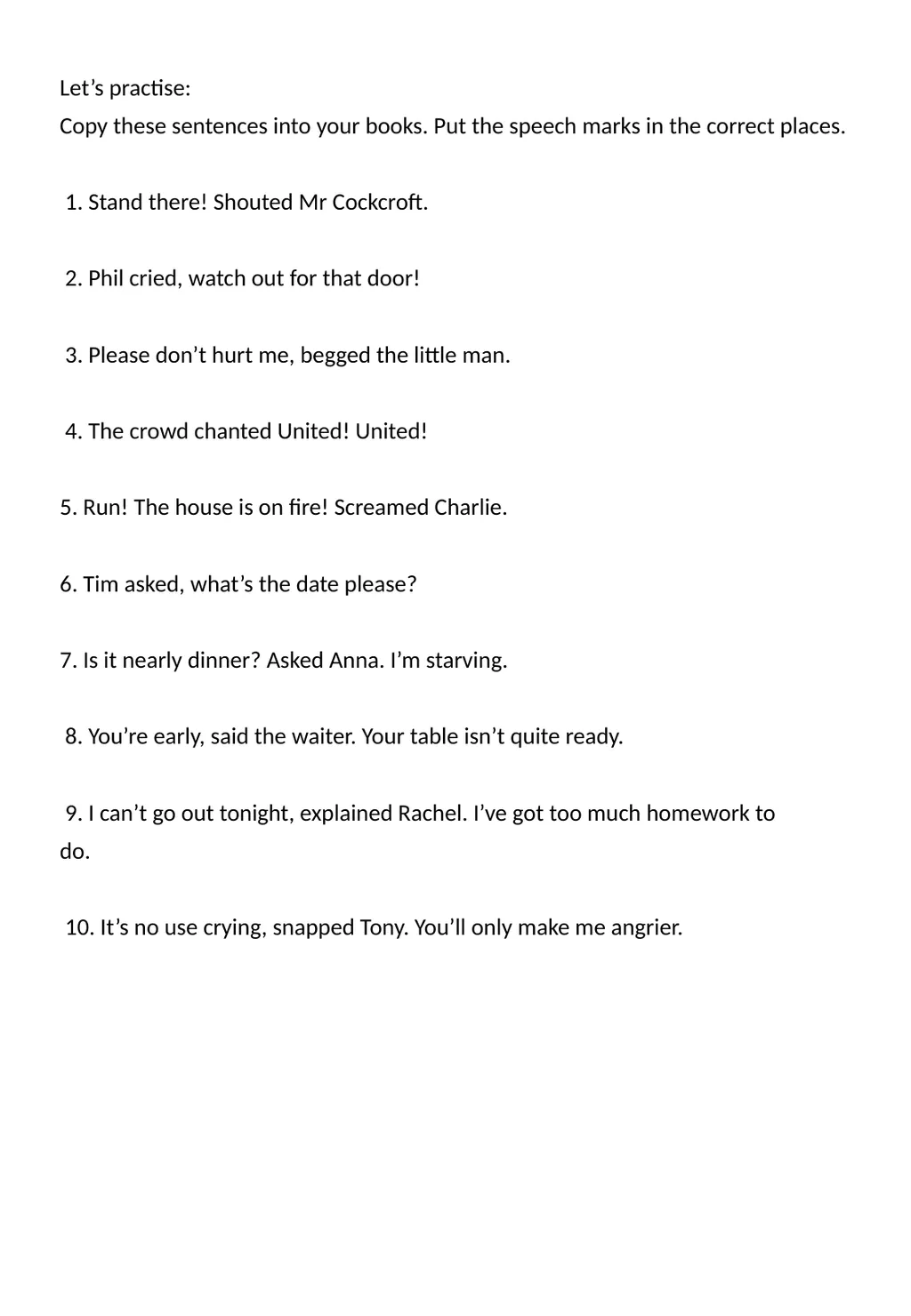
Let’s practise:
Copy these sentences into your books. Put the speech marks in the correct places.
1. Stand there! Shouted Mr Cockcroft.
2. Phil cried, watch out for that door!
3. Please don’t hurt me, begged the little man.
4. The crowd chanted United! United!
5. Run! The house is on fire! Screamed Charlie.
6. Tim asked, what’s the date please?
7. Is it nearly dinner? Asked Anna. I’m starving.
8. You’re early, said the waiter. Your table isn’t quite ready.
9. I can’t go out tonight, explained Rachel. I’ve got too much homework to
do.
10. It’s no use crying, snapped Tony. You’ll only make me angrier.<br>
Copy these sentences into your books. Put the speech marks in the correct places.
1. Stand there! Shouted Mr Cockcroft.
2. Phil cried, watch out for that door!
3. Please don’t hurt me, begged the little man.
4. The crowd chanted United! United!
5. Run! The house is on fire! Screamed Charlie.
6. Tim asked, what’s the date please?
7. Is it nearly dinner? Asked Anna. I’m starving.
8. You’re early, said the waiter. Your table isn’t quite ready.
9. I can’t go out tonight, explained Rachel. I’ve got too much homework to
do.
10. It’s no use crying, snapped Tony. You’ll only make me angrier.<br>
30
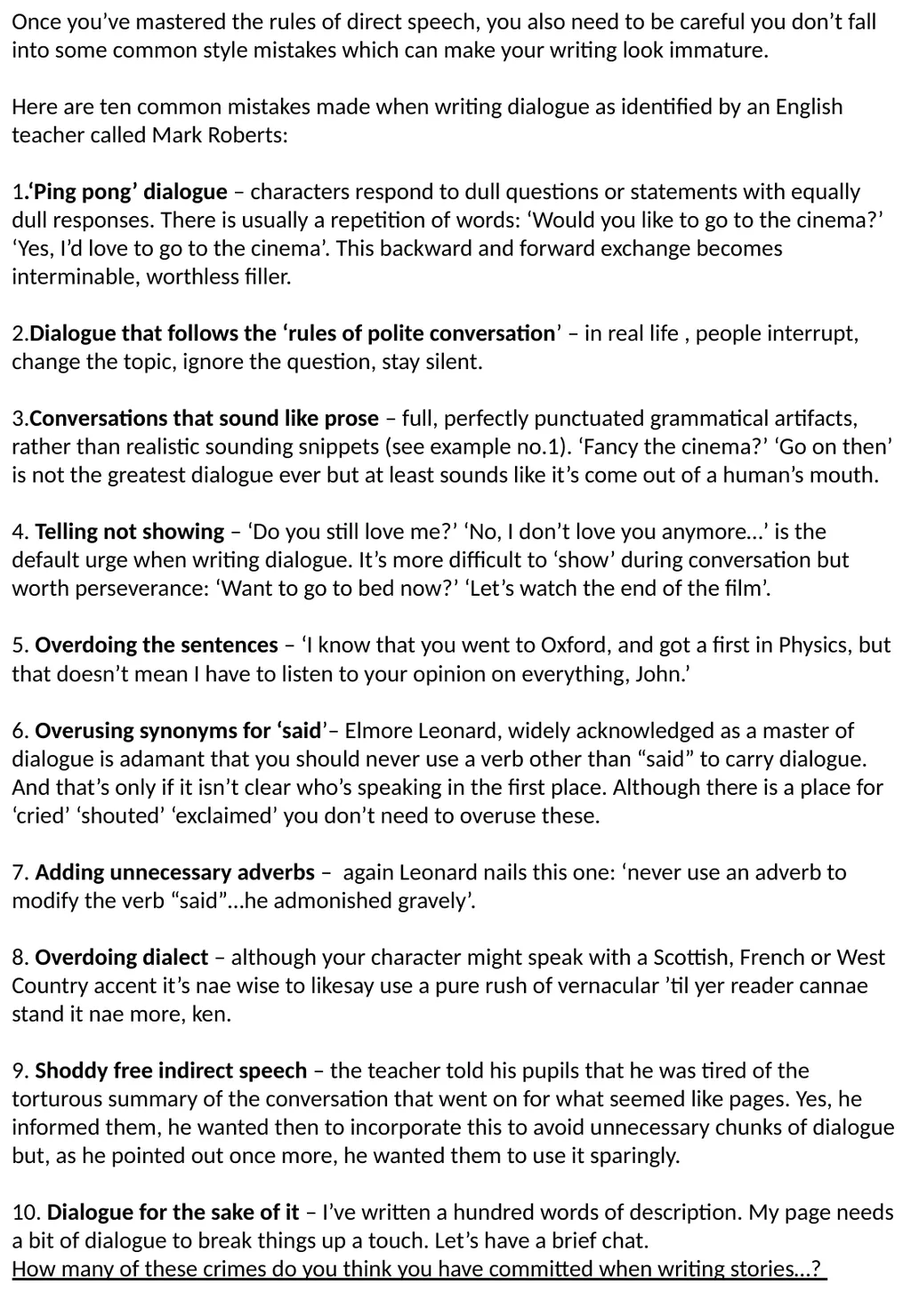
Once you’ve mastered the rules of direct speech, you also need to be careful you don’t fall into some common style mistakes which can make your writing look immature.
Here are ten common mistakes made when writing dialogue as identified by an English teacher called Mark Roberts:
1.‘Ping pong’ dialogue – characters respond to dull questions or statements with equally dull responses. There is usually a repetition of words: ‘Would you like to go to the cinema?’ ‘Yes, I’d love to go to the cinema’. This backward and forward exchange becomes interminable, worthless filler.
2.Dialogue that follows the ‘rules of polite conversation’ – in real life , people interrupt, change the topic, ignore the question, stay silent.
3.Conversations that sound like prose – full, perfectly punctuated grammatical artifacts, rather than realistic sounding snippets (see example no.1). ‘Fancy the cinema?’ ‘Go on then’ is not the greatest dialogue ever but at least sounds like it’s come out of a human’s mouth.
4. Telling not showing – ‘Do you still love me?’ ‘No, I don’t love you anymore…’ is the default urge when writing dialogue. It’s more difficult to ‘show’ during conversation but worth perseverance: ‘Want to go to bed now?’ ‘Let’s watch the end of the film’.
5. Overdoing the sentences – ‘I know that you went to Oxford, and got a first in Physics, but that doesn’t mean I have to listen to your opinion on everything, John.’
6. Overusing synonyms for ‘said’– Elmore Leonard, widely acknowledged as a master of dialogue is adamant that you should never use a verb other than “said” to carry dialogue. And that’s only if it isn’t clear who’s speaking in the first place. Although there is a place for ‘cried’ ‘shouted’ ‘exclaimed’ you don’t need to overuse these.
7. Adding unnecessary adverbs – again Leonard nails this one: ‘never use an adverb to modify the verb “said”…he admonished gravely’.
8. Overdoing dialect – although your character might speak with a Scottish, French or West Country accent it’s nae wise to likesay use a pure rush of vernacular ’til yer reader cannae stand it nae more, ken.
9. Shoddy free indirect speech – the teacher told his pupils that he was tired of the torturous summary of the conversation that went on for what seemed like pages. Yes, he informed them, he wanted then to incorporate this to avoid unnecessary chunks of dialogue but, as he pointed out once more, he wanted them to use it sparingly.
10. Dialogue for the sake of it – I’ve written a hundred words of description. My page needs a bit of dialogue to break things up a touch. Let’s have a brief chat.
How many of these crimes do you think you have committed when writing stories…?<br>
Here are ten common mistakes made when writing dialogue as identified by an English teacher called Mark Roberts:
1.‘Ping pong’ dialogue – characters respond to dull questions or statements with equally dull responses. There is usually a repetition of words: ‘Would you like to go to the cinema?’ ‘Yes, I’d love to go to the cinema’. This backward and forward exchange becomes interminable, worthless filler.
2.Dialogue that follows the ‘rules of polite conversation’ – in real life , people interrupt, change the topic, ignore the question, stay silent.
3.Conversations that sound like prose – full, perfectly punctuated grammatical artifacts, rather than realistic sounding snippets (see example no.1). ‘Fancy the cinema?’ ‘Go on then’ is not the greatest dialogue ever but at least sounds like it’s come out of a human’s mouth.
4. Telling not showing – ‘Do you still love me?’ ‘No, I don’t love you anymore…’ is the default urge when writing dialogue. It’s more difficult to ‘show’ during conversation but worth perseverance: ‘Want to go to bed now?’ ‘Let’s watch the end of the film’.
5. Overdoing the sentences – ‘I know that you went to Oxford, and got a first in Physics, but that doesn’t mean I have to listen to your opinion on everything, John.’
6. Overusing synonyms for ‘said’– Elmore Leonard, widely acknowledged as a master of dialogue is adamant that you should never use a verb other than “said” to carry dialogue. And that’s only if it isn’t clear who’s speaking in the first place. Although there is a place for ‘cried’ ‘shouted’ ‘exclaimed’ you don’t need to overuse these.
7. Adding unnecessary adverbs – again Leonard nails this one: ‘never use an adverb to modify the verb “said”…he admonished gravely’.
8. Overdoing dialect – although your character might speak with a Scottish, French or West Country accent it’s nae wise to likesay use a pure rush of vernacular ’til yer reader cannae stand it nae more, ken.
9. Shoddy free indirect speech – the teacher told his pupils that he was tired of the torturous summary of the conversation that went on for what seemed like pages. Yes, he informed them, he wanted then to incorporate this to avoid unnecessary chunks of dialogue but, as he pointed out once more, he wanted them to use it sparingly.
10. Dialogue for the sake of it – I’ve written a hundred words of description. My page needs a bit of dialogue to break things up a touch. Let’s have a brief chat.
How many of these crimes do you think you have committed when writing stories…?<br>
31
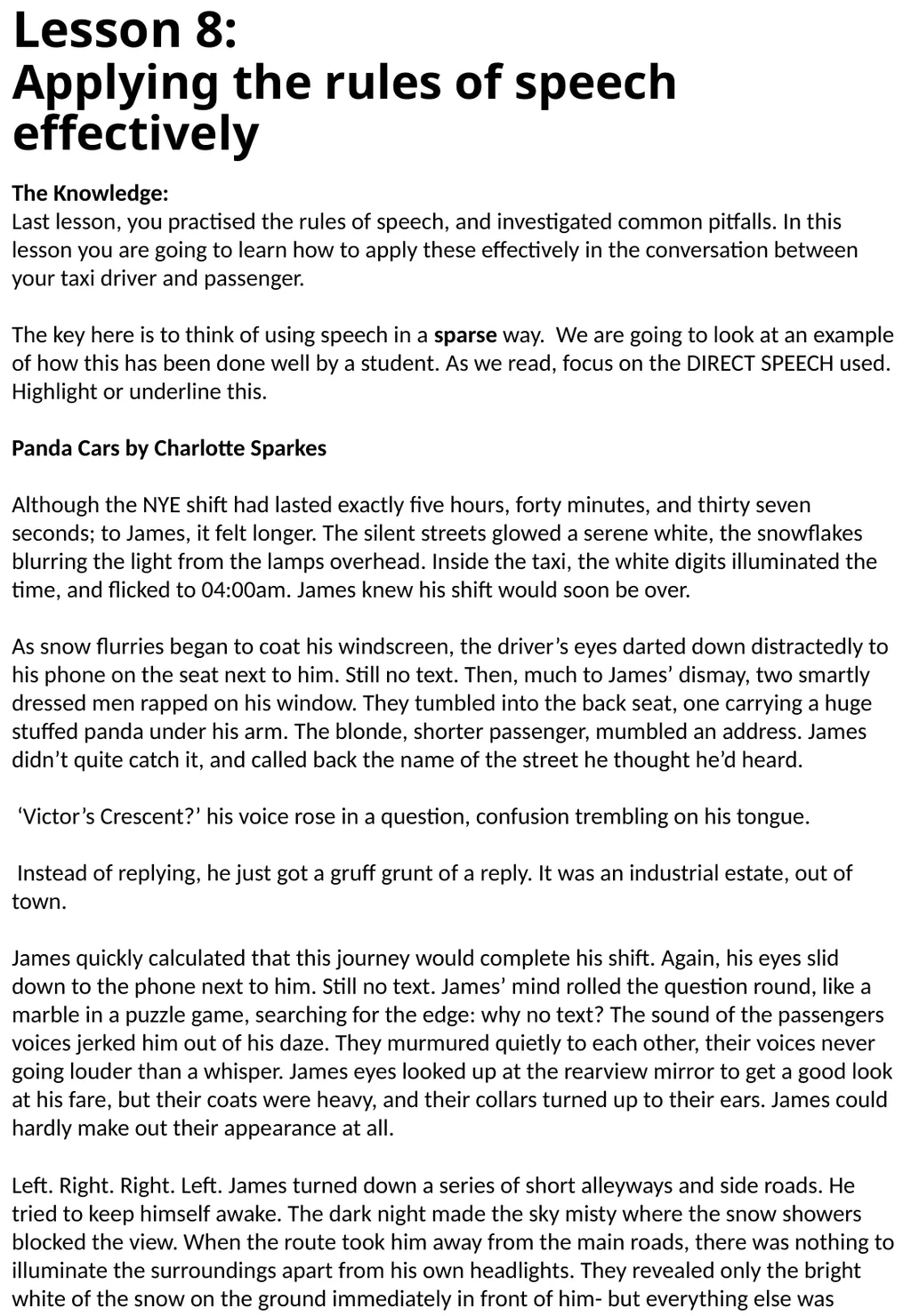
Lesson 8:
Applying the rules of speech effectively The Knowledge:
Last lesson, you practised the rules of speech, and investigated common pitfalls. In this lesson you are going to learn how to apply these effectively in the conversation between your taxi driver and passenger.
The key here is to think of using speech in a sparse way. We are going to look at an example of how this has been done well by a student. As we read, focus on the DIRECT SPEECH used. Highlight or underline this.
Panda Cars by Charlotte Sparkes
Although the NYE shift had lasted exactly five hours, forty minutes, and thirty seven seconds; to James, it felt longer. The silent streets glowed a serene white, the snowflakes blurring the light from the lamps overhead. Inside the taxi, the white digits illuminated the time, and flicked to 04:00am. James knew his shift would soon be over.
As snow flurries began to coat his windscreen, the driver’s eyes darted down distractedly to his phone on the seat next to him. Still no text. Then, much to James’ dismay, two smartly dressed men rapped on his window. They tumbled into the back seat, one carrying a huge stuffed panda under his arm. The blonde, shorter passenger, mumbled an address. James didn’t quite catch it, and called back the name of the street he thought he’d heard.
‘Victor’s Crescent?’ his voice rose in a question, confusion trembling on his tongue.
Instead of replying, he just got a gruff grunt of a reply. It was an industrial estate, out of town.
James quickly calculated that this journey would complete his shift. Again, his eyes slid down to the phone next to him. Still no text. James’ mind rolled the question round, like a marble in a puzzle game, searching for the edge: why no text? The sound of the passengers voices jerked him out of his daze. They murmured quietly to each other, their voices never going louder than a whisper. James eyes looked up at the rearview mirror to get a good look at his fare, but their coats were heavy, and their collars turned up to their ears. James could hardly make out their appearance at all.
Left. Right. Right. Left. James turned down a series of short alleyways and side roads. He tried to keep himself awake. The dark night made the sky misty where the snow showers blocked the view. When the route took him away from the main roads, there was nothing to illuminate the surroundings apart from his own headlights. They revealed only the bright white of the snow on the ground immediately in front of him- but everything else was<br>
Last lesson, you practised the rules of speech, and investigated common pitfalls. In this lesson you are going to learn how to apply these effectively in the conversation between your taxi driver and passenger.
The key here is to think of using speech in a sparse way. We are going to look at an example of how this has been done well by a student. As we read, focus on the DIRECT SPEECH used. Highlight or underline this.
Panda Cars by Charlotte Sparkes
Although the NYE shift had lasted exactly five hours, forty minutes, and thirty seven seconds; to James, it felt longer. The silent streets glowed a serene white, the snowflakes blurring the light from the lamps overhead. Inside the taxi, the white digits illuminated the time, and flicked to 04:00am. James knew his shift would soon be over.
As snow flurries began to coat his windscreen, the driver’s eyes darted down distractedly to his phone on the seat next to him. Still no text. Then, much to James’ dismay, two smartly dressed men rapped on his window. They tumbled into the back seat, one carrying a huge stuffed panda under his arm. The blonde, shorter passenger, mumbled an address. James didn’t quite catch it, and called back the name of the street he thought he’d heard.
‘Victor’s Crescent?’ his voice rose in a question, confusion trembling on his tongue.
Instead of replying, he just got a gruff grunt of a reply. It was an industrial estate, out of town.
James quickly calculated that this journey would complete his shift. Again, his eyes slid down to the phone next to him. Still no text. James’ mind rolled the question round, like a marble in a puzzle game, searching for the edge: why no text? The sound of the passengers voices jerked him out of his daze. They murmured quietly to each other, their voices never going louder than a whisper. James eyes looked up at the rearview mirror to get a good look at his fare, but their coats were heavy, and their collars turned up to their ears. James could hardly make out their appearance at all.
Left. Right. Right. Left. James turned down a series of short alleyways and side roads. He tried to keep himself awake. The dark night made the sky misty where the snow showers blocked the view. When the route took him away from the main roads, there was nothing to illuminate the surroundings apart from his own headlights. They revealed only the bright white of the snow on the ground immediately in front of him- but everything else was<br>
32
cloaked in an inky black. The more he drove, the more sleepy he felt, and the more strange this destination became. James’ eyes wandered over to his phone.
Still no text. And now no signal.
‘Definitely Victor’s Crescent?’ James questioned, still facing forward, but his eyes on the rearview mirror.
Startled, the two men sat forward, and then looked at each other, and seemed to exchange a worried glance.
‘We’re close enough here- just stop now.’ The passenger’s voice was angry, disappointed, and full of worry. James was taken aback by this strange reaction. He went to turn to face them- but stopped. He felt it wasn’t his place to question it. That marble questioning why his phone was still silent wasn’t going to be answered without any signal; he had to get out of there. He had to call and find out if the adoption papers had gone through, and he was finally officially a father.
The men paid in a rush- chucking notes onto the seat and coins rolling onto the floor. James sighed in disgust, wondering if they’d even paid in full.
Hesitantly and slowly, the men moved away from the taxi, before breaking into a run, and disappearing down a snowy side road.
James flicked the car radio on, and searched for a station that was playing music. As the dial jolted between frequencies, he caught half of a news bulletin, alerting people of a robbery that had just occurred. Warning people to be on the lookout for two men in suits, one blonde, carrying a giant panda, believed to be full of the stolen money.
James turned in his seat to be met with the sight of a forgotten giant stuffed panda on the floor.
Discussion:
There are several incidences here where Charlotte COULD have included direct speech but instead implied what the driver was thinking or feeling. Where are these? Why do you think this is effective?<br>
Still no text. And now no signal.
‘Definitely Victor’s Crescent?’ James questioned, still facing forward, but his eyes on the rearview mirror.
Startled, the two men sat forward, and then looked at each other, and seemed to exchange a worried glance.
‘We’re close enough here- just stop now.’ The passenger’s voice was angry, disappointed, and full of worry. James was taken aback by this strange reaction. He went to turn to face them- but stopped. He felt it wasn’t his place to question it. That marble questioning why his phone was still silent wasn’t going to be answered without any signal; he had to get out of there. He had to call and find out if the adoption papers had gone through, and he was finally officially a father.
The men paid in a rush- chucking notes onto the seat and coins rolling onto the floor. James sighed in disgust, wondering if they’d even paid in full.
Hesitantly and slowly, the men moved away from the taxi, before breaking into a run, and disappearing down a snowy side road.
James flicked the car radio on, and searched for a station that was playing music. As the dial jolted between frequencies, he caught half of a news bulletin, alerting people of a robbery that had just occurred. Warning people to be on the lookout for two men in suits, one blonde, carrying a giant panda, believed to be full of the stolen money.
James turned in his seat to be met with the sight of a forgotten giant stuffed panda on the floor.
Discussion:
There are several incidences here where Charlotte COULD have included direct speech but instead implied what the driver was thinking or feeling. Where are these? Why do you think this is effective?<br>
33
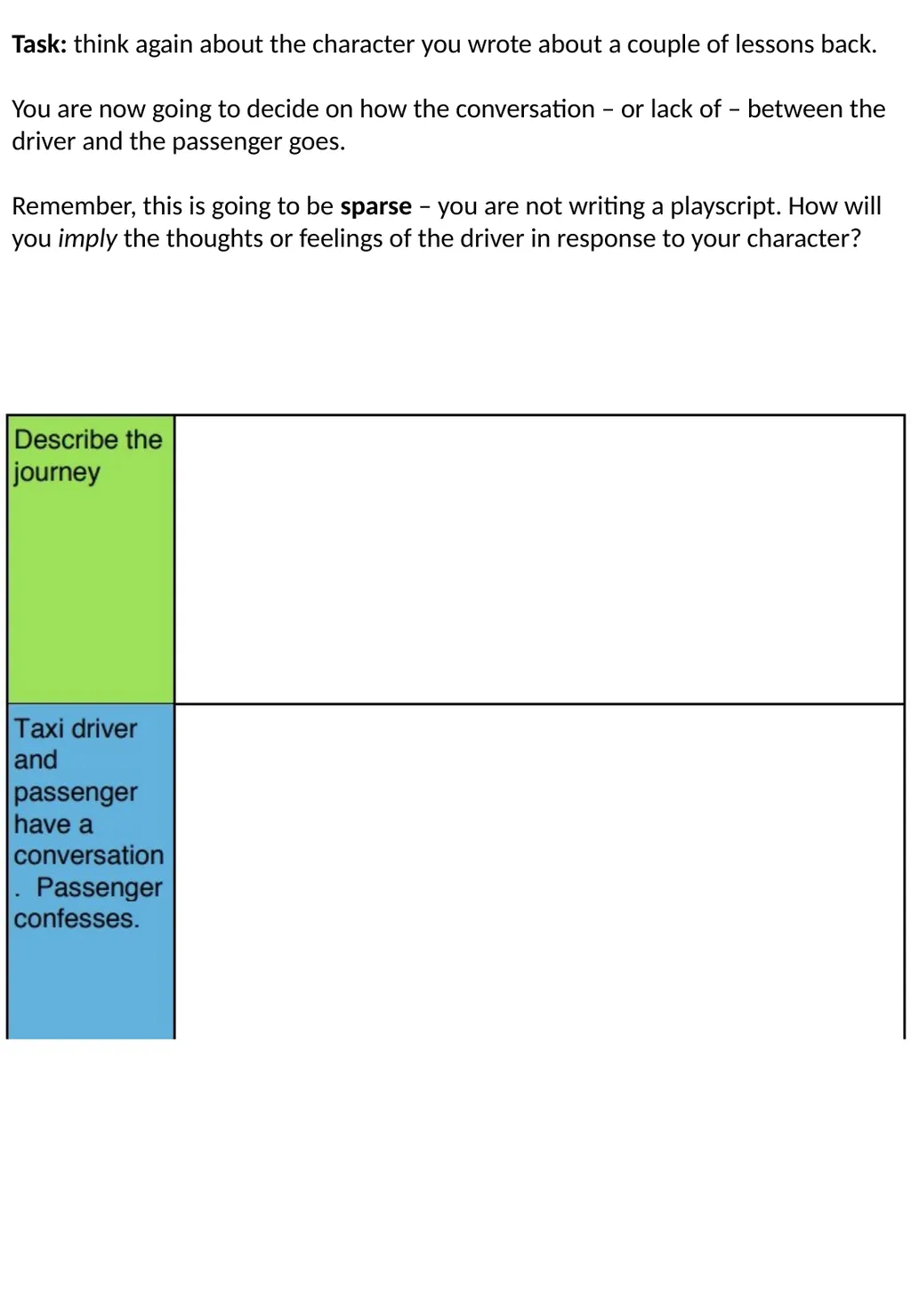
Task: think again about the character you wrote about a couple of lessons back.
You are now going to decide on how the conversation – or lack of – between the driver and the passenger goes.
Remember, this is going to be sparse – you are not writing a playscript. How will you imply the thoughts or feelings of the driver in response to your character?<br>
You are now going to decide on how the conversation – or lack of – between the driver and the passenger goes.
Remember, this is going to be sparse – you are not writing a playscript. How will you imply the thoughts or feelings of the driver in response to your character?<br>
34
Lesson 9:
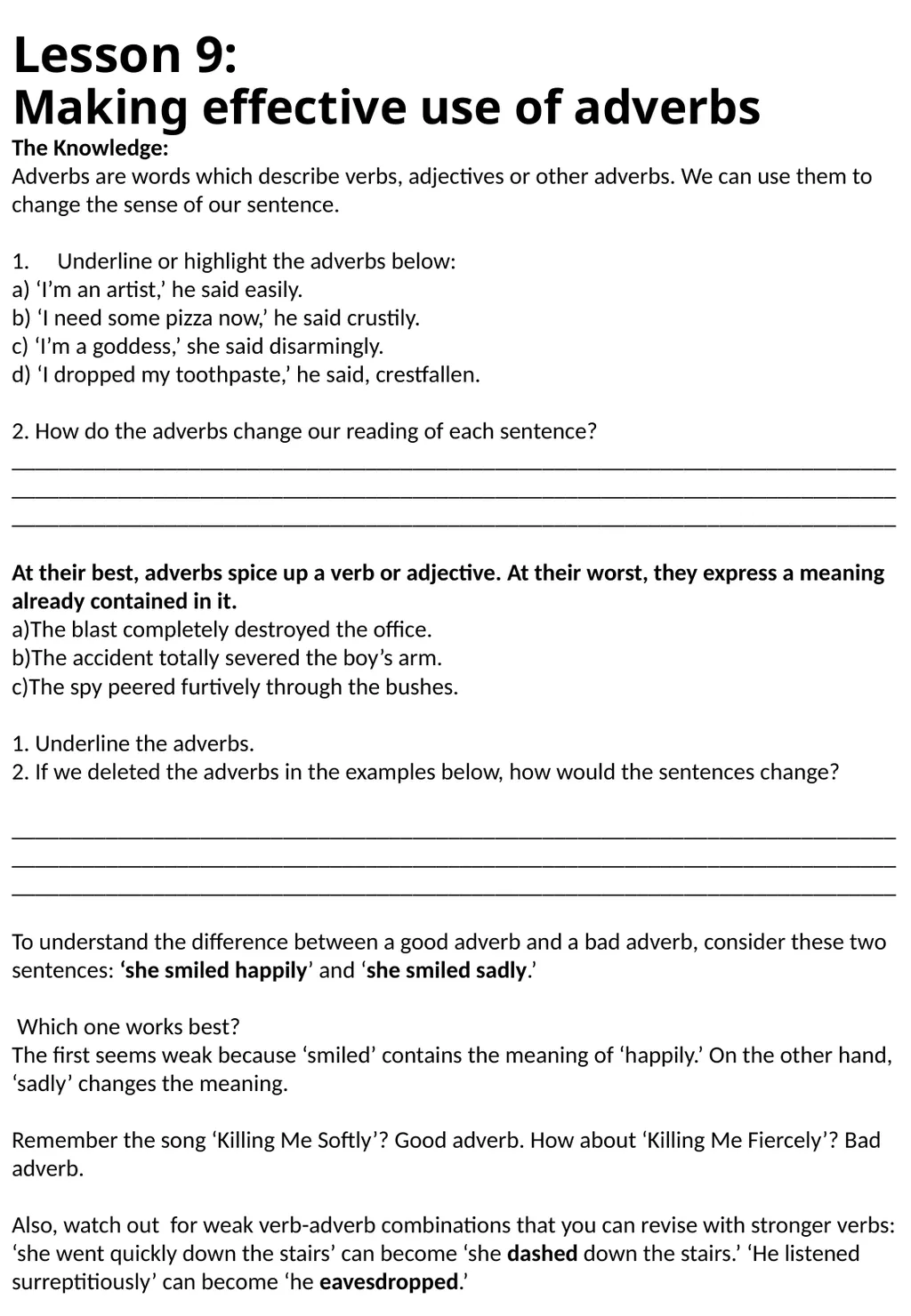
Making effective use of adverbs The Knowledge:
Adverbs are words which describe verbs, adjectives or other adverbs. We can use them to change the sense of our sentence.
Underline or highlight the adverbs below:
a) ‘I’m an artist,’ he said easily.
b) ‘I need some pizza now,’ he said crustily.
c) ‘I’m a goddess,’ she said disarmingly.
d) ‘I dropped my toothpaste,’ he said, crestfallen.
2. How do the adverbs change our reading of each sentence?
_________________________________________________________________________________________________________________________________________________________________________________________________________________________________
At their best, adverbs spice up a verb or adjective. At their worst, they express a meaning already contained in it.
a)The blast completely destroyed the office.
b)The accident totally severed the boy’s arm.
c)The spy peered furtively through the bushes.
1. Underline the adverbs.
2. If we deleted the adverbs in the examples below, how would the sentences change?
_________________________________________________________________________________________________________________________________________________________________________________________________________________________________
To understand the difference between a good adverb and a bad adverb, consider these two sentences: ‘she smiled happily’ and ‘she smiled sadly.’
Which one works best?
The first seems weak because ‘smiled’ contains the meaning of ‘happily.’ On the other hand, ‘sadly’ changes the meaning.
Remember the song ‘Killing Me Softly’? Good adverb. How about ‘Killing Me Fiercely’? Bad adverb.
Also, watch out for weak verb-adverb combinations that you can revise with stronger verbs: ‘she went quickly down the stairs’ can become ‘she dashed down the stairs.’ ‘He listened surreptitiously’ can become ‘he eavesdropped.’<br>
Adverbs are words which describe verbs, adjectives or other adverbs. We can use them to change the sense of our sentence.
Underline or highlight the adverbs below:
a) ‘I’m an artist,’ he said easily.
b) ‘I need some pizza now,’ he said crustily.
c) ‘I’m a goddess,’ she said disarmingly.
d) ‘I dropped my toothpaste,’ he said, crestfallen.
2. How do the adverbs change our reading of each sentence?
_________________________________________________________________________________________________________________________________________________________________________________________________________________________________
At their best, adverbs spice up a verb or adjective. At their worst, they express a meaning already contained in it.
a)The blast completely destroyed the office.
b)The accident totally severed the boy’s arm.
c)The spy peered furtively through the bushes.
1. Underline the adverbs.
2. If we deleted the adverbs in the examples below, how would the sentences change?
_________________________________________________________________________________________________________________________________________________________________________________________________________________________________
To understand the difference between a good adverb and a bad adverb, consider these two sentences: ‘she smiled happily’ and ‘she smiled sadly.’
Which one works best?
The first seems weak because ‘smiled’ contains the meaning of ‘happily.’ On the other hand, ‘sadly’ changes the meaning.
Remember the song ‘Killing Me Softly’? Good adverb. How about ‘Killing Me Fiercely’? Bad adverb.
Also, watch out for weak verb-adverb combinations that you can revise with stronger verbs: ‘she went quickly down the stairs’ can become ‘she dashed down the stairs.’ ‘He listened surreptitiously’ can become ‘he eavesdropped.’<br>
35
Task: For each sentence, rewrite it three times, adding a different adverb each time to change the meaning of the verb. Aim to create a different tone each time, eg happy, sad, exasperated…
Extended writing:
Here is an event. Describe it as if you were writing a story telling what happened, in your exercise book.
Remember to:
a)Think carefully about which words you begin and end your sentences with.
b)Use adverbs sparingly to change the meaning of verbs.
What happens:
1.A man or woman is waiting for a bus.
2.They see someone they have not seen in many years.
3.They have a brief conversation.
4.They get on the bus.
5.On the bus, they think back to a happy or sad memory shared with that person.<br>
Extended writing:
Here is an event. Describe it as if you were writing a story telling what happened, in your exercise book.
Remember to:
a)Think carefully about which words you begin and end your sentences with.
b)Use adverbs sparingly to change the meaning of verbs.
What happens:
1.A man or woman is waiting for a bus.
2.They see someone they have not seen in many years.
3.They have a brief conversation.
4.They get on the bus.
5.On the bus, they think back to a happy or sad memory shared with that person.<br>
36
Lesson 10:
Using punctuation effectively: rules and impact The Knowledge:
‘Punctuation’ comes from the Latin root ‘punctus,’ or ‘point.’ Those funny dots, lines and squiggles help writers point the way. To help readers, we punctuate for two reasons:
1.To set the pace of reading
2.To divide words, phrases, and ideas into convenient groupings.
Read this information about the use of punctuation by English teacher Jo Facer.
You will punctuate with power and purpose when you begin to consider pace and space. Think of a long, well-written sentence with no punctuation except the full stop. Such a sentence is a straight road with a stop sign at the end. The full-stop is the stop sign. Now think of a winding road with lots of stop signs. That analogy describes a paragraph with a lot of full-stops, an effect that will slow the pace of the story. The writer may desire such a pace for strategic reasons: to achieve clarity, convey emotion, or create suspense.
If a full-stop is a stop sign, then what kind of traffic is created by other marks? The comma is a speed bump; brackets are a detour; the colon is a flashing amber light that announces something important up ahead; the dash is a tree branch in the road. A well-placed comma points to where the writer would pause if he read the passage aloud. The semicolon is most useful for dividing and organising big chunks of information. Parentheses (brackets) introduce a play within a play. Like a detour sign in the middle of a street, they require the driver to manoeuver around to regain the original direction. Parenthetical expressions are best kept short. The dash has two uses: a pair of dashes can set off an idea contained within a sentence, and a dash near the end can deliver a punch line. That leaves the colon, and here’s what it does: it announces a word, phrase, or clause the way a trumpet flourish in in a Shakespeare play sounds the arrival of a royal procession.
Task: remind yourself of the function of each of these pieces of punctuation.<br>
‘Punctuation’ comes from the Latin root ‘punctus,’ or ‘point.’ Those funny dots, lines and squiggles help writers point the way. To help readers, we punctuate for two reasons:
1.To set the pace of reading
2.To divide words, phrases, and ideas into convenient groupings.
Read this information about the use of punctuation by English teacher Jo Facer.
You will punctuate with power and purpose when you begin to consider pace and space. Think of a long, well-written sentence with no punctuation except the full stop. Such a sentence is a straight road with a stop sign at the end. The full-stop is the stop sign. Now think of a winding road with lots of stop signs. That analogy describes a paragraph with a lot of full-stops, an effect that will slow the pace of the story. The writer may desire such a pace for strategic reasons: to achieve clarity, convey emotion, or create suspense.
If a full-stop is a stop sign, then what kind of traffic is created by other marks? The comma is a speed bump; brackets are a detour; the colon is a flashing amber light that announces something important up ahead; the dash is a tree branch in the road. A well-placed comma points to where the writer would pause if he read the passage aloud. The semicolon is most useful for dividing and organising big chunks of information. Parentheses (brackets) introduce a play within a play. Like a detour sign in the middle of a street, they require the driver to manoeuver around to regain the original direction. Parenthetical expressions are best kept short. The dash has two uses: a pair of dashes can set off an idea contained within a sentence, and a dash near the end can deliver a punch line. That leaves the colon, and here’s what it does: it announces a word, phrase, or clause the way a trumpet flourish in in a Shakespeare play sounds the arrival of a royal procession.
Task: remind yourself of the function of each of these pieces of punctuation.<br>
37
Task: Time to edit
Read the passage below and write it out with different punctuation.
When it comes to punctuation, all writers develop habits that enhance their styles. Mine include wearing out the comma and using more full stops than average. I overuse the colon. I write an exclamation with enough force to avoid the weedy appendage of an exclamation mark.
________________________________________________________________________________________________________________________________________________________________________________________________________________________________________________________________________________________________________________________________________________________________________________________________________________________________________________________________________________________________________________________________________________________________________________________________________________________
Extended writing:
Here is an event. Describe it as if you were writing a story telling what happened.
Remember to:
Use adverbs sparingly to change the meaning of verbs.
Choose your punctuation carefully. Aim to include at least the 5 from the previous page
What happens:
The chair has feelings, but we humans don’t know this.
The chair tells us about when it was first made.
The chair remembers someone who once sat on it who made it proud.
The chair talks about who currently sits on it.
The chair shares its hopes for the future.
If you would rather choose your own object, ask your teacher.
When you have completed this, you will be peer-assessing what you have written. Your teacher may put your work on the visualiser.<br>
Read the passage below and write it out with different punctuation.
When it comes to punctuation, all writers develop habits that enhance their styles. Mine include wearing out the comma and using more full stops than average. I overuse the colon. I write an exclamation with enough force to avoid the weedy appendage of an exclamation mark.
________________________________________________________________________________________________________________________________________________________________________________________________________________________________________________________________________________________________________________________________________________________________________________________________________________________________________________________________________________________________________________________________________________________________________________________________________________________
Extended writing:
Here is an event. Describe it as if you were writing a story telling what happened.
Remember to:
Use adverbs sparingly to change the meaning of verbs.
Choose your punctuation carefully. Aim to include at least the 5 from the previous page
What happens:
The chair has feelings, but we humans don’t know this.
The chair tells us about when it was first made.
The chair remembers someone who once sat on it who made it proud.
The chair talks about who currently sits on it.
The chair shares its hopes for the future.
If you would rather choose your own object, ask your teacher.
When you have completed this, you will be peer-assessing what you have written. Your teacher may put your work on the visualiser.<br>
38
Lesson 11:
Adding detail: Get the name of the dog. The Knowledge:
Novelist Joseph Conrad once described his task this way: ‘by the power of the written word to make you hear, to make you feel – it is, before all, to make you see.’ When details of character and setting appeal to the senses, they create an experience for the reader that leads to understanding. When we say ‘I see,’ we most often mean ‘I understand.’ At the St. Petersburg Times, editors warn reporters not to return to the office without ‘the name of the dog.’ This reminds the reporter to keep their eyes and ears opened. When Kelley Benham wrote a story about a ferocious rooster that attacked a toddler, she not only got the name of the rooster (Rockadoodle Two), but also the names of his parents (Rockadoodle and one-legged Henny Penny).
Before the execution of a serial killer, reporter Christopher Scanlan flew to Utah in the USA to visit the family of one of the murderer’s presumed victims. Eleven years earlier, a young woman left her house and never returned. Scanlan found the detail that told the story of the family’s enduring grief. He noticed a piece of tape over the light switch next to the front door:
Belva Kent always left the front porch light on when her children went out at night. Whoever came home last turned it off, until one day in 1974 when Mrs. Kent told her family: ‘I’m going to leave that light on until Deb comes home and she can turn it off.’
The Kents’ porch light still burns today, night and day. Just inside the front door, a strip of tape covers the switch. Deb never came home.
Here’s the key: Scanlan saw the taped-over switch and asked about it. His curiosity, not his imagination, captured the great detail. By using specific concrete details, we can all make our writing much sharper.
Task: In your exercise books
1.Write a list of objects – as many as you can in 2 minutes.
2. Now, beside as many as you can, add a detail about the object – colour, size, shape, age.. (2 minutes).
3.Choose one object. Why is it important? What story could have that object at its core?
Now, tell the story that hinges on your object. Remember to include specific, concrete details.
After you have finished writing, your neighbour will assess your work for how you have included detail. What does this add to the story?<br>
Novelist Joseph Conrad once described his task this way: ‘by the power of the written word to make you hear, to make you feel – it is, before all, to make you see.’ When details of character and setting appeal to the senses, they create an experience for the reader that leads to understanding. When we say ‘I see,’ we most often mean ‘I understand.’ At the St. Petersburg Times, editors warn reporters not to return to the office without ‘the name of the dog.’ This reminds the reporter to keep their eyes and ears opened. When Kelley Benham wrote a story about a ferocious rooster that attacked a toddler, she not only got the name of the rooster (Rockadoodle Two), but also the names of his parents (Rockadoodle and one-legged Henny Penny).
Before the execution of a serial killer, reporter Christopher Scanlan flew to Utah in the USA to visit the family of one of the murderer’s presumed victims. Eleven years earlier, a young woman left her house and never returned. Scanlan found the detail that told the story of the family’s enduring grief. He noticed a piece of tape over the light switch next to the front door:
Belva Kent always left the front porch light on when her children went out at night. Whoever came home last turned it off, until one day in 1974 when Mrs. Kent told her family: ‘I’m going to leave that light on until Deb comes home and she can turn it off.’
The Kents’ porch light still burns today, night and day. Just inside the front door, a strip of tape covers the switch. Deb never came home.
Here’s the key: Scanlan saw the taped-over switch and asked about it. His curiosity, not his imagination, captured the great detail. By using specific concrete details, we can all make our writing much sharper.
Task: In your exercise books
1.Write a list of objects – as many as you can in 2 minutes.
2. Now, beside as many as you can, add a detail about the object – colour, size, shape, age.. (2 minutes).
3.Choose one object. Why is it important? What story could have that object at its core?
Now, tell the story that hinges on your object. Remember to include specific, concrete details.
After you have finished writing, your neighbour will assess your work for how you have included detail. What does this add to the story?<br>
39
Lesson 12:
Planning the ending – a twist. The Knowledge:
You need to plan the end of your story for several reasons: so it doesn’t just peter out; so you fit the conventions of Freytag’s pyramid (the examiner will be looking for this); so you leave the reader with questions in their mind… remember, the examiner will read hundreds of stories, and you need yours to stand out!
Let’s look at a couple of examples. Pay particular attention to the endings.
1.How do they leave the reader satisfied, yet with questions to ask?
2.How do they link to the confession or conversation the passenger had with the driver?
This is a tricky balance to get right, which is why we need to practise!
Dog Days by Jodie Filford
It was a fairly unremarkable day, up until now. Impatiently waiting for the deep red light that focused his thoughts to turn green, Ted’s mood darkened. Overwhelmed with exhaustion from the monotony of his life as a taxi driver, he longed for something, anything to bring excitement into his world to waken his senses. The outline of the buildings around him, as they cast shadows in the night-time sky, were so familiar to him he felt the rage stirring up inside him. The sudden harsh sound of thunder jolted him into awareness; punishing him for his negativity.
Without warning, the car door swung open and in jumped a petite white haired lady. Her eyes startling by their blueness and frightening by their width. She tried to speak, but couldn’t – her heart beating so fast it felt ready to explode. She swallowed hard, and tried again.
“Take me to the other side of town” she rasped, as loud as she could. Her voice was hoarse and barely audible. Instinctively, Ted felt disturbed by the mere presence of this lady now perching in the back of his taxi. She looked like a fragile creature swamped in the blackness of the leather seat, but there was something so frightening in her eyes.
Once her breath caught up with her, she gathered the words and began to speak, slowly at first, and then in a remorseful tone. Despite, feeling a real sense of unease Ted tried to be as helpful as he could. Ted thought that she must have been in her early seventies - her tiny, bent up body and the paleness of her skin indicated a long and difficult life. He listened intently as the frail lady confessed to her wrongdoings.
She told Ted how she had been driving her beloved pet dog to the local vets, oblivious to the early afternoon rush of the children as they left school, chatting animatedly and not<br>
You need to plan the end of your story for several reasons: so it doesn’t just peter out; so you fit the conventions of Freytag’s pyramid (the examiner will be looking for this); so you leave the reader with questions in their mind… remember, the examiner will read hundreds of stories, and you need yours to stand out!
Let’s look at a couple of examples. Pay particular attention to the endings.
1.How do they leave the reader satisfied, yet with questions to ask?
2.How do they link to the confession or conversation the passenger had with the driver?
This is a tricky balance to get right, which is why we need to practise!
Dog Days by Jodie Filford
It was a fairly unremarkable day, up until now. Impatiently waiting for the deep red light that focused his thoughts to turn green, Ted’s mood darkened. Overwhelmed with exhaustion from the monotony of his life as a taxi driver, he longed for something, anything to bring excitement into his world to waken his senses. The outline of the buildings around him, as they cast shadows in the night-time sky, were so familiar to him he felt the rage stirring up inside him. The sudden harsh sound of thunder jolted him into awareness; punishing him for his negativity.
Without warning, the car door swung open and in jumped a petite white haired lady. Her eyes startling by their blueness and frightening by their width. She tried to speak, but couldn’t – her heart beating so fast it felt ready to explode. She swallowed hard, and tried again.
“Take me to the other side of town” she rasped, as loud as she could. Her voice was hoarse and barely audible. Instinctively, Ted felt disturbed by the mere presence of this lady now perching in the back of his taxi. She looked like a fragile creature swamped in the blackness of the leather seat, but there was something so frightening in her eyes.
Once her breath caught up with her, she gathered the words and began to speak, slowly at first, and then in a remorseful tone. Despite, feeling a real sense of unease Ted tried to be as helpful as he could. Ted thought that she must have been in her early seventies - her tiny, bent up body and the paleness of her skin indicated a long and difficult life. He listened intently as the frail lady confessed to her wrongdoings.
She told Ted how she had been driving her beloved pet dog to the local vets, oblivious to the early afternoon rush of the children as they left school, chatting animatedly and not<br>
40
really taking notice of anything or anyone surrounding them. Bobbi, her dog, had howled in pain as she went round the corner…and she had taken her eyes (only for a moment she insisted) from the road to reach out and ruffle his fur.
Then she heard a bang.
She explained to Ted how she had stopped abruptly, looking around to see what the noise could have been. She told herself she must have simply clipped the kerb; she carried on her journey. She found a parking space and hurried into the vet’s, oblivious to the drama occurring outside. Sitting very patiently in the reception area, fully absorbed in her beloved dog, her head spun to the door when she heard the wailing and screaming of someone outside.
Everything was a blur from there, she admitted. She instinctively knew that the bump she had felt in her car had something to do with the chaos outside. The sirens came screeching to a halt as she sat there and that’s when the shock took over her body, she just recalled trembling from head to toe. It appeared that a young boy had been the victim of a hit and run. He was in a critical condition.
“But- thinking about it- it couldn’t have been me. It wasn’t me. I would have noticed. So, I just left with Bobbie, and left my car there- I didn’t feel strong enough to drive…” her voice trailed off. It seemed like she had convinced herself that this couldn’t have been anything to do with her; yet her eyes told him a very different story.
Ted pulled over, and turned round to look at her- to try and convince her to go back…but she threw money down in the tray, and leapt from the cab and she disappeared down a narrow alley.
Ted’s senses seemed to be on full alert. Had this tiny women just committed a horrible crime- or was it just a coincidence? Ted’s conscience was saying he should report her to the police, but his heart was screaming she was just too innocent.
Just at that moment, when he was wrestling with his thoughts and sitting stationary, contemplating his dilemma, he spotted a bird in the path of a bike- for a moment it looked as if the bird was going to fly away- but no, the bike just plunged ahead, squashing the small body beneath its tyres.
What questions does this story leave the reader with?
_________________________________________________________________________________________________________________________________________________________________________________________________________________________________
What is the connection between the final lines and the ‘confession’?
______________________________________________________________________________________________________________________________________________________<br>
Then she heard a bang.
She explained to Ted how she had stopped abruptly, looking around to see what the noise could have been. She told herself she must have simply clipped the kerb; she carried on her journey. She found a parking space and hurried into the vet’s, oblivious to the drama occurring outside. Sitting very patiently in the reception area, fully absorbed in her beloved dog, her head spun to the door when she heard the wailing and screaming of someone outside.
Everything was a blur from there, she admitted. She instinctively knew that the bump she had felt in her car had something to do with the chaos outside. The sirens came screeching to a halt as she sat there and that’s when the shock took over her body, she just recalled trembling from head to toe. It appeared that a young boy had been the victim of a hit and run. He was in a critical condition.
“But- thinking about it- it couldn’t have been me. It wasn’t me. I would have noticed. So, I just left with Bobbie, and left my car there- I didn’t feel strong enough to drive…” her voice trailed off. It seemed like she had convinced herself that this couldn’t have been anything to do with her; yet her eyes told him a very different story.
Ted pulled over, and turned round to look at her- to try and convince her to go back…but she threw money down in the tray, and leapt from the cab and she disappeared down a narrow alley.
Ted’s senses seemed to be on full alert. Had this tiny women just committed a horrible crime- or was it just a coincidence? Ted’s conscience was saying he should report her to the police, but his heart was screaming she was just too innocent.
Just at that moment, when he was wrestling with his thoughts and sitting stationary, contemplating his dilemma, he spotted a bird in the path of a bike- for a moment it looked as if the bird was going to fly away- but no, the bike just plunged ahead, squashing the small body beneath its tyres.
What questions does this story leave the reader with?
_________________________________________________________________________________________________________________________________________________________________________________________________________________________________
What is the connection between the final lines and the ‘confession’?
______________________________________________________________________________________________________________________________________________________<br>
41
Numbers by Owen Spence
Above in the dark late evening sky, fluorescent street lights gave off an incandescent yellow glow. Beneath on the roads, there was barely any traffic. A lone car passed every now and then, but apart from that, it was empty. One taxi made its way quickly back to the station rank- the lack of other cars meant it wasn’t held up. Its driver was a young woman- with brown soft hair that fell in crazy, careless, curls. She wore a bobble hat to protect herself from the chilly temperatures- the car heater had been broken for weeks. Her black fluffy coat had the collar turned up to keep warm. It felt as if time had flown- the shift had passed quickly. Which was good, because all Katrina wanted was to get home. Home. Home that was warm. Home that had Harry- her beloved dog, and two sleeping children.
A man climbed in the back of the cab- he was slow in his movements. He had a pauper like appearance: his face was unshaven, with a shaggy beard; a moth eaten coat, with two buttons missing; on his feet were trainers with holes, and one flapping sole. Katrina eyed him carefully in the rearview mirror and thought to herself ‘I hope he’s going to pay for this journey- not like the last one’.
As Katrina pulled away, the lucent beam from her headlights swung an arc across the road. A scrawny cat was chasing a moth or piece of discarded litter.
“24 hour Tesco on Shoesbury Lane, please.” He shot her a beaming smile.
Katrina asked him politely about his day.
“It’s been a winning evening!” he said with a knowing smile.
“Yeah?” Katrina found this guy’s good mood hard to believe, given the state of the guy’s clothes.
“I got the golden number!” he sat back smugly smiling, like a cat sunning itself on a deck. Katrina raised her eyebrows in a question. “I gambled my very last pennies…and I bloody won! Twelve point five million pounds!” Katrina’s mouth dropped open in shock; she wondered how true this could be.
The taxi pulled up outside the supermarket- there was hardly anyone about- and the streetlights beamed down onto an empty pavement.
“That’s twelve pounds, please.” Katrina held her breath as the man rummaged in his pockets. He pulled out a piece of paper and a chewed old pencil, and then scrawled hastily on it before passing it to her.
Katrina’s face fell as she read the feeble IOU.
“Ah come on mate, I have a family to feed,” Katrina exclaimed. “I’m sorry, I’m good for it I promise,” he replied. Before Katrina could say anything else the man scarpered out the taxi. Katrina sighed, another runner in the same night. She was too soft, but it’s difficult to confront someone when you are a woman alone working in the middle of the night. She thought of her two kids tucked up in bed and all the bills that she had to pay since her husband left them. She felt numb.<br>
Above in the dark late evening sky, fluorescent street lights gave off an incandescent yellow glow. Beneath on the roads, there was barely any traffic. A lone car passed every now and then, but apart from that, it was empty. One taxi made its way quickly back to the station rank- the lack of other cars meant it wasn’t held up. Its driver was a young woman- with brown soft hair that fell in crazy, careless, curls. She wore a bobble hat to protect herself from the chilly temperatures- the car heater had been broken for weeks. Her black fluffy coat had the collar turned up to keep warm. It felt as if time had flown- the shift had passed quickly. Which was good, because all Katrina wanted was to get home. Home. Home that was warm. Home that had Harry- her beloved dog, and two sleeping children.
A man climbed in the back of the cab- he was slow in his movements. He had a pauper like appearance: his face was unshaven, with a shaggy beard; a moth eaten coat, with two buttons missing; on his feet were trainers with holes, and one flapping sole. Katrina eyed him carefully in the rearview mirror and thought to herself ‘I hope he’s going to pay for this journey- not like the last one’.
As Katrina pulled away, the lucent beam from her headlights swung an arc across the road. A scrawny cat was chasing a moth or piece of discarded litter.
“24 hour Tesco on Shoesbury Lane, please.” He shot her a beaming smile.
Katrina asked him politely about his day.
“It’s been a winning evening!” he said with a knowing smile.
“Yeah?” Katrina found this guy’s good mood hard to believe, given the state of the guy’s clothes.
“I got the golden number!” he sat back smugly smiling, like a cat sunning itself on a deck. Katrina raised her eyebrows in a question. “I gambled my very last pennies…and I bloody won! Twelve point five million pounds!” Katrina’s mouth dropped open in shock; she wondered how true this could be.
The taxi pulled up outside the supermarket- there was hardly anyone about- and the streetlights beamed down onto an empty pavement.
“That’s twelve pounds, please.” Katrina held her breath as the man rummaged in his pockets. He pulled out a piece of paper and a chewed old pencil, and then scrawled hastily on it before passing it to her.
Katrina’s face fell as she read the feeble IOU.
“Ah come on mate, I have a family to feed,” Katrina exclaimed. “I’m sorry, I’m good for it I promise,” he replied. Before Katrina could say anything else the man scarpered out the taxi. Katrina sighed, another runner in the same night. She was too soft, but it’s difficult to confront someone when you are a woman alone working in the middle of the night. She thought of her two kids tucked up in bed and all the bills that she had to pay since her husband left them. She felt numb.<br>
42
As she pulled away, another piece of litter caught in the shimmer of her headlights. For some reason she stopped, got out and picked it up. She gasped, it was a lottery ticket. She frantically checked her phone for the winning numbers. It was the winning ticket! The next challenge for Katrina would be with her conscience…
What questions does this story leave the reader with?
___________________________________________________________________________________________________________________________________________________________________________________________________________________________
What is the connection between the final lines and the ‘confession’?
___________________________________________________________________________________________________________________________________________________________________________________________________________________________
Now think back to your chosen character: what connection are you going to make after the passenger has left the taxi?<br>
What questions does this story leave the reader with?
___________________________________________________________________________________________________________________________________________________________________________________________________________________________
What is the connection between the final lines and the ‘confession’?
___________________________________________________________________________________________________________________________________________________________________________________________________________________________
Now think back to your chosen character: what connection are you going to make after the passenger has left the taxi?<br>
43
Lesson 13:
Plotting your Taxi Tale effectively The knowledge:
Going into Paper 1 Q5 prepared with a story which you can then adapt is going to free up your mind and ease your exam nerves. That means you need to have the direction of your story clear in your mind before you go in.
On the following pages you’re going to look at an excellent example (you’ve seen this before), broken down into the sections you’ll need to practise. The example is also helpfully annotated with things the writer has included which has gained them marks!
Then, there is a blank version for you to plot out your own ideas, drawing on everything you have learned in this unit.<br>
Going into Paper 1 Q5 prepared with a story which you can then adapt is going to free up your mind and ease your exam nerves. That means you need to have the direction of your story clear in your mind before you go in.
On the following pages you’re going to look at an excellent example (you’ve seen this before), broken down into the sections you’ll need to practise. The example is also helpfully annotated with things the writer has included which has gained them marks!
Then, there is a blank version for you to plot out your own ideas, drawing on everything you have learned in this unit.<br>
44
Section B: Question 5 (40 marker) Top of the Mark Scheme for AO5 Top of the Mark Scheme for AO6 44<br>
45
Lesson 14:
Taxi Tales assessment Reminder: what were your key pieces of feedback from your Diagnostic task?
________________________________________________________________________________________________________________________________________________________________________________________________________________
What else do you, personally, need to be aware of to improve your grade from your Diagnostic task?
________________________________________________________________________________________________________________________________________________________________________________________________________________
Final assessment: 45 minutes. Good luck!<br>
Taxi Tales assessment Reminder: what were your key pieces of feedback from your Diagnostic task?
________________________________________________________________________________________________________________________________________________________________________________________________________________
What else do you, personally, need to be aware of to improve your grade from your Diagnostic task?
________________________________________________________________________________________________________________________________________________________________________________________________________________
Final assessment: 45 minutes. Good luck!<br>