
General Ledger Training Cloud Ellucian Colleague


Description: General Ledger Training Cloud Ellucian Colleague Updated November 2019 Table of Contents Accounting System: Ellucian Colleague Chart of Accounts GL Inquiry in Colleague (ACBL, AHST) Online Repository Reports (GL0010, GL0210) GL Reports in
Related Topics
Download Presentation
"General Ledger Training Cloud Ellucian Colleague" is the property of its rightful owner. Permission is granted to download and print the materials on this website for personal, non-commercial use only, and to display it on your personal computer provided you do not modify the materials and that you retain all copyright notices contained in the materials. By downloading content from our website, you accept the terms of this agreement.
Presentation Transcript
slide1. General Ledger Training Cloud Ellucian Colleague
Updated November 2019<br>
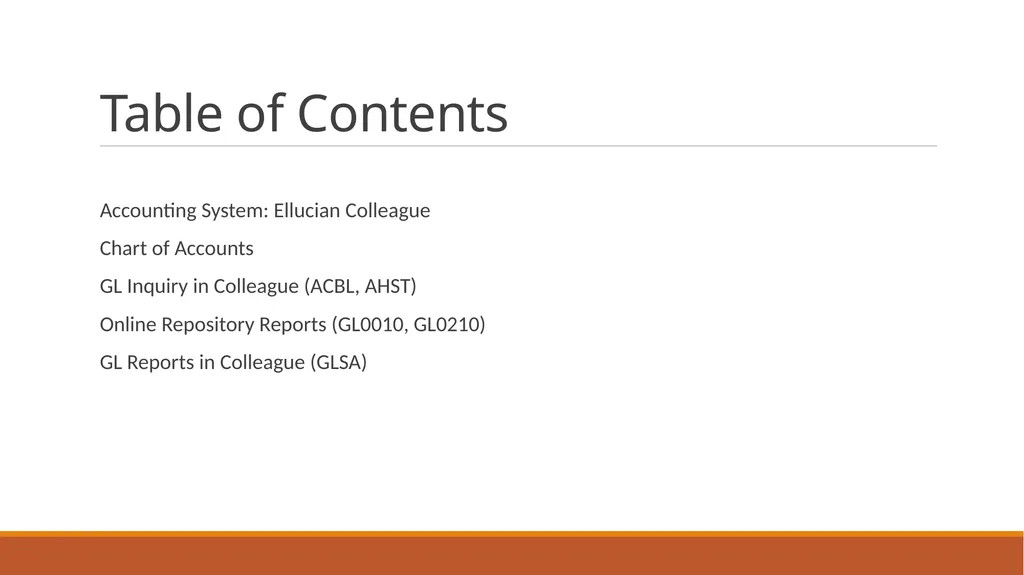
slide2. Table of Contents Accounting System: Ellucian Colleague
Chart of Accounts
GL Inquiry in Colleague (ACBL, AHST)
Online Repository Reports (GL0010, GL0210)
GL Reports in Colleague (GLSA)<br>
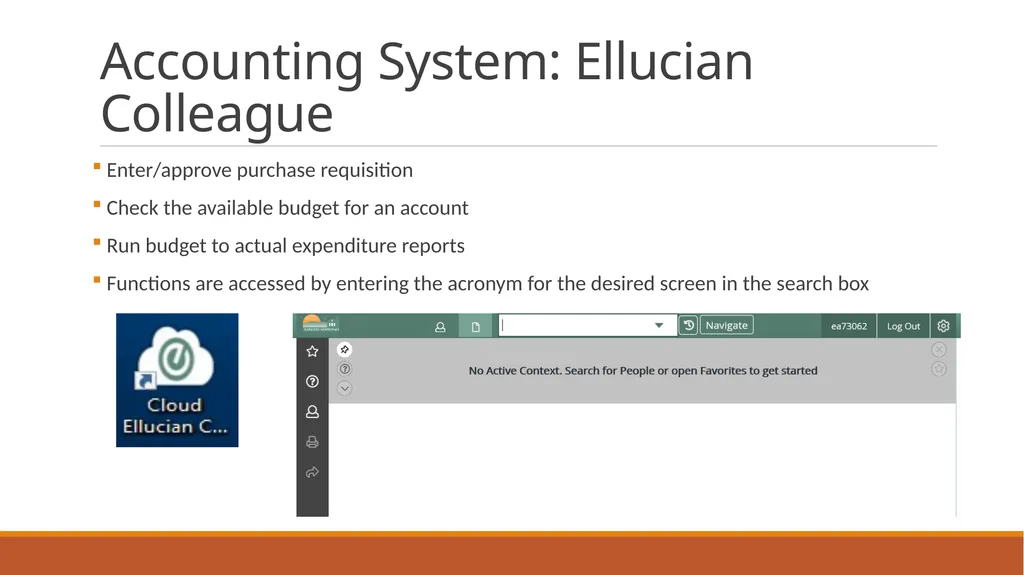
slide3. Accounting System: Ellucian Colleague Enter/approve purchase requisition
Check the available budget for an account
Run budget to actual expenditure reports
Functions are accessed by entering the acronym for the desired screen in the search box<br>
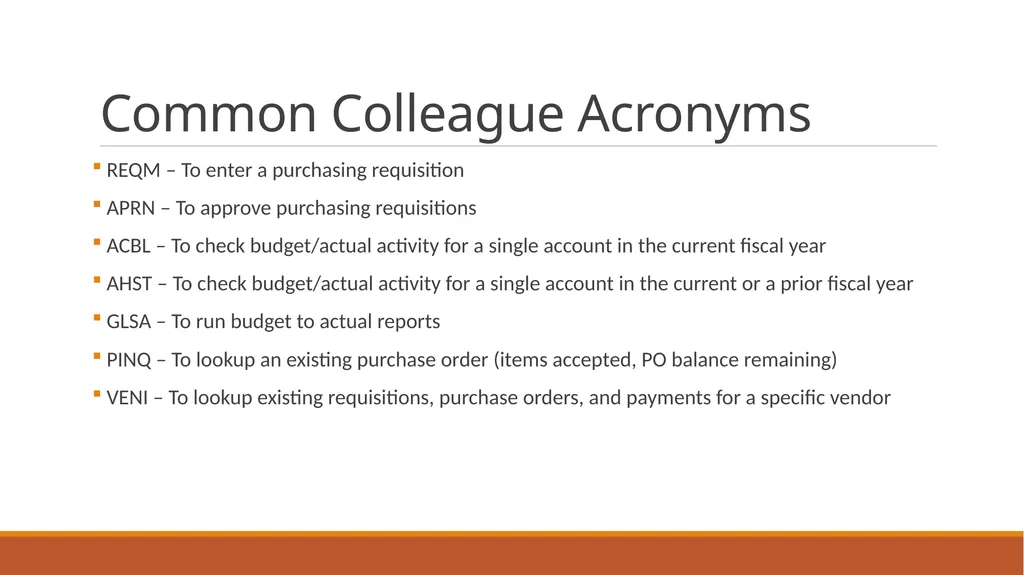
slide4. Common Colleague Acronyms REQM – To enter a purchasing requisition
APRN – To approve purchasing requisitions
ACBL – To check budget/actual activity for a single account in the current fiscal year
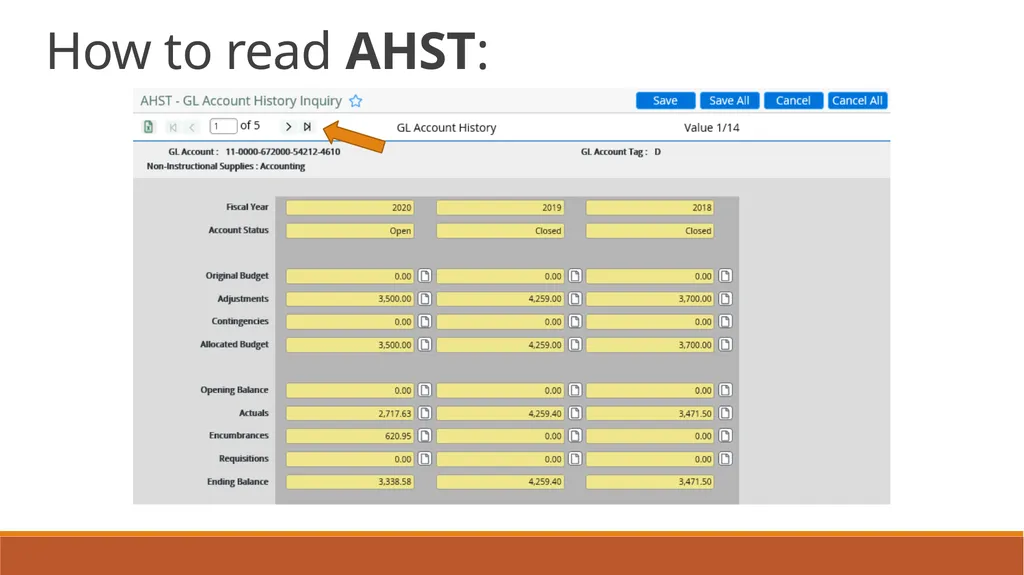
AHST – To check budget/actual activity for a single account in the current or a prior fiscal year
GLSA – To run budget to actual reports
PINQ – To lookup an existing purchase order (items accepted, PO balance remaining)
VENI – To lookup existing requisitions, purchase orders, and payments for a specific vendor<br>
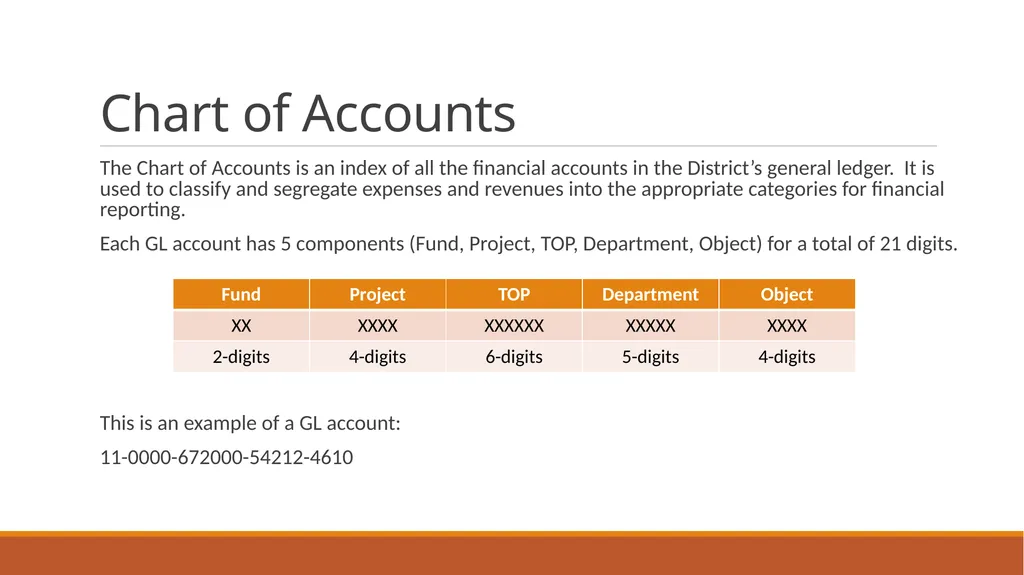
slide5. Chart of Accounts The Chart of Accounts is an index of all the financial accounts in the District’s general ledger. It is used to classify and segregate expenses and revenues into the appropriate categories for financial reporting.
Each GL account has 5 components (Fund, Project, TOP, Department, Object) for a total of 21 digits.
This is an example of a GL account:
11-0000-672000-54212-4610<br>
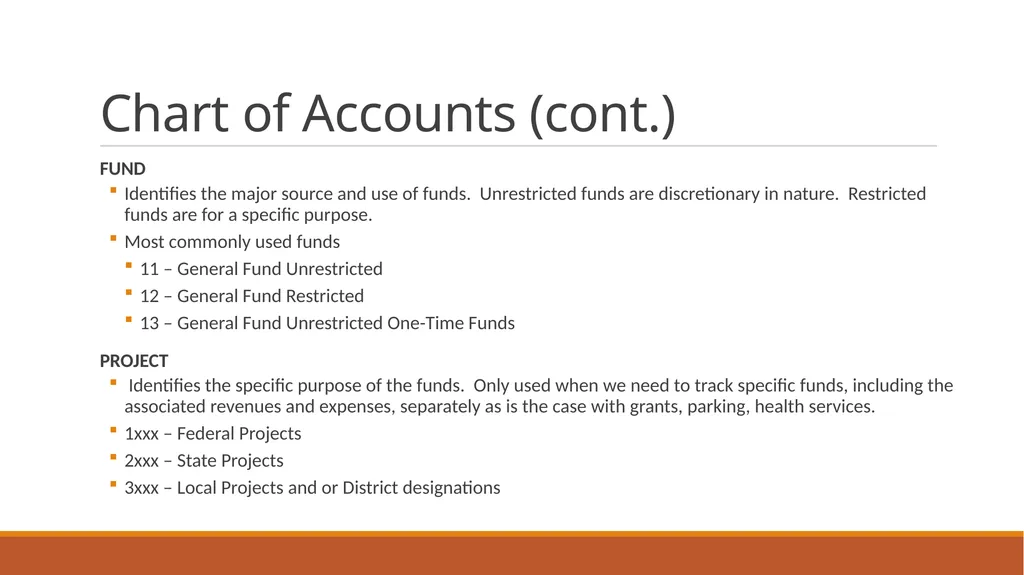
slide6. Chart of Accounts (cont.) FUND
Identifies the major source and use of funds. Unrestricted funds are discretionary in nature. Restricted funds are for a specific purpose.
Most commonly used funds
11 – General Fund Unrestricted
12 – General Fund Restricted
13 – General Fund Unrestricted One-Time Funds
PROJECT
Identifies the specific purpose of the funds. Only used when we need to track specific funds, including the associated revenues and expenses, separately as is the case with grants, parking, health services.
1xxx – Federal Projects
2xxx – State Projects
3xxx – Local Projects and or District designations<br>
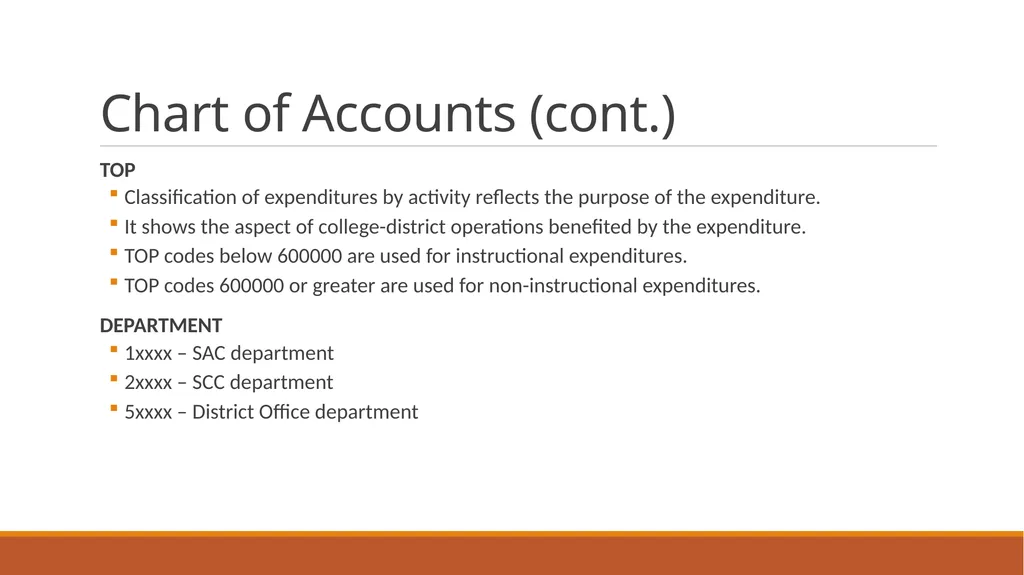
slide7. Chart of Accounts (cont.) TOP
Classification of expenditures by activity reflects the purpose of the expenditure.
It shows the aspect of college-district operations benefited by the expenditure.
TOP codes below 600000 are used for instructional expenditures.
TOP codes 600000 or greater are used for non-instructional expenditures.
DEPARTMENT
1xxxx – SAC department
2xxxx – SCC department
5xxxx – District Office department<br>
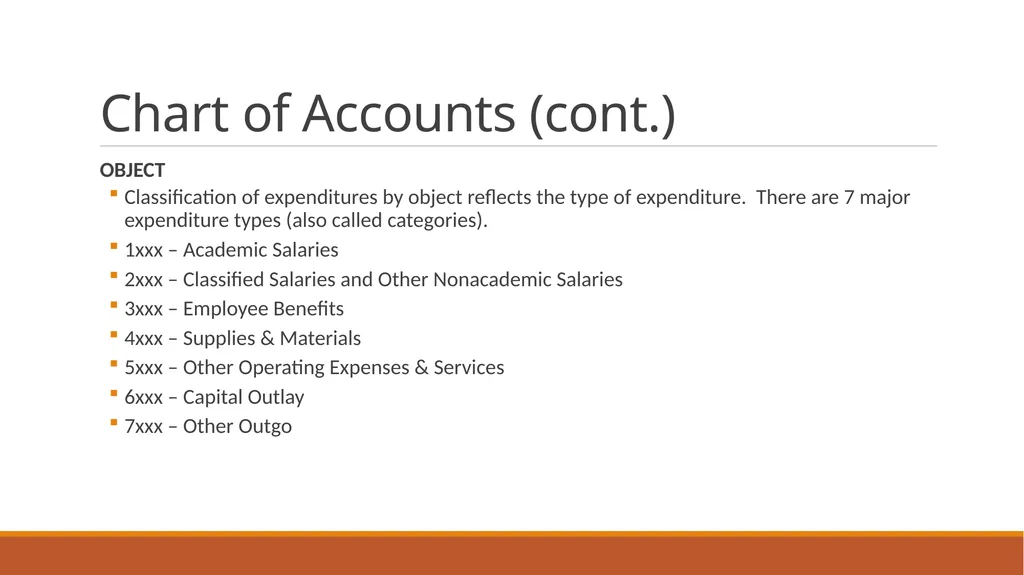
slide8. Chart of Accounts (cont.) OBJECT
Classification of expenditures by object reflects the type of expenditure. There are 7 major expenditure types (also called categories).
1xxx – Academic Salaries
2xxx – Classified Salaries and Other Nonacademic Salaries
3xxx – Employee Benefits
4xxx – Supplies & Materials
5xxx – Other Operating Expenses & Services
6xxx – Capital Outlay
7xxx – Other Outgo<br>
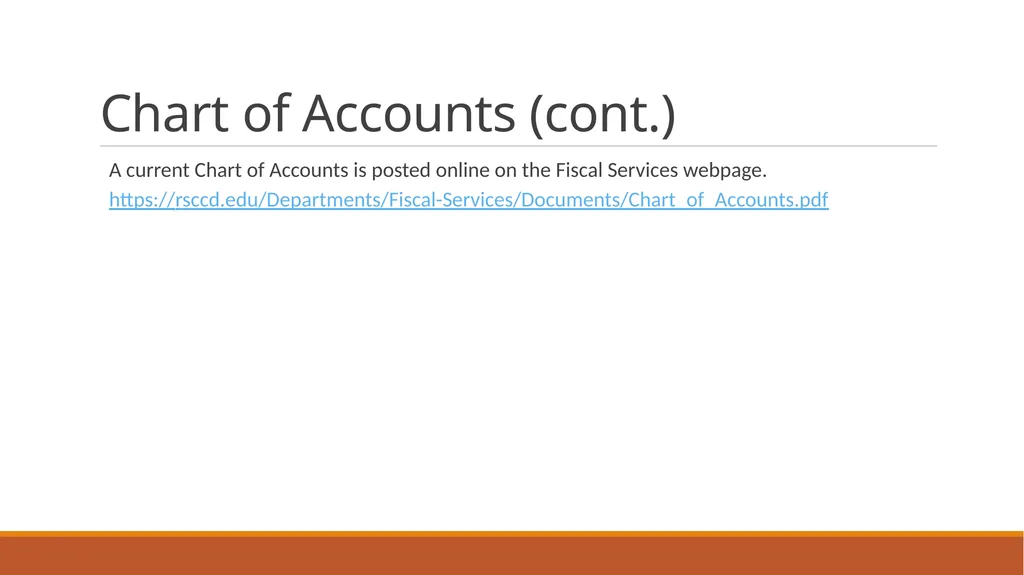
slide9. Chart of Accounts (cont.) A current Chart of Accounts is posted online on the Fiscal Services webpage.
https://rsccd.edu/Departments/Fiscal-Services/Documents/Chart_of_Accounts.pdf<br>
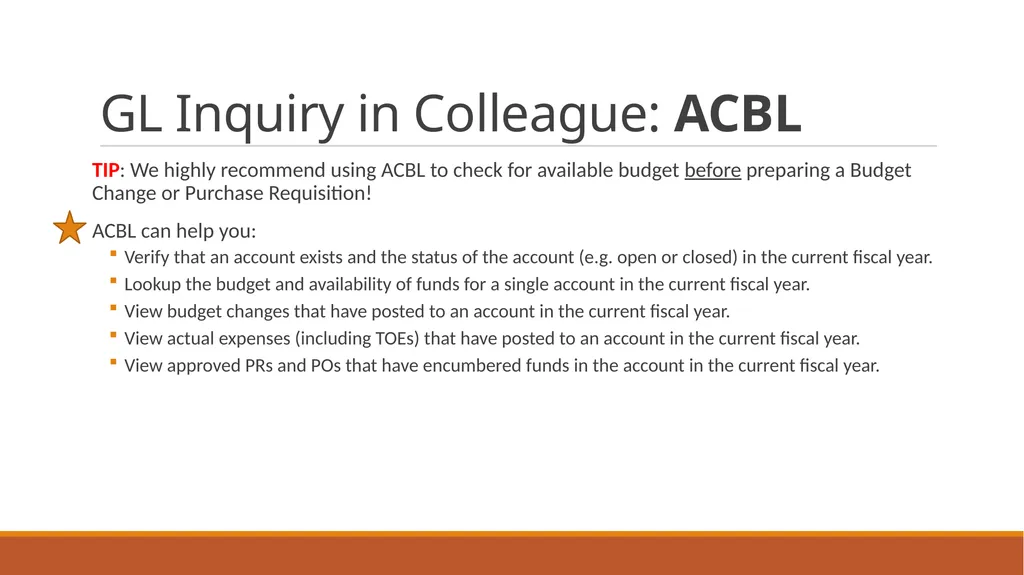
slide10. GL Inquiry in Colleague: ACBL TIP: We highly recommend using ACBL to check for available budget before preparing a Budget Change or Purchase Requisition!
ACBL can help you:
Verify that an account exists and the status of the account (e.g. open or closed) in the current fiscal year.
Lookup the budget and availability of funds for a single account in the current fiscal year.
View budget changes that have posted to an account in the current fiscal year.
View actual expenses (including TOEs) that have posted to an account in the current fiscal year.
View approved PRs and POs that have encumbered funds in the account in the current fiscal year.<br>
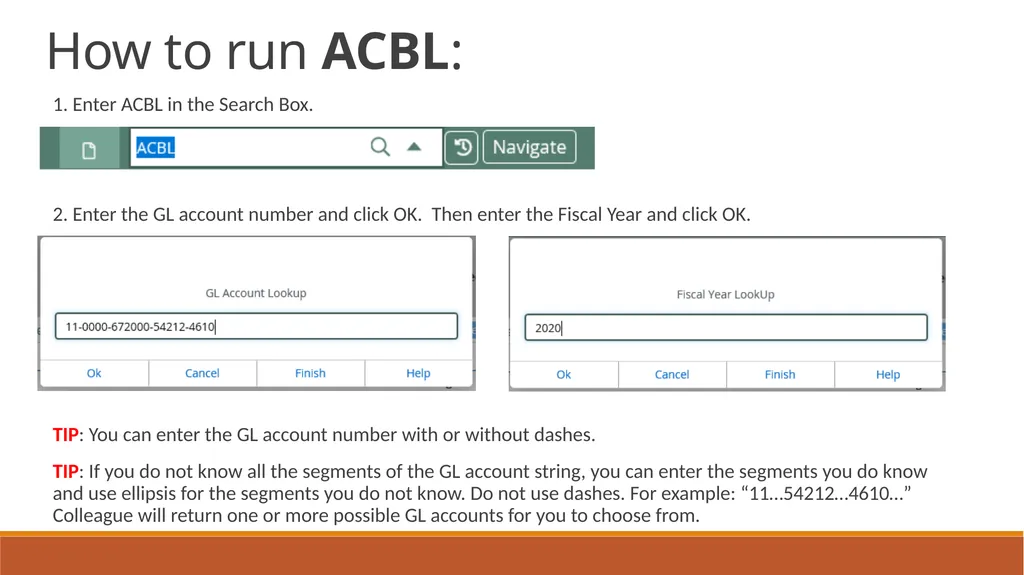
slide11. How to run ACBL: 1. Enter ACBL in the Search Box.
2. Enter the GL account number and click OK. Then enter the Fiscal Year and click OK.
TIP: You can enter the GL account number with or without dashes.
TIP: If you do not know all the segments of the GL account string, you can enter the segments you do know and use ellipsis for the segments you do not know. Do not use dashes. For example: “11…54212…4610…” Colleague will return one or more possible GL accounts for you to choose from.<br>
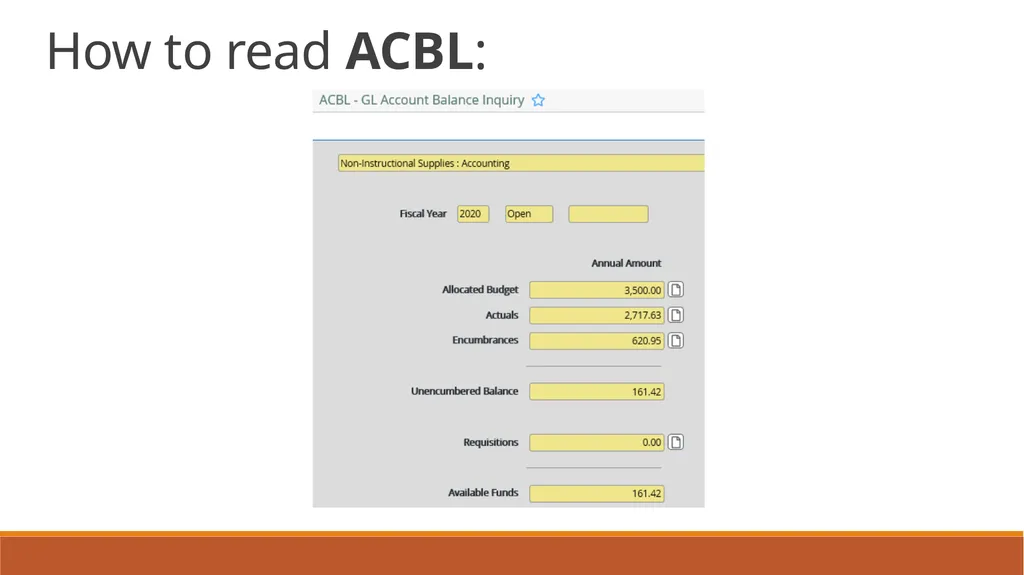
slide12. How to read ACBL:<br>
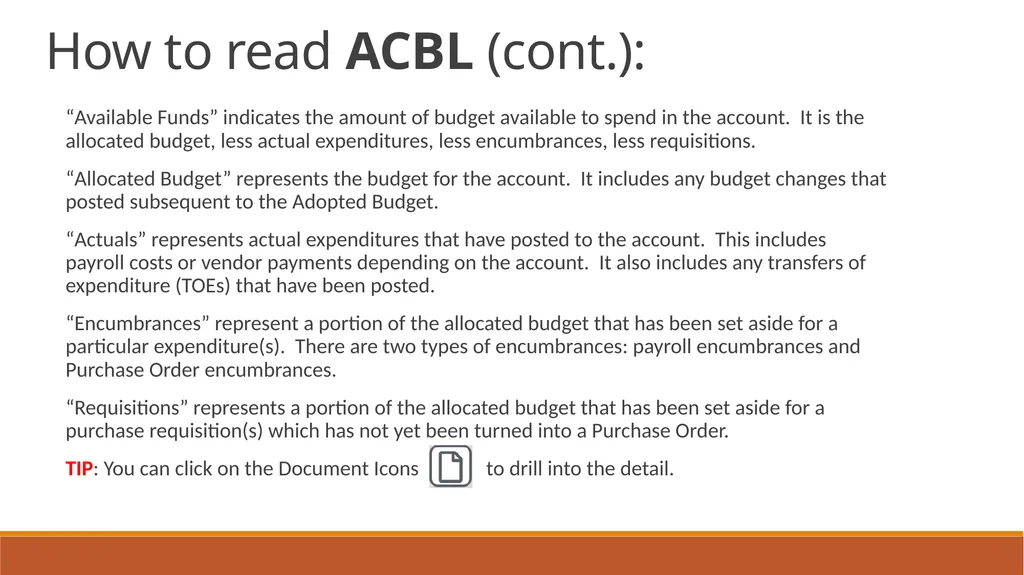
slide13. How to read ACBL (cont.): “Available Funds” indicates the amount of budget available to spend in the account. It is the allocated budget, less actual expenditures, less encumbrances, less requisitions.
“Allocated Budget” represents the budget for the account. It includes any budget changes that posted subsequent to the Adopted Budget.
“Actuals” represents actual expenditures that have posted to the account. This includes payroll costs or vendor payments depending on the account. It also includes any transfers of expenditure (TOEs) that have been posted.
“Encumbrances” represent a portion of the allocated budget that has been set aside for a particular expenditure(s). There are two types of encumbrances: payroll encumbrances and Purchase Order encumbrances.
“Requisitions” represents a portion of the allocated budget that has been set aside for a purchase requisition(s) which has not yet been turned into a Purchase Order.
TIP: You can click on the Document Icons to drill into the detail.<br>
slide14. GL Inquiry in Colleague: AHST AHST can help you:
Lookup the budget and budget changes for a single account in a prior year.
View actual expenses (including TOEs) that posted to an account in a prior year.<br>
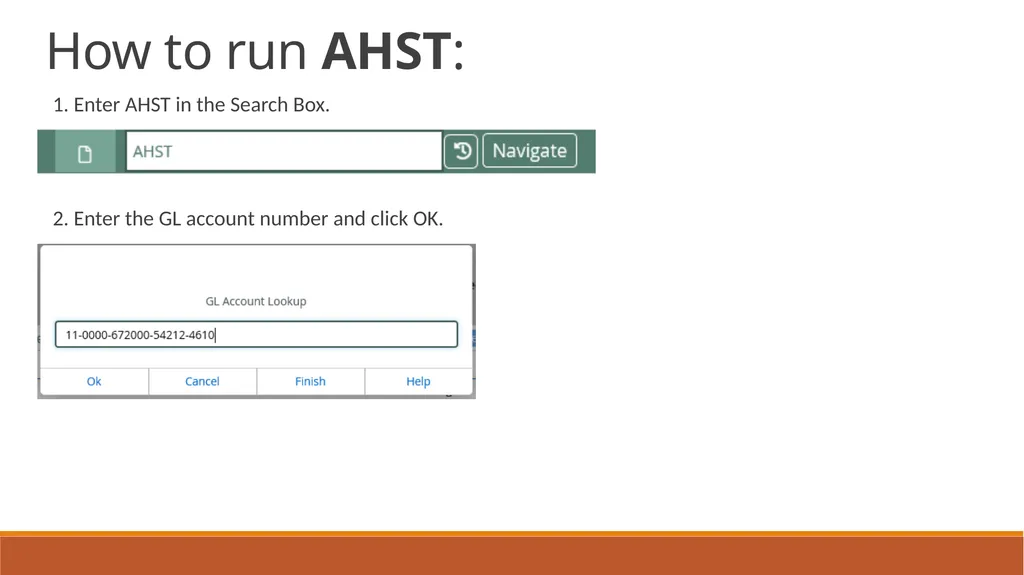
slide15. How to run AHST: 1. Enter AHST in the Search Box.
2. Enter the GL account number and click OK.<br>
slide16. How to read AHST:<br>
slide17. Online Repository Reports GL reports on the Online Repository were designed in-house by our ITS Department and pull GL data from the Colleague accounting system.
Online Repository Reports are considered more user-friendly then running reports directly from Colleague.
To access the Online Repository:
Go to Employee Intranet > Online Forms Reports and Requests > “Online Report Repository”.
OR click on the following link https://reports.rsccd.org/colorsnetweb/
TIP: You can add this link to your bookmarks so it’s easily accessible.
TIP: When you login to the Online Repository make sure you are in the “Production” environment.
TIP: If you need access to a specific report and don’t have access, please send a request for access to helpdesk@rsccd.edu.<br>
slide18. GL0010 Report GL0010 can help you:
Run a summary YTD budget to actuals report for your department or project. This report gives you a summary by account. Unlike ACBL and AHST, you can set report parameters so that your report includes multiple GL accounts, even multiple departments or projects.
GL0010 reports are fiscal Year-To-Date and do not cross fiscal years.
If you run a GL0010 report as of November 2019, the report will capture budget to actuals from July 1, 2019 through November 30, 2019.
If you run a GL0010 report as of June 2019, the report will capture budget to actuals from July 1, 2018 through June 30, 2019.<br>
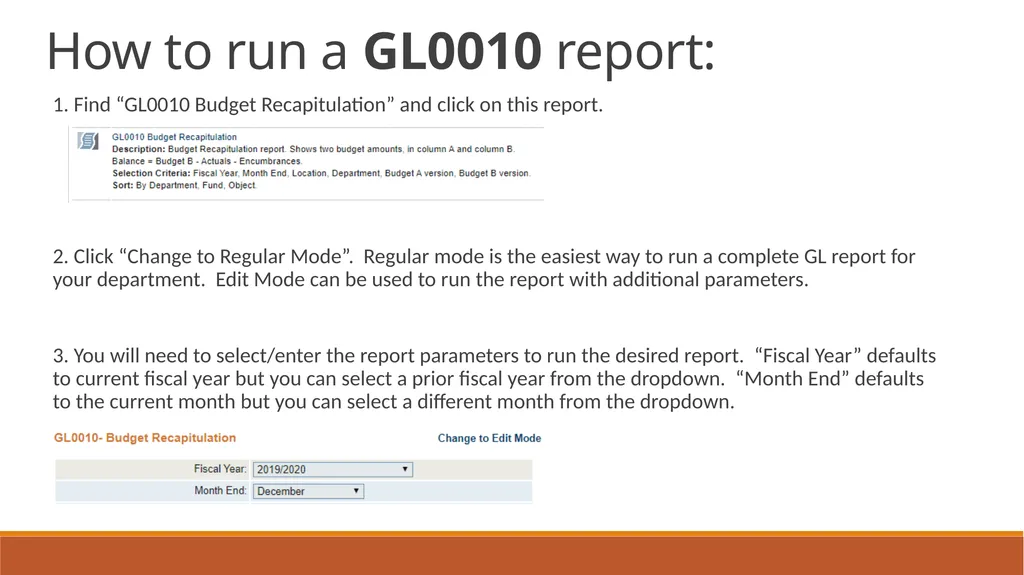
slide19. How to run a GL0010 report: 1. Find “GL0010 Budget Recapitulation” and click on this report.
2. Click “Change to Regular Mode”. Regular mode is the easiest way to run a complete GL report for your department. Edit Mode can be used to run the report with additional parameters.
3. You will need to select/enter the report parameters to run the desired report. “Fiscal Year” defaults to current fiscal year but you can select a prior fiscal year from the dropdown. “Month End” defaults to the current month but you can select a different month from the dropdown.<br>
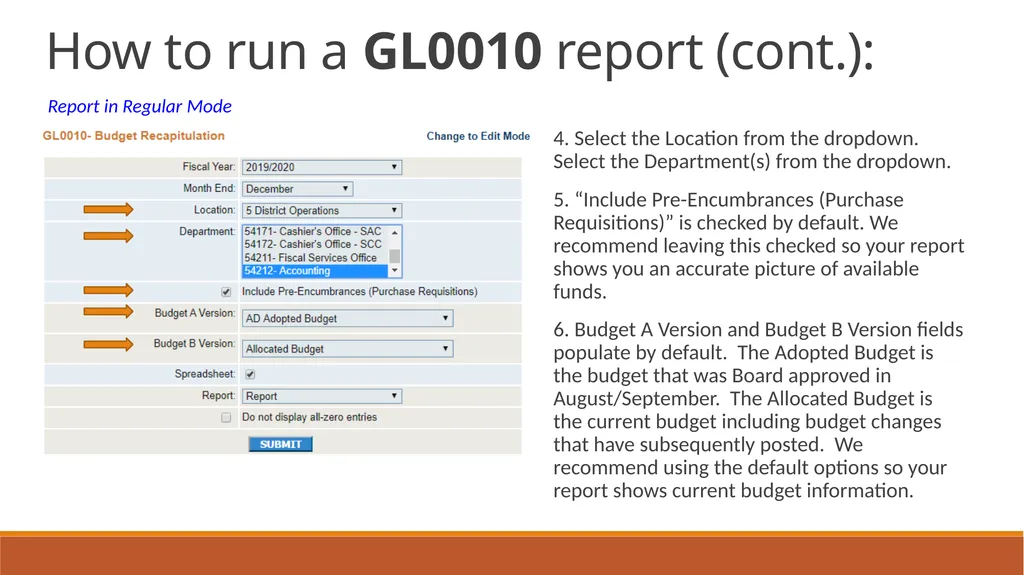
slide20. How to run a GL0010 report (cont.): 4. Select the Location from the dropdown. Select the Department(s) from the dropdown.
5. “Include Pre-Encumbrances (Purchase Requisitions)” is checked by default. We recommend leaving this checked so your report shows you an accurate picture of available funds.
6. Budget A Version and Budget B Version fields populate by default. The Adopted Budget is the budget that was Board approved in August/September. The Allocated Budget is the current budget including budget changes that have subsequently posted. We recommend using the default options so your report shows current budget information. Report in Regular Mode<br>
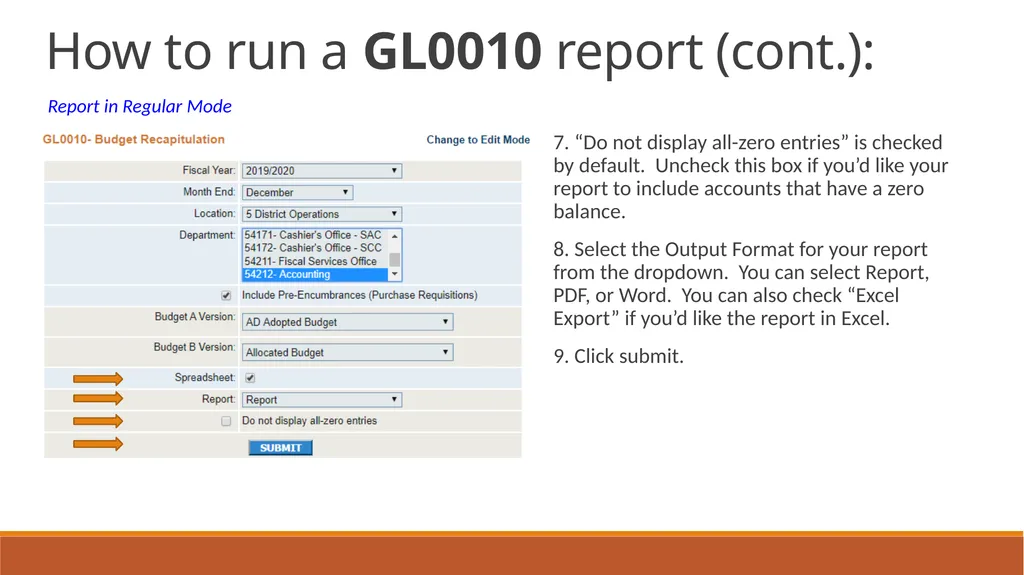
slide21. How to run a GL0010 report (cont.): 7. “Do not display all-zero entries” is checked by default. Uncheck this box if you’d like your report to include accounts that have a zero balance.
8. Select the Output Format for your report from the dropdown. You can select Report, PDF, or Word. You can also check “Excel Export” if you’d like the report in Excel.
9. Click submit. Report in Regular Mode<br>
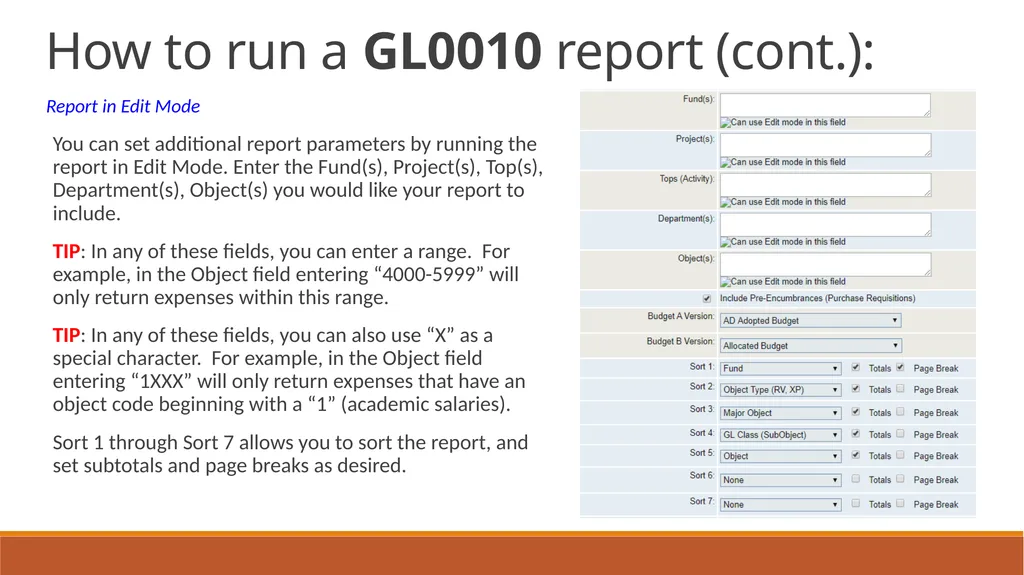
slide22. How to run a GL0010 report (cont.): You can set additional report parameters by running the report in Edit Mode. Enter the Fund(s), Project(s), Top(s), Department(s), Object(s) you would like your report to include.
TIP: In any of these fields, you can enter a range. For example, in the Object field entering “4000-5999” will only return expenses within this range.
TIP: In any of these fields, you can also use “X” as a special character. For example, in the Object field entering “1XXX” will only return expenses that have an object code beginning with a “1” (academic salaries).
Sort 1 through Sort 7 allows you to sort the report, and set subtotals and page breaks as desired. Report in Edit Mode<br>
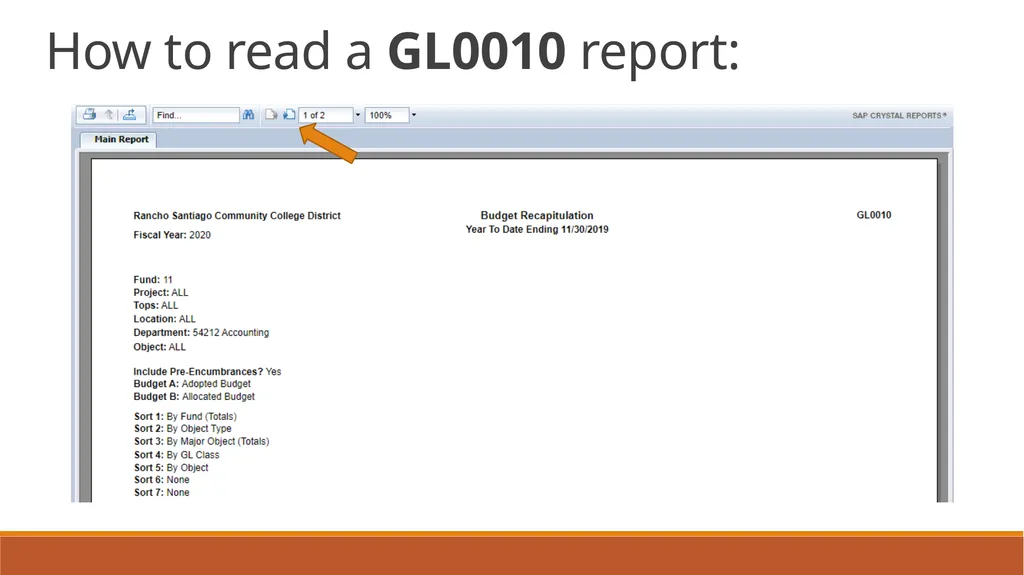
slide23. How to read a GL0010 report:<br>
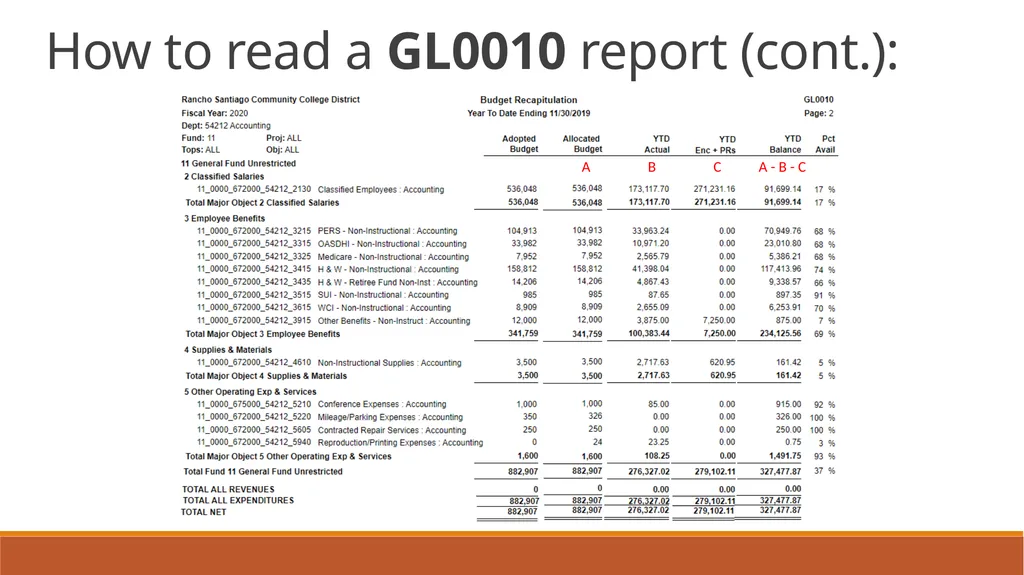
slide24. How to read a GL0010 report (cont.): A B C A - B - C<br>
slide25. How to read a GL0010 report (cont.): “Adopted Budget” is the budget that was Board approved in August/September.
“Allocated Budget” is the current budget including budget changes posted subsequent to the Adopted Budget.
“YTD Actuals” represents actual expenses. It includes any transfers of expenditure (TOEs) that have posted.
“YTD Enc + PRs” represents encumbrances and purchasing requisitions.
“YTD Balance” shows the amount of budget available to spend in the account. It is the allocated budget, less actual expenditures, less encumbrances and requisitions.
TIP: If a GL account has a negative “YTD Balance”, this indicates that the account is overspent. A budget change should be submitted to transfer budget to this account.
TIP: You can use ACBL to drill into account detail for a single account at a time. You can use a GL0210 report to drill into account detail for multiple accounts at a time.<br>
slide26. GL0210 Report GL0210 can help you:
Run a detailed report on all actual expense activity, all budget activity, or all encumbrance activity. You can set report parameters so that your report includes multiple GL accounts. You can also run the report for a specific date range (but the date range cannot cross fiscal years).<br>
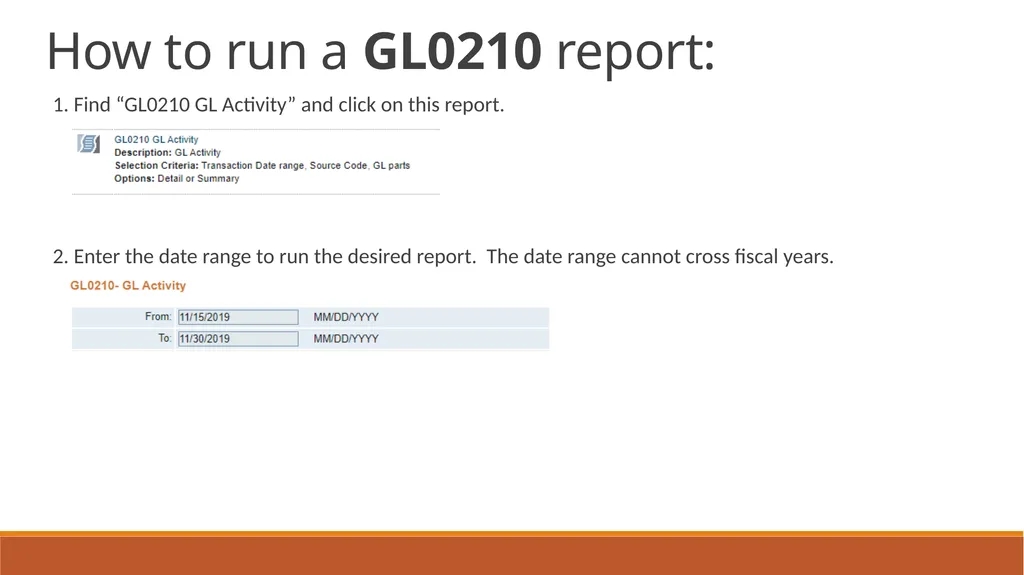
slide27. How to run a GL0210 report: 1. Find “GL0210 GL Activity” and click on this report.
2. Enter the date range to run the desired report. The date range cannot cross fiscal years.<br>
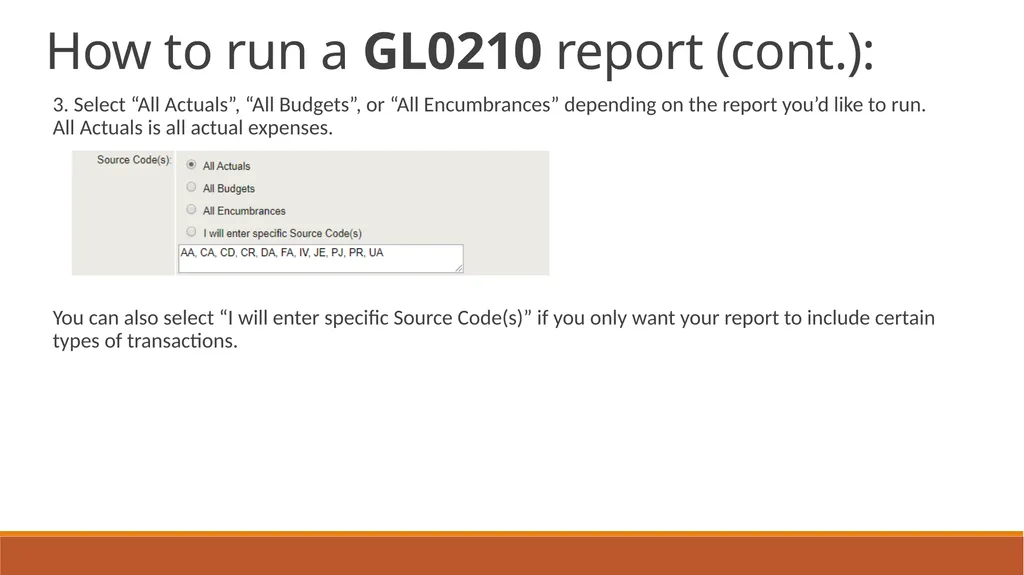
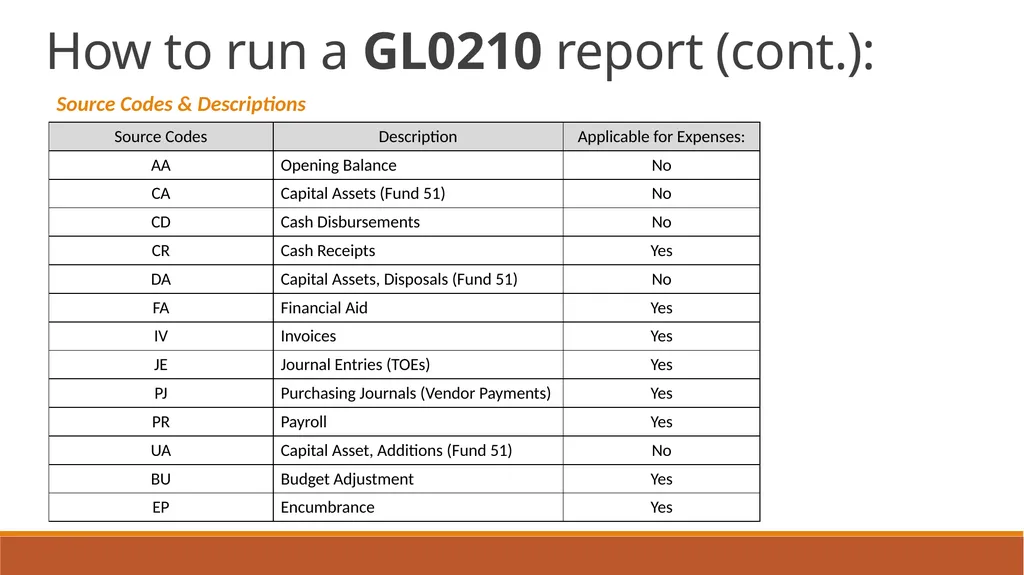
slide28. How to run a GL0210 report (cont.): 3. Select “All Actuals”, “All Budgets”, or “All Encumbrances” depending on the report you’d like to run. All Actuals is all actual expenses.
You can also select “I will enter specific Source Code(s)” if you only want your report to include certain types of transactions.<br>
slide29. How to run a GL0210 report (cont.): Source Codes & Descriptions<br>
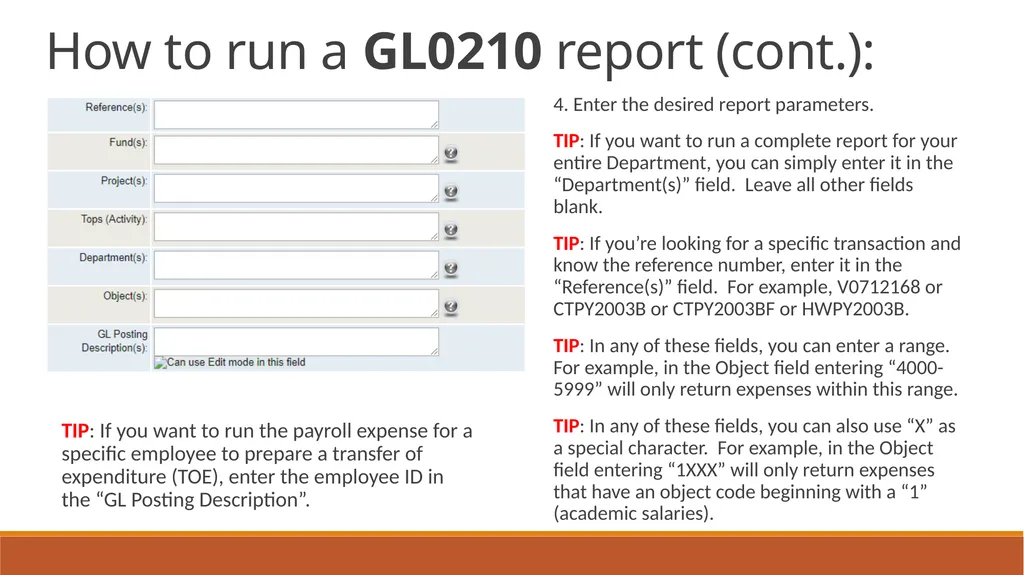
slide30. How to run a GL0210 report (cont.): 4. Enter the desired report parameters.
TIP: If you want to run a complete report for your entire Department, you can simply enter it in the “Department(s)” field. Leave all other fields blank.
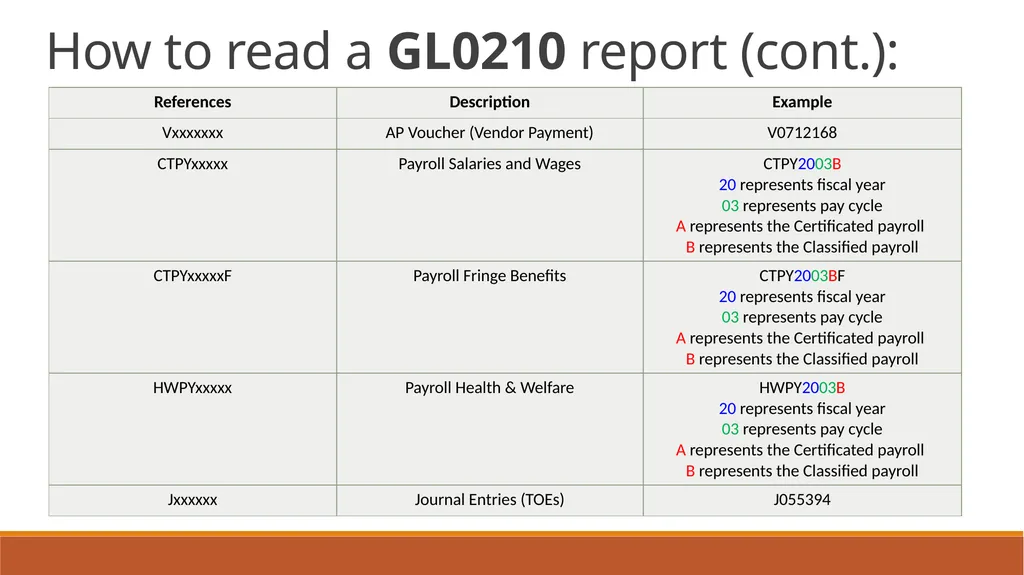
TIP: If you’re looking for a specific transaction and know the reference number, enter it in the “Reference(s)” field. For example, V0712168 or CTPY2003B or CTPY2003BF or HWPY2003B.
TIP: In any of these fields, you can enter a range. For example, in the Object field entering “4000-5999” will only return expenses within this range.
TIP: In any of these fields, you can also use “X” as a special character. For example, in the Object field entering “1XXX” will only return expenses that have an object code beginning with a “1” (academic salaries). TIP: If you want to run the payroll expense for a specific employee to prepare a transfer of expenditure (TOE), enter the employee ID in the “GL Posting Description”.<br>
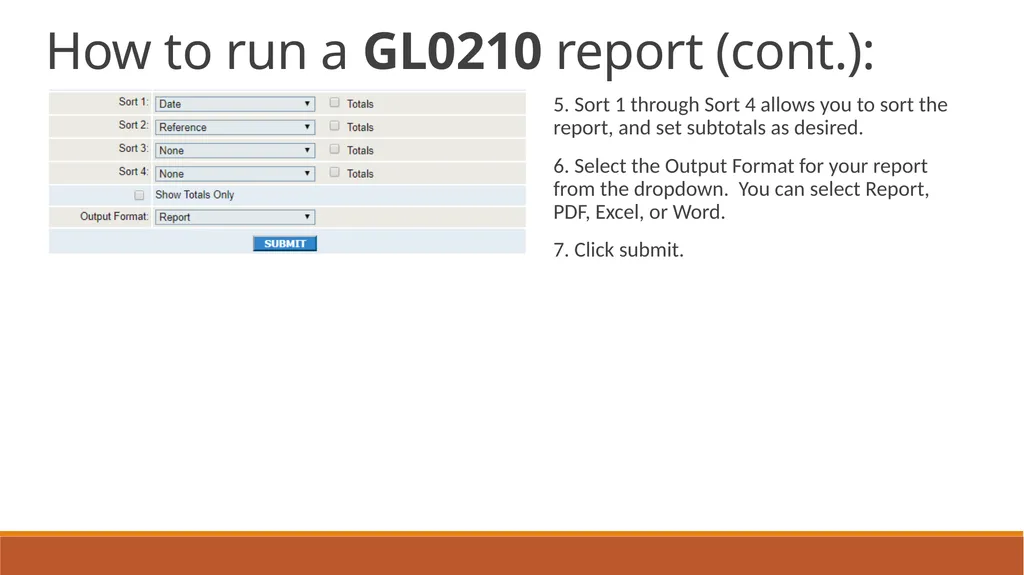
slide31. How to run a GL0210 report (cont.): 5. Sort 1 through Sort 4 allows you to sort the report, and set subtotals as desired.
6. Select the Output Format for your report from the dropdown. You can select Report, PDF, Excel, or Word.
7. Click submit.<br>
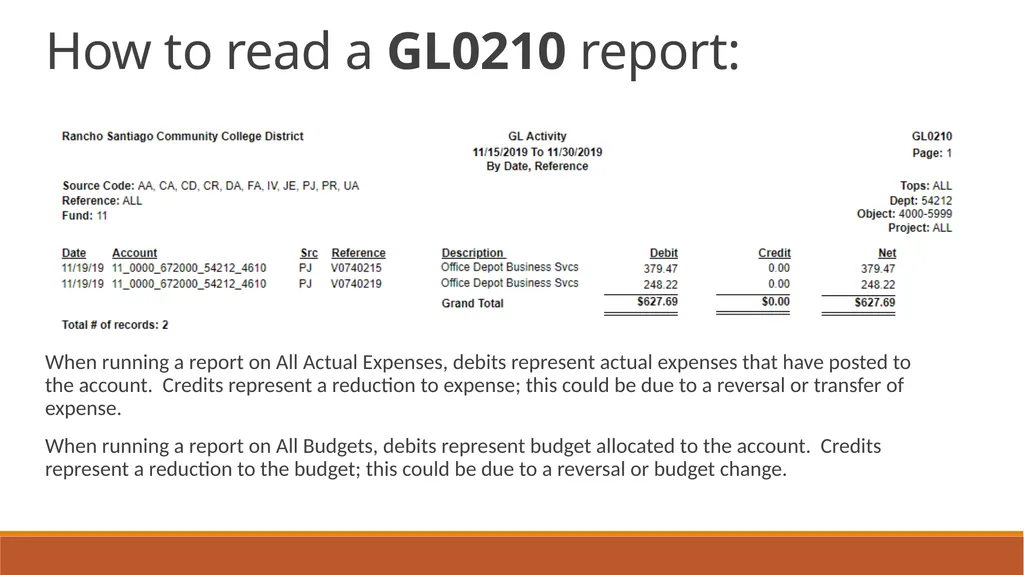
slide32. How to read a GL0210 report: When running a report on All Actual Expenses, debits represent actual expenses that have posted to the account. Credits represent a reduction to expense; this could be due to a reversal or transfer of expense.
When running a report on All Budgets, debits represent budget allocated to the account. Credits represent a reduction to the budget; this could be due to a reversal or budget change.<br>
slide33. How to read a GL0210 report (cont.):<br>
slide34. GL Reports in Colleague: GLSA GLSA can help you:
Run a summary YTD budget to actuals report for your department or project in Colleague. This report gives you a summary by account. You can set report parameters so that your report includes multiple GL accounts, even multiple departments or projects.
GLSA reports are fiscal Year-To-Date and do not cross fiscal years.<br>
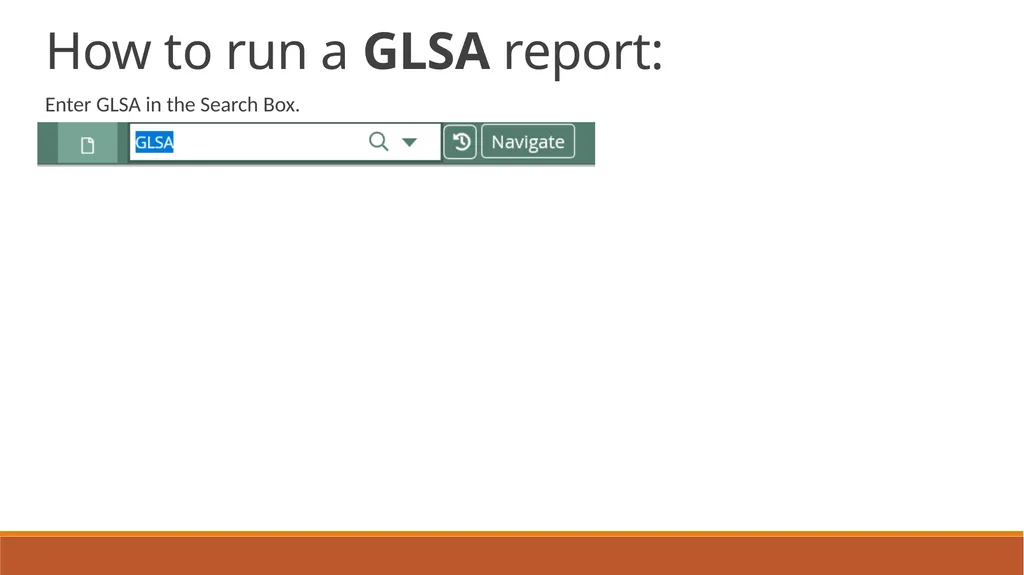
slide35. How to run a GLSA report: Enter GLSA in the Search Box.<br>
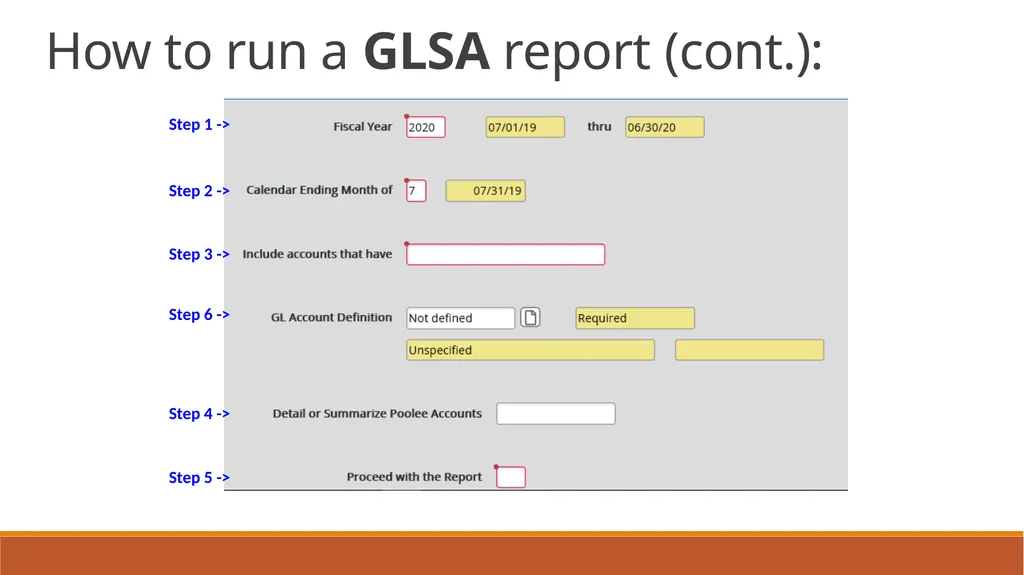
slide36. How to run a GLSA report (cont.): Step 1 -> Step 6 -> Step 2 -> Step 3 -> Step 4 -> Step 5 -><br>
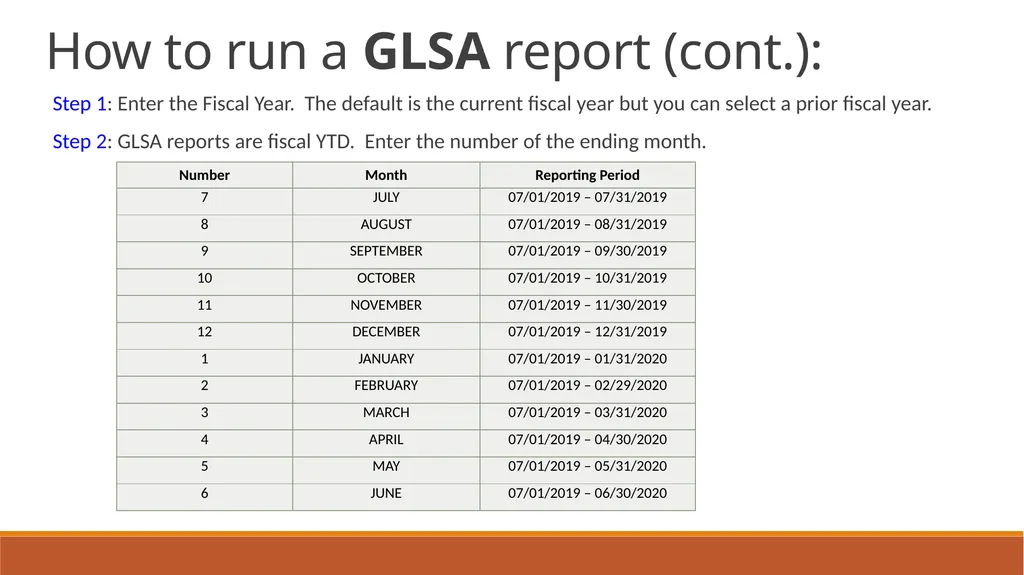
slide37. How to run a GLSA report (cont.): Step 1: Enter the Fiscal Year. The default is the current fiscal year but you can select a prior fiscal year.
Step 2: GLSA reports are fiscal YTD. Enter the number of the ending month.<br>
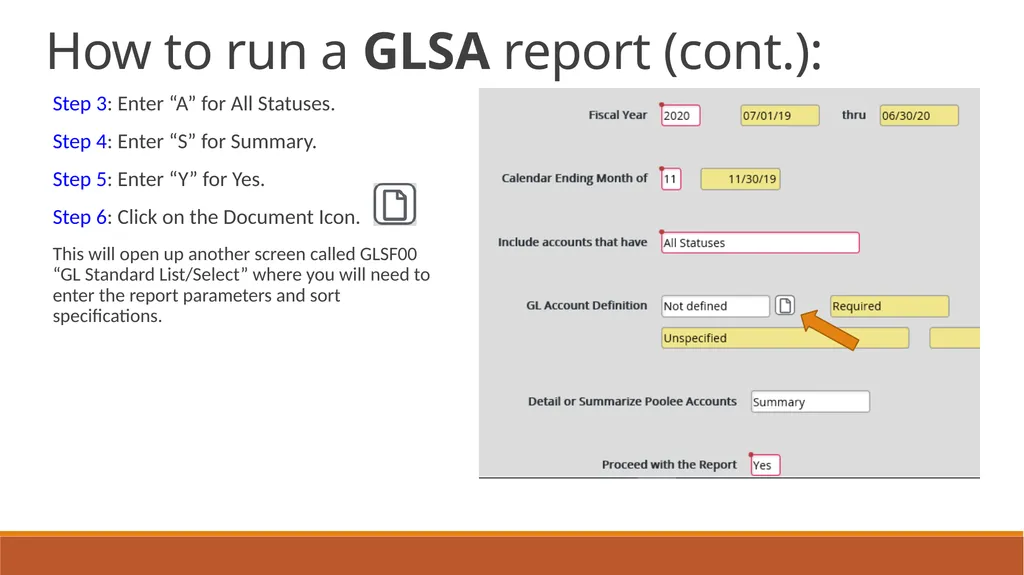
slide38. How to run a GLSA report (cont.): Step 3: Enter “A” for All Statuses.
Step 4: Enter “S” for Summary.
Step 5: Enter “Y” for Yes.
Step 6: Click on the Document Icon.
This will open up another screen called GLSF00 “GL Standard List/Select” where you will need to enter the report parameters and sort specifications.<br>
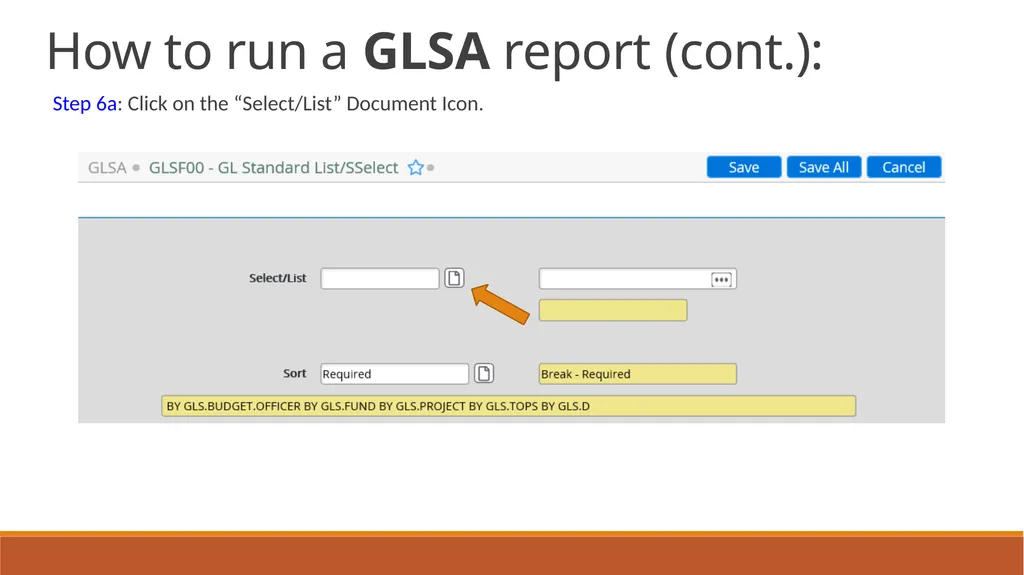
slide39. How to run a GLSA report (cont.): Step 6a: Click on the “Select/List” Document Icon.<br>
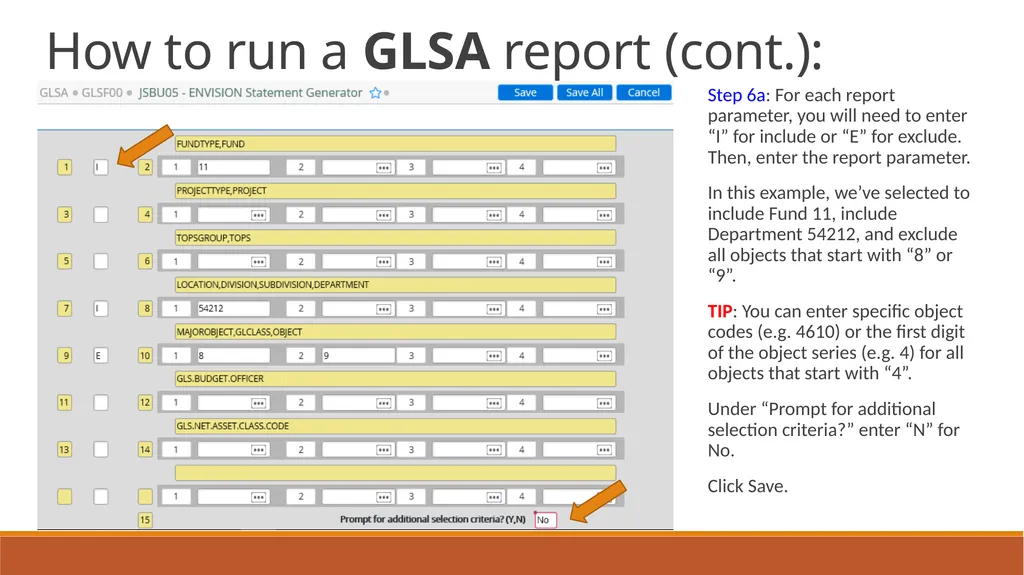
slide40. How to run a GLSA report (cont.): Step 6a: For each report parameter, you will need to enter “I” for include or “E” for exclude. Then, enter the report parameter.
In this example, we’ve selected to include Fund 11, include Department 54212, and exclude all objects that start with “8” or “9”.
TIP: You can enter specific object codes (e.g. 4610) or the first digit of the object series (e.g. 4) for all objects that start with “4”.
Under “Prompt for additional selection criteria?” enter “N” for No.
Click Save.<br>
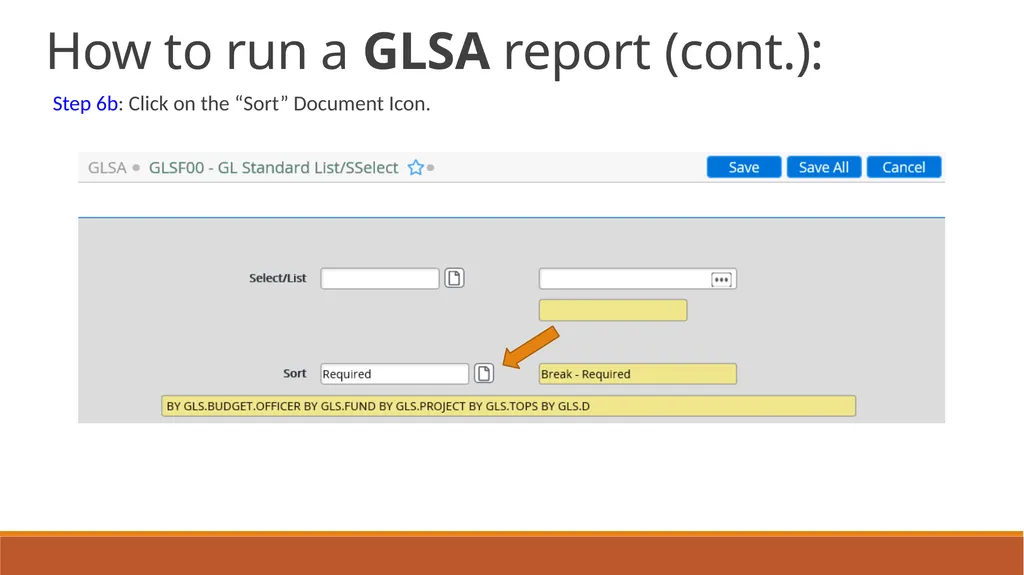
slide41. How to run a GLSA report (cont.): Step 6b: Click on the “Sort” Document Icon.<br>
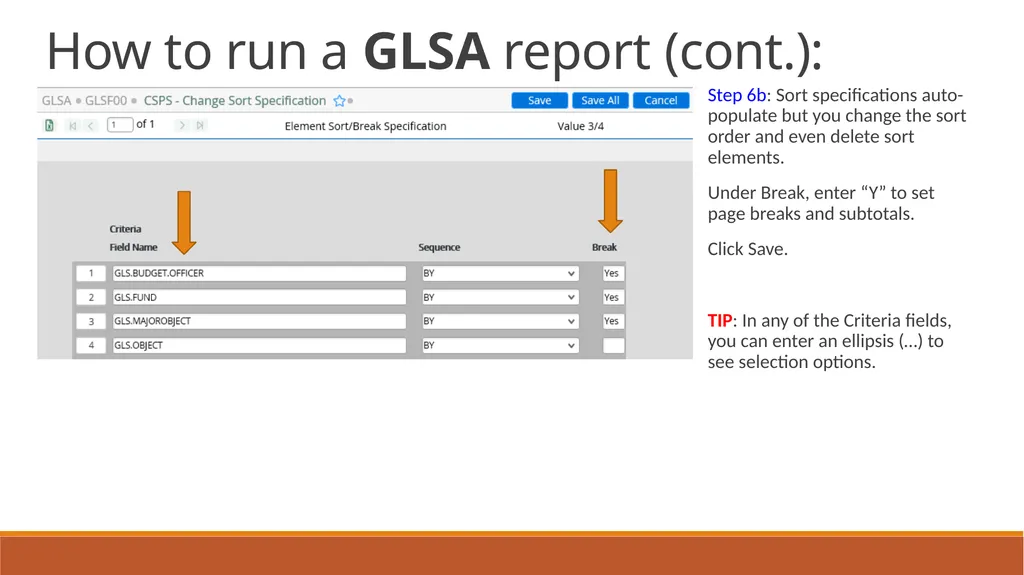
slide42. How to run a GLSA report (cont.): Step 6b: Sort specifications auto-populate but you change the sort order and even delete sort elements.
Under Break, enter “Y” to set page breaks and subtotals.
Click Save.
TIP: In any of the Criteria fields, you can enter an ellipsis (…) to see selection options.<br>
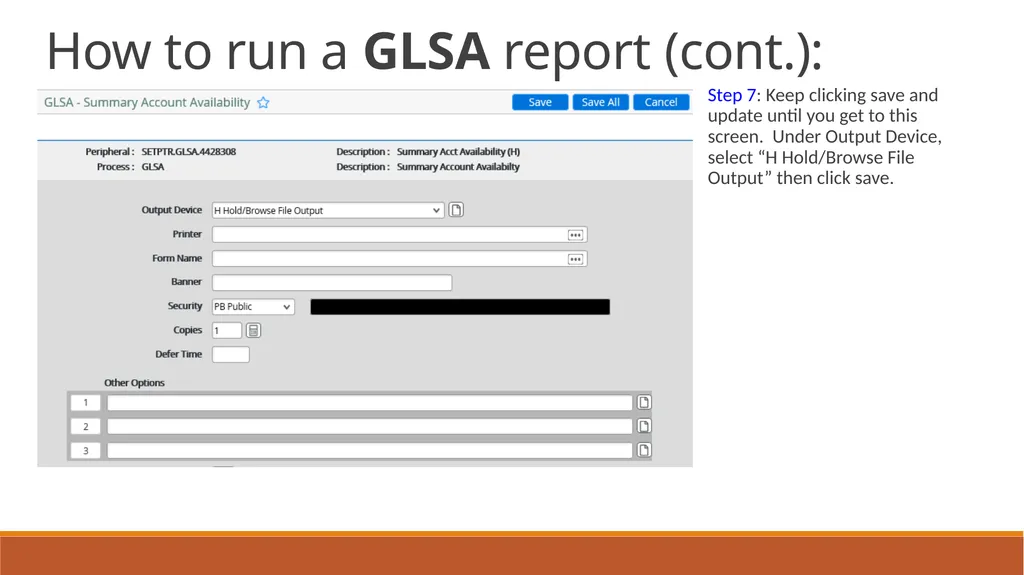
slide43. How to run a GLSA report (cont.): Step 7: Keep clicking save and update until you get to this screen. Under Output Device, select “H Hold/Browse File Output” then click save.<br>
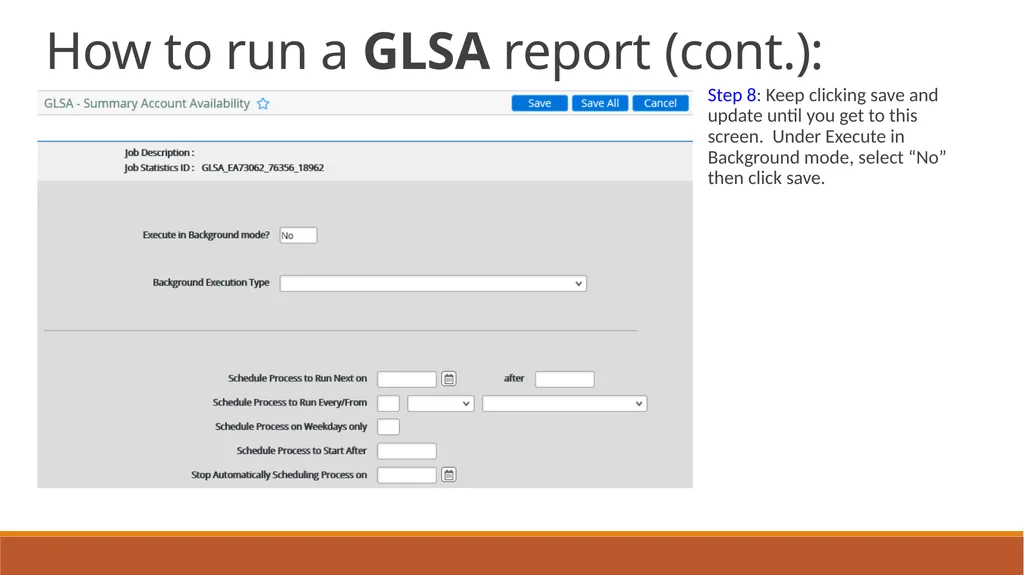
slide44. How to run a GLSA report (cont.): Step 8: Keep clicking save and update until you get to this screen. Under Execute in Background mode, select “No” then click save.<br>
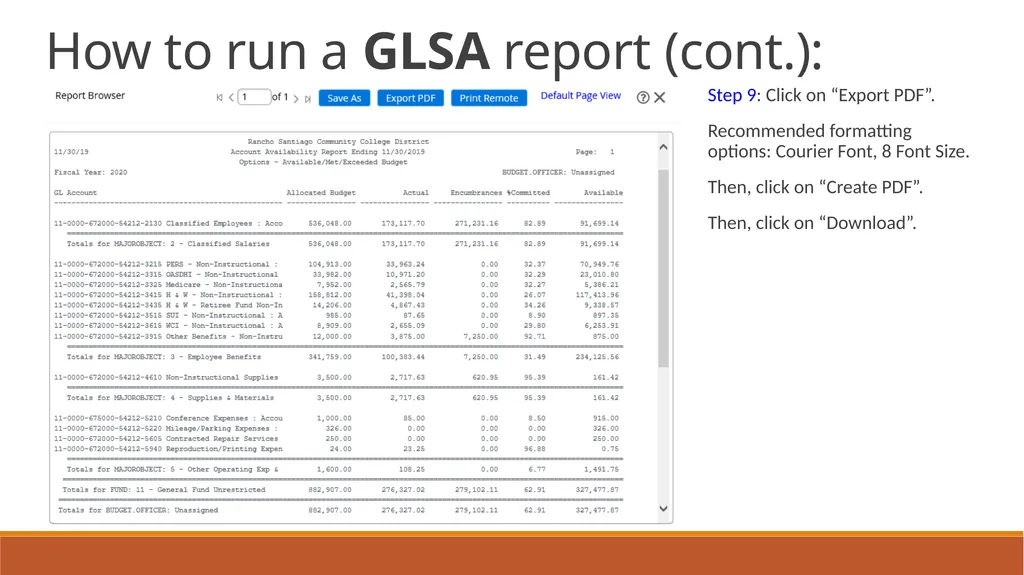
slide45. How to run a GLSA report (cont.): Step 9: Click on “Export PDF”.
Recommended formatting options: Courier Font, 8 Font Size.
Then, click on “Create PDF”.
Then, click on “Download”.<br>
slide46. Questions?<br>
Updated November 2019<br>
slide2. Table of Contents Accounting System: Ellucian Colleague
Chart of Accounts
GL Inquiry in Colleague (ACBL, AHST)
Online Repository Reports (GL0010, GL0210)
GL Reports in Colleague (GLSA)<br>
slide3. Accounting System: Ellucian Colleague Enter/approve purchase requisition
Check the available budget for an account
Run budget to actual expenditure reports
Functions are accessed by entering the acronym for the desired screen in the search box<br>
slide4. Common Colleague Acronyms REQM – To enter a purchasing requisition
APRN – To approve purchasing requisitions
ACBL – To check budget/actual activity for a single account in the current fiscal year
AHST – To check budget/actual activity for a single account in the current or a prior fiscal year
GLSA – To run budget to actual reports
PINQ – To lookup an existing purchase order (items accepted, PO balance remaining)
VENI – To lookup existing requisitions, purchase orders, and payments for a specific vendor<br>
slide5. Chart of Accounts The Chart of Accounts is an index of all the financial accounts in the District’s general ledger. It is used to classify and segregate expenses and revenues into the appropriate categories for financial reporting.
Each GL account has 5 components (Fund, Project, TOP, Department, Object) for a total of 21 digits.
This is an example of a GL account:
11-0000-672000-54212-4610<br>
slide6. Chart of Accounts (cont.) FUND
Identifies the major source and use of funds. Unrestricted funds are discretionary in nature. Restricted funds are for a specific purpose.
Most commonly used funds
11 – General Fund Unrestricted
12 – General Fund Restricted
13 – General Fund Unrestricted One-Time Funds
PROJECT
Identifies the specific purpose of the funds. Only used when we need to track specific funds, including the associated revenues and expenses, separately as is the case with grants, parking, health services.
1xxx – Federal Projects
2xxx – State Projects
3xxx – Local Projects and or District designations<br>
slide7. Chart of Accounts (cont.) TOP
Classification of expenditures by activity reflects the purpose of the expenditure.
It shows the aspect of college-district operations benefited by the expenditure.
TOP codes below 600000 are used for instructional expenditures.
TOP codes 600000 or greater are used for non-instructional expenditures.
DEPARTMENT
1xxxx – SAC department
2xxxx – SCC department
5xxxx – District Office department<br>
slide8. Chart of Accounts (cont.) OBJECT
Classification of expenditures by object reflects the type of expenditure. There are 7 major expenditure types (also called categories).
1xxx – Academic Salaries
2xxx – Classified Salaries and Other Nonacademic Salaries
3xxx – Employee Benefits
4xxx – Supplies & Materials
5xxx – Other Operating Expenses & Services
6xxx – Capital Outlay
7xxx – Other Outgo<br>
slide9. Chart of Accounts (cont.) A current Chart of Accounts is posted online on the Fiscal Services webpage.
https://rsccd.edu/Departments/Fiscal-Services/Documents/Chart_of_Accounts.pdf<br>
slide10. GL Inquiry in Colleague: ACBL TIP: We highly recommend using ACBL to check for available budget before preparing a Budget Change or Purchase Requisition!
ACBL can help you:
Verify that an account exists and the status of the account (e.g. open or closed) in the current fiscal year.
Lookup the budget and availability of funds for a single account in the current fiscal year.
View budget changes that have posted to an account in the current fiscal year.
View actual expenses (including TOEs) that have posted to an account in the current fiscal year.
View approved PRs and POs that have encumbered funds in the account in the current fiscal year.<br>
slide11. How to run ACBL: 1. Enter ACBL in the Search Box.
2. Enter the GL account number and click OK. Then enter the Fiscal Year and click OK.
TIP: You can enter the GL account number with or without dashes.
TIP: If you do not know all the segments of the GL account string, you can enter the segments you do know and use ellipsis for the segments you do not know. Do not use dashes. For example: “11…54212…4610…” Colleague will return one or more possible GL accounts for you to choose from.<br>
slide12. How to read ACBL:<br>
slide13. How to read ACBL (cont.): “Available Funds” indicates the amount of budget available to spend in the account. It is the allocated budget, less actual expenditures, less encumbrances, less requisitions.
“Allocated Budget” represents the budget for the account. It includes any budget changes that posted subsequent to the Adopted Budget.
“Actuals” represents actual expenditures that have posted to the account. This includes payroll costs or vendor payments depending on the account. It also includes any transfers of expenditure (TOEs) that have been posted.
“Encumbrances” represent a portion of the allocated budget that has been set aside for a particular expenditure(s). There are two types of encumbrances: payroll encumbrances and Purchase Order encumbrances.
“Requisitions” represents a portion of the allocated budget that has been set aside for a purchase requisition(s) which has not yet been turned into a Purchase Order.
TIP: You can click on the Document Icons to drill into the detail.<br>
slide14. GL Inquiry in Colleague: AHST AHST can help you:
Lookup the budget and budget changes for a single account in a prior year.
View actual expenses (including TOEs) that posted to an account in a prior year.<br>
slide15. How to run AHST: 1. Enter AHST in the Search Box.
2. Enter the GL account number and click OK.<br>
slide16. How to read AHST:<br>
slide17. Online Repository Reports GL reports on the Online Repository were designed in-house by our ITS Department and pull GL data from the Colleague accounting system.
Online Repository Reports are considered more user-friendly then running reports directly from Colleague.
To access the Online Repository:
Go to Employee Intranet > Online Forms Reports and Requests > “Online Report Repository”.
OR click on the following link https://reports.rsccd.org/colorsnetweb/
TIP: You can add this link to your bookmarks so it’s easily accessible.
TIP: When you login to the Online Repository make sure you are in the “Production” environment.
TIP: If you need access to a specific report and don’t have access, please send a request for access to helpdesk@rsccd.edu.<br>
slide18. GL0010 Report GL0010 can help you:
Run a summary YTD budget to actuals report for your department or project. This report gives you a summary by account. Unlike ACBL and AHST, you can set report parameters so that your report includes multiple GL accounts, even multiple departments or projects.
GL0010 reports are fiscal Year-To-Date and do not cross fiscal years.
If you run a GL0010 report as of November 2019, the report will capture budget to actuals from July 1, 2019 through November 30, 2019.
If you run a GL0010 report as of June 2019, the report will capture budget to actuals from July 1, 2018 through June 30, 2019.<br>
slide19. How to run a GL0010 report: 1. Find “GL0010 Budget Recapitulation” and click on this report.
2. Click “Change to Regular Mode”. Regular mode is the easiest way to run a complete GL report for your department. Edit Mode can be used to run the report with additional parameters.
3. You will need to select/enter the report parameters to run the desired report. “Fiscal Year” defaults to current fiscal year but you can select a prior fiscal year from the dropdown. “Month End” defaults to the current month but you can select a different month from the dropdown.<br>
slide20. How to run a GL0010 report (cont.): 4. Select the Location from the dropdown. Select the Department(s) from the dropdown.
5. “Include Pre-Encumbrances (Purchase Requisitions)” is checked by default. We recommend leaving this checked so your report shows you an accurate picture of available funds.
6. Budget A Version and Budget B Version fields populate by default. The Adopted Budget is the budget that was Board approved in August/September. The Allocated Budget is the current budget including budget changes that have subsequently posted. We recommend using the default options so your report shows current budget information. Report in Regular Mode<br>
slide21. How to run a GL0010 report (cont.): 7. “Do not display all-zero entries” is checked by default. Uncheck this box if you’d like your report to include accounts that have a zero balance.
8. Select the Output Format for your report from the dropdown. You can select Report, PDF, or Word. You can also check “Excel Export” if you’d like the report in Excel.
9. Click submit. Report in Regular Mode<br>
slide22. How to run a GL0010 report (cont.): You can set additional report parameters by running the report in Edit Mode. Enter the Fund(s), Project(s), Top(s), Department(s), Object(s) you would like your report to include.
TIP: In any of these fields, you can enter a range. For example, in the Object field entering “4000-5999” will only return expenses within this range.
TIP: In any of these fields, you can also use “X” as a special character. For example, in the Object field entering “1XXX” will only return expenses that have an object code beginning with a “1” (academic salaries).
Sort 1 through Sort 7 allows you to sort the report, and set subtotals and page breaks as desired. Report in Edit Mode<br>
slide23. How to read a GL0010 report:<br>
slide24. How to read a GL0010 report (cont.): A B C A - B - C<br>
slide25. How to read a GL0010 report (cont.): “Adopted Budget” is the budget that was Board approved in August/September.
“Allocated Budget” is the current budget including budget changes posted subsequent to the Adopted Budget.
“YTD Actuals” represents actual expenses. It includes any transfers of expenditure (TOEs) that have posted.
“YTD Enc + PRs” represents encumbrances and purchasing requisitions.
“YTD Balance” shows the amount of budget available to spend in the account. It is the allocated budget, less actual expenditures, less encumbrances and requisitions.
TIP: If a GL account has a negative “YTD Balance”, this indicates that the account is overspent. A budget change should be submitted to transfer budget to this account.
TIP: You can use ACBL to drill into account detail for a single account at a time. You can use a GL0210 report to drill into account detail for multiple accounts at a time.<br>
slide26. GL0210 Report GL0210 can help you:
Run a detailed report on all actual expense activity, all budget activity, or all encumbrance activity. You can set report parameters so that your report includes multiple GL accounts. You can also run the report for a specific date range (but the date range cannot cross fiscal years).<br>
slide27. How to run a GL0210 report: 1. Find “GL0210 GL Activity” and click on this report.
2. Enter the date range to run the desired report. The date range cannot cross fiscal years.<br>
slide28. How to run a GL0210 report (cont.): 3. Select “All Actuals”, “All Budgets”, or “All Encumbrances” depending on the report you’d like to run. All Actuals is all actual expenses.
You can also select “I will enter specific Source Code(s)” if you only want your report to include certain types of transactions.<br>
slide29. How to run a GL0210 report (cont.): Source Codes & Descriptions<br>
slide30. How to run a GL0210 report (cont.): 4. Enter the desired report parameters.
TIP: If you want to run a complete report for your entire Department, you can simply enter it in the “Department(s)” field. Leave all other fields blank.
TIP: If you’re looking for a specific transaction and know the reference number, enter it in the “Reference(s)” field. For example, V0712168 or CTPY2003B or CTPY2003BF or HWPY2003B.
TIP: In any of these fields, you can enter a range. For example, in the Object field entering “4000-5999” will only return expenses within this range.
TIP: In any of these fields, you can also use “X” as a special character. For example, in the Object field entering “1XXX” will only return expenses that have an object code beginning with a “1” (academic salaries). TIP: If you want to run the payroll expense for a specific employee to prepare a transfer of expenditure (TOE), enter the employee ID in the “GL Posting Description”.<br>
slide31. How to run a GL0210 report (cont.): 5. Sort 1 through Sort 4 allows you to sort the report, and set subtotals as desired.
6. Select the Output Format for your report from the dropdown. You can select Report, PDF, Excel, or Word.
7. Click submit.<br>
slide32. How to read a GL0210 report: When running a report on All Actual Expenses, debits represent actual expenses that have posted to the account. Credits represent a reduction to expense; this could be due to a reversal or transfer of expense.
When running a report on All Budgets, debits represent budget allocated to the account. Credits represent a reduction to the budget; this could be due to a reversal or budget change.<br>
slide33. How to read a GL0210 report (cont.):<br>
slide34. GL Reports in Colleague: GLSA GLSA can help you:
Run a summary YTD budget to actuals report for your department or project in Colleague. This report gives you a summary by account. You can set report parameters so that your report includes multiple GL accounts, even multiple departments or projects.
GLSA reports are fiscal Year-To-Date and do not cross fiscal years.<br>
slide35. How to run a GLSA report: Enter GLSA in the Search Box.<br>
slide36. How to run a GLSA report (cont.): Step 1 -> Step 6 -> Step 2 -> Step 3 -> Step 4 -> Step 5 -><br>
slide37. How to run a GLSA report (cont.): Step 1: Enter the Fiscal Year. The default is the current fiscal year but you can select a prior fiscal year.
Step 2: GLSA reports are fiscal YTD. Enter the number of the ending month.<br>
slide38. How to run a GLSA report (cont.): Step 3: Enter “A” for All Statuses.
Step 4: Enter “S” for Summary.
Step 5: Enter “Y” for Yes.
Step 6: Click on the Document Icon.
This will open up another screen called GLSF00 “GL Standard List/Select” where you will need to enter the report parameters and sort specifications.<br>
slide39. How to run a GLSA report (cont.): Step 6a: Click on the “Select/List” Document Icon.<br>
slide40. How to run a GLSA report (cont.): Step 6a: For each report parameter, you will need to enter “I” for include or “E” for exclude. Then, enter the report parameter.
In this example, we’ve selected to include Fund 11, include Department 54212, and exclude all objects that start with “8” or “9”.
TIP: You can enter specific object codes (e.g. 4610) or the first digit of the object series (e.g. 4) for all objects that start with “4”.
Under “Prompt for additional selection criteria?” enter “N” for No.
Click Save.<br>
slide41. How to run a GLSA report (cont.): Step 6b: Click on the “Sort” Document Icon.<br>
slide42. How to run a GLSA report (cont.): Step 6b: Sort specifications auto-populate but you change the sort order and even delete sort elements.
Under Break, enter “Y” to set page breaks and subtotals.
Click Save.
TIP: In any of the Criteria fields, you can enter an ellipsis (…) to see selection options.<br>
slide43. How to run a GLSA report (cont.): Step 7: Keep clicking save and update until you get to this screen. Under Output Device, select “H Hold/Browse File Output” then click save.<br>
slide44. How to run a GLSA report (cont.): Step 8: Keep clicking save and update until you get to this screen. Under Execute in Background mode, select “No” then click save.<br>
slide45. How to run a GLSA report (cont.): Step 9: Click on “Export PDF”.
Recommended formatting options: Courier Font, 8 Font Size.
Then, click on “Create PDF”.
Then, click on “Download”.<br>
slide46. Questions?<br>