
genetic course lecture (3) Modified Mendelian
MY
Published · 18 slides · 0 views
1 / 1


Description
genetic course lecture (3) Modified Mendelian dihybrid (dominance , lethal gene ) Dr. israa hussein hamzah email: esraahassan17yahoo.com szshuomustansiriyah.edu.iq Reference book: genetic (Conceptual-Approach) fourth edition (2012)
Related Topics
Download this presentation From Below
"genetic course lecture (3) Modified Mendelian" is the property of its rightful owner. Permission is granted to download and print the materials on this website for personal, non-commercial use only, and to display it on your personal computer provided you do not modify the materials and that you retain all copyright notices contained in the materials. By downloading content from our website, you accept the terms of this agreement.
Share
Embed code
Presentation Transcript
01
genetic course
lecture (3)
Modified Mendelian dihybrid
(dominance , lethal gene )
Dr. israa hussein hamzah
email: esraa_hassan17@yahoo.com
szsh@uomustansiriyah.edu.iq
Reference book: genetic (Conceptual-Approach) fourth edition (2012)
Author: Benjamin C. Pierce<br>
Modified Mendelian dihybrid
(dominance , lethal gene )
Dr. israa hussein hamzah
email: esraa_hassan17@yahoo.com
szsh@uomustansiriyah.edu.iq
Reference book: genetic (Conceptual-Approach) fourth edition (2012)
Author: Benjamin C. Pierce<br>
02
Extensions to Mendelian analysis:
Extensions to Mendelian analysis divided into two broad categories
1. single gene inherence
A-in which pair of alleles shows deviation from complete dominance and recessive
B-in which different forms of the gene are not limited to two alleles
C: where one may determine more than one trait.
2. Multifactorial inheritance in which phenotype arise from the interaction of one or more genes with environments, chance or with each other.<br>
Extensions to Mendelian analysis divided into two broad categories
1. single gene inherence
A-in which pair of alleles shows deviation from complete dominance and recessive
B-in which different forms of the gene are not limited to two alleles
C: where one may determine more than one trait.
2. Multifactorial inheritance in which phenotype arise from the interaction of one or more genes with environments, chance or with each other.<br>
03
we learned that the principle of segregation and the principle of independent assortment allow us to predict the outcomes of genetic crosses. Here, we examine several additional factors acting at individual loci that can alter the phenotypic ratios predicted by Mendel’s principles.
One of Mendel’s important contributions to the study of heredity is the concept of dominance—the idea that an individual organism possesses two different alleles for a characteristic but the trait encoded by only one of the
alleles is observed in the phenotype. With dominance, the heterozygote possesses the same phenotype as one of the homozygotes. Mendel observed dominance in all of the traits that he chose to study extensively, but he was aware that not all characteristics exhibit dominance. He conducted some crosses concerning the length of time that pea plants take to flower. dominance is frequently “in the eye of the beholder,” meaning that the classification of dominance depends on the level at which the phenotype is examined.<br>
One of Mendel’s important contributions to the study of heredity is the concept of dominance—the idea that an individual organism possesses two different alleles for a characteristic but the trait encoded by only one of the
alleles is observed in the phenotype. With dominance, the heterozygote possesses the same phenotype as one of the homozygotes. Mendel observed dominance in all of the traits that he chose to study extensively, but he was aware that not all characteristics exhibit dominance. He conducted some crosses concerning the length of time that pea plants take to flower. dominance is frequently “in the eye of the beholder,” meaning that the classification of dominance depends on the level at which the phenotype is examined.<br>
04
1- Complete dominance
In the complete dominance, the effect of one allele in a heterozygous genotype completely masks the effect of the other. The allele that masks the other is said to be dominant to the latter, and the allele that is masked is said to be recessive to the former. Complete dominance, therefore, means that the phenotype of the heterozygote is indistinguishable from that of the dominant homozygote.
A classic example of dominance is the inheritance of seed shape (pea shape) in peas. Peas may be round (associated with allele R) or wrinkled (associated with allele r). In this case, three combinations of alleles (genotypes) are possible: RR and rr are homozygous and Rr is heterozygous. The RR individuals have round peas and the rr individuals have wrinkled peas. In Rr individuals the R allele masks the presence of the r allele, so these individuals also have round peas. Thus, allele R is completely dominant to allele r, and allele r is recessive to allele R. Types of Dominance<br>
In the complete dominance, the effect of one allele in a heterozygous genotype completely masks the effect of the other. The allele that masks the other is said to be dominant to the latter, and the allele that is masked is said to be recessive to the former. Complete dominance, therefore, means that the phenotype of the heterozygote is indistinguishable from that of the dominant homozygote.
A classic example of dominance is the inheritance of seed shape (pea shape) in peas. Peas may be round (associated with allele R) or wrinkled (associated with allele r). In this case, three combinations of alleles (genotypes) are possible: RR and rr are homozygous and Rr is heterozygous. The RR individuals have round peas and the rr individuals have wrinkled peas. In Rr individuals the R allele masks the presence of the r allele, so these individuals also have round peas. Thus, allele R is completely dominant to allele r, and allele r is recessive to allele R. Types of Dominance<br>
05
Complete Dominance summery
• Dominance is interaction of alleles for the same gene (at the same locus)
• Complete dominance
• One allele completely masks the expression of the other.
• AA and Aa produce the same phenotype.
• So there are three genotypes, but only two phenotypes.
P AA X aa
G A a
F1 Aa x Aa
G A a A a
F2 AA, Aa , Aa, aa
Genotype ratio: 1: 2: 1
Phenotype ratio: 3: 1<br>
• Dominance is interaction of alleles for the same gene (at the same locus)
• Complete dominance
• One allele completely masks the expression of the other.
• AA and Aa produce the same phenotype.
• So there are three genotypes, but only two phenotypes.
P AA X aa
G A a
F1 Aa x Aa
G A a A a
F2 AA, Aa , Aa, aa
Genotype ratio: 1: 2: 1
Phenotype ratio: 3: 1<br>
06
2- Incomplete dominance (also called partial dominance, semi-dominance or intermediate inheritance)
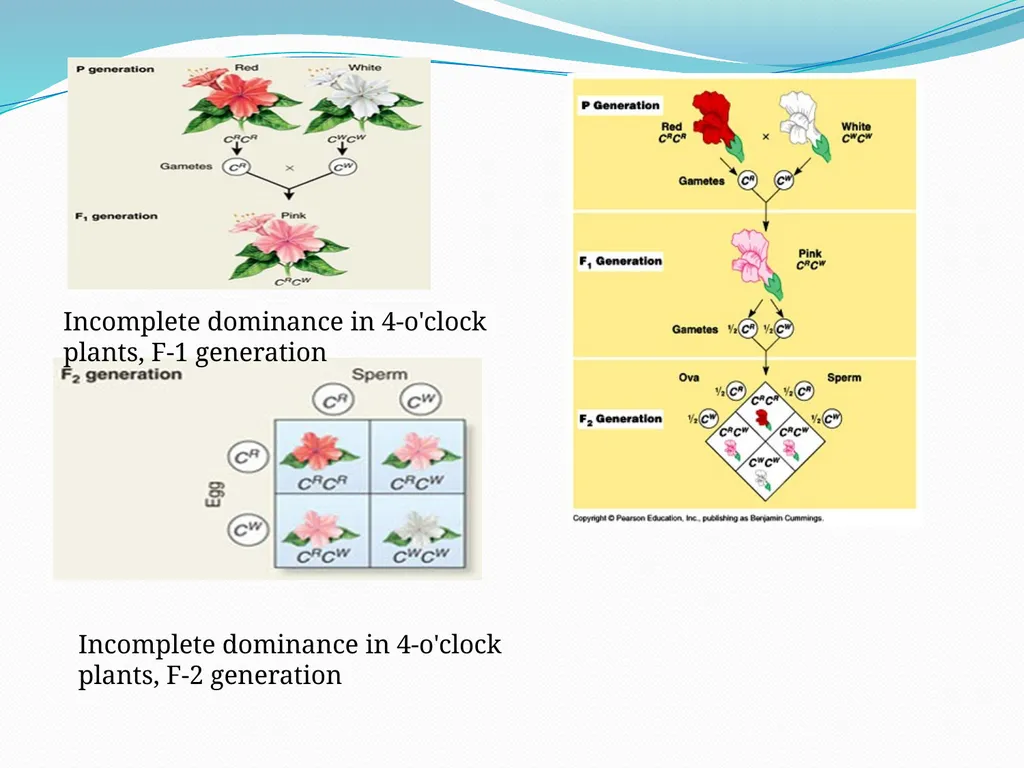
occurs when the phenotype of the heterozygous genotype is distinct from and often intermediate to the phenotypes of the homozygous genotypes. For example, the snapdragon flower color is homozygous for either red or white. When the red homozygous flower is paired with the white homozygous flower, the result yields a pink snapdragon flower. The pink snapdragon is the result of incomplete dominance. A similar type of incomplete dominance is found in the four o'clock plant wherein pink color is produced when true-bred parents of white and red flowers are crossed. In quantitative genetics, where phenotypes are measured and treated numerically, if a heterozygote's phenotype is exactly between (numerically) that of the two homozygotes, the phenotype is said to exhibit no dominance at all, i.e. dominance exists only when the heterozygote's phenotype measure lies closer to one homozygote than the other.
When plants of the F1 generation are self-pollinated, the phenotypic and genotypic ratio of the F2 generation will be 1:2:1 (Red:Pink:White)<br>
occurs when the phenotype of the heterozygous genotype is distinct from and often intermediate to the phenotypes of the homozygous genotypes. For example, the snapdragon flower color is homozygous for either red or white. When the red homozygous flower is paired with the white homozygous flower, the result yields a pink snapdragon flower. The pink snapdragon is the result of incomplete dominance. A similar type of incomplete dominance is found in the four o'clock plant wherein pink color is produced when true-bred parents of white and red flowers are crossed. In quantitative genetics, where phenotypes are measured and treated numerically, if a heterozygote's phenotype is exactly between (numerically) that of the two homozygotes, the phenotype is said to exhibit no dominance at all, i.e. dominance exists only when the heterozygote's phenotype measure lies closer to one homozygote than the other.
When plants of the F1 generation are self-pollinated, the phenotypic and genotypic ratio of the F2 generation will be 1:2:1 (Red:Pink:White)<br>
07
Incomplete dominance in 4-o'clock plants, F-1 generation Incomplete dominance in 4-o'clock plants, F-2 generation<br>
08
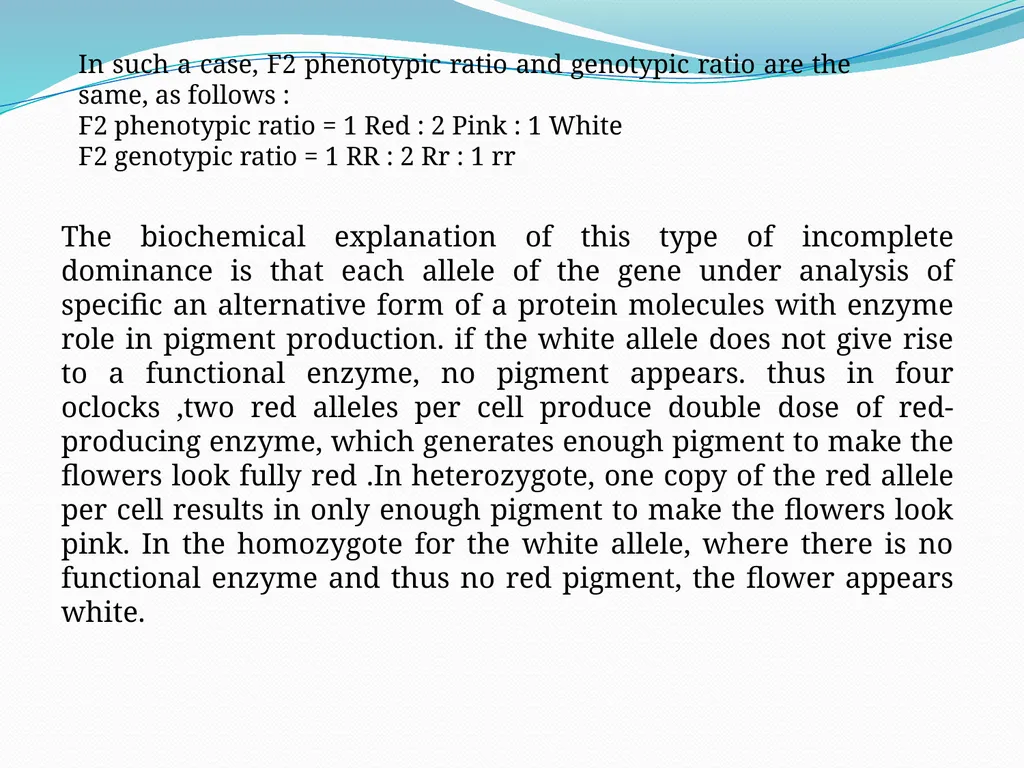
In such a case, F2 phenotypic ratio and genotypic ratio are the same, as follows :
F2 phenotypic ratio = 1 Red : 2 Pink : 1 White
F2 genotypic ratio = 1 RR : 2 Rr : 1 rr The biochemical explanation of this type of incomplete dominance is that each allele of the gene under analysis of specific an alternative form of a protein molecules with enzyme role in pigment production. if the white allele does not give rise to a functional enzyme, no pigment appears. thus in four oclocks ,two red alleles per cell produce double dose of red-producing enzyme, which generates enough pigment to make the flowers look fully red .In heterozygote, one copy of the red allele per cell results in only enough pigment to make the flowers look pink. In the homozygote for the white allele, where there is no functional enzyme and thus no red pigment, the flower appears white.<br>
F2 phenotypic ratio = 1 Red : 2 Pink : 1 White
F2 genotypic ratio = 1 RR : 2 Rr : 1 rr The biochemical explanation of this type of incomplete dominance is that each allele of the gene under analysis of specific an alternative form of a protein molecules with enzyme role in pigment production. if the white allele does not give rise to a functional enzyme, no pigment appears. thus in four oclocks ,two red alleles per cell produce double dose of red-producing enzyme, which generates enough pigment to make the flowers look fully red .In heterozygote, one copy of the red allele per cell results in only enough pigment to make the flowers look pink. In the homozygote for the white allele, where there is no functional enzyme and thus no red pigment, the flower appears white.<br>
09
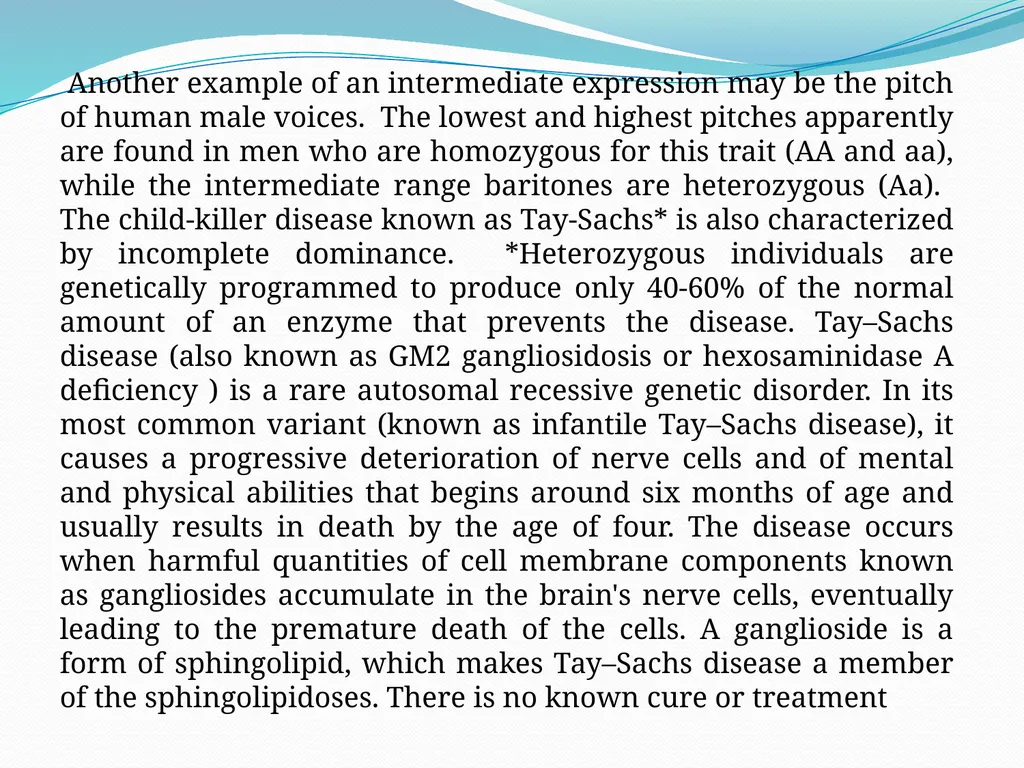
Another example of an intermediate expression may be the pitch of human male voices. The lowest and highest pitches apparently are found in men who are homozygous for this trait (AA and aa), while the intermediate range baritones are heterozygous (Aa). The child-killer disease known as Tay-Sachs* is also characterized by incomplete dominance. *Heterozygous individuals are genetically programmed to produce only 40-60% of the normal amount of an enzyme that prevents the disease. Tay–Sachs disease (also known as GM2 gangliosidosis or hexosaminidase A deficiency ) is a rare autosomal recessive genetic disorder. In its most common variant (known as infantile Tay–Sachs disease), it causes a progressive deterioration of nerve cells and of mental and physical abilities that begins around six months of age and usually results in death by the age of four. The disease occurs when harmful quantities of cell membrane components known as gangliosides accumulate in the brain's nerve cells, eventually leading to the premature death of the cells. A ganglioside is a form of sphingolipid, which makes Tay–Sachs disease a member of the sphingolipidoses. There is no known cure or treatment<br>
10
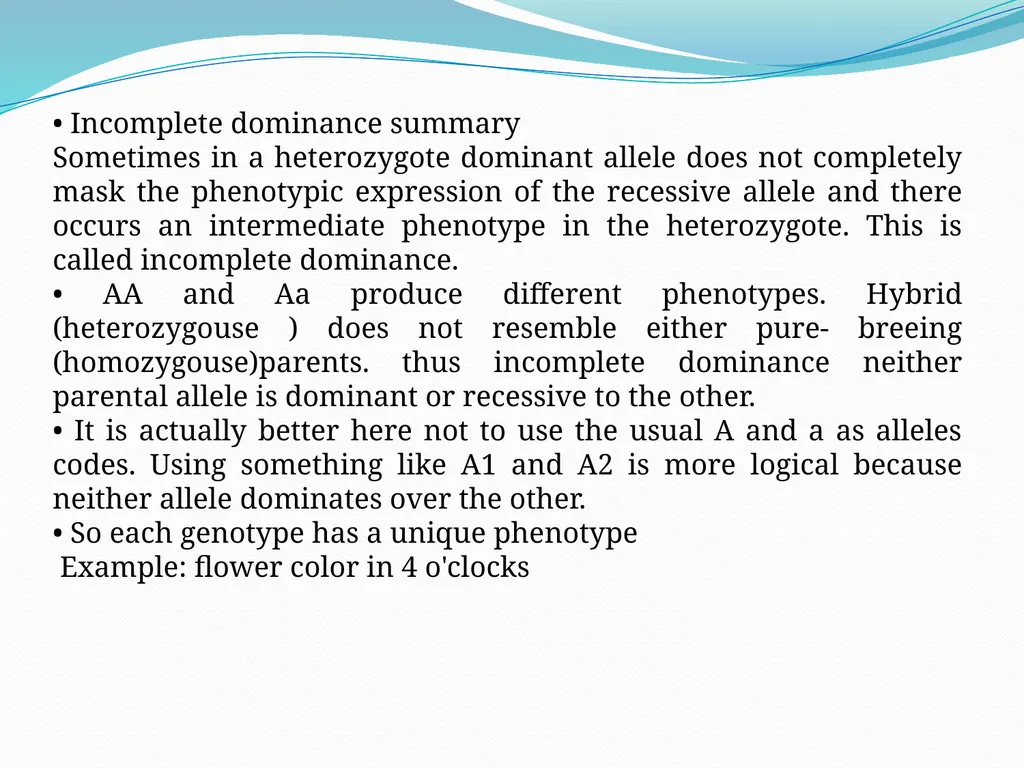
• Incomplete dominance summary
Sometimes in a heterozygote dominant allele does not completely mask the phenotypic expression of the recessive allele and there occurs an intermediate phenotype in the heterozygote. This is called incomplete dominance.
• AA and Aa produce different phenotypes. Hybrid (heterozygouse ) does not resemble either pure- breeing (homozygouse)parents. thus incomplete dominance neither parental allele is dominant or recessive to the other.
• It is actually better here not to use the usual A and a as alleles codes. Using something like A1 and A2 is more logical because neither allele dominates over the other.
• So each genotype has a unique phenotype
Example: flower color in 4 o'clocks<br>
Sometimes in a heterozygote dominant allele does not completely mask the phenotypic expression of the recessive allele and there occurs an intermediate phenotype in the heterozygote. This is called incomplete dominance.
• AA and Aa produce different phenotypes. Hybrid (heterozygouse ) does not resemble either pure- breeing (homozygouse)parents. thus incomplete dominance neither parental allele is dominant or recessive to the other.
• It is actually better here not to use the usual A and a as alleles codes. Using something like A1 and A2 is more logical because neither allele dominates over the other.
• So each genotype has a unique phenotype
Example: flower color in 4 o'clocks<br>
11
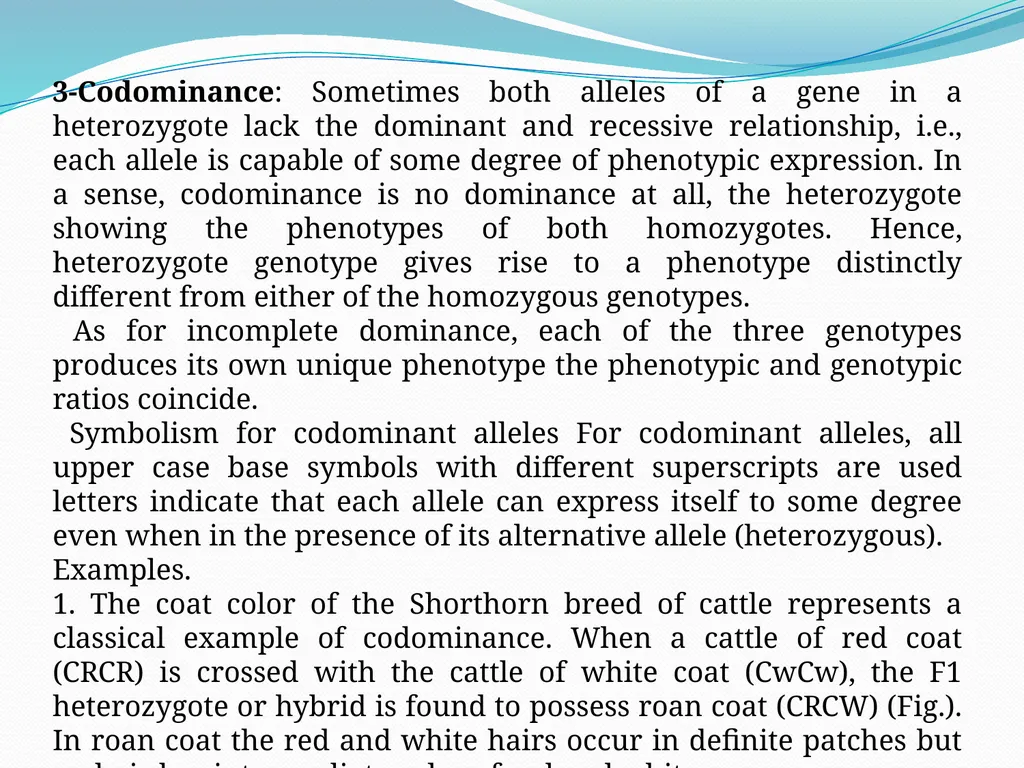
3-Codominance: Sometimes both alleles of a gene in a heterozygote lack the dominant and recessive relationship, i.e., each allele is capable of some degree of phenotypic expression. In a sense, codominance is no dominance at all, the heterozygote showing the phenotypes of both homozygotes. Hence, heterozygote genotype gives rise to a phenotype distinctly different from either of the homozygous genotypes.
As for incomplete dominance, each of the three genotypes produces its own unique phenotype the phenotypic and genotypic ratios coincide.
Symbolism for codominant alleles For codominant alleles, all upper case base symbols with different superscripts are used letters indicate that each allele can express itself to some degree even when in the presence of its alternative allele (heterozygous).
Examples.
1. The coat color of the Shorthorn breed of cattle represents a classical example of codominance. When a cattle of red coat (CRCR) is crossed with the cattle of white coat (CwCw), the F1 heterozygote or hybrid is found to possess roan coat (CRCW) (Fig.). In roan coat the red and white hairs occur in definite patches but no hair has intermediate color of red and white.<br>
As for incomplete dominance, each of the three genotypes produces its own unique phenotype the phenotypic and genotypic ratios coincide.
Symbolism for codominant alleles For codominant alleles, all upper case base symbols with different superscripts are used letters indicate that each allele can express itself to some degree even when in the presence of its alternative allele (heterozygous).
Examples.
1. The coat color of the Shorthorn breed of cattle represents a classical example of codominance. When a cattle of red coat (CRCR) is crossed with the cattle of white coat (CwCw), the F1 heterozygote or hybrid is found to possess roan coat (CRCW) (Fig.). In roan coat the red and white hairs occur in definite patches but no hair has intermediate color of red and white.<br>
12
2- The alleles governing the M-N blood group system in humans are codominants and may be represented by the symbols LM and LN, base letter L being assigned in honor of its discoverers Landsteiner and Levine). Here, three blood groups are possible–M, N and MN–and these are determined by the genotypes LMLM, LNLN, and LM LN, respectively. Blood groups actually represent the presence of an immunological antigen on the surface of red blood cells. People of LMLN genotype have both antigens. In the following summary chart, agglutination is represented by + and nonagglutination by – sign
Genotype Reaction with antisera
Anti–M Anti–N Blood group
LM LM + - M
LMLN + + MN
LNLN _ + NN<br>
Genotype Reaction with antisera
Anti–M Anti–N Blood group
LM LM + - M
LMLN + + MN
LNLN _ + NN<br>
13
3- in the ABO blood group system, chemical modifications to a glycoprotein (the H antigen) on the surfaces of blood cells are controlled by three alleles, two of which are co-dominant to each other (IA, IB) and dominant over the recessive i at the ABO locus. The IA and IB alleles produce different modifications. The enzyme coded for by IA adds an N-acetylgalactosamine to the membrane-bound H antigen. The IB enzyme adds a galactose. The i allele produces no modification. Thus IA and IB alleles are each dominant to i (IAIA and IAi individuals both have type A blood, and IBIB and IBi individuals both have type B blood, but IAIB individuals have both modifications on their blood cells and thus have type AB blood, so the IA and IB alleles are said to be co-dominant).<br>
14
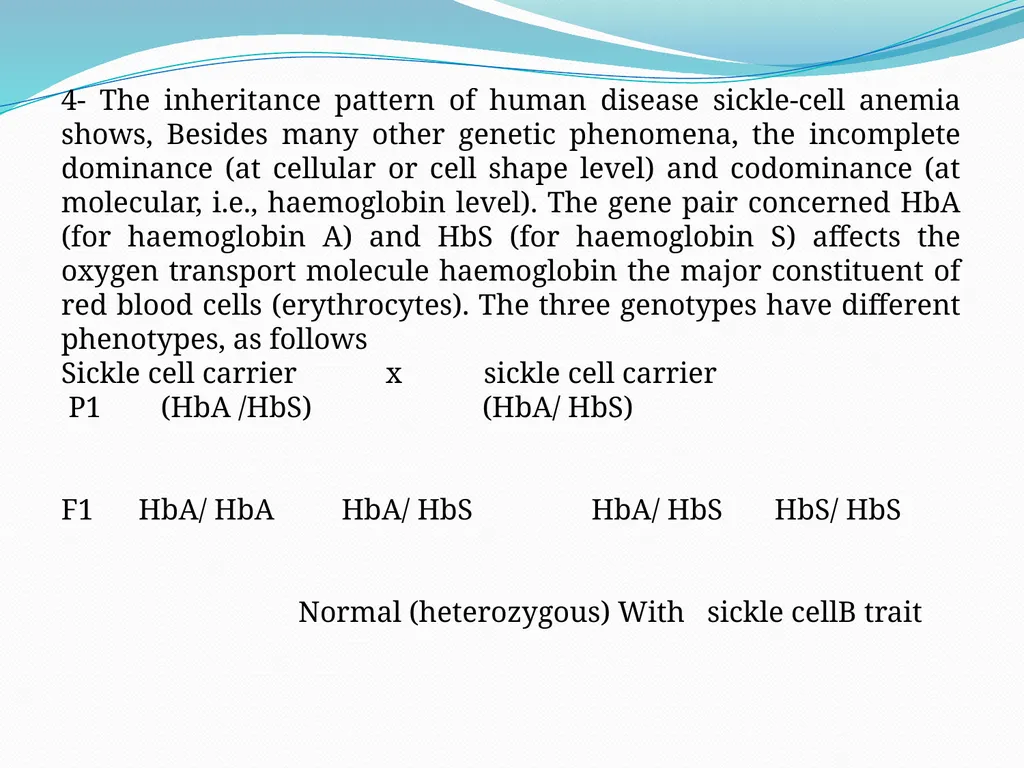
4- The inheritance pattern of human disease sickle-cell anemia shows, Besides many other genetic phenomena, the incomplete dominance (at cellular or cell shape level) and codominance (at molecular, i.e., haemoglobin level). The gene pair concerned HbA (for haemoglobin A) and HbS (for haemoglobin S) affects the oxygen transport molecule haemoglobin the major constituent of red blood cells (erythrocytes). The three genotypes have different phenotypes, as follows
Sickle cell carrier x sickle cell carrier
P1 (HbA /HbS) (HbA/ HbS)
F1 HbA/ HbA HbA/ HbS HbA/ HbS HbS/ HbS
Normal (heterozygous) With sickle cellB trait<br>
Sickle cell carrier x sickle cell carrier
P1 (HbA /HbS) (HbA/ HbS)
F1 HbA/ HbA HbA/ HbS HbA/ HbS HbS/ HbS
Normal (heterozygous) With sickle cellB trait<br>
15
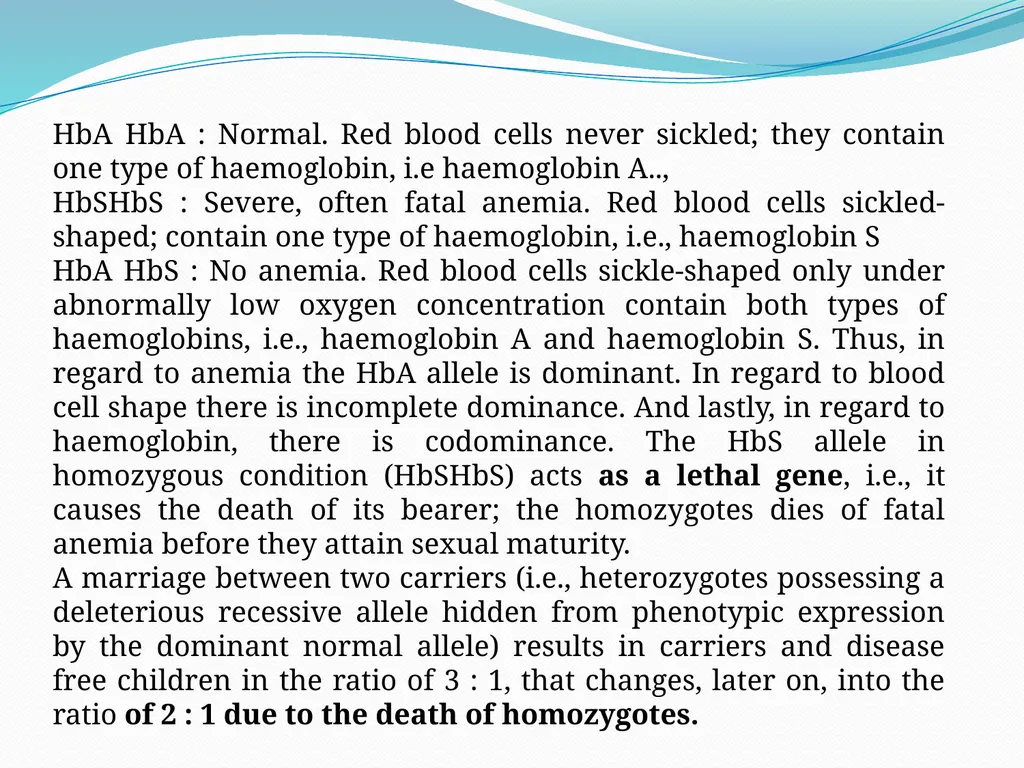
HbA HbA : Normal. Red blood cells never sickled; they contain one type of haemoglobin, i.e haemoglobin A..,
HbSHbS : Severe, often fatal anemia. Red blood cells sickled-shaped; contain one type of haemoglobin, i.e., haemoglobin S
HbA HbS : No anemia. Red blood cells sickle-shaped only under abnormally low oxygen concentration contain both types of haemoglobins, i.e., haemoglobin A and haemoglobin S. Thus, in regard to anemia the HbA allele is dominant. In regard to blood cell shape there is incomplete dominance. And lastly, in regard to haemoglobin, there is codominance. The HbS allele in homozygous condition (HbSHbS) acts as a lethal gene, i.e., it causes the death of its bearer; the homozygotes dies of fatal anemia before they attain sexual maturity.
A marriage between two carriers (i.e., heterozygotes possessing a deleterious recessive allele hidden from phenotypic expression by the dominant normal allele) results in carriers and disease free children in the ratio of 3 : 1, that changes, later on, into the ratio of 2 : 1 due to the death of homozygotes.<br>
HbSHbS : Severe, often fatal anemia. Red blood cells sickled-shaped; contain one type of haemoglobin, i.e., haemoglobin S
HbA HbS : No anemia. Red blood cells sickle-shaped only under abnormally low oxygen concentration contain both types of haemoglobins, i.e., haemoglobin A and haemoglobin S. Thus, in regard to anemia the HbA allele is dominant. In regard to blood cell shape there is incomplete dominance. And lastly, in regard to haemoglobin, there is codominance. The HbS allele in homozygous condition (HbSHbS) acts as a lethal gene, i.e., it causes the death of its bearer; the homozygotes dies of fatal anemia before they attain sexual maturity.
A marriage between two carriers (i.e., heterozygotes possessing a deleterious recessive allele hidden from phenotypic expression by the dominant normal allele) results in carriers and disease free children in the ratio of 3 : 1, that changes, later on, into the ratio of 2 : 1 due to the death of homozygotes.<br>
16
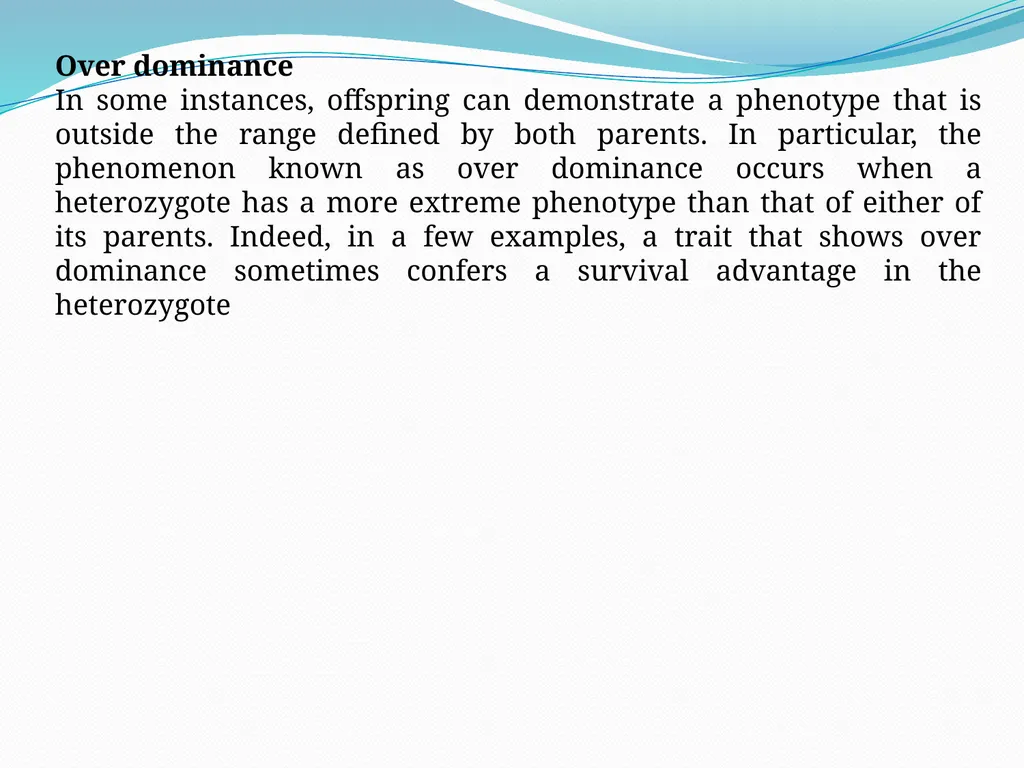
Over dominance
In some instances, offspring can demonstrate a phenotype that is outside the range defined by both parents. In particular, the phenomenon known as over dominance occurs when a heterozygote has a more extreme phenotype than that of either of its parents. Indeed, in a few examples, a trait that shows over dominance sometimes confers a survival advantage in the heterozygote<br>
In some instances, offspring can demonstrate a phenotype that is outside the range defined by both parents. In particular, the phenomenon known as over dominance occurs when a heterozygote has a more extreme phenotype than that of either of its parents. Indeed, in a few examples, a trait that shows over dominance sometimes confers a survival advantage in the heterozygote<br>
17
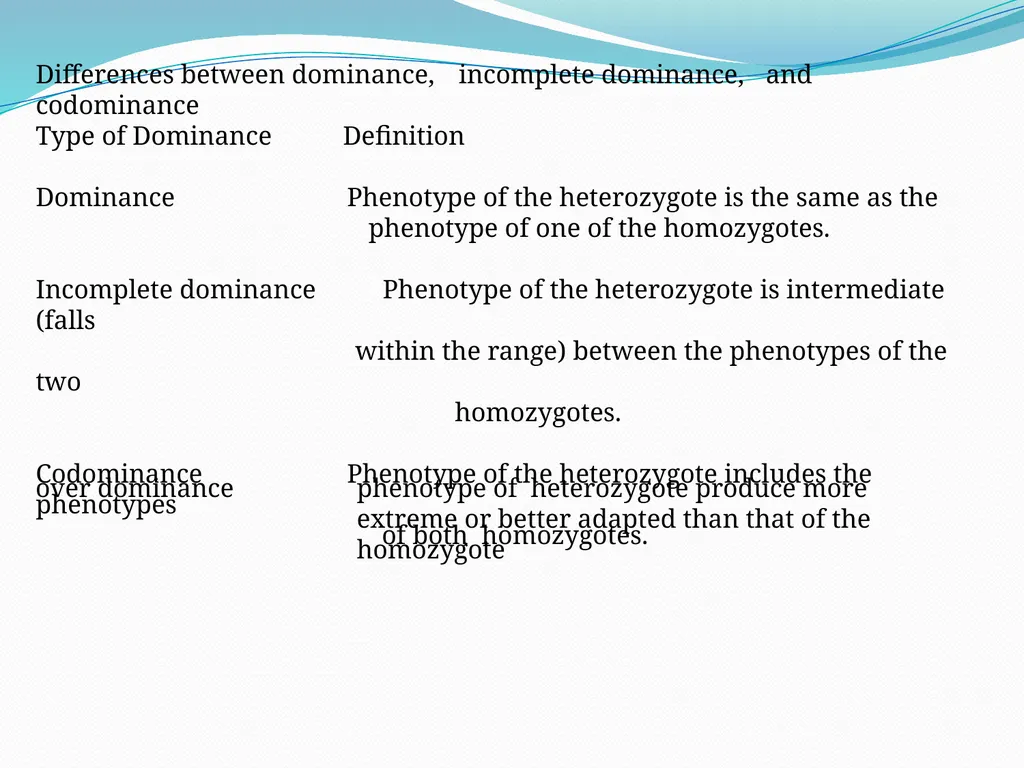
Differences between dominance, incomplete dominance, and codominance
Type of Dominance Definition
Dominance Phenotype of the heterozygote is the same as the
phenotype of one of the homozygotes.
Incomplete dominance Phenotype of the heterozygote is intermediate (falls
within the range) between the phenotypes of the two
homozygotes.
Codominance Phenotype of the heterozygote includes the phenotypes
of both homozygotes. phenotype of heterozygote produce more extreme or better adapted than that of the homozygote over dominance<br>
Type of Dominance Definition
Dominance Phenotype of the heterozygote is the same as the
phenotype of one of the homozygotes.
Incomplete dominance Phenotype of the heterozygote is intermediate (falls
within the range) between the phenotypes of the two
homozygotes.
Codominance Phenotype of the heterozygote includes the phenotypes
of both homozygotes. phenotype of heterozygote produce more extreme or better adapted than that of the homozygote over dominance<br>
18
Variation on complete dominance do not negate Mendel's law of segregation
Variation in dominance does not change Mendel's law of segregation. Alleles still come in pairs and segregate during gamete production. The difference is only in how the alleles are expressed when two different ones occur together. Incomplete dominance or codominance depend on the kind of proteins determine by the alleles and biochemical function of those proteins in the cell.<br>
Variation in dominance does not change Mendel's law of segregation. Alleles still come in pairs and segregate during gamete production. The difference is only in how the alleles are expressed when two different ones occur together. Incomplete dominance or codominance depend on the kind of proteins determine by the alleles and biochemical function of those proteins in the cell.<br>