Geography the equator What is the equator? It is an imaginary line running around the widest part of the Earth, halfway between the North Pole and the South Pole. North of the Equator, youre in the Northern Hemisphere. South of the
"Geography – the equator What is the equator? It is" is the property of its rightful owner. Permission is granted to
download and print the materials on this website for personal, non-commercial use only, and to display it
on your personal computer provided you do not modify the materials and that you retain all copyright
notices contained in the materials. By downloading content from our website, you accept the terms of this
agreement.
Presentation Transcript
01
Geography – the equator<br>
02
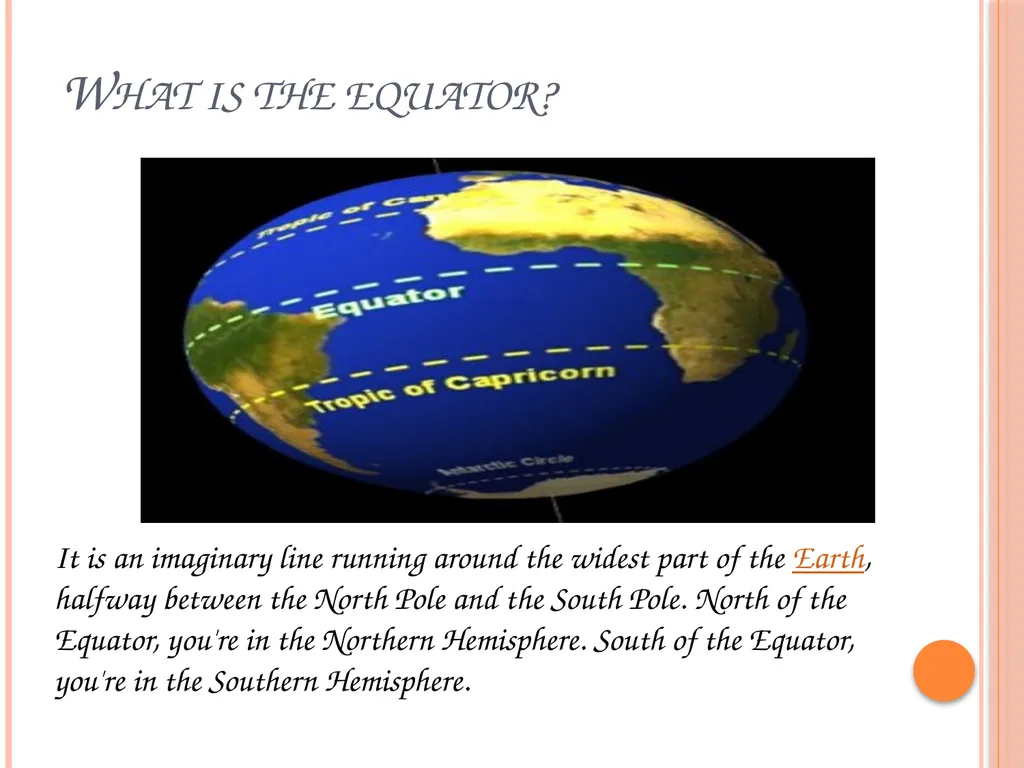
What is the equator? It is an imaginary line running around the widest part of the Earth, halfway between the North Pole and the South Pole. North of the Equator, you're in the Northern Hemisphere. South of the Equator, you're in the Southern Hemisphere.<br>
03
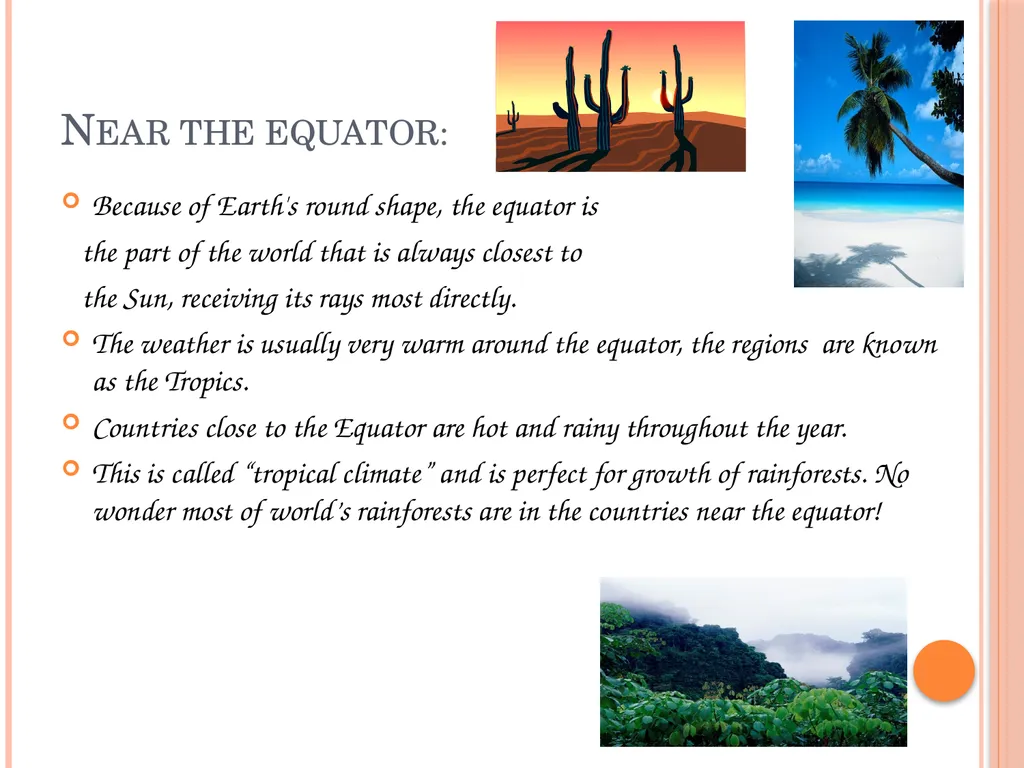
Near the equator: Because of Earth's round shape, the equator is
the part of the world that is always closest to
the Sun, receiving its rays most directly.
The weather is usually very warm around the equator, the regions are known as the Tropics.
Countries close to the Equator are hot and rainy throughout the year.
This is called “tropical climate” and is perfect for growth of rainforests. No wonder most of world’s rainforests are in the countries near the equator!<br>
04
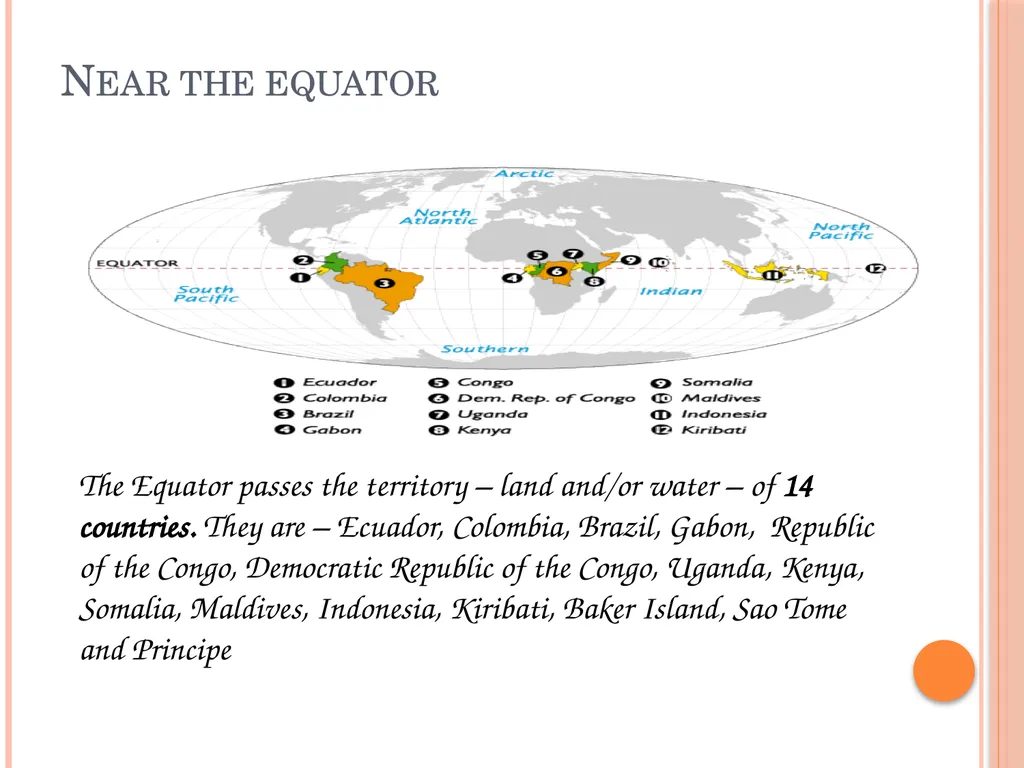
Near the equator The Equator passes the territory – land and/or water – of 14 countries. They are – Ecuador, Colombia, Brazil, Gabon, Republic of the Congo, Democratic Republic of the Congo, Uganda, Kenya, Somalia, Maldives, Indonesia, Kiribati, Baker Island, Sao Tome and Principe<br>
05
Africa and the equator The equator passes through Africa.
This is why the continent has many countries with hot weather.
Animals such as Giraffes, Elephants, Lions and Hippos
live in Africa.<br>
06
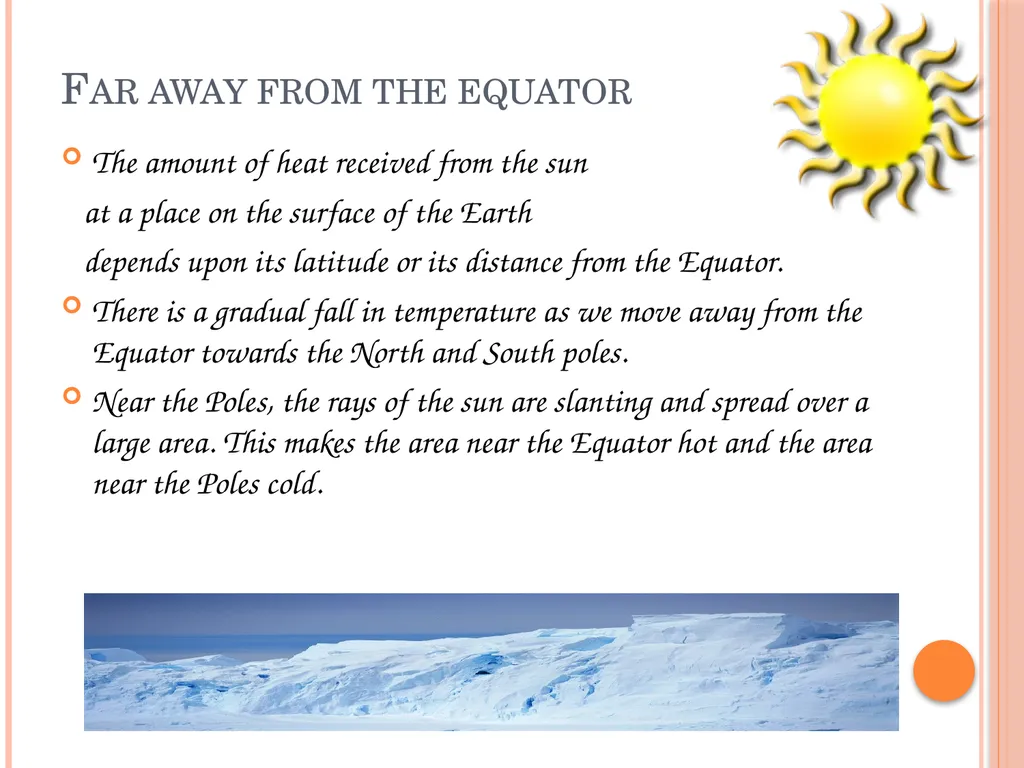
Far away from the equator The amount of heat received from the sun
at a place on the surface of the Earth
depends upon its latitude or its distance from the Equator.
There is a gradual fall in temperature as we move away from the Equator towards the North and South poles.
Near the Poles, the rays of the sun are slanting and spread over a large area. This makes the area near the Equator hot and the area near the Poles cold.<br>
07
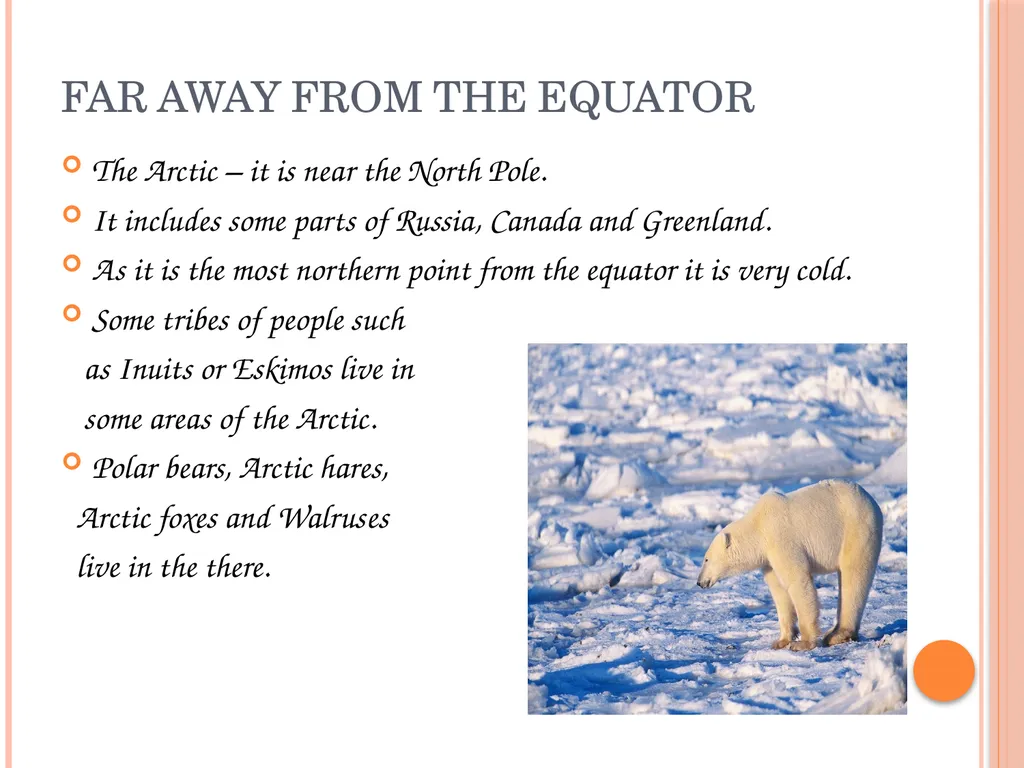
FAR AWAY FROM THE EQUATOR The Arctic – it is near the North Pole.
It includes some parts of Russia, Canada and Greenland.
As it is the most northern point from the equator it is very cold.
Some tribes of people such
as Inuits or Eskimos live in
some areas of the Arctic.
Polar bears, Arctic hares,
Arctic foxes and Walruses
live in the there.<br>
08
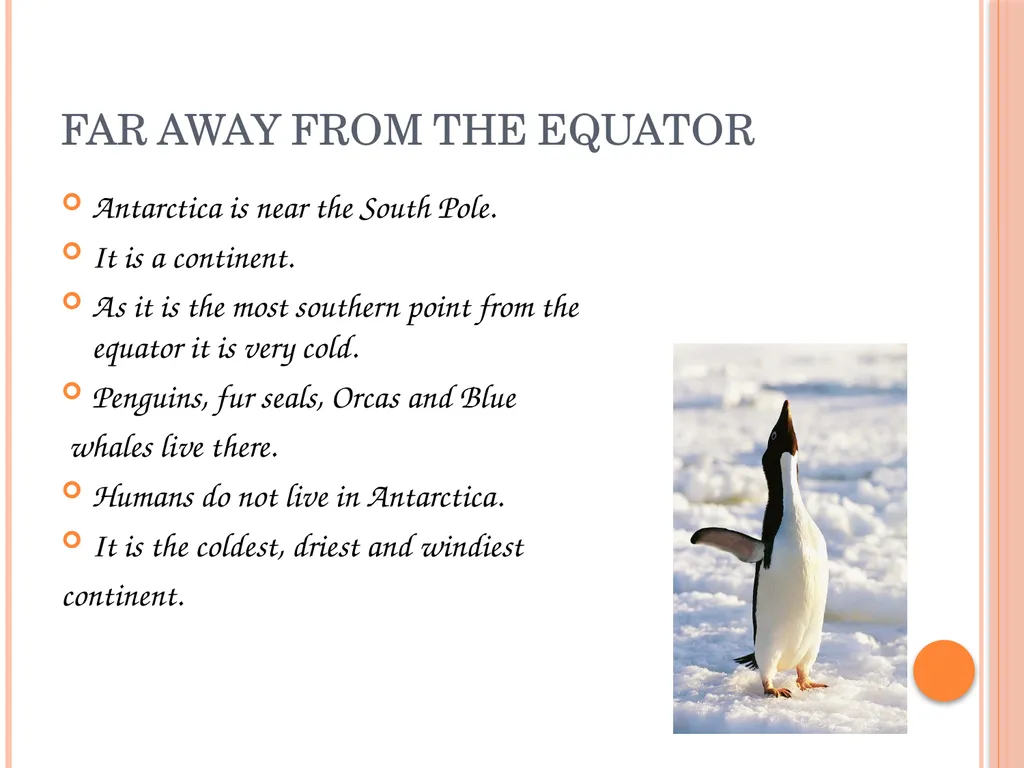
FAR AWAY FROM THE EQUATOR Antarctica is near the South Pole.
It is a continent.
As it is the most southern point from the equator it is very cold.
Penguins, fur seals, Orcas and Blue
whales live there.
Humans do not live in Antarctica.
It is the coldest, driest and windiest
continent.<br>