Georgia House Rural Development Council Memorial Hospital and Manor Bainbridge, Georgia Dean Burke M.D. - Medical DirectorChief Medical Officer Gregg Magers - Interim CEO Glennie Bench - Chair of Hospital Authority Presenters: Memorial
"Georgia House Rural Development Council Memorial" is the property of its rightful owner. Permission is granted to
download and print the materials on this website for personal, non-commercial use only, and to display it
on your personal computer provided you do not modify the materials and that you retain all copyright
notices contained in the materials. By downloading content from our website, you accept the terms of this
agreement.
Presentation Transcript
01
Georgia House Rural Development Council Memorial Hospital and Manor
Bainbridge, Georgia<br>
02
Dean Burke M.D. - Medical Director/Chief Medical Officer
Gregg Magers - Interim CEO
Glennie Bench - Chair of Hospital Authority Presenters:<br>
03
Memorial Hospital and Manor
80 Licensed Beds-staffed for 45
107 Bed attached Nursing Home
450 FTE’s
Annual Net revenue-$45 Million<br>
04
FY 2015 - Loss of $4.83 million
FY 2016 - Loss of $6.35 million
“Going Concern” letter from auditor
FY 2017 - Net Income $230, 000
First quarter FY 2018 - Net Income $244,000 MHM-Financial Comeback<br>
05
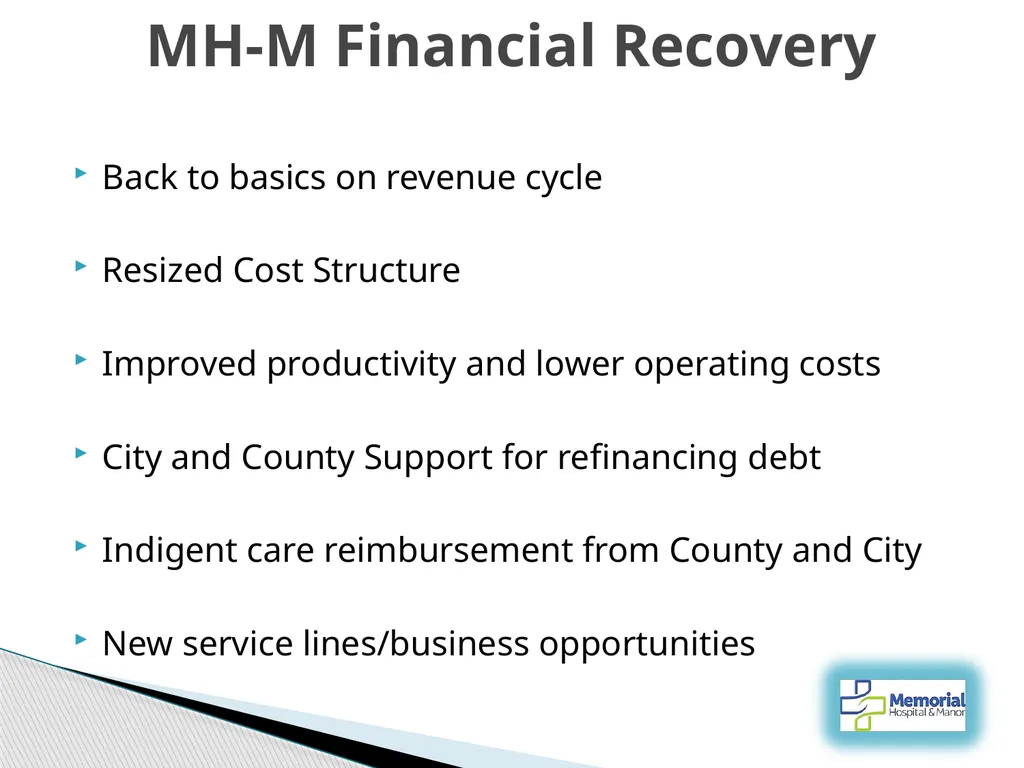
Back to basics on revenue cycle
Resized Cost Structure
Improved productivity and lower operating costs
City and County Support for refinancing debt
Indigent care reimbursement from County and City
New service lines/business opportunities MH-M Financial Recovery<br>
06
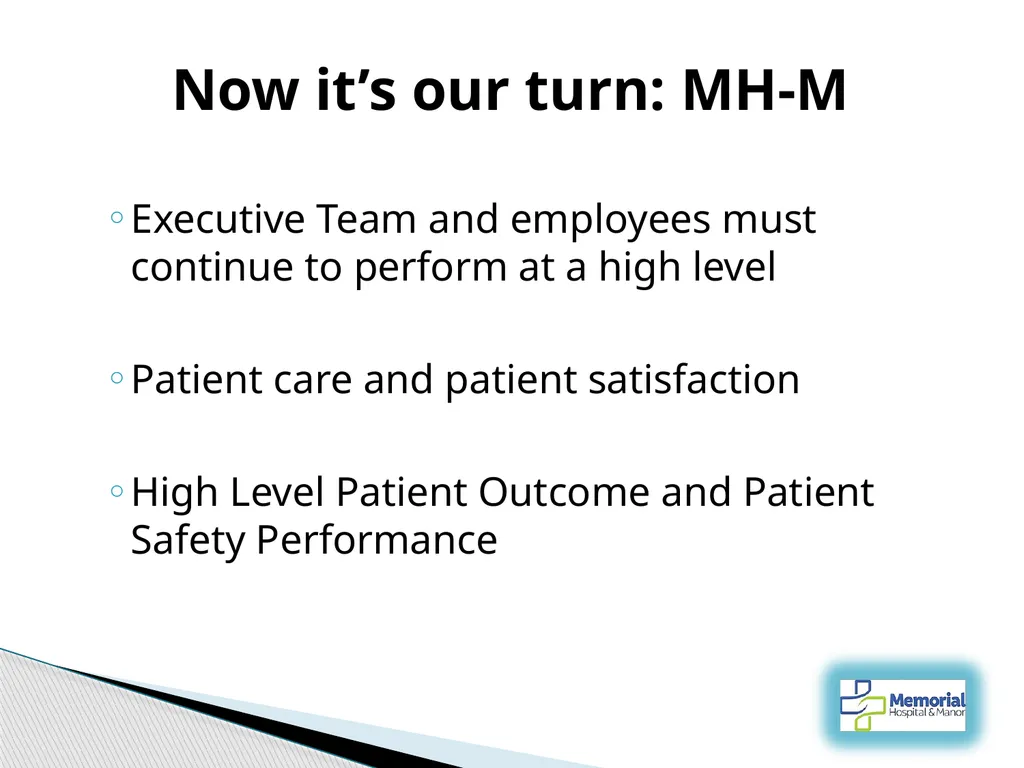
Now it’s our turn: MH-M
Executive Team and employees must continue to perform at a high level
Patient care and patient satisfaction
High Level Patient Outcome and Patient Safety Performance<br>
07
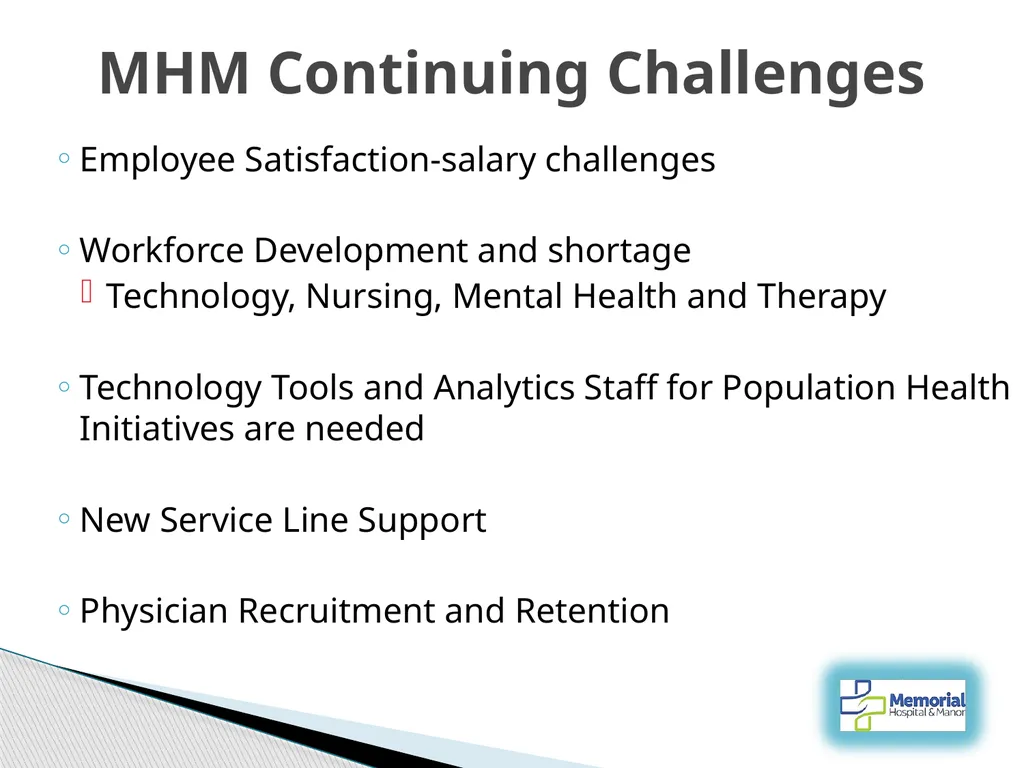
Employee Satisfaction-salary challenges
Workforce Development and shortage
Technology, Nursing, Mental Health and Therapy
Technology Tools and Analytics Staff for Population Health Initiatives are needed
New Service Line Support
Physician Recruitment and Retention MHM Continuing Challenges<br>
08
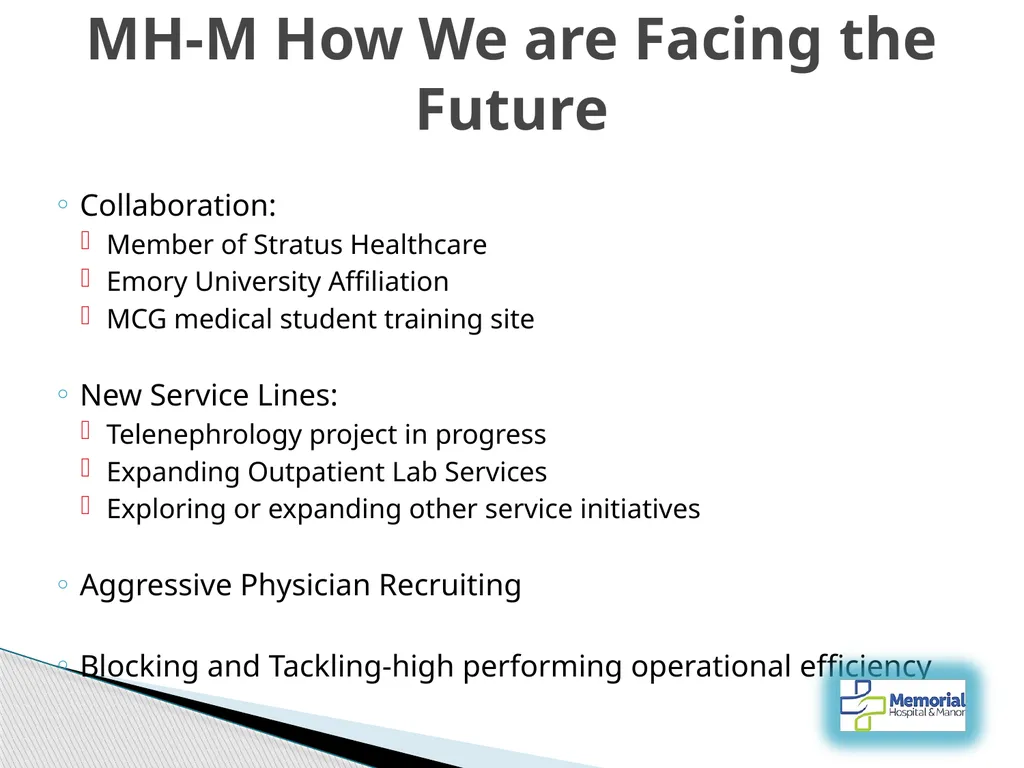
Collaboration:
Member of Stratus Healthcare
Emory University Affiliation
MCG medical student training site
New Service Lines:
Telenephrology project in progress
Expanding Outpatient Lab Services
Exploring or expanding other service initiatives
Aggressive Physician Recruiting
Blocking and Tackling-high performing operational efficiency MH-M How We are Facing the Future<br>
09
How Can the State of Georgia Help?
Financial
Develop grant programs to support investment in software and personnel for population health initiatives and value based contracting.
Enhance reimbursement and support for mental health integration into primary care.
Reevaluate physician recruiting initiatives to rural Georgia<br>
10
How Can the State of Georgia Help?
Financial Support
Increase grants for readmission prevention and home health care programs to prevent ED overutilization
Continue to support PCMH grants for practice transformation
Provide reimbursement for population health/wellness initiatives in the community setting.<br>
11
How Can the State of Georgia Help?
Workforce Support
Improve incentives for physician recruitment to rural areas
Increase support for development of rural residency programs
Increase scholarship incentives for technology schools training workforce in rural areas<br>
12
How Can the State of Georgia Help?
General Support
Increase development of Hospital Authority Board member training and scholarships for members who obtain training
Consider Rural Center of Excellence for Healthcare
To increase access to best practice support available to rural hospitals in all areas of expertise required
Expand USG support of internships and training opportunities in rural Georgia<br>
13
How Can the State of Georgia Help?
Clinical Support
Decrease bureacracy and administrative burdens from Medicaid, DCH, and Care Management Organizations for rural practices
Encourage standardization of quality metrics from all payers
Allow update to attestation of all rural primary care physicians
Develop Swing bed, post acute and home health initiatives for PPS (prospective payment) rural hospitals.<br>
14
Why are rural health delivery systems important?
Extremely poor current health outcomes-statewide 49th out of 50 states
Maternal Mortality rates one of the worst in the nation
Mental Health System remains a challenge
Healthcare jobs vital to rural economy
Healthcare access vital to new or expanding industrial development.<br>
15
State has to:
Improve prevention and wellness efforts in rural counties-the most effective way to improve outcomes and lower cost
Develop new health care models for access to care for counties that demographically cannot continue to support a traditional hospital.
Address mental and population health challenges
Address generational poverty and lack of opportunity
Education, job training, housing and transportation<br>
16
Communities have to:
Be willing to accept change to status quo
Be part of the solution
Provide resources and collaboration in problem solving
Elect servant leaders who can focus on viable solutions and are willing to collaborate with all stakeholders
Embrace education initiatives focused on workforce development<br>