Getting a Reaction Reversible and Irreversible Changes Recap What is a reversible change? A reversible change is a chemical change where no new materials are created and the original material can be recovered. What is an irreversible
"Getting a Reaction Reversible and Irreversible" is the property of its rightful owner. Permission is granted to
download and print the materials on this website for personal, non-commercial use only, and to display it
on your personal computer provided you do not modify the materials and that you retain all copyright
notices contained in the materials. By downloading content from our website, you accept the terms of this
agreement.
Presentation Transcript
01
Getting a Reaction<br>
02
Reversible and Irreversible Changes Recap What is a reversible change?
A reversible change is a chemical change where no new materials are created and the original material can be recovered.
What is an irreversible change?
A change is called irreversible if it cannot be changed back again. In an irreversible change, new materials are always formed.<br>
03
There are some changes that result in the formation of new materials.
These changes are not usually reversible.
There are different ways in which these reactions can occur such as mixing, burning, rusting and heating. Irreversible Change<br>
04
Heating Heating can alter the state of different materials.
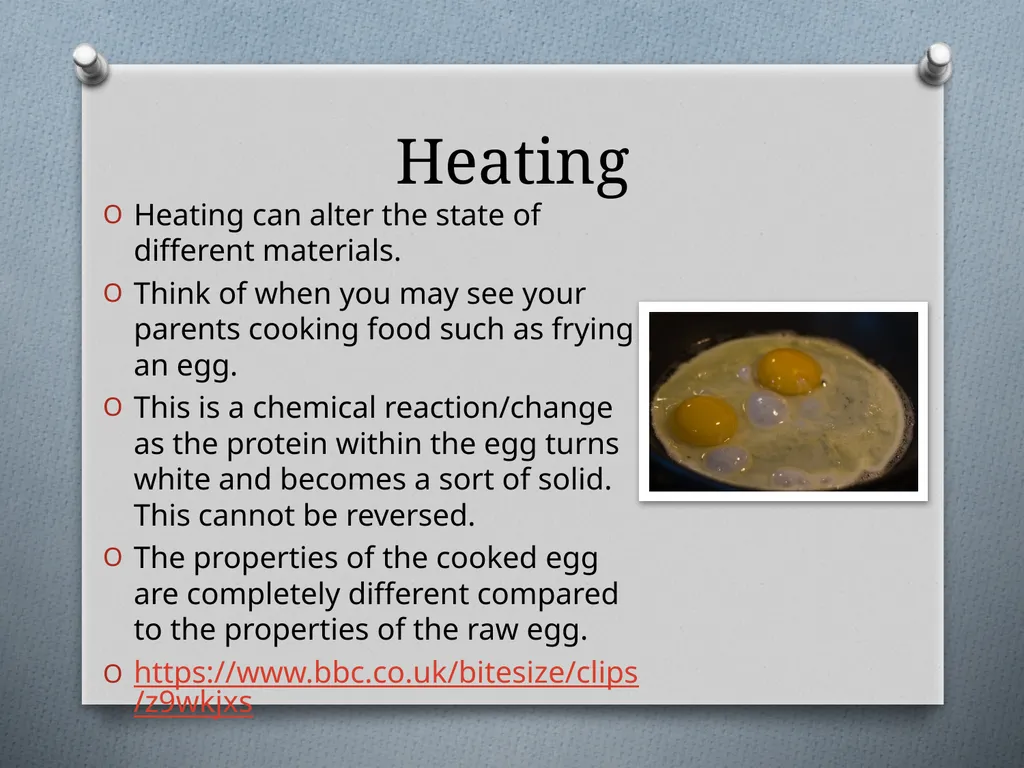
Think of when you may see your parents cooking food such as frying an egg.
This is a chemical reaction/change as the protein within the egg turns white and becomes a sort of solid. This cannot be reversed.
The properties of the cooked egg are completely different compared to the properties of the raw egg.
https://www.bbc.co.uk/bitesize/clips/z9wkjxs<br>
05
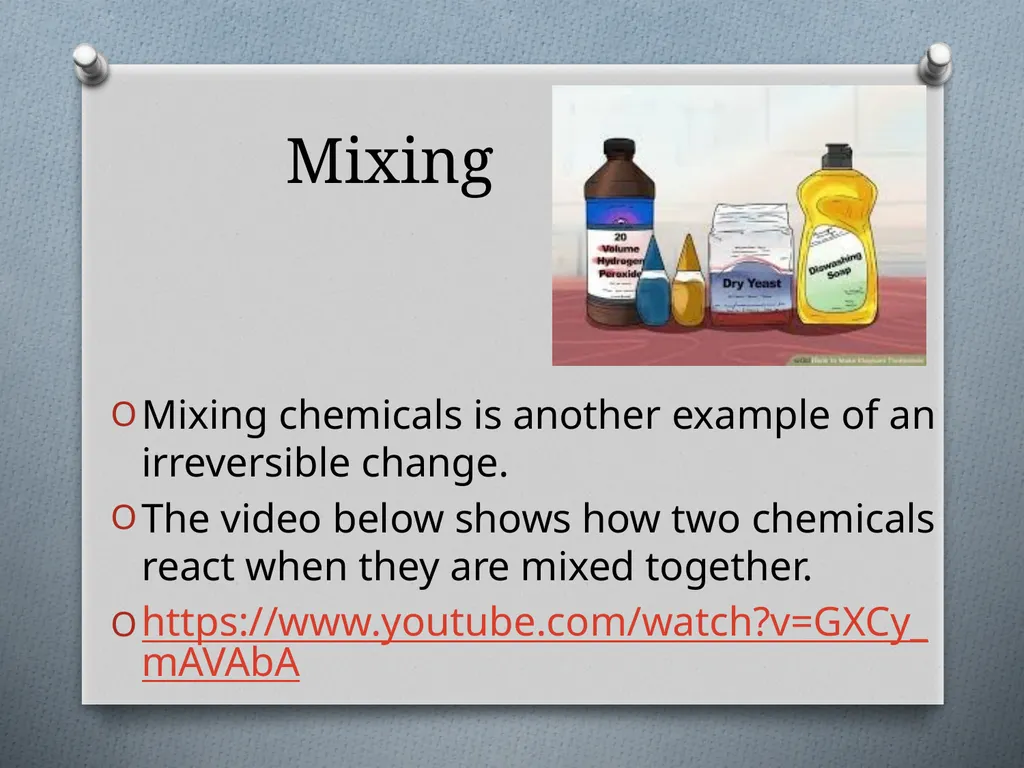
Mixing Mixing chemicals is another example of an irreversible change.
The video below shows how two chemicals react when they are mixed together.
https://www.youtube.com/watch?v=GXCy_mAVAbA<br>
06
Mixing What changes did you notice?
Is this a reversible or irreversible change? How do you know?<br>
07
Mixing Is this a reversible or irreversible change? How do you know?
It is an irreversible change as the 2 materials needed to make the ‘elephant toothpaste’ cannot be recovered again once they have been mixed.<br>
08
Burning Burning is another type of irreversible reaction.
Watch the video of the candle burning
https://www.bbc.co.uk/bitesize/clips/zc84d2p
What part of the candle do you think is burning?<br>
09
Burning What is actually burning?
It is not the wick that is burning, it is actually the wax vapour. As long as there is vapour a candle can be relit.
This also explains why a candle can take a few seconds to light as the wax has to melt and then become vapour before it lights.
Even though a candle can be relit, it is not a reversible change as the wax is not recreated. Once the wax has burnt, it cannot be recovered.<br>
10
Rusting What is rusting?
Rusting is when iron turns to iron oxide.
This does not just happen in iron though. Steel, which is made from iron, also rusts as it contains iron.
Rust takes a long time to form.
Watch the video clip below
https://www.bbc.co.uk/bitesize/clips/zc89wmn<br>
11
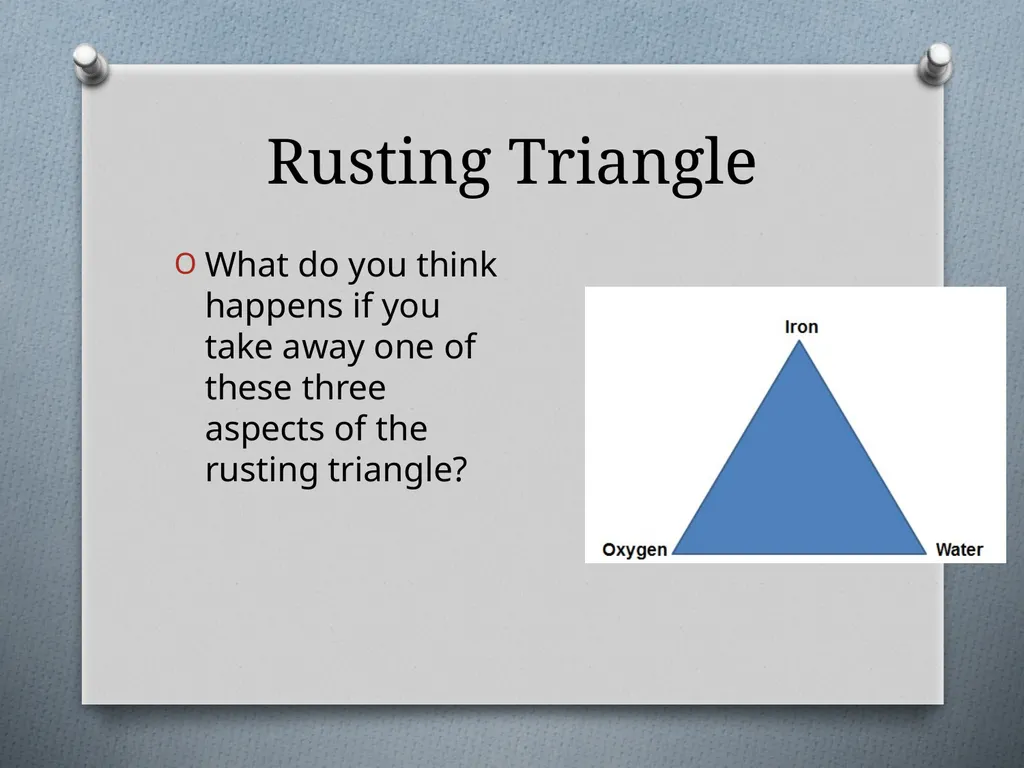
Rusting Triangle What do you think happens if you take away one of these three aspects of the rusting triangle?<br>
12
If you took away any of these aspects of the rusting triangle, then rust would not occur.
For rust to occur, iron, oxygen and water need to be present. Rusting Triangle<br>
13
How can rust be prevented?
Metals can be protected from rust using oil, grease and paint.
Can we blame water for Rust?
Oxygen found in the water mixes with the metal causing rust. If there is water around the metal then rust will be inevitable.<br>
14
Is Iron the only material that rusts? If you are able to and with the permission of your parent/guardian. You could test this question
Which materials could you use to test this? Wood and plastic
What could you do to each material? You could leave the materials in water for a set amount of time e.g. a week.
What would you observe to answer the question? You could see whether there are any changes in the materials
Are there any changes? If yes explain why, if no explain why? (think back to the rusting triangle)
Is rust a reversible or irreversible change? Irreversible<br>
15
If you would like to see some of these reactions in person you could ask your parent/guardian to
Fry an egg
Light a candle
THIS MUST ONLY BE DONE IN THE PRESENCE OF YOUR PARENT/GUARDIAN AND ONLY WITH THEIR PERMISSION. DO NOT TRY THIS ON YOUR OWN.<br>