
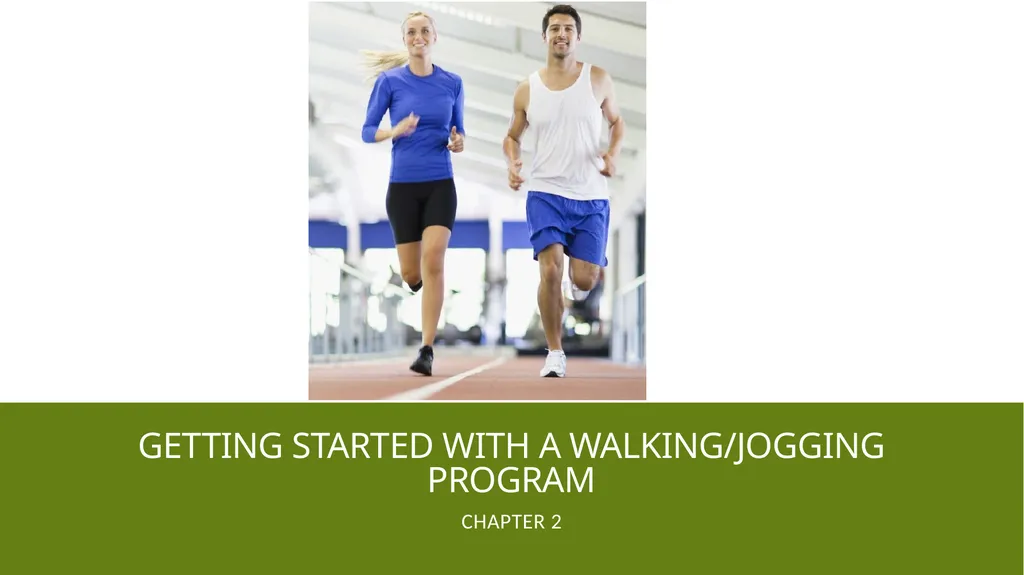
Getting Started WITH A WALKING/JOGGING PROGRAM
LO
Published · 17 slides · 0 views
1 / 1
Description
Getting Started WITH A WALKINGJOGGING PROGRAM Chapter 2 beginning A NEW ROUTINE Beginning a new exercise routine can have barriers Old habits, insufficient motivation, support from others, etc. all play a role in whether or not you
Related Topics
Share
Embed code
Download this presentation From Below
"Getting Started WITH A WALKING/JOGGING PROGRAM" is the property of its rightful owner. Permission is granted to download and print the materials on this website for personal, non-commercial use only, and to display it on your personal computer provided you do not modify the materials and that you retain all copyright notices contained in the materials. By downloading content from our website, you accept the terms of this agreement.
Presentation Transcript
01
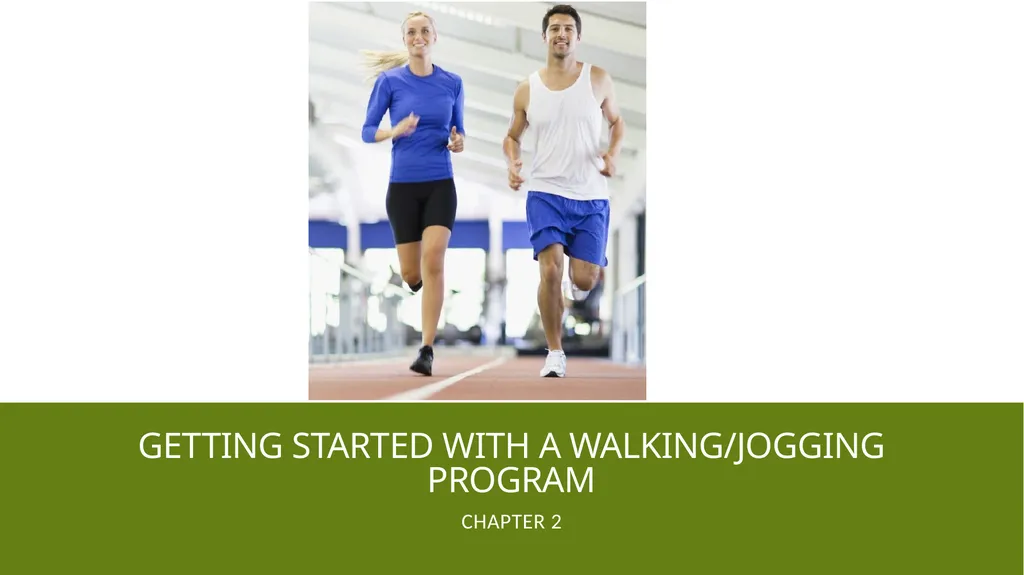
Getting Started WITH A WALKING/JOGGING PROGRAM Chapter 2<br>
02
beginning A NEW ROUTINE Beginning a new exercise routine can have barriers
Old habits, insufficient motivation, support from others, etc. all play a role in whether or not you successfully begin a new exercise program
Success can be measured by your ability to consistently participate in a walking or jogging program to reap the fitness benefits associated with the activity
Think “Lifestyle”
Behavior that is imbedded into your daily and weekly routine
Focus on what will make you consistent
Optimal health and fitness do not occur overnight
Time and more importantly, consistency, drive health and fitness outcomes<br>
Old habits, insufficient motivation, support from others, etc. all play a role in whether or not you successfully begin a new exercise program
Success can be measured by your ability to consistently participate in a walking or jogging program to reap the fitness benefits associated with the activity
Think “Lifestyle”
Behavior that is imbedded into your daily and weekly routine
Focus on what will make you consistent
Optimal health and fitness do not occur overnight
Time and more importantly, consistency, drive health and fitness outcomes<br>
03
Safety First The physical challenges of beginning a new exercise program can place you at a greater risk of injury, illness or even death
The long-term benefits of exercise unequivocally outweigh the risks during exercise
In active young adults (younger than 35), incidence of cardiac events are rare
Of those rare cardiac incidents that do occur, the presence of preexisting heart disease is the common thread, specifically atherosclerosis
Atherosclerosis causes arteries to harden and become clogged with plaque which can break apart, move to other parts of the body, and clog smaller blood vessels
It is important to screen individuals for risk factors associated with heart disease before they begin an exercise program<br>
The long-term benefits of exercise unequivocally outweigh the risks during exercise
In active young adults (younger than 35), incidence of cardiac events are rare
Of those rare cardiac incidents that do occur, the presence of preexisting heart disease is the common thread, specifically atherosclerosis
Atherosclerosis causes arteries to harden and become clogged with plaque which can break apart, move to other parts of the body, and clog smaller blood vessels
It is important to screen individuals for risk factors associated with heart disease before they begin an exercise program<br>
04
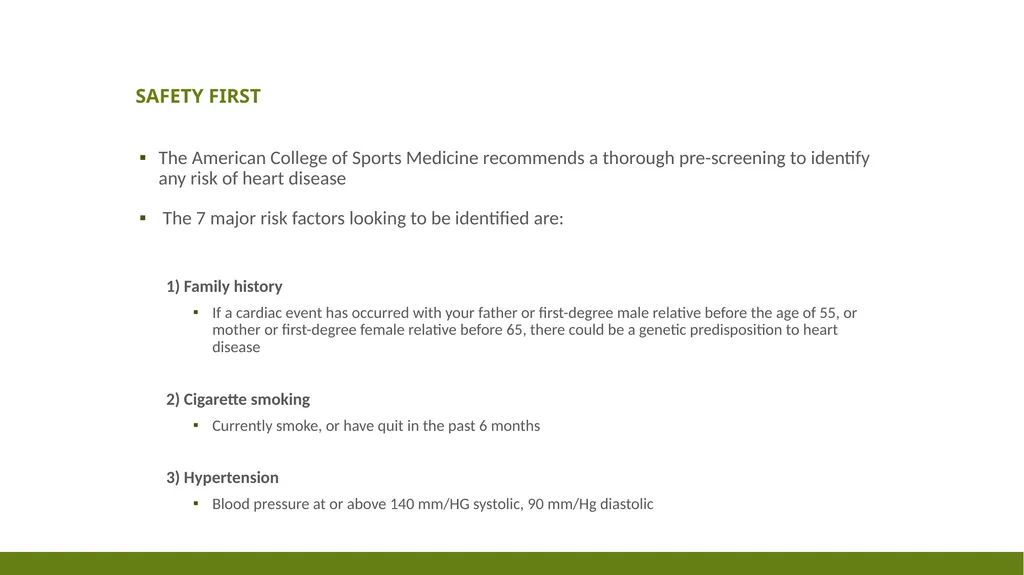
Safety First The American College of Sports Medicine recommends a thorough pre-screening to identify any risk of heart disease
The 7 major risk factors looking to be identified are:
1) Family history
If a cardiac event has occurred with your father or first-degree male relative before the age of 55, or mother or first-degree female relative before 65, there could be a genetic predisposition to heart disease
2) Cigarette smoking
Currently smoke, or have quit in the past 6 months
3) Hypertension
Blood pressure at or above 140 mm/HG systolic, 90 mm/Hg diastolic<br>
The 7 major risk factors looking to be identified are:
1) Family history
If a cardiac event has occurred with your father or first-degree male relative before the age of 55, or mother or first-degree female relative before 65, there could be a genetic predisposition to heart disease
2) Cigarette smoking
Currently smoke, or have quit in the past 6 months
3) Hypertension
Blood pressure at or above 140 mm/HG systolic, 90 mm/Hg diastolic<br>
05
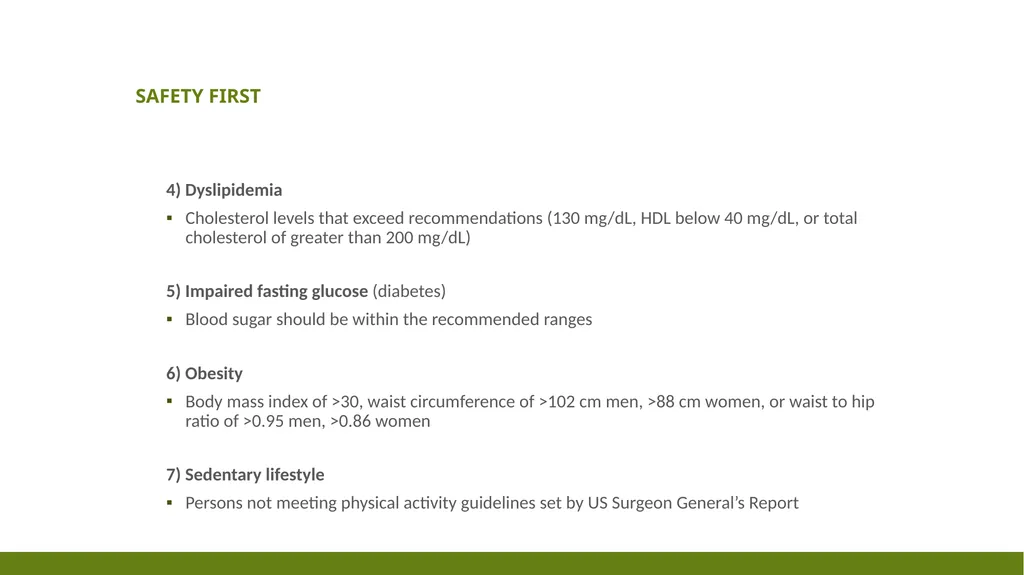
Safety First 4) Dyslipidemia
Cholesterol levels that exceed recommendations (130 mg/dL, HDL below 40 mg/dL, or total cholesterol of greater than 200 mg/dL)
5) Impaired fasting glucose (diabetes)
Blood sugar should be within the recommended ranges
6) Obesity
Body mass index of >30, waist circumference of >102 cm men, >88 cm women, or waist to hip ratio of >0.95 men, >0.86 women
7) Sedentary lifestyle
Persons not meeting physical activity guidelines set by US Surgeon General’s Report<br>
Cholesterol levels that exceed recommendations (130 mg/dL, HDL below 40 mg/dL, or total cholesterol of greater than 200 mg/dL)
5) Impaired fasting glucose (diabetes)
Blood sugar should be within the recommended ranges
6) Obesity
Body mass index of >30, waist circumference of >102 cm men, >88 cm women, or waist to hip ratio of >0.95 men, >0.86 women
7) Sedentary lifestyle
Persons not meeting physical activity guidelines set by US Surgeon General’s Report<br>
06
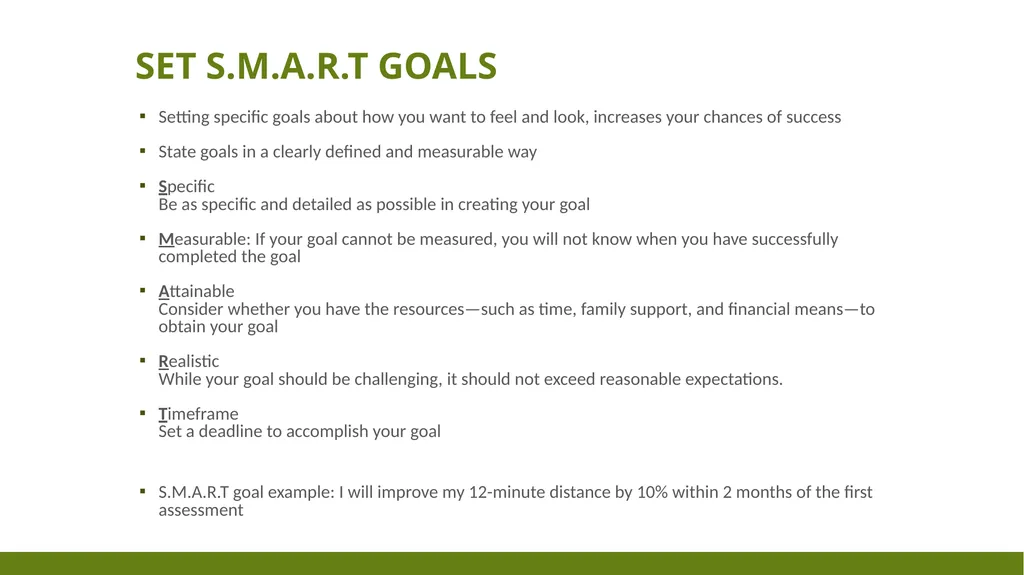
Set S.M.A.R.T Goals Setting specific goals about how you want to feel and look, increases your chances of success
State goals in a clearly defined and measurable way
Specific Be as specific and detailed as possible in creating your goal
Measurable: If your goal cannot be measured, you will not know when you have successfully completed the goal
Attainable Consider whether you have the resources—such as time, family support, and financial means—to obtain your goal
Realistic While your goal should be challenging, it should not exceed reasonable expectations.
Timeframe Set a deadline to accomplish your goal
S.M.A.R.T goal example: I will improve my 12-minute distance by 10% within 2 months of the first assessment<br>
State goals in a clearly defined and measurable way
Specific Be as specific and detailed as possible in creating your goal
Measurable: If your goal cannot be measured, you will not know when you have successfully completed the goal
Attainable Consider whether you have the resources—such as time, family support, and financial means—to obtain your goal
Realistic While your goal should be challenging, it should not exceed reasonable expectations.
Timeframe Set a deadline to accomplish your goal
S.M.A.R.T goal example: I will improve my 12-minute distance by 10% within 2 months of the first assessment<br>
07
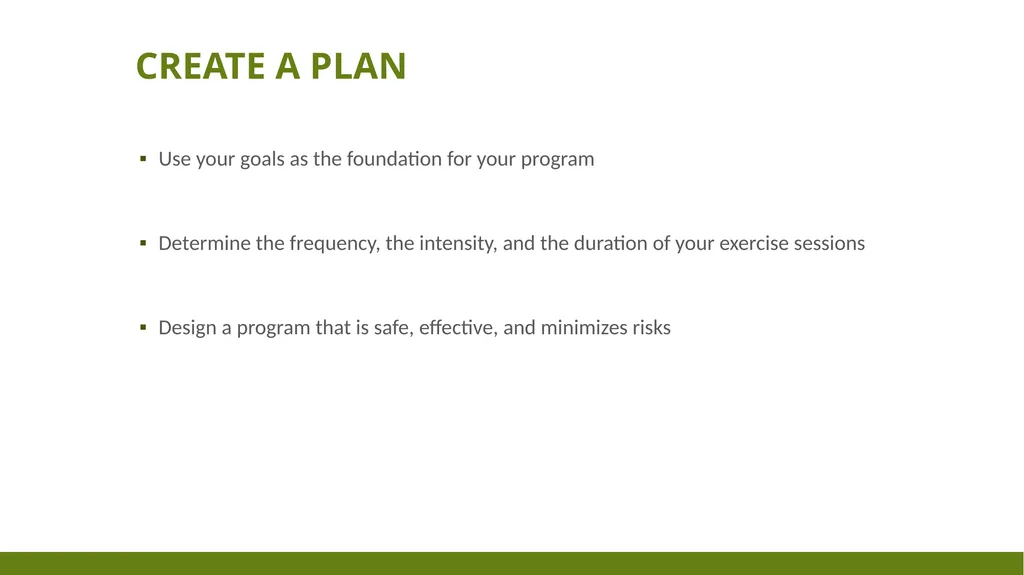
Create a Plan Use your goals as the foundation for your program
Determine the frequency, the intensity, and the duration of your exercise sessions
Design a program that is safe, effective, and minimizes risks<br>
Determine the frequency, the intensity, and the duration of your exercise sessions
Design a program that is safe, effective, and minimizes risks<br>
08
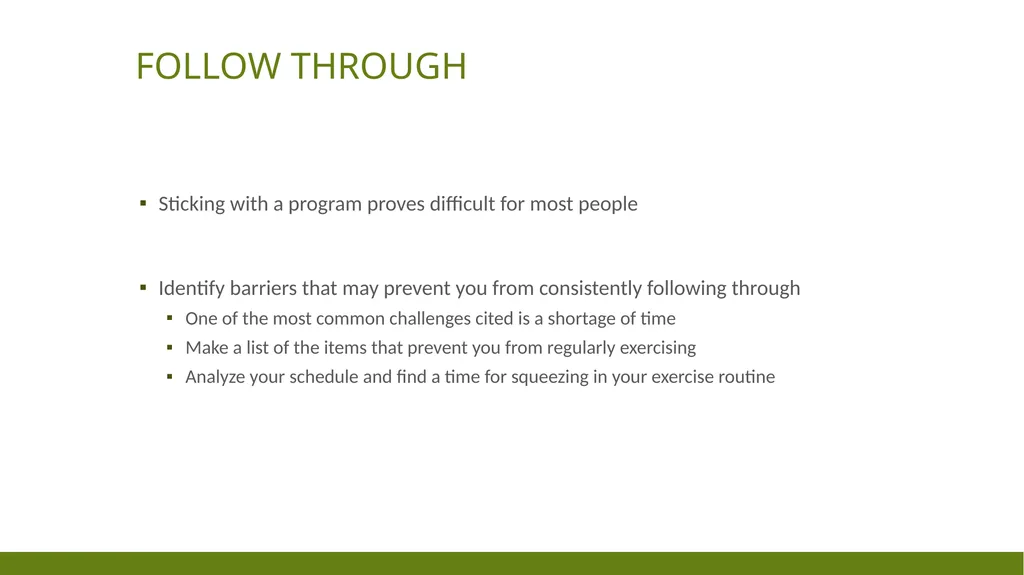
Follow through Sticking with a program proves difficult for most people
Identify barriers that may prevent you from consistently following through
One of the most common challenges cited is a shortage of time
Make a list of the items that prevent you from regularly exercising
Analyze your schedule and find a time for squeezing in your exercise routine<br>
Identify barriers that may prevent you from consistently following through
One of the most common challenges cited is a shortage of time
Make a list of the items that prevent you from regularly exercising
Analyze your schedule and find a time for squeezing in your exercise routine<br>
09
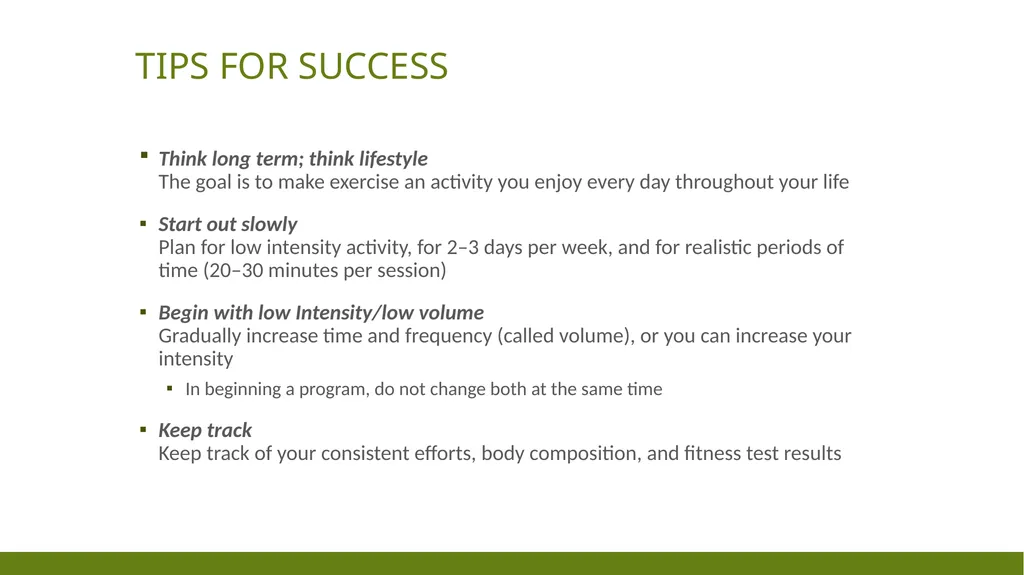
Tips for Success Think long term; think lifestyle
The goal is to make exercise an activity you enjoy every day throughout your life
Start out slowly Plan for low intensity activity, for 2–3 days per week, and for realistic periods of time (20–30 minutes per session)
Begin with low Intensity/low volume Gradually increase time and frequency (called volume), or you can increase your intensity
In beginning a program, do not change both at the same time
Keep track Keep track of your consistent efforts, body composition, and fitness test results<br>
Start out slowly Plan for low intensity activity, for 2–3 days per week, and for realistic periods of time (20–30 minutes per session)
Begin with low Intensity/low volume Gradually increase time and frequency (called volume), or you can increase your intensity
In beginning a program, do not change both at the same time
Keep track Keep track of your consistent efforts, body composition, and fitness test results<br>
10
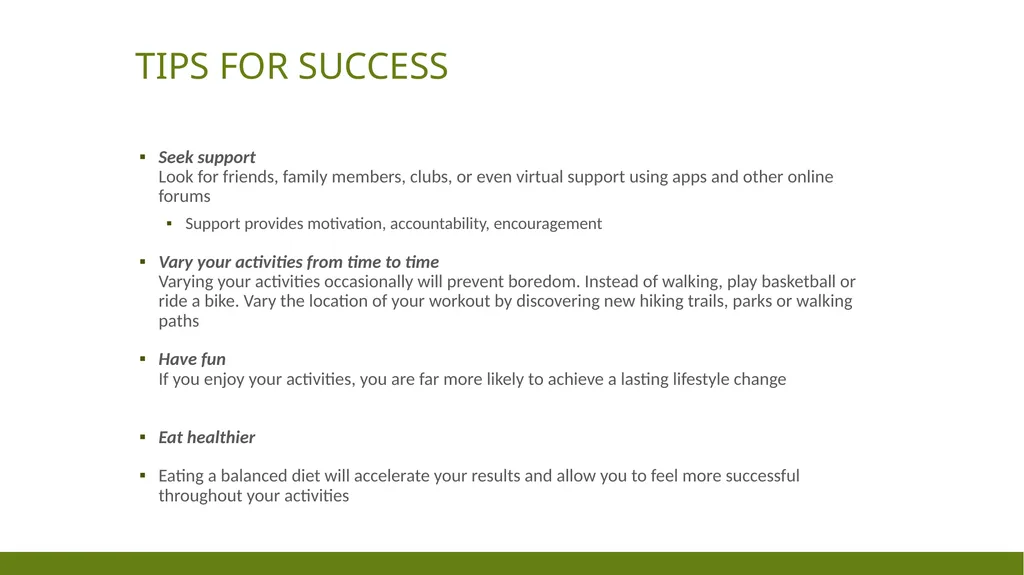
Tips for Success Seek support
Look for friends, family members, clubs, or even virtual support using apps and other online forums
Support provides motivation, accountability, encouragement
Vary your activities from time to time Varying your activities occasionally will prevent boredom. Instead of walking, play basketball or ride a bike. Vary the location of your workout by discovering new hiking trails, parks or walking paths
Have fun If you enjoy your activities, you are far more likely to achieve a lasting lifestyle change
Eat healthier
Eating a balanced diet will accelerate your results and allow you to feel more successful throughout your activities<br>
Support provides motivation, accountability, encouragement
Vary your activities from time to time Varying your activities occasionally will prevent boredom. Instead of walking, play basketball or ride a bike. Vary the location of your workout by discovering new hiking trails, parks or walking paths
Have fun If you enjoy your activities, you are far more likely to achieve a lasting lifestyle change
Eat healthier
Eating a balanced diet will accelerate your results and allow you to feel more successful throughout your activities<br>
11
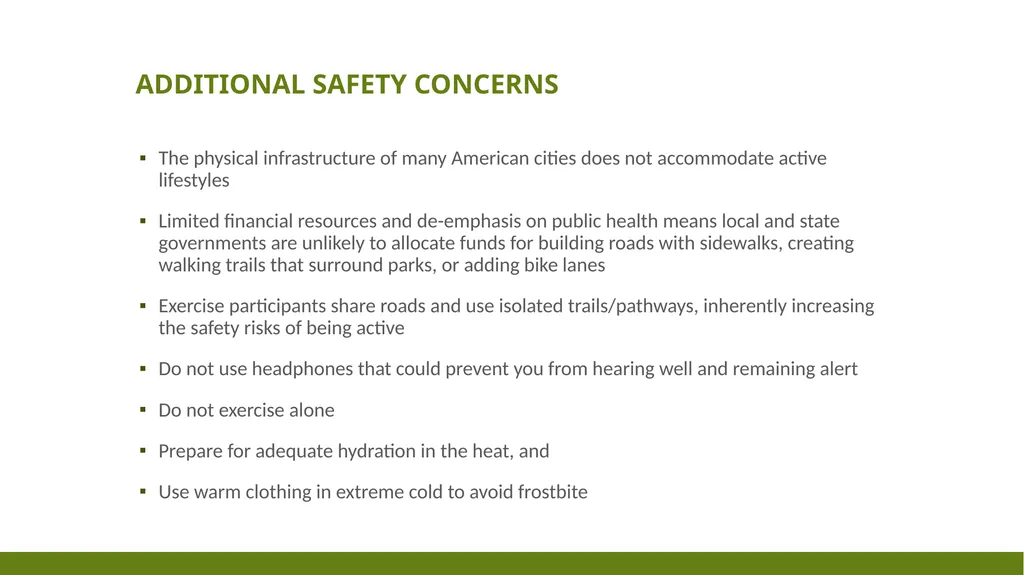
Additional Safety Concerns The physical infrastructure of many American cities does not accommodate active lifestyles
Limited financial resources and de-emphasis on public health means local and state governments are unlikely to allocate funds for building roads with sidewalks, creating walking trails that surround parks, or adding bike lanes
Exercise participants share roads and use isolated trails/pathways, inherently increasing the safety risks of being active
Do not use headphones that could prevent you from hearing well and remaining alert
Do not exercise alone
Prepare for adequate hydration in the heat, and
Use warm clothing in extreme cold to avoid frostbite<br>
Limited financial resources and de-emphasis on public health means local and state governments are unlikely to allocate funds for building roads with sidewalks, creating walking trails that surround parks, or adding bike lanes
Exercise participants share roads and use isolated trails/pathways, inherently increasing the safety risks of being active
Do not use headphones that could prevent you from hearing well and remaining alert
Do not exercise alone
Prepare for adequate hydration in the heat, and
Use warm clothing in extreme cold to avoid frostbite<br>
12
Heat-Related Illness Heat-related illnesses include heat cramps, heat exhaustion, and heat stroke
A 2013 report from the Center for Disease Control stated that about 658 deaths from heat-related illnesses occurred every year
Of those deaths, most were male, older adults<br>
A 2013 report from the Center for Disease Control stated that about 658 deaths from heat-related illnesses occurred every year
Of those deaths, most were male, older adults<br>
13
Hydration The number one risk factor associated with heat-related illness is hydration, the starting point of all heat-related illness
Hydration must begin before exercise and must become part of your daily routine
Several practical methods of monitoring hydration levels can assist in preventing illness
monitor the color of your urine
weigh yourself before and after a workout to see how much water weight is lost during an exercise session primarily as a result of sweat
The best preventative measure for maintaining a hydrated state is simply drinking plenty of water throughout the day
Insufficient hydration leads to poor performance, poor health, and potentially serious illness
If the activity planned is shorter than 60 minutes in duration, water is the recommended fluid. For activities beyond 60 minutes, a sports drink should be used<br>
Hydration must begin before exercise and must become part of your daily routine
Several practical methods of monitoring hydration levels can assist in preventing illness
monitor the color of your urine
weigh yourself before and after a workout to see how much water weight is lost during an exercise session primarily as a result of sweat
The best preventative measure for maintaining a hydrated state is simply drinking plenty of water throughout the day
Insufficient hydration leads to poor performance, poor health, and potentially serious illness
If the activity planned is shorter than 60 minutes in duration, water is the recommended fluid. For activities beyond 60 minutes, a sports drink should be used<br>
14
Cold-Related Illnesses To minimize the risk of cold-related illness, you must prevent the loss of too much body heat
The three major concerns related to cold-related illnesses are:
Hypothermia
Frost-nip, and
Frost bite
The objective of preventing cold-related illness is to maintain the proper body temperature of between 98.6 and 99.9 degrees Fahrenheit<br>
The three major concerns related to cold-related illnesses are:
Hypothermia
Frost-nip, and
Frost bite
The objective of preventing cold-related illness is to maintain the proper body temperature of between 98.6 and 99.9 degrees Fahrenheit<br>
15
Cold-Related Illnesses If body temperature falls below 98.6 F, multiple symptoms may appear, indicating the need to take action.
Some of those symptoms include:
shivering
numbness and stiffness of joints and appendages
loss of dexterity and/or poor coordination
peeling or blistering of skin, especially to exposed areas
discoloration of the skin in the extremities<br>
Some of those symptoms include:
shivering
numbness and stiffness of joints and appendages
loss of dexterity and/or poor coordination
peeling or blistering of skin, especially to exposed areas
discoloration of the skin in the extremities<br>
16
Cold-Related Illnesses Take the necessary steps to avoid problems that can arise from cold conditions
Hydration is key Cold air is usually drier air, which leads to moisture loss through breathing and evaporation
Staying hydrated is key in maintaining blood flow and regulating temperature
Stay dry Keeping shoes and socks dry and clothing from accumulating too much sweat will allow for more effective body temperature regulation
Dress appropriately Direct moisture (sweat) away from the skin
This is controlled most effectively by layering your clothing. A base layer of moisture-wicking fabric should be used against the skin while additional layers should be breathable
Cover the extremities Those parts of the body farthest away from the heart (toes, fingers, and ears) tend to get coldest first<br>
Hydration is key Cold air is usually drier air, which leads to moisture loss through breathing and evaporation
Staying hydrated is key in maintaining blood flow and regulating temperature
Stay dry Keeping shoes and socks dry and clothing from accumulating too much sweat will allow for more effective body temperature regulation
Dress appropriately Direct moisture (sweat) away from the skin
This is controlled most effectively by layering your clothing. A base layer of moisture-wicking fabric should be used against the skin while additional layers should be breathable
Cover the extremities Those parts of the body farthest away from the heart (toes, fingers, and ears) tend to get coldest first<br>
17
Stretching Techniques Slow sustained:
Hold stretch position just beyond comfort for 30 – 60 seconds.
Helps improve flexibility and least likely to cause injury and soreness.
Dynamic (Ballistic):
Bouncy, jerky movements that can cause injury and soreness
PNF (Proprioceptive Neuromuscular Facilitation):
Partner assisted stretching<br>
Hold stretch position just beyond comfort for 30 – 60 seconds.
Helps improve flexibility and least likely to cause injury and soreness.
Dynamic (Ballistic):
Bouncy, jerky movements that can cause injury and soreness
PNF (Proprioceptive Neuromuscular Facilitation):
Partner assisted stretching<br>