
Getting the Right Board… and Getting the Board
TF
Published · 28 slides · 0 views
1 / 1


Description
Getting the Right Board and Getting the Board Right Necessities Unnecessary Distractions of NFP Governance QAILS Conference 26 May 2015 John Peacock, General Manager, Associations Forum Disclaimer: This is practical advice based on our
Related Topics
Share
Embed code
Download this presentation From Below
"Getting the Right Board… and Getting the Board" is the property of its rightful owner. Permission is granted to download and print the materials on this website for personal, non-commercial use only, and to display it on your personal computer provided you do not modify the materials and that you retain all copyright notices contained in the materials. By downloading content from our website, you accept the terms of this agreement.
Presentation Transcript
01
Getting the Right Board…
and Getting the Board Right
“Necessities & Unnecessary Distractions of NFP Governance” QAILS Conference
26 May 2015
John Peacock, General Manager, Associations Forum
Disclaimer: This is practical advice based on our work with associations and charities. The contents of this presentation do not constitute legal advice, are not intended to be a substitute for legal advice and should not be relied upon as such. You should seek specialist advice in relation to any particular matters you or your organisation may have. © Associations Forum 2015<br>
John Peacock, General Manager, Associations Forum
Disclaimer: This is practical advice based on our work with associations and charities. The contents of this presentation do not constitute legal advice, are not intended to be a substitute for legal advice and should not be relied upon as such. You should seek specialist advice in relation to any particular matters you or your organisation may have. © Associations Forum 2015<br>
02
About Associations Forum Commercial entity assisting associations in Australasia & Asia
500 member organisations: professions, industries, charities
AF National Conference largest association event in Southern Hemisphere
Services similar to an association
Governance and constitution reviews
Policy and advocacy
Free member meetings and events
Networking and international connections
Member advice helpline
Journal, Enews, resources
Benchmarking surveys e.g. salaries, Boards, finances
Consulting and advice on boards, governance and planning © Associations Forum 2015<br>
500 member organisations: professions, industries, charities
AF National Conference largest association event in Southern Hemisphere
Services similar to an association
Governance and constitution reviews
Policy and advocacy
Free member meetings and events
Networking and international connections
Member advice helpline
Journal, Enews, resources
Benchmarking surveys e.g. salaries, Boards, finances
Consulting and advice on boards, governance and planning © Associations Forum 2015<br>
03
QAILS works towards the following objectives To promote the development of community legal centres (GOOD BOARDS NEEDED)
To enhance communication and cooperation between community legal centres (LEARN ABOUT OTHER BOARDS & CONSTITUTIONS)
To secure and develop funding for community legal centres
To represent the interests and opinions of members. © Associations Forum 2015<br>
To enhance communication and cooperation between community legal centres (LEARN ABOUT OTHER BOARDS & CONSTITUTIONS)
To secure and develop funding for community legal centres
To represent the interests and opinions of members. © Associations Forum 2015<br>
04
Facilitator’s Career as a CEO and Volunteer Director 20’s – Commerce degree, large corporates; Board of professional association
30’s – Association manager and CEO of small association; Board of professional association and Chair of local community association
40’s – Established Associations Forum: providing education and advice to associations
50’s – Consolidation of Associations Forum and training of associations in Australasia and Asia © Associations Forum 2015<br>
30’s – Association manager and CEO of small association; Board of professional association and Chair of local community association
40’s – Established Associations Forum: providing education and advice to associations
50’s – Consolidation of Associations Forum and training of associations in Australasia and Asia © Associations Forum 2015<br>
05
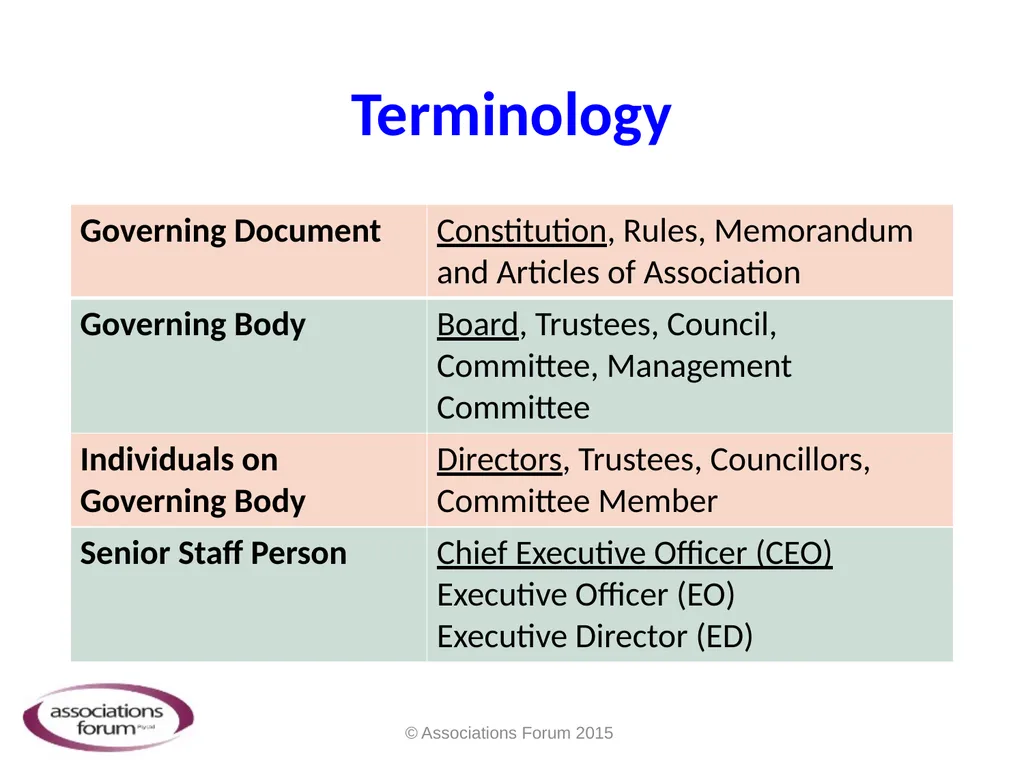
Terminology © Associations Forum 2015<br>
06
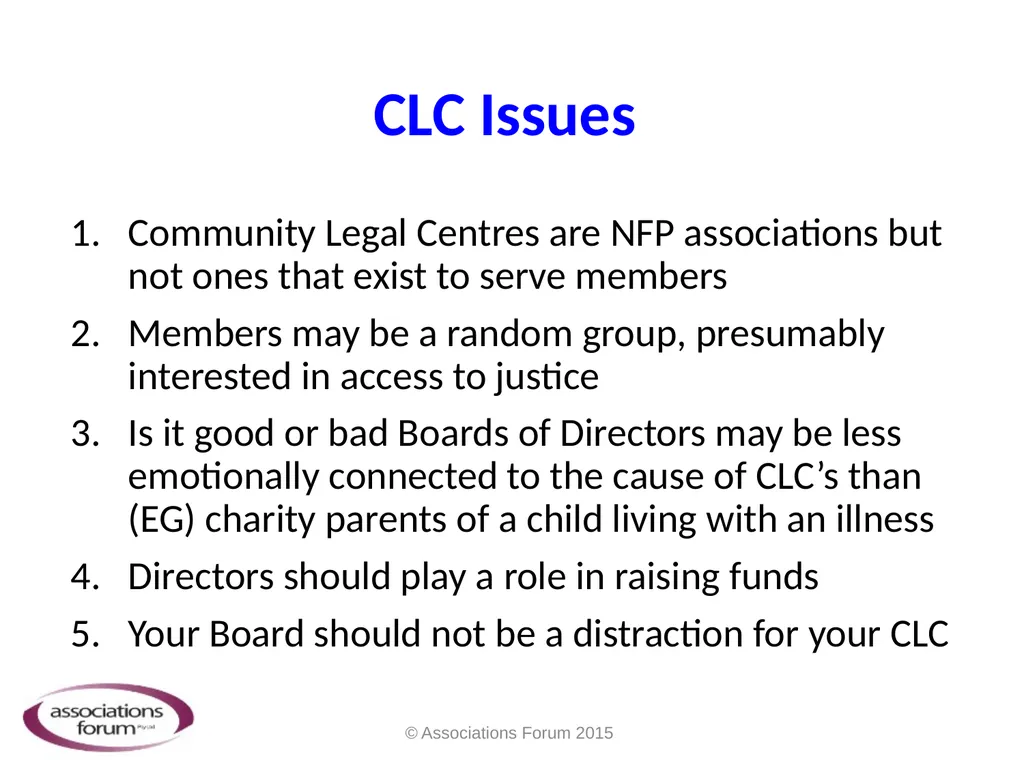
CLC Issues Community Legal Centres are NFP associations but not ones that exist to serve members
Members may be a random group, presumably interested in access to justice
Is it good or bad Boards of Directors may be less emotionally connected to the cause of CLC’s than (EG) charity parents of a child living with an illness
Directors should play a role in raising funds
Your Board should not be a distraction for your CLC © Associations Forum 2015<br>
Members may be a random group, presumably interested in access to justice
Is it good or bad Boards of Directors may be less emotionally connected to the cause of CLC’s than (EG) charity parents of a child living with an illness
Directors should play a role in raising funds
Your Board should not be a distraction for your CLC © Associations Forum 2015<br>
07
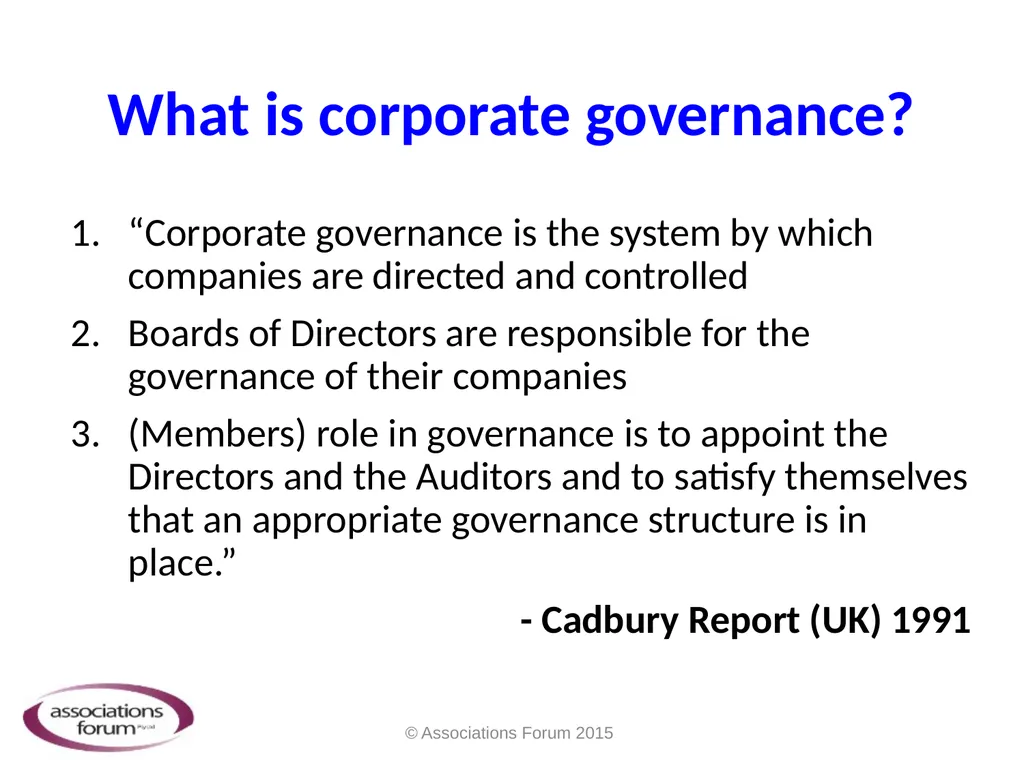
What is corporate governance? “Corporate governance is the system by which companies are directed and controlled
Boards of Directors are responsible for the governance of their companies
(Members) role in governance is to appoint the Directors and the Auditors and to satisfy themselves that an appropriate governance structure is in place.”
- Cadbury Report (UK) 1991 © Associations Forum 2015<br>
Boards of Directors are responsible for the governance of their companies
(Members) role in governance is to appoint the Directors and the Auditors and to satisfy themselves that an appropriate governance structure is in place.”
- Cadbury Report (UK) 1991 © Associations Forum 2015<br>
08
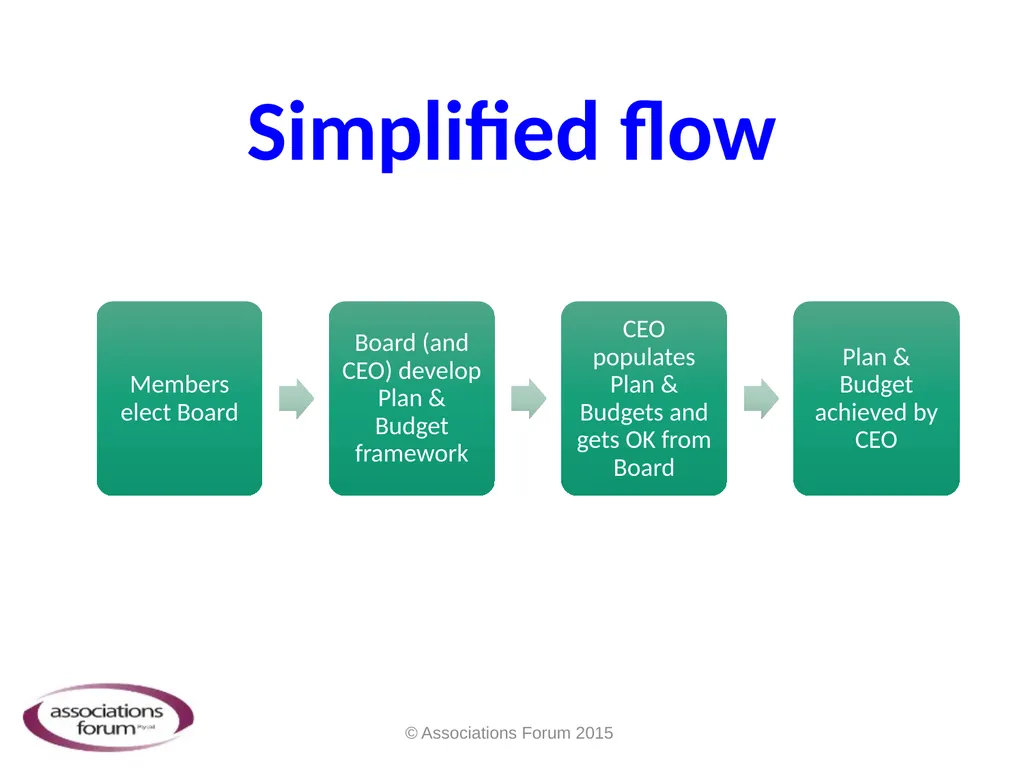
© Associations Forum 2015 Simplified flow<br>
09
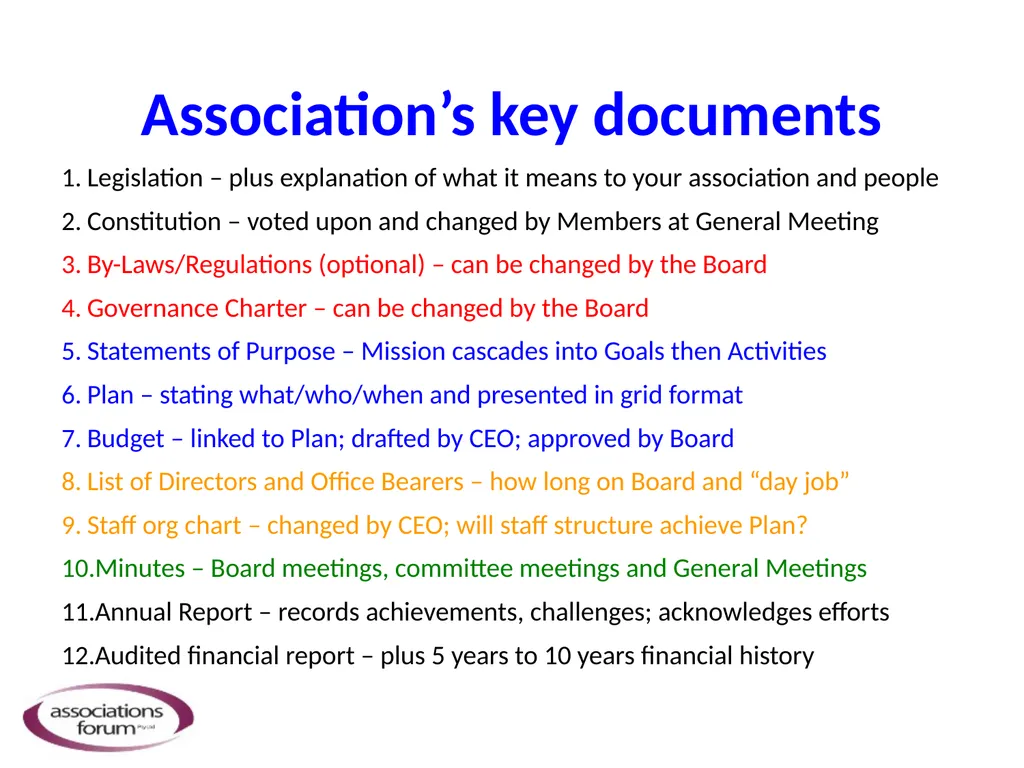
Association’s key documents Legislation – plus explanation of what it means to your association and people
Constitution – voted upon and changed by Members at General Meeting
By-Laws/Regulations (optional) – can be changed by the Board
Governance Charter – can be changed by the Board
Statements of Purpose – Mission cascades into Goals then Activities
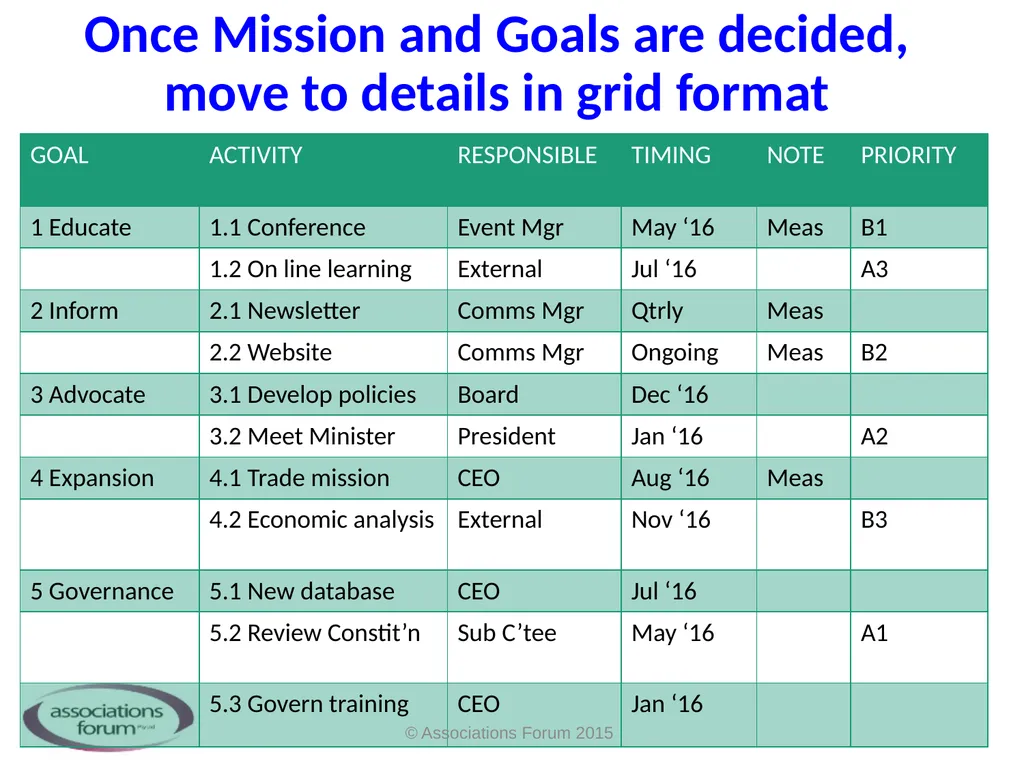
Plan – stating what/who/when and presented in grid format
Budget – linked to Plan; drafted by CEO; approved by Board
List of Directors and Office Bearers – how long on Board and “day job”
Staff org chart – changed by CEO; will staff structure achieve Plan?
Minutes – Board meetings, committee meetings and General Meetings
Annual Report – records achievements, challenges; acknowledges efforts
Audited financial report – plus 5 years to 10 years financial history<br>
Constitution – voted upon and changed by Members at General Meeting
By-Laws/Regulations (optional) – can be changed by the Board
Governance Charter – can be changed by the Board
Statements of Purpose – Mission cascades into Goals then Activities
Plan – stating what/who/when and presented in grid format
Budget – linked to Plan; drafted by CEO; approved by Board
List of Directors and Office Bearers – how long on Board and “day job”
Staff org chart – changed by CEO; will staff structure achieve Plan?
Minutes – Board meetings, committee meetings and General Meetings
Annual Report – records achievements, challenges; acknowledges efforts
Audited financial report – plus 5 years to 10 years financial history<br>
10
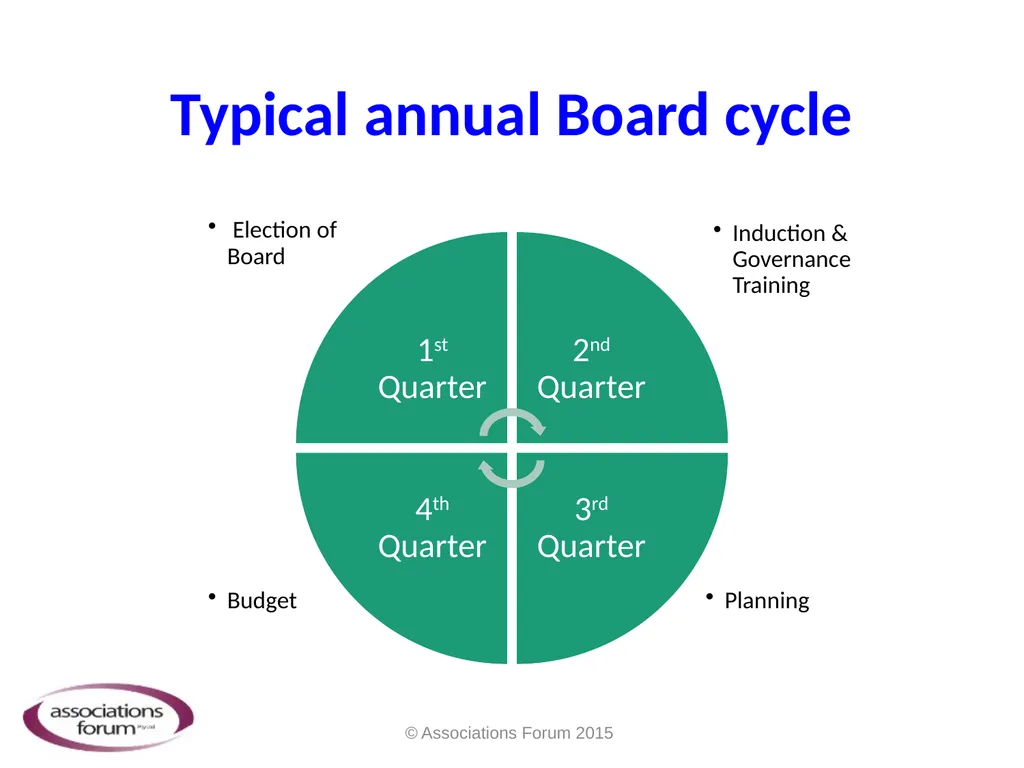
Typical annual Board cycle © Associations Forum 2015<br>
11
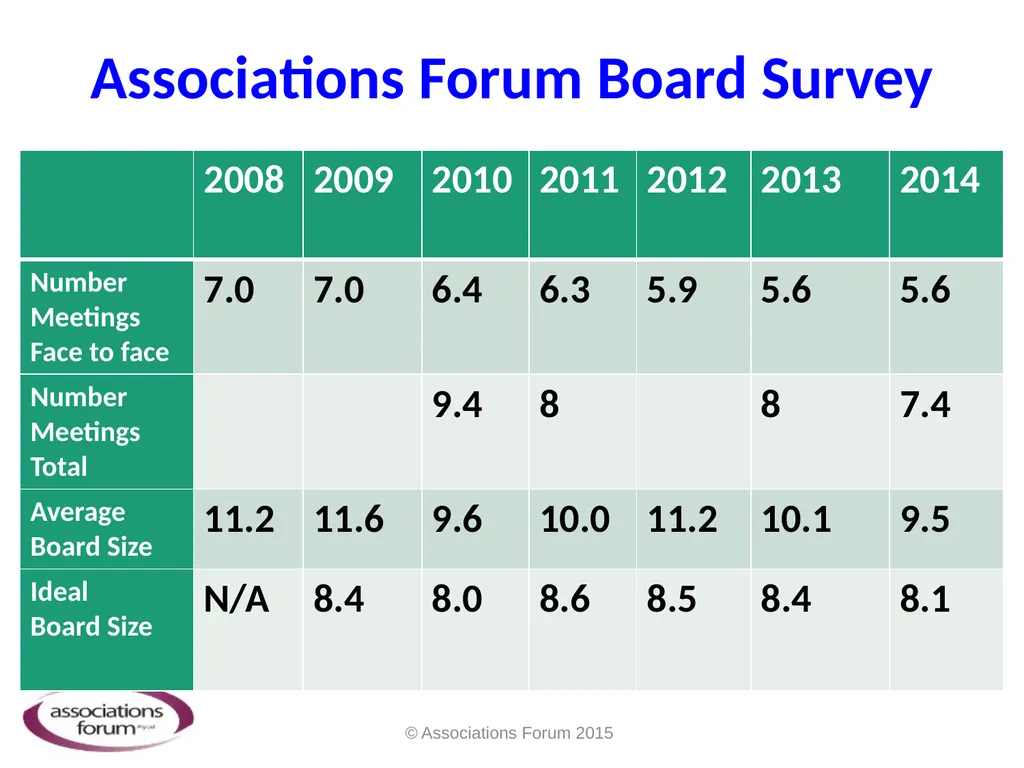
Associations Forum Board Survey © Associations Forum 2015<br>
12
Ways to attract new directors Efficient structures that maximise the use of a director’s time
Clear expectations of level of commitment expected
Clear organisation Plan and Board practices
Good communication and reports that impress the candidate
Directors publicly acknowledged and thanked © Associations Forum 2015<br>
Clear expectations of level of commitment expected
Clear organisation Plan and Board practices
Good communication and reports that impress the candidate
Directors publicly acknowledged and thanked © Associations Forum 2015<br>
13
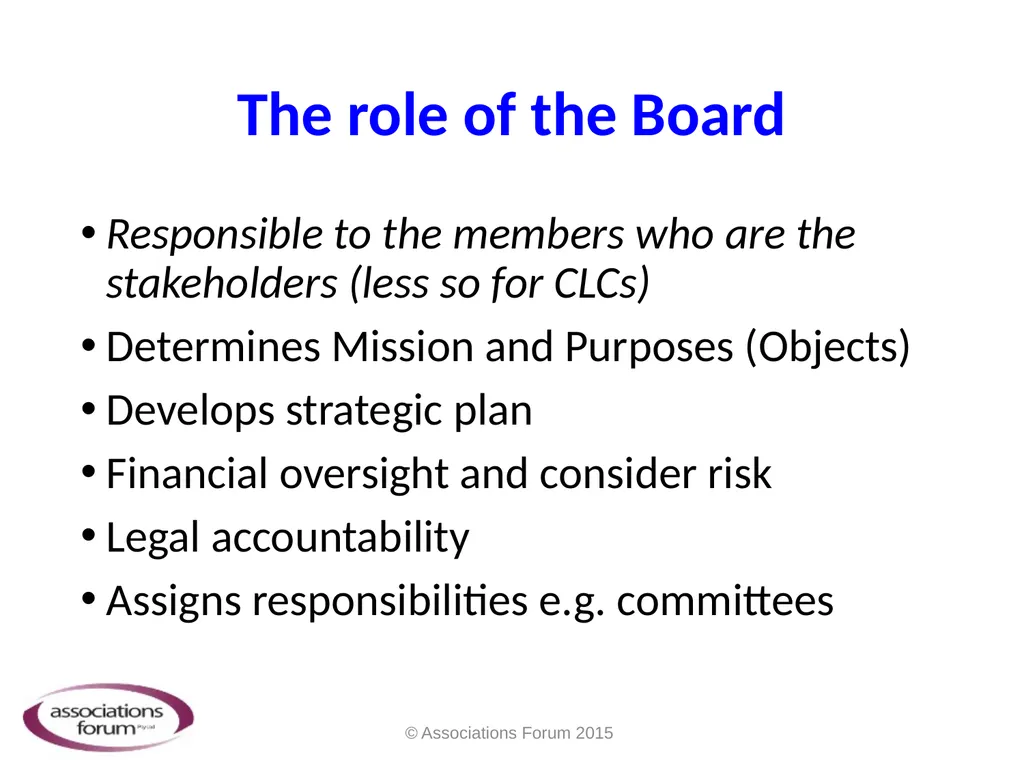
The role of the Board Responsible to the members who are the stakeholders (less so for CLCs)
Determines Mission and Purposes (Objects)
Develops strategic plan
Financial oversight and consider risk
Legal accountability
Assigns responsibilities e.g. committees © Associations Forum 2015<br>
Determines Mission and Purposes (Objects)
Develops strategic plan
Financial oversight and consider risk
Legal accountability
Assigns responsibilities e.g. committees © Associations Forum 2015<br>
14
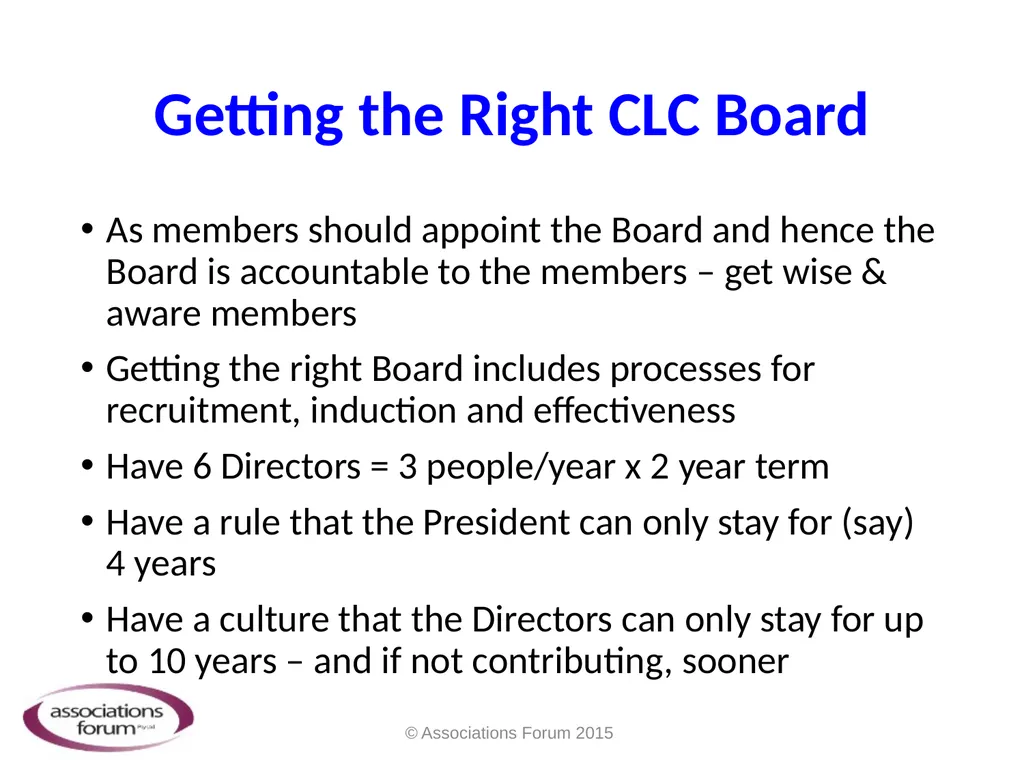
Getting the Right CLC Board As members should appoint the Board and hence the Board is accountable to the members – get wise & aware members
Getting the right Board includes processes for recruitment, induction and effectiveness
Have 6 Directors = 3 people/year x 2 year term
Have a rule that the President can only stay for (say) 4 years
Have a culture that the Directors can only stay for up to 10 years – and if not contributing, sooner © Associations Forum 2015<br>
Getting the right Board includes processes for recruitment, induction and effectiveness
Have 6 Directors = 3 people/year x 2 year term
Have a rule that the President can only stay for (say) 4 years
Have a culture that the Directors can only stay for up to 10 years – and if not contributing, sooner © Associations Forum 2015<br>
15
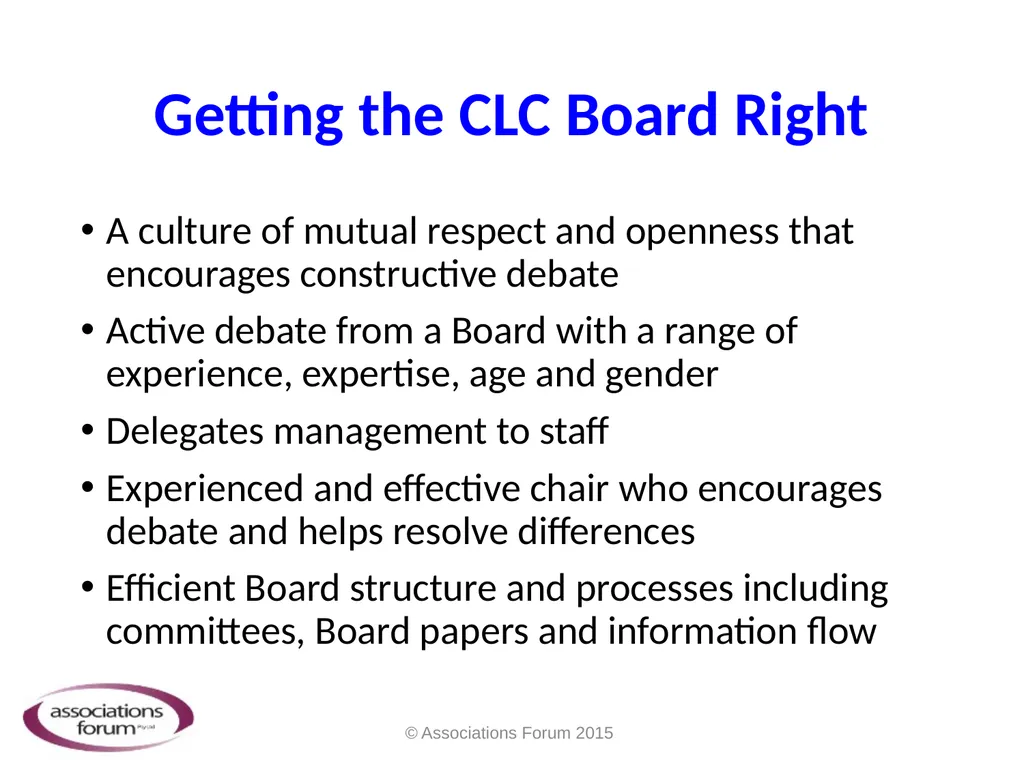
Getting the CLC Board Right A culture of mutual respect and openness that encourages constructive debate
Active debate from a Board with a range of experience, expertise, age and gender
Delegates management to staff
Experienced and effective chair who encourages debate and helps resolve differences
Efficient Board structure and processes including committees, Board papers and information flow © Associations Forum 2015<br>
Active debate from a Board with a range of experience, expertise, age and gender
Delegates management to staff
Experienced and effective chair who encourages debate and helps resolve differences
Efficient Board structure and processes including committees, Board papers and information flow © Associations Forum 2015<br>
16
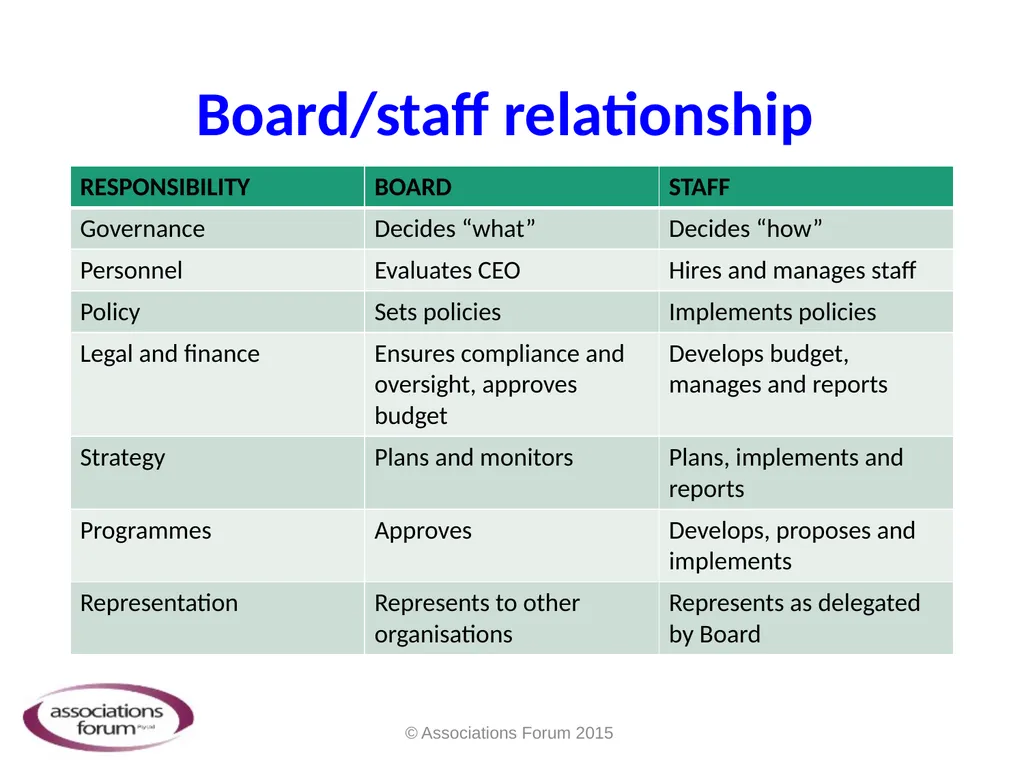
Board/staff relationship © Associations Forum 2015<br>
17
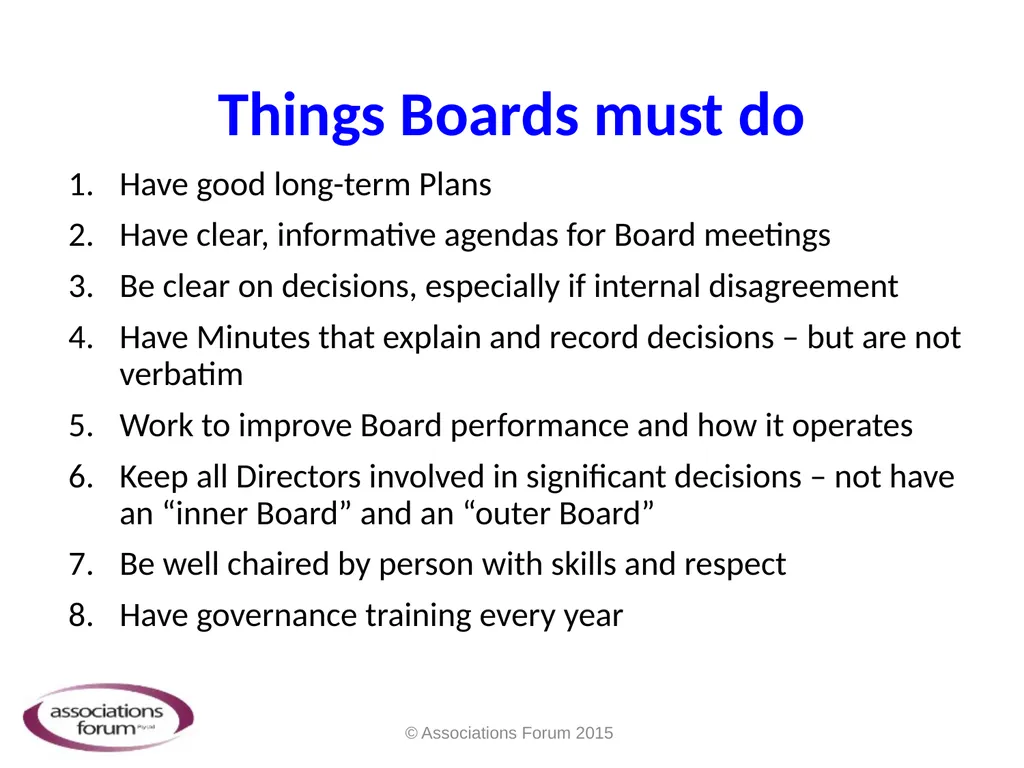
Things Boards must do Have good long-term Plans
Have clear, informative agendas for Board meetings
Be clear on decisions, especially if internal disagreement
Have Minutes that explain and record decisions – but are not verbatim
Work to improve Board performance and how it operates
Keep all Directors involved in significant decisions – not have an “inner Board” and an “outer Board”
Be well chaired by person with skills and respect
Have governance training every year © Associations Forum 2015<br>
Have clear, informative agendas for Board meetings
Be clear on decisions, especially if internal disagreement
Have Minutes that explain and record decisions – but are not verbatim
Work to improve Board performance and how it operates
Keep all Directors involved in significant decisions – not have an “inner Board” and an “outer Board”
Be well chaired by person with skills and respect
Have governance training every year © Associations Forum 2015<br>
18
Unnecessary Distractions Few members or disinterested members
Overly interested members!
Disorganised governance processes
Not enough quality Board candidates
Board with the wrong motivations that interferes
Poor chair
DISTRACTIONS BEYOND GOVERNANCE
Lack of money
Substandard management © Associations Forum 2015<br>
Overly interested members!
Disorganised governance processes
Not enough quality Board candidates
Board with the wrong motivations that interferes
Poor chair
DISTRACTIONS BEYOND GOVERNANCE
Lack of money
Substandard management © Associations Forum 2015<br>
19
Moving from “management” to “governance” When sufficient and regular income, staff should be employed
Paying for administration is the first, easier step which needs to be managed by the Board
Hiring an association professional e.g. CEO who will manage is a harder step
When management level staff are employed, the Board culture has to change from management to governance
Directors need avoid overwork and burnout – their role is oversight and not to do everything
Associations must have association and governance training © Associations Forum 2015<br>
Paying for administration is the first, easier step which needs to be managed by the Board
Hiring an association professional e.g. CEO who will manage is a harder step
When management level staff are employed, the Board culture has to change from management to governance
Directors need avoid overwork and burnout – their role is oversight and not to do everything
Associations must have association and governance training © Associations Forum 2015<br>
20
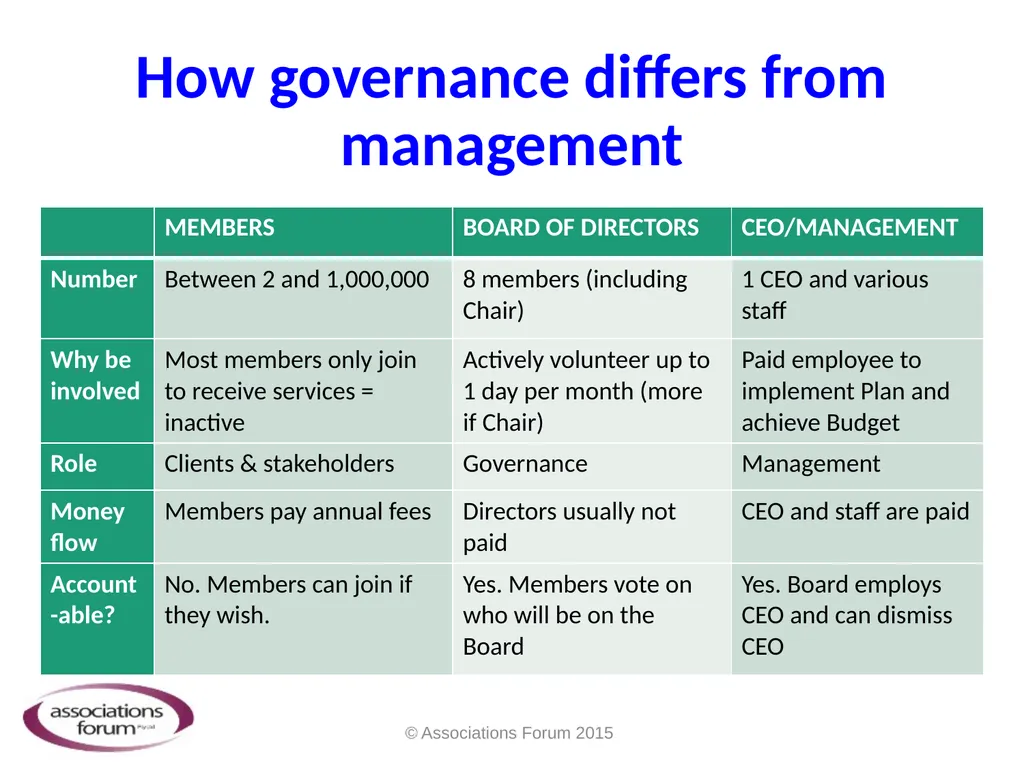
How governance differs from management © Associations Forum 2015<br>
21
Boards must ensure Plans Boards should focus on the Mission and strategic objectives
When an association employs management, Boards should allow management to achieve the Plan
When you know your Plan and Balance Sheet, a Budget can be developed
Association plans can be strategic plus operational
Strategy is balancing what is desirable and possible
Refer to plans at every Board meeting – Board monitors
Plans need ownership by Board and CEO - other volunteers and staff must see where they fit in to the Plan and Budget © Associations Forum 2015<br>
When an association employs management, Boards should allow management to achieve the Plan
When you know your Plan and Balance Sheet, a Budget can be developed
Association plans can be strategic plus operational
Strategy is balancing what is desirable and possible
Refer to plans at every Board meeting – Board monitors
Plans need ownership by Board and CEO - other volunteers and staff must see where they fit in to the Plan and Budget © Associations Forum 2015<br>
22
Once Mission and Goals are decided,
move to details in grid format © Associations Forum 2015<br>
23
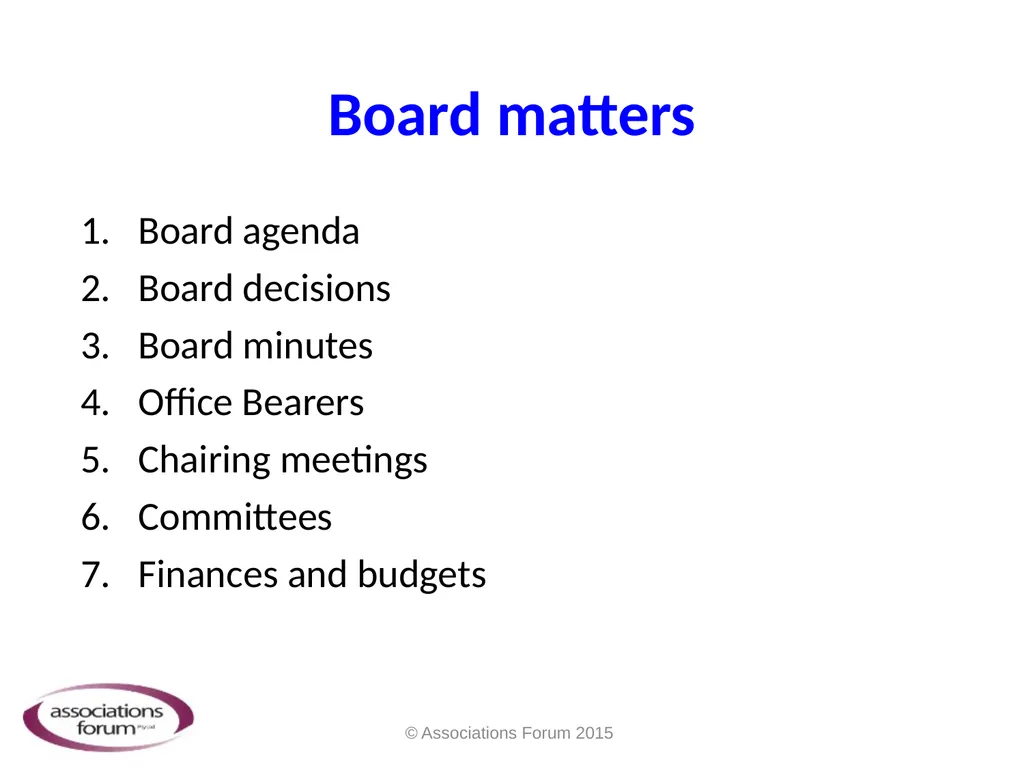
Board matters Board agenda
Board decisions
Board minutes
Office Bearers
Chairing meetings
Committees
Finances and budgets © Associations Forum 2015<br>
Board decisions
Board minutes
Office Bearers
Chairing meetings
Committees
Finances and budgets © Associations Forum 2015<br>
24
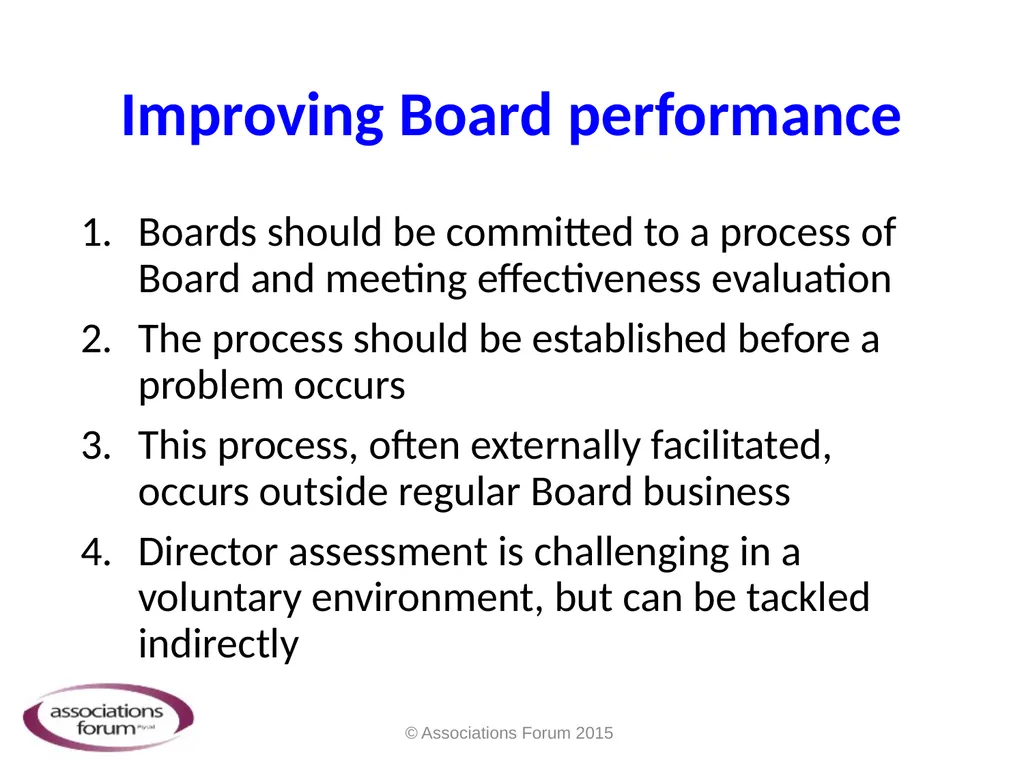
Improving Board performance Boards should be committed to a process of Board and meeting effectiveness evaluation
The process should be established before a problem occurs
This process, often externally facilitated, occurs outside regular Board business
Director assessment is challenging in a voluntary environment, but can be tackled indirectly © Associations Forum 2015<br>
The process should be established before a problem occurs
This process, often externally facilitated, occurs outside regular Board business
Director assessment is challenging in a voluntary environment, but can be tackled indirectly © Associations Forum 2015<br>
25
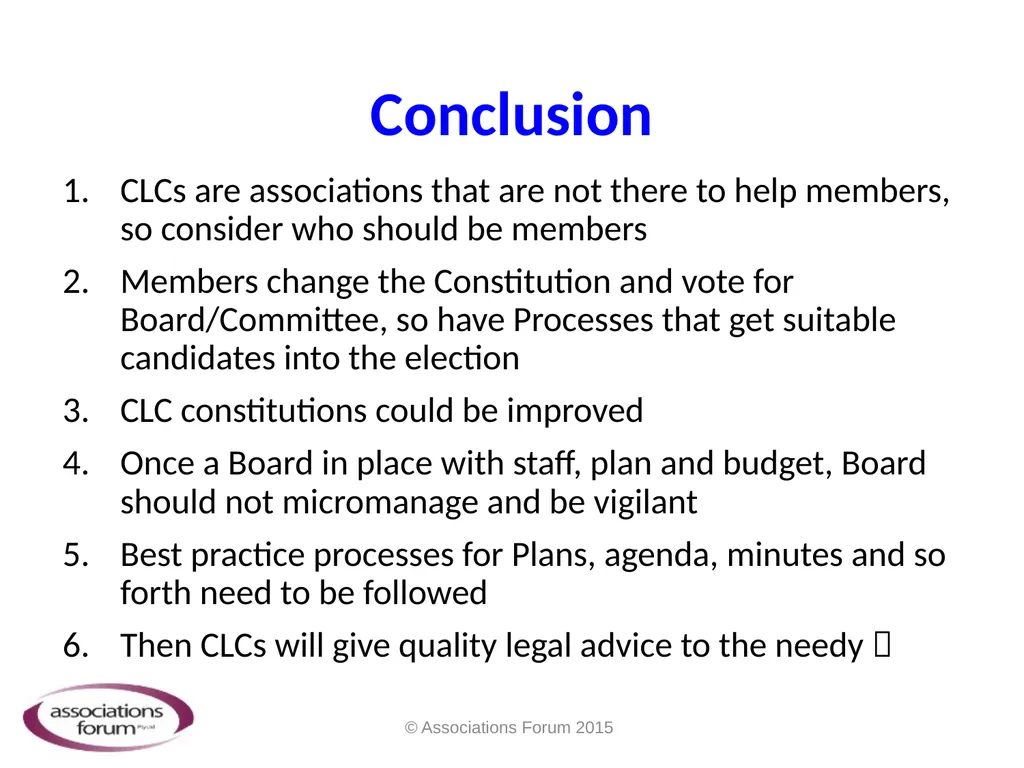
Conclusion CLCs are associations that are not there to help members, so consider who should be members
Members change the Constitution and vote for Board/Committee, so have Processes that get suitable candidates into the election
CLC constitutions could be improved
Once a Board in place with staff, plan and budget, Board should not micromanage and be vigilant
Best practice processes for Plans, agenda, minutes and so forth need to be followed
Then CLCs will give quality legal advice to the needy © Associations Forum 2015<br>
Members change the Constitution and vote for Board/Committee, so have Processes that get suitable candidates into the election
CLC constitutions could be improved
Once a Board in place with staff, plan and budget, Board should not micromanage and be vigilant
Best practice processes for Plans, agenda, minutes and so forth need to be followed
Then CLCs will give quality legal advice to the needy © Associations Forum 2015<br>
26
Levels of AF Membership Journal and eNews
Free events and member event discounts
Benchmarking surveys
Policy and advocacy
Member advice helpline
Local and international networks
Board and staff training (Silver and Gold)
Governance and constitution review (Silver and Gold)
Financial benchmarking (Gold)
Strategic planning discount (Gold) © Associations Forum 2015<br>
Free events and member event discounts
Benchmarking surveys
Policy and advocacy
Member advice helpline
Local and international networks
Board and staff training (Silver and Gold)
Governance and constitution review (Silver and Gold)
Financial benchmarking (Gold)
Strategic planning discount (Gold) © Associations Forum 2015<br>
27
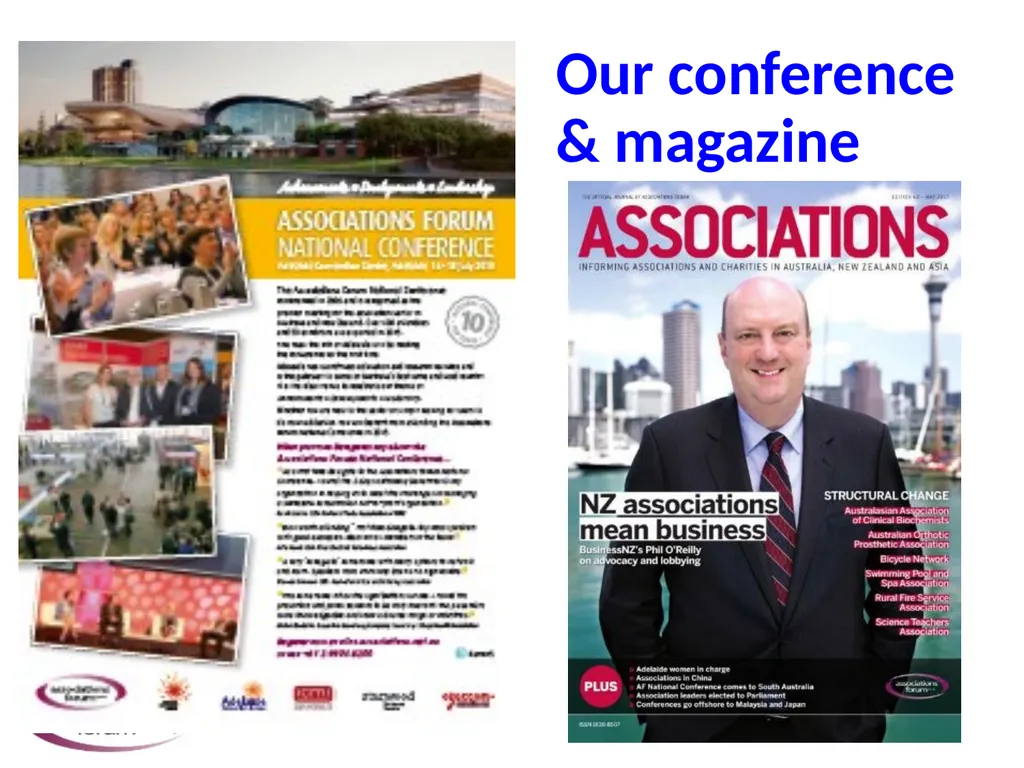
Our conference & magazine<br>
28
Thank you! John Peacock, General Manager, Associations Forum Pty Ltd
jpeacock@nfp.net.au 02 9904 8200
Associations Forum National Conference 14 - 15 July 2015 Adelaide Convention Centre, © Associations Forum 2015<br>
jpeacock@nfp.net.au 02 9904 8200
Associations Forum National Conference 14 - 15 July 2015 Adelaide Convention Centre, © Associations Forum 2015<br>