Global Trends and Challenges on Financial Inclusion Conference on Financial Inclusion: Challenges and Issues for the Deposit Insurer Alfred Hannig, Alliance for Financial Inclusion (AFI) Manila, June 20, 2013 Overview of AFI Founded in
"Global Trends and Challenges on Financial" is the property of its rightful owner. Permission is granted to
download and print the materials on this website for personal, non-commercial use only, and to display it
on your personal computer provided you do not modify the materials and that you retain all copyright
notices contained in the materials. By downloading content from our website, you accept the terms of this
agreement.
Presentation Transcript
01
Global Trends and Challenges on Financial Inclusion
Conference on Financial Inclusion: Challenges and Issues for the
Deposit Insurer Alfred Hannig, Alliance for Financial Inclusion (AFI)
Manila, June 20, 2013<br>
02
Overview of AFI Founded in September 2008, AFI is a global network of policymakers in emerging and developing countries
AFI is dedicated to accelerating the adoption of innovative financial inclusion policy solutions with the ultimate aim of making formal financial services more accessible and useable to the billions of unbanked people
AFI provides members with the tools and resources to share, develop and implement their knowledge of cutting-edge policies<br>
03
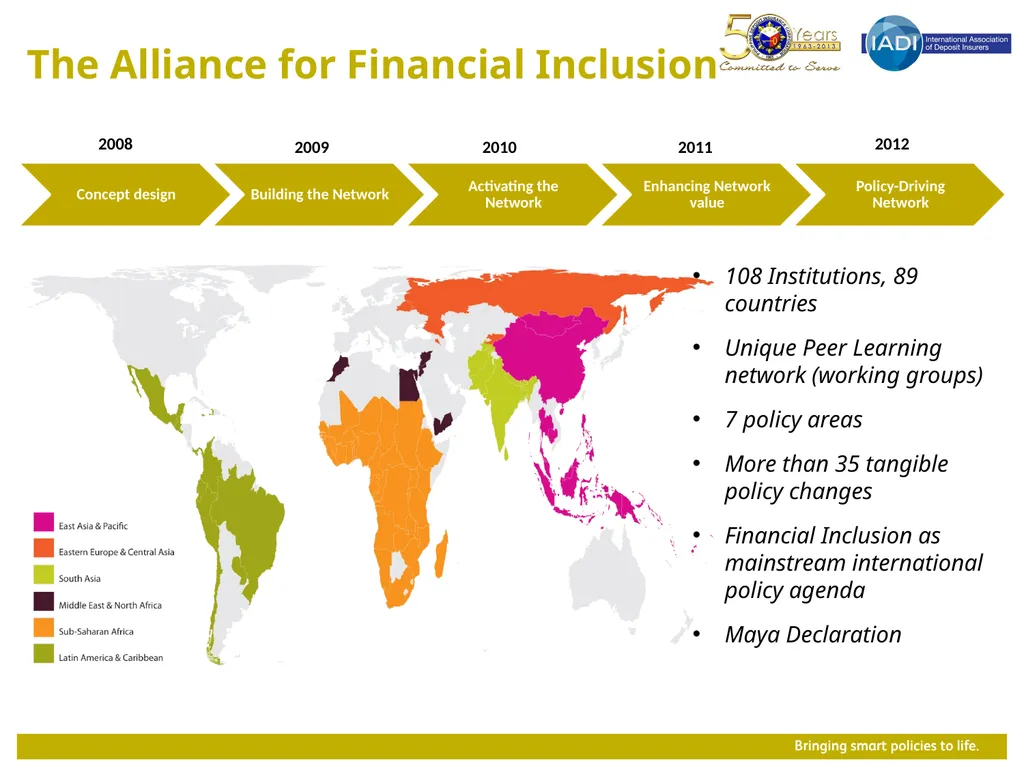
The Alliance for Financial Inclusion 108 Institutions, 89 countries
Unique Peer Learning network (working groups)
7 policy areas
More than 35 tangible policy changes
Financial Inclusion as mainstream international policy agenda
Maya Declaration 2008 2009 2010 2011 2012<br>
04
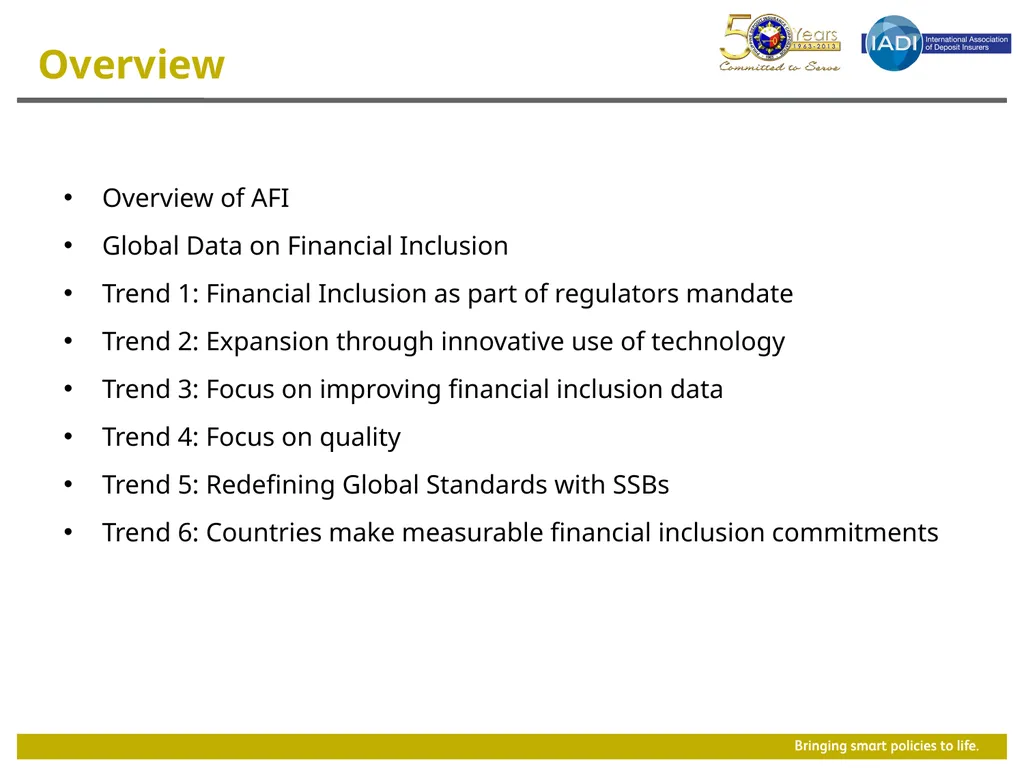
Overview of AFI
Global Data on Financial Inclusion
Trend 1: Financial Inclusion as part of regulators mandate
Trend 2: Expansion through innovative use of technology
Trend 3: Focus on improving financial inclusion data
Trend 4: Focus on quality
Trend 5: Redefining Global Standards with SSBs
Trend 6: Countries make measurable financial inclusion commitments Overview<br>
05
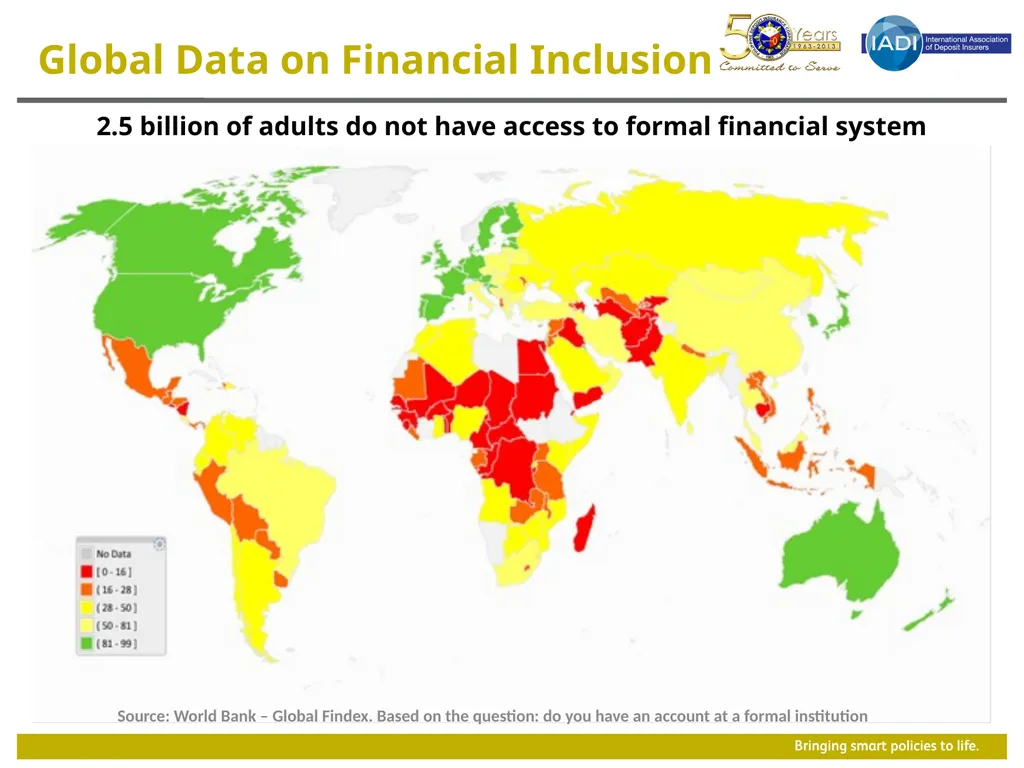
Click to edit Master title style Click to edit Master subtitle style 2.5 billion of adults do not have access to formal financial system Source: World Bank – Global Findex. Based on the question: do you have an account at a formal institution Global Data on Financial Inclusion<br>
06
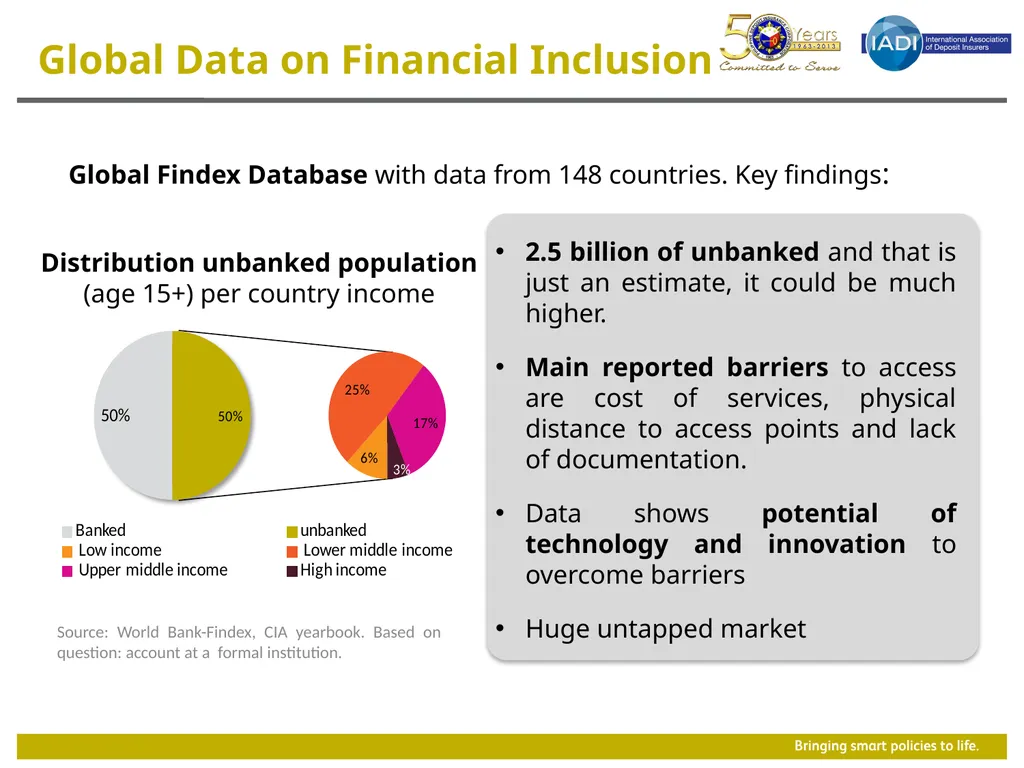
Source: World Bank-Findex, CIA yearbook. Based on question: account at a formal institution. 2.5 billion of unbanked and that is just an estimate, it could be much higher.
Main reported barriers to access are cost of services, physical distance to access points and lack of documentation.
Data shows potential of technology and innovation to overcome barriers
Huge untapped market Global Findex Database with data from 148 countries. Key findings: Global Data on Financial Inclusion Distribution unbanked population
(age 15+) per country income<br>
07
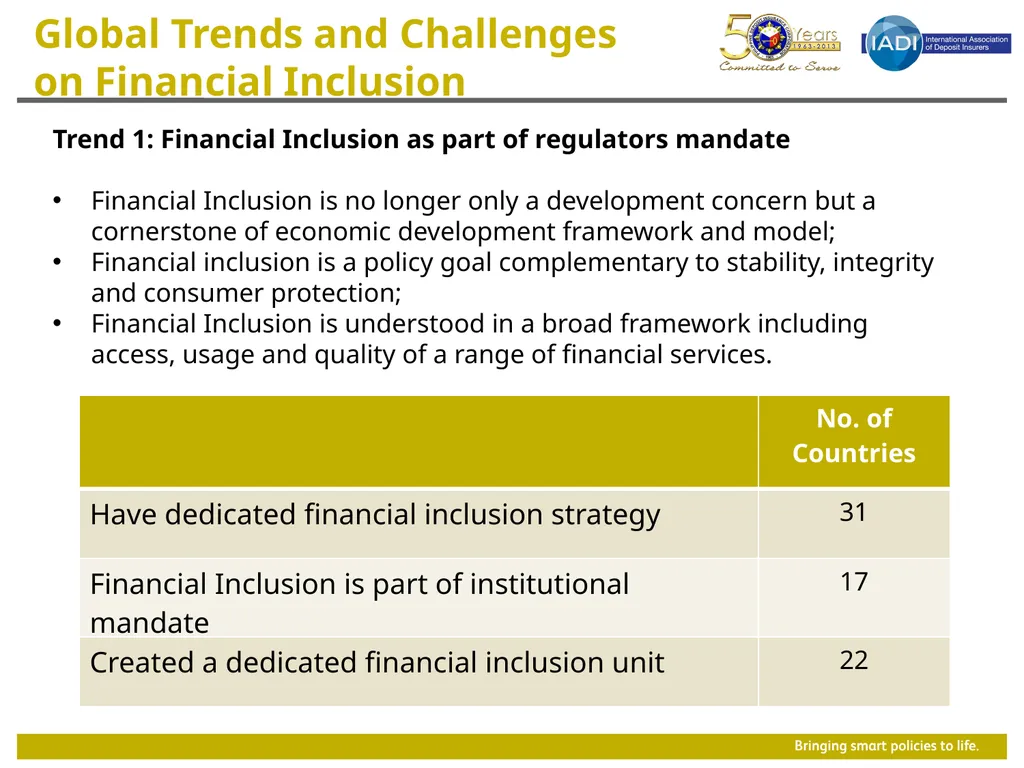
Global Trends and Challenges on Financial Inclusion Trend 1: Financial Inclusion as part of regulators mandate
Financial Inclusion is no longer only a development concern but a cornerstone of economic development framework and model;
Financial inclusion is a policy goal complementary to stability, integrity and consumer protection;
Financial Inclusion is understood in a broad framework including access, usage and quality of a range of financial services.<br>
08
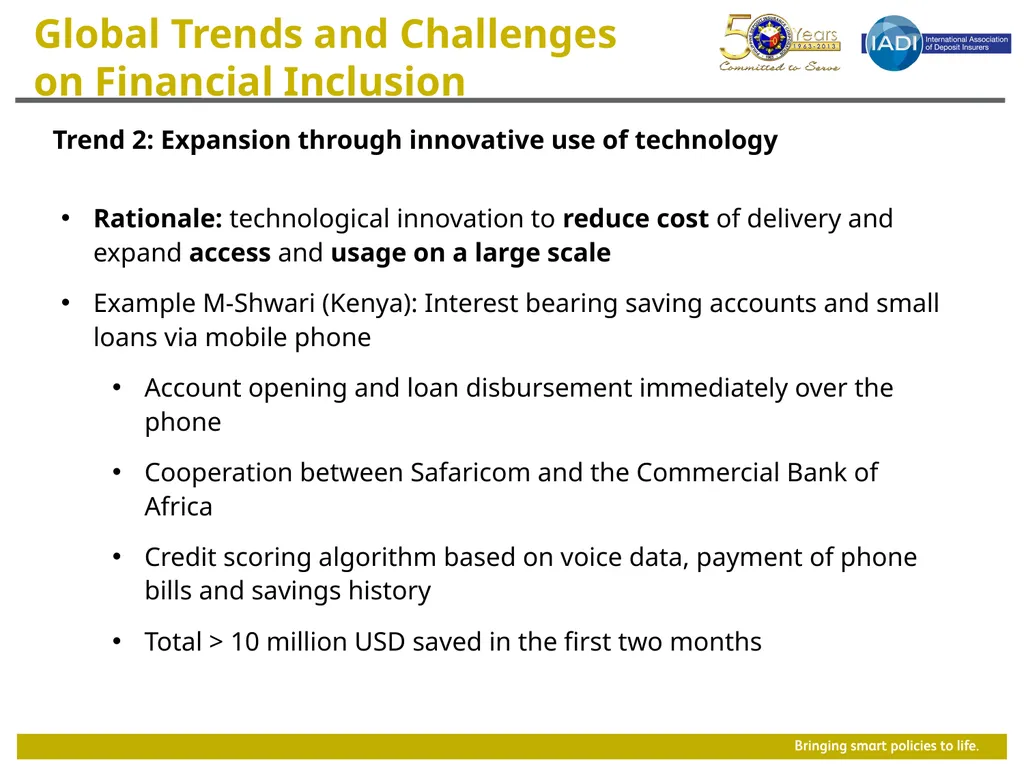
Rationale: technological innovation to reduce cost of delivery and expand access and usage on a large scale
Example M-Shwari (Kenya): Interest bearing saving accounts and small loans via mobile phone
Account opening and loan disbursement immediately over the phone
Cooperation between Safaricom and the Commercial Bank of Africa
Credit scoring algorithm based on voice data, payment of phone bills and savings history
Total > 10 million USD saved in the first two months Global Trends and Challenges on Financial Inclusion Trend 2: Expansion through innovative use of technology<br>
09
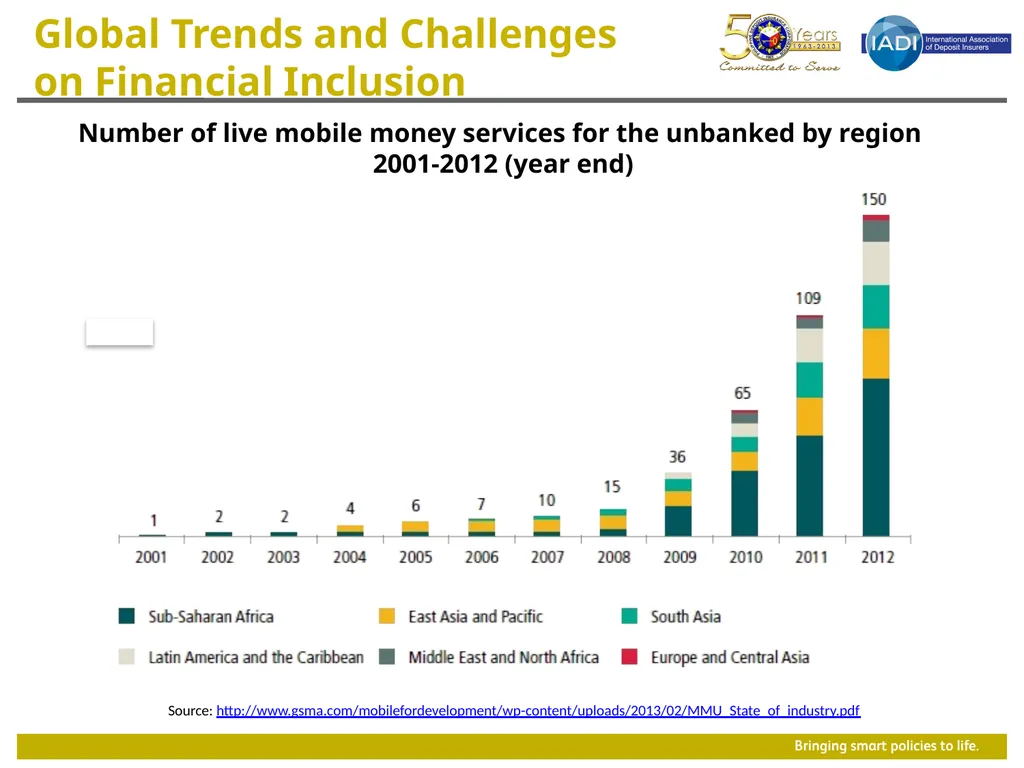
Source: http://www.gsma.com/mobilefordevelopment/wp-content/uploads/2013/02/MMU_State_of_industry.pdf Number of live mobile money services for the unbanked by region 2001-2012 (year end) Global Trends and Challenges on Financial Inclusion<br>
10
AFI Core Set of Financial Inclusion Indicators
AFI Second Tier Set of Financial Inclusion Indicators and specific AFI Indicator Sets e.g. MFS, Quality, Pacific Islands
FINDEX: First public database that consistently tracks people’s use of financial products across countries
G20 Global Partnership on Financial Inclusion (GPFI) Subgroup on Data and Measurement Global Trends and Challenges on Financial Inclusion Trend 3: Focus on improving financial inclusion data<br>
11
Rationale: service quality drives usage
50 AFI members call consumer protection a priority area
23 AFI members have made specific commitments related to consumer protection
Many countries are undertaking specific programs in financial literacy and financial education
G 20 Presidency of Russia emphasizes consumer protection and financial literacy Trend 4: Focus on quality Global Trends and Challenges on Financial Inclusion<br>
12
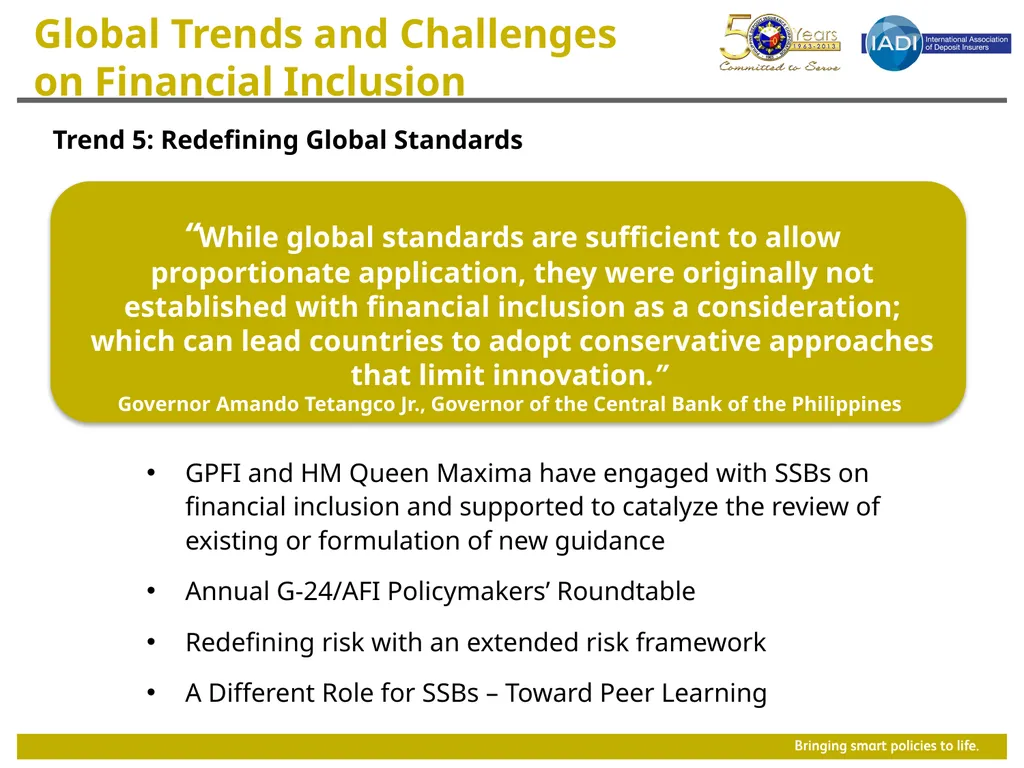
“While global standards are sufficient to allow proportionate application, they were originally not established with financial inclusion as a consideration; which can lead countries to adopt conservative approaches that limit innovation.”
Governor Amando Tetangco Jr., Governor of the Central Bank of the Philippines Trend 5: Redefining Global Standards GPFI and HM Queen Maxima have engaged with SSBs on financial inclusion and supported to catalyze the review of existing or formulation of new guidance
Annual G-24/AFI Policymakers’ Roundtable
Redefining risk with an extended risk framework
A Different Role for SSBs – Toward Peer Learning Global Trends and Challenges on Financial Inclusion<br>
13
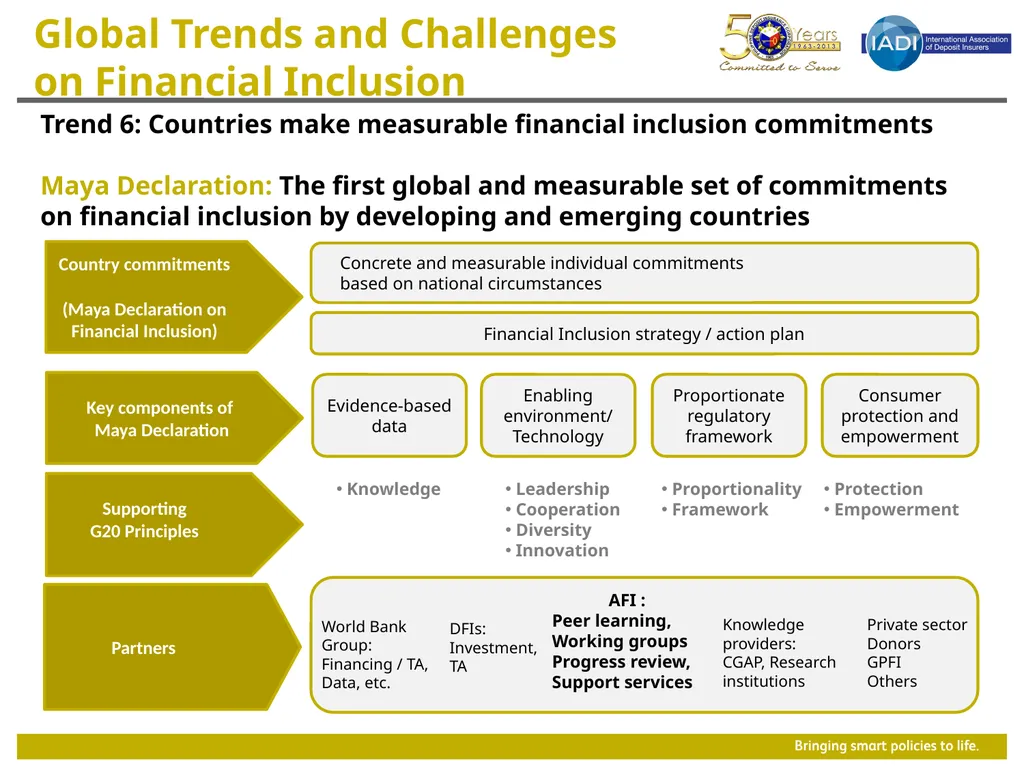
Country commitments
(Maya Declaration on Financial Inclusion) Key components of
Maya Declaration Financial Inclusion strategy / action plan Supporting
G20 Principles Evidence-based data Consumer protection and empowerment Proportionate
regulatory framework Enabling environment/ Technology Partners World Bank Group:
Financing / TA,
Data, etc. DFIs:
Investment, TA Knowledge providers:
CGAP, Research institutions Private sector
Donors
GPFI
Others Concrete and measurable individual commitments
based on national circumstances Knowledge Leadership
Cooperation
Diversity
Innovation Proportionality
Framework Protection
Empowerment AFI :
Peer learning, Working groups
Progress review,
Support services Trend 6: Countries make measurable financial inclusion commitments
Maya Declaration: The first global and measurable set of commitments on financial inclusion by developing and emerging countries Global Trends and Challenges on Financial Inclusion<br>
14
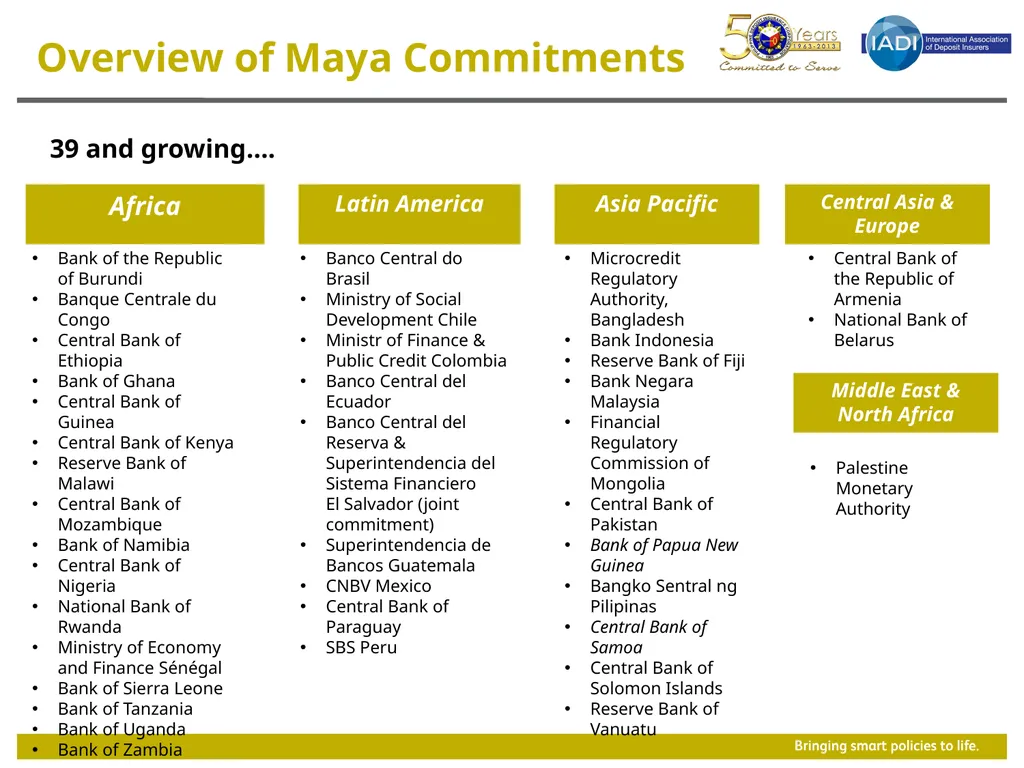
Africa Latin America Asia Pacific Central Asia & Europe Bank of the Republic of Burundi
Banque Centrale du Congo
Central Bank of Ethiopia
Bank of Ghana
Central Bank of Guinea
Central Bank of Kenya
Reserve Bank of Malawi
Central Bank of Mozambique
Bank of Namibia
Central Bank of Nigeria
National Bank of Rwanda
Ministry of Economy and Finance Sénégal
Bank of Sierra Leone
Bank of Tanzania
Bank of Uganda
Bank of Zambia Banco Central do Brasil
Ministry of Social Development Chile
Ministr of Finance & Public Credit Colombia
Banco Central del Ecuador
Banco Central del Reserva & Superintendencia del Sistema Financiero
El Salvador (joint commitment)
Superintendencia de Bancos Guatemala
CNBV Mexico
Central Bank of Paraguay
SBS Peru Microcredit Regulatory Authority, Bangladesh
Bank Indonesia
Reserve Bank of Fiji
Bank Negara Malaysia
Financial Regulatory Commission of Mongolia
Central Bank of Pakistan
Bank of Papua New Guinea
Bangko Sentral ng Pilipinas
Central Bank of Samoa
Central Bank of Solomon Islands
Reserve Bank of Vanuatu Central Bank of the Republic of Armenia
National Bank of Belarus Middle East & North Africa Palestine Monetary Authority Overview of Maya Commitments 39 and growing….<br>
15
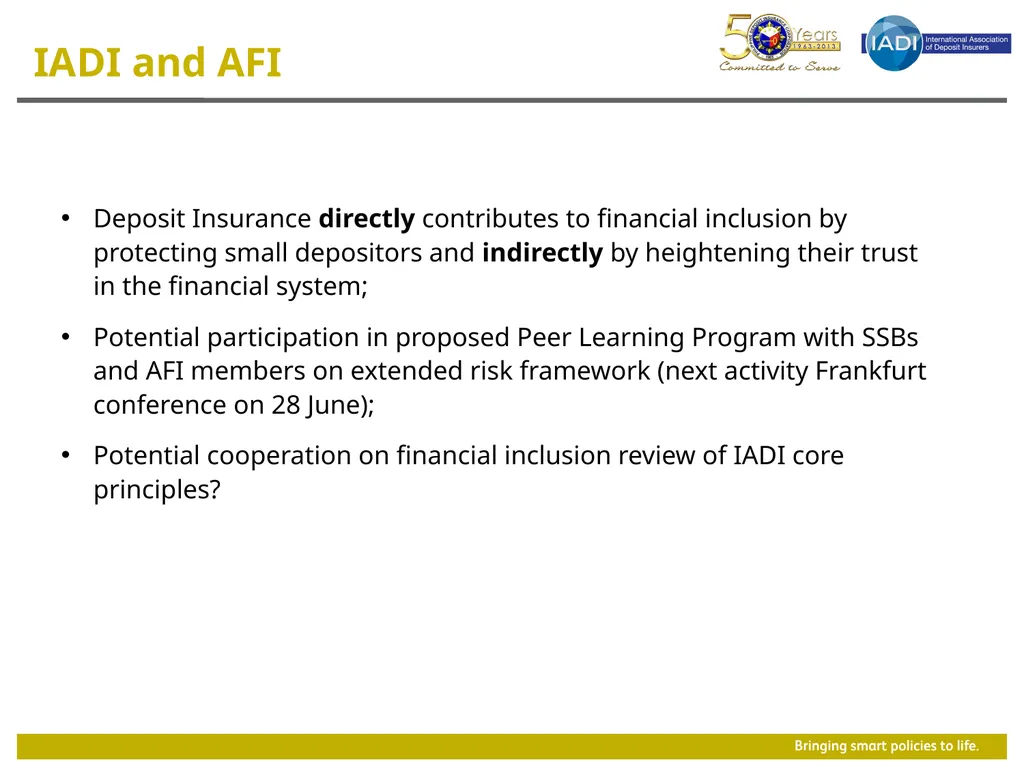
Deposit Insurance directly contributes to financial inclusion by protecting small depositors and indirectly by heightening their trust in the financial system;
Potential participation in proposed Peer Learning Program with SSBs and AFI members on extended risk framework (next activity Frankfurt conference on 28 June);
Potential cooperation on financial inclusion review of IADI core principles? IADI and AFI<br>