
Good Laboratory Practices Practices and Guidelines
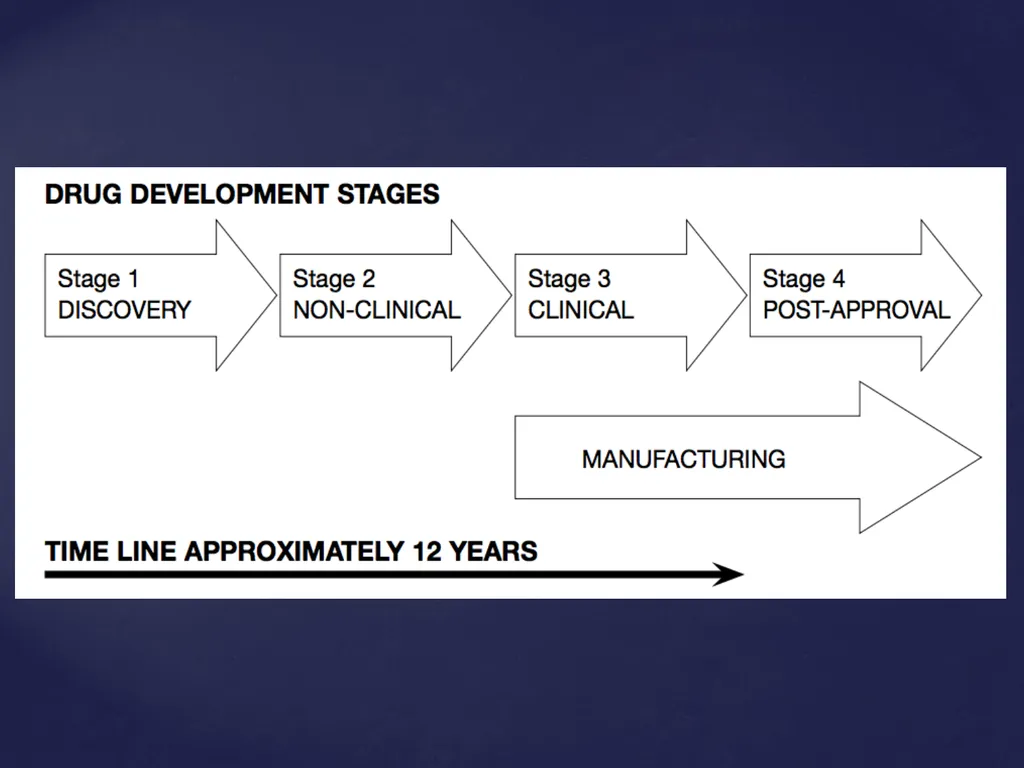



Description: Good Laboratory Practices Practices and Guidelines Dr. Richa Singh 1 2 3 4 Discovery of potential NME Not covered by a regulatory standard Post approval stage Clinical studies in human GCP Non-clinical studies not performed in human GLP
Related Topics
Download Presentation
"Good Laboratory Practices Practices and Guidelines" is the property of its rightful owner. Permission is granted to download and print the materials on this website for personal, non-commercial use only, and to display it on your personal computer provided you do not modify the materials and that you retain all copyright notices contained in the materials. By downloading content from our website, you accept the terms of this agreement.
Presentation Transcript
slide1. Good Laboratory Practices Practices and Guidelines
Dr. Richa Singh<br>
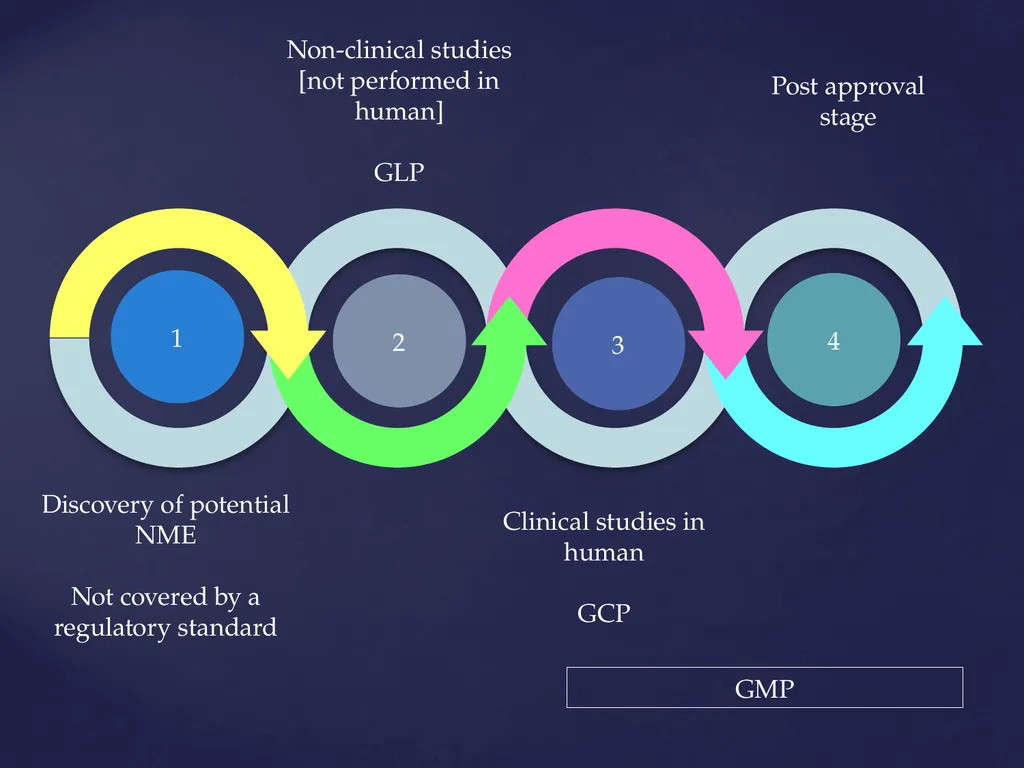
slide3. 1 2 3 4 Discovery of potential NME
Not covered by a regulatory standard Post approval stage Clinical studies in human
GCP Non-clinical studies [not performed in human]
GLP GMP<br>
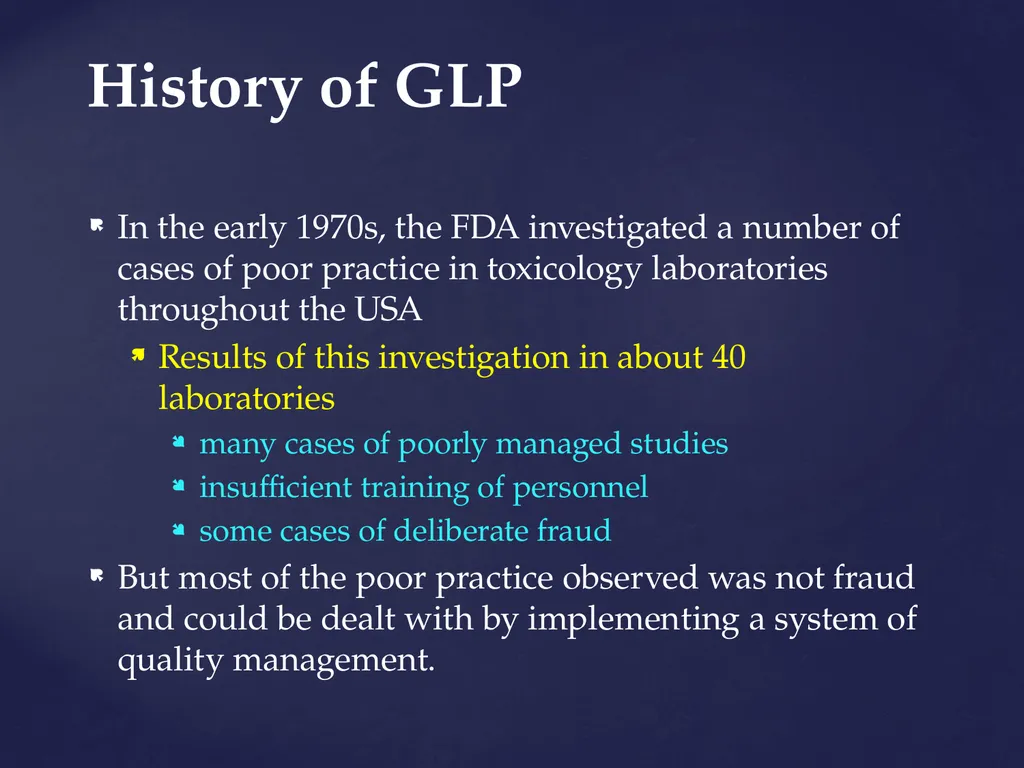
slide4. In the early 1970s, the FDA investigated a number of cases of poor practice in toxicology laboratories throughout the USA
Results of this investigation in about 40 laboratories
many cases of poorly managed studies
insufficient training of personnel
some cases of deliberate fraud
But most of the poor practice observed was not fraud and could be dealt with by implementing a system of quality management. History of GLP<br>
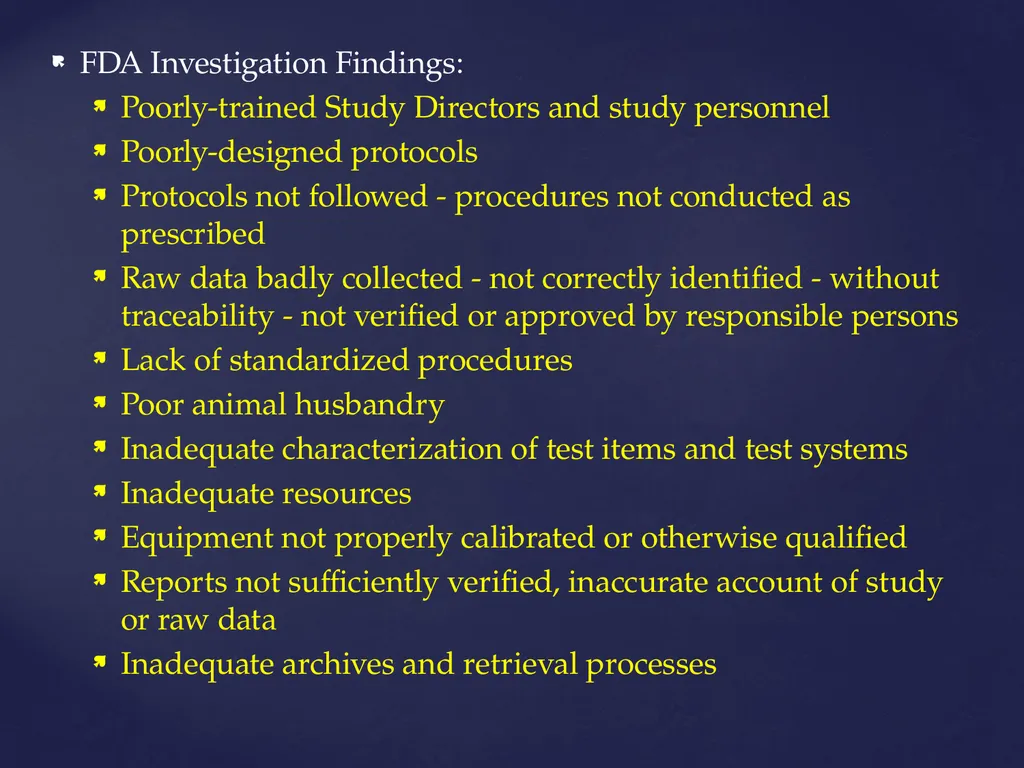
slide5. FDA Investigation Findings:
Poorly-trained Study Directors and study personnel
Poorly-designed protocols
Protocols not followed - procedures not conducted as prescribed
Raw data badly collected - not correctly identified - without traceability - not verified or approved by responsible persons
Lack of standardized procedures
Poor animal husbandry
Inadequate characterization of test items and test systems
Inadequate resources
Equipment not properly calibrated or otherwise qualified
Reports not sufficiently verified, inaccurate account of study or raw data
Inadequate archives and retrieval processes<br>
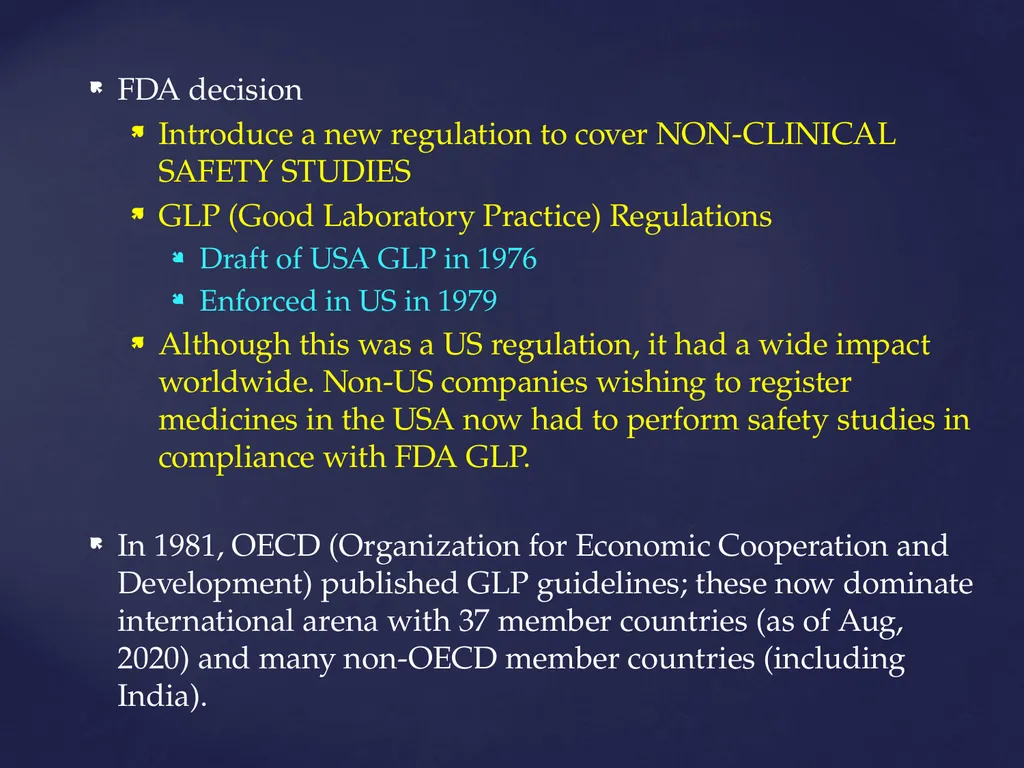
slide6. FDA decision
Introduce a new regulation to cover NON-CLINICAL SAFETY STUDIES
GLP (Good Laboratory Practice) Regulations
Draft of USA GLP in 1976
Enforced in US in 1979
Although this was a US regulation, it had a wide impact worldwide. Non-US companies wishing to register medicines in the USA now had to perform safety studies in compliance with FDA GLP.
In 1981, OECD (Organization for Economic Cooperation and Development) published GLP guidelines; these now dominate international arena with 37 member countries (as of Aug, 2020) and many non-OECD member countries (including India).<br>
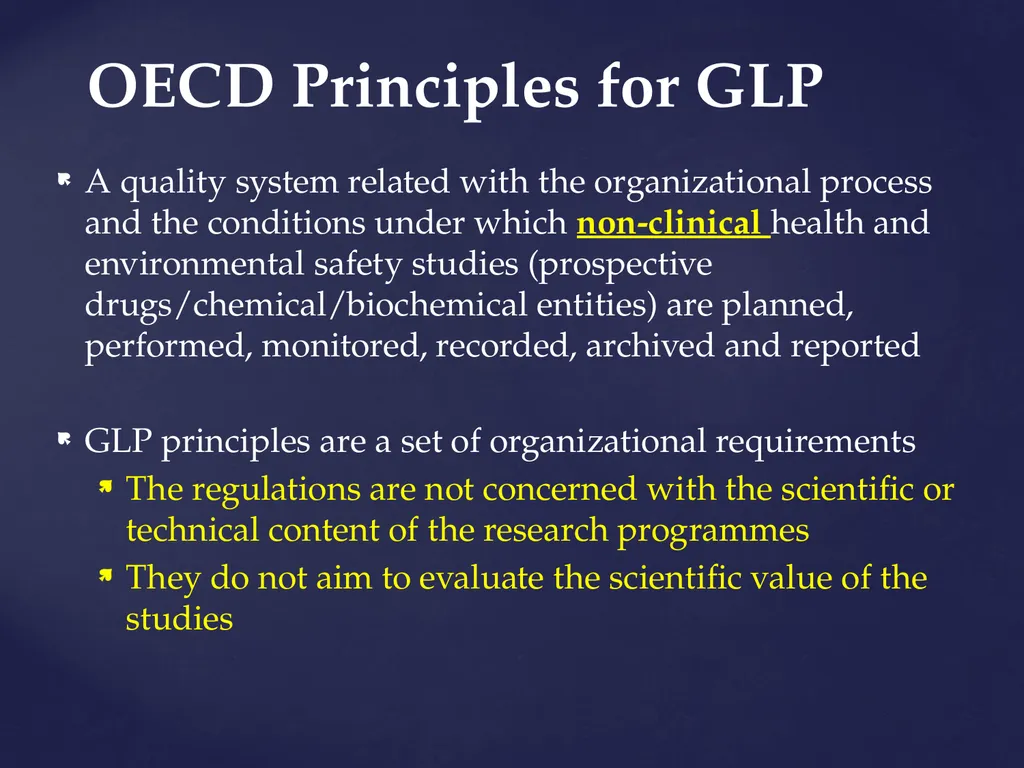
slide7. A quality system related with the organizational process and the conditions under which non-clinical health and environmental safety studies (prospective drugs/chemical/biochemical entities) are planned, performed, monitored, recorded, archived and reported
GLP principles are a set of organizational requirements
The regulations are not concerned with the scientific or technical content of the research programmes
They do not aim to evaluate the scientific value of the studies OECD Principles for GLP<br>
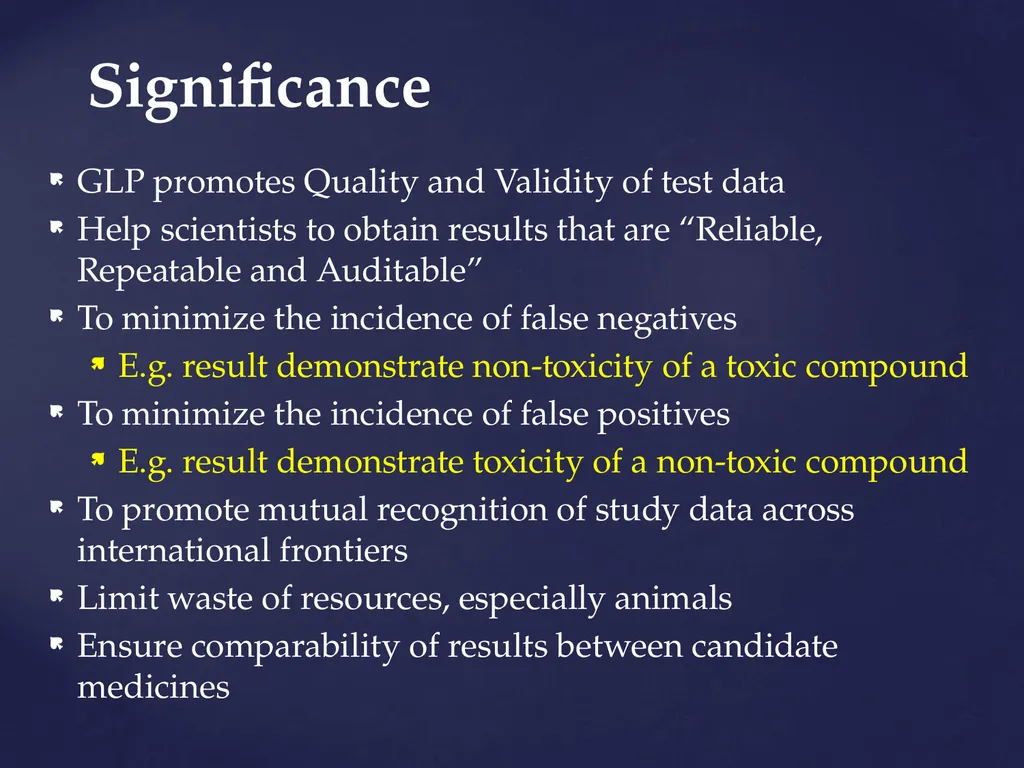
slide8. GLP promotes Quality and Validity of test data
Help scientists to obtain results that are “Reliable, Repeatable and Auditable”
To minimize the incidence of false negatives
E.g. result demonstrate non-toxicity of a toxic compound
To minimize the incidence of false positives
E.g. result demonstrate toxicity of a non-toxic compound
To promote mutual recognition of study data across international frontiers
Limit waste of resources, especially animals
Ensure comparability of results between candidate medicines Significance<br>
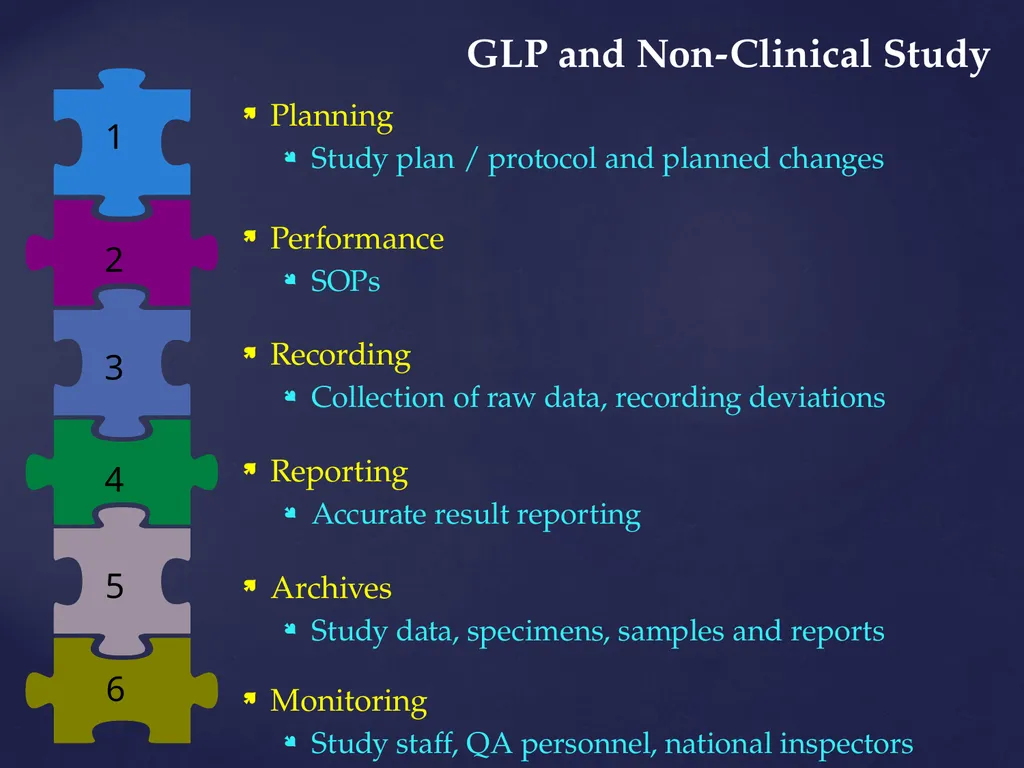
slide9. 1 2 3 4 5 6 Planning
Study plan / protocol and planned changes
Performance
SOPs
Recording
Collection of raw data, recording deviations
Reporting
Accurate result reporting
Archives
Study data, specimens, samples and reports
Monitoring
Study staff, QA personnel, national inspectors GLP and Non-Clinical Study<br>
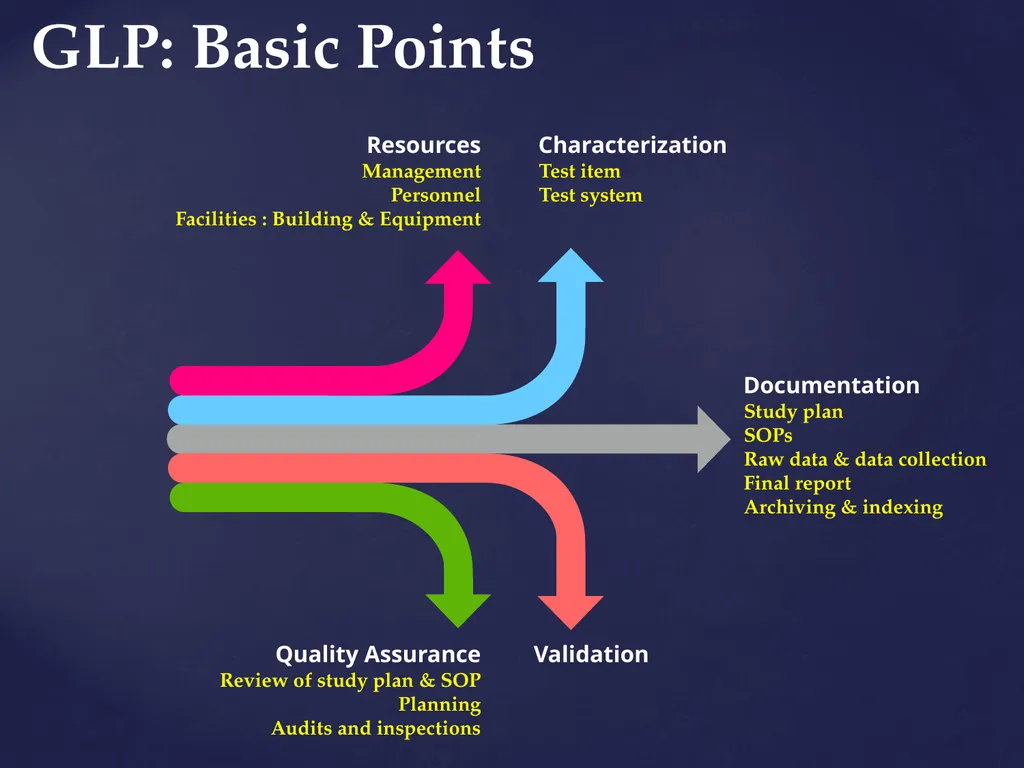
slide10. Resources
Management
Personnel
Facilities : Building & Equipment Characterization
Test item
Test system Documentation
Study plan
SOPs
Raw data & data collection
Final report
Archiving & indexing Validation Quality Assurance
Review of study plan & SOP
Planning
Audits and inspections GLP: Basic Points<br>
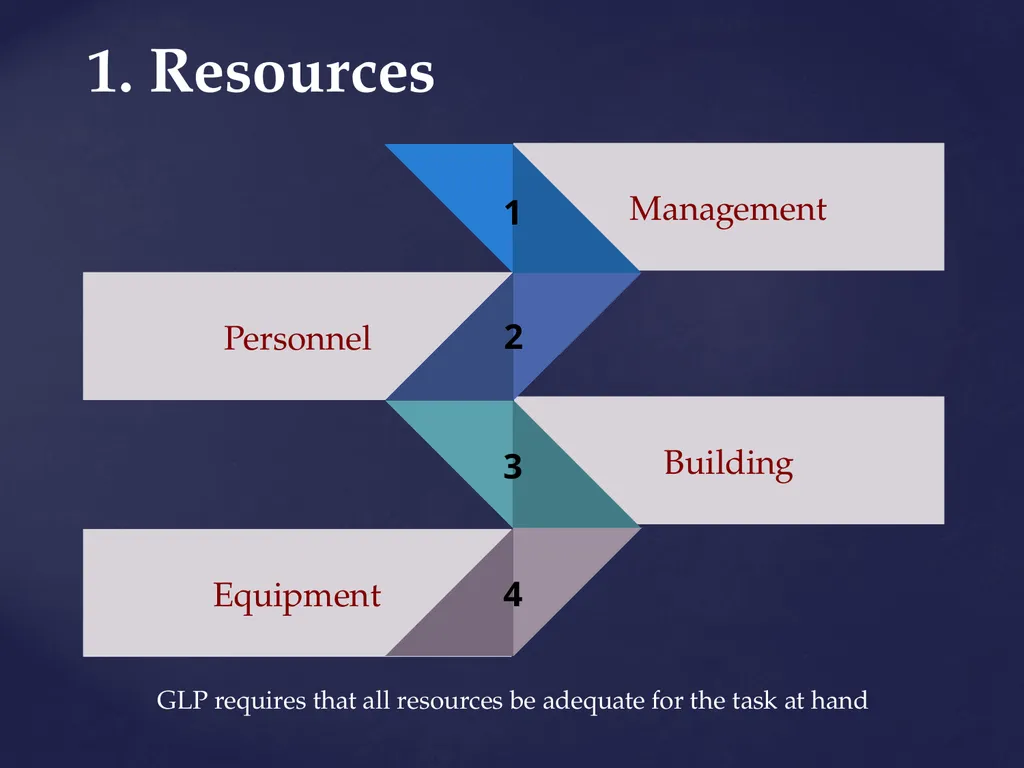
slide11. Building Personnel Equipment Management 1 2 3 4 1. Resources GLP requires that all resources be adequate for the task at hand<br>
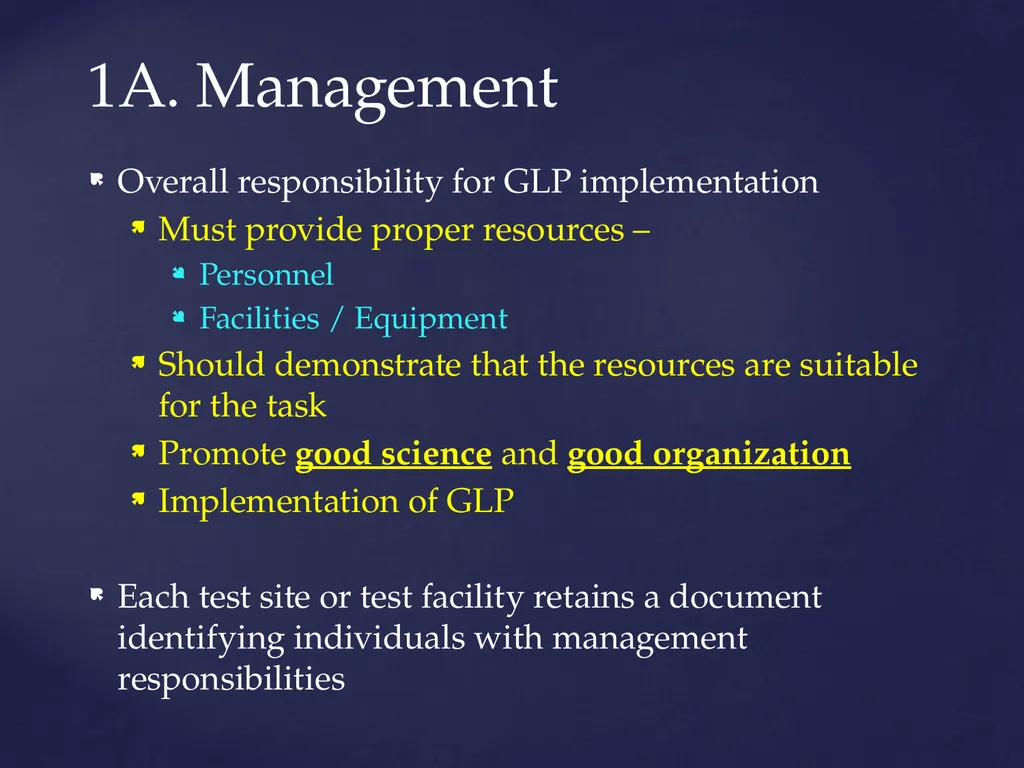
slide12. Overall responsibility for GLP implementation
Must provide proper resources –
Personnel
Facilities / Equipment
Should demonstrate that the resources are suitable for the task
Promote good science and good organization
Implementation of GLP
Each test site or test facility retains a document identifying individuals with management responsibilities 1A. Management<br>
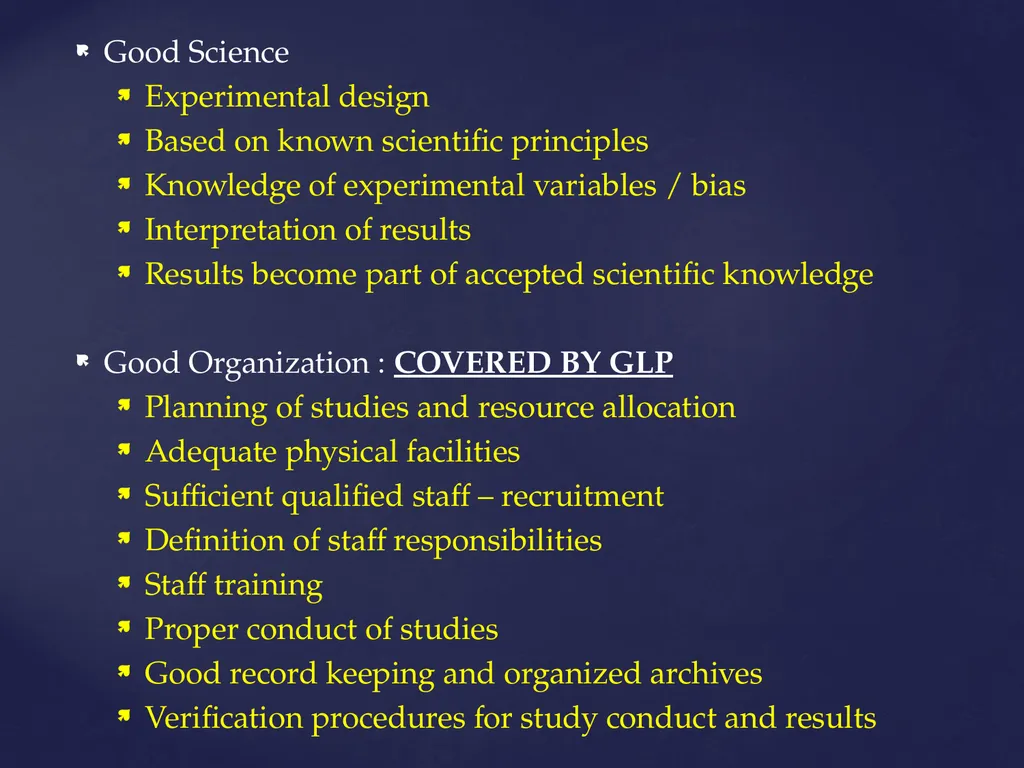
slide13. Good Science
Experimental design
Based on known scientific principles
Knowledge of experimental variables / bias
Interpretation of results
Results become part of accepted scientific knowledge
Good Organization : COVERED BY GLP
Planning of studies and resource allocation
Adequate physical facilities
Sufficient qualified staff – recruitment
Definition of staff responsibilities
Staff training
Proper conduct of studies
Good record keeping and organized archives
Verification procedures for study conduct and results<br>
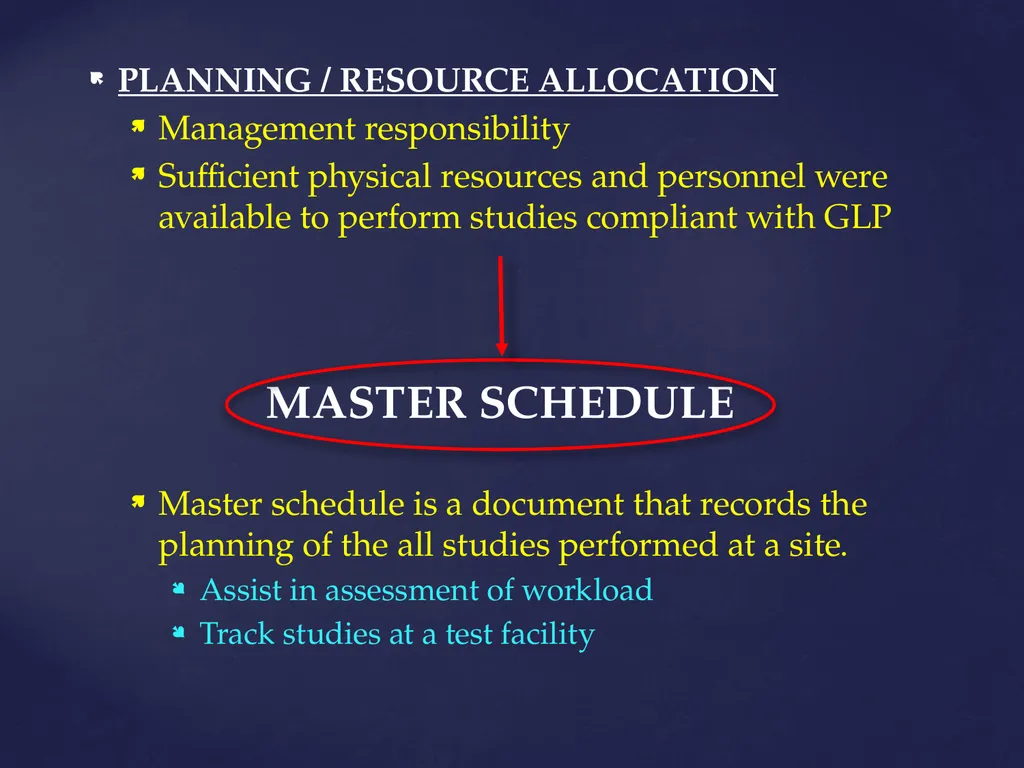
slide14. PLANNING / RESOURCE ALLOCATION
Management responsibility
Sufficient physical resources and personnel were available to perform studies compliant with GLP
Master schedule is a document that records the planning of the all studies performed at a site.
Assist in assessment of workload
Track studies at a test facility MASTER SCHEDULE<br>
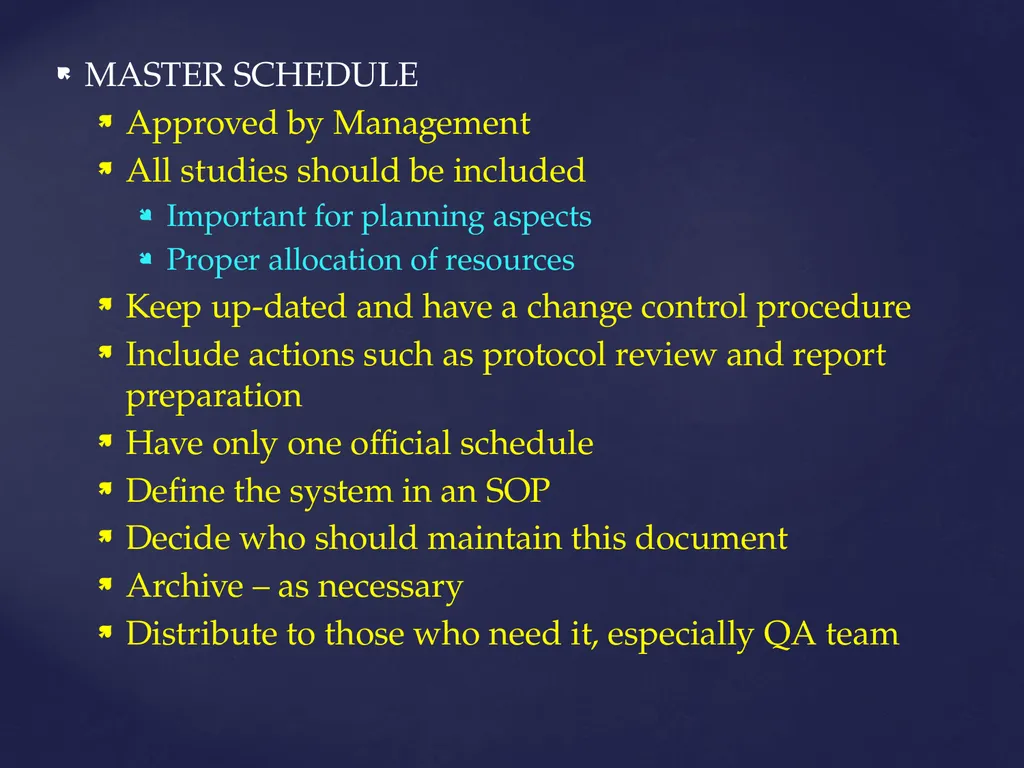
slide15. MASTER SCHEDULE
Approved by Management
All studies should be included
Important for planning aspects
Proper allocation of resources
Keep up-dated and have a change control procedure
Include actions such as protocol review and report preparation
Have only one official schedule
Define the system in an SOP
Decide who should maintain this document
Archive – as necessary
Distribute to those who need it, especially QA team<br>
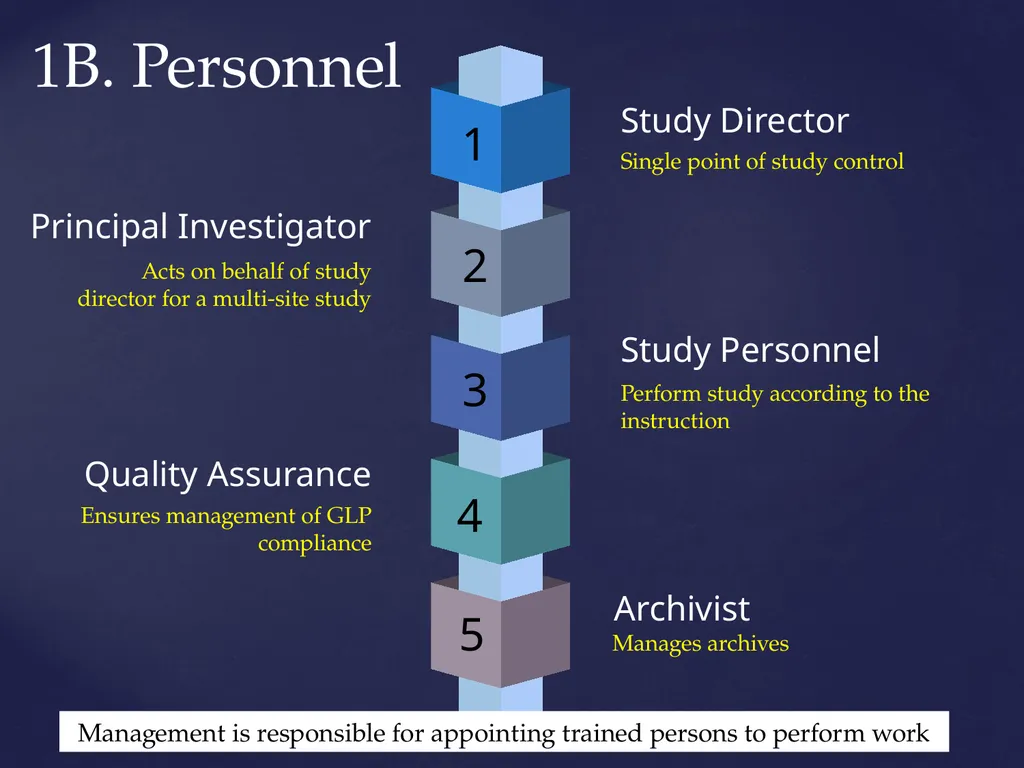
slide16. 1 2 3 4 5 Study Director Single point of study control 1B. Personnel Archivist Study Personnel Principal Investigator Acts on behalf of study director for a multi-site study Quality Assurance Perform study according to the instruction Ensures management of GLP compliance Manages archives Management is responsible for appointing trained persons to perform work<br>
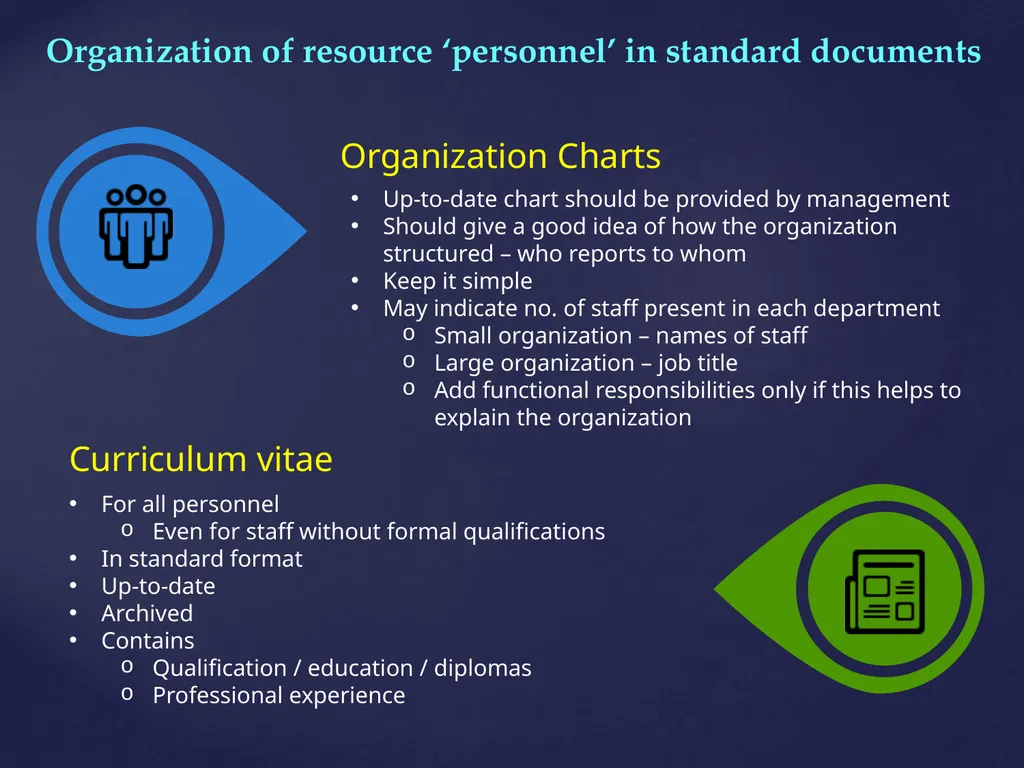
slide17. Organization Charts Curriculum vitae Organization of resource ‘personnel’ in standard documents Up-to-date chart should be provided by management
Should give a good idea of how the organization structured – who reports to whom
Keep it simple
May indicate no. of staff present in each department
Small organization – names of staff
Large organization – job title
Add functional responsibilities only if this helps to explain the organization For all personnel
Even for staff without formal qualifications
In standard format
Up-to-date
Archived
Contains
Qualification / education / diplomas
Professional experience<br>
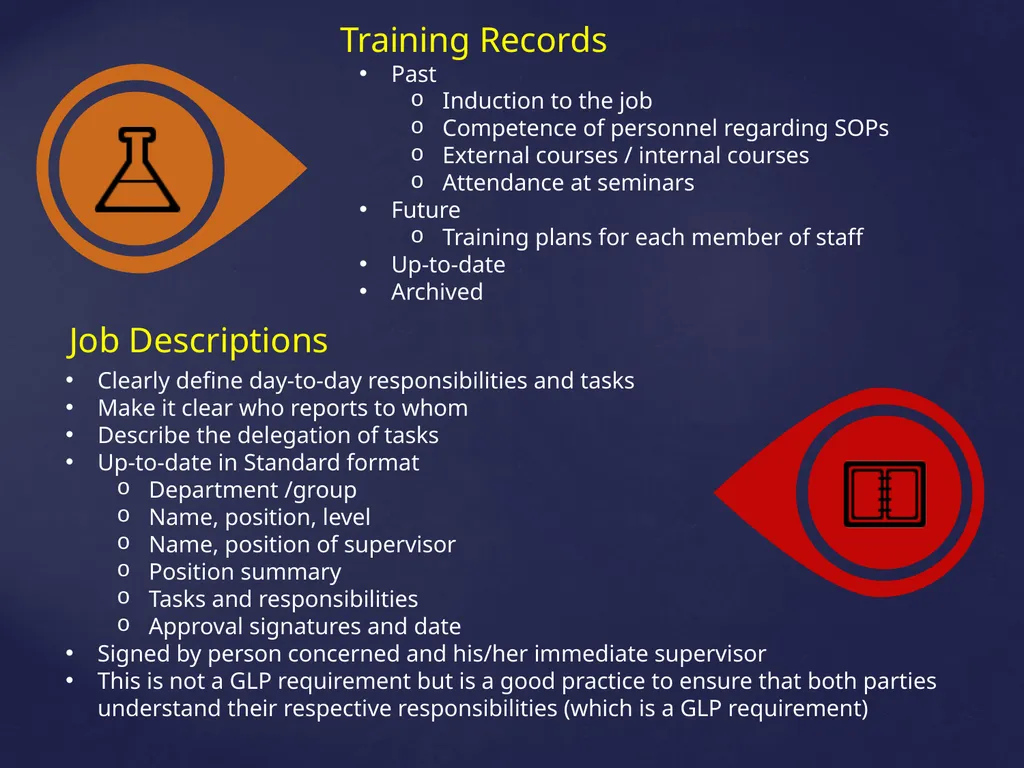
slide18. Training Records Job Descriptions Past
Induction to the job
Competence of personnel regarding SOPs
External courses / internal courses
Attendance at seminars
Future
Training plans for each member of staff
Up-to-date
Archived Clearly define day-to-day responsibilities and tasks
Make it clear who reports to whom
Describe the delegation of tasks
Up-to-date in Standard format
Department /group
Name, position, level
Name, position of supervisor
Position summary
Tasks and responsibilities
Approval signatures and date
Signed by person concerned and his/her immediate supervisor
This is not a GLP requirement but is a good practice to ensure that both parties understand their respective responsibilities (which is a GLP requirement)<br>
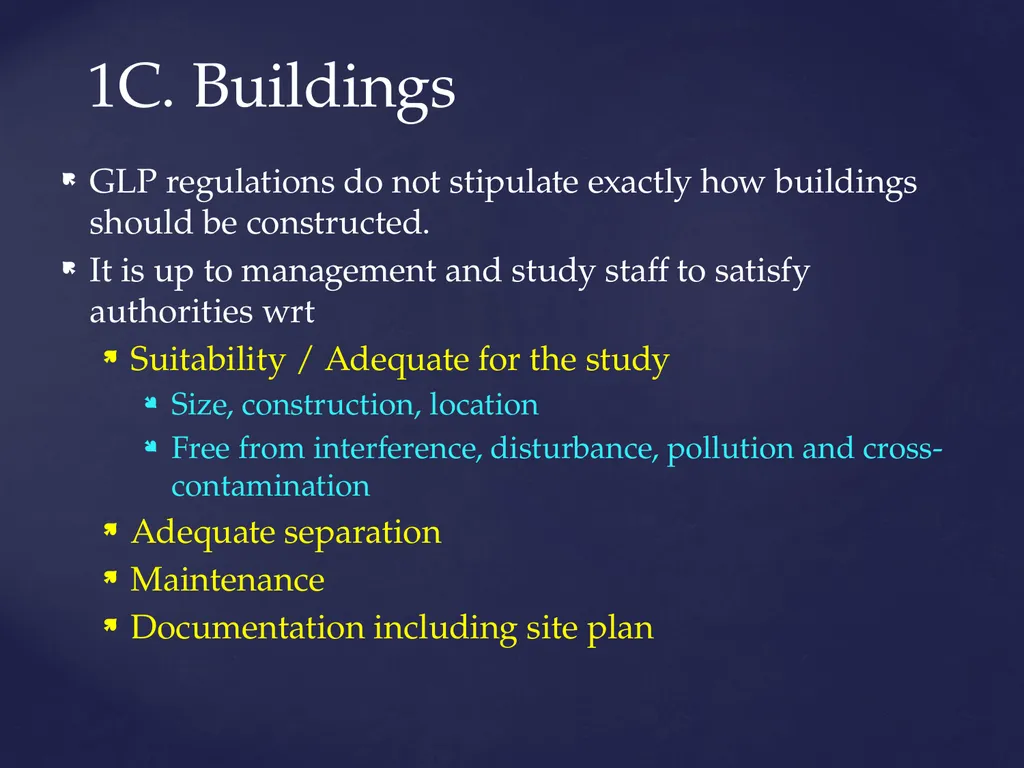
slide19. GLP regulations do not stipulate exactly how buildings should be constructed.
It is up to management and study staff to satisfy authorities wrt
Suitability / Adequate for the study
Size, construction, location
Free from interference, disturbance, pollution and cross-contamination
Adequate separation
Maintenance
Documentation including site plan 1C. Buildings<br>
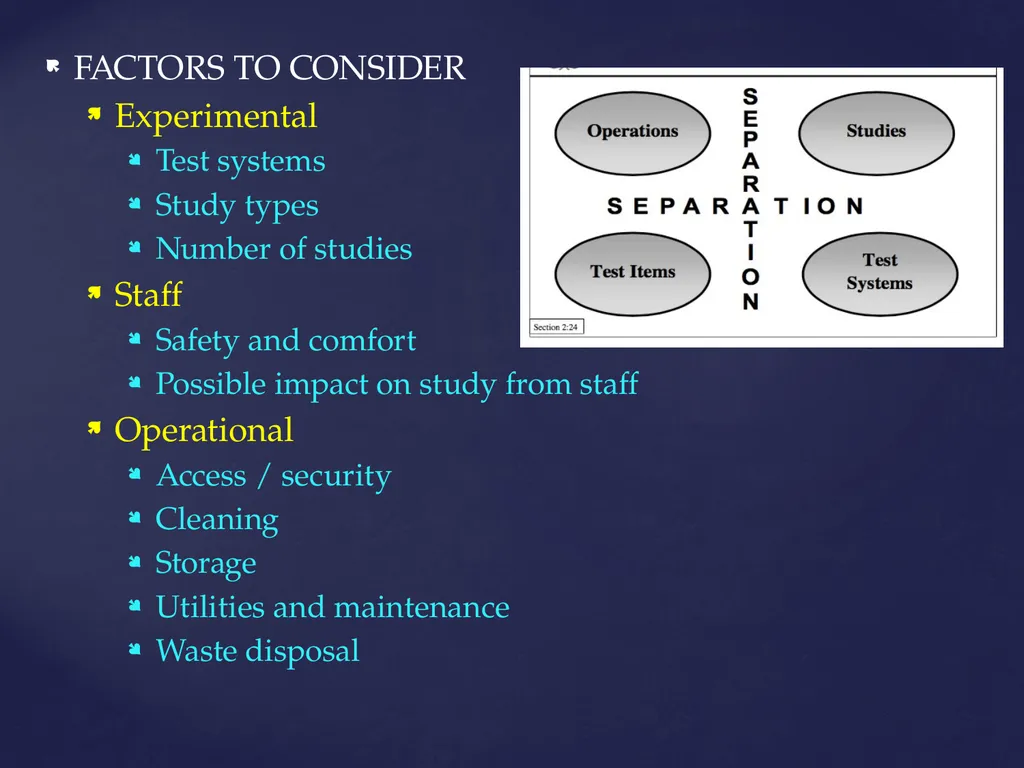
slide20. FACTORS TO CONSIDER
Experimental
Test systems
Study types
Number of studies
Staff
Safety and comfort
Possible impact on study from staff
Operational
Access / security
Cleaning
Storage
Utilities and maintenance
Waste disposal<br>
slide21. GLP regulations require that equipment used in studies
Suitable for task in hand
Properly calibrated and maintained SUITABILITY
Study director’s responsibility
Study staff must be able to justify the use
Sometimes requires proof of suitability
May need formal equipment qualification CALIBRATION
Need proof of standard working conditions
Working within limits fixed by the manufacturer
Producing reliable data
Calibration usually requires use of standards
Fix frequency of calibration in SOP
Respect calibration frequency 1D. Equipment<br>
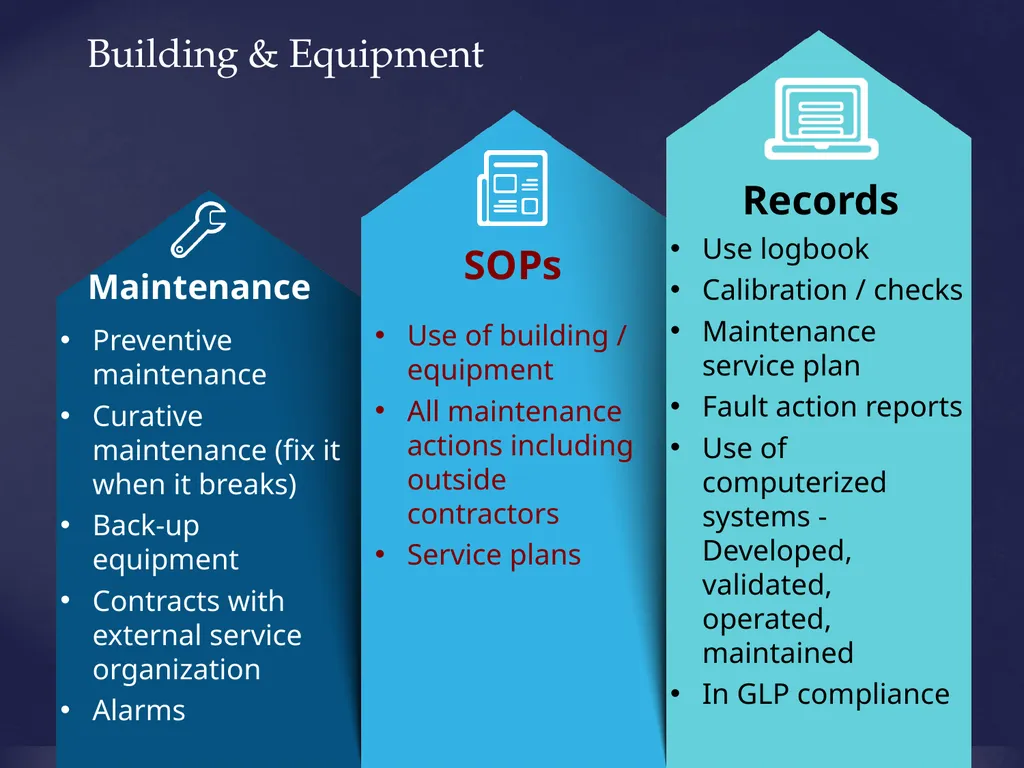
slide22. Preventive maintenance
Curative maintenance (fix it when it breaks)
Back-up equipment
Contracts with external service organization
Alarms Maintenance Use of building / equipment
All maintenance actions including outside contractors
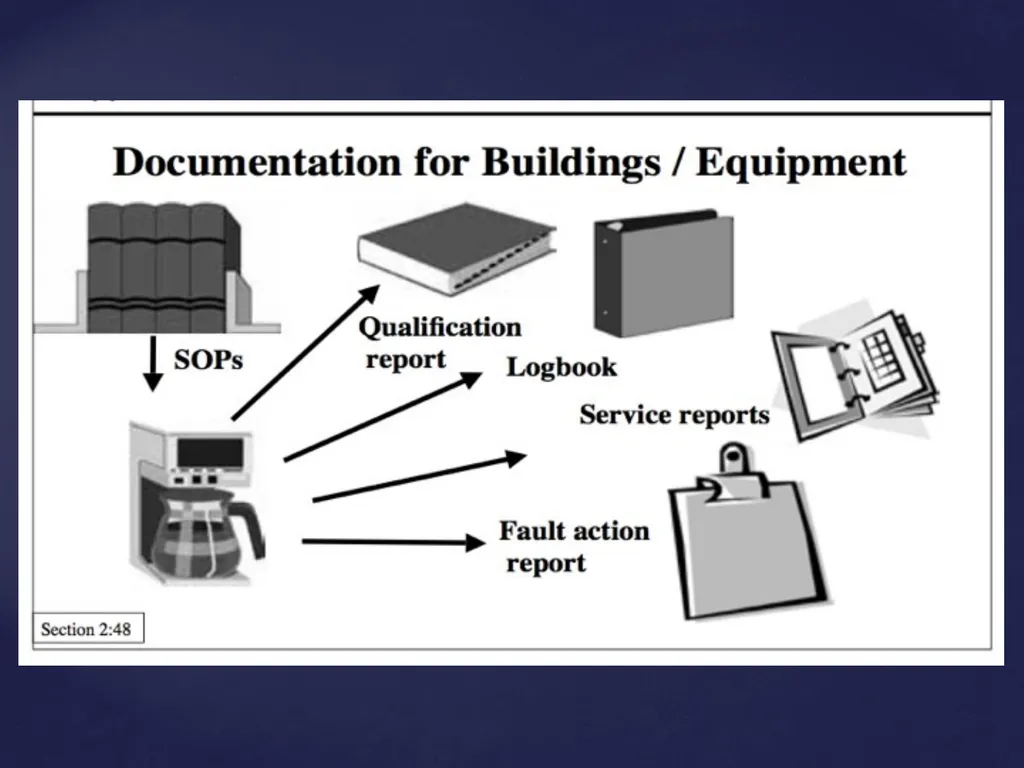
Service plans SOPs Use logbook
Calibration / checks
Maintenance service plan
Fault action reports
Use of computerized systems - Developed, validated, operated, maintained
In GLP compliance Records Building & Equipment<br>
slide24. 2. Characterization Materials used in experiments
Non-clinical studies
Test item
Often a chemical compound
Active ingredient for a medicine, a pesticide, a food additive, a vaccine, a biomass, an extraction from plant tissue, etc
Test system
Often a live animal
Plant, bacterium, an isolated organ, a field or other ecosystem, etc<br>
slide25. The GLP regulations deal with three points:
Test item itself
Preparation of dose formulation i.e. formulation of test item
Chemical analysis of both test item and formulation of test item 2A. Test Item<br>
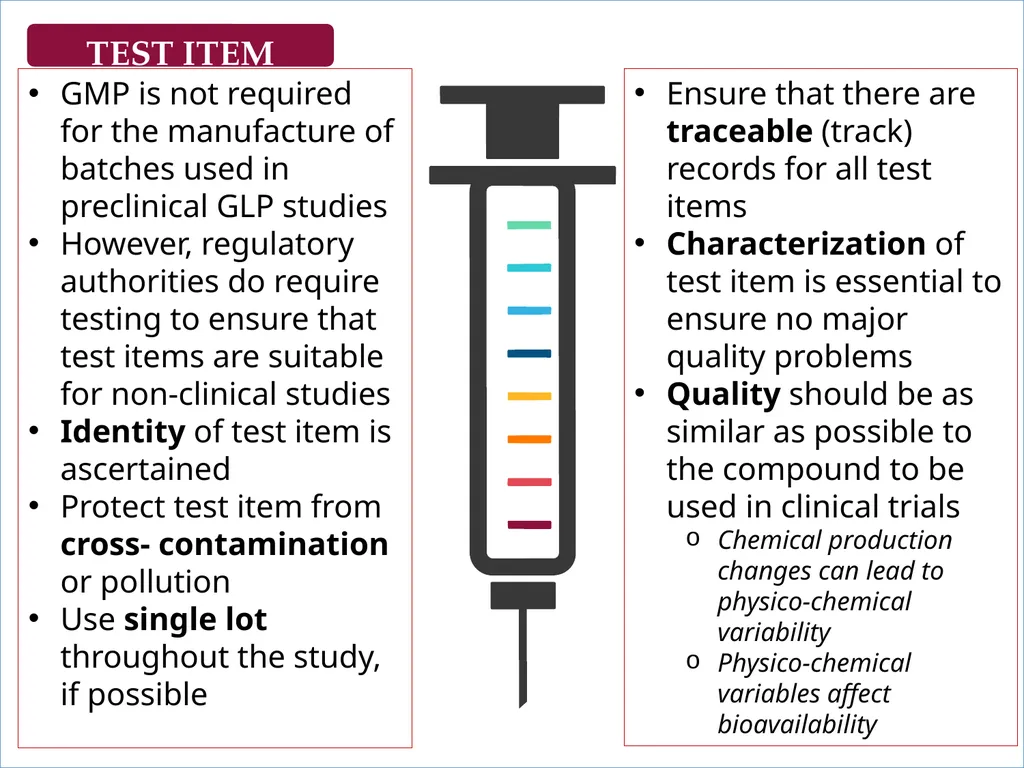
slide26. GMP is not required for the manufacture of batches used in preclinical GLP studies
However, regulatory authorities do require testing to ensure that test items are suitable for non-clinical studies
Identity of test item is ascertained
Protect test item from cross- contamination or pollution
Use single lot throughout the study, if possible TEST ITEM Ensure that there are traceable (track) records for all test items
Characterization of test item is essential to ensure no major quality problems
Quality should be as similar as possible to the compound to be used in clinical trials
Chemical production changes can lead to physico-chemical variability
Physico-chemical variables affect bioavailability<br>
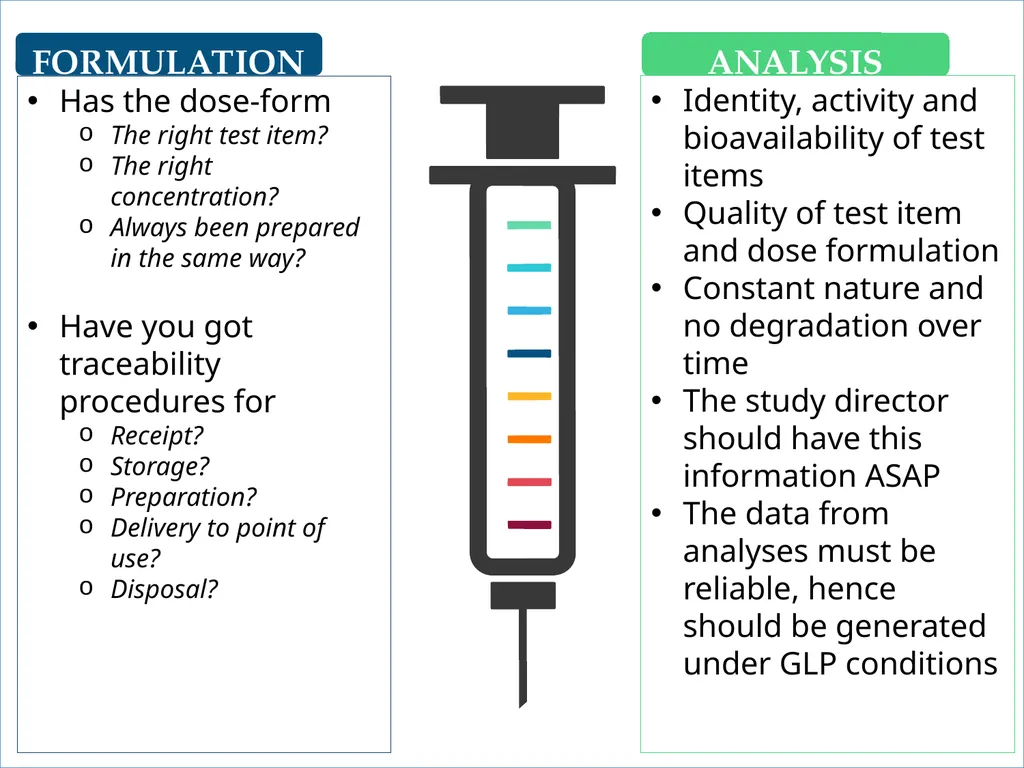
slide27. Has the dose-form
The right test item?
The right concentration?
Always been prepared in the same way?
Have you got traceability procedures for
Receipt?
Storage?
Preparation?
Delivery to point of use?
Disposal? FORMULATION Identity, activity and bioavailability of test items
Quality of test item and dose formulation
Constant nature and no degradation over time
The study director should have this information ASAP
The data from analyses must be reliable, hence should be generated under GLP conditions ANALYSIS<br>
slide28. Animals, Bacteria, Cells, Organs, Plants
GLP compliance
Compliance with animal welfare legislation (for animal test system) 2B. Test System<br>
slide29. ANIMALS
Scientist must match quantity and quality of animals to research requirements
Study Director defines
Phenotype / genotype
Sex, age
Supplier
Number
Reason for selecting the test system should be mentioned in Study Plan
Selection may be based on
Species / strain
Health status
Background data<br>
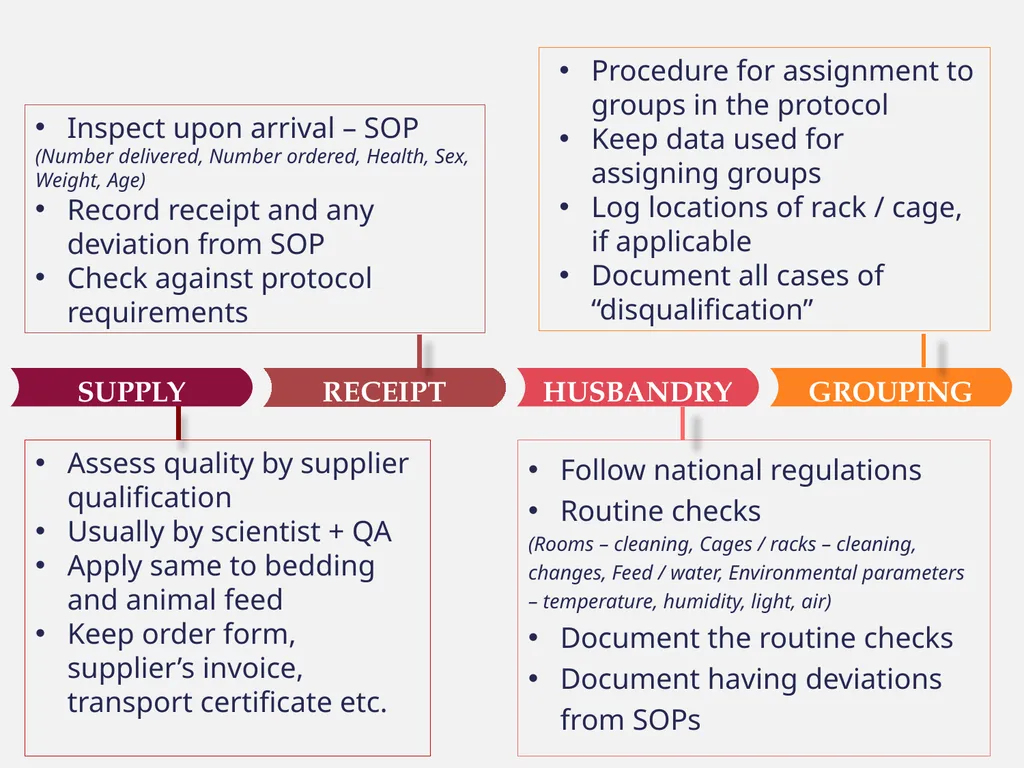
slide30. SUPPLY RECEIPT HUSBANDRY GROUPING Assess quality by supplier qualification
Usually by scientist + QA
Apply same to bedding and animal feed
Keep order form, supplier’s invoice, transport certificate etc. Inspect upon arrival – SOP
(Number delivered, Number ordered, Health, Sex, Weight, Age)
Record receipt and any deviation from SOP
Check against protocol requirements Follow national regulations
Routine checks
(Rooms – cleaning, Cages / racks – cleaning, changes, Feed / water, Environmental parameters – temperature, humidity, light, air)
Document the routine checks
Document having deviations from SOPs Procedure for assignment to groups in the protocol
Keep data used for assigning groups
Log locations of rack / cage, if applicable
Document all cases of “disqualification”<br>
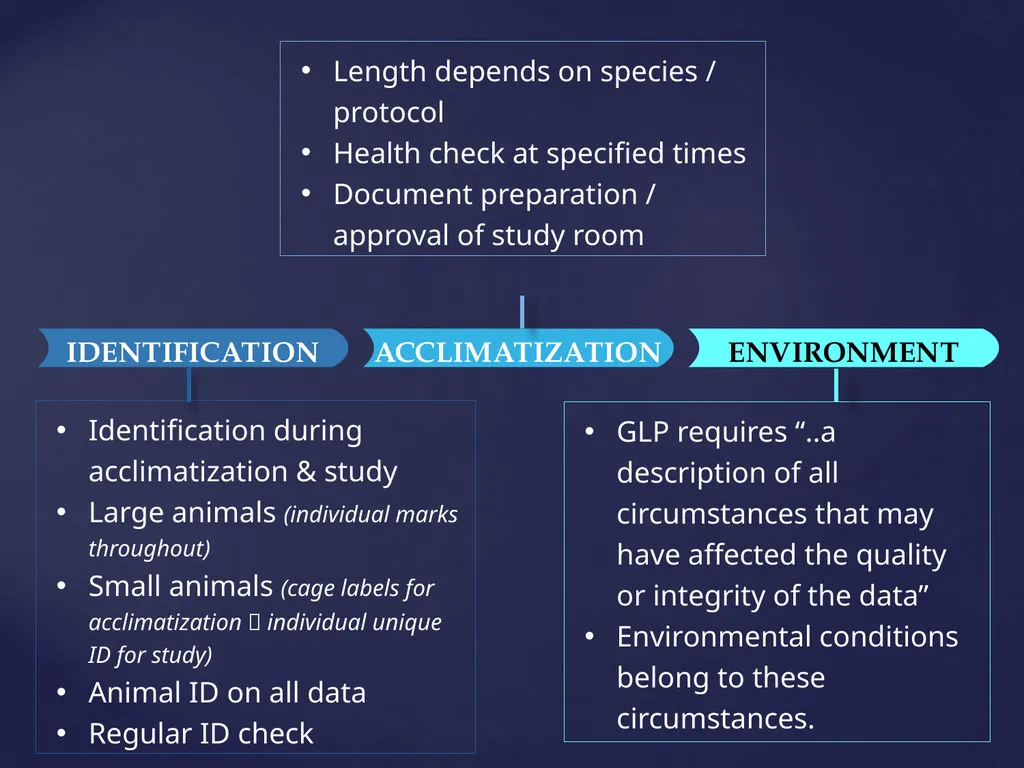
slide31. IDENTIFICATION ACCLIMATIZATION ENVIRONMENT Identification during acclimatization & study
Large animals (individual marks throughout)
Small animals (cage labels for acclimatization individual unique ID for study)
Animal ID on all data
Regular ID check Length depends on species / protocol
Health check at specified times
Document preparation / approval of study room GLP requires “..a description of all circumstances that may have affected the quality or integrity of the data”
Environmental conditions belong to these circumstances.<br>
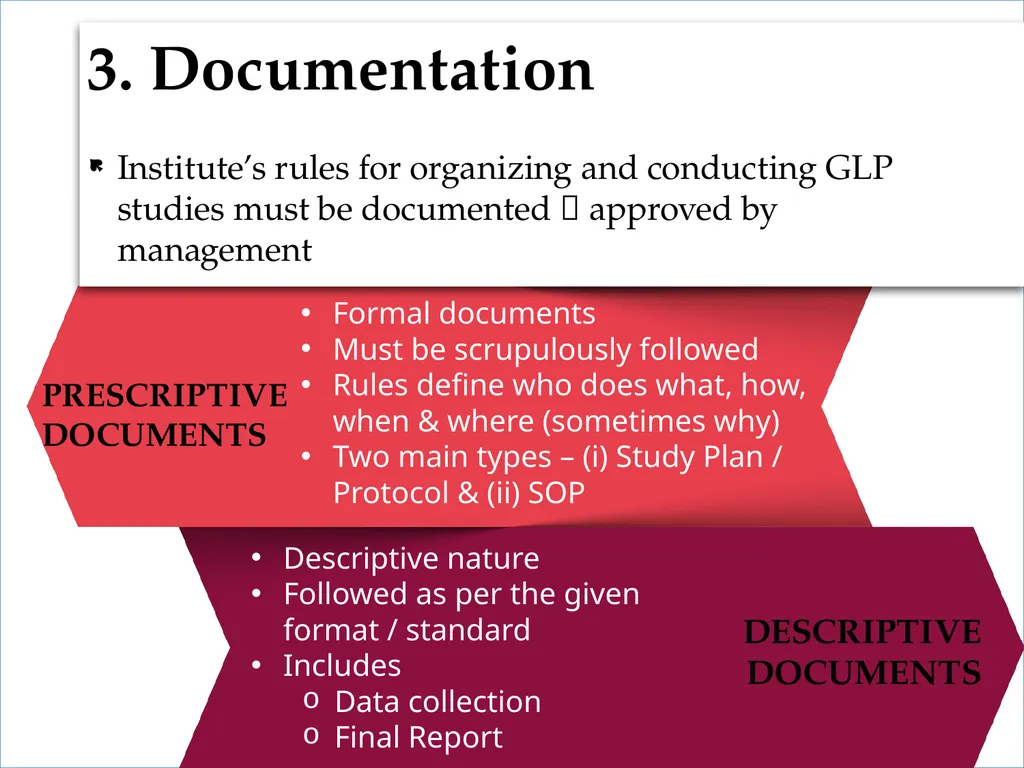
slide32. 3. Documentation Institute’s rules for organizing and conducting GLP studies must be documented approved by management PRESCRIPTIVE DOCUMENTS DESCRIPTIVE DOCUMENTS Formal documents
Must be scrupulously followed
Rules define who does what, how, when & where (sometimes why)
Two main types – (i) Study Plan / Protocol & (ii) SOP Descriptive nature
Followed as per the given format / standard
Includes
Data collection
Final Report<br>
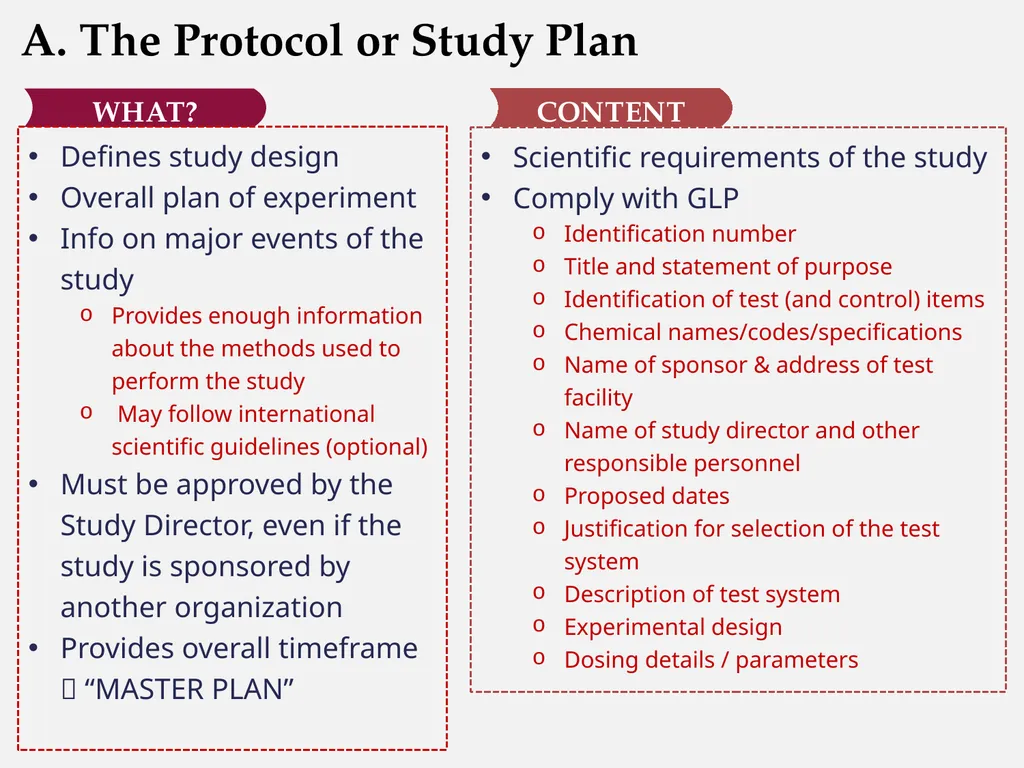
slide33. WHAT? CONTENT Defines study design
Overall plan of experiment
Info on major events of the study
Provides enough information about the methods used to perform the study
May follow international scientific guidelines (optional)
Must be approved by the Study Director, even if the study is sponsored by another organization
Provides overall timeframe “MASTER PLAN” Scientific requirements of the study
Comply with GLP
Identification number
Title and statement of purpose
Identification of test (and control) items
Chemical names/codes/specifications
Name of sponsor & address of test facility
Name of study director and other responsible personnel
Proposed dates
Justification for selection of the test system
Description of test system
Experimental design
Dosing details / parameters A. The Protocol or Study Plan<br>
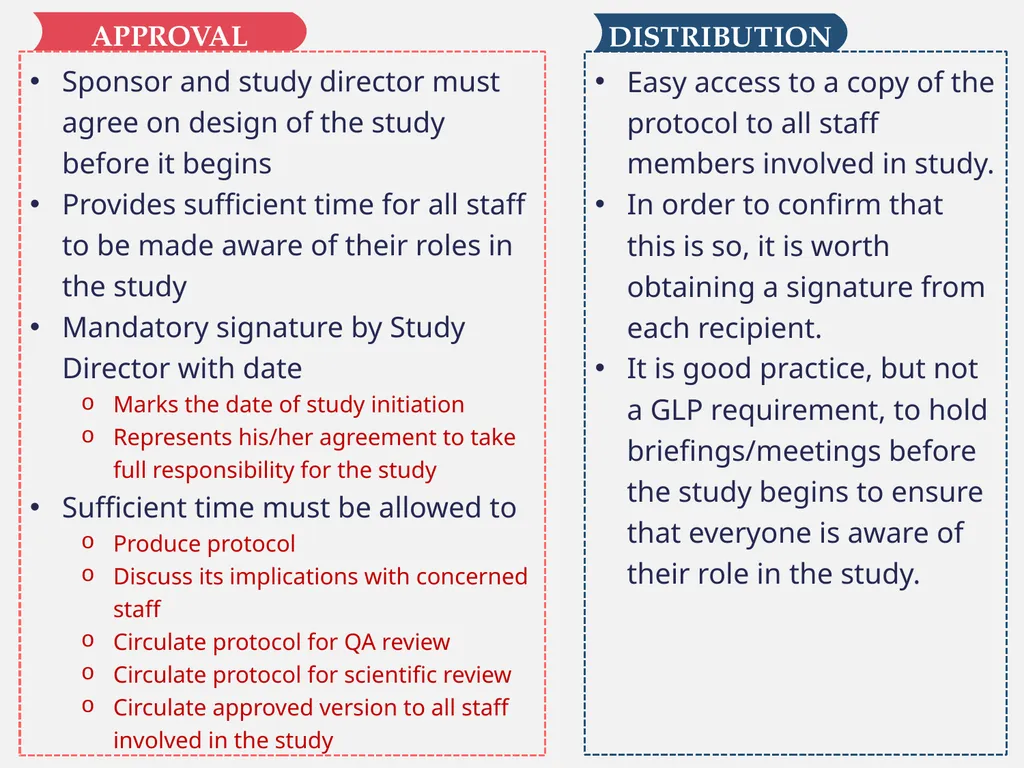
slide34. APPROVAL Sponsor and study director must agree on design of the study before it begins
Provides sufficient time for all staff to be made aware of their roles in the study
Mandatory signature by Study Director with date
Marks the date of study initiation
Represents his/her agreement to take full responsibility for the study
Sufficient time must be allowed to
Produce protocol
Discuss its implications with concerned staff
Circulate protocol for QA review
Circulate protocol for scientific review
Circulate approved version to all staff involved in the study DISTRIBUTION Easy access to a copy of the protocol to all staff members involved in study.
In order to confirm that this is so, it is worth obtaining a signature from each recipient.
It is good practice, but not a GLP requirement, to hold briefings/meetings before the study begins to ensure that everyone is aware of their role in the study.<br>
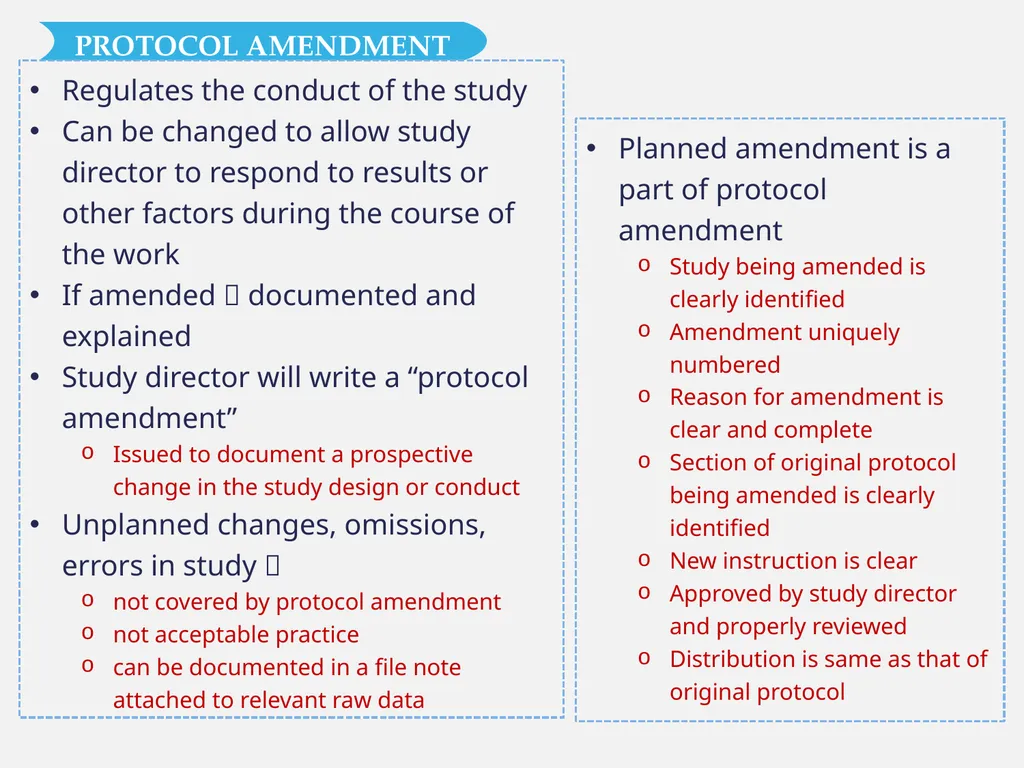
slide35. PROTOCOL AMENDMENT Regulates the conduct of the study
Can be changed to allow study director to respond to results or other factors during the course of the work
If amended documented and explained
Study director will write a “protocol amendment”
Issued to document a prospective change in the study design or conduct
Unplanned changes, omissions, errors in study
not covered by protocol amendment
not acceptable practice
can be documented in a file note attached to relevant raw data Planned amendment is a part of protocol amendment
Study being amended is clearly identified
Amendment uniquely numbered
Reason for amendment is clear and complete
Section of original protocol being amended is clearly identified
New instruction is clear
Approved by study director and properly reviewed
Distribution is same as that of original protocol<br>
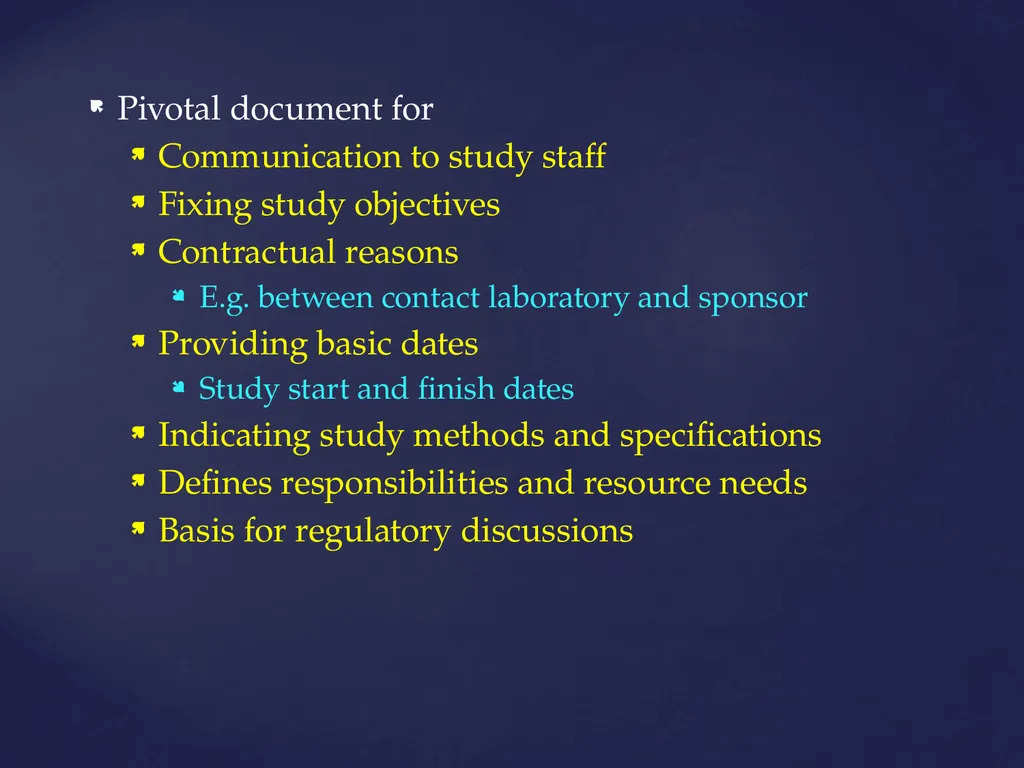
slide36. Pivotal document for
Communication to study staff
Fixing study objectives
Contractual reasons
E.g. between contact laboratory and sponsor
Providing basic dates
Study start and finish dates
Indicating study methods and specifications
Defines responsibilities and resource needs
Basis for regulatory discussions<br>
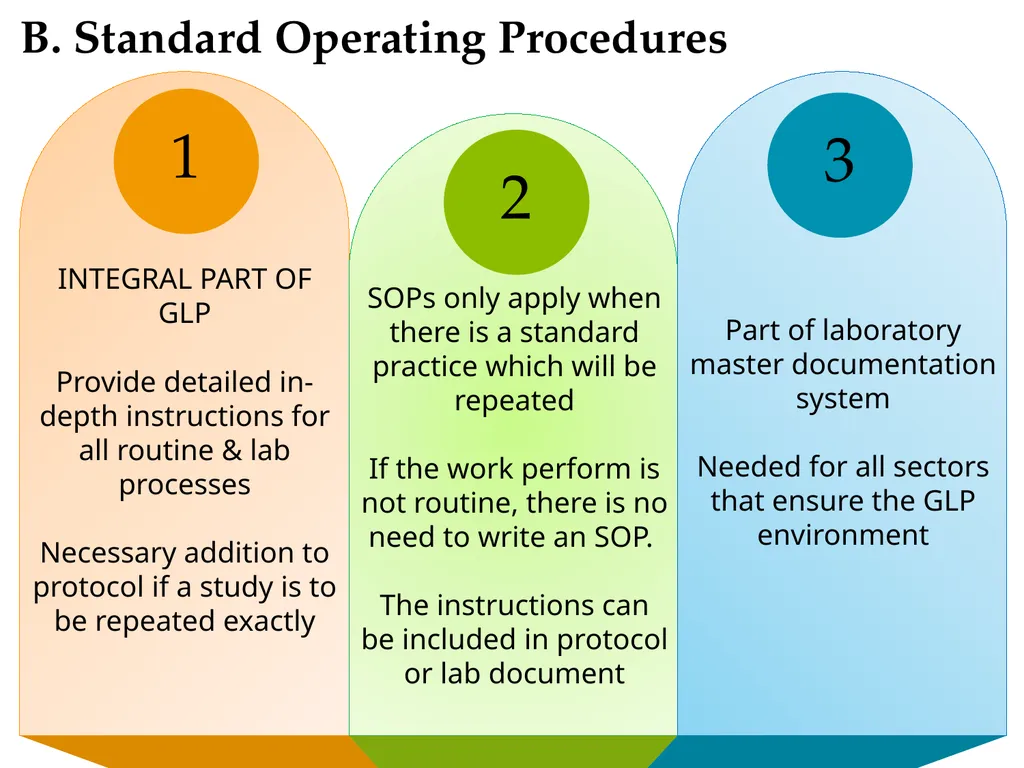
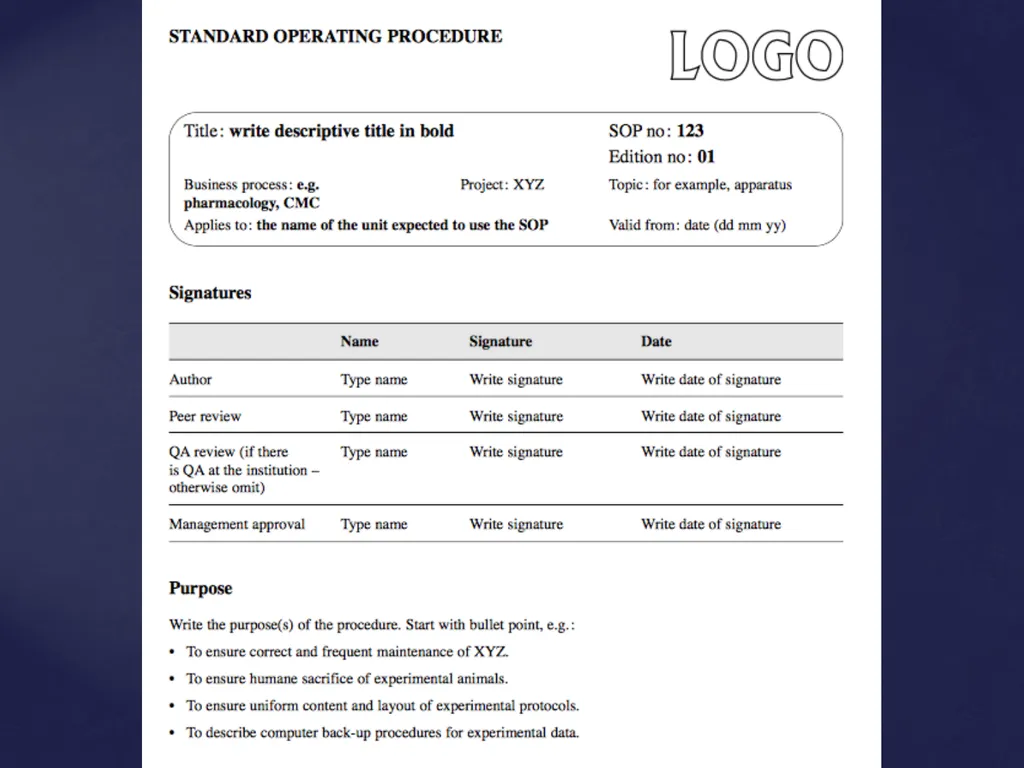
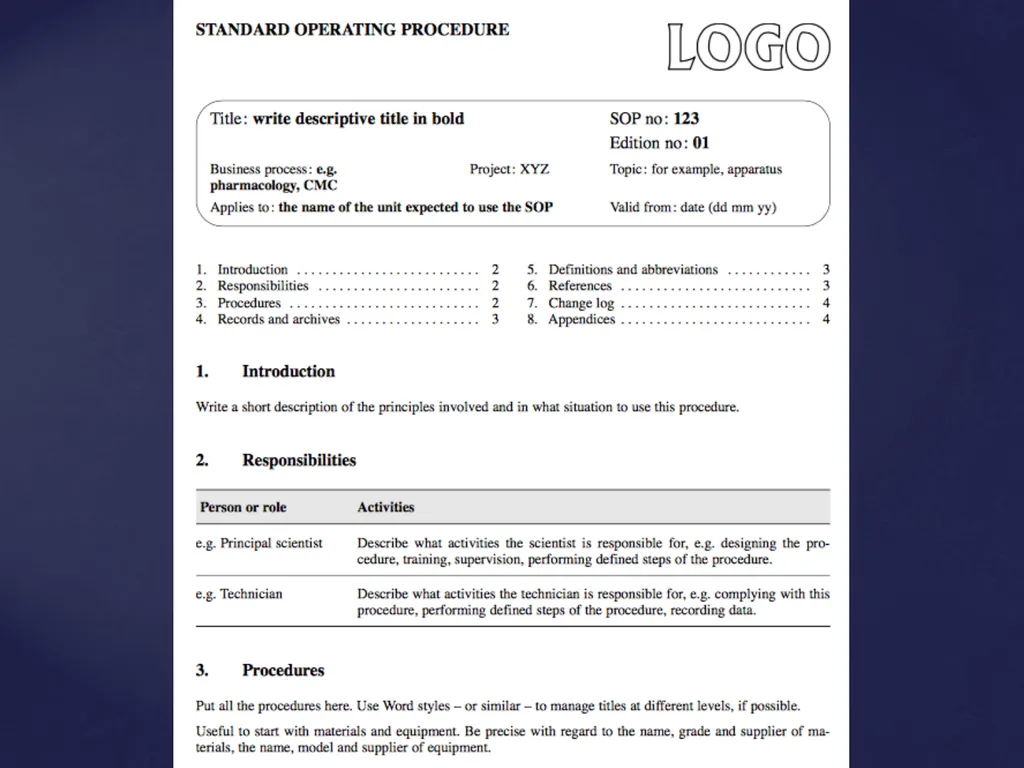
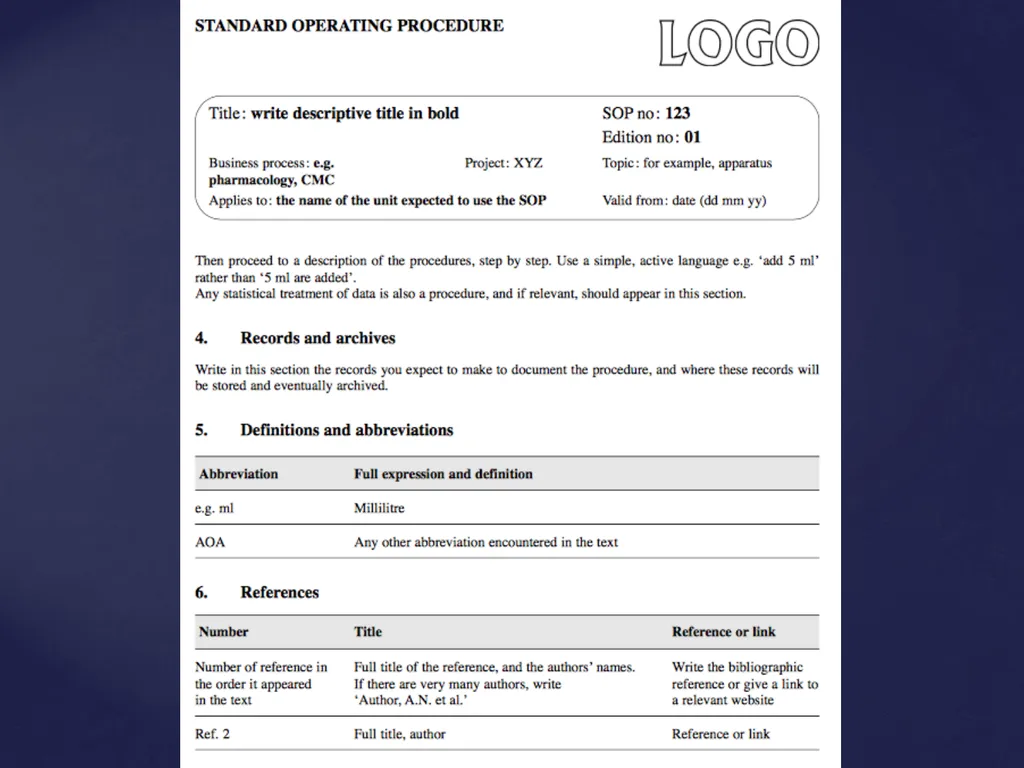
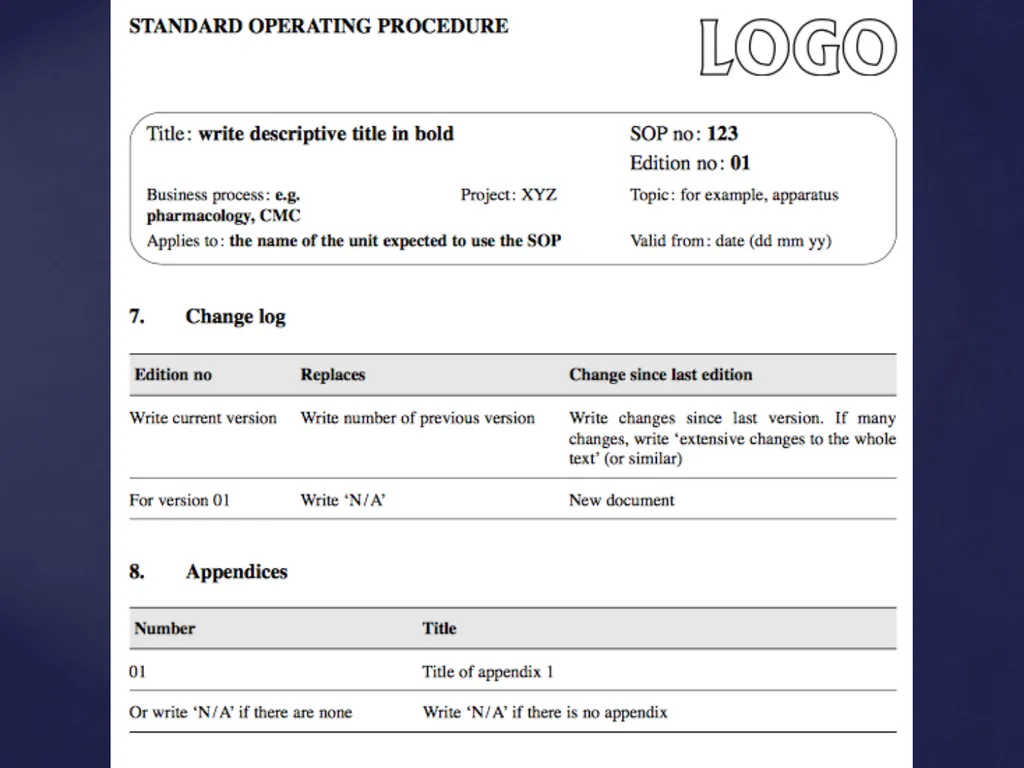
slide37. B. Standard Operating Procedures INTEGRAL PART OF GLP
Provide detailed in-depth instructions for all routine & lab processes
Necessary addition to protocol if a study is to be repeated exactly SOPs only apply when there is a standard practice which will be repeated
If the work perform is not routine, there is no need to write an SOP.
The instructions can be included in protocol or lab document Part of laboratory master documentation system
Needed for all sectors that ensure the GLP environment<br>
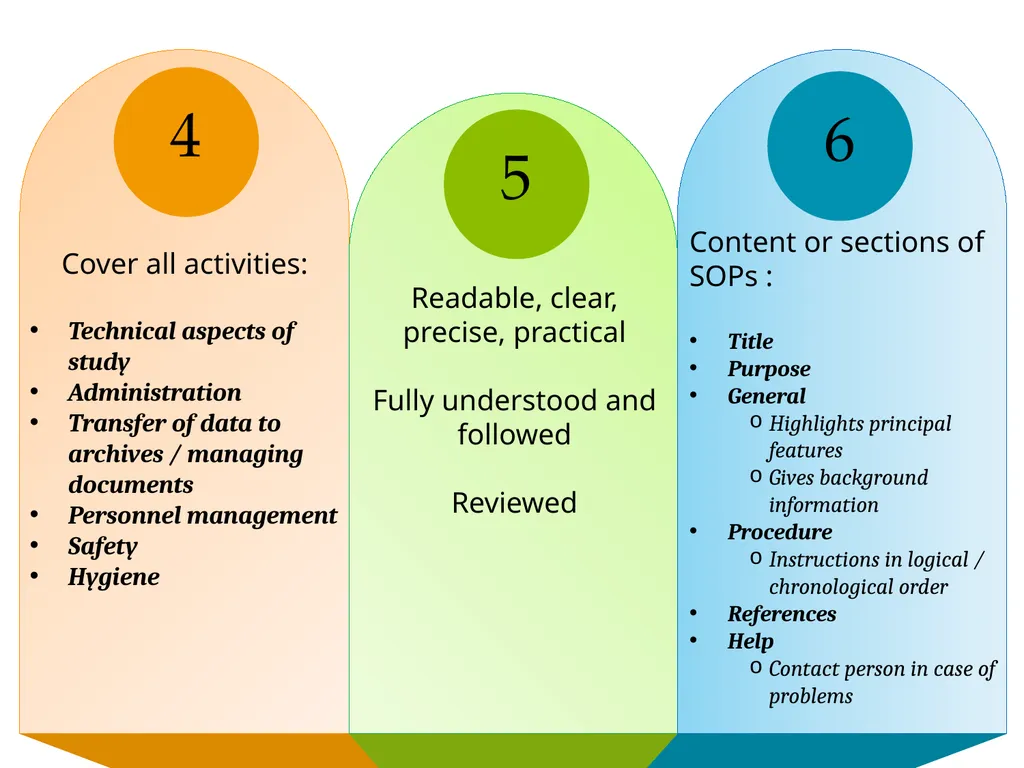
slide38. Cover all activities:
Technical aspects of study
Administration
Transfer of data to archives / managing documents
Personnel management
Safety
Hygiene Readable, clear, precise, practical
Fully understood and followed
Reviewed Content or sections of SOPs :
Title
Purpose
General
Highlights principal features
Gives background information
Procedure
Instructions in logical / chronological order
References
Help
Contact person in case of problems<br>
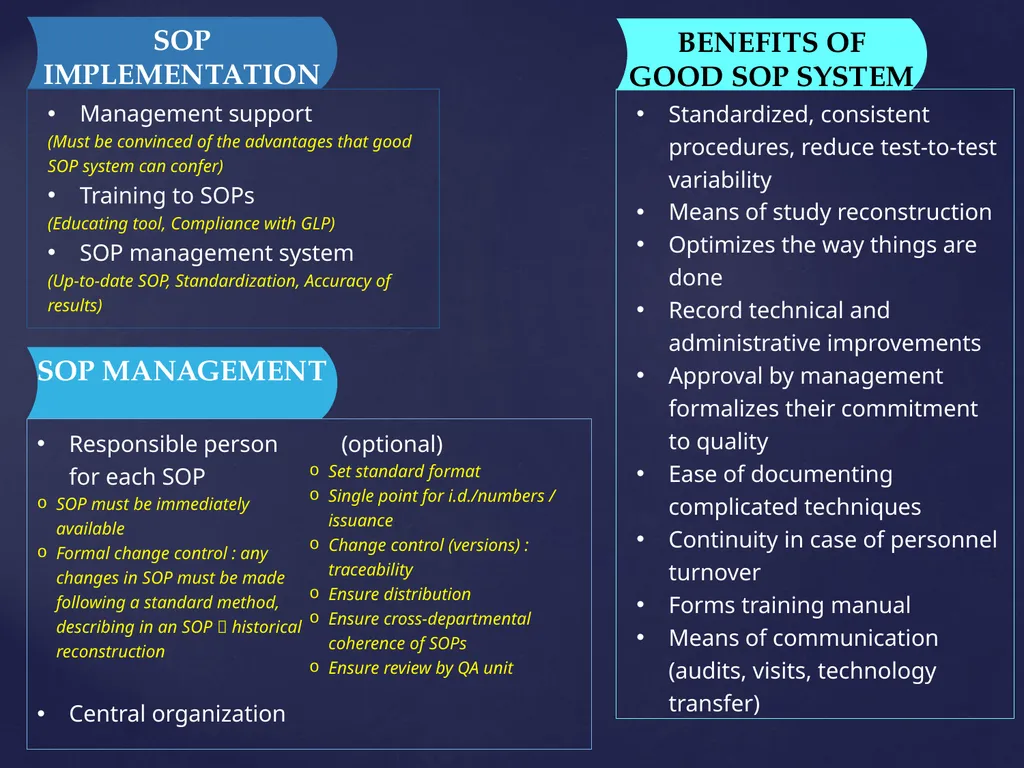
slide43. SOP IMPLEMENTATION SOP MANAGEMENT BENEFITS OF GOOD SOP SYSTEM Management support
(Must be convinced of the advantages that good SOP system can confer)
Training to SOPs
(Educating tool, Compliance with GLP)
SOP management system
(Up-to-date SOP, Standardization, Accuracy of results) Responsible person for each SOP
SOP must be immediately available
Formal change control : any changes in SOP must be made following a standard method, describing in an SOP historical reconstruction
Central organization (optional)
Set standard format
Single point for i.d./numbers / issuance
Change control (versions) : traceability
Ensure distribution
Ensure cross-departmental coherence of SOPs
Ensure review by QA unit Standardized, consistent procedures, reduce test-to-test variability
Means of study reconstruction
Optimizes the way things are done
Record technical and administrative improvements
Approval by management formalizes their commitment to quality
Ease of documenting complicated techniques
Continuity in case of personnel turnover
Forms training manual
Means of communication (audits, visits, technology transfer)<br>
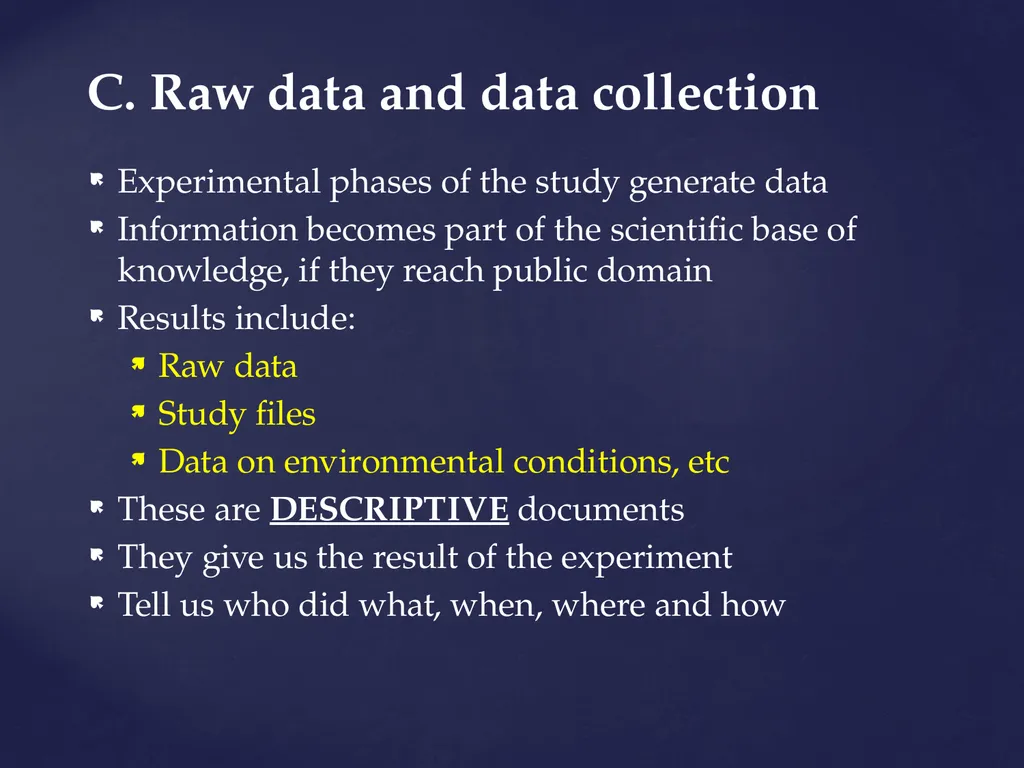
slide44. Experimental phases of the study generate data
Information becomes part of the scientific base of knowledge, if they reach public domain
Results include:
Raw data
Study files
Data on environmental conditions, etc
These are DESCRIPTIVE documents
They give us the result of the experiment
Tell us who did what, when, where and how C. Raw data and data collection<br>
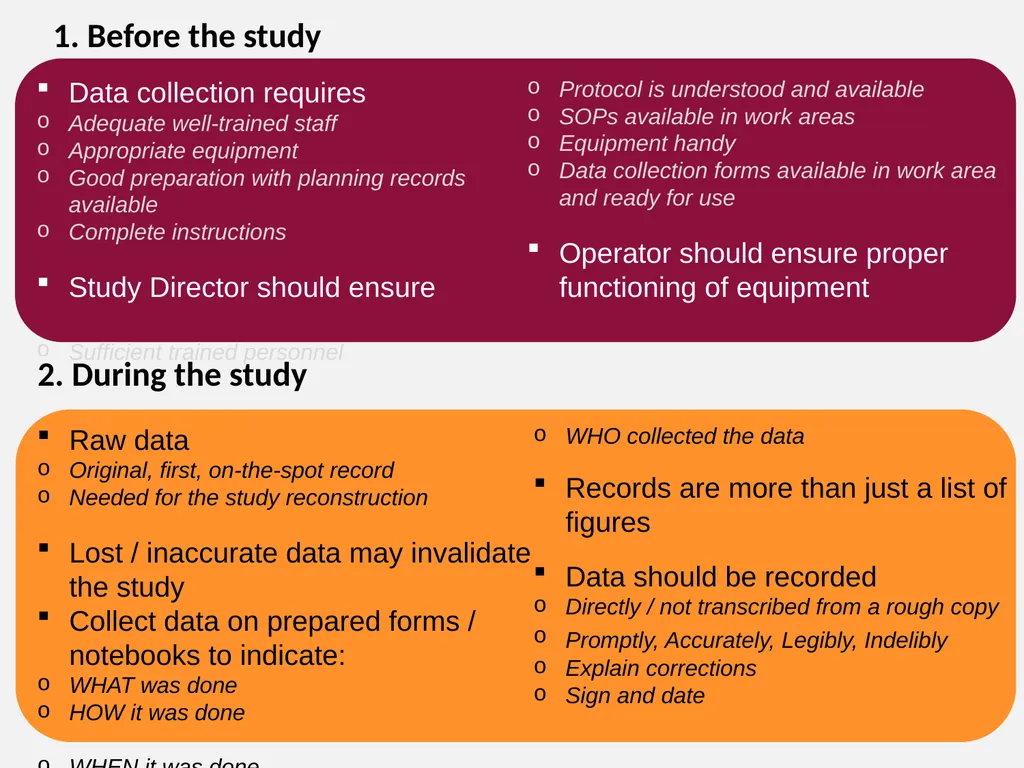
slide45. Data collection requires
Adequate well-trained staff
Appropriate equipment
Good preparation with planning records available
Complete instructions
Study Director should ensure
Sufficient trained personnel
Protocol is understood and available
SOPs available in work areas
Equipment handy
Data collection forms available in work area and ready for use
Operator should ensure proper functioning of equipment Raw data
Original, first, on-the-spot record
Needed for the study reconstruction
Lost / inaccurate data may invalidate the study
Collect data on prepared forms / notebooks to indicate:
WHAT was done
HOW it was done
WHEN it was done
WHO collected the data
Records are more than just a list of figures
Data should be recorded
Directly / not transcribed from a rough copy
Promptly, Accurately, Legibly, Indelibly
Explain corrections
Sign and date 1. Before the study 2. During the study<br>
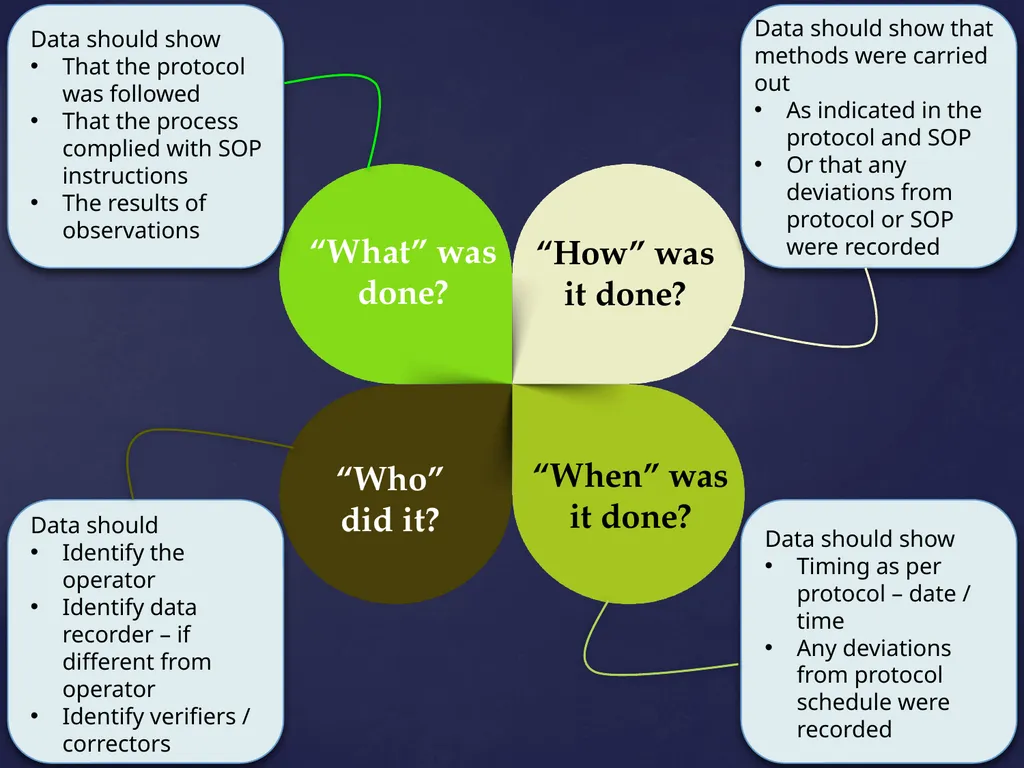
slide46. “What” was done? “Who” did it? “When” was it done? “How” was it done? Data should show
That the protocol was followed
That the process complied with SOP instructions
The results of observations Data should show that methods were carried out
As indicated in the protocol and SOP
Or that any deviations from protocol or SOP were recorded Data should show
Timing as per protocol – date / time
Any deviations from protocol schedule were recorded Data should
Identify the operator
Identify data recorder – if different from operator
Identify verifiers / correctors<br>
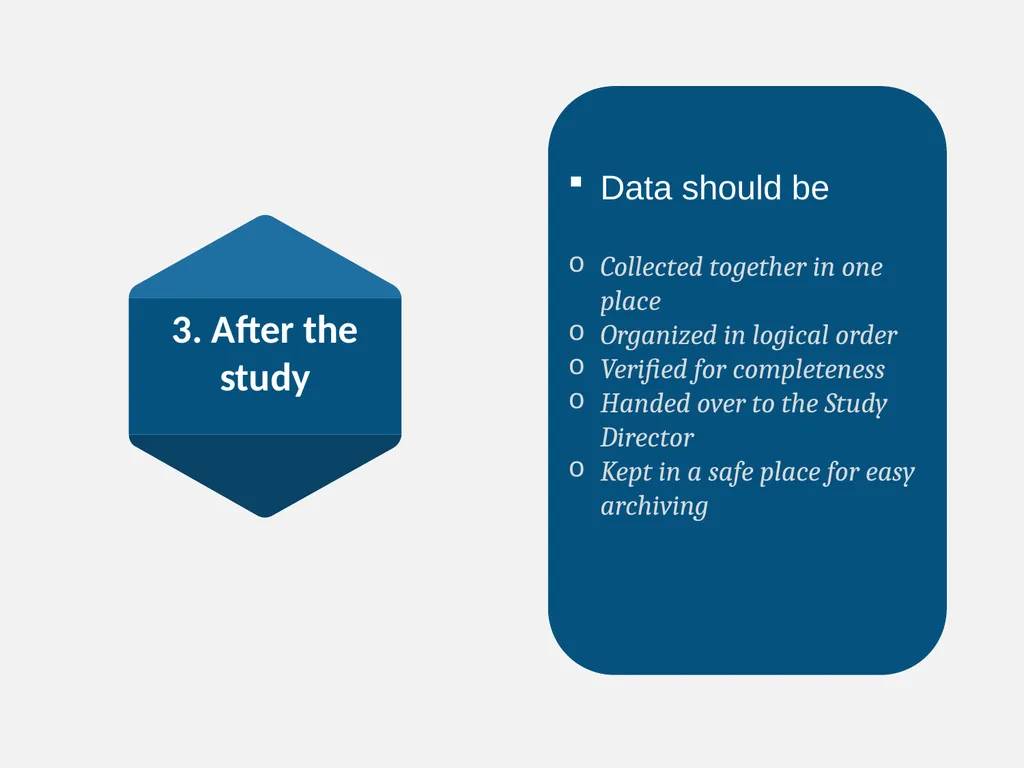
slide47. Data should be
Collected together in one place
Organized in logical order
Verified for completeness
Handed over to the Study Director
Kept in a safe place for easy archiving<br>
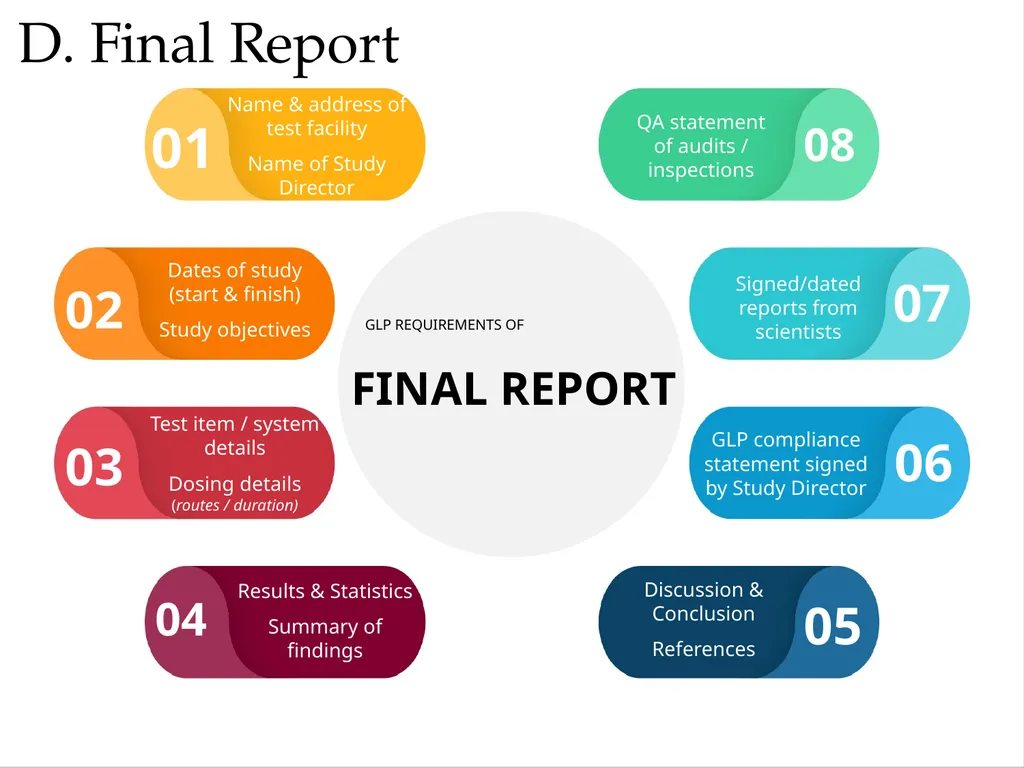
slide48. FINAL REPORT GLP REQUIREMENTS OF 01 Name & address of test facility
Name of Study Director 02 Dates of study (start & finish)
Study objectives Test item / system details
Dosing details (routes / duration) Results & Statistics
Summary of findings Discussion & Conclusion
References GLP compliance statement signed by Study Director Signed/dated reports from scientists QA statement of audits / inspections 03 04 05 06 07 08 D. Final Report<br>
slide49. Study director is responsible for the entire study, including the report
Accurate reporting and deviations
Should not be a selection of highlights of the study, leaving out the part that did not work
May include inputs from scientists
GLP compliance
Report Review by QA
Once a final report is signed, modifications can only be made via formal amendments
Amendments have to be approved by Study Director
Verified and validated by QA<br>
slide50. This is what is left when the study is over
Study plan
Raw data
Specimens
Final report
QA documents
Personnel records
Facilities / equipment validation records
Historical SOP file E. Archiving and indexing<br>
slide51. Archives is a safe depository of invaluable information
Centre for compilation and distribution of documents
Major tool for reconstruction of studies performed in past
Functions:
Long-term, secure storage
Fast retrieval of data
Contains all original scientific data, master documents, reports, etc
Tool for preparing project summary documents<br>
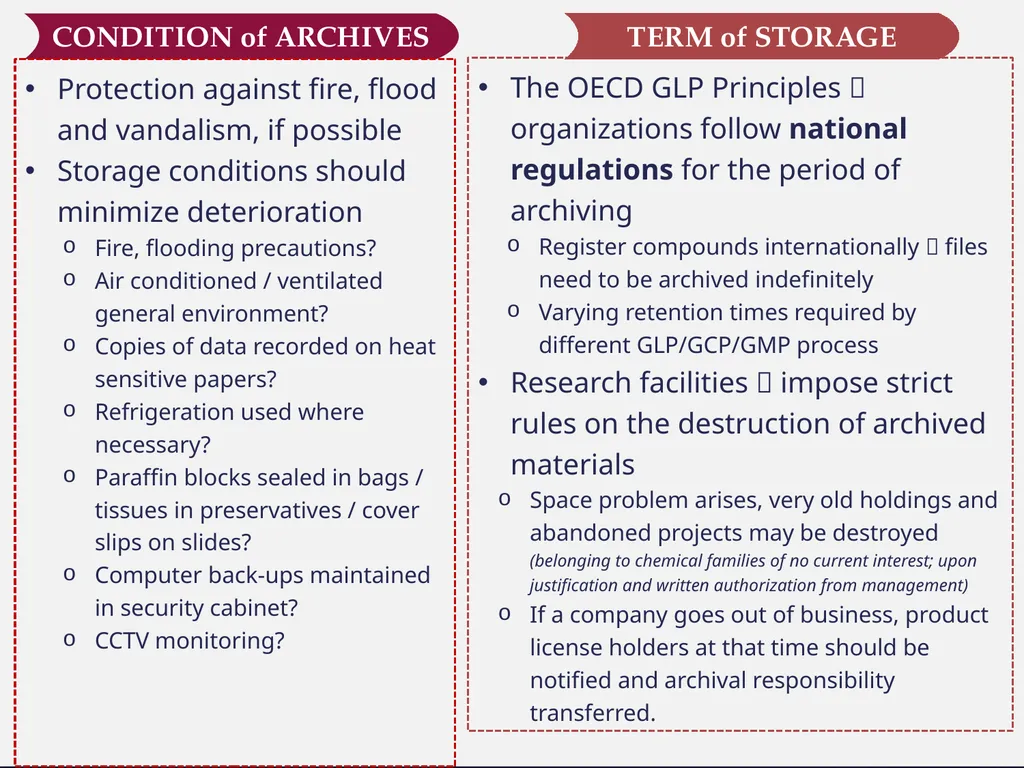
slide54. CONDITION of ARCHIVES TERM of STORAGE Protection against fire, flood and vandalism, if possible
Storage conditions should minimize deterioration
Fire, flooding precautions?
Air conditioned / ventilated general environment?
Copies of data recorded on heat sensitive papers?
Refrigeration used where necessary?
Paraffin blocks sealed in bags / tissues in preservatives / cover slips on slides?
Computer back-ups maintained in security cabinet?
CCTV monitoring? The OECD GLP Principles organizations follow national regulations for the period of archiving
Register compounds internationally files need to be archived indefinitely
Varying retention times required by different GLP/GCP/GMP process
Research facilities impose strict rules on the destruction of archived materials
Space problem arises, very old holdings and abandoned projects may be destroyed (belonging to chemical families of no current interest; upon justification and written authorization from management)
If a company goes out of business, product license holders at that time should be notified and archival responsibility transferred.<br>
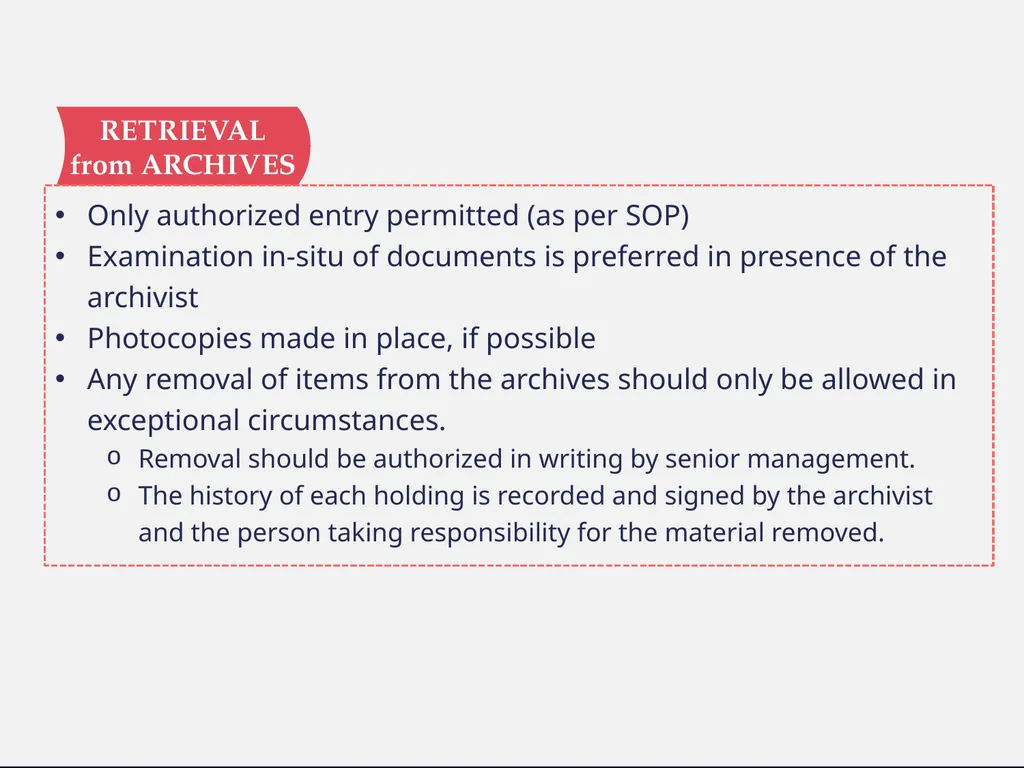
slide55. RETRIEVAL from ARCHIVES Only authorized entry permitted (as per SOP)
Examination in-situ of documents is preferred in presence of the archivist
Photocopies made in place, if possible
Any removal of items from the archives should only be allowed in exceptional circumstances.
Removal should be authorized in writing by senior management.
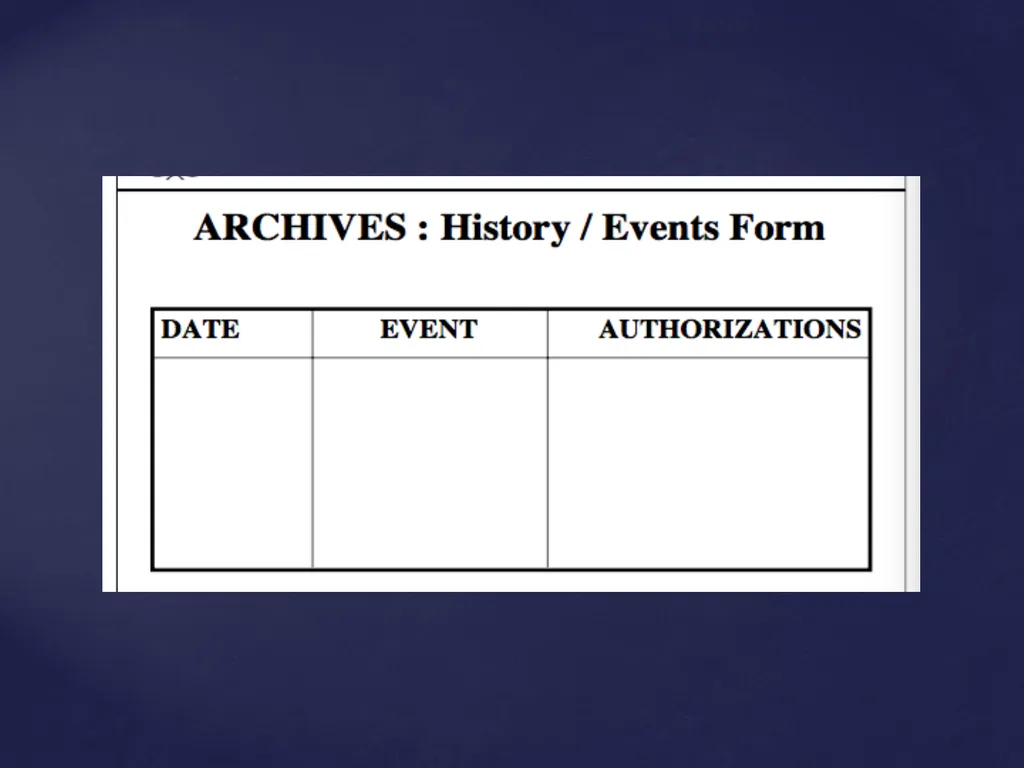
The history of each holding is recorded and signed by the archivist and the person taking responsibility for the material removed.<br>
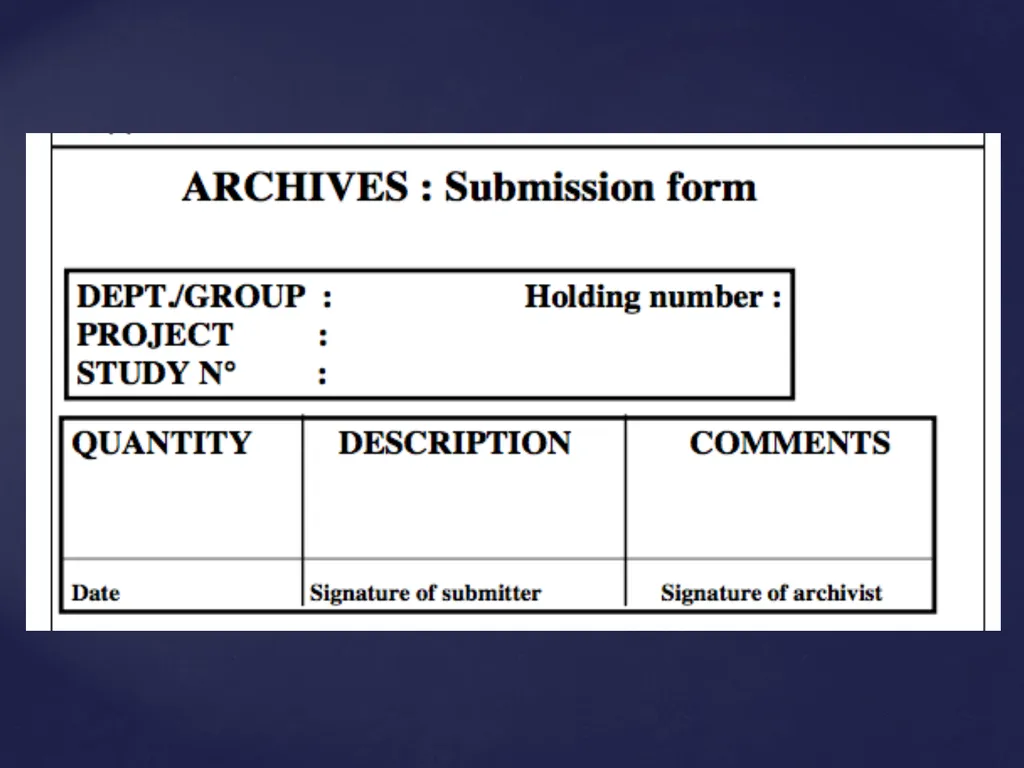
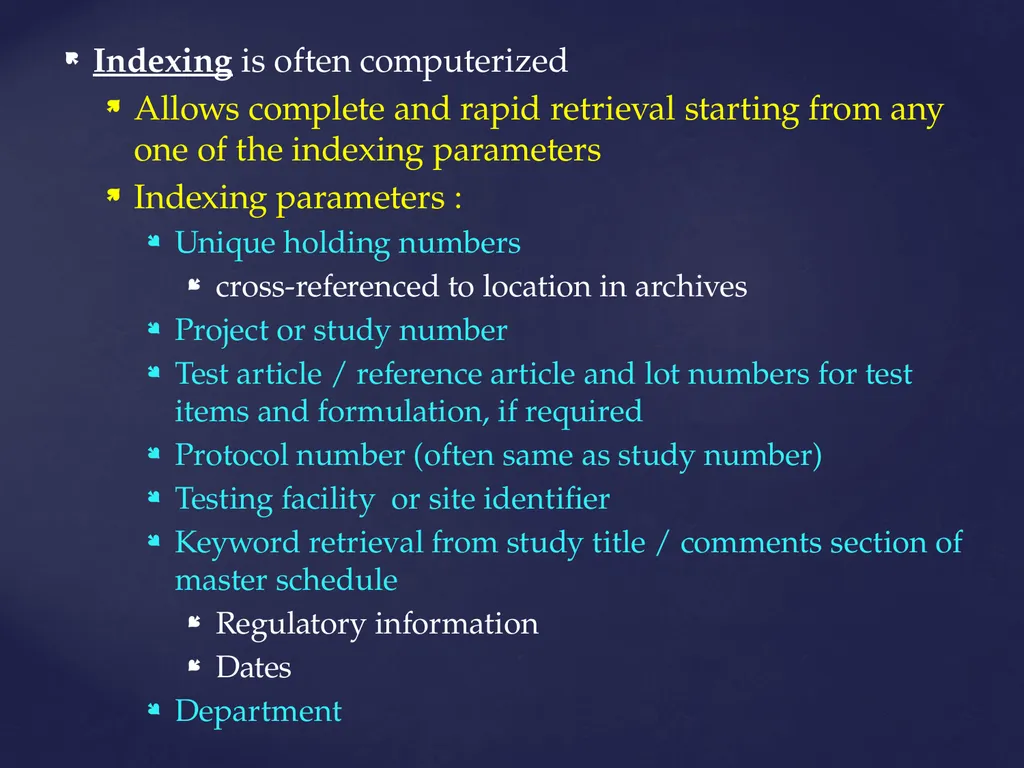
slide56. Indexing is often computerized
Allows complete and rapid retrieval starting from any one of the indexing parameters
Indexing parameters :
Unique holding numbers
cross-referenced to location in archives
Project or study number
Test article / reference article and lot numbers for test items and formulation, if required
Protocol number (often same as study number)
Testing facility or site identifier
Keyword retrieval from study title / comments section of master schedule
Regulatory information
Dates
Department<br>
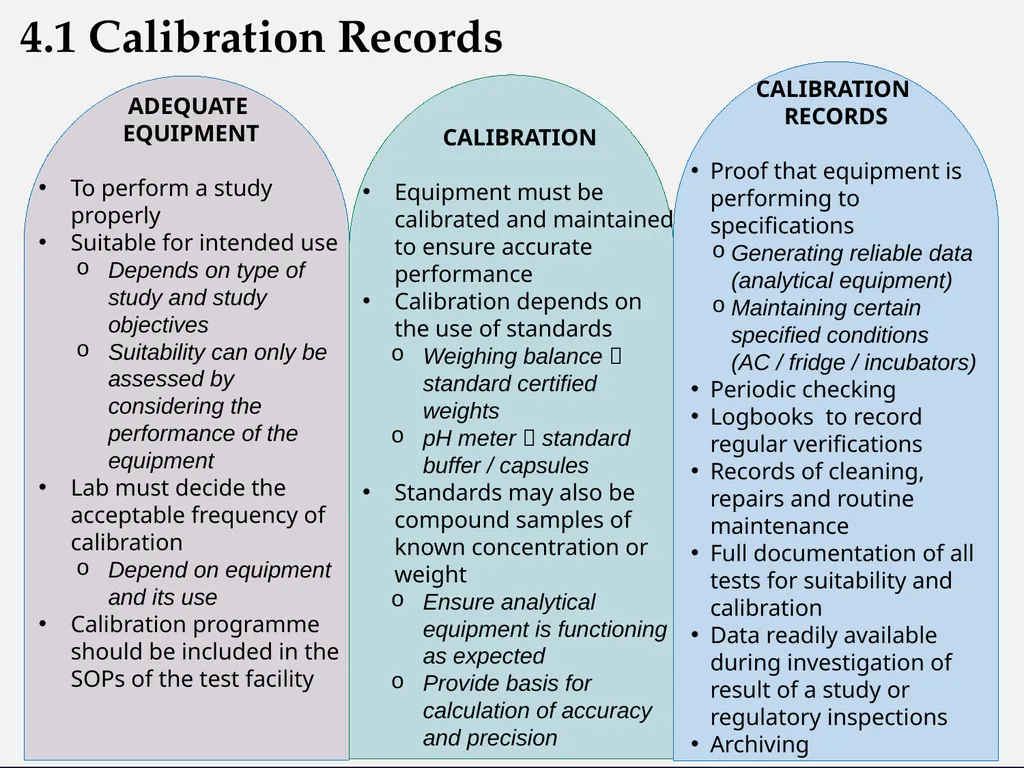
slide57. 4.1 Calibration Records ADEQUATE
EQUIPMENT
To perform a study properly
Suitable for intended use
Depends on type of study and study objectives
Suitability can only be assessed by considering the performance of the equipment
Lab must decide the acceptable frequency of calibration
Depend on equipment and its use
Calibration programme should be included in the SOPs of the test facility CALIBRATION
Equipment must be calibrated and maintained to ensure accurate performance
Calibration depends on the use of standards
Weighing balance standard certified weights
pH meter standard buffer / capsules
Standards may also be compound samples of known concentration or weight
Ensure analytical equipment is functioning as expected
Provide basis for calculation of accuracy and precision CALIBRATION
RECORDS
Proof that equipment is performing to specifications
Generating reliable data (analytical equipment)
Maintaining certain specified conditions (AC / fridge / incubators)
Periodic checking
Logbooks to record regular verifications
Records of cleaning, repairs and routine maintenance
Full documentation of all tests for suitability and calibration
Data readily available during investigation of result of a study or regulatory inspections
Archiving<br>
slide58. Bioanalytical methods used in nonclinical safety studies are validated to demonstrate
Reliability
Reproducibility
Quality of data / product
A GLP compliance program ensures data integrity via method-validation studies
Although assay validation is not directly addressed in GLP regulations, but it is always encouraged by FDA to adopt validated methods. 4.2 Validation of Methods<br>
slide59. FDA guideline ‘Guidance for Industry: Bioanalytical Method Validation’
States that analytical laboratory conducting pharmacology/toxicology and other preclinical studies should adhere to FDA’s GLP regulations
Quality Assurance Unit (QAU) responsible for method validation studies for GLP compliance
Good understanding of method validation concepts and regulatory requirements
Help QAU to focus on key areas
More effective auditing of method validation protocols, final reports and associated data<br>
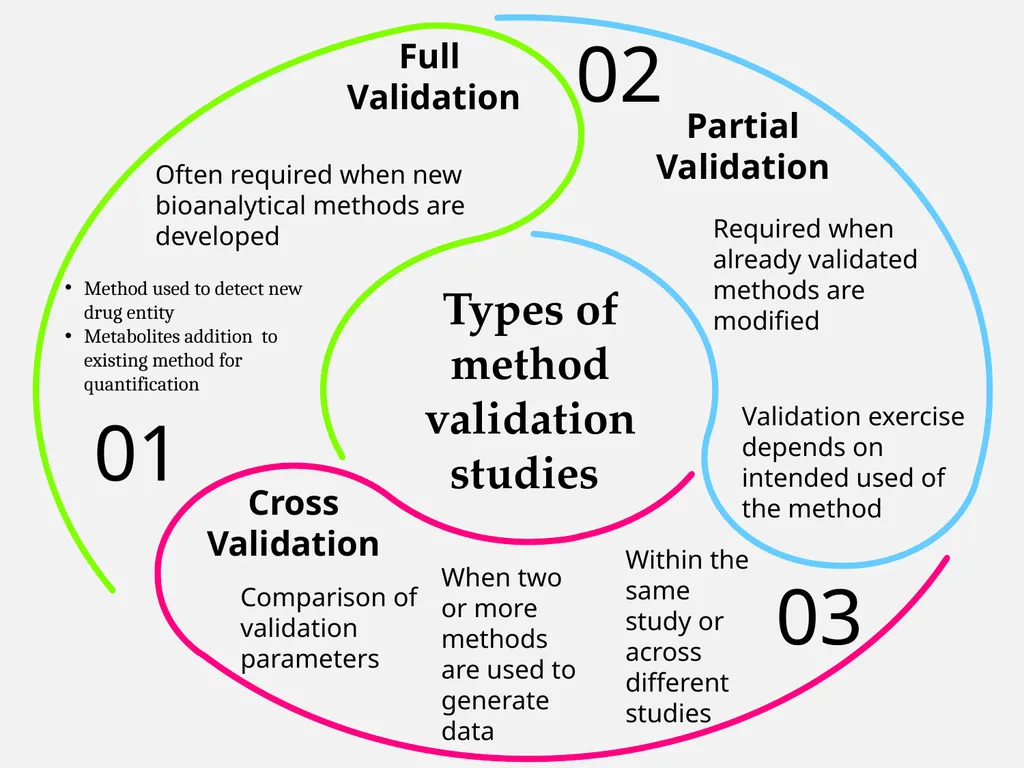
slide60. Full
Validation 02 01 03 Types of method validation studies Often required when new bioanalytical methods are developed Method used to detect new drug entity
Metabolites addition to existing method for quantification Partial Validation Cross Validation Comparison of validation parameters Required when already validated methods are modified Validation exercise depends on intended used of the method When two or more methods are used to generate data Within the same study or across different studies<br>
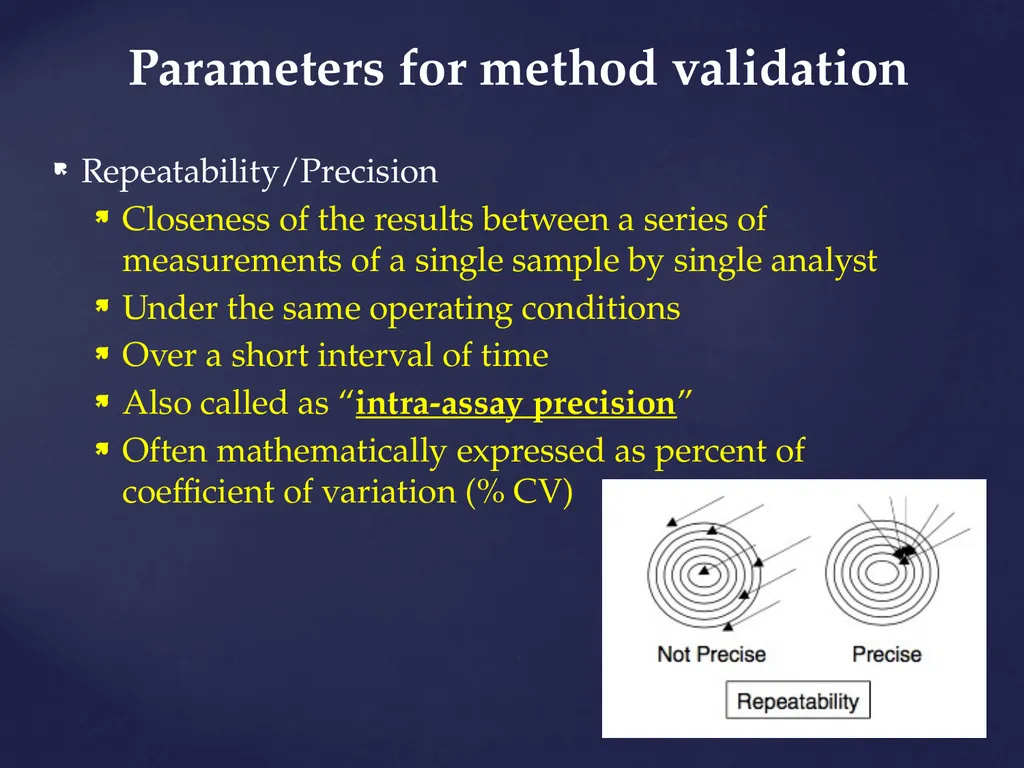
slide61. Repeatability/Precision
Closeness of the results between a series of measurements of a single sample by single analyst
Under the same operating conditions
Over a short interval of time
Also called as “intra-assay precision”
Often mathematically expressed as percent of coefficient of variation (% CV) Parameters for method validation<br>
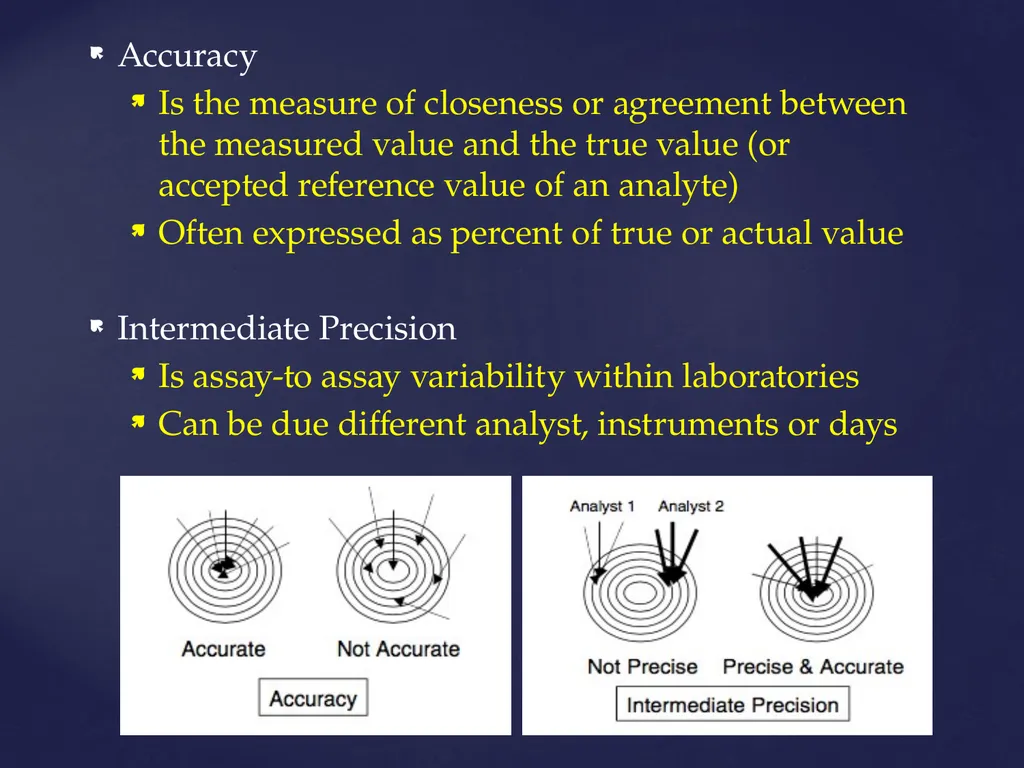
slide62. Accuracy
Is the measure of closeness or agreement between the measured value and the true value (or accepted reference value of an analyte)
Often expressed as percent of true or actual value
Intermediate Precision
Is assay-to assay variability within laboratories
Can be due different analyst, instruments or days<br>
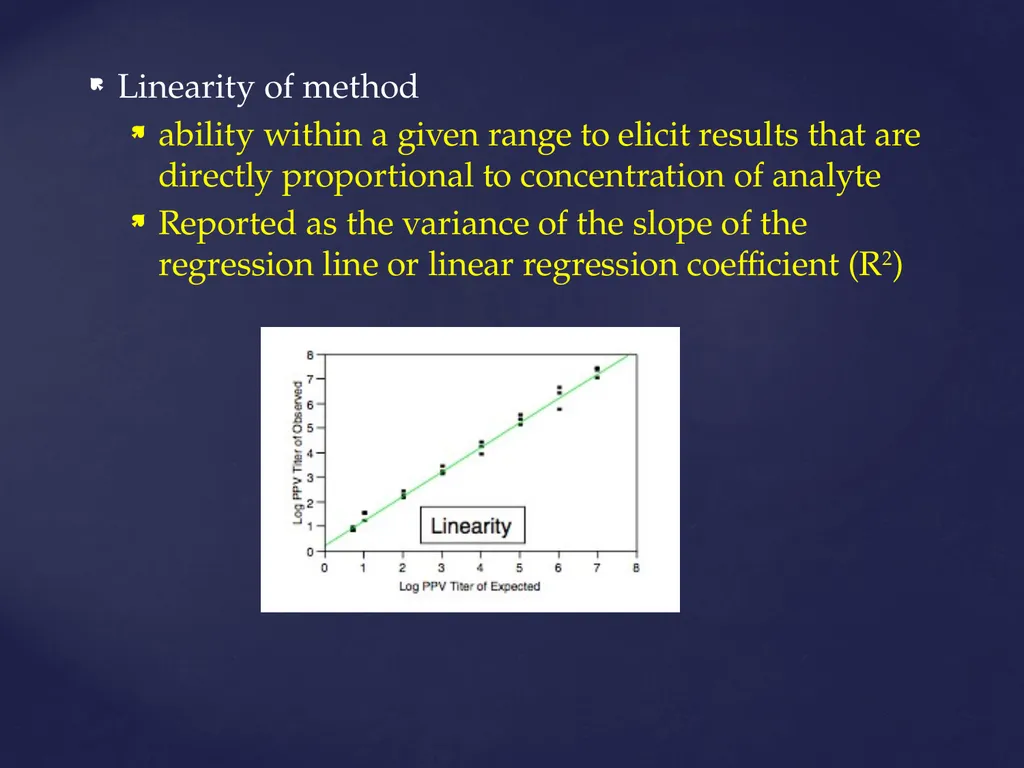
slide63. Linearity of method
ability within a given range to elicit results that are directly proportional to concentration of analyte
Reported as the variance of the slope of the regression line or linear regression coefficient (R2)<br>
slide64. Quantification limit
Refers to the lowest level of an analyte in a sample that can be quantitatively determined with suitable precision and accuracy
Selectivity
Ability of the method to differentiate and quantify the analyte in presence of other components in the sample
Stability
Robustness
Measure of a method’s capacity to remain unaffected by small, but deliberate variations in method parameters
Indication of reliability of method<br>
slide65. GLP defines the minimum quality assurance requirements to ensure validity of experimental results
QA is charged with assuring management that GLP compliance has been attained within lab
Should act as an independent unit (as per GLP)
QA must review all phases of preclinical research
From planning to reporting and archiving
Embraces all the procedures necessary to provide a high probability that a medicine will conform consistently to a specified description of quality
Must have access to all documents and procedures at all levels of organization 5. Quality Assurance (QA)<br>
slide66. QA reviews protocol (or study plan)
Mandatory process
Completeness
Clarity
In case of amendments
Protocol signed by QA
Original signed copy archived A. Protocol Review<br>
slide67. SOPs are essential
Reviewed and signed by QA
Not mandatory, a recommendation
Signed SOP indicate GLP-compliance
Complete
Clear
No conflict
Approved, distributed and archived
QA approval doesn't guarantee sound technical content
Technical content Study Director B. SOP Review<br>
slide68. Master schedule is a list of all studies at the facility
A study should be entered into master schedule sheet (MSS) before the study begins (often before protocol is written)
QA maintains MSS
QA must be aware of all planned studies
Must have copy of all studies
Direct access
Plan inspections and audits C. Master Schedule<br>
slide69. Audit
Methodological evaluation
Should be performed in cooperation with the people whose operations are being studies
Often internal audits and inspections are planned with study director D. Audits and Inspections<br>
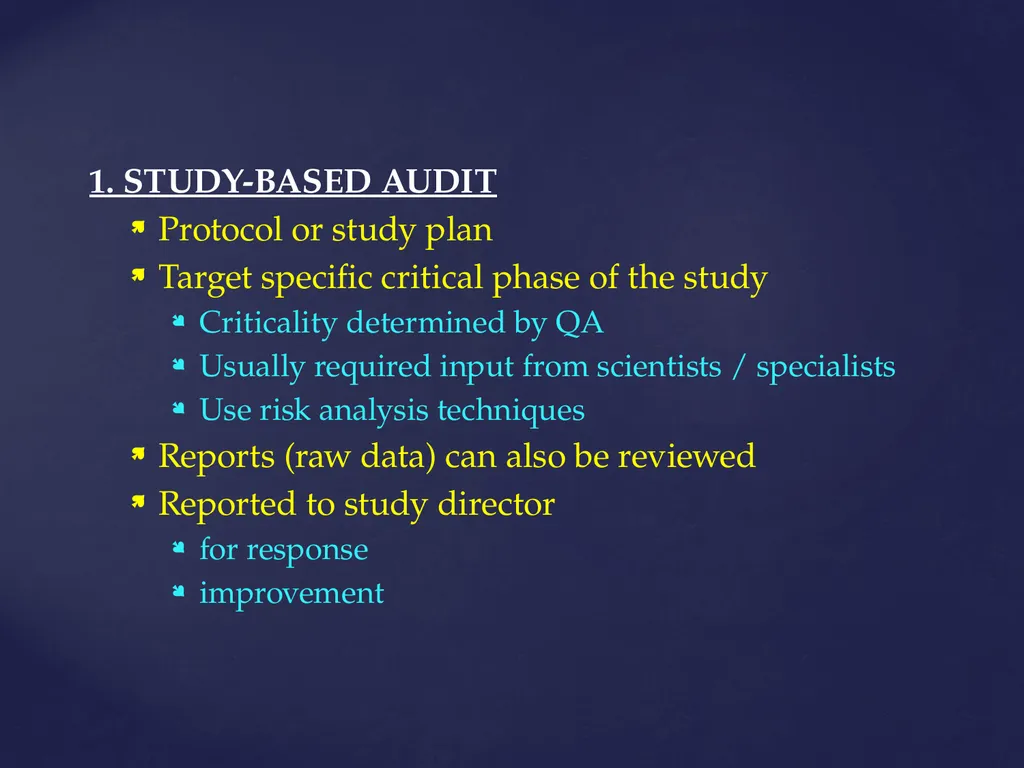
slide70. 1. STUDY-BASED AUDIT
Protocol or study plan
Target specific critical phase of the study
Criticality determined by QA
Usually required input from scientists / specialists
Use risk analysis techniques
Reports (raw data) can also be reviewed
Reported to study director
for response
improvement<br>
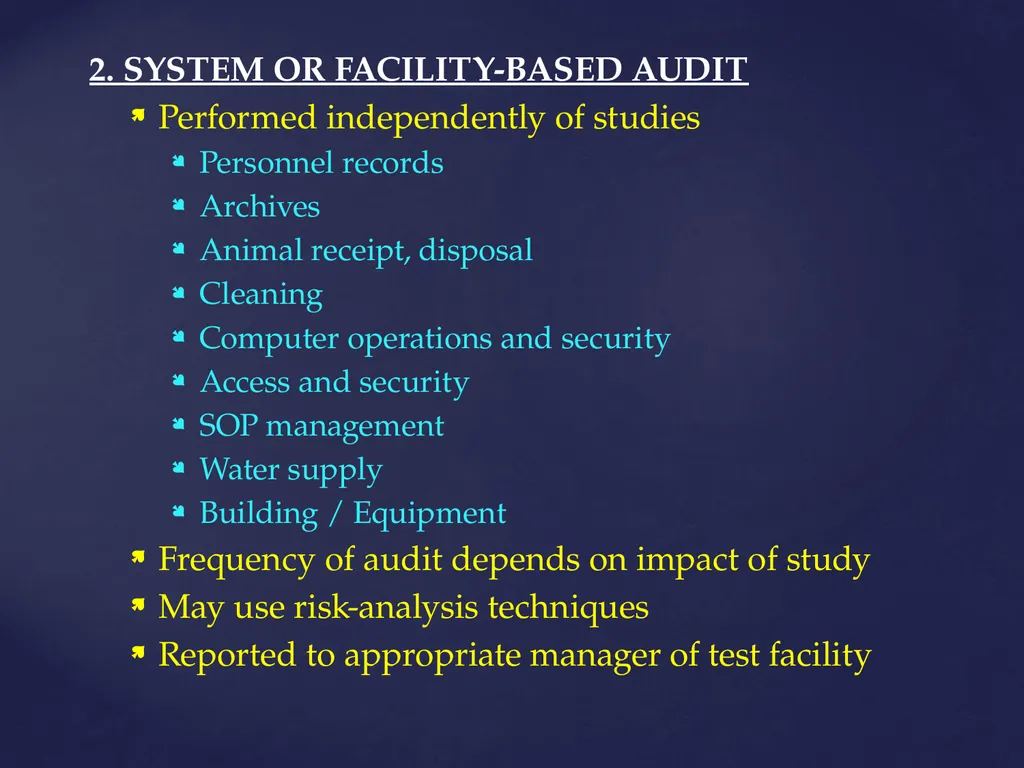
slide71. 2. SYSTEM OR FACILITY-BASED AUDIT
Performed independently of studies
Personnel records
Archives
Animal receipt, disposal
Cleaning
Computer operations and security
Access and security
SOP management
Water supply
Building / Equipment
Frequency of audit depends on impact of study
May use risk-analysis techniques
Reported to appropriate manager of test facility<br>
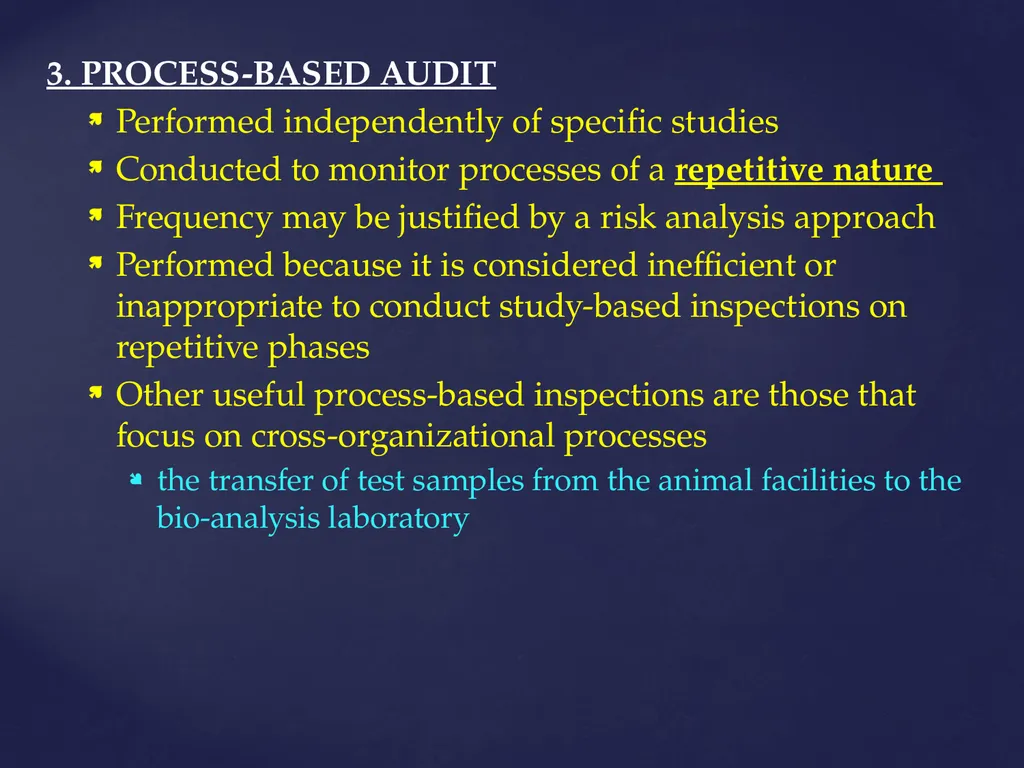
slide72. 3. PROCESS-BASED AUDIT
Performed independently of specific studies
Conducted to monitor processes of a repetitive nature
Frequency may be justified by a risk analysis approach
Performed because it is considered inefficient or inappropriate to conduct study-based inspections on repetitive phases
Other useful process-based inspections are those that focus on cross-organizational processes
the transfer of test samples from the animal facilities to the bio-analysis laboratory<br>
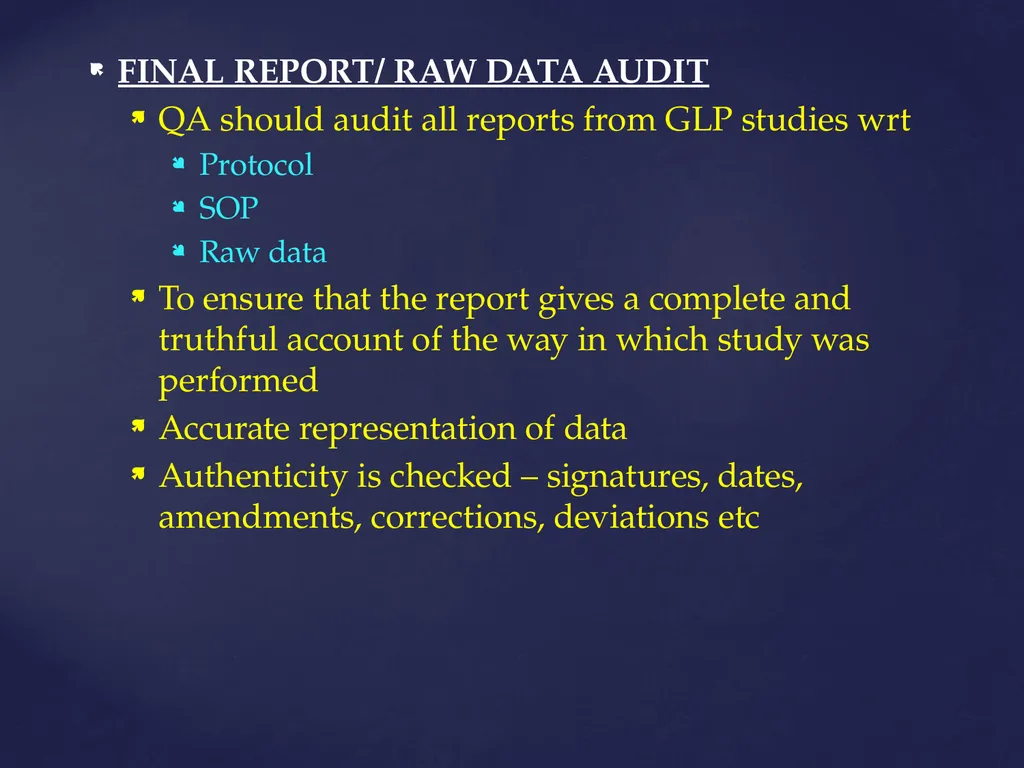
slide73. FINAL REPORT/ RAW DATA AUDIT
QA should audit all reports from GLP studies wrt
Protocol
SOP
Raw data
To ensure that the report gives a complete and truthful account of the way in which study was performed
Accurate representation of data
Authenticity is checked – signatures, dates, amendments, corrections, deviations etc<br>
slide74. QA statement is placed in report
Provides dates on which study was inspected
Reported to study director and management
QA statement is not a GLP compliance
Study director’s responsibility
As per OECD
“It is recommended that the QA statement only be completed if the study director’s claim to GLP compliance can be supported. The QA statement should indicate that the study report accurately reflects the study data. It remains the study director’s responsibility to ensure that any areas of non-compliance with the GLP principles are identified in the final report”.<br>
slide75. Content of QA Statement / Audit report
Date of inspection
Date of findings to study directors and management
Phases audited
Confirmation that report reflects methods used and data generated
Sign only if GLP compliance statement from study director is considered justifiable and all corrective actions have been completed<br>
slide76. The signed QA statement becomes a “release” document assuring that :
the study report is complete and accurately reflects the conduct and data of the study;
the study was performed in compliance with GLP;
that all audit comments have been satisfactorily resolved.
QA audit reports are not for general distribution
Should be handled with discretion
Better to archive separately from study files
No access to external auditors<br>
slide77. Thank you.<br>
Dr. Richa Singh<br>
slide3. 1 2 3 4 Discovery of potential NME
Not covered by a regulatory standard Post approval stage Clinical studies in human
GCP Non-clinical studies [not performed in human]
GLP GMP<br>
slide4. In the early 1970s, the FDA investigated a number of cases of poor practice in toxicology laboratories throughout the USA
Results of this investigation in about 40 laboratories
many cases of poorly managed studies
insufficient training of personnel
some cases of deliberate fraud
But most of the poor practice observed was not fraud and could be dealt with by implementing a system of quality management. History of GLP<br>
slide5. FDA Investigation Findings:
Poorly-trained Study Directors and study personnel
Poorly-designed protocols
Protocols not followed - procedures not conducted as prescribed
Raw data badly collected - not correctly identified - without traceability - not verified or approved by responsible persons
Lack of standardized procedures
Poor animal husbandry
Inadequate characterization of test items and test systems
Inadequate resources
Equipment not properly calibrated or otherwise qualified
Reports not sufficiently verified, inaccurate account of study or raw data
Inadequate archives and retrieval processes<br>
slide6. FDA decision
Introduce a new regulation to cover NON-CLINICAL SAFETY STUDIES
GLP (Good Laboratory Practice) Regulations
Draft of USA GLP in 1976
Enforced in US in 1979
Although this was a US regulation, it had a wide impact worldwide. Non-US companies wishing to register medicines in the USA now had to perform safety studies in compliance with FDA GLP.
In 1981, OECD (Organization for Economic Cooperation and Development) published GLP guidelines; these now dominate international arena with 37 member countries (as of Aug, 2020) and many non-OECD member countries (including India).<br>
slide7. A quality system related with the organizational process and the conditions under which non-clinical health and environmental safety studies (prospective drugs/chemical/biochemical entities) are planned, performed, monitored, recorded, archived and reported
GLP principles are a set of organizational requirements
The regulations are not concerned with the scientific or technical content of the research programmes
They do not aim to evaluate the scientific value of the studies OECD Principles for GLP<br>
slide8. GLP promotes Quality and Validity of test data
Help scientists to obtain results that are “Reliable, Repeatable and Auditable”
To minimize the incidence of false negatives
E.g. result demonstrate non-toxicity of a toxic compound
To minimize the incidence of false positives
E.g. result demonstrate toxicity of a non-toxic compound
To promote mutual recognition of study data across international frontiers
Limit waste of resources, especially animals
Ensure comparability of results between candidate medicines Significance<br>
slide9. 1 2 3 4 5 6 Planning
Study plan / protocol and planned changes
Performance
SOPs
Recording
Collection of raw data, recording deviations
Reporting
Accurate result reporting
Archives
Study data, specimens, samples and reports
Monitoring
Study staff, QA personnel, national inspectors GLP and Non-Clinical Study<br>
slide10. Resources
Management
Personnel
Facilities : Building & Equipment Characterization
Test item
Test system Documentation
Study plan
SOPs
Raw data & data collection
Final report
Archiving & indexing Validation Quality Assurance
Review of study plan & SOP
Planning
Audits and inspections GLP: Basic Points<br>
slide11. Building Personnel Equipment Management 1 2 3 4 1. Resources GLP requires that all resources be adequate for the task at hand<br>
slide12. Overall responsibility for GLP implementation
Must provide proper resources –
Personnel
Facilities / Equipment
Should demonstrate that the resources are suitable for the task
Promote good science and good organization
Implementation of GLP
Each test site or test facility retains a document identifying individuals with management responsibilities 1A. Management<br>
slide13. Good Science
Experimental design
Based on known scientific principles
Knowledge of experimental variables / bias
Interpretation of results
Results become part of accepted scientific knowledge
Good Organization : COVERED BY GLP
Planning of studies and resource allocation
Adequate physical facilities
Sufficient qualified staff – recruitment
Definition of staff responsibilities
Staff training
Proper conduct of studies
Good record keeping and organized archives
Verification procedures for study conduct and results<br>
slide14. PLANNING / RESOURCE ALLOCATION
Management responsibility
Sufficient physical resources and personnel were available to perform studies compliant with GLP
Master schedule is a document that records the planning of the all studies performed at a site.
Assist in assessment of workload
Track studies at a test facility MASTER SCHEDULE<br>
slide15. MASTER SCHEDULE
Approved by Management
All studies should be included
Important for planning aspects
Proper allocation of resources
Keep up-dated and have a change control procedure
Include actions such as protocol review and report preparation
Have only one official schedule
Define the system in an SOP
Decide who should maintain this document
Archive – as necessary
Distribute to those who need it, especially QA team<br>
slide16. 1 2 3 4 5 Study Director Single point of study control 1B. Personnel Archivist Study Personnel Principal Investigator Acts on behalf of study director for a multi-site study Quality Assurance Perform study according to the instruction Ensures management of GLP compliance Manages archives Management is responsible for appointing trained persons to perform work<br>
slide17. Organization Charts Curriculum vitae Organization of resource ‘personnel’ in standard documents Up-to-date chart should be provided by management
Should give a good idea of how the organization structured – who reports to whom
Keep it simple
May indicate no. of staff present in each department
Small organization – names of staff
Large organization – job title
Add functional responsibilities only if this helps to explain the organization For all personnel
Even for staff without formal qualifications
In standard format
Up-to-date
Archived
Contains
Qualification / education / diplomas
Professional experience<br>
slide18. Training Records Job Descriptions Past
Induction to the job
Competence of personnel regarding SOPs
External courses / internal courses
Attendance at seminars
Future
Training plans for each member of staff
Up-to-date
Archived Clearly define day-to-day responsibilities and tasks
Make it clear who reports to whom
Describe the delegation of tasks
Up-to-date in Standard format
Department /group
Name, position, level
Name, position of supervisor
Position summary
Tasks and responsibilities
Approval signatures and date
Signed by person concerned and his/her immediate supervisor
This is not a GLP requirement but is a good practice to ensure that both parties understand their respective responsibilities (which is a GLP requirement)<br>
slide19. GLP regulations do not stipulate exactly how buildings should be constructed.
It is up to management and study staff to satisfy authorities wrt
Suitability / Adequate for the study
Size, construction, location
Free from interference, disturbance, pollution and cross-contamination
Adequate separation
Maintenance
Documentation including site plan 1C. Buildings<br>
slide20. FACTORS TO CONSIDER
Experimental
Test systems
Study types
Number of studies
Staff
Safety and comfort
Possible impact on study from staff
Operational
Access / security
Cleaning
Storage
Utilities and maintenance
Waste disposal<br>
slide21. GLP regulations require that equipment used in studies
Suitable for task in hand
Properly calibrated and maintained SUITABILITY
Study director’s responsibility
Study staff must be able to justify the use
Sometimes requires proof of suitability
May need formal equipment qualification CALIBRATION
Need proof of standard working conditions
Working within limits fixed by the manufacturer
Producing reliable data
Calibration usually requires use of standards
Fix frequency of calibration in SOP
Respect calibration frequency 1D. Equipment<br>
slide22. Preventive maintenance
Curative maintenance (fix it when it breaks)
Back-up equipment
Contracts with external service organization
Alarms Maintenance Use of building / equipment
All maintenance actions including outside contractors
Service plans SOPs Use logbook
Calibration / checks
Maintenance service plan
Fault action reports
Use of computerized systems - Developed, validated, operated, maintained
In GLP compliance Records Building & Equipment<br>
slide24. 2. Characterization Materials used in experiments
Non-clinical studies
Test item
Often a chemical compound
Active ingredient for a medicine, a pesticide, a food additive, a vaccine, a biomass, an extraction from plant tissue, etc
Test system
Often a live animal
Plant, bacterium, an isolated organ, a field or other ecosystem, etc<br>
slide25. The GLP regulations deal with three points:
Test item itself
Preparation of dose formulation i.e. formulation of test item
Chemical analysis of both test item and formulation of test item 2A. Test Item<br>
slide26. GMP is not required for the manufacture of batches used in preclinical GLP studies
However, regulatory authorities do require testing to ensure that test items are suitable for non-clinical studies
Identity of test item is ascertained
Protect test item from cross- contamination or pollution
Use single lot throughout the study, if possible TEST ITEM Ensure that there are traceable (track) records for all test items
Characterization of test item is essential to ensure no major quality problems
Quality should be as similar as possible to the compound to be used in clinical trials
Chemical production changes can lead to physico-chemical variability
Physico-chemical variables affect bioavailability<br>
slide27. Has the dose-form
The right test item?
The right concentration?
Always been prepared in the same way?
Have you got traceability procedures for
Receipt?
Storage?
Preparation?
Delivery to point of use?
Disposal? FORMULATION Identity, activity and bioavailability of test items
Quality of test item and dose formulation
Constant nature and no degradation over time
The study director should have this information ASAP
The data from analyses must be reliable, hence should be generated under GLP conditions ANALYSIS<br>
slide28. Animals, Bacteria, Cells, Organs, Plants
GLP compliance
Compliance with animal welfare legislation (for animal test system) 2B. Test System<br>
slide29. ANIMALS
Scientist must match quantity and quality of animals to research requirements
Study Director defines
Phenotype / genotype
Sex, age
Supplier
Number
Reason for selecting the test system should be mentioned in Study Plan
Selection may be based on
Species / strain
Health status
Background data<br>
slide30. SUPPLY RECEIPT HUSBANDRY GROUPING Assess quality by supplier qualification
Usually by scientist + QA
Apply same to bedding and animal feed
Keep order form, supplier’s invoice, transport certificate etc. Inspect upon arrival – SOP
(Number delivered, Number ordered, Health, Sex, Weight, Age)
Record receipt and any deviation from SOP
Check against protocol requirements Follow national regulations
Routine checks
(Rooms – cleaning, Cages / racks – cleaning, changes, Feed / water, Environmental parameters – temperature, humidity, light, air)
Document the routine checks
Document having deviations from SOPs Procedure for assignment to groups in the protocol
Keep data used for assigning groups
Log locations of rack / cage, if applicable
Document all cases of “disqualification”<br>
slide31. IDENTIFICATION ACCLIMATIZATION ENVIRONMENT Identification during acclimatization & study
Large animals (individual marks throughout)
Small animals (cage labels for acclimatization individual unique ID for study)
Animal ID on all data
Regular ID check Length depends on species / protocol
Health check at specified times
Document preparation / approval of study room GLP requires “..a description of all circumstances that may have affected the quality or integrity of the data”
Environmental conditions belong to these circumstances.<br>
slide32. 3. Documentation Institute’s rules for organizing and conducting GLP studies must be documented approved by management PRESCRIPTIVE DOCUMENTS DESCRIPTIVE DOCUMENTS Formal documents
Must be scrupulously followed
Rules define who does what, how, when & where (sometimes why)
Two main types – (i) Study Plan / Protocol & (ii) SOP Descriptive nature
Followed as per the given format / standard
Includes
Data collection
Final Report<br>
slide33. WHAT? CONTENT Defines study design
Overall plan of experiment
Info on major events of the study
Provides enough information about the methods used to perform the study
May follow international scientific guidelines (optional)
Must be approved by the Study Director, even if the study is sponsored by another organization
Provides overall timeframe “MASTER PLAN” Scientific requirements of the study
Comply with GLP
Identification number
Title and statement of purpose
Identification of test (and control) items
Chemical names/codes/specifications
Name of sponsor & address of test facility
Name of study director and other responsible personnel
Proposed dates
Justification for selection of the test system
Description of test system
Experimental design
Dosing details / parameters A. The Protocol or Study Plan<br>
slide34. APPROVAL Sponsor and study director must agree on design of the study before it begins
Provides sufficient time for all staff to be made aware of their roles in the study
Mandatory signature by Study Director with date
Marks the date of study initiation
Represents his/her agreement to take full responsibility for the study
Sufficient time must be allowed to
Produce protocol
Discuss its implications with concerned staff
Circulate protocol for QA review
Circulate protocol for scientific review
Circulate approved version to all staff involved in the study DISTRIBUTION Easy access to a copy of the protocol to all staff members involved in study.
In order to confirm that this is so, it is worth obtaining a signature from each recipient.
It is good practice, but not a GLP requirement, to hold briefings/meetings before the study begins to ensure that everyone is aware of their role in the study.<br>
slide35. PROTOCOL AMENDMENT Regulates the conduct of the study
Can be changed to allow study director to respond to results or other factors during the course of the work
If amended documented and explained
Study director will write a “protocol amendment”
Issued to document a prospective change in the study design or conduct
Unplanned changes, omissions, errors in study
not covered by protocol amendment
not acceptable practice
can be documented in a file note attached to relevant raw data Planned amendment is a part of protocol amendment
Study being amended is clearly identified
Amendment uniquely numbered
Reason for amendment is clear and complete
Section of original protocol being amended is clearly identified
New instruction is clear
Approved by study director and properly reviewed
Distribution is same as that of original protocol<br>
slide36. Pivotal document for
Communication to study staff
Fixing study objectives
Contractual reasons
E.g. between contact laboratory and sponsor
Providing basic dates
Study start and finish dates
Indicating study methods and specifications
Defines responsibilities and resource needs
Basis for regulatory discussions<br>
slide37. B. Standard Operating Procedures INTEGRAL PART OF GLP
Provide detailed in-depth instructions for all routine & lab processes
Necessary addition to protocol if a study is to be repeated exactly SOPs only apply when there is a standard practice which will be repeated
If the work perform is not routine, there is no need to write an SOP.
The instructions can be included in protocol or lab document Part of laboratory master documentation system
Needed for all sectors that ensure the GLP environment<br>
slide38. Cover all activities:
Technical aspects of study
Administration
Transfer of data to archives / managing documents
Personnel management
Safety
Hygiene Readable, clear, precise, practical
Fully understood and followed
Reviewed Content or sections of SOPs :
Title
Purpose
General
Highlights principal features
Gives background information
Procedure
Instructions in logical / chronological order
References
Help
Contact person in case of problems<br>
slide43. SOP IMPLEMENTATION SOP MANAGEMENT BENEFITS OF GOOD SOP SYSTEM Management support
(Must be convinced of the advantages that good SOP system can confer)
Training to SOPs
(Educating tool, Compliance with GLP)
SOP management system
(Up-to-date SOP, Standardization, Accuracy of results) Responsible person for each SOP
SOP must be immediately available
Formal change control : any changes in SOP must be made following a standard method, describing in an SOP historical reconstruction
Central organization (optional)
Set standard format
Single point for i.d./numbers / issuance
Change control (versions) : traceability
Ensure distribution
Ensure cross-departmental coherence of SOPs
Ensure review by QA unit Standardized, consistent procedures, reduce test-to-test variability
Means of study reconstruction
Optimizes the way things are done
Record technical and administrative improvements
Approval by management formalizes their commitment to quality
Ease of documenting complicated techniques
Continuity in case of personnel turnover
Forms training manual
Means of communication (audits, visits, technology transfer)<br>
slide44. Experimental phases of the study generate data
Information becomes part of the scientific base of knowledge, if they reach public domain
Results include:
Raw data
Study files
Data on environmental conditions, etc
These are DESCRIPTIVE documents
They give us the result of the experiment
Tell us who did what, when, where and how C. Raw data and data collection<br>
slide45. Data collection requires
Adequate well-trained staff
Appropriate equipment
Good preparation with planning records available
Complete instructions
Study Director should ensure
Sufficient trained personnel
Protocol is understood and available
SOPs available in work areas
Equipment handy
Data collection forms available in work area and ready for use
Operator should ensure proper functioning of equipment Raw data
Original, first, on-the-spot record
Needed for the study reconstruction
Lost / inaccurate data may invalidate the study
Collect data on prepared forms / notebooks to indicate:
WHAT was done
HOW it was done
WHEN it was done
WHO collected the data
Records are more than just a list of figures
Data should be recorded
Directly / not transcribed from a rough copy
Promptly, Accurately, Legibly, Indelibly
Explain corrections
Sign and date 1. Before the study 2. During the study<br>
slide46. “What” was done? “Who” did it? “When” was it done? “How” was it done? Data should show
That the protocol was followed
That the process complied with SOP instructions
The results of observations Data should show that methods were carried out
As indicated in the protocol and SOP
Or that any deviations from protocol or SOP were recorded Data should show
Timing as per protocol – date / time
Any deviations from protocol schedule were recorded Data should
Identify the operator
Identify data recorder – if different from operator
Identify verifiers / correctors<br>
slide47. Data should be
Collected together in one place
Organized in logical order
Verified for completeness
Handed over to the Study Director
Kept in a safe place for easy archiving<br>
slide48. FINAL REPORT GLP REQUIREMENTS OF 01 Name & address of test facility
Name of Study Director 02 Dates of study (start & finish)
Study objectives Test item / system details
Dosing details (routes / duration) Results & Statistics
Summary of findings Discussion & Conclusion
References GLP compliance statement signed by Study Director Signed/dated reports from scientists QA statement of audits / inspections 03 04 05 06 07 08 D. Final Report<br>
slide49. Study director is responsible for the entire study, including the report
Accurate reporting and deviations
Should not be a selection of highlights of the study, leaving out the part that did not work
May include inputs from scientists
GLP compliance
Report Review by QA
Once a final report is signed, modifications can only be made via formal amendments
Amendments have to be approved by Study Director
Verified and validated by QA<br>
slide50. This is what is left when the study is over
Study plan
Raw data
Specimens
Final report
QA documents
Personnel records
Facilities / equipment validation records
Historical SOP file E. Archiving and indexing<br>
slide51. Archives is a safe depository of invaluable information
Centre for compilation and distribution of documents
Major tool for reconstruction of studies performed in past
Functions:
Long-term, secure storage
Fast retrieval of data
Contains all original scientific data, master documents, reports, etc
Tool for preparing project summary documents<br>
slide54. CONDITION of ARCHIVES TERM of STORAGE Protection against fire, flood and vandalism, if possible
Storage conditions should minimize deterioration
Fire, flooding precautions?
Air conditioned / ventilated general environment?
Copies of data recorded on heat sensitive papers?
Refrigeration used where necessary?
Paraffin blocks sealed in bags / tissues in preservatives / cover slips on slides?
Computer back-ups maintained in security cabinet?
CCTV monitoring? The OECD GLP Principles organizations follow national regulations for the period of archiving
Register compounds internationally files need to be archived indefinitely
Varying retention times required by different GLP/GCP/GMP process
Research facilities impose strict rules on the destruction of archived materials
Space problem arises, very old holdings and abandoned projects may be destroyed (belonging to chemical families of no current interest; upon justification and written authorization from management)
If a company goes out of business, product license holders at that time should be notified and archival responsibility transferred.<br>
slide55. RETRIEVAL from ARCHIVES Only authorized entry permitted (as per SOP)
Examination in-situ of documents is preferred in presence of the archivist
Photocopies made in place, if possible
Any removal of items from the archives should only be allowed in exceptional circumstances.
Removal should be authorized in writing by senior management.
The history of each holding is recorded and signed by the archivist and the person taking responsibility for the material removed.<br>
slide56. Indexing is often computerized
Allows complete and rapid retrieval starting from any one of the indexing parameters
Indexing parameters :
Unique holding numbers
cross-referenced to location in archives
Project or study number
Test article / reference article and lot numbers for test items and formulation, if required
Protocol number (often same as study number)
Testing facility or site identifier
Keyword retrieval from study title / comments section of master schedule
Regulatory information
Dates
Department<br>
slide57. 4.1 Calibration Records ADEQUATE
EQUIPMENT
To perform a study properly
Suitable for intended use
Depends on type of study and study objectives
Suitability can only be assessed by considering the performance of the equipment
Lab must decide the acceptable frequency of calibration
Depend on equipment and its use
Calibration programme should be included in the SOPs of the test facility CALIBRATION
Equipment must be calibrated and maintained to ensure accurate performance
Calibration depends on the use of standards
Weighing balance standard certified weights
pH meter standard buffer / capsules
Standards may also be compound samples of known concentration or weight
Ensure analytical equipment is functioning as expected
Provide basis for calculation of accuracy and precision CALIBRATION
RECORDS
Proof that equipment is performing to specifications
Generating reliable data (analytical equipment)
Maintaining certain specified conditions (AC / fridge / incubators)
Periodic checking
Logbooks to record regular verifications
Records of cleaning, repairs and routine maintenance
Full documentation of all tests for suitability and calibration
Data readily available during investigation of result of a study or regulatory inspections
Archiving<br>
slide58. Bioanalytical methods used in nonclinical safety studies are validated to demonstrate
Reliability
Reproducibility
Quality of data / product
A GLP compliance program ensures data integrity via method-validation studies
Although assay validation is not directly addressed in GLP regulations, but it is always encouraged by FDA to adopt validated methods. 4.2 Validation of Methods<br>
slide59. FDA guideline ‘Guidance for Industry: Bioanalytical Method Validation’
States that analytical laboratory conducting pharmacology/toxicology and other preclinical studies should adhere to FDA’s GLP regulations
Quality Assurance Unit (QAU) responsible for method validation studies for GLP compliance
Good understanding of method validation concepts and regulatory requirements
Help QAU to focus on key areas
More effective auditing of method validation protocols, final reports and associated data<br>
slide60. Full
Validation 02 01 03 Types of method validation studies Often required when new bioanalytical methods are developed Method used to detect new drug entity
Metabolites addition to existing method for quantification Partial Validation Cross Validation Comparison of validation parameters Required when already validated methods are modified Validation exercise depends on intended used of the method When two or more methods are used to generate data Within the same study or across different studies<br>
slide61. Repeatability/Precision
Closeness of the results between a series of measurements of a single sample by single analyst
Under the same operating conditions
Over a short interval of time
Also called as “intra-assay precision”
Often mathematically expressed as percent of coefficient of variation (% CV) Parameters for method validation<br>
slide62. Accuracy
Is the measure of closeness or agreement between the measured value and the true value (or accepted reference value of an analyte)
Often expressed as percent of true or actual value
Intermediate Precision
Is assay-to assay variability within laboratories
Can be due different analyst, instruments or days<br>
slide63. Linearity of method
ability within a given range to elicit results that are directly proportional to concentration of analyte
Reported as the variance of the slope of the regression line or linear regression coefficient (R2)<br>
slide64. Quantification limit
Refers to the lowest level of an analyte in a sample that can be quantitatively determined with suitable precision and accuracy
Selectivity
Ability of the method to differentiate and quantify the analyte in presence of other components in the sample
Stability
Robustness
Measure of a method’s capacity to remain unaffected by small, but deliberate variations in method parameters
Indication of reliability of method<br>
slide65. GLP defines the minimum quality assurance requirements to ensure validity of experimental results
QA is charged with assuring management that GLP compliance has been attained within lab
Should act as an independent unit (as per GLP)
QA must review all phases of preclinical research
From planning to reporting and archiving
Embraces all the procedures necessary to provide a high probability that a medicine will conform consistently to a specified description of quality
Must have access to all documents and procedures at all levels of organization 5. Quality Assurance (QA)<br>
slide66. QA reviews protocol (or study plan)
Mandatory process
Completeness
Clarity
In case of amendments
Protocol signed by QA
Original signed copy archived A. Protocol Review<br>
slide67. SOPs are essential
Reviewed and signed by QA
Not mandatory, a recommendation
Signed SOP indicate GLP-compliance
Complete
Clear
No conflict
Approved, distributed and archived
QA approval doesn't guarantee sound technical content
Technical content Study Director B. SOP Review<br>
slide68. Master schedule is a list of all studies at the facility
A study should be entered into master schedule sheet (MSS) before the study begins (often before protocol is written)
QA maintains MSS
QA must be aware of all planned studies
Must have copy of all studies
Direct access
Plan inspections and audits C. Master Schedule<br>
slide69. Audit
Methodological evaluation
Should be performed in cooperation with the people whose operations are being studies
Often internal audits and inspections are planned with study director D. Audits and Inspections<br>
slide70. 1. STUDY-BASED AUDIT
Protocol or study plan
Target specific critical phase of the study
Criticality determined by QA
Usually required input from scientists / specialists
Use risk analysis techniques
Reports (raw data) can also be reviewed
Reported to study director
for response
improvement<br>
slide71. 2. SYSTEM OR FACILITY-BASED AUDIT
Performed independently of studies
Personnel records
Archives
Animal receipt, disposal
Cleaning
Computer operations and security
Access and security
SOP management
Water supply
Building / Equipment
Frequency of audit depends on impact of study
May use risk-analysis techniques
Reported to appropriate manager of test facility<br>
slide72. 3. PROCESS-BASED AUDIT
Performed independently of specific studies
Conducted to monitor processes of a repetitive nature
Frequency may be justified by a risk analysis approach
Performed because it is considered inefficient or inappropriate to conduct study-based inspections on repetitive phases
Other useful process-based inspections are those that focus on cross-organizational processes
the transfer of test samples from the animal facilities to the bio-analysis laboratory<br>
slide73. FINAL REPORT/ RAW DATA AUDIT
QA should audit all reports from GLP studies wrt
Protocol
SOP
Raw data
To ensure that the report gives a complete and truthful account of the way in which study was performed
Accurate representation of data
Authenticity is checked – signatures, dates, amendments, corrections, deviations etc<br>
slide74. QA statement is placed in report
Provides dates on which study was inspected
Reported to study director and management
QA statement is not a GLP compliance
Study director’s responsibility
As per OECD
“It is recommended that the QA statement only be completed if the study director’s claim to GLP compliance can be supported. The QA statement should indicate that the study report accurately reflects the study data. It remains the study director’s responsibility to ensure that any areas of non-compliance with the GLP principles are identified in the final report”.<br>
slide75. Content of QA Statement / Audit report
Date of inspection
Date of findings to study directors and management
Phases audited
Confirmation that report reflects methods used and data generated
Sign only if GLP compliance statement from study director is considered justifiable and all corrective actions have been completed<br>
slide76. The signed QA statement becomes a “release” document assuring that :
the study report is complete and accurately reflects the conduct and data of the study;
the study was performed in compliance with GLP;
that all audit comments have been satisfactorily resolved.
QA audit reports are not for general distribution
Should be handled with discretion
Better to archive separately from study files
No access to external auditors<br>
slide77. Thank you.<br>