Grade 6 Grammar Studies Unit 2: Nouns Unit Overview What is a noun? Compound Nouns Common proper nouns Concrete abstract nouns Capitalization of nouns Forming plural nouns Forming possessive nouns Noun adjective agreement Lesson 2.1:
"Grade 6 Grammar Studies Unit 2: Nouns Unit" is the property of its rightful owner. Permission is granted to
download and print the materials on this website for personal, non-commercial use only, and to display it
on your personal computer provided you do not modify the materials and that you retain all copyright
notices contained in the materials. By downloading content from our website, you accept the terms of this
agreement.
Presentation Transcript
01
Grade 6 Grammar Studies Unit 2: Nouns<br>
02
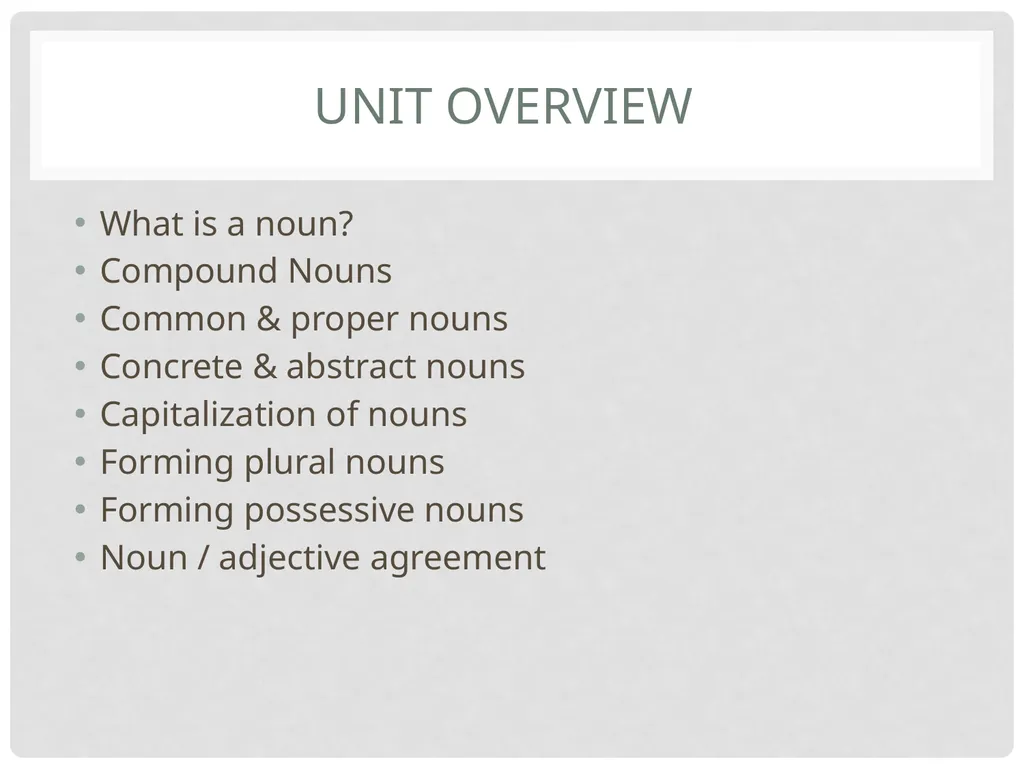
Unit Overview What is a noun?
Compound Nouns
Common & proper nouns
Concrete & abstract nouns
Capitalization of nouns
Forming plural nouns
Forming possessive nouns
Noun / adjective agreement<br>
03
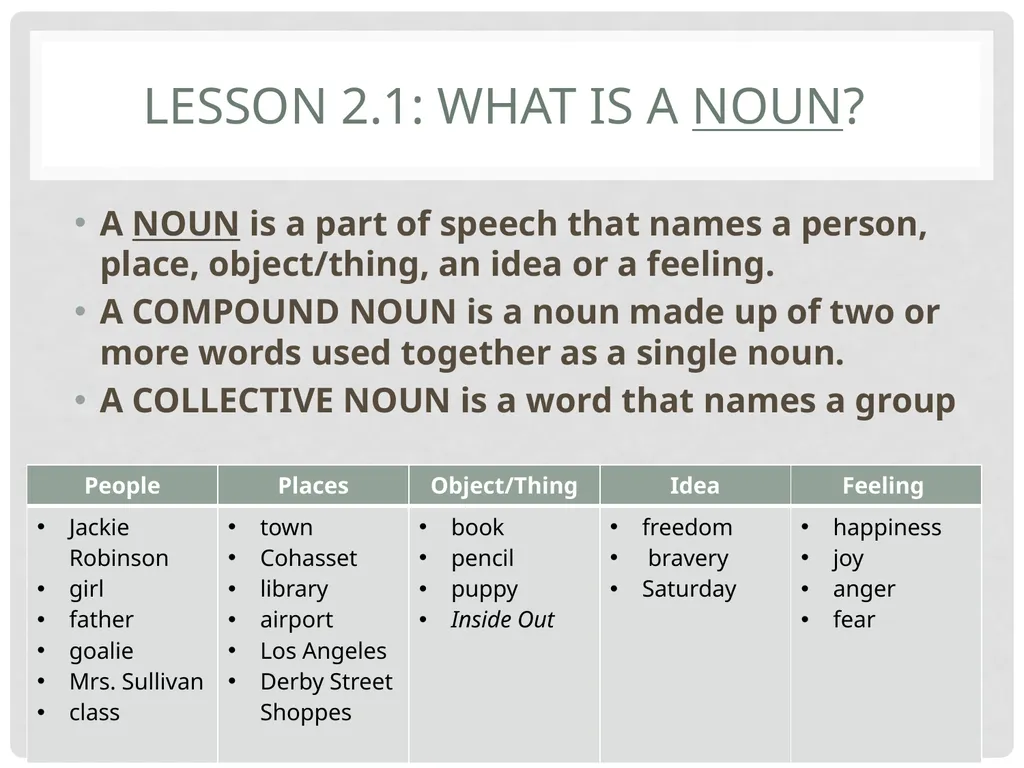
Lesson 2.1: What is a noun? A NOUN is a part of speech that names a person, place, object/thing, an idea or a feeling.
A COMPOUND NOUN is a noun made up of two or more words used together as a single noun.
A COLLECTIVE NOUN is a word that names a group
Examples of Nouns<br>
04
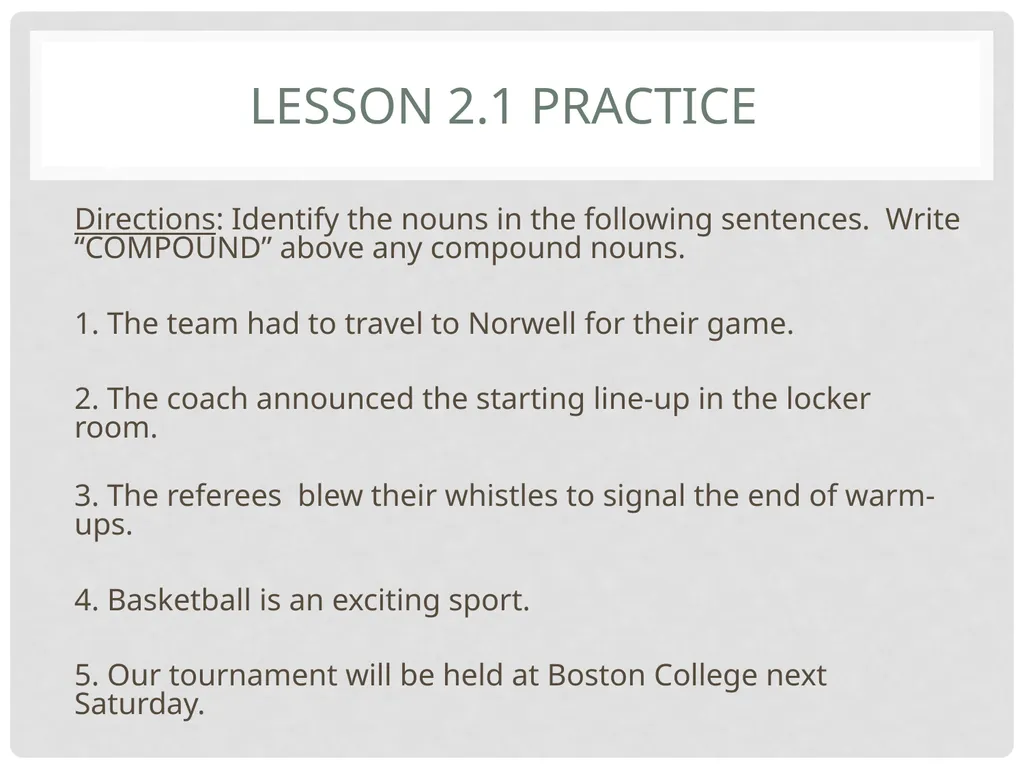
Lesson 2.1 Practice Directions: Identify the nouns in the following sentences. Write “COMPOUND” above any compound nouns.
1. The team had to travel to Norwell for their game.
2. The coach announced the starting line-up in the locker room.
3. The referees blew their whistles to signal the end of warm-ups.
4. Basketball is an exciting sport.
5. Our tournament will be held at Boston College next Saturday.<br>
05
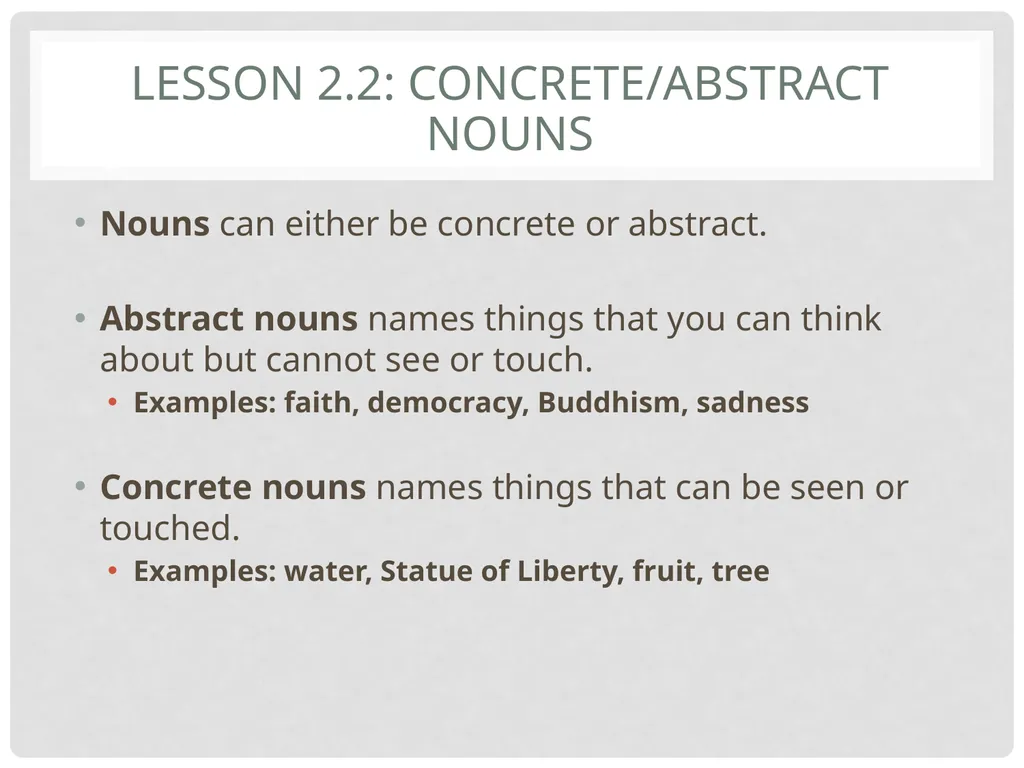
Lesson 2.2: Concrete/Abstract Nouns Nouns can either be concrete or abstract.
Abstract nouns names things that you can think about but cannot see or touch.
Examples: faith, democracy, Buddhism, sadness
Concrete nouns names things that can be seen or touched.
Examples: water, Statue of Liberty, fruit, tree<br>
06
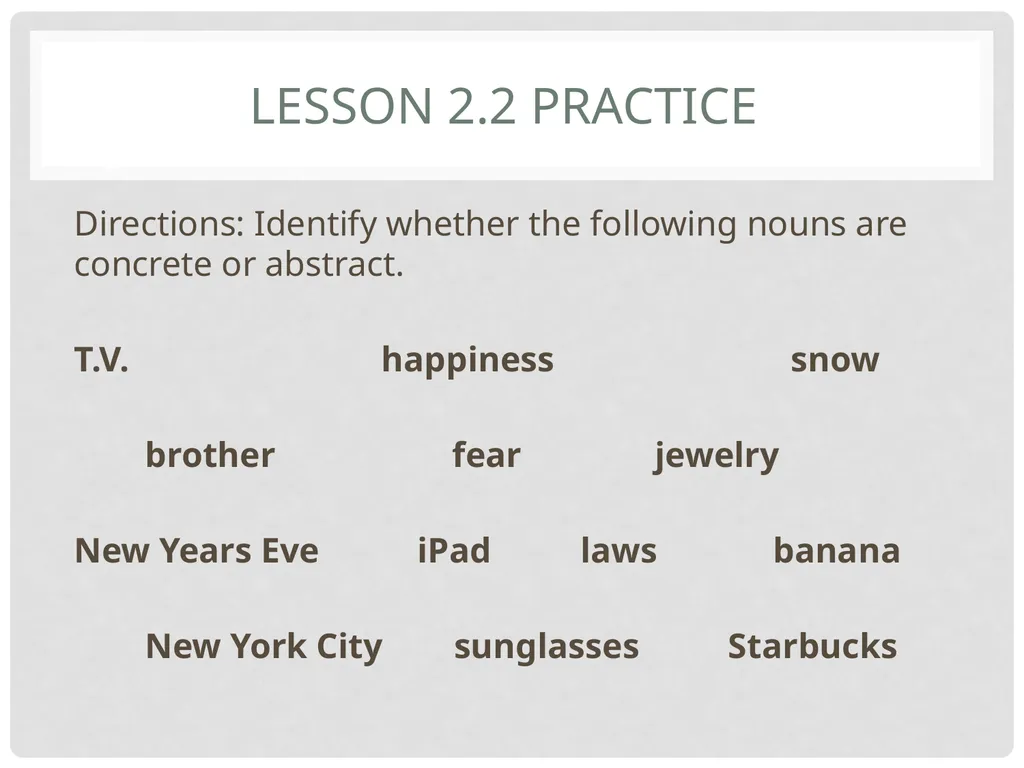
Lesson 2.2 Practice Directions: Identify whether the following nouns are concrete or abstract.
T.V. happiness snow
brother fear jewelry
New Years Eve iPad laws banana
New York City sunglasses Starbucks<br>
07
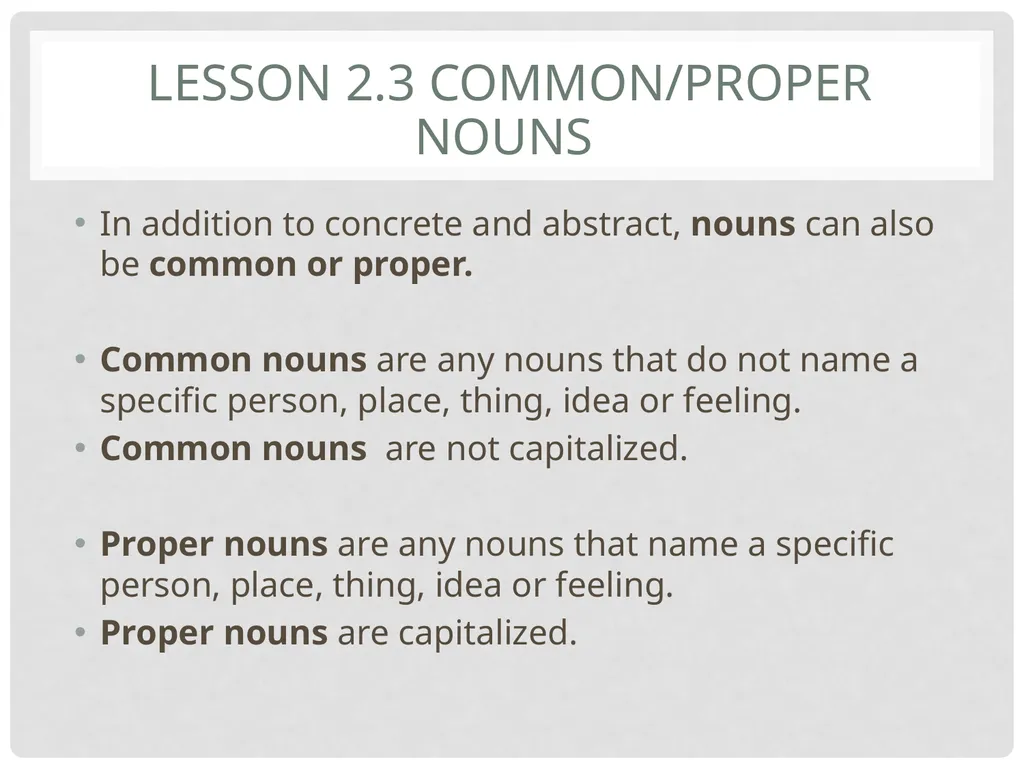
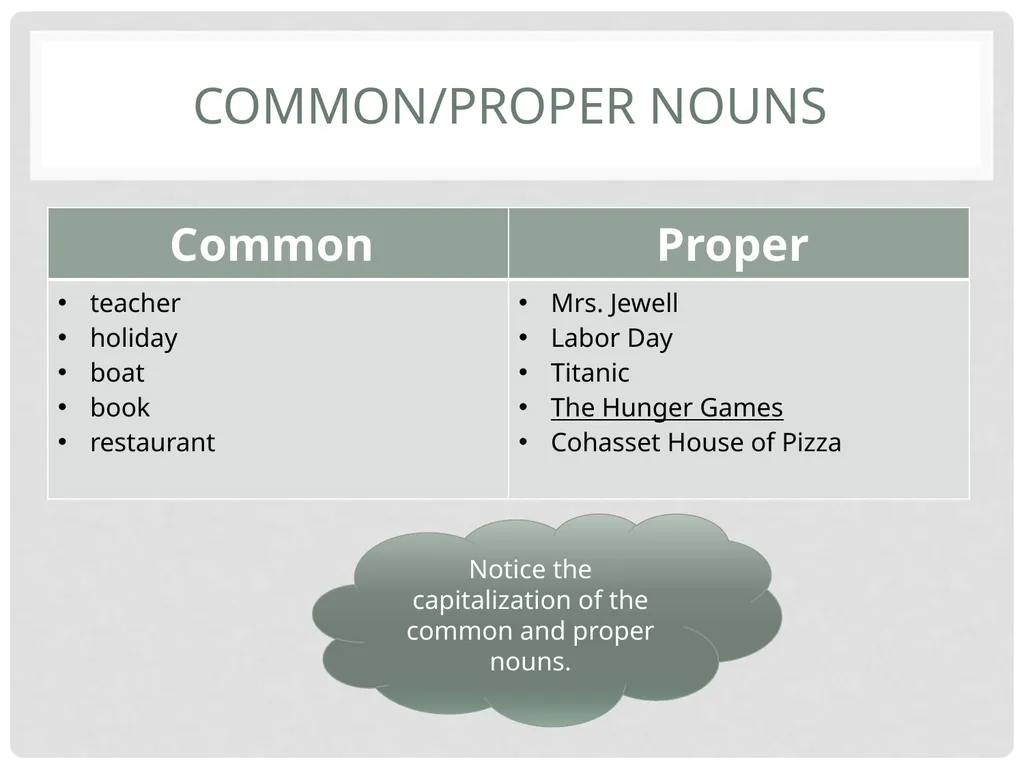
Lesson 2.3 Common/Proper Nouns In addition to concrete and abstract, nouns can also be common or proper.
Common nouns are any nouns that do not name a specific person, place, thing, idea or feeling.
Common nouns are not capitalized.
Proper nouns are any nouns that name a specific person, place, thing, idea or feeling.
Proper nouns are capitalized.<br>
08
Common/Proper Nouns Notice the capitalization of the common and proper nouns.<br>
09
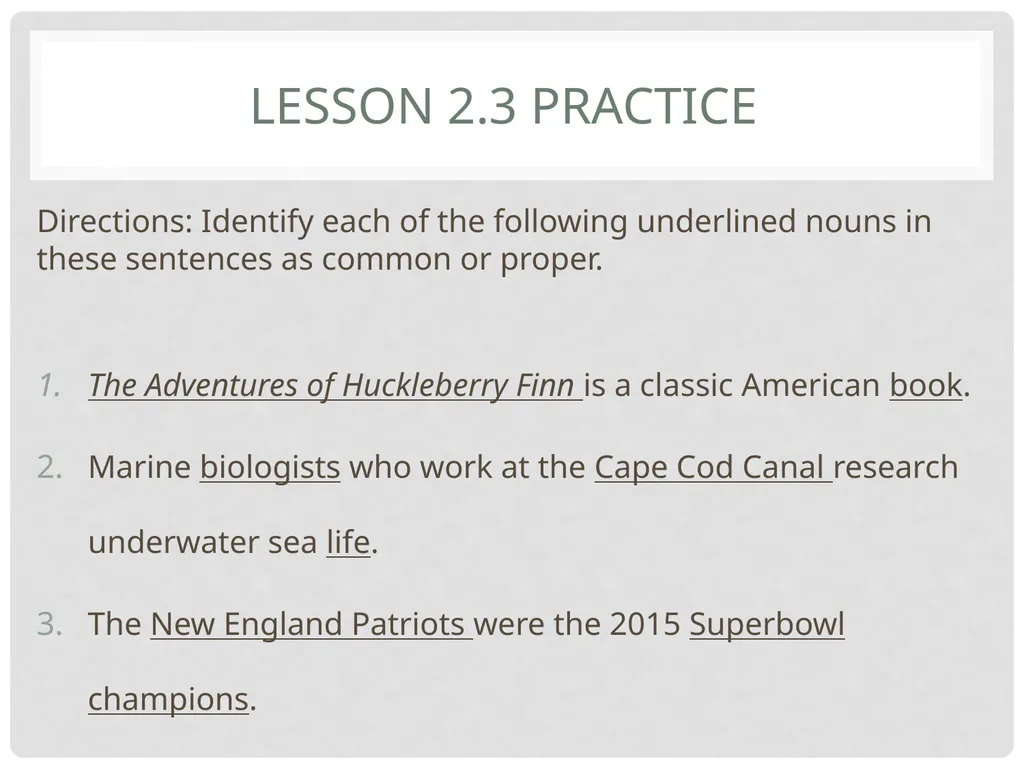
Lesson 2.3 Practice Directions: Identify each of the following underlined nouns in these sentences as common or proper.
The Adventures of Huckleberry Finn is a classic American book.
Marine biologists who work at the Cape Cod Canal research underwater sea life.
The New England Patriots were the 2015 Superbowl champions.<br>
10
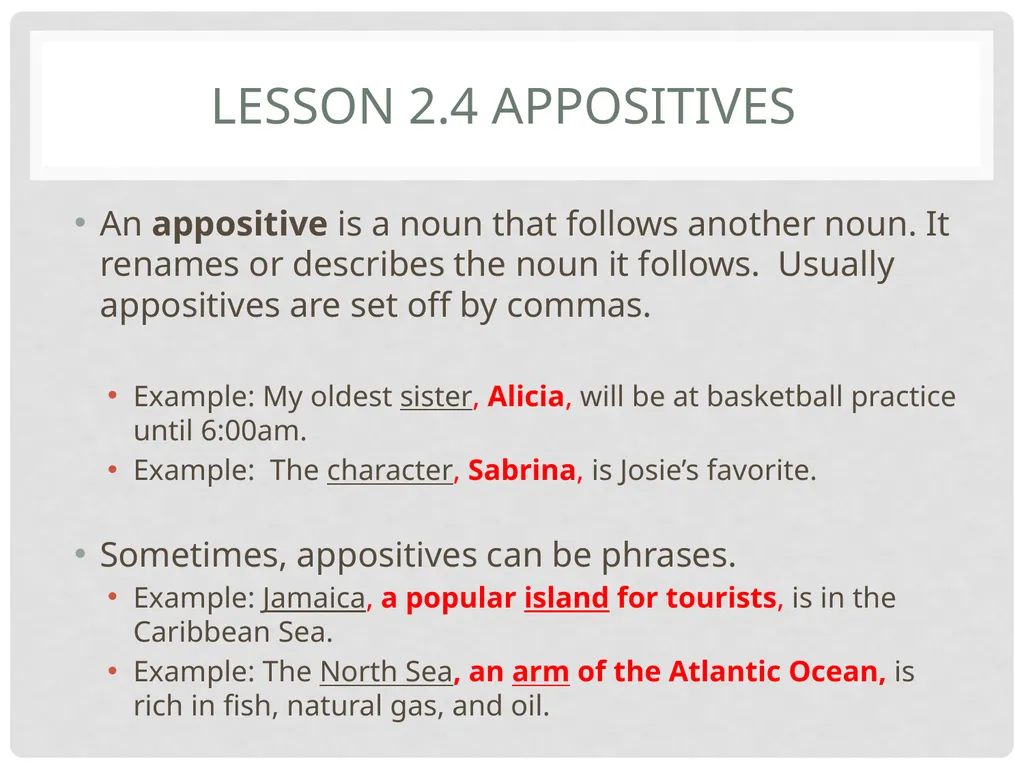
Lesson 2.4 Appositives An appositive is a noun that follows another noun. It renames or describes the noun it follows. Usually appositives are set off by commas.
Example: My oldest sister, Alicia, will be at basketball practice until 6:00am.
Example: The character, Sabrina, is Josie’s favorite.
Sometimes, appositives can be phrases.
Example: Jamaica, a popular island for tourists, is in the Caribbean Sea.
Example: The North Sea, an arm of the Atlantic Ocean, is rich in fish, natural gas, and oil.<br>
11
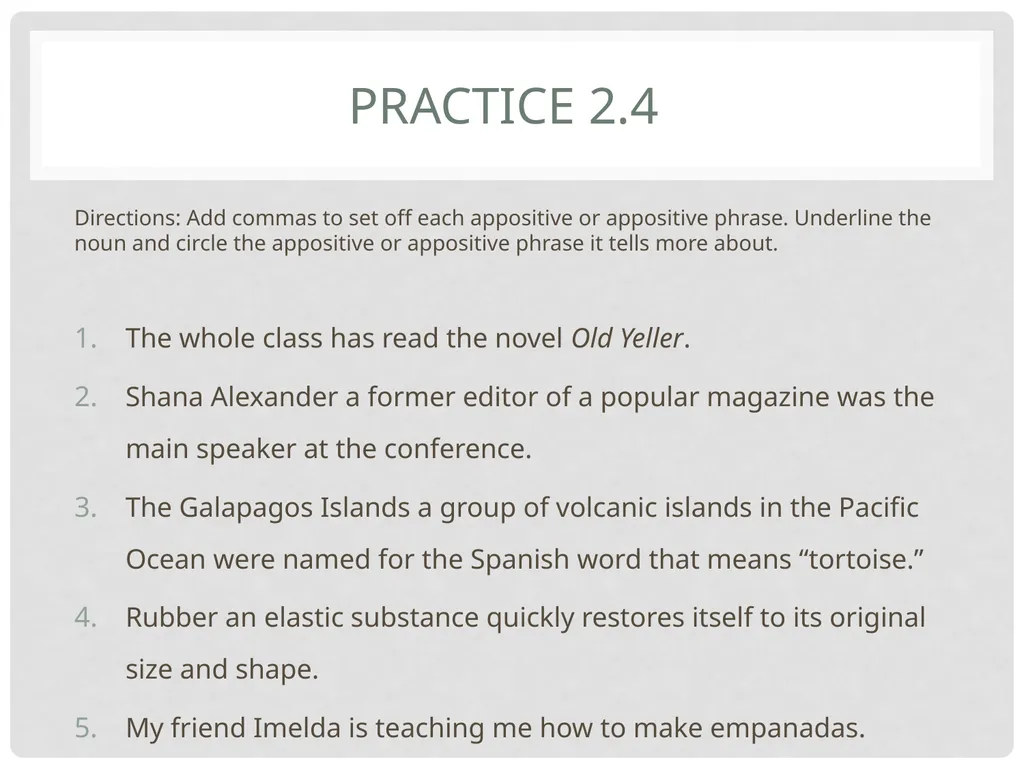
Practice 2.4 Directions: Add commas to set off each appositive or appositive phrase. Underline the noun and circle the appositive or appositive phrase it tells more about.
The whole class has read the novel Old Yeller.
Shana Alexander a former editor of a popular magazine was the main speaker at the conference.
The Galapagos Islands a group of volcanic islands in the Pacific Ocean were named for the Spanish word that means “tortoise.”
Rubber an elastic substance quickly restores itself to its original size and shape.
My friend Imelda is teaching me how to make empanadas.<br>
12
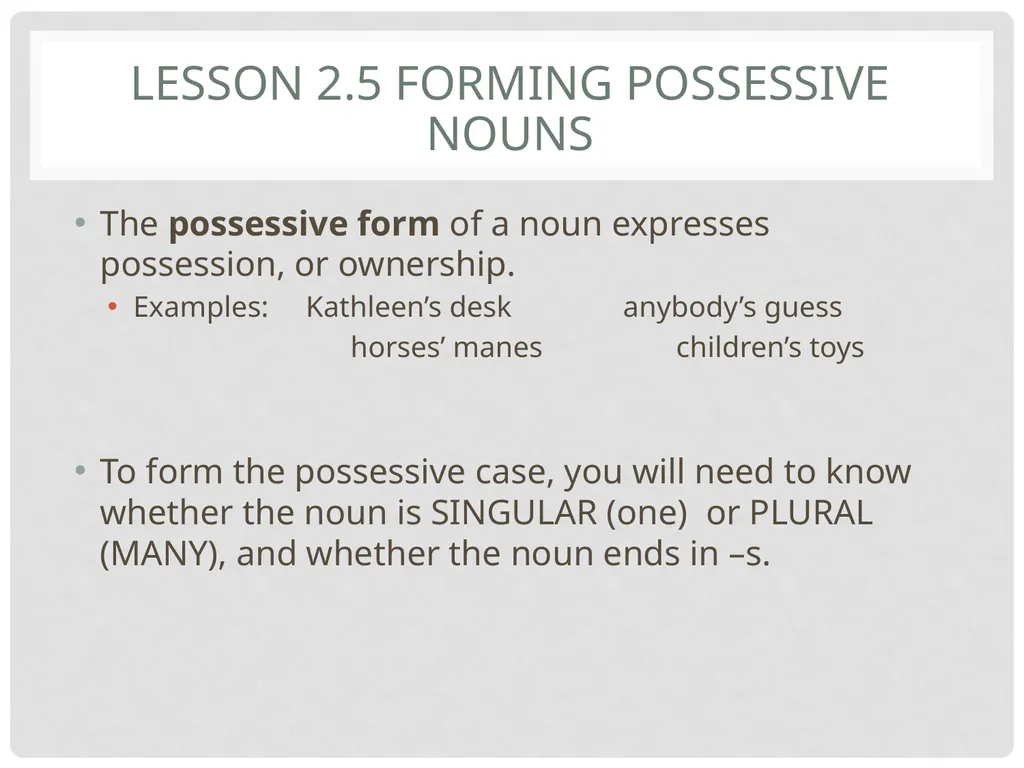
Lesson 2.5 Forming Possessive Nouns The possessive form of a noun expresses possession, or ownership.
Examples: Kathleen’s desk anybody’s guess
horses’ manes children’s toys
To form the possessive case, you will need to know whether the noun is SINGULAR (one) or PLURAL (MANY), and whether the noun ends in –s.<br>
13
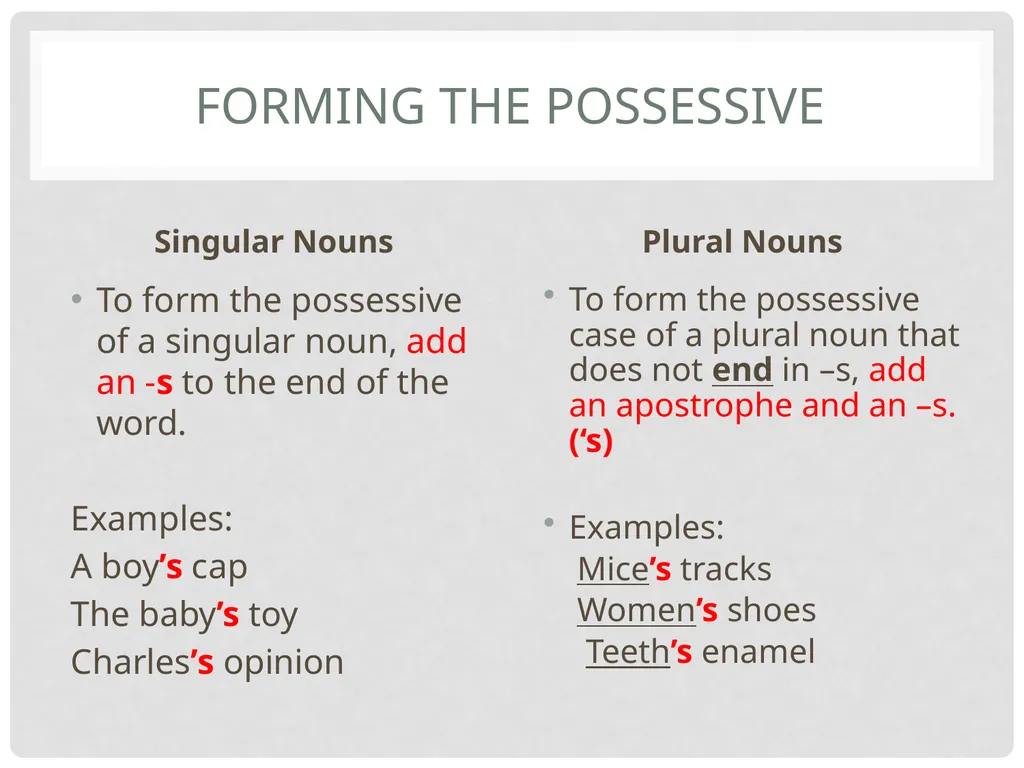
Forming the Possessive Singular Nouns To form the possessive of a singular noun, add an -s to the end of the word.
Examples:
A boy’s cap
The baby’s toy
Charles’s opinion Plural Nouns To form the possessive case of a plural noun that does not end in –s, add an apostrophe and an –s. (‘s)
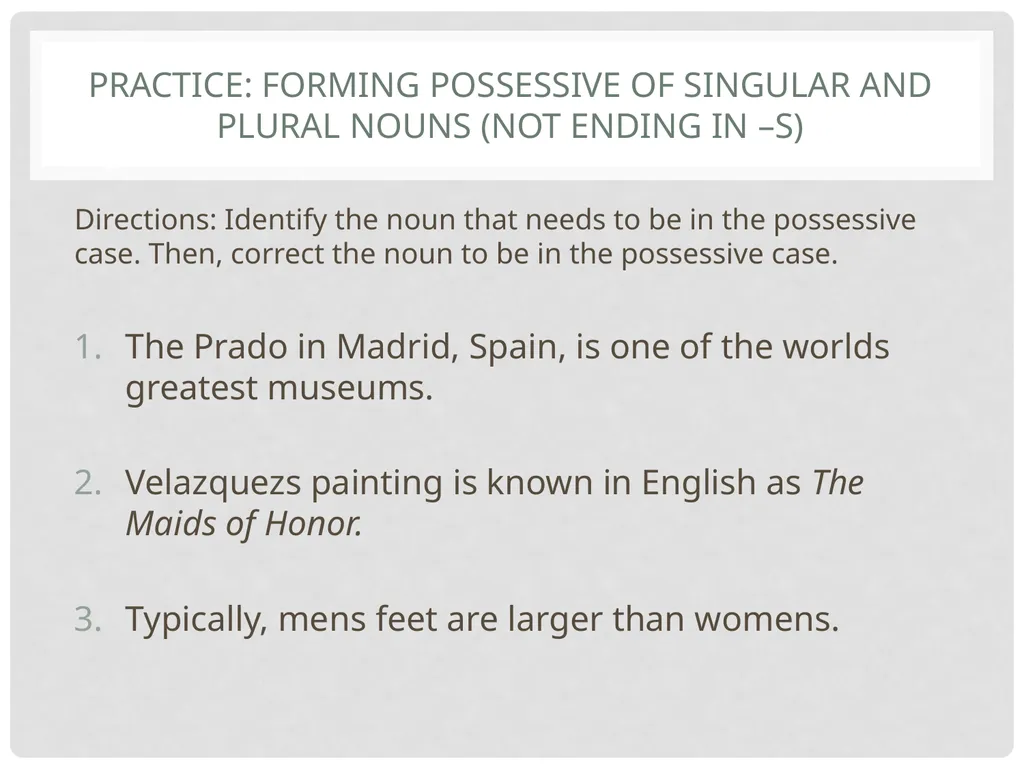
Practice: Forming possessive of singular and plural nouns (not ending in –s) Directions: Identify the noun that needs to be in the possessive case. Then, correct the noun to be in the possessive case.
The Prado in Madrid, Spain, is one of the worlds greatest museums.
Velazquezs painting is known in English as The Maids of Honor.
Typically, mens feet are larger than womens.<br>
15
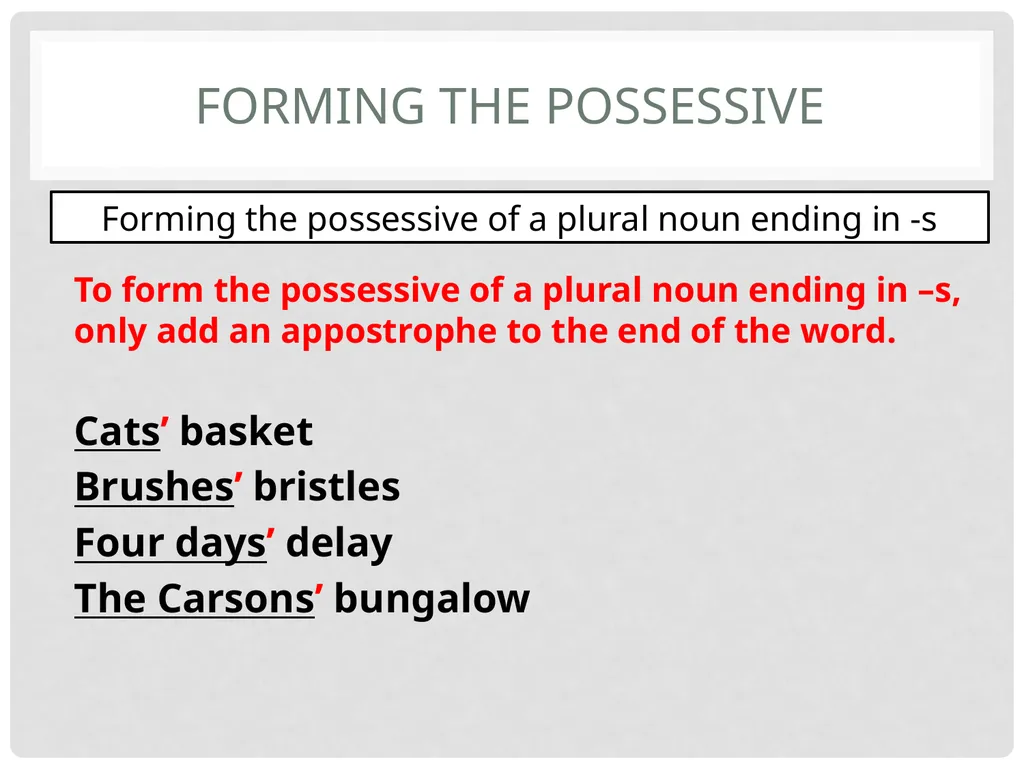
Forming the possessive To form the possessive of a plural noun ending in –s, only add an appostrophe to the end of the word.
Cats’ basket
Brushes’ bristles
Four days’ delay
The Carsons’ bungalow Forming the possessive of a plural noun ending in -s<br>
16
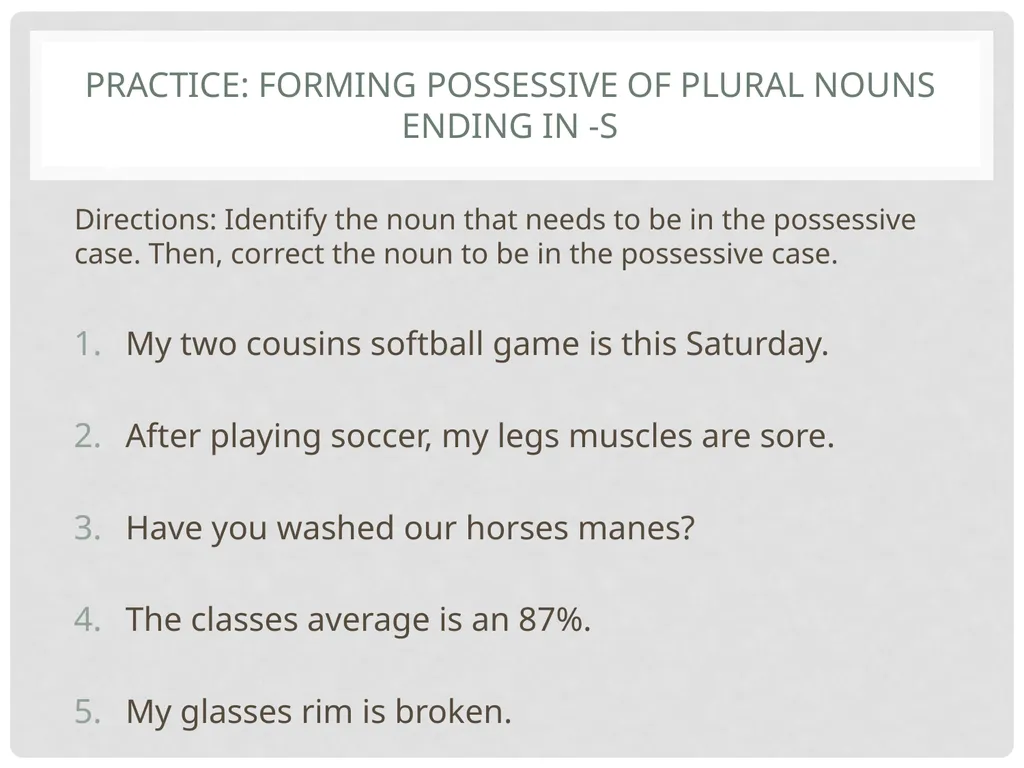
Practice: Forming possessive of Plural nouns ending in -s Directions: Identify the noun that needs to be in the possessive case. Then, correct the noun to be in the possessive case.