
Green Standards Framework Lasse Okkonen, Karelia
DP
Published · 77 slides · 0 views

1 / 1




Description
Green Standards Framework Lasse Okkonen, Karelia UAS lasse.okkonenkarelia.fi kiertotalousamk.fi Contents Background Organisational environmental management Product-based approaches to environmental management EcoDesign Life Cycle Analyses
Related Topics
Share
Embed code
Download this presentation From Below
"Green Standards Framework Lasse Okkonen, Karelia" is the property of its rightful owner. Permission is granted to download and print the materials on this website for personal, non-commercial use only, and to display it on your personal computer provided you do not modify the materials and that you retain all copyright notices contained in the materials. By downloading content from our website, you accept the terms of this agreement.
Presentation Transcript
01
Green Standards Framework Lasse Okkonen, Karelia UAS
lasse.okkonen@karelia.fi kiertotalousamk.fi<br>
lasse.okkonen@karelia.fi kiertotalousamk.fi<br>
02
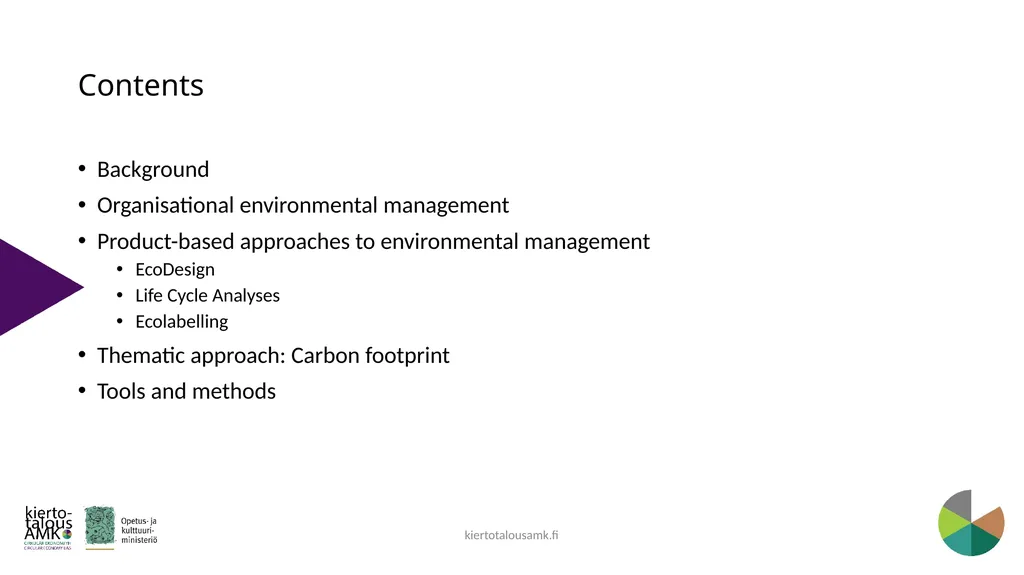
Contents Background
Organisational environmental management
Product-based approaches to environmental management
EcoDesign
Life Cycle Analyses
Ecolabelling
Thematic approach: Carbon footprint
Tools and methods kiertotalousamk.fi<br>
Organisational environmental management
Product-based approaches to environmental management
EcoDesign
Life Cycle Analyses
Ecolabelling
Thematic approach: Carbon footprint
Tools and methods kiertotalousamk.fi<br>
03
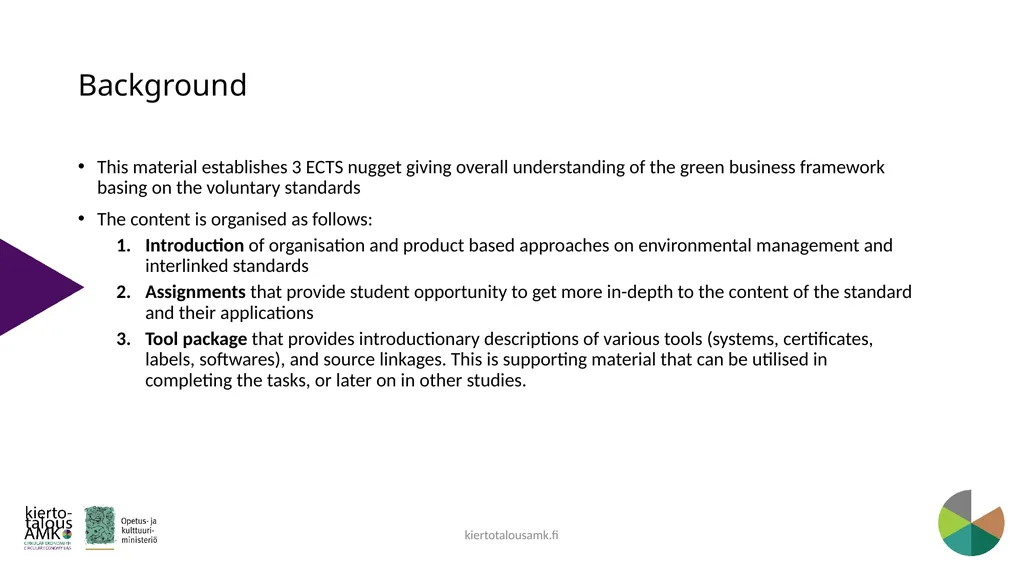
Background This material establishes 3 ECTS nugget giving overall understanding of the green business framework basing on the voluntary standards
The content is organised as follows:
Introduction of organisation and product based approaches on environmental management and interlinked standards
Assignments that provide student opportunity to get more in-depth to the content of the standard and their applications
Tool package that provides introductionary descriptions of various tools (systems, certificates, labels, softwares), and source linkages. This is supporting material that can be utilised in completing the tasks, or later on in other studies. kiertotalousamk.fi<br>
The content is organised as follows:
Introduction of organisation and product based approaches on environmental management and interlinked standards
Assignments that provide student opportunity to get more in-depth to the content of the standard and their applications
Tool package that provides introductionary descriptions of various tools (systems, certificates, labels, softwares), and source linkages. This is supporting material that can be utilised in completing the tasks, or later on in other studies. kiertotalousamk.fi<br>
04
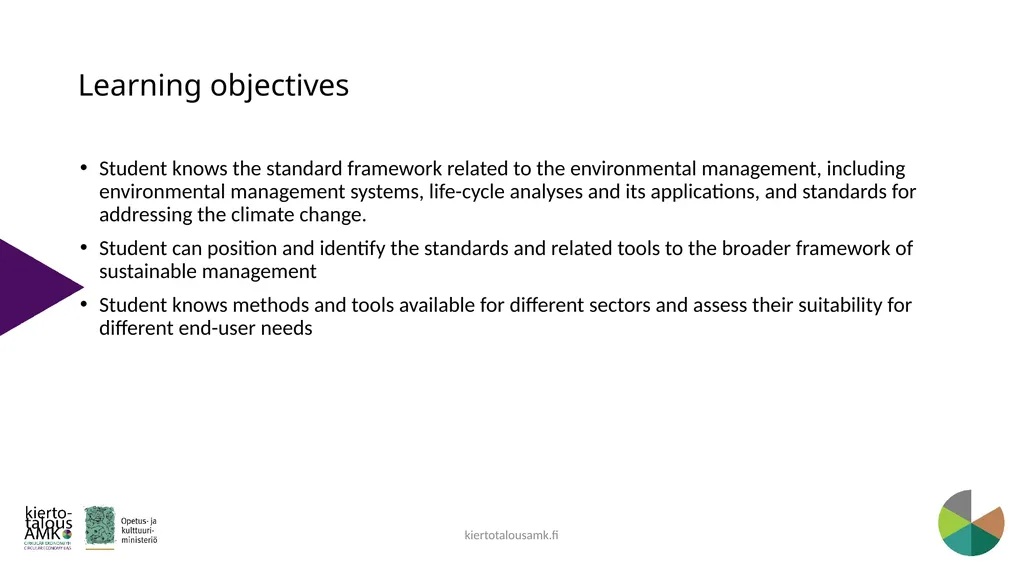
Learning objectives Student knows the standard framework related to the environmental management, including environmental management systems, life-cycle analyses and its applications, and standards for addressing the climate change.
Student can position and identify the standards and related tools to the broader framework of sustainable management
Student knows methods and tools available for different sectors and assess their suitability for different end-user needs kiertotalousamk.fi<br>
Student can position and identify the standards and related tools to the broader framework of sustainable management
Student knows methods and tools available for different sectors and assess their suitability for different end-user needs kiertotalousamk.fi<br>
05
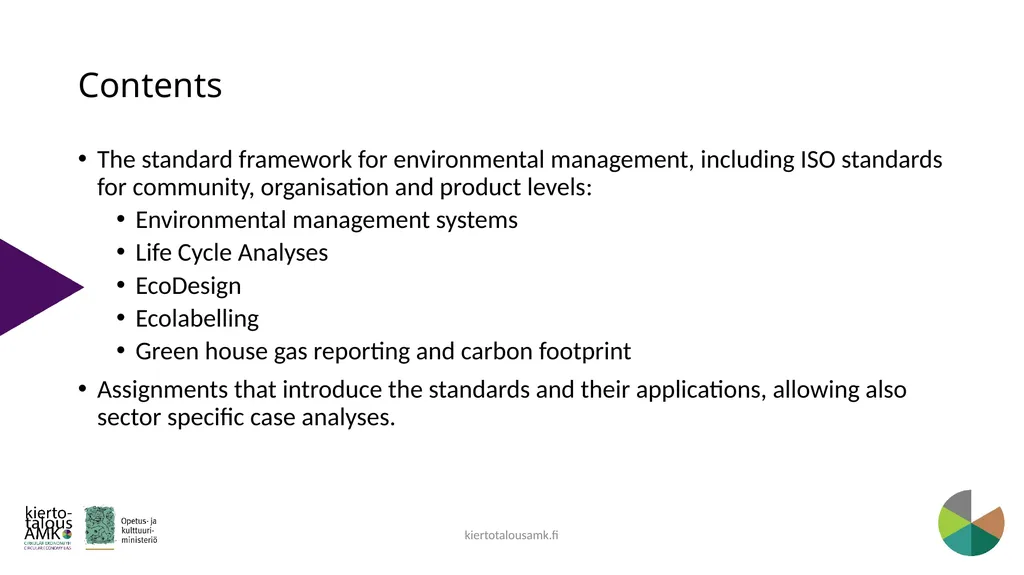
Contents The standard framework for environmental management, including ISO standards for community, organisation and product levels:
Environmental management systems
Life Cycle Analyses
EcoDesign
Ecolabelling
Green house gas reporting and carbon footprint
Assignments that introduce the standards and their applications, allowing also sector specific case analyses. kiertotalousamk.fi<br>
Environmental management systems
Life Cycle Analyses
EcoDesign
Ecolabelling
Green house gas reporting and carbon footprint
Assignments that introduce the standards and their applications, allowing also sector specific case analyses. kiertotalousamk.fi<br>
06
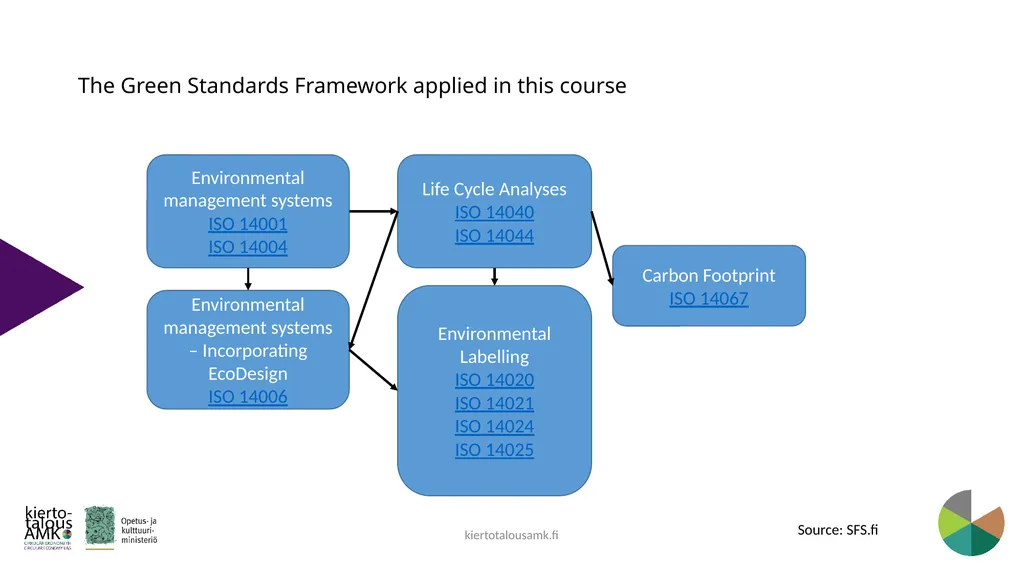
The Green Standards Framework applied in this course kiertotalousamk.fi Source: SFS.fi<br>
07
A. Organisational environmental management
A.1. Environmental Management Systems kiertotalousamk.fi<br>
08
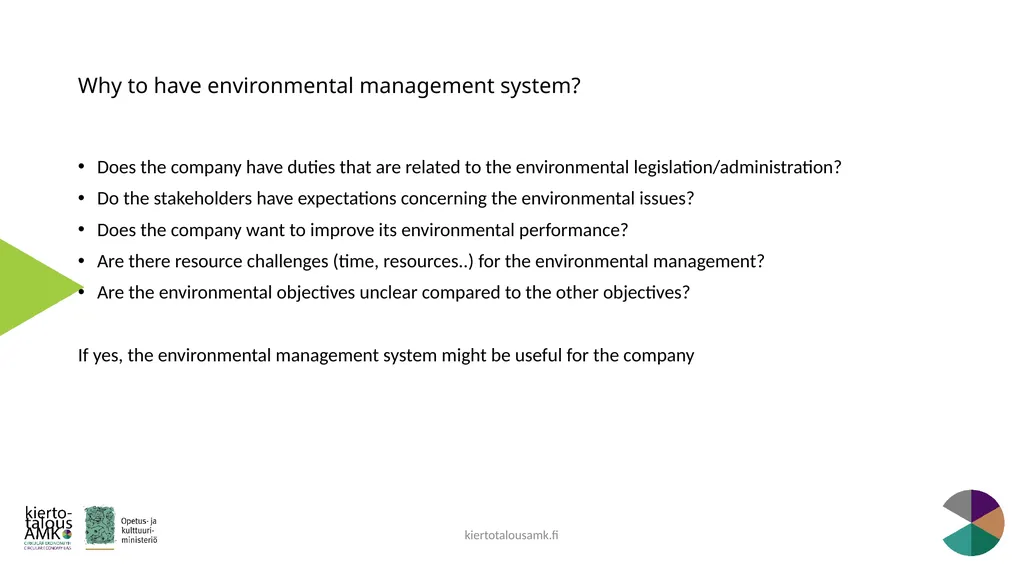
Why to have environmental management system? Does the company have duties that are related to the environmental legislation/administration?
Do the stakeholders have expectations concerning the environmental issues?
Does the company want to improve its environmental performance?
Are there resource challenges (time, resources..) for the environmental management?
Are the environmental objectives unclear compared to the other objectives?
If yes, the environmental management system might be useful for the company kiertotalousamk.fi<br>
Do the stakeholders have expectations concerning the environmental issues?
Does the company want to improve its environmental performance?
Are there resource challenges (time, resources..) for the environmental management?
Are the environmental objectives unclear compared to the other objectives?
If yes, the environmental management system might be useful for the company kiertotalousamk.fi<br>
09
Potential benefits of the environmental management system Better performance
Meeting the mandatory requirements
Preventing the pollution
Saving natural resources
New customers and markets
Better efficiency – cost efficiency, competitive advantage
Image toward stakeholders, such as investors, customers, partners
Improved consciousness
Better work safety
Other? kiertotalousamk.fi<br>
Meeting the mandatory requirements
Preventing the pollution
Saving natural resources
New customers and markets
Better efficiency – cost efficiency, competitive advantage
Image toward stakeholders, such as investors, customers, partners
Improved consciousness
Better work safety
Other? kiertotalousamk.fi<br>
10
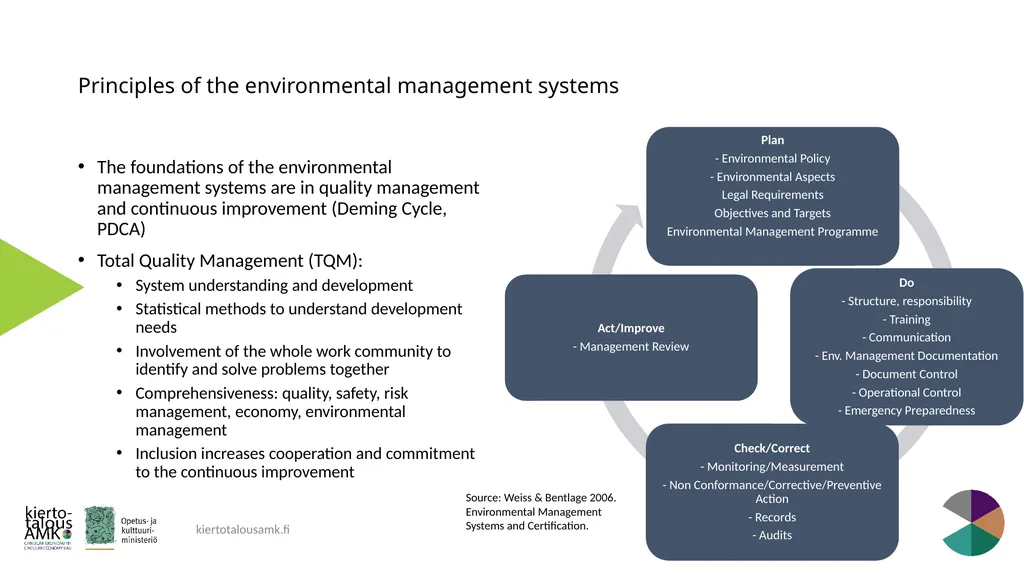
Principles of the environmental management systems The foundations of the environmental management systems are in quality management and continuous improvement (Deming Cycle, PDCA)
Total Quality Management (TQM):
System understanding and development
Statistical methods to understand development needs
Involvement of the whole work community to identify and solve problems together
Comprehensiveness: quality, safety, risk management, economy, environmental management
Inclusion increases cooperation and commitment to the continuous improvement kiertotalousamk.fi Source: Weiss & Bentlage 2006. Environmental Management Systems and Certification.<br>
Total Quality Management (TQM):
System understanding and development
Statistical methods to understand development needs
Involvement of the whole work community to identify and solve problems together
Comprehensiveness: quality, safety, risk management, economy, environmental management
Inclusion increases cooperation and commitment to the continuous improvement kiertotalousamk.fi Source: Weiss & Bentlage 2006. Environmental Management Systems and Certification.<br>
11
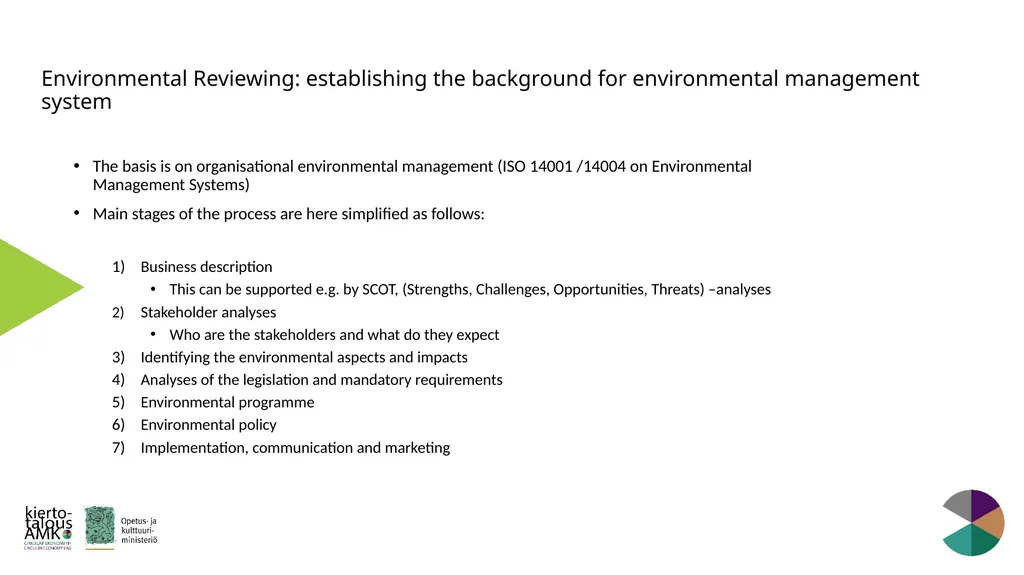
Environmental Reviewing: establishing the background for environmental management system The basis is on organisational environmental management (ISO 14001 /14004 on Environmental Management Systems)
Main stages of the process are here simplified as follows:
Business description
This can be supported e.g. by SCOT, (Strengths, Challenges, Opportunities, Threats) –analyses
Stakeholder analyses
Who are the stakeholders and what do they expect
Identifying the environmental aspects and impacts
Analyses of the legislation and mandatory requirements
Environmental programme
Environmental policy
Implementation, communication and marketing<br>
Main stages of the process are here simplified as follows:
Business description
This can be supported e.g. by SCOT, (Strengths, Challenges, Opportunities, Threats) –analyses
Stakeholder analyses
Who are the stakeholders and what do they expect
Identifying the environmental aspects and impacts
Analyses of the legislation and mandatory requirements
Environmental programme
Environmental policy
Implementation, communication and marketing<br>
12
Business description Business description – and current development phase
Products, services and processes
Any existing, or aspirations, for environmental management (systems, standards, labels, routines)
Understanding the business cases is essential for any further development activities<br>
Products, services and processes
Any existing, or aspirations, for environmental management (systems, standards, labels, routines)
Understanding the business cases is essential for any further development activities<br>
13
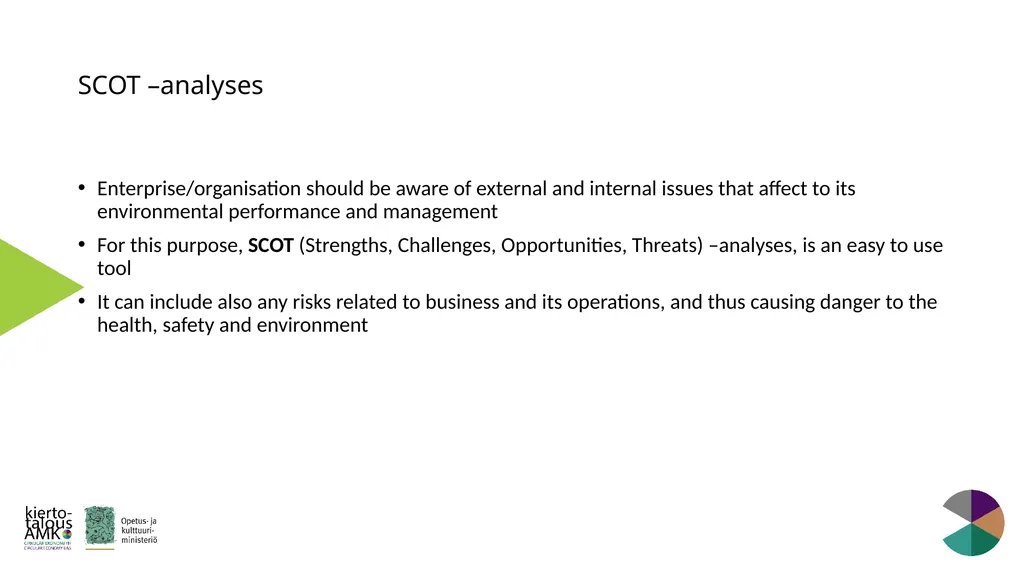
SCOT –analyses Enterprise/organisation should be aware of external and internal issues that affect to its environmental performance and management
For this purpose, SCOT (Strengths, Challenges, Opportunities, Threats) –analyses, is an easy to use tool
It can include also any risks related to business and its operations, and thus causing danger to the health, safety and environment<br>
For this purpose, SCOT (Strengths, Challenges, Opportunities, Threats) –analyses, is an easy to use tool
It can include also any risks related to business and its operations, and thus causing danger to the health, safety and environment<br>
14
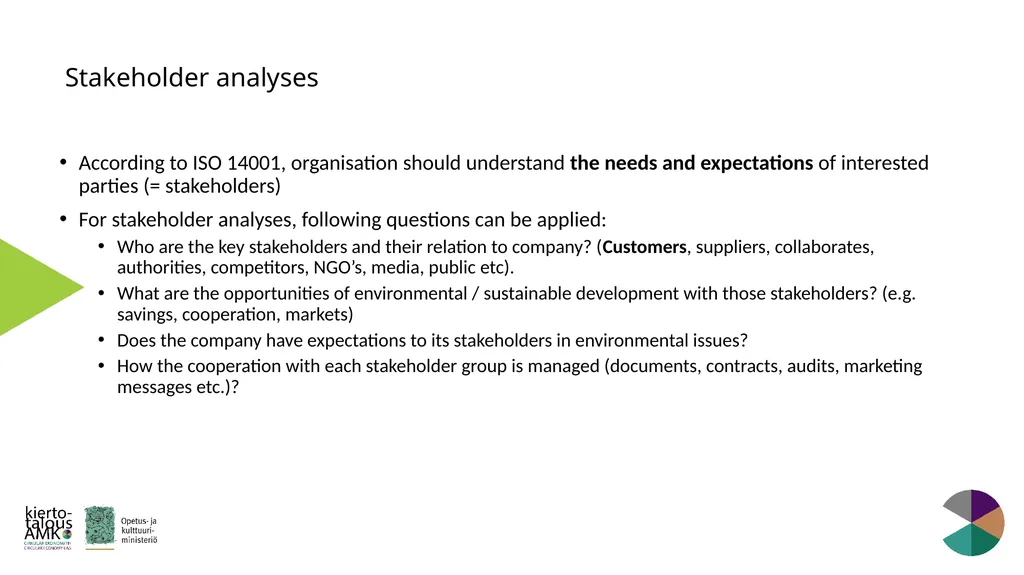
Stakeholder analyses According to ISO 14001, organisation should understand the needs and expectations of interested parties (= stakeholders)
For stakeholder analyses, following questions can be applied:
Who are the key stakeholders and their relation to company? (Customers, suppliers, collaborates, authorities, competitors, NGO’s, media, public etc).
What are the opportunities of environmental / sustainable development with those stakeholders? (e.g. savings, cooperation, markets)
Does the company have expectations to its stakeholders in environmental issues?
How the cooperation with each stakeholder group is managed (documents, contracts, audits, marketing messages etc.)?<br>
For stakeholder analyses, following questions can be applied:
Who are the key stakeholders and their relation to company? (Customers, suppliers, collaborates, authorities, competitors, NGO’s, media, public etc).
What are the opportunities of environmental / sustainable development with those stakeholders? (e.g. savings, cooperation, markets)
Does the company have expectations to its stakeholders in environmental issues?
How the cooperation with each stakeholder group is managed (documents, contracts, audits, marketing messages etc.)?<br>
15
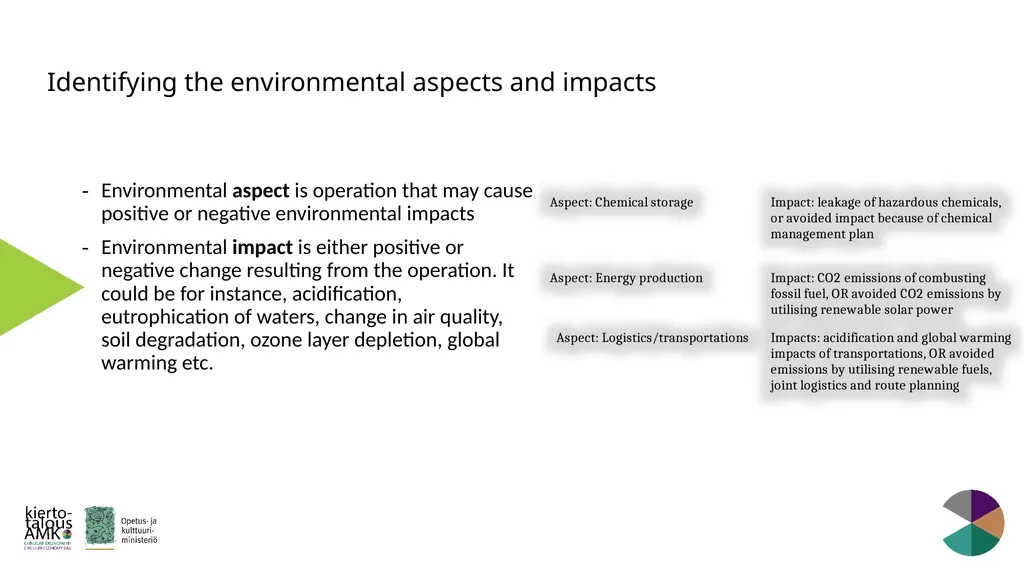
Identifying the environmental aspects and impacts Environmental aspect is operation that may cause positive or negative environmental impacts
Environmental impact is either positive or negative change resulting from the operation. It could be for instance, acidification, eutrophication of waters, change in air quality, soil degradation, ozone layer depletion, global warming etc.<br>
Environmental impact is either positive or negative change resulting from the operation. It could be for instance, acidification, eutrophication of waters, change in air quality, soil degradation, ozone layer depletion, global warming etc.<br>
16
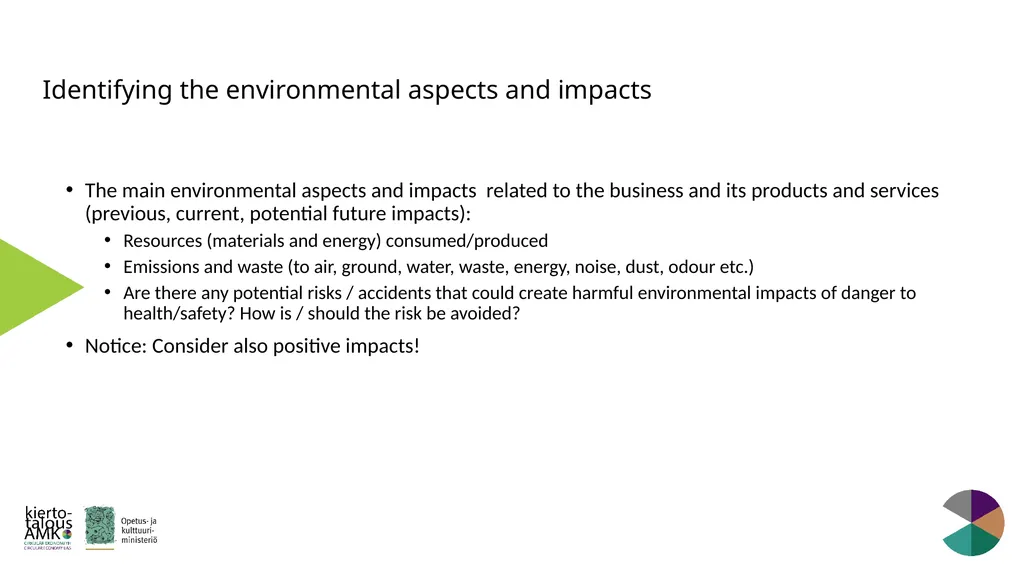
Identifying the environmental aspects and impacts The main environmental aspects and impacts related to the business and its products and services (previous, current, potential future impacts):
Resources (materials and energy) consumed/produced
Emissions and waste (to air, ground, water, waste, energy, noise, dust, odour etc.)
Are there any potential risks / accidents that could create harmful environmental impacts of danger to health/safety? How is / should the risk be avoided?
Notice: Consider also positive impacts!<br>
Resources (materials and energy) consumed/produced
Emissions and waste (to air, ground, water, waste, energy, noise, dust, odour etc.)
Are there any potential risks / accidents that could create harmful environmental impacts of danger to health/safety? How is / should the risk be avoided?
Notice: Consider also positive impacts!<br>
17
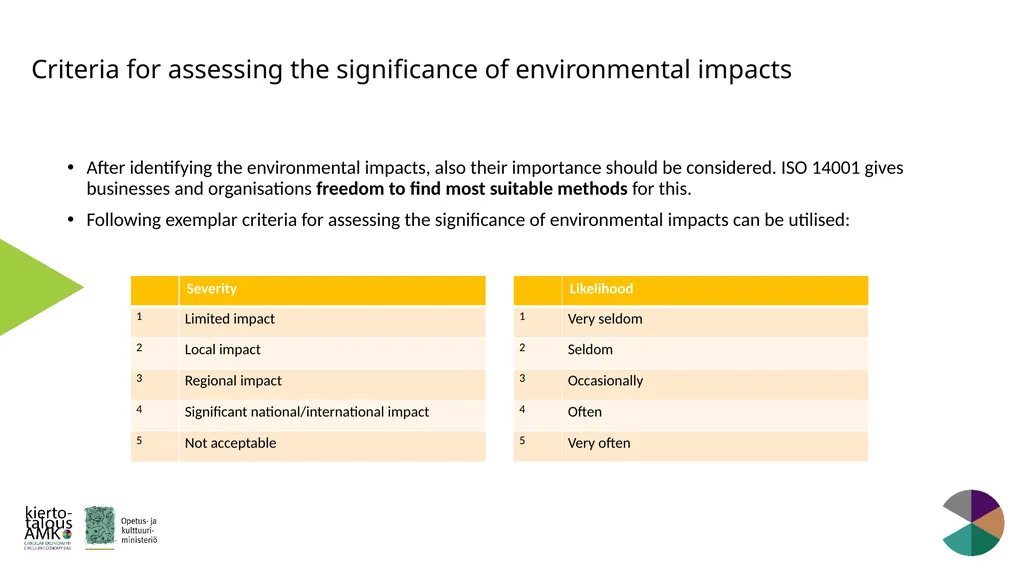
Criteria for assessing the significance of environmental impacts After identifying the environmental impacts, also their importance should be considered. ISO 14001 gives businesses and organisations freedom to find most suitable methods for this.
Following exemplar criteria for assessing the significance of environmental impacts can be utilised:<br>
Following exemplar criteria for assessing the significance of environmental impacts can be utilised:<br>
18
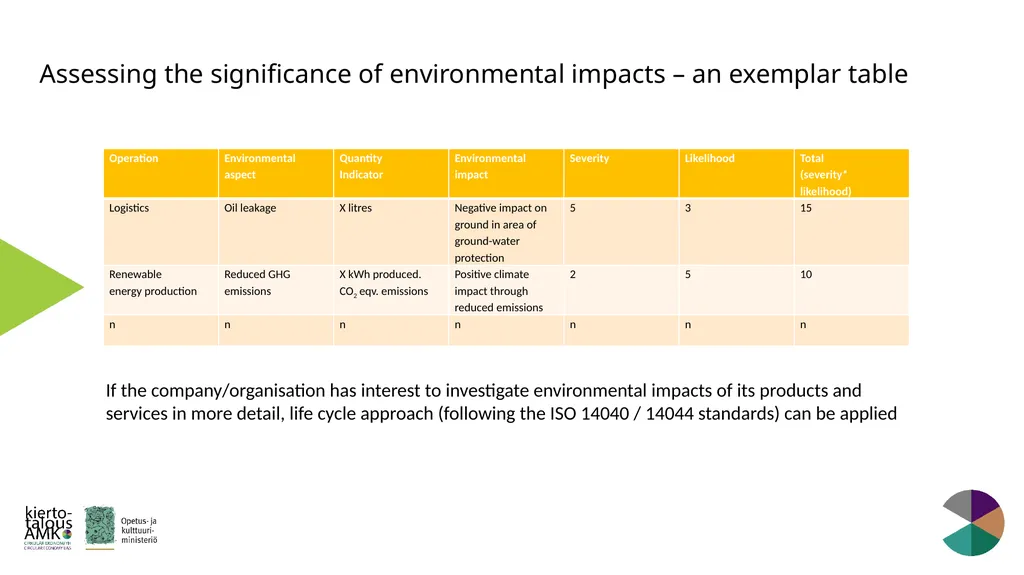
Assessing the significance of environmental impacts – an exemplar table If the company/organisation has interest to investigate environmental impacts of its products and services in more detail, life cycle approach (following the ISO 14040 / 14044 standards) can be applied<br>
19
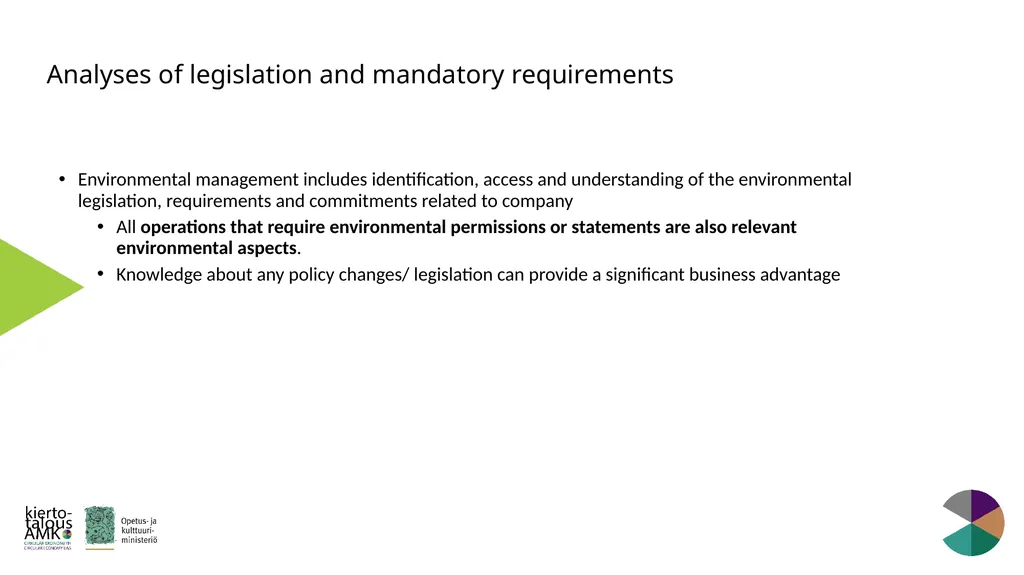
Analyses of legislation and mandatory requirements Environmental management includes identification, access and understanding of the environmental legislation, requirements and commitments related to company
All operations that require environmental permissions or statements are also relevant environmental aspects.
Knowledge about any policy changes/ legislation can provide a significant business advantage<br>
All operations that require environmental permissions or statements are also relevant environmental aspects.
Knowledge about any policy changes/ legislation can provide a significant business advantage<br>
20
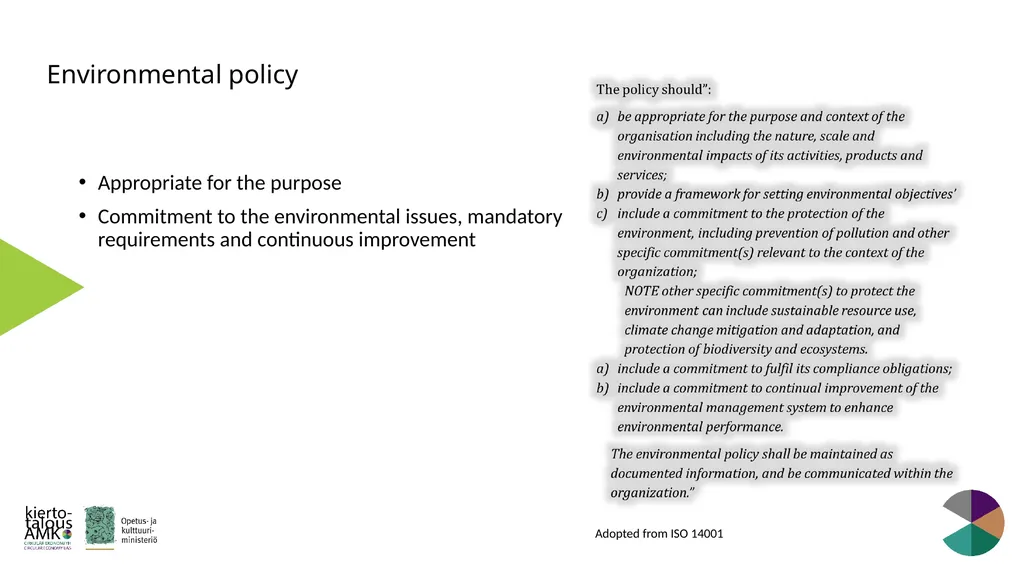
Environmental policy Appropriate for the purpose
Commitment to the environmental issues, mandatory requirements and continuous improvement Adopted from ISO 14001<br>
Commitment to the environmental issues, mandatory requirements and continuous improvement Adopted from ISO 14001<br>
21
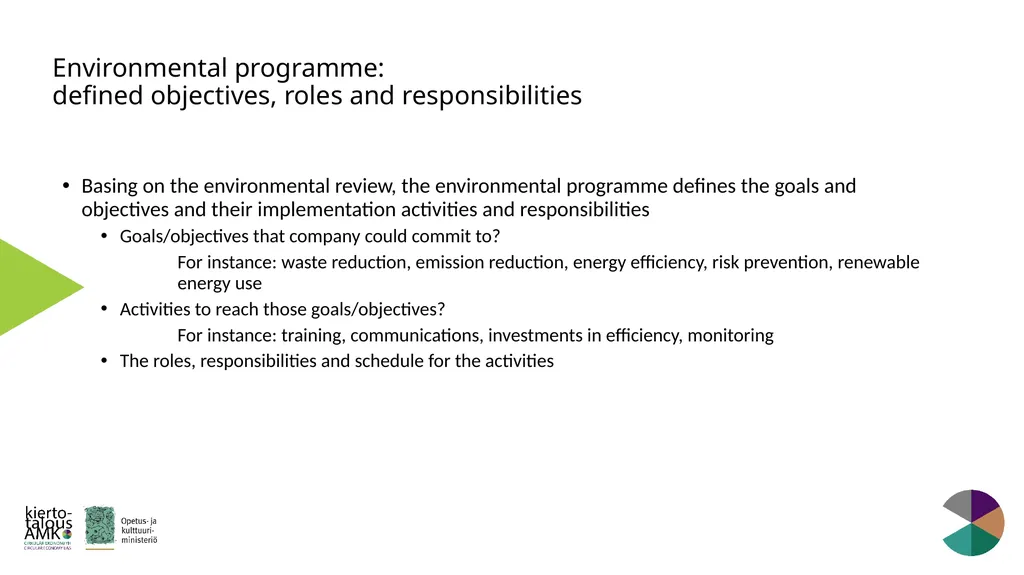
Environmental programme:
defined objectives, roles and responsibilities Basing on the environmental review, the environmental programme defines the goals and objectives and their implementation activities and responsibilities
Goals/objectives that company could commit to?
For instance: waste reduction, emission reduction, energy efficiency, risk prevention, renewable energy use
Activities to reach those goals/objectives?
For instance: training, communications, investments in efficiency, monitoring
The roles, responsibilities and schedule for the activities<br>
Goals/objectives that company could commit to?
For instance: waste reduction, emission reduction, energy efficiency, risk prevention, renewable energy use
Activities to reach those goals/objectives?
For instance: training, communications, investments in efficiency, monitoring
The roles, responsibilities and schedule for the activities<br>
22
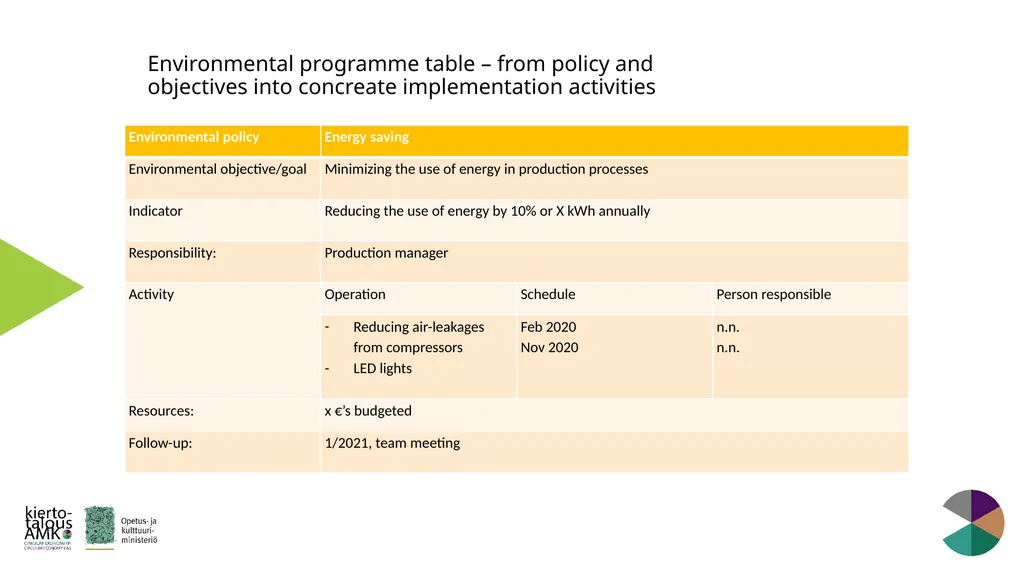
Environmental programme table – from policy and objectives into concreate implementation activities<br>
23
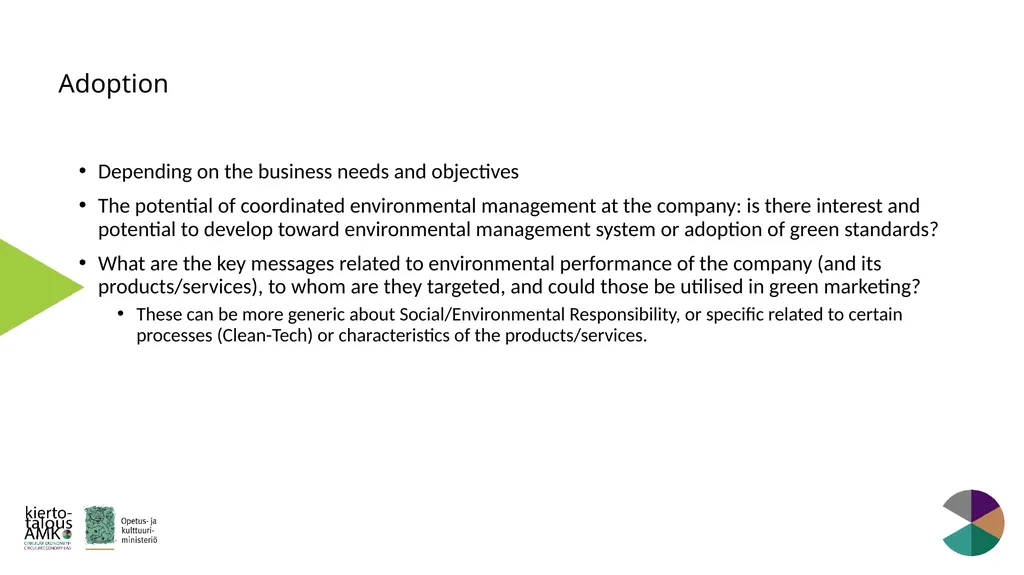
Adoption Depending on the business needs and objectives
The potential of coordinated environmental management at the company: is there interest and potential to develop toward environmental management system or adoption of green standards?
What are the key messages related to environmental performance of the company (and its products/services), to whom are they targeted, and could those be utilised in green marketing?
These can be more generic about Social/Environmental Responsibility, or specific related to certain processes (Clean-Tech) or characteristics of the products/services.<br>
The potential of coordinated environmental management at the company: is there interest and potential to develop toward environmental management system or adoption of green standards?
What are the key messages related to environmental performance of the company (and its products/services), to whom are they targeted, and could those be utilised in green marketing?
These can be more generic about Social/Environmental Responsibility, or specific related to certain processes (Clean-Tech) or characteristics of the products/services.<br>
24
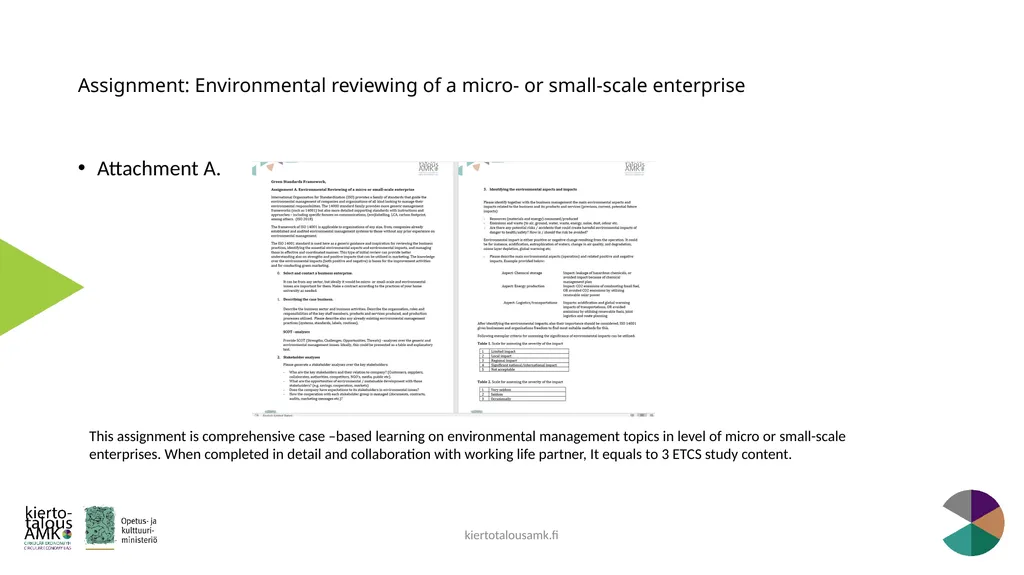
Assignment: Environmental reviewing of a micro- or small-scale enterprise Attachment A. kiertotalousamk.fi This assignment is comprehensive case –based learning on environmental management topics in level of micro or small-scale enterprises. When completed in detail and collaboration with working life partner, It equals to 3 ETCS study content.<br>
25
B. Product-based approaches to environmental management
B.1. EcoDesign kiertotalousamk.fi<br>
26
Product–based approaches Companies can strive toward environmentally better development by improving their organisational environmental management, but also by developing production processes, products and services.
Eco-design and design for the environment (Brezet &Van Hamel 1997) refer to the strategies on how to develop more sustainable products and services. The focus is at holistic development of the new concepts with less environmental burden.
For the product -based approaches life cycle method and tools are applicable.
LCA theory and method provide opportunities to investigate the life-cycle impacts of products, services, and processes. In addition, associated products (consumables), and other consumption during the lifetime should be identified and its impact modelled.
Ecolabelling applies LCA methods in systematic manner to verify and communicate environmental impacts of the products and services
In this section, we introduce these approaches and standards providing guidance for their adoption in practice. kiertotalousamk.fi<br>
Eco-design and design for the environment (Brezet &Van Hamel 1997) refer to the strategies on how to develop more sustainable products and services. The focus is at holistic development of the new concepts with less environmental burden.
For the product -based approaches life cycle method and tools are applicable.
LCA theory and method provide opportunities to investigate the life-cycle impacts of products, services, and processes. In addition, associated products (consumables), and other consumption during the lifetime should be identified and its impact modelled.
Ecolabelling applies LCA methods in systematic manner to verify and communicate environmental impacts of the products and services
In this section, we introduce these approaches and standards providing guidance for their adoption in practice. kiertotalousamk.fi<br>
27
EcoDesign strategies EcoDesign strategies (Brezet & Van Hamel 1997) detail approaches for improving the sustainability of both products and services in systematic manner, including:
Product component level
Product structure level
Product systems level, and
Innovation of new more sustainable concepts
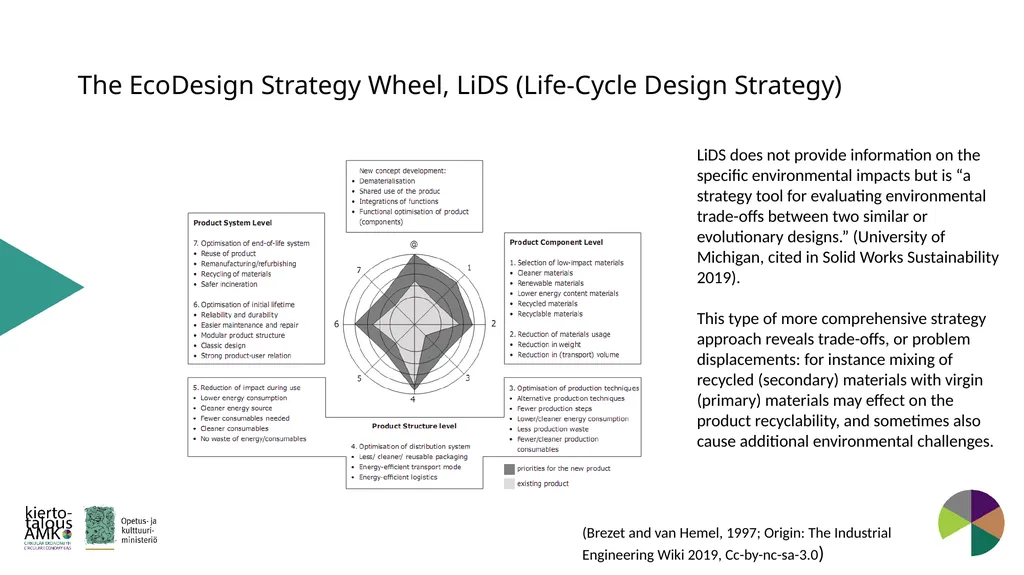
EcoDesign strategies can be analysed and developed by applying the EcoDesign Strategy wheel, called also as LiDS (Life Cycle Design Strategy) wheel. It can be applied together with the EcoDesign Checklist. kiertotalousamk.fi<br>
Product component level
Product structure level
Product systems level, and
Innovation of new more sustainable concepts
EcoDesign strategies can be analysed and developed by applying the EcoDesign Strategy wheel, called also as LiDS (Life Cycle Design Strategy) wheel. It can be applied together with the EcoDesign Checklist. kiertotalousamk.fi<br>
28
The EcoDesign Strategy Wheel, LiDS (Life-Cycle Design Strategy) (Brezet and van Hemel, 1997; Origin: The Industrial Engineering Wiki 2019, Cc-by-nc-sa-3.0) LiDS does not provide information on the specific environmental impacts but is “a strategy tool for evaluating environmental trade-offs between two similar or evolutionary designs.” (University of Michigan, cited in Solid Works Sustainability 2019).
This type of more comprehensive strategy approach reveals trade-offs, or problem displacements: for instance mixing of recycled (secondary) materials with virgin (primary) materials may effect on the product recyclability, and sometimes also cause additional environmental challenges.<br>
This type of more comprehensive strategy approach reveals trade-offs, or problem displacements: for instance mixing of recycled (secondary) materials with virgin (primary) materials may effect on the product recyclability, and sometimes also cause additional environmental challenges.<br>
29
EcoDesign strategies Product component level:
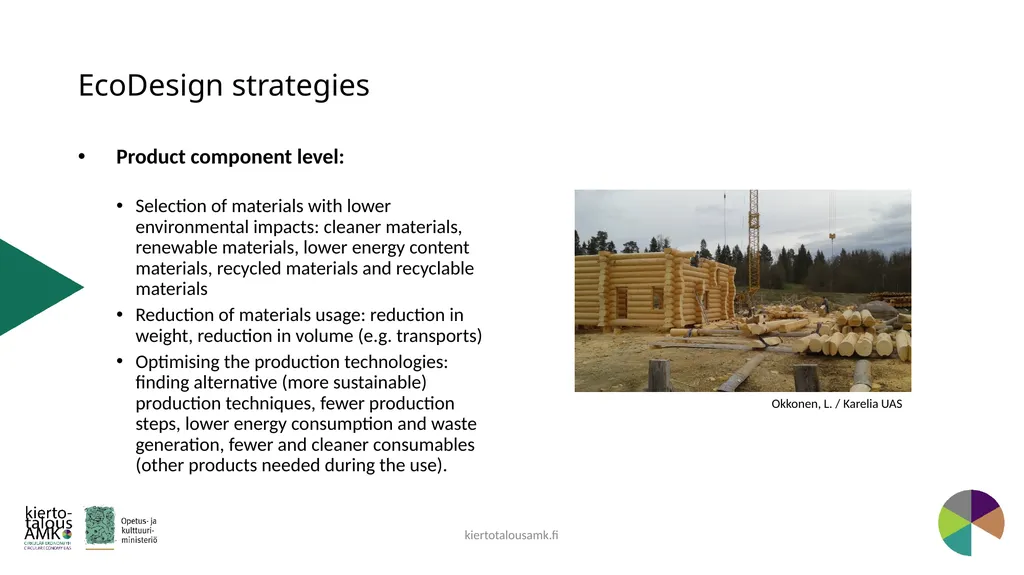
Selection of materials with lower environmental impacts: cleaner materials, renewable materials, lower energy content materials, recycled materials and recyclable materials
Reduction of materials usage: reduction in weight, reduction in volume (e.g. transports)
Optimising the production technologies: finding alternative (more sustainable) production techniques, fewer production steps, lower energy consumption and waste generation, fewer and cleaner consumables (other products needed during the use). kiertotalousamk.fi Okkonen, L. / Karelia UAS<br>
Selection of materials with lower environmental impacts: cleaner materials, renewable materials, lower energy content materials, recycled materials and recyclable materials
Reduction of materials usage: reduction in weight, reduction in volume (e.g. transports)
Optimising the production technologies: finding alternative (more sustainable) production techniques, fewer production steps, lower energy consumption and waste generation, fewer and cleaner consumables (other products needed during the use). kiertotalousamk.fi Okkonen, L. / Karelia UAS<br>
30
EcoDesign strategies Product structure level:
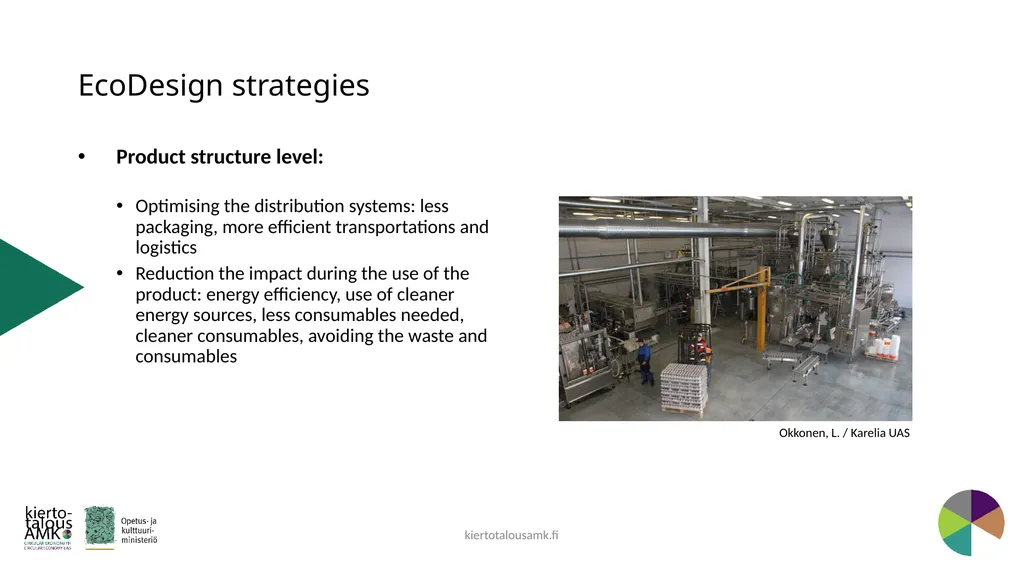
Optimising the distribution systems: less packaging, more efficient transportations and logistics
Reduction the impact during the use of the product: energy efficiency, use of cleaner energy sources, less consumables needed, cleaner consumables, avoiding the waste and consumables kiertotalousamk.fi Okkonen, L. / Karelia UAS<br>
Optimising the distribution systems: less packaging, more efficient transportations and logistics
Reduction the impact during the use of the product: energy efficiency, use of cleaner energy sources, less consumables needed, cleaner consumables, avoiding the waste and consumables kiertotalousamk.fi Okkonen, L. / Karelia UAS<br>
31
EcoDesign strategies Product systems level:
Optimising the initial lifetime of the product: production of reliable and durable products, improving the product maintenance and repair, modular product structures, classic (attractive) designs, and creation of stronger product-user relations
Do you have a product that you find a classic design, attractive and with you have strong product-user relation? That product might have longer life-time, and cause less environmental burden, compared to other products.
Optimising end-of-life systems: product reuse, remanufacturing/refurbishing, material recycling, utilisation as energy through incineration kiertotalousamk.fi<br>
Optimising the initial lifetime of the product: production of reliable and durable products, improving the product maintenance and repair, modular product structures, classic (attractive) designs, and creation of stronger product-user relations
Do you have a product that you find a classic design, attractive and with you have strong product-user relation? That product might have longer life-time, and cause less environmental burden, compared to other products.
Optimising end-of-life systems: product reuse, remanufacturing/refurbishing, material recycling, utilisation as energy through incineration kiertotalousamk.fi<br>
32
EcoDesign policy and legislation The European Union has established a set of rules and requirements for energy labelling and the EcoDesign
In content, the focus is especially on energy-related products
The main policy/legislation documents are:
EU's Energy Labelling framework Regulation (EU)2017/1369)
EU's Ecodesign Directive (2009/125/EC)
EU's Ecodesign Working Plan 2016-2019 (COM/2016/0773)
The energy-efficient products regulation includes both energy labelling and ecolabelling legislation
This is established for 26 product groups. See the product groups and legislations here.
In addition, there are voluntary agreements for other product categories kiertotalousamk.fi<br>
In content, the focus is especially on energy-related products
The main policy/legislation documents are:
EU's Energy Labelling framework Regulation (EU)2017/1369)
EU's Ecodesign Directive (2009/125/EC)
EU's Ecodesign Working Plan 2016-2019 (COM/2016/0773)
The energy-efficient products regulation includes both energy labelling and ecolabelling legislation
This is established for 26 product groups. See the product groups and legislations here.
In addition, there are voluntary agreements for other product categories kiertotalousamk.fi<br>
33
Assignment: Choose one tangible product from the industry sector you find interesting
Get familiar with the product and processes along its life cycle
Please analyse the environmental strengths and challenges related to the product by using the Ecodesign strategy questions (EcoDesign checklist). Provide a one-page summary of your analyses.
You may also visualise your findings as indicative LiDS Wheel or other graphic presentation. kiertotalousamk.fi<br>
Get familiar with the product and processes along its life cycle
Please analyse the environmental strengths and challenges related to the product by using the Ecodesign strategy questions (EcoDesign checklist). Provide a one-page summary of your analyses.
You may also visualise your findings as indicative LiDS Wheel or other graphic presentation. kiertotalousamk.fi<br>
34
B. Product-based approaches to environmnetal management
B.2. Life-Cycle Analyses kiertotalousamk.fi<br>
35
Life Cycle Analyses – A method for ecological product/service development The life cycle analysis or LCA is an approach to estimate the environmental impact of a product or service throughout its lifecycle
Both products and services can have severe, and surprising, environmental impacts
In LCA environmental impacts are identified and analyzed from ”cradle to grave” or “cradle-to-cradle”, covering the whole production chain
Identification of environmental impacts
Re-designing products and services to decrease their negative impacts
Can be made in different levels of detail, e.g. a screening analyses points the direction where to analyze in more detail
Allows comparisons
Requires cooperation along the production chain (often complex networks hard to trace) kiertotalousamk.fi<br>
Both products and services can have severe, and surprising, environmental impacts
In LCA environmental impacts are identified and analyzed from ”cradle to grave” or “cradle-to-cradle”, covering the whole production chain
Identification of environmental impacts
Re-designing products and services to decrease their negative impacts
Can be made in different levels of detail, e.g. a screening analyses points the direction where to analyze in more detail
Allows comparisons
Requires cooperation along the production chain (often complex networks hard to trace) kiertotalousamk.fi<br>
36
Life Cycle Analyses – A method for ecological product/service development Life cycle approach has gained increased role in green design and marketing as it enables identifying different types of environmental impacts of the products and services, and also establish metrics for the overall impacts.
The analyses are guided through ISO standards 14040 (principles and framework) and 14044 (requirements and guidelines).
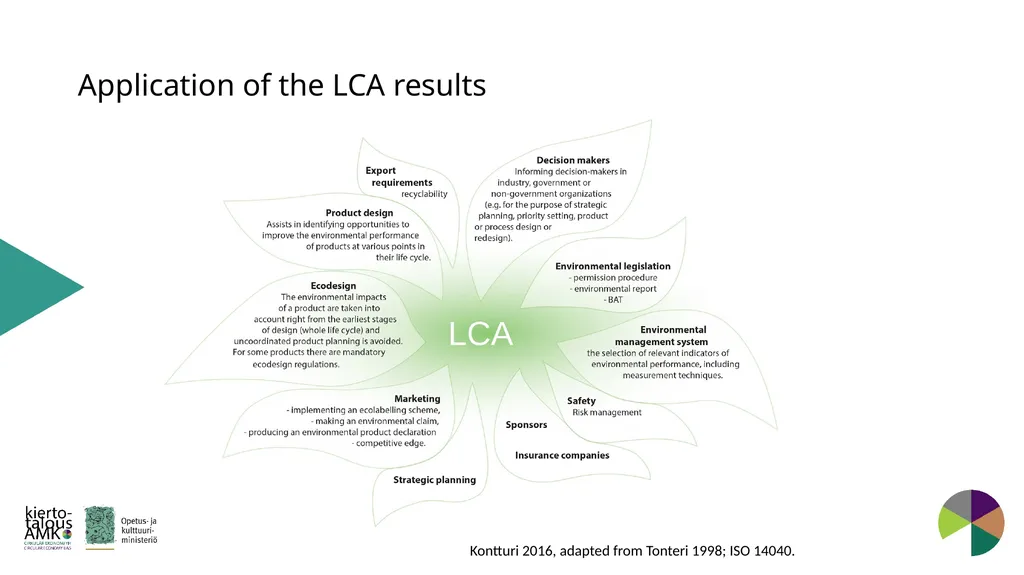
The analyses can be utilised for instance for applying ecolabels, environmental product declarations, environmental management systems or in development of strategies / green marketing
The main steps of the analyses are as follows (ISO 14040):
Defining the goal and scope
Life Cycle Inventory (LCI)
Life Cycle Impact Analyses
Interpretation kiertotalousamk.fi<br>
The analyses are guided through ISO standards 14040 (principles and framework) and 14044 (requirements and guidelines).
The analyses can be utilised for instance for applying ecolabels, environmental product declarations, environmental management systems or in development of strategies / green marketing
The main steps of the analyses are as follows (ISO 14040):
Defining the goal and scope
Life Cycle Inventory (LCI)
Life Cycle Impact Analyses
Interpretation kiertotalousamk.fi<br>
37
The life-cycle analyses typically have following steps (ISO 14040) Defining the goal and scope:
Including the functional unit of analyses (e.g. product with certain dimensions and defined use), target audience and objectives of the study.
This definition includes also system boundaries, i.e. what is included/excluded from the analyses. The approach varies depending on the objectives.
Life Cycle Inventory (LCI):
Including detailed inventory of the input and outputs (e.g. materials, production processes, transportations, use of fuel and other energy, and waste and emission outputs). The resulting inventory table provides data for the further analyses of the impacts. kiertotalousamk.fi<br>
Including the functional unit of analyses (e.g. product with certain dimensions and defined use), target audience and objectives of the study.
This definition includes also system boundaries, i.e. what is included/excluded from the analyses. The approach varies depending on the objectives.
Life Cycle Inventory (LCI):
Including detailed inventory of the input and outputs (e.g. materials, production processes, transportations, use of fuel and other energy, and waste and emission outputs). The resulting inventory table provides data for the further analyses of the impacts. kiertotalousamk.fi<br>
38
The life-cycle analyses typically have following steps (ISO 14040) Life Cycle Impact Analyses (LCIA):
Utilises data from the inventory to analyse environmental impacts related to the product life cycle. Through the steps of classification, categorisation, normalisation and weighting, it is possible to establish end-point impact analyses, where different types of environmental impacts are compared and single impact end-point metric is established.
Alternatively, mid-point methods can be applied without normalisation and weighting of the impacts, which results in single indicators, such as climate impact or eutrophication impact.
As the LCA is an approach with several optional methods for different purposes, it is important to defined the objectives and choose the methodology accordingly.
Interpretation of the results:
In this stage the results of the analyses are utilised to make conclusions and recommendations over the results (depending on the goal and scope). This phase includes also analyses of result reliability/sensitivity kiertotalousamk.fi<br>
Utilises data from the inventory to analyse environmental impacts related to the product life cycle. Through the steps of classification, categorisation, normalisation and weighting, it is possible to establish end-point impact analyses, where different types of environmental impacts are compared and single impact end-point metric is established.
Alternatively, mid-point methods can be applied without normalisation and weighting of the impacts, which results in single indicators, such as climate impact or eutrophication impact.
As the LCA is an approach with several optional methods for different purposes, it is important to defined the objectives and choose the methodology accordingly.
Interpretation of the results:
In this stage the results of the analyses are utilised to make conclusions and recommendations over the results (depending on the goal and scope). This phase includes also analyses of result reliability/sensitivity kiertotalousamk.fi<br>
39
Application of the LCA results Kontturi 2016, adapted from Tonteri 1998; ISO 14040.<br>
40
Assignment: Getting familiar with the LCA Standard (ISO 14040) Getting familiar with LCA standard
Upload the licenced standards (SFS-EN ISO 14040 and SFS-EN ISO 14044 ) via your university e-library services. Remember to follow the licence terms and not to distribute the standards in any other use. Establish full-text answers to following questions. Please avoid repeating the standard text but use your own text to describe the content.
What are the key characteristics of life cycle assessment?
For which purposes you can use LCA?
What does goal and scope definition mean in LCA?
Define life cycle inventory analyses and life cycle impact assessment
Present shortly reporting and critical evaluation of the LCA kiertotalousamk.fi<br>
Upload the licenced standards (SFS-EN ISO 14040 and SFS-EN ISO 14044 ) via your university e-library services. Remember to follow the licence terms and not to distribute the standards in any other use. Establish full-text answers to following questions. Please avoid repeating the standard text but use your own text to describe the content.
What are the key characteristics of life cycle assessment?
For which purposes you can use LCA?
What does goal and scope definition mean in LCA?
Define life cycle inventory analyses and life cycle impact assessment
Present shortly reporting and critical evaluation of the LCA kiertotalousamk.fi<br>
41
Assignment: Getting familiar with the LCA studies Getting familiar with the LCA studies
Find a study report applying the LCA methods. You might use e.g. Google Scholar or your organisation e-library/databases. Select a study you find interesting or close to your own field.
Find out what has been the goal and scope of the study. What has been the functional unit of the analyses, e.g. a certain product, component, amount of product/a, hour of service..
How has the product system defined? What has been included / excluded from the analyses and why?
What kind of inventory data has been collected for the analyses? Inventory data can include e.g. raw materials, energy consumptions, emissions (to water, ground and atmosphere), needed other processes (transportations) and other products.
What kind of impacts have been analysed and by which methods? Do these present overall environmental impacts of some specific environmental impact?
How have the results being interpreted? Do you agree / disagree with the main findings of the study. kiertotalousamk.fi<br>
Find a study report applying the LCA methods. You might use e.g. Google Scholar or your organisation e-library/databases. Select a study you find interesting or close to your own field.
Find out what has been the goal and scope of the study. What has been the functional unit of the analyses, e.g. a certain product, component, amount of product/a, hour of service..
How has the product system defined? What has been included / excluded from the analyses and why?
What kind of inventory data has been collected for the analyses? Inventory data can include e.g. raw materials, energy consumptions, emissions (to water, ground and atmosphere), needed other processes (transportations) and other products.
What kind of impacts have been analysed and by which methods? Do these present overall environmental impacts of some specific environmental impact?
How have the results being interpreted? Do you agree / disagree with the main findings of the study. kiertotalousamk.fi<br>
42
B. Product-based approaches to environmental management
B.3. Environmental Labelling kiertotalousamk.fi<br>
43
Why ecolabelling? General concern about the environmental impacts
It was realised that this concern can be translated into a market advantage for certain products number of labels and environmental claims emerged: there are over 3000 different types of labels
Products are often described as ”recyclable”, ”eco-friendly”, ”green”, ”low-energy”, ”recycled content”
There is evident need to have established criteria and system for providing ecolabels<br>
It was realised that this concern can be translated into a market advantage for certain products number of labels and environmental claims emerged: there are over 3000 different types of labels
Products are often described as ”recyclable”, ”eco-friendly”, ”green”, ”low-energy”, ”recycled content”
There is evident need to have established criteria and system for providing ecolabels<br>
44
Why environmental labelling? Labelling attracts consumers with environmental awareness
Labelling also confused as there many labels and declarations
Have you been confused with different labels? Please give an example.
Without reliable and verified practices consumers could be mislead there has been need to standardise the practices and requirements
This need of credibility and impartiality led to establishment of both public and private organisations that provide third-party (external) labelling services
These services take place as national and multinational programmes / schemes that award ecolabels<br>
Labelling also confused as there many labels and declarations
Have you been confused with different labels? Please give an example.
Without reliable and verified practices consumers could be mislead there has been need to standardise the practices and requirements
This need of credibility and impartiality led to establishment of both public and private organisations that provide third-party (external) labelling services
These services take place as national and multinational programmes / schemes that award ecolabels<br>
45
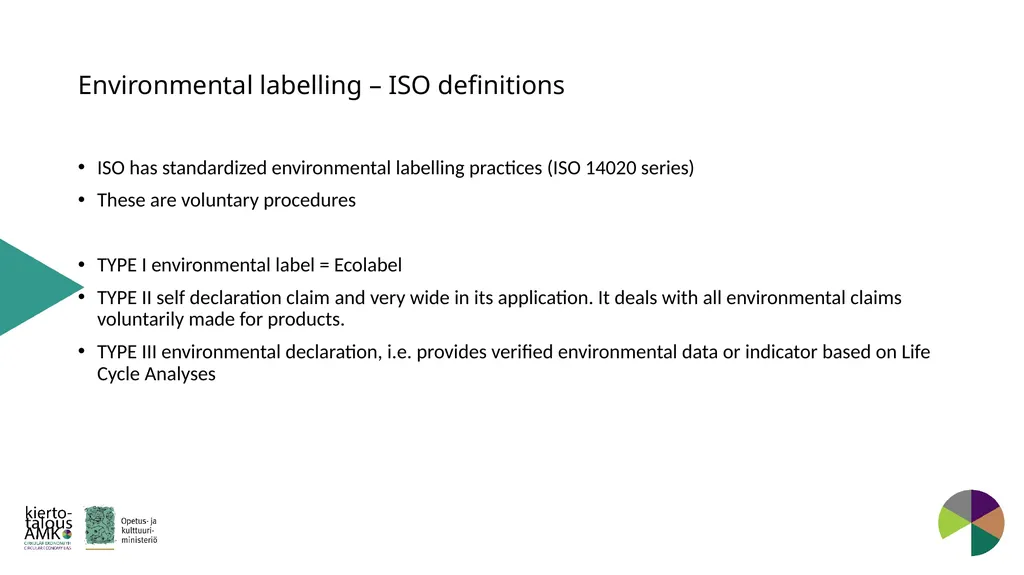
Environmental labelling – ISO definitions ISO has standardized environmental labelling practices (ISO 14020 series)
These are voluntary procedures
TYPE I environmental label = Ecolabel
TYPE II self declaration claim and very wide in its application. It deals with all environmental claims voluntarily made for products.
TYPE III environmental declaration, i.e. provides verified environmental data or indicator based on Life Cycle Analyses<br>
These are voluntary procedures
TYPE I environmental label = Ecolabel
TYPE II self declaration claim and very wide in its application. It deals with all environmental claims voluntarily made for products.
TYPE III environmental declaration, i.e. provides verified environmental data or indicator based on Life Cycle Analyses<br>
46
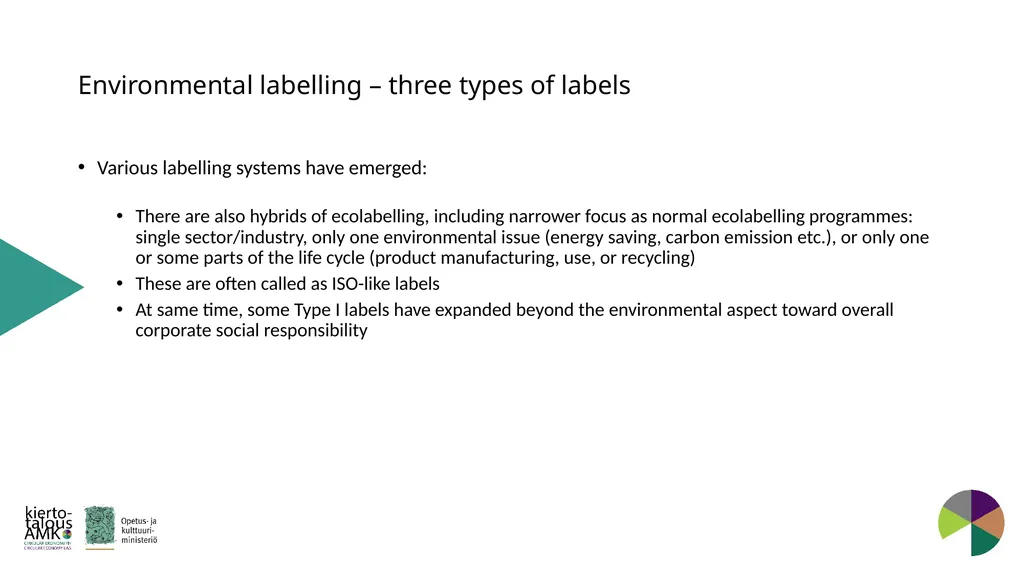
Environmental labelling – three types of labels Various labelling systems have emerged:
There are also hybrids of ecolabelling, including narrower focus as normal ecolabelling programmes: single sector/industry, only one environmental issue (energy saving, carbon emission etc.), or only one or some parts of the life cycle (product manufacturing, use, or recycling)
These are often called as ISO-like labels
At same time, some Type I labels have expanded beyond the environmental aspect toward overall corporate social responsibility<br>
There are also hybrids of ecolabelling, including narrower focus as normal ecolabelling programmes: single sector/industry, only one environmental issue (energy saving, carbon emission etc.), or only one or some parts of the life cycle (product manufacturing, use, or recycling)
These are often called as ISO-like labels
At same time, some Type I labels have expanded beyond the environmental aspect toward overall corporate social responsibility<br>
47
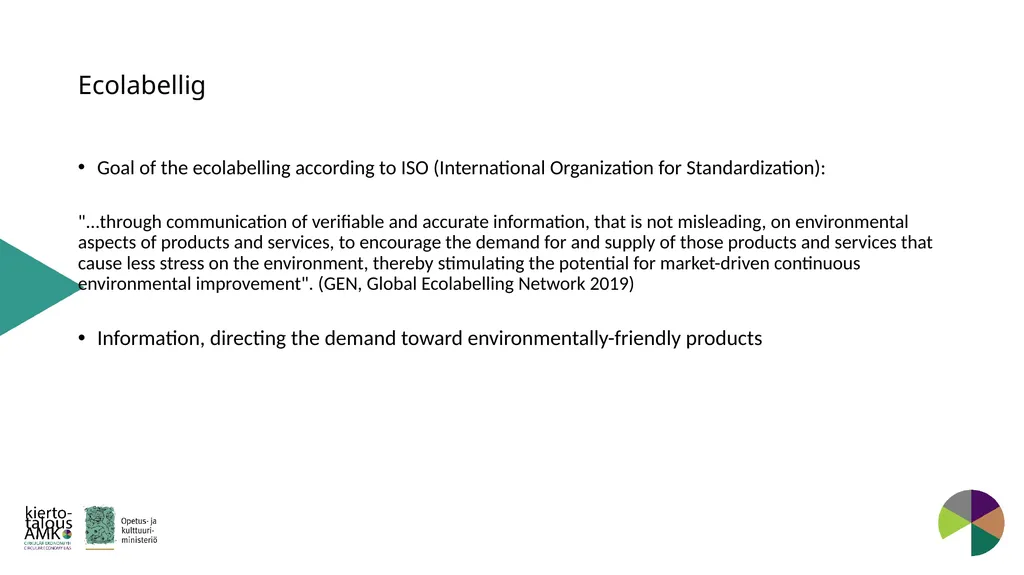
Ecolabellig Goal of the ecolabelling according to ISO (International Organization for Standardization):
"...through communication of verifiable and accurate information, that is not misleading, on environmental aspects of products and services, to encourage the demand for and supply of those products and services that cause less stress on the environment, thereby stimulating the potential for market-driven continuous environmental improvement". (GEN, Global Ecolabelling Network 2019)
Information, directing the demand toward environmentally-friendly products<br>
"...through communication of verifiable and accurate information, that is not misleading, on environmental aspects of products and services, to encourage the demand for and supply of those products and services that cause less stress on the environment, thereby stimulating the potential for market-driven continuous environmental improvement". (GEN, Global Ecolabelling Network 2019)
Information, directing the demand toward environmentally-friendly products<br>
48
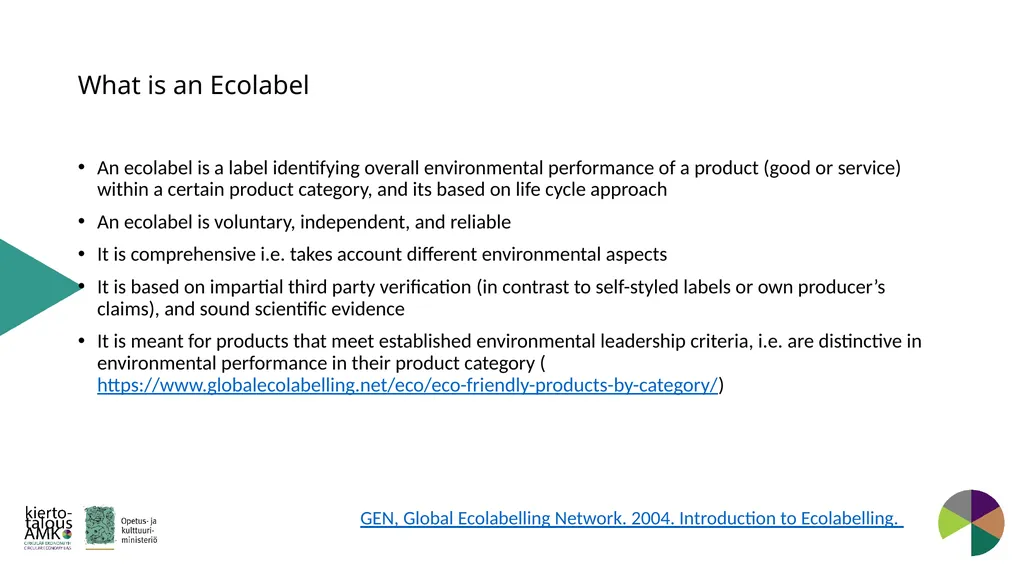
What is an Ecolabel An ecolabel is a label identifying overall environmental performance of a product (good or service) within a certain product category, and its based on life cycle approach
An ecolabel is voluntary, independent, and reliable
It is comprehensive i.e. takes account different environmental aspects
It is based on impartial third party verification (in contrast to self-styled labels or own producer’s claims), and sound scientific evidence
It is meant for products that meet established environmental leadership criteria, i.e. are distinctive in environmental performance in their product category (https://www.globalecolabelling.net/eco/eco-friendly-products-by-category/) GEN, Global Ecolabelling Network. 2004. Introduction to Ecolabelling.<br>
An ecolabel is voluntary, independent, and reliable
It is comprehensive i.e. takes account different environmental aspects
It is based on impartial third party verification (in contrast to self-styled labels or own producer’s claims), and sound scientific evidence
It is meant for products that meet established environmental leadership criteria, i.e. are distinctive in environmental performance in their product category (https://www.globalecolabelling.net/eco/eco-friendly-products-by-category/) GEN, Global Ecolabelling Network. 2004. Introduction to Ecolabelling.<br>
49
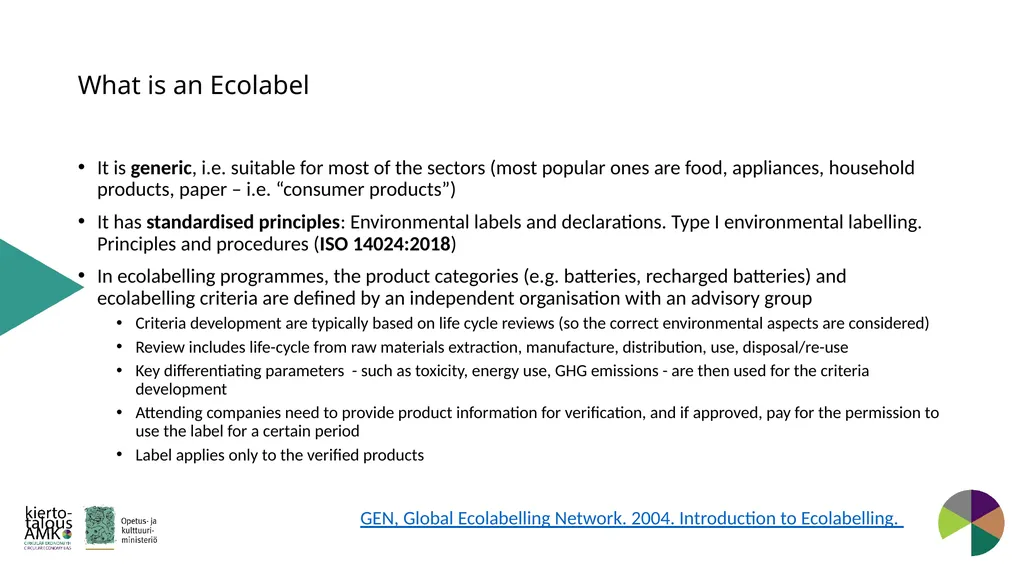
What is an Ecolabel It is generic, i.e. suitable for most of the sectors (most popular ones are food, appliances, household products, paper – i.e. “consumer products”)
It has standardised principles: Environmental labels and declarations. Type I environmental labelling. Principles and procedures (ISO 14024:2018)
In ecolabelling programmes, the product categories (e.g. batteries, recharged batteries) and ecolabelling criteria are defined by an independent organisation with an advisory group
Criteria development are typically based on life cycle reviews (so the correct environmental aspects are considered)
Review includes life-cycle from raw materials extraction, manufacture, distribution, use, disposal/re-use
Key differentiating parameters - such as toxicity, energy use, GHG emissions - are then used for the criteria development
Attending companies need to provide product information for verification, and if approved, pay for the permission to use the label for a certain period
Label applies only to the verified products GEN, Global Ecolabelling Network. 2004. Introduction to Ecolabelling.<br>
It has standardised principles: Environmental labels and declarations. Type I environmental labelling. Principles and procedures (ISO 14024:2018)
In ecolabelling programmes, the product categories (e.g. batteries, recharged batteries) and ecolabelling criteria are defined by an independent organisation with an advisory group
Criteria development are typically based on life cycle reviews (so the correct environmental aspects are considered)
Review includes life-cycle from raw materials extraction, manufacture, distribution, use, disposal/re-use
Key differentiating parameters - such as toxicity, energy use, GHG emissions - are then used for the criteria development
Attending companies need to provide product information for verification, and if approved, pay for the permission to use the label for a certain period
Label applies only to the verified products GEN, Global Ecolabelling Network. 2004. Introduction to Ecolabelling.<br>
50
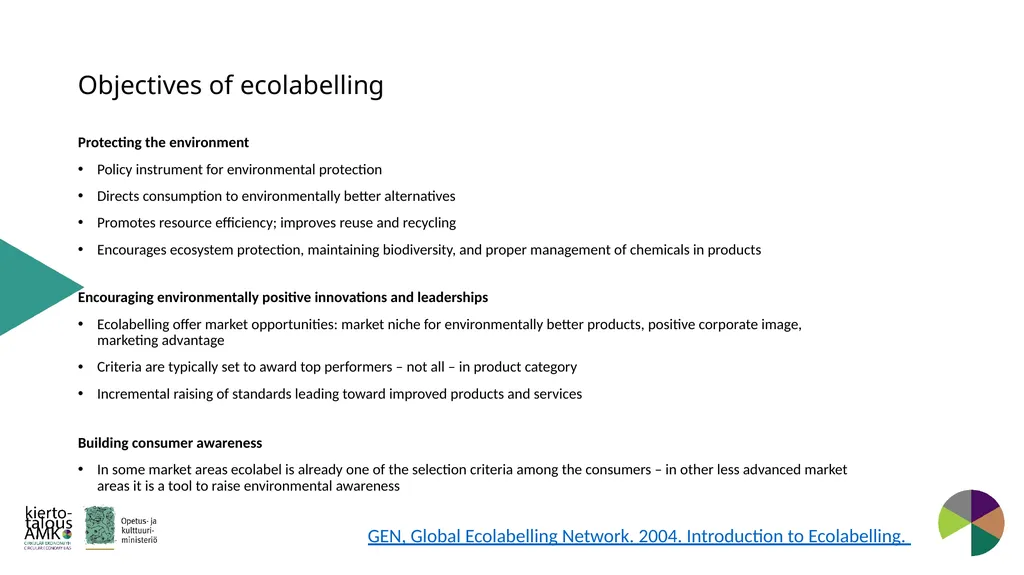
Objectives of ecolabelling Protecting the environment
Policy instrument for environmental protection
Directs consumption to environmentally better alternatives
Promotes resource efficiency; improves reuse and recycling
Encourages ecosystem protection, maintaining biodiversity, and proper management of chemicals in products
Encouraging environmentally positive innovations and leaderships
Ecolabelling offer market opportunities: market niche for environmentally better products, positive corporate image, marketing advantage
Criteria are typically set to award top performers – not all – in product category
Incremental raising of standards leading toward improved products and services
Building consumer awareness
In some market areas ecolabel is already one of the selection criteria among the consumers – in other less advanced market areas it is a tool to raise environmental awareness GEN, Global Ecolabelling Network. 2004. Introduction to Ecolabelling.<br>
Policy instrument for environmental protection
Directs consumption to environmentally better alternatives
Promotes resource efficiency; improves reuse and recycling
Encourages ecosystem protection, maintaining biodiversity, and proper management of chemicals in products
Encouraging environmentally positive innovations and leaderships
Ecolabelling offer market opportunities: market niche for environmentally better products, positive corporate image, marketing advantage
Criteria are typically set to award top performers – not all – in product category
Incremental raising of standards leading toward improved products and services
Building consumer awareness
In some market areas ecolabel is already one of the selection criteria among the consumers – in other less advanced market areas it is a tool to raise environmental awareness GEN, Global Ecolabelling Network. 2004. Introduction to Ecolabelling.<br>
51
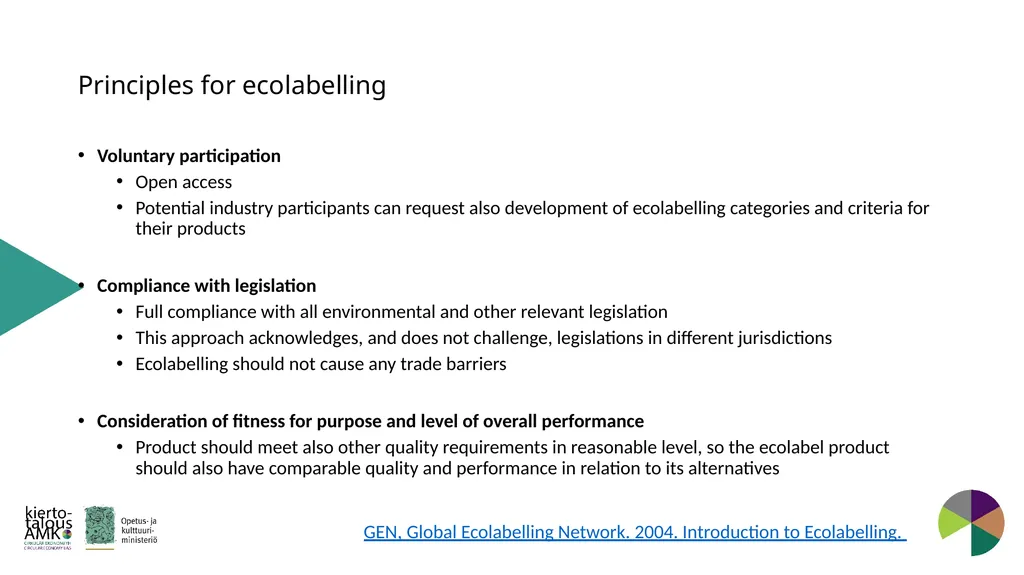
Principles for ecolabelling Voluntary participation
Open access
Potential industry participants can request also development of ecolabelling categories and criteria for their products
Compliance with legislation
Full compliance with all environmental and other relevant legislation
This approach acknowledges, and does not challenge, legislations in different jurisdictions
Ecolabelling should not cause any trade barriers
Consideration of fitness for purpose and level of overall performance
Product should meet also other quality requirements in reasonable level, so the ecolabel product should also have comparable quality and performance in relation to its alternatives GEN, Global Ecolabelling Network. 2004. Introduction to Ecolabelling.<br>
Open access
Potential industry participants can request also development of ecolabelling categories and criteria for their products
Compliance with legislation
Full compliance with all environmental and other relevant legislation
This approach acknowledges, and does not challenge, legislations in different jurisdictions
Ecolabelling should not cause any trade barriers
Consideration of fitness for purpose and level of overall performance
Product should meet also other quality requirements in reasonable level, so the ecolabel product should also have comparable quality and performance in relation to its alternatives GEN, Global Ecolabelling Network. 2004. Introduction to Ecolabelling.<br>
52
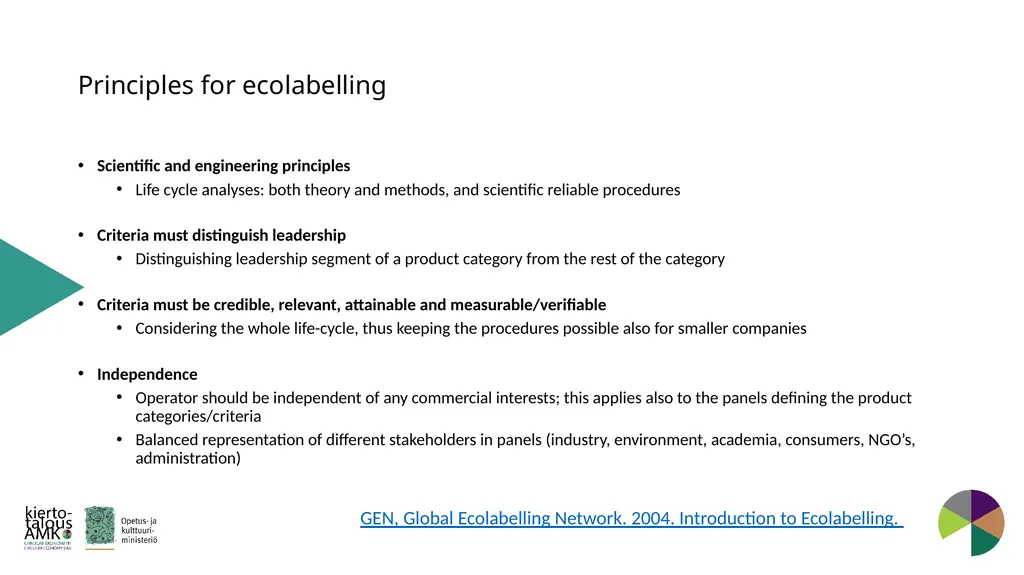
Principles for ecolabelling Scientific and engineering principles
Life cycle analyses: both theory and methods, and scientific reliable procedures
Criteria must distinguish leadership
Distinguishing leadership segment of a product category from the rest of the category
Criteria must be credible, relevant, attainable and measurable/verifiable
Considering the whole life-cycle, thus keeping the procedures possible also for smaller companies
Independence
Operator should be independent of any commercial interests; this applies also to the panels defining the product categories/criteria
Balanced representation of different stakeholders in panels (industry, environment, academia, consumers, NGO’s, administration) GEN, Global Ecolabelling Network. 2004. Introduction to Ecolabelling.<br>
Life cycle analyses: both theory and methods, and scientific reliable procedures
Criteria must distinguish leadership
Distinguishing leadership segment of a product category from the rest of the category
Criteria must be credible, relevant, attainable and measurable/verifiable
Considering the whole life-cycle, thus keeping the procedures possible also for smaller companies
Independence
Operator should be independent of any commercial interests; this applies also to the panels defining the product categories/criteria
Balanced representation of different stakeholders in panels (industry, environment, academia, consumers, NGO’s, administration) GEN, Global Ecolabelling Network. 2004. Introduction to Ecolabelling.<br>
53
Principles for ecolabelling Open and accountable process
Process must be transparent
It can be observed, monitored, questioned
Good quality management system is recommended
Public criteria and their review, inclusion of stakeholders in criteria development
Flexibility
Programmes must operate “business-like”
Cost efficiency
Responding quickly to market changes and technology development
This requires reviews, updating of product categories and criteria, and considerations of market and technology developments
Consistence with the ISO standards (ISO 14020 series)
Provides better legitimacy and soundness GEN, Global Ecolabelling Network. 2004. Introduction to Ecolabelling.<br>
Process must be transparent
It can be observed, monitored, questioned
Good quality management system is recommended
Public criteria and their review, inclusion of stakeholders in criteria development
Flexibility
Programmes must operate “business-like”
Cost efficiency
Responding quickly to market changes and technology development
This requires reviews, updating of product categories and criteria, and considerations of market and technology developments
Consistence with the ISO standards (ISO 14020 series)
Provides better legitimacy and soundness GEN, Global Ecolabelling Network. 2004. Introduction to Ecolabelling.<br>
54
Assignment: Get familiar with some of the ecolabels and their contents Select an ecolabel or an environmental label (generic or sectoral)
Provide short description of the label and its main characteristics
Find out what it requires to have it? (Criteria)
Describe the application process
Provide internet link to the Programme / Scheme providing the Label
Find three examples of products/services using the Label
You may find examples via Global Ecolabelling Network or from the tool package at the end of this presentation.<br>
Provide short description of the label and its main characteristics
Find out what it requires to have it? (Criteria)
Describe the application process
Provide internet link to the Programme / Scheme providing the Label
Find three examples of products/services using the Label
You may find examples via Global Ecolabelling Network or from the tool package at the end of this presentation.<br>
55
C. Thematic approach: Carbon footprint kiertotalousamk.fi<br>
56
Key concepts Carbon Footprint: The amount of CO2e released into the atmosphere as a result of the activities of a particular individual, organisation or community
Carbon = GHG emissions as CO2 equivalent
Footprint = metaphor for the total global warming impact of these gases with GWP 100a
Carbon Offsets: Compensating emissions produced by funding an equivalent carbon saving elsewhere
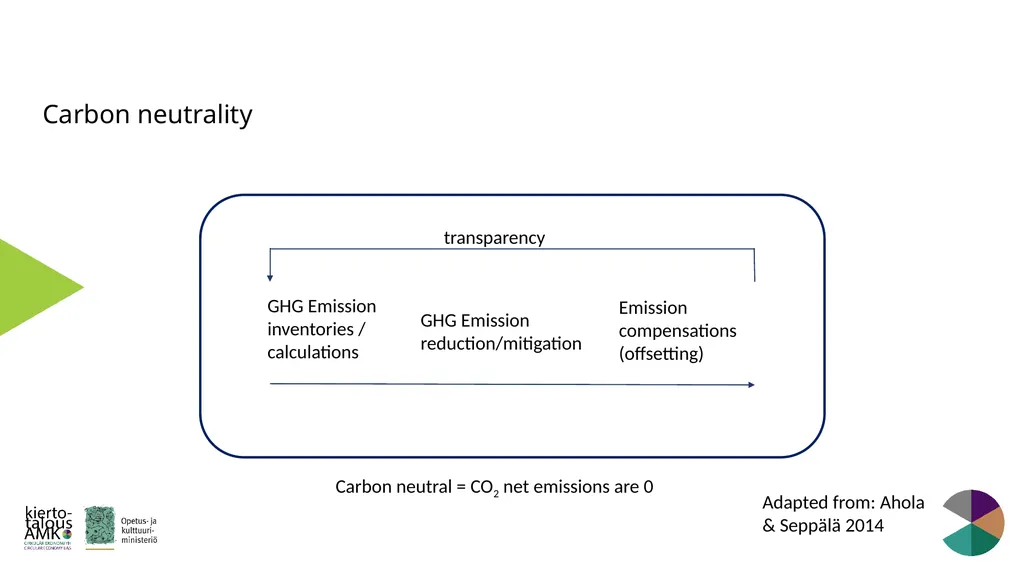
Carbon neutral: Having a net zero carbon footprint by balancing emissions released with an equivalent amount sequestered, avoided or offset<br>
Carbon = GHG emissions as CO2 equivalent
Footprint = metaphor for the total global warming impact of these gases with GWP 100a
Carbon Offsets: Compensating emissions produced by funding an equivalent carbon saving elsewhere
Carbon neutral: Having a net zero carbon footprint by balancing emissions released with an equivalent amount sequestered, avoided or offset<br>
57
Carbon neutrality GHG Emission inventories / calculations GHG Emission reduction/mitigation Emission compensations (offsetting) transparency Carbon neutral = CO2 net emissions are 0 Adapted from: Ahola & Seppälä 2014<br>
58
Carbon neutrality Carbon neutrality has become widely established in companies’ public relations, media and public debate. However, its content and scope varies a lot.
The term carbon neutrality is still often defined by a common usage as there are no internationally accepted rules for using the claim of carbon neutrality.
Carbon neutrality means zero net greenhouse gas emissions to atmosphere, and it can be achieved by measuring emissions, reducing them as much as possible and compensating the residual emissions.
The lack of transparency, especially in outlining the organizational boundaries and main indirect emissions, measurement of emissions, efforts to achieve internal emission reductions, and the type of offsetting for residual emissions, have all affected the credibility of carbon neutrality claims.
However, it has become already very important to the companies’ public relations and reputation. In practice, carbon neutrality is often seen as inspirer to new business. The Finnish Environmental Centre SYKE 2017<br>
The term carbon neutrality is still often defined by a common usage as there are no internationally accepted rules for using the claim of carbon neutrality.
Carbon neutrality means zero net greenhouse gas emissions to atmosphere, and it can be achieved by measuring emissions, reducing them as much as possible and compensating the residual emissions.
The lack of transparency, especially in outlining the organizational boundaries and main indirect emissions, measurement of emissions, efforts to achieve internal emission reductions, and the type of offsetting for residual emissions, have all affected the credibility of carbon neutrality claims.
However, it has become already very important to the companies’ public relations and reputation. In practice, carbon neutrality is often seen as inspirer to new business. The Finnish Environmental Centre SYKE 2017<br>
59
Organisational carbon footprint calculations For instance: PAS 2060 Specification for the demonstration of carbon neutrality (British Standarding Institute). This standard sets out the requirements for achieving and demonstrating carbon neutrality
The specification defines a consistent set of measures and requirements for entities (e.g. organisations, governments, communities, families, individuals) to demonstrate carbon neutrality for a product, service, organisation, community, event or building.
According to PAS 2060, The carbon footprint measurements should include 100% of Scope 1 and Scope 2 emissions, plus all Scope 3 emissions that contribute more than 1% of the total footprint.
DIRECT ORGANISATIONAL + VALUE-CHAIN EMISSIONS
The weakness is the lack of life-cycle emissions of the products and services<br>
The specification defines a consistent set of measures and requirements for entities (e.g. organisations, governments, communities, families, individuals) to demonstrate carbon neutrality for a product, service, organisation, community, event or building.
According to PAS 2060, The carbon footprint measurements should include 100% of Scope 1 and Scope 2 emissions, plus all Scope 3 emissions that contribute more than 1% of the total footprint.
DIRECT ORGANISATIONAL + VALUE-CHAIN EMISSIONS
The weakness is the lack of life-cycle emissions of the products and services<br>
60
Carbon footprint of products - ISO 14067 ISO has published standard: ISO 14067:2018 Greenhouse gases -- Carbon footprint of products -- Requirements and guidelines for quantification, which supports carbon footprint calculation and also communication of the results
Based on Life Cycle Analyses – both theory and method
Analyses are based on defined product systems, inventory data (materials, processes, other products…), and validated LCA impact assessment methods (e.g. IPCC GWP100a)
LCA standards ISO 14040, ISO 14044
Links to quantification of environmental labels and declarations (ISO 14020, ISO 14024, ISO 14025)
Instructions how to generate partial carbon footprint analyses
Instructions and requirements of communicating carbon footprint results<br>
Based on Life Cycle Analyses – both theory and method
Analyses are based on defined product systems, inventory data (materials, processes, other products…), and validated LCA impact assessment methods (e.g. IPCC GWP100a)
LCA standards ISO 14040, ISO 14044
Links to quantification of environmental labels and declarations (ISO 14020, ISO 14024, ISO 14025)
Instructions how to generate partial carbon footprint analyses
Instructions and requirements of communicating carbon footprint results<br>
61
Assignment: The Greenhouse Gas Protocol provides guidance for calculation and reporting the corporation value chain GHG emissions
Please select an industrial production sector you find most interesting
Get familiar with the report on corporate GHG accounting, and define following concepts:
SCOPE 1 Direct emissions
SCOPE 2 Indirect emissions
SCOPE 3 Indirect emissions in both downstream and upstream of the value chain
Please provide examples of each from the production sector you have chosen for this study
Which of the emissions are most challenging to quantify? How could they be analysed in reliable manner? kiertotalousamk.fi<br>
Please select an industrial production sector you find most interesting
Get familiar with the report on corporate GHG accounting, and define following concepts:
SCOPE 1 Direct emissions
SCOPE 2 Indirect emissions
SCOPE 3 Indirect emissions in both downstream and upstream of the value chain
Please provide examples of each from the production sector you have chosen for this study
Which of the emissions are most challenging to quantify? How could they be analysed in reliable manner? kiertotalousamk.fi<br>
62
Discussion - How to become carbon neutral? Awareness of your own consumptions and generation of GHG emissions
Housing (heat, electricity, water, consumables)
Transportations
Products and services consumed (use, re-use, recycling, disposal)
Identifying and utilising emission reduction opportunities
Change of behavior, reduction of consumption (energy and material efficiencies)
Extend the life-cycle: Reuse, recycle, share…
Renewables instead of non-renewables, recyclables instead of non-recyclables
Services instead of products (with certain preconditions)
Choosing the products and services that cause less GHG emissions (but be aware of problem displacements – other environmentally harmful impacts!)<br>
Housing (heat, electricity, water, consumables)
Transportations
Products and services consumed (use, re-use, recycling, disposal)
Identifying and utilising emission reduction opportunities
Change of behavior, reduction of consumption (energy and material efficiencies)
Extend the life-cycle: Reuse, recycle, share…
Renewables instead of non-renewables, recyclables instead of non-recyclables
Services instead of products (with certain preconditions)
Choosing the products and services that cause less GHG emissions (but be aware of problem displacements – other environmentally harmful impacts!)<br>
63
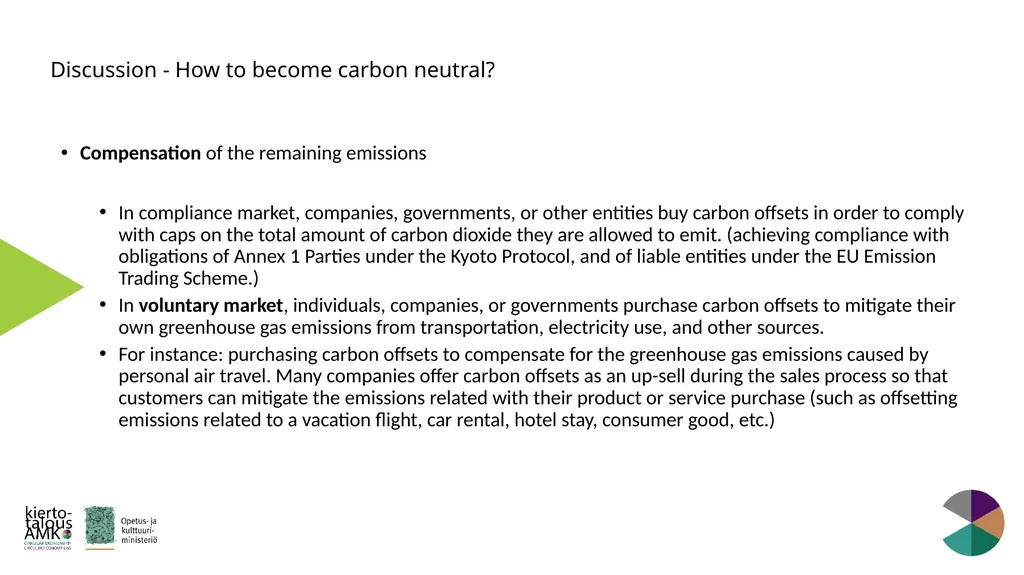
Discussion - How to become carbon neutral? Compensation of the remaining emissions
In compliance market, companies, governments, or other entities buy carbon offsets in order to comply with caps on the total amount of carbon dioxide they are allowed to emit. (achieving compliance with obligations of Annex 1 Parties under the Kyoto Protocol, and of liable entities under the EU Emission Trading Scheme.)
In voluntary market, individuals, companies, or governments purchase carbon offsets to mitigate their own greenhouse gas emissions from transportation, electricity use, and other sources.
For instance: purchasing carbon offsets to compensate for the greenhouse gas emissions caused by personal air travel. Many companies offer carbon offsets as an up-sell during the sales process so that customers can mitigate the emissions related with their product or service purchase (such as offsetting emissions related to a vacation flight, car rental, hotel stay, consumer good, etc.)<br>
In compliance market, companies, governments, or other entities buy carbon offsets in order to comply with caps on the total amount of carbon dioxide they are allowed to emit. (achieving compliance with obligations of Annex 1 Parties under the Kyoto Protocol, and of liable entities under the EU Emission Trading Scheme.)
In voluntary market, individuals, companies, or governments purchase carbon offsets to mitigate their own greenhouse gas emissions from transportation, electricity use, and other sources.
For instance: purchasing carbon offsets to compensate for the greenhouse gas emissions caused by personal air travel. Many companies offer carbon offsets as an up-sell during the sales process so that customers can mitigate the emissions related with their product or service purchase (such as offsetting emissions related to a vacation flight, car rental, hotel stay, consumer good, etc.)<br>
64
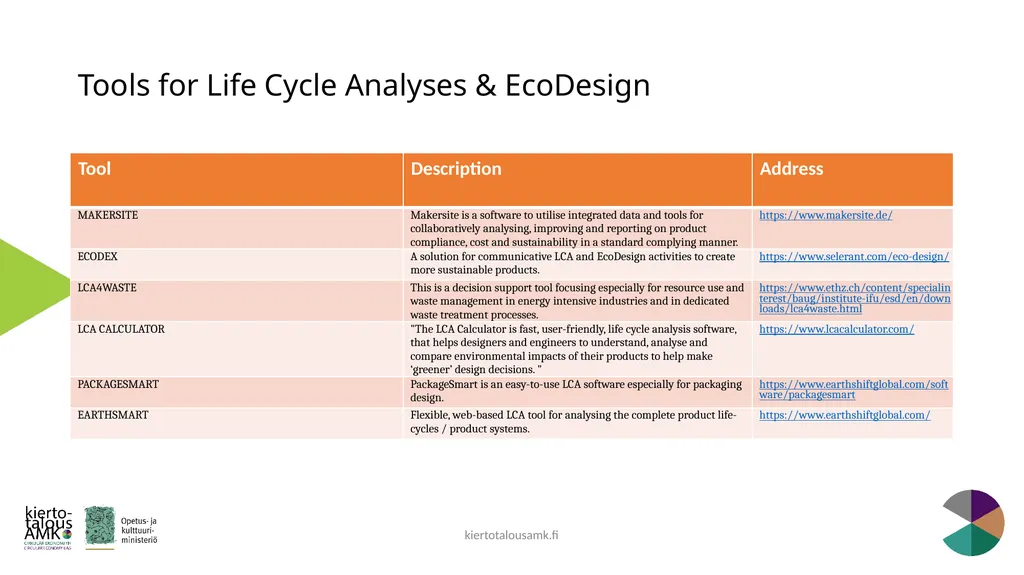
C. Tool package for implementing green standards
(Based on: Okkonen, L. 2019. Compendium of Assessed Digital Tools. D2M Project) kiertotalousamk.fi<br>
65
Tools for sustainable business planning kiertotalousamk.fi<br>
66
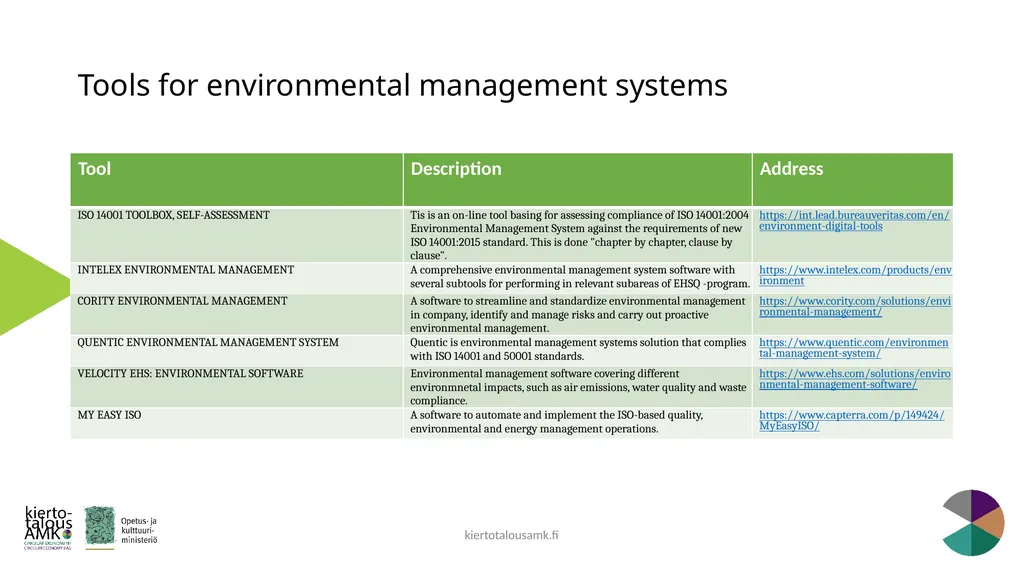
Tools for environmental management systems kiertotalousamk.fi<br>
67
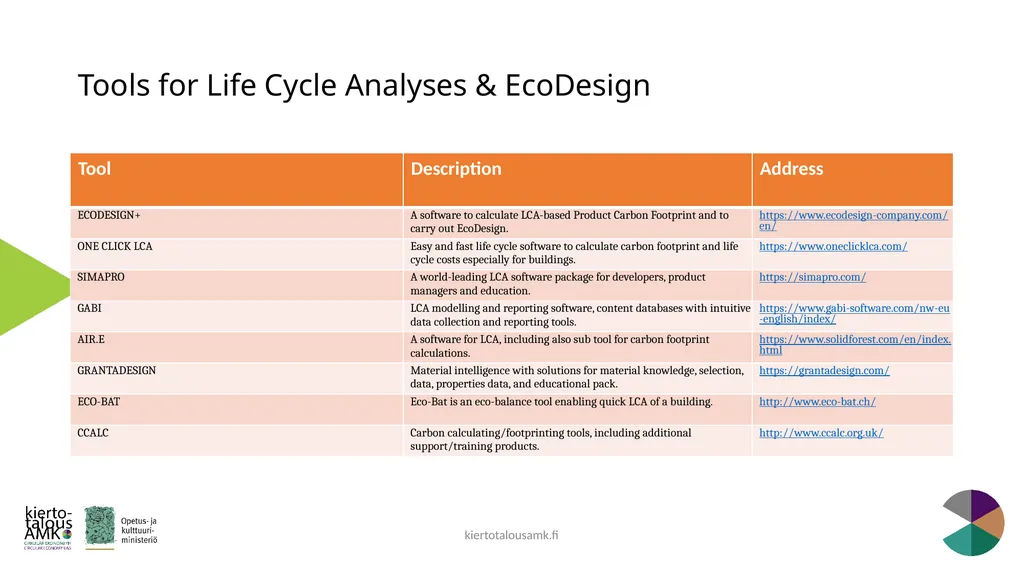
Tools for Life Cycle Analyses & EcoDesign kiertotalousamk.fi<br>
68
Tools for Life Cycle Analyses & EcoDesign kiertotalousamk.fi<br>
69
Certificates and labels - Verifying the sustainability kiertotalousamk.fi<br>
70
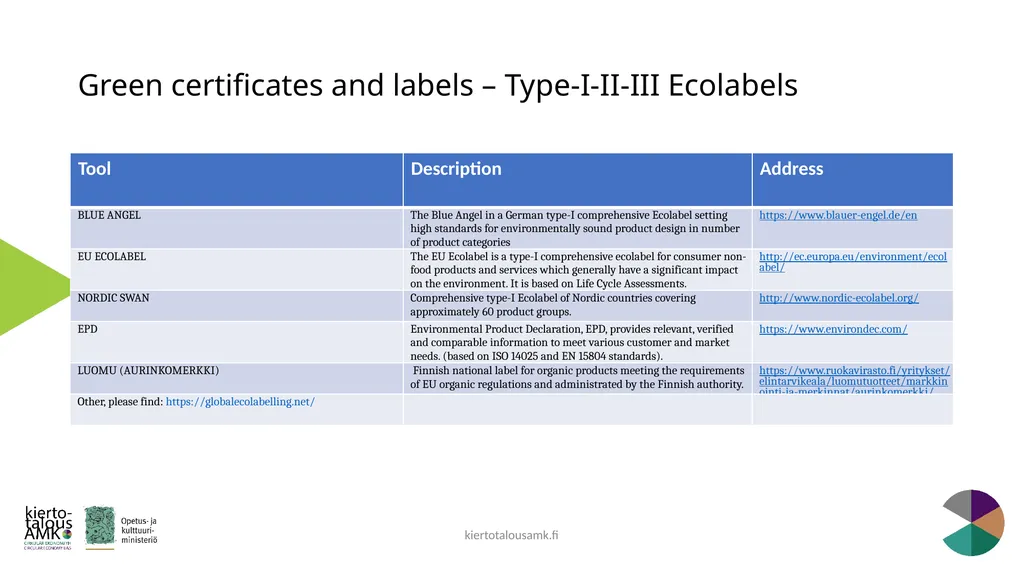
Green certificates and labels – Type-I-II-III Ecolabels kiertotalousamk.fi<br>
71
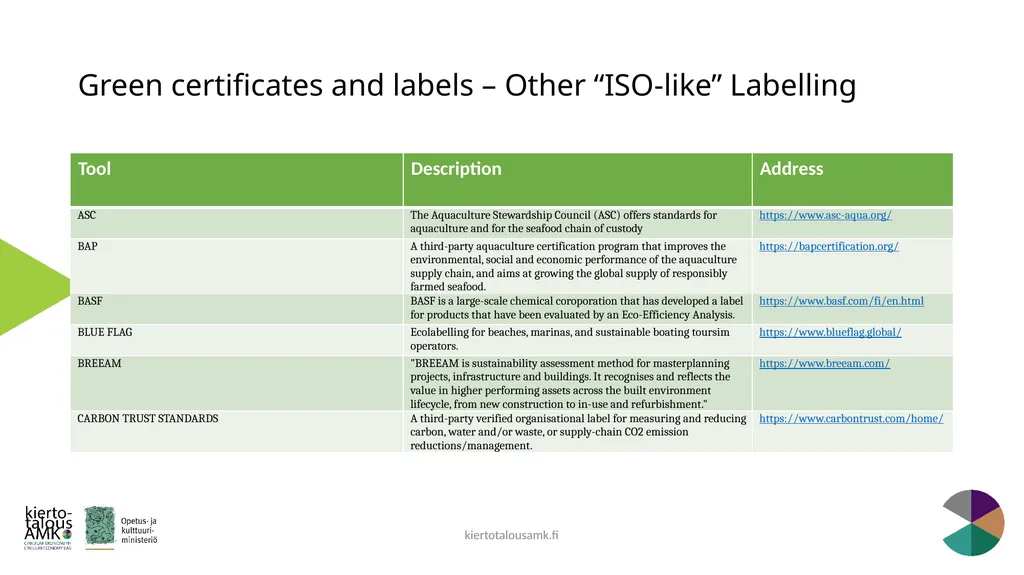
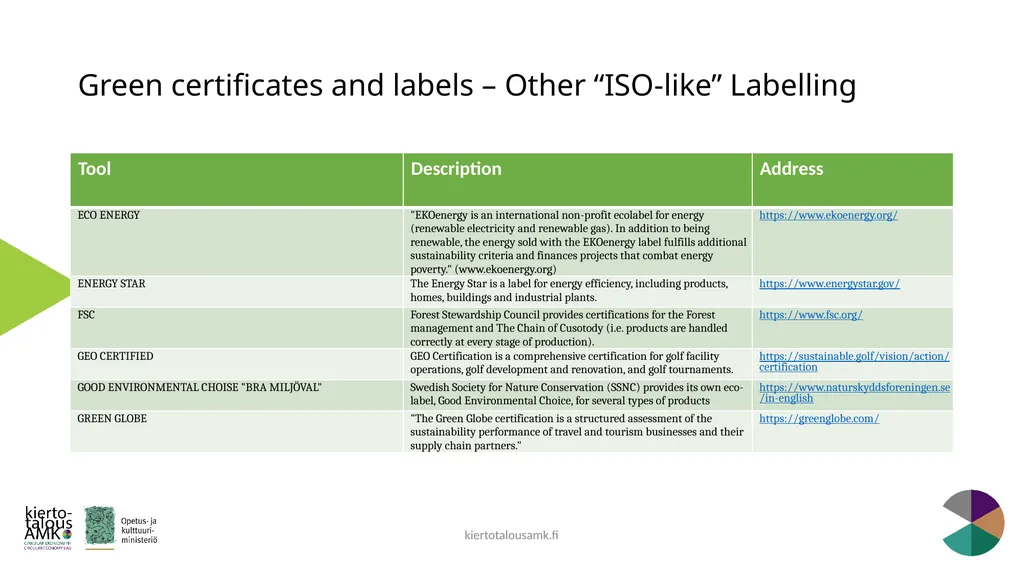
Green certificates and labels – Other “ISO-like” Labelling kiertotalousamk.fi<br>
72
Green certificates and labels – Other “ISO-like” Labelling kiertotalousamk.fi<br>
73
Green certificates and labels – Other “ISO-like” Labelling kiertotalousamk.fi<br>
74
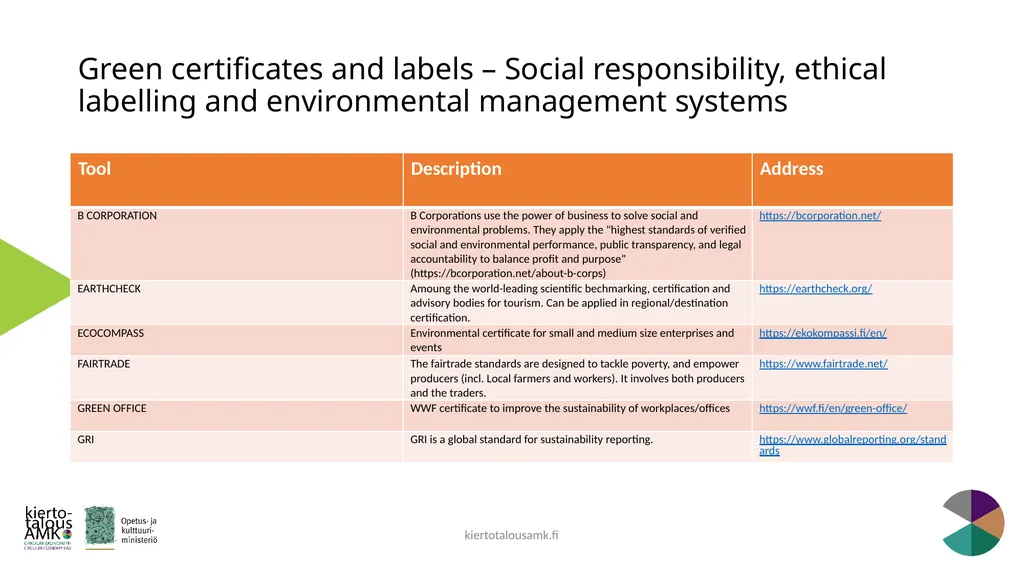
Green certificates and labels – Social responsibility, ethical labelling and environmental management systems kiertotalousamk.fi<br>
75
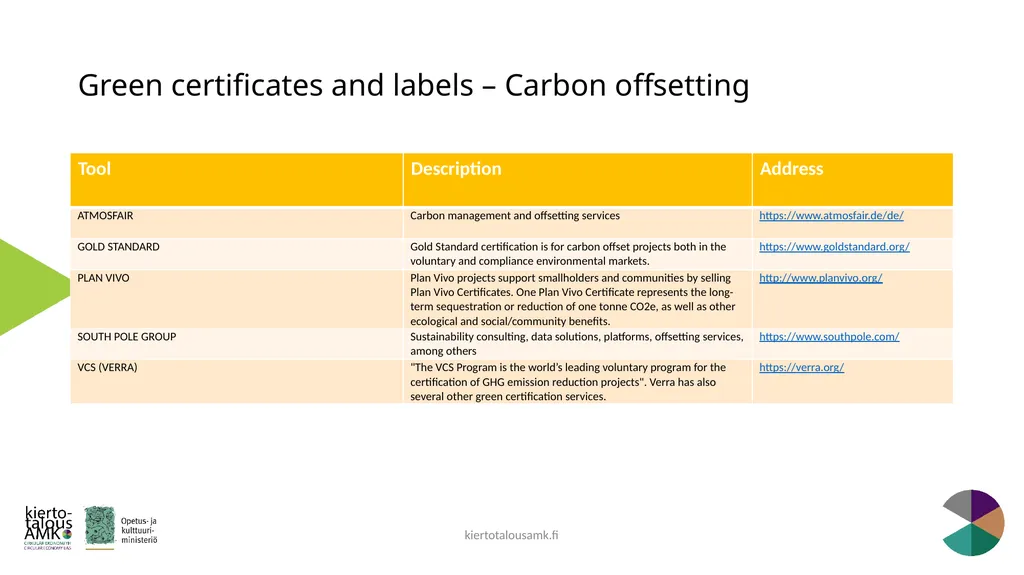
Green certificates and labels – Carbon offsetting kiertotalousamk.fi<br>
76
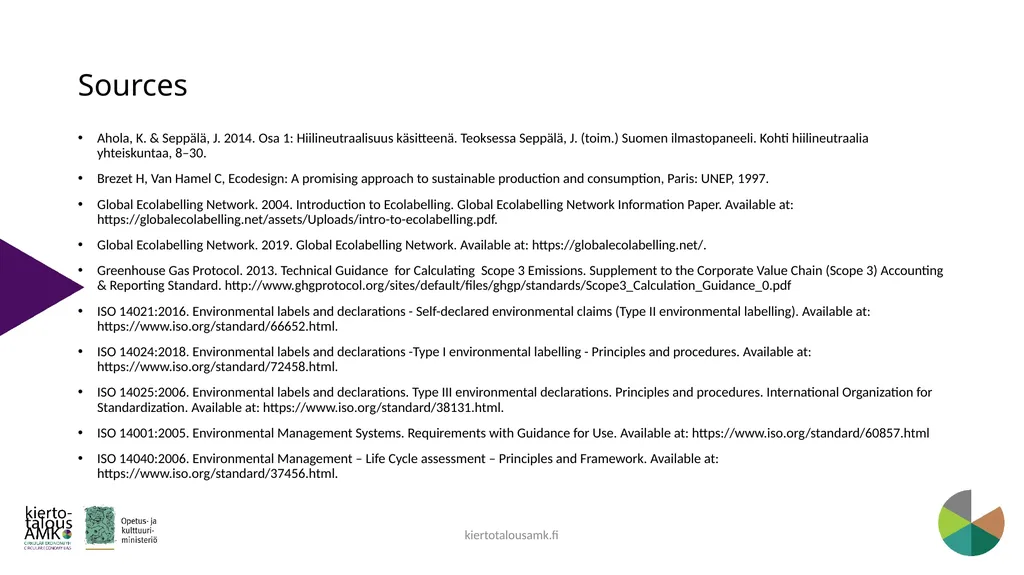
Sources Ahola, K. & Seppälä, J. 2014. Osa 1: Hiilineutraalisuus käsitteenä. Teoksessa Seppälä, J. (toim.) Suomen ilmastopaneeli. Kohti hiilineutraalia yhteiskuntaa, 8–30.
Brezet H, Van Hamel C, Ecodesign: A promising approach to sustainable production and consumption, Paris: UNEP, 1997.
Global Ecolabelling Network. 2004. Introduction to Ecolabelling. Global Ecolabelling Network Information Paper. Available at: https://globalecolabelling.net/assets/Uploads/intro-to-ecolabelling.pdf.
Global Ecolabelling Network. 2019. Global Ecolabelling Network. Available at: https://globalecolabelling.net/.
Greenhouse Gas Protocol. 2013. Technical Guidance for Calculating Scope 3 Emissions. Supplement to the Corporate Value Chain (Scope 3) Accounting & Reporting Standard. http://www.ghgprotocol.org/sites/default/files/ghgp/standards/Scope3_Calculation_Guidance_0.pdf
ISO 14021:2016. Environmental labels and declarations - Self-declared environmental claims (Type II environmental labelling). Available at: https://www.iso.org/standard/66652.html.
ISO 14024:2018. Environmental labels and declarations -Type I environmental labelling - Principles and procedures. Available at: https://www.iso.org/standard/72458.html.
ISO 14025:2006. Environmental labels and declarations. Type III environmental declarations. Principles and procedures. International Organization for Standardization. Available at: https://www.iso.org/standard/38131.html.
ISO 14001:2005. Environmental Management Systems. Requirements with Guidance for Use. Available at: https://www.iso.org/standard/60857.html
ISO 14040:2006. Environmental Management – Life Cycle assessment – Principles and Framework. Available at: https://www.iso.org/standard/37456.html. kiertotalousamk.fi<br>
Brezet H, Van Hamel C, Ecodesign: A promising approach to sustainable production and consumption, Paris: UNEP, 1997.
Global Ecolabelling Network. 2004. Introduction to Ecolabelling. Global Ecolabelling Network Information Paper. Available at: https://globalecolabelling.net/assets/Uploads/intro-to-ecolabelling.pdf.
Global Ecolabelling Network. 2019. Global Ecolabelling Network. Available at: https://globalecolabelling.net/.
Greenhouse Gas Protocol. 2013. Technical Guidance for Calculating Scope 3 Emissions. Supplement to the Corporate Value Chain (Scope 3) Accounting & Reporting Standard. http://www.ghgprotocol.org/sites/default/files/ghgp/standards/Scope3_Calculation_Guidance_0.pdf
ISO 14021:2016. Environmental labels and declarations - Self-declared environmental claims (Type II environmental labelling). Available at: https://www.iso.org/standard/66652.html.
ISO 14024:2018. Environmental labels and declarations -Type I environmental labelling - Principles and procedures. Available at: https://www.iso.org/standard/72458.html.
ISO 14025:2006. Environmental labels and declarations. Type III environmental declarations. Principles and procedures. International Organization for Standardization. Available at: https://www.iso.org/standard/38131.html.
ISO 14001:2005. Environmental Management Systems. Requirements with Guidance for Use. Available at: https://www.iso.org/standard/60857.html
ISO 14040:2006. Environmental Management – Life Cycle assessment – Principles and Framework. Available at: https://www.iso.org/standard/37456.html. kiertotalousamk.fi<br>
77
Sources Kontturi, A-M. 2016- Utilization of the life cycle analysis in the product marketing: Case Kero hirsirakennus Oy. Available at: http://urn.fi/URN:NBN:fi:amk-2016092614561.
Okkonen, L. 2019. Compendium of Assessed Digital Tools. D2M Project. Unpublished.
PAS 2060. 2014. Specification for the demonstration of carbon neutrality. Lontoo: The British Standards Institution.
Renvall, J. 2015. Alustava ympäristökatselmus. Harjoitustyön ohje. Karelia-amk.
SYKE. Suomen Ympäristökeskus. 2017. Climate Guide. https://ilmasto-opas.fi/en/.
The Industrial Design Engineering Wiki. 2019. Available at: http://wikid.io.tudelft.nl/WikID/index.php/Main_Page.
Tonteri, H. 1998. Metallituotteiden elinkaariarviointi. Tekninen tiedotus, MET-julkaisuja nro 7/98. Helsinki: Metalliteollisuuden Kustannus Oy.
Van Hemel, C.G. 1995. The LiDS wheel. In Ecodesign, A promising approach to sustainable production and consumption, Brezet, H. and Van Hemel, C.G. (1997). UNEP: Paris.
Weiss & Bentlage 2006. Environmental Management Systems and Certification. kiertotalousamk.fi<br>
Okkonen, L. 2019. Compendium of Assessed Digital Tools. D2M Project. Unpublished.
PAS 2060. 2014. Specification for the demonstration of carbon neutrality. Lontoo: The British Standards Institution.
Renvall, J. 2015. Alustava ympäristökatselmus. Harjoitustyön ohje. Karelia-amk.
SYKE. Suomen Ympäristökeskus. 2017. Climate Guide. https://ilmasto-opas.fi/en/.
The Industrial Design Engineering Wiki. 2019. Available at: http://wikid.io.tudelft.nl/WikID/index.php/Main_Page.
Tonteri, H. 1998. Metallituotteiden elinkaariarviointi. Tekninen tiedotus, MET-julkaisuja nro 7/98. Helsinki: Metalliteollisuuden Kustannus Oy.
Van Hemel, C.G. 1995. The LiDS wheel. In Ecodesign, A promising approach to sustainable production and consumption, Brezet, H. and Van Hemel, C.G. (1997). UNEP: Paris.
Weiss & Bentlage 2006. Environmental Management Systems and Certification. kiertotalousamk.fi<br>