
Grievance Redress Mechanism Sensitization of

Description: Grievance Redress Mechanism Sensitization of FACILITY GRM FOCAL PERSONS Presentation outline Introduction to grievance redress mechanisms Importance of grievance redress mechanism to a project Types of Grievances and redress outcomes
Related Topics
Download Presentation
"Grievance Redress Mechanism Sensitization of" is the property of its rightful owner. Permission is granted to download and print the materials on this website for personal, non-commercial use only, and to display it on your personal computer provided you do not modify the materials and that you retain all copyright notices contained in the materials. By downloading content from our website, you accept the terms of this agreement.
Presentation Transcript
slide1. Grievance Redress Mechanism Sensitization of FACILITY GRM FOCAL PERSONS<br>
slide2. Presentation outline Introduction to grievance redress mechanisms
Importance of grievance redress mechanism to a project
Types of Grievances and redress outcomes
Principles of a good GRM
Project grievance handling structures
GRM tools
Timelines and Reporting
GRM contacts at National level
Responsibilities and protocols for handling complaints<br>
slide3. GRM Covers 47 counties and the National government
Focuses on all grievances whether major or minor that have linkage to the project either by what the project is doing or what it is not doing yet it was supposed to do.
The GRM has four specific objectives, which are to facilitate:
Smooth implementation of the project;
Timely and effective resolution of problems;
Strengthening stakeholder engagement, trust and transparency;
Ensuring that recurring problems are mitigated in future.<br>
slide4. What is a grievance? Any concern or dissatisfaction or discontent, with the facility and/or services offered/provided, about actions taken/not taken whether exposed or not, whether valid or not, which the public/employee thinks, believes or even feels to be unfair, unjust or inequitable.” J.M. Jucius,
Grievance: An official statement of a complaint over something believed to be wrong or unfair. (Oxford English Dictionary)
A “patient grievance” is a written or verbal complaint by a patient, or the patient's representative, regarding the patient's care, abuse or neglect, or issues related to the facility.
Medical Grievances –specific to medical care or treatment,<br>
slide5. Grievance redress mechanisms Grievance Redress Mechanism (GRM): A set of structures, procedures and processes by which complaints, queries, clarifications and feedback about a project are responded.
It Provides affected people with avenues for making a complaint or resolving any dispute that may arise during the course of the implementation of a project;
Ensures that appropriate and mutually acceptable redress actions are identified and implemented to the satisfaction of complainants; and
Avoids the need to resort to judicial proceedings<br>
slide6. Importance of grievance redress mechanism to a project A well-designed and implemented complaints handling mechanism significantly enhances operational efficiency in a variety of ways, including
Generating public awareness about the project and its objectives;
Deterring fraud and corruption;
Mitigating risks;
Providing project staff with practical suggestions/feedback that allow them to be more accountable, transparent, and responsive to beneficiaries;
Increases stakeholder involvement in the project.
An effective GRM can help detect problems before they become more widespread, thereby preserving the project reputation specifically<br>
slide7. Types of Grievances Real or Imaginary:
Expressed or Implied:
Visible Grievances or Hidden Grievances:
Oral or Written:
Disguised Grievances: mental pressure or frustration, other factors and not related to work.
Individual or Group Grievances:
Union Grievances: on behalf of member employees
Policy Grievances: relating to terms of employment<br>
slide8. 5 Common Patient Complaints in Healthcare Lack of Communication and Dismissiveness
Long Wait Times.
Issues with Staff Members.
Amount of Time Spent with Doctor.
Insurance and Billing.<br>
slide9. Complaint categories Service delivery related complaints
Workers complaints
Complaints due to professional negligence
GBV/Sexual Exploitation and Abuse (SEA)
Environmental and community health hazards
Fraud and corruption
Complaints from VMG communities
Complaints related to socio-economic concerns during COVID 19<br>
slide10. Grievance redress outcomes Negotiated: voluntary agreement between two parties to a dispute.
Mediated: voluntary agreement between two parties to a dispute to seek its resolution through the less formal method of mediation by a neutral third party. The ultimate acceptance or rejection of the proposed remedy lies with the disputing parties.
Apology: something that you say or write to tell someone that you are sorry that you have hurt them or caused trouble for them. This is with or without reference to mitigating circumstances.
Award: This means that the complainant(s) is accorded some compensation<br>
slide11. Principles of Effective GRMs Fairness : Grievances should be handled confidentially, assessed impartially, and managed transparently.
Objectivity and independence : The GRM should operate independently of all interested parties in order to guarantee fair, objective, and impartial treatment to each case. GRM officials should have the means and powers to investigate grievances (e.g., interview witnesses, access records).
Simplicity and accessibility : Procedures to file grievances and seek action should be simple enough for project beneficiaries to understand them. The GRM should be accessible to all stakeholders, irrespective of the remoteness of the area they live in, the language they speak, and their level of education or income.<br>
slide12. Principles of Effective GRMs Responsiveness and efficiency- The GRM is designed to be responsive to the needs of all complainants. Accordingly, officials handling grievances are trained to take effective action upon, and respond quickly to, grievances and suggestions.
Speed and proportionality- All grievances, simple or complex, are addressed and resolved as quickly as possible. The action taken on the grievance or suggestion is swift, decisive, and constructive.
Participatory and social inclusion- Special attention is given to ensure that poor people and marginalized groups, including those with special needs, are able to access the GRM.<br>
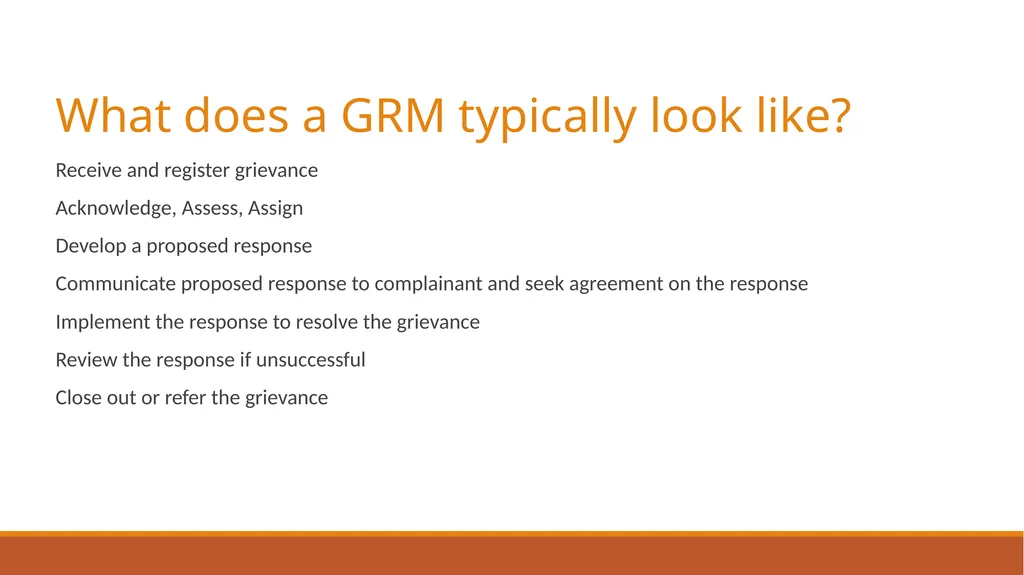
slide13. What does a GRM typically look like? Receive and register grievance
Acknowledge, Assess, Assign
Develop a proposed response
Communicate proposed response to complainant and seek agreement on the response
Implement the response to resolve the grievance
Review the response if unsuccessful
Close out or refer the grievance<br>
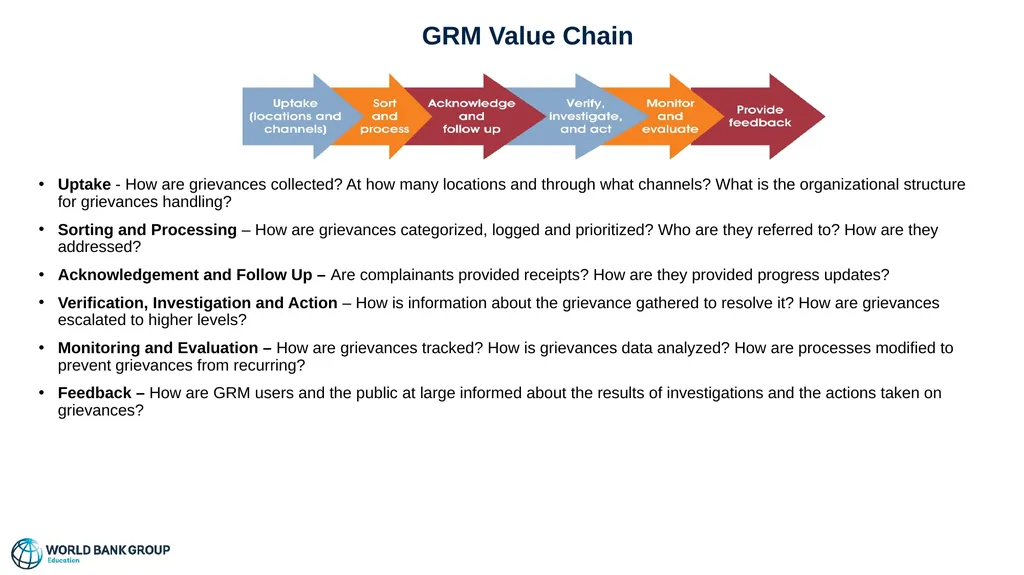
slide14. GRM Value Chain Uptake - How are grievances collected? At how many locations and through what channels? What is the organizational structure for grievances handling?
Sorting and Processing – How are grievances categorized, logged and prioritized? Who are they referred to? How are they addressed?
Acknowledgement and Follow Up – Are complainants provided receipts? How are they provided progress updates?
Verification, Investigation and Action – How is information about the grievance gathered to resolve it? How are grievances escalated to higher levels?
Monitoring and Evaluation – How are grievances tracked? How is grievances data analyzed? How are processes modified to prevent grievances from recurring?
Feedback – How are GRM users and the public at large informed about the results of investigations and the actions taken on grievances?<br>
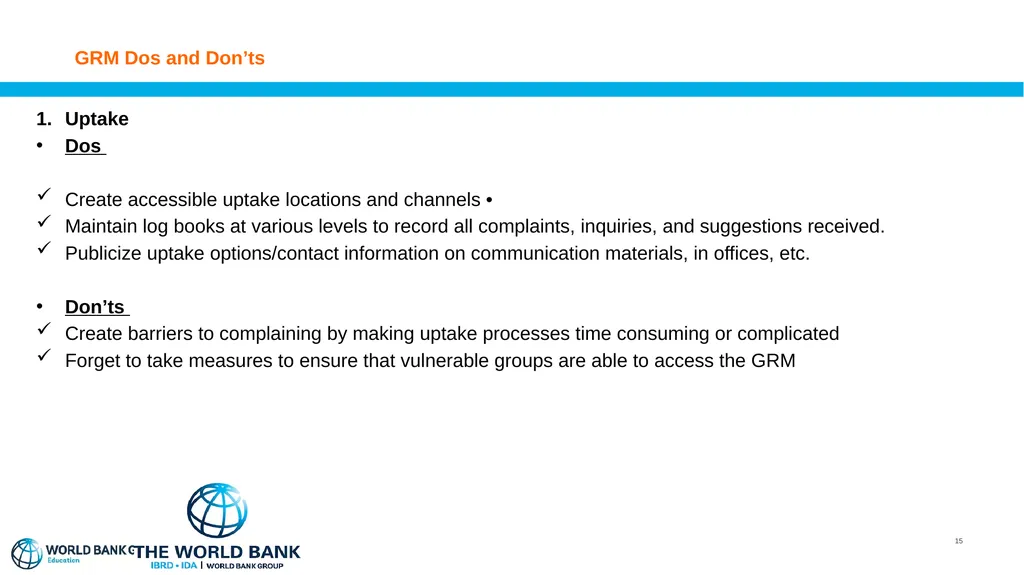
slide15. GRM Dos and Don’ts 15 Uptake
Dos
Create accessible uptake locations and channels •
Maintain log books at various levels to record all complaints, inquiries, and suggestions received.
Publicize uptake options/contact information on communication materials, in offices, etc.
Don’ts
Create barriers to complaining by making uptake processes time consuming or complicated
Forget to take measures to ensure that vulnerable groups are able to access the GRM<br>
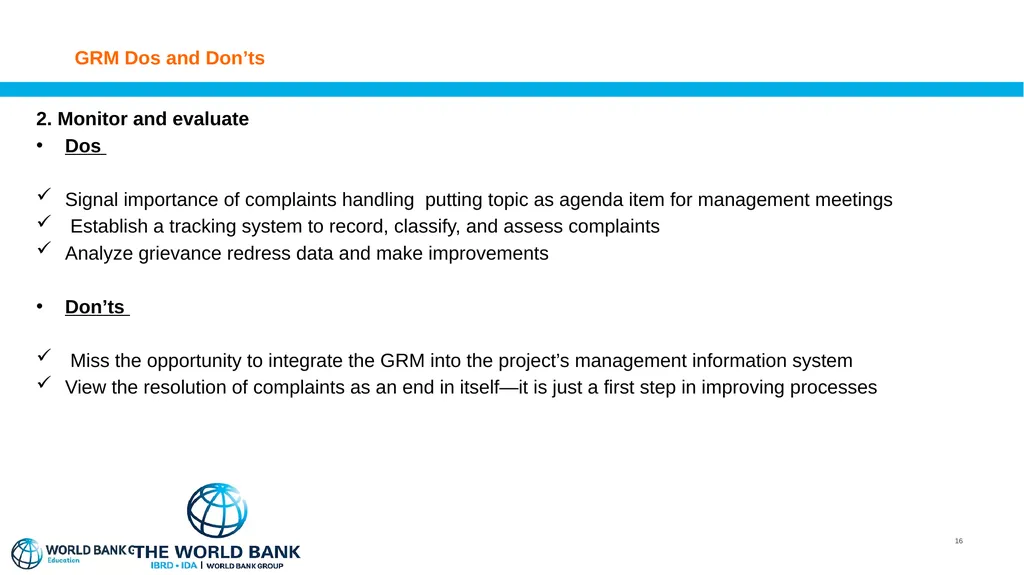
slide16. GRM Dos and Don’ts 16 2. Monitor and evaluate
Dos
Signal importance of complaints handling putting topic as agenda item for management meetings
Establish a tracking system to record, classify, and assess complaints
Analyze grievance redress data and make improvements
Don’ts
Miss the opportunity to integrate the GRM into the project’s management information system
View the resolution of complaints as an end in itself—it is just a first step in improving processes<br>
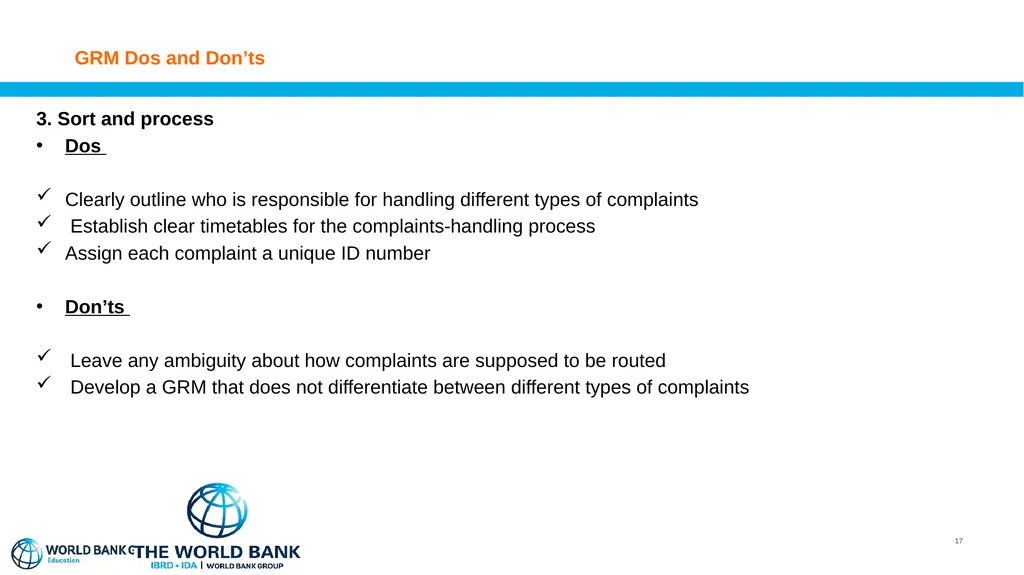
slide17. GRM Dos and Don’ts 17 3. Sort and process
Dos
Clearly outline who is responsible for handling different types of complaints
Establish clear timetables for the complaints-handling process
Assign each complaint a unique ID number
Don’ts
Leave any ambiguity about how complaints are supposed to be routed
Develop a GRM that does not differentiate between different types of complaints<br>
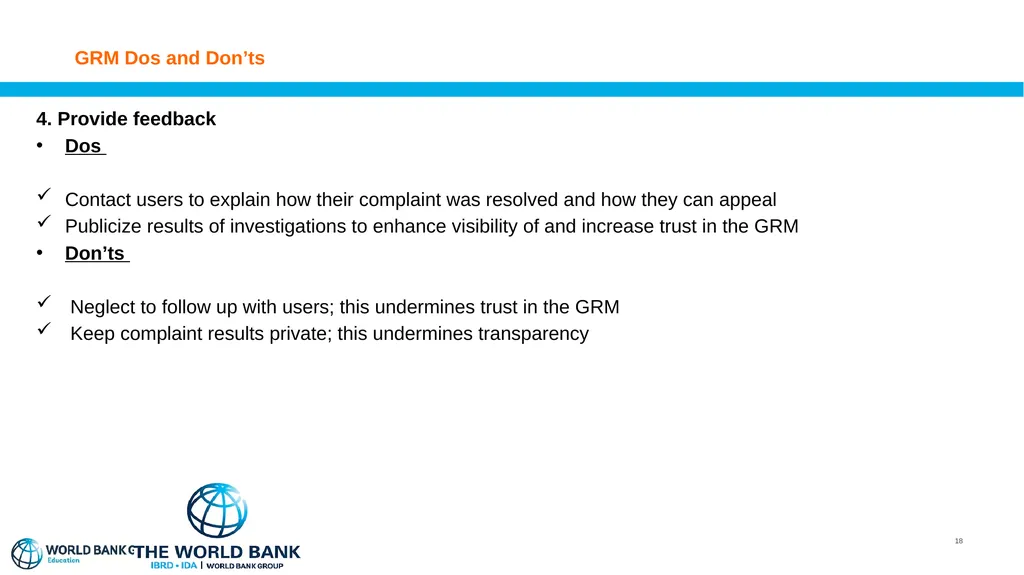
slide18. GRM Dos and Don’ts 18 4. Provide feedback
Dos
Contact users to explain how their complaint was resolved and how they can appeal
Publicize results of investigations to enhance visibility of and increase trust in the GRM
Don’ts
Neglect to follow up with users; this undermines trust in the GRM
Keep complaint results private; this undermines transparency<br>
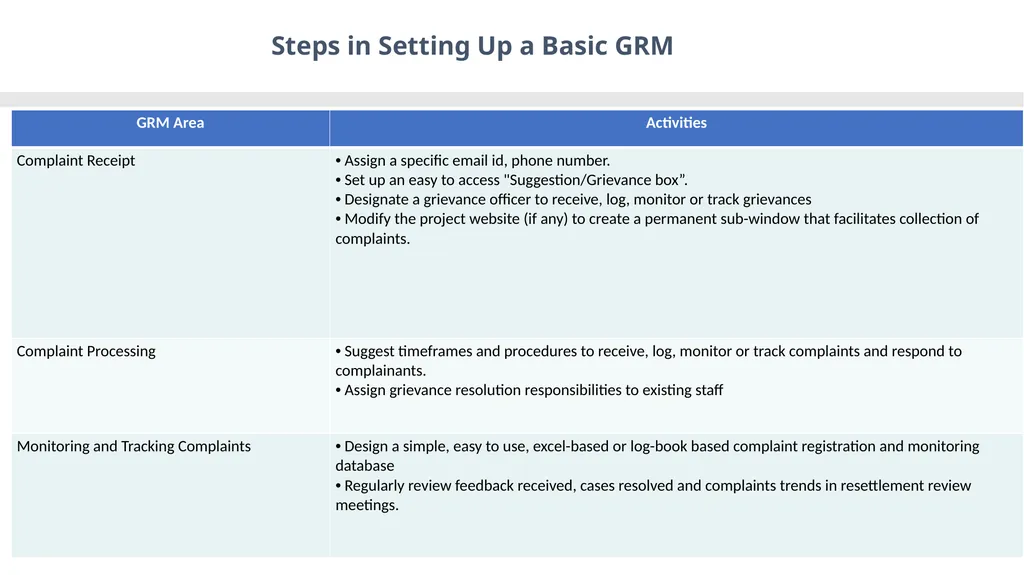
slide19. Steps in Setting Up a Basic GRM<br>
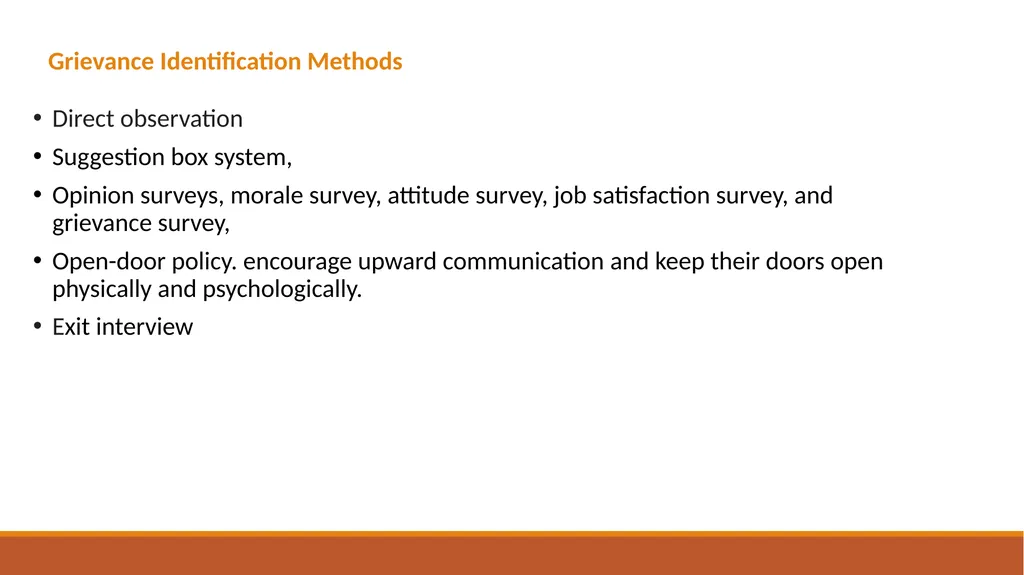
slide20. Grievance Identification Methods Direct observation
Suggestion box system,
Opinion surveys, morale survey, attitude survey, job satisfaction survey, and grievance survey,
Open-door policy. encourage upward communication and keep their doors open physically and psychologically.
Exit interview<br>
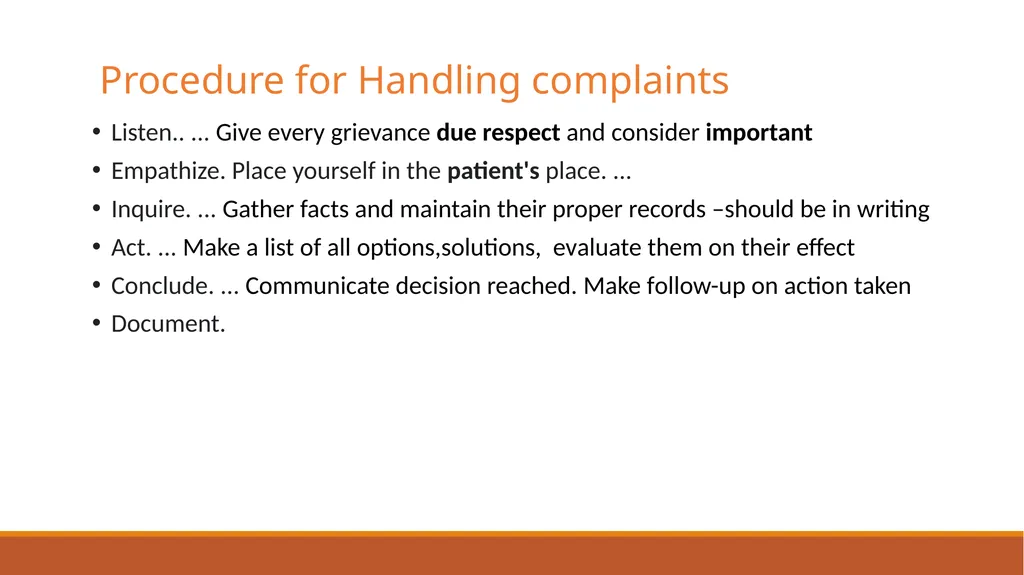
slide21. Procedure for Handling complaints Listen.. ... Give every grievance due respect and consider important
Empathize. Place yourself in the patient's place. ...
Inquire. ... Gather facts and maintain their proper records –should be in writing
Act. ... Make a list of all options,solutions, evaluate them on their effect
Conclude. ... Communicate decision reached. Make follow-up on action taken
Document.<br>
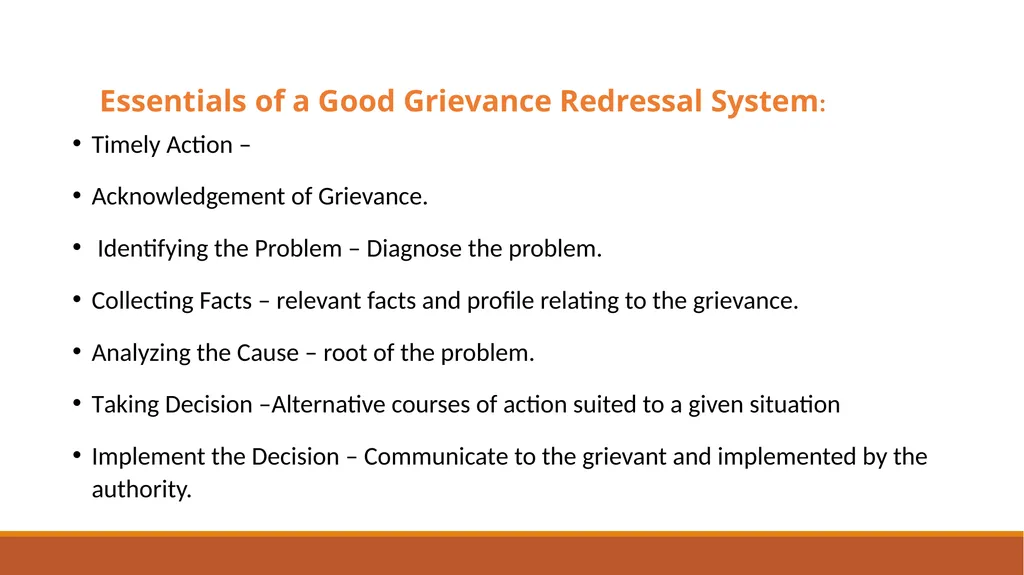
slide22. Essentials of a Good Grievance Redressal System: Timely Action –
Acknowledgement of Grievance.
Identifying the Problem – Diagnose the problem.
Collecting Facts – relevant facts and profile relating to the grievance.
Analyzing the Cause – root of the problem.
Taking Decision –Alternative courses of action suited to a given situation
Implement the Decision – Communicate to the grievant and implemented by the authority.<br>
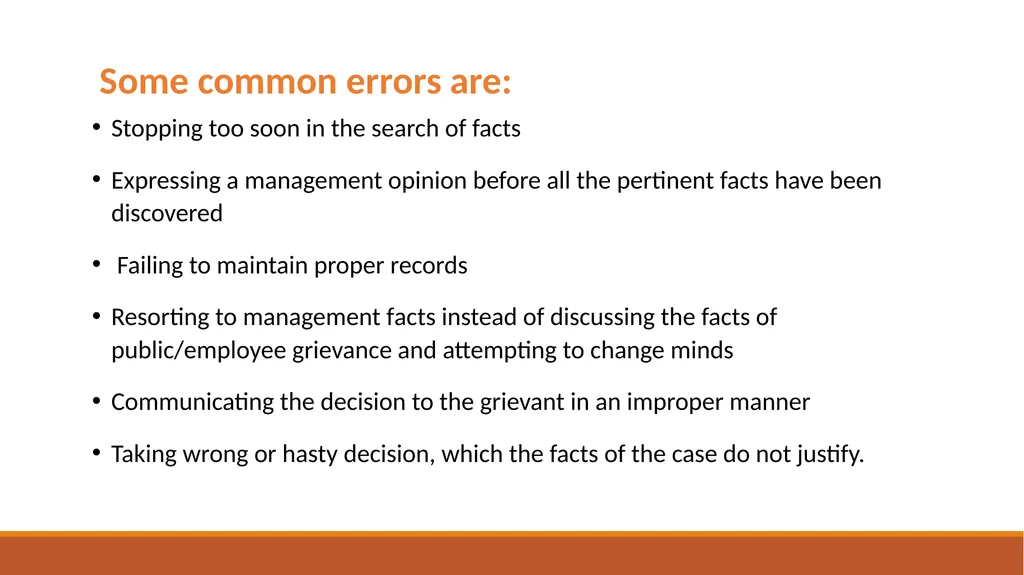
slide23. Some common errors are: Stopping too soon in the search of facts
Expressing a management opinion before all the pertinent facts have been discovered
Failing to maintain proper records
Resorting to management facts instead of discussing the facts of public/employee grievance and attempting to change minds
Communicating the decision to the grievant in an improper manner
Taking wrong or hasty decision, which the facts of the case do not justify.<br>
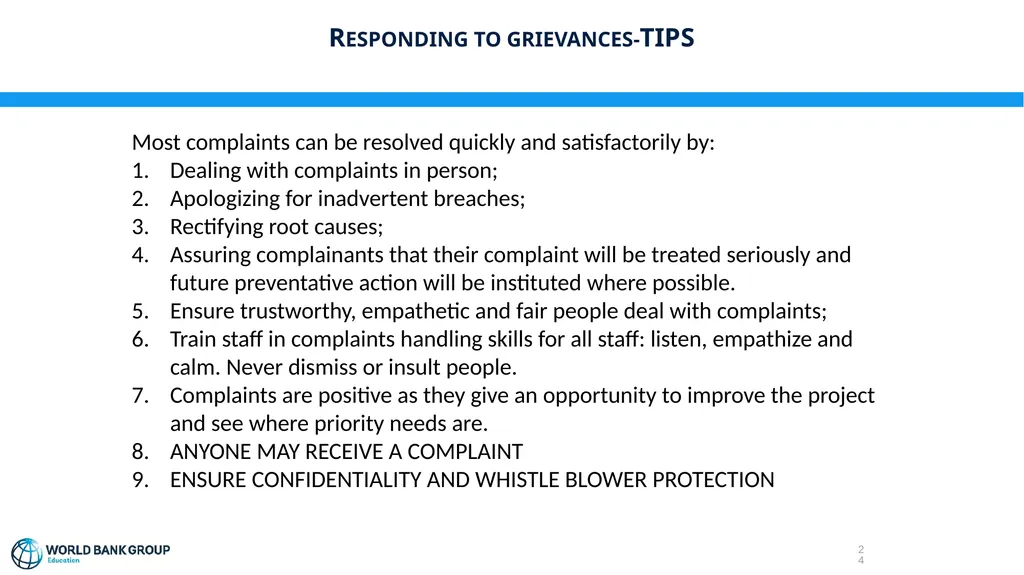
slide24. Responding to grievances-TIPS Most complaints can be resolved quickly and satisfactorily by:
Dealing with complaints in person;
Apologizing for inadvertent breaches;
Rectifying root causes;
Assuring complainants that their complaint will be treated seriously and future preventative action will be instituted where possible.
Ensure trustworthy, empathetic and fair people deal with complaints;
Train staff in complaints handling skills for all staff: listen, empathize and calm. Never dismiss or insult people.
Complaints are positive as they give an opportunity to improve the project and see where priority needs are.
ANYONE MAY RECEIVE A COMPLAINT
ENSURE CONFIDENTIALITY AND WHISTLE BLOWER PROTECTION 24<br>
slide25. Grievance Prevention Provide sufficient and timely information to communities.- Many grievances arise because of misunderstandings; lack of information; or delayed, inconsistent, or insufficient information.
Conduct meaningful community consultations.
Build capacity for project staff, particularly community facilitators and other field-level staff.<br>
slide26. Group Exercise 1.What mechanisms do you have in place:
At health centre level;
Sub county level
County level
2. Who are the focal persons at each level?
Have they received an orientation in receiving/logging/resolution and referral? If not when can you do this?
Have you raised awareness among the community about the GRMs at the 3 levels? How/when with whom? If not, how can you do this.
Any challenges or suggestions to strengthen the GRM?<br>
slide2. Presentation outline Introduction to grievance redress mechanisms
Importance of grievance redress mechanism to a project
Types of Grievances and redress outcomes
Principles of a good GRM
Project grievance handling structures
GRM tools
Timelines and Reporting
GRM contacts at National level
Responsibilities and protocols for handling complaints<br>
slide3. GRM Covers 47 counties and the National government
Focuses on all grievances whether major or minor that have linkage to the project either by what the project is doing or what it is not doing yet it was supposed to do.
The GRM has four specific objectives, which are to facilitate:
Smooth implementation of the project;
Timely and effective resolution of problems;
Strengthening stakeholder engagement, trust and transparency;
Ensuring that recurring problems are mitigated in future.<br>
slide4. What is a grievance? Any concern or dissatisfaction or discontent, with the facility and/or services offered/provided, about actions taken/not taken whether exposed or not, whether valid or not, which the public/employee thinks, believes or even feels to be unfair, unjust or inequitable.” J.M. Jucius,
Grievance: An official statement of a complaint over something believed to be wrong or unfair. (Oxford English Dictionary)
A “patient grievance” is a written or verbal complaint by a patient, or the patient's representative, regarding the patient's care, abuse or neglect, or issues related to the facility.
Medical Grievances –specific to medical care or treatment,<br>
slide5. Grievance redress mechanisms Grievance Redress Mechanism (GRM): A set of structures, procedures and processes by which complaints, queries, clarifications and feedback about a project are responded.
It Provides affected people with avenues for making a complaint or resolving any dispute that may arise during the course of the implementation of a project;
Ensures that appropriate and mutually acceptable redress actions are identified and implemented to the satisfaction of complainants; and
Avoids the need to resort to judicial proceedings<br>
slide6. Importance of grievance redress mechanism to a project A well-designed and implemented complaints handling mechanism significantly enhances operational efficiency in a variety of ways, including
Generating public awareness about the project and its objectives;
Deterring fraud and corruption;
Mitigating risks;
Providing project staff with practical suggestions/feedback that allow them to be more accountable, transparent, and responsive to beneficiaries;
Increases stakeholder involvement in the project.
An effective GRM can help detect problems before they become more widespread, thereby preserving the project reputation specifically<br>
slide7. Types of Grievances Real or Imaginary:
Expressed or Implied:
Visible Grievances or Hidden Grievances:
Oral or Written:
Disguised Grievances: mental pressure or frustration, other factors and not related to work.
Individual or Group Grievances:
Union Grievances: on behalf of member employees
Policy Grievances: relating to terms of employment<br>
slide8. 5 Common Patient Complaints in Healthcare Lack of Communication and Dismissiveness
Long Wait Times.
Issues with Staff Members.
Amount of Time Spent with Doctor.
Insurance and Billing.<br>
slide9. Complaint categories Service delivery related complaints
Workers complaints
Complaints due to professional negligence
GBV/Sexual Exploitation and Abuse (SEA)
Environmental and community health hazards
Fraud and corruption
Complaints from VMG communities
Complaints related to socio-economic concerns during COVID 19<br>
slide10. Grievance redress outcomes Negotiated: voluntary agreement between two parties to a dispute.
Mediated: voluntary agreement between two parties to a dispute to seek its resolution through the less formal method of mediation by a neutral third party. The ultimate acceptance or rejection of the proposed remedy lies with the disputing parties.
Apology: something that you say or write to tell someone that you are sorry that you have hurt them or caused trouble for them. This is with or without reference to mitigating circumstances.
Award: This means that the complainant(s) is accorded some compensation<br>
slide11. Principles of Effective GRMs Fairness : Grievances should be handled confidentially, assessed impartially, and managed transparently.
Objectivity and independence : The GRM should operate independently of all interested parties in order to guarantee fair, objective, and impartial treatment to each case. GRM officials should have the means and powers to investigate grievances (e.g., interview witnesses, access records).
Simplicity and accessibility : Procedures to file grievances and seek action should be simple enough for project beneficiaries to understand them. The GRM should be accessible to all stakeholders, irrespective of the remoteness of the area they live in, the language they speak, and their level of education or income.<br>
slide12. Principles of Effective GRMs Responsiveness and efficiency- The GRM is designed to be responsive to the needs of all complainants. Accordingly, officials handling grievances are trained to take effective action upon, and respond quickly to, grievances and suggestions.
Speed and proportionality- All grievances, simple or complex, are addressed and resolved as quickly as possible. The action taken on the grievance or suggestion is swift, decisive, and constructive.
Participatory and social inclusion- Special attention is given to ensure that poor people and marginalized groups, including those with special needs, are able to access the GRM.<br>
slide13. What does a GRM typically look like? Receive and register grievance
Acknowledge, Assess, Assign
Develop a proposed response
Communicate proposed response to complainant and seek agreement on the response
Implement the response to resolve the grievance
Review the response if unsuccessful
Close out or refer the grievance<br>
slide14. GRM Value Chain Uptake - How are grievances collected? At how many locations and through what channels? What is the organizational structure for grievances handling?
Sorting and Processing – How are grievances categorized, logged and prioritized? Who are they referred to? How are they addressed?
Acknowledgement and Follow Up – Are complainants provided receipts? How are they provided progress updates?
Verification, Investigation and Action – How is information about the grievance gathered to resolve it? How are grievances escalated to higher levels?
Monitoring and Evaluation – How are grievances tracked? How is grievances data analyzed? How are processes modified to prevent grievances from recurring?
Feedback – How are GRM users and the public at large informed about the results of investigations and the actions taken on grievances?<br>
slide15. GRM Dos and Don’ts 15 Uptake
Dos
Create accessible uptake locations and channels •
Maintain log books at various levels to record all complaints, inquiries, and suggestions received.
Publicize uptake options/contact information on communication materials, in offices, etc.
Don’ts
Create barriers to complaining by making uptake processes time consuming or complicated
Forget to take measures to ensure that vulnerable groups are able to access the GRM<br>
slide16. GRM Dos and Don’ts 16 2. Monitor and evaluate
Dos
Signal importance of complaints handling putting topic as agenda item for management meetings
Establish a tracking system to record, classify, and assess complaints
Analyze grievance redress data and make improvements
Don’ts
Miss the opportunity to integrate the GRM into the project’s management information system
View the resolution of complaints as an end in itself—it is just a first step in improving processes<br>
slide17. GRM Dos and Don’ts 17 3. Sort and process
Dos
Clearly outline who is responsible for handling different types of complaints
Establish clear timetables for the complaints-handling process
Assign each complaint a unique ID number
Don’ts
Leave any ambiguity about how complaints are supposed to be routed
Develop a GRM that does not differentiate between different types of complaints<br>
slide18. GRM Dos and Don’ts 18 4. Provide feedback
Dos
Contact users to explain how their complaint was resolved and how they can appeal
Publicize results of investigations to enhance visibility of and increase trust in the GRM
Don’ts
Neglect to follow up with users; this undermines trust in the GRM
Keep complaint results private; this undermines transparency<br>
slide19. Steps in Setting Up a Basic GRM<br>
slide20. Grievance Identification Methods Direct observation
Suggestion box system,
Opinion surveys, morale survey, attitude survey, job satisfaction survey, and grievance survey,
Open-door policy. encourage upward communication and keep their doors open physically and psychologically.
Exit interview<br>
slide21. Procedure for Handling complaints Listen.. ... Give every grievance due respect and consider important
Empathize. Place yourself in the patient's place. ...
Inquire. ... Gather facts and maintain their proper records –should be in writing
Act. ... Make a list of all options,solutions, evaluate them on their effect
Conclude. ... Communicate decision reached. Make follow-up on action taken
Document.<br>
slide22. Essentials of a Good Grievance Redressal System: Timely Action –
Acknowledgement of Grievance.
Identifying the Problem – Diagnose the problem.
Collecting Facts – relevant facts and profile relating to the grievance.
Analyzing the Cause – root of the problem.
Taking Decision –Alternative courses of action suited to a given situation
Implement the Decision – Communicate to the grievant and implemented by the authority.<br>
slide23. Some common errors are: Stopping too soon in the search of facts
Expressing a management opinion before all the pertinent facts have been discovered
Failing to maintain proper records
Resorting to management facts instead of discussing the facts of public/employee grievance and attempting to change minds
Communicating the decision to the grievant in an improper manner
Taking wrong or hasty decision, which the facts of the case do not justify.<br>
slide24. Responding to grievances-TIPS Most complaints can be resolved quickly and satisfactorily by:
Dealing with complaints in person;
Apologizing for inadvertent breaches;
Rectifying root causes;
Assuring complainants that their complaint will be treated seriously and future preventative action will be instituted where possible.
Ensure trustworthy, empathetic and fair people deal with complaints;
Train staff in complaints handling skills for all staff: listen, empathize and calm. Never dismiss or insult people.
Complaints are positive as they give an opportunity to improve the project and see where priority needs are.
ANYONE MAY RECEIVE A COMPLAINT
ENSURE CONFIDENTIALITY AND WHISTLE BLOWER PROTECTION 24<br>
slide25. Grievance Prevention Provide sufficient and timely information to communities.- Many grievances arise because of misunderstandings; lack of information; or delayed, inconsistent, or insufficient information.
Conduct meaningful community consultations.
Build capacity for project staff, particularly community facilitators and other field-level staff.<br>
slide26. Group Exercise 1.What mechanisms do you have in place:
At health centre level;
Sub county level
County level
2. Who are the focal persons at each level?
Have they received an orientation in receiving/logging/resolution and referral? If not when can you do this?
Have you raised awareness among the community about the GRMs at the 3 levels? How/when with whom? If not, how can you do this.
Any challenges or suggestions to strengthen the GRM?<br>