GROUNDS FOR JUDICIAL REVIEW Darryl Hutcheon 19 April 2024 The Classic Explanation of judicial review grounds The House of Lords in the GCHQ case (1985 AC 374): one can conveniently classify under three heads the grounds upon which
"GROUNDS FOR JUDICIAL REVIEW Darryl Hutcheon 19" is the property of its rightful owner. Permission is granted to
download and print the materials on this website for personal, non-commercial use only, and to display it
on your personal computer provided you do not modify the materials and that you retain all copyright
notices contained in the materials. By downloading content from our website, you accept the terms of this
agreement.
Presentation Transcript
01
GROUNDS FOR JUDICIAL REVIEW Darryl Hutcheon
19 April 2024<br>
02
The “Classic” Explanation of judicial review grounds The House of Lords in the GCHQ case ([1985] AC 374):
“one can conveniently classify under three heads the grounds upon which administrative action is subject to control by judicial review. The first I would call “illegality”, the second “irrationality” and the third “procedural impropriety…”
These headline concepts are a helpful, if imperfect, guide to the different angles of challenge in a judicial review…<br>
03
CATEGORY (i) - ILLEGALITY Challenging the decision on the basis that the decision-maker misunderstood the law, failed to comply with some free-standing legal rule (for example, a statutory duty to do something) or failed to stay within the legal limits of their powers.<br>
04
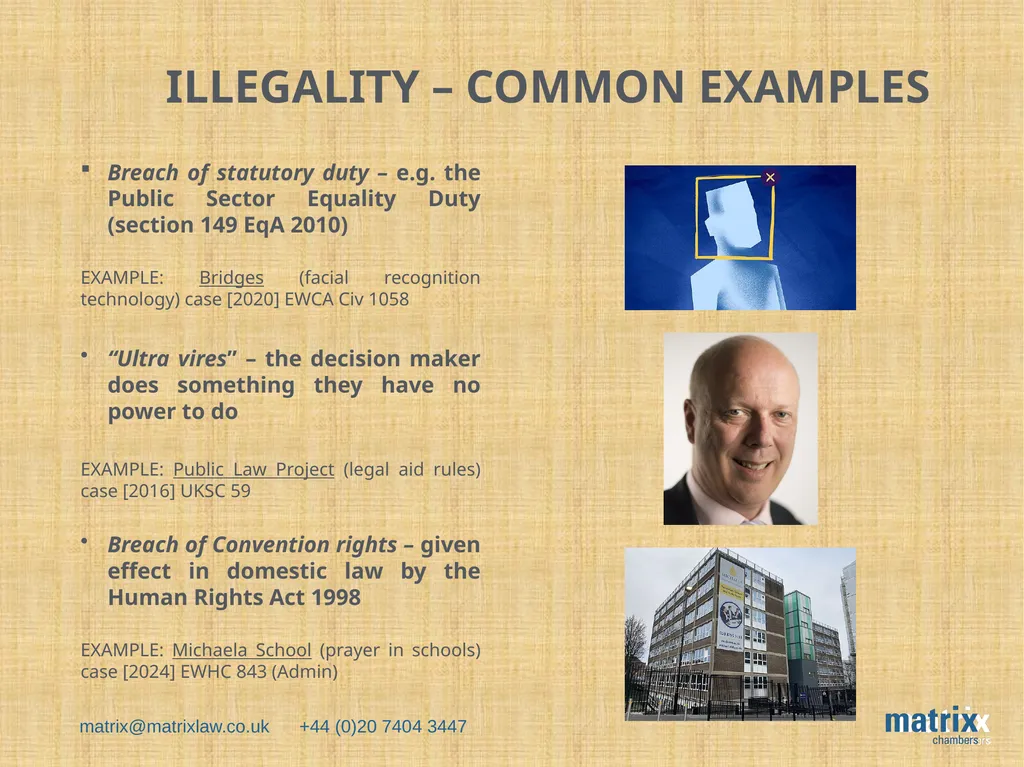
ILLEGALITY – COMMON EXAMPLES Breach of statutory duty – e.g. the Public Sector Equality Duty (section 149 EqA 2010)
EXAMPLE: Bridges (facial recognition technology) case [2020] EWCA Civ 1058
“Ultra vires” – the decision maker does something they have no power to do
EXAMPLE: Public Law Project (legal aid rules) case [2016] UKSC 59
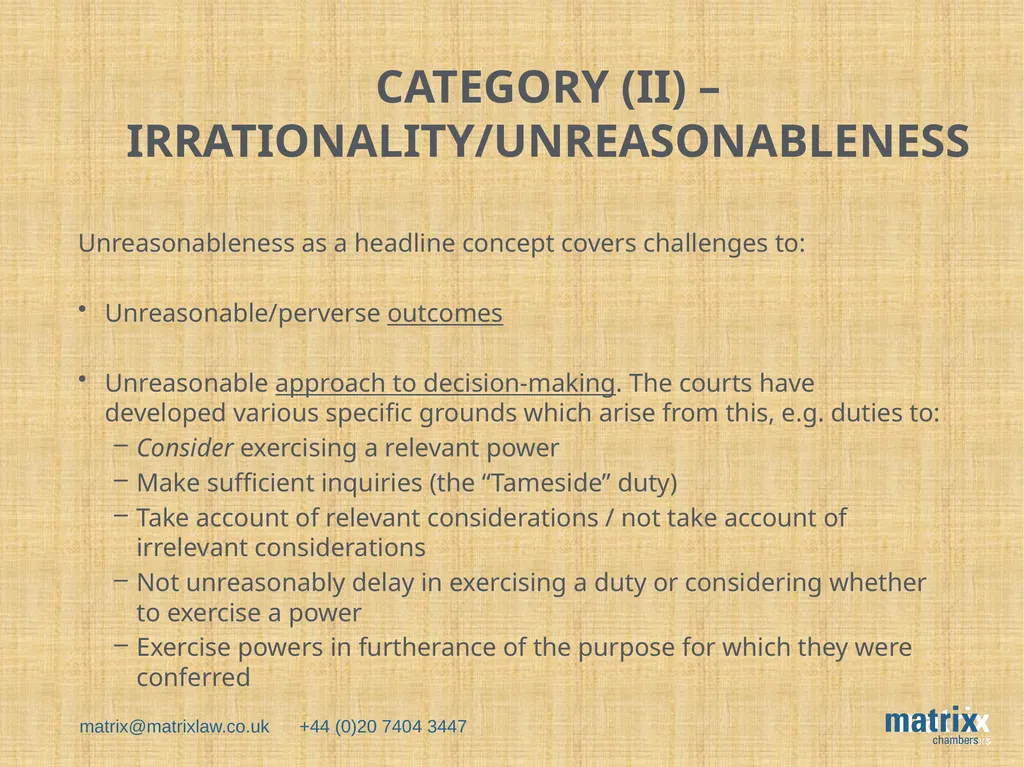
Breach of Convention rights – given effect in domestic law by the Human Rights Act 1998
EXAMPLE: Michaela School (prayer in schools) case [2024] EWHC 843 (Admin)<br>
05
CATEGORY (II) – IRRATIONALITy/UNREASONABLENESS This (broader, “softer”) category covers challenges to the way that a discretion or power has been exercised on the basis that the decision-maker’s approach was “irrational” or “unreasonable”.
High threshold…
“the public law doctrine of irrationality… sets a deliberately high standard” (Campaign Against the Arms Trade case [2019] EWCA Civ 1020)
… but also a sliding scale:
“in ordinary judicial review proceedings where a test of reasonableness applies, the intensity of the court’s review will vary according to the context”
(SC (two-child benefit limit) case [2019] EWCA Civ 615)<br>
06
CATEGORY (II) – IRRATIONALITy/UNREASONABLENESS Unreasonableness as a headline concept covers challenges to:
Unreasonable/perverse outcomes
Unreasonable approach to decision-making. The courts have developed various specific grounds which arise from this, e.g. duties to:
Consider exercising a relevant power
Make sufficient inquiries (the “Tameside” duty)
Take account of relevant considerations / not take account of irrelevant considerations
Not unreasonably delay in exercising a duty or considering whether to exercise a power
Exercise powers in furtherance of the purpose for which they were conferred<br>
07
CATEGORy (III) – PROCEDURAL FLAWS There is a general duty on public authorities to make decisions in a procedurally fair way. This is more “hard edged” than irrationality; the Court will determine for itself whether the public body acted fairly (rather than merely reviewing the reasonableness of the approach which was taken). But the requirements of “procedural fairness” are highly context-specific.
Two core elements of the duty to act fairly are (i) to give a person the opportunity to be heard (and sufficient information to be able meaningfully to exercise that right); and (ii) the avoidance of bias on the part of the decision-maker.<br>
08
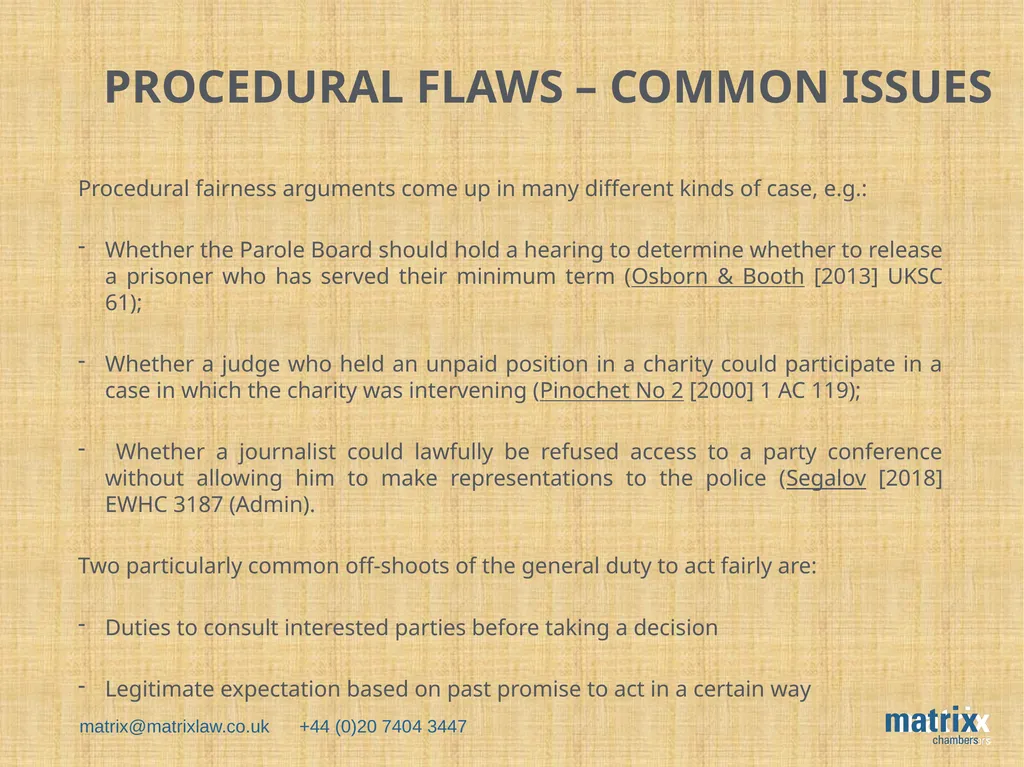
PROCEDURAL FLAWS – COMMON ISSUES Procedural fairness arguments come up in many different kinds of case, e.g.:
Whether the Parole Board should hold a hearing to determine whether to release a prisoner who has served their minimum term (Osborn & Booth [2013] UKSC 61);
Whether a judge who held an unpaid position in a charity could participate in a case in which the charity was intervening (Pinochet No 2 [2000] 1 AC 119);
Whether a journalist could lawfully be refused access to a party conference without allowing him to make representations to the police (Segalov [2018] EWHC 3187 (Admin).
Two particularly common off-shoots of the general duty to act fairly are:
Duties to consult interested parties before taking a decision
Legitimate expectation based on past promise to act in a certain way<br>
09
DARRYL HUTCHEON darrylhutcheon@matrixlaw.co.uk
Matrix,
Griffin Building, Gray’s Inn
London WC1R 5LN
DX400 Chancery Lane, London<br>