Group Dynamics We cannot live for ourselves alone. Our lives are connected by a thousand invisible threads. (Herman Melville) Group dynamics is the study of groups, and a general term for group processes. Group process refers to the
"Group Dynamics “We cannot live for ourselves" is the property of its rightful owner. Permission is granted to
download and print the materials on this website for personal, non-commercial use only, and to display it
on your personal computer provided you do not modify the materials and that you retain all copyright
notices contained in the materials. By downloading content from our website, you accept the terms of this
agreement.
Presentation Transcript
01
Group
Dynamics<br>
02
“We cannot live for ourselves alone. Our lives are connected by a thousand invisible threads.”
(Herman Melville)<br>
03
Group dynamics is the study of groups, and a general term for group processes.
Group process refers to the understanding of the behaviour of people in groups.
When dynamics are positive, the group works well together. When dynamics are poor, the group’s effectiveness is reduced. Problems can come from poor facilitation, too much deference to authority, blocking, groupthink and free riding, among others. Group Dynamics - defined<br>
04
The most popular reasons for joining a group are related to our needs for security, esteem, affiliation, power, identity, huddling, and task functions. Benefits of being in a group Affiliation – fulfil social need/opportunity for interaction Security – reduce the threat of “standing alone” Self-esteem – provides feelings of self-worth Goal achievement – what cannot be achieved individually often becomes possible<br>
05
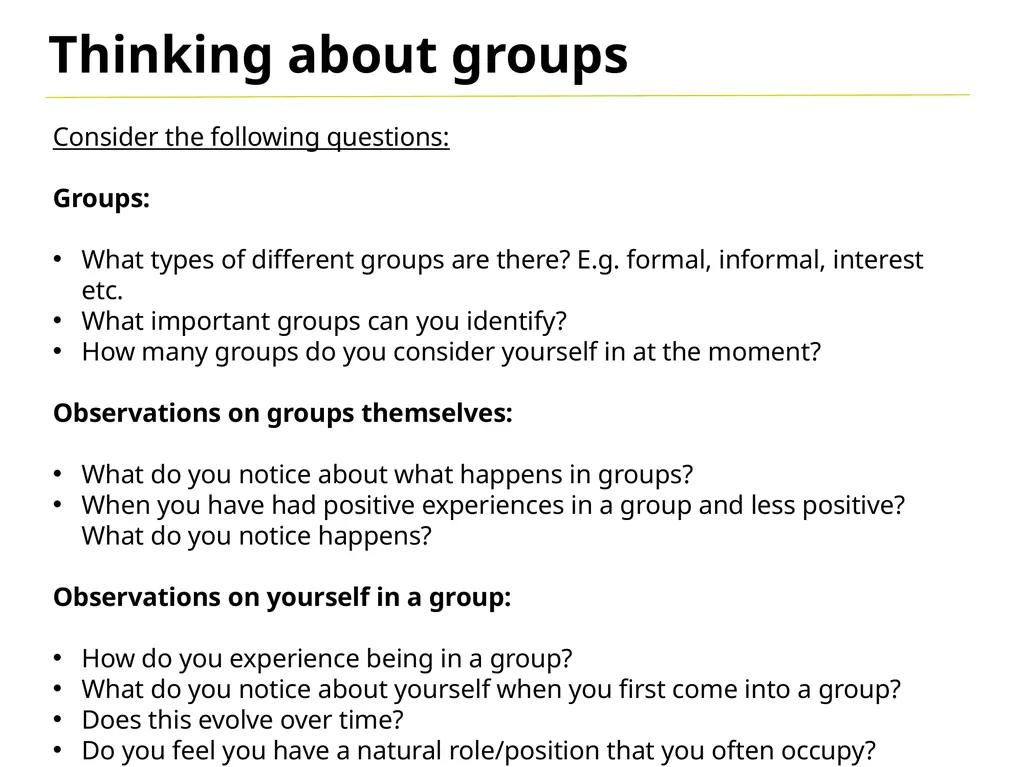
Consider the following questions:
Groups:
What types of different groups are there? E.g. formal, informal, interest etc.
What important groups can you identify?
How many groups do you consider yourself in at the moment?
Observations on groups themselves:
What do you notice about what happens in groups?
When you have had positive experiences in a group and less positive? What do you notice happens?
Observations on yourself in a group:
How do you experience being in a group?
What do you notice about yourself when you first come into a group?
Does this evolve over time?
Do you feel you have a natural role/position that you often occupy? Thinking about groups<br>
06
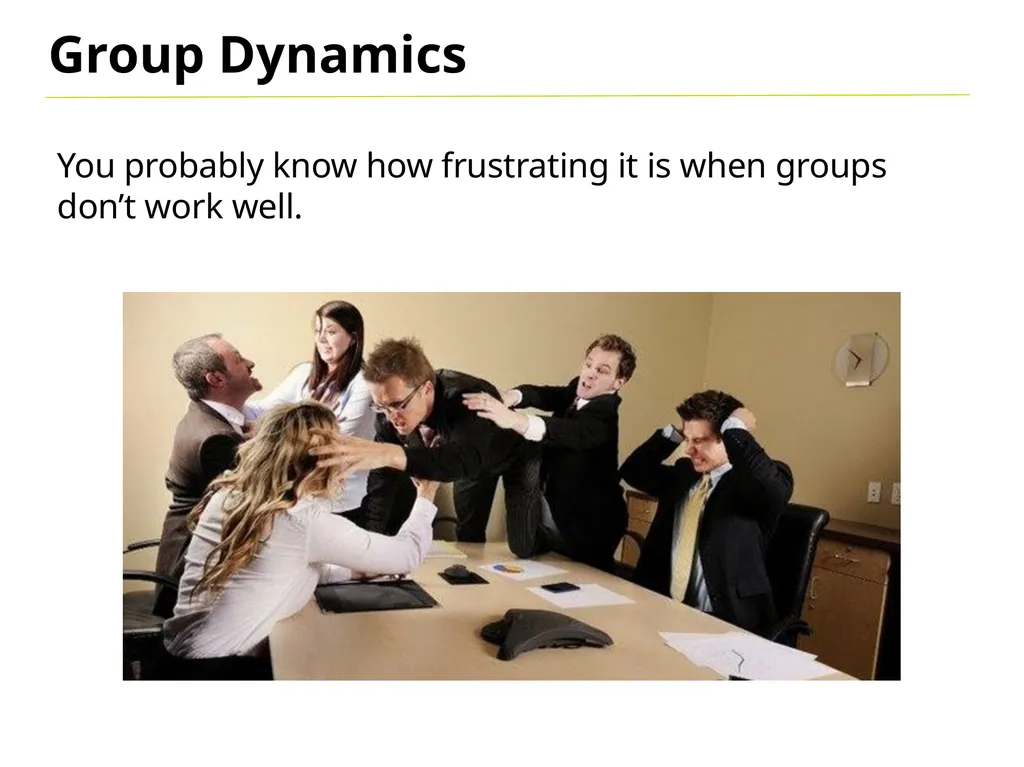
You probably know how frustrating it is when groups don’t work well. Group Dynamics<br>
07
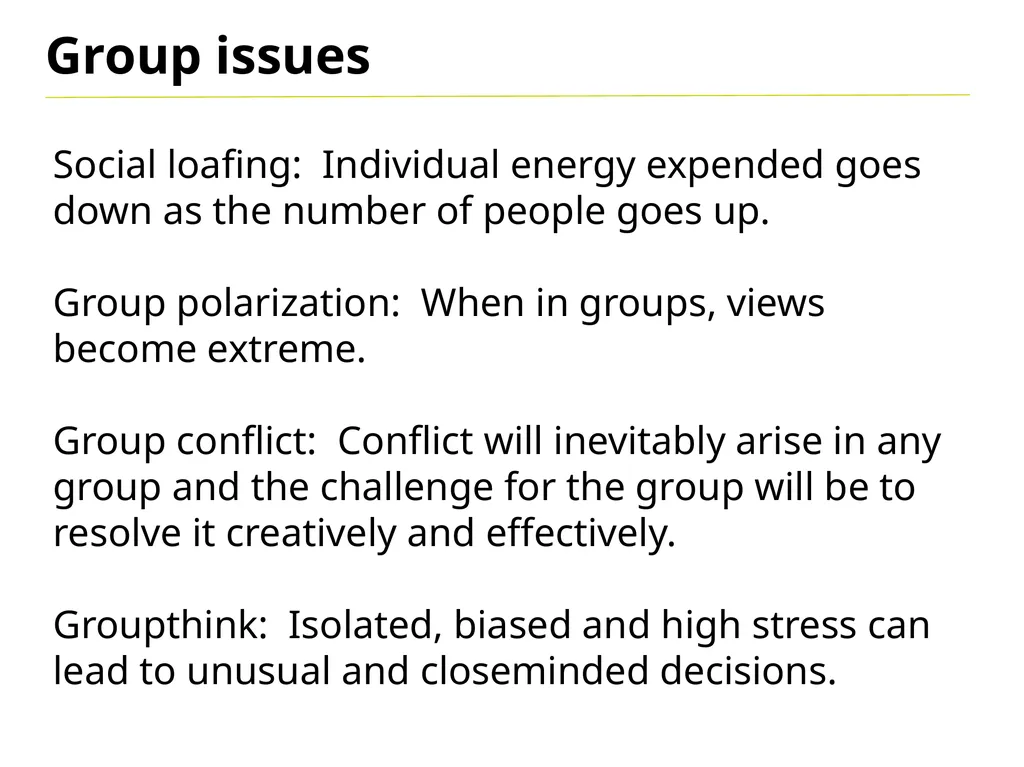
Group issues Social loafing: Individual energy expended goes down as the number of people goes up.
Group polarization: When in groups, views become extreme.
Group conflict: Conflict will inevitably arise in any group and the challenge for the group will be to resolve it creatively and effectively.
Groupthink: Isolated, biased and high stress can lead to unusual and closeminded decisions.<br>
08
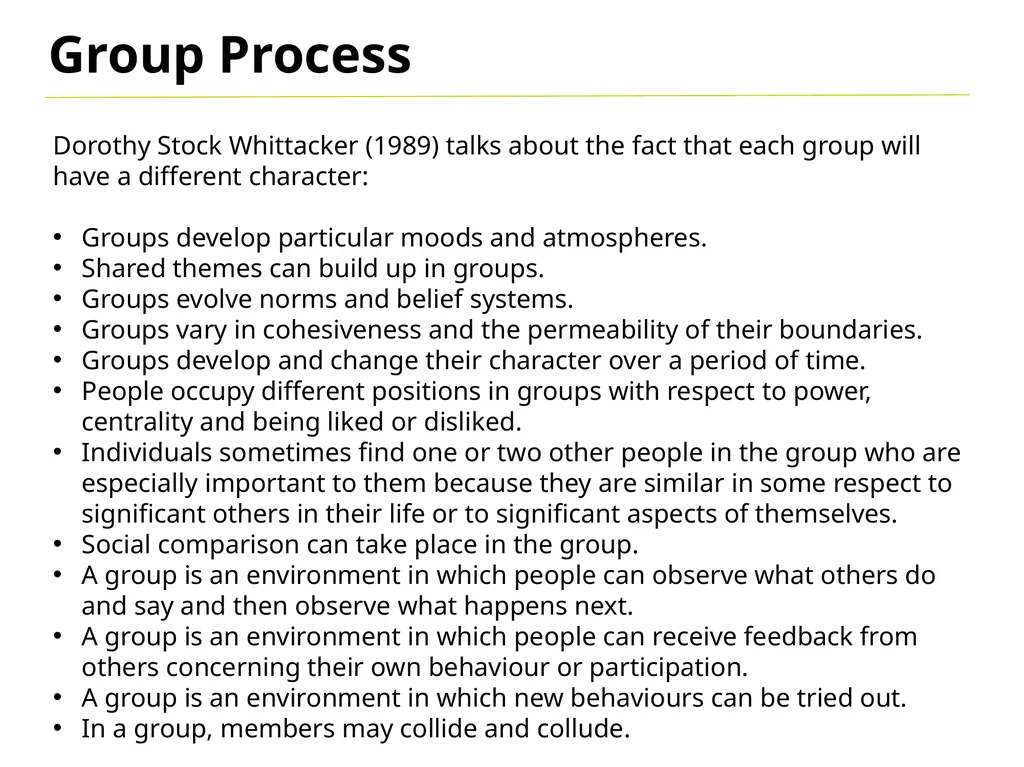
Dorothy Stock Whittacker (1989) talks about the fact that each group will have a different character:
Groups develop particular moods and atmospheres.
Shared themes can build up in groups.
Groups evolve norms and belief systems.
Groups vary in cohesiveness and the permeability of their boundaries.
Groups develop and change their character over a period of time.
People occupy different positions in groups with respect to power, centrality and being liked or disliked.
Individuals sometimes find one or two other people in the group who are especially important to them because they are similar in some respect to significant others in their life or to significant aspects of themselves.
Social comparison can take place in the group.
A group is an environment in which people can observe what others do and say and then observe what happens next.
A group is an environment in which people can receive feedback from others concerning their own behaviour or participation.
A group is an environment in which new behaviours can be tried out.
In a group, members may collide and collude. Group Process<br>
09
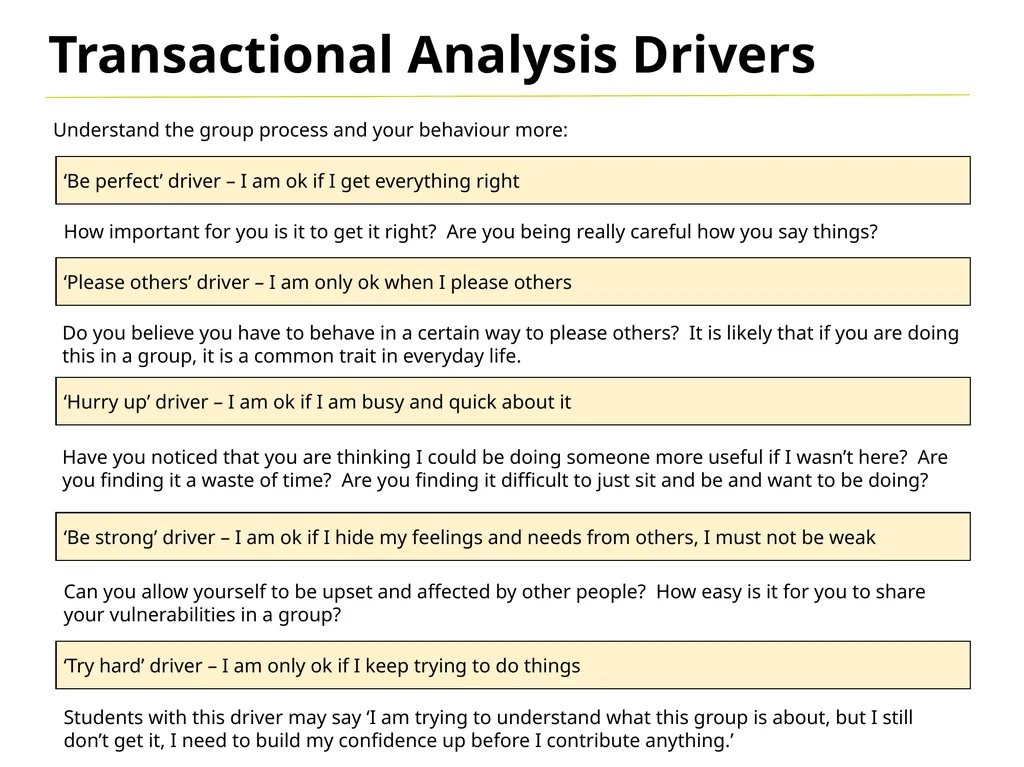
Understand the group process and your behaviour more: Transactional Analysis Drivers ‘Be perfect’ driver – I am ok if I get everything right How important for you is it to get it right? Are you being really careful how you say things? ‘Please others’ driver – I am only ok when I please others Do you believe you have to behave in a certain way to please others? It is likely that if you are doing this in a group, it is a common trait in everyday life. ‘Hurry up’ driver – I am ok if I am busy and quick about it Have you noticed that you are thinking I could be doing someone more useful if I wasn’t here? Are you finding it a waste of time? Are you finding it difficult to just sit and be and want to be doing? ‘Be strong’ driver – I am ok if I hide my feelings and needs from others, I must not be weak Can you allow yourself to be upset and affected by other people? How easy is it for you to share your vulnerabilities in a group? ‘Try hard’ driver – I am only ok if I keep trying to do things Students with this driver may say ‘I am trying to understand what this group is about, but I still don’t get it, I need to build my confidence up before I contribute anything.’<br>
10
Role negotiation (Roger Harrison) For each person, write a one word or short phrase to describe what you want more of and less of from them, and what you want maintained.<br>