“Growing South Africa together for a capable and

Published  . 0 views
↓ Download
“Growing South Africa together for a capable and
1 / 1
“Growing South Africa together for a capable and - slide 1 of 34 “Growing South Africa together for a capable and - slide 2 of 34 “Growing South Africa together for a capable and - slide 3 of 34 “Growing South Africa together for a capable and - slide 4 of 34 “Growing South Africa together for a capable and - slide 5 of 34 “Growing South Africa together for a capable and - slide 6 of 34 “Growing South Africa together for a capable and - slide 7 of 34 “Growing South Africa together for a capable and - slide 8 of 34 “Growing South Africa together for a capable and - slide 9 of 34 “Growing South Africa together for a capable and - slide 10 of 34 “Growing South Africa together for a capable and - slide 11 of 34 “Growing South Africa together for a capable and - slide 12 of 34 “Growing South Africa together for a capable and - slide 13 of 34 “Growing South Africa together for a capable and - slide 14 of 34 “Growing South Africa together for a capable and - slide 15 of 34 “Growing South Africa together for a capable and - slide 16 of 34 “Growing South Africa together for a capable and - slide 17 of 34 “Growing South Africa together for a capable and - slide 18 of 34 “Growing South Africa together for a capable and - slide 19 of 34 “Growing South Africa together for a capable and - slide 20 of 34 “Growing South Africa together for a capable and - slide 21 of 34 “Growing South Africa together for a capable and - slide 22 of 34 “Growing South Africa together for a capable and - slide 23 of 34 “Growing South Africa together for a capable and - slide 24 of 34 “Growing South Africa together for a capable and - slide 25 of 34 “Growing South Africa together for a capable and - slide 26 of 34 “Growing South Africa together for a capable and - slide 27 of 34 “Growing South Africa together for a capable and - slide 28 of 34 “Growing South Africa together for a capable and - slide 29 of 34 “Growing South Africa together for a capable and - slide 30 of 34 “Growing South Africa together for a capable and - slide 31 of 34 “Growing South Africa together for a capable and - slide 32 of 34 “Growing South Africa together for a capable and - slide 33 of 34 “Growing South Africa together for a capable and - slide 34 of 34
Description: Growing South Africa together for a capable and ethical Public Service Department of Public Service and Administration (DPSA) 1 Office of the Director-General BRANCH: PRESENTATION OUTLINE Introduction Performance on the implementation of

Related Topics

Download Presentation

"“Growing South Africa together for a capable and" is the property of its rightful owner. Permission is granted to download and print the materials on this website for personal, non-commercial use only, and to display it on your personal computer provided you do not modify the materials and that you retain all copyright notices contained in the materials. By downloading content from our website, you accept the terms of this agreement.

Presentation Transcript

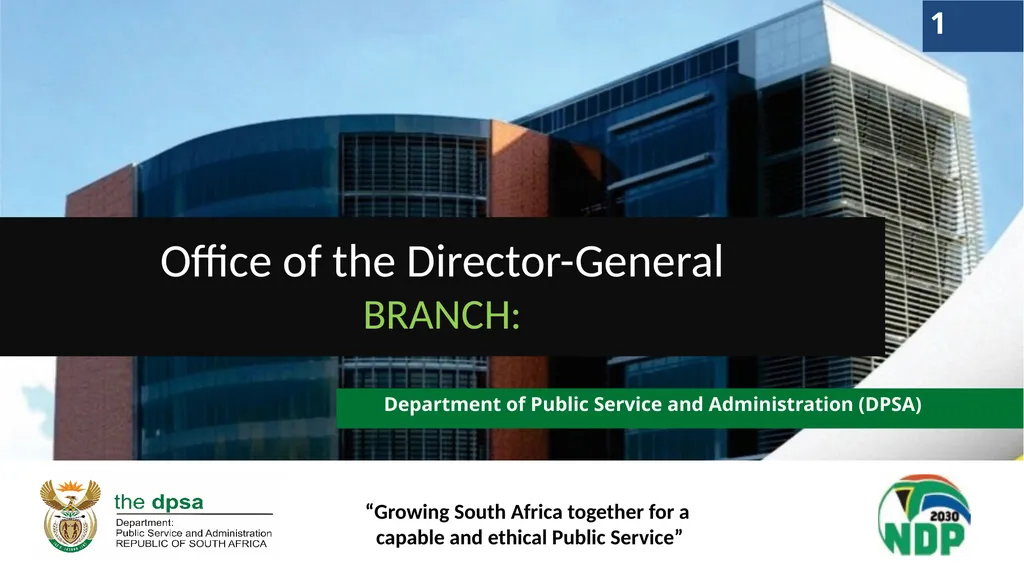
slide1. “Growing South Africa together for a
capable and ethical Public Service” Department of Public Service and Administration (DPSA) 1 Office of the Director-General
BRANCH:<br>
slide2. PRESENTATION OUTLINE Introduction

Performance on the implementation of the 2019/ APP Annual Targets

Financial Information

Human Resource Management Information 2<br>
slide3. INTRODUCTION The presentation focuses on the Department of Public Service and Administration’s (DPSA’s) 2019/20 Annual Report as Audited by the Auditor General of South Africa ( AGSA).

For the 2019/2020 the department has achieved a clean ( unqualified) Audit Opinion

The presentation covers the following areas;

Achievements against the implementation of the 2019/20 Annual Performance Plan (APP)
Financial Performance
Human Resource Information

The progress on the implementation of the APP annual targets is rated as Achieved or Not Achieved. 3<br>
slide4. PERFOMANCE INFORMATION 4<br>
slide5. OVERALL DPSA PERFORMANCE ON THE IMPLEMENTATION OF THE 2019/20 APP ANNUAL TARGETS 5<br>
slide6. SUMMARY OF CONSOLIDATED PERFORMANCE PER PROGRAMME 6<br>
slide7. PROGRAMME 1: ADMINISTRATION (2) ANNUAL TARGETS ACHIEVED The Programme had 6 Annual Targets and all 6 (100%) targets were achieved

The department complied with regards to the following submissions as regulated ;

1. The Interim and Annual Financial Statements were submitted to National Treasury

2. The Bi-annual reports on the compliance with the Broad-Based Black Economic Empowerment (BBBEE) status level of contributor as prescribed in the preferential procurement regulations 2017.

3. Quarterly reports on the implementation of the APP were submitted to relevant authorities.

4. Progress reports on the implementation of the Internal Audit and Risk Management plans with a specific focus on the audit of Human Resource, Asset Management, Supply Chain Management, Financial Statements and Information Technology.

5. The reports on the DPSA’s compliance to Financial Management, Human Resources and Labour Relations Prescripts were submitted. Among the things covered in the reports are areas of compliance such as strategic management, audit and risk management.

6. Quarterly reports on the implementation of the Department's Bi-lateral and Multi-lateral agreements and programmes were submitted 7<br>
slide8. PROGRAMME 2: POLICY DEVELOPMENT, RESEARCH & ANALYSIS (2) ANNUAL TARGETS ACHIEVED The Programme had 8 annual targets and achieved 7 (87%) of its Annual Targets.

1. The institutionalisation of selected aspects towards the draft regulations for the Office of Standards and Compliance ( OSC) was conducted through consultations held with national departments.

2. The business case on the structure and governance of the Office of Standards was compiled

As part of the approved Structure the OSC has been created as a Chief Directorate.

3. The Report on support provided to departments to improve on areas of non- compliance with Public Service legislative and regulatory prescripts as identified in the 2017/18 Auditor-General report developed . 8<br>
slide9. PROGRAMME 2: POLICY DEVELOPMENT, RESEARCH & ANALYSIS (2) ANNUAL TARGETS ACHIEVED The Report on the revised Public Administration Performance Information areas for inclusion in the Annual Report Format for auditing by the AG was produced

The Department has proposed the revision of a number of areas, including the following:
 
There should be reporting on information and communication technology (ICT) related expenditure.
Additional reporting should be required in area of anti-corruption and ethics emanating from Regulation 22 such as reporting on corruption and the designation of ethics officers to promote, advise and monitor ethical behaviour.
The format of questions relating to employee wellness.

The report on the implementation of recommendations made towards the establishment of a national administration to support the Public Administration Management Act was submitted

The recommendation arising from the research is that there should be legislative amendments effected to existing Acts to give meaning and effect to the NDP recommendations such as clearly defining what the definition of the National Administration, Provincial Administration and Local Administration are, as constitutionally intended.

The DPSA is supporting the Presidency in this work 9<br>
slide10. PROGRAMME 2: POLICY DEVELOPMENT, RESEARCH & ANALYSIS (2) ANNUAL TARGETS ACHIEVED The report on linking organisational productivity assessment with the Performance Management and Development System  (PMDS) was compiled

The purpose of linking of organisational productivity assessment with the PMDS is a key process towards the mainstreaming and entrenchment of productivity assessments in the Public Service, thus ensuring accountability.

The report on the state of readiness of departments to Organisational Functionality Assessment Tool was compiled

The report provides an assessed of the extent to which departments are ready to deploy Organisational Functionality Assessment Tool. The challenges experienced by departments in implementing the OFA Tool are, amongst others:

Lack of data integrity and document management systems
Lack of capacity and capability with departments to execute the Tool 10<br>
slide11. PROGRAMME 2: POLICY DEVELOPMENT, RESEARCH & ANALYSIS (3) NON-ACHIEVED ANNUAL TARGETS The following annual target was not achieved:

“Further consultation with selected national and provincial departments towards the legislative drafting of the draft White Paper for the Transformation and Modernisation of public administration conducted”

1.1. Reasons for non-achievement:

Although the draft White Paper for the Transformation and Modernisation of public administration was produced but it was not timeously submitted to the MPSA for approval before consultation on the document 11<br>
slide12. PROGRAMME 3: PUBLIC SERVICE EMPLOYMENT & CONDITIONS OF SERVICE (1) ANNUAL TARGETS ACHIEVED The Programme had achieved all 7 (100%) Annual Targets.

The report on the average percentage of funded
vacant posts on PERSAL was submitted.

The median vacancy rate in the 4th quarter
for the past 5 financial years has been
declining up to the 2018/19
financial year as reflected in the table below.

There has been a slight increase for the 4th
quarter of the 2019/20 financial year
to 10.28%. 12<br>
slide13. PROGRAMME 3: PUBLIC SERVICE EMPLOYMENT & CONDITIONS OF SERVICE (2) ANNUAL TARGETS ACHIEVED 2. Policy implementation support was provided to national departments and provincial administrations on the implementation of the revised SMS PMDS by a national workshop and 9 provincial workshops conducted.

The aim of the support is to address some of the challenges experienced by departments on the implementation of the revised PMDS to ensure that there is correct implementation and compliance.

The report on the Graduate Recruitment Scheme Framework was compiled

Some of the recommendations indicate that the state should have a common approach based on a strategy for recruiting dedicated young people, developing their skills and linking their career progression to performance.

Therefore, in line with the decentralised human resource management approach of the Public Service, the Framework provides an approach for departments on how to establish their departmental-based graduates’ recruitment schemes in line with their skills needs.

During the reporting period, the Framework was being piloted with 12 departments. Furthermore, a circular was issued to all national and provincial departments requesting them to fully implement the Framework. 13<br>
slide14. PROGRAMME 3: PUBLIC SERVICE EMPLOYMENT & CONDITIONS OF SERVICE (3) ANNUAL TARGETS ACHIEVED SELECTED ANALYSIS 4. The annual report on the appointment of persons into developmental programmes within the Public Service indicates that:

The total number of youth appointed in the developmental programmes from 2014 to 2019 is 178 434 and out of this number, 39 767 secured employment, either contract or permanent.

The 2019/20 data is not yet available, it will be presented during the quarter 4 of 2020/21 financial year 14<br>
slide15. PROGRAMME 3: PUBLIC SERVICE EMPLOYMENT & CONDITIONS OF SERVICE (2) ANNUAL TARGETS ACHIEVED The Programme had achieved all 7 (100%) Annual Targets.

5. Quarterly analysis reports on the average number of days taken to resolve disciplinary cases and precautionary suspension cases by national and provincial departments were compiled.

The five year trend on the average number of days taken to resolve disciplinary cases is depicted below. 15<br>
slide16. PROGRAMME 3: PUBLIC SERVICE EMPLOYMENT & CONDITIONS OF SERVICE (3) ANNUAL TARGETS ACHIEVED The reasons why departments have not complied with the prescribed 90 day period include the following;

The non-availability of the Chairpersons and initiators;
The diverse nature and complexity of cases;
Political interference; and
The lack of protection for key witnesses i.e. fraud and corruption related case.

 In order to ensure compliance with the prescribed 90 day period, the Department has undertaken the following initiatives:

Written letters to the Accounting Officers regarding non-compliance with the prescripts with regards to the failure to report and failure to finalise cases within 90 days;
Working with National Treasury to reconfigure the PERSAL system to allow for departments to capture cases for reporting and monitoring;
Established a pool of labour relations specialists to assist departments with chairpersons and initiators;
Rolling out a capacity building programme in conjunction with PSETA for initiators and chairpersons for disciplinary cases;
In conjunction with donor partners is developing an audit methodology to audit cases and assist in their finalisation; and
Continues to provide support, guidance and advice where required. 16<br>
slide17. PROGRAMME 3: PUBLIC SERVICE EMPLOYMENT & CONDITIONS OF SERVICE (4) ANNUAL TARGETS ACHIEVED 6. Quarterly reports on the implementation of the Government Employee Housing Scheme (GEHS) were submitted.

As at March 2020, 651 358 employees were receiving the GEHS housing allowance for home ownership and 261 964 employees who do not own houses were also receiving GEHS allowance for renting .

A total of R8.6 billion was saved in the Individual Linked Savings Facility.

7. The report of the establishment of the housing finance solution for the GEHS has been produced 17<br>
slide18. PROGRAMME 4: GOVERNMENT CHIEF INFORMATION OFFICER (1) ANNUAL TARGETS ACHIEVED The Programme achieved all its 4 (100%) 2019/20 Annual Targets as follows:

The priority e-Government initiatives to support digital transformation for the public administration was submitted by the required deadlines.

Public Service Information Security Standard submitted as required

The revised Corporate Governance of ICT Policy Framework was also submitted. 18<br>
slide19. PROGRAMME 4: GOVERNMENT CHIEF INFORMATION OFFICER (2) ANNUAL TARGETS ACHIEVED 4. The report on ICT expenditure by all national and provincial departments in managing the cost related to information technology (IT) procurement within the Public Service indicates that above 40 billion has been spent since 2015- 2018/19 financial years. ICT expenditure of 2018-19 has recorded an increase of 11% compared to the base ICT expenditure of 2017-18.

The reasons for the increase among others are:

Networks and Hardware which have recorded the highest expenditures for all National and Provincial departments

In addition, the continuous increase in ICT expenditure can be attributed to, inter-aliar:

Cost of ICT operational support
Upgrades of equipment and systems
Security software installations. 19<br>
slide20. PROGRAMME 5: SERVICE DELIVERY SUPPORT (1) ANNUAL TARGETS ACHIEVED The Programme had achieved all 6 (100%) of its Annual Targets:

1. The report on the implementation of the Operations Management Framework by 3 prioritised departments Human Settlement, Energy and the South African Social Security Agency was developed
 
The report indicates that 112 departments were implementing the Operations Management Framework as an effort to promote efficiency and effectiveness in service delivery.
The key findings are the following:
There has been an increase in capacity, departmental support, document management and implementation plans as compared to the previous year
A majority of departments have not institutionalised the Operation Management Framework

2. The report on the institutionalisation of the framework for the establishment, promotion and maintenance of service centres was submitted by the required deadlines.

3. The Service Delivery Model (SDM) for the Public Service was developed and submitted to the Director-General.

The aim of the SDM was to guide departments implementation service delivery to our citizen 20<br>
slide21. PROGRAMME 5: SERVICE DELIVERY SUPPORT (2) ANNUAL TARGETS ACHIEVED 21<br>
slide22. PROGRAMME 5: SERVICE DELIVERY SUPPORT (3) ANNUAL TARGETS ACHIEVED 5. The report on implementation of the Batho Pele standards by all national and provincial departments was submitted.

The Batho Pele standards were developed in 2015 as part of the MTSF 2009 – 14, and piloted in six departments, viz., Department of Employment and Labour, Department of Health, Department of Basic Education, Department of Transport, Department of Social Development and the Department of Human Settlements.

The Implementation of the Batho Pele Standards is part of the National Government’s of action under the current Medium Term Strategic Framework (MTSF) 2019 – 24, and is based on the quest for improvement in the provision of key services to communities.

As part of the improvement effort, the implementation of the Medium Term Strategic Framework (MTSF) 2019 – 24 programme of action has identifies the implementation of Batho Pele principles and standards as one of the government projects. Standards aim at improving service delivery through increasing government official’s response to the needs of the citizen.

Continuing from the 6 pilot departments, viz., department of Basic Education, Health, Human Settlements, Labour, Social Development and Transport, the project was extended to all service departments and some municipalities 22<br>
slide23. PROGRAMME 5: SERVICE DELIVERY SUPPORT (4) ANNUAL TARGETS ACHIEVED 6. The report on the inspections and unannounced visits conducted at service sites was complied

After capacitating relevant departments, the DPSA embarked on monitoring the implementation of Complaints Management System, Public Service Charter and overall implementation of Batho Pele through announced and unannounced sites visits.

The following assessments and observations were made during the visits;
As defined in the PSCBC Resolution 1 of 2013, the Public Service Charter is the social contract, commitment and agreement between the State and public servants.. The Charter further enables citizens to understand what they can expect from the State and will form the basis for engagement between government and citizens or organs of civil society –

The public service charter is not effectively implemented due to poor understanding of the charter coupled with the absence of leadership commitment.

Key findings in relation to the implementation of complaints management systems is that the progress at a snail’s pace. due to the lack of leadership commitment because complaints management policies and standard operating procedures are not in place.

Reports are also not compiled to enable departments to understand the experiences and needs of the citizens so that the complaints data can be used to effect improvements and improve planning and delivery of services 23<br>
slide24. PROGRAMME 6: GOVERNANCE OF PUBLIC ADMINISTRATION (1) ANNUAL TARGETS ACHIEVED 24 The Programme has achieved all its 4 (100%) of Annual Targets;

The proposal on the establishment of the Head of the National Administration and Head of the Public Service was developed
Among the issues raised in the proposal is the establishment of the specialised Service Delivery Unit/ Project Office Bureau for the purposes of service delivery imperatives.

The Guidelines to support the implementation of the revised Determination on Other Remunerative Work was developed

3. The report on the adherence by Public Service employees in national and provincial departments to the Directive on conducting business with an organ of state

The report shows, that some departments identified public officials who did not resign from the Public Service, but are still continuing to conduct business with an organ of state.

The DPSA will continue remind departments of their responsibility to take disciplinary action against those officials who have not resigned but are still doing business with the an organ of state.

.<br>
slide25. PROGRAMME 6: GOVERNANCE OF PUBLIC ADMINISTRATION (2) ANNUAL TARGETS ACHIEVED 2. The report on the adherence by designated employees from national and provincial departments to the legislative framework regarding the electronic disclosure of financial interests (e-Disclosure system) indicates that;

There has been some improvements in the adherence/compliance rate by designated employees across all categories but 100% adherence has not yet been achieved as projected. Departments are expected to implement disciplinary measures against non-adherence employees so that 100% is achieved.

The DPSA will continue to remind the affected departments of the expectation to achieved 100% compliance rate. 25<br>
slide26. FINANCIAL INFORMATION 26<br>
slide27. TOTAL EXPENDITURE PER PROGRAMME 27<br>
slide28. TOTAL EXPENDITURE PER ECONOMIC CLASSIFICATION 28<br>
slide29. OTHER FINANCIAL INFORMATION 29 Transfers and Subsidies:

Expenditure as at the end of financial year amounted to R508, 244 million or 99.9% of the allocated budget of R508, 502 million. These are mainly transfers to National School of Government, the Public Service Commission, the Centre for Public Service Innovation as well as transfer to foreign Organisation and international organisations. The transfers also include payments made to household in respect of the leave gratuities.

Payments for Capital Assets

Expenditure as at end of the financial year is 3,262 million or 71.2% of the allocated budget of R4, 579 million.

30 Days - No payment exceeded the 30 days period during the 2019/20 financial year.

Unauthorised expenditure - No unauthorised expenditure was incurred during the 2019/20 financial year.

Fruitless and wasteful expenditure – No fruitless and wasteful expenditure was incurred during the 2019/20 financial year.

Irregular expenditure - No irregular and unauthorized expenditure reported during the 2019/20 financial year.<br>
slide30. HUMAN RESOURCE MANAGEMENT (1) 30 As at 31 March 2020, the employment and vacancies by salary band was as follows:


As at March 2020, the Department had a vacancy rate of 13.4%. The vacancy rate fluctuates as a result of retirement, transfers, resignations, discharged due to ill-health and dismissals.
In addition, due to the reduced compensation budget by the National Treasury, the Department has prioritised fewer posts to be filled.<br>
slide31. HUMAN RESOURCE MANAGEMENT INFROMATION (2) 31<br>
slide32. HUMAN RESOURCE MANAGEMENT INFROMATION (2) 32<br>
slide33. HUMAN RESOURCE MANAGEMENT INFROMATION (3) The high vacancy is as a result of the filling of posts being put hold until the Revised Structure has been approved

Post the approval of the MACRO organisational structure by the Minister in December 2019, the department has developed a recruitment plan for the filling of all the vacant posts

Significant progress has been made to date on the filling of the posts in line with the recruitment during the current MTEF period

The targeting of SMS Women appointments is being prioritized to achieve the National Target of 50% 50%. 33<br>
slide34. 34<br>