
Guide to the 2X Criteria Version 2.0 June 2022
LS
Published · 70 slides · 0 views

1 / 1
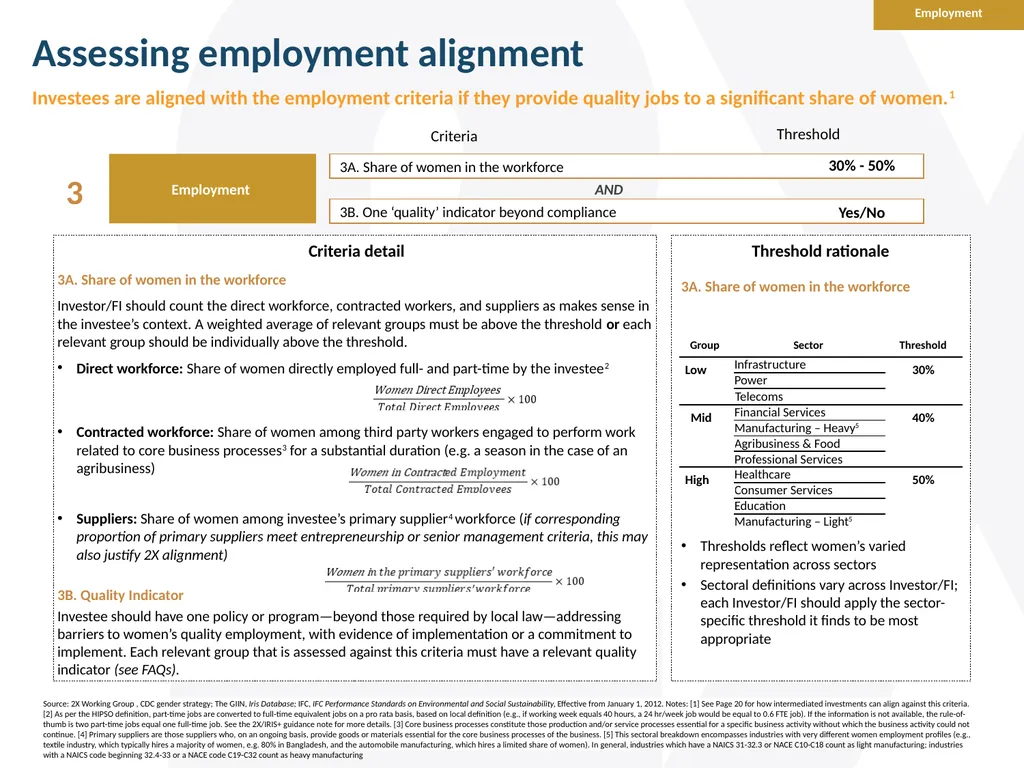
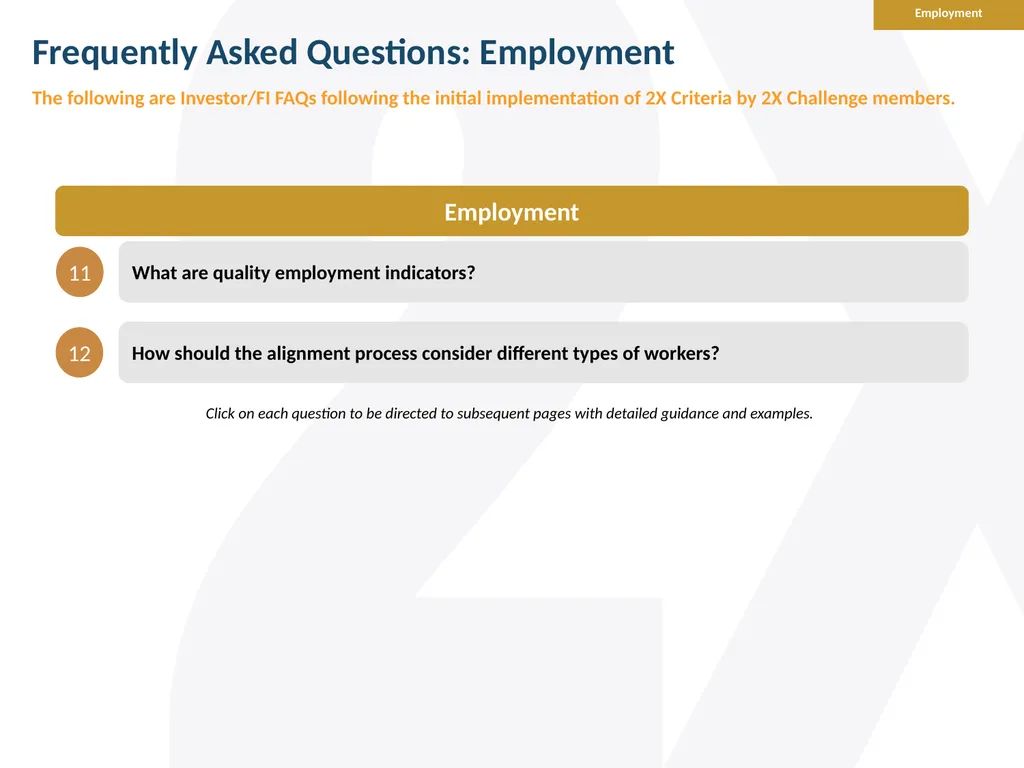

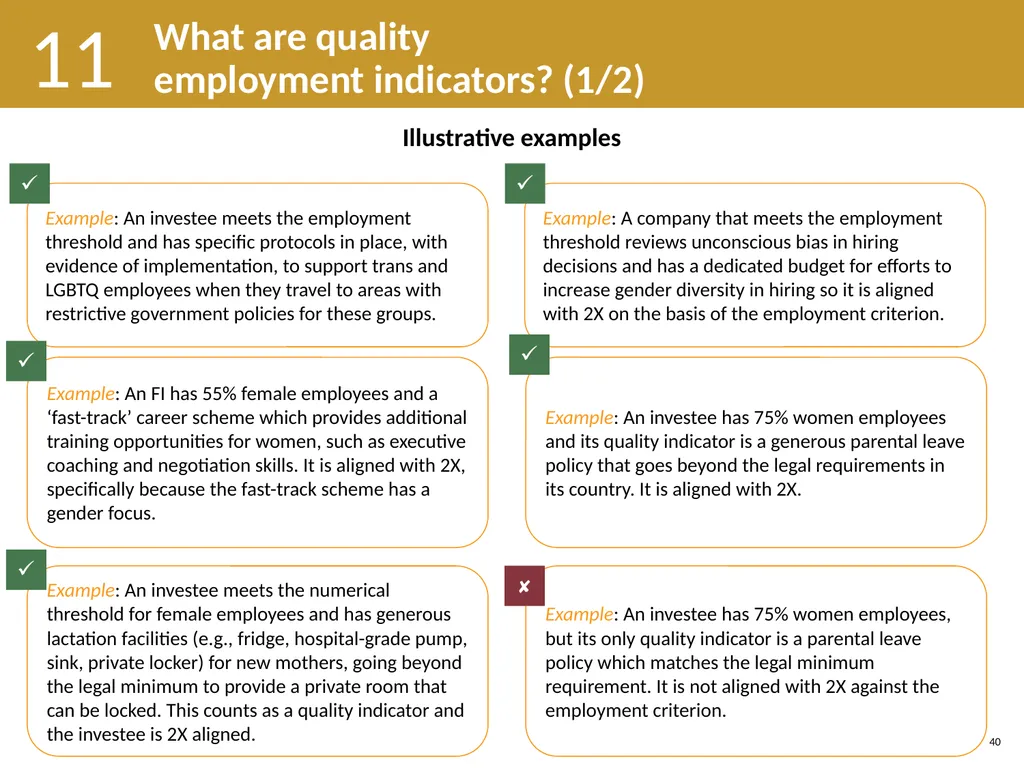
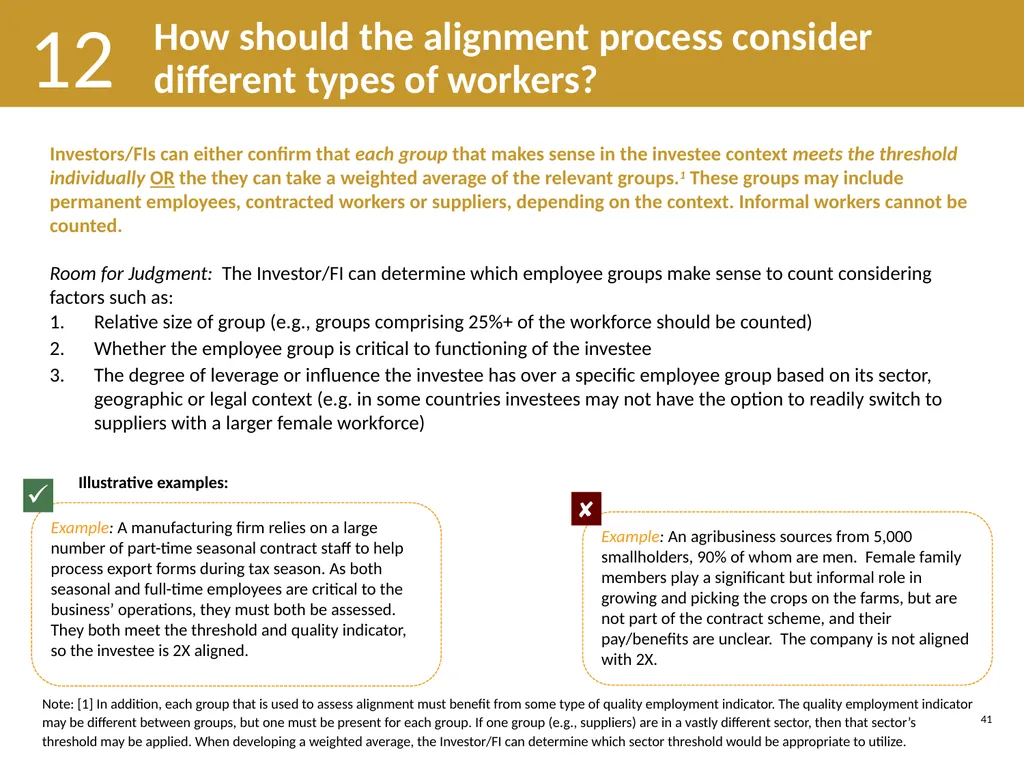




Description
Guide to the 2X Criteria Version 2.0 June 2022 Image Source: 2X Supported By 2 Acknowledgements Version 1.0 of this guide to the 2X Criteria has been adapted from an internal guidance document for 2X Challenge Members written by Dalberg
Related Topics
Share
Embed code
Download this presentation From Below
"Guide to the 2X Criteria Version 2.0 June 2022" is the property of its rightful owner. Permission is granted to download and print the materials on this website for personal, non-commercial use only, and to display it on your personal computer provided you do not modify the materials and that you retain all copyright notices contained in the materials. By downloading content from our website, you accept the terms of this agreement.
Presentation Transcript
01
Guide to the 2X Criteria
Version 2.0
June 2022 Image Source: 2X Supported By<br>
02
2 Acknowledgements Version 1.0 of this guide to the 2X Criteria has been adapted from an internal guidance document for 2X Challenge Members written by Dalberg Advisors, with significant technical input from the 2X Challenge Working Group, particularly Anne-Marie Lévesque and Majid Mirza of FinDev Canada and Arpita Raksit and Sonia Jordan-Kirwan of CDC Group (now BII).
Version 2.0 was released in June 2021 to reflect 2X Challenge members’ new interpretation of the 2X Criteria for the 2021-2022 period. This version was developed with significant technical input from Anne-Marie Lévesque of FinDev Canada, Jessica Espinoza Trujano of DEG, Alec Paxton of DFC and Jen Braswell of BII.
New guidance on Criterion 4, Consumption, especially for investments in infrastructure was made possible by significant support from the European Investment Bank (EIB).<br>
Version 2.0 was released in June 2021 to reflect 2X Challenge members’ new interpretation of the 2X Criteria for the 2021-2022 period. This version was developed with significant technical input from Anne-Marie Lévesque of FinDev Canada, Jessica Espinoza Trujano of DEG, Alec Paxton of DFC and Jen Braswell of BII.
New guidance on Criterion 4, Consumption, especially for investments in infrastructure was made possible by significant support from the European Investment Bank (EIB).<br>
03
3 About the 2X Challenge The 2X Challenge was launched in June 2018 as a major new commitment of the development finance institutions (DFIs) from the G7 countries (CDP, CDC Group, FinDev Canada, Proparco, DEG, JBIC/JICA and OPIC, now DFC) to unlock resources that will help advance women’s economic empowerment and gender equality.
These DFIs have since been supporting investments and initiatives that provide women in developing countries with access to leadership opportunities, quality forms of employment, finance, enterprise support, as well as products and services that enhance the inclusion or economic participation of women and girls. The 2X Criteria was developed with the support of Dalberg Advisors to help members identify such investments and initiatives.
Since the launch, seven new DFI members have joined to expand the commitment: BIO-Invest, Finnfund, FMO, IFU, SIFEM, OeEB, and Swedfund. The EIB became the first multi-lateral development bank (MDB) to join the 2X Challenge in 2019, followed by the IFC and the EBRD in 2021.
For further information and feedback, please use the 2X Challenge contact form: https://www.2xchallenge.org/contact<br>
These DFIs have since been supporting investments and initiatives that provide women in developing countries with access to leadership opportunities, quality forms of employment, finance, enterprise support, as well as products and services that enhance the inclusion or economic participation of women and girls. The 2X Criteria was developed with the support of Dalberg Advisors to help members identify such investments and initiatives.
Since the launch, seven new DFI members have joined to expand the commitment: BIO-Invest, Finnfund, FMO, IFU, SIFEM, OeEB, and Swedfund. The EIB became the first multi-lateral development bank (MDB) to join the 2X Challenge in 2019, followed by the IFC and the EBRD in 2021.
For further information and feedback, please use the 2X Challenge contact form: https://www.2xchallenge.org/contact<br>
04
4 The 2X Criteria were developed in 2018 to help 2X Challenge members identify which transactions could be reported towards the common $3 billion target in investments that benefit women. Since their launch, the criteria have emerged as a go-to standard for gender lens investing for DFIs and other investors.
In the now 2+ years of applying the 2X Criteria, 2X members have come to recognize the criteria’s many strengths, but also areas for improvement. In line with the iterative approach outlined in the original criteria guidance, 2X Challenge members have agreed on certain adjustments to their interpretation of the 2X Criteria for the next phase of the 2X Challenge (2021-2022).
These adjustments aim to strike the right balance between the need to set the bar correctly to reward good performance and encourage long-term behavioral shifts with investees, but also the need for the 2X Criteria to remain user-friendly for members and other users across the investment industry.
While this new interpretation does not formally change the 2X Criteria (nor 2X qualifications made before June 2021), 2X Challenge members strongly encourage investors and financial institutions wishing to align their investments with the 2X Criteria to adopt it. More detailed explanations and interpretation guidance on the adjustments are available in this document, especially in sections dedicated to the Leadership and Indirect criteria. About the 2021-2022 interpretation of the 2X Criteria<br>
In the now 2+ years of applying the 2X Criteria, 2X members have come to recognize the criteria’s many strengths, but also areas for improvement. In line with the iterative approach outlined in the original criteria guidance, 2X Challenge members have agreed on certain adjustments to their interpretation of the 2X Criteria for the next phase of the 2X Challenge (2021-2022).
These adjustments aim to strike the right balance between the need to set the bar correctly to reward good performance and encourage long-term behavioral shifts with investees, but also the need for the 2X Criteria to remain user-friendly for members and other users across the investment industry.
While this new interpretation does not formally change the 2X Criteria (nor 2X qualifications made before June 2021), 2X Challenge members strongly encourage investors and financial institutions wishing to align their investments with the 2X Criteria to adopt it. More detailed explanations and interpretation guidance on the adjustments are available in this document, especially in sections dedicated to the Leadership and Indirect criteria. About the 2021-2022 interpretation of the 2X Criteria<br>
05
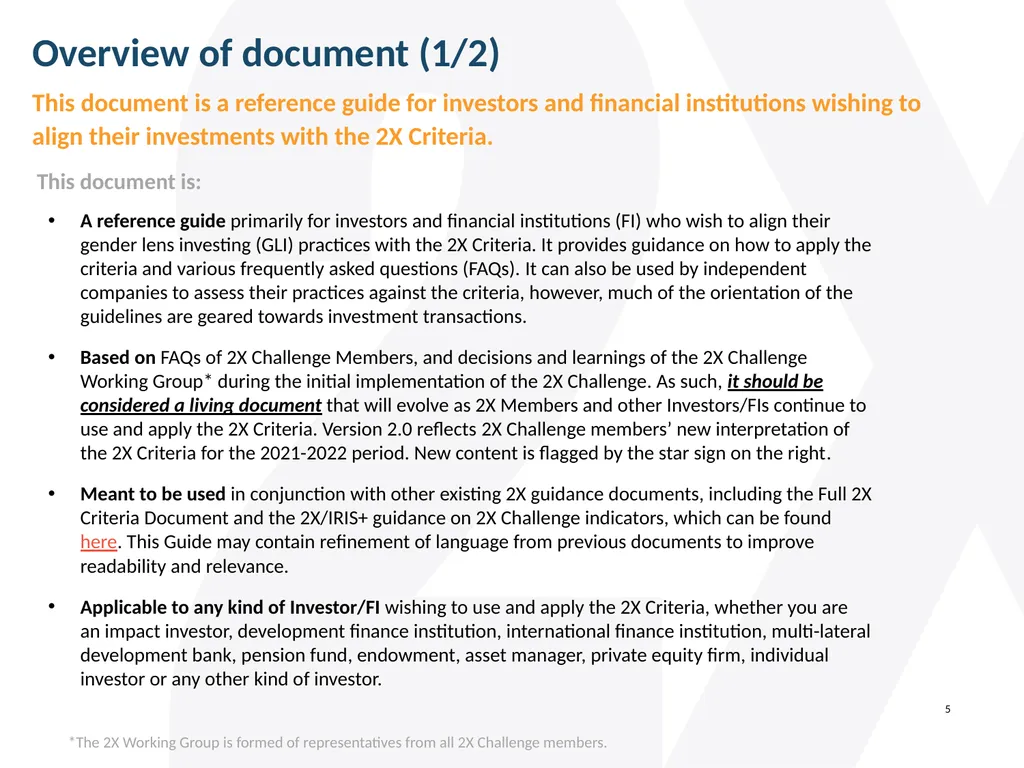
Overview of document (1/2) 5 This document is a reference guide for investors and financial institutions wishing to align their investments with the 2X Criteria. This document is: A reference guide primarily for investors and financial institutions (FI) who wish to align their gender lens investing (GLI) practices with the 2X Criteria. It provides guidance on how to apply the criteria and various frequently asked questions (FAQs). It can also be used by independent companies to assess their practices against the criteria, however, much of the orientation of the guidelines are geared towards investment transactions.
Based on FAQs of 2X Challenge Members, and decisions and learnings of the 2X Challenge Working Group* during the initial implementation of the 2X Challenge. As such, it should be considered a living document that will evolve as 2X Members and other Investors/FIs continue to use and apply the 2X Criteria. Version 2.0 reflects 2X Challenge members’ new interpretation of the 2X Criteria for the 2021-2022 period. New content is flagged by the star sign on the right.
Meant to be used in conjunction with other existing 2X guidance documents, including the Full 2X Criteria Document and the 2X/IRIS+ guidance on 2X Challenge indicators, which can be found here. This Guide may contain refinement of language from previous documents to improve readability and relevance.
Applicable to any kind of Investor/FI wishing to use and apply the 2X Criteria, whether you are an impact investor, development finance institution, international finance institution, multi-lateral development bank, pension fund, endowment, asset manager, private equity firm, individual investor or any other kind of investor. *The 2X Working Group is formed of representatives from all 2X Challenge members.<br>
Based on FAQs of 2X Challenge Members, and decisions and learnings of the 2X Challenge Working Group* during the initial implementation of the 2X Challenge. As such, it should be considered a living document that will evolve as 2X Members and other Investors/FIs continue to use and apply the 2X Criteria. Version 2.0 reflects 2X Challenge members’ new interpretation of the 2X Criteria for the 2021-2022 period. New content is flagged by the star sign on the right.
Meant to be used in conjunction with other existing 2X guidance documents, including the Full 2X Criteria Document and the 2X/IRIS+ guidance on 2X Challenge indicators, which can be found here. This Guide may contain refinement of language from previous documents to improve readability and relevance.
Applicable to any kind of Investor/FI wishing to use and apply the 2X Criteria, whether you are an impact investor, development finance institution, international finance institution, multi-lateral development bank, pension fund, endowment, asset manager, private equity firm, individual investor or any other kind of investor. *The 2X Working Group is formed of representatives from all 2X Challenge members.<br>
06
Overview of document (2/2) 6 This document is a reference guide for investors and financial institutions wishing to align their investments with the 2X Criteria. This document is NOT: Meant to be read end-to-end. Investors/FIs should utilize this as a reference guide to locate information on specific topics within each of the criteria.
Meant to grant investors, financial institutions and companies the ability to qualify investments for the 2X Challenge, which is the sole prerogative of 2X Challenge Members. Use of this guide does not imply endorsement of an investment or a company by the 2X Challenge or its Members. For further information and feedback about this Guide, please use the 2X Challenge contact form: https://www.2xchallenge.org/contact<br>
Meant to grant investors, financial institutions and companies the ability to qualify investments for the 2X Challenge, which is the sole prerogative of 2X Challenge Members. Use of this guide does not imply endorsement of an investment or a company by the 2X Challenge or its Members. For further information and feedback about this Guide, please use the 2X Challenge contact form: https://www.2xchallenge.org/contact<br>
07
8 The 2X Criteria
and Overall Guidance<br>
and Overall Guidance<br>
08
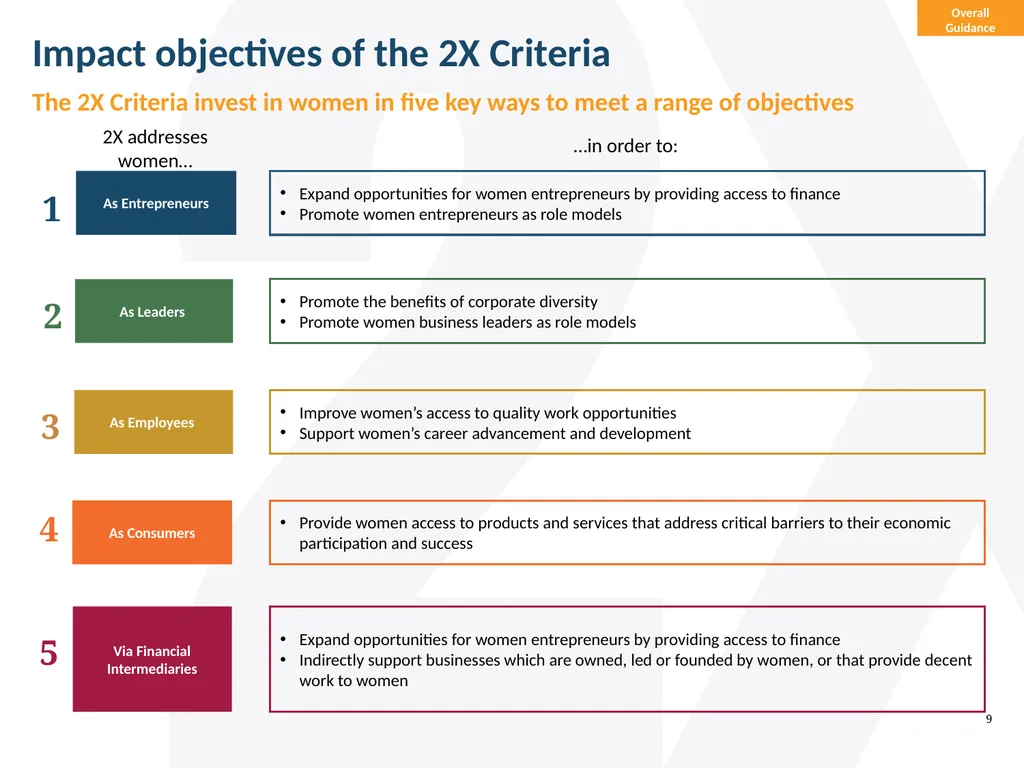
9 Impact objectives of the 2X Criteria The 2X Criteria invest in women in five key ways to meet a range of objectives As Entrepreneurs 1 As Leaders 2 As Employees 3 As Consumers 4 Via Financial Intermediaries 5 Expand opportunities for women entrepreneurs by providing access to finance
Promote women entrepreneurs as role models Promote the benefits of corporate diversity
Promote women business leaders as role models Improve women’s access to quality work opportunities
Support women’s career advancement and development Provide women access to products and services that address critical barriers to their economic participation and success Expand opportunities for women entrepreneurs by providing access to finance
Indirectly support businesses which are owned, led or founded by women, or that provide decent work to women …in order to: 2X addresses women… Overall Guidance<br>
Promote women entrepreneurs as role models Promote the benefits of corporate diversity
Promote women business leaders as role models Improve women’s access to quality work opportunities
Support women’s career advancement and development Provide women access to products and services that address critical barriers to their economic participation and success Expand opportunities for women entrepreneurs by providing access to finance
Indirectly support businesses which are owned, led or founded by women, or that provide decent work to women …in order to: 2X addresses women… Overall Guidance<br>
09
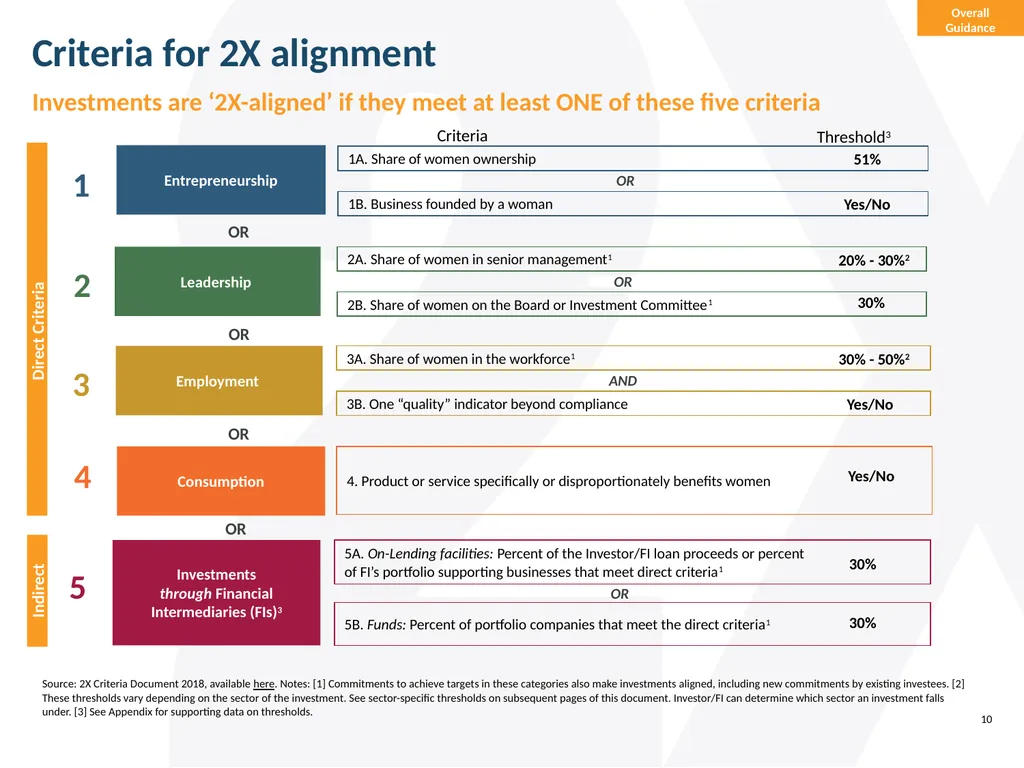
Source: 2X Criteria Document 2018, available here. Notes: [1] Commitments to achieve targets in these categories also make investments aligned, including new commitments by existing investees. [2] These thresholds vary depending on the sector of the investment. See sector-specific thresholds on subsequent pages of this document. Investor/FI can determine which sector an investment falls under. [3] See Appendix for supporting data on thresholds. OR OR Direct Criteria Criteria Threshold3 51% Yes/No 20% - 30%2 30% 30% - 50%2 Yes/No Indirect Criteria for 2X alignment Investments are ‘2X-aligned’ if they meet at least ONE of these five criteria 30% 30% 10 Overall Guidance Yes/No<br>
10
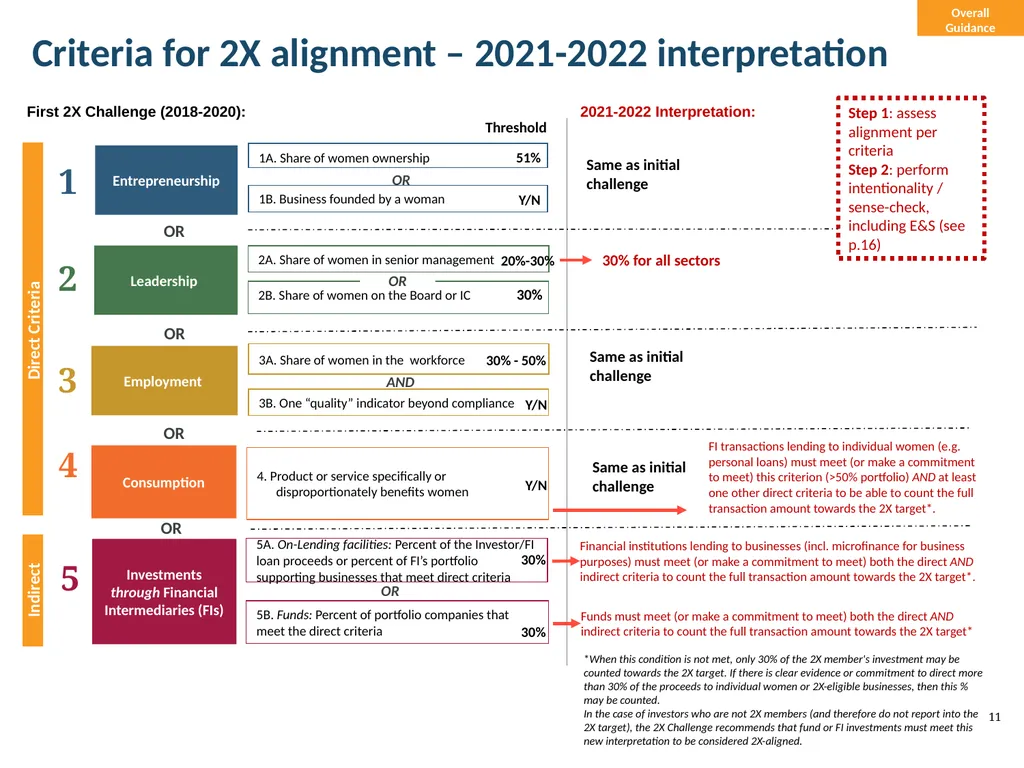
30% for all sectors Financial institutions lending to businesses (incl. microfinance for business purposes) must meet (or make a commitment to meet) both the direct AND indirect criteria to count the full transaction amount towards the 2X target*. 2021-2022 Interpretation: FI transactions lending to individual women (e.g. personal loans) must meet (or make a commitment to meet) this criterion (>50% portfolio) AND at least one other direct criteria to be able to count the full transaction amount towards the 2X target*. Same as initial challenge Same as initial challenge Same as initial challenge *When this condition is not met, only 30% of the 2X member's investment may be counted towards the 2X target. If there is clear evidence or commitment to direct more than 30% of the proceeds to individual women or 2X-eligible businesses, then this % may be counted.
In the case of investors who are not 2X members (and therefore do not report into the 2X target), the 2X Challenge recommends that fund or FI investments must meet this new interpretation to be considered 2X-aligned. First 2X Challenge (2018-2020): Funds must meet (or make a commitment to meet) both the direct AND indirect criteria to count the full transaction amount towards the 2X target* OR OR Direct Criteria Threshold 51% Y/N 20%-30% 30% 30% - 50% Y/N Indirect 30% 30% Y/N Criteria for 2X alignment – 2021-2022 interpretation Overall Guidance Step 1: assess alignment per criteria
Step 2: perform intentionality / sense-check, including E&S (see p.16) 11<br>
In the case of investors who are not 2X members (and therefore do not report into the 2X target), the 2X Challenge recommends that fund or FI investments must meet this new interpretation to be considered 2X-aligned. First 2X Challenge (2018-2020): Funds must meet (or make a commitment to meet) both the direct AND indirect criteria to count the full transaction amount towards the 2X target* OR OR Direct Criteria Threshold 51% Y/N 20%-30% 30% 30% - 50% Y/N Indirect 30% 30% Y/N Criteria for 2X alignment – 2021-2022 interpretation Overall Guidance Step 1: assess alignment per criteria
Step 2: perform intentionality / sense-check, including E&S (see p.16) 11<br>
11
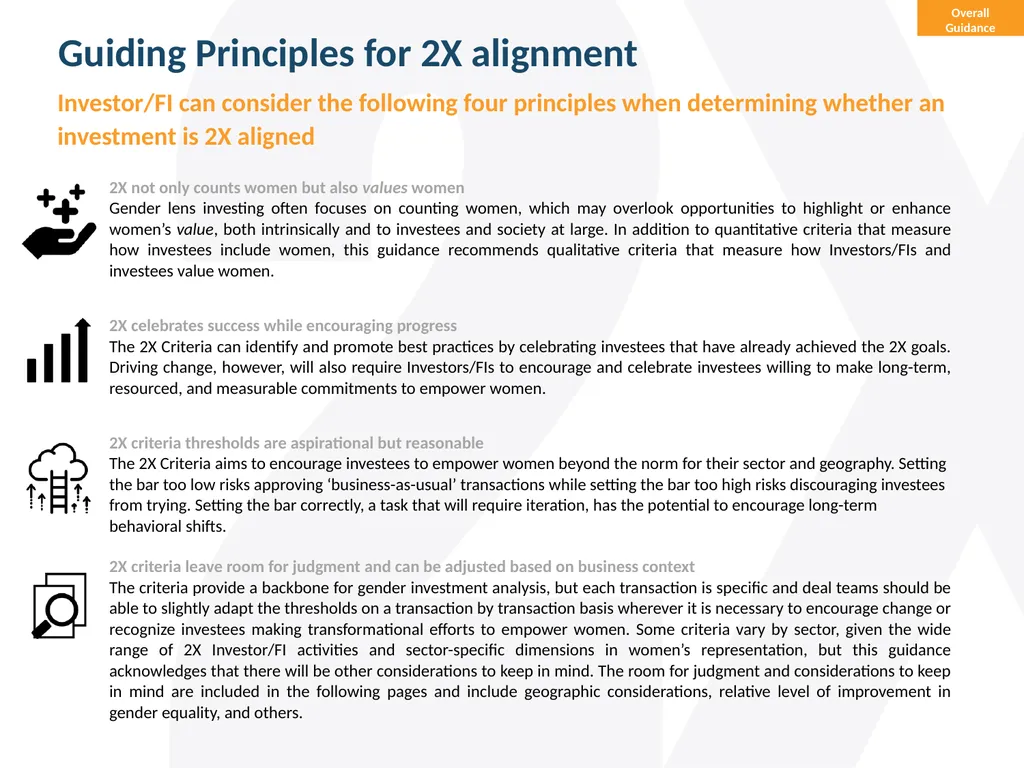
Guiding Principles for 2X alignment 12 Investor/FI can consider the following four principles when determining whether an investment is 2X aligned Overall Guidance<br>
12
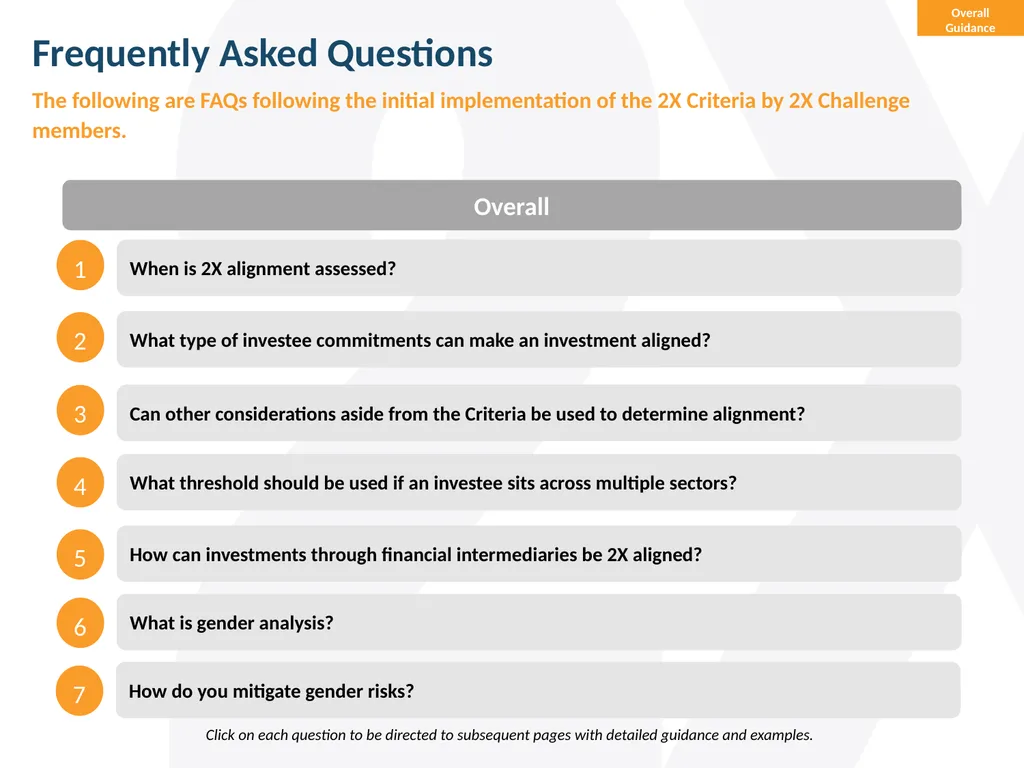
Frequently Asked Questions 13 The following are FAQs following the initial implementation of the 2X Criteria by 2X Challenge members. Overall When is 2X alignment assessed? What type of investee commitments can make an investment aligned? How can investments through financial intermediaries be 2X aligned? 1 3 5 2 Can other considerations aside from the Criteria be used to determine alignment? Click on each question to be directed to subsequent pages with detailed guidance and examples. Overall Guidance 4 What threshold should be used if an investee sits across multiple sectors? What is gender analysis? 6 How do you mitigate gender risks? 7<br>
13
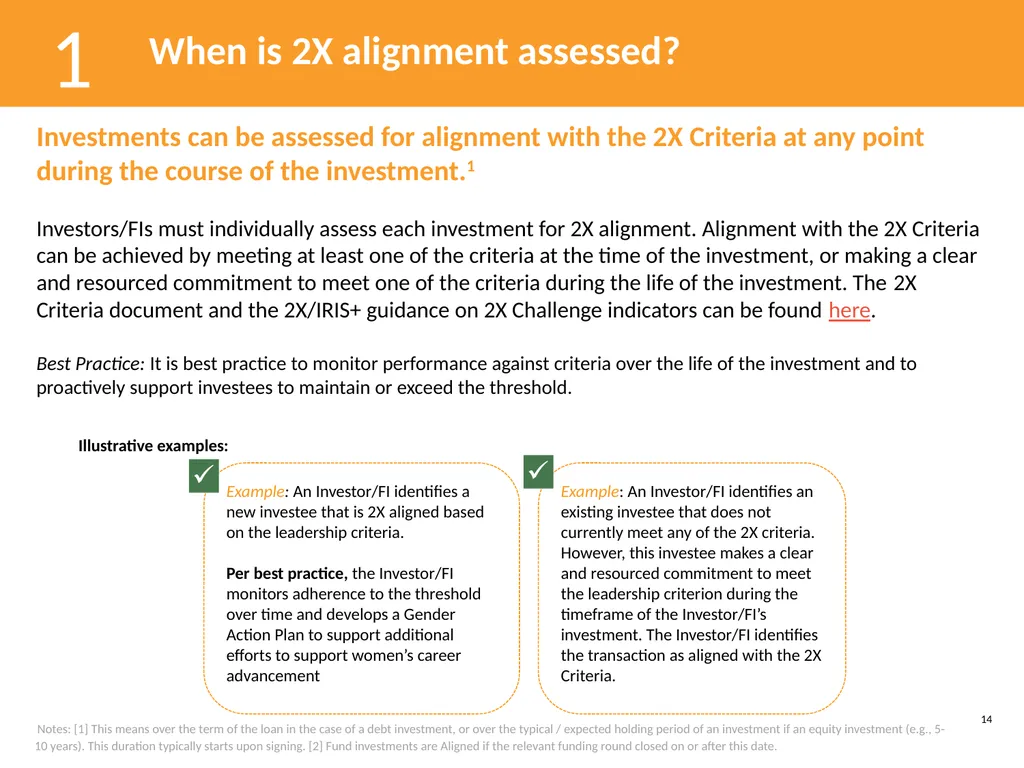
When is 2X alignment assessed? 14 Illustrative examples: Investments can be assessed for alignment with the 2X Criteria at any point during the course of the investment.1
Investors/FIs must individually assess each investment for 2X alignment. Alignment with the 2X Criteria can be achieved by meeting at least one of the criteria at the time of the investment, or making a clear and resourced commitment to meet one of the criteria during the life of the investment. The 2X Criteria document and the 2X/IRIS+ guidance on 2X Challenge indicators can be found here.
Best Practice: It is best practice to monitor performance against criteria over the life of the investment and to proactively support investees to maintain or exceed the threshold. Example: An Investor/FI identifies a new investee that is 2X aligned based on the leadership criteria.
Per best practice, the Investor/FI monitors adherence to the threshold over time and develops a Gender Action Plan to support additional efforts to support women’s career advancement 1 Overall Guidance Example: An Investor/FI identifies an existing investee that does not currently meet any of the 2X criteria. However, this investee makes a clear and resourced commitment to meet the leadership criterion during the timeframe of the Investor/FI’s investment. The Investor/FI identifies the transaction as aligned with the 2X Criteria. Notes: [1] This means over the term of the loan in the case of a debt investment, or over the typical / expected holding period of an investment if an equity investment (e.g., 5-10 years). This duration typically starts upon signing. [2] Fund investments are Aligned if the relevant funding round closed on or after this date. How can investments through financial intermediaries be 2X aligned? (2/2) 6 Overall Guidance Who should Investors and Financial Institutions count as entrepreneurs? Entrepreneurship 6 Who can be considered a Senior Manager? (1/2) 8 Leadership How should Investors/FIs define and assess an
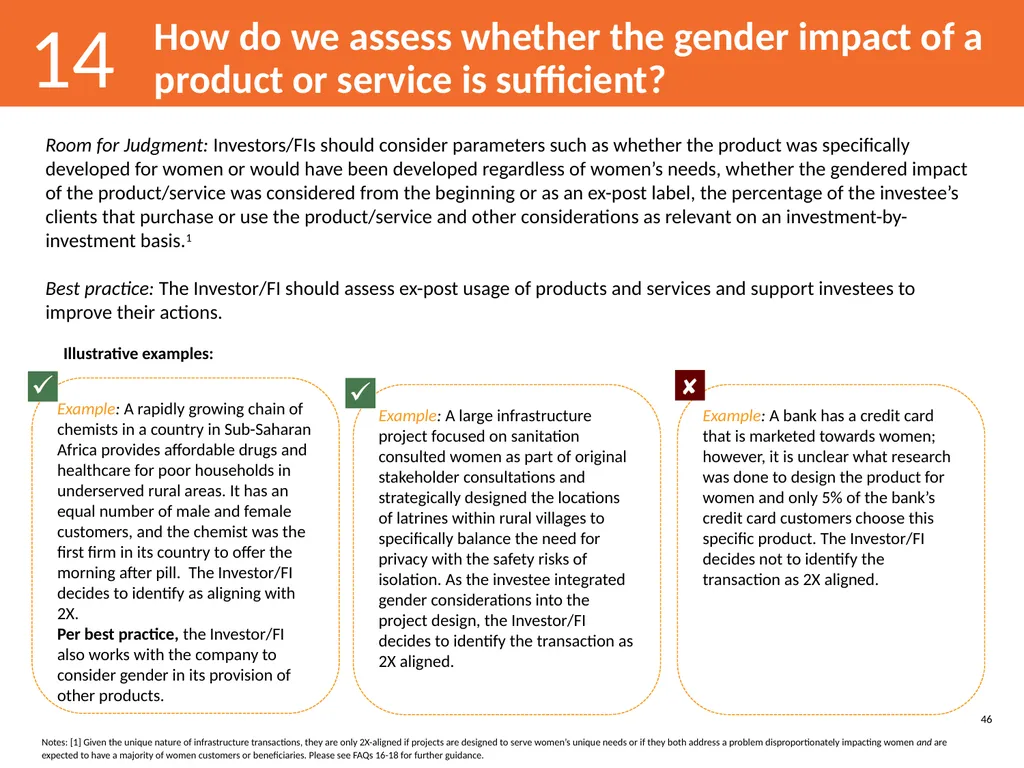
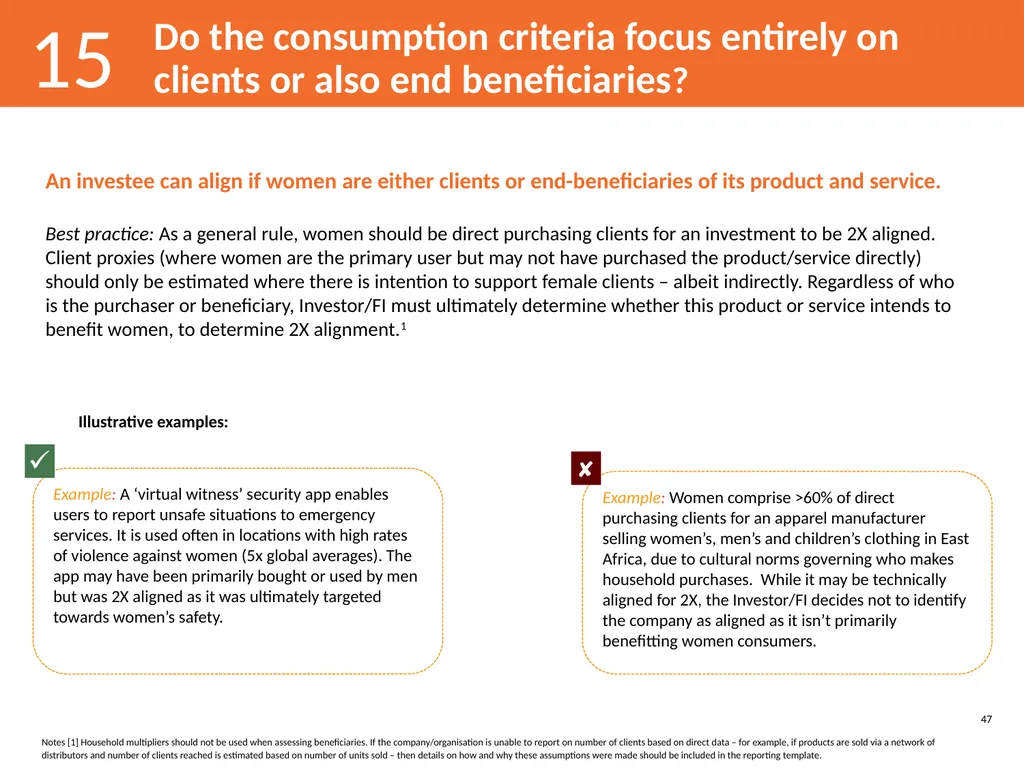
‘active role’ on a Board? 10 Leadership What are quality employment indicators? (1/2) 11 Employment How should the alignment process consider different types of workers? 12 Employment 13 Consumption How do we assess whether the gender impact of a product or service is sufficient? 14 Consumption Does the consumption criteria focus entirely on clients or also end beneficiaries? 15 Consumption When is 2X alignment assessed? 1<br>
Investors/FIs must individually assess each investment for 2X alignment. Alignment with the 2X Criteria can be achieved by meeting at least one of the criteria at the time of the investment, or making a clear and resourced commitment to meet one of the criteria during the life of the investment. The 2X Criteria document and the 2X/IRIS+ guidance on 2X Challenge indicators can be found here.
Best Practice: It is best practice to monitor performance against criteria over the life of the investment and to proactively support investees to maintain or exceed the threshold. Example: An Investor/FI identifies a new investee that is 2X aligned based on the leadership criteria.
Per best practice, the Investor/FI monitors adherence to the threshold over time and develops a Gender Action Plan to support additional efforts to support women’s career advancement 1 Overall Guidance Example: An Investor/FI identifies an existing investee that does not currently meet any of the 2X criteria. However, this investee makes a clear and resourced commitment to meet the leadership criterion during the timeframe of the Investor/FI’s investment. The Investor/FI identifies the transaction as aligned with the 2X Criteria. Notes: [1] This means over the term of the loan in the case of a debt investment, or over the typical / expected holding period of an investment if an equity investment (e.g., 5-10 years). This duration typically starts upon signing. [2] Fund investments are Aligned if the relevant funding round closed on or after this date. How can investments through financial intermediaries be 2X aligned? (2/2) 6 Overall Guidance Who should Investors and Financial Institutions count as entrepreneurs? Entrepreneurship 6 Who can be considered a Senior Manager? (1/2) 8 Leadership How should Investors/FIs define and assess an
‘active role’ on a Board? 10 Leadership What are quality employment indicators? (1/2) 11 Employment How should the alignment process consider different types of workers? 12 Employment 13 Consumption How do we assess whether the gender impact of a product or service is sufficient? 14 Consumption Does the consumption criteria focus entirely on clients or also end beneficiaries? 15 Consumption When is 2X alignment assessed? 1<br>
14
What type of investee commitments can
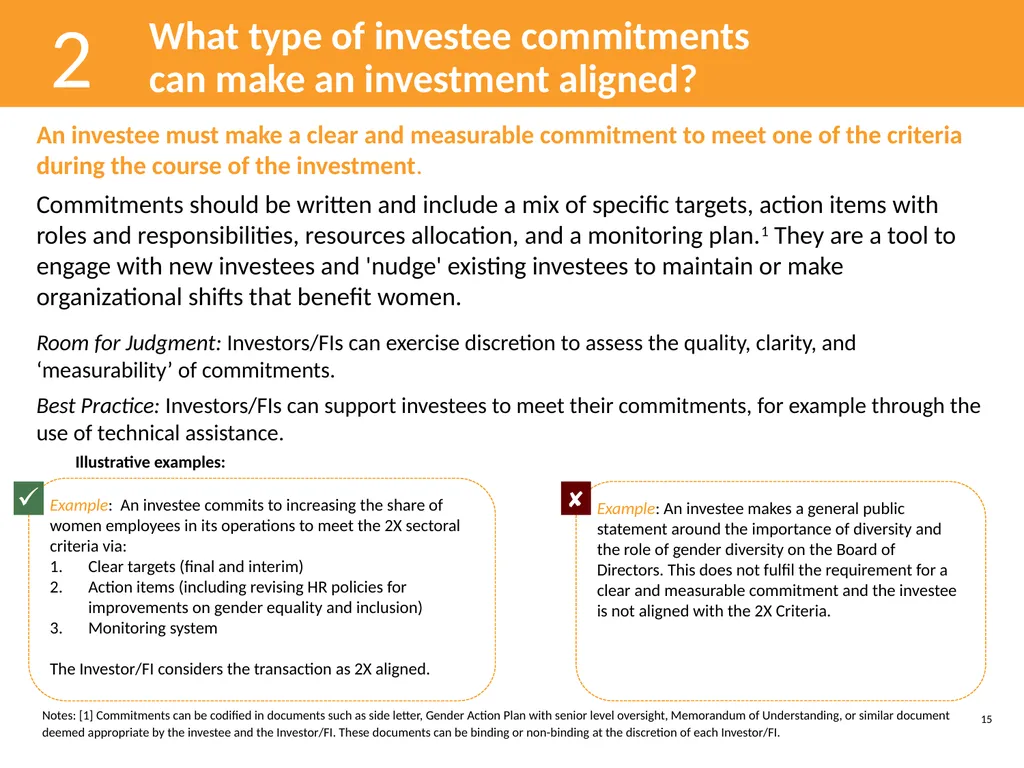
make an investment 2X aligned? 15 Illustrative examples: An investee must make a clear and measurable commitment to meet one of the criteria during the course of the investment.
Commitments should be written and include a mix of specific targets, action items with roles and responsibilities, resources allocation, and a monitoring plan.1 They are a tool to engage with new investees and 'nudge' existing investees to maintain or make organizational shifts that benefit women.
Room for Judgment: Investors/FIs can exercise discretion to assess the quality, clarity, and ‘measurability’ of commitments.
Best Practice: Investors/FIs can support investees to meet their commitments, for example through the use of technical assistance. Example: An investee commits to increasing the share of women employees in its operations to meet the 2X sectoral criteria via:
Clear targets (final and interim)
Action items (including revising HR policies for improvements on gender equality and inclusion)
Monitoring system
The Investor/FI considers the transaction as 2X aligned. Example: An investee makes a general public statement around the importance of diversity and the role of gender diversity on the Board of Directors. This does not fulfil the requirement for a clear and measurable commitment and the investee is not aligned with the 2X Criteria. Notes: [1] Commitments can be codified in documents such as side letter, Gender Action Plan with senior level oversight, Memorandum of Understanding, or similar document deemed appropriate by the investee and the Investor/FI. These documents can be binding or non-binding at the discretion of each Investor/FI. 2 Overall Guidance How can investments through financial intermediaries be 2X aligned? (2/2) 6 Overall Guidance Who should Investors and Financial Institutions count as entrepreneurs? Entrepreneurship 6 Who can be considered a Senior Manager? (1/2) 8 Leadership How should Investors/FIs define and assess an
‘active role’ on a Board? 10 Leadership What are quality employment indicators? (1/2) 11 Employment How should the alignment process consider different types of workers? 12 Employment 13 Consumption How do we assess whether the gender impact of a product or service is sufficient? 14 Consumption Does the consumption criteria focus entirely on clients or also end beneficiaries? 15 Consumption What type of investee commitments
can make an investment aligned? 2<br>
Commitments should be written and include a mix of specific targets, action items with roles and responsibilities, resources allocation, and a monitoring plan.1 They are a tool to engage with new investees and 'nudge' existing investees to maintain or make organizational shifts that benefit women.
Room for Judgment: Investors/FIs can exercise discretion to assess the quality, clarity, and ‘measurability’ of commitments.
Best Practice: Investors/FIs can support investees to meet their commitments, for example through the use of technical assistance. Example: An investee commits to increasing the share of women employees in its operations to meet the 2X sectoral criteria via:
Clear targets (final and interim)
Action items (including revising HR policies for improvements on gender equality and inclusion)
Monitoring system
The Investor/FI considers the transaction as 2X aligned. Example: An investee makes a general public statement around the importance of diversity and the role of gender diversity on the Board of Directors. This does not fulfil the requirement for a clear and measurable commitment and the investee is not aligned with the 2X Criteria. Notes: [1] Commitments can be codified in documents such as side letter, Gender Action Plan with senior level oversight, Memorandum of Understanding, or similar document deemed appropriate by the investee and the Investor/FI. These documents can be binding or non-binding at the discretion of each Investor/FI. 2 Overall Guidance How can investments through financial intermediaries be 2X aligned? (2/2) 6 Overall Guidance Who should Investors and Financial Institutions count as entrepreneurs? Entrepreneurship 6 Who can be considered a Senior Manager? (1/2) 8 Leadership How should Investors/FIs define and assess an
‘active role’ on a Board? 10 Leadership What are quality employment indicators? (1/2) 11 Employment How should the alignment process consider different types of workers? 12 Employment 13 Consumption How do we assess whether the gender impact of a product or service is sufficient? 14 Consumption Does the consumption criteria focus entirely on clients or also end beneficiaries? 15 Consumption What type of investee commitments
can make an investment aligned? 2<br>
15
Can other considerations aside from
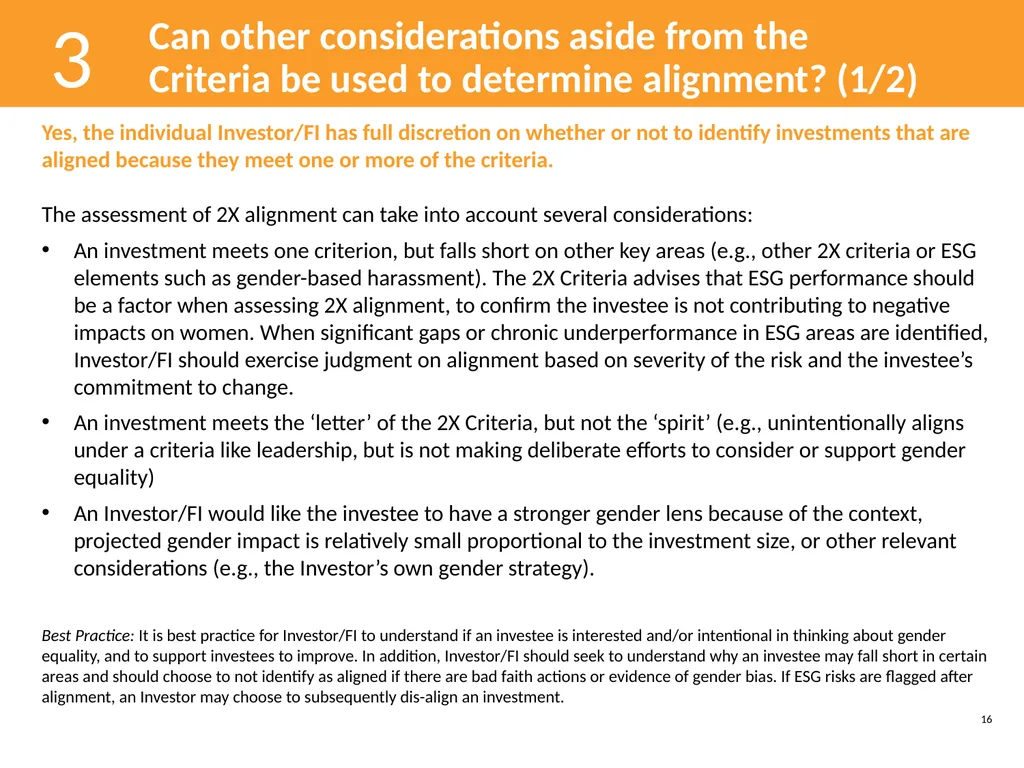
Criteria be used to determine alignment? (1/2) 16 Yes, the individual Investor/FI has full discretion on whether or not to identify investments that are aligned because they meet one or more of the criteria.
The assessment of 2X alignment can take into account several considerations:
An investment meets one criterion, but falls short on other key areas (e.g., other 2X criteria or ESG elements such as gender-based harassment). The 2X Criteria advises that ESG performance should be a factor when assessing 2X alignment, to confirm the investee is not contributing to negative impacts on women. When significant gaps or chronic underperformance in ESG areas are identified, Investor/FI should exercise judgment on alignment based on severity of the risk and the investee’s commitment to change.
An investment meets the ‘letter’ of the 2X Criteria, but not the ‘spirit’ (e.g., unintentionally aligns under a criteria like leadership, but is not making deliberate efforts to consider or support gender equality)
An Investor/FI would like the investee to have a stronger gender lens because of the context, projected gender impact is relatively small proportional to the investment size, or other relevant considerations (e.g., the Investor’s own gender strategy).
Best Practice: It is best practice for Investor/FI to understand if an investee is interested and/or intentional in thinking about gender equality, and to support investees to improve. In addition, Investor/FI should seek to understand why an investee may fall short in certain areas and should choose to not identify as aligned if there are bad faith actions or evidence of gender bias. If ESG risks are flagged after alignment, an Investor may choose to subsequently dis-align an investment. 3 Overall Guidance How can investments through financial intermediaries be 2X aligned? (2/2) 6 Overall Guidance Who should Investors and Financial Institutions count as entrepreneurs? Entrepreneurship 6 Who can be considered a Senior Manager? (1/2) 8 Leadership How should Investors/FIs define and assess an
‘active role’ on a Board? 10 Leadership What are quality employment indicators? (1/2) 11 Employment How should the alignment process consider different types of workers? 12 Employment 13 Consumption How do we assess whether the gender impact of a product or service is sufficient? 14 Consumption Does the consumption criteria focus entirely on clients or also end beneficiaries? 15 Consumption Can other considerations aside from the Criteria be used to determine alignment? (1/2) 3<br>
The assessment of 2X alignment can take into account several considerations:
An investment meets one criterion, but falls short on other key areas (e.g., other 2X criteria or ESG elements such as gender-based harassment). The 2X Criteria advises that ESG performance should be a factor when assessing 2X alignment, to confirm the investee is not contributing to negative impacts on women. When significant gaps or chronic underperformance in ESG areas are identified, Investor/FI should exercise judgment on alignment based on severity of the risk and the investee’s commitment to change.
An investment meets the ‘letter’ of the 2X Criteria, but not the ‘spirit’ (e.g., unintentionally aligns under a criteria like leadership, but is not making deliberate efforts to consider or support gender equality)
An Investor/FI would like the investee to have a stronger gender lens because of the context, projected gender impact is relatively small proportional to the investment size, or other relevant considerations (e.g., the Investor’s own gender strategy).
Best Practice: It is best practice for Investor/FI to understand if an investee is interested and/or intentional in thinking about gender equality, and to support investees to improve. In addition, Investor/FI should seek to understand why an investee may fall short in certain areas and should choose to not identify as aligned if there are bad faith actions or evidence of gender bias. If ESG risks are flagged after alignment, an Investor may choose to subsequently dis-align an investment. 3 Overall Guidance How can investments through financial intermediaries be 2X aligned? (2/2) 6 Overall Guidance Who should Investors and Financial Institutions count as entrepreneurs? Entrepreneurship 6 Who can be considered a Senior Manager? (1/2) 8 Leadership How should Investors/FIs define and assess an
‘active role’ on a Board? 10 Leadership What are quality employment indicators? (1/2) 11 Employment How should the alignment process consider different types of workers? 12 Employment 13 Consumption How do we assess whether the gender impact of a product or service is sufficient? 14 Consumption Does the consumption criteria focus entirely on clients or also end beneficiaries? 15 Consumption Can other considerations aside from the Criteria be used to determine alignment? (1/2) 3<br>
16
Can other considerations aside from
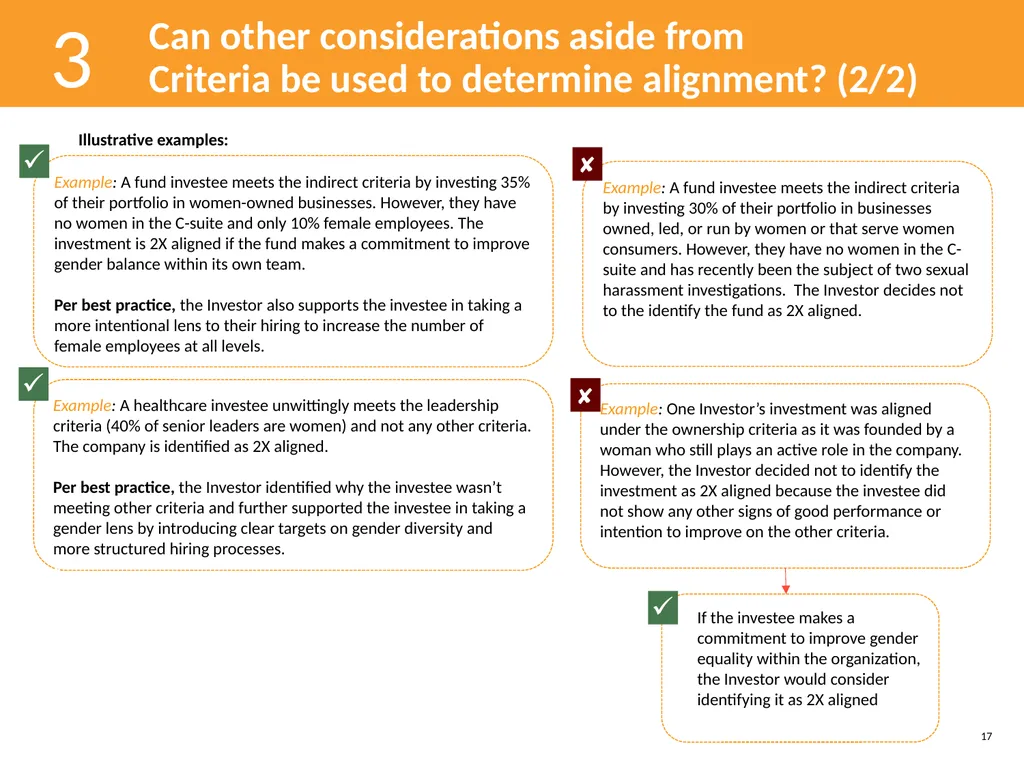
Criteria be used to determine alignment? (2/2) 17 Illustrative examples: Example: A fund investee meets the indirect criteria by investing 35% of their portfolio in women-owned businesses. However, they have no women in the C-suite and only 10% female employees. The investment is 2X aligned if the fund makes a commitment to improve gender balance within its own team.
Per best practice, the Investor also supports the investee in taking a more intentional lens to their hiring to increase the number of female employees at all levels. Example: A fund investee meets the indirect criteria by investing 30% of their portfolio in businesses owned, led, or run by women or that serve women consumers. However, they have no women in the C-suite and has recently been the subject of two sexual harassment investigations. The Investor decides not to the identify the fund as 2X aligned. 3 Overall Guidance Example: A healthcare investee unwittingly meets the leadership criteria (40% of senior leaders are women) and not any other criteria. The company is identified as 2X aligned.
Per best practice, the Investor identified why the investee wasn’t meeting other criteria and further supported the investee in taking a gender lens by introducing clear targets on gender diversity and more structured hiring processes.
Example: One Investor’s investment was aligned under the ownership criteria as it was founded by a woman who still plays an active role in the company. However, the Investor decided not to identify the investment as 2X aligned because the investee did not show any other signs of good performance or intention to improve on the other criteria. If the investee makes a commitment to improve gender equality within the organization, the Investor would consider identifying it as 2X aligned How can investments through financial intermediaries be 2X aligned? (2/2) 6 Overall Guidance Who should Investors and Financial Institutions count as entrepreneurs? Entrepreneurship 6 Who can be considered a Senior Manager? (1/2) 8 Leadership How should Investors/FIs define and assess an
‘active role’ on a Board? 10 Leadership What are quality employment indicators? (1/2) 11 Employment How should the alignment process consider different types of workers? 12 Employment 13 Consumption How do we assess whether the gender impact of a product or service is sufficient? 14 Consumption Does the consumption criteria focus entirely on clients or also end beneficiaries? 15 Consumption Can other considerations aside from Criteria be used to determine alignment? (2/2) 3<br>
Per best practice, the Investor also supports the investee in taking a more intentional lens to their hiring to increase the number of female employees at all levels. Example: A fund investee meets the indirect criteria by investing 30% of their portfolio in businesses owned, led, or run by women or that serve women consumers. However, they have no women in the C-suite and has recently been the subject of two sexual harassment investigations. The Investor decides not to the identify the fund as 2X aligned. 3 Overall Guidance Example: A healthcare investee unwittingly meets the leadership criteria (40% of senior leaders are women) and not any other criteria. The company is identified as 2X aligned.
Per best practice, the Investor identified why the investee wasn’t meeting other criteria and further supported the investee in taking a gender lens by introducing clear targets on gender diversity and more structured hiring processes.
Example: One Investor’s investment was aligned under the ownership criteria as it was founded by a woman who still plays an active role in the company. However, the Investor decided not to identify the investment as 2X aligned because the investee did not show any other signs of good performance or intention to improve on the other criteria. If the investee makes a commitment to improve gender equality within the organization, the Investor would consider identifying it as 2X aligned How can investments through financial intermediaries be 2X aligned? (2/2) 6 Overall Guidance Who should Investors and Financial Institutions count as entrepreneurs? Entrepreneurship 6 Who can be considered a Senior Manager? (1/2) 8 Leadership How should Investors/FIs define and assess an
‘active role’ on a Board? 10 Leadership What are quality employment indicators? (1/2) 11 Employment How should the alignment process consider different types of workers? 12 Employment 13 Consumption How do we assess whether the gender impact of a product or service is sufficient? 14 Consumption Does the consumption criteria focus entirely on clients or also end beneficiaries? 15 Consumption Can other considerations aside from Criteria be used to determine alignment? (2/2) 3<br>
17
What threshold should be used if a
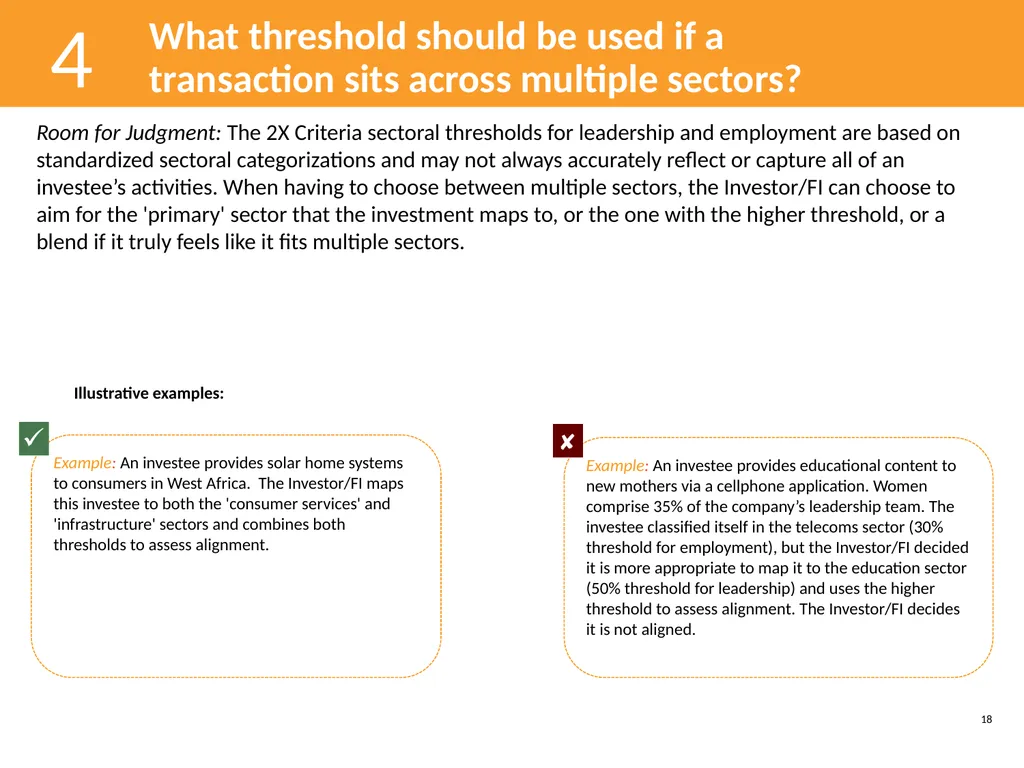
transaction sits across multiple sectors? 18 Illustrative examples: Room for Judgment: The 2X Criteria sectoral thresholds for leadership and employment are based on standardized sectoral categorizations and may not always accurately reflect or capture all of an investee’s activities. When having to choose between multiple sectors, the Investor/FI can choose to aim for the 'primary' sector that the investment maps to, or the one with the higher threshold, or a blend if it truly feels like it fits multiple sectors. Example: An investee provides solar home systems to consumers in West Africa. The Investor/FI maps this investee to both the 'consumer services' and 'infrastructure' sectors and combines both thresholds to assess alignment. Example: An investee provides educational content to new mothers via a cellphone application. Women comprise 35% of the company’s leadership team. The investee classified itself in the telecoms sector (30% threshold for employment), but the Investor/FI decided it is more appropriate to map it to the education sector (50% threshold for leadership) and uses the higher threshold to assess alignment. The Investor/FI decides it is not aligned. 4 Overall Guidance How can investments through financial
intermediaries be 2X aligned? (2/2) 6 Overall Guidance Who should Investors and Financial
Institutions count as entrepreneurs? Entrepreneurship 6 Who can be considered a Senior Manager? (1/2) 8 Leadership How should Investors/FIs define and assess an
‘active role’ on a Board? 10 Leadership What are quality employment indicators? (1/2) 11 Employment How should the alignment process consider different types of workers? 12 Employment 13 Consumption How do we assess whether the gender impact of a product or service is sufficient? 14 Consumption Does the consumption criteria focus entirely on clients or also end beneficiaries? 15 Consumption What threshold should be used if a transaction sits across multiple sectors? 4<br>
‘active role’ on a Board? 10 Leadership What are quality employment indicators? (1/2) 11 Employment How should the alignment process consider different types of workers? 12 Employment 13 Consumption How do we assess whether the gender impact of a product or service is sufficient? 14 Consumption Does the consumption criteria focus entirely on clients or also end beneficiaries? 15 Consumption What threshold should be used if a transaction sits across multiple sectors? 4<br>
18
How can investments through financial
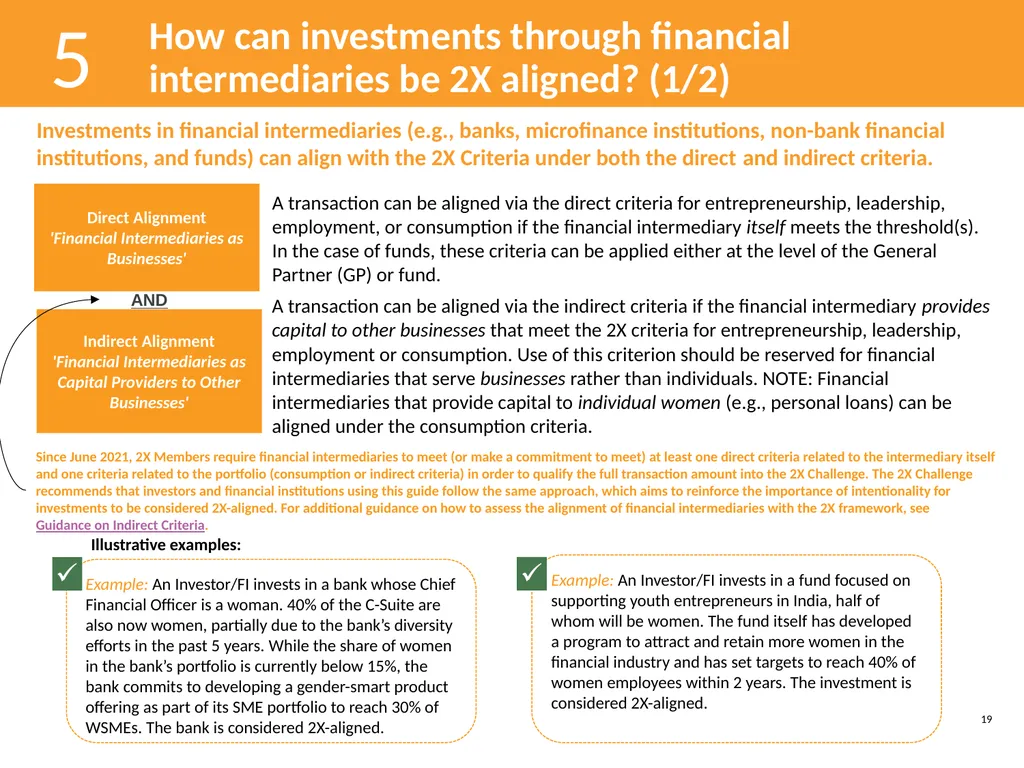
intermediaries be 2X aligned? (1/2) 19 Illustrative examples: Investments in financial intermediaries (e.g., banks, microfinance institutions, non-bank financial institutions, and funds) can align with the 2X Criteria under both the direct and indirect criteria. Example: An Investor/FI invests in a bank whose Chief Financial Officer is a woman. 40% of the C-Suite are also now women, partially due to the bank’s diversity efforts in the past 5 years. While the share of women in the bank’s portfolio is currently below 15%, the bank commits to developing a gender-smart product offering as part of its SME portfolio to reach 30% of WSMEs. The bank is considered 2X-aligned. Example: An Investor/FI invests in a fund focused on supporting youth entrepreneurs in India, half of whom will be women. The fund itself has developed a program to attract and retain more women in the financial industry and has set targets to reach 40% of women employees within 2 years. The investment is considered 2X-aligned. Direct Alignment
'Financial Intermediaries as Businesses' Indirect Alignment
'Financial Intermediaries as Capital Providers to Other Businesses' A transaction can be aligned via the direct criteria for entrepreneurship, leadership, employment, or consumption if the financial intermediary itself meets the threshold(s). In the case of funds, these criteria can be applied either at the level of the General Partner (GP) or fund. A transaction can be aligned via the indirect criteria if the financial intermediary provides capital to other businesses that meet the 2X criteria for entrepreneurship, leadership, employment or consumption. Use of this criterion should be reserved for financial intermediaries that serve businesses rather than individuals. NOTE: Financial intermediaries that provide capital to individual women (e.g., personal loans) can be aligned under the consumption criteria. 5 Overall Guidance How can investments through financial intermediaries be 2X aligned? (2/2) 6 Overall Guidance Who should Investors and Financial Institutions count as entrepreneurs? Entrepreneurship 6 Who can be considered a Senior Manager? (1/2) 8 Leadership How should Investors/FIs define and assess an
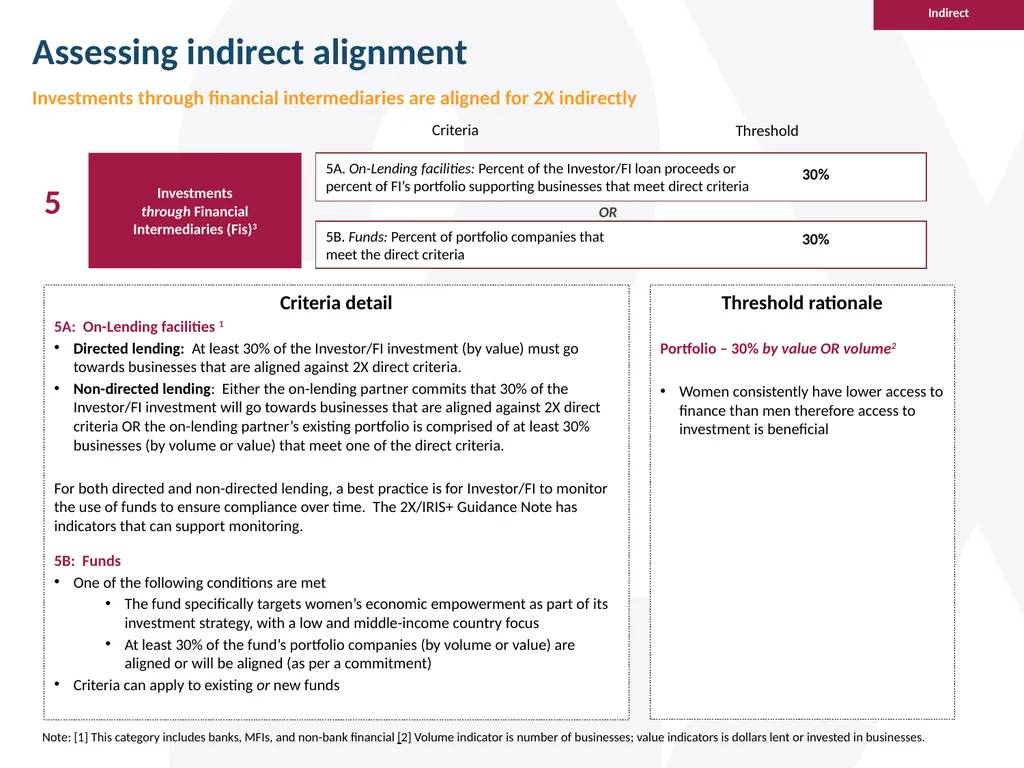
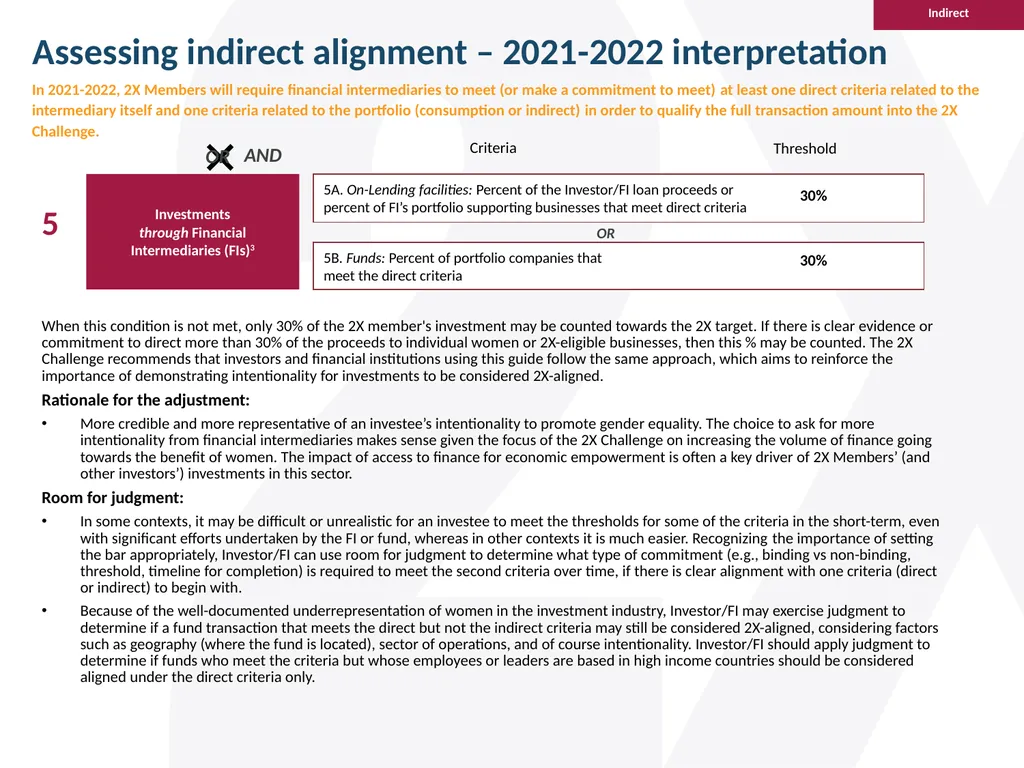
‘active role’ on a Board? 10 Leadership What are quality employment indicators? (1/2) 11 Employment How should the alignment process consider different types of workers? 12 Employment 13 Consumption How do we assess whether the gender impact of a product or service is sufficient? 14 Consumption Does the consumption criteria focus entirely on clients or also end beneficiaries? 15 Consumption How can investments through financial intermediaries be 2X aligned? (1/2) 5 Since June 2021, 2X Members require financial intermediaries to meet (or make a commitment to meet) at least one direct criteria related to the intermediary itself and one criteria related to the portfolio (consumption or indirect criteria) in order to qualify the full transaction amount into the 2X Challenge. The 2X Challenge recommends that investors and financial institutions using this guide follow the same approach, which aims to reinforce the importance of intentionality for investments to be considered 2X-aligned. For additional guidance on how to assess the alignment of financial intermediaries with the 2X framework, see Guidance on Indirect Criteria. AND<br>
'Financial Intermediaries as Businesses' Indirect Alignment
'Financial Intermediaries as Capital Providers to Other Businesses' A transaction can be aligned via the direct criteria for entrepreneurship, leadership, employment, or consumption if the financial intermediary itself meets the threshold(s). In the case of funds, these criteria can be applied either at the level of the General Partner (GP) or fund. A transaction can be aligned via the indirect criteria if the financial intermediary provides capital to other businesses that meet the 2X criteria for entrepreneurship, leadership, employment or consumption. Use of this criterion should be reserved for financial intermediaries that serve businesses rather than individuals. NOTE: Financial intermediaries that provide capital to individual women (e.g., personal loans) can be aligned under the consumption criteria. 5 Overall Guidance How can investments through financial intermediaries be 2X aligned? (2/2) 6 Overall Guidance Who should Investors and Financial Institutions count as entrepreneurs? Entrepreneurship 6 Who can be considered a Senior Manager? (1/2) 8 Leadership How should Investors/FIs define and assess an
‘active role’ on a Board? 10 Leadership What are quality employment indicators? (1/2) 11 Employment How should the alignment process consider different types of workers? 12 Employment 13 Consumption How do we assess whether the gender impact of a product or service is sufficient? 14 Consumption Does the consumption criteria focus entirely on clients or also end beneficiaries? 15 Consumption How can investments through financial intermediaries be 2X aligned? (1/2) 5 Since June 2021, 2X Members require financial intermediaries to meet (or make a commitment to meet) at least one direct criteria related to the intermediary itself and one criteria related to the portfolio (consumption or indirect criteria) in order to qualify the full transaction amount into the 2X Challenge. The 2X Challenge recommends that investors and financial institutions using this guide follow the same approach, which aims to reinforce the importance of intentionality for investments to be considered 2X-aligned. For additional guidance on how to assess the alignment of financial intermediaries with the 2X framework, see Guidance on Indirect Criteria. AND<br>
19
How can investments through financial
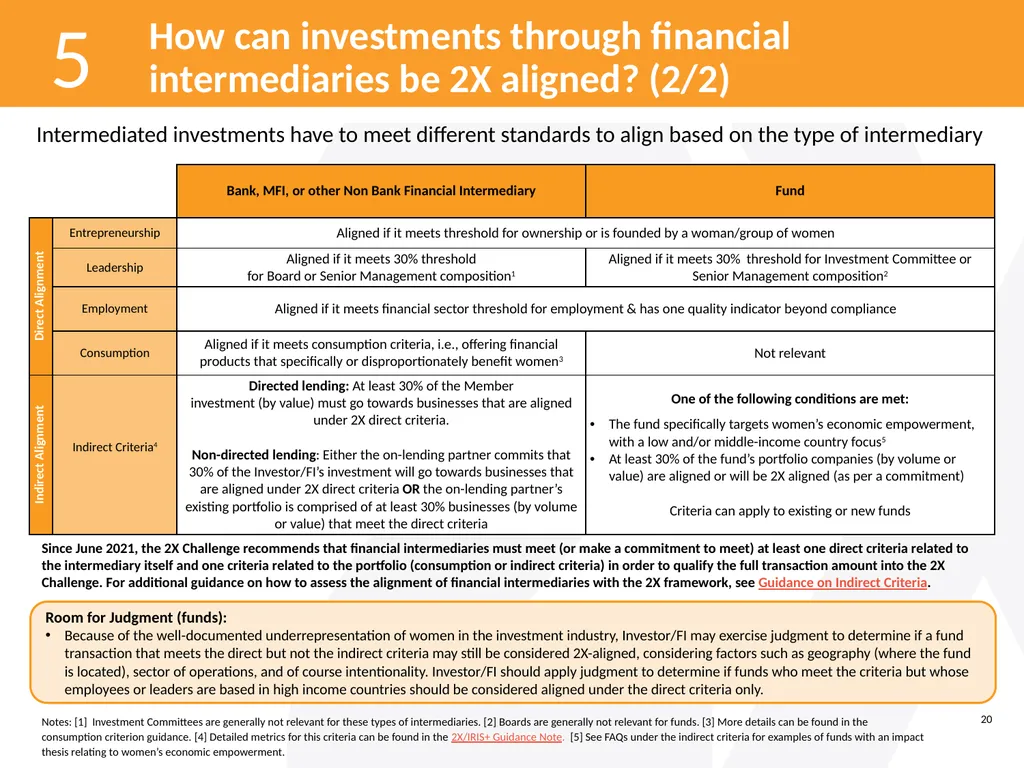
intermediaries be 2X aligned? (2/2) 20 Intermediated investments have to meet different standards to align based on the type of intermediary Notes: [1] Investment Committees are generally not relevant for these types of intermediaries. [2] Boards are generally not relevant for funds. [3] More details can be found in the consumption criterion guidance. [4] Detailed metrics for this criteria can be found in the 2X/IRIS+ Guidance Note. [5] See FAQs under the indirect criteria for examples of funds with an impact thesis relating to women’s economic empowerment. Room for Judgment (funds):
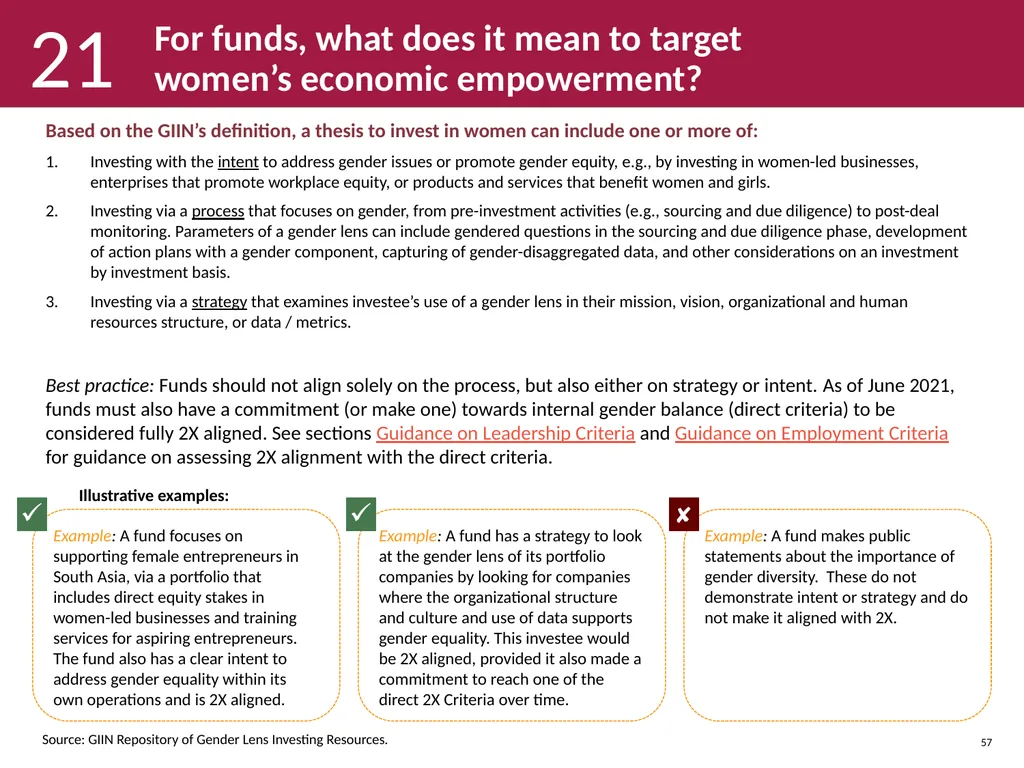
Because of the well-documented underrepresentation of women in the investment industry, Investor/FI may exercise judgment to determine if a fund transaction that meets the direct but not the indirect criteria may still be considered 2X-aligned, considering factors such as geography (where the fund is located), sector of operations, and of course intentionality. Investor/FI should apply judgment to determine if funds who meet the criteria but whose employees or leaders are based in high income countries should be considered aligned under the direct criteria only. 6 Overall Guidance Who should Investors and Financial Institutions count as entrepreneurs? Entrepreneurship 6 Who can be considered a Senior Manager? (1/2) 8 Leadership How should Investors/FIs define and assess an
‘active role’ on a Board? 10 Leadership What are quality employment indicators? (1/2) 11 Employment How should the alignment process consider different types of workers? 12 Employment 13 Consumption How do we assess whether the gender impact of a product or service is sufficient? 14 Consumption Does the consumption criteria focus entirely on clients or also end beneficiaries? 15 Consumption How can investments through financial intermediaries be 2X aligned? (2/2) 5 Since June 2021, the 2X Challenge recommends that financial intermediaries must meet (or make a commitment to meet) at least one direct criteria related to the intermediary itself and one criteria related to the portfolio (consumption or indirect criteria) in order to qualify the full transaction amount into the 2X Challenge. For additional guidance on how to assess the alignment of financial intermediaries with the 2X framework, see Guidance on Indirect Criteria.<br>
Because of the well-documented underrepresentation of women in the investment industry, Investor/FI may exercise judgment to determine if a fund transaction that meets the direct but not the indirect criteria may still be considered 2X-aligned, considering factors such as geography (where the fund is located), sector of operations, and of course intentionality. Investor/FI should apply judgment to determine if funds who meet the criteria but whose employees or leaders are based in high income countries should be considered aligned under the direct criteria only. 6 Overall Guidance Who should Investors and Financial Institutions count as entrepreneurs? Entrepreneurship 6 Who can be considered a Senior Manager? (1/2) 8 Leadership How should Investors/FIs define and assess an
‘active role’ on a Board? 10 Leadership What are quality employment indicators? (1/2) 11 Employment How should the alignment process consider different types of workers? 12 Employment 13 Consumption How do we assess whether the gender impact of a product or service is sufficient? 14 Consumption Does the consumption criteria focus entirely on clients or also end beneficiaries? 15 Consumption How can investments through financial intermediaries be 2X aligned? (2/2) 5 Since June 2021, the 2X Challenge recommends that financial intermediaries must meet (or make a commitment to meet) at least one direct criteria related to the intermediary itself and one criteria related to the portfolio (consumption or indirect criteria) in order to qualify the full transaction amount into the 2X Challenge. For additional guidance on how to assess the alignment of financial intermediaries with the 2X framework, see Guidance on Indirect Criteria.<br>
20
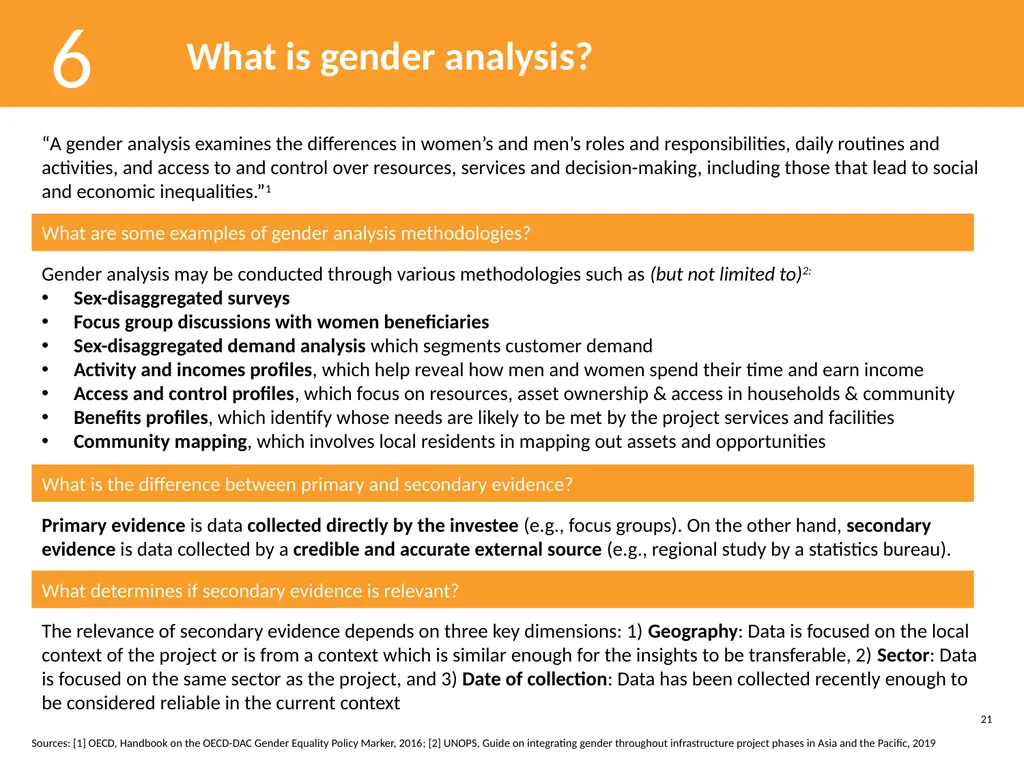
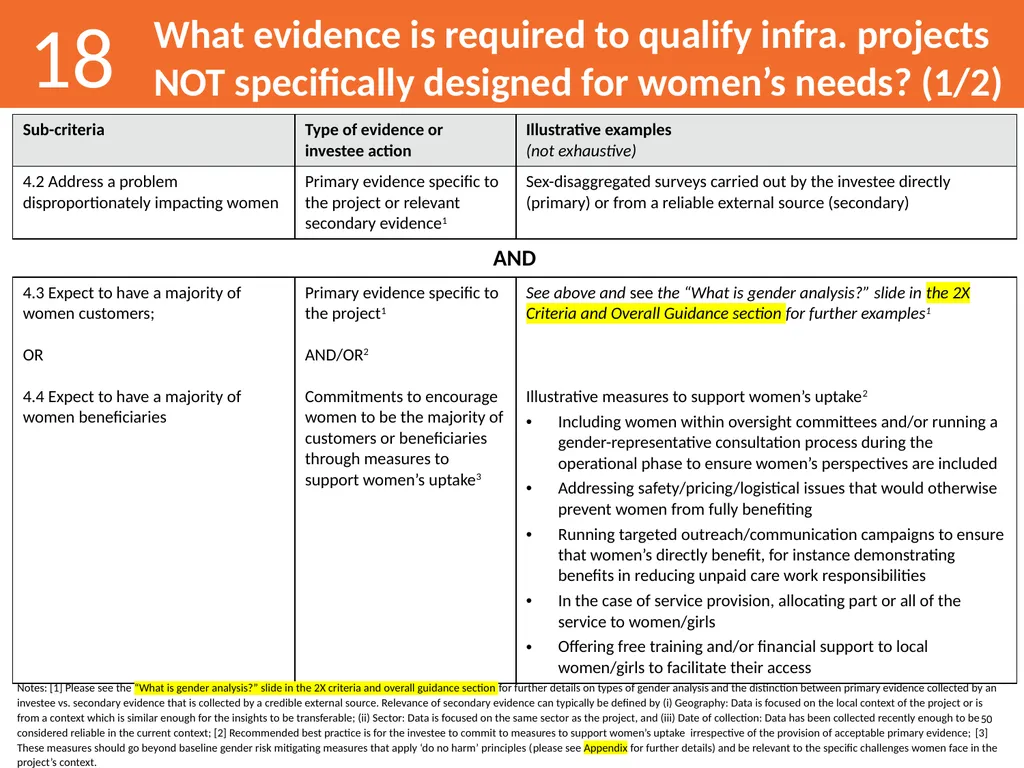
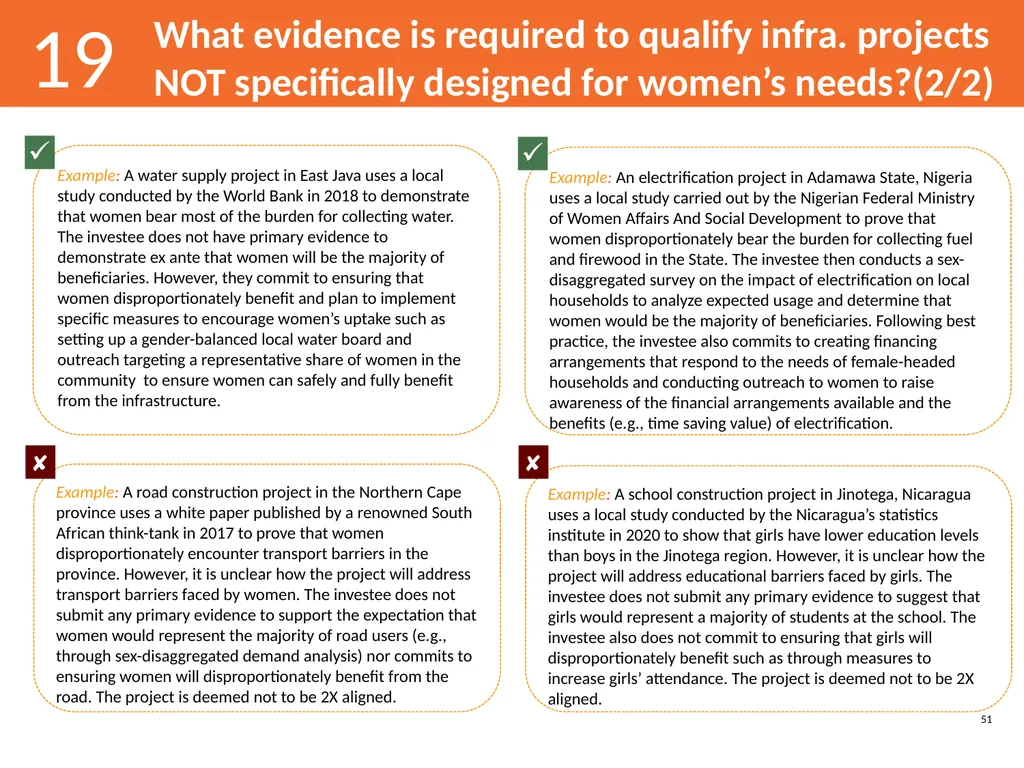
“A gender analysis examines the differences in women’s and men’s roles and responsibilities, daily routines and activities, and access to and control over resources, services and decision-making, including those that lead to social and economic inequalities.”1 What are some examples of gender analysis methodologies? What is the difference between primary and secondary evidence? What determines if secondary evidence is relevant? Gender analysis may be conducted through various methodologies such as (but not limited to)2:
Sex-disaggregated surveys
Focus group discussions with women beneficiaries
Sex-disaggregated demand analysis which segments customer demand
Activity and incomes profiles, which help reveal how men and women spend their time and earn income
Access and control profiles, which focus on resources, asset ownership & access in households & community
Benefits profiles, which identify whose needs are likely to be met by the project services and facilities
Community mapping, which involves local residents in mapping out assets and opportunities Primary evidence is data collected directly by the investee (e.g., focus groups). On the other hand, secondary evidence is data collected by a credible and accurate external source (e.g., regional study by a statistics bureau). The relevance of secondary evidence depends on three key dimensions: 1) Geography: Data is focused on the local context of the project or is from a context which is similar enough for the insights to be transferable, 2) Sector: Data is focused on the same sector as the project, and 3) Date of collection: Data has been collected recently enough to be considered reliable in the current context Sources: [1] OECD, Handbook on the OECD-DAC Gender Equality Policy Marker, 2016; [2] UNOPS, Guide on integrating gender throughout infrastructure project phases in Asia and the Pacific, 2019 What is gender analysis? 21 6<br>
Sex-disaggregated surveys
Focus group discussions with women beneficiaries
Sex-disaggregated demand analysis which segments customer demand
Activity and incomes profiles, which help reveal how men and women spend their time and earn income
Access and control profiles, which focus on resources, asset ownership & access in households & community
Benefits profiles, which identify whose needs are likely to be met by the project services and facilities
Community mapping, which involves local residents in mapping out assets and opportunities Primary evidence is data collected directly by the investee (e.g., focus groups). On the other hand, secondary evidence is data collected by a credible and accurate external source (e.g., regional study by a statistics bureau). The relevance of secondary evidence depends on three key dimensions: 1) Geography: Data is focused on the local context of the project or is from a context which is similar enough for the insights to be transferable, 2) Sector: Data is focused on the same sector as the project, and 3) Date of collection: Data has been collected recently enough to be considered reliable in the current context Sources: [1] OECD, Handbook on the OECD-DAC Gender Equality Policy Marker, 2016; [2] UNOPS, Guide on integrating gender throughout infrastructure project phases in Asia and the Pacific, 2019 What is gender analysis? 21 6<br>
21
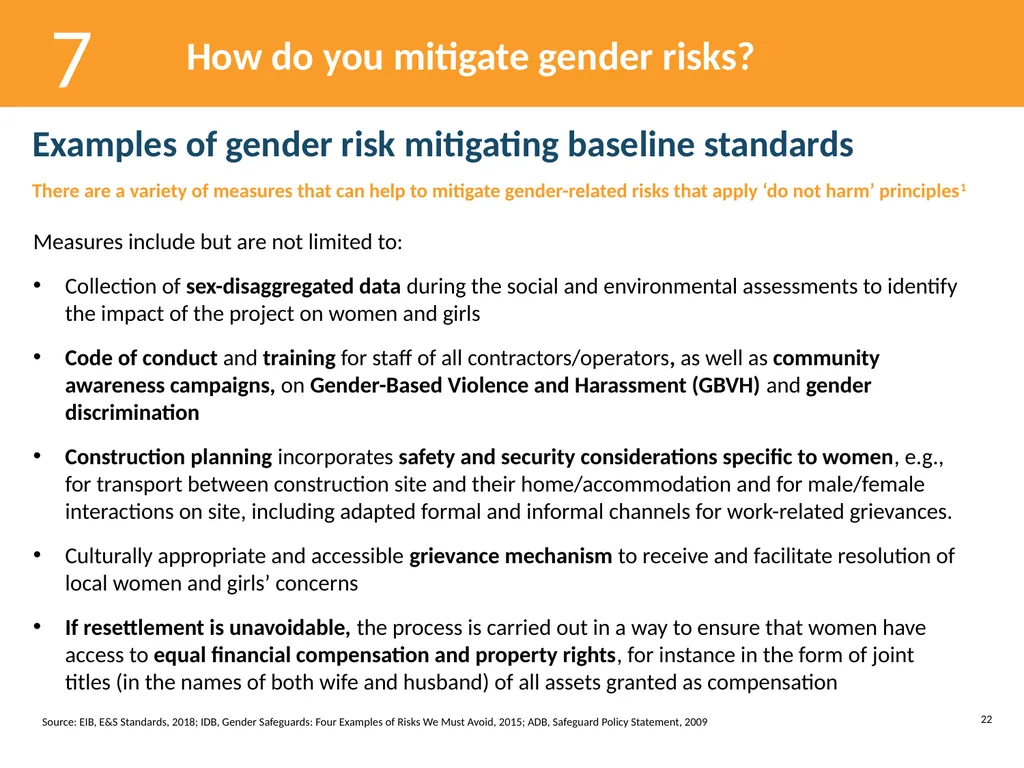
Examples of gender risk mitigating baseline standards Measures include but are not limited to:
Collection of sex-disaggregated data during the social and environmental assessments to identify the impact of the project on women and girls
Code of conduct and training for staff of all contractors/operators, as well as community awareness campaigns, on Gender-Based Violence and Harassment (GBVH) and gender discrimination
Construction planning incorporates safety and security considerations specific to women, e.g., for transport between construction site and their home/accommodation and for male/female interactions on site, including adapted formal and informal channels for work-related grievances.
Culturally appropriate and accessible grievance mechanism to receive and facilitate resolution of local women and girls’ concerns
If resettlement is unavoidable, the process is carried out in a way to ensure that women have access to equal financial compensation and property rights, for instance in the form of joint titles (in the names of both wife and husband) of all assets granted as compensation Source: EIB, E&S Standards, 2018; IDB, Gender Safeguards: Four Examples of Risks We Must Avoid, 2015; ADB, Safeguard Policy Statement, 2009 There are a variety of measures that can help to mitigate gender-related risks that apply ‘do not harm’ principles1 22 How do you mitigate gender risks? 7<br>
Collection of sex-disaggregated data during the social and environmental assessments to identify the impact of the project on women and girls
Code of conduct and training for staff of all contractors/operators, as well as community awareness campaigns, on Gender-Based Violence and Harassment (GBVH) and gender discrimination
Construction planning incorporates safety and security considerations specific to women, e.g., for transport between construction site and their home/accommodation and for male/female interactions on site, including adapted formal and informal channels for work-related grievances.
Culturally appropriate and accessible grievance mechanism to receive and facilitate resolution of local women and girls’ concerns
If resettlement is unavoidable, the process is carried out in a way to ensure that women have access to equal financial compensation and property rights, for instance in the form of joint titles (in the names of both wife and husband) of all assets granted as compensation Source: EIB, E&S Standards, 2018; IDB, Gender Safeguards: Four Examples of Risks We Must Avoid, 2015; ADB, Safeguard Policy Statement, 2009 There are a variety of measures that can help to mitigate gender-related risks that apply ‘do not harm’ principles1 22 How do you mitigate gender risks? 7<br>
22
23 Guidance on
Entrepreneurship Criteria<br>
Entrepreneurship Criteria<br>
23
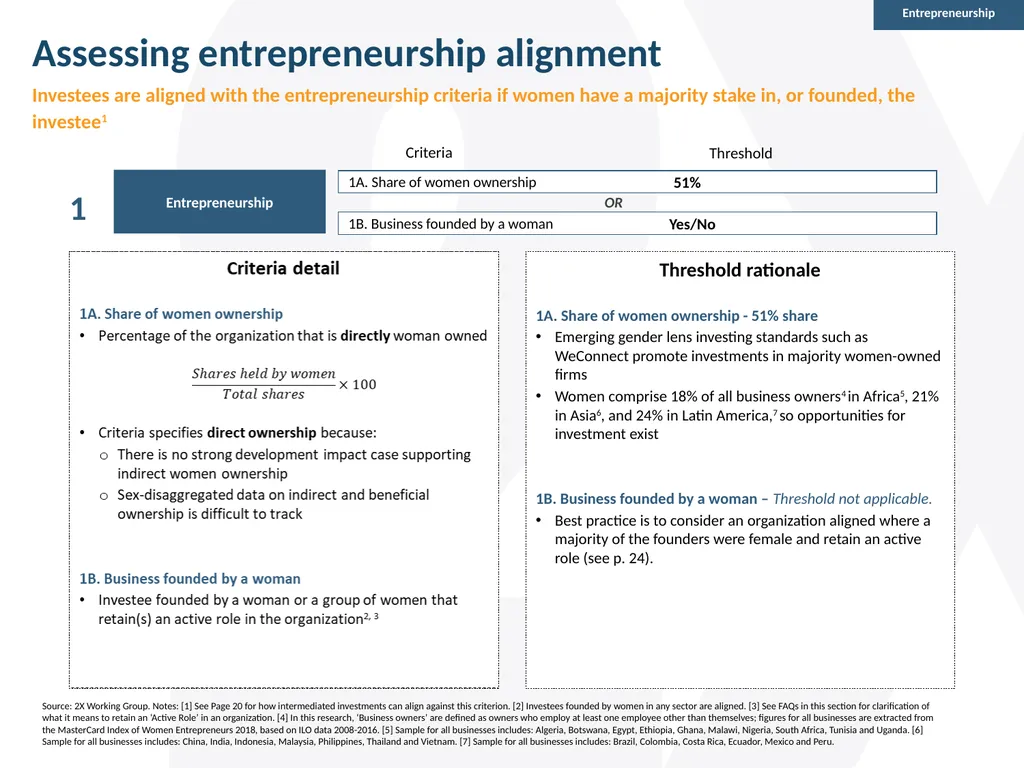
Assessing entrepreneurship alignment 24 Investees are aligned with the entrepreneurship criteria if women have a majority stake in, or founded, the investee1 Source: 2X Working Group. Notes: [1] See Page 20 for how intermediated investments can align against this criterion. [2] Investees founded by women in any sector are aligned. [3] See FAQs in this section for clarification of what it means to retain an ‘Active Role’ in an organization. [4] In this research, ‘Business owners’ are defined as owners who employ at least one employee other than themselves; figures for all businesses are extracted from the MasterCard Index of Women Entrepreneurs 2018, based on ILO data 2008-2016. [5] Sample for all businesses includes: Algeria, Botswana, Egypt, Ethiopia, Ghana, Malawi, Nigeria, South Africa, Tunisia and Uganda. [6] Sample for all businesses includes: China, India, Indonesia, Malaysia, Philippines, Thailand and Vietnam. [7] Sample for all businesses includes: Brazil, Colombia, Costa Rica, Ecuador, Mexico and Peru. Criteria Threshold 51% Yes/No Entrepreneurship<br>
24
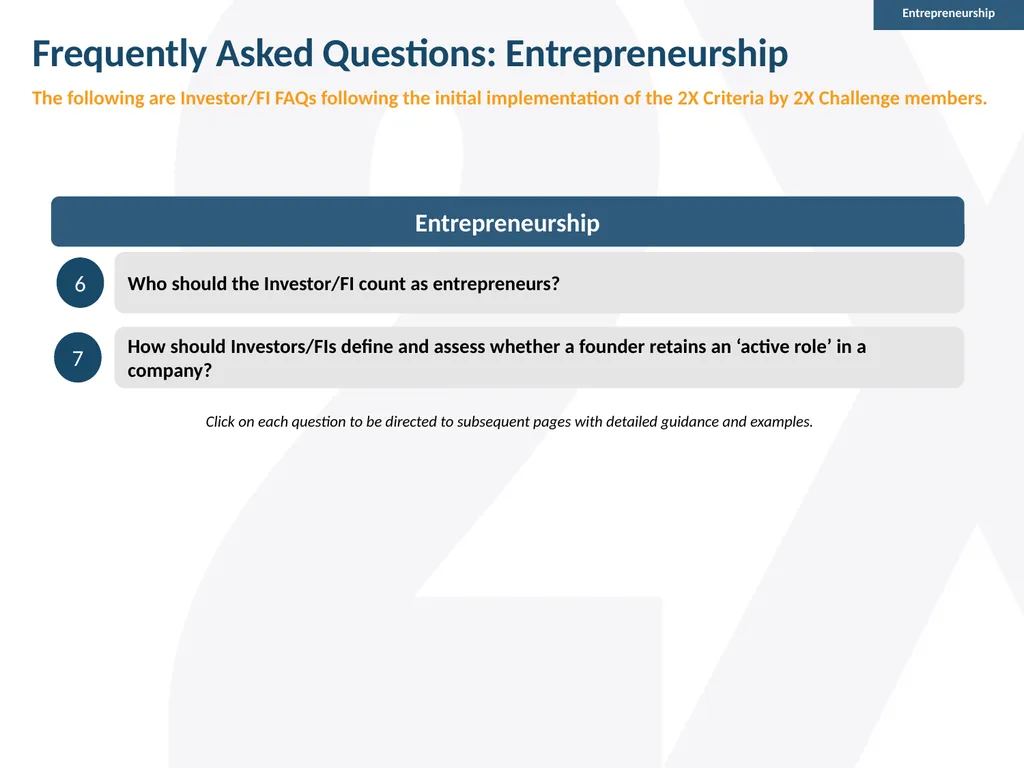
Frequently Asked Questions: Entrepreneurship 25 The following are Investor/FI FAQs following the initial implementation of the 2X Criteria by 2X Challenge members. Entrepreneurship Who should the Investor/FI count as entrepreneurs? How should Investors/FIs define and assess whether a founder retains an ‘active role’ in a company? 6 7 Entrepreneurship Click on each question to be directed to subsequent pages with detailed guidance and examples.<br>
25
Who should Investors and Financial
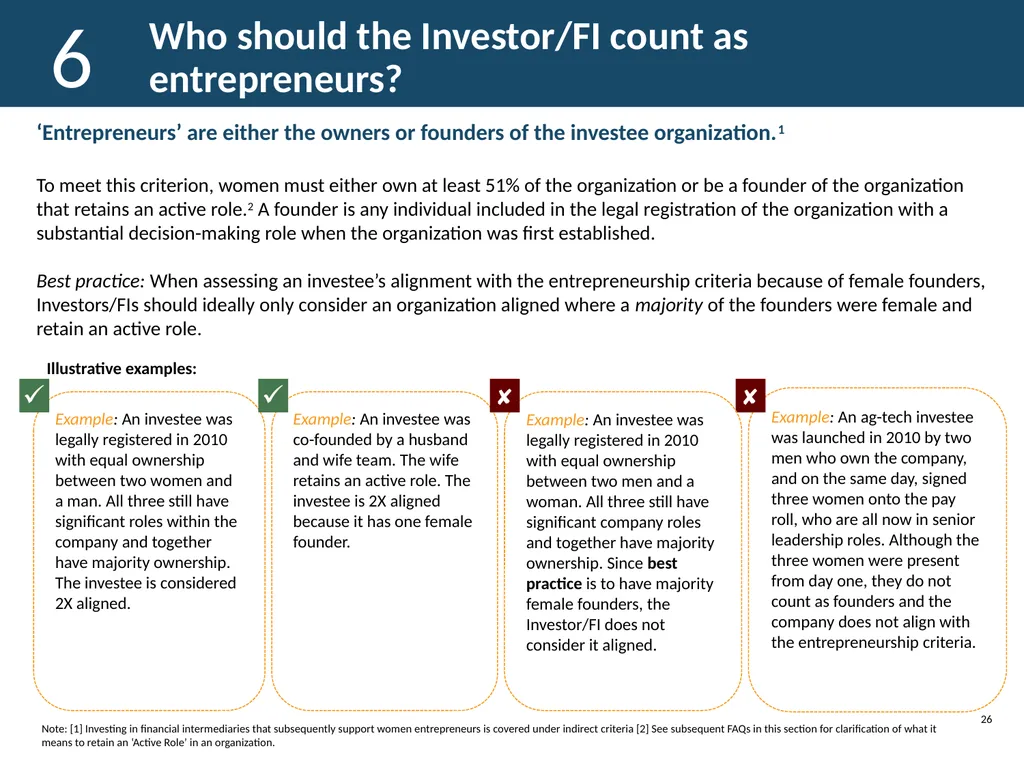
Institutions count as entrepreneurs? 26 Illustrative examples: ‘Entrepreneurs’ are either the owners or founders of the investee organization.1
To meet this criterion, women must either own at least 51% of the organization or be a founder of the organization that retains an active role.2 A founder is any individual included in the legal registration of the organization with a substantial decision-making role when the organization was first established.
Best practice: When assessing an investee’s alignment with the entrepreneurship criteria because of female founders, Investors/FIs should ideally only consider an organization aligned where a majority of the founders were female and retain an active role. Example: An investee was legally registered in 2010 with equal ownership between two women and a man. All three still have significant roles within the company and together have majority ownership. The investee is considered 2X aligned. Example: An ag-tech investee was launched in 2010 by two men who own the company, and on the same day, signed three women onto the pay roll, who are all now in senior leadership roles. Although the three women were present from day one, they do not count as founders and the company does not align with the entrepreneurship criteria. Entrepreneurship Note: [1] Investing in financial intermediaries that subsequently support women entrepreneurs is covered under indirect criteria [2] See subsequent FAQs in this section for clarification of what it means to retain an ‘Active Role’ in an organization. Example: An investee was co-founded by a husband and wife team. The wife retains an active role. The investee is 2X aligned because it has one female founder. 6 Example: An investee was legally registered in 2010 with equal ownership between two men and a woman. All three still have significant company roles and together have majority ownership. Since best practice is to have majority female founders, the Investor/FI does not consider it aligned. Who can be considered a Senior Manager? (1/2) 8 Leadership How should Investors/FIs define and assess an
‘active role’ on a Board? 10 Leadership What are quality employment indicators? (1/2) 11 Employment How should the alignment process consider different types of workers? 12 Employment 13 Consumption How do we assess whether the gender impact of a product or service is sufficient? 14 Consumption Does the consumption criteria focus entirely on clients or also end beneficiaries? 15 Consumption Who should the Investor/FI count as entrepreneurs? 6<br>
To meet this criterion, women must either own at least 51% of the organization or be a founder of the organization that retains an active role.2 A founder is any individual included in the legal registration of the organization with a substantial decision-making role when the organization was first established.
Best practice: When assessing an investee’s alignment with the entrepreneurship criteria because of female founders, Investors/FIs should ideally only consider an organization aligned where a majority of the founders were female and retain an active role. Example: An investee was legally registered in 2010 with equal ownership between two women and a man. All three still have significant roles within the company and together have majority ownership. The investee is considered 2X aligned. Example: An ag-tech investee was launched in 2010 by two men who own the company, and on the same day, signed three women onto the pay roll, who are all now in senior leadership roles. Although the three women were present from day one, they do not count as founders and the company does not align with the entrepreneurship criteria. Entrepreneurship Note: [1] Investing in financial intermediaries that subsequently support women entrepreneurs is covered under indirect criteria [2] See subsequent FAQs in this section for clarification of what it means to retain an ‘Active Role’ in an organization. Example: An investee was co-founded by a husband and wife team. The wife retains an active role. The investee is 2X aligned because it has one female founder. 6 Example: An investee was legally registered in 2010 with equal ownership between two men and a woman. All three still have significant company roles and together have majority ownership. Since best practice is to have majority female founders, the Investor/FI does not consider it aligned. Who can be considered a Senior Manager? (1/2) 8 Leadership How should Investors/FIs define and assess an
‘active role’ on a Board? 10 Leadership What are quality employment indicators? (1/2) 11 Employment How should the alignment process consider different types of workers? 12 Employment 13 Consumption How do we assess whether the gender impact of a product or service is sufficient? 14 Consumption Does the consumption criteria focus entirely on clients or also end beneficiaries? 15 Consumption Who should the Investor/FI count as entrepreneurs? 6<br>
26
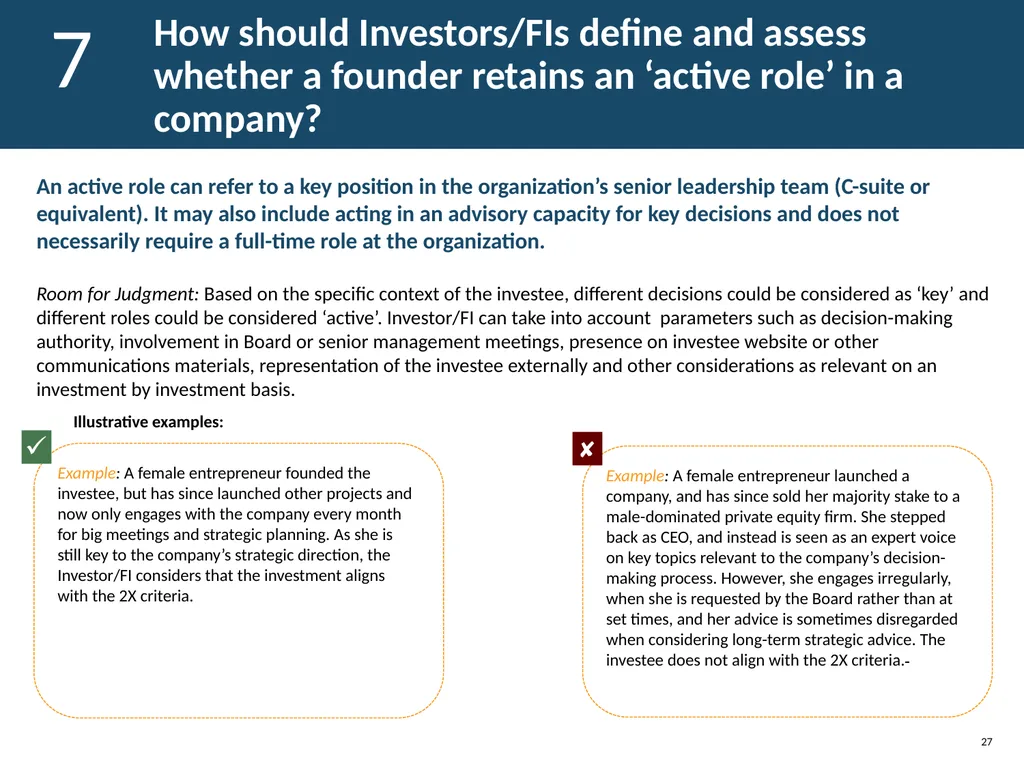
27 Illustrative examples: An active role can refer to a key position in the organization’s senior leadership team (C-suite or equivalent). It may also include acting in an advisory capacity for key decisions and does not necessarily require a full-time role at the organization.
Room for Judgment: Based on the specific context of the investee, different decisions could be considered as ‘key’ and different roles could be considered ‘active’. Investor/FI can take into account parameters such as decision-making authority, involvement in Board or senior management meetings, presence on investee website or other communications materials, representation of the investee externally and other considerations as relevant on an investment by investment basis. Example: A female entrepreneur founded the investee, but has since launched other projects and now only engages with the company every month for big meetings and strategic planning. As she is still key to the company’s strategic direction, the Investor/FI considers that the investment aligns with the 2X criteria. Example: A female entrepreneur launched a company, and has since sold her majority stake to a male-dominated private equity firm. She stepped back as CEO, and instead is seen as an expert voice on key topics relevant to the company’s decision-making process. However, she engages irregularly, when she is requested by the Board rather than at set times, and her advice is sometimes disregarded when considering long-term strategic advice. The investee does not align with the 2X criteria. Entrepreneurship 7 Who can be considered a Senior Manager? (1/2) 8 Leadership How should Investors/FIs define and assess an
‘active role’ on a Board? 10 Leadership What are quality employment indicators? (1/2) 11 Employment How should the alignment process consider different types of workers? 12 Employment 13 Consumption How do we assess whether the gender impact of a product or service is sufficient? 14 Consumption Does the consumption criteria focus entirely on clients or also end beneficiaries? 15 Consumption How should Investors/FIs define and assess whether a founder retains an ‘active role’ in a company? 7<br>
Room for Judgment: Based on the specific context of the investee, different decisions could be considered as ‘key’ and different roles could be considered ‘active’. Investor/FI can take into account parameters such as decision-making authority, involvement in Board or senior management meetings, presence on investee website or other communications materials, representation of the investee externally and other considerations as relevant on an investment by investment basis. Example: A female entrepreneur founded the investee, but has since launched other projects and now only engages with the company every month for big meetings and strategic planning. As she is still key to the company’s strategic direction, the Investor/FI considers that the investment aligns with the 2X criteria. Example: A female entrepreneur launched a company, and has since sold her majority stake to a male-dominated private equity firm. She stepped back as CEO, and instead is seen as an expert voice on key topics relevant to the company’s decision-making process. However, she engages irregularly, when she is requested by the Board rather than at set times, and her advice is sometimes disregarded when considering long-term strategic advice. The investee does not align with the 2X criteria. Entrepreneurship 7 Who can be considered a Senior Manager? (1/2) 8 Leadership How should Investors/FIs define and assess an
‘active role’ on a Board? 10 Leadership What are quality employment indicators? (1/2) 11 Employment How should the alignment process consider different types of workers? 12 Employment 13 Consumption How do we assess whether the gender impact of a product or service is sufficient? 14 Consumption Does the consumption criteria focus entirely on clients or also end beneficiaries? 15 Consumption How should Investors/FIs define and assess whether a founder retains an ‘active role’ in a company? 7<br>
27
28 Guidance on
Leadership Criteria<br>
28
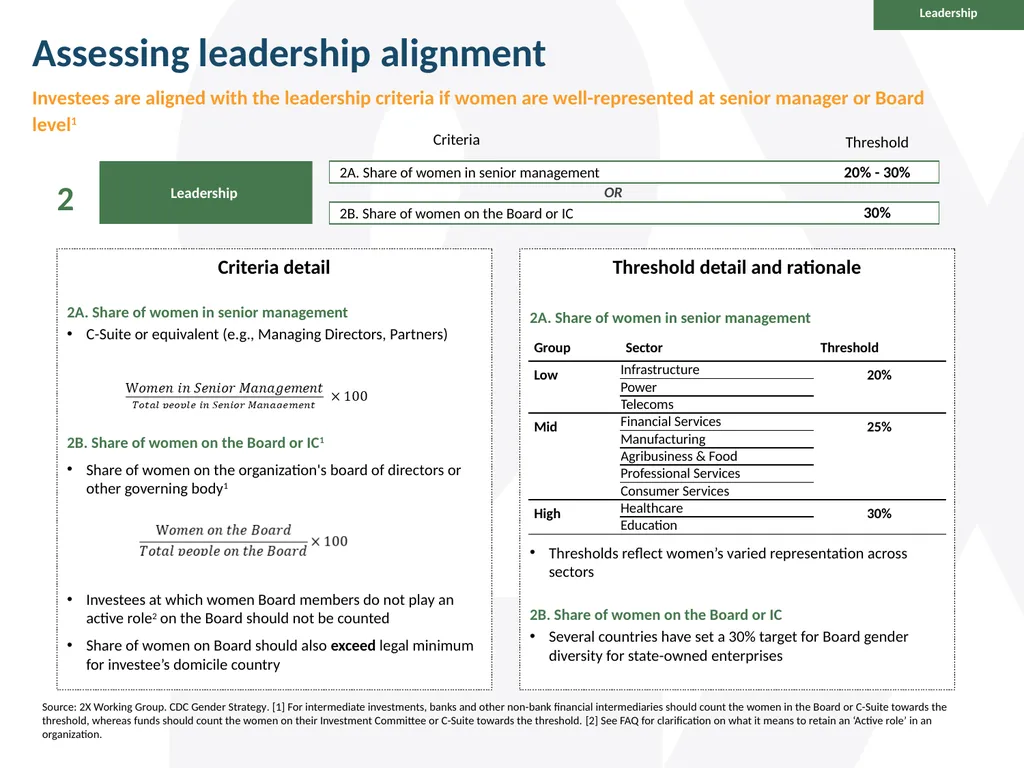
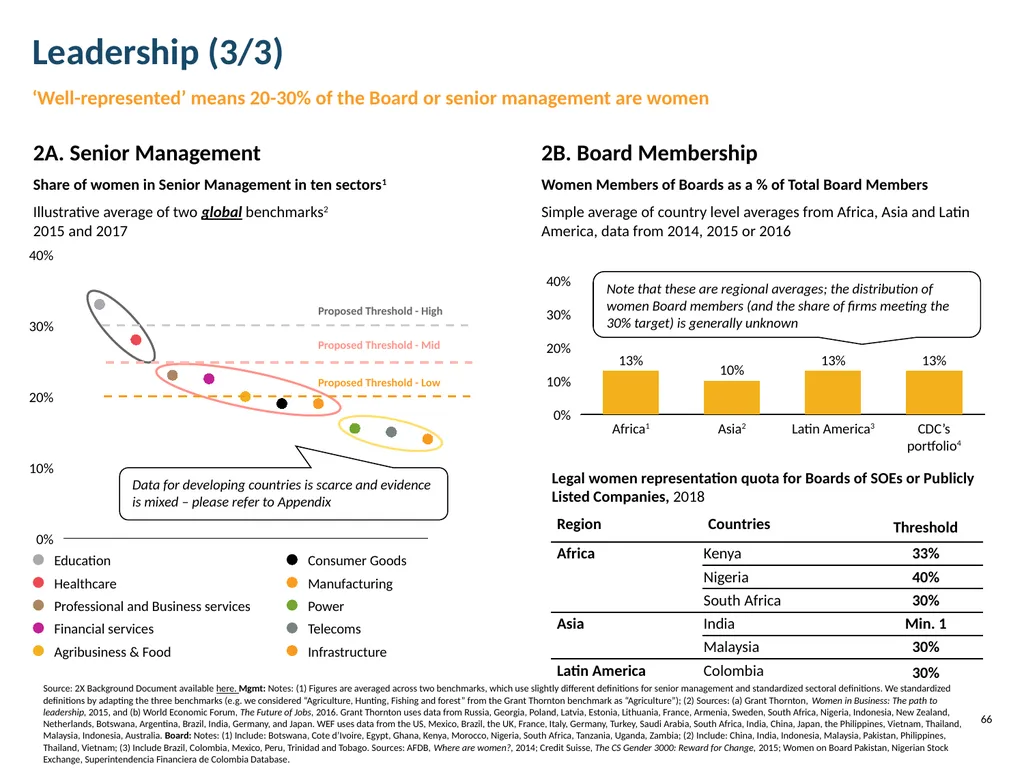
Assessing leadership alignment 29 Investees are aligned with the leadership criteria if women are well-represented at senior manager or Board level1 Source: 2X Working Group. CDC Gender Strategy. [1] For intermediate investments, banks and other non-bank financial intermediaries should count the women in the Board or C-Suite towards the threshold, whereas funds should count the women on their Investment Committee or C-Suite towards the threshold. [2] See FAQ for clarification on what it means to retain an ‘Active role’ in an organization. Criteria Threshold Leadership<br>
29
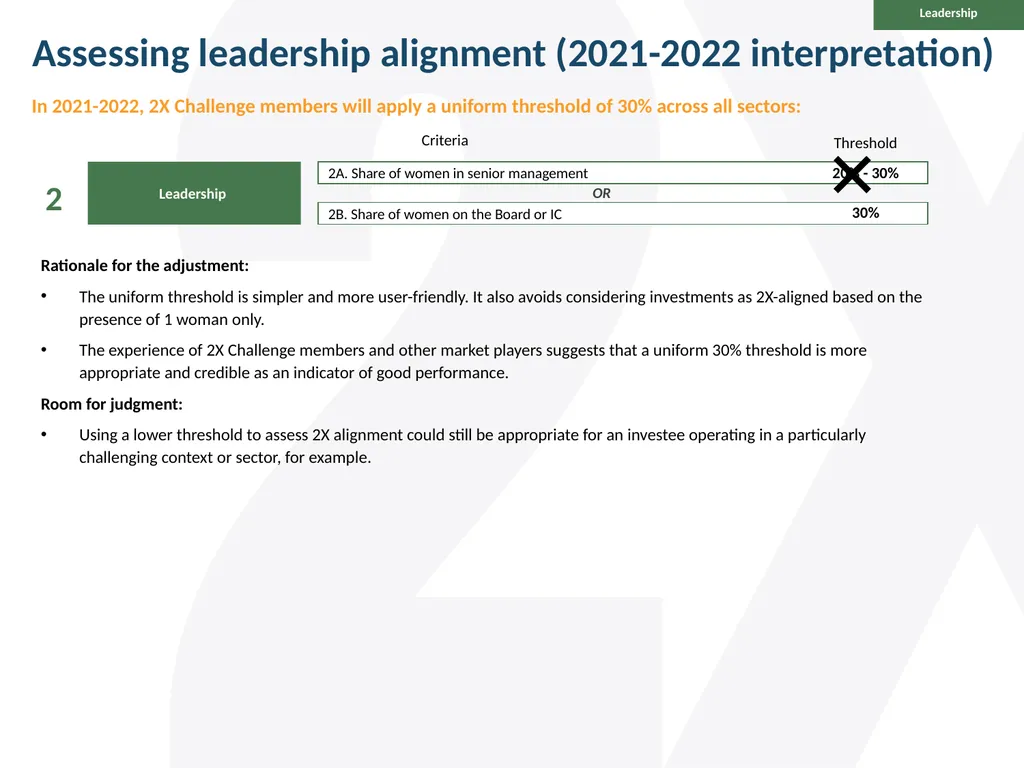
Assessing leadership alignment (2021-2022 interpretation) 30 In 2021-2022, 2X Challenge members will apply a uniform threshold of 30% across all sectors: Criteria Threshold Leadership Rationale for the adjustment:
The uniform threshold is simpler and more user-friendly. It also avoids considering investments as 2X-aligned based on the presence of 1 woman only.
The experience of 2X Challenge members and other market players suggests that a uniform 30% threshold is more appropriate and credible as an indicator of good performance.
Room for judgment:
Using a lower threshold to assess 2X alignment could still be appropriate for an investee operating in a particularly challenging context or sector, for example.<br>
The uniform threshold is simpler and more user-friendly. It also avoids considering investments as 2X-aligned based on the presence of 1 woman only.
The experience of 2X Challenge members and other market players suggests that a uniform 30% threshold is more appropriate and credible as an indicator of good performance.
Room for judgment:
Using a lower threshold to assess 2X alignment could still be appropriate for an investee operating in a particularly challenging context or sector, for example.<br>
30
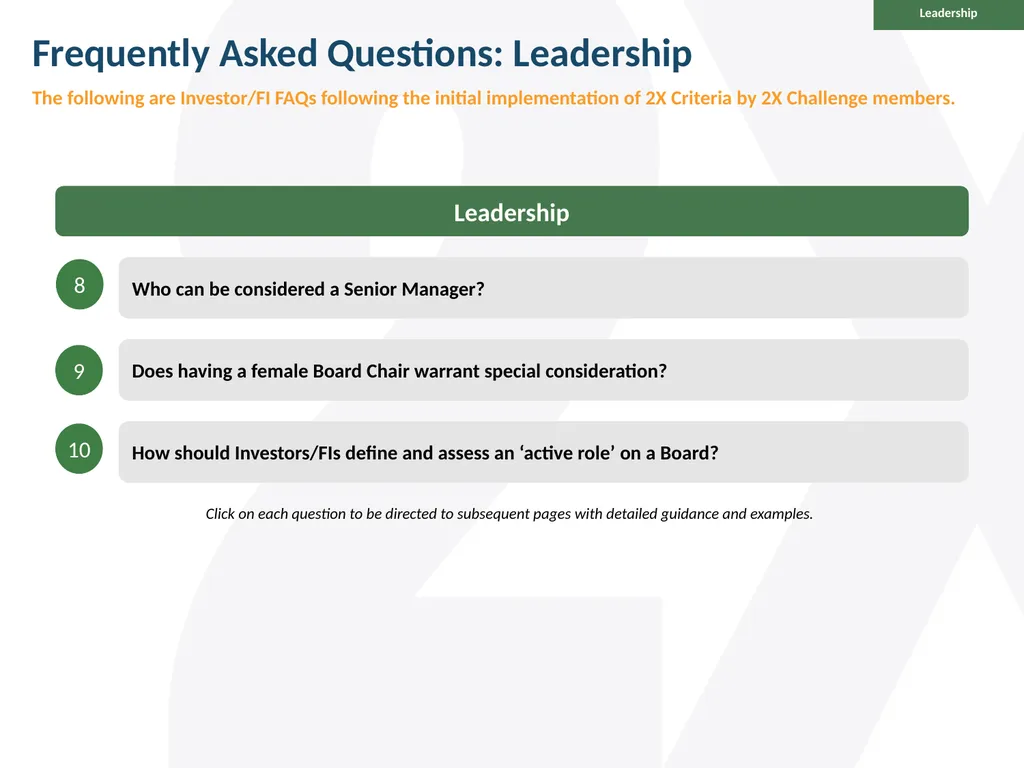
Frequently Asked Questions: Leadership 31 The following are Investor/FI FAQs following the initial implementation of 2X Criteria by 2X Challenge members. Leadership Who can be considered a Senior Manager? Does having a female Board Chair warrant special consideration? How should Investors/FIs define and assess an ‘active role’ on a Board? 8 10 9 Leadership Click on each question to be directed to subsequent pages with detailed guidance and examples.<br>
31
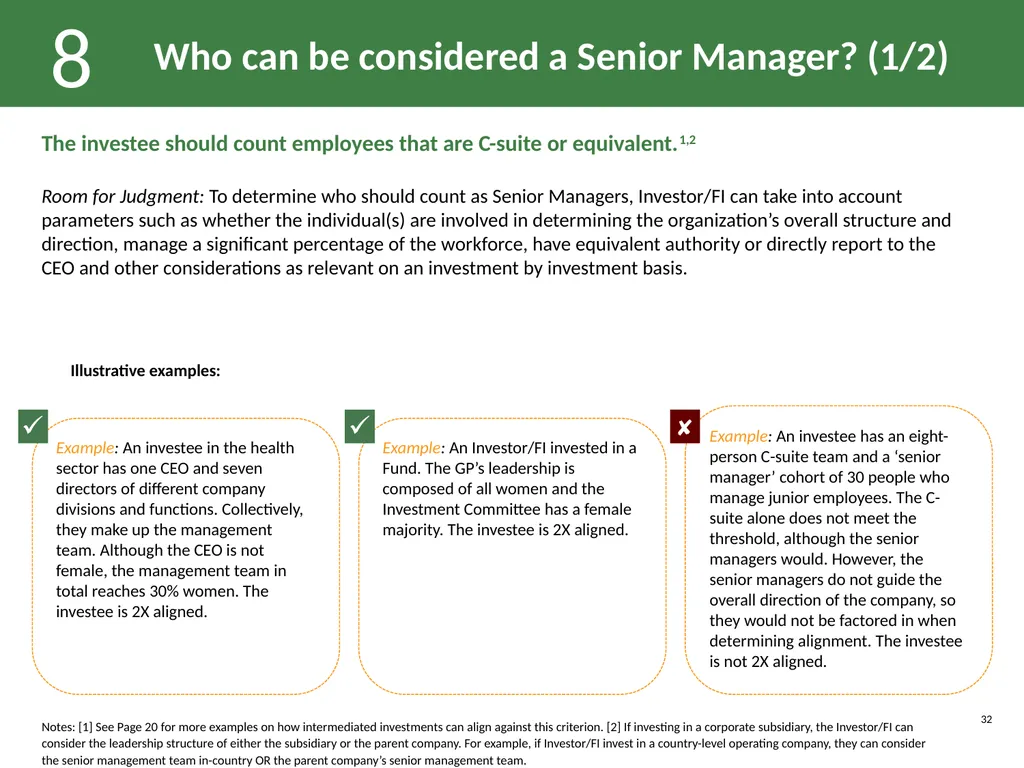
Who can be considered a Senior Manager? (1/2) 32 Notes: [1] See Page 20 for more examples on how intermediated investments can align against this criterion. [2] If investing in a corporate subsidiary, the Investor/FI can consider the leadership structure of either the subsidiary or the parent company. For example, if Investor/FI invest in a country-level operating company, they can consider the senior management team in-country OR the parent company’s senior management team. 8 The investee should count employees that are C-suite or equivalent.1,2
Room for Judgment: To determine who should count as Senior Managers, Investor/FI can take into account parameters such as whether the individual(s) are involved in determining the organization’s overall structure and direction, manage a significant percentage of the workforce, have equivalent authority or directly report to the CEO and other considerations as relevant on an investment by investment basis. Illustrative examples: Example: An investee in the health sector has one CEO and seven directors of different company divisions and functions. Collectively, they make up the management team. Although the CEO is not female, the management team in total reaches 30% women. The investee is 2X aligned. Example: An investee has an eight-person C-suite team and a ‘senior manager’ cohort of 30 people who manage junior employees. The C-suite alone does not meet the threshold, although the senior managers would. However, the senior managers do not guide the overall direction of the company, so they would not be factored in when determining alignment. The investee is not 2X aligned. Leadership Example: An Investor/FI invested in a Fund. The GP’s leadership is composed of all women and the Investment Committee has a female majority. The investee is 2X aligned. How should Investors/FIs define and assess an
‘active role’ on a Board? 10 Leadership What are quality employment indicators? (1/2) 11 Employment How should the alignment process consider different types of workers? 12 Employment 13 Consumption How do we assess whether the gender impact of a product or service is sufficient? 14 Consumption Does the consumption criteria focus entirely on clients or also end beneficiaries? 15 Consumption Who can be considered a Senior Manager? (1/2) 8<br>
Room for Judgment: To determine who should count as Senior Managers, Investor/FI can take into account parameters such as whether the individual(s) are involved in determining the organization’s overall structure and direction, manage a significant percentage of the workforce, have equivalent authority or directly report to the CEO and other considerations as relevant on an investment by investment basis. Illustrative examples: Example: An investee in the health sector has one CEO and seven directors of different company divisions and functions. Collectively, they make up the management team. Although the CEO is not female, the management team in total reaches 30% women. The investee is 2X aligned. Example: An investee has an eight-person C-suite team and a ‘senior manager’ cohort of 30 people who manage junior employees. The C-suite alone does not meet the threshold, although the senior managers would. However, the senior managers do not guide the overall direction of the company, so they would not be factored in when determining alignment. The investee is not 2X aligned. Leadership Example: An Investor/FI invested in a Fund. The GP’s leadership is composed of all women and the Investment Committee has a female majority. The investee is 2X aligned. How should Investors/FIs define and assess an
‘active role’ on a Board? 10 Leadership What are quality employment indicators? (1/2) 11 Employment How should the alignment process consider different types of workers? 12 Employment 13 Consumption How do we assess whether the gender impact of a product or service is sufficient? 14 Consumption Does the consumption criteria focus entirely on clients or also end beneficiaries? 15 Consumption Who can be considered a Senior Manager? (1/2) 8<br>
32
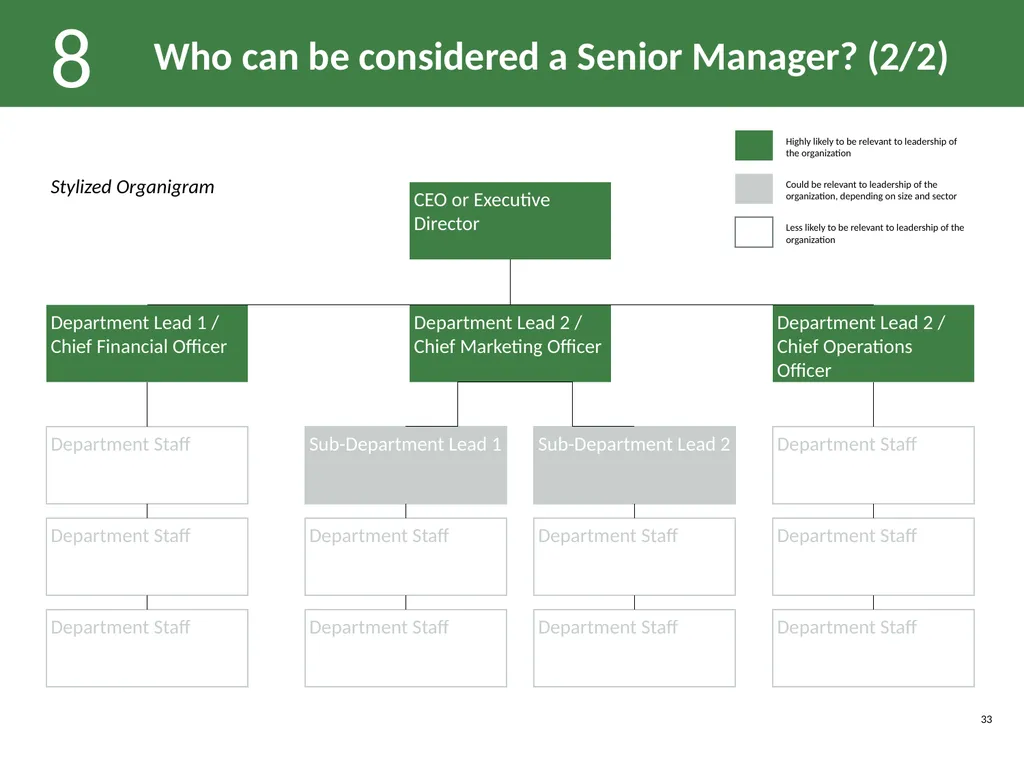
Who can be considered a Senior Manager? (2/2) 33 8 CEO or Executive Director Department Lead 1 / Chief Financial Officer Department Lead 2 / Chief Marketing Officer Department Lead 2 / Chief Operations Officer Department Staff Department Staff Department Staff Department Staff Department Staff Sub-Department Lead 2 Department Staff Department Staff Department Staff Department Staff Department Staff Sub-Department Lead 1 Highly likely to be relevant to leadership of the organization Could be relevant to leadership of the organization, depending on size and sector Less likely to be relevant to leadership of the organization Stylized Organigram Leadership How should Investors/FIs define and assess an
‘active role’ on a Board? 10 Leadership What are quality employment indicators? (1/2) 11 Employment How should the alignment process consider different types of workers? 12 Employment 13 Consumption How do we assess whether the gender impact of a product or service is sufficient? 14 Consumption Does the consumption criteria focus entirely on clients or also end beneficiaries? 15 Consumption 8 Who can be considered a Senior Manager? (2/2)<br>
‘active role’ on a Board? 10 Leadership What are quality employment indicators? (1/2) 11 Employment How should the alignment process consider different types of workers? 12 Employment 13 Consumption How do we assess whether the gender impact of a product or service is sufficient? 14 Consumption Does the consumption criteria focus entirely on clients or also end beneficiaries? 15 Consumption 8 Who can be considered a Senior Manager? (2/2)<br>
33
Does having a female Board Chair warrant
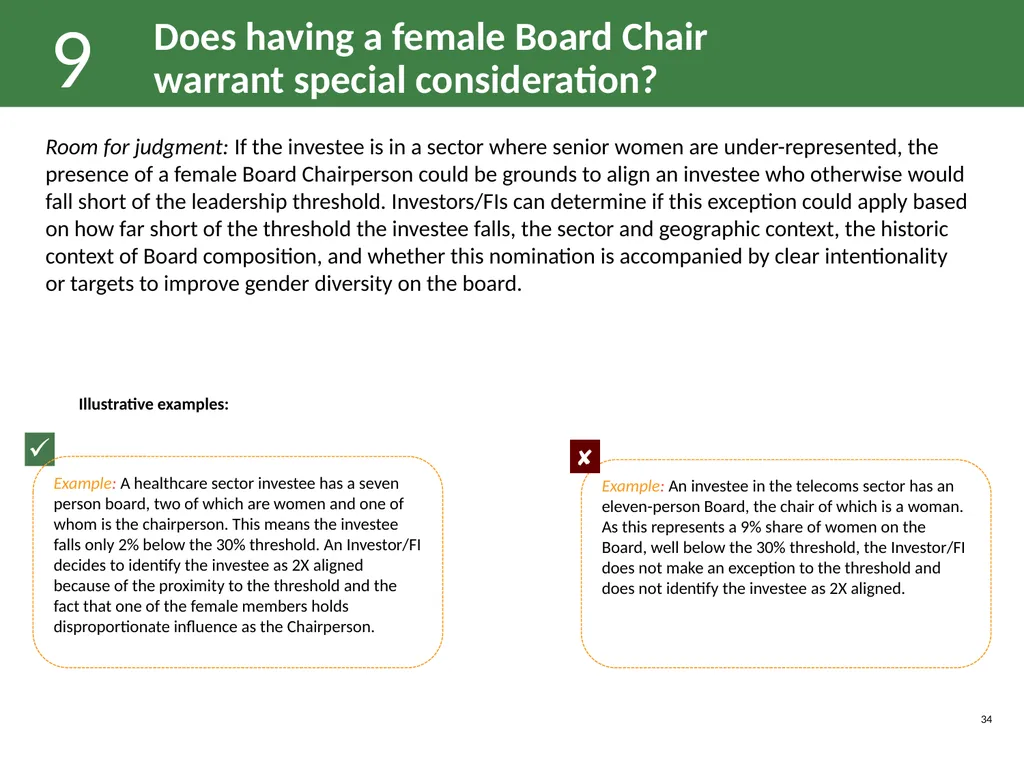
special consideration? Room for judgment: If the investee is in a sector where senior women are under-represented, the presence of a female Board Chairperson could be grounds to align an investee who otherwise would fall short of the leadership threshold. Investors/FIs can determine if this exception could apply based on how far short of the threshold the investee falls, the sector and geographic context, the historic context of Board composition, and whether this nomination is accompanied by clear intentionality or targets to improve gender diversity on the board. 34 9 Illustrative examples: Example: A healthcare sector investee has a seven person board, two of which are women and one of whom is the chairperson. This means the investee falls only 2% below the 30% threshold. An Investor/FI decides to identify the investee as 2X aligned because of the proximity to the threshold and the fact that one of the female members holds disproportionate influence as the Chairperson. Example: An investee in the telecoms sector has an eleven-person Board, the chair of which is a woman. As this represents a 9% share of women on the Board, well below the 30% threshold, the Investor/FI does not make an exception to the threshold and does not identify the investee as 2X aligned. Leadership How should Investors/FIs define and assess an
‘active role’ on a Board? 10 Leadership What are quality employment indicators? (1/2) 11 Employment How should the alignment process consider different types of workers? 12 Employment 13 Consumption How do we assess whether the gender impact of a product or service is sufficient? 14 Consumption Does the consumption criteria focus entirely on clients or also end beneficiaries? 15 Consumption Does having a female Board Chair
warrant special consideration? 9<br>
special consideration? Room for judgment: If the investee is in a sector where senior women are under-represented, the presence of a female Board Chairperson could be grounds to align an investee who otherwise would fall short of the leadership threshold. Investors/FIs can determine if this exception could apply based on how far short of the threshold the investee falls, the sector and geographic context, the historic context of Board composition, and whether this nomination is accompanied by clear intentionality or targets to improve gender diversity on the board. 34 9 Illustrative examples: Example: A healthcare sector investee has a seven person board, two of which are women and one of whom is the chairperson. This means the investee falls only 2% below the 30% threshold. An Investor/FI decides to identify the investee as 2X aligned because of the proximity to the threshold and the fact that one of the female members holds disproportionate influence as the Chairperson. Example: An investee in the telecoms sector has an eleven-person Board, the chair of which is a woman. As this represents a 9% share of women on the Board, well below the 30% threshold, the Investor/FI does not make an exception to the threshold and does not identify the investee as 2X aligned. Leadership How should Investors/FIs define and assess an
‘active role’ on a Board? 10 Leadership What are quality employment indicators? (1/2) 11 Employment How should the alignment process consider different types of workers? 12 Employment 13 Consumption How do we assess whether the gender impact of a product or service is sufficient? 14 Consumption Does the consumption criteria focus entirely on clients or also end beneficiaries? 15 Consumption Does having a female Board Chair
warrant special consideration? 9<br>
34
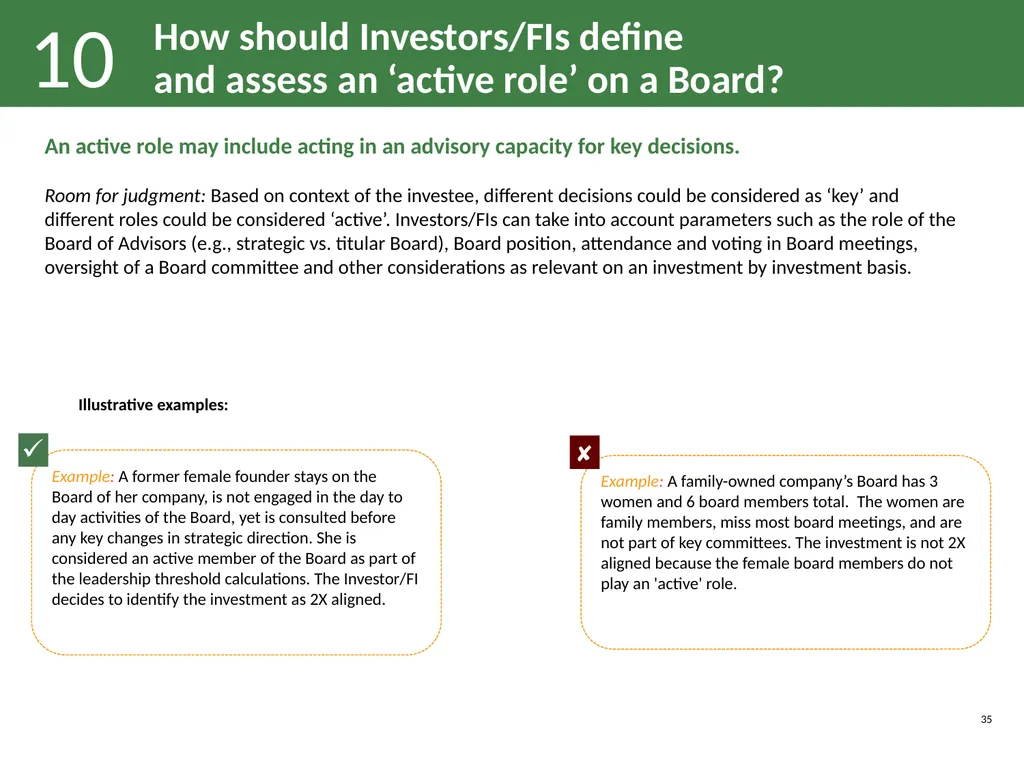
An active role may include acting in an advisory capacity for key decisions.
Room for judgment: Based on context of the investee, different decisions could be considered as ‘key’ and different roles could be considered ‘active’. Investors/FIs can take into account parameters such as the role of the Board of Advisors (e.g., strategic vs. titular Board), Board position, attendance and voting in Board meetings, oversight of a Board committee and other considerations as relevant on an investment by investment basis. How should Investors/FIs define and assess an
‘active role’ on a Board? 35 10 Illustrative examples: Example: A former female founder stays on the Board of her company, is not engaged in the day to day activities of the Board, yet is consulted before any key changes in strategic direction. She is considered an active member of the Board as part of the leadership threshold calculations. The Investor/FI decides to identify the investment as 2X aligned. Example: A family-owned company’s Board has 3 women and 6 board members total. The women are family members, miss most board meetings, and are not part of key committees. The investment is not 2X aligned because the female board members do not play an 'active' role. Leadership What are quality employment indicators? (1/2) 11 Employment How should the alignment process consider different types of workers? 12 Employment 13 Consumption How do we assess whether the gender impact of a product or service is sufficient? 14 Consumption Does the consumption criteria focus entirely on clients or also end beneficiaries? 15 Consumption How should Investors/FIs define
and assess an ‘active role’ on a Board? 10<br>
Room for judgment: Based on context of the investee, different decisions could be considered as ‘key’ and different roles could be considered ‘active’. Investors/FIs can take into account parameters such as the role of the Board of Advisors (e.g., strategic vs. titular Board), Board position, attendance and voting in Board meetings, oversight of a Board committee and other considerations as relevant on an investment by investment basis. How should Investors/FIs define and assess an
‘active role’ on a Board? 35 10 Illustrative examples: Example: A former female founder stays on the Board of her company, is not engaged in the day to day activities of the Board, yet is consulted before any key changes in strategic direction. She is considered an active member of the Board as part of the leadership threshold calculations. The Investor/FI decides to identify the investment as 2X aligned. Example: A family-owned company’s Board has 3 women and 6 board members total. The women are family members, miss most board meetings, and are not part of key committees. The investment is not 2X aligned because the female board members do not play an 'active' role. Leadership What are quality employment indicators? (1/2) 11 Employment How should the alignment process consider different types of workers? 12 Employment 13 Consumption How do we assess whether the gender impact of a product or service is sufficient? 14 Consumption Does the consumption criteria focus entirely on clients or also end beneficiaries? 15 Consumption How should Investors/FIs define
and assess an ‘active role’ on a Board? 10<br>
35
36 Guidance on
Employment Criteria<br>
Employment Criteria<br>
36
Assessing employment alignment 37 Investees are aligned with the employment criteria if they provide quality jobs to a significant share of women.1 Criteria detail
3A. Share of women in the workforce
Investor/FI should count the direct workforce, contracted workers, and suppliers as makes sense in the investee’s context. A weighted average of relevant groups must be above the threshold or each relevant group should be individually above the threshold.
Direct workforce: Share of women directly employed full- and part-time by the investee2
Contracted workforce: Share of women among third party workers engaged to perform work related to core business processes3 for a substantial duration (e.g. a season in the case of an agribusiness)
Suppliers: Share of women among investee’s primary supplier4 workforce (if corresponding proportion of primary suppliers meet entrepreneurship or senior management criteria, this may also justify 2X alignment)
3B. Quality Indicator
Investee should have one policy or program—beyond those required by local law—addressing barriers to women’s quality employment, with evidence of implementation or a commitment to implement. Each relevant group that is assessed against this criteria must have a relevant quality indicator (see FAQs). Threshold rationale
3A. Share of women in the workforce
Thresholds reflect women’s varied representation across sectors
Sectoral definitions vary across Investor/FI; each Investor/FI should apply the sector-specific threshold it finds to be most appropriate Source: 2X Working Group , CDC gender strategy; The GIIN, Iris Database; IFC, IFC Performance Standards on Environmental and Social Sustainability, Effective from January 1, 2012. Notes: [1] See Page 20 for how intermediated investments can align against this criteria. [2] As per the HIPSO definition, part-time jobs are converted to full-time equivalent jobs on a pro rata basis, based on local definition (e.g., if working week equals 40 hours, a 24 hr/week job would be equal to 0.6 FTE job). If the information is not available, the rule-of-thumb is two part-time jobs equal one full-time job. See the 2X/IRIS+ guidance note for more details. [3] Core business processes constitute those production and/or service processes essential for a specific business activity without which the business activity could not continue. [4] Primary suppliers are those suppliers who, on an ongoing basis, provide goods or materials essential for the core business processes of the business. [5] This sectoral breakdown encompasses industries with very different women employment profiles (e.g., textile industry, which typically hires a majority of women, e.g. 80% in Bangladesh, and the automobile manufacturing, which hires a limited share of women). In general, industries which have a NAICS 31-32.3 or NACE C10-C18 count as light manufacturing; industries with a NAICS code beginning 32.4-33 or a NACE code C19-C32 count as heavy manufacturing 30% - 50% Yes/No Criteria Threshold Employment<br>
3A. Share of women in the workforce
Investor/FI should count the direct workforce, contracted workers, and suppliers as makes sense in the investee’s context. A weighted average of relevant groups must be above the threshold or each relevant group should be individually above the threshold.
Direct workforce: Share of women directly employed full- and part-time by the investee2
Contracted workforce: Share of women among third party workers engaged to perform work related to core business processes3 for a substantial duration (e.g. a season in the case of an agribusiness)
Suppliers: Share of women among investee’s primary supplier4 workforce (if corresponding proportion of primary suppliers meet entrepreneurship or senior management criteria, this may also justify 2X alignment)
3B. Quality Indicator
Investee should have one policy or program—beyond those required by local law—addressing barriers to women’s quality employment, with evidence of implementation or a commitment to implement. Each relevant group that is assessed against this criteria must have a relevant quality indicator (see FAQs). Threshold rationale
3A. Share of women in the workforce
Thresholds reflect women’s varied representation across sectors
Sectoral definitions vary across Investor/FI; each Investor/FI should apply the sector-specific threshold it finds to be most appropriate Source: 2X Working Group , CDC gender strategy; The GIIN, Iris Database; IFC, IFC Performance Standards on Environmental and Social Sustainability, Effective from January 1, 2012. Notes: [1] See Page 20 for how intermediated investments can align against this criteria. [2] As per the HIPSO definition, part-time jobs are converted to full-time equivalent jobs on a pro rata basis, based on local definition (e.g., if working week equals 40 hours, a 24 hr/week job would be equal to 0.6 FTE job). If the information is not available, the rule-of-thumb is two part-time jobs equal one full-time job. See the 2X/IRIS+ guidance note for more details. [3] Core business processes constitute those production and/or service processes essential for a specific business activity without which the business activity could not continue. [4] Primary suppliers are those suppliers who, on an ongoing basis, provide goods or materials essential for the core business processes of the business. [5] This sectoral breakdown encompasses industries with very different women employment profiles (e.g., textile industry, which typically hires a majority of women, e.g. 80% in Bangladesh, and the automobile manufacturing, which hires a limited share of women). In general, industries which have a NAICS 31-32.3 or NACE C10-C18 count as light manufacturing; industries with a NAICS code beginning 32.4-33 or a NACE code C19-C32 count as heavy manufacturing 30% - 50% Yes/No Criteria Threshold Employment<br>
37
Frequently Asked Questions: Employment 38 The following are Investor/FI FAQs following the initial implementation of 2X Criteria by 2X Challenge members. Employment What are quality employment indicators? How should the alignment process consider different types of workers? 11 12 Employment Click on each question to be directed to subsequent pages with detailed guidance and examples.<br>
38
What are quality employment indicators? (1/2) 39 The quality indicator can be from one of the three categories below or others that address women’s barriers to quality employment. It must be above the legal minimum and there must be evidence of implementation or a commitment to implement.
Recruitment - Have a clear gender lens in hiring, to eliminate bias and diversify pipeline
Examples: Targets for gender diversity in recruitment, gender-balanced interview panels, anonymized resume screening, trainings for recruiters on unconscious bias, mechanisms to track gender disaggregated data in employee recruitment, etc.
Retention - Ensure an inclusive working environment for all women in the workplace
Examples: Paid parental leave, flexible working policies, on-site childcare facilities, on-site lactation accommodation, a clear Diversity, Equity and Inclusion strategy, Employee Resource Groups for trans-women or women with disabilities, etc.
Career Advancement – Support women’s progression and leadership in the workplace
Examples: Mentoring, coaching or training1 tailored to female staff, HR Committee or Employee Resource Group to track gendered outcomes in promotions or other forms of advancements, trainings on unconscious bias in performance review processes, etc. Note: [1] Mentoring, coaching or training opportunities must intentionally be designed to benefit women in order to be Aligned; guidance based on Catalyst, “Mentoring: Necessary but insufficient for Advancement.” and Harvard Business Review, “When Men Mentor Women.” 11 The 2X/IRIS+ guidance proposes specific metrics that Investor/FI can leverage to measure & monitor alignment. It is best practice to monitor implementation and compliance with policies over the life of the investment. Employment How should the alignment process consider different types of workers? 12 Employment 13 Consumption How do we assess whether the gender impact of a product or service is sufficient? 14 Consumption Does the consumption criteria focus entirely on clients or also end beneficiaries? 15 Consumption What are quality
employment indicators? (1/2) 11<br>
Recruitment - Have a clear gender lens in hiring, to eliminate bias and diversify pipeline
Examples: Targets for gender diversity in recruitment, gender-balanced interview panels, anonymized resume screening, trainings for recruiters on unconscious bias, mechanisms to track gender disaggregated data in employee recruitment, etc.
Retention - Ensure an inclusive working environment for all women in the workplace
Examples: Paid parental leave, flexible working policies, on-site childcare facilities, on-site lactation accommodation, a clear Diversity, Equity and Inclusion strategy, Employee Resource Groups for trans-women or women with disabilities, etc.
Career Advancement – Support women’s progression and leadership in the workplace
Examples: Mentoring, coaching or training1 tailored to female staff, HR Committee or Employee Resource Group to track gendered outcomes in promotions or other forms of advancements, trainings on unconscious bias in performance review processes, etc. Note: [1] Mentoring, coaching or training opportunities must intentionally be designed to benefit women in order to be Aligned; guidance based on Catalyst, “Mentoring: Necessary but insufficient for Advancement.” and Harvard Business Review, “When Men Mentor Women.” 11 The 2X/IRIS+ guidance proposes specific metrics that Investor/FI can leverage to measure & monitor alignment. It is best practice to monitor implementation and compliance with policies over the life of the investment. Employment How should the alignment process consider different types of workers? 12 Employment 13 Consumption How do we assess whether the gender impact of a product or service is sufficient? 14 Consumption Does the consumption criteria focus entirely on clients or also end beneficiaries? 15 Consumption What are quality
employment indicators? (1/2) 11<br>
39
40 Illustrative examples Example: A company that meets the employment threshold reviews unconscious bias in hiring decisions and has a dedicated budget for efforts to increase gender diversity in hiring so it is aligned with 2X on the basis of the employment criterion. Example: An FI has 55% female employees and a ‘fast-track’ career scheme which provides additional training opportunities for women, such as executive coaching and negotiation skills. It is aligned with 2X, specifically because the fast-track scheme has a gender focus. Example: An investee has 75% women employees and its quality indicator is a generous parental leave policy that goes beyond the legal requirements in its country. It is aligned with 2X. Example: An investee meets the employment threshold and has specific protocols in place, with evidence of implementation, to support trans and LGBTQ employees when they travel to areas with restrictive government policies for these groups. What are quality employment indicators? (2/2) 11 Employment Example: An investee has 75% women employees, but its only quality indicator is a parental leave policy which matches the legal minimum requirement. It is not aligned with 2X against the employment criterion. Example: An investee meets the numerical threshold for female employees and has generous lactation facilities (e.g., fridge, hospital-grade pump, sink, private locker) for new mothers, going beyond the legal minimum to provide a private room that can be locked. This counts as a quality indicator and the investee is 2X aligned. How should the alignment process
consider different types of workers? 12 Employment 13 Consumption How do we assess whether the gender
impact of a product or service is sufficient? 14 Consumption Does the consumption criteria focus
entirely on clients or also end beneficiaries? 15 Consumption What are quality
employment indicators? (1/2) 11<br>
employment indicators? (1/2) 11<br>
40
How should the alignment process
consider different types of workers? 41 12 Investors/FIs can either confirm that each group that makes sense in the investee context meets the threshold individually OR the they can take a weighted average of the relevant groups.1 These groups may include permanent employees, contracted workers or suppliers, depending on the context. Informal workers cannot be counted.
Room for Judgment: The Investor/FI can determine which employee groups make sense to count considering factors such as:
Relative size of group (e.g., groups comprising 25%+ of the workforce should be counted)
Whether the employee group is critical to functioning of the investee
The degree of leverage or influence the investee has over a specific employee group based on its sector, geographic or legal context (e.g. in some countries investees may not have the option to readily switch to suppliers with a larger female workforce) Illustrative examples: Example: A manufacturing firm relies on a large number of part-time seasonal contract staff to help process export forms during tax season. As both seasonal and full-time employees are critical to the business’ operations, they must both be assessed. They both meet the threshold and quality indicator, so the investee is 2X aligned. Example: An agribusiness sources from 5,000 smallholders, 90% of whom are men. Female family members play a significant but informal role in growing and picking the crops on the farms, but are not part of the contract scheme, and their pay/benefits are unclear. The company is not aligned with 2X. Employment Note: [1] In addition, each group that is used to assess alignment must benefit from some type of quality employment indicator. The quality employment indicator may be different between groups, but one must be present for each group. If one group (e.g., suppliers) are in a vastly different sector, then that sector’s threshold may be applied. When developing a weighted average, the Investor/FI can determine which sector threshold would be appropriate to utilize. What does ‘specifically/disproportionately benefitting women’ mean? 13 Consumption How do we assess whether the gender impact of a product or service is sufficient? 14 Consumption Does the consumption criteria focus entirely on clients or also end beneficiaries? 15 Consumption How should the alignment process consider different types of workers? 12<br>
Room for Judgment: The Investor/FI can determine which employee groups make sense to count considering factors such as:
Relative size of group (e.g., groups comprising 25%+ of the workforce should be counted)
Whether the employee group is critical to functioning of the investee
The degree of leverage or influence the investee has over a specific employee group based on its sector, geographic or legal context (e.g. in some countries investees may not have the option to readily switch to suppliers with a larger female workforce) Illustrative examples: Example: A manufacturing firm relies on a large number of part-time seasonal contract staff to help process export forms during tax season. As both seasonal and full-time employees are critical to the business’ operations, they must both be assessed. They both meet the threshold and quality indicator, so the investee is 2X aligned. Example: An agribusiness sources from 5,000 smallholders, 90% of whom are men. Female family members play a significant but informal role in growing and picking the crops on the farms, but are not part of the contract scheme, and their pay/benefits are unclear. The company is not aligned with 2X. Employment Note: [1] In addition, each group that is used to assess alignment must benefit from some type of quality employment indicator. The quality employment indicator may be different between groups, but one must be present for each group. If one group (e.g., suppliers) are in a vastly different sector, then that sector’s threshold may be applied. When developing a weighted average, the Investor/FI can determine which sector threshold would be appropriate to utilize. What does ‘specifically/disproportionately benefitting women’ mean? 13 Consumption How do we assess whether the gender impact of a product or service is sufficient? 14 Consumption Does the consumption criteria focus entirely on clients or also end beneficiaries? 15 Consumption How should the alignment process consider different types of workers? 12<br>
41
42 Guidance on
Consumption Criteria Supported By<br>
Consumption Criteria Supported By<br>
42
Assessing consumption alignment 43 The consumption criteria can be aligned if the investee provides goods or services targeting and benefiting women.1 Criteria Detail
4. Specifically or disproportionately benefitting women:
Products and services can align if they2
Are designed for women’s unique needs; or
Address a problem disproportionately impacting women; or
Have a majority of women customers3; or
Have a majority of women beneficiaries4
For each proposed 2X investment, the investee would need to provide a rationale for how these products/services disproportionately benefit women. Given the unique nature of infrastructure transactions, the sub-criteria are applied differently, and these transactions are subject to specific evidence requirements.2 Notes: [1] Financial institutions (FIs) can align against this criteria if they either design products or services specifically for women’s needs or they on-lend to individual women and these women compose the majority of the FI’s customers. More details on intermediated investments can be found on Page 18. [2] Given the unique nature of infrastructure transactions, they are only 2X-aligned if projects are designed to serve women’s unique needs (i.e., align under 4.1) or if they both address a problem disproportionately impacting women and are expected to have a majority of women customers or beneficiaries (i.e., align under 4.2 and 4.3 or 4.4). Please see FAQs 16-18 for further guidance. [3] As a general rule, these should be direct purchasing clients. Client proxies (where women are the primary user but may not have purchased the product/service directly), should only be estimated where there is intention to support female clients – albeit indirectly. [4] See FAQ 15 for more details. Criteria Consumption Yes/No<br>
4. Specifically or disproportionately benefitting women:
Products and services can align if they2
Are designed for women’s unique needs; or
Address a problem disproportionately impacting women; or
Have a majority of women customers3; or
Have a majority of women beneficiaries4
For each proposed 2X investment, the investee would need to provide a rationale for how these products/services disproportionately benefit women. Given the unique nature of infrastructure transactions, the sub-criteria are applied differently, and these transactions are subject to specific evidence requirements.2 Notes: [1] Financial institutions (FIs) can align against this criteria if they either design products or services specifically for women’s needs or they on-lend to individual women and these women compose the majority of the FI’s customers. More details on intermediated investments can be found on Page 18. [2] Given the unique nature of infrastructure transactions, they are only 2X-aligned if projects are designed to serve women’s unique needs (i.e., align under 4.1) or if they both address a problem disproportionately impacting women and are expected to have a majority of women customers or beneficiaries (i.e., align under 4.2 and 4.3 or 4.4). Please see FAQs 16-18 for further guidance. [3] As a general rule, these should be direct purchasing clients. Client proxies (where women are the primary user but may not have purchased the product/service directly), should only be estimated where there is intention to support female clients – albeit indirectly. [4] See FAQ 15 for more details. Criteria Consumption Yes/No<br>
43
Frequently Asked Questions: Consumption 44 The following are Investor/FI FAQs following the initial implementation of 2X Criteria by 2X Challenge members. Consumption What does ‘specifically / disproportionately benefitting women’ mean? How do we assess whether the gender impact of a product or service is sufficient? 13 14 Do the consumption criteria focus entirely on clients or also end beneficiaries? 15 Consumption Click on each question to be directed to subsequent pages with detailed guidance and examples. How do the criteria apply to infrastructure projects? What evidence is required to qualify infrastructure projects specifically designed for women’s unique needs? 16 17 What evidence is required to qualify infrastructure projects NOT specifically designed for women’s unique needs? 18<br>
44
What does ‘specifically/disproportionately
benefitting women’ mean? 45 13 Designed for women’s unique needs Addresses a problem disproportionately impacting women Has a majority of women customers2 Has a majority of women beneficiaries2 Example: A bank provides small-ticket, flexible repayment loan products to women-owned SMEs, reflecting these clients’ desire to adjust borrowing strategies based on business needs. As the investee consulted female entrepreneurs and designed the product for their needs, it is 2X aligned. Example: A tech platform aggregates demand & supply of produce, and provides logistics to move produce, saving women time. 65% of its urban street vendor clients are women. Illustrative Examples: Investors/FIs have room for judgment in determining alignment Example: A ‘virtual witness’ security app for unsafe situations directs users toward emergency services. As this service is primarily used in locations with high rates of violence against women (5x global averages)3 and disproportionately benefits women, it is 2X aligned. Example: A professional services company provides unconscious bias training to employees in large corporations. Unconscious bias is known to reinforce pernicious gender norms in the workplace and limit women’s advancement, so the investment is 2X aligned. Example: An ag extension service provider trains male heads of households in fertilizer application, with the understanding they may transfer learnings to their wives. As there is unclear intent to ensure women benefit, it is not 2X aligned. Example: A road construction firm is being assessed against the consumption criteria, under the premise that new road infrastructure will disproportionately benefit women by enabling them to travel for paid and unpaid work. However, the investee is not able to provide evidence that lack of transport is a major barrier to women’s paid employment opportunities or contributes to women’s unpaid work responsibilities such as collecting water or fuel. The project is not 2X aligned.1 Sources: Analysis from Women’s Economic Empowerment Through Financial Inclusion: Review of evidence, Innovations for Poverty Action, 2017; Unilever: Opportunities for Women, 2017; . Notes [1] Given the unique nature of infrastructure transactions, they are only 2X-aligned if projects are designed to serve women’s unique needs or if they both address a problem disproportionately impacting women and are expected to have a majority of women customers or beneficiaries. Please see FAQs 16-18 for further guidance. [2] As a general rule, these should be direct purchasing clients. Client proxies (where women are the primary user but may not have purchased the product/service directly), should only be estimated where there is an intention to support female clients – albeit indirectly [3] App may have been primarily bought or downloaded by men, but was intentionally targeted towards women’s safety. Consumption Example: A healthcare service provider has increased the number of female customers in the past five years, but men are still the majority of customers. It is not 2X aligned. How do we assess whether the gender
impact of a product or service is sufficient? 14 Consumption Does the consumption criteria focus
entirely on clients or also end beneficiaries? 15 Consumption What does ‘specifically / disproportionately benefitting women’ mean? 13<br>
45
Room for Judgment: Investors/FIs should consider parameters such as whether the product was specifically developed for women or would have been developed regardless of women’s needs, whether the gendered impact of the product/service was considered from the beginning or as an ex-post label, the percentage of the investee’s clients that purchase or use the product/service and other considerations as relevant on an investment-by-investment basis.1
Best practice: The Investor/FI should assess ex-post usage of products and services and support investees to improve their actions. How do we assess whether the gender impact of a product or service is sufficient? 46 14 Illustrative examples: Example: A rapidly growing chain of chemists in a country in Sub-Saharan Africa provides affordable drugs and healthcare for poor households in underserved rural areas. It has an equal number of male and female customers, and the chemist was the first firm in its country to offer the morning after pill. The Investor/FI decides to identify as aligning with 2X.
Per best practice, the Investor/FI also works with the company to consider gender in its provision of other products. Consumption Example: A large infrastructure project focused on sanitation consulted women as part of original stakeholder consultations and strategically designed the locations of latrines within rural villages to specifically balance the need for privacy with the safety risks of isolation. As the investee integrated gender considerations into the project design, the Investor/FI decides to identify the transaction as 2X aligned. Example: A bank has a credit card that is marketed towards women; however, it is unclear what research was done to design the product for women and only 5% of the bank’s credit card customers choose this specific product. The Investor/FI decides not to identify the transaction as 2X aligned. Does the consumption criteria focus entirely on clients or also end beneficiaries? 15 Consumption How do we assess whether the gender impact of a product or service is sufficient? 14 Notes: [1] Given the unique nature of infrastructure transactions, they are only 2X-aligned if projects are designed to serve women’s unique needs or if they both address a problem disproportionately impacting women and are expected to have a majority of women customers or beneficiaries. Please see FAQs 16-18 for further guidance.<br>
Best practice: The Investor/FI should assess ex-post usage of products and services and support investees to improve their actions. How do we assess whether the gender impact of a product or service is sufficient? 46 14 Illustrative examples: Example: A rapidly growing chain of chemists in a country in Sub-Saharan Africa provides affordable drugs and healthcare for poor households in underserved rural areas. It has an equal number of male and female customers, and the chemist was the first firm in its country to offer the morning after pill. The Investor/FI decides to identify as aligning with 2X.
Per best practice, the Investor/FI also works with the company to consider gender in its provision of other products. Consumption Example: A large infrastructure project focused on sanitation consulted women as part of original stakeholder consultations and strategically designed the locations of latrines within rural villages to specifically balance the need for privacy with the safety risks of isolation. As the investee integrated gender considerations into the project design, the Investor/FI decides to identify the transaction as 2X aligned. Example: A bank has a credit card that is marketed towards women; however, it is unclear what research was done to design the product for women and only 5% of the bank’s credit card customers choose this specific product. The Investor/FI decides not to identify the transaction as 2X aligned. Does the consumption criteria focus entirely on clients or also end beneficiaries? 15 Consumption How do we assess whether the gender impact of a product or service is sufficient? 14 Notes: [1] Given the unique nature of infrastructure transactions, they are only 2X-aligned if projects are designed to serve women’s unique needs or if they both address a problem disproportionately impacting women and are expected to have a majority of women customers or beneficiaries. Please see FAQs 16-18 for further guidance.<br>
46
Does the consumption criteria focus
entirely on clients or also end beneficiaries? 47 15 An investee can align if women are either clients or end-beneficiaries of its product and service.
Best practice: As a general rule, women should be direct purchasing clients for an investment to be 2X aligned. Client proxies (where women are the primary user but may not have purchased the product/service directly) should only be estimated where there is intention to support female clients – albeit indirectly. Regardless of who is the purchaser or beneficiary, Investor/FI must ultimately determine whether this product or service intends to benefit women, to determine 2X alignment.1 Illustrative examples: Example: A ‘virtual witness’ security app enables users to report unsafe situations to emergency services. It is used often in locations with high rates of violence against women (5x global averages). The app may have been primarily bought or used by men but was 2X aligned as it was ultimately targeted towards women’s safety. Example: Women comprise >60% of direct purchasing clients for an apparel manufacturer selling women’s, men’s and children’s clothing in East Africa, due to cultural norms governing who makes household purchases. While it may be technically aligned for 2X, the Investor/FI decides not to identify the company as aligned as it isn’t primarily benefitting women consumers. Consumption Do the consumption criteria focus entirely on clients or also end beneficiaries? 15 Notes [1] Household multipliers should not be used when assessing beneficiaries. If the company/organisation is unable to report on number of clients based on direct data – for example, if products are sold via a network of distributors and number of clients reached is estimated based on number of units sold – then details on how and why these assumptions were made should be included in the reporting template.<br>
Best practice: As a general rule, women should be direct purchasing clients for an investment to be 2X aligned. Client proxies (where women are the primary user but may not have purchased the product/service directly) should only be estimated where there is intention to support female clients – albeit indirectly. Regardless of who is the purchaser or beneficiary, Investor/FI must ultimately determine whether this product or service intends to benefit women, to determine 2X alignment.1 Illustrative examples: Example: A ‘virtual witness’ security app enables users to report unsafe situations to emergency services. It is used often in locations with high rates of violence against women (5x global averages). The app may have been primarily bought or used by men but was 2X aligned as it was ultimately targeted towards women’s safety. Example: Women comprise >60% of direct purchasing clients for an apparel manufacturer selling women’s, men’s and children’s clothing in East Africa, due to cultural norms governing who makes household purchases. While it may be technically aligned for 2X, the Investor/FI decides not to identify the company as aligned as it isn’t primarily benefitting women consumers. Consumption Do the consumption criteria focus entirely on clients or also end beneficiaries? 15 Notes [1] Household multipliers should not be used when assessing beneficiaries. If the company/organisation is unable to report on number of clients based on direct data – for example, if products are sold via a network of distributors and number of clients reached is estimated based on number of units sold – then details on how and why these assumptions were made should be included in the reporting template.<br>
47
How do the criteria apply to infrastructure transactions? 48 15 Illustrative examples: Example: A highway is constructed in a region where women disproportionately encounter transport barriers. However, it is unclear how the project addresses women’s existing transport barriers or whether women are expected to be the majority of road users. The project is not 2X aligned. Consumption How do the criteria apply to infrastructure transactions? 16 Criteria Detail
Product or service specifically or disproportionately benefitting women:
Infrastructure transactions can align if they1, 2 Notes: [1] The consumption sub-criteria remain the same but are applied differently for infrastructure transactions. [2] All infrastructure transactions should be reviewed for baseline gender risk mitigating measures that apply ‘do no harm’ principles. See Appendix for further details. [3] See FAQ 15 for more details. Example: A metro renovation project integrates gender design features such as dedicated waiting spaces, separate washrooms (with layouts appropriate for all gender identities), as well as lactation facilities. Example: A water supply project is undertaken in an area where it is evidenced that women disproportionately take on the unpaid domestic work of collecting water. Following a household survey conducted on a representative sample of women in the area, the project expects that women are the majority of beneficiaries. Are designed for women’s unique needs Address a problem disproportionately impacting women;
AND
Expect to have a majority of women customers; or
Expect to have a majority of women beneficiaries3 OR Example: A school is built in a region where girls have lower education levels than boys. However, the school does not include any design features to ensure girls can safely and fully benefit and it is unclear whether girls will represent the majority of students. The project is not 2X aligned. See FAQ 17 See FAQ 18-19<br>
Product or service specifically or disproportionately benefitting women:
Infrastructure transactions can align if they1, 2 Notes: [1] The consumption sub-criteria remain the same but are applied differently for infrastructure transactions. [2] All infrastructure transactions should be reviewed for baseline gender risk mitigating measures that apply ‘do no harm’ principles. See Appendix for further details. [3] See FAQ 15 for more details. Example: A metro renovation project integrates gender design features such as dedicated waiting spaces, separate washrooms (with layouts appropriate for all gender identities), as well as lactation facilities. Example: A water supply project is undertaken in an area where it is evidenced that women disproportionately take on the unpaid domestic work of collecting water. Following a household survey conducted on a representative sample of women in the area, the project expects that women are the majority of beneficiaries. Are designed for women’s unique needs Address a problem disproportionately impacting women;
AND
Expect to have a majority of women customers; or
Expect to have a majority of women beneficiaries3 OR Example: A school is built in a region where girls have lower education levels than boys. However, the school does not include any design features to ensure girls can safely and fully benefit and it is unclear whether girls will represent the majority of students. The project is not 2X aligned. See FAQ 17 See FAQ 18-19<br>
48
What evidence is required to qualify infra. projects designed for women’s unique needs? 49 15 For projects which are designed – in part or as a whole – to respond to women’s unique needs, investees must:
Conduct gender analysis using primary evidence specific to the project (e.g., women focus groups, sex-disaggregated surveys or demand analysis) or relevant secondary evidence1
AND
Demonstrate a link between the gender analysis conducted/collected and the gender design features incorporated in the project Consumption Illustrative examples: Example: A highway is constructed in a region of Mexico. The investee wants to utilize secondary research in South Asia to justify the key adjustments made to the highway to design it for women’s unique needs. However, the Investor/FI determine the secondary evidence is not relevant to the project in Mexico. The project is not 2X aligned. Notes: [1] Please see the “What is gender analysis?” slide in the 2X criteria and overall guidance section for further details on types of gender analysis and the distinction between primary evidence that is collected by an investee vs. secondary evidence that is collected by a credible external source. Relevance of secondary evidence can typically be defined by (i) Geography: Data is focused on the local context of the project or is from a context which is similar enough for the insights to be transferable; (ii) Sector: Data is focused on the same sector as the project, and (iii) Date of collection: Data has been collected recently enough to be considered reliable in the current context. What evidence is required to qualify infra. projects designed for women’s unique needs? 17 Example: A social housing project consulted secondary research and conducted focus groups to design the housing to address women’s stated needs, including safety (e.g., by locating waste collection bins in public, well-lit areas) and unpaid care responsibilities (e.g., by having all units overlook a communal playground where caregivers can oversee children from their unit’s window). Example: A sanitation project leads focus groups with a representative sample of local women to identify locations and designs for latrines which balance women’s needs for privacy with safety risks of isolation. Example: A hospital is built in a region of Kenya where secondary evidence suggests women face poorer health outcomes than men. However, the project does not include any design features meant to ensure women can safely and fully benefit from the hospital. The project is not 2X aligned. <br>
Conduct gender analysis using primary evidence specific to the project (e.g., women focus groups, sex-disaggregated surveys or demand analysis) or relevant secondary evidence1
AND
Demonstrate a link between the gender analysis conducted/collected and the gender design features incorporated in the project Consumption Illustrative examples: Example: A highway is constructed in a region of Mexico. The investee wants to utilize secondary research in South Asia to justify the key adjustments made to the highway to design it for women’s unique needs. However, the Investor/FI determine the secondary evidence is not relevant to the project in Mexico. The project is not 2X aligned. Notes: [1] Please see the “What is gender analysis?” slide in the 2X criteria and overall guidance section for further details on types of gender analysis and the distinction between primary evidence that is collected by an investee vs. secondary evidence that is collected by a credible external source. Relevance of secondary evidence can typically be defined by (i) Geography: Data is focused on the local context of the project or is from a context which is similar enough for the insights to be transferable; (ii) Sector: Data is focused on the same sector as the project, and (iii) Date of collection: Data has been collected recently enough to be considered reliable in the current context. What evidence is required to qualify infra. projects designed for women’s unique needs? 17 Example: A social housing project consulted secondary research and conducted focus groups to design the housing to address women’s stated needs, including safety (e.g., by locating waste collection bins in public, well-lit areas) and unpaid care responsibilities (e.g., by having all units overlook a communal playground where caregivers can oversee children from their unit’s window). Example: A sanitation project leads focus groups with a representative sample of local women to identify locations and designs for latrines which balance women’s needs for privacy with safety risks of isolation. Example: A hospital is built in a region of Kenya where secondary evidence suggests women face poorer health outcomes than men. However, the project does not include any design features meant to ensure women can safely and fully benefit from the hospital. The project is not 2X aligned. <br>
49
What evidence is required to qualify infra. projects NOT specifically designed for women’s needs? 50 15 Consumption What evidence is required to qualify infra. projects NOT specifically designed for women’s needs? (1/2) 18 Notes: [1] Please see the “What is gender analysis?” slide in the 2X criteria and overall guidance section for further details on types of gender analysis and the distinction between primary evidence collected by an investee vs. secondary evidence that is collected by a credible external source. Relevance of secondary evidence can typically be defined by (i) Geography: Data is focused on the local context of the project or is from a context which is similar enough for the insights to be transferable; (ii) Sector: Data is focused on the same sector as the project, and (iii) Date of collection: Data has been collected recently enough to be considered reliable in the current context; [2] Recommended best practice is for the investee to commit to measures to support women’s uptake irrespective of the provision of acceptable primary evidence; [3] These measures should go beyond baseline gender risk mitigating measures that apply ‘do no harm’ principles (please see Appendix for further details) and be relevant to the specific challenges women face in the project’s context.<br>
50
What evidence is required to qualify infra. projects NOT specifically designed for women’s needs? 51 15 Example: A water supply project in East Java uses a local study conducted by the World Bank in 2018 to demonstrate that women bear most of the burden for collecting water. The investee does not have primary evidence to demonstrate ex ante that women will be the majority of beneficiaries. However, they commit to ensuring that women disproportionately benefit and plan to implement specific measures to encourage women’s uptake such as setting up a gender-balanced local water board and outreach targeting a representative share of women in the community to ensure women can safely and fully benefit from the infrastructure. Example: An electrification project in Adamawa State, Nigeria uses a local study carried out by the Nigerian Federal Ministry of Women Affairs And Social Development to prove that women disproportionately bear the burden for collecting fuel and firewood in the State. The investee then conducts a sex-disaggregated survey on the impact of electrification on local households to analyze expected usage and determine that women would be the majority of beneficiaries. Following best practice, the investee also commits to creating financing arrangements that respond to the needs of female-headed households and conducting outreach to women to raise awareness of the financial arrangements available and the benefits (e.g., time saving value) of electrification. Consumption Example: A road construction project in the Northern Cape province uses a white paper published by a renowned South African think-tank in 2017 to prove that women disproportionately encounter transport barriers in the province. However, it is unclear how the project will address transport barriers faced by women. The investee does not submit any primary evidence to support the expectation that women would represent the majority of road users (e.g., through sex-disaggregated demand analysis) nor commits to ensuring women will disproportionately benefit from the road. The project is deemed not to be 2X aligned. Example: A school construction project in Jinotega, Nicaragua uses a local study conducted by the Nicaragua’s statistics institute in 2020 to show that girls have lower education levels than boys in the Jinotega region. However, it is unclear how the project will address educational barriers faced by girls. The investee does not submit any primary evidence to suggest that girls would represent a majority of students at the school. The investee also does not commit to ensuring that girls will disproportionately benefit such as through measures to increase girls’ attendance. The project is deemed not to be 2X aligned. What evidence is required to qualify infra. projects NOT specifically designed for women’s needs?(2/2) 19 <br>
51
52 Guidance on Indirect Criteria
Investing through financial intermediaries<br>
Investing through financial intermediaries<br>
52
Assessing indirect alignment 53 Investments through financial intermediaries are aligned for 2X indirectly Note: [1] This category includes banks, MFIs, and non-bank financial [2] Volume indicator is number of businesses; value indicators is dollars lent or invested in businesses. 30% Criteria Threshold Indirect 30%<br>
53
Assessing indirect alignment – 2021-2022 interpretation 54 In 2021-2022, 2X Members will require financial intermediaries to meet (or make a commitment to meet) at least one direct criteria related to the intermediary itself and one criteria related to the portfolio (consumption or indirect) in order to qualify the full transaction amount into the 2X Challenge. 30% Criteria Threshold Indirect 30% OR AND When this condition is not met, only 30% of the 2X member's investment may be counted towards the 2X target. If there is clear evidence or commitment to direct more than 30% of the proceeds to individual women or 2X-eligible businesses, then this % may be counted. The 2X Challenge recommends that investors and financial institutions using this guide follow the same approach, which aims to reinforce the importance of demonstrating intentionality for investments to be considered 2X-aligned.
Rationale for the adjustment:
More credible and more representative of an investee’s intentionality to promote gender equality. The choice to ask for more intentionality from financial intermediaries makes sense given the focus of the 2X Challenge on increasing the volume of finance going towards the benefit of women. The impact of access to finance for economic empowerment is often a key driver of 2X Members’ (and other investors’) investments in this sector.
Room for judgment:
In some contexts, it may be difficult or unrealistic for an investee to meet the thresholds for some of the criteria in the short-term, even with significant efforts undertaken by the FI or fund, whereas in other contexts it is much easier. Recognizing the importance of setting the bar appropriately, Investor/FI can use room for judgment to determine what type of commitment (e.g., binding vs non-binding, threshold, timeline for completion) is required to meet the second criteria over time, if there is clear alignment with one criteria (direct or indirect) to begin with.
Because of the well-documented underrepresentation of women in the investment industry, Investor/FI may exercise judgment to determine if a fund transaction that meets the direct but not the indirect criteria may still be considered 2X-aligned, considering factors such as geography (where the fund is located), sector of operations, and of course intentionality. Investor/FI should apply judgment to determine if funds who meet the criteria but whose employees or leaders are based in high income countries should be considered aligned under the direct criteria only.<br>
Rationale for the adjustment:
More credible and more representative of an investee’s intentionality to promote gender equality. The choice to ask for more intentionality from financial intermediaries makes sense given the focus of the 2X Challenge on increasing the volume of finance going towards the benefit of women. The impact of access to finance for economic empowerment is often a key driver of 2X Members’ (and other investors’) investments in this sector.
Room for judgment:
In some contexts, it may be difficult or unrealistic for an investee to meet the thresholds for some of the criteria in the short-term, even with significant efforts undertaken by the FI or fund, whereas in other contexts it is much easier. Recognizing the importance of setting the bar appropriately, Investor/FI can use room for judgment to determine what type of commitment (e.g., binding vs non-binding, threshold, timeline for completion) is required to meet the second criteria over time, if there is clear alignment with one criteria (direct or indirect) to begin with.
Because of the well-documented underrepresentation of women in the investment industry, Investor/FI may exercise judgment to determine if a fund transaction that meets the direct but not the indirect criteria may still be considered 2X-aligned, considering factors such as geography (where the fund is located), sector of operations, and of course intentionality. Investor/FI should apply judgment to determine if funds who meet the criteria but whose employees or leaders are based in high income countries should be considered aligned under the direct criteria only.<br>
54
Frequently Asked Questions: Indirect 55 The following are Investor/FI FAQs following the initial implementation of 2X Criteria by 2X Challenge members. Indirect Criteria 16 17 How should Investors/FIs deal with actual use of capital by financial intermediaries and funds? Can holding companies or SPVs be assessed for alignment with the 2X criteria? For funds, what does it mean to target women’s economic empowerment? Indirect 19 Click on each question to be directed to subsequent pages with detailed guidance and examples. What happens if a financial intermediary or fund meets the direct criteria related to the intermediary itself, but not the portfolio criteria? Or vice versa? 18<br>
55
If an Investor/FI mandates the use of capital, then at least 30% of its investment must go to aligned businesses. If an Investor/FI does not mandate use of capital, the FI Investee must demonstrate that over 30% of its portfolio is already composed of 2X aligned businesses, or effectively ‘commit’ to using 30% of the investment towards aligned businesses. For funds, the fund must commit that 30% of the total fund portfolio will go towards 2X aligned businesses.1
This commitment (like any other 2X commitment) should be clearly written and monitorable over time (see FAQ 2 under overall guidance).
Best practice: Investor/FI must track data over time as feasible, or ensure the investee makes a good faith effort to use funds as directed, e.g., via monitoring or keeping records of fund use. The 2X/IRIS+ Guidance Note has indicators that can support monitoring. How should Investors/FIs deal with actual use of capital by financial intermediaries and funds? 56 20 Illustrative examples: Example: An Investor/FI invests in a new private equity fund with a gender-balanced team. It has never targeted women’s economic empowerment in its strategy before, so the Investor/FI asks them to commit that 30% of the fund’s portfolio must be lent to SMEs which meet one of the direct criteria. With the commitment, the investment is thus 2X aligned. Per best practice, the Investor/FI monitors the fund’s portfolio over time to ensure good faith efforts. Example: An Investor/FI makes a loan to a bank for on-lending to SMEs. The Investor/FI mandates that over 30% of the investment will go to women-owned SMEs. Given the mandate on how to deploy capital, and the existing gender balance (40%-60%) on the bank’s Board, the investment is 2X aligned. Note: [1] For funds that specifically target women’s economic empowerment in low and middle-income countries, they do not need to meet a threshold target. If funds have already partially deployed funds, they are still required to commit that their overall portfolio will be above the 30% threshold.<br>
This commitment (like any other 2X commitment) should be clearly written and monitorable over time (see FAQ 2 under overall guidance).
Best practice: Investor/FI must track data over time as feasible, or ensure the investee makes a good faith effort to use funds as directed, e.g., via monitoring or keeping records of fund use. The 2X/IRIS+ Guidance Note has indicators that can support monitoring. How should Investors/FIs deal with actual use of capital by financial intermediaries and funds? 56 20 Illustrative examples: Example: An Investor/FI invests in a new private equity fund with a gender-balanced team. It has never targeted women’s economic empowerment in its strategy before, so the Investor/FI asks them to commit that 30% of the fund’s portfolio must be lent to SMEs which meet one of the direct criteria. With the commitment, the investment is thus 2X aligned. Per best practice, the Investor/FI monitors the fund’s portfolio over time to ensure good faith efforts. Example: An Investor/FI makes a loan to a bank for on-lending to SMEs. The Investor/FI mandates that over 30% of the investment will go to women-owned SMEs. Given the mandate on how to deploy capital, and the existing gender balance (40%-60%) on the bank’s Board, the investment is 2X aligned. Note: [1] For funds that specifically target women’s economic empowerment in low and middle-income countries, they do not need to meet a threshold target. If funds have already partially deployed funds, they are still required to commit that their overall portfolio will be above the 30% threshold.<br>
56
Based on the GIIN’s definition, a thesis to invest in women can include one or more of:
Investing with the intent to address gender issues or promote gender equity, e.g., by investing in women-led businesses, enterprises that promote workplace equity, or products and services that benefit women and girls.
Investing via a process that focuses on gender, from pre-investment activities (e.g., sourcing and due diligence) to post-deal monitoring. Parameters of a gender lens can include gendered questions in the sourcing and due diligence phase, development of action plans with a gender component, capturing of gender-disaggregated data, and other considerations on an investment by investment basis.
Investing via a strategy that examines investee’s use of a gender lens in their mission, vision, organizational and human resources structure, or data / metrics.
Best practice: Funds should not align solely on the process, but also either on strategy or intent. As of June 2021, funds must also have a commitment (or make one) towards internal gender balance (direct criteria) to be considered fully 2X aligned. See sections Guidance on Leadership Criteria and Guidance on Employment Criteria for guidance on assessing 2X alignment with the direct criteria. For funds, what does it mean to target women’s economic empowerment? 57 Source: GIIN Repository of Gender Lens Investing Resources. Example: A fund focuses on supporting female entrepreneurs in South Asia, via a portfolio that includes direct equity stakes in women-led businesses and training services for aspiring entrepreneurs. The fund also has a clear intent to address gender equality within its own operations and is 2X aligned. Example: A fund makes public statements about the importance of gender diversity. These do not demonstrate intent or strategy and do not make it aligned with 2X. Illustrative examples: Example: A fund has a strategy to look at the gender lens of its portfolio companies by looking for companies where the organizational structure and culture and use of data supports gender equality. This investee would be 2X aligned, provided it also made a commitment to reach one of the direct 2X Criteria over time. 21<br>
Investing with the intent to address gender issues or promote gender equity, e.g., by investing in women-led businesses, enterprises that promote workplace equity, or products and services that benefit women and girls.
Investing via a process that focuses on gender, from pre-investment activities (e.g., sourcing and due diligence) to post-deal monitoring. Parameters of a gender lens can include gendered questions in the sourcing and due diligence phase, development of action plans with a gender component, capturing of gender-disaggregated data, and other considerations on an investment by investment basis.
Investing via a strategy that examines investee’s use of a gender lens in their mission, vision, organizational and human resources structure, or data / metrics.
Best practice: Funds should not align solely on the process, but also either on strategy or intent. As of June 2021, funds must also have a commitment (or make one) towards internal gender balance (direct criteria) to be considered fully 2X aligned. See sections Guidance on Leadership Criteria and Guidance on Employment Criteria for guidance on assessing 2X alignment with the direct criteria. For funds, what does it mean to target women’s economic empowerment? 57 Source: GIIN Repository of Gender Lens Investing Resources. Example: A fund focuses on supporting female entrepreneurs in South Asia, via a portfolio that includes direct equity stakes in women-led businesses and training services for aspiring entrepreneurs. The fund also has a clear intent to address gender equality within its own operations and is 2X aligned. Example: A fund makes public statements about the importance of gender diversity. These do not demonstrate intent or strategy and do not make it aligned with 2X. Illustrative examples: Example: A fund has a strategy to look at the gender lens of its portfolio companies by looking for companies where the organizational structure and culture and use of data supports gender equality. This investee would be 2X aligned, provided it also made a commitment to reach one of the direct 2X Criteria over time. 21<br>
57
What happens if a financial intermediary or fund meets the direct criteria related to the intermediary itself, but not the portfolio criteria? Or vice versa? 58 As of June 2021, the 2X Challenge recommends that fund or FI investments must meet (or make a commitment to meet) at least one direct criteria related to the intermediary itself and one criteria related to the portfolio (consumption or indirect criteria) in order to qualify the full transaction amount into the 2X Challenge.
Room for Judgment: In some contexts, it may however be difficult or unrealistic for an investee to meet the thresholds for some of the criteria in the short-term, even with significant efforts undertaken by the FI or fund, whereas in other contexts it is much easier. Recognizing the importance of setting the bar appropriately, Investor/FI can use room for judgment to determine what type of commitment (e.g., binding vs non-binding, threshold, timeline for completion) is required to meet the second criteria over time, if there is clear alignment with one criteria (direct or indirect) to begin with.
Tracking investment volumes that are 2X aligned: When only one criteria (direct or indirect) is met, Investor/FI who track the volume of 2X aligned investments may only count 30% of their investment’s value as 2X aligned. If there is clear evidence or commitment to direct more than 30% of the proceeds to individual women or 2X-eligible businesses, then this % of the transaction value may be counted, in line with the approach adopted by 2X Challenge members to report on their 2X-qualified transactions. 22<br>
Room for Judgment: In some contexts, it may however be difficult or unrealistic for an investee to meet the thresholds for some of the criteria in the short-term, even with significant efforts undertaken by the FI or fund, whereas in other contexts it is much easier. Recognizing the importance of setting the bar appropriately, Investor/FI can use room for judgment to determine what type of commitment (e.g., binding vs non-binding, threshold, timeline for completion) is required to meet the second criteria over time, if there is clear alignment with one criteria (direct or indirect) to begin with.
Tracking investment volumes that are 2X aligned: When only one criteria (direct or indirect) is met, Investor/FI who track the volume of 2X aligned investments may only count 30% of their investment’s value as 2X aligned. If there is clear evidence or commitment to direct more than 30% of the proceeds to individual women or 2X-eligible businesses, then this % of the transaction value may be counted, in line with the approach adopted by 2X Challenge members to report on their 2X-qualified transactions. 22<br>
58
What happens if a financial intermediary or fund meets the direct criteria related to the intermediary itself, but not the portfolio criteria? Or vice versa? 59 Illustrative examples: Example: An Investor/FI invests in a fund with a clear target to have at least 50% of its portfolio in 2X aligned companies. The fund does not currently meet any of the direct criteria but confirms in writing that it strives to make progress towards them over time, naming illustrative actions it wants to take (e.g., putting in place a career advancement program for women) within a clear timeline. The investment can be considered 2X aligned. Example: An Investor/FI provides a loan to a bank with a clear 40% use of proceeds towards WSMEs. The bank has no women in its senior management team and has no discernible quality indicator for women’s employment. Despite the Investor/FI’s suggestions, the bank is not willing to make a soft commitment towards improving its gender balanced over time. The investment is not fully 2X aligned.
Volume tracking: if the Investor/FI is tracking the volume of its investments that are 2X aligned, it could count the share of the loan (40%) that is going towards WSMEs as 2X aligned. 23 Example: An Investor/FI invests in a financial institution which is considered an employer of choice for women in its country and meets the direct criteria. The FI concludes that a 30% use of proceeds for WSMEs would be too aggressive given its challenging context but confirms in writing that it will take steps to make progress towards the indirect criteria at portfolio level over time, starting with a gender diagnostic of its SME portfolio. The investment can be considered 2X aligned. Example: As part of a general facility, an Investor/FI provides a loan to a financial institution which exceeds both the direct Leadership and Employment criteria. Due diligence reveals that this performance is the result of a robust diversity and inclusion strategy, and the CEO’s vocal support for women’s career progression. However, when it comes to their loan portfolio, the institution does not yet track gender-disaggregated data and declines to softly commit to make progress towards the indirect criteria in the short term, although they express interest in learning more in the future. The investment is not fully 2X aligned.
Volume tracking: if the Investor/FI is tracking the volume of its investments that are 2X aligned, it could count 30% of this transaction’s value as 2X aligned.<br>
Volume tracking: if the Investor/FI is tracking the volume of its investments that are 2X aligned, it could count the share of the loan (40%) that is going towards WSMEs as 2X aligned. 23 Example: An Investor/FI invests in a financial institution which is considered an employer of choice for women in its country and meets the direct criteria. The FI concludes that a 30% use of proceeds for WSMEs would be too aggressive given its challenging context but confirms in writing that it will take steps to make progress towards the indirect criteria at portfolio level over time, starting with a gender diagnostic of its SME portfolio. The investment can be considered 2X aligned. Example: As part of a general facility, an Investor/FI provides a loan to a financial institution which exceeds both the direct Leadership and Employment criteria. Due diligence reveals that this performance is the result of a robust diversity and inclusion strategy, and the CEO’s vocal support for women’s career progression. However, when it comes to their loan portfolio, the institution does not yet track gender-disaggregated data and declines to softly commit to make progress towards the indirect criteria in the short term, although they express interest in learning more in the future. The investment is not fully 2X aligned.
Volume tracking: if the Investor/FI is tracking the volume of its investments that are 2X aligned, it could count 30% of this transaction’s value as 2X aligned.<br>
59
Can holding companies or SPVs be assessed for
alignment with the 2X criteria? 60 Room for Judgment: In general, the ultimate ‘real world’ use of funds is what matters. If the holding company or SPV has no ‘substance’ in the real world and simply channels funds directly to an operating company (or related group of companies) that is 2X aligned under the standard direct criteria, the investment will be aligned. If the holding company functions more like an investment fund (i.e., channels money to multiple unrelated companies), the indirect criteria can be used. If the holding company itself has ‘substance’ in the real world (i.e., its own employees, management, and substantive board), the holding company itself can be assessed for alignment under the 2X direct criteria. Illustrative examples: Example: An Investor/FI invests in a fintech company which intends to provide loans for women customers. However, to do so, it sets up an SPV based in Switzerland. The investment can still be aligned for 2X, as the SPV is established to provide capital for on-lending to at least 30% women customers. Example: An Investor/FI invests in a garment manufacturer selling fabrics and finished textiles to households in East Africa. The garment manufacturer operates globally, and does not meet any of the direct 2X criteria. For operational reasons, the Investor/FI invests through a Mauritius holding company with a ‘board’ consisting of 3 representatives, of whom 2 are women. The investment does not align for 2X as the holding company's board is purely an artifact of the investment process and the funds are ultimately channeled to a company with no alignment with 2X. Example: An Investor/FI invests in a holding company ‘platform’ that will establish a chain of hotel subsidiaries under one brand in various African countries. The platform sponsor commits that female employment across the chain will reach 50% and it will implement a quality indicator, in line with the employment criteria for Consumer Services. The investment is 2X aligned. 24<br>
60
Appendix
Glossary and supportive
data on thresholds
*Supportive data is an update to what is in the Background Document Image Source: 2X<br>
61
Glossary 62 Definitions and guidance for the indicators Source: Dalberg Analysis, The GIIN, IRIS Database, IFC Performance Standards<br>
62
Entrepreneurship 63 Women-owned enterprises accounts for 3-46% of all businesses in selected markets Mexico Colombia 17% Botswana 8% Ghana Uganda India Nigeria Vietnam Costa Rica Peru Brazil 25% 31% Ethiopia Thailand Philippines 22% China Ecuador South Africa Malaysia Indonesia Egypt Tunsia Malawi 46% Algeria 34% 28% 27% 19% 26% 18% 25% 19% 24% 23% 22% 16% 11% 10% 10% 8% 3% Sub-Saharan Africa East Asia & Pacific Latin America & Caribbean Global 43% Middle East & North Africa South Asia 39% 34% 24% 14% 8% Women Business Owners1 as a % of Total Business Owners
Sample of countries in Africa, Asia and Latin America,
2008-2016 (all business sizes)
Source: Mastercard Foundation, based on ILO data Share of women owned2 SMEs3 by region
2011
Source: IFC Please note that these figures do not describe the distribution of women owners across firms. The prevalence of businesses with a 51% share of women in each country is unknown. Source: MasterCard Index of Women Entrepreneurship 2018, https://mstr.cd/2KmBaZ1; IFC, Women-Owned SME: A business Opportunity for financial institutions, 2014 https://bit.ly/2XjPp69 . Notes: (1) “Business owners” are defined as owners who employ at least one employee other than themselves; (2) At least one woman owner of the company, (3) SME is defined as a formal (registered) enterprise in the non-agricultural private sector with 5 to 250 employees<br>
Sample of countries in Africa, Asia and Latin America,
2008-2016 (all business sizes)
Source: Mastercard Foundation, based on ILO data Share of women owned2 SMEs3 by region
2011
Source: IFC Please note that these figures do not describe the distribution of women owners across firms. The prevalence of businesses with a 51% share of women in each country is unknown. Source: MasterCard Index of Women Entrepreneurship 2018, https://mstr.cd/2KmBaZ1; IFC, Women-Owned SME: A business Opportunity for financial institutions, 2014 https://bit.ly/2XjPp69 . Notes: (1) “Business owners” are defined as owners who employ at least one employee other than themselves; (2) At least one woman owner of the company, (3) SME is defined as a formal (registered) enterprise in the non-agricultural private sector with 5 to 250 employees<br>
63
Leadership (1/3) 64 Data on the share of women in senior management varies widely Women as % of Senior Management
2015, 2016 and 2017 10% 30% 0% 20% 40% Consumer Goods Education Professional and Business services Healthcare Financial services Power Agribusiness & Food Manufacturing Telecoms Infrastructure Average of two global benchmarks1, 2015 and 2017 Share of women among C-Suite (CEO, CFO, COO, MD) that are also on Board in a sample of`~1k+ listed companies in ten African countries – The BoardRoom Africa2 Senior management (ExCo or direct reports) in sample of 55 African companies - McKinsey3 Asia Africa Latin America Women as % of Senior Management
Grant Thorton, 2018
Counts C-suite jobs, such as chief executive officer (CEO), chief operating officer (COO) or chief finance officer (CFO), managing directors or partners 2X Investor/FI should collect data on share of women in senior management and revise the thresholds accordingly Source: (1) (a) Grant Thornton, Women in Business: The path to leadership, 2015, and (b) World Economic Forum, The Future of Jobs, 2016; (2) The Boardroom Africa 2017, n=1k+; McKinsey & Company, Women Matter Africa survey data, 2015; n = 55<br>
2015, 2016 and 2017 10% 30% 0% 20% 40% Consumer Goods Education Professional and Business services Healthcare Financial services Power Agribusiness & Food Manufacturing Telecoms Infrastructure Average of two global benchmarks1, 2015 and 2017 Share of women among C-Suite (CEO, CFO, COO, MD) that are also on Board in a sample of`~1k+ listed companies in ten African countries – The BoardRoom Africa2 Senior management (ExCo or direct reports) in sample of 55 African companies - McKinsey3 Asia Africa Latin America Women as % of Senior Management
Grant Thorton, 2018
Counts C-suite jobs, such as chief executive officer (CEO), chief operating officer (COO) or chief finance officer (CFO), managing directors or partners 2X Investor/FI should collect data on share of women in senior management and revise the thresholds accordingly Source: (1) (a) Grant Thornton, Women in Business: The path to leadership, 2015, and (b) World Economic Forum, The Future of Jobs, 2016; (2) The Boardroom Africa 2017, n=1k+; McKinsey & Company, Women Matter Africa survey data, 2015; n = 55<br>
64
Leadership (2/3) 65 Women make up 5-31% of total Board members in selected developing countries Source: AFDB, Where are women?, 2014; Credit Suisse, The CS Gender 3000: Reward for Change, 2015; Women on Board Pakistan, Nigerian Stock Exchange, Superintendencia Financiera de Colombia Database Zambia 10% Ghana 7% 13% Norway Trinidad and Tobago Kenya 8% South Africa 8% Tanzania Botswana Nigeria 17% Global average Malaysia 10% Egypt Colombia Uganda 31% Thailand India Philippines Peru Pakistan 13% 16% China Brazil Tunisia Vietnam Indonesia 20% Morroco Mexico Cote d Ivoire 6% 16% 40% 14% 20% 11% 17% 15% 9% 14% 13% 11% 7% 6% 6% 5% Women Board Members of Boards as a % of Total Board Members
Data from 2014, 2015 or 2016 Please note that these figures do not describe the distribution of women across Boards. The prevalence of Boards with a 30% share of women in each country is unknown.<br>
Data from 2014, 2015 or 2016 Please note that these figures do not describe the distribution of women across Boards. The prevalence of Boards with a 30% share of women in each country is unknown.<br>
65
Leadership (3/3) ‘Well-represented’ means 20-30% of the Board or senior management are women 0% 10% 30% 20% 40% Share of women in Senior Management in ten sectors1
Illustrative average of two global benchmarks2 2015 and 2017 Financial services Education Healthcare Professional and Business services Agribusiness & Food Consumer Goods Manufacturing Power Telecoms Infrastructure Proposed Threshold - High Proposed Threshold - Mid Proposed Threshold - Low 0% 20% 10% 30% 40% Asia2 Africa1 Latin America3 CDC’s portfolio4 13% 10% 13% 13% Women Members of Boards as a % of Total Board Members
Simple average of country level averages from Africa, Asia and Latin America, data from 2014, 2015 or 2016 Legal women representation quota for Boards of SOEs or Publicly Listed Companies, 2018 Note that these are regional averages; the distribution of women Board members (and the share of firms meeting the 30% target) is generally unknown Data for developing countries is scarce and evidence is mixed – please refer to Appendix 2A. Senior Management 2B. Board Membership Source: 2X Background Document available here. Mgmt: Notes: (1) Figures are averaged across two benchmarks, which use slightly different definitions for senior management and standardized sectoral definitions. We standardized definitions by adapting the three benchmarks (e.g. we considered “Agriculture, Hunting, Fishing and forest” from the Grant Thornton benchmark as “Agriculture”); (2) Sources: (a) Grant Thornton, Women in Business: The path to leadership, 2015, and (b) World Economic Forum, The Future of Jobs, 2016. Grant Thornton uses data from Russia, Georgia, Poland, Latvia, Estonia, Lithuania, France, Armenia, Sweden, South Africa, Nigeria, Indonesia, New Zealand, Netherlands, Botswana, Argentina, Brazil, India, Germany, and Japan. WEF uses data from the US, Mexico, Brazil, the UK, France, Italy, Germany, Turkey, Saudi Arabia, South Africa, India, China, Japan, the Philippines, Vietnam, Thailand, Malaysia, Indonesia, Australia. Board: Notes: (1) Include: Botswana, Cote d’Ivoire, Egypt, Ghana, Kenya, Morocco, Nigeria, South Africa, Tanzania, Uganda, Zambia; (2) Include: China, India, Indonesia, Malaysia, Pakistan, Philippines, Thailand, Vietnam; (3) Include Brazil, Colombia, Mexico, Peru, Trinidad and Tobago. Sources: AFDB, Where are women?, 2014; Credit Suisse, The CS Gender 3000: Reward for Change, 2015; Women on Board Pakistan, Nigerian Stock Exchange, Superintendencia Financiera de Colombia Database. 66<br>
Illustrative average of two global benchmarks2 2015 and 2017 Financial services Education Healthcare Professional and Business services Agribusiness & Food Consumer Goods Manufacturing Power Telecoms Infrastructure Proposed Threshold - High Proposed Threshold - Mid Proposed Threshold - Low 0% 20% 10% 30% 40% Asia2 Africa1 Latin America3 CDC’s portfolio4 13% 10% 13% 13% Women Members of Boards as a % of Total Board Members
Simple average of country level averages from Africa, Asia and Latin America, data from 2014, 2015 or 2016 Legal women representation quota for Boards of SOEs or Publicly Listed Companies, 2018 Note that these are regional averages; the distribution of women Board members (and the share of firms meeting the 30% target) is generally unknown Data for developing countries is scarce and evidence is mixed – please refer to Appendix 2A. Senior Management 2B. Board Membership Source: 2X Background Document available here. Mgmt: Notes: (1) Figures are averaged across two benchmarks, which use slightly different definitions for senior management and standardized sectoral definitions. We standardized definitions by adapting the three benchmarks (e.g. we considered “Agriculture, Hunting, Fishing and forest” from the Grant Thornton benchmark as “Agriculture”); (2) Sources: (a) Grant Thornton, Women in Business: The path to leadership, 2015, and (b) World Economic Forum, The Future of Jobs, 2016. Grant Thornton uses data from Russia, Georgia, Poland, Latvia, Estonia, Lithuania, France, Armenia, Sweden, South Africa, Nigeria, Indonesia, New Zealand, Netherlands, Botswana, Argentina, Brazil, India, Germany, and Japan. WEF uses data from the US, Mexico, Brazil, the UK, France, Italy, Germany, Turkey, Saudi Arabia, South Africa, India, China, Japan, the Philippines, Vietnam, Thailand, Malaysia, Indonesia, Australia. Board: Notes: (1) Include: Botswana, Cote d’Ivoire, Egypt, Ghana, Kenya, Morocco, Nigeria, South Africa, Tanzania, Uganda, Zambia; (2) Include: China, India, Indonesia, Malaysia, Pakistan, Philippines, Thailand, Vietnam; (3) Include Brazil, Colombia, Mexico, Peru, Trinidad and Tobago. Sources: AFDB, Where are women?, 2014; Credit Suisse, The CS Gender 3000: Reward for Change, 2015; Women on Board Pakistan, Nigerian Stock Exchange, Superintendencia Financiera de Colombia Database. 66<br>
66
Employment (1/3) 67 Women’s workforce participation varies narrowly by country and region 80% 60% 0 20% 40% 48% 48% 23% 46% 35% 44% 38% 34% 15% 13% Philippines India Average Asia Cambodia China 30% 49% 67% 32% 40% 14% 21% 30% 12% 9% Zambia Ghana Botswana Nigeria Ethiopia Tanzania Average Africa 7% 51% 28% 41% 11% 26% 17% 12% 6% 1% Average Latin America Mexico Nicaragua Brazil Healthcare Consumer services Education Financial Services Manufa-cturing Agribusiness & Food Prof. & Business services Power Transport & Telecoms Infra & Construction Asia Africa Latin America Share of women in the workforce in nine sectors
by country, data from 2008 to 2017 Source: United Nations System in China, Gender Equality in China's Economic Transformation, 2014; Danish Trade Union Council for International Development Cooperation, Cambodia Labour Market Profile, 2014 (2004 figures); ILO and ADB, Gender Equality in the Labor Market in the Philippines, 2013; Indian National Sample Survey Organisation, 68th round of employment and unemployment, 2011-12; McKinsey Global Institute analysis ; Ghana Statistical Service, National employment Report, 2015; Statistics Botswana, Formal Sector Employment Survey, 2016; National Bureau of Statistics, National Manpower Stock and Employment Generation Survey, 2010; The Federal Democratic Republic of Ethiopia Central Statistical Agency, National Labor Force Survey, 2013; University of Amsterdam, An overview of women’s work and employment in Zambia, 2009; Tanzanian National Bureau of Statistics, Integrated Labor Force Survey, 2014; University of Amsterdam, An overview of women's work and employment in Brazil, 2009; INEGI, Database Mexico, 2016; World Bank, Equidad de género en el mercado laboral en Nicaragua, 2008<br>
by country, data from 2008 to 2017 Source: United Nations System in China, Gender Equality in China's Economic Transformation, 2014; Danish Trade Union Council for International Development Cooperation, Cambodia Labour Market Profile, 2014 (2004 figures); ILO and ADB, Gender Equality in the Labor Market in the Philippines, 2013; Indian National Sample Survey Organisation, 68th round of employment and unemployment, 2011-12; McKinsey Global Institute analysis ; Ghana Statistical Service, National employment Report, 2015; Statistics Botswana, Formal Sector Employment Survey, 2016; National Bureau of Statistics, National Manpower Stock and Employment Generation Survey, 2010; The Federal Democratic Republic of Ethiopia Central Statistical Agency, National Labor Force Survey, 2013; University of Amsterdam, An overview of women’s work and employment in Zambia, 2009; Tanzanian National Bureau of Statistics, Integrated Labor Force Survey, 2014; University of Amsterdam, An overview of women's work and employment in Brazil, 2009; INEGI, Database Mexico, 2016; World Bank, Equidad de género en el mercado laboral en Nicaragua, 2008<br>
67
Employment (2/3) 68 Except for consumer services, regional averages are in line with global averages 50% 20% 0% 60% 10% 30% 40% 70% Professional & Business services Agribusiness & Food Healthcare Consumer services Education Manufacturing Financial services Power Transports & Telecoms Infrastructure & Construction WEF ILO UN Average Asia Average Africa Average Latin America Share of women in the workforce in nine sectors,
Data from three global benchmarks and aggregation of regional benchmarks, data between 2008 and 2017 Source: World Economic Forum, The Future of Jobs, 2016, International Labor Organization, Dataset 2008-2016, and UN Women Database, Share of women in subcategories of the service sectors, 2008-2015<br>
Data from three global benchmarks and aggregation of regional benchmarks, data between 2008 and 2017 Source: World Economic Forum, The Future of Jobs, 2016, International Labor Organization, Dataset 2008-2016, and UN Women Database, Share of women in subcategories of the service sectors, 2008-2015<br>
68
Employment (3/3) 69 The ‘significant share’ of women in workforce varies from 30 to 50% depending on sector Source: United Nations System in China, Gender Equality in China's Economic Transformation, 2014; Danish Trade Union Council for International Development Cooperation, Cambodia Labour Market Profile, 2014 (2004 figures); ILO and ADB, Gender Equality in the Labor Market in the Philippines, 2013; Ghana Statistical Service, National employment Report, 2015; Statistics Botswana, Formal Sector Employment Survey, 2016; National Bureau of Statistics, National Manpower Stock and Employment Generation Survey, 2010; The Federal Democratic Republic of Ethiopia Central Statistical Agency, National Labor Force Survey, 2013; University of Amsterdam, An overview of women’s work and employment in Zambia, 2009; Tanzanian National Bureau of Statistics, Integrated Labor Force Survey, 2014; University of Amsterdam, An overview of women's work and employment in Brazil, 2009; INEGI, Database Mexico, 2016; World Bank, Equidad de género en el mercado laboral en Nicaragua, 2008. Notes: (1) Sectoral breakdowns vary across the benchmarks used from each region. See list of sources below. We standardized sector definitions. (2) Arithmetical average of statistical data from a subset of 13 countries in Africa, Asia and Latin America; (3) List of countries includes: Botswana, Ethiopia, Ghana, Nigeria, Tanzania, Zambia; (4) List of countries includes: Cambodia, China, India and The Philippines; (5) List of countries includes: Brazil, Mexico, Nicaragua; (6) https://bit.ly/2XbmNMt; (7) Consumer services mostly refer to accommodation and food businesses; (8) We suggest to break down “Manufacturing” into two subsectors with different thresholds - In general, industries which have a NAICS 31-32.3 or NACE C10-C18 count as light manufacturing; industries with a NAICS code beginning 32.4-33 or a NACE code C19-C32 count as heavy manufacturing. Use room for judgement as some non-capital-intensive manufacturing is light. 10% 60% 20% 0% 30% 50% 40% Share of women in the workforce in ten sectors1,
Simple average of country averages for selected countries2 in Africa3, Asia4 and Latin America5, 2008 and 2017, and
IFC Portfolio Averages6, 2016 s Health care Financial services Consumer services7 Manufacturing8 Education Telecoms & Transports Agribusiness & Food Professional & Business services Power Infrastructure & Construction Proposed Threshold - High Proposed Threshold - Mid Proposed Threshold - Low Renewable energy projects are grouped under infrastructure. Power includes oil, gas, and mining<br>
Simple average of country averages for selected countries2 in Africa3, Asia4 and Latin America5, 2008 and 2017, and
IFC Portfolio Averages6, 2016 s Health care Financial services Consumer services7 Manufacturing8 Education Telecoms & Transports Agribusiness & Food Professional & Business services Power Infrastructure & Construction Proposed Threshold - High Proposed Threshold - Mid Proposed Threshold - Low Renewable energy projects are grouped under infrastructure. Power includes oil, gas, and mining<br>
69
70 This Investor/FI guide to the 2X Criteria has been adapted from an internal guidance document for 2X Challenge Members written by Dalberg Advisors, with significant input from the 2X Challenge Working Group. The development of this Reference Guide was made possible by the support of FinDev Canada, European Investment Bank (EIB), DEG, US DFC and British International Investment (BII). BII is funded by UK AID from the United Kingdom Government.<br>