
Guidelines for Minimizing the Effects of Conflicts
NS
Published · 30 slides · 0 views
1 / 1
Description
Guidelines for Minimizing the Effects of Conflicts of Interest in Genetic Research on Addiction Thomas F. Babor and Katherine Robaina University of Connecticut School of Medicine October 22, 2014 Industry involvement in genetic research:
Related Topics
Share
Embed code
Download this presentation From Below
"Guidelines for Minimizing the Effects of Conflicts" is the property of its rightful owner. Permission is granted to download and print the materials on this website for personal, non-commercial use only, and to display it on your personal computer provided you do not modify the materials and that you retain all copyright notices contained in the materials. By downloading content from our website, you accept the terms of this agreement.
Presentation Transcript
01
Guidelines for Minimizing the Effects of Conflicts of Interest in Genetic Research on Addiction
Thomas F. Babor
and Katherine Robaina
University of Connecticut
School of Medicine October 22, 2014<br>
02
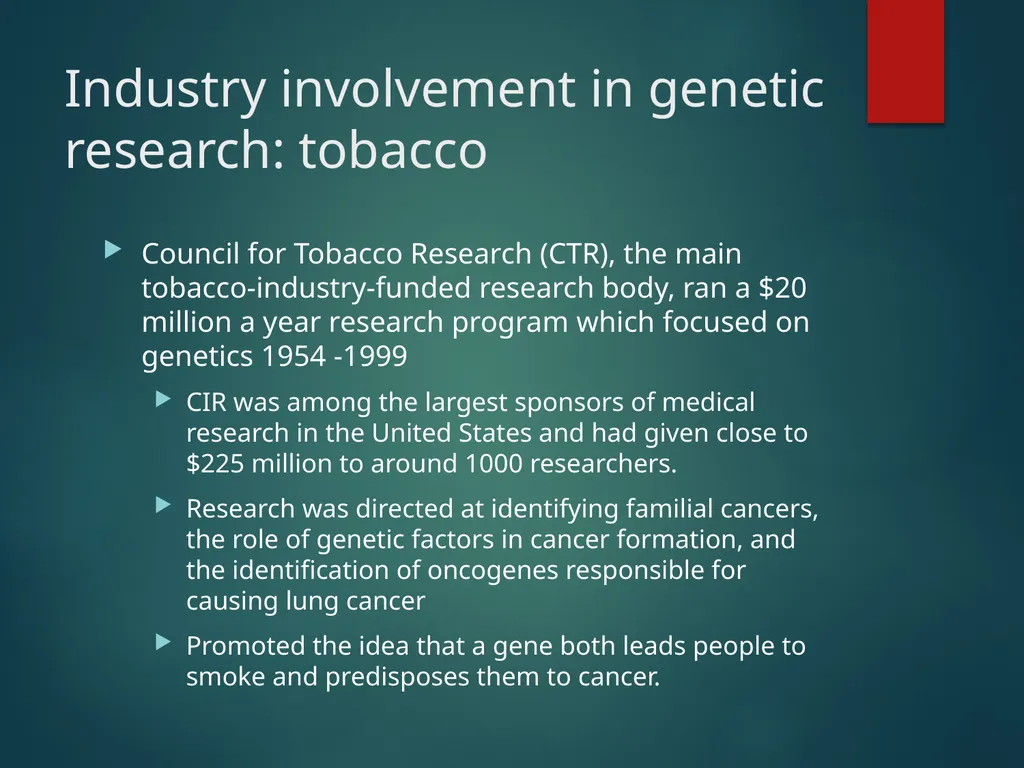
Industry involvement in genetic research: tobacco Council for Tobacco Research (CTR), the main tobacco-industry-funded research body, ran a $20 million a year research program which focused on genetics 1954 -1999
CIR was among the largest sponsors of medical research in the United States and had given close to $225 million to around 1000 researchers.
Research was directed at identifying familial cancers, the role of genetic factors in cancer formation, and the identification of oncogenes responsible for causing lung cancer
Promoted the idea that a gene both leads people to smoke and predisposes them to cancer.<br>
CIR was among the largest sponsors of medical research in the United States and had given close to $225 million to around 1000 researchers.
Research was directed at identifying familial cancers, the role of genetic factors in cancer formation, and the identification of oncogenes responsible for causing lung cancer
Promoted the idea that a gene both leads people to smoke and predisposes them to cancer.<br>
03
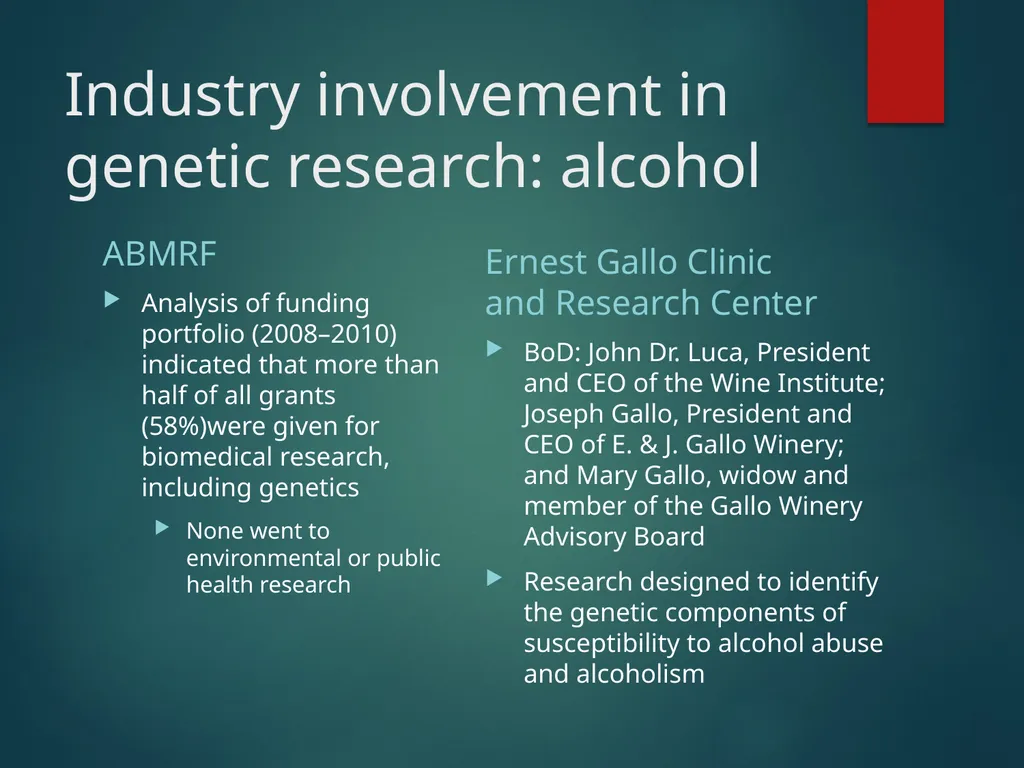
Industry involvement in genetic research: alcohol ABMRF Analysis of funding portfolio (2008–2010) indicated that more than half of all grants (58%)were given for biomedical research, including genetics
None went to environmental or public health research Ernest Gallo Clinic and Research Center BoD: John Dr. Luca, President and CEO of the Wine Institute; Joseph Gallo, President and CEO of E. & J. Gallo Winery; and Mary Gallo, widow and member of the Gallo Winery Advisory Board
Research designed to identify the genetic components of susceptibility to alcohol abuse and alcoholism<br>
None went to environmental or public health research Ernest Gallo Clinic and Research Center BoD: John Dr. Luca, President and CEO of the Wine Institute; Joseph Gallo, President and CEO of E. & J. Gallo Winery; and Mary Gallo, widow and member of the Gallo Winery Advisory Board
Research designed to identify the genetic components of susceptibility to alcohol abuse and alcoholism<br>
04
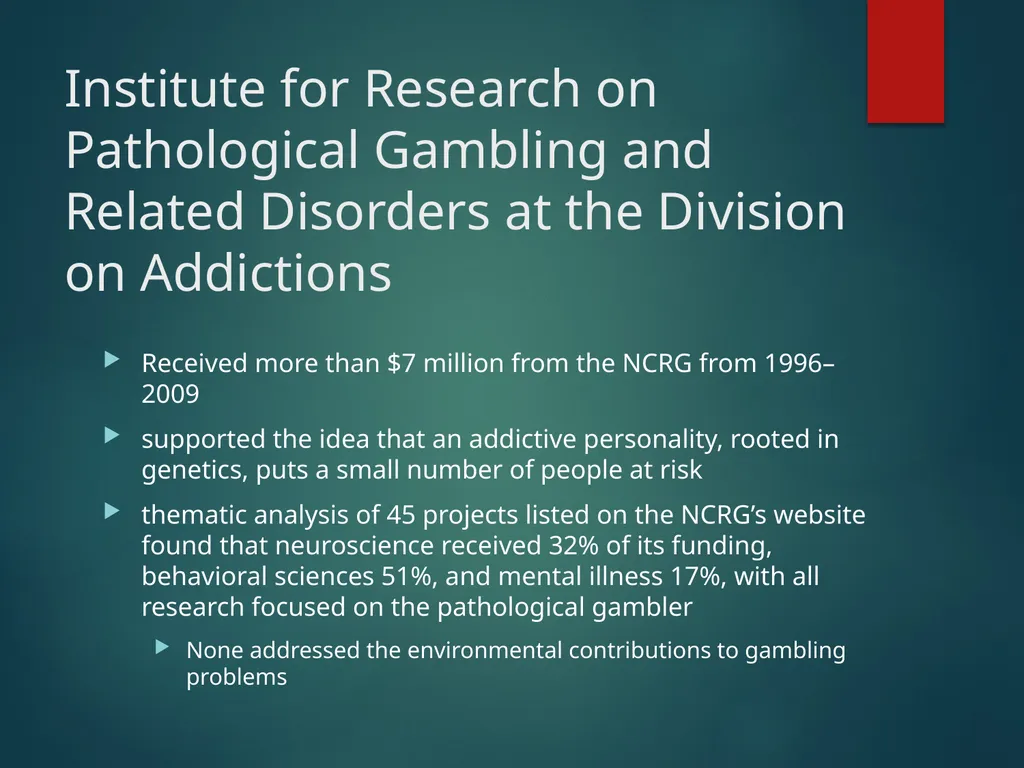
Institute for Research on
Pathological Gambling and Related Disorders at the Division on Addictions Received more than $7 million from the NCRG from 1996–2009
supported the idea that an addictive personality, rooted in genetics, puts a small number of people at risk
thematic analysis of 45 projects listed on the NCRG’s website found that neuroscience received 32% of its funding, behavioral sciences 51%, and mental illness 17%, with all research focused on the pathological gambler
None addressed the environmental contributions to gambling problems<br>
supported the idea that an addictive personality, rooted in genetics, puts a small number of people at risk
thematic analysis of 45 projects listed on the NCRG’s website found that neuroscience received 32% of its funding, behavioral sciences 51%, and mental illness 17%, with all research focused on the pathological gambler
None addressed the environmental contributions to gambling problems<br>
05
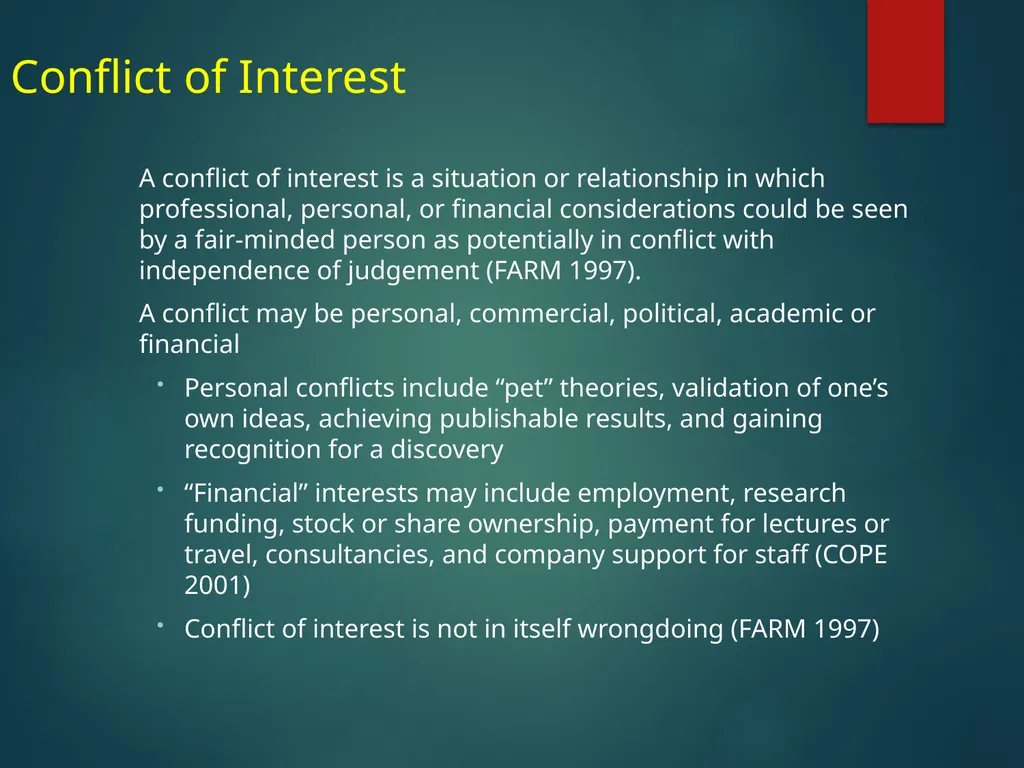
Conflict of Interest A conflict of interest is a situation or relationship in which professional, personal, or financial considerations could be seen by a fair-minded person as potentially in conflict with independence of judgement (FARM 1997).
A conflict may be personal, commercial, political, academic or financial
Personal conflicts include “pet” theories, validation of one’s own ideas, achieving publishable results, and gaining recognition for a discovery
“Financial” interests may include employment, research funding, stock or share ownership, payment for lectures or travel, consultancies, and company support for staff (COPE 2001)
Conflict of interest is not in itself wrongdoing (FARM 1997)<br>
A conflict may be personal, commercial, political, academic or financial
Personal conflicts include “pet” theories, validation of one’s own ideas, achieving publishable results, and gaining recognition for a discovery
“Financial” interests may include employment, research funding, stock or share ownership, payment for lectures or travel, consultancies, and company support for staff (COPE 2001)
Conflict of interest is not in itself wrongdoing (FARM 1997)<br>
06
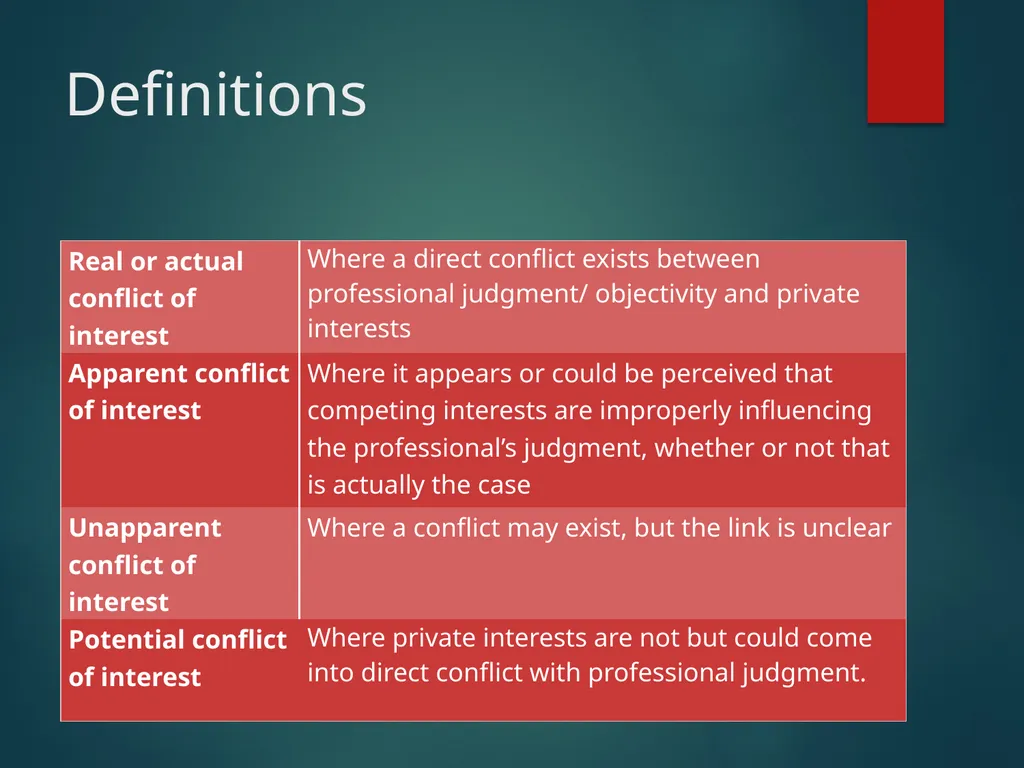
Definitions<br>
07
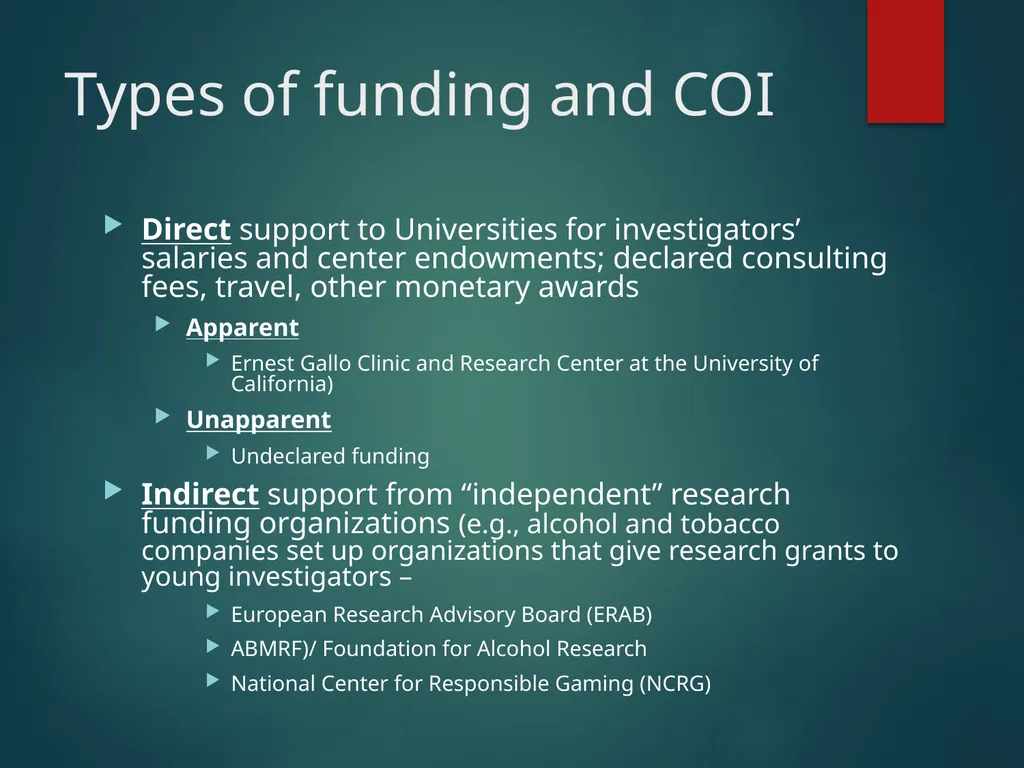
Types of funding and COI Direct support to Universities for investigators’ salaries and center endowments; declared consulting fees, travel, other monetary awards
Apparent
Ernest Gallo Clinic and Research Center at the University of California)
Unapparent
Undeclared funding
Indirect support from “independent” research funding organizations (e.g., alcohol and tobacco companies set up organizations that give research grants to young investigators –
European Research Advisory Board (ERAB)
ABMRF)/ Foundation for Alcohol Research
National Center for Responsible Gaming (NCRG)<br>
Apparent
Ernest Gallo Clinic and Research Center at the University of California)
Unapparent
Undeclared funding
Indirect support from “independent” research funding organizations (e.g., alcohol and tobacco companies set up organizations that give research grants to young investigators –
European Research Advisory Board (ERAB)
ABMRF)/ Foundation for Alcohol Research
National Center for Responsible Gaming (NCRG)<br>
08
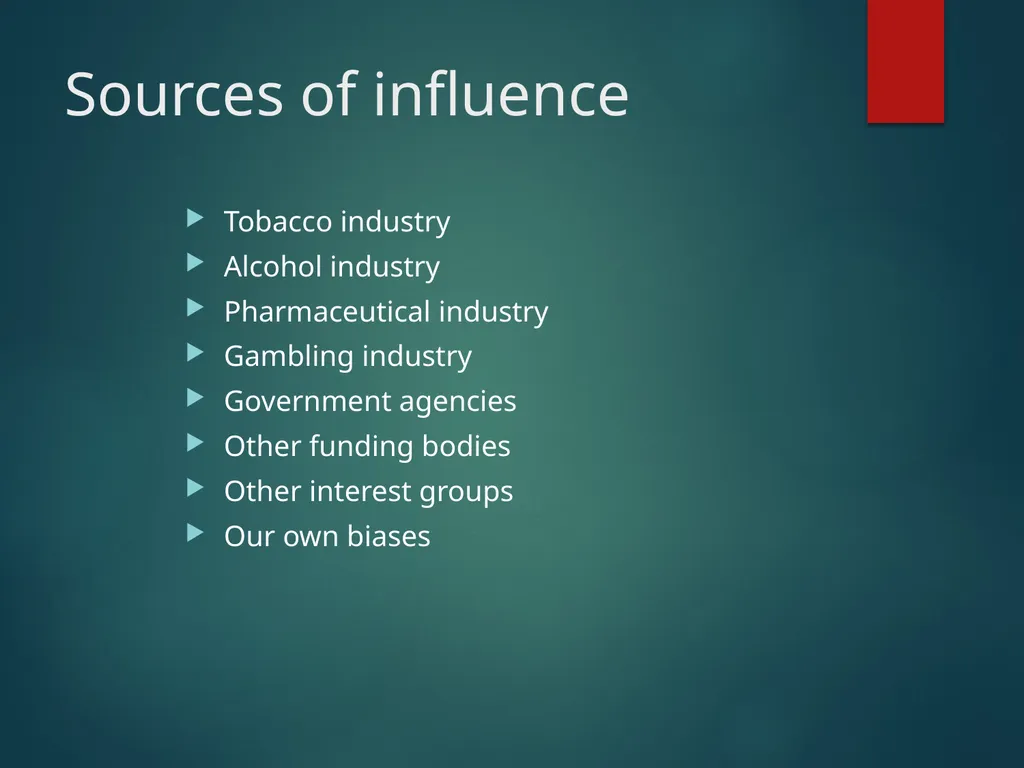
Sources of influence Tobacco industry
Alcohol industry
Pharmaceutical industry
Gambling industry
Government agencies
Other funding bodies
Other interest groups
Our own biases<br>
Alcohol industry
Pharmaceutical industry
Gambling industry
Government agencies
Other funding bodies
Other interest groups
Our own biases<br>
09
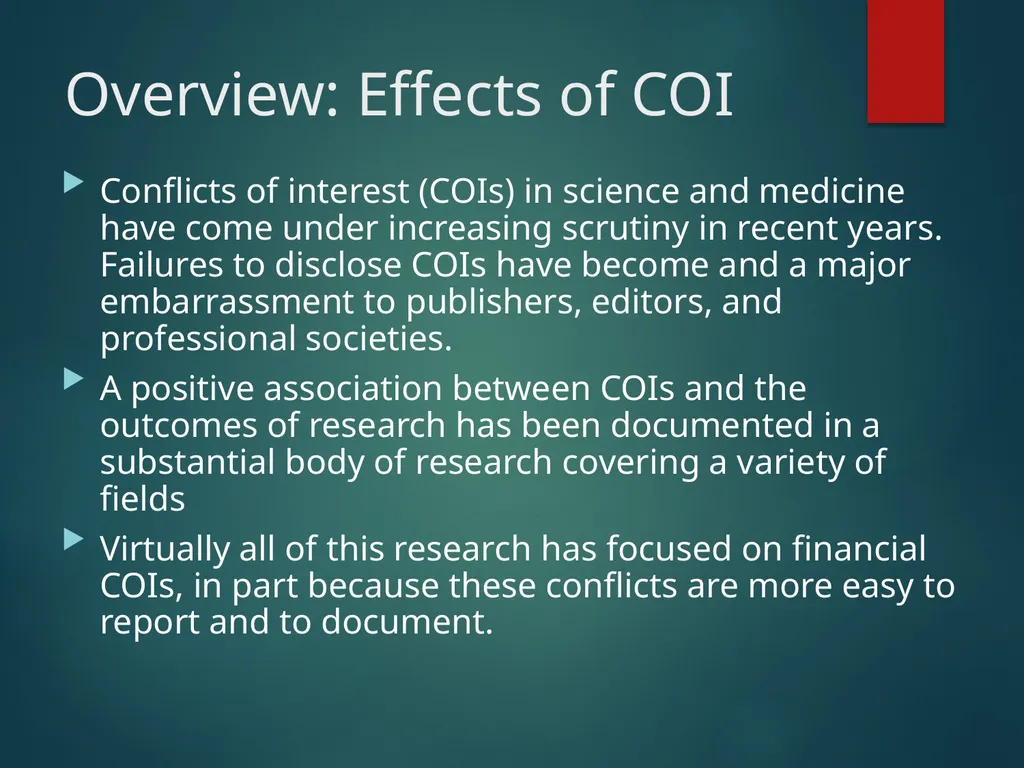
Overview: Effects of COI Conflicts of interest (COIs) in science and medicine have come under increasing scrutiny in recent years. Failures to disclose COIs have become and a major embarrassment to publishers, editors, and professional societies.
A positive association between COIs and the outcomes of research has been documented in a substantial body of research covering a variety of fields
Virtually all of this research has focused on financial COIs, in part because these conflicts are more easy to report and to document.<br>
A positive association between COIs and the outcomes of research has been documented in a substantial body of research covering a variety of fields
Virtually all of this research has focused on financial COIs, in part because these conflicts are more easy to report and to document.<br>
10
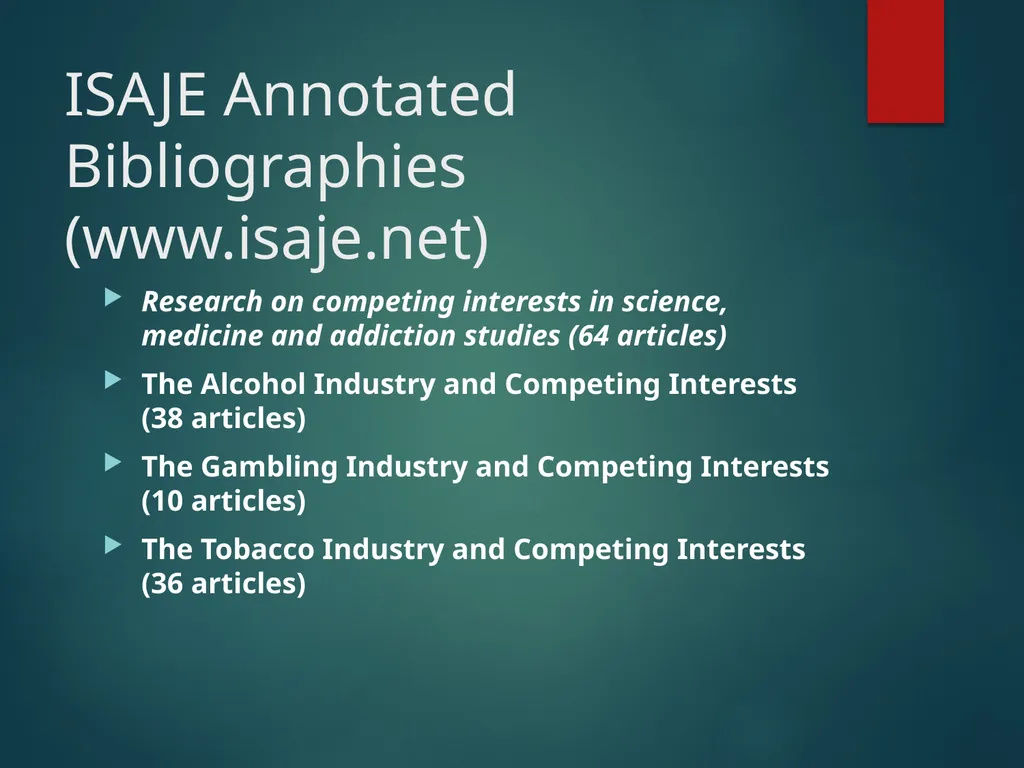
ISAJE Annotated Bibliographies
(www.isaje.net) Research on competing interests in science, medicine and addiction studies (64 articles)
The Alcohol Industry and Competing Interests (38 articles)
The Gambling Industry and Competing Interests (10 articles)
The Tobacco Industry and Competing Interests (36 articles)<br>
The Alcohol Industry and Competing Interests (38 articles)
The Gambling Industry and Competing Interests (10 articles)
The Tobacco Industry and Competing Interests (36 articles)<br>
11
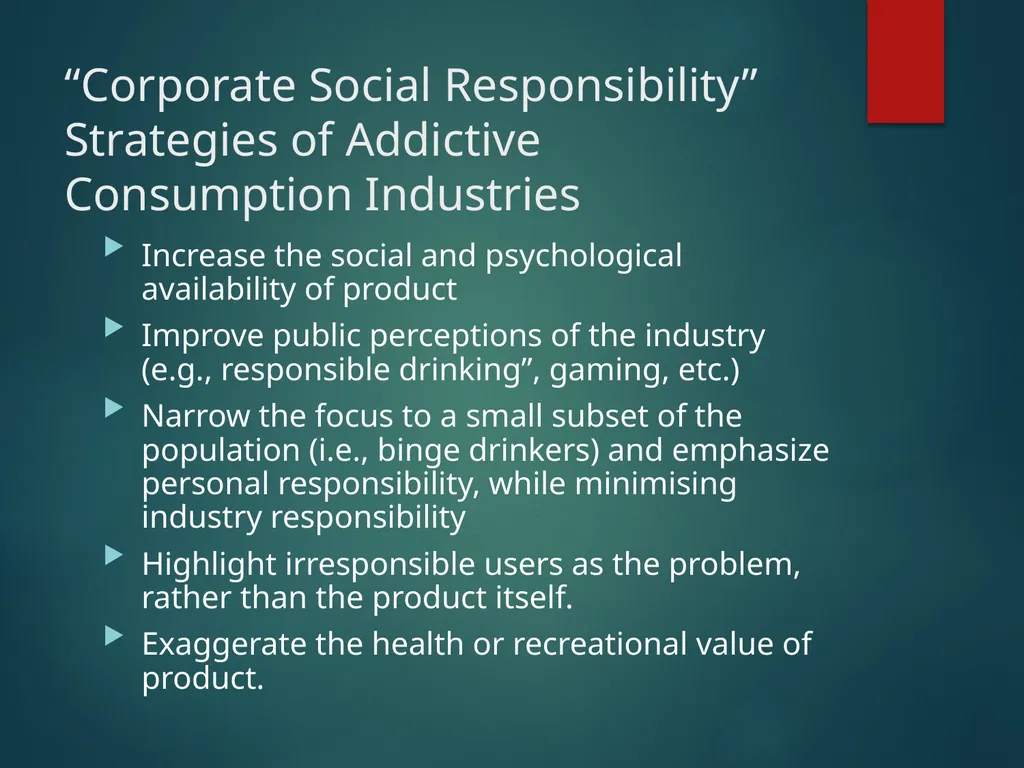
“Corporate Social Responsibility” Strategies of Addictive Consumption Industries Increase the social and psychological availability of product
Improve public perceptions of the industry (e.g., responsible drinking”, gaming, etc.)
Narrow the focus to a small subset of the population (i.e., binge drinkers) and emphasize personal responsibility, while minimising industry responsibility
Highlight irresponsible users as the problem, rather than the product itself.
Exaggerate the health or recreational value of product.<br>
Improve public perceptions of the industry (e.g., responsible drinking”, gaming, etc.)
Narrow the focus to a small subset of the population (i.e., binge drinkers) and emphasize personal responsibility, while minimising industry responsibility
Highlight irresponsible users as the problem, rather than the product itself.
Exaggerate the health or recreational value of product.<br>
12
Examples of strategies used by addictive consumption industries Vulnerability of “special populations” to the adverse effects of alcohol consumption is “generally not psychological or due to social or economic conditions,” but is “instead, a biological predisposition [which] makes them especially susceptible.”
–International Center for Alcohol Policies (ICAP)
“[Genetic research]…primarily a means of attracting researchers to areas of scientific inquiry not being addressed and, in particular, were focused on satisfying the needs of lawyers involved in defending the tobacco industry in litigation”
–Legacy Tobacco Documents<br>
–International Center for Alcohol Policies (ICAP)
“[Genetic research]…primarily a means of attracting researchers to areas of scientific inquiry not being addressed and, in particular, were focused on satisfying the needs of lawyers involved in defending the tobacco industry in litigation”
–Legacy Tobacco Documents<br>
13
Consequences of COI Stigma
Dissention among colleagues
Research bias
Agenda setting by commercial interests
Bureaucratic regulation
Legitimacy for commercial interests<br>
Dissention among colleagues
Research bias
Agenda setting by commercial interests
Bureaucratic regulation
Legitimacy for commercial interests<br>
14
Research Bias Impact of financial contributions and gifts is often unconscious
Self-interest as an automatic response and “viscerally compelling”
Deliberate fudging of data or interpretation of findings in order to maintain funding stream is rare but damages science when it occurs
Subtle bias motivated by norm of reciprocity<br>
Self-interest as an automatic response and “viscerally compelling”
Deliberate fudging of data or interpretation of findings in order to maintain funding stream is rare but damages science when it occurs
Subtle bias motivated by norm of reciprocity<br>
15
Research bias Evidence supports the claim that industry-funded research produces industry-favourable results:
Alcohol (McCambridge & Hartwell 2014),
Pharmaceutical (Als-Nielson et al., 2003)
Tobacco (Wallace, 2009; Barnes and Bero, 1998)<br>
Alcohol (McCambridge & Hartwell 2014),
Pharmaceutical (Als-Nielson et al., 2003)
Tobacco (Wallace, 2009; Barnes and Bero, 1998)<br>
16
Implications Effect on clinical decision-making and public policy
Loss of credibility and trust in science
Impact on collegiality<br>
Loss of credibility and trust in science
Impact on collegiality<br>
17
Agenda Setting To the extent that funding for a particular research question is dictated by commercial reasons, it is likely to alter the research agenda of the recipient organisation or an individual.
Industry funding for tobacco and alcohol has been criticised because it often supports topics that are considered favorable to an industry’s commercial interests (Babor, 2009).<br>
Industry funding for tobacco and alcohol has been criticised because it often supports topics that are considered favorable to an industry’s commercial interests (Babor, 2009).<br>
18
How to minimize conflicts of interest (COI) Regulatory bans, Ethical analysis, total bans<br>
19
Three Approaches to COI 1) “Hands-on” approach
2) “Hands-off” approach
3) Moral jeopardy analysis linked to guidelines developed by expert committees<br>
2) “Hands-off” approach
3) Moral jeopardy analysis linked to guidelines developed by expert committees<br>
20
1) “Hands-on Approach” Engage in dialogue with industry representatives, set conditions for the acceptance of industry funding for programs and research, and participate as “partners” in industry-funded scientific activities, based on the assumption that the industry is acting as a “good corporate citizen” and will spend the money anyway.
Government cuts to funding for public health campaigns are a reason for partnerships with the industry.<br>
Government cuts to funding for public health campaigns are a reason for partnerships with the industry.<br>
21
Rationale for questioning hands-on approach Industry motivated primarily by shareholders’ emphasis on bottom line
Industry representatives have no expertise in research and research priorities
Potential for research bias, agenda-setting, etc.
Precedents set by tobacco, pharmaceutical, alcohol and gambling industries
“Partnerships” tend to be one-way and one-sided, with industry have equal role in agenda-setting when researchers are not invited to set the industry’s agenda.<br>
Industry representatives have no expertise in research and research priorities
Potential for research bias, agenda-setting, etc.
Precedents set by tobacco, pharmaceutical, alcohol and gambling industries
“Partnerships” tend to be one-way and one-sided, with industry have equal role in agenda-setting when researchers are not invited to set the industry’s agenda.<br>
22
2) A “hands-off” position Investigators and organizations are advised not to engage in communication or collaboration with addictive consumption industry representatives.
Based on the assumption that the commercial interests are incompatible with the values and aims of health promotion, disease prevention and scientific research.<br>
Based on the assumption that the commercial interests are incompatible with the values and aims of health promotion, disease prevention and scientific research.<br>
23
Clarion Declaration, 2008 The alcohol industry is …involved in disseminating information, collecting industry statistics, research and development activities, legislative and regulatory lobbying, information and education programmes, media relations, marketing, and scientific research; and the development of social aspects organisations which are funded by the alcohol beverage industry to manage issues from the industry’s point of view ostensibly from a neutral position
The industry's research-related activities often question or compete with social policy or public health views about alcohol problems and related policy options, particularly the need for effective strategies to prevent alcohol problems.
Industry-supported research activities are used to enhance a false perception of corporate citizenship and thus gain political legitimacy for the industry. Industry involvement in research is therefore an efficient way for the industry to influence politics in ways that are favourable to the industry's commercial interests.<br>
The industry's research-related activities often question or compete with social policy or public health views about alcohol problems and related policy options, particularly the need for effective strategies to prevent alcohol problems.
Industry-supported research activities are used to enhance a false perception of corporate citizenship and thus gain political legitimacy for the industry. Industry involvement in research is therefore an efficient way for the industry to influence politics in ways that are favourable to the industry's commercial interests.<br>
24
The twin aims of protecting the public from alcohol related harm and the alcohol industry’s mission to promote and sell as much alcohol as possible are inherently incompatible
Therefore to protect the integrity and legitimacy of alcohol research, and the reputation of academic institutions in the field of alcohol research, as well as public health no funding relationships with the alcohol industry should be entered into. Clarion Declaration, 2008 Conclusions<br>
Therefore to protect the integrity and legitimacy of alcohol research, and the reputation of academic institutions in the field of alcohol research, as well as public health no funding relationships with the alcohol industry should be entered into. Clarion Declaration, 2008 Conclusions<br>
25
Limitations of hands-off approach Funding sources differ in extent of moral jeopardy
Many researchers already accept funding
Opposition to control and independence<br>
Many researchers already accept funding
Opposition to control and independence<br>
26
3) Regulatory Guidelines COI declarations required by journal editors, professional associations, government agencies, and international organizations
EXAMPLE: The World Health Organization and the Pan American Organization are currently developing guidelines for UN Member States to manage interactions, including research, between dangerous consumption industries (food, soda, alcohol, tobacco) and governmental health agencies.
Moral jeopardy analysis linked to guidelines developed by expert committees<br>
EXAMPLE: The World Health Organization and the Pan American Organization are currently developing guidelines for UN Member States to manage interactions, including research, between dangerous consumption industries (food, soda, alcohol, tobacco) and governmental health agencies.
Moral jeopardy analysis linked to guidelines developed by expert committees<br>
27
PERIL Analysis (Adams, 2007) Purpose
Are the purposes of the funding and recipient organizations divergent or consistent?
Extent
To what extent does the recipient rely on this source of funding?
As the proportion of income increases, it becomes more difficult to separate from the source’s expectations.
Relevant harm
What is the harm associated with the product or service provided by the organization?.
Identified
Does the funding organization benefit from being identified with the researcher’s reputation or organization?
Is there a visible association with public good activities for the purposes of positive branding. Can this be used for political or commercial purposes.
Link
What is the Link between funder and researcher? The more direct the link, the stronger the influence and the more visible the association.<br>
Are the purposes of the funding and recipient organizations divergent or consistent?
Extent
To what extent does the recipient rely on this source of funding?
As the proportion of income increases, it becomes more difficult to separate from the source’s expectations.
Relevant harm
What is the harm associated with the product or service provided by the organization?.
Identified
Does the funding organization benefit from being identified with the researcher’s reputation or organization?
Is there a visible association with public good activities for the purposes of positive branding. Can this be used for political or commercial purposes.
Link
What is the Link between funder and researcher? The more direct the link, the stronger the influence and the more visible the association.<br>
28
Guidelines for individuals Be informed about the risks associated with all funding sources
Support institutional policies regarding industry funding of research by dangerous consumption industries
Adopt a hands-off or moral jeopardy approach to industry funding
Declare all real, apparent or potential conflicts of interest to journal editors and other responsible sources.
Advocate for the creation of funding sources that are independent of commercial interests in the conduct of addiction research<br>
Support institutional policies regarding industry funding of research by dangerous consumption industries
Adopt a hands-off or moral jeopardy approach to industry funding
Declare all real, apparent or potential conflicts of interest to journal editors and other responsible sources.
Advocate for the creation of funding sources that are independent of commercial interests in the conduct of addiction research<br>
29
Guidelines for organizations Develop COI declaration procedures and ask all candidates for membership or election to a leadership position to provide information about financial and non-financial conflicts
Make COI declarations a condition for certifying scientific journals in the context of ethical standards
Develop policies for professional societies, non-governmental organizations, government agencies, and international organizations.<br>
Make COI declarations a condition for certifying scientific journals in the context of ethical standards
Develop policies for professional societies, non-governmental organizations, government agencies, and international organizations.<br>
30
Primum non nocere<br>