
Handling error in reporting Guide : Mr. Suresh

Description: Handling error in reporting Guide : Mr. Suresh Sindhi Presented By : Kamarunnisa J Rahul Kapur Khushi M. Shah Himanshu Agarwal Jayesh D.Pandit 38th India Fellowship Seminar 21st February 2023 Group 6 www.actuariesindia.org Mr. Suresh
Related Topics
Download Presentation
"Handling error in reporting Guide : Mr. Suresh" is the property of its rightful owner. Permission is granted to download and print the materials on this website for personal, non-commercial use only, and to display it on your personal computer provided you do not modify the materials and that you retain all copyright notices contained in the materials. By downloading content from our website, you accept the terms of this agreement.
Presentation Transcript
slide1. Handling error in reporting Guide : Mr. Suresh Sindhi
Presented By :
Kamarunnisa J
Rahul Kapur
Khushi M. Shah
Himanshu Agarwal
Jayesh D.Pandit 38th India Fellowship Seminar
21st February 2023 – Group 6<br>
slide2. www.actuariesindia.org Mr. Suresh Sindhi is currently working as the Head of Valuation & Reinsurance with a life insurance company.
He was working as a Consulting Actuary and Appointed Actuary with an international life insurance company and providing actuarial consulting services to various domestic & international corporate clients.
He has acquired almost 23 years of actuarial & leadership experience working with various life insurance, pension consulting & reinsurance companies. He is actively involved in the educational and examination activities of the Indian and UK Actuarial Institutes.
As an industry expert, he is the member of “Board of Studies” at Wadia College, Pune & instrumental in designing the syllabus of actuarial subjects at the degree level course, “Banking, Insurance & Actuarial Science”.
He is a regular speaker at various prestigious institutions including National Insurance Academy (NIA), Pune, & has delivered guest lectures on varied topics related to insurance and actuarial field at various institutions.
His interest is in learning & application of modern data science techniques such as AI, ML, Predictive Modelling, ’R’ programming language to insurance and risk industry. Introduction of Guide 2<br>
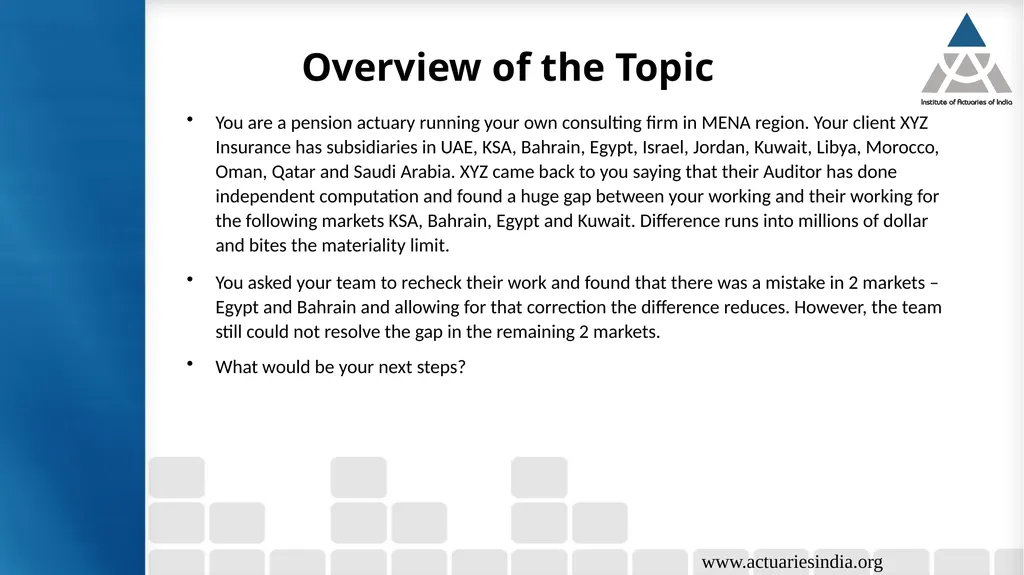
slide3. You are a pension actuary running your own consulting firm in MENA region. Your client XYZ Insurance has subsidiaries in UAE, KSA, Bahrain, Egypt, Israel, Jordan, Kuwait, Libya, Morocco, Oman, Qatar and Saudi Arabia. XYZ came back to you saying that their Auditor has done independent computation and found a huge gap between your working and their working for the following markets KSA, Bahrain, Egypt and Kuwait. Difference runs into millions of dollar and bites the materiality limit.
You asked your team to recheck their work and found that there was a mistake in 2 markets – Egypt and Bahrain and allowing for that correction the difference reduces. However, the team still could not resolve the gap in the remaining 2 markets.
What would be your next steps? www.actuariesindia.org Overview of the Topic<br>
slide4. Likely errors in pension work
Likely impact of the error on the financial position of the scheme and professional handling of the errors
Adhering to APS and GN
Handling and communicating the error to stakeholders www.actuariesindia.org Agenda<br>
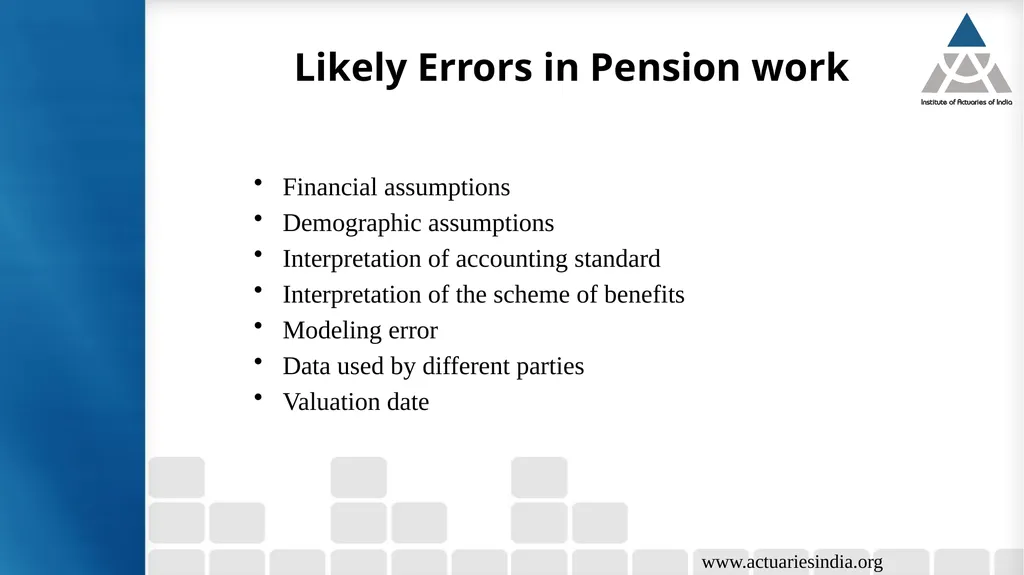
slide5. Likely Errors in Pension work Financial assumptions
Demographic assumptions
Interpretation of accounting standard
Interpretation of the scheme of benefits
Modeling error
Data used by different parties
Valuation date www.actuariesindia.org<br>
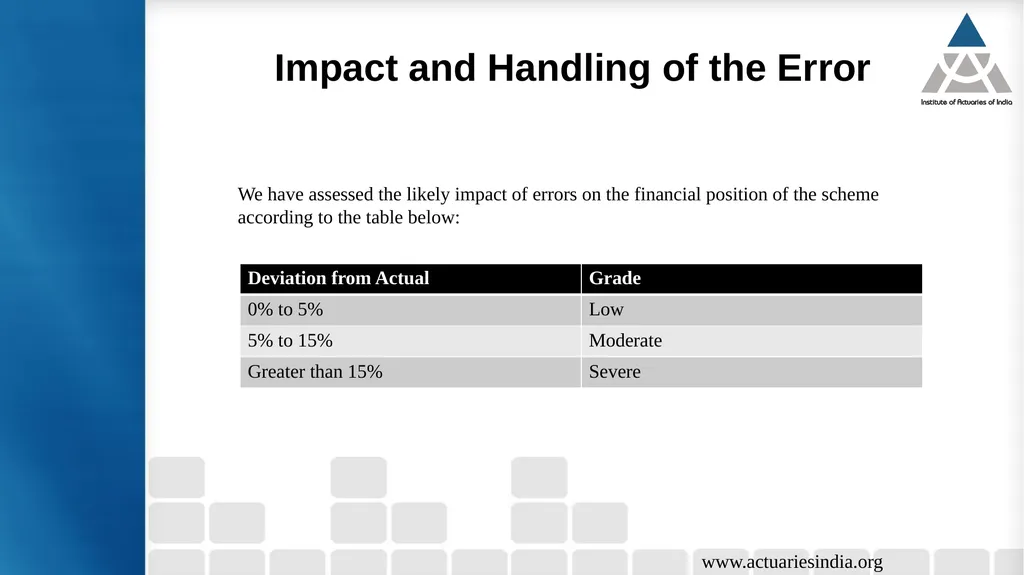
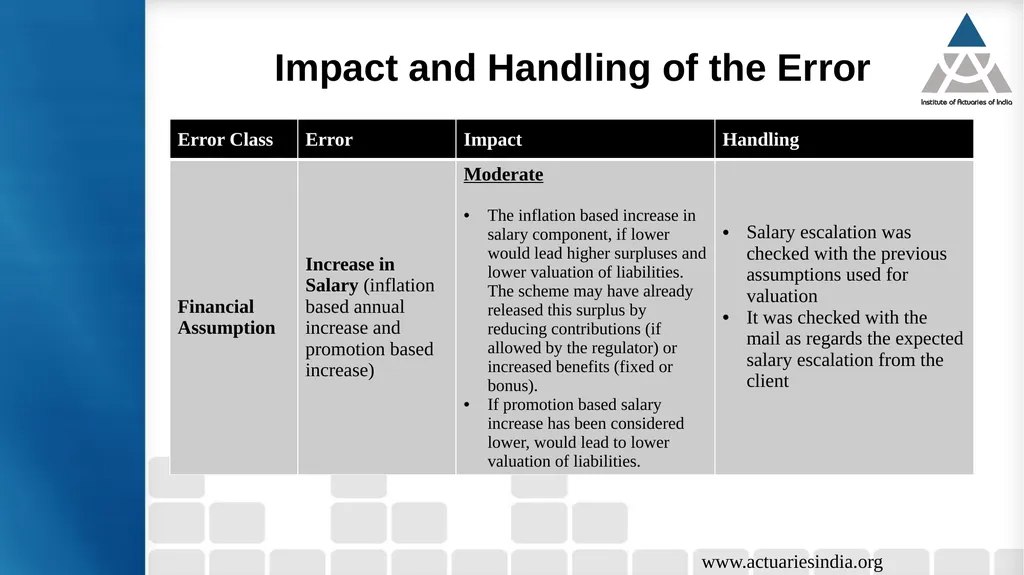
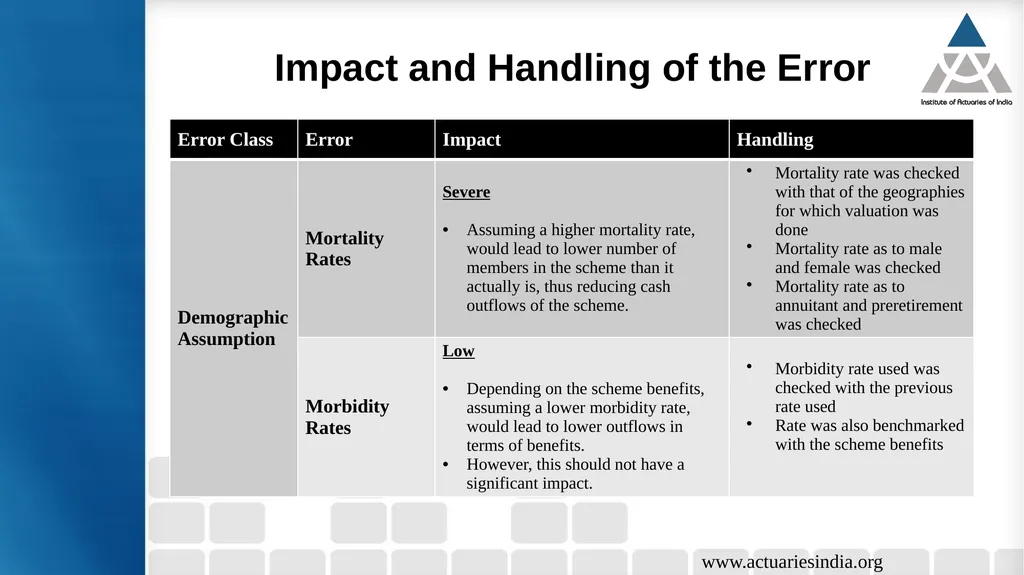
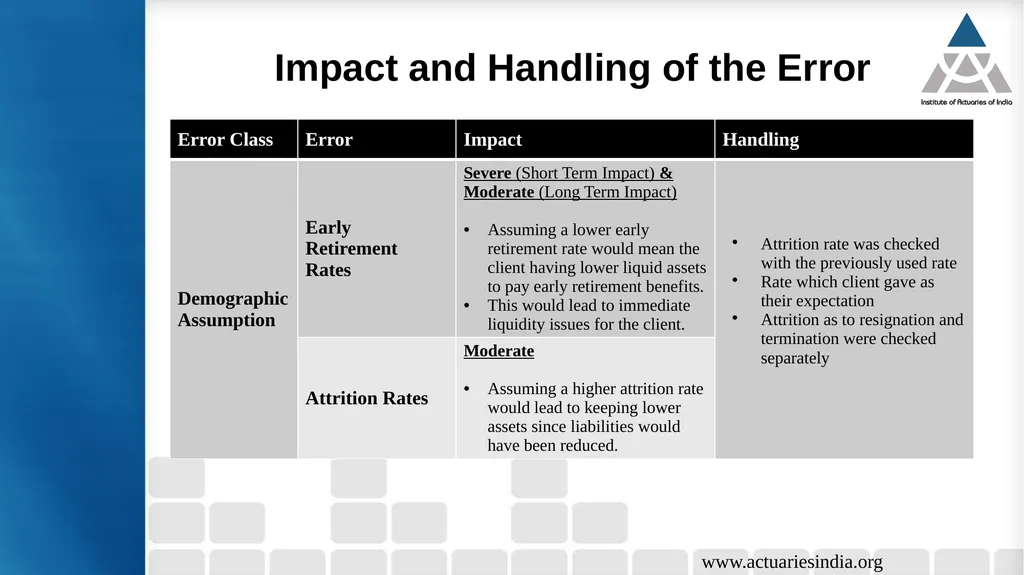
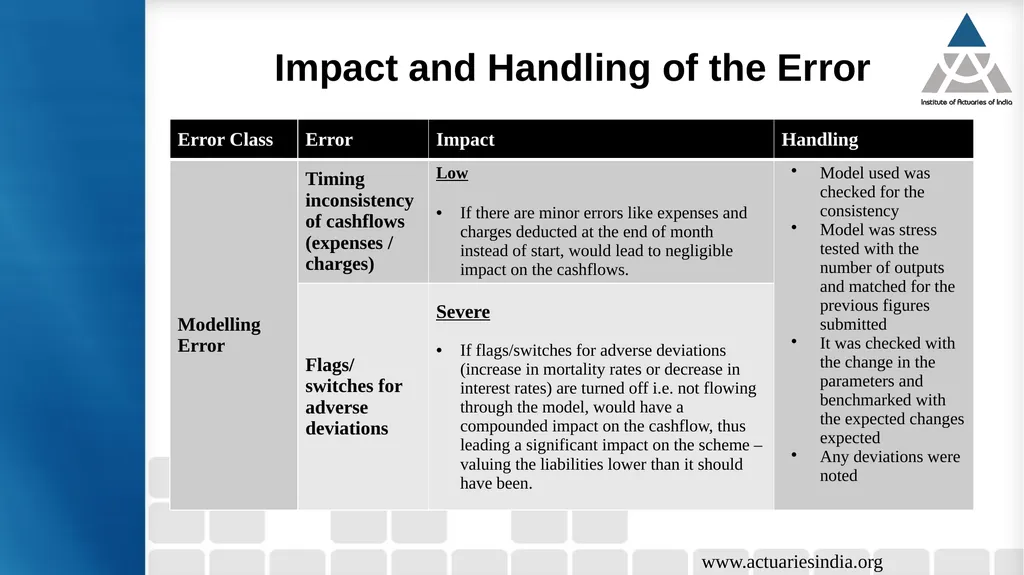
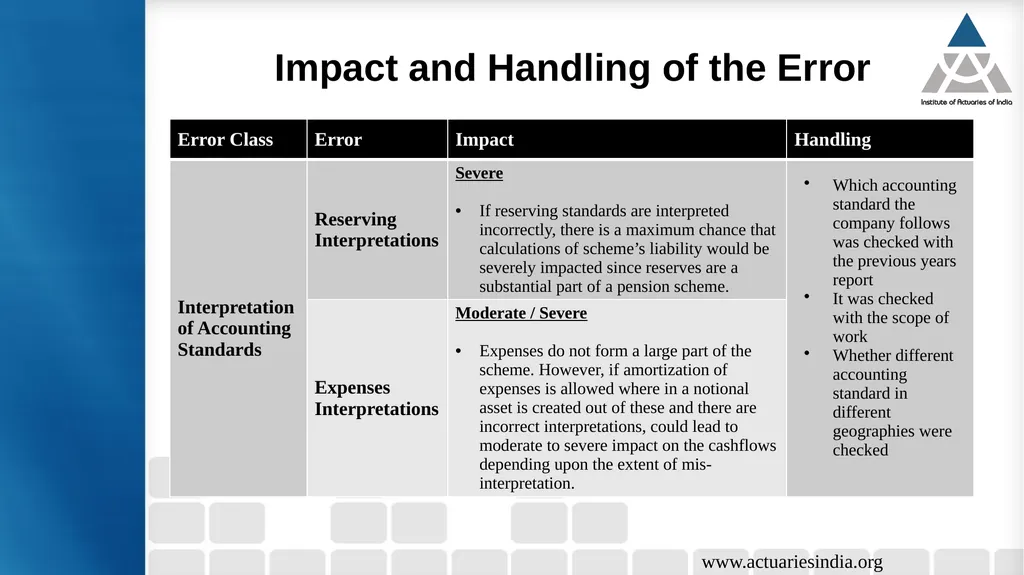
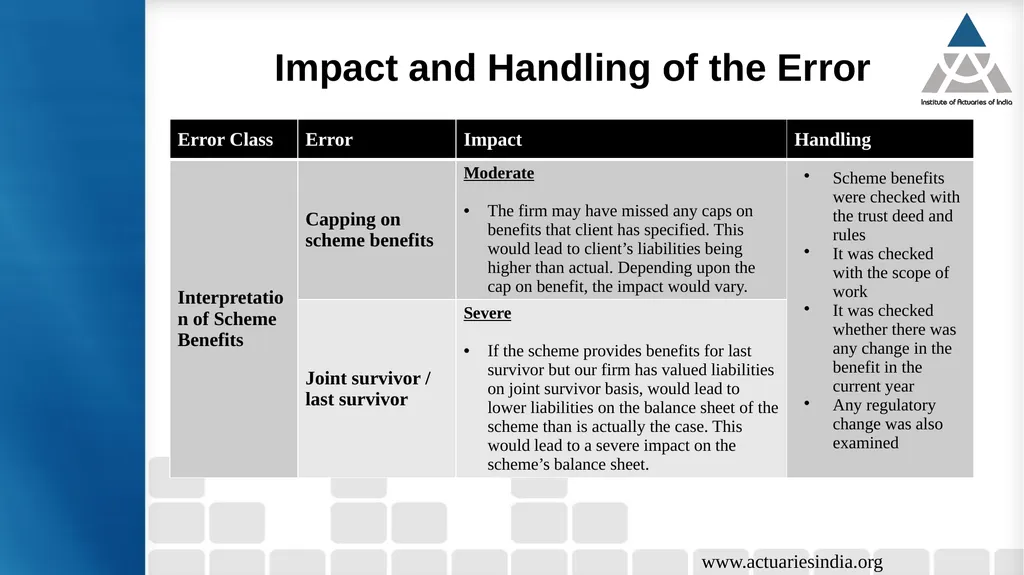
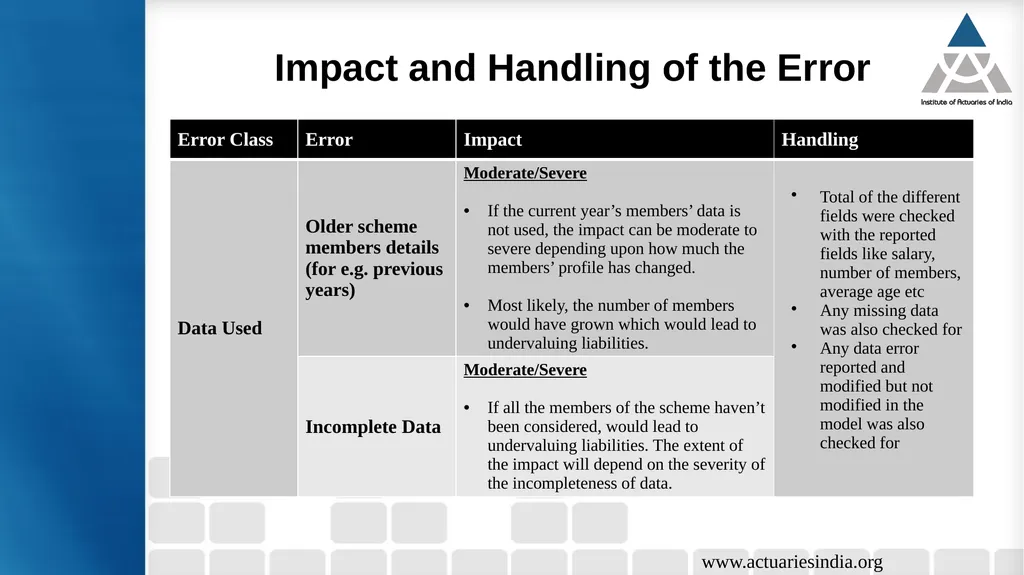
slide6. We have assessed the likely impact of errors on the financial position of the scheme according to the table below: www.actuariesindia.org Impact and Handling of the Error<br>
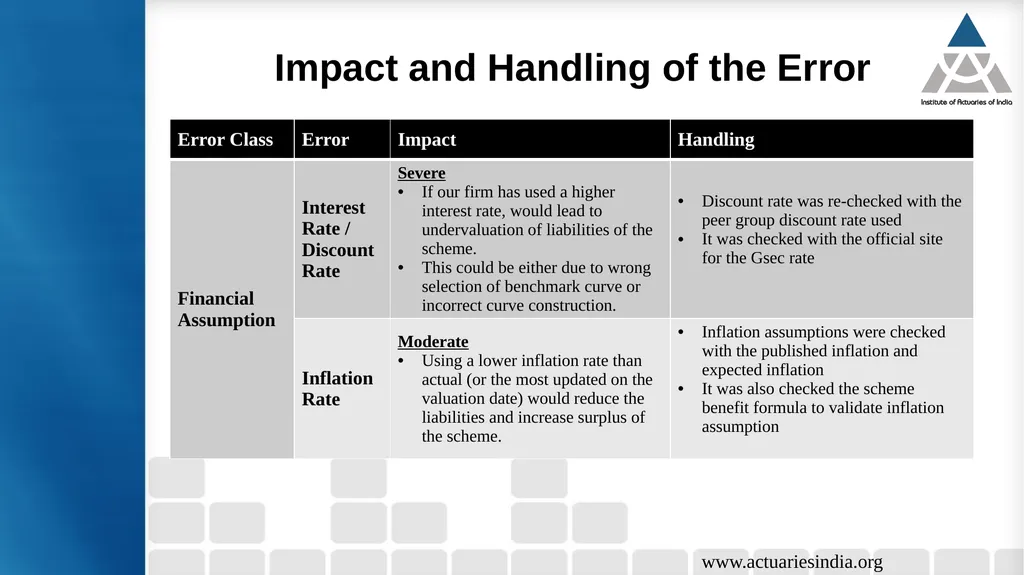
slide7. www.actuariesindia.org Impact and Handling of the Error<br>
slide8. www.actuariesindia.org Impact and Handling of the Error<br>
slide9. www.actuariesindia.org Impact and Handling of the Error<br>
slide10. www.actuariesindia.org Impact and Handling of the Error<br>
slide11. www.actuariesindia.org Impact and Handling of the Error<br>
slide12. www.actuariesindia.org Impact and Handling of the Error<br>
slide13. www.actuariesindia.org Impact and Handling of the Error<br>
slide14. www.actuariesindia.org Impact and Handling of the Error<br>
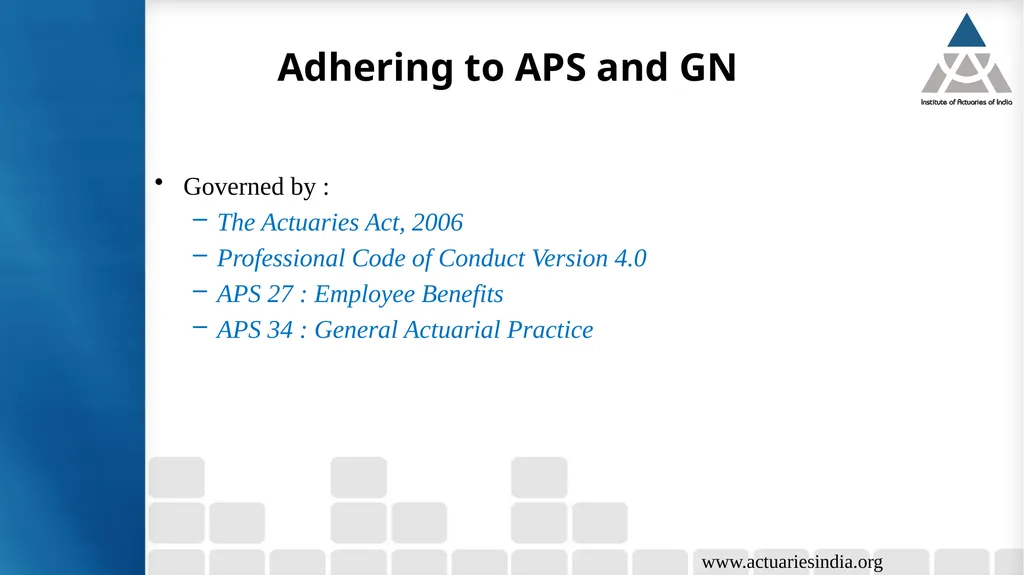
slide15. Adhering to APS and GN Governed by :
The Actuaries Act, 2006
Professional Code of Conduct Version 4.0
APS 27 : Employee Benefits
APS 34 : General Actuarial Practice www.actuariesindia.org<br>
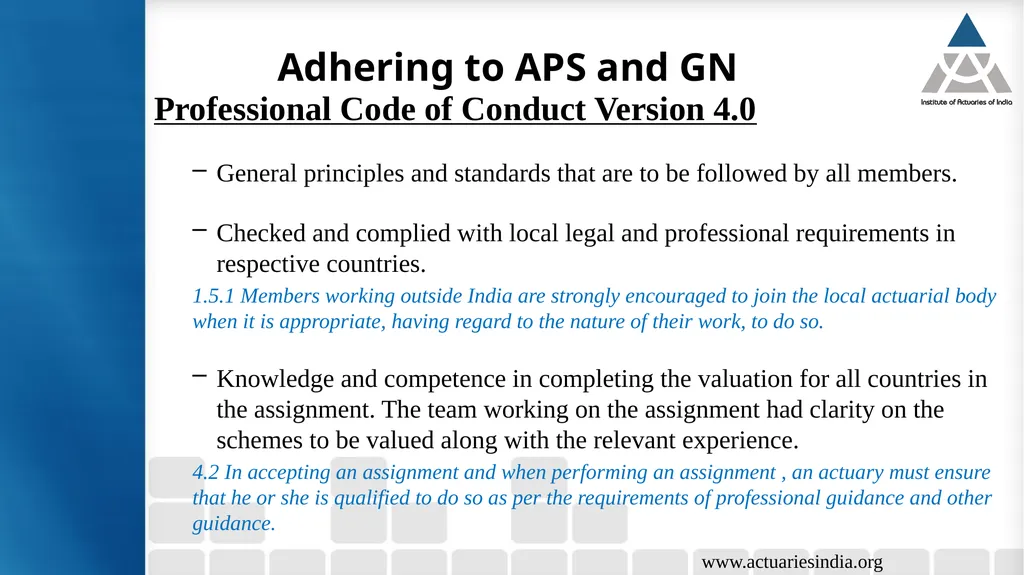
slide16. Professional Code of Conduct Version 4.0
General principles and standards that are to be followed by all members.
Checked and complied with local legal and professional requirements in respective countries.
1.5.1 Members working outside India are strongly encouraged to join the local actuarial body when it is appropriate, having regard to the nature of their work, to do so.
Knowledge and competence in completing the valuation for all countries in the assignment. The team working on the assignment had clarity on the schemes to be valued along with the relevant experience.
4.2 In accepting an assignment and when performing an assignment , an actuary must ensure that he or she is qualified to do so as per the requirements of professional guidance and other guidance. www.actuariesindia.org Adhering to APS and GN<br>
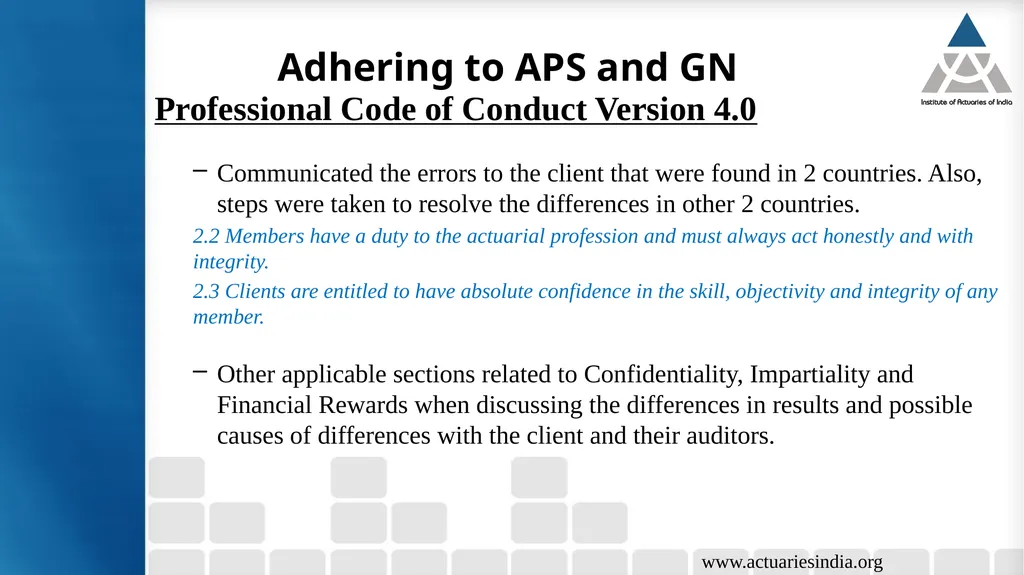
slide17. Professional Code of Conduct Version 4.0
Communicated the errors to the client that were found in 2 countries. Also, steps were taken to resolve the differences in other 2 countries.
2.2 Members have a duty to the actuarial profession and must always act honestly and with integrity.
2.3 Clients are entitled to have absolute confidence in the skill, objectivity and integrity of any member.
Other applicable sections related to Confidentiality, Impartiality and Financial Rewards when discussing the differences in results and possible causes of differences with the client and their auditors. www.actuariesindia.org Adhering to APS and GN<br>
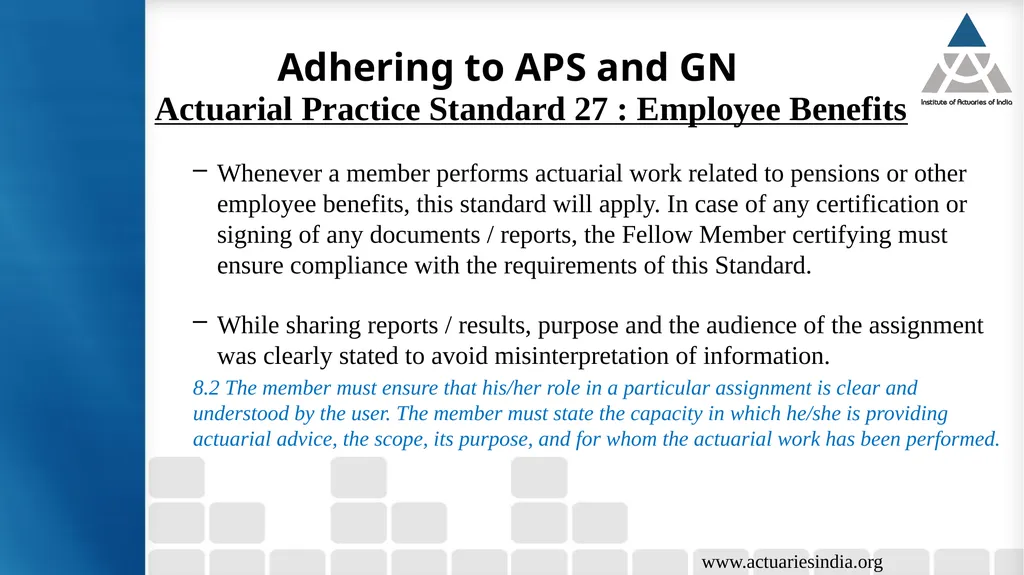
slide18. www.actuariesindia.org Actuarial Practice Standard 27 : Employee Benefits
Whenever a member performs actuarial work related to pensions or other employee benefits, this standard will apply. In case of any certification or signing of any documents / reports, the Fellow Member certifying must ensure compliance with the requirements of this Standard.
While sharing reports / results, purpose and the audience of the assignment was clearly stated to avoid misinterpretation of information.
8.2 The member must ensure that his/her role in a particular assignment is clear and understood by the user. The member must state the capacity in which he/she is providing actuarial advice, the scope, its purpose, and for whom the actuarial work has been performed. Adhering to APS and GN<br>
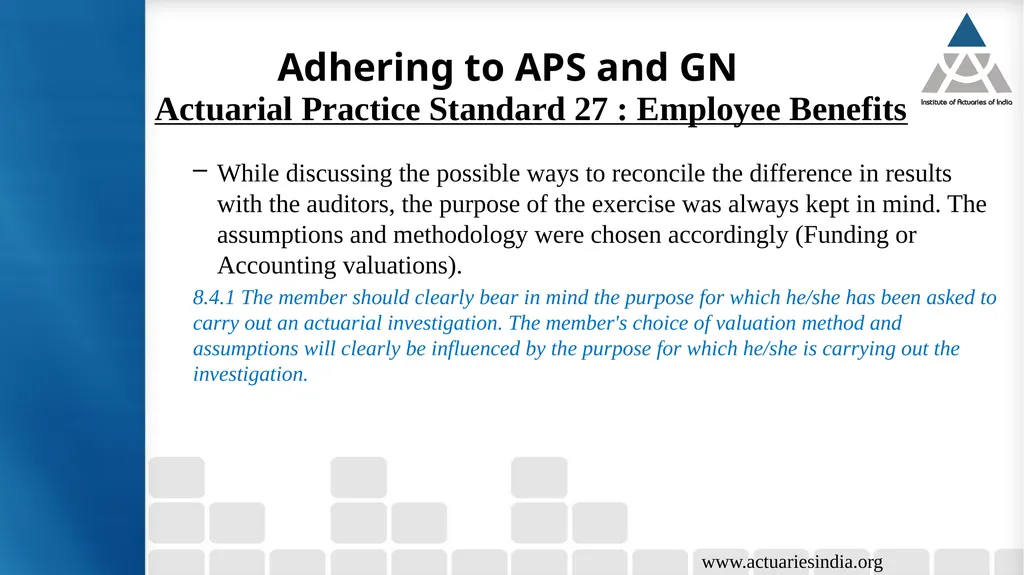
slide19. www.actuariesindia.org Actuarial Practice Standard 27 : Employee Benefits
While discussing the possible ways to reconcile the difference in results with the auditors, the purpose of the exercise was always kept in mind. The assumptions and methodology were chosen accordingly (Funding or Accounting valuations).
8.4.1 The member should clearly bear in mind the purpose for which he/she has been asked to carry out an actuarial investigation. The member's choice of valuation method and assumptions will clearly be influenced by the purpose for which he/she is carrying out the investigation. Adhering to APS and GN<br>
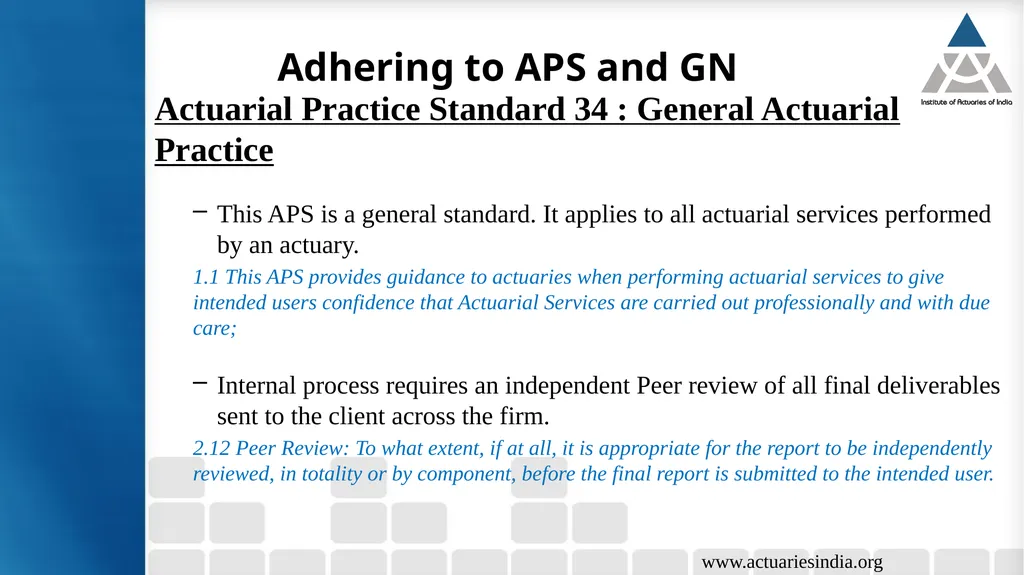
slide20. www.actuariesindia.org Actuarial Practice Standard 34 : General Actuarial Practice
This APS is a general standard. It applies to all actuarial services performed by an actuary.
1.1 This APS provides guidance to actuaries when performing actuarial services to give intended users confidence that Actuarial Services are carried out professionally and with due care;
Internal process requires an independent Peer review of all final deliverables sent to the client across the firm.
2.12 Peer Review: To what extent, if at all, it is appropriate for the report to be independently reviewed, in totality or by component, before the final report is submitted to the intended user. Adhering to APS and GN<br>
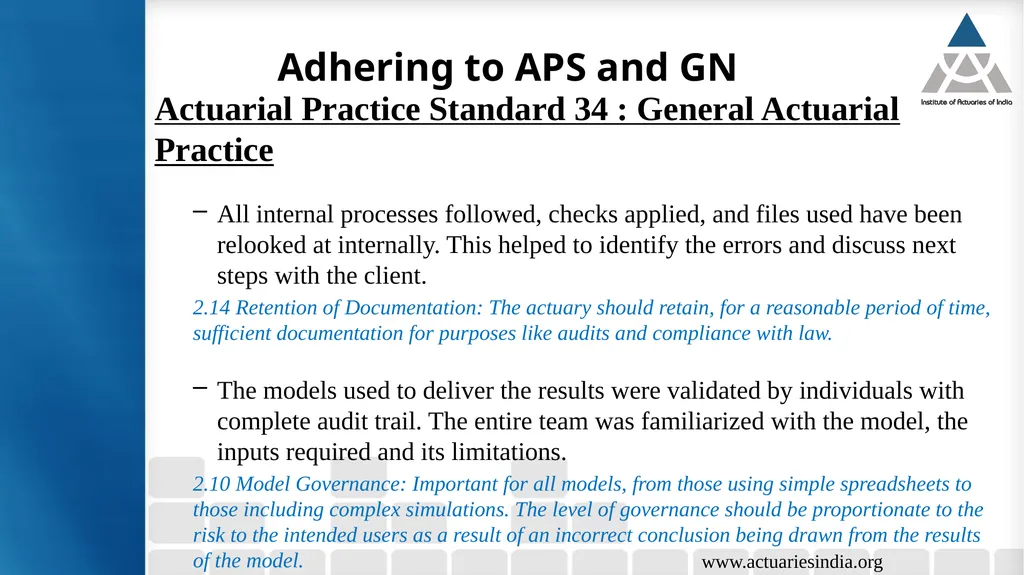
slide21. www.actuariesindia.org Actuarial Practice Standard 34 : General Actuarial Practice
All internal processes followed, checks applied, and files used have been relooked at internally. This helped to identify the errors and discuss next steps with the client.
2.14 Retention of Documentation: The actuary should retain, for a reasonable period of time, sufficient documentation for purposes like audits and compliance with law.
The models used to deliver the results were validated by individuals with complete audit trail. The entire team was familiarized with the model, the inputs required and its limitations.
2.10 Model Governance: Important for all models, from those using simple spreadsheets to those including complex simulations. The level of governance should be proportionate to the risk to the intended users as a result of an incorrect conclusion being drawn from the results of the model. Adhering to APS and GN<br>
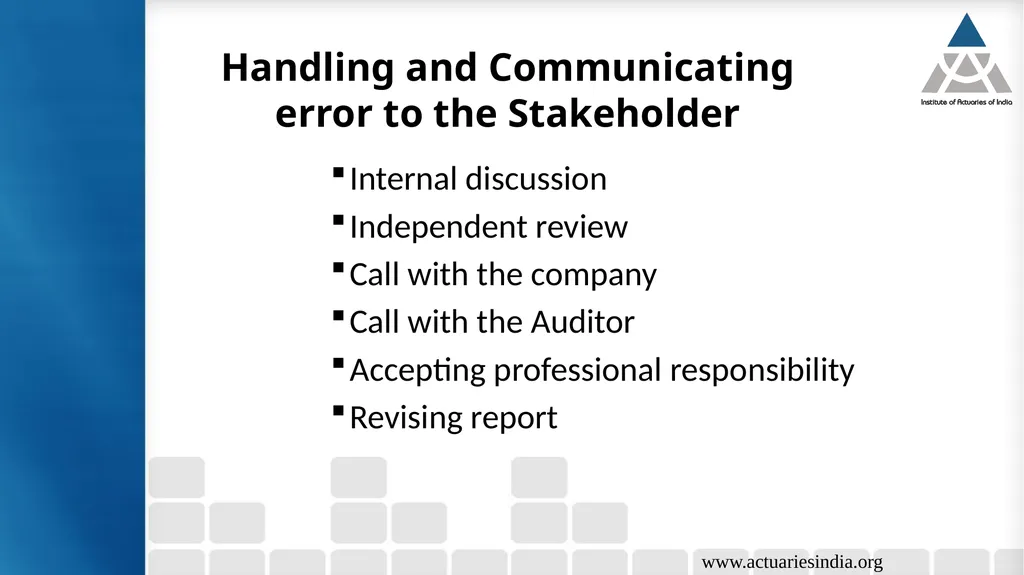
slide22. Internal discussion
Independent review
Call with the company
Call with the Auditor
Accepting professional responsibility
Revising report www.actuariesindia.org Handling and Communicating error to the Stakeholder<br>
slide23. www.actuariesindia.org Thank you<br>
Presented By :
Kamarunnisa J
Rahul Kapur
Khushi M. Shah
Himanshu Agarwal
Jayesh D.Pandit 38th India Fellowship Seminar
21st February 2023 – Group 6<br>
slide2. www.actuariesindia.org Mr. Suresh Sindhi is currently working as the Head of Valuation & Reinsurance with a life insurance company.
He was working as a Consulting Actuary and Appointed Actuary with an international life insurance company and providing actuarial consulting services to various domestic & international corporate clients.
He has acquired almost 23 years of actuarial & leadership experience working with various life insurance, pension consulting & reinsurance companies. He is actively involved in the educational and examination activities of the Indian and UK Actuarial Institutes.
As an industry expert, he is the member of “Board of Studies” at Wadia College, Pune & instrumental in designing the syllabus of actuarial subjects at the degree level course, “Banking, Insurance & Actuarial Science”.
He is a regular speaker at various prestigious institutions including National Insurance Academy (NIA), Pune, & has delivered guest lectures on varied topics related to insurance and actuarial field at various institutions.
His interest is in learning & application of modern data science techniques such as AI, ML, Predictive Modelling, ’R’ programming language to insurance and risk industry. Introduction of Guide 2<br>
slide3. You are a pension actuary running your own consulting firm in MENA region. Your client XYZ Insurance has subsidiaries in UAE, KSA, Bahrain, Egypt, Israel, Jordan, Kuwait, Libya, Morocco, Oman, Qatar and Saudi Arabia. XYZ came back to you saying that their Auditor has done independent computation and found a huge gap between your working and their working for the following markets KSA, Bahrain, Egypt and Kuwait. Difference runs into millions of dollar and bites the materiality limit.
You asked your team to recheck their work and found that there was a mistake in 2 markets – Egypt and Bahrain and allowing for that correction the difference reduces. However, the team still could not resolve the gap in the remaining 2 markets.
What would be your next steps? www.actuariesindia.org Overview of the Topic<br>
slide4. Likely errors in pension work
Likely impact of the error on the financial position of the scheme and professional handling of the errors
Adhering to APS and GN
Handling and communicating the error to stakeholders www.actuariesindia.org Agenda<br>
slide5. Likely Errors in Pension work Financial assumptions
Demographic assumptions
Interpretation of accounting standard
Interpretation of the scheme of benefits
Modeling error
Data used by different parties
Valuation date www.actuariesindia.org<br>
slide6. We have assessed the likely impact of errors on the financial position of the scheme according to the table below: www.actuariesindia.org Impact and Handling of the Error<br>
slide7. www.actuariesindia.org Impact and Handling of the Error<br>
slide8. www.actuariesindia.org Impact and Handling of the Error<br>
slide9. www.actuariesindia.org Impact and Handling of the Error<br>
slide10. www.actuariesindia.org Impact and Handling of the Error<br>
slide11. www.actuariesindia.org Impact and Handling of the Error<br>
slide12. www.actuariesindia.org Impact and Handling of the Error<br>
slide13. www.actuariesindia.org Impact and Handling of the Error<br>
slide14. www.actuariesindia.org Impact and Handling of the Error<br>
slide15. Adhering to APS and GN Governed by :
The Actuaries Act, 2006
Professional Code of Conduct Version 4.0
APS 27 : Employee Benefits
APS 34 : General Actuarial Practice www.actuariesindia.org<br>
slide16. Professional Code of Conduct Version 4.0
General principles and standards that are to be followed by all members.
Checked and complied with local legal and professional requirements in respective countries.
1.5.1 Members working outside India are strongly encouraged to join the local actuarial body when it is appropriate, having regard to the nature of their work, to do so.
Knowledge and competence in completing the valuation for all countries in the assignment. The team working on the assignment had clarity on the schemes to be valued along with the relevant experience.
4.2 In accepting an assignment and when performing an assignment , an actuary must ensure that he or she is qualified to do so as per the requirements of professional guidance and other guidance. www.actuariesindia.org Adhering to APS and GN<br>
slide17. Professional Code of Conduct Version 4.0
Communicated the errors to the client that were found in 2 countries. Also, steps were taken to resolve the differences in other 2 countries.
2.2 Members have a duty to the actuarial profession and must always act honestly and with integrity.
2.3 Clients are entitled to have absolute confidence in the skill, objectivity and integrity of any member.
Other applicable sections related to Confidentiality, Impartiality and Financial Rewards when discussing the differences in results and possible causes of differences with the client and their auditors. www.actuariesindia.org Adhering to APS and GN<br>
slide18. www.actuariesindia.org Actuarial Practice Standard 27 : Employee Benefits
Whenever a member performs actuarial work related to pensions or other employee benefits, this standard will apply. In case of any certification or signing of any documents / reports, the Fellow Member certifying must ensure compliance with the requirements of this Standard.
While sharing reports / results, purpose and the audience of the assignment was clearly stated to avoid misinterpretation of information.
8.2 The member must ensure that his/her role in a particular assignment is clear and understood by the user. The member must state the capacity in which he/she is providing actuarial advice, the scope, its purpose, and for whom the actuarial work has been performed. Adhering to APS and GN<br>
slide19. www.actuariesindia.org Actuarial Practice Standard 27 : Employee Benefits
While discussing the possible ways to reconcile the difference in results with the auditors, the purpose of the exercise was always kept in mind. The assumptions and methodology were chosen accordingly (Funding or Accounting valuations).
8.4.1 The member should clearly bear in mind the purpose for which he/she has been asked to carry out an actuarial investigation. The member's choice of valuation method and assumptions will clearly be influenced by the purpose for which he/she is carrying out the investigation. Adhering to APS and GN<br>
slide20. www.actuariesindia.org Actuarial Practice Standard 34 : General Actuarial Practice
This APS is a general standard. It applies to all actuarial services performed by an actuary.
1.1 This APS provides guidance to actuaries when performing actuarial services to give intended users confidence that Actuarial Services are carried out professionally and with due care;
Internal process requires an independent Peer review of all final deliverables sent to the client across the firm.
2.12 Peer Review: To what extent, if at all, it is appropriate for the report to be independently reviewed, in totality or by component, before the final report is submitted to the intended user. Adhering to APS and GN<br>
slide21. www.actuariesindia.org Actuarial Practice Standard 34 : General Actuarial Practice
All internal processes followed, checks applied, and files used have been relooked at internally. This helped to identify the errors and discuss next steps with the client.
2.14 Retention of Documentation: The actuary should retain, for a reasonable period of time, sufficient documentation for purposes like audits and compliance with law.
The models used to deliver the results were validated by individuals with complete audit trail. The entire team was familiarized with the model, the inputs required and its limitations.
2.10 Model Governance: Important for all models, from those using simple spreadsheets to those including complex simulations. The level of governance should be proportionate to the risk to the intended users as a result of an incorrect conclusion being drawn from the results of the model. Adhering to APS and GN<br>
slide22. Internal discussion
Independent review
Call with the company
Call with the Auditor
Accepting professional responsibility
Revising report www.actuariesindia.org Handling and Communicating error to the Stakeholder<br>
slide23. www.actuariesindia.org Thank you<br>