
Haploids and Doubled Haploids How they are
TA
Published · 26 slides · 0 views

1 / 1
Description
Haploids and Doubled Haploids How they are produced, and how breeders use them Take one pollen grain. Grow it into a plant. Double its chromosomes. You now have a pure line in one generation instead of eight. Haploids Doubled Haploids
Related Topics
Share
Embed code
Download this presentation From Below
"Haploids and Doubled Haploids How they are" is the property of its rightful owner. Permission is granted to download and print the materials on this website for personal, non-commercial use only, and to display it on your personal computer provided you do not modify the materials and that you retain all copyright notices contained in the materials. By downloading content from our website, you accept the terms of this agreement.
Presentation Transcript
01
Haploids and Doubled Haploids How they are produced, and how breeders use them “Take one pollen grain. Grow it into a plant. Double its chromosomes.
You now have a pure line — in one generation instead of eight.” Haploids & Doubled Haploids · Plant Breeding · B.Sc. (Ag.) 1<br>
You now have a pure line — in one generation instead of eight.” Haploids & Doubled Haploids · Plant Breeding · B.Sc. (Ag.) 1<br>
02
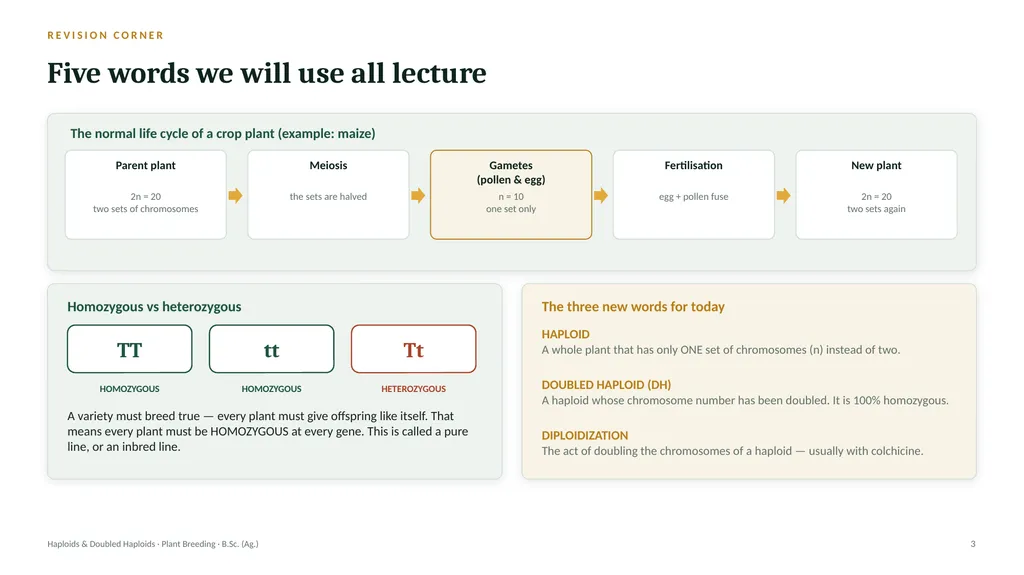
REVISION CORNER Five words we will use all lecture Haploids & Doubled Haploids · Plant Breeding · B.Sc. (Ag.) 3 The normal life cycle of a crop plant (example: maize) Parent plant 2n = 20
two sets of chromosomes Meiosis the sets are halved Gametes
(pollen & egg) n = 10
one set only Fertilisation egg + pollen fuse New plant 2n = 20
two sets again Homozygous vs heterozygous TT HOMOZYGOUS tt HOMOZYGOUS Tt HETEROZYGOUS A variety must breed true — every plant must give offspring like itself. That means every plant must be HOMOZYGOUS at every gene. This is called a pure line, or an inbred line. The three new words for today HAPLOID A whole plant that has only ONE set of chromosomes (n) instead of two. DOUBLED HAPLOID (DH) A haploid whose chromosome number has been doubled. It is 100% homozygous. DIPLOIDIZATION The act of doubling the chromosomes of a haploid — usually with colchicine.<br>
two sets of chromosomes Meiosis the sets are halved Gametes
(pollen & egg) n = 10
one set only Fertilisation egg + pollen fuse New plant 2n = 20
two sets again Homozygous vs heterozygous TT HOMOZYGOUS tt HOMOZYGOUS Tt HETEROZYGOUS A variety must breed true — every plant must give offspring like itself. That means every plant must be HOMOZYGOUS at every gene. This is called a pure line, or an inbred line. The three new words for today HAPLOID A whole plant that has only ONE set of chromosomes (n) instead of two. DOUBLED HAPLOID (DH) A haploid whose chromosome number has been doubled. It is 100% homozygous. DIPLOIDIZATION The act of doubling the chromosomes of a haploid — usually with colchicine.<br>
03
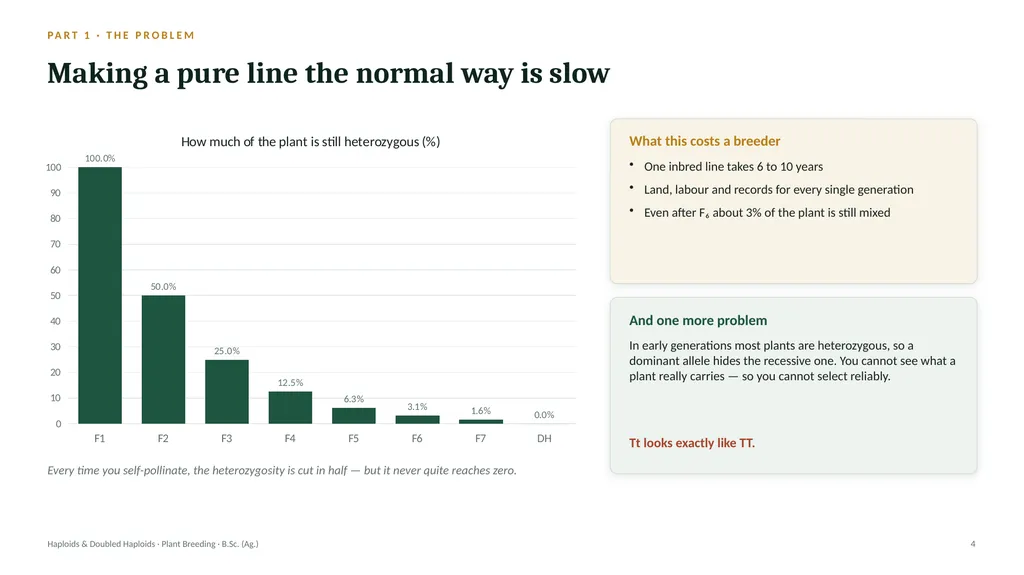
PART 1 · THE PROBLEM Making a pure line the normal way is slow Haploids & Doubled Haploids · Plant Breeding · B.Sc. (Ag.) 4 Every time you self-pollinate, the heterozygosity is cut in half — but it never quite reaches zero. What this costs a breeder One inbred line takes 6 to 10 years
Land, labour and records for every single generation
Even after F₆ about 3% of the plant is still mixed And one more problem In early generations most plants are heterozygous, so a dominant allele hides the recessive one. You cannot see what a plant really carries — so you cannot select reliably. Tt looks exactly like TT.<br>
Land, labour and records for every single generation
Even after F₆ about 3% of the plant is still mixed And one more problem In early generations most plants are heterozygous, so a dominant allele hides the recessive one. You cannot see what a plant really carries — so you cannot select reliably. Tt looks exactly like TT.<br>
04
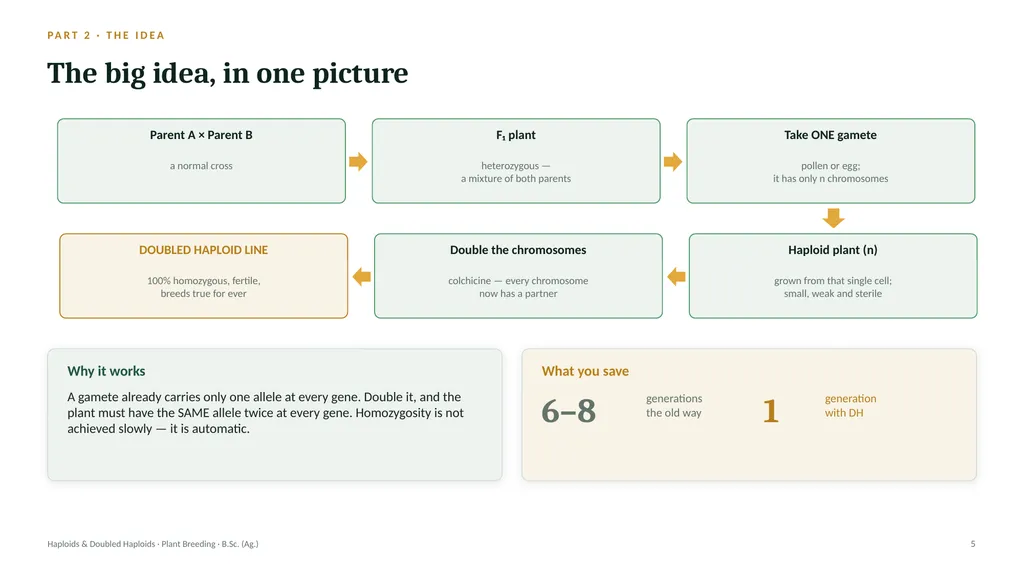
PART 2 · THE IDEA The big idea, in one picture Haploids & Doubled Haploids · Plant Breeding · B.Sc. (Ag.) 5 Parent A × Parent B a normal cross F₁ plant heterozygous —
a mixture of both parents Take ONE gamete pollen or egg;
it has only n chromosomes Haploid plant (n) grown from that single cell;
small, weak and sterile Double the chromosomes colchicine — every chromosome
now has a partner DOUBLED HAPLOID LINE 100% homozygous, fertile,
breeds true for ever Why it works A gamete already carries only one allele at every gene. Double it, and the plant must have the SAME allele twice at every gene. Homozygosity is not achieved slowly — it is automatic. What you save 6–8 generations
the old way 1 generation
with DH<br>
a mixture of both parents Take ONE gamete pollen or egg;
it has only n chromosomes Haploid plant (n) grown from that single cell;
small, weak and sterile Double the chromosomes colchicine — every chromosome
now has a partner DOUBLED HAPLOID LINE 100% homozygous, fertile,
breeds true for ever Why it works A gamete already carries only one allele at every gene. Double it, and the plant must have the SAME allele twice at every gene. Homozygosity is not achieved slowly — it is automatic. What you save 6–8 generations
the old way 1 generation
with DH<br>
05
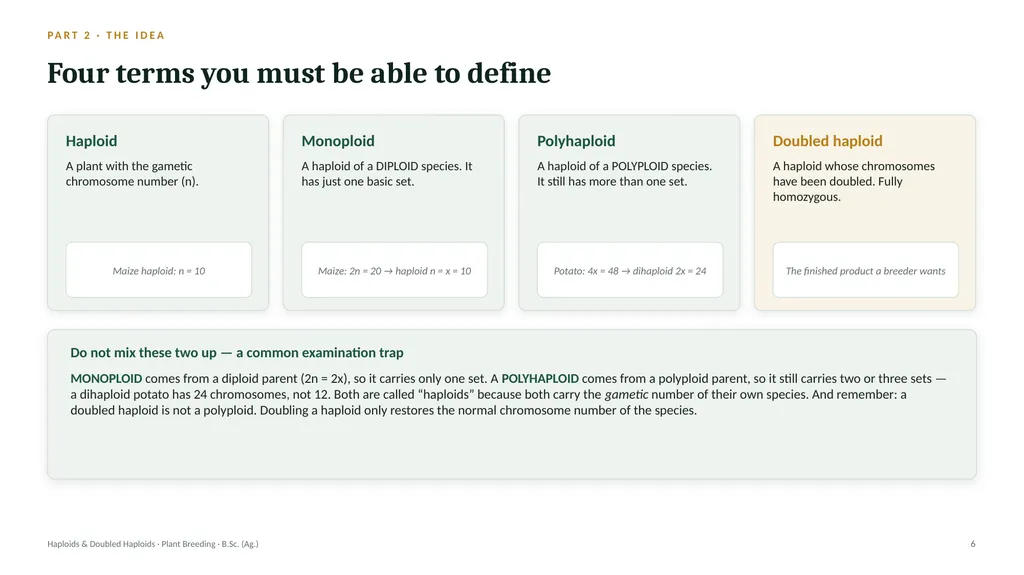
PART 2 · THE IDEA Four terms you must be able to define Haploids & Doubled Haploids · Plant Breeding · B.Sc. (Ag.) 6 Haploid A plant with the gametic chromosome number (n). Maize haploid: n = 10 Monoploid A haploid of a DIPLOID species. It has just one basic set. Maize: 2n = 20 → haploid n = x = 10 Polyhaploid A haploid of a POLYPLOID species. It still has more than one set. Potato: 4x = 48 → dihaploid 2x = 24 Doubled haploid A haploid whose chromosomes have been doubled. Fully homozygous. The finished product a breeder wants Do not mix these two up — a common examination trap MONOPLOID comes from a diploid parent (2n = 2x), so it carries only one set. A POLYHAPLOID comes from a polyploid parent, so it still carries two or three sets — a dihaploid potato has 24 chromosomes, not 12. Both are called “haploids” because both carry the gametic number of their own species. And remember: a doubled haploid is not a polyploid. Doubling a haploid only restores the normal chromosome number of the species.<br>
06
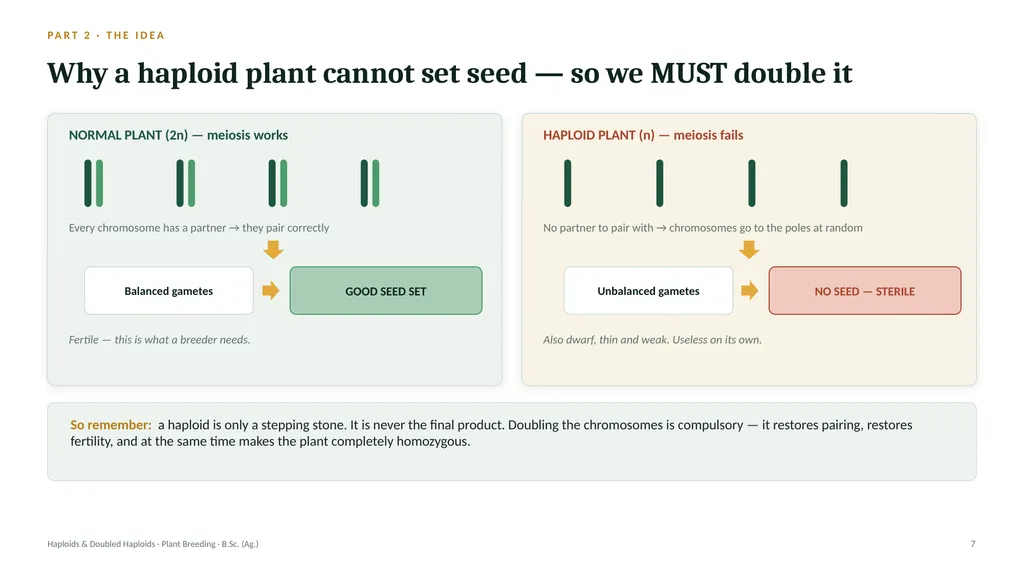
PART 2 · THE IDEA Why a haploid plant cannot set seed — so we MUST double it Haploids & Doubled Haploids · Plant Breeding · B.Sc. (Ag.) 7 NORMAL PLANT (2n) — meiosis works Every chromosome has a partner → they pair correctly Balanced gametes GOOD SEED SET Fertile — this is what a breeder needs. HAPLOID PLANT (n) — meiosis fails No partner to pair with → chromosomes go to the poles at random Unbalanced gametes NO SEED — STERILE Also dwarf, thin and weak. Useless on its own. So remember: a haploid is only a stepping stone. It is never the final product. Doubling the chromosomes is compulsory — it restores pairing, restores fertility, and at the same time makes the plant completely homozygous.<br>
07
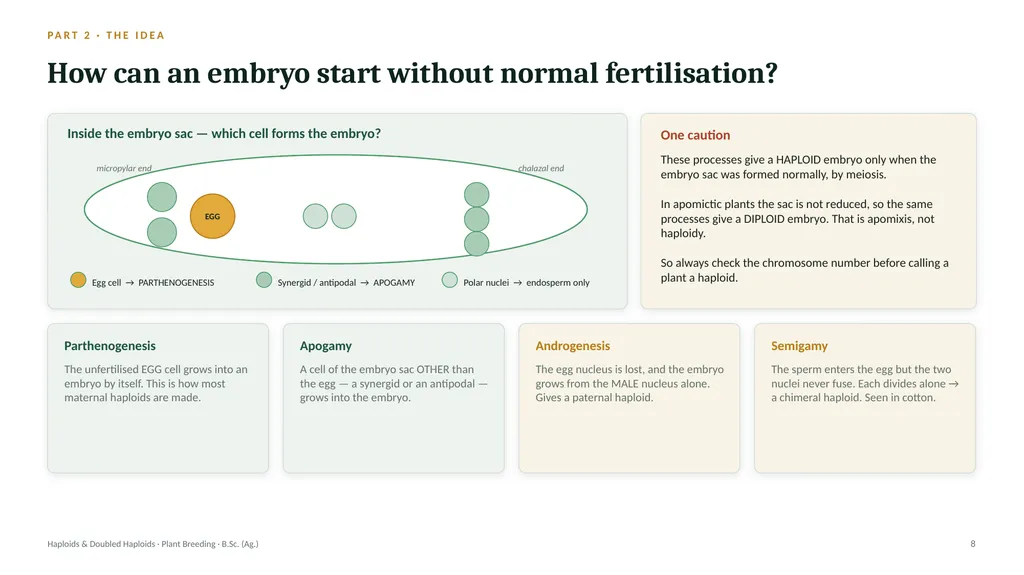
PART 2 · THE IDEA How can an embryo start without normal fertilisation? Haploids & Doubled Haploids · Plant Breeding · B.Sc. (Ag.) 8 Inside the embryo sac — which cell forms the embryo? micropylar end chalazal end EGG Egg cell → PARTHENOGENESIS Synergid / antipodal → APOGAMY Polar nuclei → endosperm only One caution These processes give a HAPLOID embryo only when the embryo sac was formed normally, by meiosis.
In apomictic plants the sac is not reduced, so the same processes give a DIPLOID embryo. That is apomixis, not haploidy.
So always check the chromosome number before calling a plant a haploid. Parthenogenesis The unfertilised EGG cell grows into an embryo by itself. This is how most maternal haploids are made. Apogamy A cell of the embryo sac OTHER than the egg — a synergid or an antipodal — grows into the embryo. Androgenesis The egg nucleus is lost, and the embryo grows from the MALE nucleus alone. Gives a paternal haploid. Semigamy The sperm enters the egg but the two nuclei never fuse. Each divides alone → a chimeral haploid. Seen in cotton.<br>
In apomictic plants the sac is not reduced, so the same processes give a DIPLOID embryo. That is apomixis, not haploidy.
So always check the chromosome number before calling a plant a haploid. Parthenogenesis The unfertilised EGG cell grows into an embryo by itself. This is how most maternal haploids are made. Apogamy A cell of the embryo sac OTHER than the egg — a synergid or an antipodal — grows into the embryo. Androgenesis The egg nucleus is lost, and the embryo grows from the MALE nucleus alone. Gives a paternal haploid. Semigamy The sperm enters the egg but the two nuclei never fuse. Each divides alone → a chimeral haploid. Seen in cotton.<br>
08
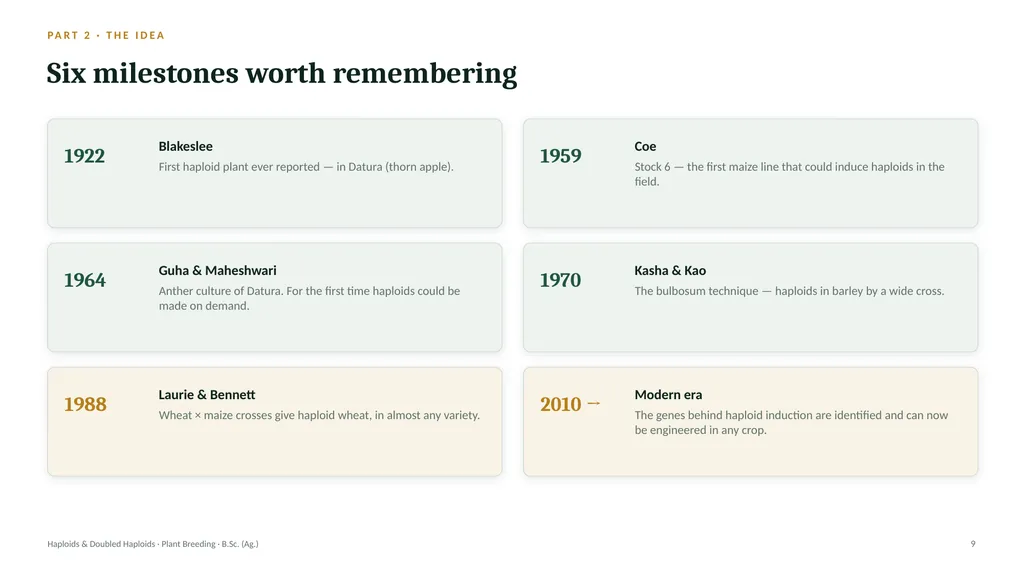
PART 2 · THE IDEA Six milestones worth remembering Haploids & Doubled Haploids · Plant Breeding · B.Sc. (Ag.) 9 1922 Blakeslee First haploid plant ever reported — in Datura (thorn apple). 1959 Coe Stock 6 — the first maize line that could induce haploids in the field. 1964 Guha & Maheshwari Anther culture of Datura. For the first time haploids could be made on demand. 1970 Kasha & Kao The bulbosum technique — haploids in barley by a wide cross. 1988 Laurie & Bennett Wheat × maize crosses give haploid wheat, in almost any variety. 2010 → Modern era The genes behind haploid induction are identified and can now be engineered in any crop.<br>
09
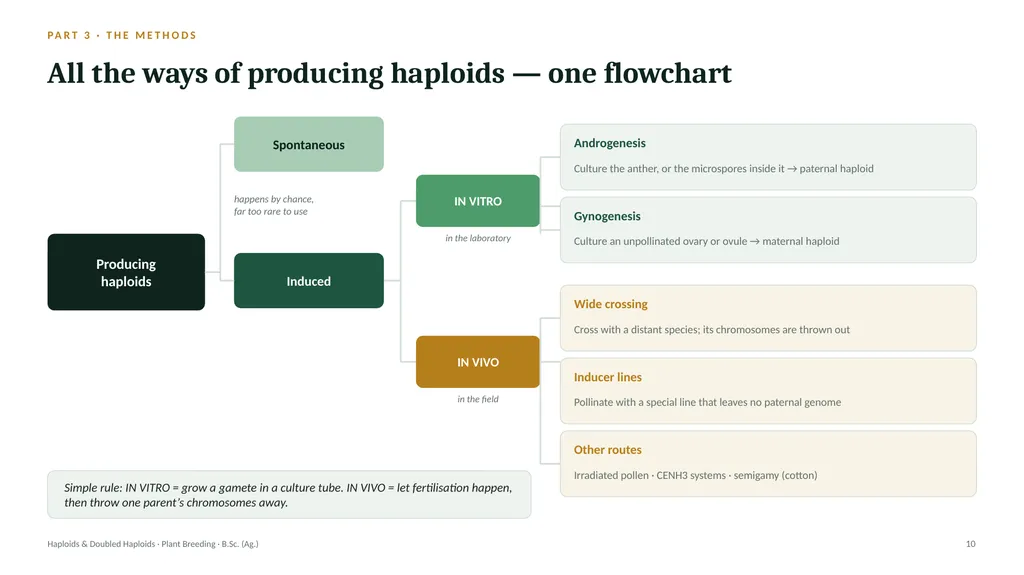
PART 3 · THE METHODS All the ways of producing haploids — one flowchart Haploids & Doubled Haploids · Plant Breeding · B.Sc. (Ag.) 10 Producing
haploids Spontaneous happens by chance,
far too rare to use Induced IN VITRO in the laboratory IN VIVO in the field Androgenesis Culture the anther, or the microspores inside it → paternal haploid Gynogenesis Culture an unpollinated ovary or ovule → maternal haploid Wide crossing Cross with a distant species; its chromosomes are thrown out Inducer lines Pollinate with a special line that leaves no paternal genome Other routes Irradiated pollen · CENH3 systems · semigamy (cotton) Simple rule: IN VITRO = grow a gamete in a culture tube. IN VIVO = let fertilisation happen, then throw one parent’s chromosomes away.<br>
haploids Spontaneous happens by chance,
far too rare to use Induced IN VITRO in the laboratory IN VIVO in the field Androgenesis Culture the anther, or the microspores inside it → paternal haploid Gynogenesis Culture an unpollinated ovary or ovule → maternal haploid Wide crossing Cross with a distant species; its chromosomes are thrown out Inducer lines Pollinate with a special line that leaves no paternal genome Other routes Irradiated pollen · CENH3 systems · semigamy (cotton) Simple rule: IN VITRO = grow a gamete in a culture tube. IN VIVO = let fertilisation happen, then throw one parent’s chromosomes away.<br>
10
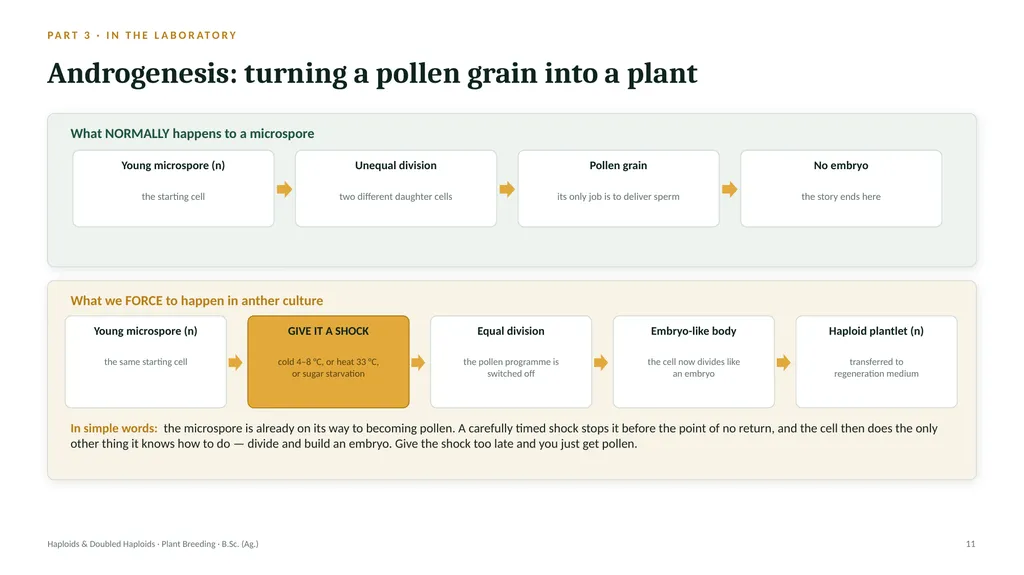
PART 3 · IN THE LABORATORY Androgenesis: turning a pollen grain into a plant Haploids & Doubled Haploids · Plant Breeding · B.Sc. (Ag.) 11 What NORMALLY happens to a microspore Young microspore (n) the starting cell Unequal division two different daughter cells Pollen grain its only job is to deliver sperm No embryo the story ends here What we FORCE to happen in anther culture Young microspore (n) the same starting cell GIVE IT A SHOCK cold 4–8 °C, or heat 33 °C,
or sugar starvation Equal division the pollen programme is
switched off Embryo-like body the cell now divides like
an embryo Haploid plantlet (n) transferred to
regeneration medium In simple words: the microspore is already on its way to becoming pollen. A carefully timed shock stops it before the point of no return, and the cell then does the only other thing it knows how to do — divide and build an embryo. Give the shock too late and you just get pollen.<br>
or sugar starvation Equal division the pollen programme is
switched off Embryo-like body the cell now divides like
an embryo Haploid plantlet (n) transferred to
regeneration medium In simple words: the microspore is already on its way to becoming pollen. A carefully timed shock stops it before the point of no return, and the cell then does the only other thing it knows how to do — divide and build an embryo. Give the shock too late and you just get pollen.<br>
11
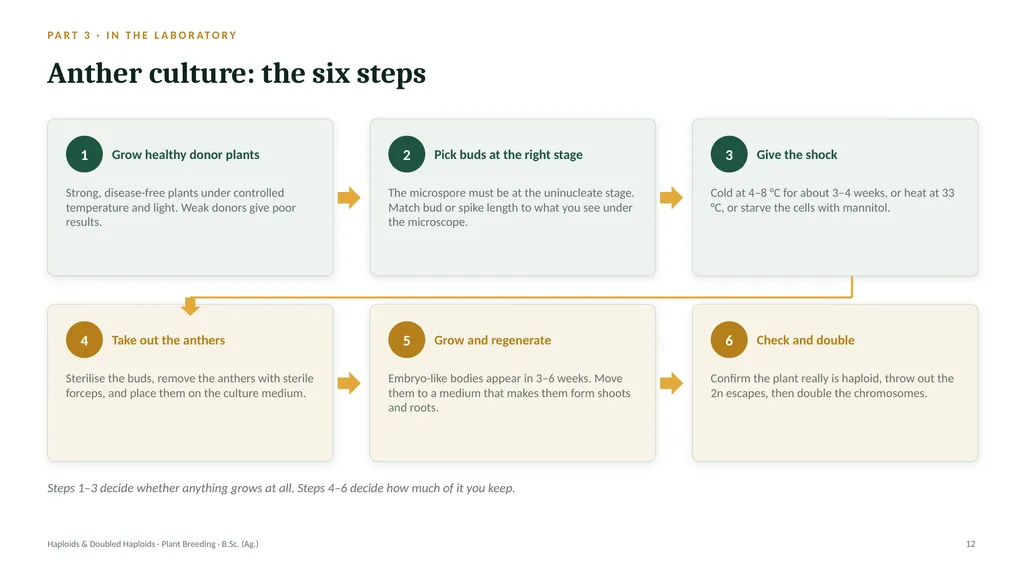
PART 3 · IN THE LABORATORY Anther culture: the six steps Haploids & Doubled Haploids · Plant Breeding · B.Sc. (Ag.) 12 1 Grow healthy donor plants Strong, disease-free plants under controlled temperature and light. Weak donors give poor results. 2 Pick buds at the right stage The microspore must be at the uninucleate stage. Match bud or spike length to what you see under the microscope. 3 Give the shock Cold at 4–8 °C for about 3–4 weeks, or heat at 33 °C, or starve the cells with mannitol. 4 Take out the anthers Sterilise the buds, remove the anthers with sterile forceps, and place them on the culture medium. 5 Grow and regenerate Embryo-like bodies appear in 3–6 weeks. Move them to a medium that makes them form shoots and roots. 6 Check and double Confirm the plant really is haploid, throw out the 2n escapes, then double the chromosomes. Steps 1–3 decide whether anything grows at all. Steps 4–6 decide how much of it you keep.<br>
12
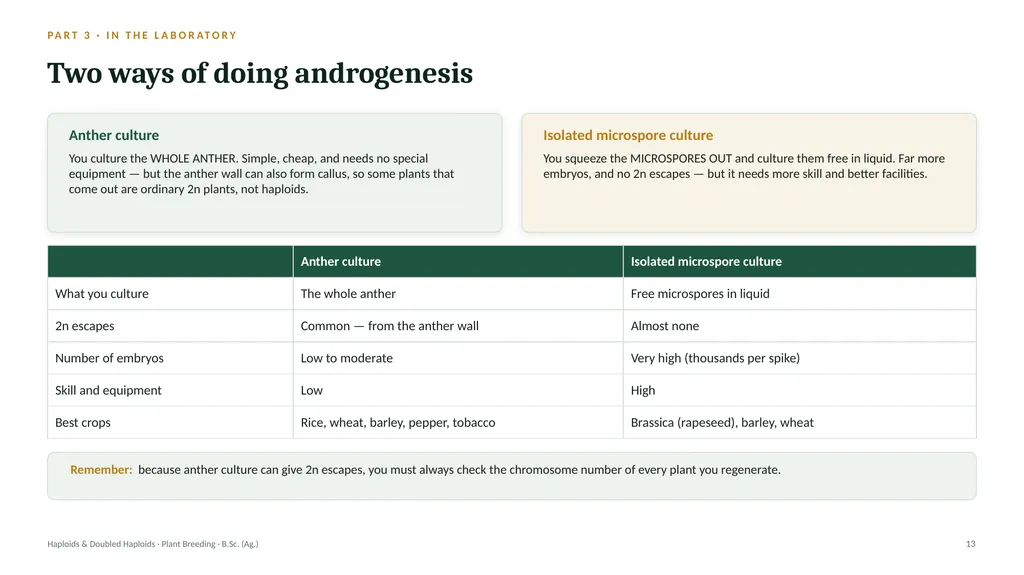
PART 3 · IN THE LABORATORY Two ways of doing androgenesis Haploids & Doubled Haploids · Plant Breeding · B.Sc. (Ag.) 13 Anther culture You culture the WHOLE ANTHER. Simple, cheap, and needs no special equipment — but the anther wall can also form callus, so some plants that come out are ordinary 2n plants, not haploids. Isolated microspore culture You squeeze the MICROSPORES OUT and culture them free in liquid. Far more embryos, and no 2n escapes — but it needs more skill and better facilities. Remember: because anther culture can give 2n escapes, you must always check the chromosome number of every plant you regenerate.<br>
13
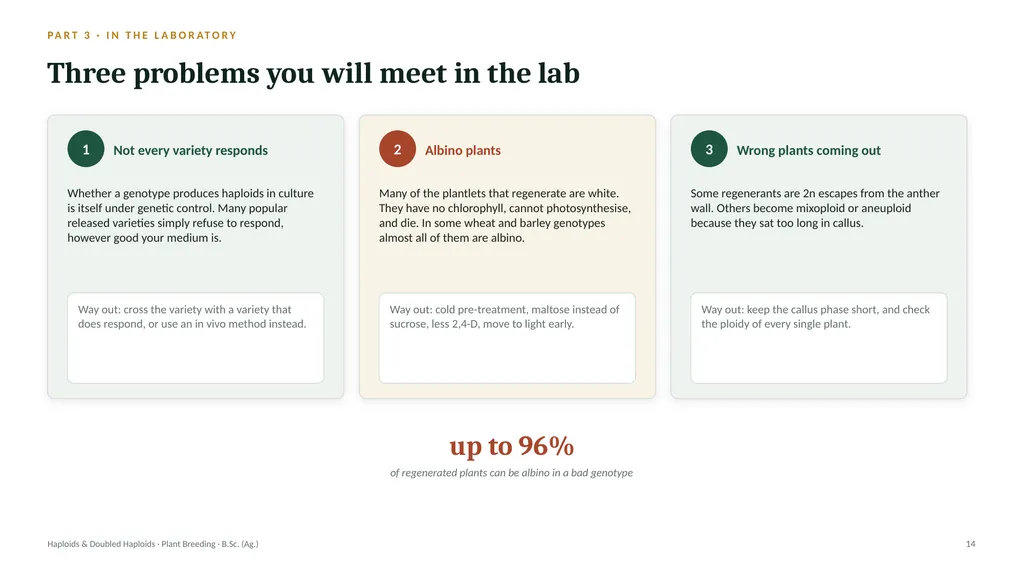
PART 3 · IN THE LABORATORY Three problems you will meet in the lab Haploids & Doubled Haploids · Plant Breeding · B.Sc. (Ag.) 14 1 Not every variety responds Whether a genotype produces haploids in culture is itself under genetic control. Many popular released varieties simply refuse to respond, however good your medium is. Way out: cross the variety with a variety that does respond, or use an in vivo method instead. 2 Albino plants Many of the plantlets that regenerate are white. They have no chlorophyll, cannot photosynthesise, and die. In some wheat and barley genotypes almost all of them are albino. Way out: cold pre-treatment, maltose instead of sucrose, less 2,4-D, move to light early. 3 Wrong plants coming out Some regenerants are 2n escapes from the anther wall. Others become mixoploid or aneuploid because they sat too long in callus. Way out: keep the callus phase short, and check the ploidy of every single plant. up to 96% of regenerated plants can be albino in a bad genotype<br>
14
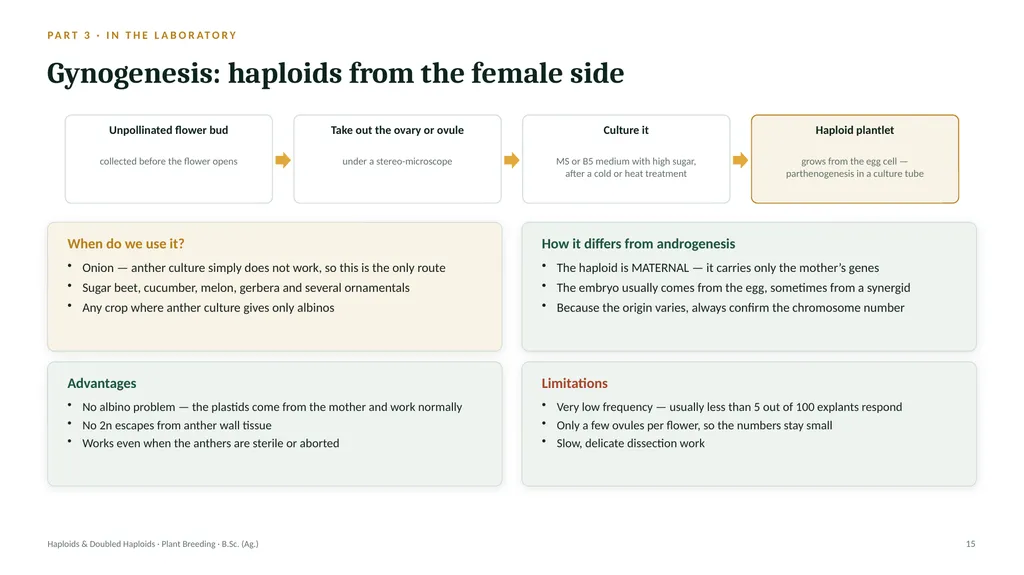
PART 3 · IN THE LABORATORY Gynogenesis: haploids from the female side Haploids & Doubled Haploids · Plant Breeding · B.Sc. (Ag.) 15 Unpollinated flower bud collected before the flower opens Take out the ovary or ovule under a stereo-microscope Culture it MS or B5 medium with high sugar,
after a cold or heat treatment Haploid plantlet grows from the egg cell —
parthenogenesis in a culture tube When do we use it? Onion — anther culture simply does not work, so this is the only route
Sugar beet, cucumber, melon, gerbera and several ornamentals
Any crop where anther culture gives only albinos How it differs from androgenesis The haploid is MATERNAL — it carries only the mother’s genes
The embryo usually comes from the egg, sometimes from a synergid
Because the origin varies, always confirm the chromosome number Advantages No albino problem — the plastids come from the mother and work normally
No 2n escapes from anther wall tissue
Works even when the anthers are sterile or aborted Limitations Very low frequency — usually less than 5 out of 100 explants respond
Only a few ovules per flower, so the numbers stay small
Slow, delicate dissection work<br>
after a cold or heat treatment Haploid plantlet grows from the egg cell —
parthenogenesis in a culture tube When do we use it? Onion — anther culture simply does not work, so this is the only route
Sugar beet, cucumber, melon, gerbera and several ornamentals
Any crop where anther culture gives only albinos How it differs from androgenesis The haploid is MATERNAL — it carries only the mother’s genes
The embryo usually comes from the egg, sometimes from a synergid
Because the origin varies, always confirm the chromosome number Advantages No albino problem — the plastids come from the mother and work normally
No 2n escapes from anther wall tissue
Works even when the anthers are sterile or aborted Limitations Very low frequency — usually less than 5 out of 100 explants respond
Only a few ovules per flower, so the numbers stay small
Slow, delicate dissection work<br>
15
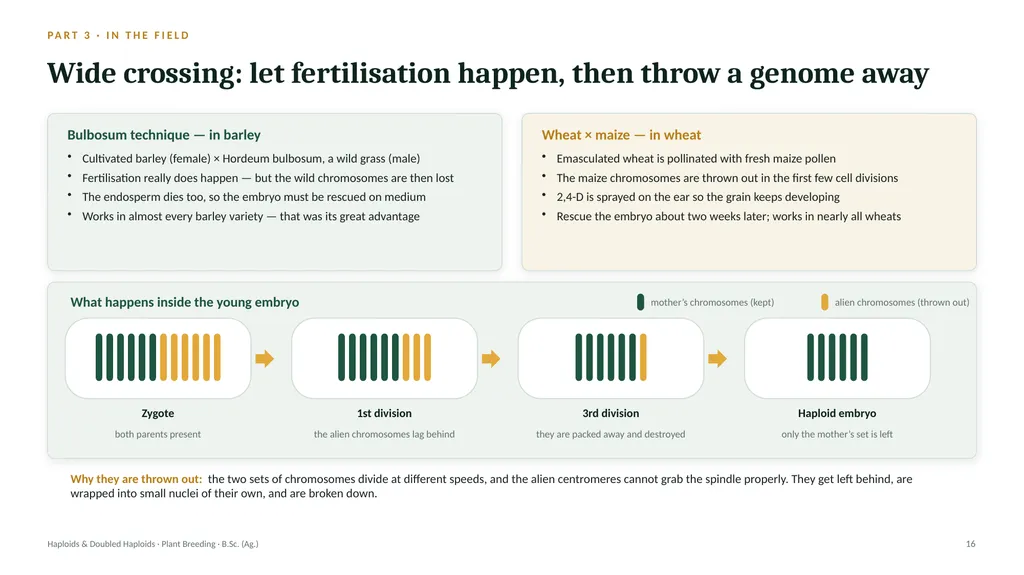
PART 3 · IN THE FIELD Wide crossing: let fertilisation happen, then throw a genome away Haploids & Doubled Haploids · Plant Breeding · B.Sc. (Ag.) 16 Bulbosum technique — in barley Cultivated barley (female) × Hordeum bulbosum, a wild grass (male)
Fertilisation really does happen — but the wild chromosomes are then lost
The endosperm dies too, so the embryo must be rescued on medium
Works in almost every barley variety — that was its great advantage Wheat × maize — in wheat Emasculated wheat is pollinated with fresh maize pollen
The maize chromosomes are thrown out in the first few cell divisions
2,4-D is sprayed on the ear so the grain keeps developing
Rescue the embryo about two weeks later; works in nearly all wheats What happens inside the young embryo Zygote both parents present 1st division the alien chromosomes lag behind 3rd division they are packed away and destroyed Haploid embryo only the mother’s set is left mother’s chromosomes (kept) alien chromosomes (thrown out) Why they are thrown out: the two sets of chromosomes divide at different speeds, and the alien centromeres cannot grab the spindle properly. They get left behind, are wrapped into small nuclei of their own, and are broken down.<br>
Fertilisation really does happen — but the wild chromosomes are then lost
The endosperm dies too, so the embryo must be rescued on medium
Works in almost every barley variety — that was its great advantage Wheat × maize — in wheat Emasculated wheat is pollinated with fresh maize pollen
The maize chromosomes are thrown out in the first few cell divisions
2,4-D is sprayed on the ear so the grain keeps developing
Rescue the embryo about two weeks later; works in nearly all wheats What happens inside the young embryo Zygote both parents present 1st division the alien chromosomes lag behind 3rd division they are packed away and destroyed Haploid embryo only the mother’s set is left mother’s chromosomes (kept) alien chromosomes (thrown out) Why they are thrown out: the two sets of chromosomes divide at different speeds, and the alien centromeres cannot grab the spindle properly. They get left behind, are wrapped into small nuclei of their own, and are broken down.<br>
16
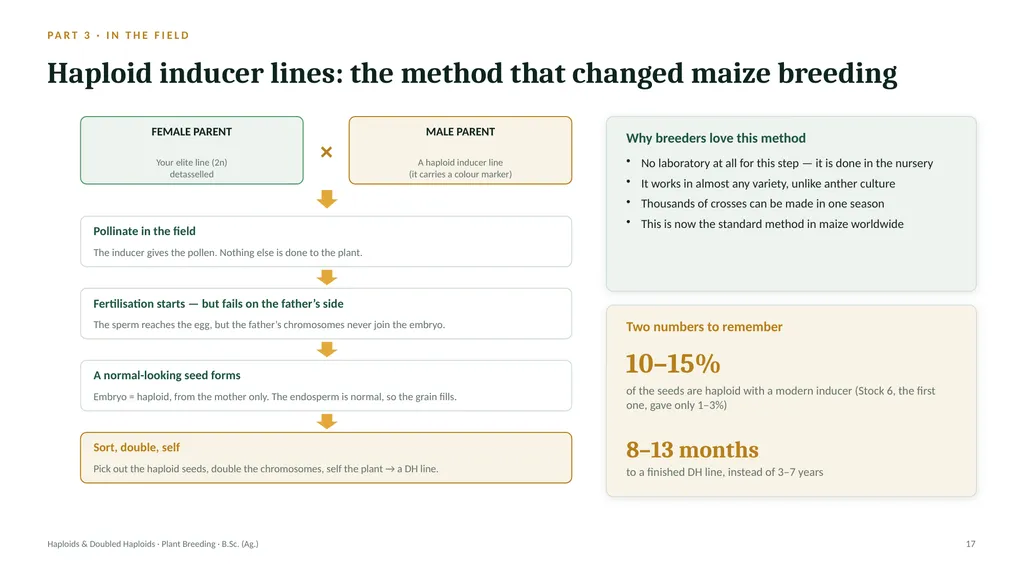
PART 3 · IN THE FIELD Haploid inducer lines: the method that changed maize breeding Haploids & Doubled Haploids · Plant Breeding · B.Sc. (Ag.) 17 FEMALE PARENT Your elite line (2n)
detasselled × MALE PARENT A haploid inducer line
(it carries a colour marker) Pollinate in the field The inducer gives the pollen. Nothing else is done to the plant. Fertilisation starts — but fails on the father’s side The sperm reaches the egg, but the father’s chromosomes never join the embryo. A normal-looking seed forms Embryo = haploid, from the mother only. The endosperm is normal, so the grain fills. Sort, double, self Pick out the haploid seeds, double the chromosomes, self the plant → a DH line. Why breeders love this method No laboratory at all for this step — it is done in the nursery
It works in almost any variety, unlike anther culture
Thousands of crosses can be made in one season
This is now the standard method in maize worldwide Two numbers to remember 10–15% of the seeds are haploid with a modern inducer (Stock 6, the first one, gave only 1–3%) 8–13 months to a finished DH line, instead of 3–7 years<br>
detasselled × MALE PARENT A haploid inducer line
(it carries a colour marker) Pollinate in the field The inducer gives the pollen. Nothing else is done to the plant. Fertilisation starts — but fails on the father’s side The sperm reaches the egg, but the father’s chromosomes never join the embryo. A normal-looking seed forms Embryo = haploid, from the mother only. The endosperm is normal, so the grain fills. Sort, double, self Pick out the haploid seeds, double the chromosomes, self the plant → a DH line. Why breeders love this method No laboratory at all for this step — it is done in the nursery
It works in almost any variety, unlike anther culture
Thousands of crosses can be made in one season
This is now the standard method in maize worldwide Two numbers to remember 10–15% of the seeds are haploid with a modern inducer (Stock 6, the first one, gave only 1–3%) 8–13 months to a finished DH line, instead of 3–7 years<br>
17
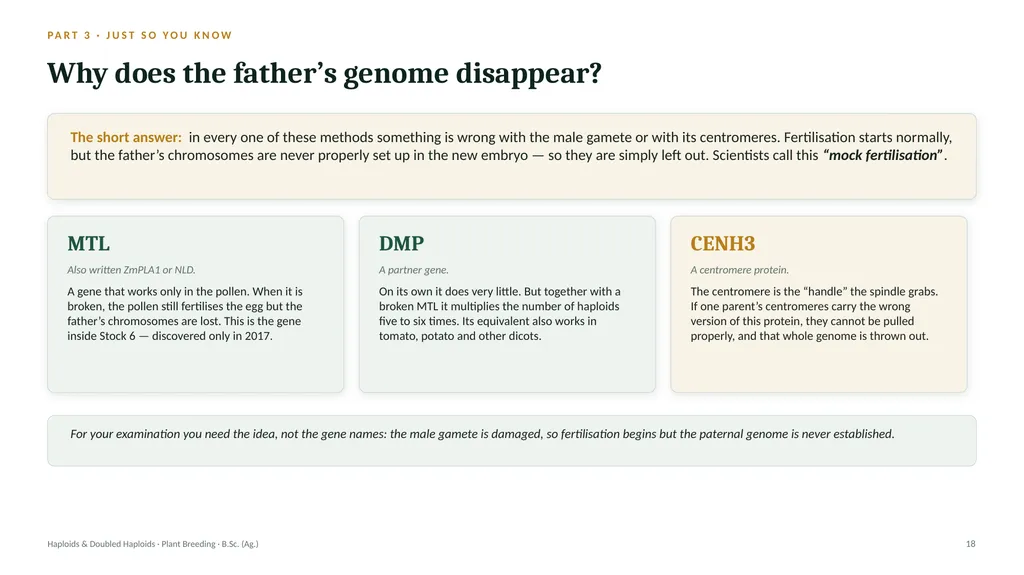
PART 3 · JUST SO YOU KNOW Why does the father’s genome disappear? Haploids & Doubled Haploids · Plant Breeding · B.Sc. (Ag.) 18 The short answer: in every one of these methods something is wrong with the male gamete or with its centromeres. Fertilisation starts normally, but the father’s chromosomes are never properly set up in the new embryo — so they are simply left out. Scientists call this “mock fertilisation”. MTL Also written ZmPLA1 or NLD. A gene that works only in the pollen. When it is broken, the pollen still fertilises the egg but the father’s chromosomes are lost. This is the gene inside Stock 6 — discovered only in 2017. DMP A partner gene. On its own it does very little. But together with a broken MTL it multiplies the number of haploids five to six times. Its equivalent also works in tomato, potato and other dicots. CENH3 A centromere protein. The centromere is the “handle” the spindle grabs. If one parent’s centromeres carry the wrong version of this protein, they cannot be pulled properly, and that whole genome is thrown out. For your examination you need the idea, not the gene names: the male gamete is damaged, so fertilisation begins but the paternal genome is never established.<br>
18
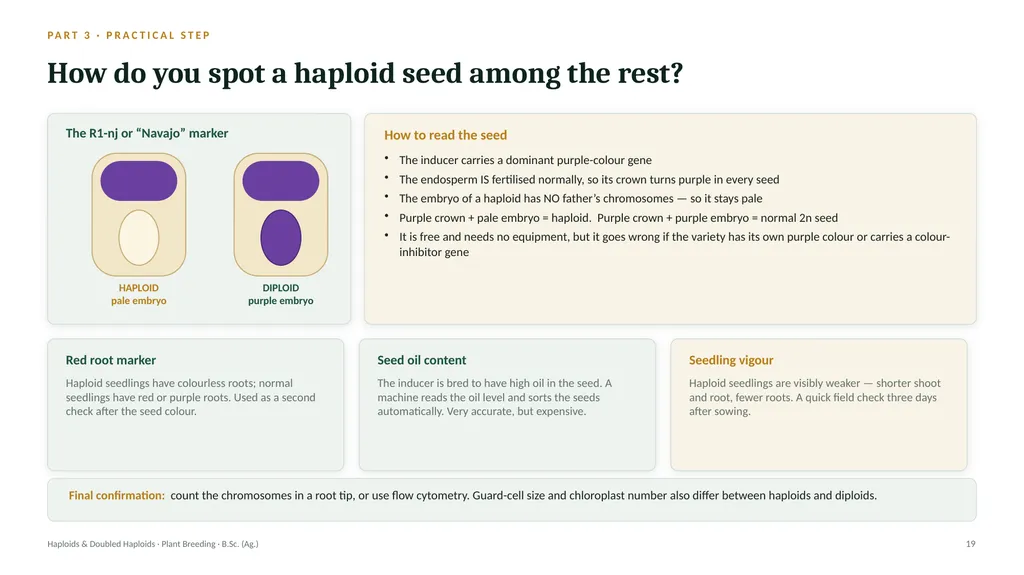
PART 3 · PRACTICAL STEP How do you spot a haploid seed among the rest? Haploids & Doubled Haploids · Plant Breeding · B.Sc. (Ag.) 19 The R1-nj or “Navajo” marker HAPLOID
pale embryo DIPLOID
purple embryo How to read the seed The inducer carries a dominant purple-colour gene
The endosperm IS fertilised normally, so its crown turns purple in every seed
The embryo of a haploid has NO father’s chromosomes — so it stays pale
Purple crown + pale embryo = haploid. Purple crown + purple embryo = normal 2n seed
It is free and needs no equipment, but it goes wrong if the variety has its own purple colour or carries a colour-inhibitor gene Red root marker Haploid seedlings have colourless roots; normal seedlings have red or purple roots. Used as a second check after the seed colour. Seed oil content The inducer is bred to have high oil in the seed. A machine reads the oil level and sorts the seeds automatically. Very accurate, but expensive. Seedling vigour Haploid seedlings are visibly weaker — shorter shoot and root, fewer roots. A quick field check three days after sowing. Final confirmation: count the chromosomes in a root tip, or use flow cytometry. Guard-cell size and chloroplast number also differ between haploids and diploids.<br>
pale embryo DIPLOID
purple embryo How to read the seed The inducer carries a dominant purple-colour gene
The endosperm IS fertilised normally, so its crown turns purple in every seed
The embryo of a haploid has NO father’s chromosomes — so it stays pale
Purple crown + pale embryo = haploid. Purple crown + purple embryo = normal 2n seed
It is free and needs no equipment, but it goes wrong if the variety has its own purple colour or carries a colour-inhibitor gene Red root marker Haploid seedlings have colourless roots; normal seedlings have red or purple roots. Used as a second check after the seed colour. Seed oil content The inducer is bred to have high oil in the seed. A machine reads the oil level and sorts the seeds automatically. Very accurate, but expensive. Seedling vigour Haploid seedlings are visibly weaker — shorter shoot and root, fewer roots. A quick field check three days after sowing. Final confirmation: count the chromosomes in a root tip, or use flow cytometry. Guard-cell size and chloroplast number also differ between haploids and diploids.<br>
19
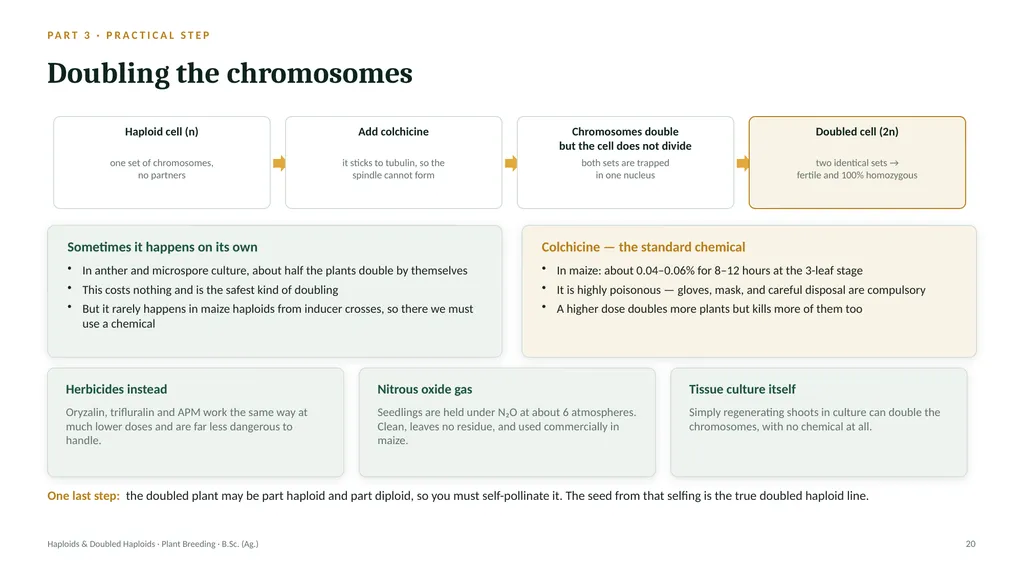
PART 3 · PRACTICAL STEP Doubling the chromosomes Haploids & Doubled Haploids · Plant Breeding · B.Sc. (Ag.) 20 Haploid cell (n) one set of chromosomes,
no partners Add colchicine it sticks to tubulin, so the
spindle cannot form Chromosomes double
but the cell does not divide both sets are trapped
in one nucleus Doubled cell (2n) two identical sets →
fertile and 100% homozygous Sometimes it happens on its own In anther and microspore culture, about half the plants double by themselves
This costs nothing and is the safest kind of doubling
But it rarely happens in maize haploids from inducer crosses, so there we must use a chemical Colchicine — the standard chemical In maize: about 0.04–0.06% for 8–12 hours at the 3-leaf stage
It is highly poisonous — gloves, mask, and careful disposal are compulsory
A higher dose doubles more plants but kills more of them too Herbicides instead Oryzalin, trifluralin and APM work the same way at much lower doses and are far less dangerous to handle. Nitrous oxide gas Seedlings are held under N₂O at about 6 atmospheres. Clean, leaves no residue, and used commercially in maize. Tissue culture itself Simply regenerating shoots in culture can double the chromosomes, with no chemical at all. One last step: the doubled plant may be part haploid and part diploid, so you must self-pollinate it. The seed from that selfing is the true doubled haploid line.<br>
no partners Add colchicine it sticks to tubulin, so the
spindle cannot form Chromosomes double
but the cell does not divide both sets are trapped
in one nucleus Doubled cell (2n) two identical sets →
fertile and 100% homozygous Sometimes it happens on its own In anther and microspore culture, about half the plants double by themselves
This costs nothing and is the safest kind of doubling
But it rarely happens in maize haploids from inducer crosses, so there we must use a chemical Colchicine — the standard chemical In maize: about 0.04–0.06% for 8–12 hours at the 3-leaf stage
It is highly poisonous — gloves, mask, and careful disposal are compulsory
A higher dose doubles more plants but kills more of them too Herbicides instead Oryzalin, trifluralin and APM work the same way at much lower doses and are far less dangerous to handle. Nitrous oxide gas Seedlings are held under N₂O at about 6 atmospheres. Clean, leaves no residue, and used commercially in maize. Tissue culture itself Simply regenerating shoots in culture can double the chromosomes, with no chemical at all. One last step: the doubled plant may be part haploid and part diploid, so you must self-pollinate it. The seed from that selfing is the true doubled haploid line.<br>
20
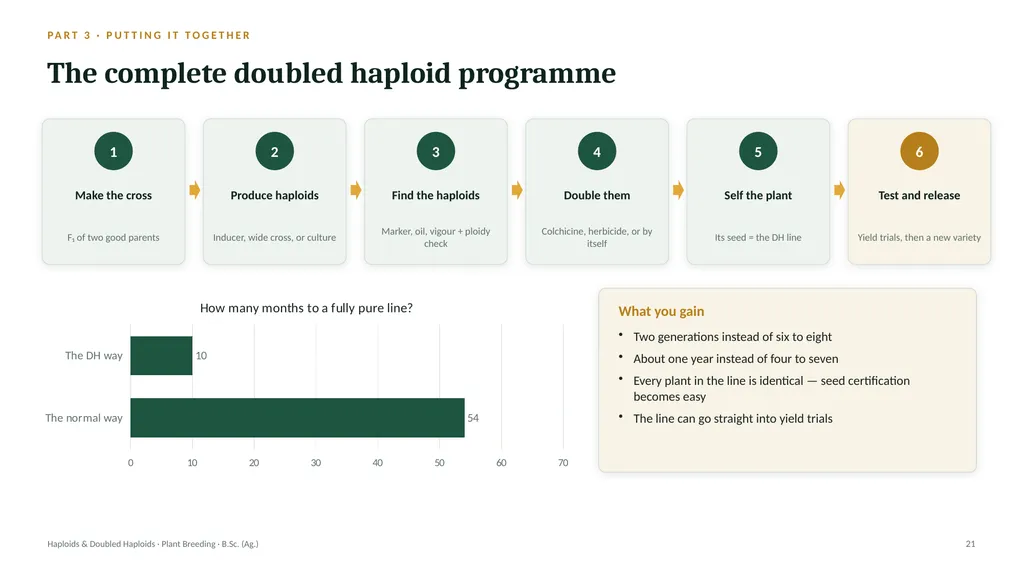
PART 3 · PUTTING IT TOGETHER The complete doubled haploid programme Haploids & Doubled Haploids · Plant Breeding · B.Sc. (Ag.) 21 1 Make the cross F₁ of two good parents 2 Produce haploids Inducer, wide cross, or culture 3 Find the haploids Marker, oil, vigour + ploidy check 4 Double them Colchicine, herbicide, or by itself 5 Self the plant Its seed = the DH line 6 Test and release Yield trials, then a new variety What you gain Two generations instead of six to eight
About one year instead of four to seven
Every plant in the line is identical — seed certification becomes easy
The line can go straight into yield trials<br>
About one year instead of four to seven
Every plant in the line is identical — seed certification becomes easy
The line can go straight into yield trials<br>
21
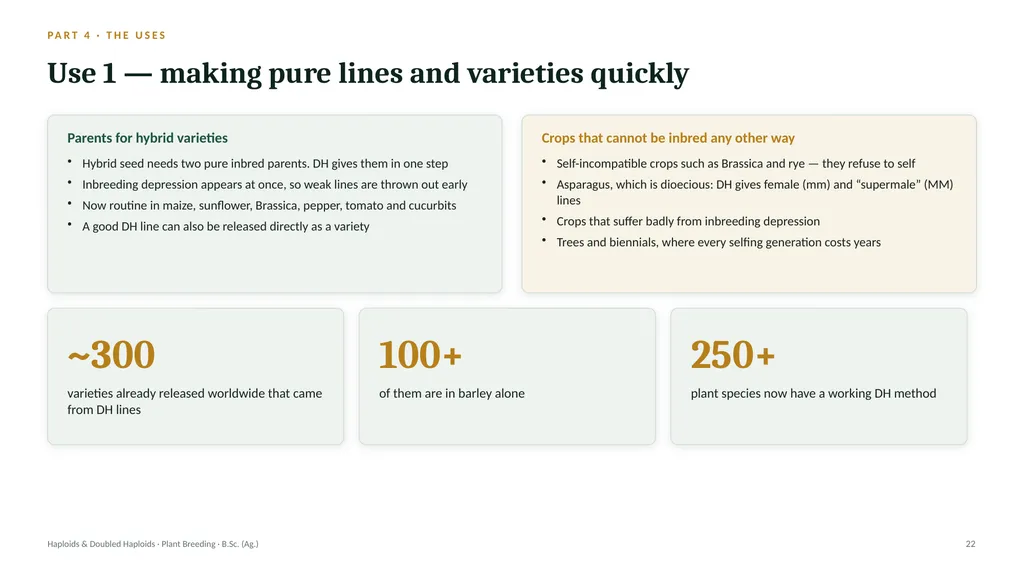
PART 4 · THE USES Use 1 — making pure lines and varieties quickly Haploids & Doubled Haploids · Plant Breeding · B.Sc. (Ag.) 22 Parents for hybrid varieties Hybrid seed needs two pure inbred parents. DH gives them in one step
Inbreeding depression appears at once, so weak lines are thrown out early
Now routine in maize, sunflower, Brassica, pepper, tomato and cucurbits
A good DH line can also be released directly as a variety Crops that cannot be inbred any other way Self-incompatible crops such as Brassica and rye — they refuse to self
Asparagus, which is dioecious: DH gives female (mm) and “supermale” (MM) lines
Crops that suffer badly from inbreeding depression
Trees and biennials, where every selfing generation costs years ~300 varieties already released worldwide that came from DH lines 100+ of them are in barley alone 250+ plant species now have a working DH method<br>
Inbreeding depression appears at once, so weak lines are thrown out early
Now routine in maize, sunflower, Brassica, pepper, tomato and cucurbits
A good DH line can also be released directly as a variety Crops that cannot be inbred any other way Self-incompatible crops such as Brassica and rye — they refuse to self
Asparagus, which is dioecious: DH gives female (mm) and “supermale” (MM) lines
Crops that suffer badly from inbreeding depression
Trees and biennials, where every selfing generation costs years ~300 varieties already released worldwide that came from DH lines 100+ of them are in barley alone 250+ plant species now have a working DH method<br>
22
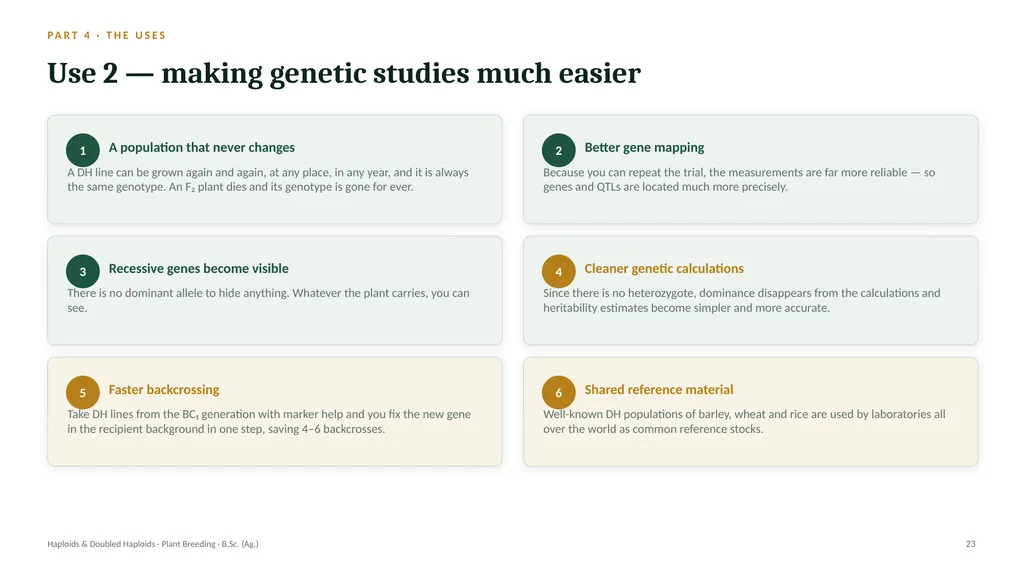
PART 4 · THE USES Use 2 — making genetic studies much easier Haploids & Doubled Haploids · Plant Breeding · B.Sc. (Ag.) 23 1 A population that never changes A DH line can be grown again and again, at any place, in any year, and it is always the same genotype. An F₂ plant dies and its genotype is gone for ever. 2 Better gene mapping Because you can repeat the trial, the measurements are far more reliable — so genes and QTLs are located much more precisely. 3 Recessive genes become visible There is no dominant allele to hide anything. Whatever the plant carries, you can see. 4 Cleaner genetic calculations Since there is no heterozygote, dominance disappears from the calculations and heritability estimates become simpler and more accurate. 5 Faster backcrossing Take DH lines from the BC₁ generation with marker help and you fix the new gene in the recipient background in one step, saving 4–6 backcrosses. 6 Shared reference material Well-known DH populations of barley, wheat and rice are used by laboratories all over the world as common reference stocks.<br>
23
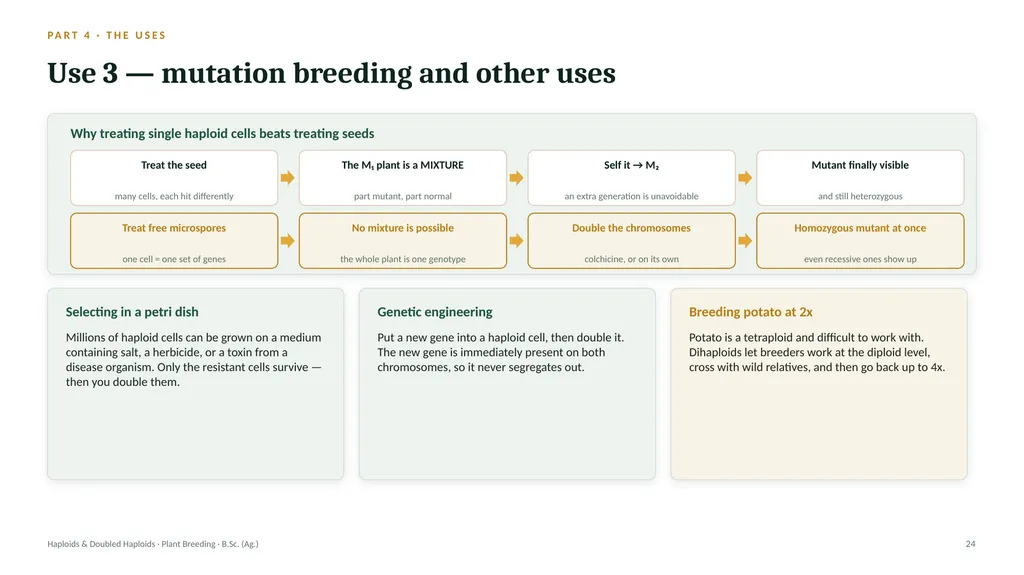
PART 4 · THE USES Use 3 — mutation breeding and other uses Haploids & Doubled Haploids · Plant Breeding · B.Sc. (Ag.) 24 Why treating single haploid cells beats treating seeds Treat the seed many cells, each hit differently The M₁ plant is a MIXTURE part mutant, part normal Self it → M₂ an extra generation is unavoidable Mutant finally visible and still heterozygous Treat free microspores one cell = one set of genes No mixture is possible the whole plant is one genotype Double the chromosomes colchicine, or on its own Homozygous mutant at once even recessive ones show up Selecting in a petri dish Millions of haploid cells can be grown on a medium containing salt, a herbicide, or a toxin from a disease organism. Only the resistant cells survive — then you double them. Genetic engineering Put a new gene into a haploid cell, then double it. The new gene is immediately present on both chromosomes, so it never segregates out. Breeding potato at 2x Potato is a tetraploid and difficult to work with. Dihaploids let breeders work at the diploid level, cross with wild relatives, and then go back up to 4x.<br>
24
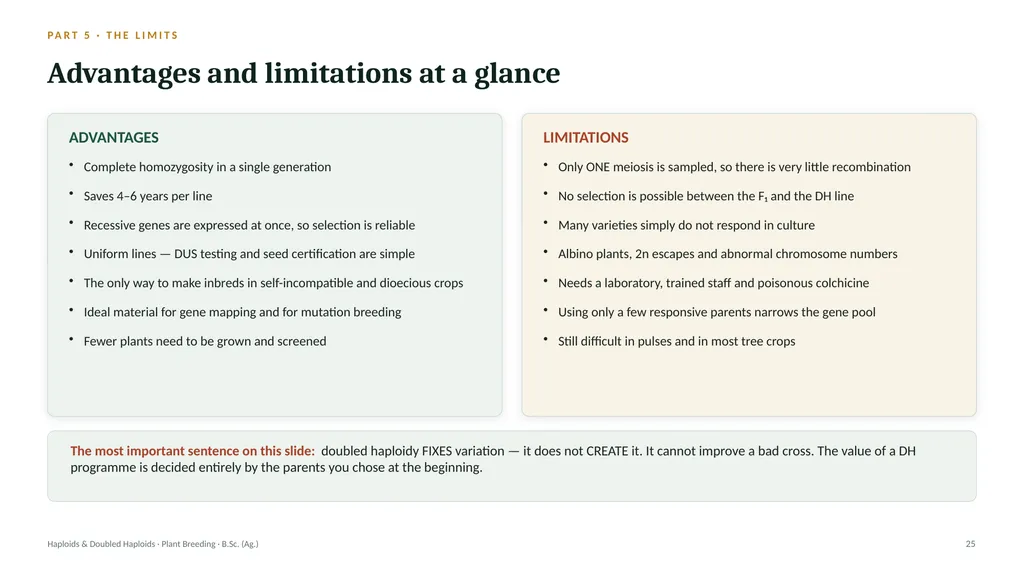
PART 5 · THE LIMITS Advantages and limitations at a glance Haploids & Doubled Haploids · Plant Breeding · B.Sc. (Ag.) 25 ADVANTAGES Complete homozygosity in a single generation
Saves 4–6 years per line
Recessive genes are expressed at once, so selection is reliable
Uniform lines — DUS testing and seed certification are simple
The only way to make inbreds in self-incompatible and dioecious crops
Ideal material for gene mapping and for mutation breeding
Fewer plants need to be grown and screened LIMITATIONS Only ONE meiosis is sampled, so there is very little recombination
No selection is possible between the F₁ and the DH line
Many varieties simply do not respond in culture
Albino plants, 2n escapes and abnormal chromosome numbers
Needs a laboratory, trained staff and poisonous colchicine
Using only a few responsive parents narrows the gene pool
Still difficult in pulses and in most tree crops The most important sentence on this slide: doubled haploidy FIXES variation — it does not CREATE it. It cannot improve a bad cross. The value of a DH programme is decided entirely by the parents you chose at the beginning.<br>
Saves 4–6 years per line
Recessive genes are expressed at once, so selection is reliable
Uniform lines — DUS testing and seed certification are simple
The only way to make inbreds in self-incompatible and dioecious crops
Ideal material for gene mapping and for mutation breeding
Fewer plants need to be grown and screened LIMITATIONS Only ONE meiosis is sampled, so there is very little recombination
No selection is possible between the F₁ and the DH line
Many varieties simply do not respond in culture
Albino plants, 2n escapes and abnormal chromosome numbers
Needs a laboratory, trained staff and poisonous colchicine
Using only a few responsive parents narrows the gene pool
Still difficult in pulses and in most tree crops The most important sentence on this slide: doubled haploidy FIXES variation — it does not CREATE it. It cannot improve a bad cross. The value of a DH programme is decided entirely by the parents you chose at the beginning.<br>
25
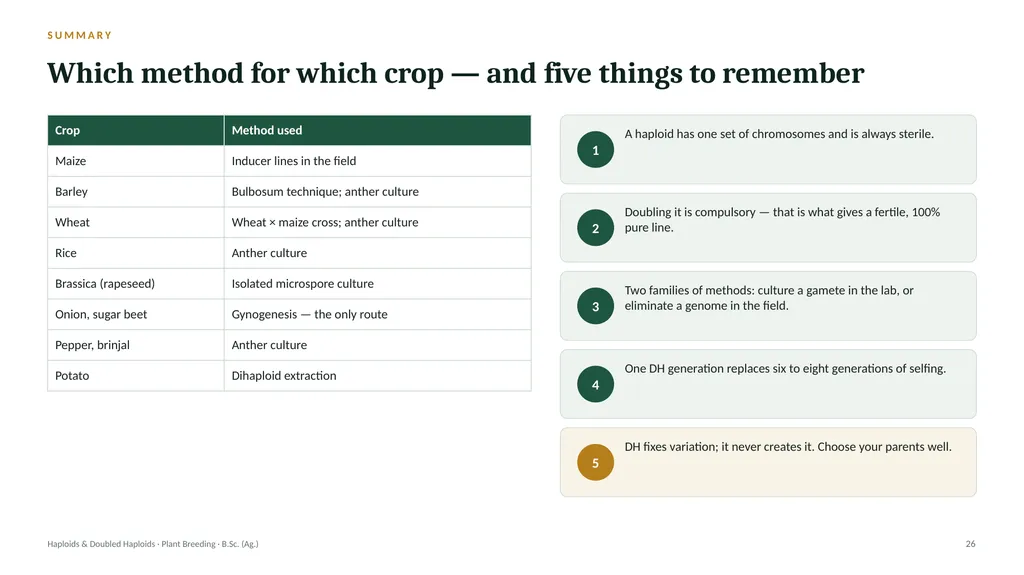
SUMMARY Which method for which crop — and five things to remember Haploids & Doubled Haploids · Plant Breeding · B.Sc. (Ag.) 26 1 A haploid has one set of chromosomes and is always sterile. 2 Doubling it is compulsory — that is what gives a fertile, 100% pure line. 3 Two families of methods: culture a gamete in the lab, or eliminate a genome in the field. 4 One DH generation replaces six to eight generations of selfing. 5 DH fixes variation; it never creates it. Choose your parents well.<br>
26
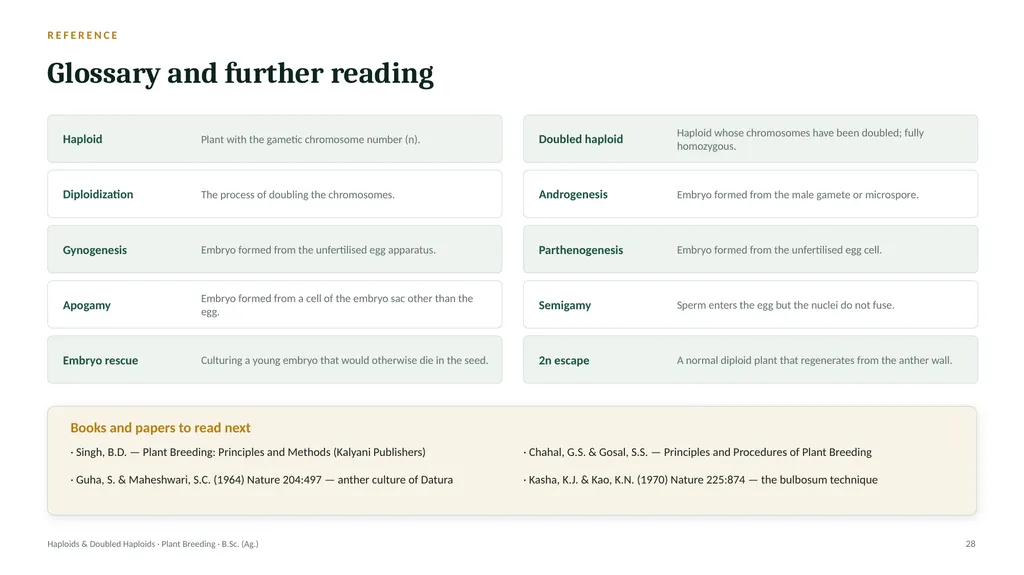
REFERENCE Glossary and further reading Haploids & Doubled Haploids · Plant Breeding · B.Sc. (Ag.) 28 Haploid Plant with the gametic chromosome number (n). Doubled haploid Haploid whose chromosomes have been doubled; fully homozygous. Diploidization The process of doubling the chromosomes. Androgenesis Embryo formed from the male gamete or microspore. Gynogenesis Embryo formed from the unfertilised egg apparatus. Parthenogenesis Embryo formed from the unfertilised egg cell. Apogamy Embryo formed from a cell of the embryo sac other than the egg. Semigamy Sperm enters the egg but the nuclei do not fuse. Embryo rescue Culturing a young embryo that would otherwise die in the seed. 2n escape A normal diploid plant that regenerates from the anther wall. Books and papers to read next · Singh, B.D. — Plant Breeding: Principles and Methods (Kalyani Publishers) · Chahal, G.S. & Gosal, S.S. — Principles and Procedures of Plant Breeding · Guha, S. & Maheshwari, S.C. (1964) Nature 204:497 — anther culture of Datura · Kasha, K.J. & Kao, K.N. (1970) Nature 225:874 — the bulbosum technique<br>