Hard Soft Acids and Bases B.Sc. III year Dr. Prabhat K. Baroliya Department of Chemistry MLSU, Udaipur e-mail; prabhatkbaroliyamlsu.ac.in Application of HSAB Concepts Relative strength of Hydracids HF,HCL,HBR and HI In aqueous solution
"Hard & Soft Acids and Bases B.Sc. III year Dr." is the property of its rightful owner. Permission is granted to
download and print the materials on this website for personal, non-commercial use only, and to display it
on your personal computer provided you do not modify the materials and that you retain all copyright
notices contained in the materials. By downloading content from our website, you accept the terms of this
agreement.
Presentation Transcript
01
Hard & Soft
Acids and Bases
B.Sc. III year Dr. Prabhat K. Baroliya Department of Chemistry
MLSU, Udaipur
e-mail; prabhatkbaroliya@mlsu.ac.in<br>
02
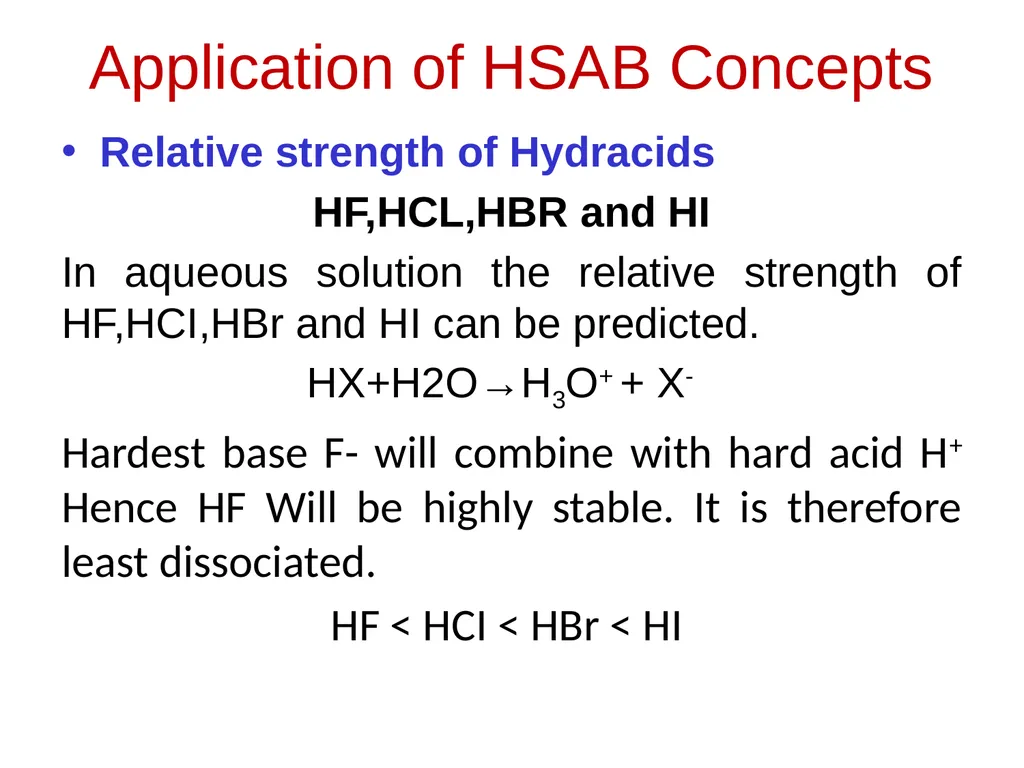
Application of HSAB Concepts Relative strength of Hydracids
HF,HCL,HBR and HI
In aqueous solution the relative strength of HF,HCI,HBr and HI can be predicted.
HX+H2O→H3O+ + X-
Hardest base F- will combine with hard acid H+ Hence HF Will be highly stable. It is therefore least dissociated.
HF < HCI < HBr < HI<br>
03
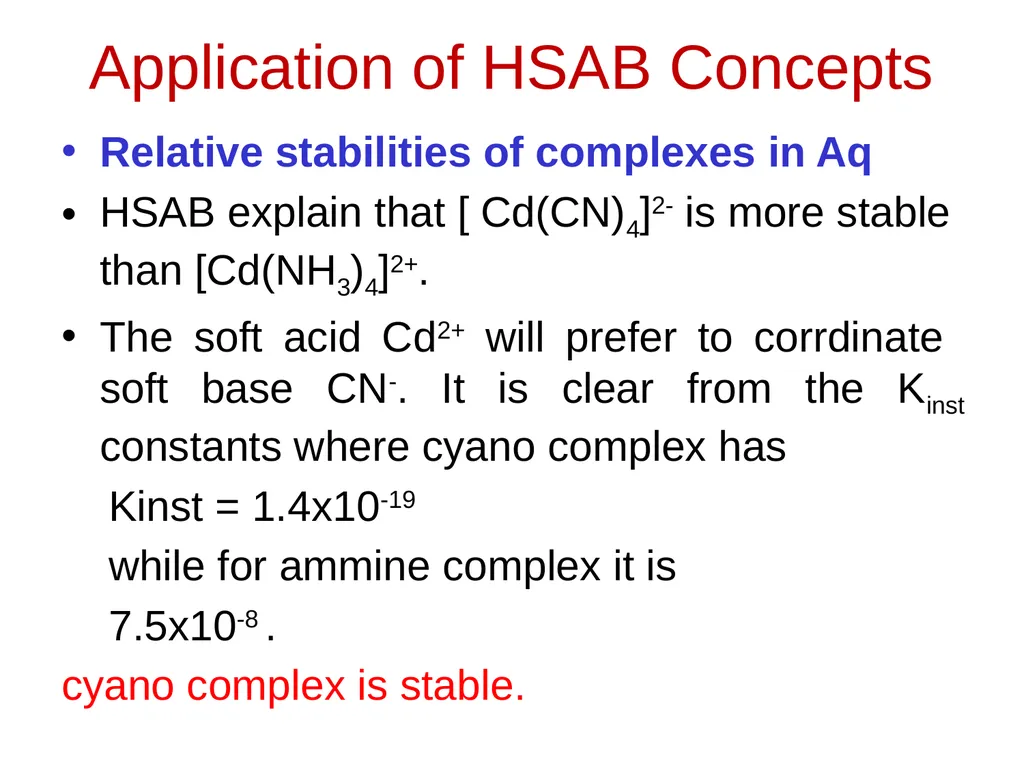
Application of HSAB Concepts Relative stabilities of complexes in Aq
HSAB explain that [ Cd(CN)4]2- is more stable than [Cd(NH3)4]2+.
The soft acid Cd2+ will prefer to corrdinate soft base CN-. It is clear from the Kinst constants where cyano complex has
Kinst = 1.4x10⁻¹⁹
while for ammine complex it is
7.5x10⁻⁸ .
cyano complex is stable.<br>
04
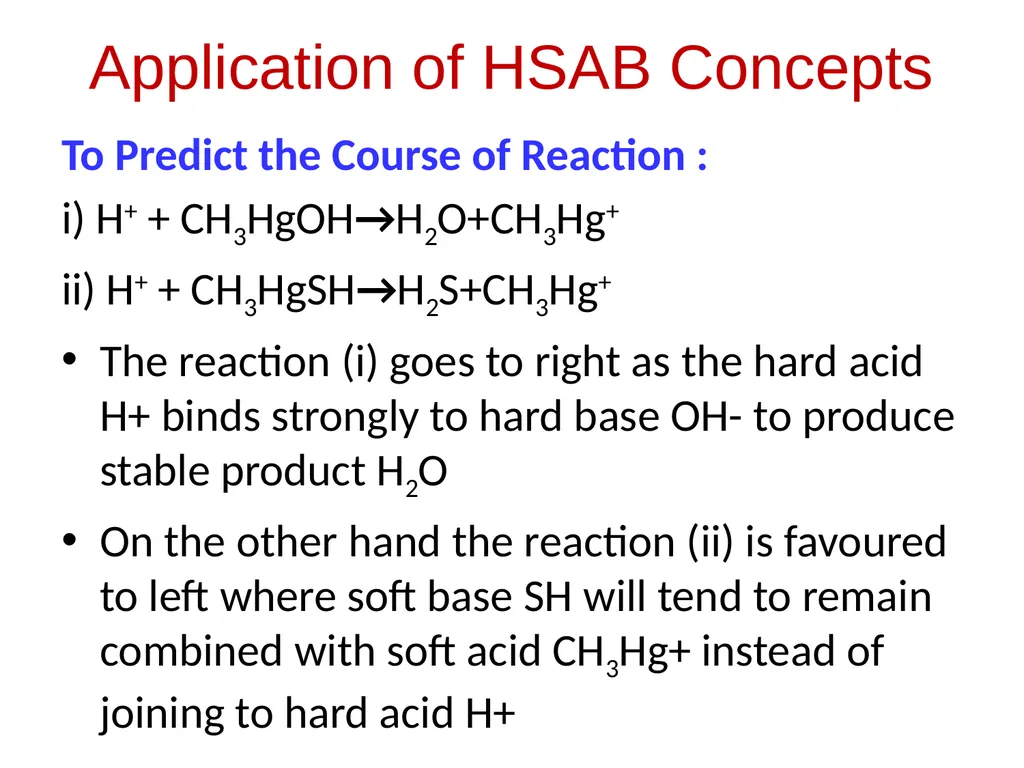
Application of HSAB Concepts To Predict the Course of Reaction :
i) H+ + CH3HgOH→H2O+CH3Hg+
ii) H+ + CH3HgSH→H2S+CH3Hg+
The reaction (i) goes to right as the hard acid H+ binds strongly to hard base OH- to produce stable product H2O
On the other hand the reaction (ii) is favoured to left where soft base SH will tend to remain combined with soft acid CH3Hg+ instead of joining to hard acid H+<br>
05
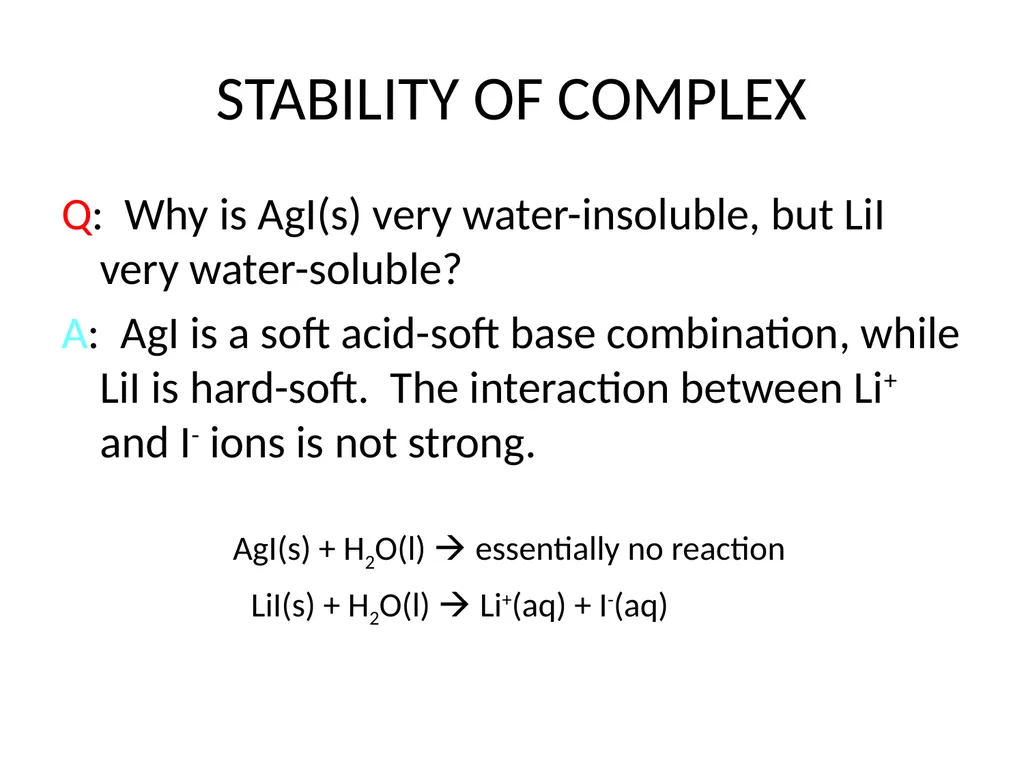
STABILITY OF COMPLEX Q: Why is AgI(s) very water-insoluble, but LiI very water-soluble?
A: AgI is a soft acid-soft base combination, while LiI is hard-soft. The interaction between Li+ and I- ions is not strong. AgI(s) + H2O(l) essentially no reaction LiI(s) + H2O(l) Li+(aq) + I-(aq)<br>
06
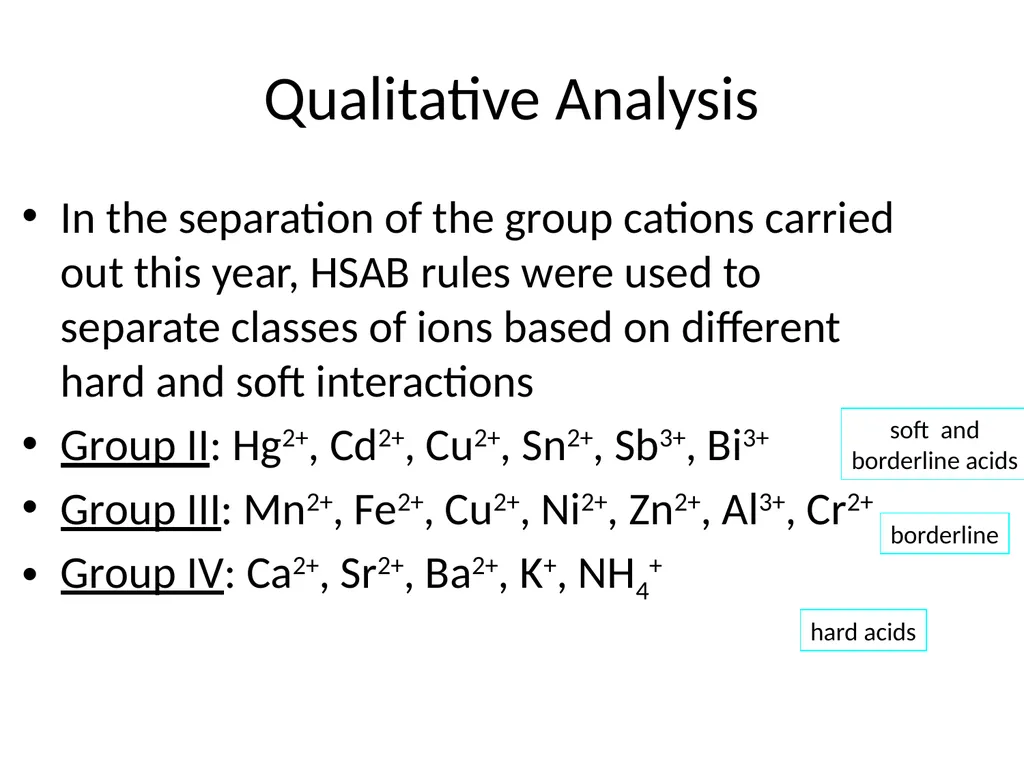
Qualitative Analysis In the separation of the group cations carried out this year, HSAB rules were used to separate classes of ions based on different hard and soft interactions
Group II: Hg2+, Cd2+, Cu2+, Sn2+, Sb3+, Bi3+
Group III: Mn2+, Fe2+, Cu2+, Ni2+, Zn2+, Al3+, Cr2+
Group IV: Ca2+, Sr2+, Ba2+, K+, NH4+ soft and
borderline acids borderline hard acids<br>
07
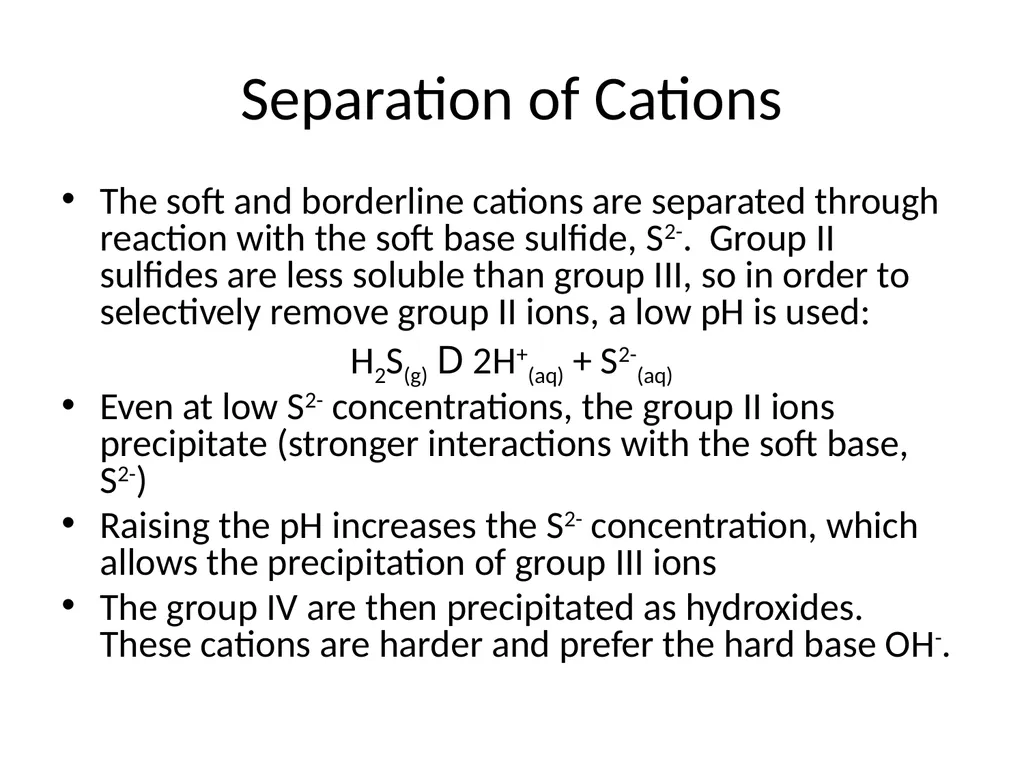
Separation of Cations The soft and borderline cations are separated through reaction with the soft base sulfide, S2-. Group II sulfides are less soluble than group III, so in order to selectively remove group II ions, a low pH is used:
H2S(g) D 2H+(aq) + S2-(aq)
Even at low S2- concentrations, the group II ions precipitate (stronger interactions with the soft base, S2-)
Raising the pH increases the S2- concentration, which allows the precipitation of group III ions
The group IV are then precipitated as hydroxides. These cations are harder and prefer the hard base OH-.<br>
08
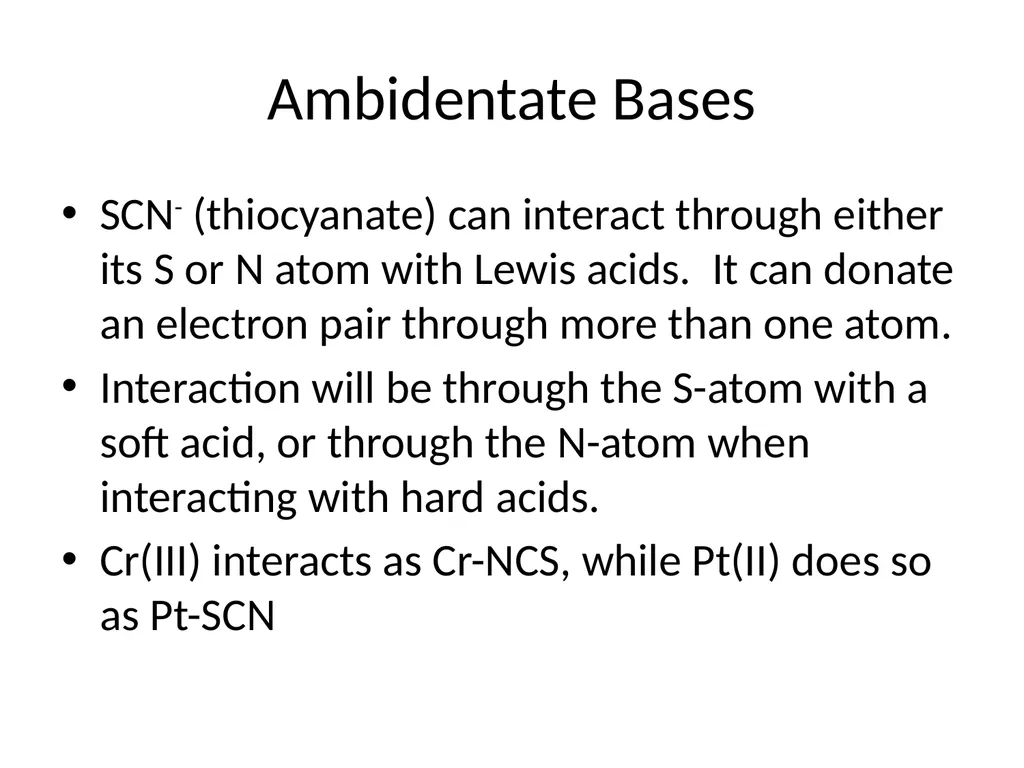
Ambidentate Bases SCN- (thiocyanate) can interact through either its S or N atom with Lewis acids. It can donate an electron pair through more than one atom.
Interaction will be through the S-atom with a soft acid, or through the N-atom when interacting with hard acids.
Cr(III) interacts as Cr-NCS, while Pt(II) does so as Pt-SCN<br>
09
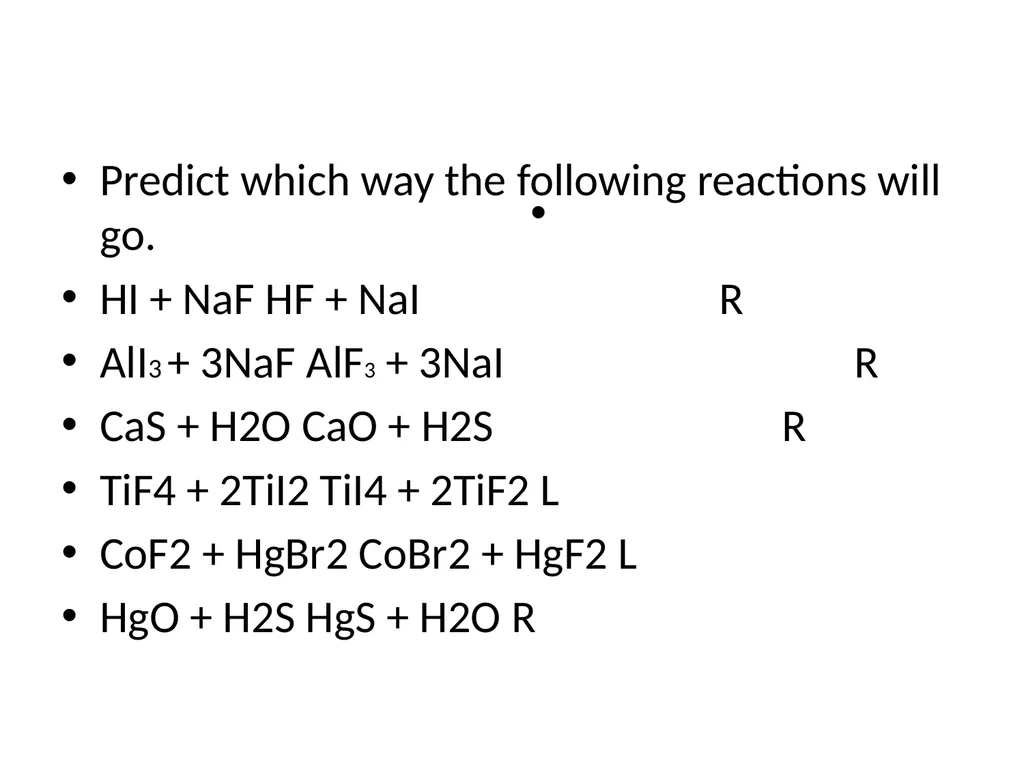
Predict which way the following reactions will go.
HI + NaF HF + NaI R
AlI3 + 3NaF AlF3 + 3NaI R
CaS + H2O CaO + H2S R
TiF4 + 2TiI2 TiI4 + 2TiF2 L
CoF2 + HgBr2 CoBr2 + HgF2 L
HgO + H2S HgS + H2O R<br>
10
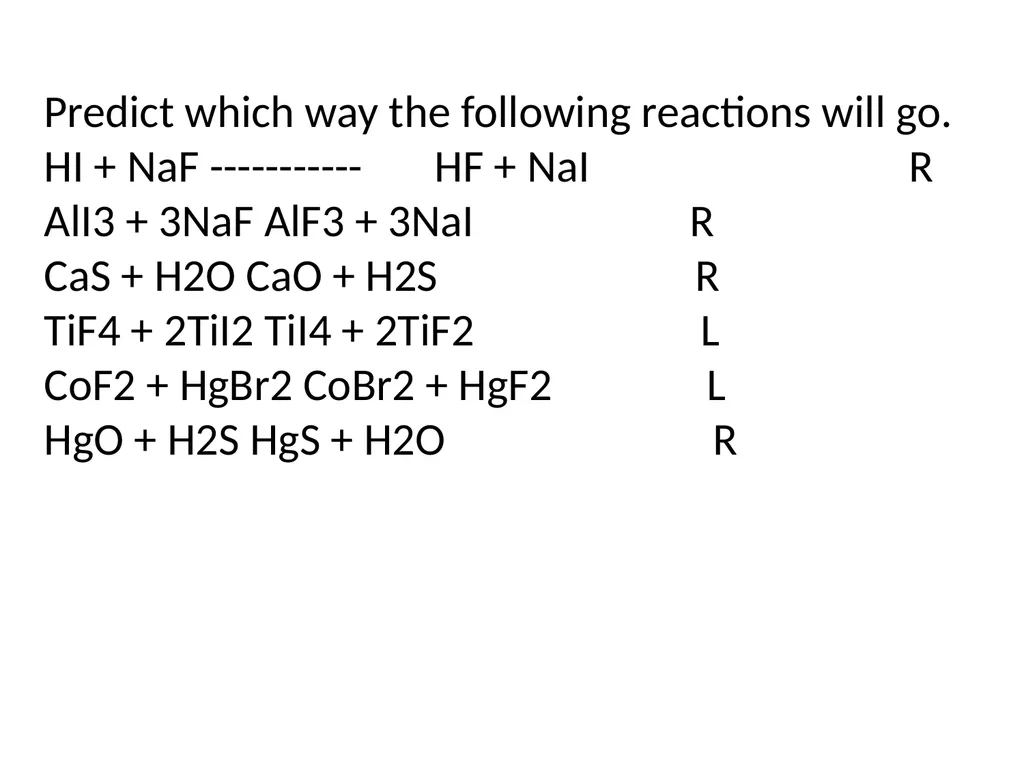
Predict which way the following reactions will go.
HI + NaF ----------- HF + NaI R
AlI3 + 3NaF AlF3 + 3NaI R
CaS + H2O CaO + H2S R
TiF4 + 2TiI2 TiI4 + 2TiF2 L
CoF2 + HgBr2 CoBr2 + HgF2 L
HgO + H2S HgS + H2O R<br>
11
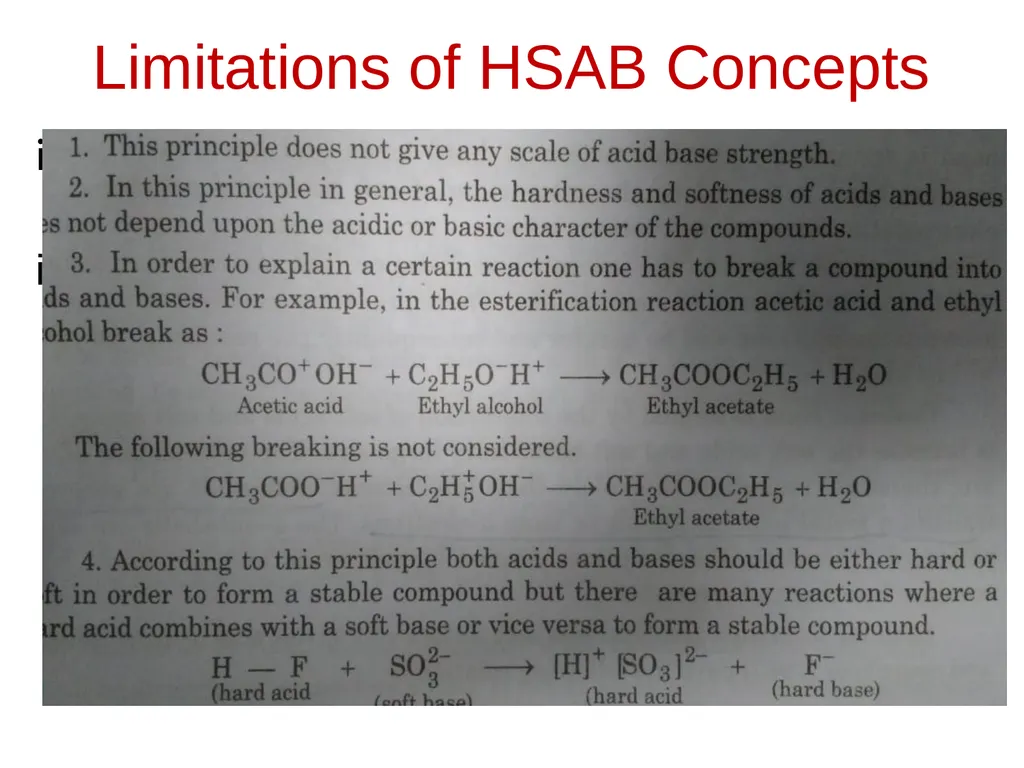
Limitations of HSAB Concepts It does not provide any scale for acids and bases strength
The hardness and softness of A & B does not depend on the acidic and basic chararacter of compounds<br>
12
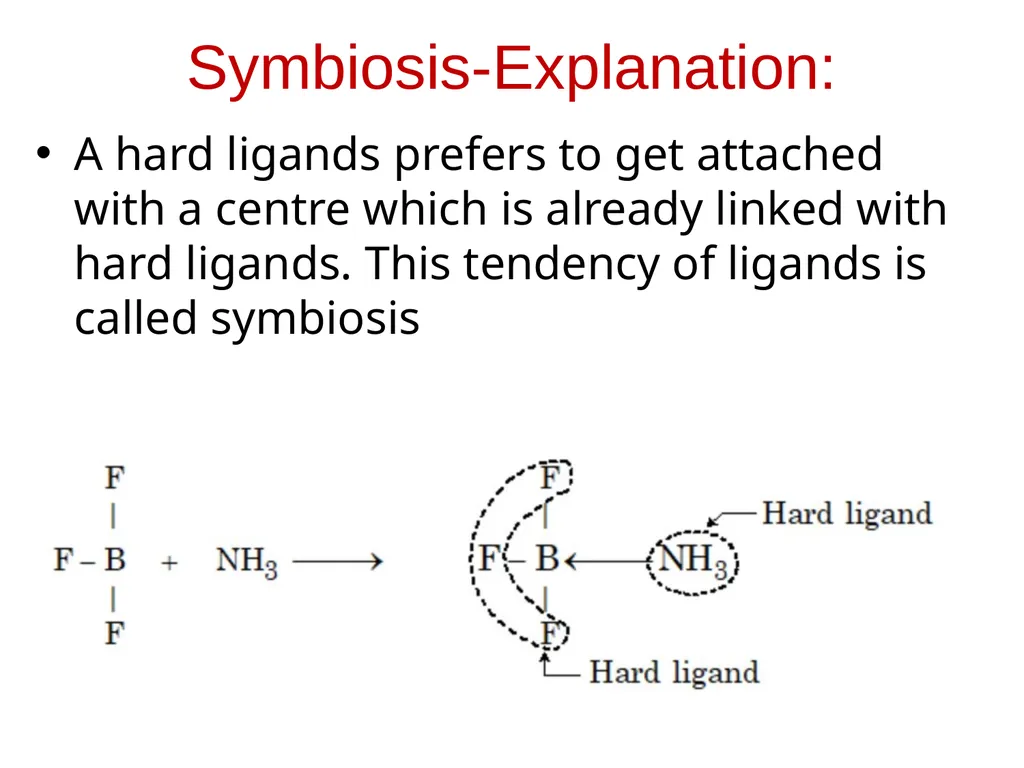
Symbiosis This biological term was adopted for chemistry by Jørgensen in 1964, who applied it to explain the process by which a hard ligand on a metal encourages the metal to receive another hard ligand rather than a soft ligand while a soft ligand on a metal encourages the metal to receive another soft ligand rather than a hard ligand.<br>
13
Symbiosis-Explanation: A hard ligands prefers to get attached with a centre which is already linked with hard ligands. This tendency of ligands is called symbiosis<br>
14
Symbiosis-Explanation: Soft ligands prefers to get attached with a centre which is already linked with soft ligands.
Formation of BH4− ion by the combination of BH3 (in which H atoms are soft ligands) and H− ion (soft ligands).<br>