HARMFUL TRADITIONAL PRACTICES PREVENTION Geneva 2019 Dr Venkatraman Chandra-Mouli DEFINITIONS Traditional cultural practices: They reflect values beliefs held by members of a community for periods often spanning generations. Some are
"HARMFUL TRADITIONAL PRACTICES PREVENTION Geneva" is the property of its rightful owner. Permission is granted to
download and print the materials on this website for personal, non-commercial use only, and to display it
on your personal computer provided you do not modify the materials and that you retain all copyright
notices contained in the materials. By downloading content from our website, you accept the terms of this
agreement.
Presentation Transcript
01
HARMFUL TRADITIONAL PRACTICES PREVENTION Geneva 2019 Dr Venkatraman Chandra-Mouli<br>
02
DEFINITIONS Traditional cultural practices: They reflect values & beliefs held by members of a community for periods often spanning generations. Some are beneficial, some have neither benefits nor harms, and some are harmful to a specific group e.g. FGM, child marriage.
Female genital mutilation (FGM): Any procedure that involves the partial or total removal of external genitalia or other injury to the female genital organs for non-medical reasons.
Child marriage: Formal marriage or informal union before the age of 18 years.<br>
03
RATIONALE 1/2 Harmful traditional problems among adolescents are an important problem: Over 200 million girls & women are estimated to be living with the effects of FGM which is predominantly performed on girls under the age of 18 years. Every year, about 12 million girls are married before the age of 18.
Harmful traditional problems among adolescents can have serious health and social consequences: FGM has no known health benefits,. It can cause immediate health consequences- hemorrhage, shock, infections and death and can cause long-term health and social consequences such as post-traumatic stress disorder and menstrual health problems. Women with type III FGM are more likely to experience problems during child birth. Babies born to children with FGM are at increased risk of neonatal complications. Child marriage is often leads to early childbearing in young girls which is associated with an increased risk of pregnancy-related mortality and morbidity and of increased risk of mortality and morbidity in babies born to a adolescent mothers. Child marriage is also associated with an increased risk of intimate partner violence. Finally, it has a negative effect on educational attainment.<br>
04
RATIONALE 2/2 Prevention of harmful traditional practice interventions has been shown to be effective: There is a growing evidence base of effective approaches as well as those which are promising but have not been shown to be effective.
Laws and policies and prevention strategies and their implementation need attention: Laws and policies forbidding the practices are in place in many countries, but that has not stopped the practices from continuing. Efforts must be stepped up to communicate the laws and policies and to support their application without exception. These efforts must be combined with efforts to mobilize families and community, empower girls, and to provide those who have experienced FGM and child marriage with the health, social and legal services they need.<br>
05
HUMAN RIGHTS OBLIGATIONS Human rights standards call for an holistic approach to the prevention and elimination of harmful practices.
States must adopt legislative measures to prohibit these practices, including providing for adequate sanctions, combined with other legal and policy measures, including social measures. These measures must include attention to the root causes of harmful practices, capacity building at all levels, and protective measures for women and children who have been victims of harmful practices.<br>
06
KEY CONCEPTS TO CONSIDER FGM and child marriage are longstanding, deep-seated traditional practices that cannot be reversed by briefly implemented single-component interventions: Efforts to prevent FGM and CM require long term and multi-level interventions.
Leaders, including health care providers, may themselves support FGM or CM: All stakeholders need to be involved in contributing to efforts to prevent FGM and CM.
Many adolescents who have undergone FGM or have been married before 18 do not have access to care and support: In addition, girls and women may delay seeking care because they are embarrassed or ashamed.<br>
07
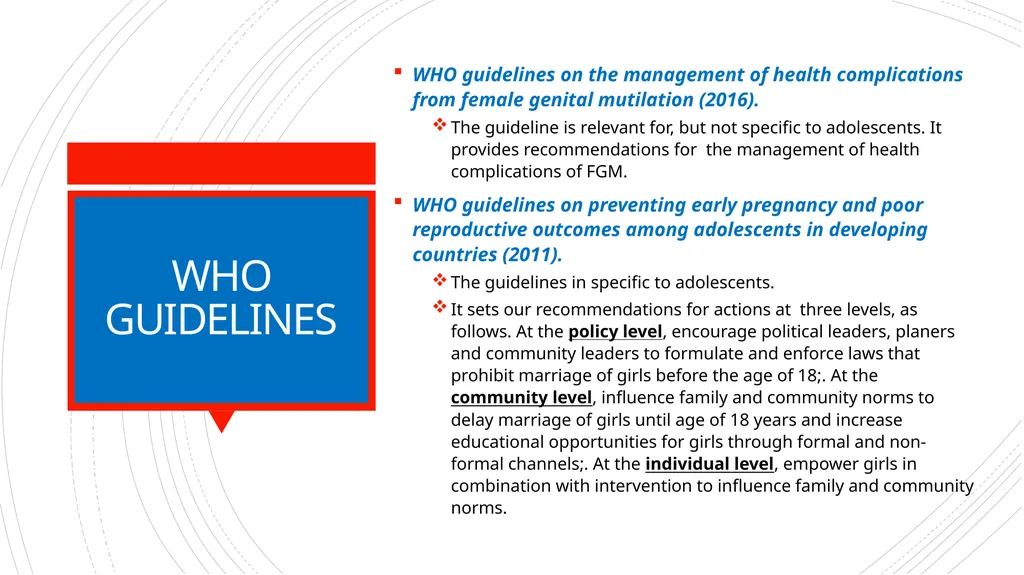
WHO GUIDELINES WHO guidelines on the management of health complications from female genital mutilation (2016).
The guideline is relevant for, but not specific to adolescents. It provides recommendations for the management of health complications of FGM.
WHO guidelines on preventing early pregnancy and poor reproductive outcomes among adolescents in developing countries (2011).
The guidelines in specific to adolescents.
It sets our recommendations for actions at three levels, as follows. At the policy level, encourage political leaders, planers and community leaders to formulate and enforce laws that prohibit marriage of girls before the age of 18;. At the community level, influence family and community norms to delay marriage of girls until age of 18 years and increase educational opportunities for girls through formal and non-formal channels;. At the individual level, empower girls in combination with intervention to influence family and community norms.<br>
08
COMPLEMENTARY DOCUMENTS TO WHO’s GUIDELINES Care of girls and women living with female genital mutilation: a clinical handbook (WHO, 2018).
Female genital mutilation: integrating the prevention and the management of the health complications into the curricula of nursing and midwifery- a teacher’s guide (WHO, 2001).
Interagency statement on eliminating female genital mutilation (WHO, 2008).
Global strategy to stop health care providers from performing female genital mutilation (WHO, 2010).
Salam RA, Faqqah A, Sajjad N, et al. Improving adolescent sexual and reproductive health: a systematic review of potential interventions. J Adolesc Health. 2016:59(4 Suppl.):S11-S28(212).
Kalamar AM, Lee-Rife S, Hindin MJ. Interventions to prevent child marriage among young people in low- and middle-income countries: a systematic review of the published and gray literature. J Adolesc Health. 2016;59 (3 Suppl.):S16-S21(213).
Ending child marriage: progress and prospects (UNICEF, 2014).
Wodon QT, Male C, Nayihouba KA, et al. Economic impacts of child marriage: global synthesis report. Washington, DC: World Bank Group; 2017 (2010).<br>