
Head Start ERSEA Training 2026-27 Eligibility
YM
Published · 103 slides · 0 views

1 / 1















Description
Head Start ERSEA Training 2026-27 Eligibility Recruitment Selection Enrollment Attendance Please Get your cell phones and lets play Please Turn off your cell phones! Eligibility What makes a child eligible for Head Start? The only true
Related Topics
Share
Embed code
Download this presentation From Below
"Head Start ERSEA Training 2026-27 Eligibility" is the property of its rightful owner. Permission is granted to download and print the materials on this website for personal, non-commercial use only, and to display it on your personal computer provided you do not modify the materials and that you retain all copyright notices contained in the materials. By downloading content from our website, you accept the terms of this agreement.
Presentation Transcript
01
Head Start ERSEA Training
2026-27<br>
2026-27<br>
02
Eligibility
Recruitment
Selection
Enrollment
Attendance<br>
03
Please
Get your cell phones and let’s play<br>
Get your cell phones and let’s play<br>
04
Please
Turn off your cell phones!<br>
Turn off your cell phones!<br>
05
Eligibility What makes a child eligible for Head Start?
The only true requirement for Head Start enrollment is that the child is at least 3 years of age on the day of enrollment, and not older than 5 years of age by August 1 of that year.<br>
The only true requirement for Head Start enrollment is that the child is at least 3 years of age on the day of enrollment, and not older than 5 years of age by August 1 of that year.<br>
06
Can a child be enrolled during the school year if they have already turned 5?
Yes, as long as he/she didn’t turn 5 before August 1 of that year. Eligibility<br>
Yes, as long as he/she didn’t turn 5 before August 1 of that year. Eligibility<br>
07
Can a child be enrolled during the school year if they did not turn 3 by August 1?
Yes, as long as they are 3 on the day you are enrolling them. Eligibility<br>
Yes, as long as they are 3 on the day you are enrolling them. Eligibility<br>
08
If the child is age eligible, then the parent must be allowed to fill out an application. Though family income is a huge factor in whether a child will receive an enrollment slot, it does not prohibit the child’s application from being placed on the waiting list. Eligibility<br>
09
Eligibility What is the main question a parent will ask you when they finish the application?
Will my child get in the program? Your answer is………....I don’t know.<br>
Will my child get in the program? Your answer is………....I don’t know.<br>
10
The enrollment application must be done INTERVIEW STYLE with the parent. In other words, you will ask the questions to the parent and record their answers. Eligibility<br>
11
Filling out the enrollment application Let’s Look At the App<br>
12
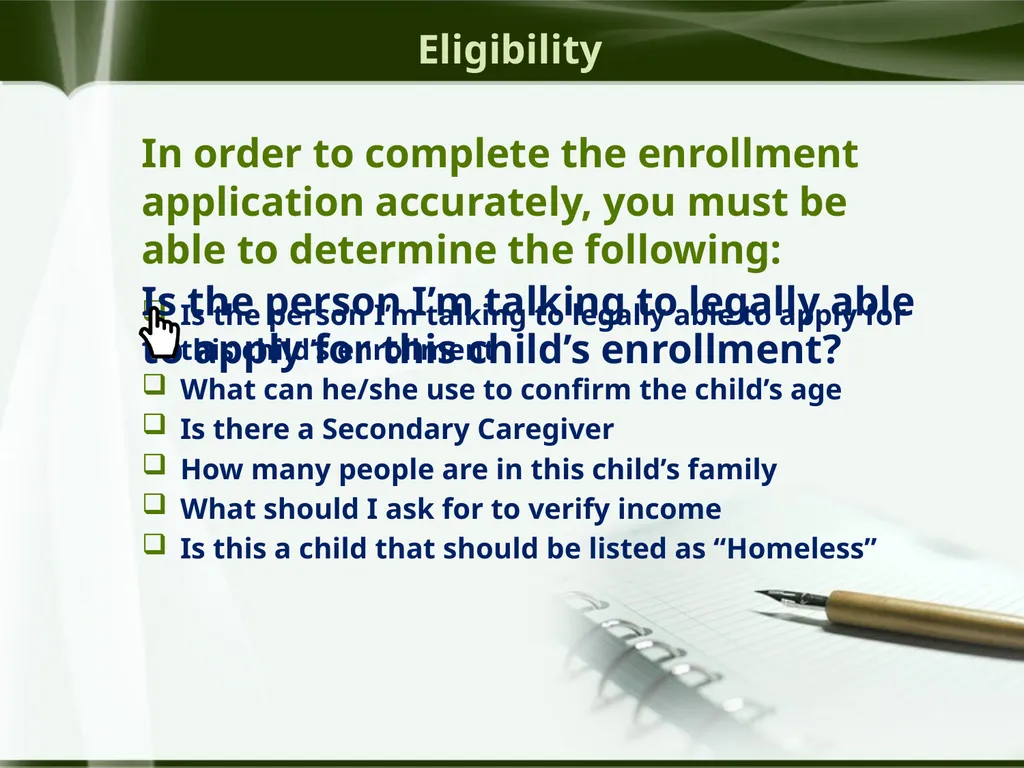
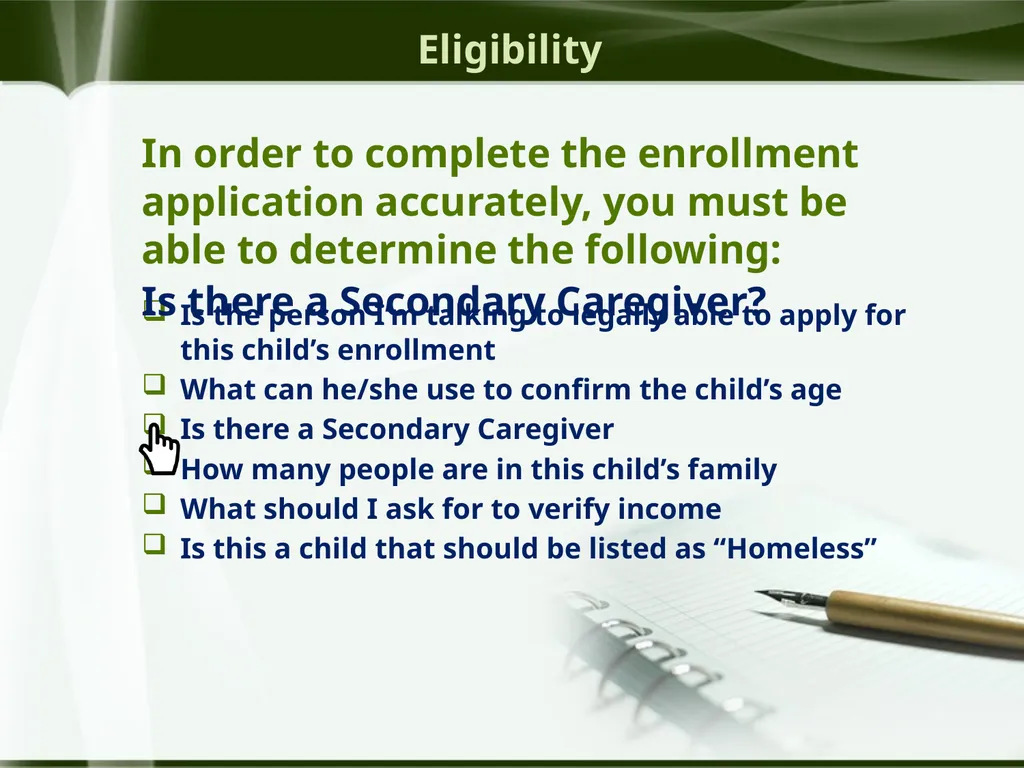
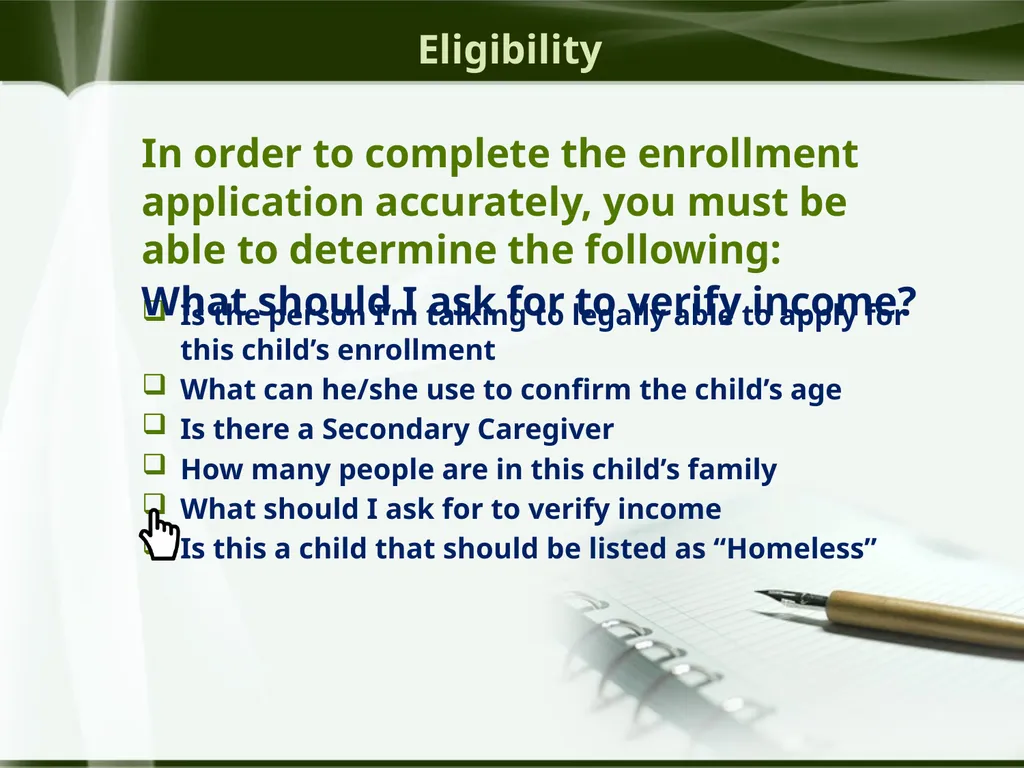
In order to complete the enrollment application accurately, you must be able to determine the following:
Is the person I’m talking to legally able to apply for this child’s enrollment
What can he/she use to confirm the child’s age
Is there a Secondary Caregiver
How many people are in this child’s family
What should I ask for to verify income
Is this a child that should be listed as “Homeless” Eligibility Is the person I’m talking to legally able to apply for this child’s enrollment?<br>
Is the person I’m talking to legally able to apply for this child’s enrollment
What can he/she use to confirm the child’s age
Is there a Secondary Caregiver
How many people are in this child’s family
What should I ask for to verify income
Is this a child that should be listed as “Homeless” Eligibility Is the person I’m talking to legally able to apply for this child’s enrollment?<br>
13
Eligibility Important Things to Remember:
The only person that can fill out an enrollment application and provide income documentation is a “custodial” parent/guardian. This includes a biological parent that has custody of the child for at least 50% of the time, or the spouse of that person (stepparent) .
Custodial Parent/Stepparent: Lives with child the majority, or at least 50% of the time.
Non-Custodial Parent/Stepparent: Lives with child less than 50% of the time.<br>
The only person that can fill out an enrollment application and provide income documentation is a “custodial” parent/guardian. This includes a biological parent that has custody of the child for at least 50% of the time, or the spouse of that person (stepparent) .
Custodial Parent/Stepparent: Lives with child the majority, or at least 50% of the time.
Non-Custodial Parent/Stepparent: Lives with child less than 50% of the time.<br>
14
Eligibility Important Things to Remember:
When you sit down to fill out an enrollment application with someone, begin the conversation by asking about their relationship to the child. If they are the biological parent and the child lives with them, you don’t need any kind of paperwork to prove this.
But if they are a guardian, foster parent, or a parent that has 50/50 custody of their child, you need proof. You can still fill out the application with them if they don’t have proof on that day, but they must bring in documentation of their parental status before the child can be put on the waiting list.<br>
When you sit down to fill out an enrollment application with someone, begin the conversation by asking about their relationship to the child. If they are the biological parent and the child lives with them, you don’t need any kind of paperwork to prove this.
But if they are a guardian, foster parent, or a parent that has 50/50 custody of their child, you need proof. You can still fill out the application with them if they don’t have proof on that day, but they must bring in documentation of their parental status before the child can be put on the waiting list.<br>
15
Eligibility Important Things to Remember:
To clarify, a stepparent can also fill out the application for the child as long as they are married to and live with the custodial parent/guardian.<br>
To clarify, a stepparent can also fill out the application for the child as long as they are married to and live with the custodial parent/guardian.<br>
16
In order to complete the enrollment application accurately, you must be able to determine the following:
Is the person I’m talking to legally able to apply for this child’s enrollment
What can he/she use to confirm the child’s age
Is there a Secondary Caregiver
How many people are in this child’s family
What should I ask for to verify income
Is this a child that should be listed as “Homeless” Eligibility What can he/she use to confirm the child’s age?<br>
Is the person I’m talking to legally able to apply for this child’s enrollment
What can he/she use to confirm the child’s age
Is there a Secondary Caregiver
How many people are in this child’s family
What should I ask for to verify income
Is this a child that should be listed as “Homeless” Eligibility What can he/she use to confirm the child’s age?<br>
17
Eligibility Important Things to Remember:
The document that you should try to get from the parent to verify the child’s age is a birth certificate. However, that is not always possible, and it is not required at the time of the application. Here are some things you could use instead:
Hospital certificate
Document or letter from another agency
Immunization card
Insurance card
And many other things
Note: The birth certificate is required in the
child’s folder soon after enrollment.<br>
The document that you should try to get from the parent to verify the child’s age is a birth certificate. However, that is not always possible, and it is not required at the time of the application. Here are some things you could use instead:
Hospital certificate
Document or letter from another agency
Immunization card
Insurance card
And many other things
Note: The birth certificate is required in the
child’s folder soon after enrollment.<br>
18
Eligibility Important Things to Remember:
Be sure to check the birth date on the document given to you by the parent to assure that the child will be between the ages of 3-4 on August 1 of that year.
Note: If the child will be 5 before August 1, do not continue with the application because he/she is not age eligible. If the child will be 3 years of age during the school year but not by August 1, you can continue to fill out the application with the parent because the child will be age eligible at some point in the school year.<br>
Be sure to check the birth date on the document given to you by the parent to assure that the child will be between the ages of 3-4 on August 1 of that year.
Note: If the child will be 5 before August 1, do not continue with the application because he/she is not age eligible. If the child will be 3 years of age during the school year but not by August 1, you can continue to fill out the application with the parent because the child will be age eligible at some point in the school year.<br>
19
In order to complete the enrollment application accurately, you must be able to determine the following:
Is the person I’m talking to legally able to apply for this child’s enrollment
What can he/she use to confirm the child’s age
Is there a Secondary Caregiver
How many people are in this child’s family
What should I ask for to verify income
Is this a child that should be listed as “Homeless” Eligibility Is there a Secondary Caregiver?<br>
Is the person I’m talking to legally able to apply for this child’s enrollment
What can he/she use to confirm the child’s age
Is there a Secondary Caregiver
How many people are in this child’s family
What should I ask for to verify income
Is this a child that should be listed as “Homeless” Eligibility Is there a Secondary Caregiver?<br>
20
Eligibility Important Things to Remember:
If the biological parent that lives with the child is married and living with their spouse, their spouse must be listed as the Secondary Caregiver.
The only exception would be if two biological parents had 50/50 custody. In that case, one biological parent would be listed as Primary and the other would be listed as Secondary, even though they don’t live together.<br>
If the biological parent that lives with the child is married and living with their spouse, their spouse must be listed as the Secondary Caregiver.
The only exception would be if two biological parents had 50/50 custody. In that case, one biological parent would be listed as Primary and the other would be listed as Secondary, even though they don’t live together.<br>
21
Eligibility Dual Custody:
When two parents share equal 50/50 custody of their child, we refer to that as “Dual Custody”. That means the child spends an equal amount of time living with each parent. It used to be a rare designation for children of divorced couples but is now very common in KY. So how do you count the “Number in Family” and obtain income from a Dual Custody family?<br>
When two parents share equal 50/50 custody of their child, we refer to that as “Dual Custody”. That means the child spends an equal amount of time living with each parent. It used to be a rare designation for children of divorced couples but is now very common in KY. So how do you count the “Number in Family” and obtain income from a Dual Custody family?<br>
22
Eligibility Dual Custody:
The first thing to know is that if it is Dual Custody, the parent filling out the application would be listed as the Primary Caregiver and the other parent must be listed as the Secondary Caregiver.<br>
The first thing to know is that if it is Dual Custody, the parent filling out the application would be listed as the Primary Caregiver and the other parent must be listed as the Secondary Caregiver.<br>
23
Eligibility Dual Custody:
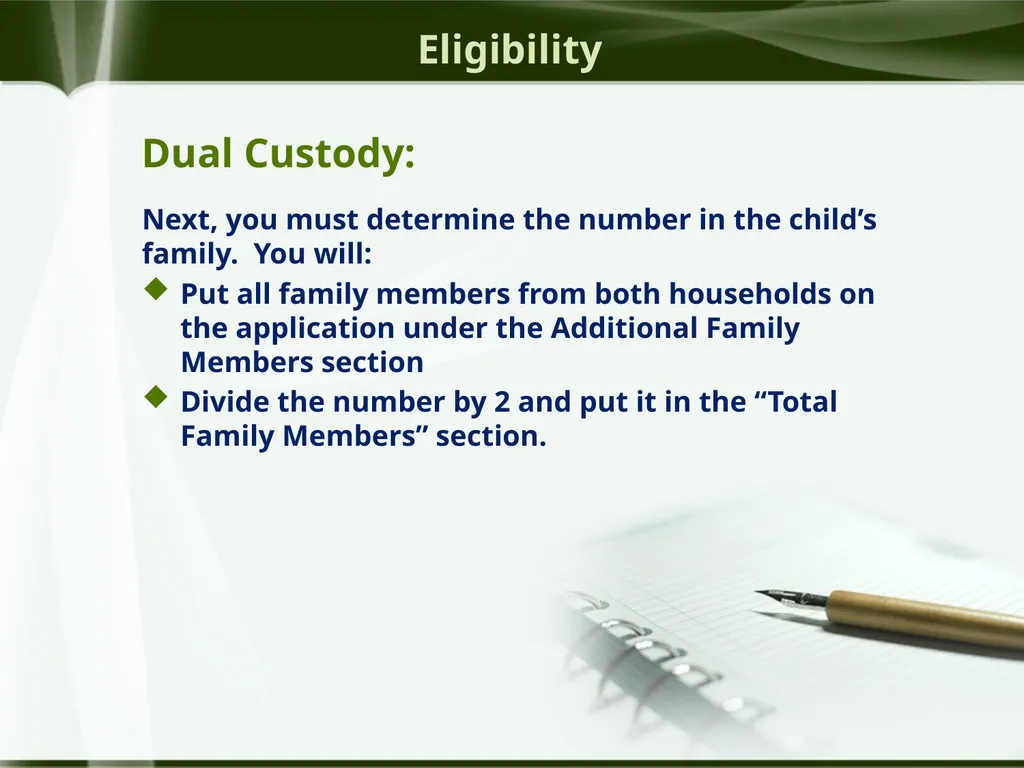
Next, you must determine the number in the child’s family. You will:
Put all family members from both households on the application under the Additional Family Members section
Divide the number by 2 and put it in the “Total Family Members” section.<br>
Next, you must determine the number in the child’s family. You will:
Put all family members from both households on the application under the Additional Family Members section
Divide the number by 2 and put it in the “Total Family Members” section.<br>
24
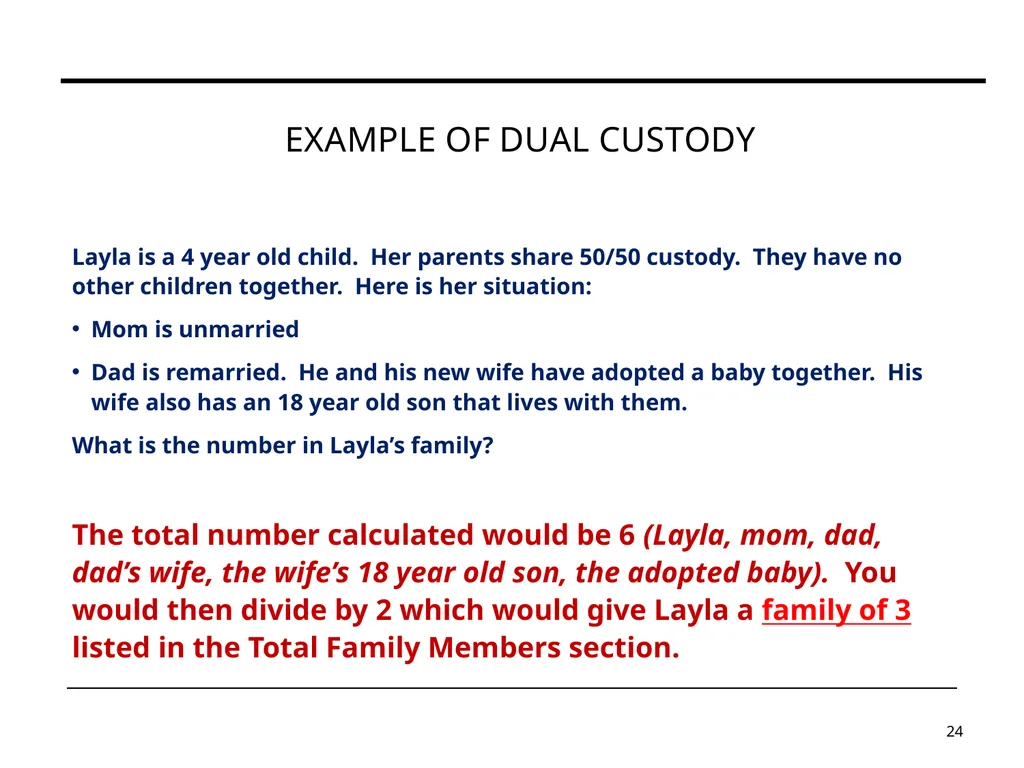
Example of dual custody Layla is a 4 year old child. Her parents share 50/50 custody. They have no other children together. Here is her situation:
Mom is unmarried
Dad is remarried. He and his new wife have adopted a baby together. His wife also has an 18 year old son that lives with them.
What is the number in Layla’s family?
The total number calculated would be 6 (Layla, mom, dad, dad’s wife, the wife’s 18 year old son, the adopted baby). You would then divide by 2 which would give Layla a family of 3 listed in the Total Family Members section. 24<br>
Mom is unmarried
Dad is remarried. He and his new wife have adopted a baby together. His wife also has an 18 year old son that lives with them.
What is the number in Layla’s family?
The total number calculated would be 6 (Layla, mom, dad, dad’s wife, the wife’s 18 year old son, the adopted baby). You would then divide by 2 which would give Layla a family of 3 listed in the Total Family Members section. 24<br>
25
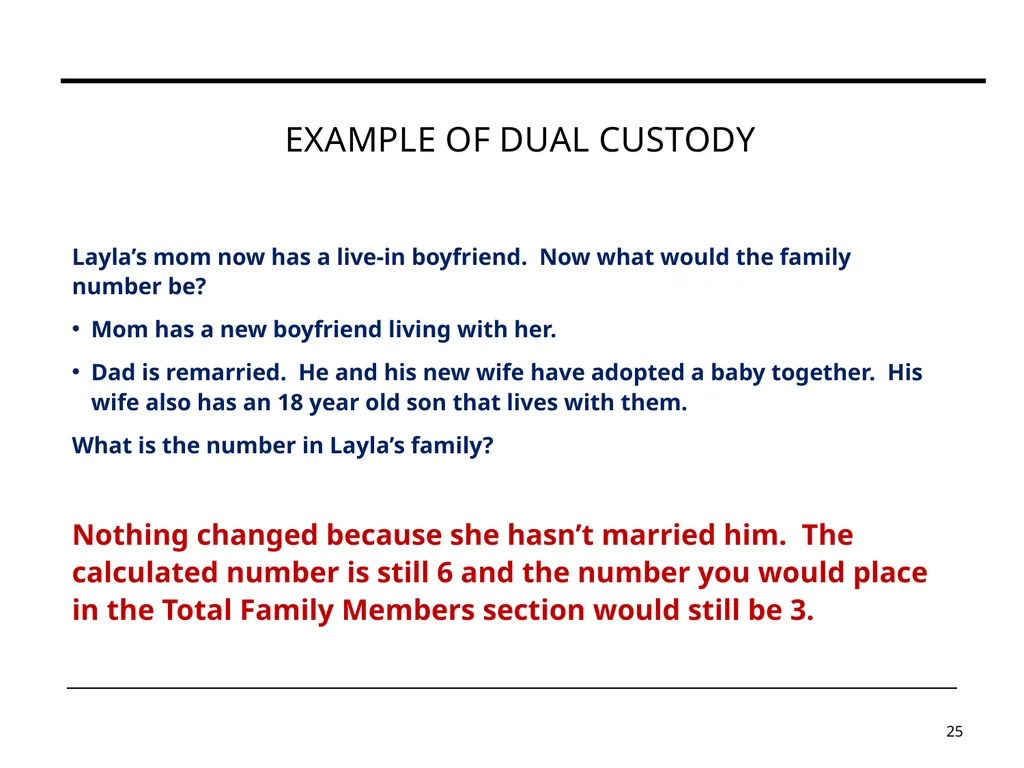
Example of dual custody Layla’s mom now has a live-in boyfriend. Now what would the family number be?
Mom has a new boyfriend living with her.
Dad is remarried. He and his new wife have adopted a baby together. His wife also has an 18 year old son that lives with them.
What is the number in Layla’s family?
Nothing changed because she hasn’t married him. The calculated number is still 6 and the number you would place in the Total Family Members section would still be 3. 25<br>
Mom has a new boyfriend living with her.
Dad is remarried. He and his new wife have adopted a baby together. His wife also has an 18 year old son that lives with them.
What is the number in Layla’s family?
Nothing changed because she hasn’t married him. The calculated number is still 6 and the number you would place in the Total Family Members section would still be 3. 25<br>
26
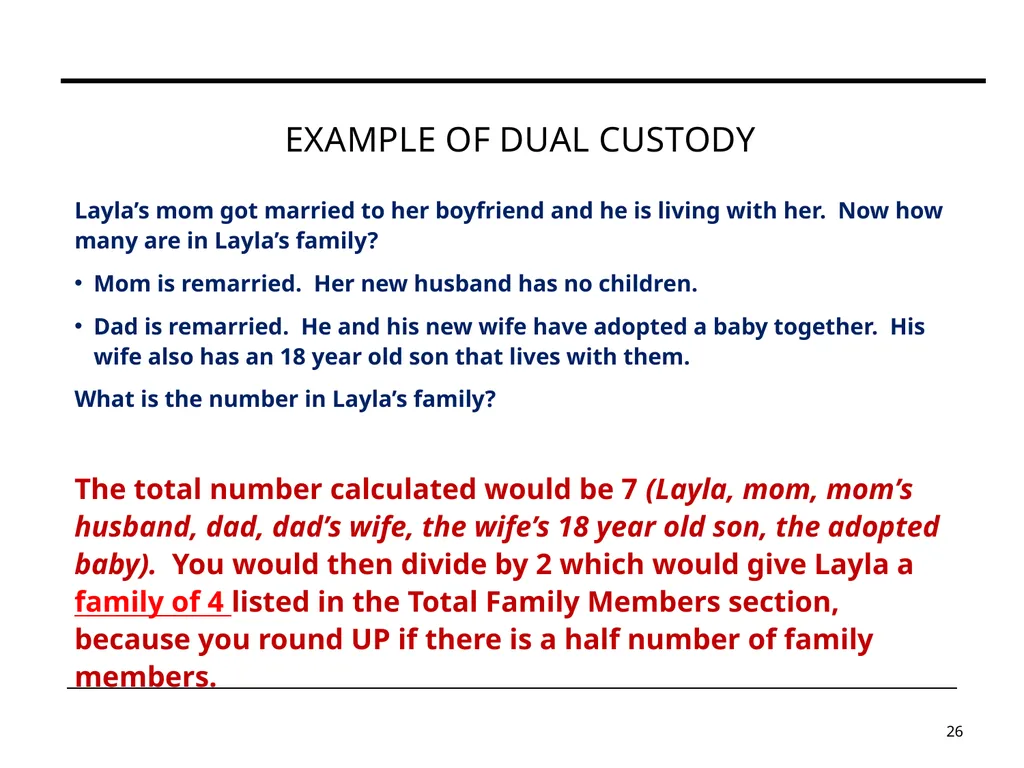
Example of dual custody Layla’s mom got married to her boyfriend and he is living with her. Now how many are in Layla’s family?
Mom is remarried. Her new husband has no children.
Dad is remarried. He and his new wife have adopted a baby together. His wife also has an 18 year old son that lives with them.
What is the number in Layla’s family?
The total number calculated would be 7 (Layla, mom, mom’s husband, dad, dad’s wife, the wife’s 18 year old son, the adopted baby). You would then divide by 2 which would give Layla a family of 4 listed in the Total Family Members section, because you round UP if there is a half number of family members. 26<br>
Mom is remarried. Her new husband has no children.
Dad is remarried. He and his new wife have adopted a baby together. His wife also has an 18 year old son that lives with them.
What is the number in Layla’s family?
The total number calculated would be 7 (Layla, mom, mom’s husband, dad, dad’s wife, the wife’s 18 year old son, the adopted baby). You would then divide by 2 which would give Layla a family of 4 listed in the Total Family Members section, because you round UP if there is a half number of family members. 26<br>
27
Example of dual custody We’re still gonna use Layla’s family in the next scenario. Now that we have the correct number in the family, we need to decide how to obtain income. 27<br>
28
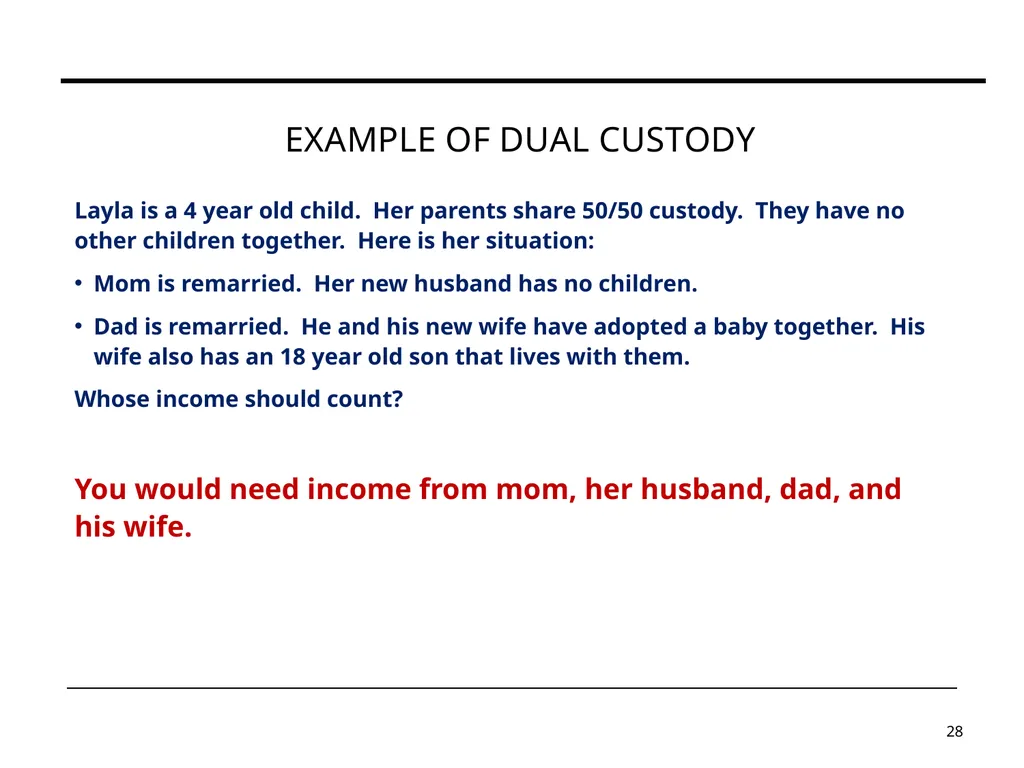
Example of dual custody Layla is a 4 year old child. Her parents share 50/50 custody. They have no other children together. Here is her situation:
Mom is remarried. Her new husband has no children.
Dad is remarried. He and his new wife have adopted a baby together. His wife also has an 18 year old son that lives with them.
Whose income should count?
You would need income from mom, her husband, dad, and his wife. 28<br>
Mom is remarried. Her new husband has no children.
Dad is remarried. He and his new wife have adopted a baby together. His wife also has an 18 year old son that lives with them.
Whose income should count?
You would need income from mom, her husband, dad, and his wife. 28<br>
29
Example of dual custody Now that we know who to obtain income from in Layla’s family, how do we count it? 29 Let’s take a look at what her family income will be……………<br>
30
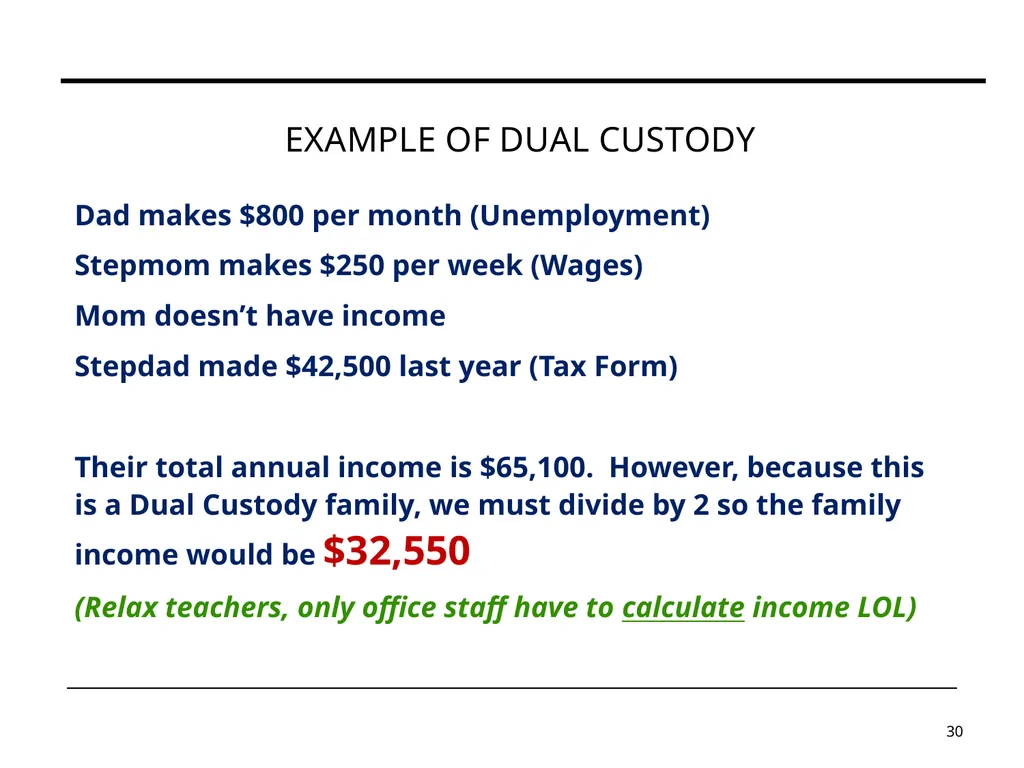
Example of dual custody Dad makes $800 per month (Unemployment)
Stepmom makes $250 per week (Wages)
Mom doesn’t have income
Stepdad made $42,500 last year (Tax Form)
Their total annual income is $65,100. However, because this is a Dual Custody family, we must divide by 2 so the family income would be $32,550
(Relax teachers, only office staff have to calculate income LOL) 30<br>
Stepmom makes $250 per week (Wages)
Mom doesn’t have income
Stepdad made $42,500 last year (Tax Form)
Their total annual income is $65,100. However, because this is a Dual Custody family, we must divide by 2 so the family income would be $32,550
(Relax teachers, only office staff have to calculate income LOL) 30<br>
31
Example of dual custody Ready for some more headaches related to Dual Custody? 31<br>
32
Example of dual custody We have now determined the income and family members for Layla. However, there are some things that could affect whether we need to gather income from everyone. For example, what do we do if Layla’s step brother draws SSI?
So let’s look at situations that affect what income documents we need to obtain…… 32<br>
So let’s look at situations that affect what income documents we need to obtain…… 32<br>
33
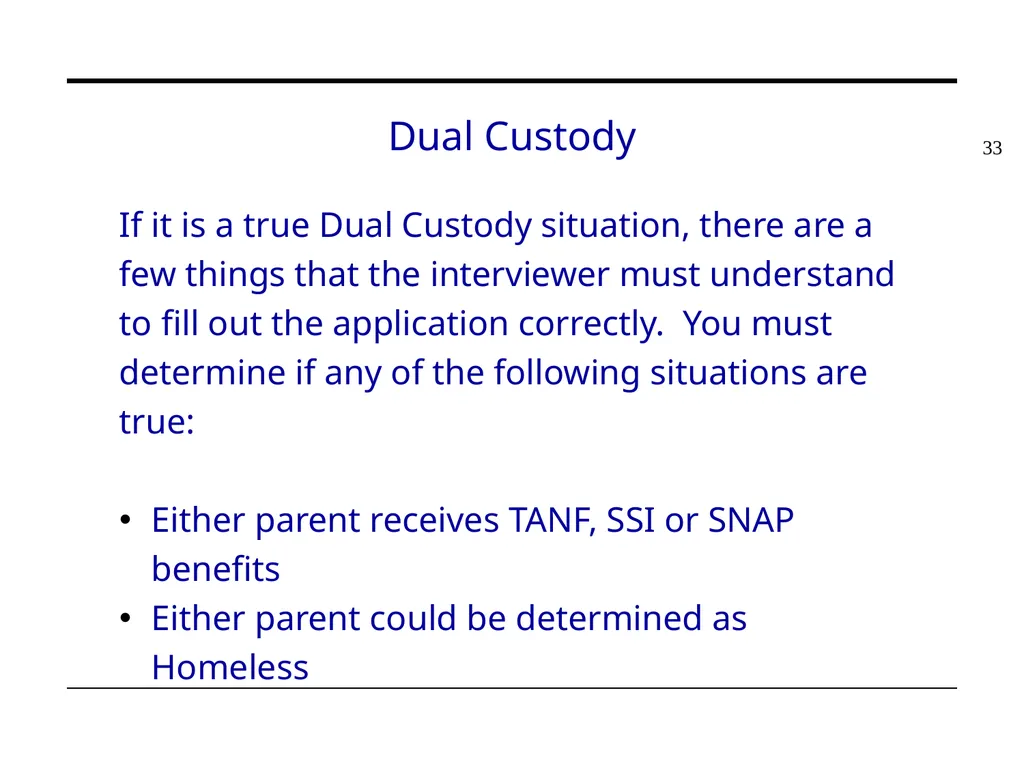
33 Dual Custody If it is a true Dual Custody situation, there are a few things that the interviewer must understand to fill out the application correctly. You must determine if any of the following situations are true:
Either parent receives TANF, SSI or SNAP benefits
Either parent could be determined as Homeless<br>
Either parent receives TANF, SSI or SNAP benefits
Either parent could be determined as Homeless<br>
34
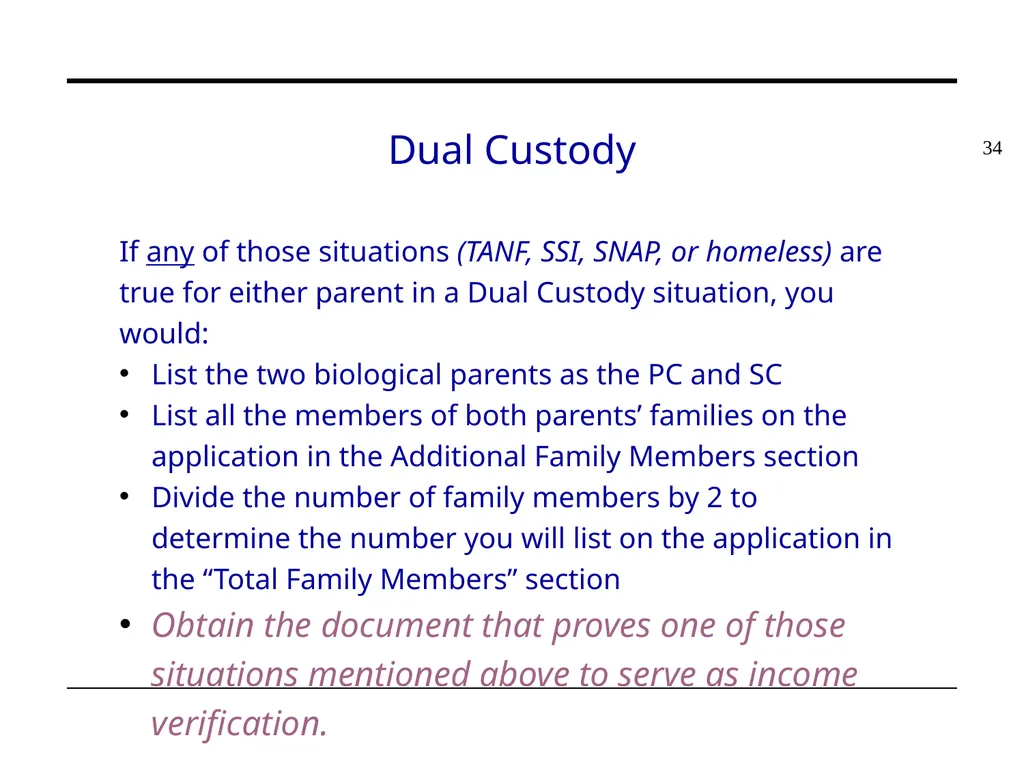
34 Dual Custody If any of those situations (TANF, SSI, SNAP, or homeless) are true for either parent in a Dual Custody situation, you would:
List the two biological parents as the PC and SC
List all the members of both parents’ families on the application in the Additional Family Members section
Divide the number of family members by 2 to determine the number you will list on the application in the “Total Family Members” section
Obtain the document that proves one of those situations mentioned above to serve as income verification.<br>
List the two biological parents as the PC and SC
List all the members of both parents’ families on the application in the Additional Family Members section
Divide the number of family members by 2 to determine the number you will list on the application in the “Total Family Members” section
Obtain the document that proves one of those situations mentioned above to serve as income verification.<br>
35
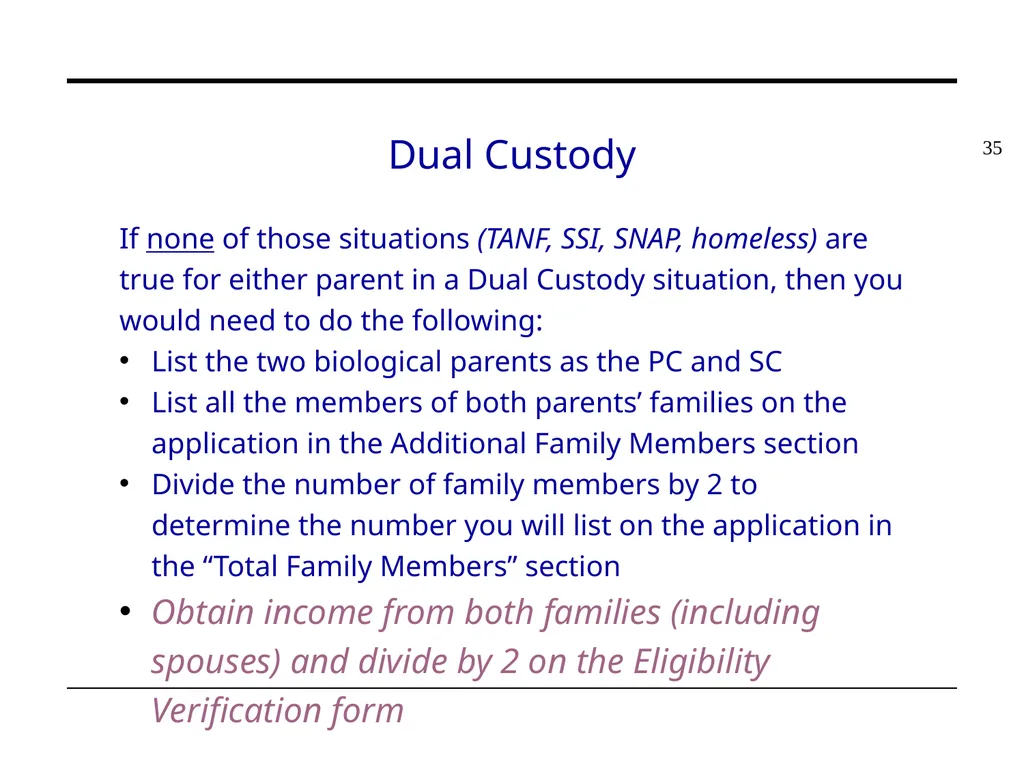
35 Dual Custody If none of those situations (TANF, SSI, SNAP, homeless) are true for either parent in a Dual Custody situation, then you would need to do the following:
List the two biological parents as the PC and SC
List all the members of both parents’ families on the application in the Additional Family Members section
Divide the number of family members by 2 to determine the number you will list on the application in the “Total Family Members” section
Obtain income from both families (including spouses) and divide by 2 on the Eligibility Verification form<br>
List the two biological parents as the PC and SC
List all the members of both parents’ families on the application in the Additional Family Members section
Divide the number of family members by 2 to determine the number you will list on the application in the “Total Family Members” section
Obtain income from both families (including spouses) and divide by 2 on the Eligibility Verification form<br>
36
Moving on, let’s stop thinking about Dual Custody for the following slides 36<br>
37
Eligibility Important Things to Remember:
If a biological parent has a live-in boyfriend/girlfriend, that person cannot be listed as the Secondary Caregiver on the application. However, there is one exception to the rule.
If both biological parents live together with the child but are not married, they MUST be listed as the primary and secondary caregiver.<br>
If a biological parent has a live-in boyfriend/girlfriend, that person cannot be listed as the Secondary Caregiver on the application. However, there is one exception to the rule.
If both biological parents live together with the child but are not married, they MUST be listed as the primary and secondary caregiver.<br>
38
Eligibility Important Things to Remember:
Is it required that the parent filling out the application be listed as the primary caregiver?
No. It really doesn’t matter which parent is listed as the PC or SC because they both can make decisions for the child. If the parent that is filling out the application has a preference, then list the PC and SC the way she wants them.<br>
Is it required that the parent filling out the application be listed as the primary caregiver?
No. It really doesn’t matter which parent is listed as the PC or SC because they both can make decisions for the child. If the parent that is filling out the application has a preference, then list the PC and SC the way she wants them.<br>
39
Eligibility Important Things to Remember:
Let’s say the biological parents are divorced and living separately. The mom has primary custody and the dad has the child every other weekend. When filling out the application, the mom tells you she wants the dad to be listed as the secondary caregiver. Is that allowable?
No. If the dad is not living with the custodial parent (mom), then he cannot be listed as the secondary caregiver on the application. Remember, we are talking about a situation that is NOT Dual Custody.<br>
Let’s say the biological parents are divorced and living separately. The mom has primary custody and the dad has the child every other weekend. When filling out the application, the mom tells you she wants the dad to be listed as the secondary caregiver. Is that allowable?
No. If the dad is not living with the custodial parent (mom), then he cannot be listed as the secondary caregiver on the application. Remember, we are talking about a situation that is NOT Dual Custody.<br>
40
In order to complete the enrollment application accurately, you must be able to determine the following:
Is the person I’m talking to legally able to apply for this child’s enrollment
What can he/she use to confirm the child’s age
Is there a Secondary Caregiver
How many people are in this child’s family
What should I ask for to verify income
Is this a child that should be listed as “Homeless” Eligibility How many people are in the child’s family?<br>
Is the person I’m talking to legally able to apply for this child’s enrollment
What can he/she use to confirm the child’s age
Is there a Secondary Caregiver
How many people are in this child’s family
What should I ask for to verify income
Is this a child that should be listed as “Homeless” Eligibility How many people are in the child’s family?<br>
41
Eligibility Important Things to Remember:
One of the most important things that the interviewer must understand when filling out an enrollment application with a parent is how to determine the number of people in a child’s FAMILY. The interviewer must use the Head Start definition of “Family” in order to determine who those people are.
Even if the interviewer doesn’t actually fill out the Eligibility Verification form that determines a child’s enrollment, the staff person that does fill out the EV form is completely dependent upon the interviewer accurately listing the family members on the enrollment application.<br>
One of the most important things that the interviewer must understand when filling out an enrollment application with a parent is how to determine the number of people in a child’s FAMILY. The interviewer must use the Head Start definition of “Family” in order to determine who those people are.
Even if the interviewer doesn’t actually fill out the Eligibility Verification form that determines a child’s enrollment, the staff person that does fill out the EV form is completely dependent upon the interviewer accurately listing the family members on the enrollment application.<br>
42
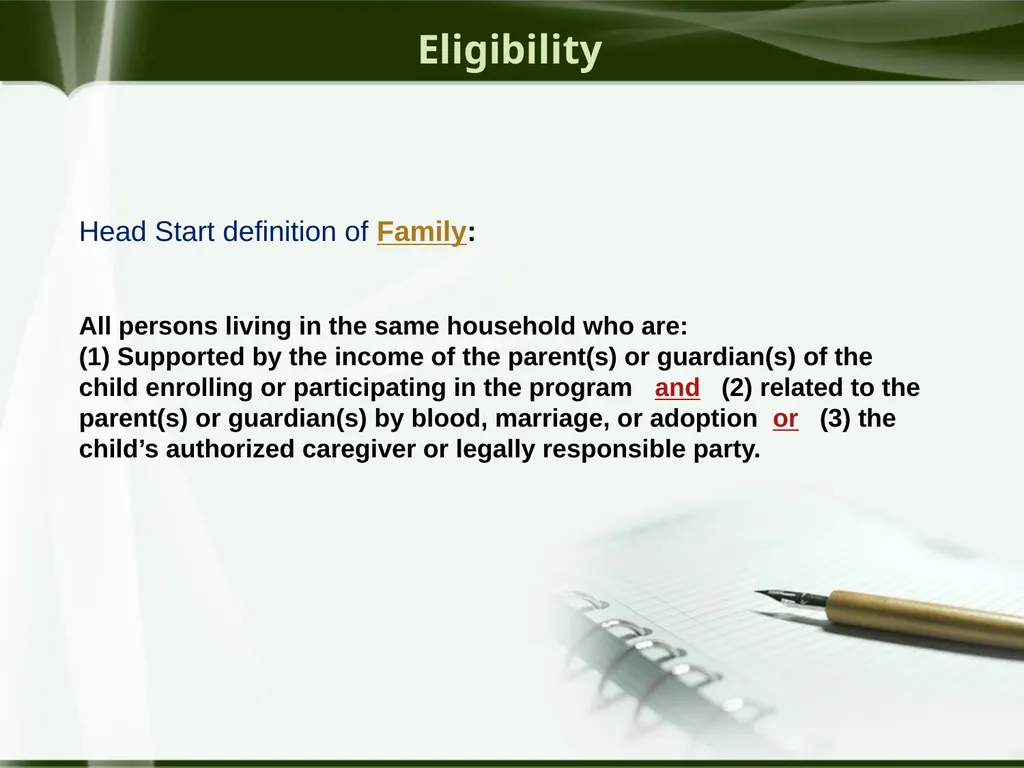
Eligibility Head Start definition of Family:
All persons living in the same household who are:
(1) Supported by the income of the parent(s) or guardian(s) of the child enrolling or participating in the program and (2) related to the parent(s) or guardian(s) by blood, marriage, or adoption or (3) the child’s authorized caregiver or legally responsible party.<br>
All persons living in the same household who are:
(1) Supported by the income of the parent(s) or guardian(s) of the child enrolling or participating in the program and (2) related to the parent(s) or guardian(s) by blood, marriage, or adoption or (3) the child’s authorized caregiver or legally responsible party.<br>
43
In groups, we will now review some scenarios you might encounter when determining FAMILY members 43<br>
44
Scenarios for Determining Family Size Allison and John have two kids: 3 year old Chris and 2 year old Sam. Allison also has another child, Grayson (14 years old), from a previous marriage that lives with them. John comes in to fill out an application for 3 year old Chris. How many are in the family? There are 5 in the family. 44<br>
45
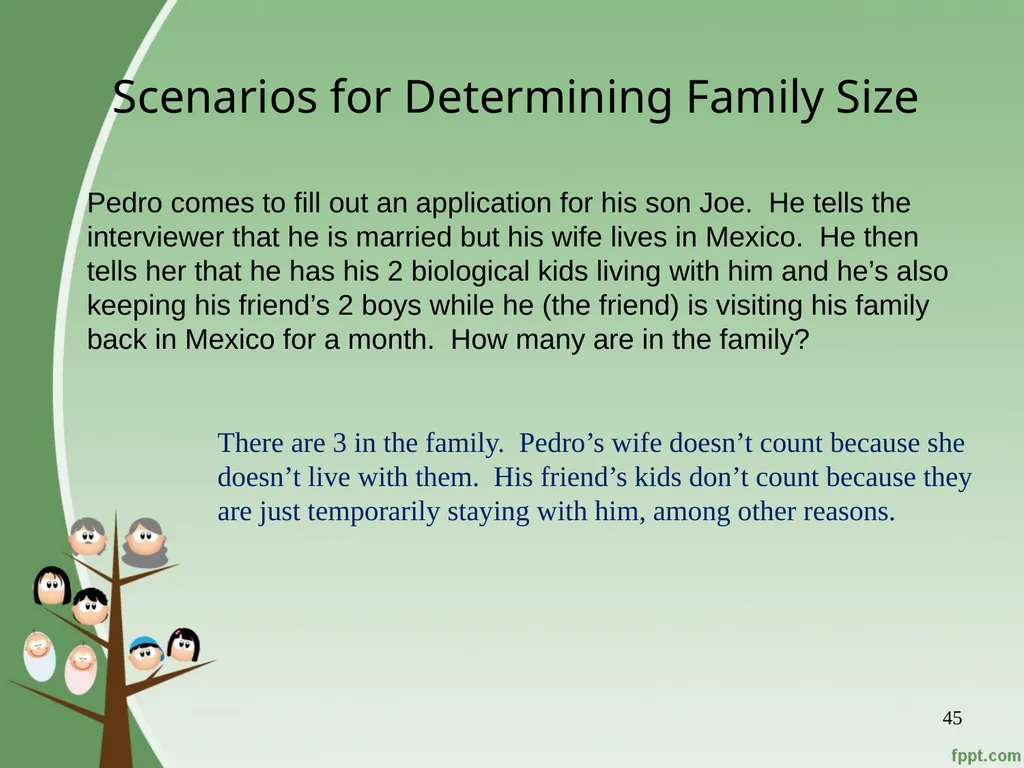
Scenarios for Determining Family Size Pedro comes to fill out an application for his son Joe. He tells the interviewer that he is married but his wife lives in Mexico. He then tells her that he has his 2 biological kids living with him and he’s also keeping his friend’s 2 boys while he (the friend) is visiting his family back in Mexico for a month. How many are in the family? There are 3 in the family. Pedro’s wife doesn’t count because she doesn’t live with them. His friend’s kids don’t count because they are just temporarily staying with him, among other reasons. 45<br>
46
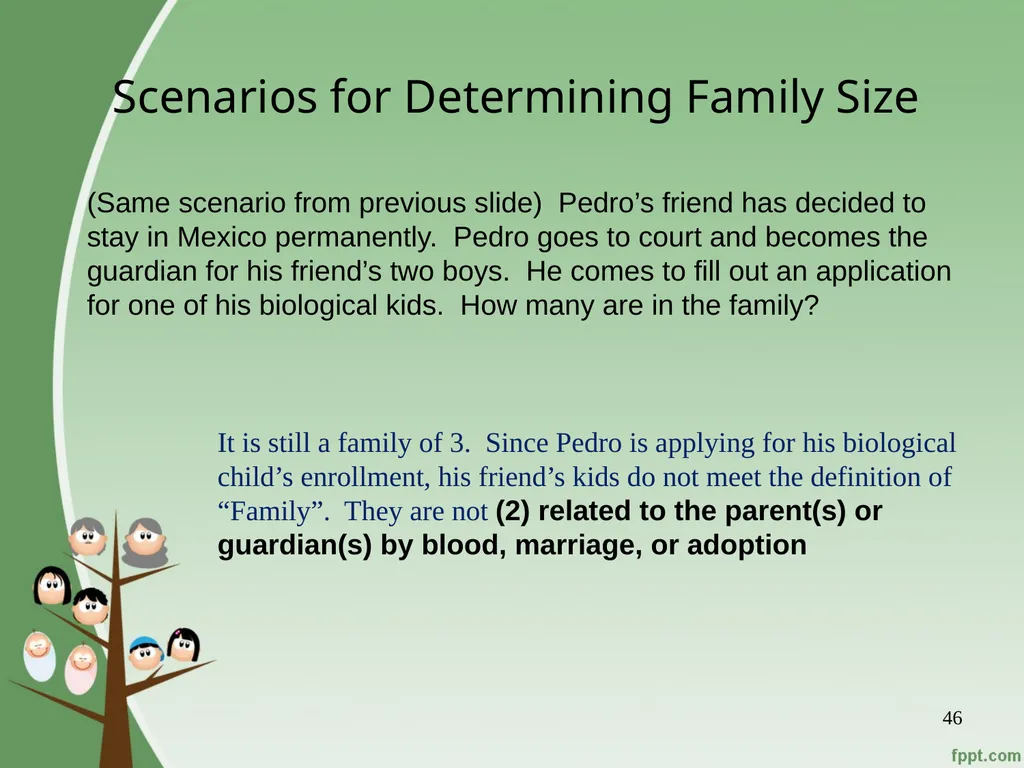
Scenarios for Determining Family Size (Same scenario from previous slide) Pedro’s friend has decided to stay in Mexico permanently. Pedro goes to court and becomes the guardian for his friend’s two boys. He comes to fill out an application for one of his biological kids. How many are in the family? It is still a family of 3. Since Pedro is applying for his biological child’s enrollment, his friend’s kids do not meet the definition of “Family”. They are not (2) related to the parent(s) or guardian(s) by blood, marriage, or adoption 46<br>
47
Scenarios for Determining Family Size Jeff comes to fill out an application for his son Ethan. He tells the interviewer that Ethan lives with him on the weekends and lives with his ex-wife (Ethan’s mom) during the week. Jeff and his ex-wife live within 1 mile of each other. How many are in the family? It would be a family of 2 (Ethan and his mom), but Jeff would not be part of the family and could not fill out the application because he is not the custodial parent. 47<br>
48
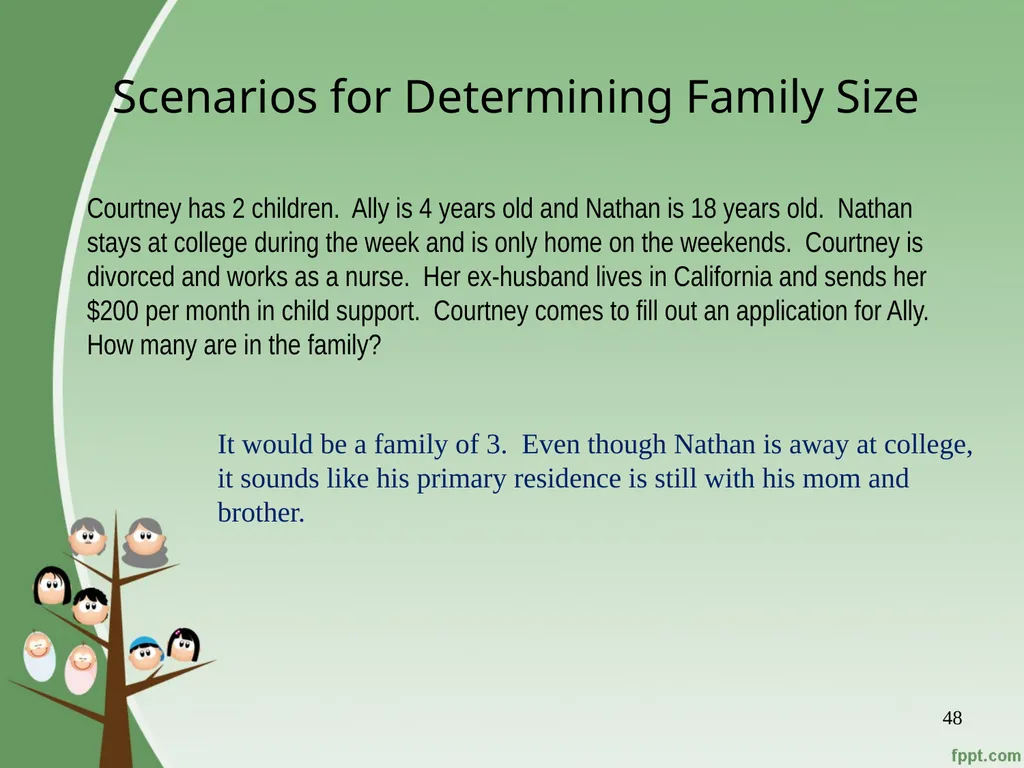
Scenarios for Determining Family Size It would be a family of 3. Even though Nathan is away at college, it sounds like his primary residence is still with his mom and brother. Courtney has 2 children. Ally is 4 years old and Nathan is 18 years old. Nathan stays at college during the week and is only home on the weekends. Courtney is divorced and works as a nurse. Her ex-husband lives in California and sends her $200 per month in child support. Courtney comes to fill out an application for Ally. How many are in the family? 48<br>
49
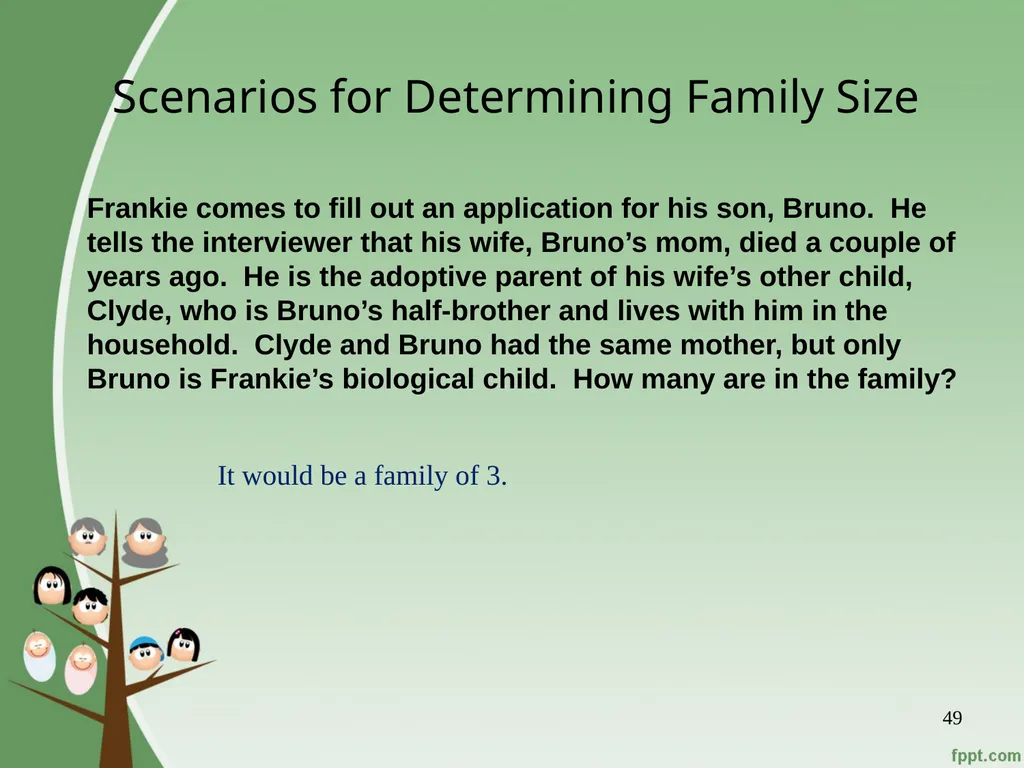
Scenarios for Determining Family Size It would be a family of 3. Frankie comes to fill out an application for his son, Bruno. He tells the interviewer that his wife, Bruno’s mom, died a couple of years ago. He is the adoptive parent of his wife’s other child, Clyde, who is Bruno’s half-brother and lives with him in the household. Clyde and Bruno had the same mother, but only Bruno is Frankie’s biological child. How many are in the family? 49<br>
50
Scenarios for Determining Family Size It would be a family of 2. Tina is 19 years old, has never worked at a job, and still lives at home with her mom and dad. She has a 3 year old daughter named Sidney. She comes to fill out an application today for Sidney. She tells the interviewer that her mom and dad pay for everything for her and Sidney including their clothes, food, etc. How many are in the family? 50<br>
51
Scenarios for Determining Family Size It would be a family of 5. Since the grandparents are “supported by the income of the parent (Gina)” and they are “related to the parent by blood, marriage, or adoption,” this means they are counted in the family for the enrolling child. If Gina’s income was not supporting them, they would not be counted. Gina comes to fill out an application for her 3 year old daughter. Gina and her 2 kids live with Gina’s parents. The house belongs to her parents, but Gina works at a job and pays all of the bills including the electric, water, etc. for the entire family. How many are in the family? 51<br>
52
Scenarios for Determining Family Size It would be a family of 1. A foster child is always a family of 1. They do not count in someone else’s family, and the other members of the household do not count in their family number. John and Mary have 5 kids living with them. They have 1 foster child, 2 biological children, 1 adopted child, and a 17 year old friend of the family that had nowhere else to go so they have allowed him to live with them for the past 6 months. They are his legal guardians. They come to fill out an application for their foster child. How many are in the family? 52<br>
53
Scenarios for Determining Family Size It would be a family of 5 (John, Mary, 2 biological kids, and 1 adopted kid). The foster child does not count in another child’s family. The 17 year old friend of the family does not meet the definition of “Family”. (Same scenario as before) John and Mary have 5 kids living with them. They have 1 foster child, 2 biological children, 1 adopted child, and a 17 year old friend of the family that had nowhere else to go so they have allowed him to live with them for the past 6 months. They are his legal guardians. They come to fill out an application for their biological child. How many are in the family? 53<br>
54
In order to complete the enrollment application accurately, you must be able to determine the following:
Is the person I’m talking to legally able to apply for this child’s enrollment
What can he/she use to confirm the child’s age
Is there a Secondary Caregiver
How many people are in this child’s family
What should I ask for to verify income
Is this a child that should be listed as “Homeless” Eligibility What should I ask for to verify income?<br>
Is the person I’m talking to legally able to apply for this child’s enrollment
What can he/she use to confirm the child’s age
Is there a Secondary Caregiver
How many people are in this child’s family
What should I ask for to verify income
Is this a child that should be listed as “Homeless” Eligibility What should I ask for to verify income?<br>
55
Eligibility Important Things to Remember:
As with determining family members, verifying income can be very complicated. There are a lot of different kinds of documents that you may be given by a parent to show their income, so you need to make sure they are giving you something that can be used by the people in your office that complete the Eligibility Verification form.
Note: Regardless of how many people are in the child’s family, you only obtain income documentation for the Primary and Secondary Caregivers (unless its Dual Custody).<br>
As with determining family members, verifying income can be very complicated. There are a lot of different kinds of documents that you may be given by a parent to show their income, so you need to make sure they are giving you something that can be used by the people in your office that complete the Eligibility Verification form.
Note: Regardless of how many people are in the child’s family, you only obtain income documentation for the Primary and Secondary Caregivers (unless its Dual Custody).<br>
56
Eligibility Important Things to Remember:
When asking the parent to provide you with income documentation, you must know what does/doesn’t count toward the family income or can be used to verify their income. Let’s look at a list and you tell me which item you would need to accept from a parent as income …………….<br>
When asking the parent to provide you with income documentation, you must know what does/doesn’t count toward the family income or can be used to verify their income. Let’s look at a list and you tell me which item you would need to accept from a parent as income …………….<br>
57
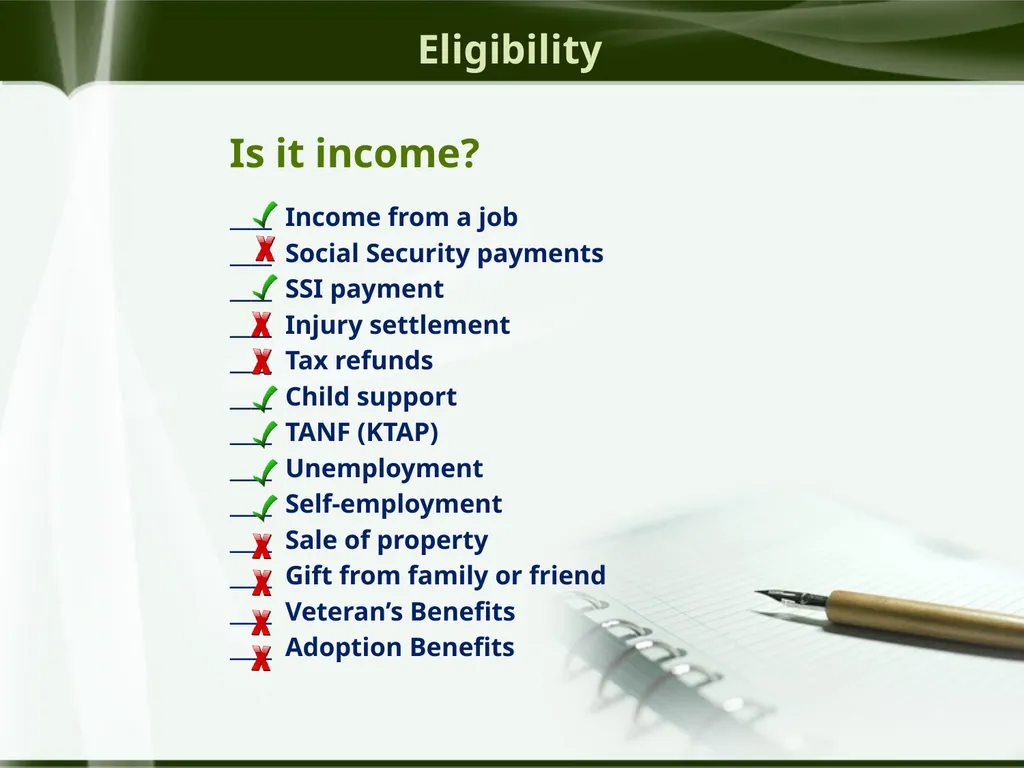
Eligibility Is it income?
____ Income from a job
____ Social Security payments
____ SSI payment
____ Injury settlement
____ Tax refunds
____ Child support
____ TANF (KTAP)
____ Unemployment
____ Self-employment
____ Sale of property
____ Gift from family or friend
____ Veteran’s Benefits
____ Adoption Benefits<br>
____ Income from a job
____ Social Security payments
____ SSI payment
____ Injury settlement
____ Tax refunds
____ Child support
____ TANF (KTAP)
____ Unemployment
____ Self-employment
____ Sale of property
____ Gift from family or friend
____ Veteran’s Benefits
____ Adoption Benefits<br>
58
Eligibility Income Documents
So now that we know what counts as income, what should we ask for?
In order to be certain that you are obtaining documentation from a family that truly represents their income, you must have a conversation with them to determine what you need.
For example, if you ask a single parent about her job and she tells you that she has worked at Walmart for the past 2 years, ask if she can give you a copy of her W-2 from the previous calendar year. That would be the easiest form of documentation.<br>
So now that we know what counts as income, what should we ask for?
In order to be certain that you are obtaining documentation from a family that truly represents their income, you must have a conversation with them to determine what you need.
For example, if you ask a single parent about her job and she tells you that she has worked at Walmart for the past 2 years, ask if she can give you a copy of her W-2 from the previous calendar year. That would be the easiest form of documentation.<br>
59
Eligibility Income Documents
But determining income is not always as simple as a parent handing you a W-2. That’s why you must understand what to ask for to represent their true income.
As a rule, you can always start the income conversation by asking if they can bring you a W-2 or other tax form from the previous calendar year. They may agree to do that, but ask a few questions to see if that previous calendar year income is the best thing to accept.<br>
But determining income is not always as simple as a parent handing you a W-2. That’s why you must understand what to ask for to represent their true income.
As a rule, you can always start the income conversation by asking if they can bring you a W-2 or other tax form from the previous calendar year. They may agree to do that, but ask a few questions to see if that previous calendar year income is the best thing to accept.<br>
60
Eligibility Income Documents
Here’s an example of when you wouldn’t want to accept a W-2:
Mom tells you that her husband worked for a construction company for 6 years making $20 per hour but the company closed in October of last year. Today is March 1 and her husband still hasn’t found another job. She says she can provide last year’s tax information. However, if you accept her tax form, will it really show the family’s true financial situation at this time? No it won’t. But if she can provide you with his unemployment documents for a recent 1 month period, that should be what you use to verify their income.<br>
Here’s an example of when you wouldn’t want to accept a W-2:
Mom tells you that her husband worked for a construction company for 6 years making $20 per hour but the company closed in October of last year. Today is March 1 and her husband still hasn’t found another job. She says she can provide last year’s tax information. However, if you accept her tax form, will it really show the family’s true financial situation at this time? No it won’t. But if she can provide you with his unemployment documents for a recent 1 month period, that should be what you use to verify their income.<br>
61
Eligibility Income Documents
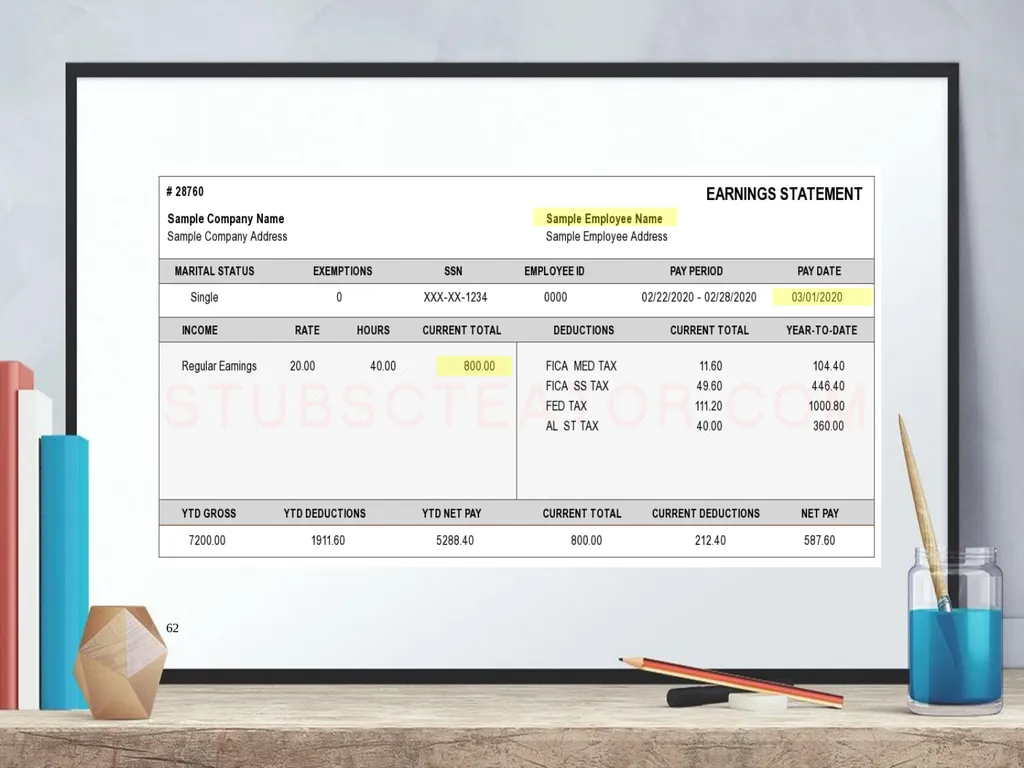
Income must be obtained for a full, consecutive 1 month period if the parent is presenting pay stubs. The ending period on the check stub cannot be more than 30 days prior to the day you are accepting it.
Note: You cannot use a letter/statement from a 3rd party, such as Community Based Services, to verify a family’s income
The next slide gives an example of what a check stub would look like<br>
Income must be obtained for a full, consecutive 1 month period if the parent is presenting pay stubs. The ending period on the check stub cannot be more than 30 days prior to the day you are accepting it.
Note: You cannot use a letter/statement from a 3rd party, such as Community Based Services, to verify a family’s income
The next slide gives an example of what a check stub would look like<br>
62
Determining Income 62<br>
63
Eligibility Income Documents
But what if a parent cannot provide last year’s tax information, pay stubs, or any other document that verifies their income?
For instance, if a person mows grass for a living and receives cash for payment, they wouldn’t have a document to prove their income. So what should the interviewer ask for?<br>
But what if a parent cannot provide last year’s tax information, pay stubs, or any other document that verifies their income?
For instance, if a person mows grass for a living and receives cash for payment, they wouldn’t have a document to prove their income. So what should the interviewer ask for?<br>
64
Eligibility Income Documents
When a parent has income that can’t be proved with a document, you could accept a written statement from either the employer OR the parent that shows the amount they receive. The statement must show an amount, a time period, and a date. For example, the statement could look like this…………………<br>
When a parent has income that can’t be proved with a document, you could accept a written statement from either the employer OR the parent that shows the amount they receive. The statement must show an amount, a time period, and a date. For example, the statement could look like this…………………<br>
65
I make $200 per month mowing grass for my neighbors.
Walter White
3/1/26 Note: I want to clarify that it would be very rare that you would need to accept this because Walter should be receiving SNAP. 65<br>
Walter White
3/1/26 Note: I want to clarify that it would be very rare that you would need to accept this because Walter should be receiving SNAP. 65<br>
66
Eligibility Income Documents
What should I do in a situation when the parent says they don’t have any income?
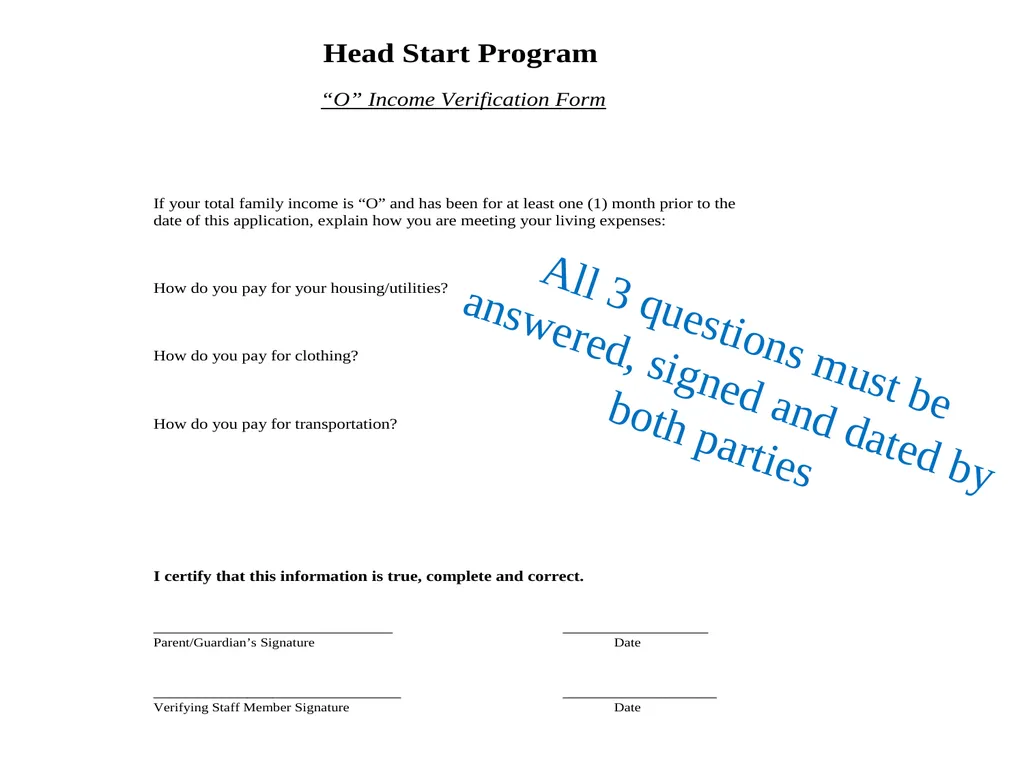
After having a conversation with the parent, if you feel that he/she truly doesn’t have an income based on the information you have learned in the previous slides of this presentation, you will need to fill out a “0” income form that describes this situation. It looks like this………………….<br>
What should I do in a situation when the parent says they don’t have any income?
After having a conversation with the parent, if you feel that he/she truly doesn’t have an income based on the information you have learned in the previous slides of this presentation, you will need to fill out a “0” income form that describes this situation. It looks like this………………….<br>
67
All 3 questions must be answered, signed and dated by both parties 67<br>
68
Again, I want to point out that it would be extremely rare that a family has no income, and also doesn’t receive SNAP, SSI, or TANF. But here is one example of how that could be the case and they would be considered 0 Income………….. If a family was receiving Social Security benefits, Veterans benefits, or Adoption benefits, none of those are considered income. It’s possible that the family could be living on those type of benefits and not qualify for SNAP. If that were the case, you would have them fill out the “0 Income Form” and list those benefits in the sections that explains how they are supporting their family. 68<br>
69
What are Veterans Benefits
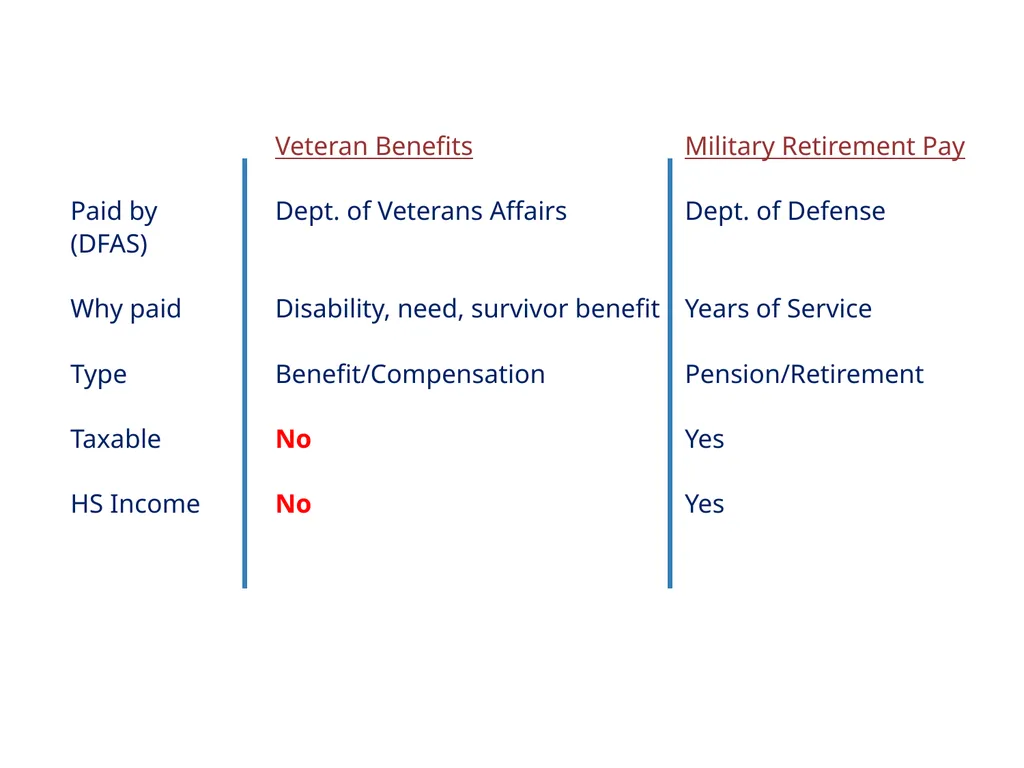
If you have a family that receives Veterans Benefits, that is not counted as income. The confusion for us is that Veterans Benefits do not include things like regular military pay or retired military pay. Those things DO count as income. Confusing, right? So here is a chart to help us understand the difference…………..<br>
If you have a family that receives Veterans Benefits, that is not counted as income. The confusion for us is that Veterans Benefits do not include things like regular military pay or retired military pay. Those things DO count as income. Confusing, right? So here is a chart to help us understand the difference…………..<br>
70
Veteran Benefits Military Retirement Pay
Paid by Dept. of Veterans Affairs Dept. of Defense (DFAS)
Why paid Disability, need, survivor benefit Years of Service
Type Benefit/Compensation Pension/Retirement
Taxable No Yes
HS Income No Yes 70<br>
Paid by Dept. of Veterans Affairs Dept. of Defense (DFAS)
Why paid Disability, need, survivor benefit Years of Service
Type Benefit/Compensation Pension/Retirement
Taxable No Yes
HS Income No Yes 70<br>
71
Important Things to Remember:
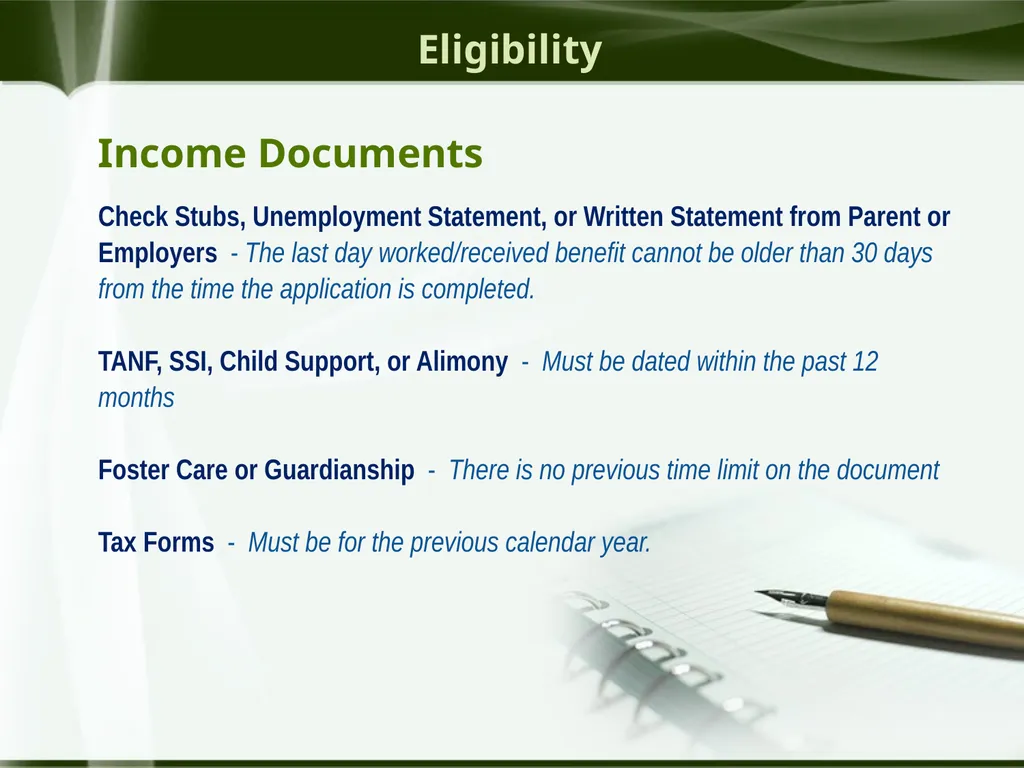
When accepting income documentation, be sure to look at the date on the document. Here is a timeline that each kind of income documentation must meet…………………….<br>
When accepting income documentation, be sure to look at the date on the document. Here is a timeline that each kind of income documentation must meet…………………….<br>
72
Eligibility Income Documents
Check Stubs, Unemployment Statement, or Written Statement from Parent or Employers - The last day worked/received benefit cannot be older than 30 days from the time the application is completed.
TANF, SSI, Child Support, or Alimony - Must be dated within the past 12 months
Foster Care or Guardianship - There is no previous time limit on the document
Tax Forms - Must be for the previous calendar year.<br>
Check Stubs, Unemployment Statement, or Written Statement from Parent or Employers - The last day worked/received benefit cannot be older than 30 days from the time the application is completed.
TANF, SSI, Child Support, or Alimony - Must be dated within the past 12 months
Foster Care or Guardianship - There is no previous time limit on the document
Tax Forms - Must be for the previous calendar year.<br>
73
Eligibility Income Documents
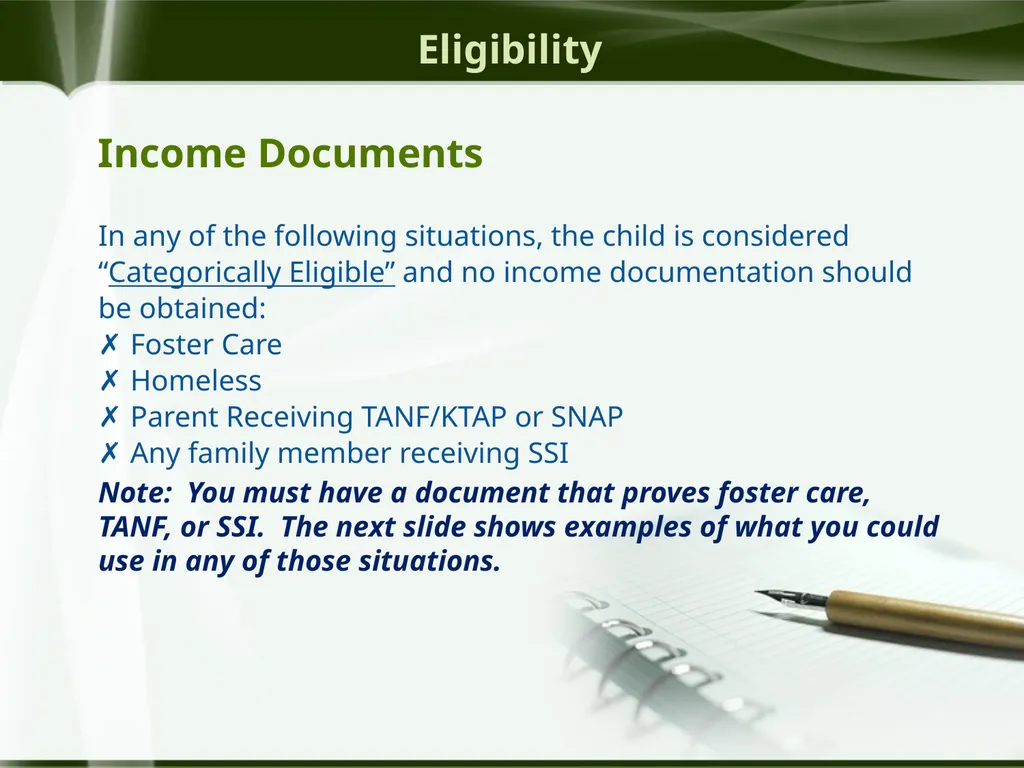
In any of the following situations, the child is considered “Categorically Eligible” and no income documentation should be obtained:
Foster Care
Homeless
Parent Receiving TANF/KTAP or SNAP
Any family member receiving SSI
Note: You must have a document that proves foster care, TANF, or SSI. The next slide shows examples of what you could use in any of those situations.<br>
In any of the following situations, the child is considered “Categorically Eligible” and no income documentation should be obtained:
Foster Care
Homeless
Parent Receiving TANF/KTAP or SNAP
Any family member receiving SSI
Note: You must have a document that proves foster care, TANF, or SSI. The next slide shows examples of what you could use in any of those situations.<br>
74
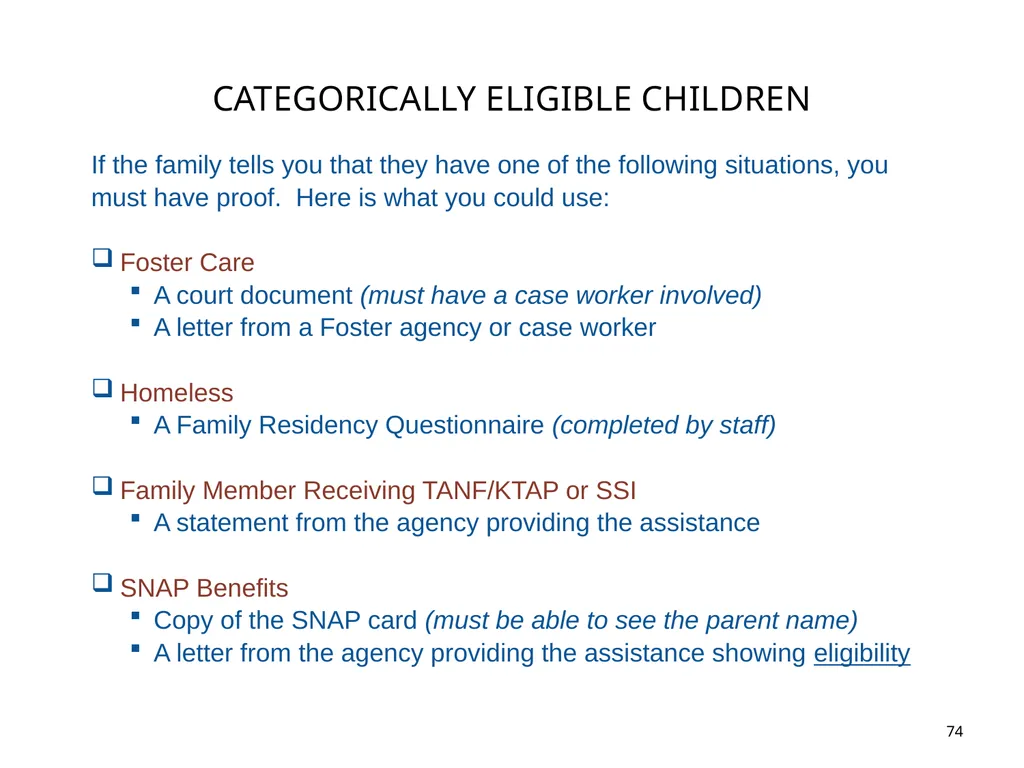
Categorically eligible children 74 If the family tells you that they have one of the following situations, you must have proof. Here is what you could use:
Foster Care
A court document (must have a case worker involved)
A letter from a Foster agency or case worker
Homeless
A Family Residency Questionnaire (completed by staff)
Family Member Receiving TANF/KTAP or SSI
A statement from the agency providing the assistance
SNAP Benefits
Copy of the SNAP card (must be able to see the parent name)
A letter from the agency providing the assistance showing eligibility<br>
Foster Care
A court document (must have a case worker involved)
A letter from a Foster agency or case worker
Homeless
A Family Residency Questionnaire (completed by staff)
Family Member Receiving TANF/KTAP or SSI
A statement from the agency providing the assistance
SNAP Benefits
Copy of the SNAP card (must be able to see the parent name)
A letter from the agency providing the assistance showing eligibility<br>
75
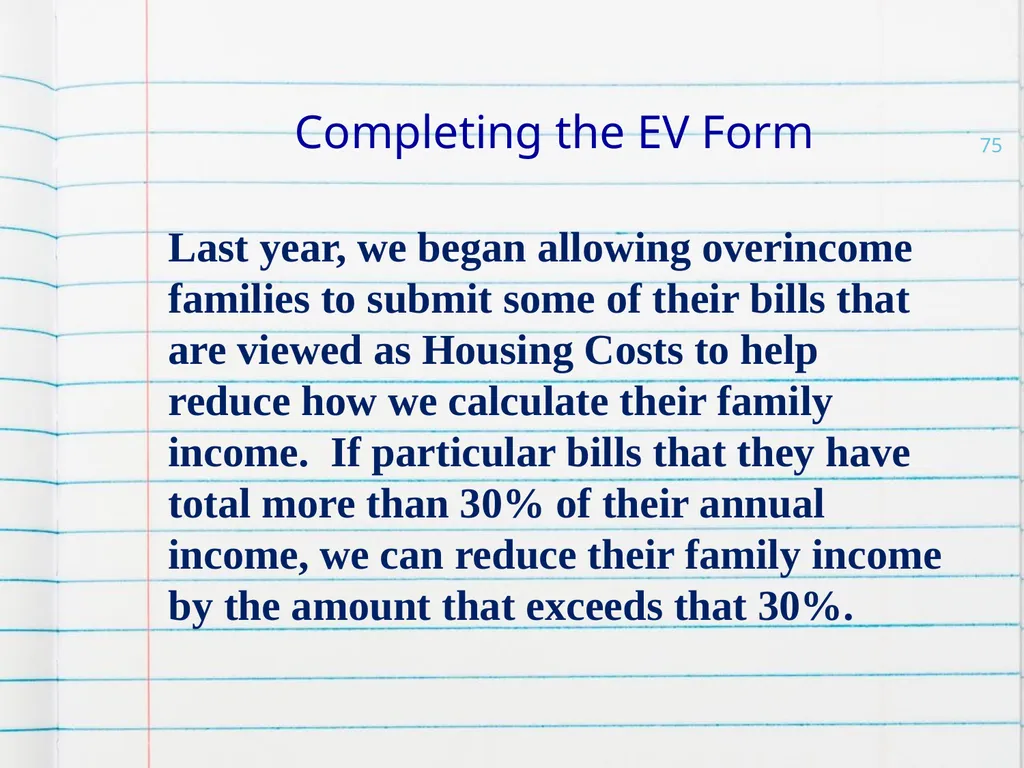
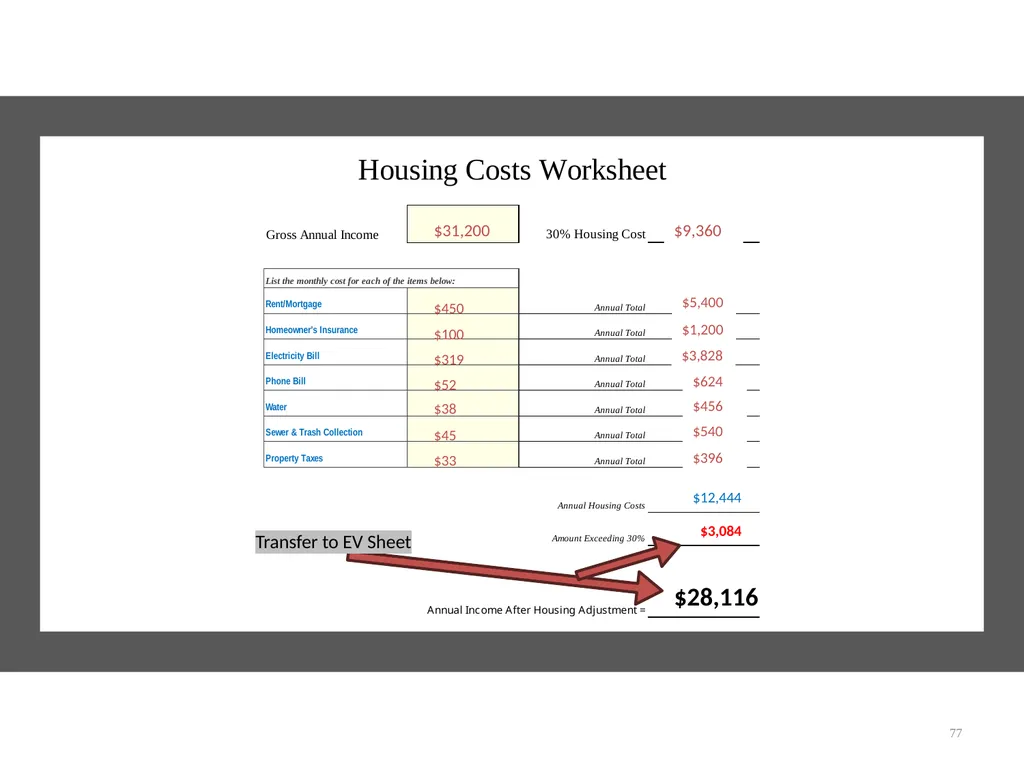
75 Last year, we began allowing overincome families to submit some of their bills that are viewed as Housing Costs to help reduce how we calculate their family income. If particular bills that they have total more than 30% of their annual income, we can reduce their family income by the amount that exceeds that 30%. Completing the EV Form<br>
76
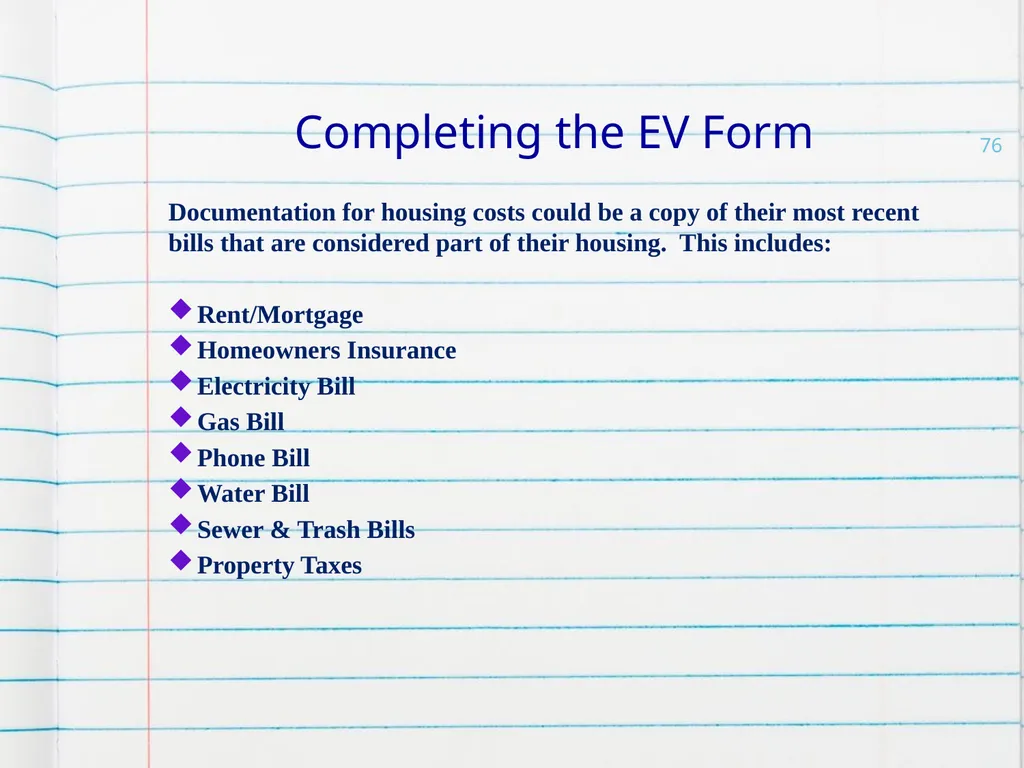
76 Documentation for housing costs could be a copy of their most recent bills that are considered part of their housing. This includes:
Rent/Mortgage
Homeowners Insurance
Electricity Bill
Gas Bill
Phone Bill
Water Bill
Sewer & Trash Bills
Property Taxes Completing the EV Form<br>
Rent/Mortgage
Homeowners Insurance
Electricity Bill
Gas Bill
Phone Bill
Water Bill
Sewer & Trash Bills
Property Taxes Completing the EV Form<br>
77
$31,200 $9,360 $450 $5,400 $100 $1,200 $319 $3,828 $52 $624 $38 $456 $45 $540 $33 $396 $12,444 $3,084 $28,116 Transfer to EV Sheet 77<br>
78
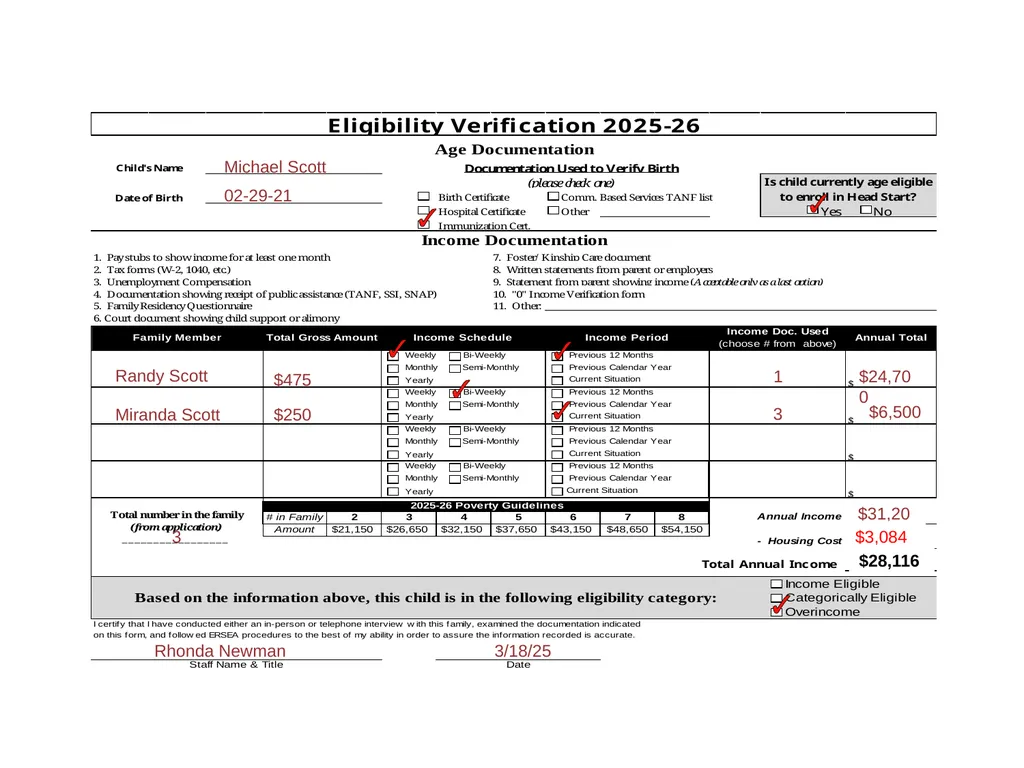
Michael Scott 02-29-21 Randy Scott $475 1 $24,700 Miranda Scott $250 3 $6,500 $31,200 3 Rhonda Newman 3/18/25 $3,084 $28,116 78<br>
79
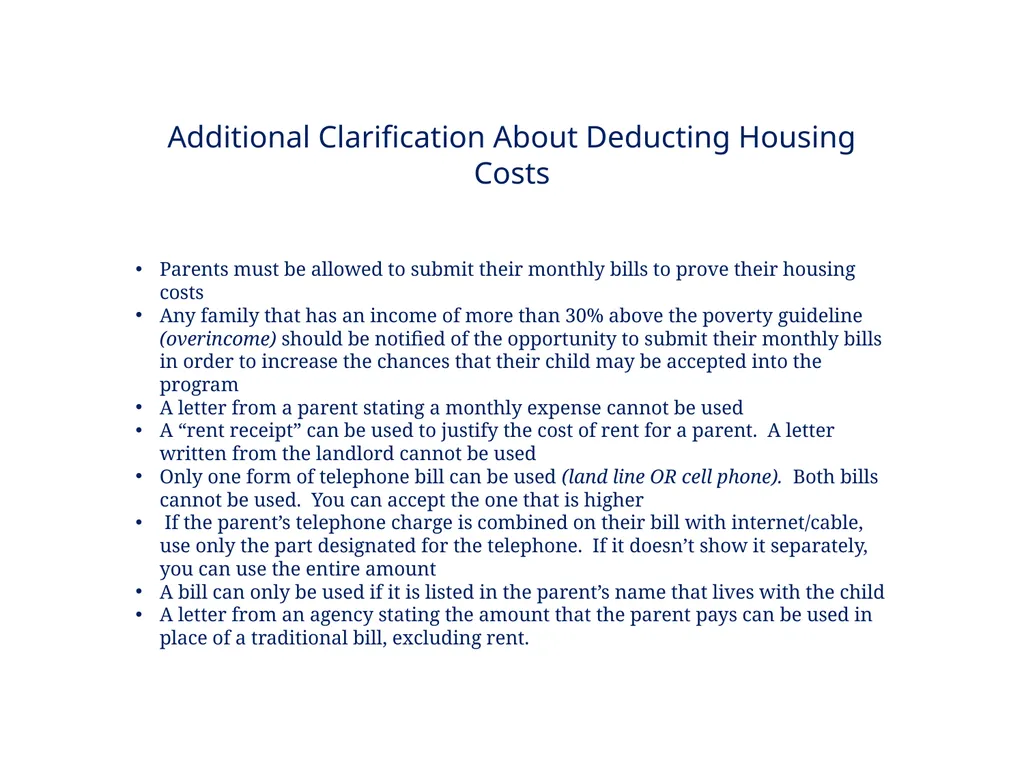
Additional Clarification About Deducting Housing Costs 79 Parents must be allowed to submit their monthly bills to prove their housing costs
Any family that has an income of more than 30% above the poverty guideline (overincome) should be notified of the opportunity to submit their monthly bills in order to increase the chances that their child may be accepted into the program
A letter from a parent stating a monthly expense cannot be used
A “rent receipt” can be used to justify the cost of rent for a parent. A letter written from the landlord cannot be used
Only one form of telephone bill can be used (land line OR cell phone). Both bills cannot be used. You can accept the one that is higher
If the parent’s telephone charge is combined on their bill with internet/cable, use only the part designated for the telephone. If it doesn’t show it separately, you can use the entire amount
A bill can only be used if it is listed in the parent’s name that lives with the child
A letter from an agency stating the amount that the parent pays can be used in place of a traditional bill, excluding rent.<br>
Any family that has an income of more than 30% above the poverty guideline (overincome) should be notified of the opportunity to submit their monthly bills in order to increase the chances that their child may be accepted into the program
A letter from a parent stating a monthly expense cannot be used
A “rent receipt” can be used to justify the cost of rent for a parent. A letter written from the landlord cannot be used
Only one form of telephone bill can be used (land line OR cell phone). Both bills cannot be used. You can accept the one that is higher
If the parent’s telephone charge is combined on their bill with internet/cable, use only the part designated for the telephone. If it doesn’t show it separately, you can use the entire amount
A bill can only be used if it is listed in the parent’s name that lives with the child
A letter from an agency stating the amount that the parent pays can be used in place of a traditional bill, excluding rent.<br>
80
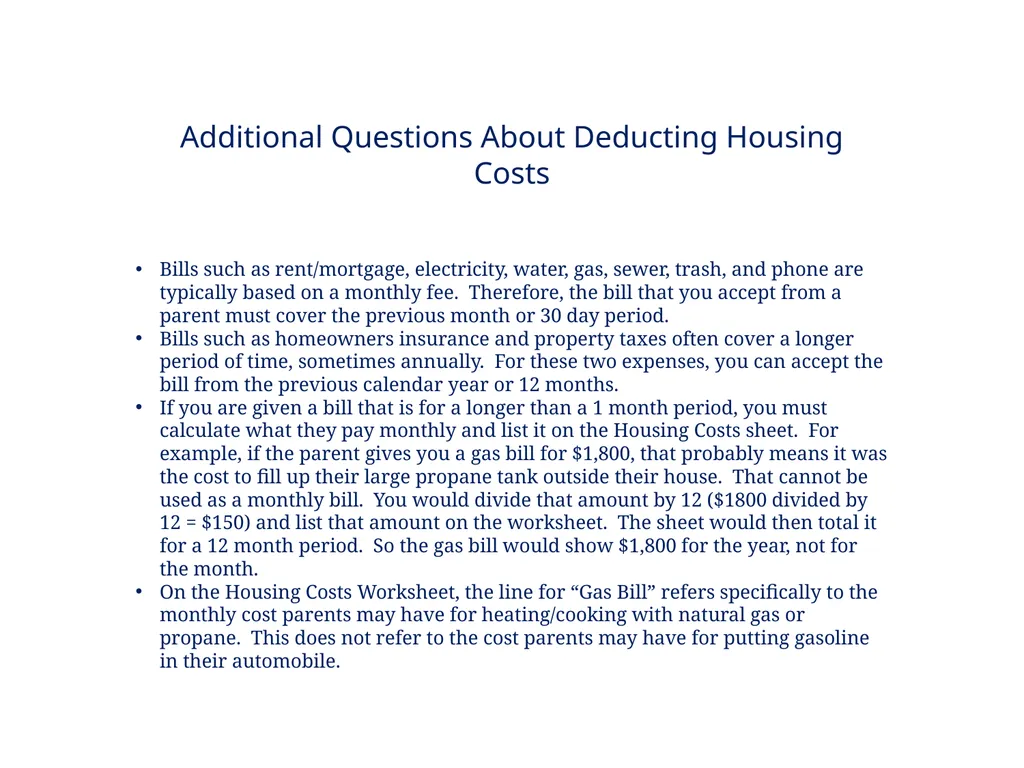
Additional Questions About Deducting Housing Costs 80 Bills such as rent/mortgage, electricity, water, gas, sewer, trash, and phone are typically based on a monthly fee. Therefore, the bill that you accept from a parent must cover the previous month or 30 day period.
Bills such as homeowners insurance and property taxes often cover a longer period of time, sometimes annually. For these two expenses, you can accept the bill from the previous calendar year or 12 months.
If you are given a bill that is for a longer than a 1 month period, you must calculate what they pay monthly and list it on the Housing Costs sheet. For example, if the parent gives you a gas bill for $1,800, that probably means it was the cost to fill up their large propane tank outside their house. That cannot be used as a monthly bill. You would divide that amount by 12 ($1800 divided by 12 = $150) and list that amount on the worksheet. The sheet would then total it for a 12 month period. So the gas bill would show $1,800 for the year, not for the month.
On the Housing Costs Worksheet, the line for “Gas Bill” refers specifically to the monthly cost parents may have for heating/cooking with natural gas or propane. This does not refer to the cost parents may have for putting gasoline in their automobile.<br>
Bills such as homeowners insurance and property taxes often cover a longer period of time, sometimes annually. For these two expenses, you can accept the bill from the previous calendar year or 12 months.
If you are given a bill that is for a longer than a 1 month period, you must calculate what they pay monthly and list it on the Housing Costs sheet. For example, if the parent gives you a gas bill for $1,800, that probably means it was the cost to fill up their large propane tank outside their house. That cannot be used as a monthly bill. You would divide that amount by 12 ($1800 divided by 12 = $150) and list that amount on the worksheet. The sheet would then total it for a 12 month period. So the gas bill would show $1,800 for the year, not for the month.
On the Housing Costs Worksheet, the line for “Gas Bill” refers specifically to the monthly cost parents may have for heating/cooking with natural gas or propane. This does not refer to the cost parents may have for putting gasoline in their automobile.<br>
81
81 When housing costs are used to reduce the total annual income as shown in the previous slide, you need to be aware of how to list the income on COPA. Completing the EV Form<br>
82
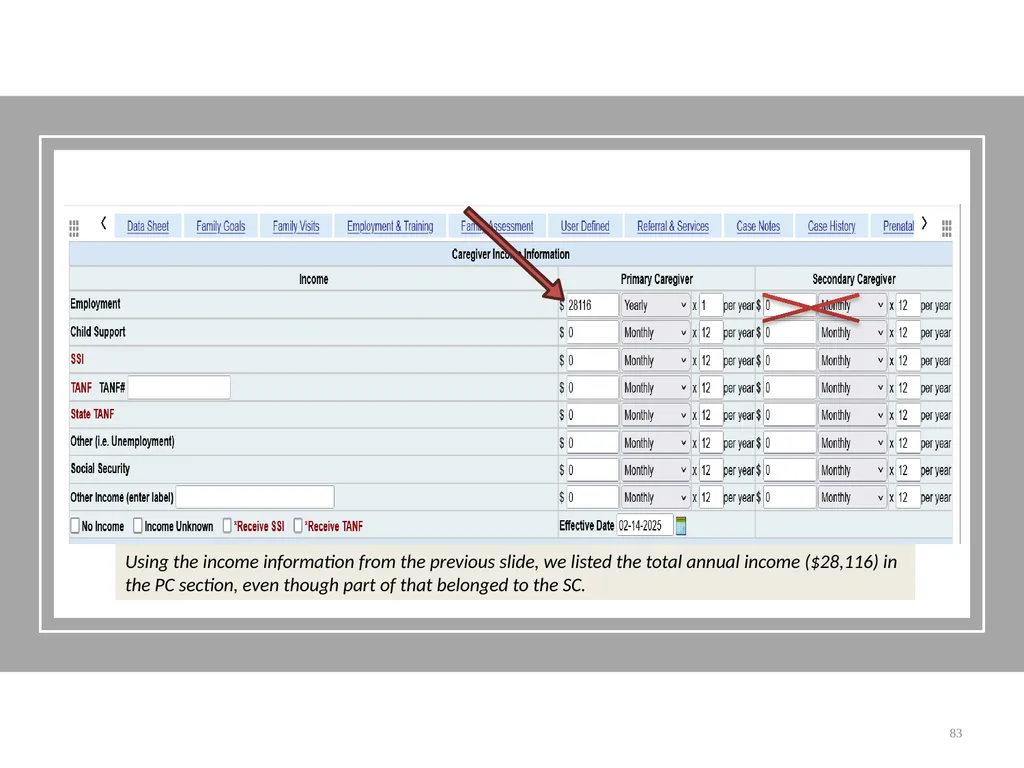
82 If there is income for 2 parents AND the housing deduction is used, you will need to list the Total Annual Income amount in the section under Family Income for the Primary Caregiver only. You won’t list income for the Secondary Caregiver in this situation. Completing the EV Form<br>
83
Using the income information from the previous slide, we listed the total annual income ($28,116) in the PC section, even though part of that belonged to the SC. 83<br>
84
In order to complete the enrollment application accurately, you must be able to determine the following:
Is the person I’m talking to legally able to apply for this child’s enrollment
What can he/she use to confirm the child’s age
Is there a Secondary Caregiver
How many people are in this child’s family
What should I ask for to verify income
Is this a child that should be listed as “Homeless” Eligibility Is this a child that should be listed as “homeless”?<br>
Is the person I’m talking to legally able to apply for this child’s enrollment
What can he/she use to confirm the child’s age
Is there a Secondary Caregiver
How many people are in this child’s family
What should I ask for to verify income
Is this a child that should be listed as “Homeless” Eligibility Is this a child that should be listed as “homeless”?<br>
85
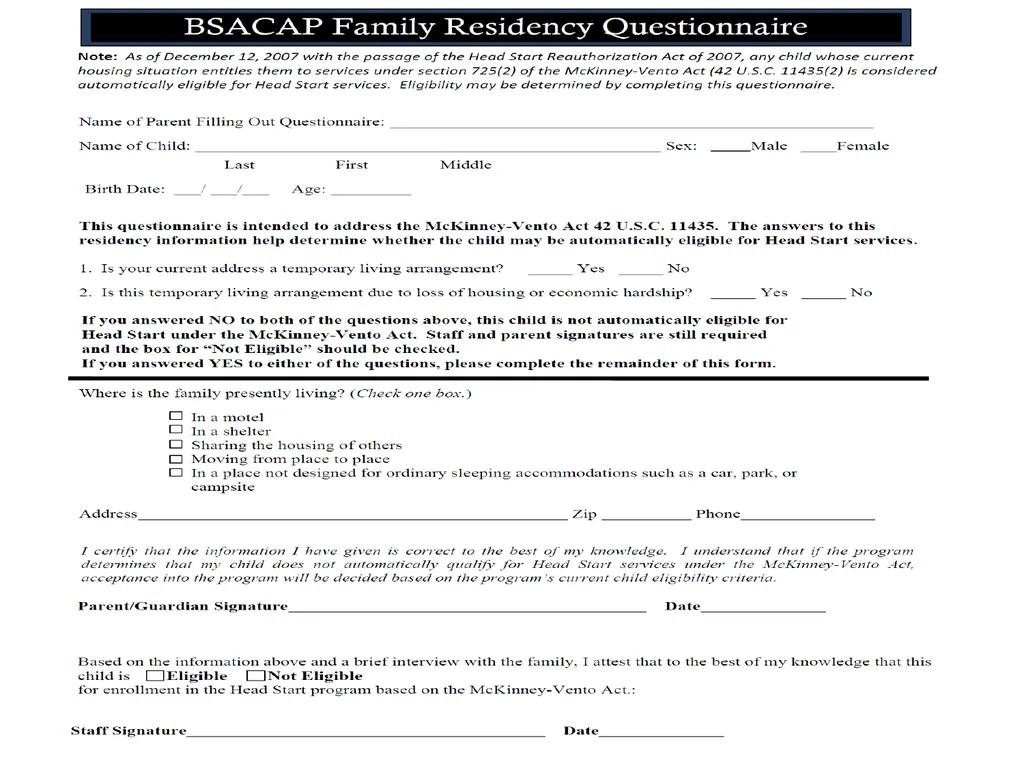
Eligibility For designating a child as “homeless”, the document that you will have is the Family Residency Questionnaire (FRQ) that you fill out with the parent. You should not mention the word “homeless” to the family because they may take offense to that word being used to describe their living situation. They may not know that they are viewed as homeless under the guidelines of the McKinney-Vento Act. These are the same guidelines used by your school system.
Let’s look at the FRQ and how it should be completed.<br>
Let’s look at the FRQ and how it should be completed.<br>
86
86<br>
87
Homeless Families
Let’s take a look at some situations and determine if they would be designated as “Homeless” for Head Start according to the McKinney-Vento Act…….<br>
Let’s take a look at some situations and determine if they would be designated as “Homeless” for Head Start according to the McKinney-Vento Act…….<br>
88
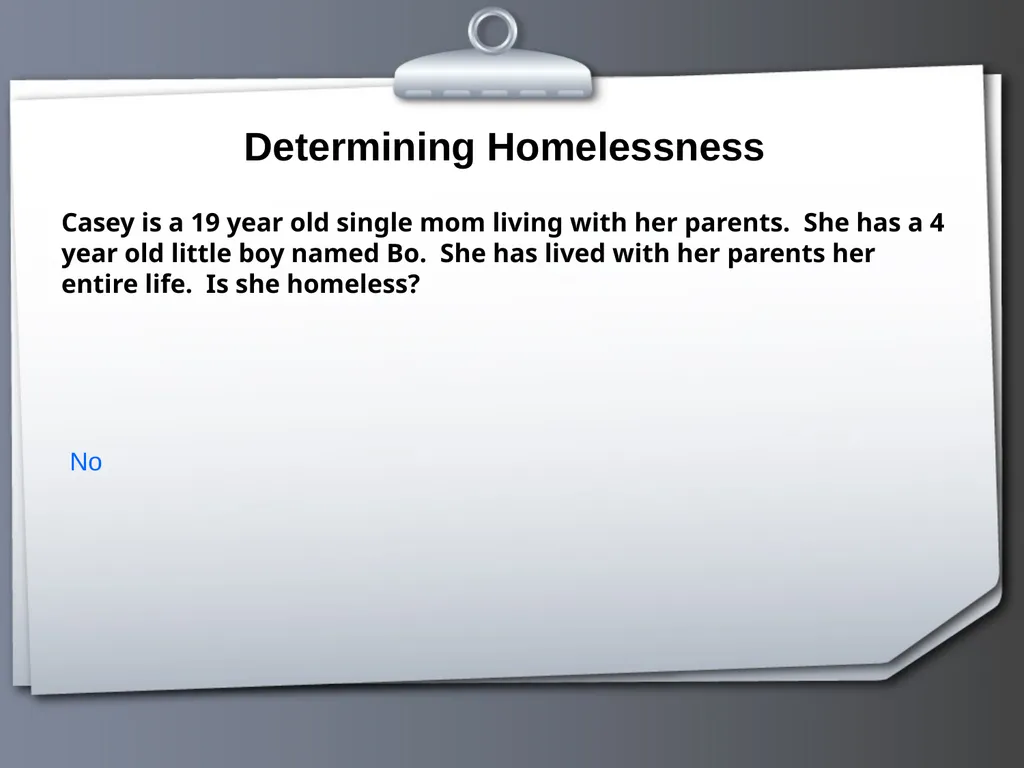
Determining Homelessness Casey is a 19 year old single mom living with her parents. She has a 4 year old little boy named Bo. She has lived with her parents her entire life. Is she homeless? No<br>
89
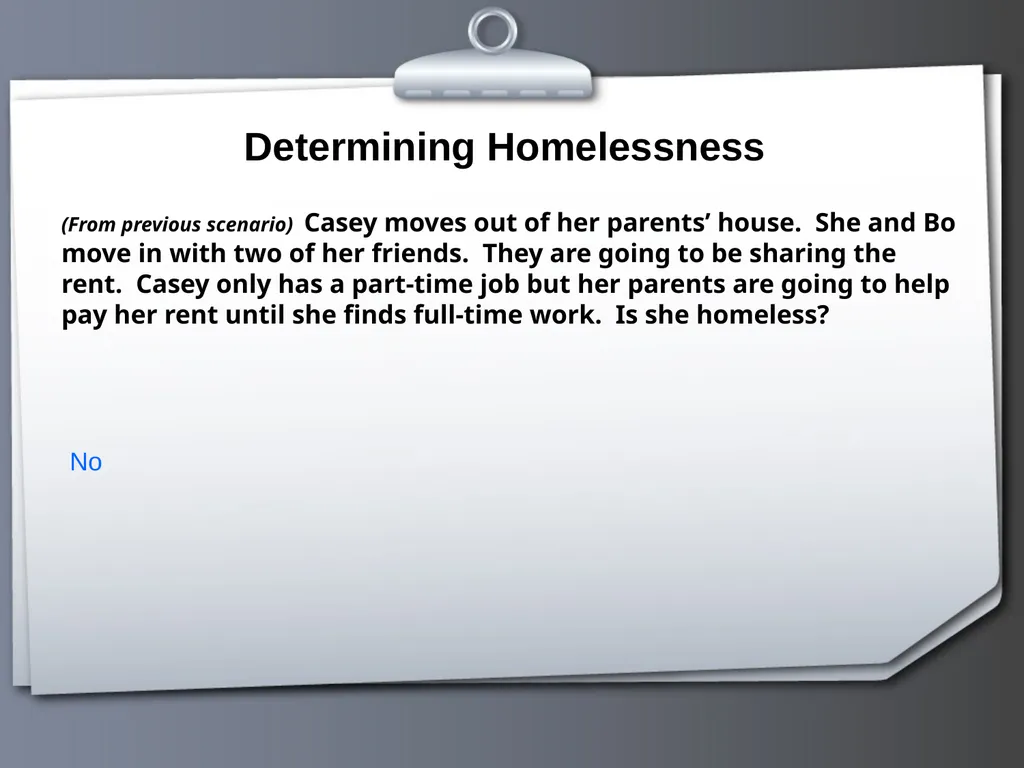
Determining Homelessness (From previous scenario) Casey moves out of her parents’ house. She and Bo move in with two of her friends. They are going to be sharing the rent. Casey only has a part-time job but her parents are going to help pay her rent until she finds full-time work. Is she homeless? No<br>
90
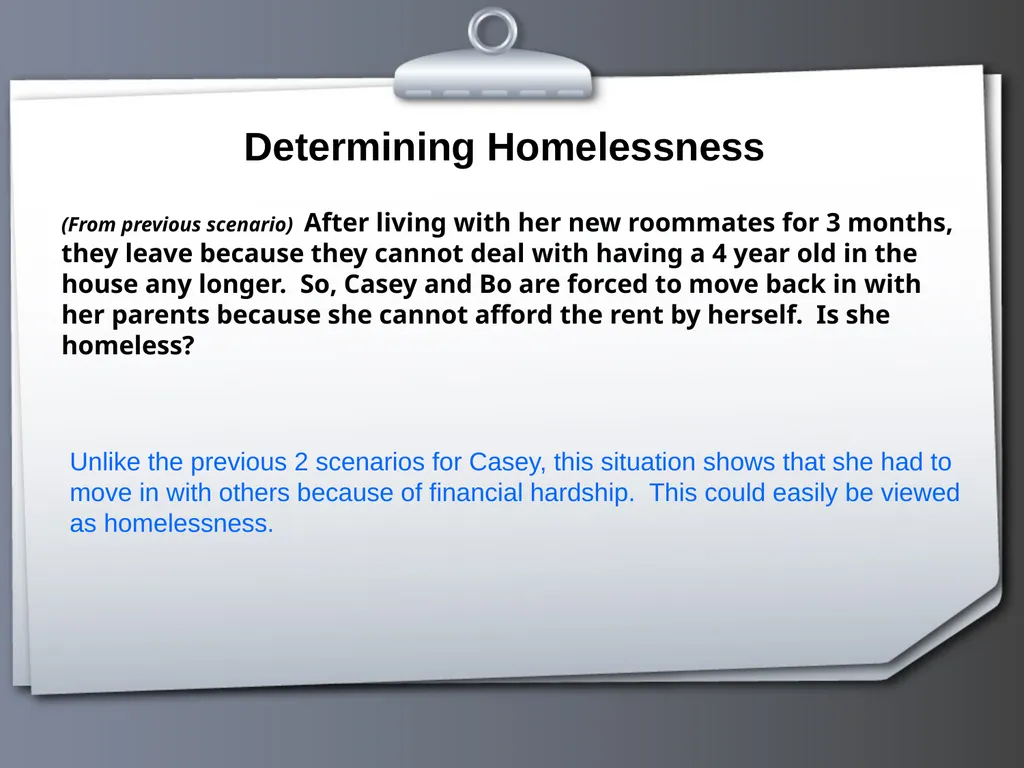
Determining Homelessness (From previous scenario) After living with her new roommates for 3 months, they leave because they cannot deal with having a 4 year old in the house any longer. So, Casey and Bo are forced to move back in with her parents because she cannot afford the rent by herself. Is she homeless? Unlike the previous 2 scenarios for Casey, this situation shows that she had to move in with others because of financial hardship. This could easily be viewed as homelessness.<br>
91
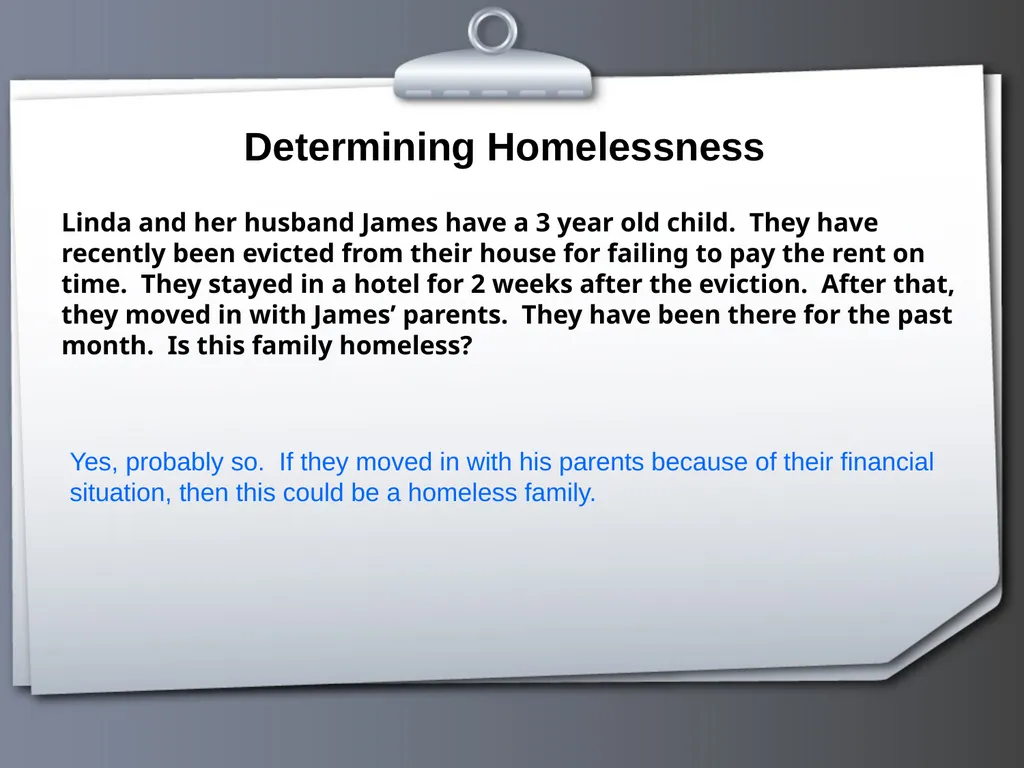
Determining Homelessness Linda and her husband James have a 3 year old child. They have recently been evicted from their house for failing to pay the rent on time. They stayed in a hotel for 2 weeks after the eviction. After that, they moved in with James’ parents. They have been there for the past month. Is this family homeless? Yes, probably so. If they moved in with his parents because of their financial situation, then this could be a homeless family.<br>
92
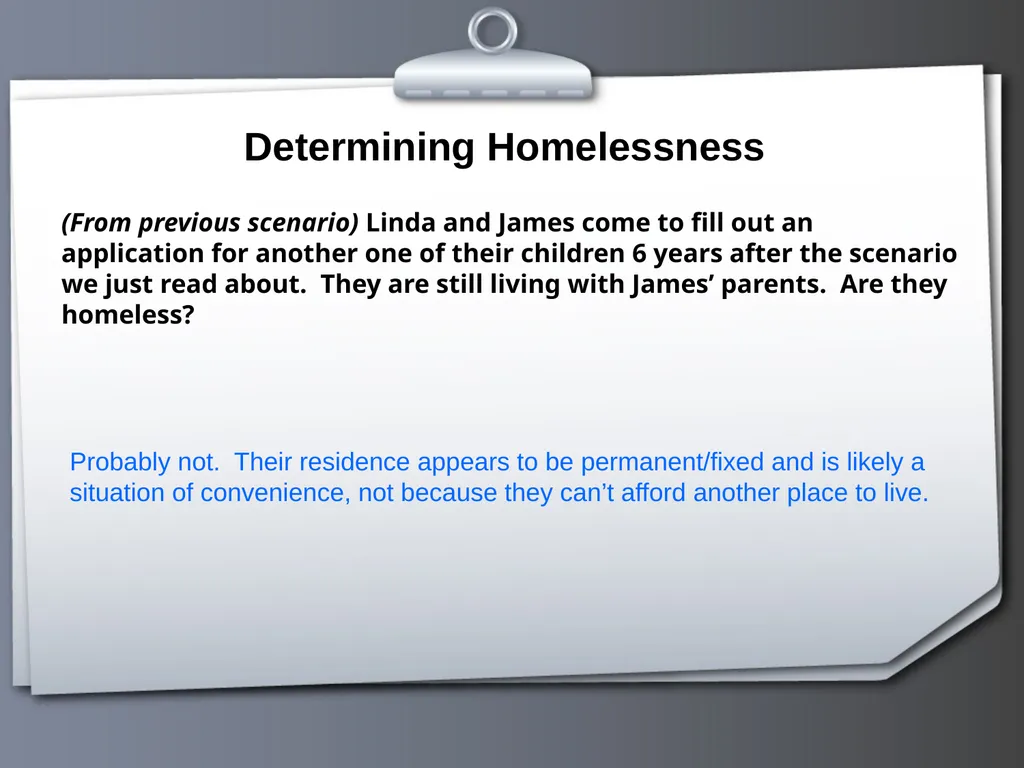
Determining Homelessness (From previous scenario) Linda and James come to fill out an application for another one of their children 6 years after the scenario we just read about. They are still living with James’ parents. Are they homeless? Probably not. Their residence appears to be permanent/fixed and is likely a situation of convenience, not because they can’t afford another place to live.<br>
93
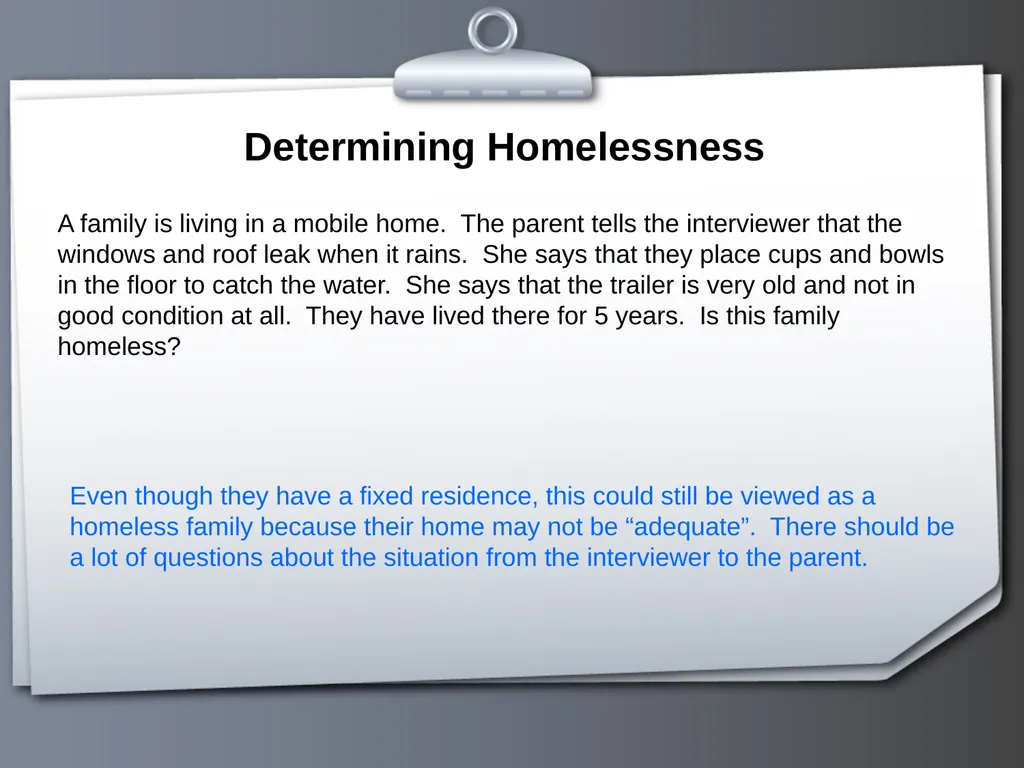
Determining Homelessness Even though they have a fixed residence, this could still be viewed as a homeless family because their home may not be “adequate”. There should be a lot of questions about the situation from the interviewer to the parent. A family is living in a mobile home. The parent tells the interviewer that the windows and roof leak when it rains. She says that they place cups and bowls in the floor to catch the water. She says that the trailer is very old and not in good condition at all. They have lived there for 5 years. Is this family homeless?<br>
94
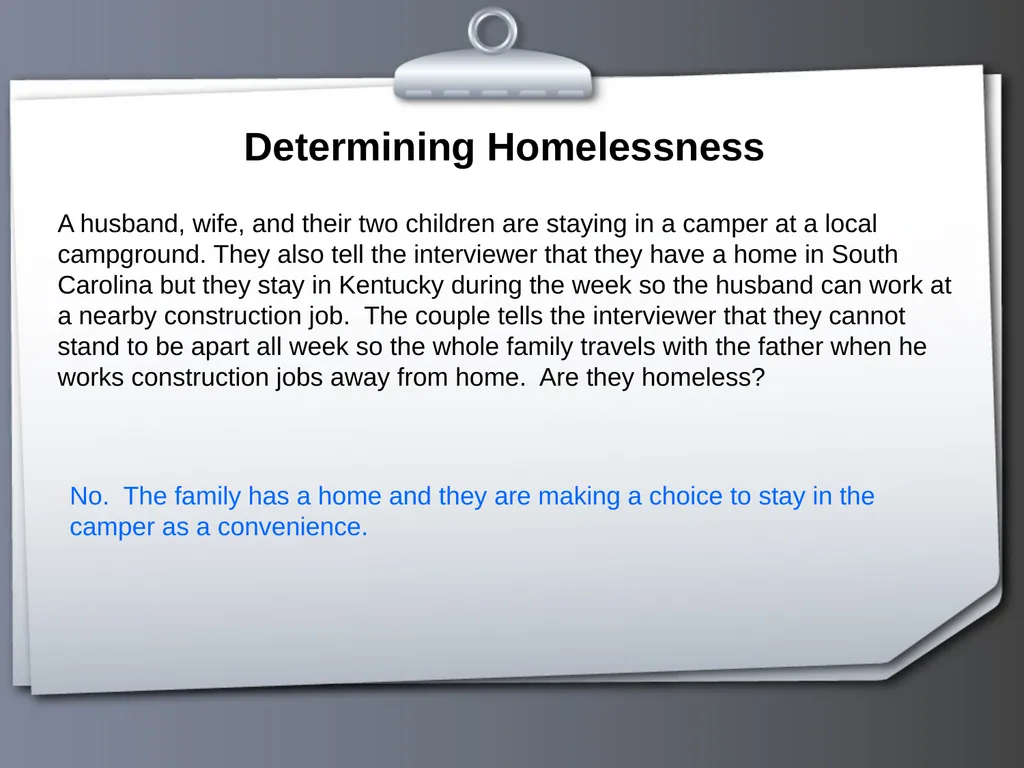
Determining Homelessness A husband, wife, and their two children are staying in a camper at a local campground. They also tell the interviewer that they have a home in South Carolina but they stay in Kentucky during the week so the husband can work at a nearby construction job. The couple tells the interviewer that they cannot stand to be apart all week so the whole family travels with the father when he works construction jobs away from home. Are they homeless? No. The family has a home and they are making a choice to stay in the camper as a convenience.<br>
95
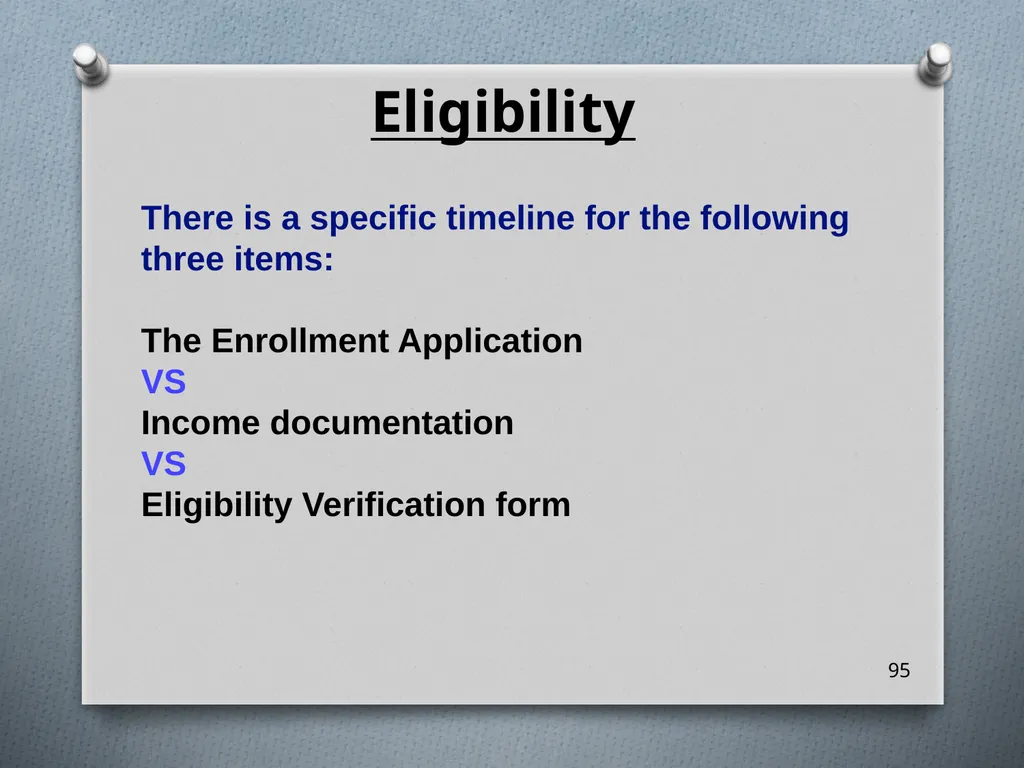
Eligibility There is a specific timeline for the following three items:
The Enrollment Application
VS
Income documentation
VS
Eligibility Verification form 95<br>
The Enrollment Application
VS
Income documentation
VS
Eligibility Verification form 95<br>
96
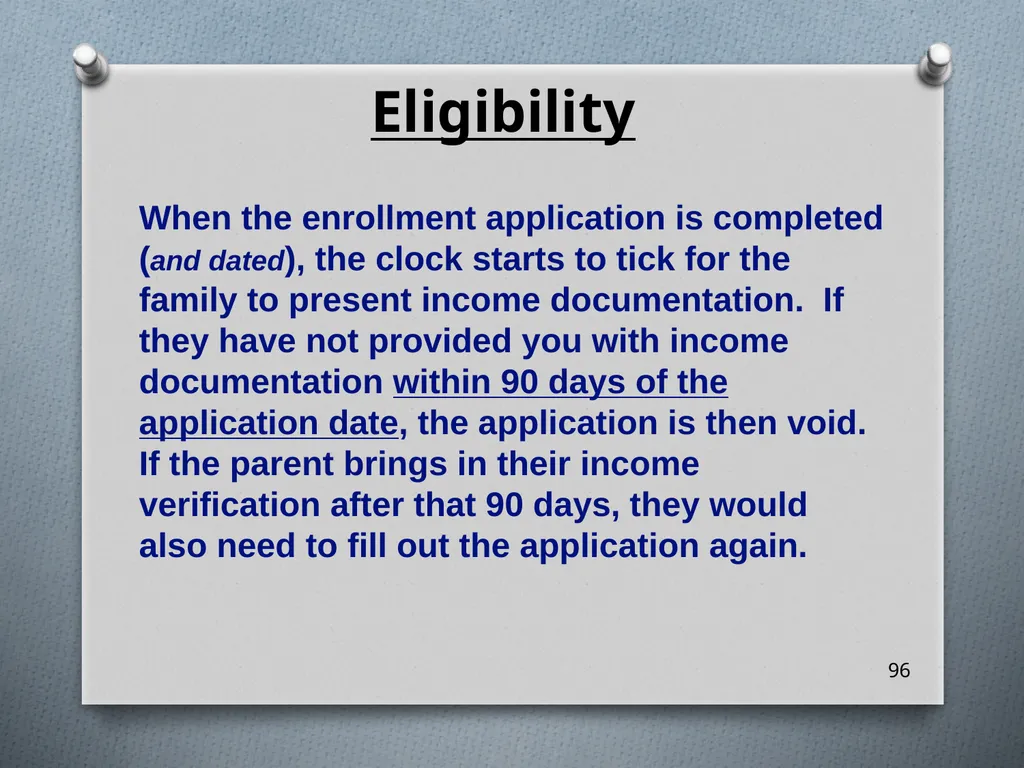
When the enrollment application is completed (and dated), the clock starts to tick for the family to present income documentation. If they have not provided you with income documentation within 90 days of the application date, the application is then void. If the parent brings in their income verification after that 90 days, they would also need to fill out the application again. Eligibility 96<br>
97
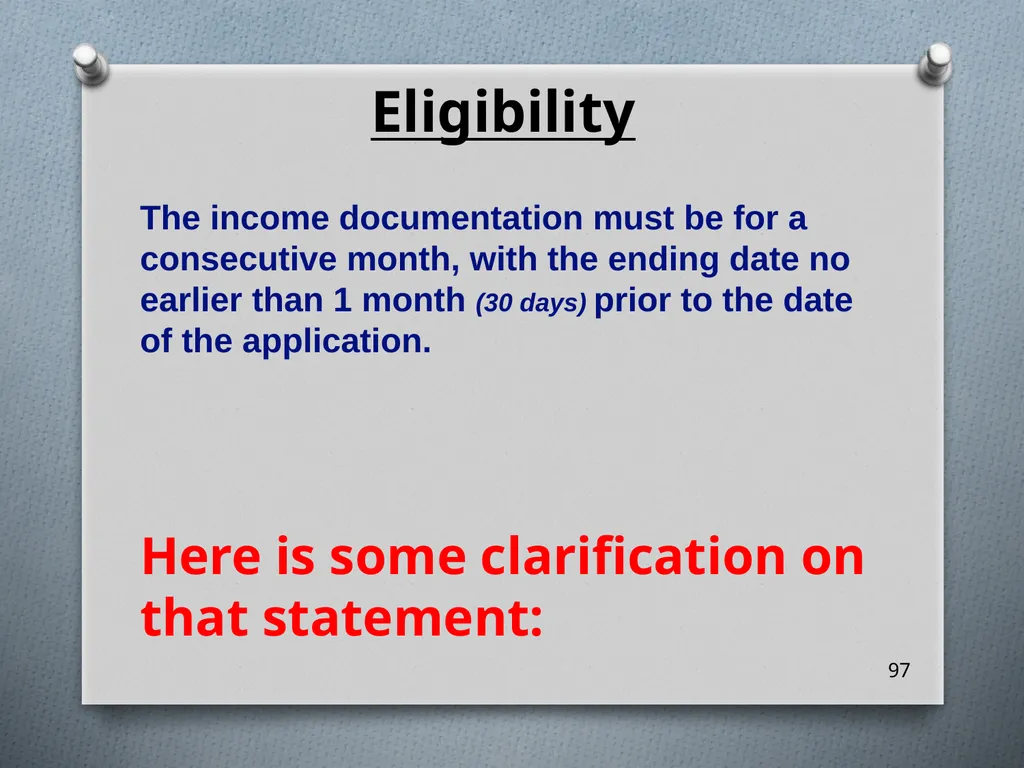
The income documentation must be for a consecutive month, with the ending date no earlier than 1 month (30 days) prior to the date of the application.
Here is some clarification on that statement: Eligibility 97<br>
Here is some clarification on that statement: Eligibility 97<br>
98
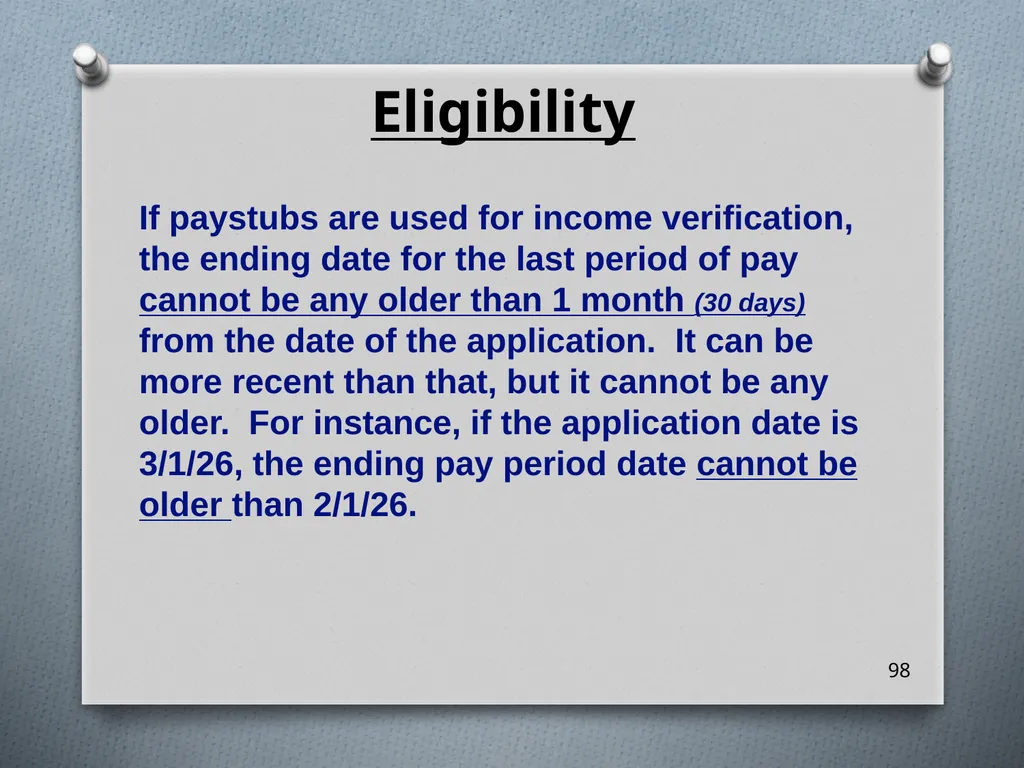
If paystubs are used for income verification, the ending date for the last period of pay cannot be any older than 1 month (30 days) from the date of the application. It can be more recent than that, but it cannot be any older. For instance, if the application date is 3/1/26, the ending pay period date cannot be older than 2/1/26. Eligibility 98<br>
99
The Eligibility Verification form must be completed within 30 days of receiving the income documentation. Eligibility 99<br>
100
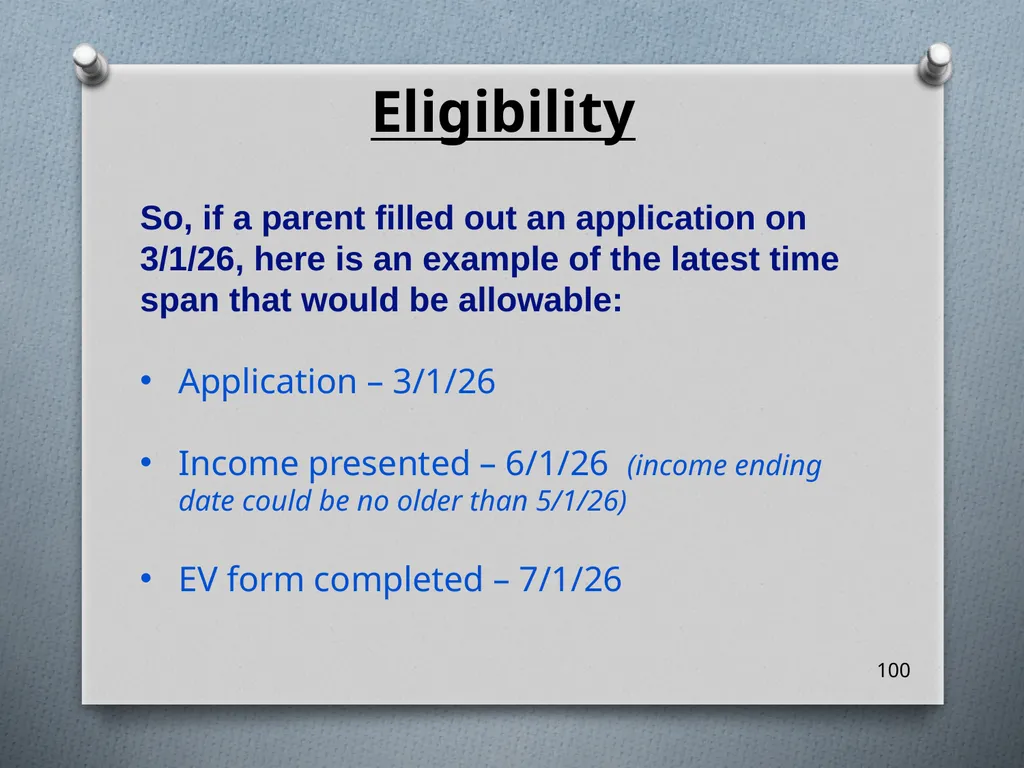
So, if a parent filled out an application on 3/1/26, here is an example of the latest time span that would be allowable:
Application – 3/1/26
Income presented – 6/1/26 (income ending date could be no older than 5/1/26)
EV form completed – 7/1/26 Eligibility 100<br>
Application – 3/1/26
Income presented – 6/1/26 (income ending date could be no older than 5/1/26)
EV form completed – 7/1/26 Eligibility 100<br>
101
Recruitment All programs are allowed to enroll children from any county within the BSACAP service area (Floyd, Johnson, Magoffin, Martin, and Pike) if a parent comes to you. But here are two rules that all programs must follow:
DO NOT recruit any child outside of your service area, including any of our other counties.
You are not allowed to enroll a child from outside our BSACAP service area without letting the grantee office know so we can contact the program where the child resides for permission.<br>
DO NOT recruit any child outside of your service area, including any of our other counties.
You are not allowed to enroll a child from outside our BSACAP service area without letting the grantee office know so we can contact the program where the child resides for permission.<br>
102
Questions<br>
103
Resources There is a lot of ERSEA-related information that may not have been covered in this training today. Our website www.headstart.bsacap.org has an ERSEA tab with procedures and previous training slides that should answer any question that you may have. If you can’t find an answer to a question, don’t hesitate to contact me.
Phone: (606)-789-1600
Email: tjenkins@bsacap.org<br>
Phone: (606)-789-1600
Email: tjenkins@bsacap.org<br>