
Health Home Care Coordinators Basic Training
TA
Published · 148 slides · 0 views

1 / 1







Description
Health Home Care Coordinators Basic Training January 2024 I diagnosed abdominal pain when the real problem was hunger, I confused social issues with medical problems in other patients, too. I mislabeled the hopelessness of long-term
Related Topics
Share
Embed code
Download this presentation From Below
"Health Home Care Coordinators Basic Training" is the property of its rightful owner. Permission is granted to download and print the materials on this website for personal, non-commercial use only, and to display it on your personal computer provided you do not modify the materials and that you retain all copyright notices contained in the materials. By downloading content from our website, you accept the terms of this agreement.
Presentation Transcript
01
Health Home Care Coordinators Basic Training January 2024<br>
02
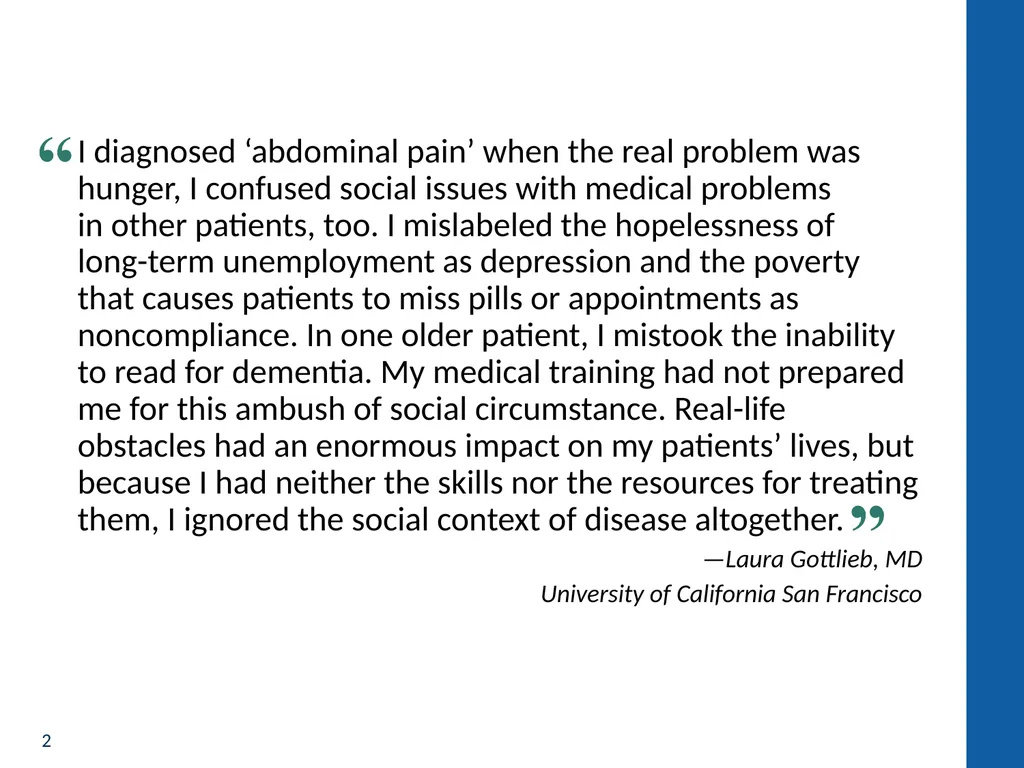
I diagnosed ‘abdominal pain’ when the real problem was hunger, I confused social issues with medical problems
in other patients, too. I mislabeled the hopelessness of
long-term unemployment as depression and the poverty that causes patients to miss pills or appointments as noncompliance. In one older patient, I mistook the inability
to read for dementia. My medical training had not prepared me for this ambush of social circumstance. Real-life obstacles had an enormous impact on my patients’ lives, but because I had neither the skills nor the resources for treating them, I ignored the social context of disease altogether.
—Laura Gottlieb, MD
University of California San Francisco<br>
—Laura Gottlieb, MD
University of California San Francisco<br>
03
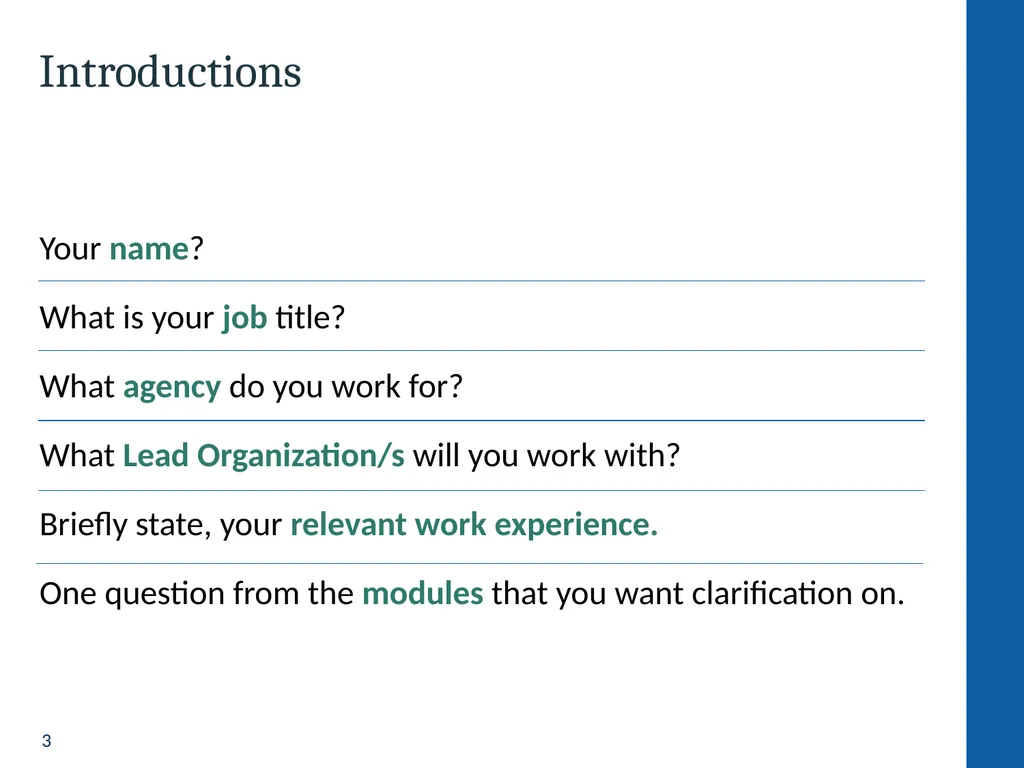
Introductions Your name?
What is your job title?
What agency do you work for?
What Lead Organization/s will you work with?
Briefly state, your relevant work experience.
One question from the modules that you want clarification on.<br>
What is your job title?
What agency do you work for?
What Lead Organization/s will you work with?
Briefly state, your relevant work experience.
One question from the modules that you want clarification on.<br>
04
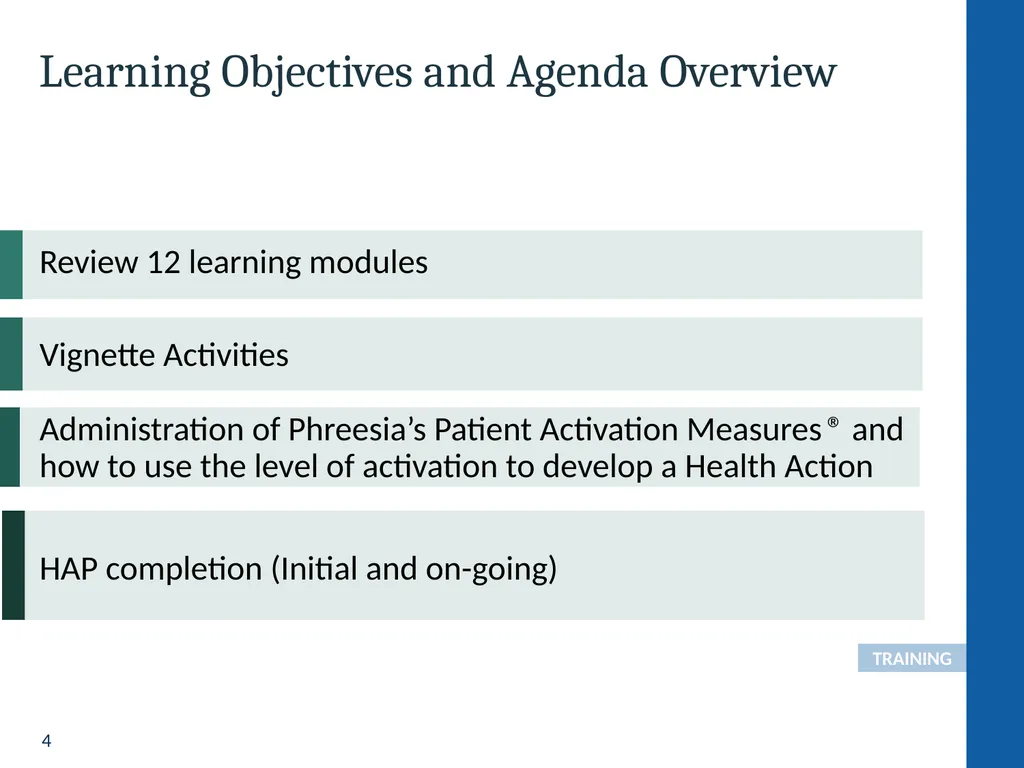
Learning Objectives and Agenda Overview Review 12 learning modules
Vignette Activities
Administration of Phreesia’s Patient Activation Measures ® and how to use the level of activation to develop a Health Action
HAP completion (Initial and on-going) TRAINING<br>
Vignette Activities
Administration of Phreesia’s Patient Activation Measures ® and how to use the level of activation to develop a Health Action
HAP completion (Initial and on-going) TRAINING<br>
05
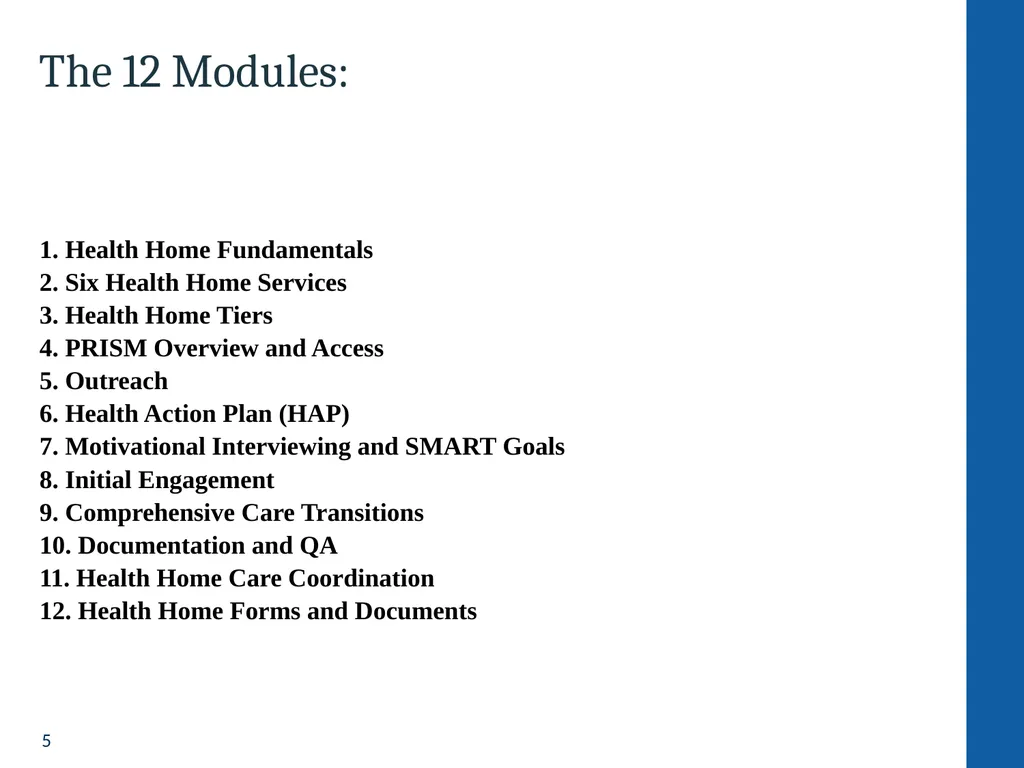
The 12 Modules: 1. Health Home Fundamentals
2. Six Health Home Services
3. Health Home Tiers
4. PRISM Overview and Access
5. Outreach
6. Health Action Plan (HAP)
7. Motivational Interviewing and SMART Goals
8. Initial Engagement
9. Comprehensive Care Transitions
10. Documentation and QA
11. Health Home Care Coordination
12. Health Home Forms and Documents<br>
06
Module 1 – Fundamentals<br>
07
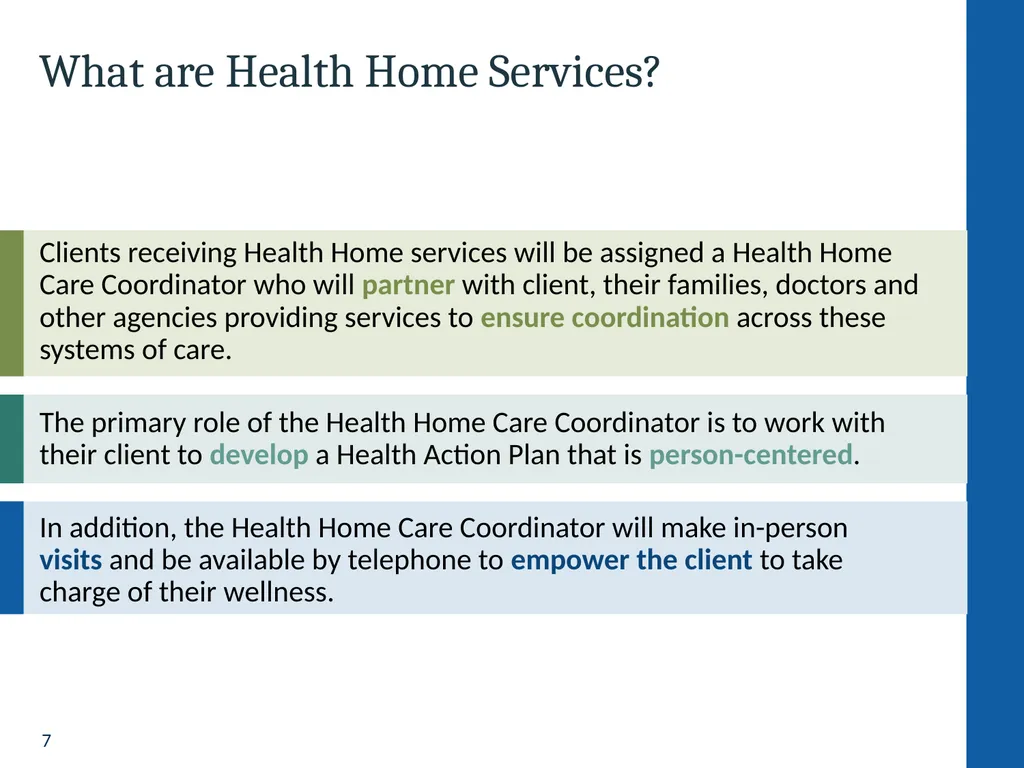
What are Health Home Services? Clients receiving Health Home services will be assigned a Health Home Care Coordinator who will partner with client, their families, doctors and other agencies providing services to ensure coordination across these systems of care.
The primary role of the Health Home Care Coordinator is to work with their client to develop a Health Action Plan that is person-centered.
In addition, the Health Home Care Coordinator will make in-person visits and be available by telephone to empower the client to take charge of their wellness.<br>
08
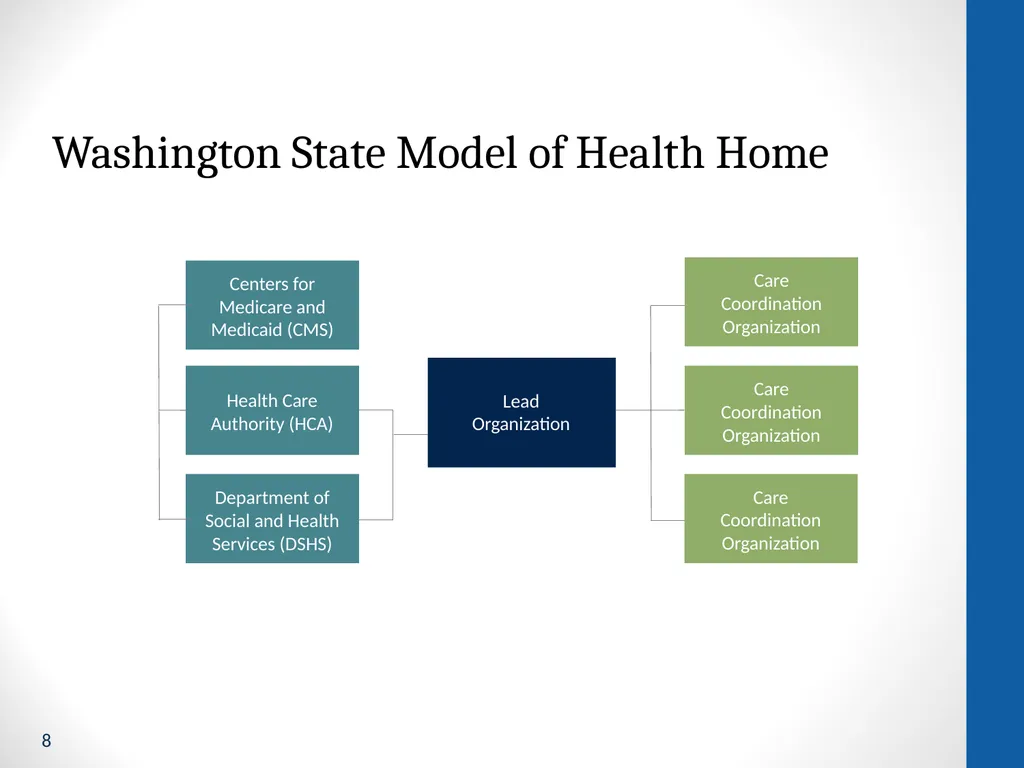
Washington State Model of Health Home Centers for Medicare and Medicaid (CMS) Health Care Authority (HCA) Department of Social and Health Services (DSHS) Lead Organization Care Coordination Organization Care Coordination Organization Care Coordination Organization<br>
09
Let’s Pause to Check for Understanding Do you have any experience with the program that you wish to share?
What questions remain from the Fundamentals module?<br>
What questions remain from the Fundamentals module?<br>
10
Module 2 –
Six Health Home Services<br>
11
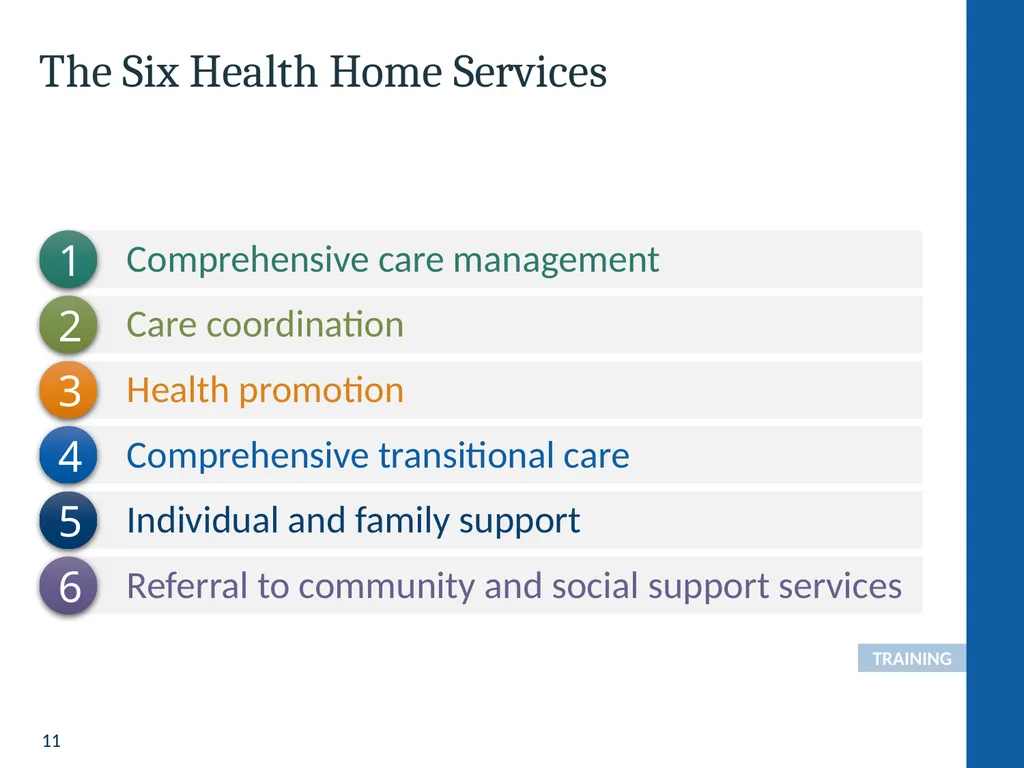
The Six Health Home Services Comprehensive care management Care coordination Health promotion Comprehensive transitional care Individual and family support Referral to community and social support services 1 2 3 4 5 6 TRAINING<br>
12
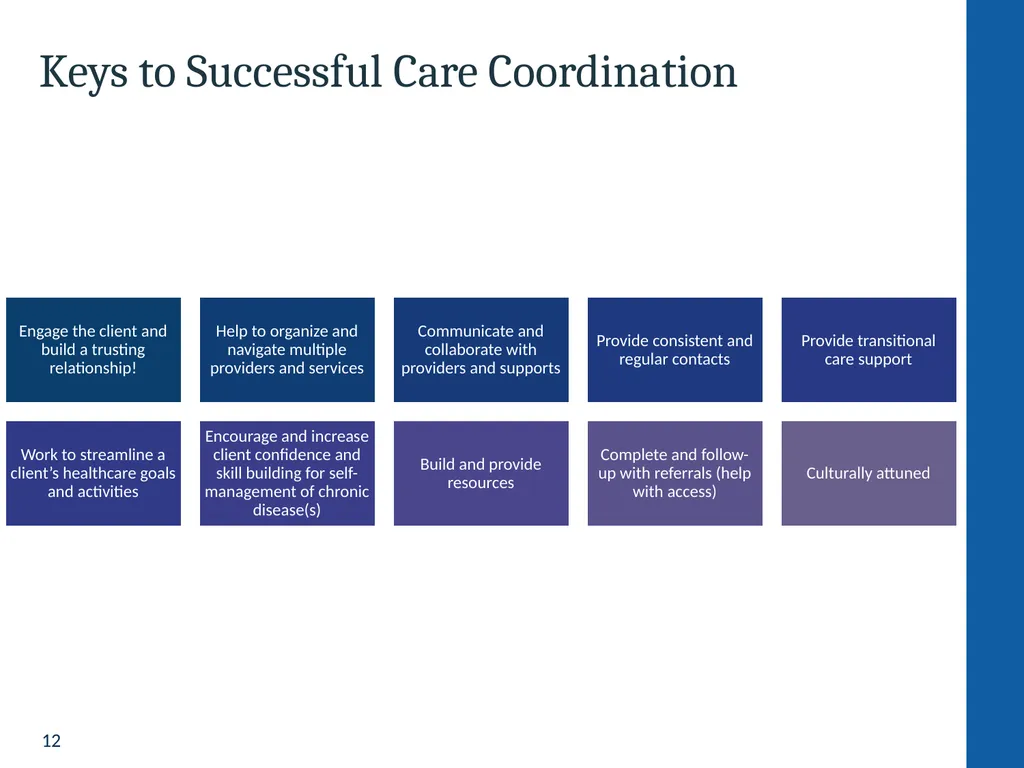
Keys to Successful Care Coordination<br>
13
Let’s Pause to Check for Understanding Do you have any questions about the six core services or the role of a Care Coordinator in incorporating these six core services?<br>
14
Module 3 – Health Home Tiers<br>
15
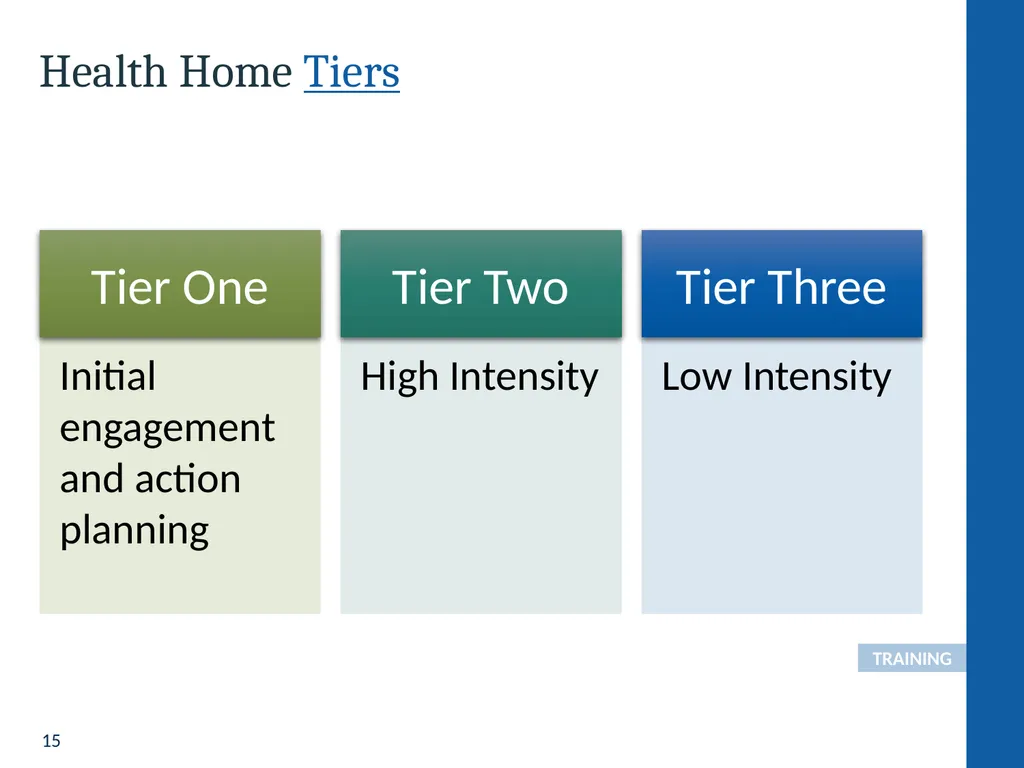
Health Home Tiers Initial engagement and action planning High Intensity Low Intensity Tier One Tier Two Tier Three TRAINING<br>
16
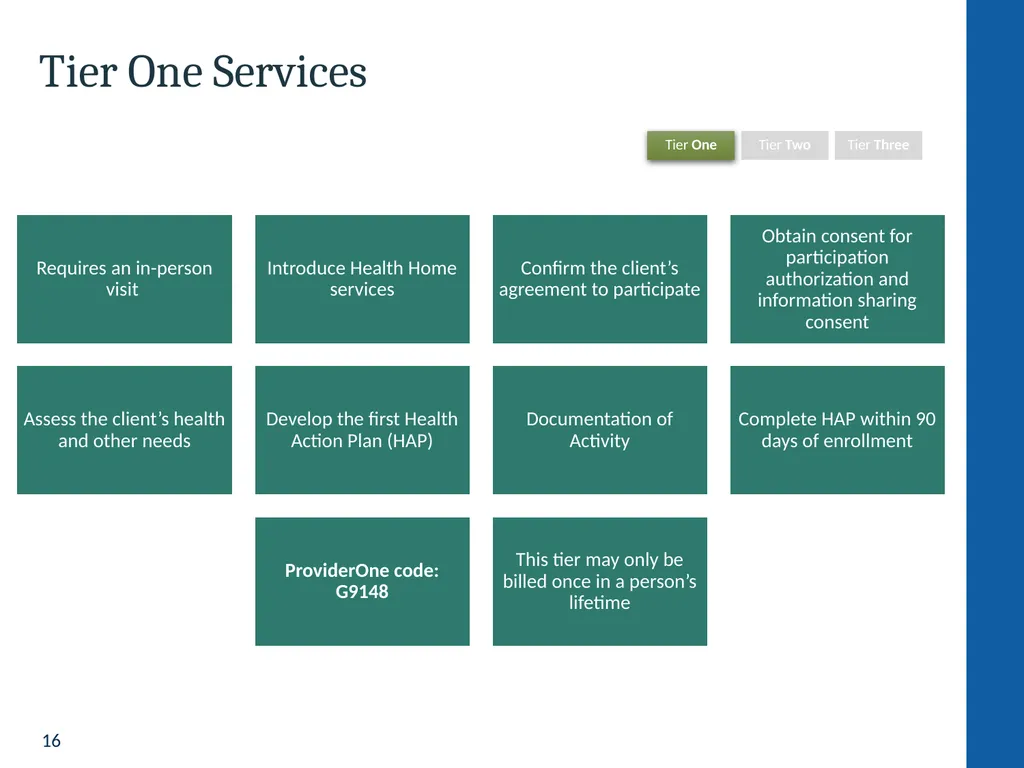
Tier One Services<br>
17
Tier Two High Intensity Tier Three Low intensity<br>
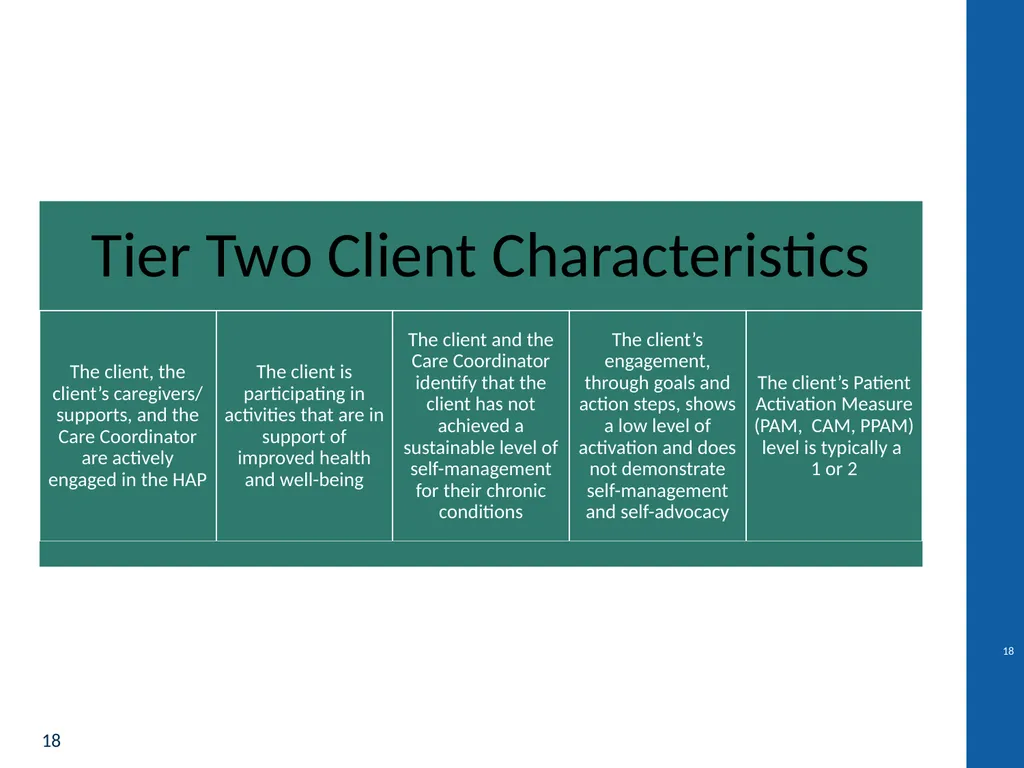
18
18<br>
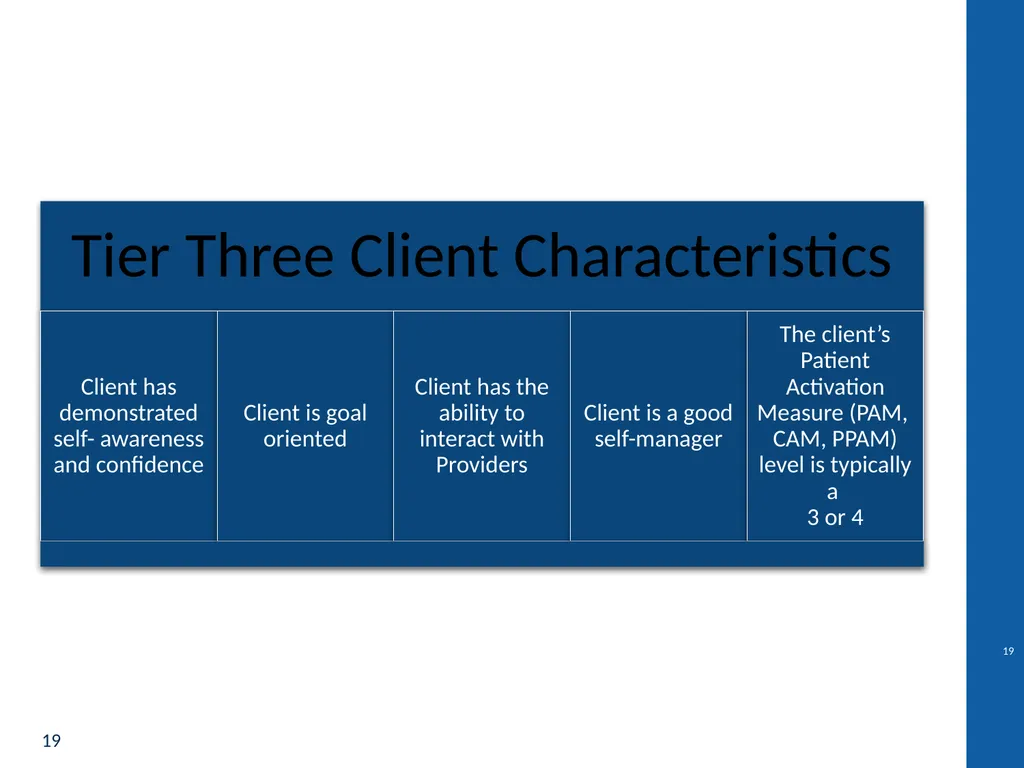
19
19<br>
20
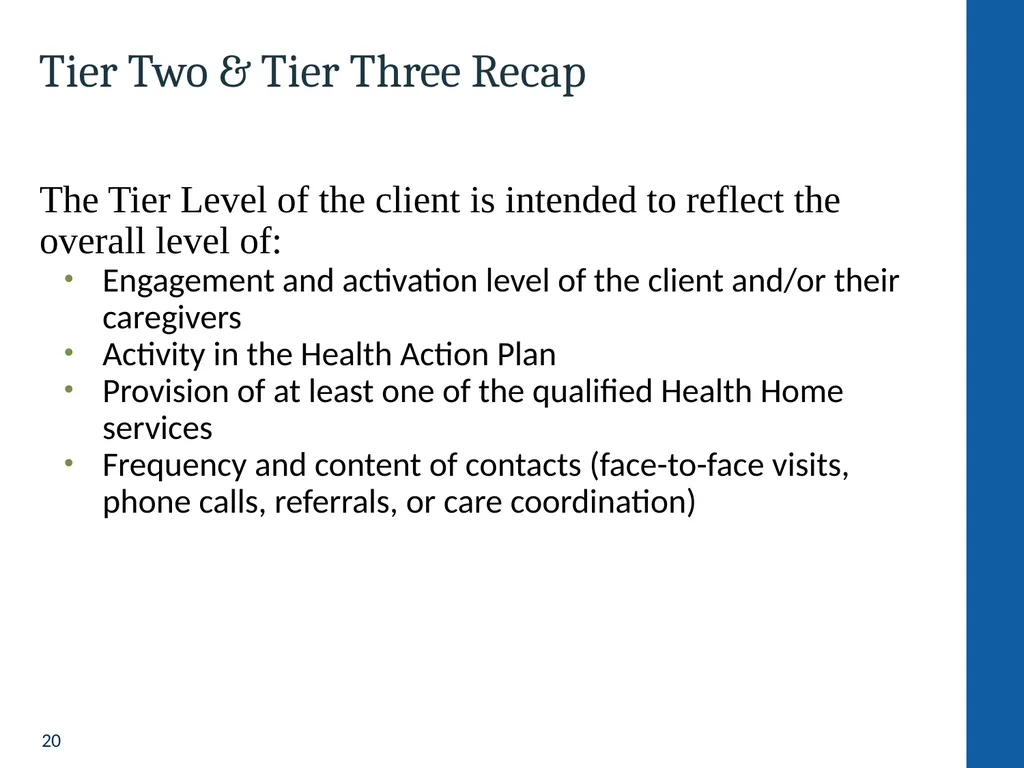
Tier Two & Tier Three Recap The Tier Level of the client is intended to reflect the overall level of:
Engagement and activation level of the client and/or their caregivers
Activity in the Health Action Plan
Provision of at least one of the qualified Health Home services
Frequency and content of contacts (face-to-face visits, phone calls, referrals, or care coordination)<br>
Engagement and activation level of the client and/or their caregivers
Activity in the Health Action Plan
Provision of at least one of the qualified Health Home services
Frequency and content of contacts (face-to-face visits, phone calls, referrals, or care coordination)<br>
21
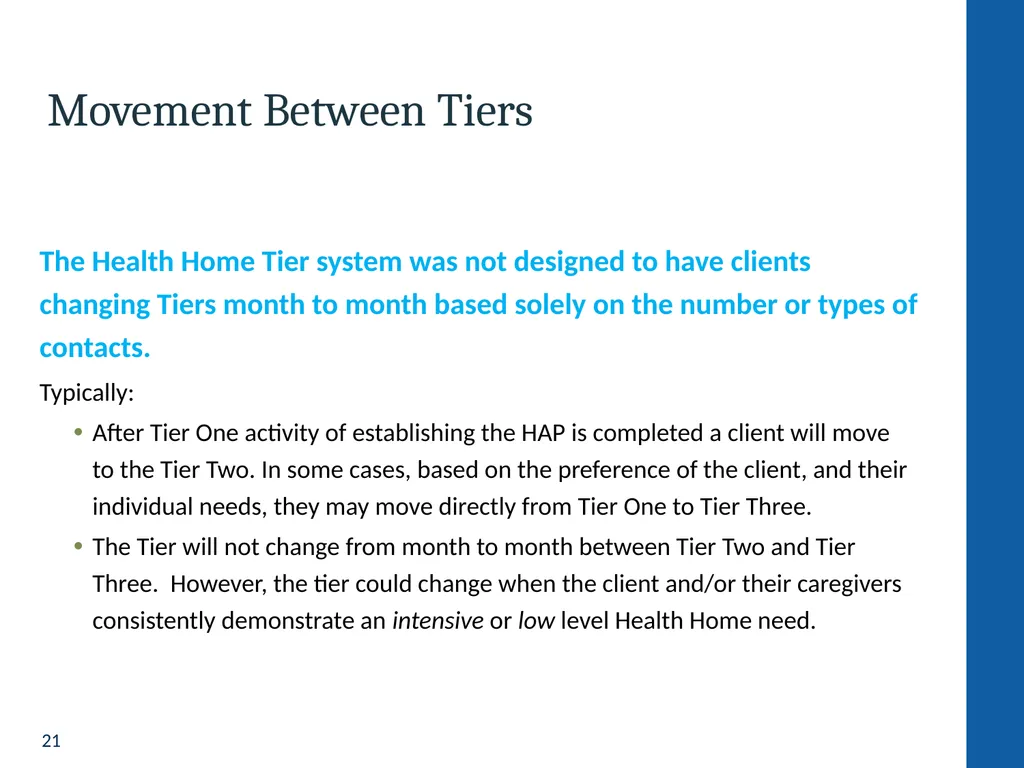
Movement Between Tiers The Health Home Tier system was not designed to have clients changing Tiers month to month based solely on the number or types of contacts.
Typically:
After Tier One activity of establishing the HAP is completed a client will move to the Tier Two. In some cases, based on the preference of the client, and their individual needs, they may move directly from Tier One to Tier Three.
The Tier will not change from month to month between Tier Two and Tier Three. However, the tier could change when the client and/or their caregivers consistently demonstrate an intensive or low level Health Home need.<br>
22
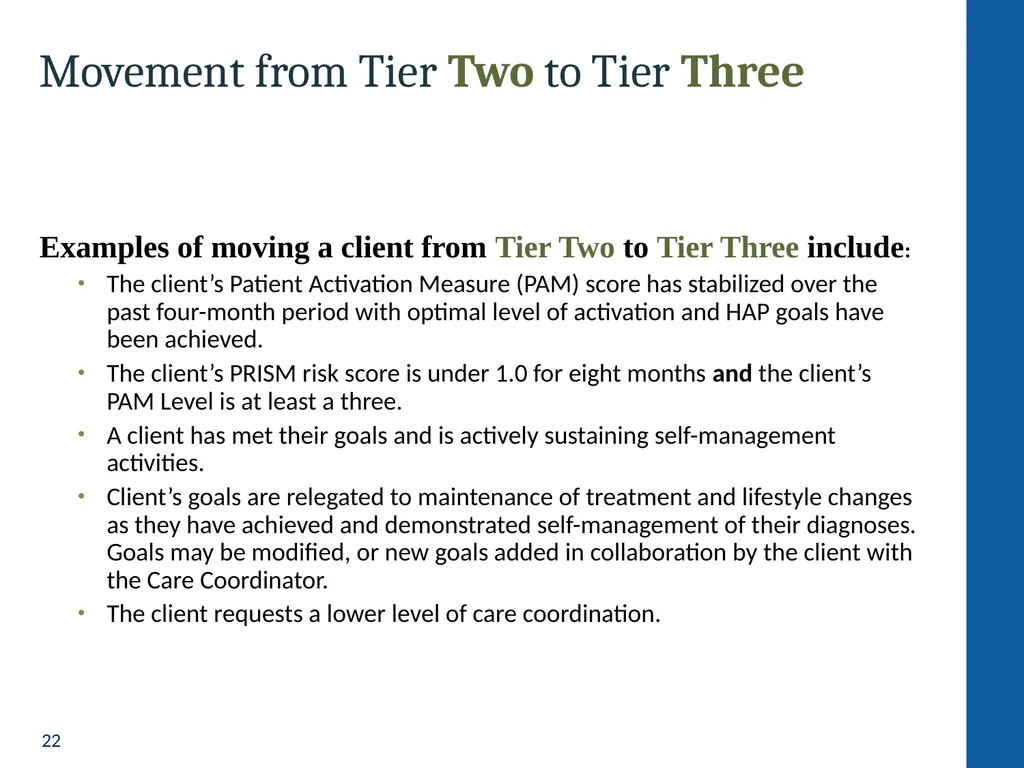
Movement from Tier Two to Tier Three Examples of moving a client from Tier Two to Tier Three include:
The client’s Patient Activation Measure (PAM) score has stabilized over the past four-month period with optimal level of activation and HAP goals have been achieved.
The client’s PRISM risk score is under 1.0 for eight months and the client’s PAM Level is at least a three.
A client has met their goals and is actively sustaining self-management activities.
Client’s goals are relegated to maintenance of treatment and lifestyle changes as they have achieved and demonstrated self-management of their diagnoses. Goals may be modified, or new goals added in collaboration by the client with the Care Coordinator.
The client requests a lower level of care coordination.<br>
23
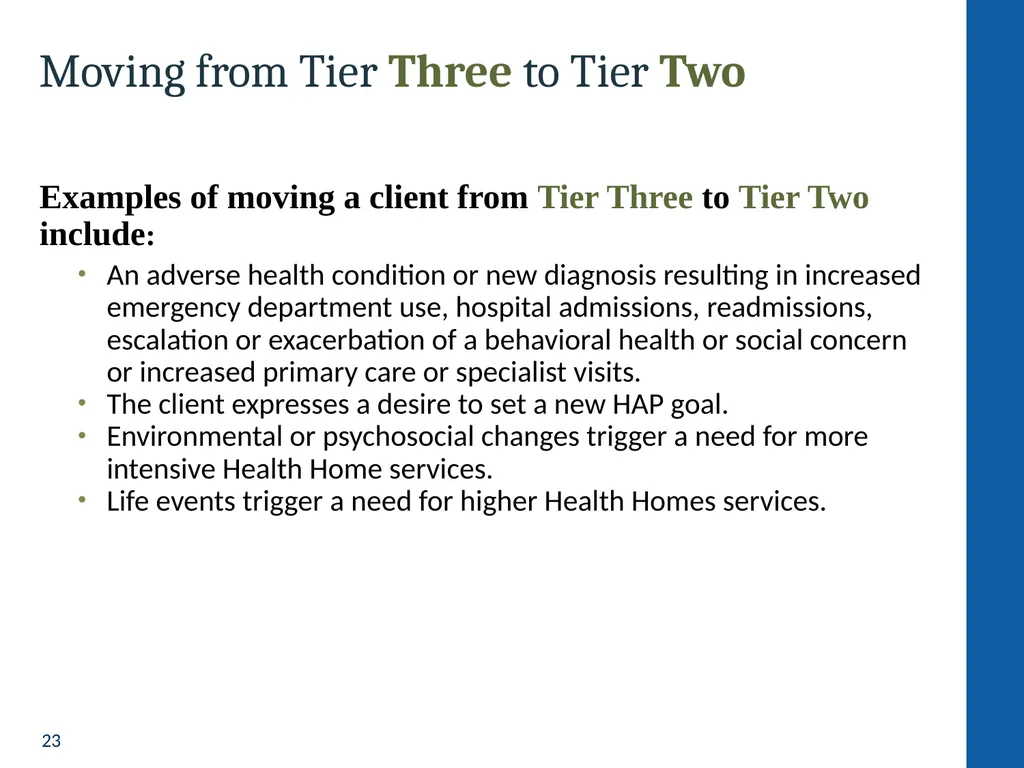
Moving from Tier Three to Tier Two Examples of moving a client from Tier Three to Tier Two include:
An adverse health condition or new diagnosis resulting in increased emergency department use, hospital admissions, readmissions, escalation or exacerbation of a behavioral health or social concern or increased primary care or specialist visits.
The client expresses a desire to set a new HAP goal.
Environmental or psychosocial changes trigger a need for more intensive Health Home services.
Life events trigger a need for higher Health Homes services.<br>
24
Let’s Pause to Check for Understanding Do you have any questions about the 3 payment tiers?<br>
25
Module 4 – PRISM
Predictive Risk Intelligence SysteM<br>
26
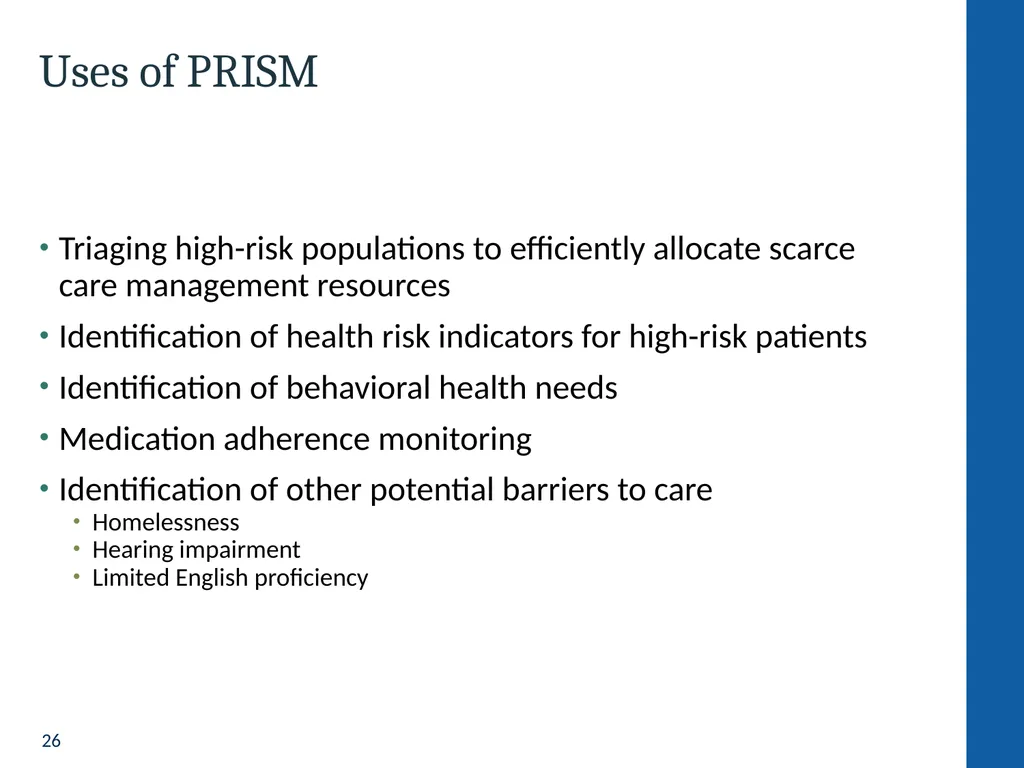
Uses of PRISM Triaging high-risk populations to efficiently allocate scarce care management resources
Identification of health risk indicators for high-risk patients
Identification of behavioral health needs
Medication adherence monitoring
Identification of other potential barriers to care
Homelessness
Hearing impairment
Limited English proficiency<br>
Identification of health risk indicators for high-risk patients
Identification of behavioral health needs
Medication adherence monitoring
Identification of other potential barriers to care
Homelessness
Hearing impairment
Limited English proficiency<br>
27
Uses of PRISM (cont.) Access to treating and prescribing provider contact information for care coordination
Creation of health summary reports to share with providers
Identification of care opportunities
Clients who need PCP
Clients receiving LTSS and who is the case manager
Other care opportunities<br>
Creation of health summary reports to share with providers
Identification of care opportunities
Clients who need PCP
Clients receiving LTSS and who is the case manager
Other care opportunities<br>
28
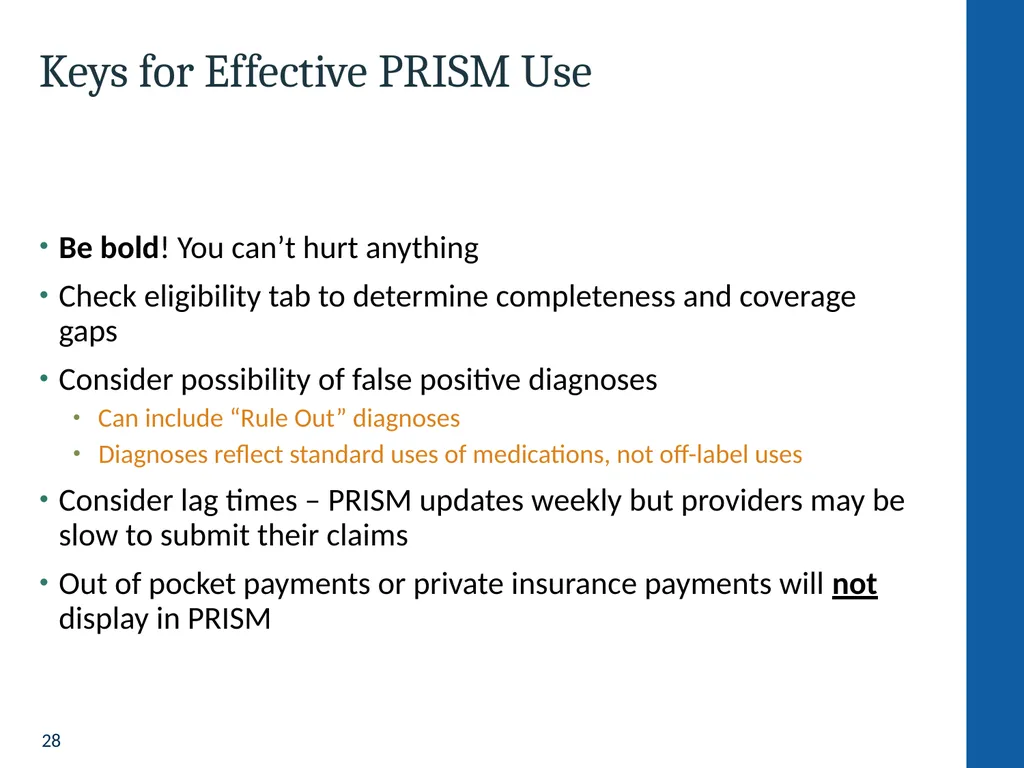
Keys for Effective PRISM Use Be bold! You can’t hurt anything
Check eligibility tab to determine completeness and coverage gaps
Consider possibility of false positive diagnoses
Can include “Rule Out” diagnoses
Diagnoses reflect standard uses of medications, not off-label uses
Consider lag times – PRISM updates weekly but providers may be slow to submit their claims
Out of pocket payments or private insurance payments will not display in PRISM<br>
29
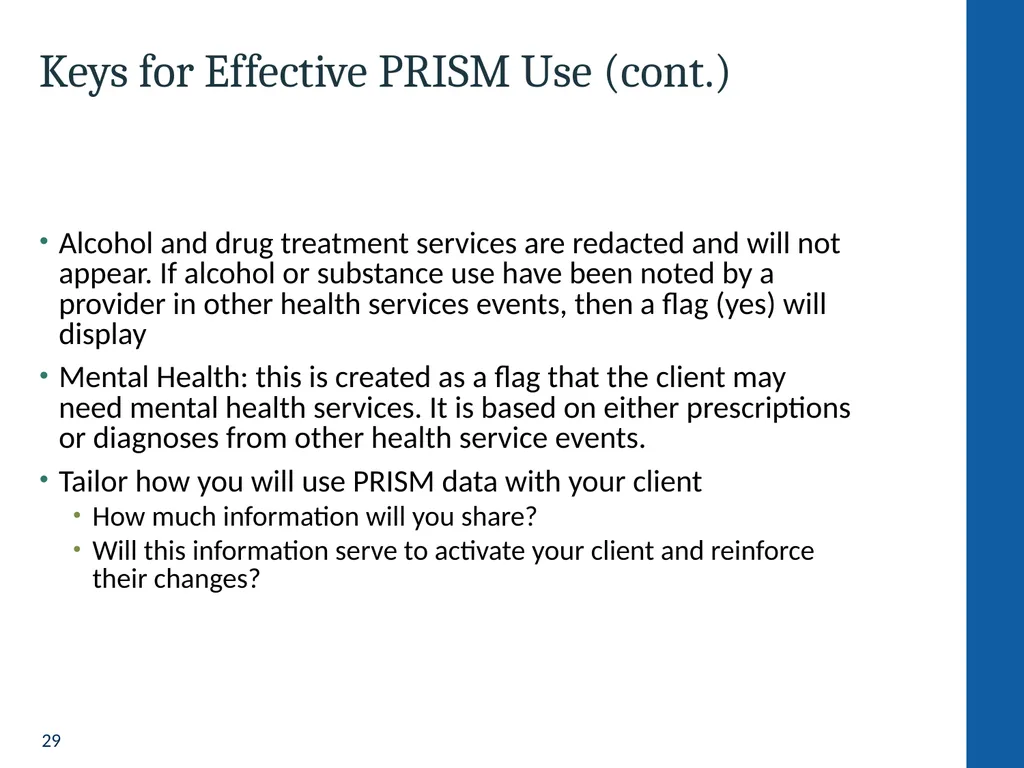
Keys for Effective PRISM Use (cont.) Alcohol and drug treatment services are redacted and will not appear. If alcohol or substance use have been noted by a provider in other health services events, then a flag (yes) will display
Mental Health: this is created as a flag that the client may need mental health services. It is based on either prescriptions or diagnoses from other health service events.
Tailor how you will use PRISM data with your client
How much information will you share?
Will this information serve to activate your client and reinforce their changes?<br>
30
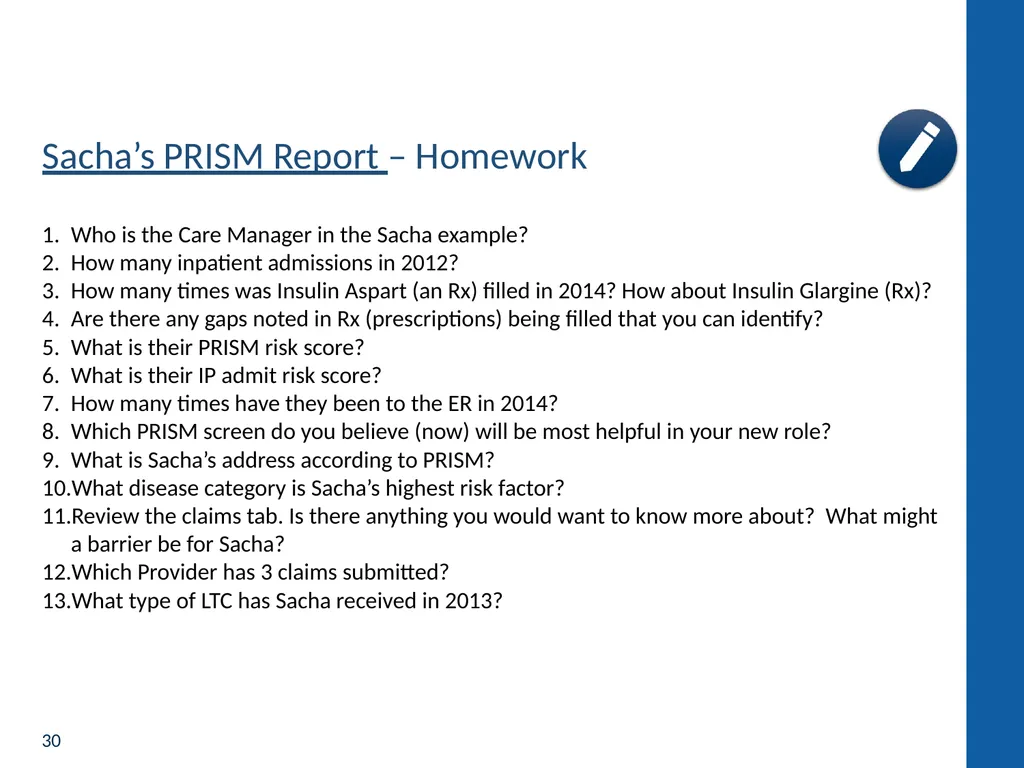
Sacha’s PRISM Report – Homework Who is the Care Manager in the Sacha example?
How many inpatient admissions in 2012?
How many times was Insulin Aspart (an Rx) filled in 2014? How about Insulin Glargine (Rx)?
Are there any gaps noted in Rx (prescriptions) being filled that you can identify?
What is their PRISM risk score?
What is their IP admit risk score?
How many times have they been to the ER in 2014?
Which PRISM screen do you believe (now) will be most helpful in your new role?
What is Sacha’s address according to PRISM?
What disease category is Sacha’s highest risk factor?
Review the claims tab. Is there anything you would want to know more about? What might a barrier be for Sacha?
Which Provider has 3 claims submitted?
What type of LTC has Sacha received in 2013?<br>
31
Let’s Pause to Check for Understanding Have you used PRISM in the past and what was your experience? How did you use the information about your client? Which screens did you find most helpful?
Do you have any questions?<br>
Do you have any questions?<br>
32
Module 5 – Outreach<br>
33
Client Outreach Using “smart assignment” the Lead will provide the CCO with a list of eligible clients
The Health Care Authority (HCA) will send Fee-for-Service clients the Health Home letter and “Your Washington State Health Home Booklet”
Lead Organizations that are Managed Care Organizations (MCO) will send their enrollment materials to their members
The Care Coordinator, support staff or Outreach Specialist will contact the client by phone or in person to schedule the first face-to-face visit TRAINING<br>
34
Let’s Pause to Check for Understanding What experiences have you had when you have initially contacted new clients in the past? What worked or didn’t work?
Do you have any questions?<br>
Do you have any questions?<br>
35
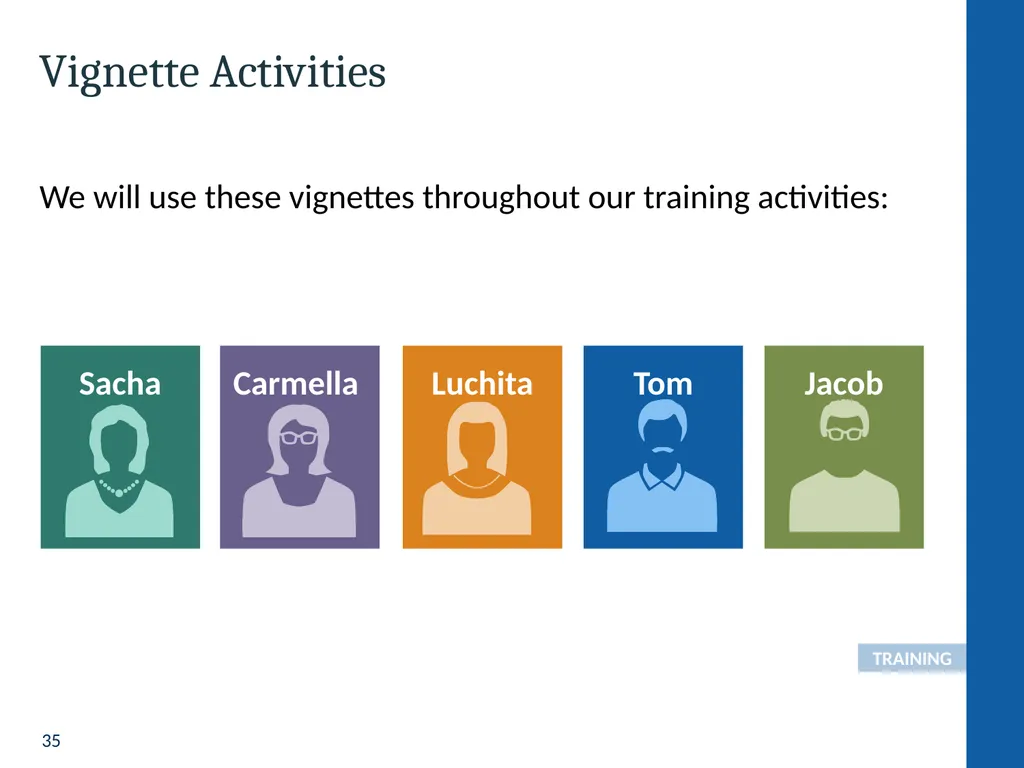
Vignette Activities We will use these vignettes throughout our training activities: Sacha Carmella Luchita Tom Jacob TRAINING<br>
36
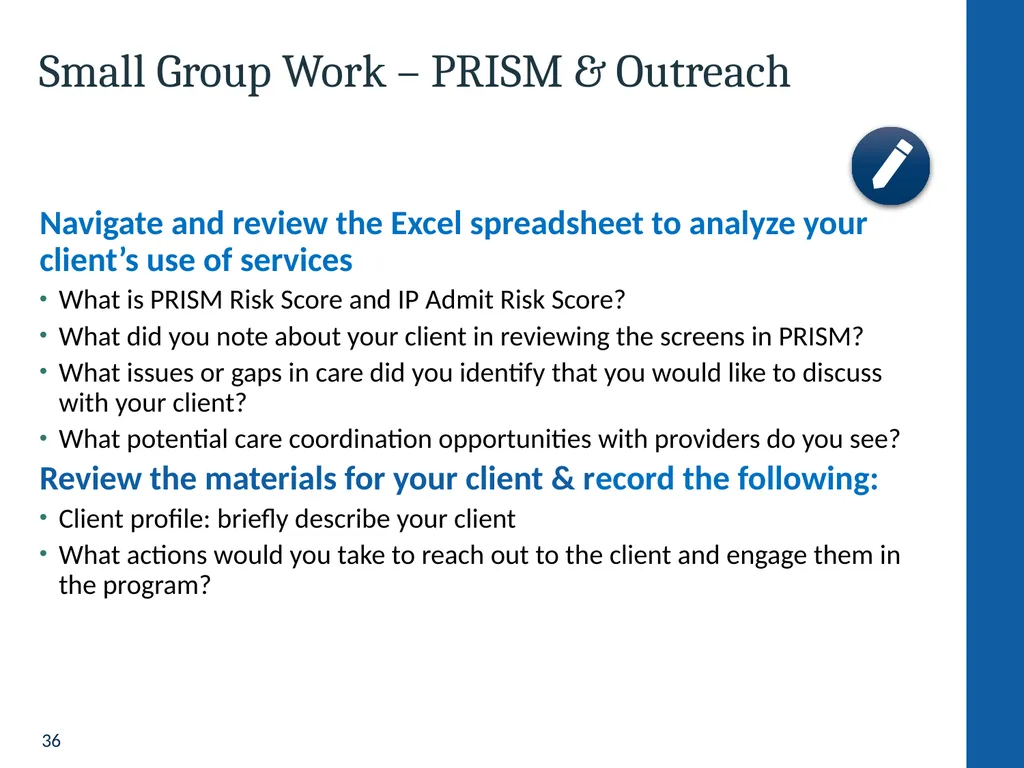
Small Group Work – PRISM & Outreach Navigate and review the Excel spreadsheet to analyze your client’s use of services
What is PRISM Risk Score and IP Admit Risk Score?
What did you note about your client in reviewing the screens in PRISM?
What issues or gaps in care did you identify that you would like to discuss with your client?
What potential care coordination opportunities with providers do you see?
Review the materials for your client & record the following:
Client profile: briefly describe your client
What actions would you take to reach out to the client and engage them in the program?<br>
37
Module 7 - Motivational Interviewing and SMART Goals<br>
38
The Spirit of Motivational Interviewing (MI) Empathic “way of being”
Collaborative – Partnership of experiences
Evocative – Draws out, elicit ideas, identifies barriers, and explores solutions
Encourages autonomy and provides support<br>
Collaborative – Partnership of experiences
Evocative – Draws out, elicit ideas, identifies barriers, and explores solutions
Encourages autonomy and provides support<br>
39
Engagement – Setting the Agenda Begin with an attitude of curiosity and a desire to
understand more
Learn how the client’s behaviors or concerns fit into the person’s situation or world view
Be transparent and communicate your intentions and purpose<br>
Learn how the client’s behaviors or concerns fit into the person’s situation or world view
Be transparent and communicate your intentions and purpose<br>
40
Motivational Interviewing Strategies Start with where the person is and try to understand
how the client understands their own situation
Be empathetic and ask open ended questions
Listen and do reflective listening
“It sounds like you are feeling…”
“So, you are saying that you believe…”<br>
Be empathetic and ask open ended questions
Listen and do reflective listening
“It sounds like you are feeling…”
“So, you are saying that you believe…”<br>
41
Motivational Interviewing Strategies (cont.) Express acceptance and affirmation of the client’s freedom of choice and self-direction
Elicit and selectively reinforce the client's own self motivational statements, expressions of problem recognition, concerns, desire, intention to change, and ability to change<br>
Elicit and selectively reinforce the client's own self motivational statements, expressions of problem recognition, concerns, desire, intention to change, and ability to change<br>
42
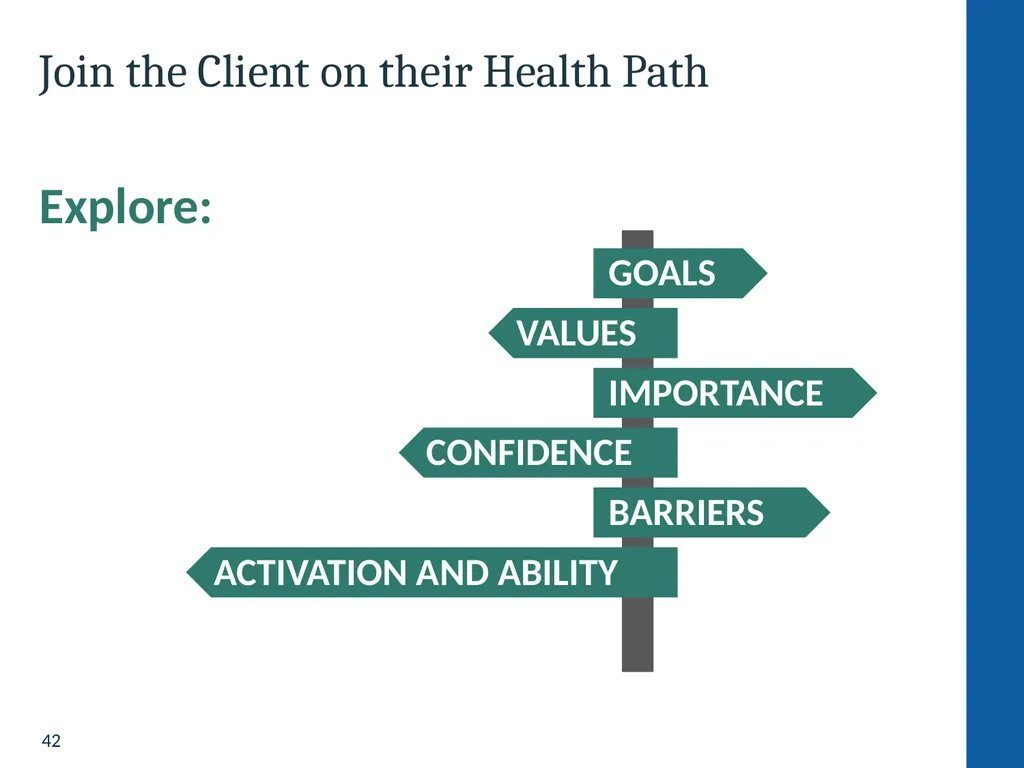
Join the Client on their Health Path Explore:<br>
43
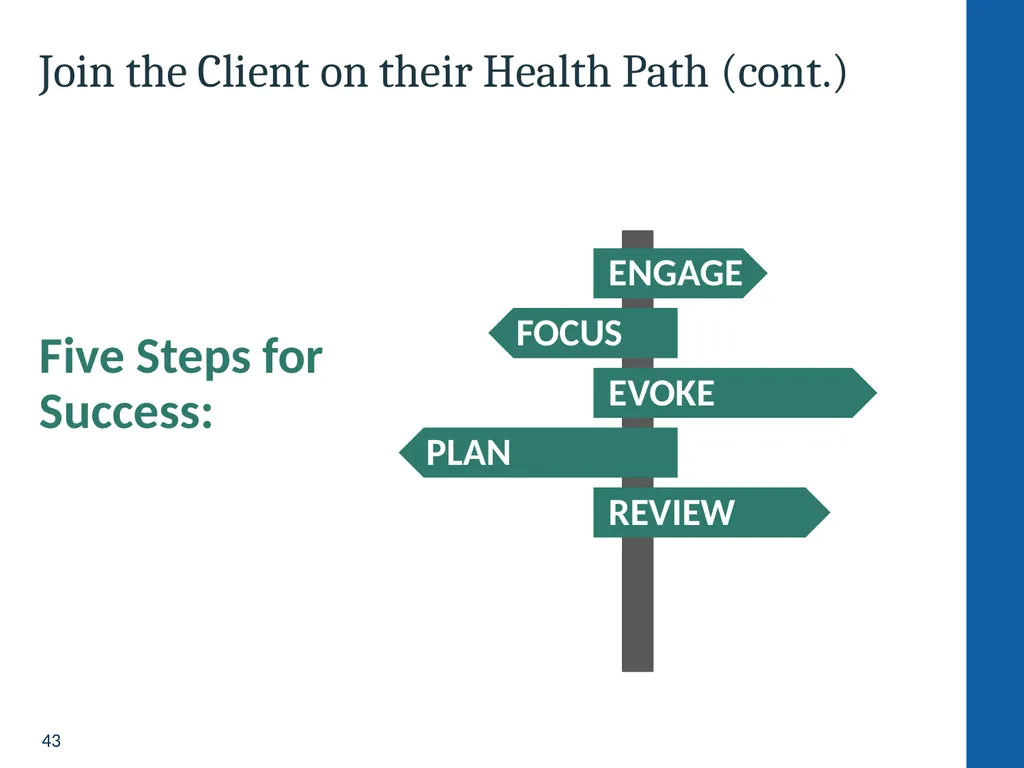
Join the Client on their Health Path (cont.) Five Steps for Success:<br>
44
The Patient Activation Measure® Coaching and Action Plan Development<br>
45
Review of the Patient Activation Measure® The PAM1 is a behavior measurement tool that
Reliably measures activation and the behaviors that underlie activation
Provides insight into how to improve unhealthy behaviors and grow/sustain healthy behaviors
Allows us to improve activation levels/behaviors, lower medical spending and improve health
1 All references to the Patient Activation Measure in this presentation are the property of Phreesia (copy and trademark). Parts of this presentation were adopted from Phreesia training materials.<br>
46
Types of PAMs Patient Activation Measure – PAM®
assesses the client’s activation level
Caregiver Activation Measure – CAM®
assesses the caregiver’s activation level in caring for their client
Parent Patient Activation Measure – PPAM®
assesses the parent’s activation level in caring for their child<br>
assesses the client’s activation level
Caregiver Activation Measure – CAM®
assesses the caregiver’s activation level in caring for their client
Parent Patient Activation Measure – PPAM®
assesses the parent’s activation level in caring for their child<br>
47
What is Client Activation? Having the knowledge, skills, emotional support, and belief to:
Self manage health
Collaborate with providers
Maintain function and prevent declines
Access appropriate high-quality care<br>
Self manage health
Collaborate with providers
Maintain function and prevent declines
Access appropriate high-quality care<br>
48
Administering the PAM Emphasize that the tool is a health survey
It is all about helping the client
It is neither used to judge nor reduce or deny any benefits<br>
It is all about helping the client
It is neither used to judge nor reduce or deny any benefits<br>
49
PAM 13 Question Survey Let’s review the 13 Patient Activation Measure Statements now<br>
50
Tips for Administering the Assessment Tool It does not require a face-to-face contact to complete
This survey can be administered over the telephone
It could be mailed and completed in advance of the first face-to-face visit
Check with your Lead regarding their policies related to administering this and other assessments<br>
This survey can be administered over the telephone
It could be mailed and completed in advance of the first face-to-face visit
Check with your Lead regarding their policies related to administering this and other assessments<br>
51
Tips for Administering the Assessment Tool (cont.) Some people do a better job completing it themselves
Consider asking the caregiver to complete a CAM if the client is unable to respond
If a client refuses offer again at a later date
You could provide a copy of the tool and ask the questions and record the answers
This is helpful for clients with limited reading ability<br>
Consider asking the caregiver to complete a CAM if the client is unable to respond
If a client refuses offer again at a later date
You could provide a copy of the tool and ask the questions and record the answers
This is helpful for clients with limited reading ability<br>
52
Tips for Administering the Assessment Tool
(cont.) Ask the client how much they agree or disagree with the
13 statements
Always start with strongly disagree to strongly agree
Always ask the questions in order
Do not change the questions
Statements become increasingly more difficult to agree with<br>
Always start with strongly disagree to strongly agree
Always ask the questions in order
Do not change the questions
Statements become increasingly more difficult to agree with<br>
53
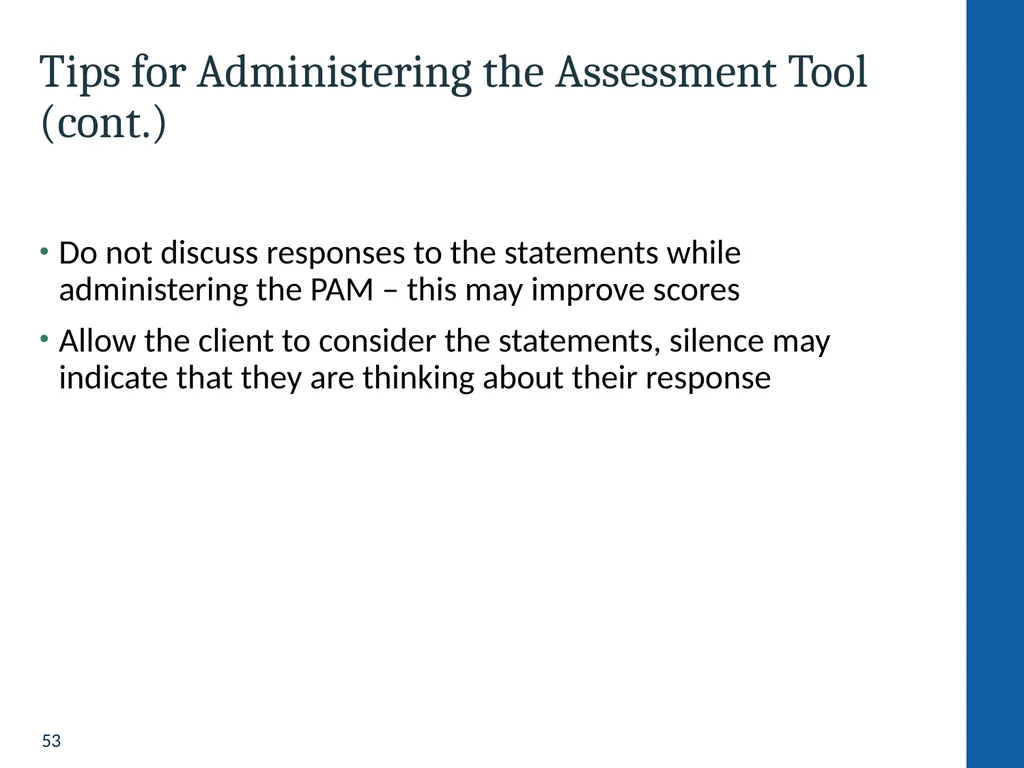
Tips for Administering the Assessment Tool (cont.) Do not discuss responses to the statements while administering the PAM – this may improve scores
Allow the client to consider the statements, silence may indicate that they are thinking about their response<br>
Allow the client to consider the statements, silence may indicate that they are thinking about their response<br>
54
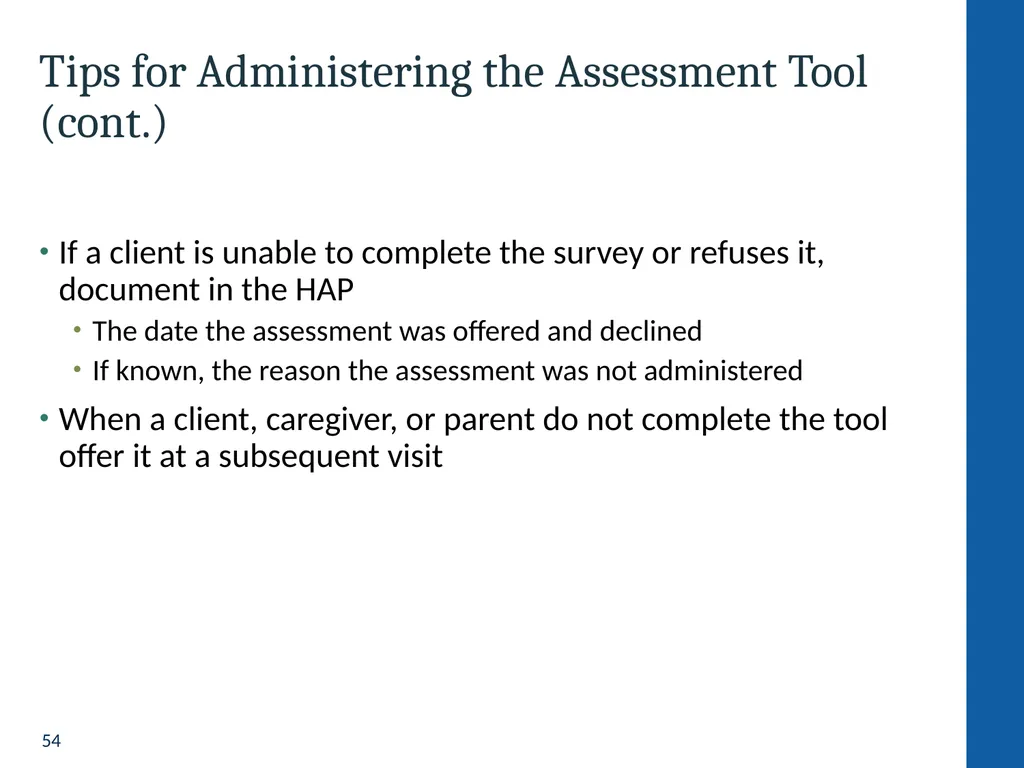
Tips for Administering the Assessment Tool (cont.) If a client is unable to complete the survey or refuses it, document in the HAP
The date the assessment was offered and declined
If known, the reason the assessment was not administered
When a client, caregiver, or parent do not complete the tool offer it at a subsequent visit<br>
The date the assessment was offered and declined
If known, the reason the assessment was not administered
When a client, caregiver, or parent do not complete the tool offer it at a subsequent visit<br>
55
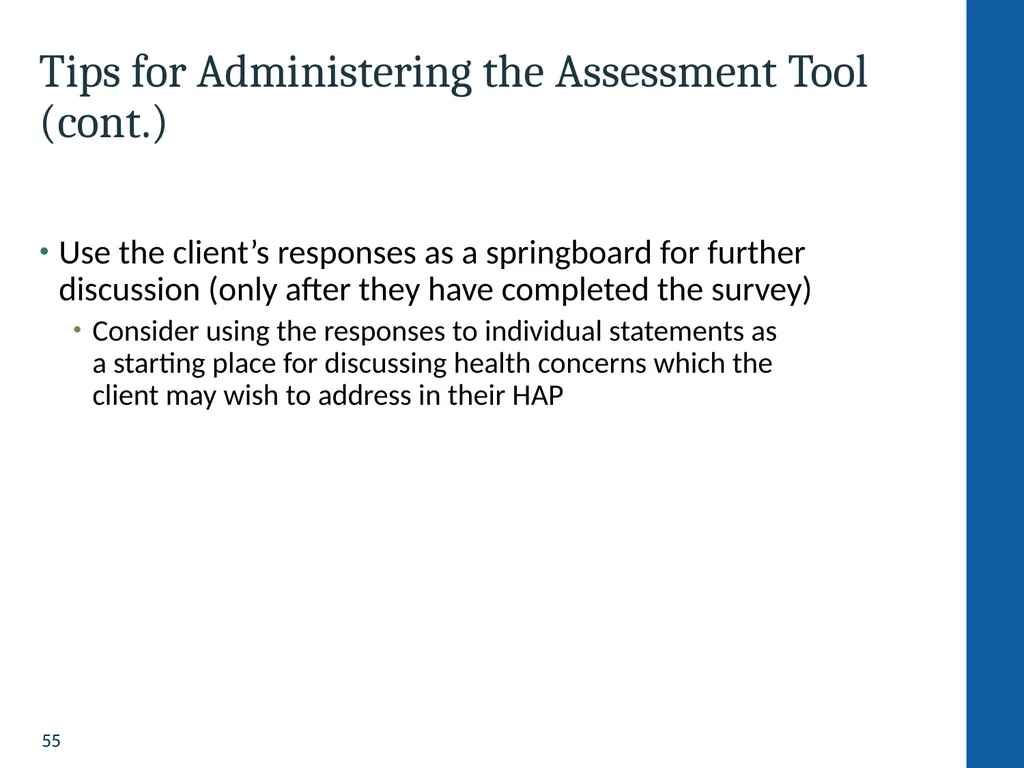
Tips for Administering the Assessment Tool (cont.) Use the client’s responses as a springboard for further discussion (only after they have completed the survey)
Consider using the responses to individual statements as a starting place for discussing health concerns which the client may wish to address in their HAP<br>
Consider using the responses to individual statements as a starting place for discussing health concerns which the client may wish to address in their HAP<br>
56
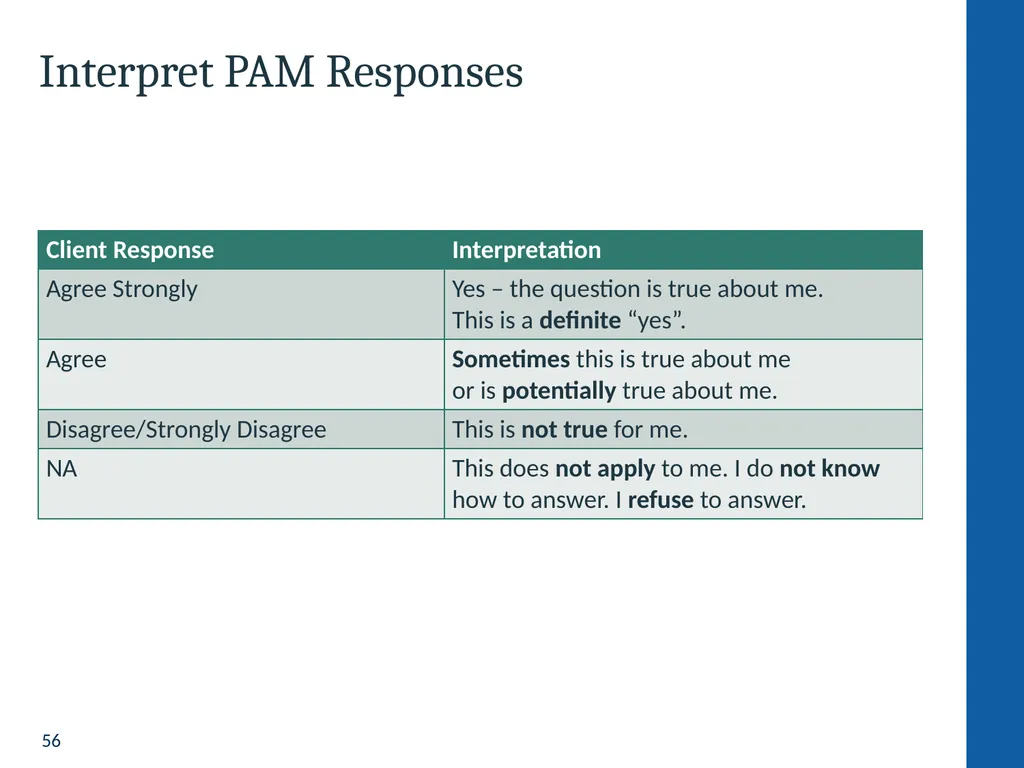
Interpret PAM Responses<br>
57
Scoring Scoring is the same for the PAM, CAM, and PPAM
Ask your Lead Organization for the scoring guide
Most Leads have software that will score the tool
The activation score is converted to an activation level<br>
Ask your Lead Organization for the scoring guide
Most Leads have software that will score the tool
The activation score is converted to an activation level<br>
58
PAM Segmentation Characteristics Level 1: Disengaged and overwhelmed
Starting to take a role. Clients do not yet grasp that they must plan to take an active role in their own health. They are disposed to being passive recipients of care.
Level 2: Becoming aware, but still struggling
Building knowledge and confidence. Clients lack the basic health related facts or have not connected these facts into larger understanding of their health or recommended health regimen.<br>
59
PAM Segmentation (cont.) Level 3: Taking action
Clients have the key facts and are beginning to take action but may lack confidence and the skill to support their behaviors.
Level 4: Maintaining behaviors and pushing further
Clients have adopted new behaviors but may not be able to maintain them in the face of stress or health changes.<br>
Clients have the key facts and are beginning to take action but may lack confidence and the skill to support their behaviors.
Level 4: Maintaining behaviors and pushing further
Clients have adopted new behaviors but may not be able to maintain them in the face of stress or health changes.<br>
60
PAM Segmentation Characteristics Roughly 45% to 50% of all Medicaid clients who have
completed the measure score at a Level 1 or Level 2
Level 1: Disengaged and overwhelmed
Level 2: Becoming aware, but still struggling
Review the client's activation score and level to tailor coaching that is appropriate to the client<br>
Level 1: Disengaged and overwhelmed
Level 2: Becoming aware, but still struggling
Review the client's activation score and level to tailor coaching that is appropriate to the client<br>
61
Elicit the Client’s Story Using Responses
to PAM Questions Select an item where their answers begin to move away
from strongly agree. Help the client discover:
What led them to select the response?
Why this level and not a lower level?
What would it take to reach the next level?
Is this something we could work on together?<br>
What led them to select the response?
Why this level and not a lower level?
What would it take to reach the next level?
Is this something we could work on together?<br>
62
Elicit the Client’s Story Using Responses
to PAM Questions (cont.) With self-reflection the client makes an assessment of:
What the problem is
What will have to happen to alter this assessment
How the Care Coordinator can coach the client to pursue behavioral changes<br>
What the problem is
What will have to happen to alter this assessment
How the Care Coordinator can coach the client to pursue behavioral changes<br>
63
Tailor Your Coaching Use responses to individual PAM items to get them to explain what is going on.
The client will make statements indicating what they think are the barriers or challenges.
Use perceived barriers to jointly problem solve throughout the coaching process.<br>
The client will make statements indicating what they think are the barriers or challenges.
Use perceived barriers to jointly problem solve throughout the coaching process.<br>
64
Analyze the Results Incorporating Motivational Interviewing Techniques Notice when your client begins to disagree or strongly disagree with the statements
This can be a good place to begin discussion about identifying areas where the client or representative may want to consider the type of goal they may be interested in pursuing
Consider using motivational interviewing techniques to draw the client or representative out<br>
This can be a good place to begin discussion about identifying areas where the client or representative may want to consider the type of goal they may be interested in pursuing
Consider using motivational interviewing techniques to draw the client or representative out<br>
65
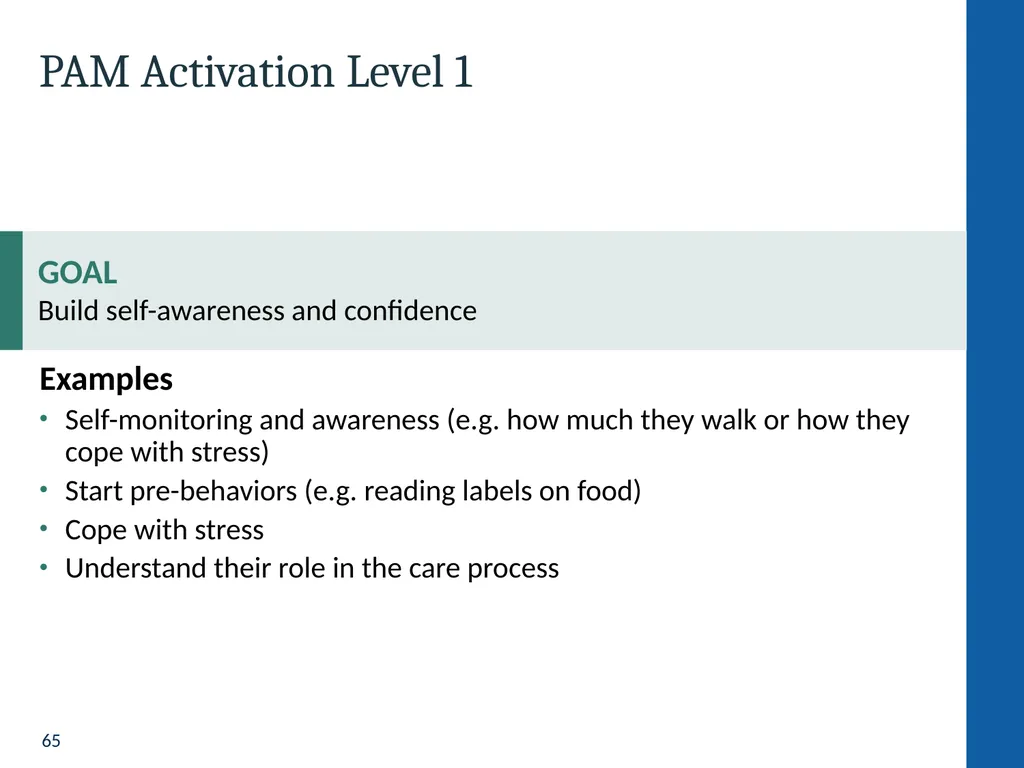
PAM Activation Level 1 Examples
Self-monitoring and awareness (e.g. how much they walk or how they cope with stress)
Start pre-behaviors (e.g. reading labels on food)
Cope with stress
Understand their role in the care process<br>
Self-monitoring and awareness (e.g. how much they walk or how they cope with stress)
Start pre-behaviors (e.g. reading labels on food)
Cope with stress
Understand their role in the care process<br>
66
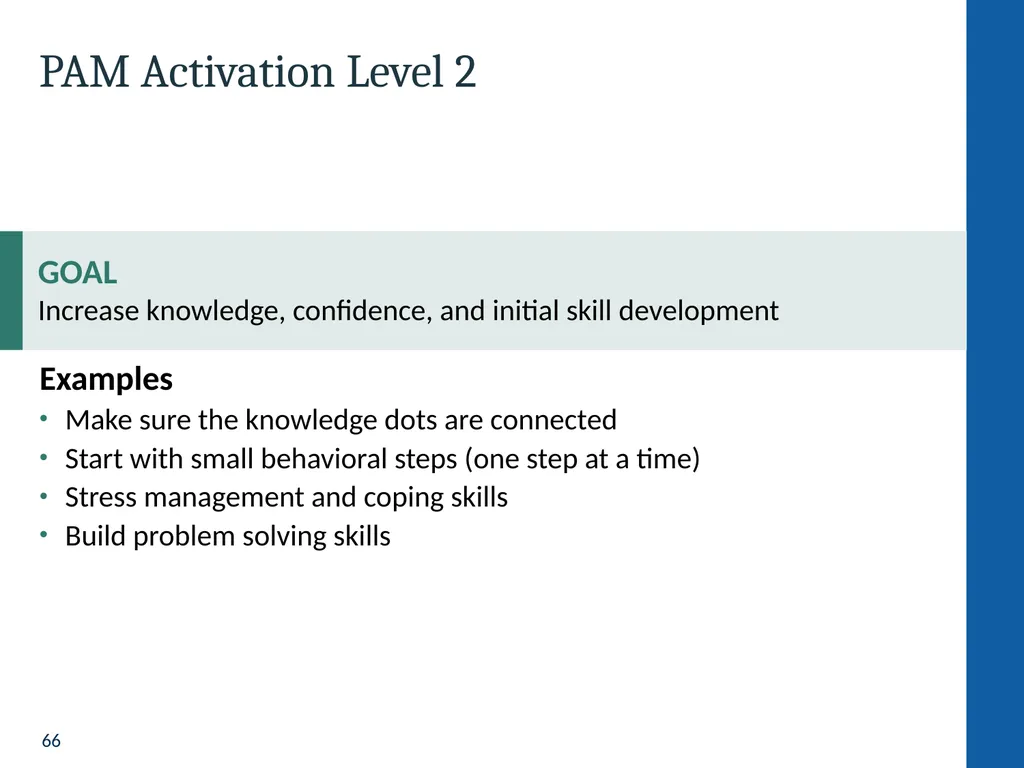
PAM Activation Level 2 Examples
Make sure the knowledge dots are connected
Start with small behavioral steps (one step at a time)
Stress management and coping skills
Build problem solving skills<br>
Make sure the knowledge dots are connected
Start with small behavioral steps (one step at a time)
Stress management and coping skills
Build problem solving skills<br>
67
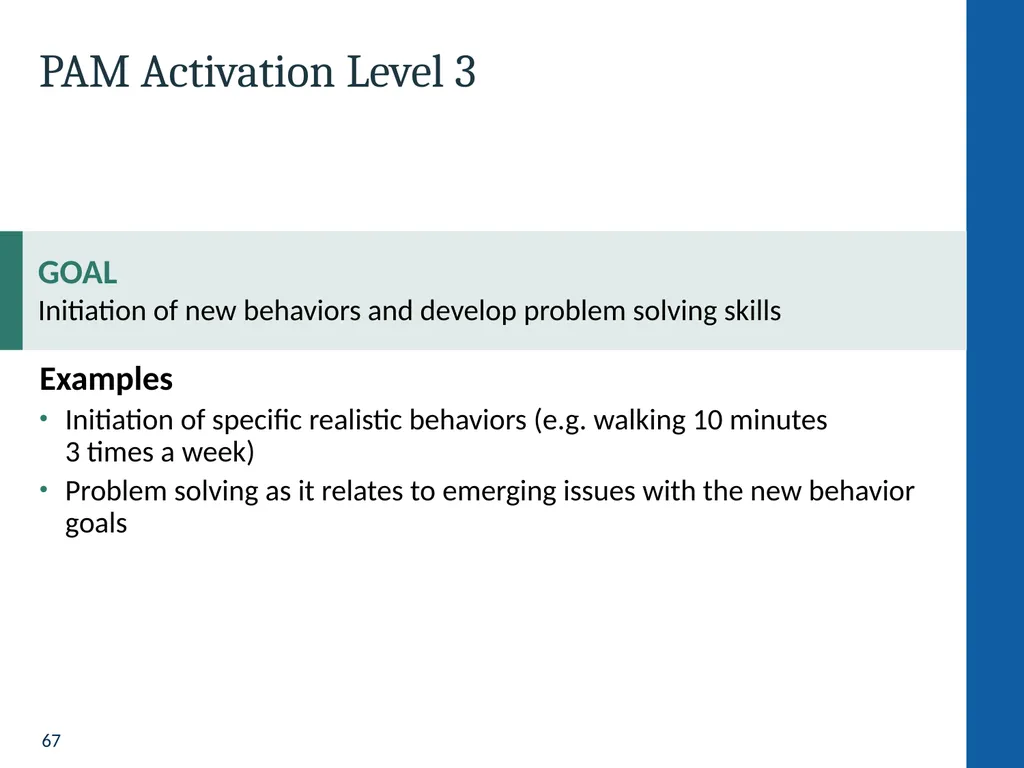
PAM Activation Level 3 Examples
Initiation of specific realistic behaviors (e.g. walking 10 minutes 3 times a week)
Problem solving as it relates to emerging issues with the new behavior goals<br>
Initiation of specific realistic behaviors (e.g. walking 10 minutes 3 times a week)
Problem solving as it relates to emerging issues with the new behavior goals<br>
68
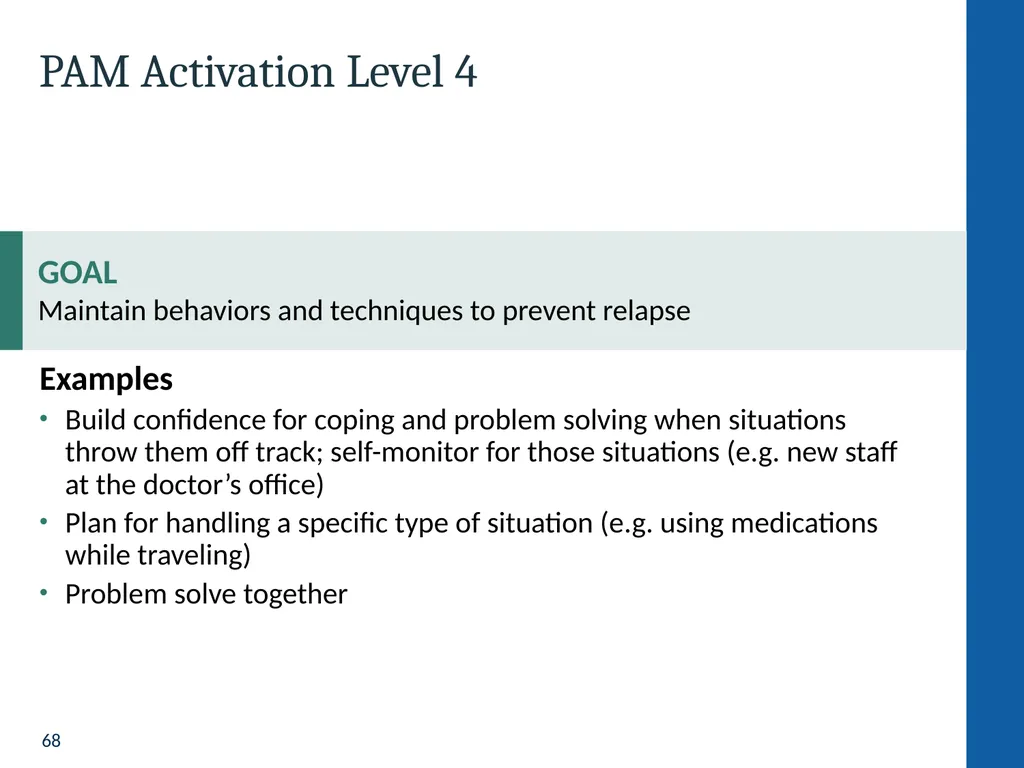
PAM Activation Level 4 Examples
Build confidence for coping and problem solving when situations throw them off track; self-monitor for those situations (e.g. new staff at the doctor’s office)
Plan for handling a specific type of situation (e.g. using medications while traveling)
Problem solve together<br>
Build confidence for coping and problem solving when situations throw them off track; self-monitor for those situations (e.g. new staff at the doctor’s office)
Plan for handling a specific type of situation (e.g. using medications while traveling)
Problem solve together<br>
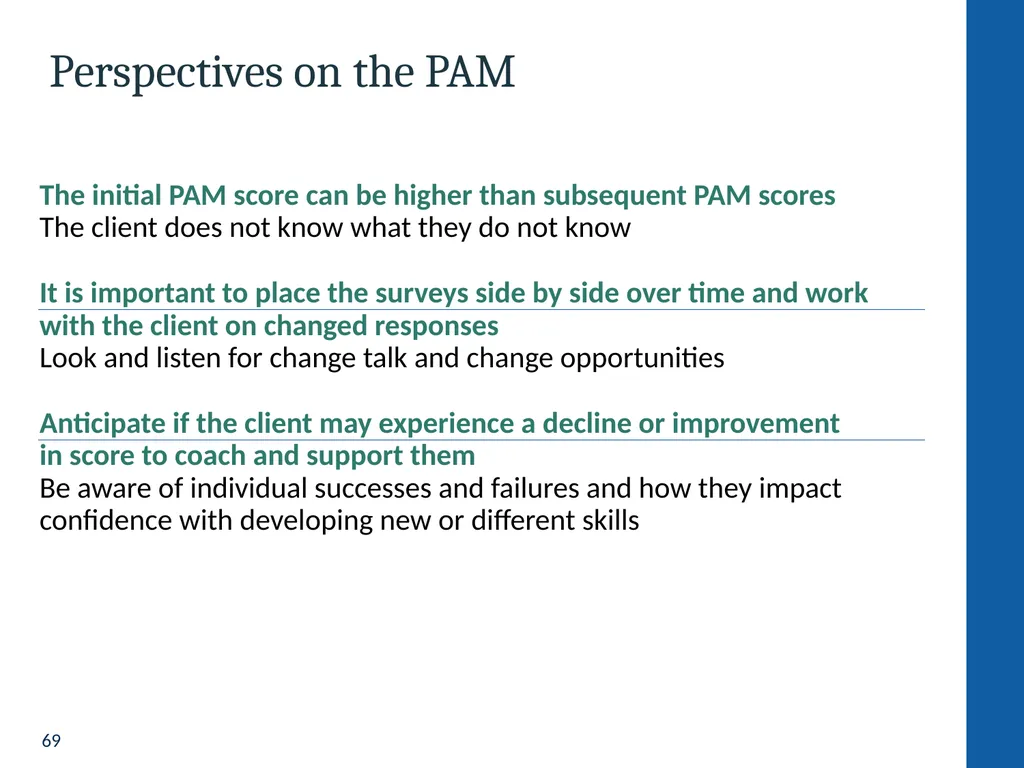
69
Perspectives on the PAM The initial PAM score can be higher than subsequent PAM scores
The client does not know what they do not know
It is important to place the surveys side by side over time and work with the client on changed responses Look and listen for change talk and change opportunities
Anticipate if the client may experience a decline or improvement in score to coach and support them Be aware of individual successes and failures and how they impact confidence with developing new or different skills<br>
70
Where Do I Get Copies of the Tools? Lead Organizations are required to purchase a license for these products through Phreesia
For copies of the PAM, PPAM and CAM, the translated tools and scoring guide contact your Lead to get Phreesia’s:
Website address
User name
Password<br>
For copies of the PAM, PPAM and CAM, the translated tools and scoring guide contact your Lead to get Phreesia’s:
Website address
User name
Password<br>
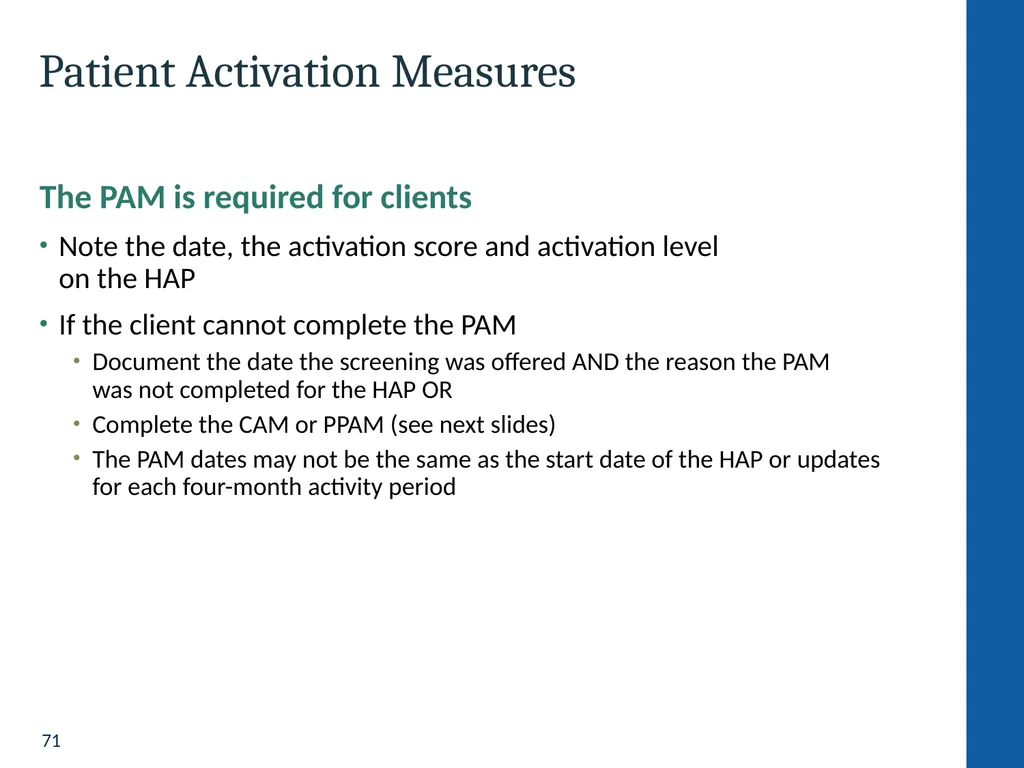
71
Patient Activation Measures The PAM is required for clients
Note the date, the activation score and activation level on the HAP
If the client cannot complete the PAM
Document the date the screening was offered AND the reason the PAM was not completed for the HAP OR
Complete the CAM or PPAM (see next slides)
The PAM dates may not be the same as the start date of the HAP or updates for each four-month activity period<br>
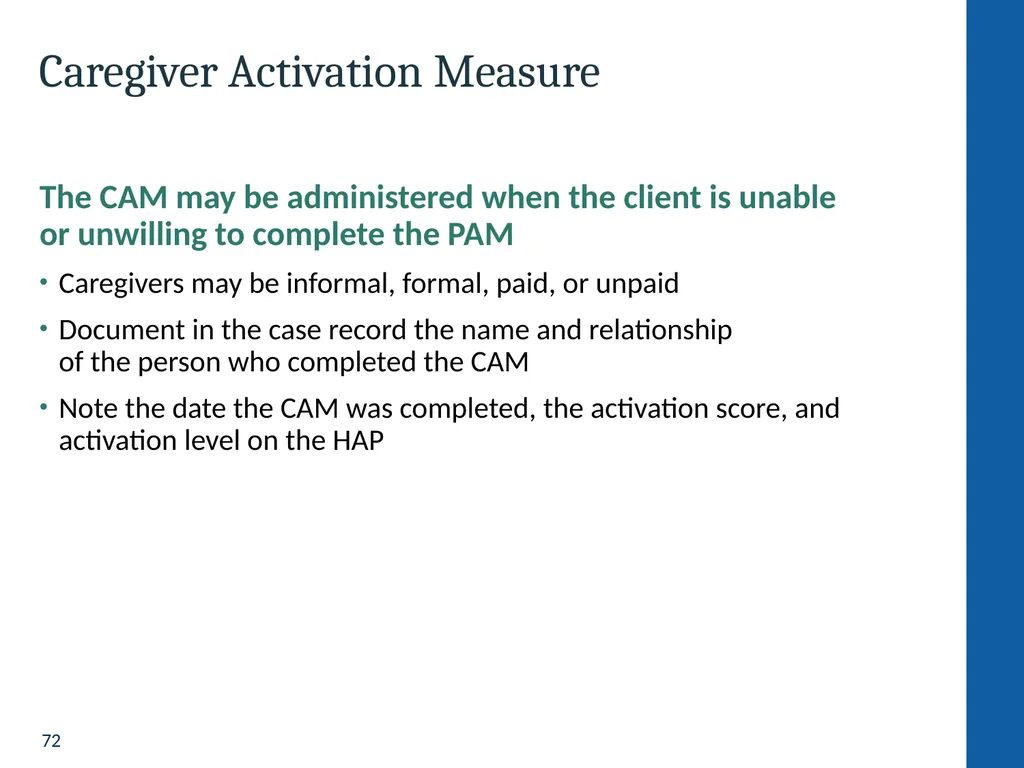
72
Caregiver Activation Measure The CAM may be administered when the client is unable
or unwilling to complete the PAM
Caregivers may be informal, formal, paid, or unpaid
Document in the case record the name and relationship of the person who completed the CAM
Note the date the CAM was completed, the activation score, and activation level on the HAP<br>
Caregivers may be informal, formal, paid, or unpaid
Document in the case record the name and relationship of the person who completed the CAM
Note the date the CAM was completed, the activation score, and activation level on the HAP<br>
73
Parent Patient Activation Measure The PPAM must be administered to the parent or guardian
of children under the age of 18 years
Parents include: biological, adoptive, or foster
Note the date the PPAM was completed, the activation score and activation level on the HAP
Document in the case record the name and relationship of the person who completed the PPAM
If the parent or guardian declines to complete the PPAM document the date the assessment was offered and the reason the parent/guardian did not complete the screening<br>
74
PAM® Small Group Work What is the PAM® score for your client?
What is the client’s or parent’s Level of Activation?
What did you note about his/her responses to the PAM/PPAM®?
If available should the caregiver complete the CAM®?
How would you begin to work with your client in relation to their responses and Level of Activation?<br>
What is the client’s or parent’s Level of Activation?
What did you note about his/her responses to the PAM/PPAM®?
If available should the caregiver complete the CAM®?
How would you begin to work with your client in relation to their responses and Level of Activation?<br>
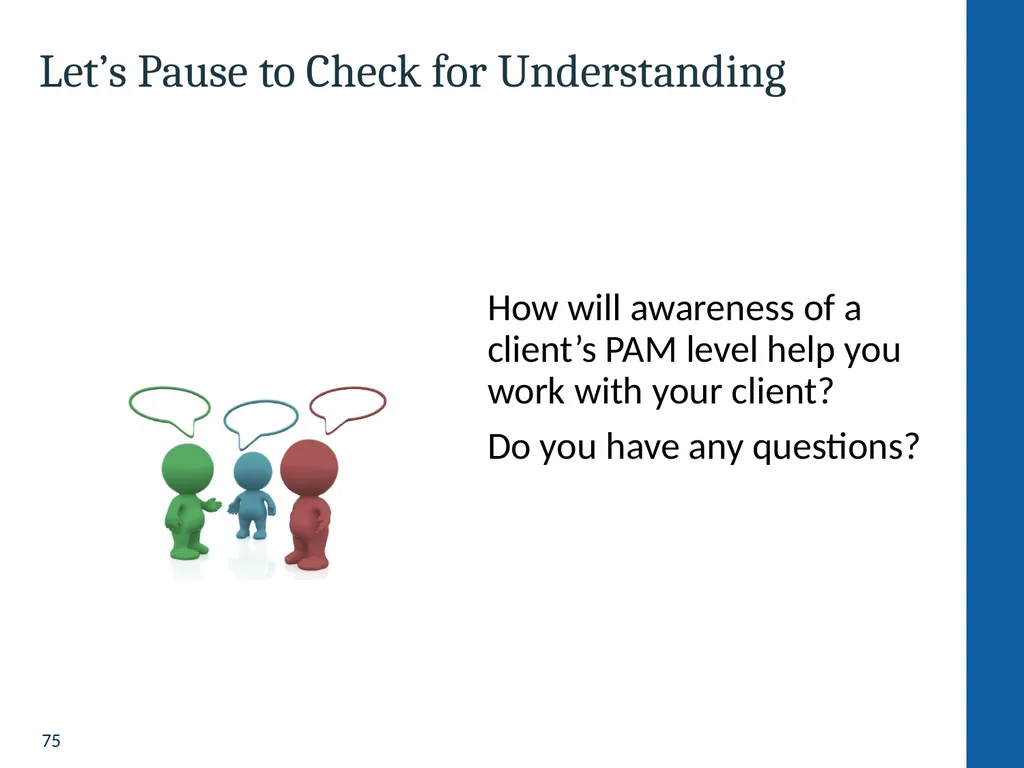
75
Let’s Pause to Check for Understanding How will awareness of a client’s PAM level help you work with your client?
Do you have any questions?<br>
Do you have any questions?<br>
76
Moving Toward Health Action Planning Consider the client’s responses by reviewing and discussing the activation measure results
Responses may provide a clue as to changes the client would like to make
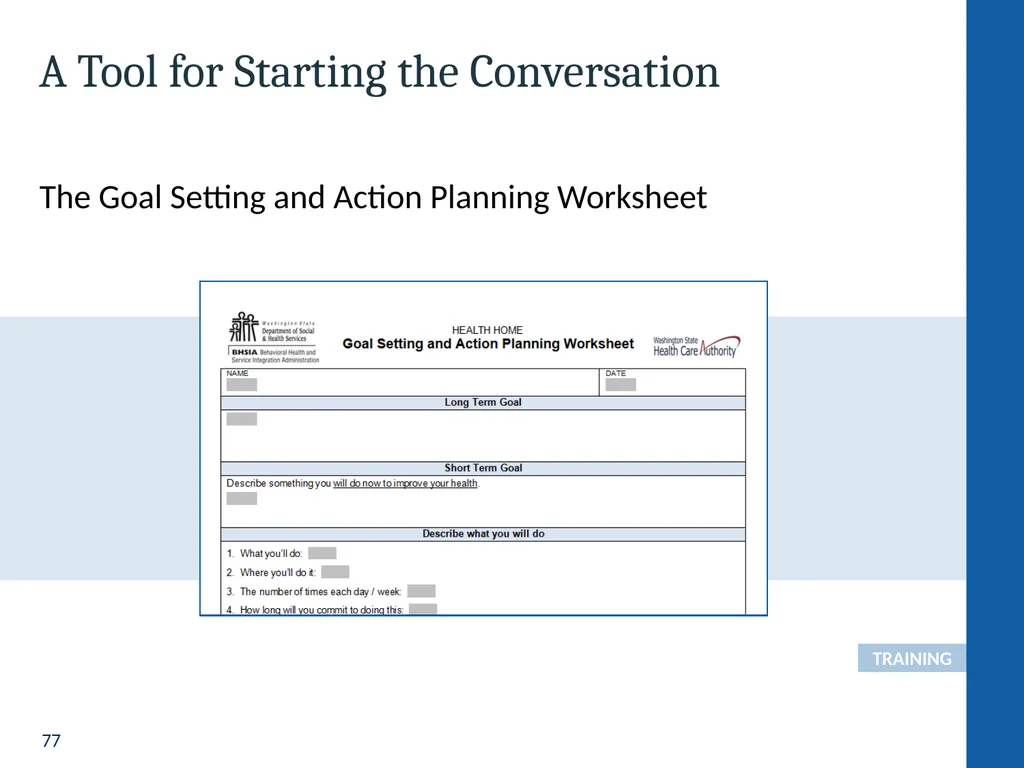
Consider using the Goal Setting and Action Planning Worksheet<br>
Responses may provide a clue as to changes the client would like to make
Consider using the Goal Setting and Action Planning Worksheet<br>
77
A Tool for Starting the Conversation The Goal Setting and Action Planning Worksheet TRAINING<br>
78
Coaching and Action Planning Goal Setting and Action Planning Worksheet
Start where the client is
Determine what the client wants to change
The action plan is negotiated and tied to the discussion about the level of activation<br>
Start where the client is
Determine what the client wants to change
The action plan is negotiated and tied to the discussion about the level of activation<br>
79
Coaching and Action Planning (cont.) Goal Setting and Action Planning Worksheet
The action plan is something achievable given the client's level of activation
At Levels 1 and 2 action plans focus on knowledge, belief, awareness and pre-behaviors
At Levels 3 and 4 action plans focus on the initiation of new behaviors and maintaining behaviors<br>
The action plan is something achievable given the client's level of activation
At Levels 1 and 2 action plans focus on knowledge, belief, awareness and pre-behaviors
At Levels 3 and 4 action plans focus on the initiation of new behaviors and maintaining behaviors<br>
80
Developing an Action Plan Coach the client to select the Action Steps with the least number of barriers and prioritize them
Save the list of Action Steps so alternatives can be tried if the first ones are not successful; reassure client that many problems are not easily solved and may take time and multiple approaches<br>
Save the list of Action Steps so alternatives can be tried if the first ones are not successful; reassure client that many problems are not easily solved and may take time and multiple approaches<br>
81
Develop Action Steps Describe
What the client has agreed to do
What the Care Coordinator has agreed to do
Where they will do it
How often(each day/week)?
For how long?<br>
What the client has agreed to do
What the Care Coordinator has agreed to do
Where they will do it
How often(each day/week)?
For how long?<br>
82
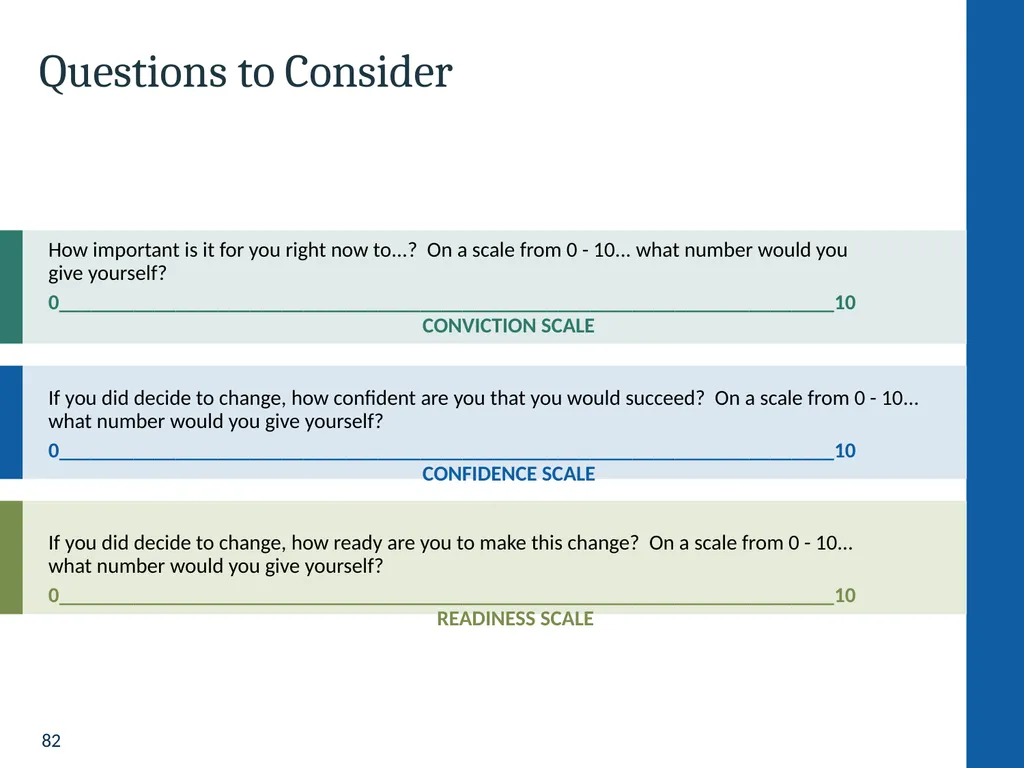
Questions to Consider How important is it for you right now to...? On a scale from 0 - 10... what number would you
give yourself?
0_________________________________________________________________________10 CONVICTION SCALE
If you did decide to change, how confident are you that you would succeed? On a scale from 0 - 10... what number would you give yourself?
0_________________________________________________________________________10 CONFIDENCE SCALE
If you did decide to change, how ready are you to make this change? On a scale from 0 - 10... what number would you give yourself?
0_________________________________________________________________________10 READINESS SCALE<br>
83
Coaching and the Health Action Plan Use a coaching for activation approach to guide the client to:
Appropriate choices
Attainable goals
Action steps
Improved health<br>
Appropriate choices
Attainable goals
Action steps
Improved health<br>
84
The Health Action Plan (HAP) Establishes:
Client and Care Coordinator identified:
Long term goal
Short term goal/s
Action steps<br>
Client and Care Coordinator identified:
Long term goal
Short term goal/s
Action steps<br>
85
Key Skills for Health Action Planning Demonstrate positive belief in the client’s ability to take an active role to accomplish appropriate goals and action steps
Emphasize stress management, coping and resiliency skills
Ask the client to recall a former success: How did it feel?<br>
Emphasize stress management, coping and resiliency skills
Ask the client to recall a former success: How did it feel?<br>
86
Key Skills for Health Action Planning (cont.) Elicit the client’s story
Build rapport
Obtain a behavioral history, including past attempts to change behavior
Identify barriers
Use open-ended questions
Focus on feelings
Use reflections<br>
Build rapport
Obtain a behavioral history, including past attempts to change behavior
Identify barriers
Use open-ended questions
Focus on feelings
Use reflections<br>
87
Analyze! What do you think drives poor health and high costs
for your client?
85% of avoidable costs are due to behavioral, not medical factors
Consider:
Client’s perspective
Results from assessment and screening tools
PRISM Risk Factors
Client’s Level of Activation<br>
85% of avoidable costs are due to behavioral, not medical factors
Consider:
Client’s perspective
Results from assessment and screening tools
PRISM Risk Factors
Client’s Level of Activation<br>
88
Use Active and Reflective Listening Assure them that you can see their point of view
Acknowledge the struggles or difficulty involved
Acknowledge their successes, skills, abilities, and strengths
Thoughts
Beliefs and values - link these values to their long term goals, short term goals, and action steps
Behaviors
Use you statements – strength-based approach
“You sound determined.”<br>
89
Emphasize Problem Solving A Health Action Plan requires addressing problems through “action steps”
Adults learn best by “doing” rather than through reading materials or hearing information
Working through a problem using health coaching increases and enhances retention
Identify their capacity for change and self-efficacy<br>
Adults learn best by “doing” rather than through reading materials or hearing information
Working through a problem using health coaching increases and enhances retention
Identify their capacity for change and self-efficacy<br>
90
Identify Barriers to Change Ambivalence?
Understanding?
Support system?
Energy levels/sleep quality/pain?
Depression?
Health literacy?
Financial?
Confidence?
Social isolation?<br>
Understanding?
Support system?
Energy levels/sleep quality/pain?
Depression?
Health literacy?
Financial?
Confidence?
Social isolation?<br>
91
Explore Possible Solutions ASK the client to review possible solutions, but not make a decision
just yet…
ASK the client to identify possible solutions, “do you have any ideas on how you could solve this problem?”
ASK the client if they would like you to share your thoughts and/or provide ideas using Health Home resources.
ASK the client if they would like you to provide additional health education information. If so, review and discuss the information with them at the next visit.<br>
92
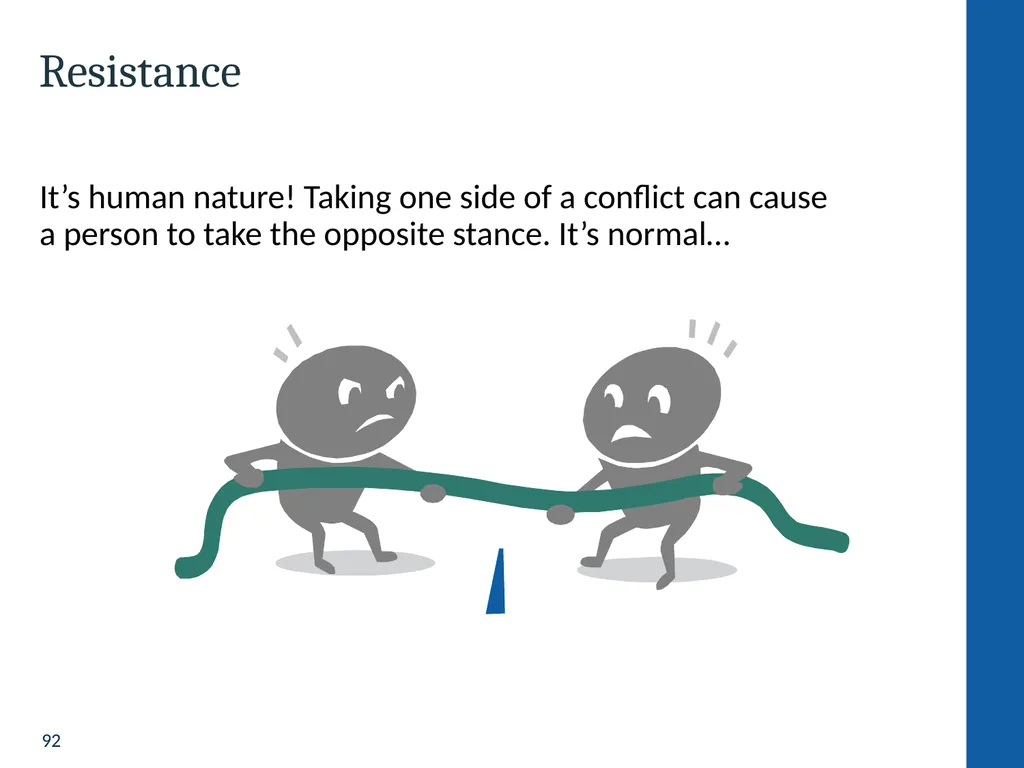
Resistance It’s human nature! Taking one side of a conflict can cause
a person to take the opposite stance. It’s normal…<br>
93
Behavioral Change Trying to convince another person to make a behavior
change can actually cause the person to be less likely
to make a change.
Even if you are successful in convincing someone to make a behavioral change, the change is not likely to last.<br>
Even if you are successful in convincing someone to make a behavioral change, the change is not likely to last.<br>
94
Resist the Righting Reflex Exercise Speaker
Share your thoughts and feelings about a behavioral change you have thought about making or a change you previously made but are having trouble maintaining
Listener
Ask open-ended questions
No closed-end questions
Neither agree nor disagree
Avoid sharing your opinions or experiences Pair up and take turns as the speaker and the listener<br>
95
How Did It Go? What was it like to be the listener… did you want to interject your experiences or thoughts?
Were there times when you wanted to jump in and offer advice or “fix it”?
What was it like for you as the speaker… did you feel understood?
How did it feel to have someone place all of their focus on you and your concerns for even 5 minutes?
What did you learn from this interaction about your own style?<br>
96
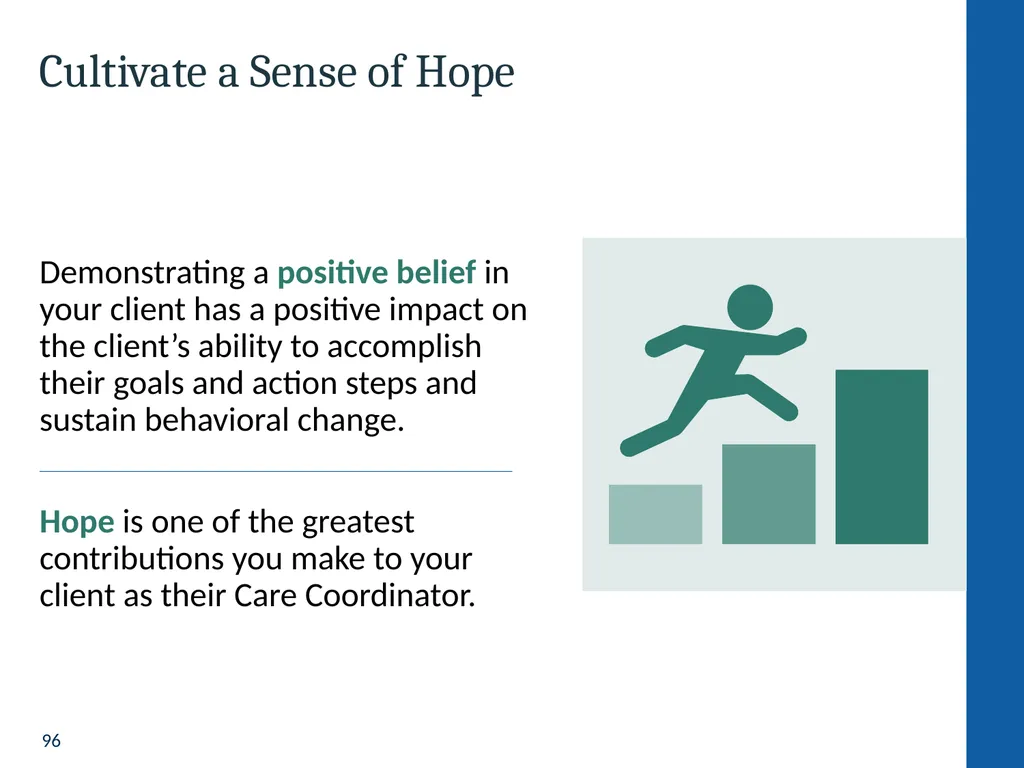
Cultivate a Sense of Hope Demonstrating a positive belief in your client has a positive impact on the client’s ability to accomplish their goals and action steps and sustain behavioral change.
Hope is one of the greatest contributions you make to your client as their Care Coordinator.<br>
Hope is one of the greatest contributions you make to your client as their Care Coordinator.<br>
97
Let’s Pause to Check for Understanding How is the role of a Care Coordinator different than those you have had in the past?
What benefits do you see for your clients who engage in the program?
Do you have any questions about what we covered?<br>
What benefits do you see for your clients who engage in the program?
Do you have any questions about what we covered?<br>
98
Learning Module 6 - HAP<br>
99
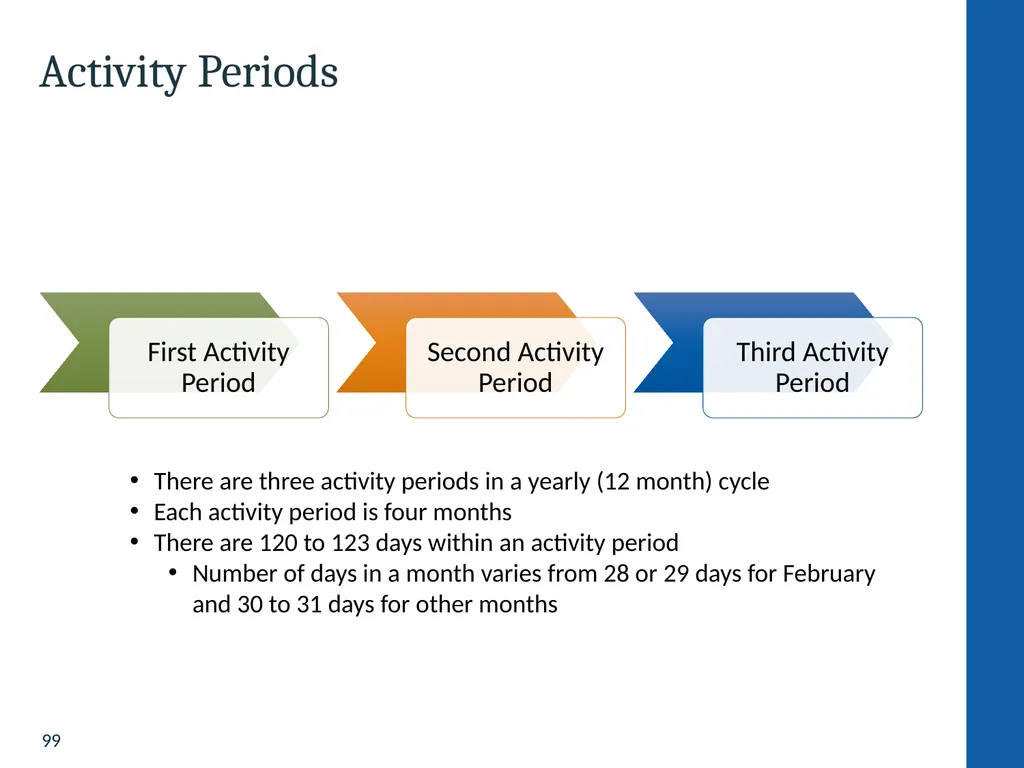
Activity Periods There are three activity periods in a yearly (12 month) cycle
Each activity period is four months
There are 120 to 123 days within an activity period
Number of days in a month varies from 28 or 29 days for February and 30 to 31 days for other months<br>
Each activity period is four months
There are 120 to 123 days within an activity period
Number of days in a month varies from 28 or 29 days for February and 30 to 31 days for other months<br>
100
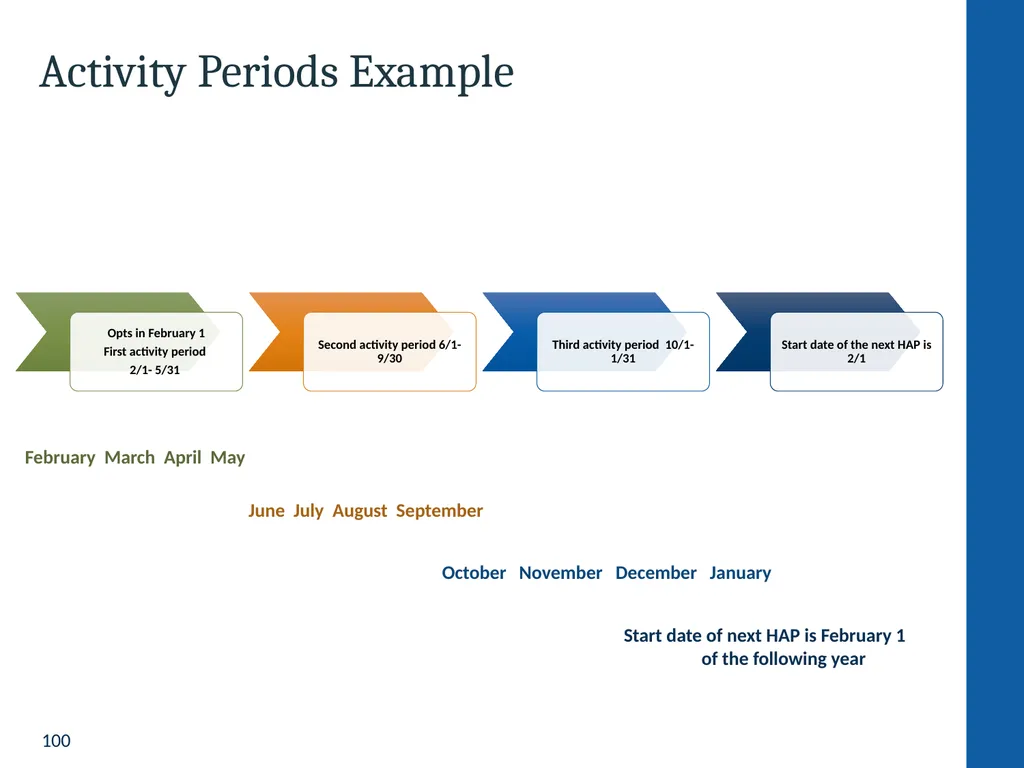
Activity Periods Example June July August September February March April May October November December January Start date of next HAP is February 1 of the following year<br>
101
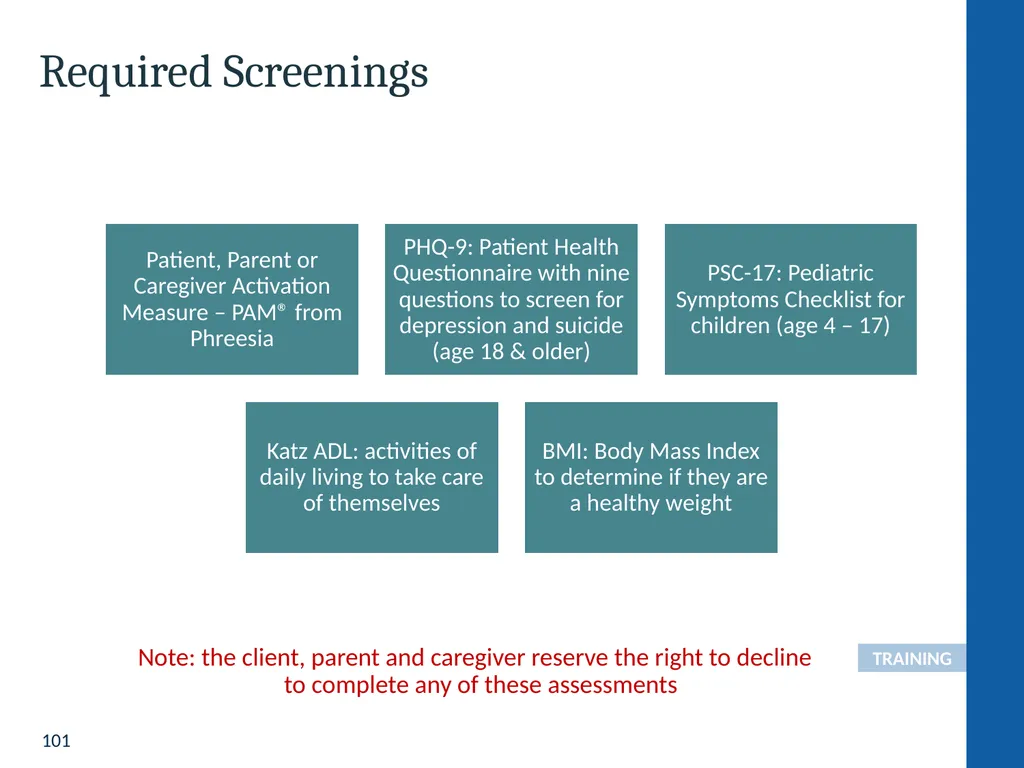
Required Screenings Note: the client, parent and caregiver reserve the right to decline to complete any of these assessments TRAINING<br>
102
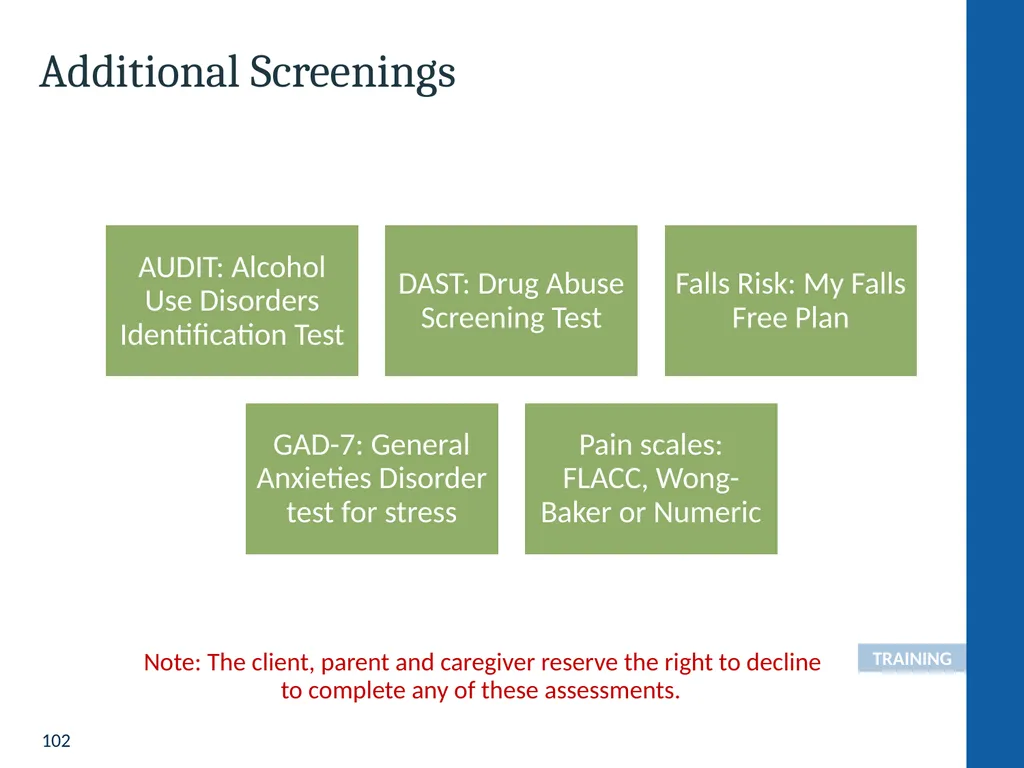
Additional Screenings Note: The client, parent and caregiver reserve the right to decline to complete any of these assessments. TRAINING<br>
103
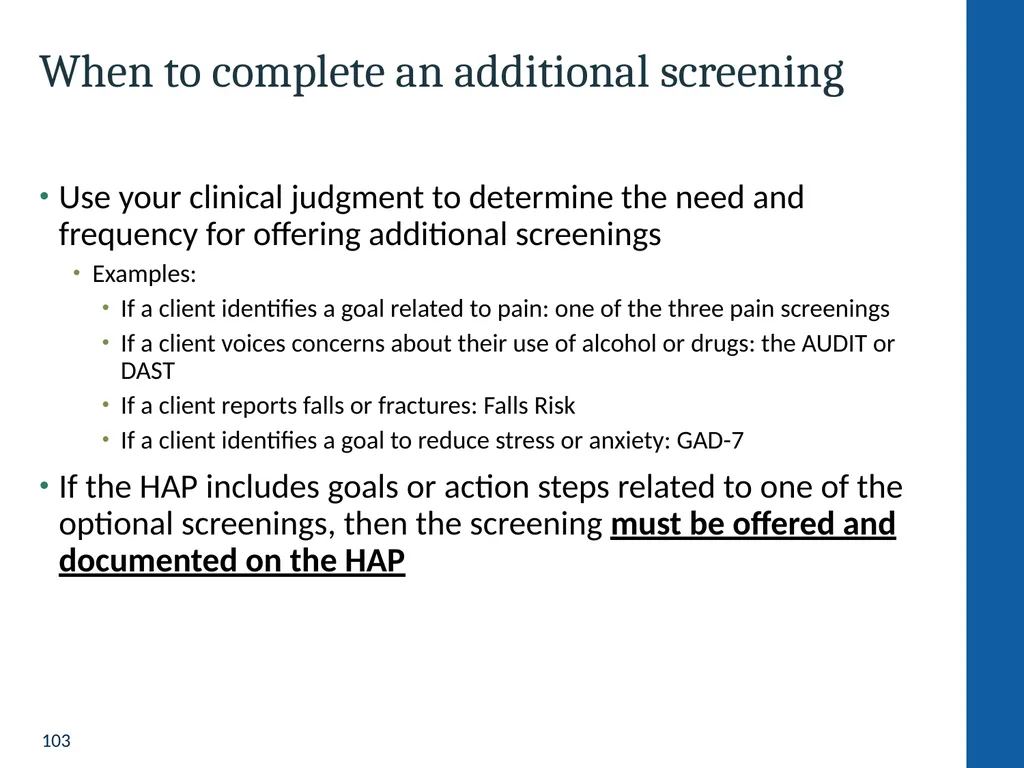
When to complete an additional screening Use your clinical judgment to determine the need and frequency for offering additional screenings
Examples:
If a client identifies a goal related to pain: one of the three pain screenings
If a client voices concerns about their use of alcohol or drugs: the AUDIT or DAST
If a client reports falls or fractures: Falls Risk
If a client identifies a goal to reduce stress or anxiety: GAD-7
If the HAP includes goals or action steps related to one of the optional screenings, then the screening must be offered and documented on the HAP<br>
104
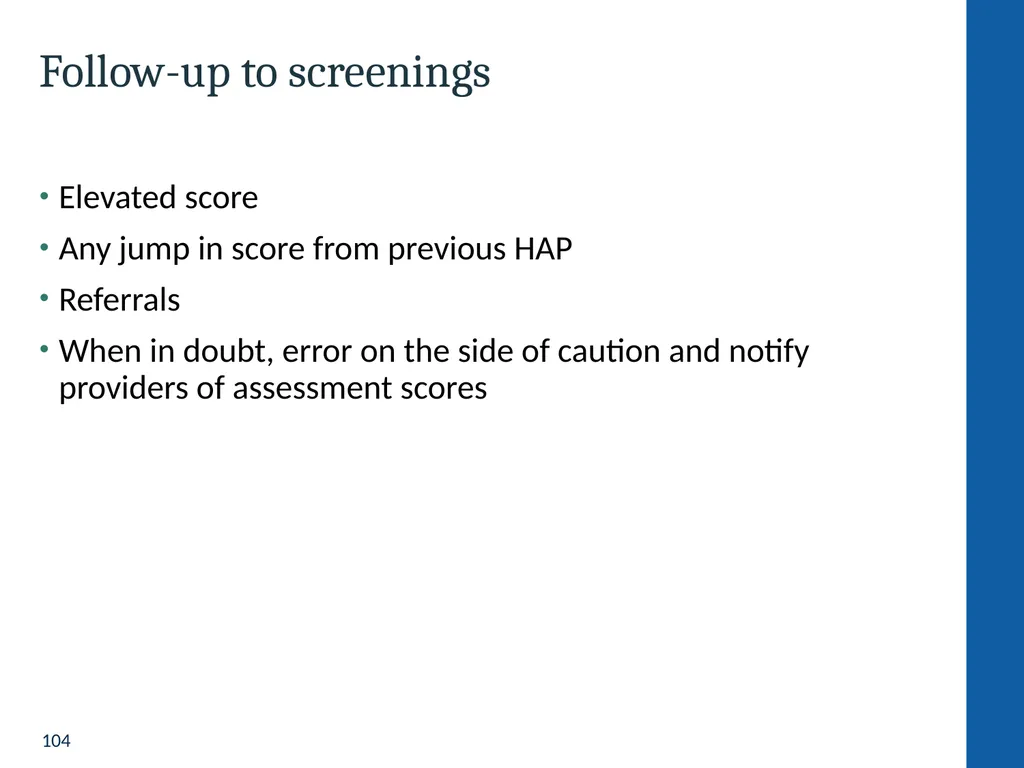
Follow-up to screenings Elevated score
Any jump in score from previous HAP
Referrals
When in doubt, error on the side of caution and notify providers of assessment scores<br>
Any jump in score from previous HAP
Referrals
When in doubt, error on the side of caution and notify providers of assessment scores<br>
105
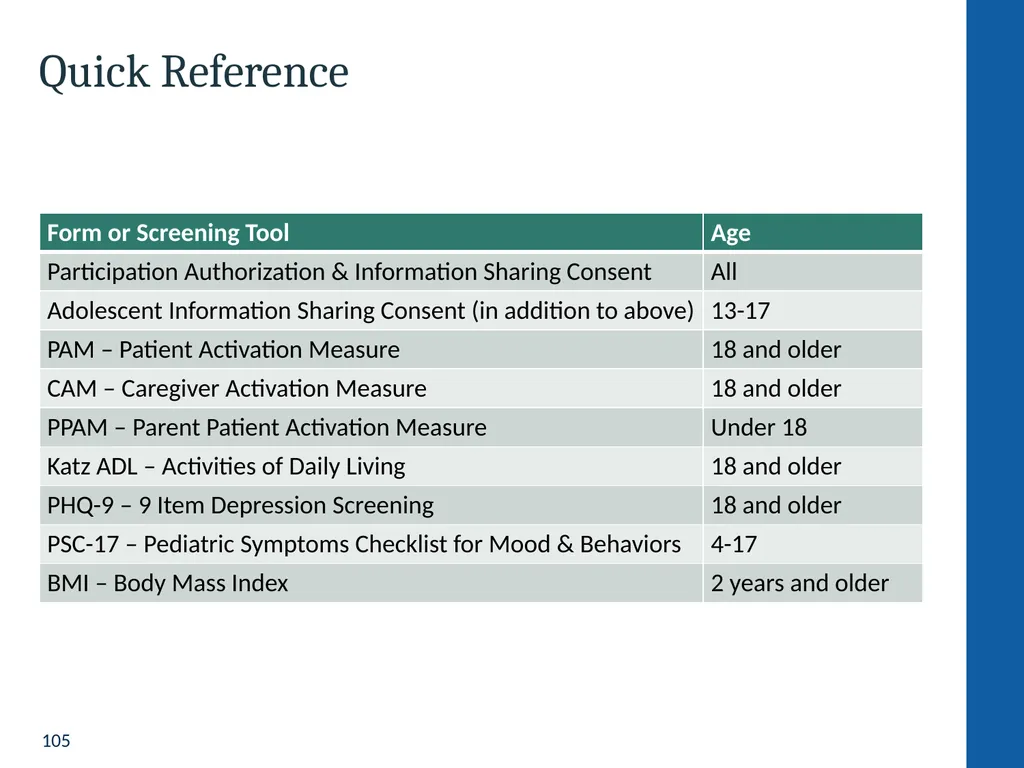
Quick Reference<br>
106
What if Client Refuses Assessments Clients have the right to refuse to participate in the required and additional assessments. If this is the case, it is best practice to incorporate the following steps:
Ask the client why they are refusing
Document the reason for the client declining assessments
Indicate the date and reason for the refusal
If the client doesn’t feel like completing assessments at the time of the visit, reschedule a time to complete the assessments at a later date
A reminder that assessment can be completed at anytime during that HAP activity period<br>
107
Help Identify a Long-Term Goal Use a person-centered approach to help the client identify:
What would they like to have happen as a result of their health changes?
What would they like to be able to do that they can’t currently do?
What their level of activation is and how it will help or hinder their ability to achieve their goal/s?
Long term goals may relate more to social goals but by achieving them the client may:
Reduce medical costs
Slow the progression of chronic disease
Delay the onset of another chronic disease
Reduce avoidable ED visits and hospital admissions and readmissions
Increase their sense of their own well-being<br>
108
Help the Client Identify Long-Term and Short-Term Goals “Physically, what can you do best?”
“When are you strongest?”
“Who do you contact when you aren’t feeling well?”
“Which health concerns have the biggest impact on your life?”
“What are some ways you may increase your wellness?”<br>
“When are you strongest?”
“Who do you contact when you aren’t feeling well?”
“Which health concerns have the biggest impact on your life?”
“What are some ways you may increase your wellness?”<br>
109
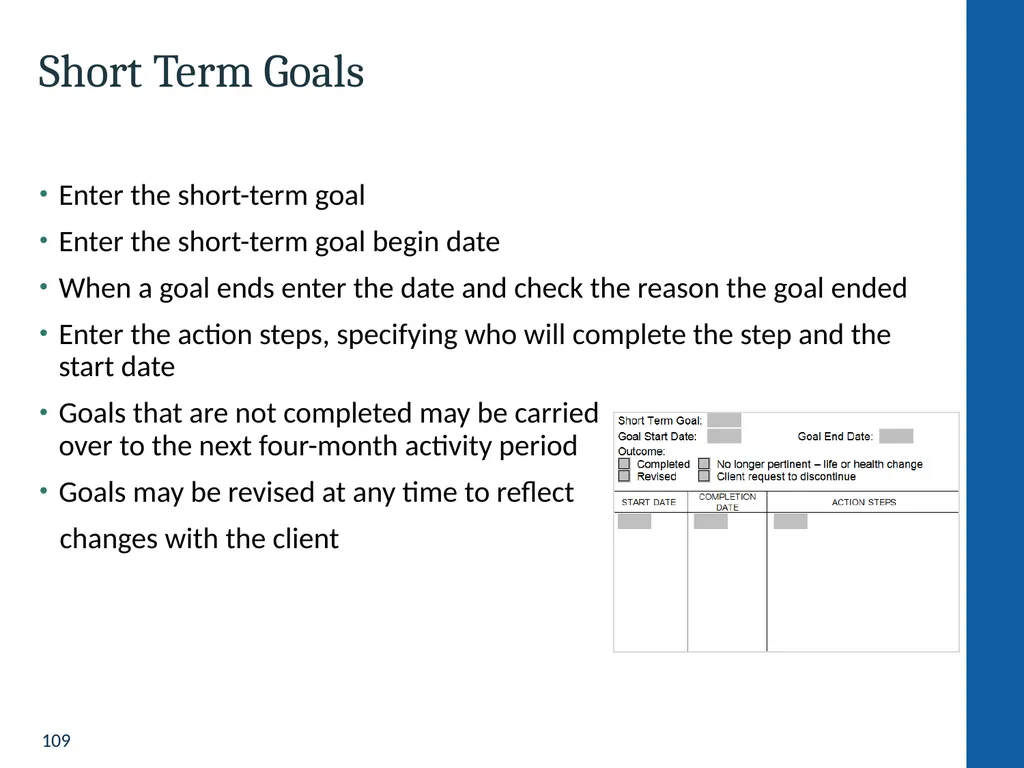
Short Term Goals Enter the short-term goal
Enter the short-term goal begin date
When a goal ends enter the date and check the reason the goal ended
Enter the action steps, specifying who will complete the step and the start date
Goals that are not completed may be carried over to the next four-month activity period
Goals may be revised at any time to reflect
changes with the client<br>
110
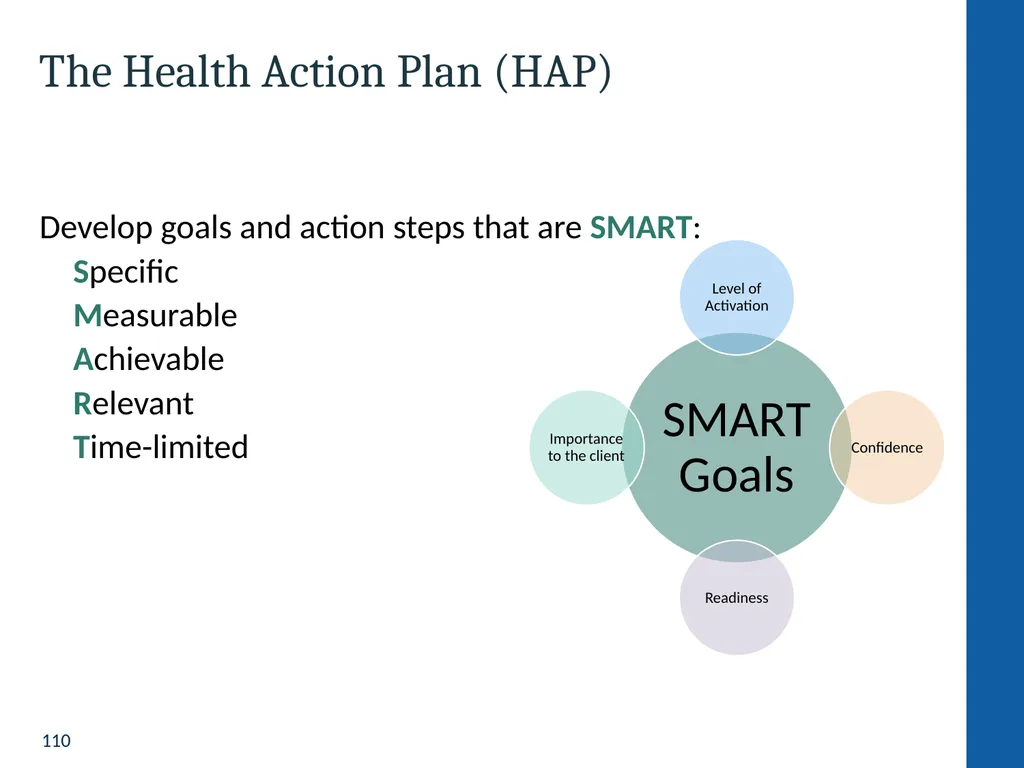
The Health Action Plan (HAP) Develop goals and action steps that are SMART:
Specific
Measurable
Achievable
Relevant
Time-limited<br>
Specific
Measurable
Achievable
Relevant
Time-limited<br>
111
Final Notes About the HAP Provide the HAP information to the client, or with the client’s consent, to the caregiver and family
The HAP may be:
Printed and mailed
Delivered at the face-to-face visit
Emailed using secure mail and/or encryption
Each face-to-face visit or telephone contact provides an opportunity to discuss and review progress on the HAP
The HAP is a fluid document that changes with the client’s needs and preferences<br>
112
Module 8 – Initial Engagement<br>
113
First visit The first visit is a lot about making connections and giving the client time to tell you what they need. Try not to inundate them too much with information
Create a folder to take with you that includes everything you will need for the client
Review tips for safety before leaving the office and when you arrive at the home from the Initial Engagement Module
Visiting facilities – bring along the “Residential Introduction Letter”<br>
Create a folder to take with you that includes everything you will need for the client
Review tips for safety before leaving the office and when you arrive at the home from the Initial Engagement Module
Visiting facilities – bring along the “Residential Introduction Letter”<br>
114
Small Group Work – HAP Considering your client’s PRISM results, PAM responses and Level of Activation:
Complete a HAP (make up scores as needed for this activity)
Record the following:
One long-term goal
At least two short-term goals
Actions steps to reach each short-term goal
Who will complete the step and by when?
Which of the 6 Health Home services might the client need now and in the near future?
Which optional screenings might be helpful for your client?<br>
115
Let’s Pause to Check for Understanding What experiences have you had offering, administering and providing follow-up to these screenings in the past?
How can you work with your client to increase the value of the HAP?
Do you have any questions about the HAP?<br>
How can you work with your client to increase the value of the HAP?
Do you have any questions about the HAP?<br>
116
Module 9 – Comprehensive Transitional Care TRAINING<br>
117
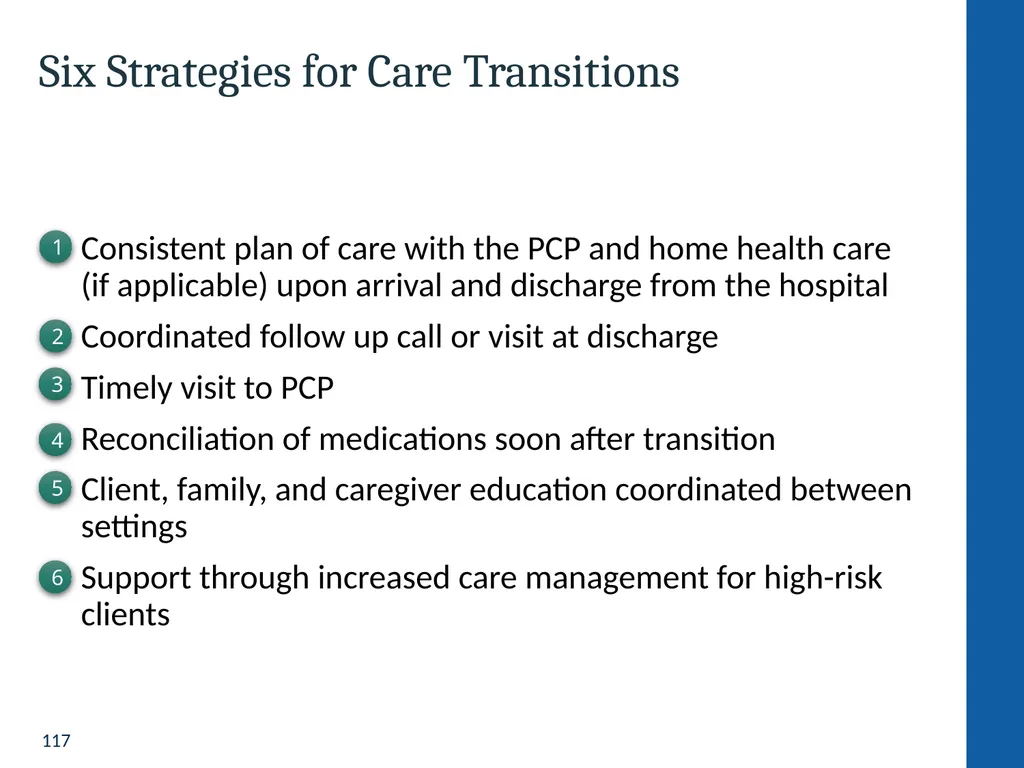
Six Strategies for Care Transitions Consistent plan of care with the PCP and home health care (if applicable) upon arrival and discharge from the hospital
Coordinated follow up call or visit at discharge
Timely visit to PCP
Reconciliation of medications soon after transition
Client, family, and caregiver education coordinated between settings
Support through increased care management for high-risk clients 1 2 3 4 5 6<br>
Coordinated follow up call or visit at discharge
Timely visit to PCP
Reconciliation of medications soon after transition
Client, family, and caregiver education coordinated between settings
Support through increased care management for high-risk clients 1 2 3 4 5 6<br>
118
Comprehensive Transitional Care How will you know if a client has been hospitalized?
Review PRISM risk scores and planning in advance of ED or in-patient visits
Social/Resource Barriers Assessment
Discharge planning instructions and client, family, and caregiver follow-up<br>
Review PRISM risk scores and planning in advance of ED or in-patient visits
Social/Resource Barriers Assessment
Discharge planning instructions and client, family, and caregiver follow-up<br>
119
Let’s Consider Our Vignettes Brainstorm steps a Care Coordinator would take when a client needs a care transition -
If your client was hospitalized, what transition services might you provide?
How would you work with your client if they admit to the hospital, transfers to a nursing facility and is now returning home?
NOTE: When entering a hospital, nursing facility, or other institution introduce yourself to staff each time so they are aware of your role and the services you may offer.<br>
120
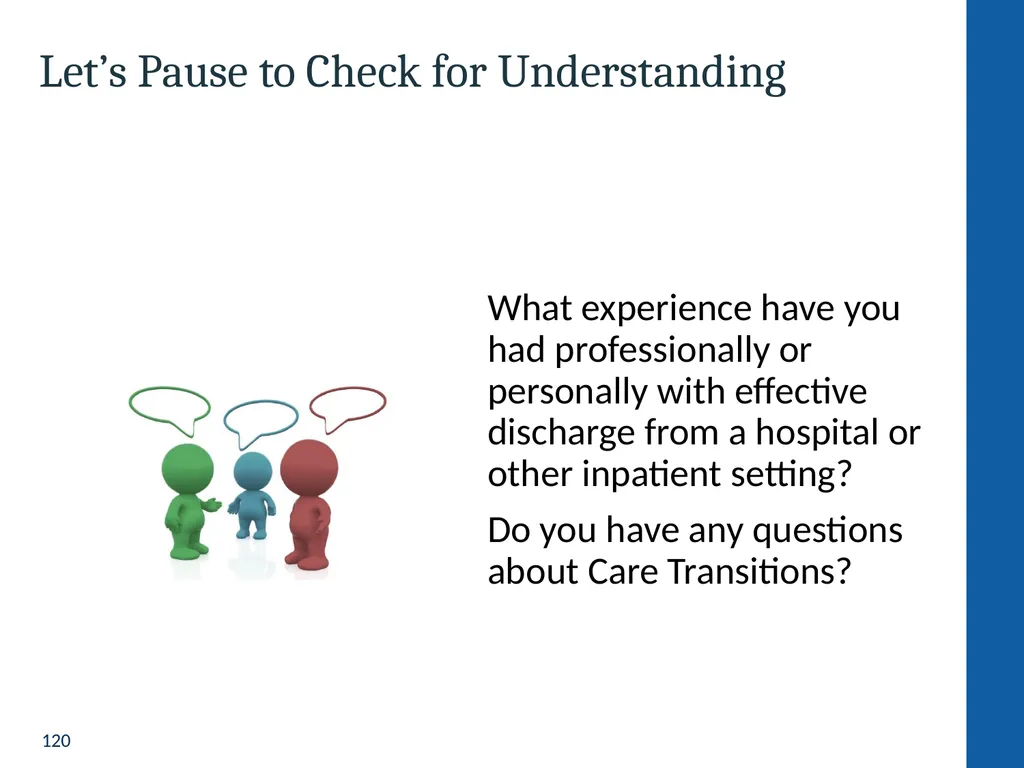
Let’s Pause to Check for Understanding What experience have you had professionally or personally with effective discharge from a hospital or other inpatient setting?
Do you have any questions about Care Transitions?<br>
Do you have any questions about Care Transitions?<br>
121
Module 10 – Documentation and Quality Assurance<br>
122
Something to Consider If someone assumed your case, would they know where to pick up?
Does the case narrative indicate which of the six Health Home core service/s was provided during the month?
Does the documentation support the tier that is being billed?
Were forms completed?
Were required and additional screenings completed with appropriate follow-up?
Are person-centered goals and action steps addressed?
Were all fields of HAP completed?
Was HAP offered and shared?<br>
123
Key Considerations to Document In-person visit with the client to develop and finalize the HAP
Completion of the HAP within 90 days of enrollment with the Care Coordination Organization
Case narrative supports the Tier that was billed
Monthly in-person and telephonic interactions with the client
Completion and update of the HAP (including screenings) at least once during every activity period or when there was change in the client’s health status, needs, or preferences<br>
124
Key Considerations to Document (cont.) Provision of services in a culturally competent manner with equal access for clients with language and communication barriers
Services are delivered
In the client’s primary language (document if interpreter is used)
Recognizing cultural differences and obstacles faced by persons with a developmental disability
Recognizing the dynamics of substance use
Provision of services tailored to special needs such as functional impairment or environmental factors<br>
125
Key Considerations to Document (cont.) Communication and coordination between the client and the client’s service providers and other support systems to address barriers and achieve health action goals
Provision of individual and family support through care coordination and care transition activities
Development and/or coordination of multidisciplinary teams to provide assistance as needed<br>
Provision of individual and family support through care coordination and care transition activities
Development and/or coordination of multidisciplinary teams to provide assistance as needed<br>
126
Key Considerations to Document (cont.) Provision of educational materials that:
promote improved clinical outcomes
increase self-management skills
are appropriate to the level of activation
Note: Document any educational information sent out in client’s preferred language if other than English
Use of peer supports to increase the client’s knowledge about their health conditions and adherence to treatment<br>
127
Key Considerations to Document (cont.) Discussion about advance care planning with the client, parent, or collateral
Within the first year that the client agrees to participate in the Health Home Program
If this was not completed by a previous Care Coordinator then document that a discussion was offered to the client, parent, family member, or guardian
Assistance provided to maintain the client’s eligibility for programs and services as needed
Referrals to available community resources to help achieve health action goals<br>
128
Key Considerations to Document (cont.) Process for notification of the client’s admission or discharge from an emergency department or inpatient setting
Because we do not duplicate benefits, if another agency, such as the MCO, is providing care transitions, note this in the case narrative
Provision of care transition to prevent avoidable readmissions after discharge from an inpatient facility and ensure proper and timely follow-up care
Participation by the Care Coordinator in all appropriate phases of care transition<br>
129
Time Management Plan your day/week by scheduling time for:
Outreach calls and letters
Face-to-face visits
Follow-up calls
Making and actively managing referrals
Working with allied staff and multidisciplinary care teams
Documentation
Schedule time for responding to EDIE or Point Click Care alerts
Carve out time in your schedule and if no one has been hospitalized or admitted in the ED, use this time for the above activities<br>
130
Let’s Pause to Check for Understanding What tips can you share that have helped you better manage your caseload?
Do you have any questions?<br>
Do you have any questions?<br>
131
Re-HAPs 4-month, 8-month or Annual<br>
132
The Health Home Program Considers: The client’s perspective
Results from assessment and screening tools
PRISM risk factors
A client’s level of activation<br>
Results from assessment and screening tools
PRISM risk factors
A client’s level of activation<br>
133
Monthly Visits (Non-HAP) Review short-term goals and action steps
Perform a needs assessment
Follow-up of referrals or action items
Relationship building
Listen for any changes that the client wants to make
Even if it is not aligned with goals and action steps
Consider updates to goals and action steps as needed<br>
Perform a needs assessment
Follow-up of referrals or action items
Relationship building
Listen for any changes that the client wants to make
Even if it is not aligned with goals and action steps
Consider updates to goals and action steps as needed<br>
134
Small Group Work – HAP Update The 4-month, 8-month or annual HAP - Considering your client’s PRISM results, PAM responses and Level of Activation:
Update your HAP (make up scores as needed for this activity)
Record the following:
Update one of the short-term goals and action steps based on client not completing the action steps
Update one of the short-term goals and action steps based on the client’s resistance to the action step and/or goal
Which of the 6 Health Home services might the client need now?
Which optional screenings might be helpful for your client?
Document your visit including follow-up from previous contact<br>
135
Module 11 – Care Coordination<br>
136
Components of Care Coordination Understand the client’s needs, goals, health condition(s) and interventions
Streamline access to services and providers (medical and non-medical)
Engage the client
Strong communication with the client, their providers and supports to accommodate their needs<br>
Streamline access to services and providers (medical and non-medical)
Engage the client
Strong communication with the client, their providers and supports to accommodate their needs<br>
137
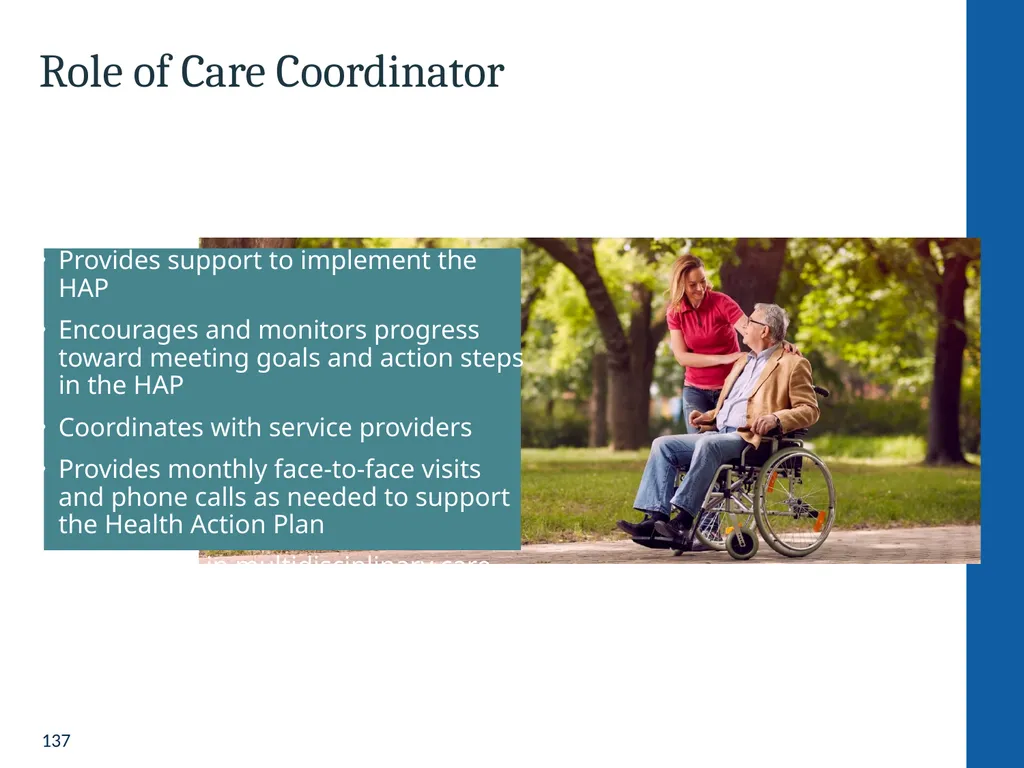
Role of Care Coordinator Provides support to implement the HAP
Encourages and monitors progress toward meeting goals and action steps in the HAP
Coordinates with service providers
Provides monthly face-to-face visits and phone calls as needed to support the Health Action Plan
Participates in multidisciplinary care
teams<br>
Encourages and monitors progress toward meeting goals and action steps in the HAP
Coordinates with service providers
Provides monthly face-to-face visits and phone calls as needed to support the Health Action Plan
Participates in multidisciplinary care
teams<br>
138
Let’s Pause to Check for Understanding Do you have any questions in regards to performing a re-HAP?
Do you have any questions regarding care coordination activities during a visit on a non-HAP month?
Any questions about care coordination or your role as a care coordinator?<br>
Do you have any questions regarding care coordination activities during a visit on a non-HAP month?
Any questions about care coordination or your role as a care coordinator?<br>
139
Module 12 –
Forms and Documents<br>
140
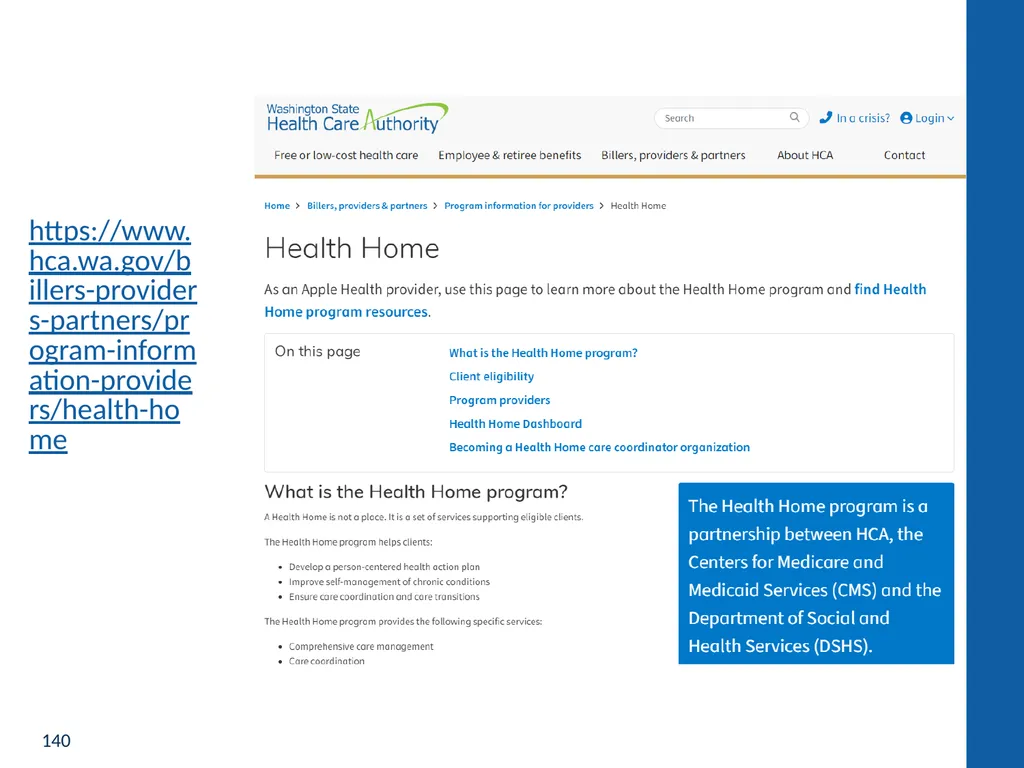
https://www.hca.wa.gov/billers-providers-partners/program-information-providers/health-home<br>
141
Navigating the DSHS Website Where to find resources
Where to find documents
Where to find assessment screening tools
Training
Invitations
Health Home Herald<br>
Where to find documents
Where to find assessment screening tools
Training
Invitations
Health Home Herald<br>
142
The DSHS Website
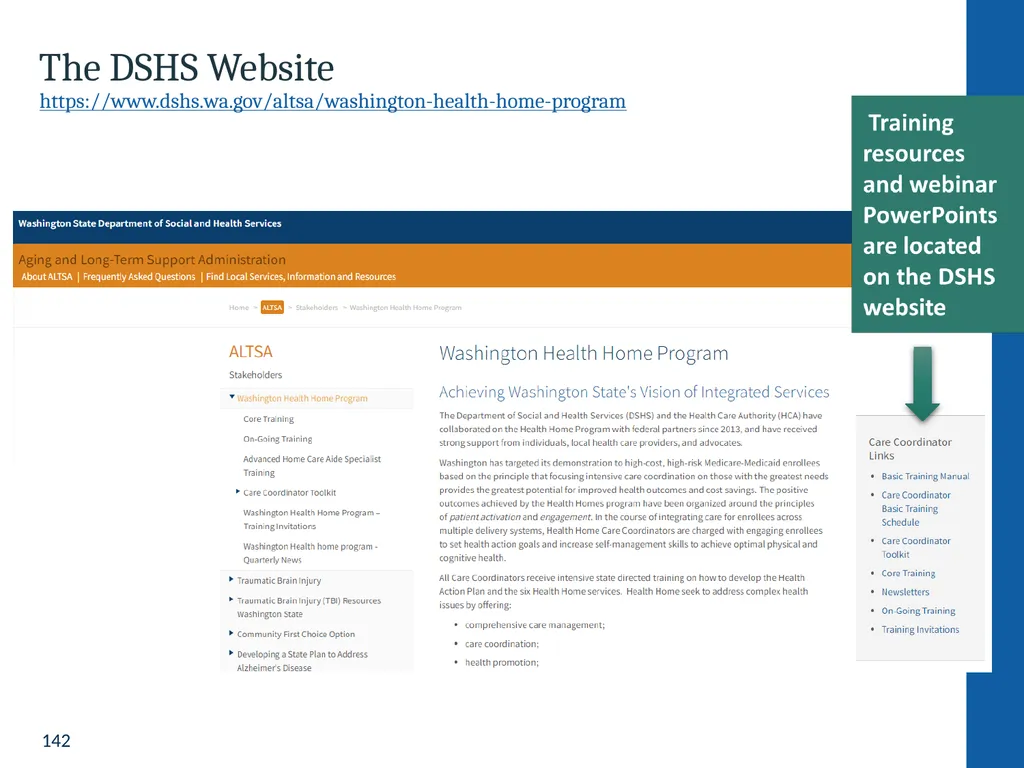
https://www.dshs.wa.gov/altsa/washington-health-home-program<br>
143
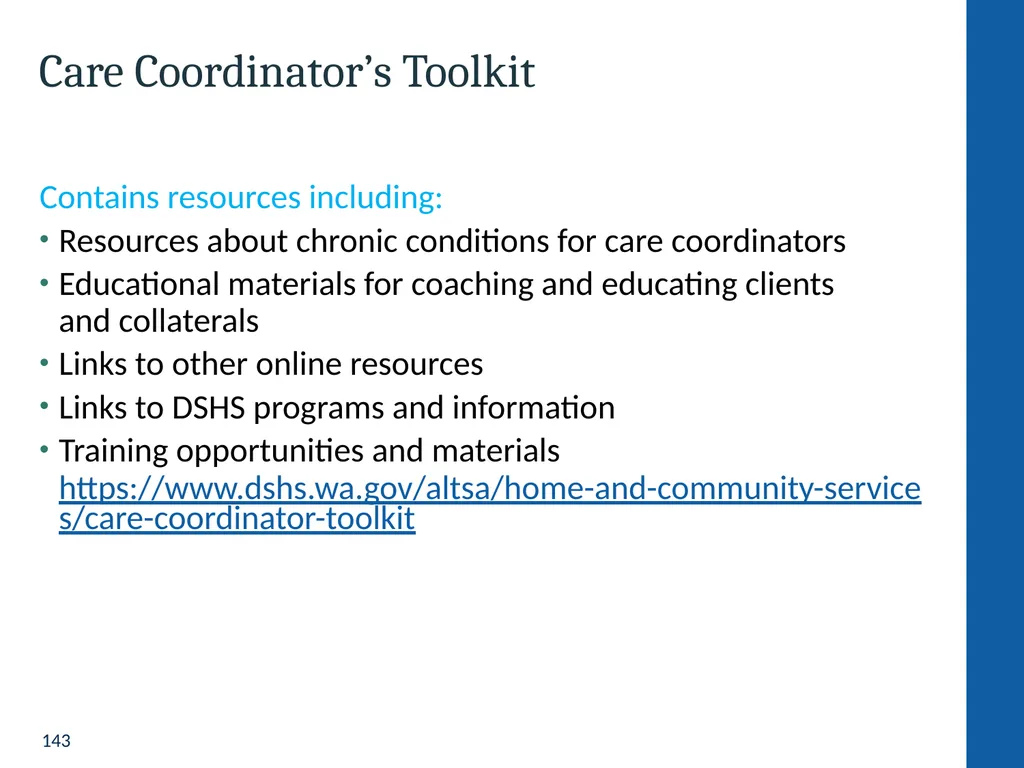
Care Coordinator’s Toolkit Contains resources including:
Resources about chronic conditions for care coordinators
Educational materials for coaching and educating clients and collaterals
Links to other online resources
Links to DSHS programs and information
Training opportunities and materials https://www.dshs.wa.gov/altsa/home-and-community-services/care-coordinator-toolkit<br>
144
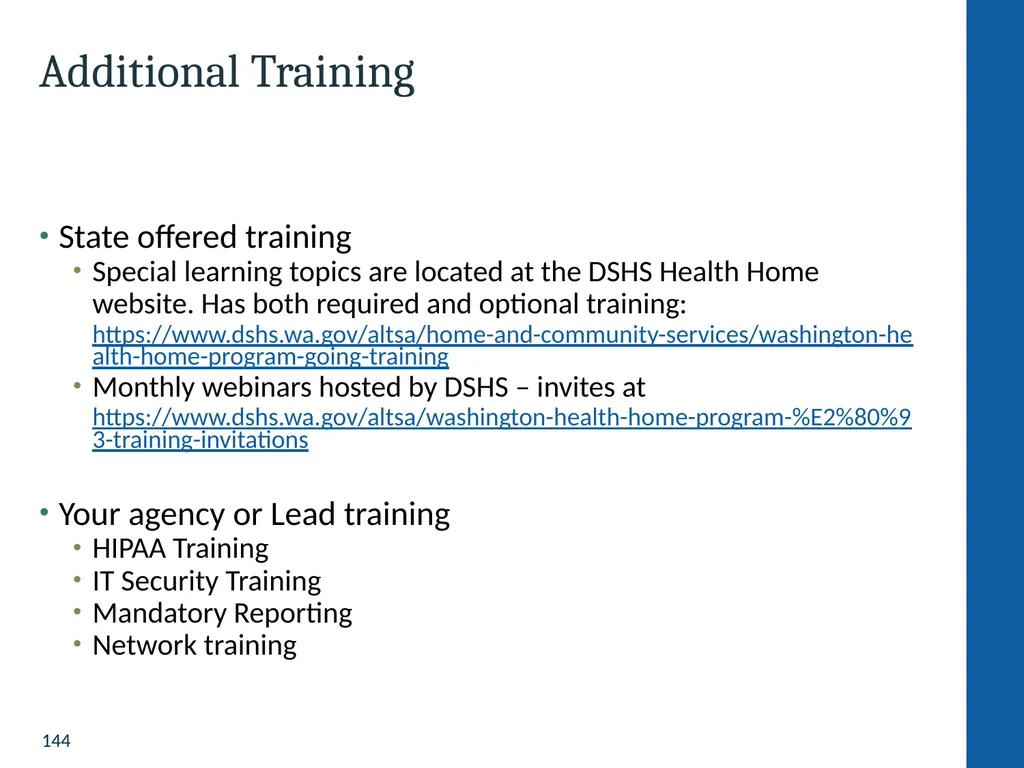
Additional Training State offered training
Special learning topics are located at the DSHS Health Home website. Has both required and optional training: https://www.dshs.wa.gov/altsa/home-and-community-services/washington-health-home-program-going-training
Monthly webinars hosted by DSHS – invites at https://www.dshs.wa.gov/altsa/washington-health-home-program-%E2%80%93-training-invitations
Your agency or Lead training
HIPAA Training
IT Security Training
Mandatory Reporting
Network training<br>
145
Let’s Pause to Check for Understanding Do you have any final questions?<br>
146
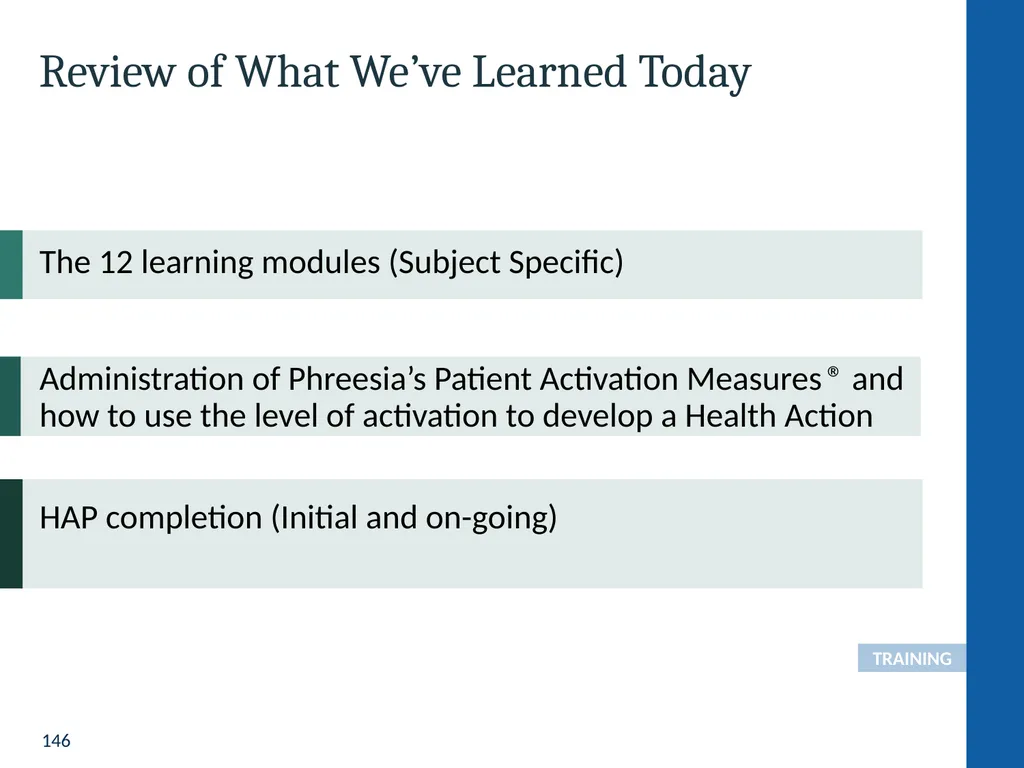
Review of What We’ve Learned Today The 12 learning modules (Subject Specific)
Administration of Phreesia’s Patient Activation Measures ® and how to use the level of activation to develop a Health Action
HAP completion (Initial and on-going) TRAINING<br>
Administration of Phreesia’s Patient Activation Measures ® and how to use the level of activation to develop a Health Action
HAP completion (Initial and on-going) TRAINING<br>
147
Please Complete the Training Evaluation We appreciate
your feedback! TRAINING<br>