04
What is Health Promotion? Today Health Promotion is more than personal and population education.
Defined in a number of ways
“The process of enabling people to increase control over and improve their health”
(World Health Organization 1986)
Health Promotion = health education x healthy public policy
(Tones and Tilford, 1994)<br>
05
The scope of health promotion activity Frameworks and Models are tools that help explain phenomena.
Many tools developed to explain the scope of health promotion.
Tannahill (1985) model of health promotion
Naidoo and Wills (2000) typology of health promotion
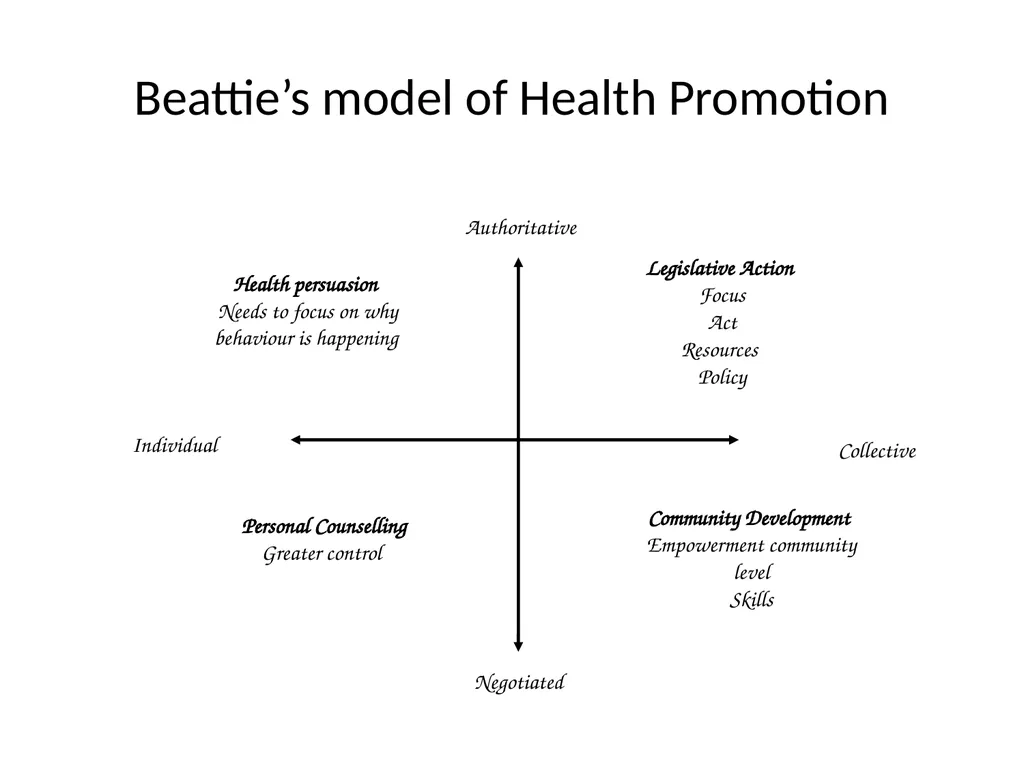
Beattie (1991) model of health promotion
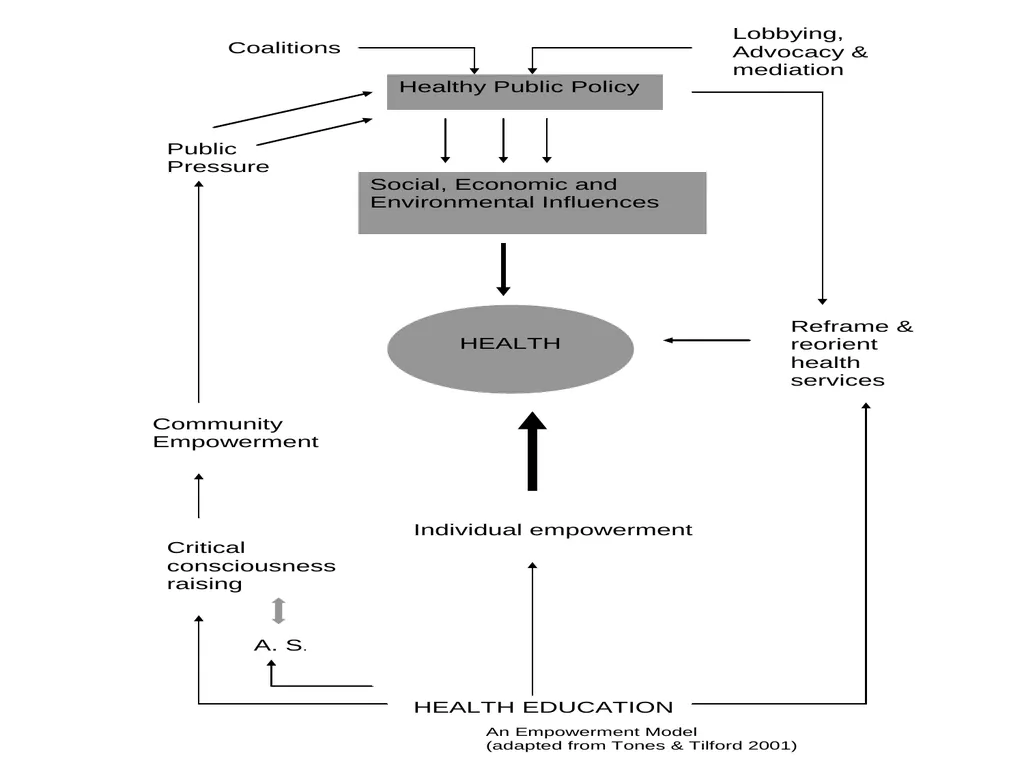
Tones and Tilford (1994) empowerment model of health promotion
Caplan and Holland (1990) Four perspectives on health promotion<br>
06
Beattie’s model of Health Promotion Individual Authoritative Collective Negotiated Health persuasion
Needs to focus on why behaviour is happening Legislative Action
Focus
Act
Resources
Policy Community Development
Empowerment community level
Skills Personal Counselling
Greater control<br>
07
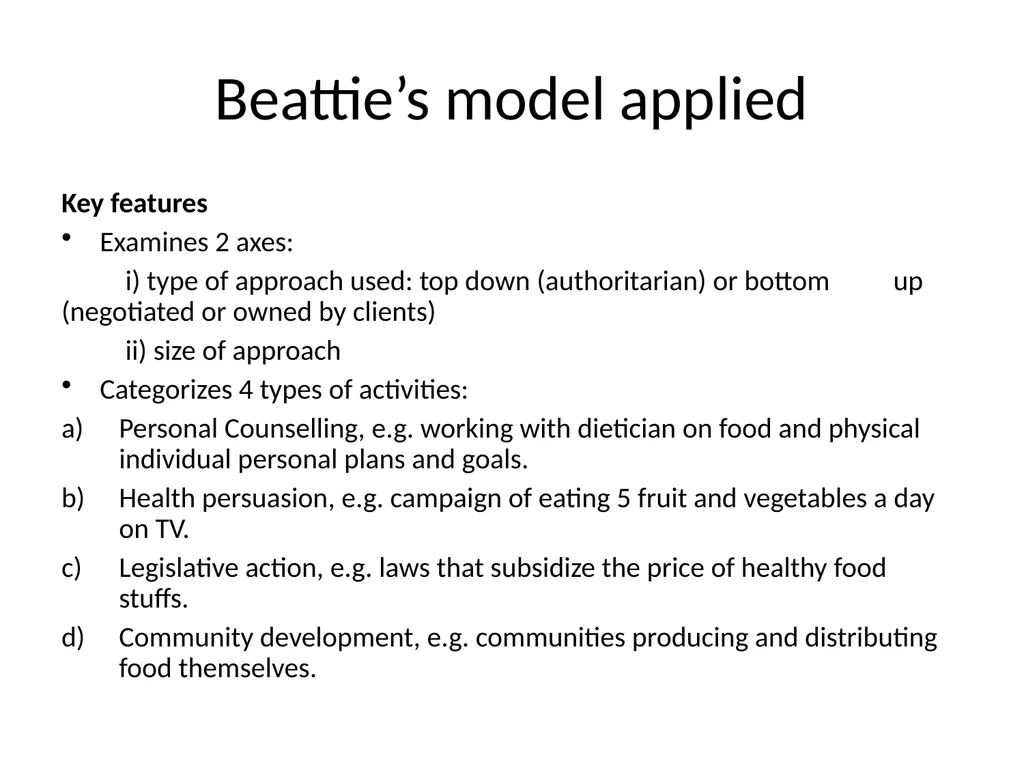
Beattie’s model applied Key features
Examines 2 axes:
i) type of approach used: top down (authoritarian) or bottom up (negotiated or owned by clients)
ii) size of approach
Categorizes 4 types of activities:
Personal Counselling, e.g. working with dietician on food and physical individual personal plans and goals.
Health persuasion, e.g. campaign of eating 5 fruit and vegetables a day on TV.
Legislative action, e.g. laws that subsidize the price of healthy food stuffs.
Community development, e.g. communities producing and distributing food themselves.<br>
08
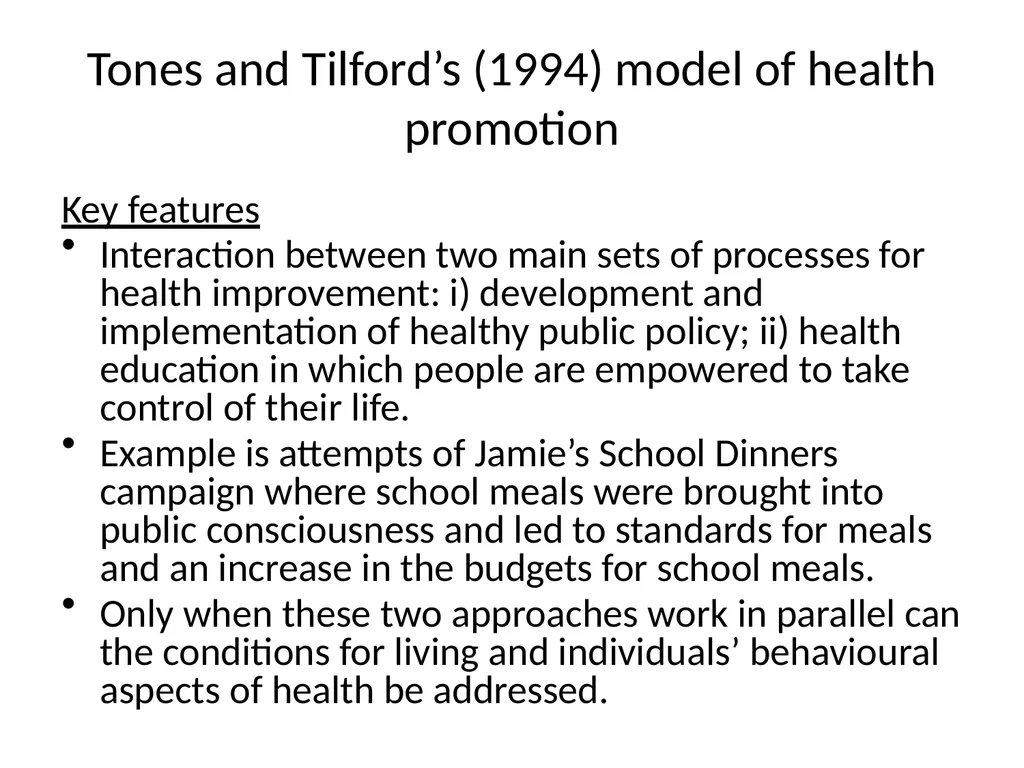
Tones and Tilford’s (1994) model of health promotion Key features
Interaction between two main sets of processes for health improvement: i) development and implementation of healthy public policy; ii) health education in which people are empowered to take control of their life.
Example is attempts of Jamie’s School Dinners campaign where school meals were brought into public consciousness and led to standards for meals and an increase in the budgets for school meals.
Only when these two approaches work in parallel can the conditions for living and individuals’ behavioural aspects of health be addressed.<br>
09
Caplan and Holland’s model of health promotion (1990)<br>
10
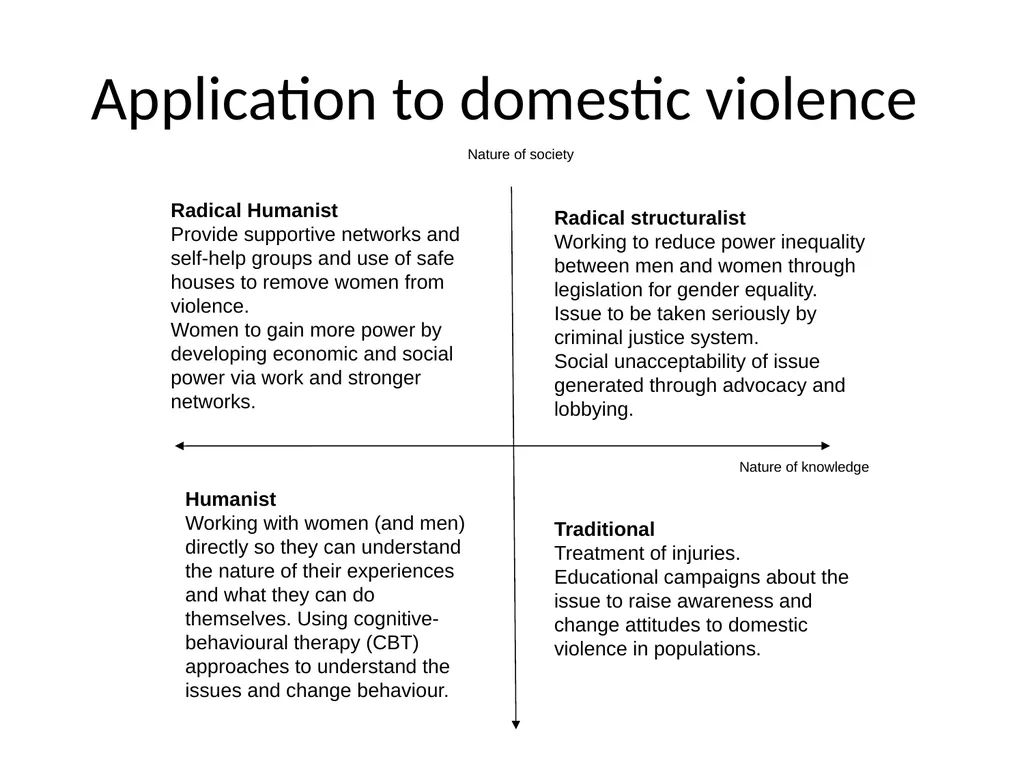
Caplan and Holland’s model of health promotion (1990) Key features
More complex and theoretically driven.
Attempts to unpick what determines health and ill-health and therefore what activities can be used to address health issues.
One axis refers to a theory of knowledge and how knowledge is generated in relation to health.
The other axis refers to how society is constructed and how this impacts on health.<br>
11
Application to domestic violence<br>
12
Key principles in health promotion Principles are important as they relate to how we should work in practice
The World Health Organization provides a global perspective
Gregg and O’Hara (2007) provide a good synthesis of many of these<br>
13
Focus on upstream approaches “You know”, he said, “...sometimes it feels like this. There I am standing by the shore of a swiftly flowing river and I hear the cry of a drowning man. So I jump into the river, put my arms around him, pull him to shore and apply artificial respiration. Just when he begins to breathe, there is another cry for help. So I jump into the river, reach him, pull him to shore, apply artificial respiration, and then just as he begins to breathe, another cry for help. So back in the river again, reaching, pulling, applying, breathing and then another yell. Again and again, without end, goes the sequence. You know, I am so busy jumping in, pulling them to shore, applying artificial respiration, that I have no time to see who the hell is upstream pushing them all in.” (McKinlay, 1979 p. 249)<br>
14
Non-victim-blaming approaches Victim-blaming is an approach to health education which only focuses on individual action rather than the external forces that influence an individual person, resulting in blaming people for their health behaviour and related consequences (Hubley et al., 2020).
Practitioners should resist victim-blaming as it does not show understanding of the influences of health behaviour.
Instead, practitioners should consider the social and economic experiences of people’s lives which may explain how and why people behave in the manner that they do.<br>
15
Evidence-based practice Evidence-based practice is concerned with trying to understand which approaches and methods of working are likely to produce the strongest health improvement.
Generating evidence by providing stronger evaluation of programmes and initiatives as they are developed and implemented, and encouraging the utilization of the existing evidence base by practitioners, are both key principles of practice.<br>
16
Participation and empowerment Participation implies ‘being present and taking part’ in health promotion activities and, secondly, recognizing that, when people participate, what they say should be listened to and acted upon (Lowcock and Cross, 2011)
Empowerment is an approach that facilitates people working together to increase the control that they have over events that influence their lives and health (Woodall et al. 2010)
Given that a definition of health promotion is about taking control, then these two interlinked concepts are fundamental to how we act as practitioners<br>
17
Equity Equity in health is concerned with fairness and the idea that everyone should have an equal right to the fullest health possible.
The term inequity enshrines an unfair distribution of health status, e.g. poorer health is experienced in lower social classes.
Health should be more equally distributed and health promotion approaches should, as a high priority, address health inequities.
Policies and projects are now being evaluated to assess their impact on health equity, to reduce the disproportional impact on those that already experience poorer health, using a technique known as health equity audits (Office of the Deputy Prime Minister and Department of Health, 2005).<br>
18
Ethical principles There are four major ethical principles outlined in Naidoo and Wills (2016):
Autonomy – “Respect for the rights of individuals and their rights to govern their own lives” (Naidoo and Wills, 2016 p. 96)
Beneficence – Doing and promoting good but we would need to consider whose good, the individual or wider group
Non-maleficence – Doing no harm
Justice – People should be treated equally and fairly<br>
19
Summary The scope of health promotion is varied and diverse and not limited to health education.
In order to address health issues, a wider range of health promotion approaches should be used that directly addresses the wider upstream determinants.
Approaches should be evaluated on the basis of key health promotion principles.<br>