
Heather Holliday, Assistant Director Jill
LO
Published · 26 slides · 0 views

1 / 1
Description
Heather Holliday, Assistant Director Jill Robinson, Program Coordinator Upstate Catherine McGuinn, Program Coordinator Lower State Introduction to Organic Certification Topics Interest in Organic Products and Market Trends Meaning of
Related Topics
Share
Embed code
Download this presentation From Below
"Heather Holliday, Assistant Director Jill" is the property of its rightful owner. Permission is granted to download and print the materials on this website for personal, non-commercial use only, and to display it on your personal computer provided you do not modify the materials and that you retain all copyright notices contained in the materials. By downloading content from our website, you accept the terms of this agreement.
Presentation Transcript
01
Heather Holliday, Assistant Director
Jill Robinson, Program Coordinator Upstate
Catherine McGuinn, Program Coordinator Lower State Introduction to Organic Certification<br>
Jill Robinson, Program Coordinator Upstate
Catherine McGuinn, Program Coordinator Lower State Introduction to Organic Certification<br>
02
Topics Interest in Organic Products and Market Trends
Meaning of Organic
Who Sets the Rules and Stakeholder Responsibilities
Organic Certification Process
Organic System Plan
Organic Practices
Labeling, Recordkeeping, Audit Considerations
Enforcement
Resources<br>
Meaning of Organic
Who Sets the Rules and Stakeholder Responsibilities
Organic Certification Process
Organic System Plan
Organic Practices
Labeling, Recordkeeping, Audit Considerations
Enforcement
Resources<br>
03
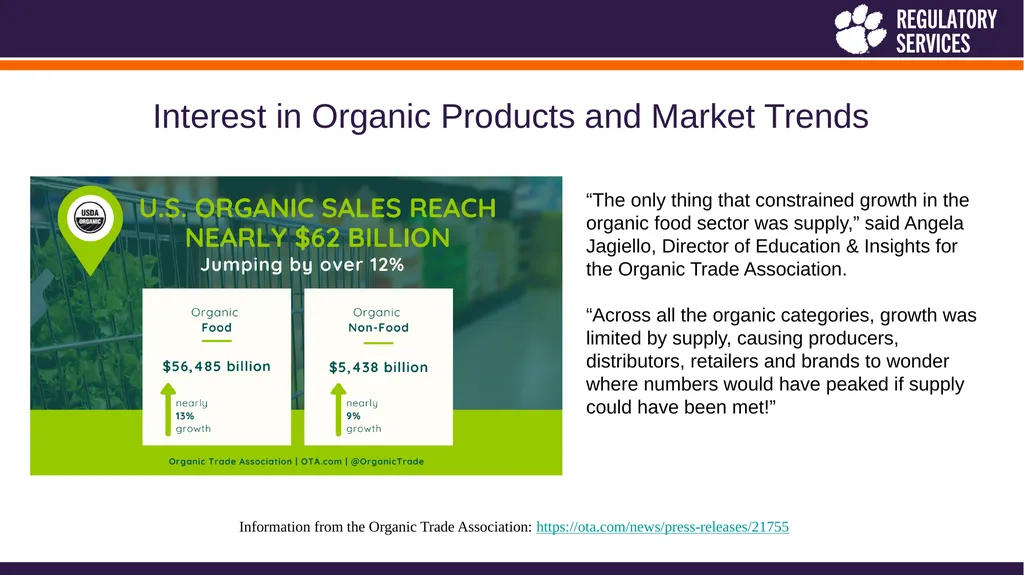
Interest in Organic Products and Market Trends “The only thing that constrained growth in the organic food sector was supply,” said Angela Jagiello, Director of Education & Insights for the Organic Trade Association.
“Across all the organic categories, growth was limited by supply, causing producers, distributors, retailers and brands to wonder where numbers would have peaked if supply could have been met!” Information from the Organic Trade Association: https://ota.com/news/press-releases/21755<br>
“Across all the organic categories, growth was limited by supply, causing producers, distributors, retailers and brands to wonder where numbers would have peaked if supply could have been met!” Information from the Organic Trade Association: https://ota.com/news/press-releases/21755<br>
04
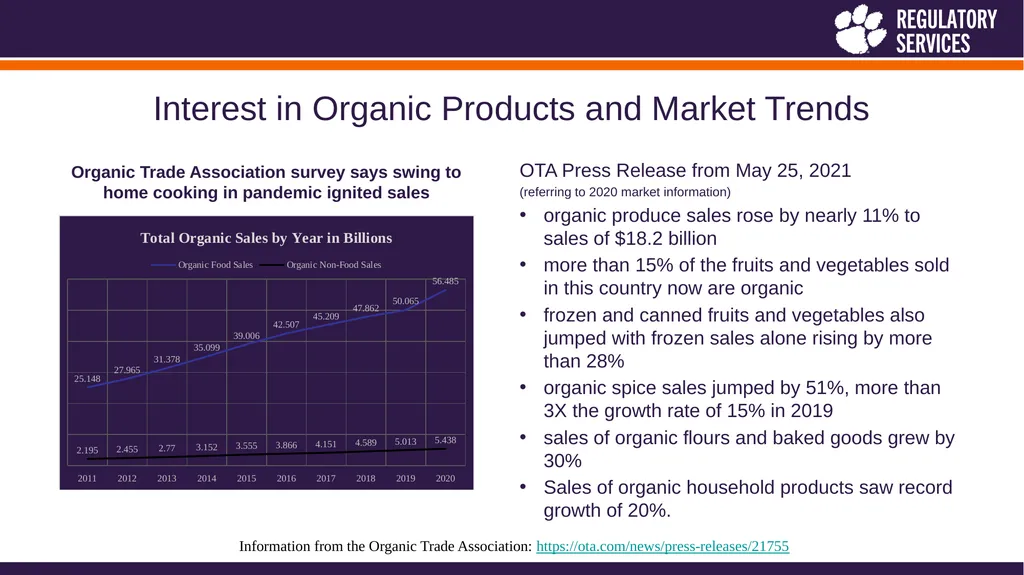
Interest in Organic Products and Market Trends Organic Trade Association survey says swing to home cooking in pandemic ignited sales OTA Press Release from May 25, 2021
(referring to 2020 market information)
organic produce sales rose by nearly 11% to sales of $18.2 billion
more than 15% of the fruits and vegetables sold in this country now are organic
frozen and canned fruits and vegetables also jumped with frozen sales alone rising by more than 28%
organic spice sales jumped by 51%, more than 3X the growth rate of 15% in 2019
sales of organic flours and baked goods grew by 30%
Sales of organic household products saw record growth of 20%. Information from the Organic Trade Association: https://ota.com/news/press-releases/21755<br>
(referring to 2020 market information)
organic produce sales rose by nearly 11% to sales of $18.2 billion
more than 15% of the fruits and vegetables sold in this country now are organic
frozen and canned fruits and vegetables also jumped with frozen sales alone rising by more than 28%
organic spice sales jumped by 51%, more than 3X the growth rate of 15% in 2019
sales of organic flours and baked goods grew by 30%
Sales of organic household products saw record growth of 20%. Information from the Organic Trade Association: https://ota.com/news/press-releases/21755<br>
05
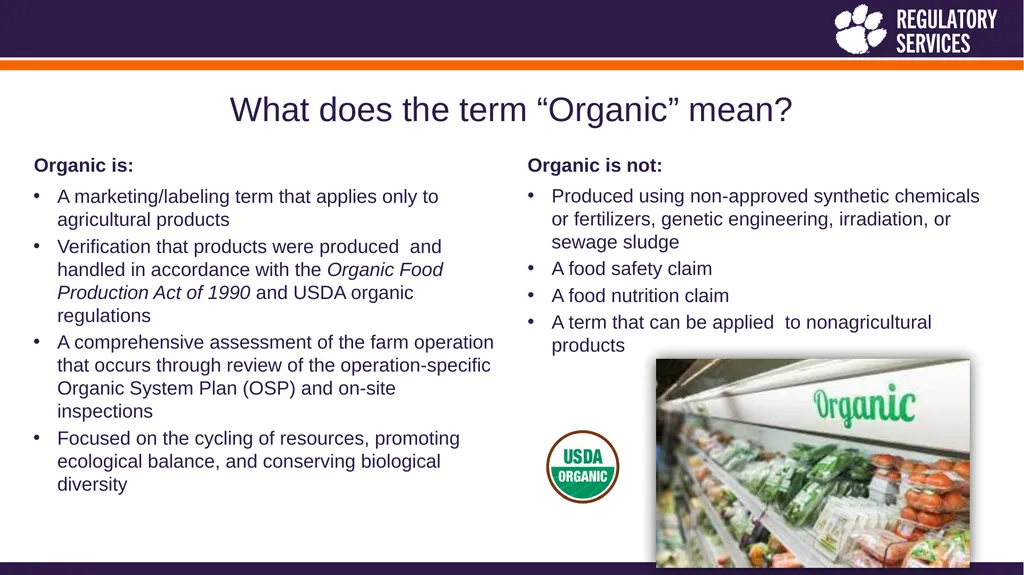
What does the term “Organic” mean? Organic is: A marketing/labeling term that applies only to agricultural products
Verification that products were produced and handled in accordance with the Organic Food Production Act of 1990 and USDA organic regulations
A comprehensive assessment of the farm operation that occurs through review of the operation-specific Organic System Plan (OSP) and on-site inspections
Focused on the cycling of resources, promoting ecological balance, and conserving biological diversity Organic is not: Produced using non-approved synthetic chemicals or fertilizers, genetic engineering, irradiation, or sewage sludge
A food safety claim
A food nutrition claim
A term that can be applied to nonagricultural products<br>
Verification that products were produced and handled in accordance with the Organic Food Production Act of 1990 and USDA organic regulations
A comprehensive assessment of the farm operation that occurs through review of the operation-specific Organic System Plan (OSP) and on-site inspections
Focused on the cycling of resources, promoting ecological balance, and conserving biological diversity Organic is not: Produced using non-approved synthetic chemicals or fertilizers, genetic engineering, irradiation, or sewage sludge
A food safety claim
A food nutrition claim
A term that can be applied to nonagricultural products<br>
06
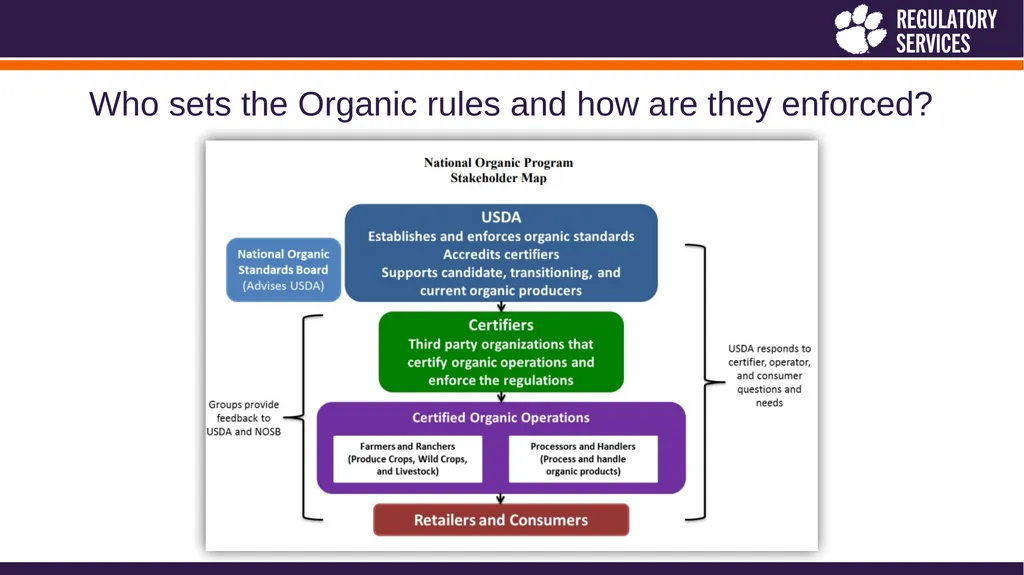
Who sets the Organic rules and how are they enforced?<br>
07
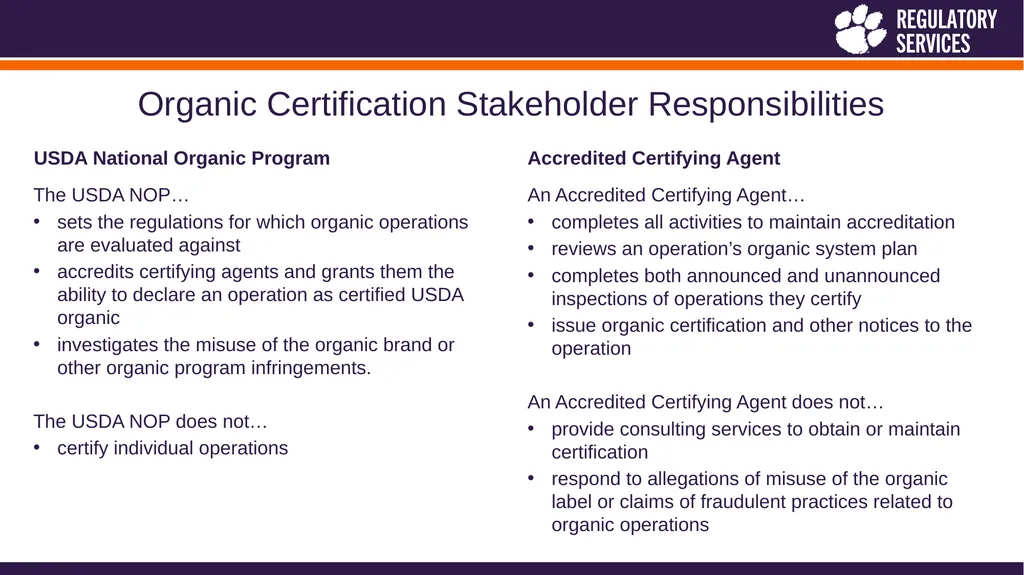
Organic Certification Stakeholder Responsibilities USDA National Organic Program The USDA NOP…
sets the regulations for which organic operations are evaluated against
accredits certifying agents and grants them the ability to declare an operation as certified USDA organic
investigates the misuse of the organic brand or other organic program infringements.
The USDA NOP does not…
certify individual operations Accredited Certifying Agent An Accredited Certifying Agent…
completes all activities to maintain accreditation
reviews an operation’s organic system plan
completes both announced and unannounced inspections of operations they certify
issue organic certification and other notices to the operation
An Accredited Certifying Agent does not…
provide consulting services to obtain or maintain certification
respond to allegations of misuse of the organic label or claims of fraudulent practices related to organic operations<br>
sets the regulations for which organic operations are evaluated against
accredits certifying agents and grants them the ability to declare an operation as certified USDA organic
investigates the misuse of the organic brand or other organic program infringements.
The USDA NOP does not…
certify individual operations Accredited Certifying Agent An Accredited Certifying Agent…
completes all activities to maintain accreditation
reviews an operation’s organic system plan
completes both announced and unannounced inspections of operations they certify
issue organic certification and other notices to the operation
An Accredited Certifying Agent does not…
provide consulting services to obtain or maintain certification
respond to allegations of misuse of the organic label or claims of fraudulent practices related to organic operations<br>
08
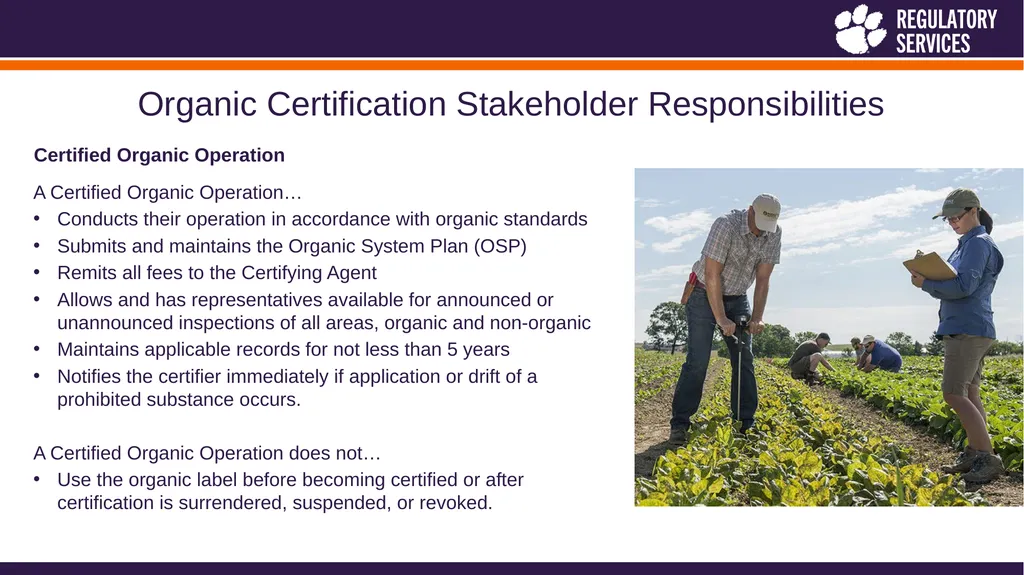
Organic Certification Stakeholder Responsibilities Certified Organic Operation A Certified Organic Operation…
Conducts their operation in accordance with organic standards
Submits and maintains the Organic System Plan (OSP)
Remits all fees to the Certifying Agent
Allows and has representatives available for announced or unannounced inspections of all areas, organic and non-organic
Maintains applicable records for not less than 5 years
Notifies the certifier immediately if application or drift of a prohibited substance occurs.
A Certified Organic Operation does not…
Use the organic label before becoming certified or after certification is surrendered, suspended, or revoked.<br>
Conducts their operation in accordance with organic standards
Submits and maintains the Organic System Plan (OSP)
Remits all fees to the Certifying Agent
Allows and has representatives available for announced or unannounced inspections of all areas, organic and non-organic
Maintains applicable records for not less than 5 years
Notifies the certifier immediately if application or drift of a prohibited substance occurs.
A Certified Organic Operation does not…
Use the organic label before becoming certified or after certification is surrendered, suspended, or revoked.<br>
09
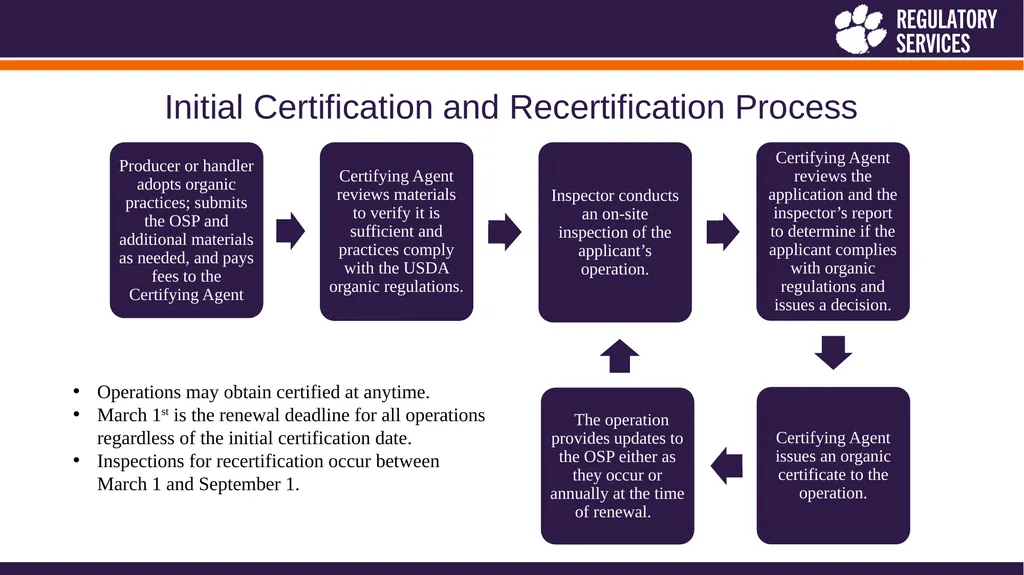
Initial Certification and Recertification Process Operations may obtain certified at anytime.
March 1st is the renewal deadline for all operations regardless of the initial certification date.
Inspections for recertification occur between March 1 and September 1.<br>
March 1st is the renewal deadline for all operations regardless of the initial certification date.
Inspections for recertification occur between March 1 and September 1.<br>
10
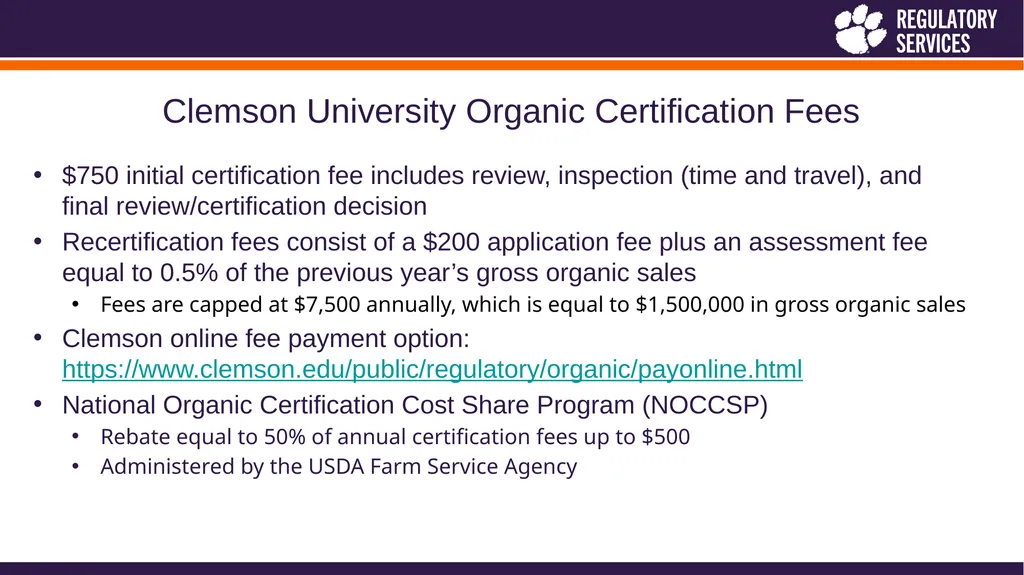
Clemson University Organic Certification Fees $750 initial certification fee includes review, inspection (time and travel), and final review/certification decision
Recertification fees consist of a $200 application fee plus an assessment fee equal to 0.5% of the previous year’s gross organic sales
Fees are capped at $7,500 annually, which is equal to $1,500,000 in gross organic sales
Clemson online fee payment option: https://www.clemson.edu/public/regulatory/organic/payonline.html
National Organic Certification Cost Share Program (NOCCSP)
Rebate equal to 50% of annual certification fees up to $500
Administered by the USDA Farm Service Agency<br>
Recertification fees consist of a $200 application fee plus an assessment fee equal to 0.5% of the previous year’s gross organic sales
Fees are capped at $7,500 annually, which is equal to $1,500,000 in gross organic sales
Clemson online fee payment option: https://www.clemson.edu/public/regulatory/organic/payonline.html
National Organic Certification Cost Share Program (NOCCSP)
Rebate equal to 50% of annual certification fees up to $500
Administered by the USDA Farm Service Agency<br>
11
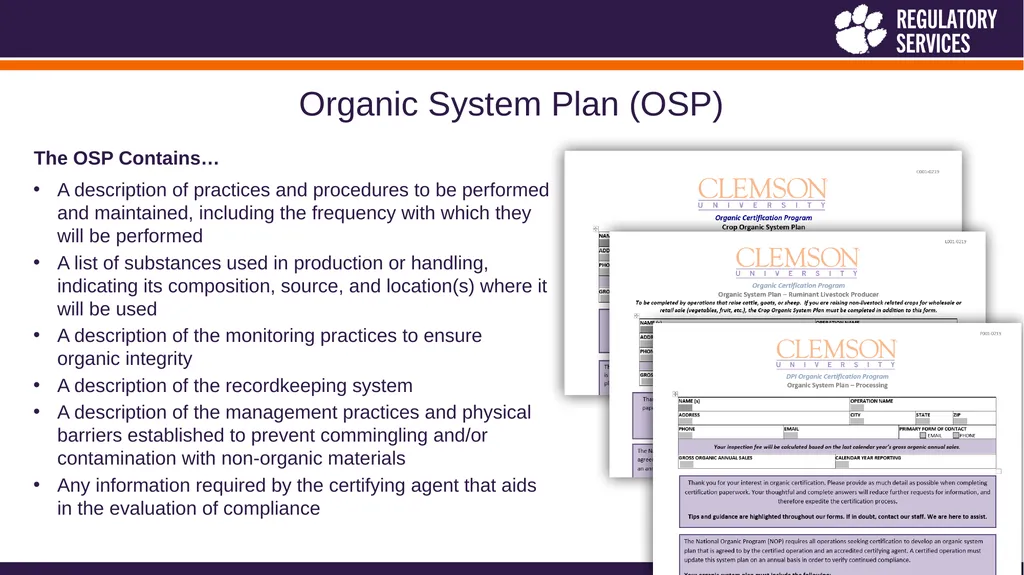
Organic System Plan (OSP) The OSP Contains… A description of practices and procedures to be performed and maintained, including the frequency with which they will be performed
A list of substances used in production or handling, indicating its composition, source, and location(s) where it will be used
A description of the monitoring practices to ensure organic integrity
A description of the recordkeeping system
A description of the management practices and physical barriers established to prevent commingling and/or contamination with non-organic materials
Any information required by the certifying agent that aids in the evaluation of compliance<br>
A list of substances used in production or handling, indicating its composition, source, and location(s) where it will be used
A description of the monitoring practices to ensure organic integrity
A description of the recordkeeping system
A description of the management practices and physical barriers established to prevent commingling and/or contamination with non-organic materials
Any information required by the certifying agent that aids in the evaluation of compliance<br>
12
Tip for Writing an Effective OSP:
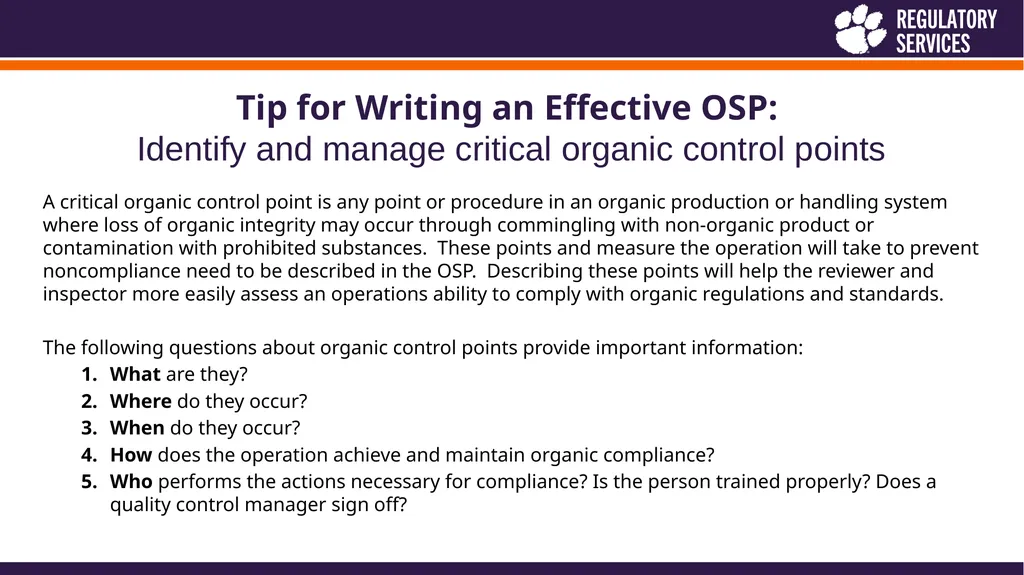
Identify and manage critical organic control points A critical organic control point is any point or procedure in an organic production or handling system where loss of organic integrity may occur through commingling with non-organic product or contamination with prohibited substances. These points and measure the operation will take to prevent noncompliance need to be described in the OSP. Describing these points will help the reviewer and inspector more easily assess an operations ability to comply with organic regulations and standards.
The following questions about organic control points provide important information:
What are they?
Where do they occur?
When do they occur?
How does the operation achieve and maintain organic compliance?
Who performs the actions necessary for compliance? Is the person trained properly? Does a quality control manager sign off?<br>
The following questions about organic control points provide important information:
What are they?
Where do they occur?
When do they occur?
How does the operation achieve and maintain organic compliance?
Who performs the actions necessary for compliance? Is the person trained properly? Does a quality control manager sign off?<br>
13
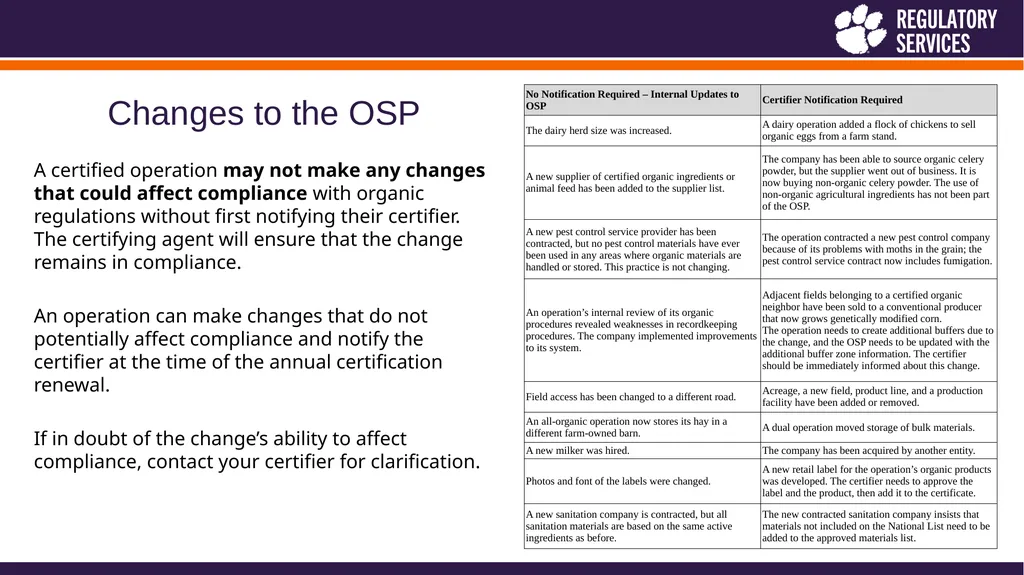
Changes to the OSP A certified operation may not make any changes that could affect compliance with organic regulations without first notifying their certifier. The certifying agent will ensure that the change remains in compliance.
An operation can make changes that do not potentially affect compliance and notify the certifier at the time of the annual certification renewal.
If in doubt of the change’s ability to affect compliance, contact your certifier for clarification.<br>
An operation can make changes that do not potentially affect compliance and notify the certifier at the time of the annual certification renewal.
If in doubt of the change’s ability to affect compliance, contact your certifier for clarification.<br>
14
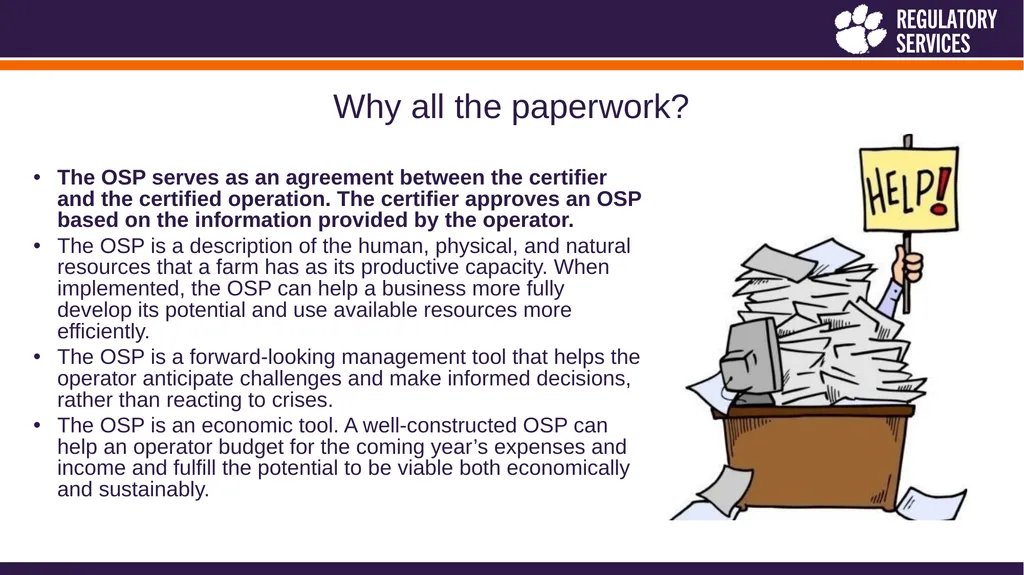
Why all the paperwork? The OSP serves as an agreement between the certifier and the certified operation. The certifier approves an OSP based on the information provided by the operator.
The OSP is a description of the human, physical, and natural resources that a farm has as its productive capacity. When implemented, the OSP can help a business more fully develop its potential and use available resources more efficiently.
The OSP is a forward-looking management tool that helps the operator anticipate challenges and make informed decisions, rather than reacting to crises.
The OSP is an economic tool. A well-constructed OSP can help an operator budget for the coming year’s expenses and income and fulfill the potential to be viable both economically and sustainably.<br>
The OSP is a description of the human, physical, and natural resources that a farm has as its productive capacity. When implemented, the OSP can help a business more fully develop its potential and use available resources more efficiently.
The OSP is a forward-looking management tool that helps the operator anticipate challenges and make informed decisions, rather than reacting to crises.
The OSP is an economic tool. A well-constructed OSP can help an operator budget for the coming year’s expenses and income and fulfill the potential to be viable both economically and sustainably.<br>
15
Organic Certification Requirements Organic regulations are published in the Code of Federal Regulations (CFR 7 subsection 205).
https://www.ecfr.gov/cgi-bin/text-idx?tpl=/ecfrbrowse/Title07/7cfr205_main_02.tpl
Further guidance documents are issued by the National Organic Program in the Program Handbook.
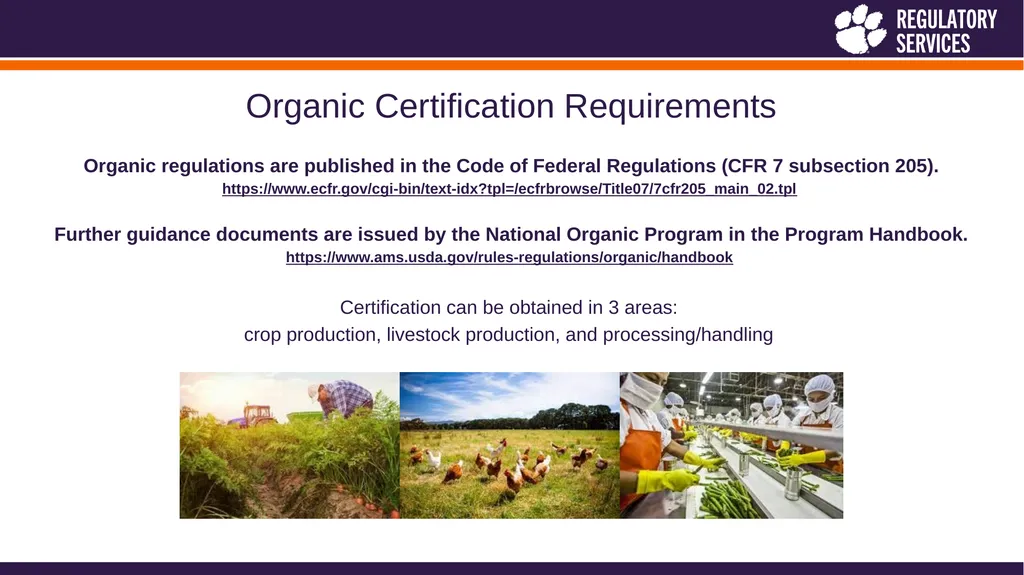
https://www.ams.usda.gov/rules-regulations/organic/handbook Certification can be obtained in 3 areas:
crop production, livestock production, and processing/handling<br>
https://www.ecfr.gov/cgi-bin/text-idx?tpl=/ecfrbrowse/Title07/7cfr205_main_02.tpl
Further guidance documents are issued by the National Organic Program in the Program Handbook.
https://www.ams.usda.gov/rules-regulations/organic/handbook Certification can be obtained in 3 areas:
crop production, livestock production, and processing/handling<br>
16
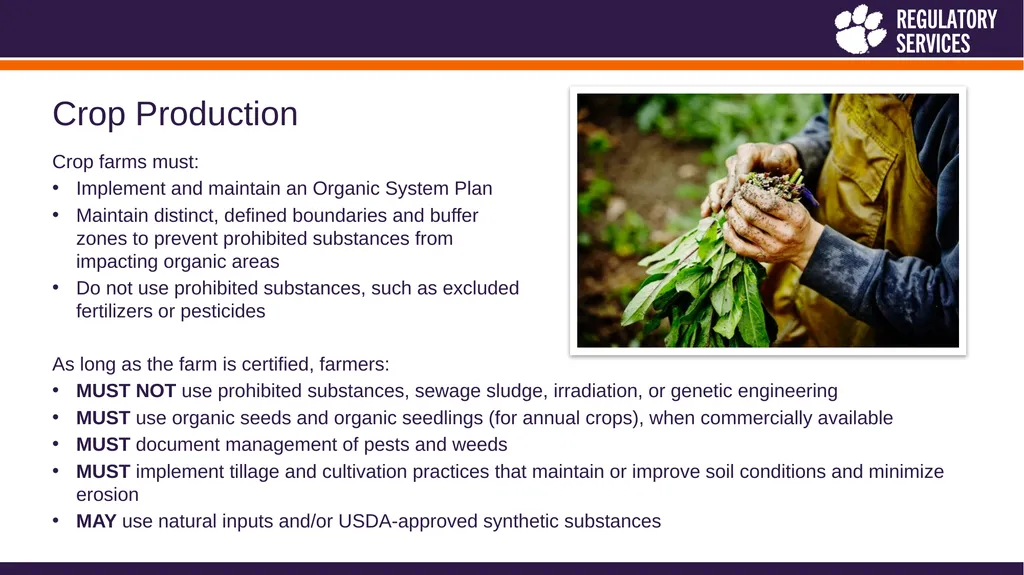
Crop Production As long as the farm is certified, farmers:
MUST NOT use prohibited substances, sewage sludge, irradiation, or genetic engineering
MUST use organic seeds and organic seedlings (for annual crops), when commercially available
MUST document management of pests and weeds
MUST implement tillage and cultivation practices that maintain or improve soil conditions and minimize erosion
MAY use natural inputs and/or USDA-approved synthetic substances Crop farms must:
Implement and maintain an Organic System Plan
Maintain distinct, defined boundaries and buffer zones to prevent prohibited substances from impacting organic areas
Do not use prohibited substances, such as excluded fertilizers or pesticides<br>
MUST NOT use prohibited substances, sewage sludge, irradiation, or genetic engineering
MUST use organic seeds and organic seedlings (for annual crops), when commercially available
MUST document management of pests and weeds
MUST implement tillage and cultivation practices that maintain or improve soil conditions and minimize erosion
MAY use natural inputs and/or USDA-approved synthetic substances Crop farms must:
Implement and maintain an Organic System Plan
Maintain distinct, defined boundaries and buffer zones to prevent prohibited substances from impacting organic areas
Do not use prohibited substances, such as excluded fertilizers or pesticides<br>
17
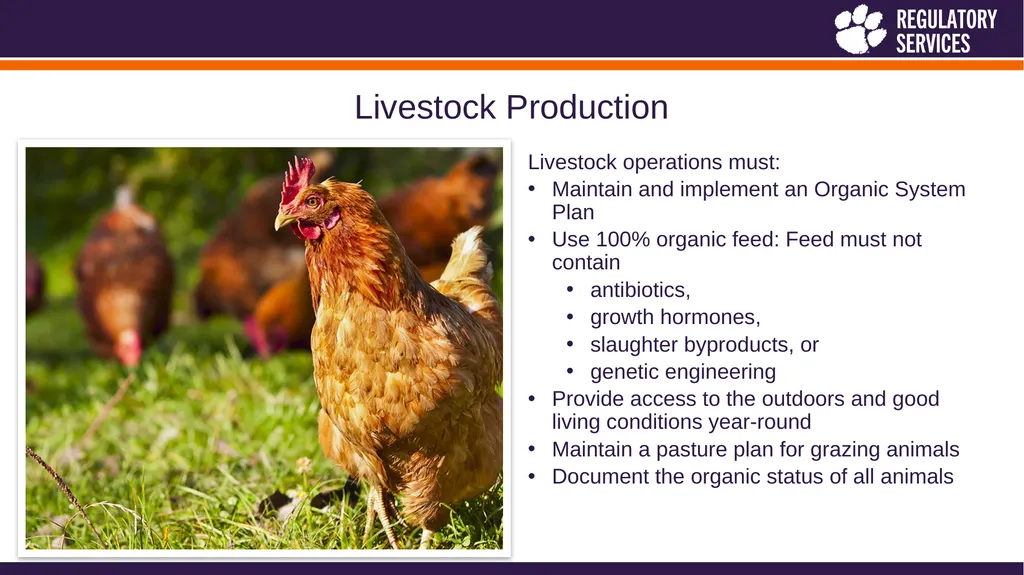
Livestock Production Livestock operations must:
Maintain and implement an Organic System Plan
Use 100% organic feed: Feed must not contain
antibiotics,
growth hormones,
slaughter byproducts, or
genetic engineering
Provide access to the outdoors and good living conditions year-round
Maintain a pasture plan for grazing animals
Document the organic status of all animals<br>
Maintain and implement an Organic System Plan
Use 100% organic feed: Feed must not contain
antibiotics,
growth hormones,
slaughter byproducts, or
genetic engineering
Provide access to the outdoors and good living conditions year-round
Maintain a pasture plan for grazing animals
Document the organic status of all animals<br>
18
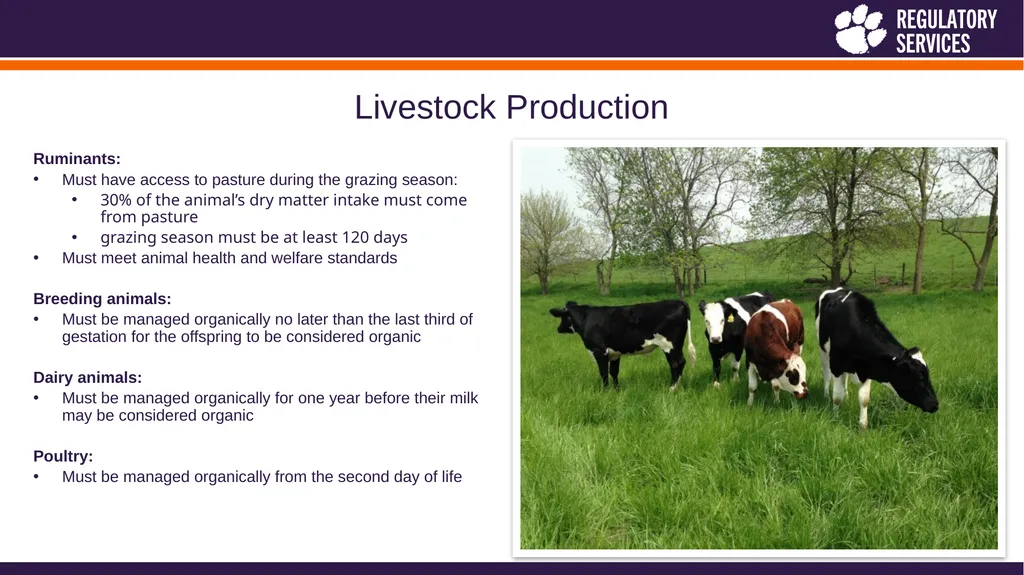
Livestock Production Ruminants:
Must have access to pasture during the grazing season:
30% of the animal’s dry matter intake must come from pasture
grazing season must be at least 120 days
Must meet animal health and welfare standards
Breeding animals:
Must be managed organically no later than the last third of gestation for the offspring to be considered organic
Dairy animals:
Must be managed organically for one year before their milk may be considered organic
Poultry:
Must be managed organically from the second day of life<br>
Must have access to pasture during the grazing season:
30% of the animal’s dry matter intake must come from pasture
grazing season must be at least 120 days
Must meet animal health and welfare standards
Breeding animals:
Must be managed organically no later than the last third of gestation for the offspring to be considered organic
Dairy animals:
Must be managed organically for one year before their milk may be considered organic
Poultry:
Must be managed organically from the second day of life<br>
19
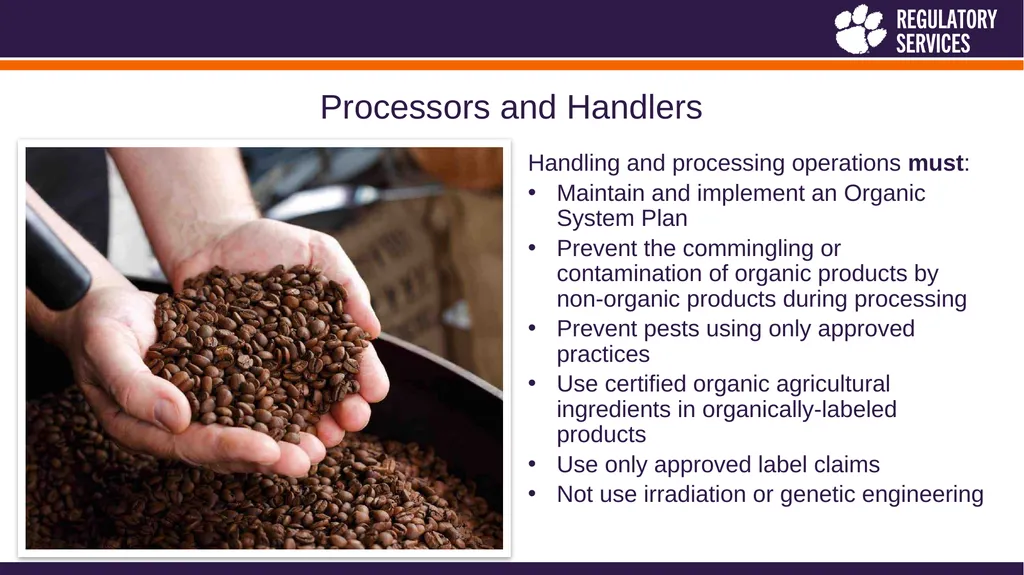
Processors and Handlers Handling and processing operations must:
Maintain and implement an Organic System Plan
Prevent the commingling or contamination of organic products by non-organic products during processing
Prevent pests using only approved practices
Use certified organic agricultural ingredients in organically-labeled products
Use only approved label claims
Not use irradiation or genetic engineering<br>
Maintain and implement an Organic System Plan
Prevent the commingling or contamination of organic products by non-organic products during processing
Prevent pests using only approved practices
Use certified organic agricultural ingredients in organically-labeled products
Use only approved label claims
Not use irradiation or genetic engineering<br>
20
Allowed and Prohibited Substances In general, synthetic substances are prohibited in organic products unless specifically allowed. Non-synthetic substances are allowed unless specifically prohibited.
The National List of Allowed and Prohibited Substances (National List) is part of the organic regulations. It identifies substances that may and may not be used in organic production and handling (part of the CFR)
The National List includes:
Synthetic substances which are allowed for use
Natural substances which are prohibited for use.
The National List has separate sections for crops, livestock, and handling/food processing.
Additional resources to evaluate a substance for use in an organic operation:
Organic Materials Review Institute https://www.omri.org/
California Department of Food and Agriculture Organic Material Input Program https://www.cdfa.ca.gov/is/ffldrs/fertilizer_OIM.html
Washington State Department of Agriculture Organic Materials Input List https://cms.agr.wa.gov/getmedia/6322228c-c949-44a2-926c-2a86739269e3/WSDA_Organic_Input_Material_List<br>
The National List of Allowed and Prohibited Substances (National List) is part of the organic regulations. It identifies substances that may and may not be used in organic production and handling (part of the CFR)
The National List includes:
Synthetic substances which are allowed for use
Natural substances which are prohibited for use.
The National List has separate sections for crops, livestock, and handling/food processing.
Additional resources to evaluate a substance for use in an organic operation:
Organic Materials Review Institute https://www.omri.org/
California Department of Food and Agriculture Organic Material Input Program https://www.cdfa.ca.gov/is/ffldrs/fertilizer_OIM.html
Washington State Department of Agriculture Organic Materials Input List https://cms.agr.wa.gov/getmedia/6322228c-c949-44a2-926c-2a86739269e3/WSDA_Organic_Input_Material_List<br>
21
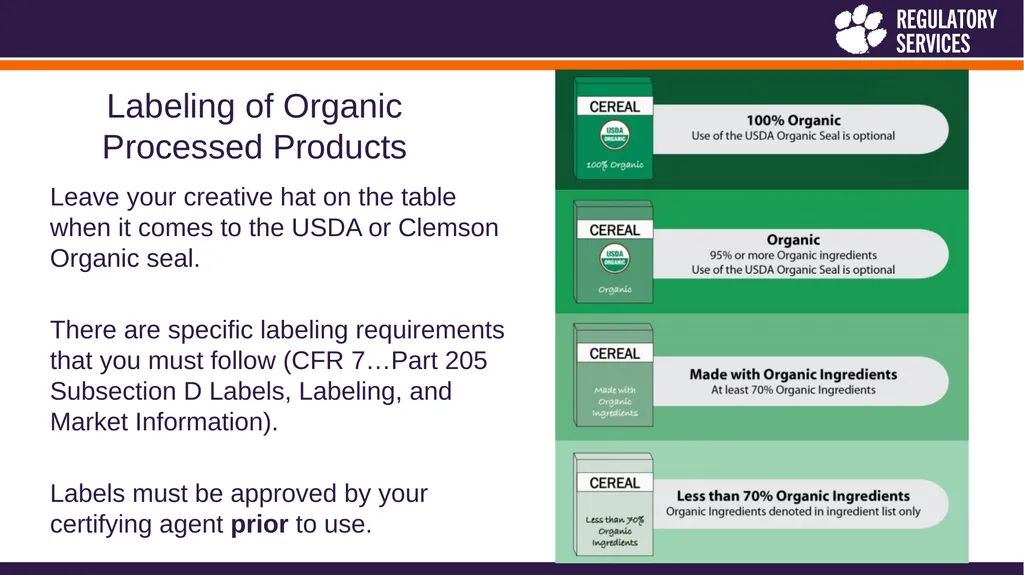
Labeling of Organic Processed Products Leave your creative hat on the table when it comes to the USDA or Clemson Organic seal.
There are specific labeling requirements that you must follow (CFR 7…Part 205 Subsection D Labels, Labeling, and Market Information).
Labels must be approved by your certifying agent prior to use.<br>
There are specific labeling requirements that you must follow (CFR 7…Part 205 Subsection D Labels, Labeling, and Market Information).
Labels must be approved by your certifying agent prior to use.<br>
22
Recordkeeping The OSP needs to include information about recordkeeping procedures in sufficient detail to ensure that the operation is complying with recordkeeping requirements and must provide traceability of inputs and products.
Insufficient information in records may include:
Harvest records that do not include the field identification
Sanitation records that do not include a signature line
No space on a form for lot numbers to record incoming ingredients
Resources to help develop recordkeeping practices:
https://attra.ncat.org/product/documentation-forms-for-organic-crop-and-livestock-producers/
https://www.ams.usda.gov/sites/default/files/media/2602.pdf<br>
Insufficient information in records may include:
Harvest records that do not include the field identification
Sanitation records that do not include a signature line
No space on a form for lot numbers to record incoming ingredients
Resources to help develop recordkeeping practices:
https://attra.ncat.org/product/documentation-forms-for-organic-crop-and-livestock-producers/
https://www.ams.usda.gov/sites/default/files/media/2602.pdf<br>
23
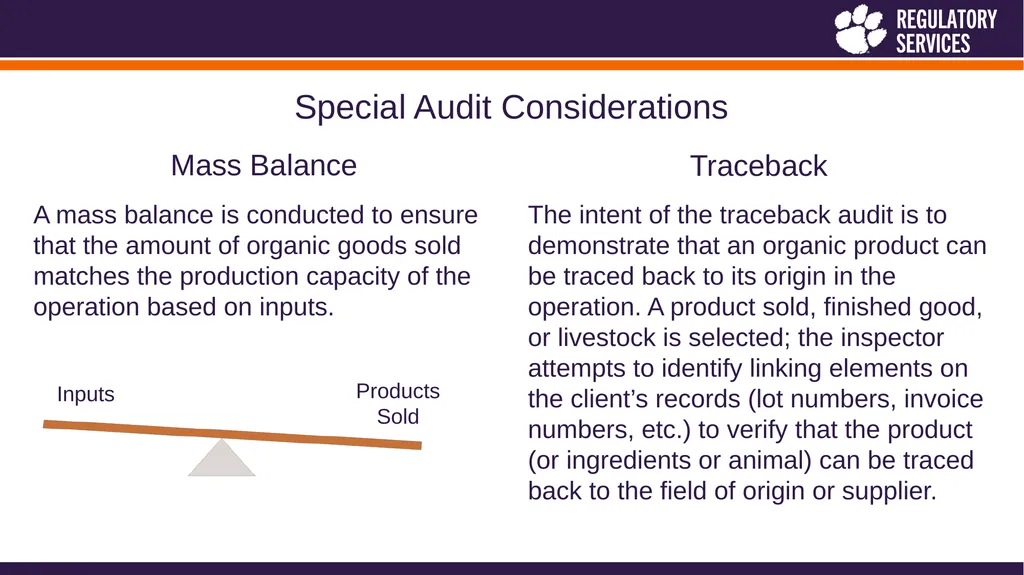
Special Audit Considerations A mass balance is conducted to ensure that the amount of organic goods sold matches the production capacity of the operation based on inputs. The intent of the traceback audit is to demonstrate that an organic product can be traced back to its origin in the operation. A product sold, finished good, or livestock is selected; the inspector attempts to identify linking elements on the client’s records (lot numbers, invoice numbers, etc.) to verify that the product (or ingredients or animal) can be traced back to the field of origin or supplier. Mass Balance Traceback Inputs Products Sold<br>
24
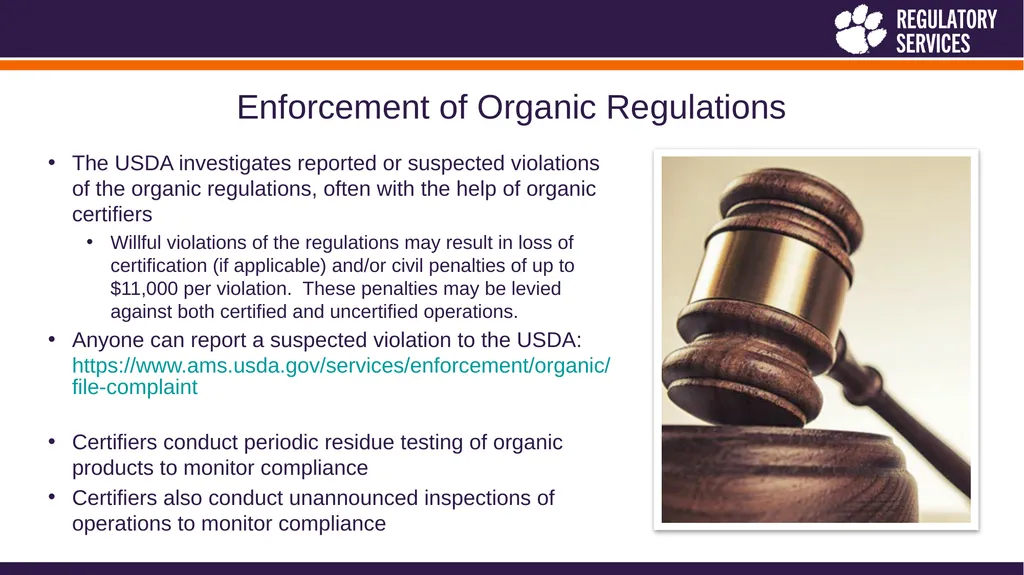
Enforcement of Organic Regulations The USDA investigates reported or suspected violations of the organic regulations, often with the help of organic certifiers
Willful violations of the regulations may result in loss of certification (if applicable) and/or civil penalties of up to $11,000 per violation. These penalties may be levied against both certified and uncertified operations.
Anyone can report a suspected violation to the USDA: https://www.ams.usda.gov/services/enforcement/organic/file-complaint
Certifiers conduct periodic residue testing of organic products to monitor compliance
Certifiers also conduct unannounced inspections of operations to monitor compliance<br>
Willful violations of the regulations may result in loss of certification (if applicable) and/or civil penalties of up to $11,000 per violation. These penalties may be levied against both certified and uncertified operations.
Anyone can report a suspected violation to the USDA: https://www.ams.usda.gov/services/enforcement/organic/file-complaint
Certifiers conduct periodic residue testing of organic products to monitor compliance
Certifiers also conduct unannounced inspections of operations to monitor compliance<br>
25
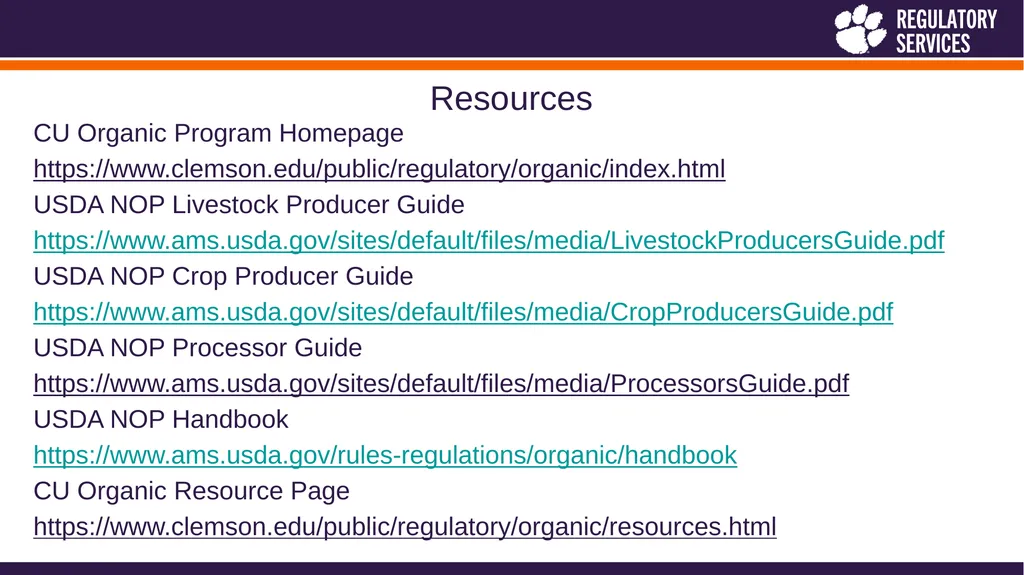
Resources CU Organic Program Homepage
https://www.clemson.edu/public/regulatory/organic/index.html
USDA NOP Livestock Producer Guide
https://www.ams.usda.gov/sites/default/files/media/LivestockProducersGuide.pdf
USDA NOP Crop Producer Guide
https://www.ams.usda.gov/sites/default/files/media/CropProducersGuide.pdf
USDA NOP Processor Guide
https://www.ams.usda.gov/sites/default/files/media/ProcessorsGuide.pdf
USDA NOP Handbook
https://www.ams.usda.gov/rules-regulations/organic/handbook
CU Organic Resource Page
https://www.clemson.edu/public/regulatory/organic/resources.html<br>
https://www.clemson.edu/public/regulatory/organic/index.html
USDA NOP Livestock Producer Guide
https://www.ams.usda.gov/sites/default/files/media/LivestockProducersGuide.pdf
USDA NOP Crop Producer Guide
https://www.ams.usda.gov/sites/default/files/media/CropProducersGuide.pdf
USDA NOP Processor Guide
https://www.ams.usda.gov/sites/default/files/media/ProcessorsGuide.pdf
USDA NOP Handbook
https://www.ams.usda.gov/rules-regulations/organic/handbook
CU Organic Resource Page
https://www.clemson.edu/public/regulatory/organic/resources.html<br>
26
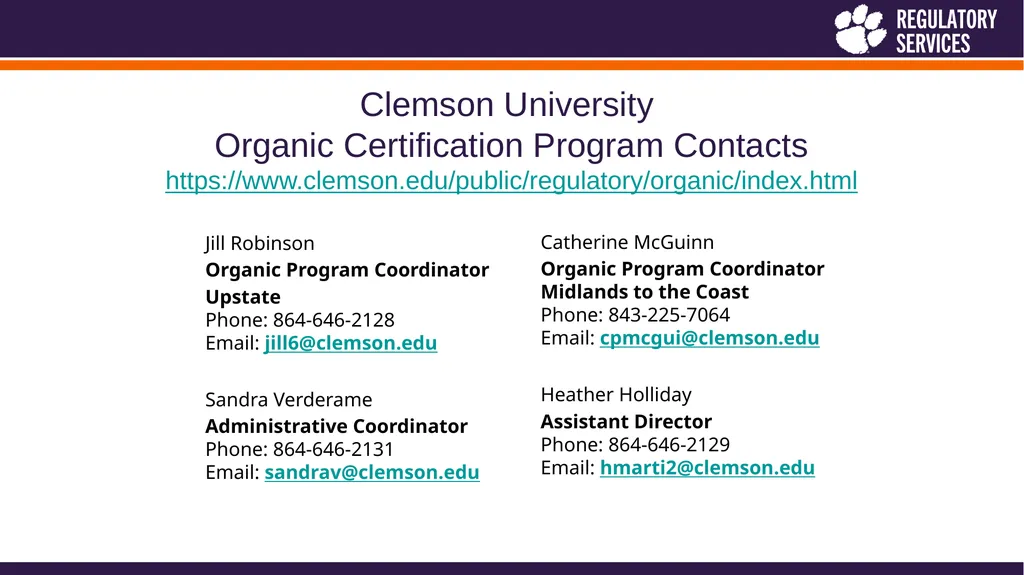
Clemson University
Organic Certification Program Contacts
https://www.clemson.edu/public/regulatory/organic/index.html Jill Robinson
Organic Program Coordinator
Upstate Phone: 864-646-2128 Email: jill6@clemson.edu
Sandra Verderame
Administrative Coordinator Phone: 864-646-2131 Email: sandrav@clemson.edu Catherine McGuinn
Organic Program Coordinator Midlands to the Coast Phone: 843-225-7064 Email: cpmcgui@clemson.edu
Heather Holliday
Assistant Director Phone: 864-646-2129 Email: hmarti2@clemson.edu<br>
Organic Program Coordinator
Upstate Phone: 864-646-2128 Email: jill6@clemson.edu
Sandra Verderame
Administrative Coordinator Phone: 864-646-2131 Email: sandrav@clemson.edu Catherine McGuinn
Organic Program Coordinator Midlands to the Coast Phone: 843-225-7064 Email: cpmcgui@clemson.edu
Heather Holliday
Assistant Director Phone: 864-646-2129 Email: hmarti2@clemson.edu<br>