
Hematopoietic Stem Cell Transplant: Remotely
A
Published · 1 slides · 0 views
1 / 1
Description
Hematopoietic Stem Cell Transplant: Remotely Supporting Our Caregivers An Integrative Review September 26, 2023 Copyright 2020 MD Anderson Cancer Center All rights reserved. Jessica Osburn1 MS, APRN, AGACNP-BC, AOCNP Ashley Martinez1 DNP,
Related Topics
Share
Embed code
Download this presentation From Below
"Hematopoietic Stem Cell Transplant: Remotely" is the property of its rightful owner. Permission is granted to download and print the materials on this website for personal, non-commercial use only, and to display it on your personal computer provided you do not modify the materials and that you retain all copyright notices contained in the materials. By downloading content from our website, you accept the terms of this agreement.
Presentation Transcript
01
Hematopoietic Stem Cell Transplant: Remotely Supporting Our Caregivers
An Integrative Review September 26, 2023 Copyright 2020 MD Anderson Cancer Center All rights reserved. Jessica Osburn1 MS, APRN, AGACNP-BC, AOCNP
Ashley Martinez1 DNP, APRN, FNP-BC, AOCNP, CPHQ, NEA-BC, NPD-BC
Joyce Dains1 DrPH, JD, APRN, FNP-BC, FNAP, FAANP, FAAN Hematopoietic stem cell transplantation (HSCT) is an intensive treatment requiring the support of a caregiver. This role is a highly demanding responsibility and often caregivers face distress. In a world that has become highly technological, the aim of this integrative review is to determine the availability and impact of remote interventions in reducing distress in caregivers of HSCT patients. A literature review was conducted using PubMed and Scopus databases. The search included articles published between January 1, 2013 and February 20, 2023. The search yielded 699 unique articles, of which four were included in the final review. The four included studies of the impact of remote interventions on distress or burden in caregivers of adult HSCT patients. Abstract Background This review is composed of four studies: one mixed-methods study (Carr et al., 2019), one prospective multi-component study (Fauer et al., 2019), one randomized controlled trial (Pensak et al., 2020), and one longitudinal study (Kisch et al., 2022). While these studies varied in terms of design, sample size (range 14-56), geographic distribution (academic medical centers within the United States, HSCT centers in Sweden), and intervention delivery (telephone, video, mobile application, website), they all studied the impact of remotely accessible interventions for caregivers of patients undergoing HSCT.
Results from this review are organized by availability and impact of the interventions. Availability is characterized by accessibility and delivery type to evaluate remote intervention dissemination. Impact assesses three elements: quality of life (QOL), mental health, and perceived usefulness. Together, these three elements define and serve as a measurement of remote intervention effectiveness in reducing distress in HSCT caregivers. Results Quality of life, mental health, and perceived usefulness define and serve as a measurement of remote intervention effectiveness in reducing distress in HSCT caregivers.
Quality of Life
Pep-Pal was associated with improved caregiver interpersonal situation, reduced caregiver burden & helped shift caregiver’s focus and prioritize their own mental, physical and emotional needs
BMT Roadmap use, anxiety and fatigue were associated with QOL, and subscale scores decreased in caregivers from baseline to discharge.
Mental Health
Pep-Pal was reported to help manage stress as a caregiver & associated with significant reductions in perceived stress and increased ability to learn stress management skills
BMT Roadmap was associated with an overall increase in vigor, decrease in anxiety, distress, depression, and fatigue from baseline to discharge
Caregivers felt more relieved and at peace following CSNAT-I conversations
Perceived Usefulness
Caregivers reported an overall satisfaction with Pep-Pal, but 21% of caregivers indicated they would find a mobile app more useful
Pensak et al. a priori hypothesis and criterion for success (that participants would watch at least 7/9 Pep-Pal sessions) was not met
BMT Roadmap was perceived to be useful, and activation increased from baseline to discharge
CSNAT-I was highly accepted as an intervention and participation demand from caregivers was high Theme: Impact This review identified four studies that provided remote interventions to reduce distress in caregivers of HSCT patients: this limited result alone highlight the need for continued development, implementation, and validation of remotely accessible interventions.
Telehealth will continue to grow as it offers improved patient access, cost savings, and better outcomes with engaged patients (Balestra, 2018). ASPE discovered via the Census Bureau’s Household Pulse Survey conducted April-October 2021, that while one in four respondents had accessed telehealth services in the last four weeks, significant disparities remained: video telehealth rates were lowest amongst those without a high school diploma, >65 years in age, Latino, Asian, and Black populations (Karima et al., 2022). This survey highlights the need for remote interventions and increased accessibility for vulnerable groups.
Active engagement of caregivers in intervention development can streamline interventions and directly prioritize caregiver needs, wishes, and concerns. Clinical Implications Footnotes:
1. The University of Texas Md Anderson Cancer Center
Author Note
The authors have no conflicts of interest or financial disclosures.
The data in this poster presentation comes from an original Integrative Review Manuscript conducted as part of the Post Graduate APRN Fellowship in Oncology which was submitted to the Journal of the Advanced Practitioner in Oncology July 11, 2023. References Methods With the assistance of a research medical librarian, in February of 2023 PubMed and Scopus databases were searched using the following terms: (caregiver OR partner OR carer OR family) AND (support OR education OR massage OR financial stress OR sleep OR burden OR intervention OR psychosocial OR strain OR stress OR distress OR group) AND (hemato OR transplant OR transplants OR transplantation OR stem cell OR bmt).
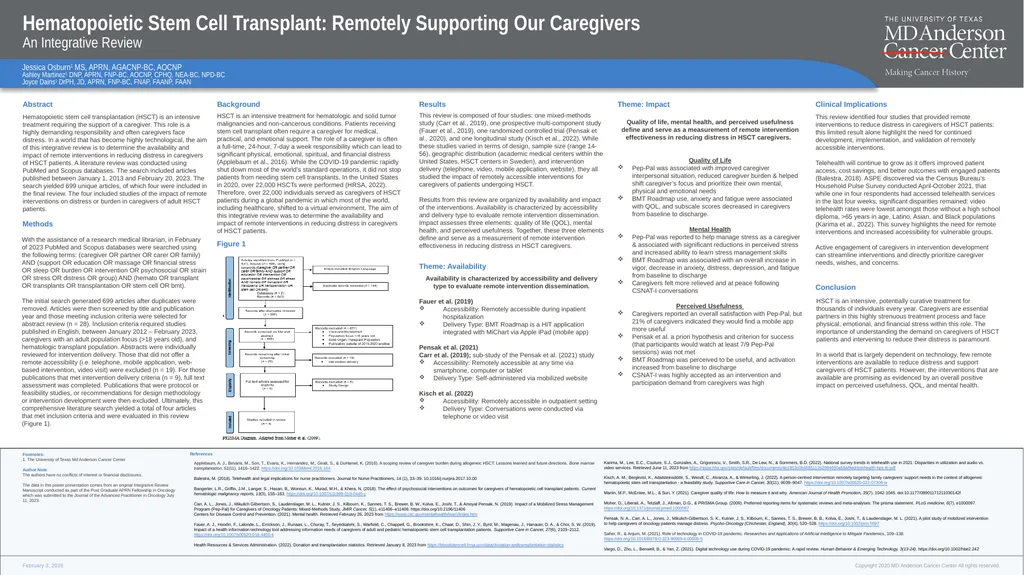
The initial search generated 699 articles after duplicates were removed. Articles were then screened by title and publication year and those meeting inclusion criteria were selected for abstract review (n = 28). Inclusion criteria required studies published in English, between January 2012 – February 2023, caregivers with an adult population focus (>18 years old), and hematologic transplant population. Abstracts were individually reviewed for intervention delivery. Those that did not offer a remote accessibility (i.e. telephone, mobile application, web-based intervention, video visit) were excluded (n = 19). For those publications that met intervention delivery criteria (n = 9), full text assessment was completed. Publications that were protocol or feasibility studies, or recommendations for design methodology or intervention development were then excluded. Ultimately, this comprehensive literature search yielded a total of four articles that met inclusion criteria and were evaluated in this review (Figure 1). Figure 1 HSCT is an intensive treatment for hematologic and solid tumor malignancies and non-cancerous conditions. Patients receiving stem cell transplant often require a caregiver for medical, practical, and emotional support. The role of a caregiver is often a full-time, 24-hour, 7-day a week responsibility which can lead to significant physical, emotional, spiritual, and financial distress (Applebaum et al., 2016). While the COVID-19 pandemic rapidly shut down most of the world’s standard operations, it did not stop patients from needing stem cell transplants. In the United States in 2020, over 22,000 HSCTs were performed (HRSA, 2022). Therefore, over 22,000 individuals served as caregivers of HSCT patients during a global pandemic in which most of the world, including healthcare, shifted to a virtual environment. The aim of this integrative review was to determine the availability and impact of remote interventions in reducing distress in caregivers of HSCT patients. Theme: Availability Availability is characterized by accessibility and delivery type to evaluate remote intervention dissemination.
Fauer et al. (2019)
Accessibility: Remotely accessible during inpatient hospitalization
Delivery Type: BMT Roadmap is a HIT application integrated with MiChart via Apple iPad (mobile app)
Pensak et al. (2021)
Carr et al. (2019); sub-study of the Pensak et al. (2021) study
Accessibility: Remotely accessible at any time via smartphone, computer or tablet
Delivery Type: Self-administered via mobilized website
Kisch et al. (2022)
Accessibility: Remotely accessible in outpatient setting
Delivery Type: Conversations were conducted via telephone or video visit Applebaum, A. J., Bevans, M., Son, T., Evans, K., Hernandez, M., Giralt, S., & DuHamel, K. (2016). A scoping review of caregiver burden during allogeneic HSCT: Lessons learned and future directions. Bone marrow transplantation, 51(11), 1416–1422. https://doi.org/10.1038/bmt.2016.164
Balestra, M. (2018). Telehealth and legal implications for nurse practitioners. Journal for Nurse Practitioners, 14 (1), 33–39. 10.1016/j.nurpra.2017.10.00
Bangerter, L.R., Griffin, J.M., Langer, S., Hasan, B., Wonsun, K., Murad, M.H., & Khera, N. (2018). The effect of psychosocial interventions on outcomes for caregivers of hematopoietic cell transplant patients. Current hematologic malignancy reports, 13(3), 155–163. https://doi.org/10.1007/s11899-018-0445-y
Carr, A. L., Jones, J., Mikulich Gilbertson, S., Laudenslager, M. L., Kutner, J. S., Kilbourn, K., Sannes, T. S., Brewer, B. W., Kolva, E., Joshi, T., & Amoyal Pensak, N. (2019). Impact of a Mobilized Stress Management Program (Pep-Pal) for Caregivers of Oncology Patients: Mixed-Methods Study. JMIR Cancer, 5(1), e11406–e11406. https://doi.org/10.2196/11406
Centers for Disease Control and Prevention. (2021). Mental health. Retrieved February 26, 2023 from https://www.cdc.gov/mentalhealth/learn/index.htm
Fauer, A. J., Hoodin, F., Lalonde, L., Errickson, J., Runaas, L., Churay, T., Seyedsalehi, S., Warfield, C., Chappell, G., Brookshire, K., Chaar, D., Shin, J. Y., Byrd, M., Magenau, J., Hanauer, D. A., & Choi, S. W. (2019). Impact of a health information technology tool addressing information needs of caregivers of adult and pediatric hematopoietic stem cell transplantation patients. Supportive Care in Cancer, 27(6), 2103–2112. https://doi.org/10.1007/s00520-018-4450-4
Health Resources & Services Administration. (2022). Donation and transplantation statistics. Retrieved January 8, 2023 from https://bloodstemcell.hrsa.gov/data/donation-andtransplantation-statistics Karima, M., Lee, E.C., Couture, S.J., Gonzales, A., Grigorescu, V., Smith, S.R., De Lew, N., & Sommers, B.D. (2022). National survey trends in telehealth use in 2021: Disparities in utilization and audio vs. video services. Retrieved June 11, 2023 from https://aspe.hhs.gov/sites/default/files/documents/4e1853c0b4885112b2994680a58af9ed/telehealth-hps-ib.pdf
Kisch, A. M., Bergkvist, K., Adalsteinsdóttir, S., Wendt, C., Alvariza, A., & Winterling, J. (2022). A person-centred intervention remotely targeting family caregivers’ support needs in the context of allogeneic hematopoietic stem cell transplantation - a feasibility study. Supportive Care in Cancer, 30(11), 9039–9047. https://doi.org/10.1007/s00520-022-07306-w
Martin, M.P., McEntee, M.L., & Suri, Y. (2021). Caregiver quality of life: How to measure it and why. American Journal of Health Promotion, 35(7), 1042-1045. doi:10.1177/08901171211030142f
Moher, D., Liberati, A., Tetzlaff, J., Altman, D.G., & PRISMA Group. (2009). Preferred reporting items for systematic reviews and meta-analyses: The prisma statement. PLoS medicine, 6(7), e1000097. https://doi.org/10.1371/journal.pmed.1000097
Pensak, N. A., Carr, A. L., Jones, J., Mikulich‐Gilbertson, S. K., Kutner, J. S., Kilbourn, K., Sannes, T. S., Brewer, B. B., Kolva, E., Joshi, T., & Laudenslager, M. L. (2021). A pilot study of mobilized intervention to help caregivers of oncology patients manage distress. Psycho-Oncology (Chichester, England), 30(4), 520–528. https://doi.org/10.1002/pon.5597
Saher, R., & Anjum, M. (2021). Role of technology in COVID-19 pandemic. Researches and Applications of Artificial Intelligence to Mitigate Pandemics, 109–138. https://doi.org/10.1016/B978-0-323-90959-4.00005-5
Vargo, D., Zhu, L., Benwell, B., & Yan, Z. (2021). Digital technology use during COVID-19 pandemic: A rapid review. Human Behavior & Emerging Technology, 3(13-24). https://doi.org/10.1002/hbe2.242 Conclusion HSCT is an intensive, potentially curative treatment for thousands of individuals every year. Caregivers are essential partners in this highly strenuous treatment process and face physical, emotional, and financial stress within this role. The importance of understanding the demand on caregivers of HSCT patients and intervening to reduce their distress is paramount.
In a world that is largely dependent on technology, few remote interventions are available to reduce distress and support caregivers of HSCT patients. However, the interventions that are available are promising as evidenced by an overall positive impact on perceived usefulness, QOL, and mental health.<br>
Ashley Martinez1 DNP, APRN, FNP-BC, AOCNP, CPHQ, NEA-BC, NPD-BC
Joyce Dains1 DrPH, JD, APRN, FNP-BC, FNAP, FAANP, FAAN Hematopoietic stem cell transplantation (HSCT) is an intensive treatment requiring the support of a caregiver. This role is a highly demanding responsibility and often caregivers face distress. In a world that has become highly technological, the aim of this integrative review is to determine the availability and impact of remote interventions in reducing distress in caregivers of HSCT patients. A literature review was conducted using PubMed and Scopus databases. The search included articles published between January 1, 2013 and February 20, 2023. The search yielded 699 unique articles, of which four were included in the final review. The four included studies of the impact of remote interventions on distress or burden in caregivers of adult HSCT patients. Abstract Background This review is composed of four studies: one mixed-methods study (Carr et al., 2019), one prospective multi-component study (Fauer et al., 2019), one randomized controlled trial (Pensak et al., 2020), and one longitudinal study (Kisch et al., 2022). While these studies varied in terms of design, sample size (range 14-56), geographic distribution (academic medical centers within the United States, HSCT centers in Sweden), and intervention delivery (telephone, video, mobile application, website), they all studied the impact of remotely accessible interventions for caregivers of patients undergoing HSCT.
Results from this review are organized by availability and impact of the interventions. Availability is characterized by accessibility and delivery type to evaluate remote intervention dissemination. Impact assesses three elements: quality of life (QOL), mental health, and perceived usefulness. Together, these three elements define and serve as a measurement of remote intervention effectiveness in reducing distress in HSCT caregivers. Results Quality of life, mental health, and perceived usefulness define and serve as a measurement of remote intervention effectiveness in reducing distress in HSCT caregivers.
Quality of Life
Pep-Pal was associated with improved caregiver interpersonal situation, reduced caregiver burden & helped shift caregiver’s focus and prioritize their own mental, physical and emotional needs
BMT Roadmap use, anxiety and fatigue were associated with QOL, and subscale scores decreased in caregivers from baseline to discharge.
Mental Health
Pep-Pal was reported to help manage stress as a caregiver & associated with significant reductions in perceived stress and increased ability to learn stress management skills
BMT Roadmap was associated with an overall increase in vigor, decrease in anxiety, distress, depression, and fatigue from baseline to discharge
Caregivers felt more relieved and at peace following CSNAT-I conversations
Perceived Usefulness
Caregivers reported an overall satisfaction with Pep-Pal, but 21% of caregivers indicated they would find a mobile app more useful
Pensak et al. a priori hypothesis and criterion for success (that participants would watch at least 7/9 Pep-Pal sessions) was not met
BMT Roadmap was perceived to be useful, and activation increased from baseline to discharge
CSNAT-I was highly accepted as an intervention and participation demand from caregivers was high Theme: Impact This review identified four studies that provided remote interventions to reduce distress in caregivers of HSCT patients: this limited result alone highlight the need for continued development, implementation, and validation of remotely accessible interventions.
Telehealth will continue to grow as it offers improved patient access, cost savings, and better outcomes with engaged patients (Balestra, 2018). ASPE discovered via the Census Bureau’s Household Pulse Survey conducted April-October 2021, that while one in four respondents had accessed telehealth services in the last four weeks, significant disparities remained: video telehealth rates were lowest amongst those without a high school diploma, >65 years in age, Latino, Asian, and Black populations (Karima et al., 2022). This survey highlights the need for remote interventions and increased accessibility for vulnerable groups.
Active engagement of caregivers in intervention development can streamline interventions and directly prioritize caregiver needs, wishes, and concerns. Clinical Implications Footnotes:
1. The University of Texas Md Anderson Cancer Center
Author Note
The authors have no conflicts of interest or financial disclosures.
The data in this poster presentation comes from an original Integrative Review Manuscript conducted as part of the Post Graduate APRN Fellowship in Oncology which was submitted to the Journal of the Advanced Practitioner in Oncology July 11, 2023. References Methods With the assistance of a research medical librarian, in February of 2023 PubMed and Scopus databases were searched using the following terms: (caregiver OR partner OR carer OR family) AND (support OR education OR massage OR financial stress OR sleep OR burden OR intervention OR psychosocial OR strain OR stress OR distress OR group) AND (hemato OR transplant OR transplants OR transplantation OR stem cell OR bmt).
The initial search generated 699 articles after duplicates were removed. Articles were then screened by title and publication year and those meeting inclusion criteria were selected for abstract review (n = 28). Inclusion criteria required studies published in English, between January 2012 – February 2023, caregivers with an adult population focus (>18 years old), and hematologic transplant population. Abstracts were individually reviewed for intervention delivery. Those that did not offer a remote accessibility (i.e. telephone, mobile application, web-based intervention, video visit) were excluded (n = 19). For those publications that met intervention delivery criteria (n = 9), full text assessment was completed. Publications that were protocol or feasibility studies, or recommendations for design methodology or intervention development were then excluded. Ultimately, this comprehensive literature search yielded a total of four articles that met inclusion criteria and were evaluated in this review (Figure 1). Figure 1 HSCT is an intensive treatment for hematologic and solid tumor malignancies and non-cancerous conditions. Patients receiving stem cell transplant often require a caregiver for medical, practical, and emotional support. The role of a caregiver is often a full-time, 24-hour, 7-day a week responsibility which can lead to significant physical, emotional, spiritual, and financial distress (Applebaum et al., 2016). While the COVID-19 pandemic rapidly shut down most of the world’s standard operations, it did not stop patients from needing stem cell transplants. In the United States in 2020, over 22,000 HSCTs were performed (HRSA, 2022). Therefore, over 22,000 individuals served as caregivers of HSCT patients during a global pandemic in which most of the world, including healthcare, shifted to a virtual environment. The aim of this integrative review was to determine the availability and impact of remote interventions in reducing distress in caregivers of HSCT patients. Theme: Availability Availability is characterized by accessibility and delivery type to evaluate remote intervention dissemination.
Fauer et al. (2019)
Accessibility: Remotely accessible during inpatient hospitalization
Delivery Type: BMT Roadmap is a HIT application integrated with MiChart via Apple iPad (mobile app)
Pensak et al. (2021)
Carr et al. (2019); sub-study of the Pensak et al. (2021) study
Accessibility: Remotely accessible at any time via smartphone, computer or tablet
Delivery Type: Self-administered via mobilized website
Kisch et al. (2022)
Accessibility: Remotely accessible in outpatient setting
Delivery Type: Conversations were conducted via telephone or video visit Applebaum, A. J., Bevans, M., Son, T., Evans, K., Hernandez, M., Giralt, S., & DuHamel, K. (2016). A scoping review of caregiver burden during allogeneic HSCT: Lessons learned and future directions. Bone marrow transplantation, 51(11), 1416–1422. https://doi.org/10.1038/bmt.2016.164
Balestra, M. (2018). Telehealth and legal implications for nurse practitioners. Journal for Nurse Practitioners, 14 (1), 33–39. 10.1016/j.nurpra.2017.10.00
Bangerter, L.R., Griffin, J.M., Langer, S., Hasan, B., Wonsun, K., Murad, M.H., & Khera, N. (2018). The effect of psychosocial interventions on outcomes for caregivers of hematopoietic cell transplant patients. Current hematologic malignancy reports, 13(3), 155–163. https://doi.org/10.1007/s11899-018-0445-y
Carr, A. L., Jones, J., Mikulich Gilbertson, S., Laudenslager, M. L., Kutner, J. S., Kilbourn, K., Sannes, T. S., Brewer, B. W., Kolva, E., Joshi, T., & Amoyal Pensak, N. (2019). Impact of a Mobilized Stress Management Program (Pep-Pal) for Caregivers of Oncology Patients: Mixed-Methods Study. JMIR Cancer, 5(1), e11406–e11406. https://doi.org/10.2196/11406
Centers for Disease Control and Prevention. (2021). Mental health. Retrieved February 26, 2023 from https://www.cdc.gov/mentalhealth/learn/index.htm
Fauer, A. J., Hoodin, F., Lalonde, L., Errickson, J., Runaas, L., Churay, T., Seyedsalehi, S., Warfield, C., Chappell, G., Brookshire, K., Chaar, D., Shin, J. Y., Byrd, M., Magenau, J., Hanauer, D. A., & Choi, S. W. (2019). Impact of a health information technology tool addressing information needs of caregivers of adult and pediatric hematopoietic stem cell transplantation patients. Supportive Care in Cancer, 27(6), 2103–2112. https://doi.org/10.1007/s00520-018-4450-4
Health Resources & Services Administration. (2022). Donation and transplantation statistics. Retrieved January 8, 2023 from https://bloodstemcell.hrsa.gov/data/donation-andtransplantation-statistics Karima, M., Lee, E.C., Couture, S.J., Gonzales, A., Grigorescu, V., Smith, S.R., De Lew, N., & Sommers, B.D. (2022). National survey trends in telehealth use in 2021: Disparities in utilization and audio vs. video services. Retrieved June 11, 2023 from https://aspe.hhs.gov/sites/default/files/documents/4e1853c0b4885112b2994680a58af9ed/telehealth-hps-ib.pdf
Kisch, A. M., Bergkvist, K., Adalsteinsdóttir, S., Wendt, C., Alvariza, A., & Winterling, J. (2022). A person-centred intervention remotely targeting family caregivers’ support needs in the context of allogeneic hematopoietic stem cell transplantation - a feasibility study. Supportive Care in Cancer, 30(11), 9039–9047. https://doi.org/10.1007/s00520-022-07306-w
Martin, M.P., McEntee, M.L., & Suri, Y. (2021). Caregiver quality of life: How to measure it and why. American Journal of Health Promotion, 35(7), 1042-1045. doi:10.1177/08901171211030142f
Moher, D., Liberati, A., Tetzlaff, J., Altman, D.G., & PRISMA Group. (2009). Preferred reporting items for systematic reviews and meta-analyses: The prisma statement. PLoS medicine, 6(7), e1000097. https://doi.org/10.1371/journal.pmed.1000097
Pensak, N. A., Carr, A. L., Jones, J., Mikulich‐Gilbertson, S. K., Kutner, J. S., Kilbourn, K., Sannes, T. S., Brewer, B. B., Kolva, E., Joshi, T., & Laudenslager, M. L. (2021). A pilot study of mobilized intervention to help caregivers of oncology patients manage distress. Psycho-Oncology (Chichester, England), 30(4), 520–528. https://doi.org/10.1002/pon.5597
Saher, R., & Anjum, M. (2021). Role of technology in COVID-19 pandemic. Researches and Applications of Artificial Intelligence to Mitigate Pandemics, 109–138. https://doi.org/10.1016/B978-0-323-90959-4.00005-5
Vargo, D., Zhu, L., Benwell, B., & Yan, Z. (2021). Digital technology use during COVID-19 pandemic: A rapid review. Human Behavior & Emerging Technology, 3(13-24). https://doi.org/10.1002/hbe2.242 Conclusion HSCT is an intensive, potentially curative treatment for thousands of individuals every year. Caregivers are essential partners in this highly strenuous treatment process and face physical, emotional, and financial stress within this role. The importance of understanding the demand on caregivers of HSCT patients and intervening to reduce their distress is paramount.
In a world that is largely dependent on technology, few remote interventions are available to reduce distress and support caregivers of HSCT patients. However, the interventions that are available are promising as evidenced by an overall positive impact on perceived usefulness, QOL, and mental health.<br>