
Higher RMPS REVISION TASKS Use this resource to
Description: Higher RMPS REVISION TASKS Use this resource to help with your revision. Task 1- Life of Buddha 1. Create a timeline of all the key moments in the Buddhas life. Use colour, symbols and images. 2. Try to narrow the key moments down to 6 key
Related Topics
Download Presentation
"Higher RMPS REVISION TASKS Use this resource to" is the property of its rightful owner. Permission is granted to download and print the materials on this website for personal, non-commercial use only, and to display it on your personal computer provided you do not modify the materials and that you retain all copyright notices contained in the materials. By downloading content from our website, you accept the terms of this agreement.
Presentation Transcript
slide1. Higher RMPS REVISION TASKS Use this resource to help with your revision.<br>
slide2. Task 1- Life of Buddha 1. Create a timeline of all the key moments in the Buddha’s life.
Use colour, symbols and images.
2. Try to narrow the key moments down to 6 key points. Choose the 6 most important points.
3. Answer this question.
Describe the Life of the Buddha. (6 Marks)<br>
slide3. Task 2 - The Buddha’s Beliefs Describe what the main beliefs of the Buddha were. (6 Marks)
Use this source to help you.
https://www.bbc.co.uk/education/clips/zb37tfr<br>
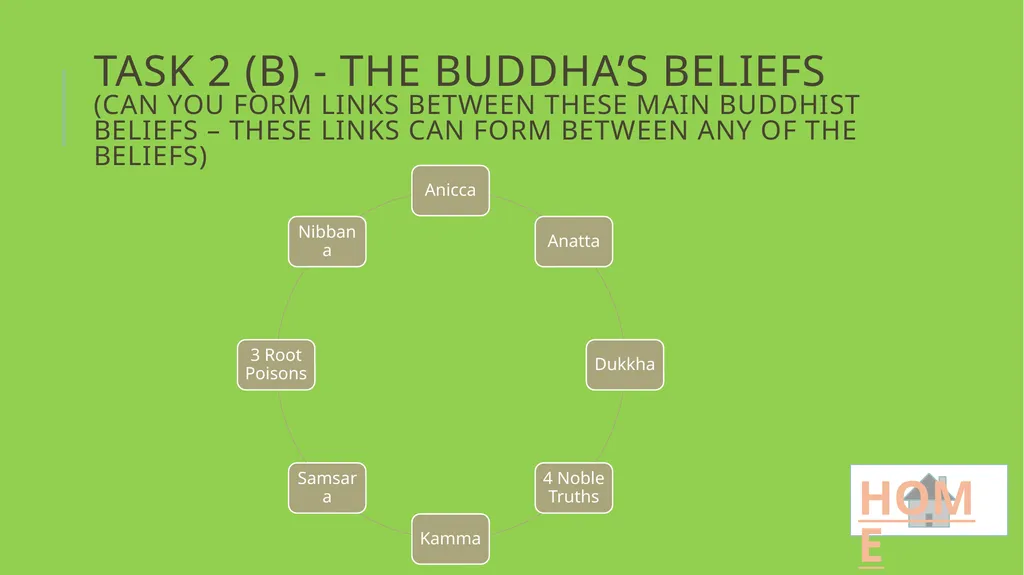
slide4. Task 2 (b) - The Buddha’s Beliefs (can you form links between these main Buddhist beliefs – these links can form between any of the beliefs)<br>
slide5. Task 3 - The importance of the Buddha. Explain why the Buddha is important to Buddhists. (4 marks)<br>
slide6. Task 4 - Buddhism Glossary Create yourself an Buddhism glossary that you can use for reference on words you come across in Pali that you need to remember.
Use colour and images to help you.
Get someone to test you on these words and their meanings.<br>
slide7. Task 5 - Samsara Explain what is meant by Samsara (4 marks)
Describe the Buddhist wheel of life.
What are the benefits and difficulties to Buddhists of believing in samsara.<br>
slide8. Task 6- Kamma Give 3 examples of skillful actions
Give 3 examples of unskillful actions
Explain the importance of Kamma (4 Marks)<br>
slide9. Task 7- Worship Describe how Buddhists show their commitment to Buddhism. (6 Marks)
How might Theravadin worship differ to that of a follower of Mahayana buddhism.<br>
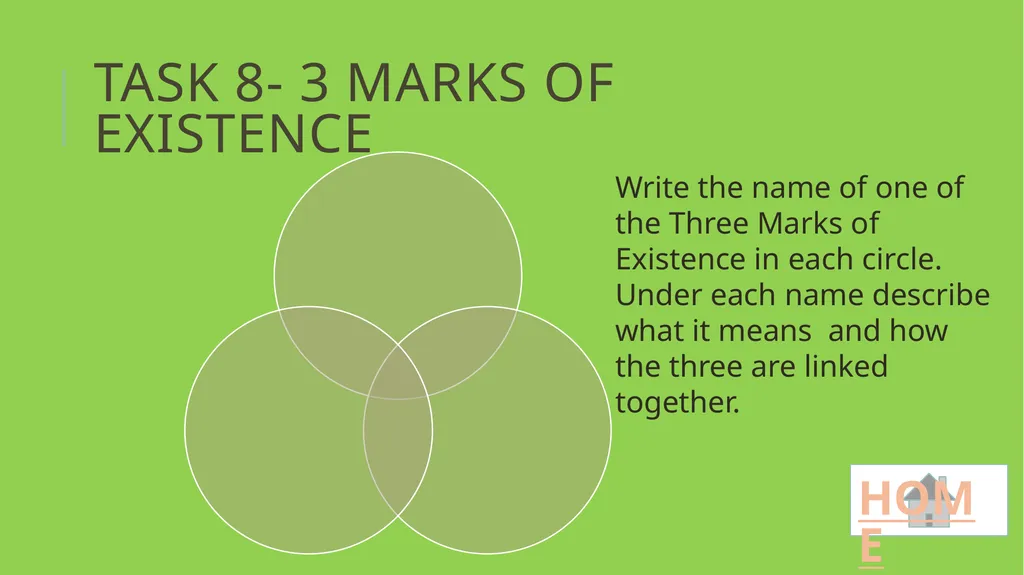
slide10. Task 8- 3 Marks of Existence Write the name of one of the Three Marks of Existence in each circle. Under each name describe what it means and how the three are linked together.<br>
slide11. Task 9- Nature of Humans Draw a human outline.
Inside it write everything Buddhist’s believe about the nature of human beings.<br>
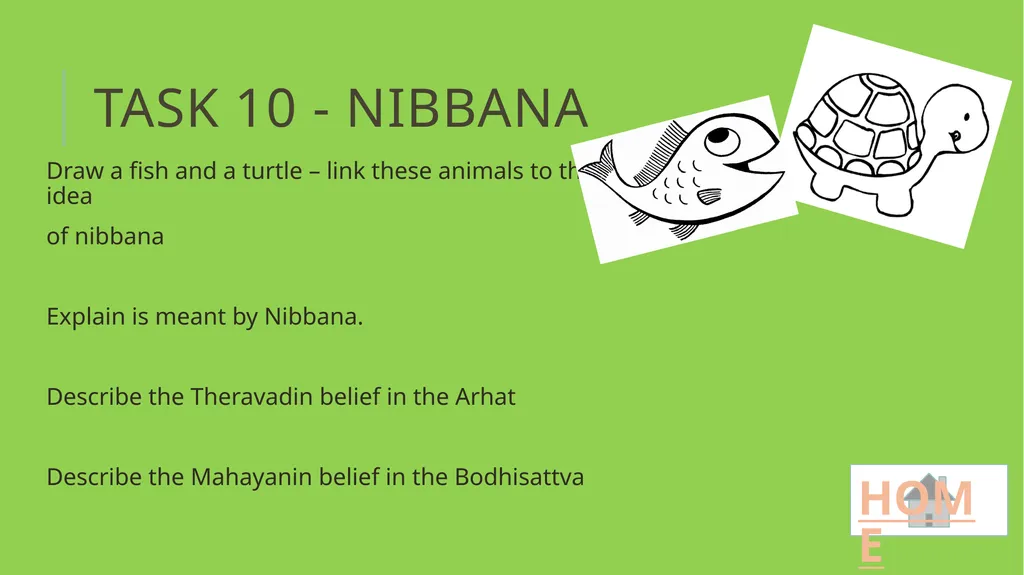
slide12. Task 10 - Nibbana Draw a fish and a turtle – link these animals to the idea
of nibbana
Explain is meant by Nibbana.
Describe the Theravadin belief in the Arhat
Describe the Mahayanin belief in the Bodhisattva<br>
slide13. Task 11-Impermanence Explain Buddhist beliefs about Impermanence. (6 Marks)
Give examples to support your answer.<br>
slide14. Task 12- Meditation Describe two forms of Buddhist meditation. (4 Marks)
Explain why meditation is an important aspect of Buddhist practice. (6 marks)<br>
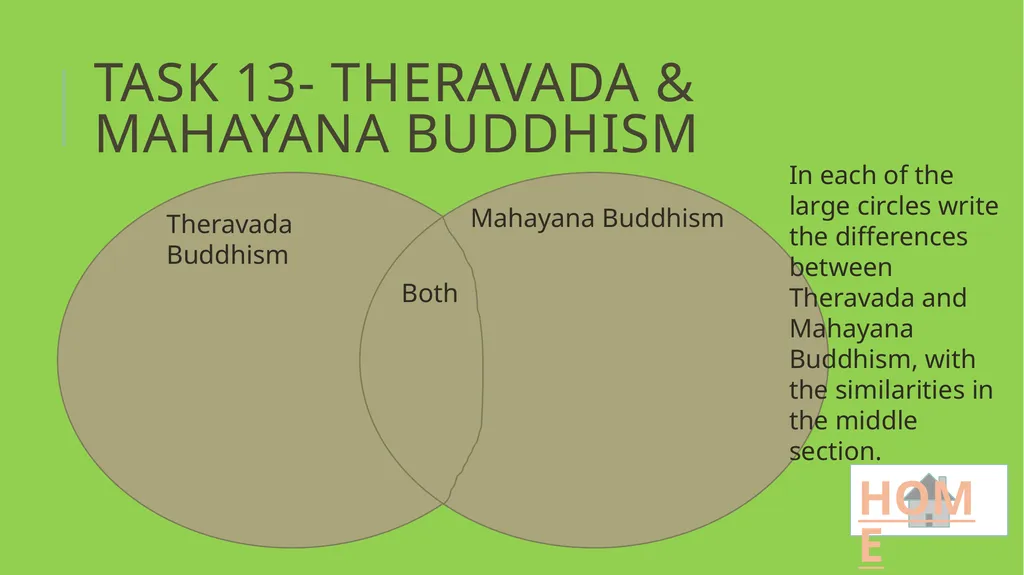
slide15. Task 13- Theravada & Mahayana Buddhism Theravada Buddhism Mahayana Buddhism Both In each of the large circles write the differences between Theravada and Mahayana Buddhism, with the similarities in the middle section.<br>
slide16. Task 14- The three jewels Describe The 3 Jewels in Buddhism
Explain why each of these are important to Buddhists<br>
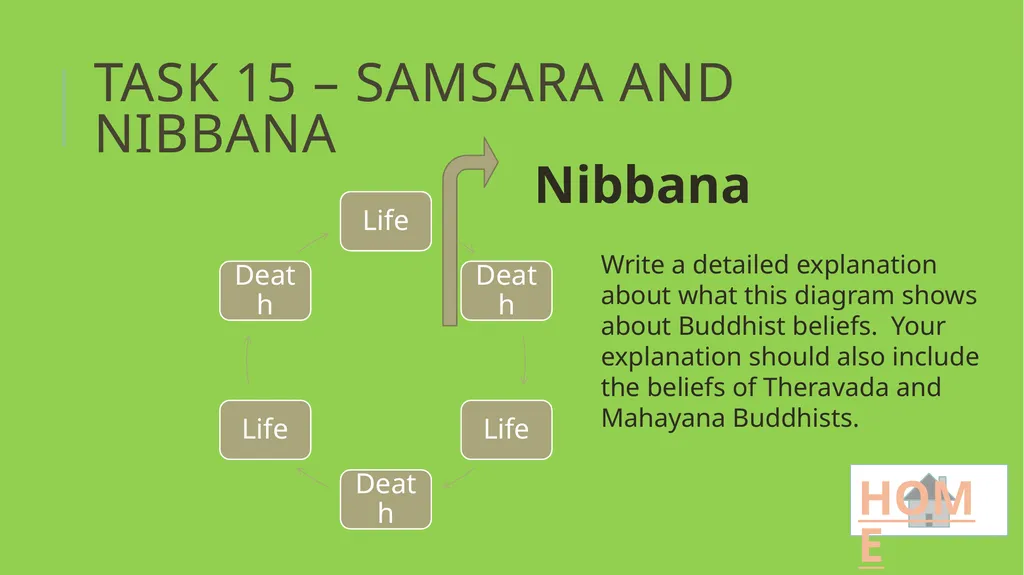
slide17. Task 15 – Samsara and nibbana Nibbana Write a detailed explanation about what this diagram shows about Buddhist beliefs. Your explanation should also include the beliefs of Theravada and Mahayana Buddhists.<br>
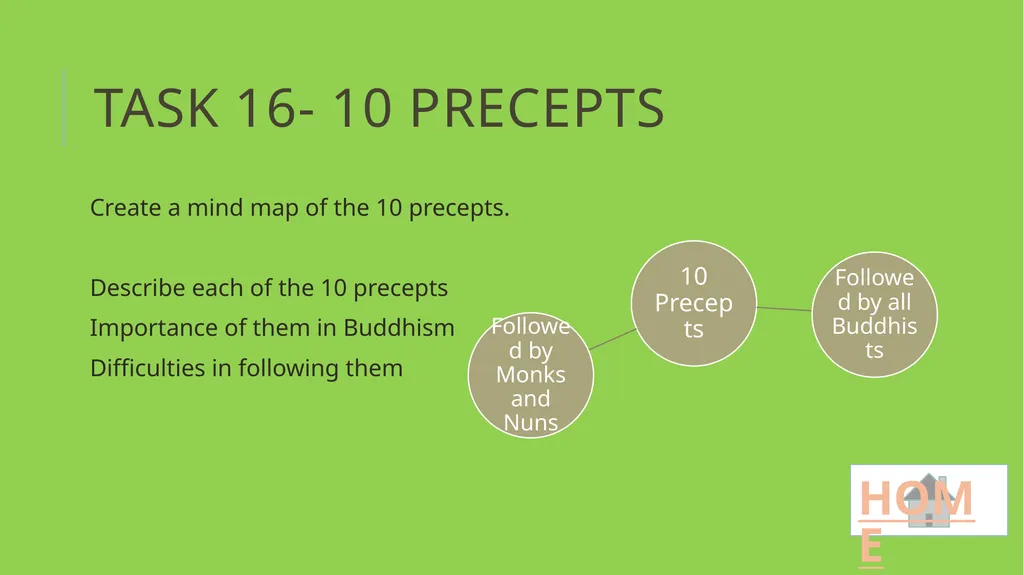
slide18. Task 16- 10 Precepts Create a mind map of the 10 precepts.
Describe each of the 10 precepts
Importance of them in Buddhism
Difficulties in following them<br>
slide19. Task 17 – Sangha Explain what Buddhist understand by the term Sangha
“Living as part of the sangha is no longer relevant in today’s world.”
Would Buddhists agree? (8 marks)
Answer:
https://www.sqa.org.uk/pastpapers/papers/instructions/2015/mi_N5_Religious-Moral-and-Philosophical-Studies_mi_2015.pdf<br>
slide20. Task 18- Story of Kisagotami Draw a cartoon to illustrate the story of Kisagotami – how does this story demonstrate the Three Marks of Existence.<br>
slide21. Task 19- Tanah Create an image to illustrate the idea of Tanah.
Why is this an important in the teachings of the Buddha.<br>
slide22. Task 20-Three Root Poisons Describe the 3 Root Poisons in Buddhism and give an example of each.
Why are the Three Root Poisons referred to as the “fuel of the wheel”<br>
slide23. Task 21- The Noble Eightfold Path Create a revision guide for yourself that explains the Noble Eightfold Path, specifically concentrating on Right Intention, Right Speech, Right Livelihood, Right Action.
Why is the path important, what is involved in following each of guidelines and any difficulties that could be faced when putting them into practice.<br>
slide24. Task 22- How was the world created? Create a comic strip outlining the main events of Genesis 1 and Genesis 2.<br>
slide25. Task 23- Literal Christians Outline the main ideas of Literal Christians on the origins of the world.
What arguments would others just to criticise these views.<br>
slide26. Task 24 –Liberal Christian Viewpoint Outline the main ideas of Liberal Christians on the origins of the world.
What arguments would others just to criticise these views.<br>
slide27. Task 25 – Cosmological Argument Create a diagram to illustrate the Cosmological (First Cause) Argument
Outline two arguments used to support and two arguments used to oppose this view<br>
slide28. Task 26- Big Bang Explain how the world was created by the big bang.
Include the following key words:
* Nothing before
* Singularity
* Explosion
*13.7 billion years ago
* Space, Time, Energy and matter<br>
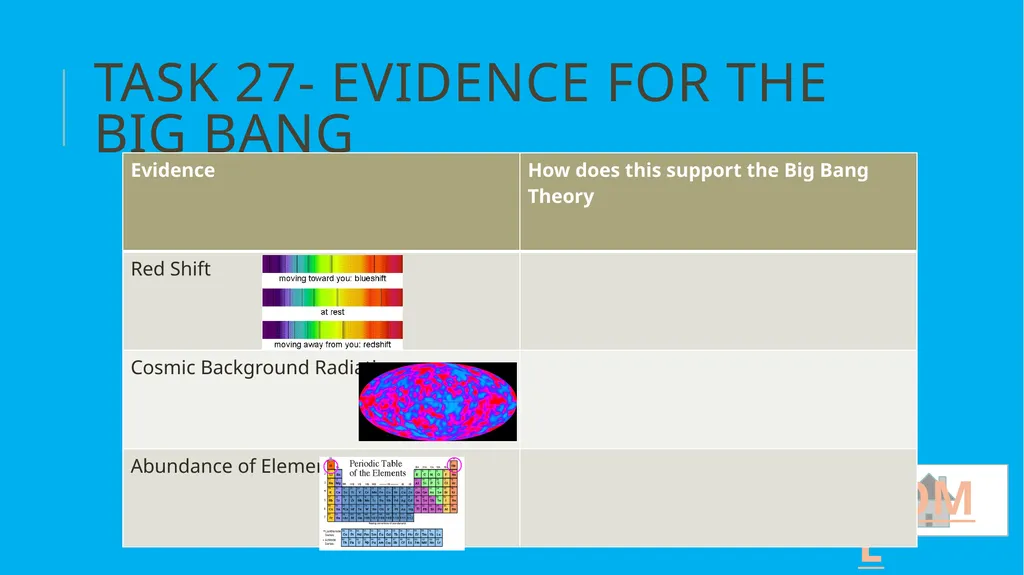
slide29. Task 27- Evidence for the Big Bang<br>
slide30. Task 28-How was the world created? Describe a religious response to this question (4 marks)
Describe Sciences’ response to this question. (4 Marks)
Explain how the two viewpoints are similar or different (3 marks)<br>
slide31. Task 29- Evolution Explain the process of evolution.
Include the following key terms:
* Natural Selection
* Survival of the Fittest<br>
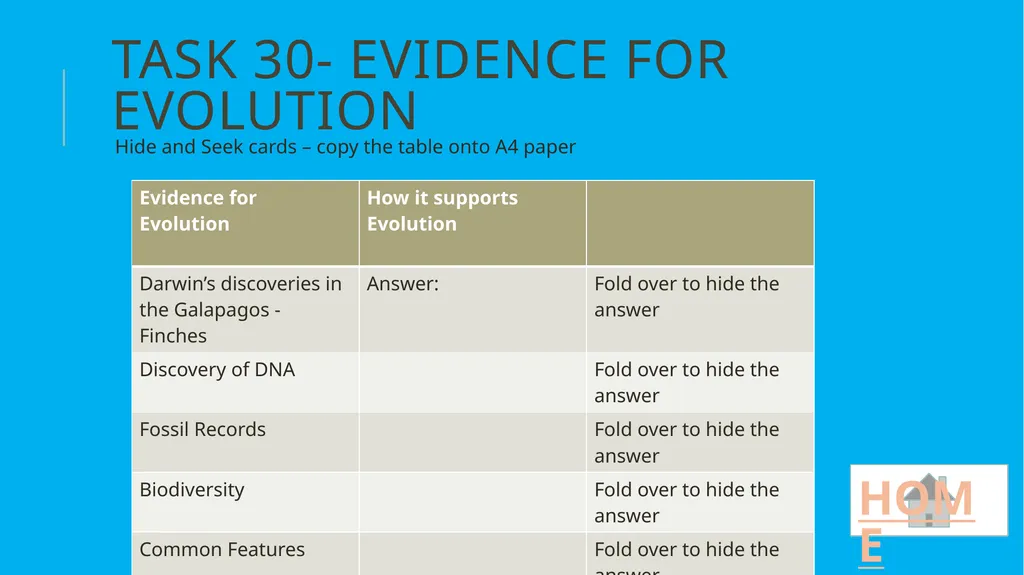
slide32. Task 30- Evidence for Evolution Hide and Seek cards – copy the table onto A4 paper<br>
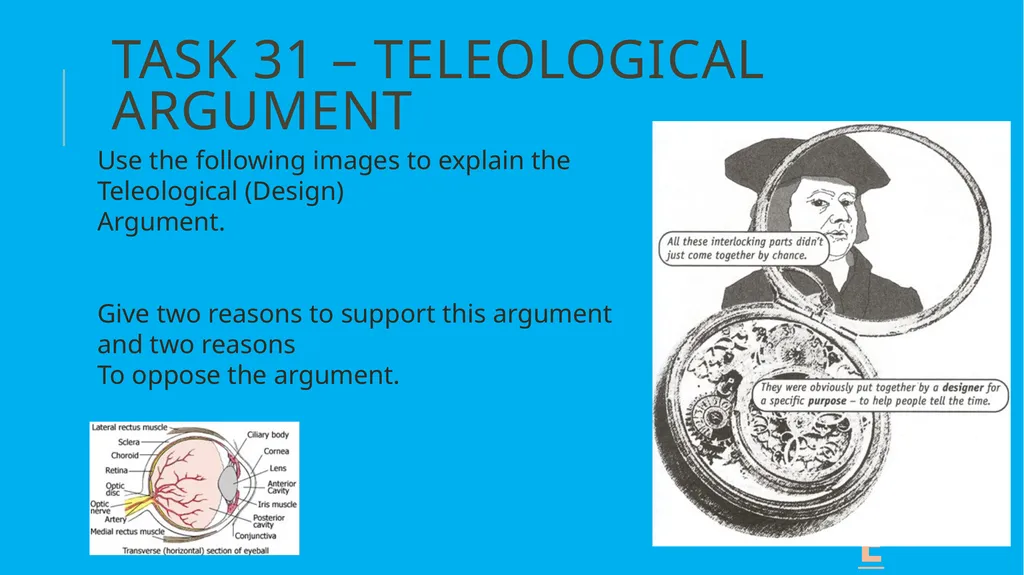
slide33. Task 31 – Teleological Argument Use the following images to explain the Teleological (Design)
Argument.
Give two reasons to support this argument and two reasons
To oppose the argument.<br>
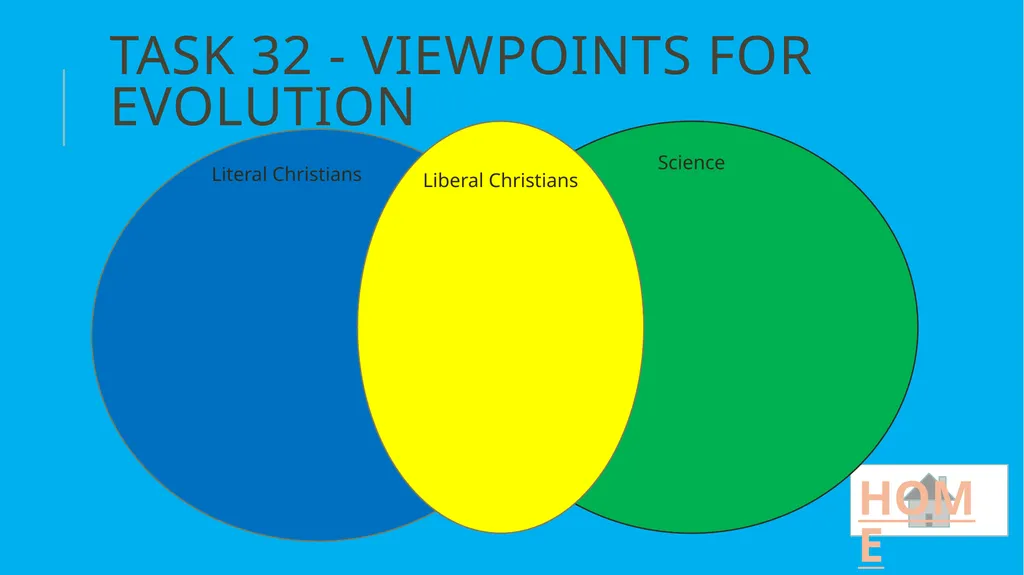
slide34. Task 32 - Viewpoints for Evolution Literal Christians Science Liberal Christians<br>
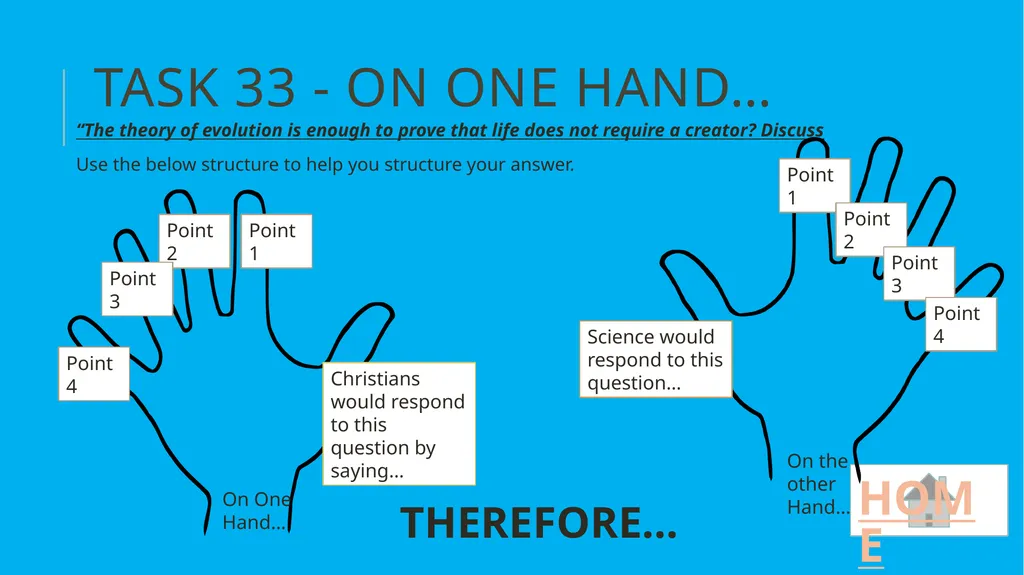
slide35. Task 33 - On One Hand… “The theory of evolution is enough to prove that life does not require a creator? Discuss
Use the below structure to help you structure your answer. On One Hand… On the other Hand… Christians would respond to this question by saying… Science would respond to this question… Point 1 Point 2 Point 3 Point 4 Point 1 Point 2 Point 3 Point 4 THEREFORE…<br>
slide2. Task 1- Life of Buddha 1. Create a timeline of all the key moments in the Buddha’s life.
Use colour, symbols and images.
2. Try to narrow the key moments down to 6 key points. Choose the 6 most important points.
3. Answer this question.
Describe the Life of the Buddha. (6 Marks)<br>
slide3. Task 2 - The Buddha’s Beliefs Describe what the main beliefs of the Buddha were. (6 Marks)
Use this source to help you.
https://www.bbc.co.uk/education/clips/zb37tfr<br>
slide4. Task 2 (b) - The Buddha’s Beliefs (can you form links between these main Buddhist beliefs – these links can form between any of the beliefs)<br>
slide5. Task 3 - The importance of the Buddha. Explain why the Buddha is important to Buddhists. (4 marks)<br>
slide6. Task 4 - Buddhism Glossary Create yourself an Buddhism glossary that you can use for reference on words you come across in Pali that you need to remember.
Use colour and images to help you.
Get someone to test you on these words and their meanings.<br>
slide7. Task 5 - Samsara Explain what is meant by Samsara (4 marks)
Describe the Buddhist wheel of life.
What are the benefits and difficulties to Buddhists of believing in samsara.<br>
slide8. Task 6- Kamma Give 3 examples of skillful actions
Give 3 examples of unskillful actions
Explain the importance of Kamma (4 Marks)<br>
slide9. Task 7- Worship Describe how Buddhists show their commitment to Buddhism. (6 Marks)
How might Theravadin worship differ to that of a follower of Mahayana buddhism.<br>
slide10. Task 8- 3 Marks of Existence Write the name of one of the Three Marks of Existence in each circle. Under each name describe what it means and how the three are linked together.<br>
slide11. Task 9- Nature of Humans Draw a human outline.
Inside it write everything Buddhist’s believe about the nature of human beings.<br>
slide12. Task 10 - Nibbana Draw a fish and a turtle – link these animals to the idea
of nibbana
Explain is meant by Nibbana.
Describe the Theravadin belief in the Arhat
Describe the Mahayanin belief in the Bodhisattva<br>
slide13. Task 11-Impermanence Explain Buddhist beliefs about Impermanence. (6 Marks)
Give examples to support your answer.<br>
slide14. Task 12- Meditation Describe two forms of Buddhist meditation. (4 Marks)
Explain why meditation is an important aspect of Buddhist practice. (6 marks)<br>
slide15. Task 13- Theravada & Mahayana Buddhism Theravada Buddhism Mahayana Buddhism Both In each of the large circles write the differences between Theravada and Mahayana Buddhism, with the similarities in the middle section.<br>
slide16. Task 14- The three jewels Describe The 3 Jewels in Buddhism
Explain why each of these are important to Buddhists<br>
slide17. Task 15 – Samsara and nibbana Nibbana Write a detailed explanation about what this diagram shows about Buddhist beliefs. Your explanation should also include the beliefs of Theravada and Mahayana Buddhists.<br>
slide18. Task 16- 10 Precepts Create a mind map of the 10 precepts.
Describe each of the 10 precepts
Importance of them in Buddhism
Difficulties in following them<br>
slide19. Task 17 – Sangha Explain what Buddhist understand by the term Sangha
“Living as part of the sangha is no longer relevant in today’s world.”
Would Buddhists agree? (8 marks)
Answer:
https://www.sqa.org.uk/pastpapers/papers/instructions/2015/mi_N5_Religious-Moral-and-Philosophical-Studies_mi_2015.pdf<br>
slide20. Task 18- Story of Kisagotami Draw a cartoon to illustrate the story of Kisagotami – how does this story demonstrate the Three Marks of Existence.<br>
slide21. Task 19- Tanah Create an image to illustrate the idea of Tanah.
Why is this an important in the teachings of the Buddha.<br>
slide22. Task 20-Three Root Poisons Describe the 3 Root Poisons in Buddhism and give an example of each.
Why are the Three Root Poisons referred to as the “fuel of the wheel”<br>
slide23. Task 21- The Noble Eightfold Path Create a revision guide for yourself that explains the Noble Eightfold Path, specifically concentrating on Right Intention, Right Speech, Right Livelihood, Right Action.
Why is the path important, what is involved in following each of guidelines and any difficulties that could be faced when putting them into practice.<br>
slide24. Task 22- How was the world created? Create a comic strip outlining the main events of Genesis 1 and Genesis 2.<br>
slide25. Task 23- Literal Christians Outline the main ideas of Literal Christians on the origins of the world.
What arguments would others just to criticise these views.<br>
slide26. Task 24 –Liberal Christian Viewpoint Outline the main ideas of Liberal Christians on the origins of the world.
What arguments would others just to criticise these views.<br>
slide27. Task 25 – Cosmological Argument Create a diagram to illustrate the Cosmological (First Cause) Argument
Outline two arguments used to support and two arguments used to oppose this view<br>
slide28. Task 26- Big Bang Explain how the world was created by the big bang.
Include the following key words:
* Nothing before
* Singularity
* Explosion
*13.7 billion years ago
* Space, Time, Energy and matter<br>
slide29. Task 27- Evidence for the Big Bang<br>
slide30. Task 28-How was the world created? Describe a religious response to this question (4 marks)
Describe Sciences’ response to this question. (4 Marks)
Explain how the two viewpoints are similar or different (3 marks)<br>
slide31. Task 29- Evolution Explain the process of evolution.
Include the following key terms:
* Natural Selection
* Survival of the Fittest<br>
slide32. Task 30- Evidence for Evolution Hide and Seek cards – copy the table onto A4 paper<br>
slide33. Task 31 – Teleological Argument Use the following images to explain the Teleological (Design)
Argument.
Give two reasons to support this argument and two reasons
To oppose the argument.<br>
slide34. Task 32 - Viewpoints for Evolution Literal Christians Science Liberal Christians<br>
slide35. Task 33 - On One Hand… “The theory of evolution is enough to prove that life does not require a creator? Discuss
Use the below structure to help you structure your answer. On One Hand… On the other Hand… Christians would respond to this question by saying… Science would respond to this question… Point 1 Point 2 Point 3 Point 4 Point 1 Point 2 Point 3 Point 4 THEREFORE…<br>