
Hindu Nationalism Revisited Overview Being
AM
Published · 15 slides · 0 views

1 / 1
Description
Hindu Nationalism Revisited Overview Being familiar with the information (and readings for) the slides on Hindu Nationalism: An Overview is critical Will start with HOW the many readings for today relate to lecture Will then discuss them
Related Topics
Share
Embed code
Download this presentation From Below
"Hindu Nationalism Revisited Overview Being" is the property of its rightful owner. Permission is granted to download and print the materials on this website for personal, non-commercial use only, and to display it on your personal computer provided you do not modify the materials and that you retain all copyright notices contained in the materials. By downloading content from our website, you accept the terms of this agreement.
Presentation Transcript
01
Hindu Nationalism Revisited<br>
02
Overview Being familiar with the information (and readings for) the slides on “Hindu Nationalism: An Overview” is critical
Will start with HOW the many readings for today relate to lecture
Will then discuss them in the context of set of themes about rise of Hindu nationalism in India<br>
Will start with HOW the many readings for today relate to lecture
Will then discuss them in the context of set of themes about rise of Hindu nationalism in India<br>
03
Readings SAHGAL presents an overview of the rise of Hindu Nationalism highlighting some themes, particularly gender
TWO articles by PANKAJ MISHRA trace both the HISTORICAL rise of Hindu Nationalism (focusing on the destruction of the BABRI mosque in Dec 1992) and its more contemporary manifestations with Modi’s victory in 2019
Finally, ASHRAF, points out how growing intolerance is harming not only Muslims but India itself, and its Hindu population<br>
04
THEMES in Hindu Nationalism HISTORY of Hindu nationalism
Differences between Hinduism and Hindutva
History: Colonialism, the RSS, HMS, Savarkar and the idea of TWO INDIAs
FEAR of Muslims: No Hindtuva without ANTI MUSLIM agenda
Recap: MARGINALIZATION of Hindu Nationalism under Nehru
RECENT Rise of Hindu Nationalism (1980s to the present)
Role of AYODHYA campaign
Recap: Caste, rise of OBCs and Dalits
Aggressive Hindu Nationalism under Narendra Modi<br>
05
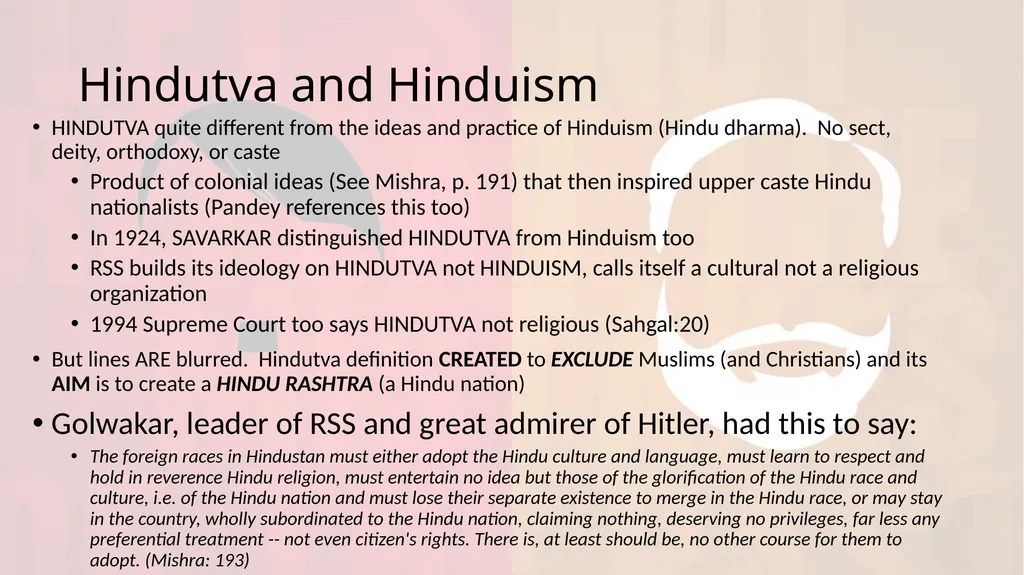
Hindutva and Hinduism HINDUTVA quite different from the ideas and practice of Hinduism (Hindu dharma). No sect, deity, orthodoxy, or caste
Product of colonial ideas (See Mishra, p. 191) that then inspired upper caste Hindu nationalists (Pandey references this too)
In 1924, SAVARKAR distinguished HINDUTVA from Hinduism too
RSS builds its ideology on HINDUTVA not HINDUISM, calls itself a cultural not a religious organization
1994 Supreme Court too says HINDUTVA not religious (Sahgal:20)
But lines ARE blurred. Hindutva definition CREATED to EXCLUDE Muslims (and Christians) and its AIM is to create a HINDU RASHTRA (a Hindu nation)
Golwakar, leader of RSS and great admirer of Hitler, had this to say:
The foreign races in Hindustan must either adopt the Hindu culture and language, must learn to respect and hold in reverence Hindu religion, must entertain no idea but those of the glorification of the Hindu race and culture, i.e. of the Hindu nation and must lose their separate existence to merge in the Hindu race, or may stay in the country, wholly subordinated to the Hindu nation, claiming nothing, deserving no privileges, far less any preferential treatment -- not even citizen's rights. There is, at least should be, no other course for them to adopt. (Mishra: 193)<br>
06
Creating a Fear of Muslims Hindutva PREMISED on creating a fear of a Muslim minority, whether that fear is the idea of rising Muslim demographic, of Muslim terrorism, or “appeasement” of minorities
WITHOUT stoking that fear, there is NO BASIS for Hindu Nationalism (i.e. making Hindus speaking different languages, with different cultures, divided by class, caste and gender, feel they are “one people”)
“They hope to unite Hindu society by constantly invoking such real and imagined threats as are posed by the evangelical Christians and militant Muslims” (Mishra: 196-97)
“VD Savarkar made hatred of Muslims central to this philosophy, but Hindus also had to emulate their strength” (Sahgal: 20)<br>
07
The RSS Rashtriya Swayamsewak Sangh (National Volunteers Corps)
Created in 1925, to promote Hindu unity and create a Hindu Rashtra
Cadre based, from local neighborhood committees to national organization
Calls itself a “cultural” organization. Never contested elections
At the center of a “family” of organizations including political party (formerly BJS, now BJP) a women’s organization, labor, student, religious and youth organizations
All nominally independent, but run by organizers appointed by the RSS
Defended Hindus and attacked Muslims during partition riots
Banned for a year after implicated in (though legally cleared of) the plot to assassinate Mahatma Gandhi in January 1948<br>
08
Marginalization: 1950s-mid 80s The JANA SANGH (BJS) had little electoral success. The INC won every national election from 1951-52 to 1977
INC had its own Hindu traditionalists, who were anti Nehru but WITHIN the party (reference PANDEY essay)
The BJS won only 3 of 499 Parliamentary seats in 52; 4 of 505 in 1957; 14 of 508 in 1962; 35 of 523 in 1967 (after Nehru’s death) and; 21 of 521 in 1971 (after a split in the INC)
For the 1977 elections, many parties dissolved their original identities to form the JANATA party, the BJS among them. The Janata Party (that included former BJS) won 295 of 544 seats in Parliament
Post Janata, RSS helped to recreate a political affiliate, now called the Bharatiya Janata Party (BJP) but won only 2 of 543 seats in the national elections of 1984<br>
09
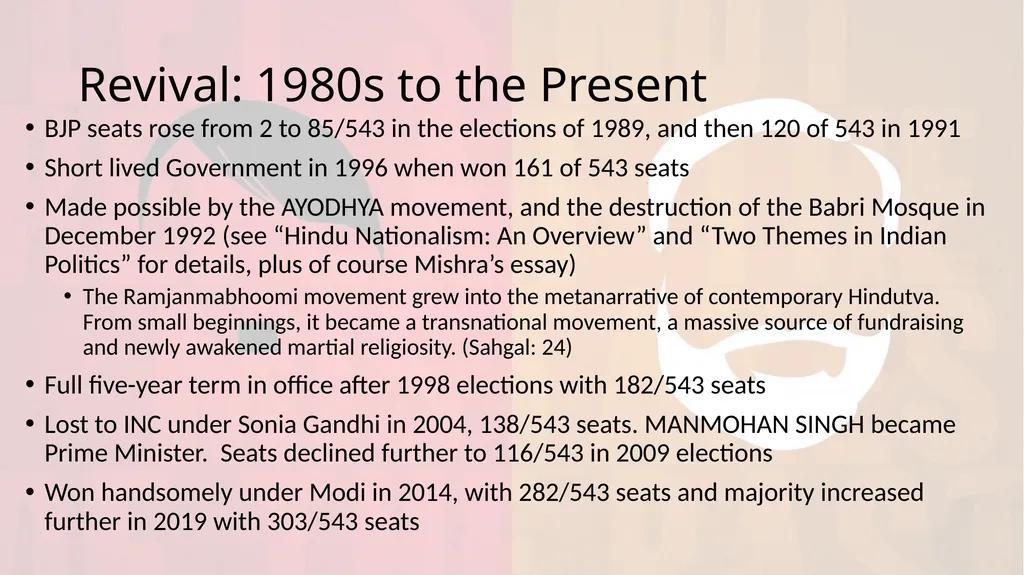
Revival: 1980s to the Present BJP seats rose from 2 to 85/543 in the elections of 1989, and then 120 of 543 in 1991
Short lived Government in 1996 when won 161 of 543 seats
Made possible by the AYODHYA movement, and the destruction of the Babri Mosque in December 1992 (see “Hindu Nationalism: An Overview” and “Two Themes in Indian Politics” for details, plus of course Mishra’s essay)
The Ramjanmabhoomi movement grew into the metanarrative of contemporary Hindutva. From small beginnings, it became a transnational movement, a massive source of fundraising and newly awakened martial religiosity. (Sahgal: 24)
Full five-year term in office after 1998 elections with 182/543 seats
Lost to INC under Sonia Gandhi in 2004, 138/543 seats. MANMOHAN SINGH became Prime Minister. Seats declined further to 116/543 in 2009 elections
Won handsomely under Modi in 2014, with 282/543 seats and majority increased further in 2019 with 303/543 seats<br>
10
Political Contexts Populist politics and legitimization of sectarian politics
Role of Indira and Rajiv Gandhi (see earlier powerpoints)
Mr. Gandhi appeared to perfectly embody a pseudo-socialist elite that claimed to supervise post-colonial India’s attempt to catch up with the modern West but that in reality single-mindedly pursued its own interests. (Mishra, Op. Ed.)
The “Congress System” with power and prestige concentrated in the “high command”
There seemed no possibility of dialogue with a metropolitan ruling class of such Godlike aloofness, which had cruelly stranded us in history while itself moving serenely toward convergence with the prosperous West. This sense of abandonment became more wounding as India began in the 1990s to embrace global capitalism together with a quasi-American ethic of individualism amid a colossal population shift from rural to urban areas. Satellite television and the internet spawned previously inconceivable fantasies of private wealth and consumption, even as inequality, corruption and nepotism grew and India’s social hierarchies appeared as entrenched as ever (Mishra Op Ed.)<br>
11
Socio-Cultural and Economic Context Caste Mobilization
“Mandir” a direct response to “Mandal” (See “Two Themes in Indian Politics” for details)
Economic: Neo Liberalism
India is a grotesquely unequal society. Its constitution, and much political rhetoric, upholds the notion that all individuals are equal and possess the same right to education and job opportunities; but the everyday experience of most Indians testify to appalling violations of this principle. A great majority of Indians, forced to inhabit the vast gap between a glossy democratic ideal and a squalid undemocratic reality, have long stored up deep feelings of injury, weakness, inferiority, degradation, inadequacy and envy; these stem from defeats or humiliation suffered at the hands of those of higher status than themselves in a rigid hierarchy. (Mishra Op Ed)<br>
12
Modi’s India Playing on Ressentiment (a psychological state arising from suppressed feelings of envy and hatred that cannot be acted upon)
He may have failed to create job opportunities for disadvantaged Indians. But he has sanctioned them, with his own vengeful contempt for English-speaking elites, to raucously talk back to, and shout down, the already privileged. In lieu of any liberation from injustice, he has emancipated the darkest of emotions; he has licensed his supporters to explicitly hate a range of people from perfidious Pakistanis and Indian Muslims to their “anti-national” Indian appeasers (Mishra Op Ed)
Populism (compare with Indira?)
From the beginning, he was careful to present himself to his primary audience of stragglers as one of them: a self-made individual who had to overcome hurdles thrown in his way by an arrogant and venal elite that indulged treasonous Muslims while pouring contempt on salt-of-the-earth Hindus like himself. Boasting of his 56-inch chest, he promised to transform India into an international superpower and to reinsert Hindus into the grand march of history. (Mishra Op.Ed.)
Modi Centric politics. Even RSS plays a secondary role
Illiberal: Contempt for old elites, specially Nehruvian liberals. No hesitation in dog whistles about minorities, or expressing support for more explicit statements denigrating Muslims or threatening violence toward them
Nehru a particular target of attack, Gandhi sporadically “to test the waters” of public opinion<br>
13
Social Media Adept at use of social media
With cheap smartphones in the hands of the poorest of Indians…. Mr. Modi is preternaturally alert to the fact that the smartphone’s screen is pulling hundreds of millions of Indians, who have barely emerged from illiteracy, into a wonderland of fantasy and myth.... After decades of Western-educated and emotionally constricted Indian leaders, Mr. Modi uninhibitedly participates — whether speaking tearfully of his poverty-stricken past or boasting of his bromance with Barack Obama — in digital media’s quasi-egalitarian culture of exhibitionism. (Mishra Op Ed.)<br>
With cheap smartphones in the hands of the poorest of Indians…. Mr. Modi is preternaturally alert to the fact that the smartphone’s screen is pulling hundreds of millions of Indians, who have barely emerged from illiteracy, into a wonderland of fantasy and myth.... After decades of Western-educated and emotionally constricted Indian leaders, Mr. Modi uninhibitedly participates — whether speaking tearfully of his poverty-stricken past or boasting of his bromance with Barack Obama — in digital media’s quasi-egalitarian culture of exhibitionism. (Mishra Op Ed.)<br>
14
Intolerance and Move to Hindu Rashtra Ghar Wapsi: “return home” of Muslims and Christians “back” to Hindu faith. Not a great success says Sahgal.
Love Jihad: restrict marriages across religious (but even caste) lines (See next slide set for more details)
Cow Protection: See readings on “Hindutva in the News” for next week
Citizenship: Discriminatory “Citizenship Amendment Act” passed 2019 (again, see next slide set)
Any criticism represented as acts of an “antinational” “tukde tukde gang” who want to break India apart
Hinduization of Polity: No meat on Hindu Religious festivals, although only about 20% of Indians are vegetarians Also see this and this<br>
15
Paths to the Future? ASHRAF, says criticism of Hindu Nationalism is a
“ ….warning to the Hindus to save their religion from being appropriated for political purposes. Else they will, with time, learn to hate and kill and devastate India. This has been Pakistan’s experience. With the genie of radical Islam let out by President Ziaul Haque, decades of bloodshed and instability followed”
He ends with Fahmida Riaz poem:
Raising the flag of religion,
I guess now you’ll be setting up Hindu Raj?
You too will commence to muddle everything up
You, too, will ravage your beautiful garden.
You, too, will sit and ponder –
I can tell preparations are afoot –
who is truly Hindu, who is not.
I guess you’ll be passing fatwas soon!
Think of the contrasts with the India of Gandhi and Nehru
Hindu Nationalism as Fascism? See Sahgal, Sarkar, among others
Is there a reason that scholars who take GENDER seriously are making this comparison most vocally?<br>