HIVPeerSupport 19th September 2017 Peer support is a relationship in which people see each other as equal partners and where the focus is on mutual learning and growth. Peer Support Peer Support At the roots of peer support there is a hope
"#HIVPeerSupport 19th September 2017 Peer support" is the property of its rightful owner. Permission is granted to
download and print the materials on this website for personal, non-commercial use only, and to display it
on your personal computer provided you do not modify the materials and that you retain all copyright
notices contained in the materials. By downloading content from our website, you accept the terms of this
agreement.
Presentation Transcript
01
#HIVPeerSupport 19th September 2017<br>
02
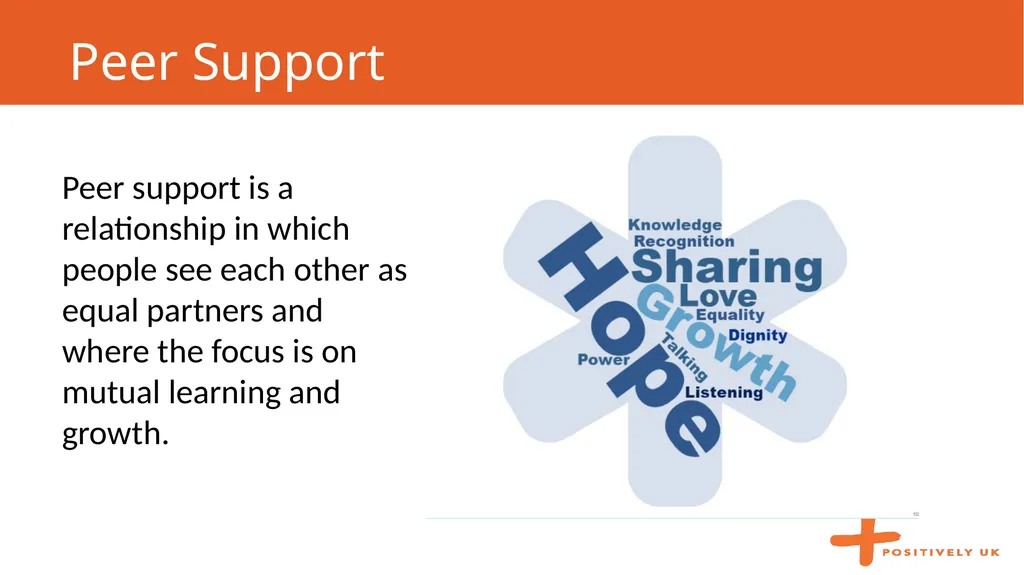
Peer support is a relationship in which people see each other as equal partners and where the focus is on mutual learning and growth. Peer Support<br>
03
Peer Support At the roots of peer support there is a hope and a belief that through sharing and support we can transform our lives and the lives of our communities for the better.<br>
04
People living with HIV providing and accessing peer support.
Organisations developing and providing peer support programmes
Health and Social care staff
Commissioners
Policy makers Who are the standards for?<br>
05
Who produced the standards? People with HIV using and providing peer support services
Voluntary Organisations: THT, Positively UK, George House Trust, Sahir House, CHIVA, UK-CAB
Professional bodies: BHIVA, NHIVNA
UK wide consultation: on-line and face to face: Bristol, Liverpool, Brighton, CHIVA camp<br>
06
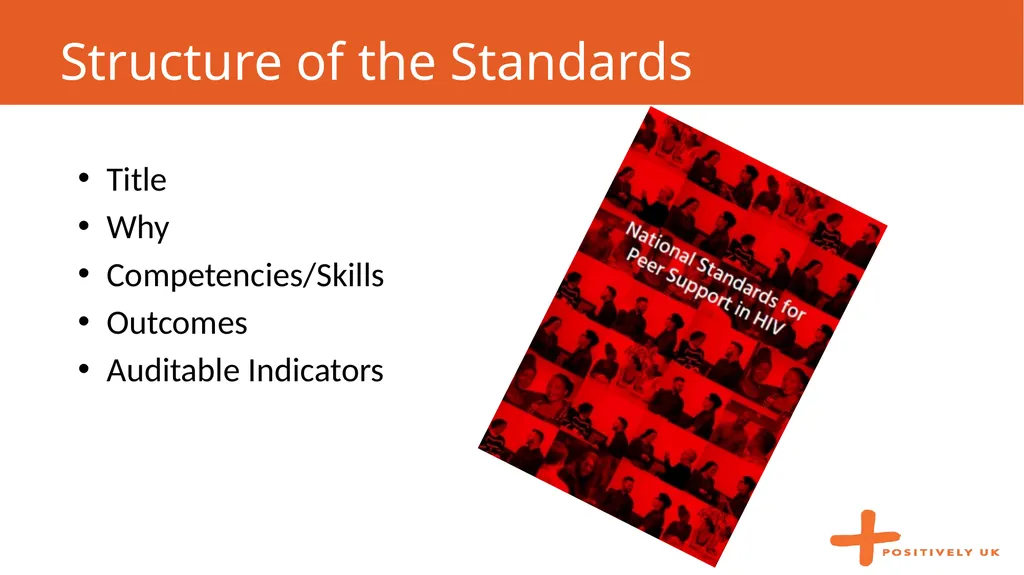
Structure of the Standards Title
Why
Competencies/Skills
Outcomes
Auditable Indicators<br>
07
Standard 1 Everyone living with HIV should have access to peer support<br>
08
Standard 1 Auditable indicators for Service Providers
A range of interventions in place to meet the needs of people living with HIV such as:
Face-to-face, online, group support, workshops
Services tailored to specific communities e.g. gay men, women, African community etc.
Procedures and policies in place for safeguarding and confidentiality<br>
09
Standard 1 Auditable Indicators for HIV Clinics
90% of those newly diagnosed offered peer support or signposted to peer support at first clinic appointment.
90% of those living with HIV offered peer support or signposted to peer support when facing a significant life event
Procedures and policies in place for safeguarding and confidentiality
Agreed pathway from clinic to peer support which can be tiered depending upon resources.<br>
10
Standard 2 People who provide peer support will be living with HIV and have access to training, support and personal development<br>
11
Standard 2 Auditable indicators for health, social care and HIV service providers
All people, whether paid staff or volunteers, providing peer support have attended and completed relevant training
Peer support training covers the core competencies set out above
Peer support training is recognised and accredited by a secondary organisation; where possible training is linked to a professional qualification
A schedule for supervision of peer supporters – both paid staff and volunteers - is agreed and provided
All people providing peer support attend an agreed numbers of supervision sessions per year
All people providing peer support have access to and complete an agreed programme of professional development per year<br>
12
Standard 3 Peer Support will include robust monitoring, measuring and evaluation processes<br>
13
Standard 3 Auditable indicators for health, social care and HIV service providers
There will be an agreed monitoring system in place for capturing, as a minimum, basic data on who is accessing the service
There will be an agreed method of evaluation to measure impact of services upon health and wellbeing
Monitoring and evaluation will be used to make changes and improvements to the service.
There will be established systems in place to provide people accessing support with access to their records, in line with legal requirements<br>
14
Standard 4 Children and Young People with HIV will have access to child and youth centred peer-support<br>
15
Standard 4 Auditable indicators for health, social care professionals and service providers
Young people living with HIV will have access to youth-centred peer support
Procedures and policies in place for safeguarding and confidentiality<br>
16
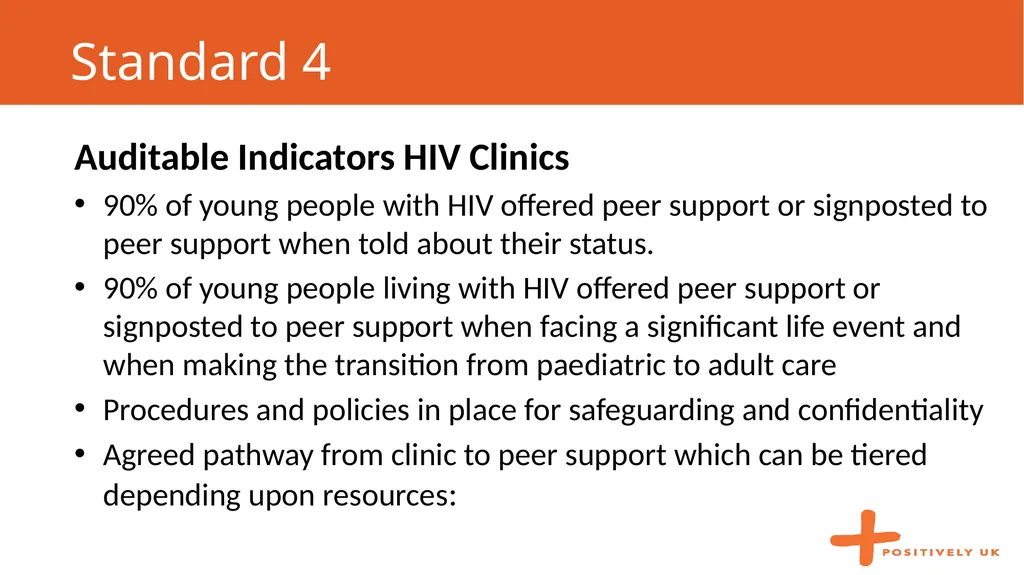
Standard 4 Auditable Indicators HIV Clinics
90% of young people with HIV offered peer support or signposted to peer support when told about their status.
90% of young people living with HIV offered peer support or signposted to peer support when facing a significant life event and when making the transition from paediatric to adult care
Procedures and policies in place for safeguarding and confidentiality
Agreed pathway from clinic to peer support which can be tiered depending upon resources:<br>
17
Discussion: How can we use the standards in our role as mentors and facilitators?<br>
18
What Next? Share #HIVPeerSupport
Sign Up www.hivpeersupport.com
Implement<br>