
Home Learning for Year 7 History This unit will



Description: Home Learning for Year 7 History This unit will teach you about Medieval Life. You will be writing some historical fiction ( a story set in the past) and the next few weeks lessons will form part of your research for this task. Please work
Related Topics
Download Presentation
"Home Learning for Year 7 History This unit will" is the property of its rightful owner. Permission is granted to download and print the materials on this website for personal, non-commercial use only, and to display it on your personal computer provided you do not modify the materials and that you retain all copyright notices contained in the materials. By downloading content from our website, you accept the terms of this agreement.
Presentation Transcript
slide2. Home Learning for Year 7 History
This unit will teach you about Medieval Life. You will be writing some historical fiction ( a story set in the past) and the next few weeks lessons will form part of your research for this task. Please work in your purple exercise books. If you don’t have this please use lined paper but keep your notes together.
Work your way through the tasks on the power point.
Answer in full sentences in your book.
Each fortnight we will post a lesson that we expect to take about an hour and a half to work through. We will also give you a Meanwhile Elsewhere research homework which should take you another hour.
If you get stuck, re-read the task and see if you can work it out. Next ask an adult or a friend. If you are still stuck don’t panic. If you are really unsure and you have tried everything else then you can email your History teacher.
If you run out of work then continue to research your list of greatest Britons.<br>
slide3. Write the title and today’s date : What was life like in a medieval town? Insert an image of a medieval town here. I used:
https://www.johndclare.net/KS3/1-6-2.htmo.uk/pin/266838346646908439/<br>
slide4. Take a mental walk round this image by zooming in. What is different from the way we live today? Insert an image of a medieval town here, similar to the one at:
https://www.johndclare.net/KS3/1-6-2.htm
Remember to respect all IP rights when selecting images.<br>
slide5. Task 1: Write 50 words describing the medieval town. You could talk about: transport, housing, jobs, religion. Insert an image of a medieval town here, similar to the one at:
https://www.johndclare.net/KS3/1-6-2.htm
Remember to respect all IP rights when selecting images.<br>
slide6. Watch this : Medieval Towns - Timelines.tv History of Britain A03 - YouTube Task 2:
Answer the questions below in your book:
Towns like Ledbury formed around the Church. Why was this?
What did the town have to apply for in order to trade?
Who began to lease out the plots of land around the Church?
The trades people paid a rent of 12p rather than service. Why was this important?
What would happen if a peasant ran away to the town and stayed for a year?<br>
slide7. Now look back at the picture in slide 1 What jobs do you think they had in a Medieval town?
Task 3 : Use the slide on the next page to make a mind map. (Try doing it from memory if you can) Jobs in the Medieval Town<br>
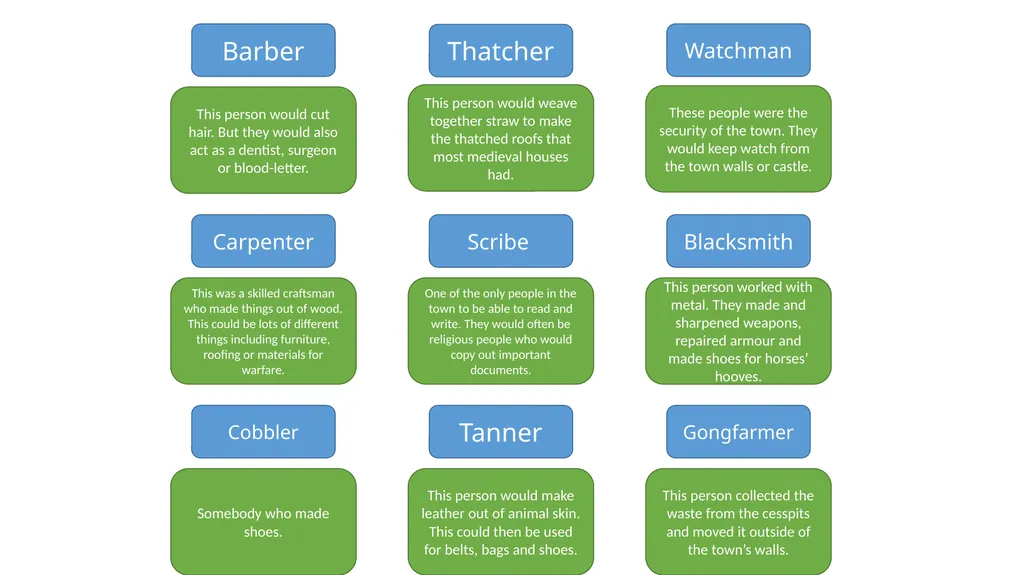
slide8. Barber This person would cut hair. But they would also act as a dentist, surgeon or blood-letter. This person would weave together straw to make the thatched roofs that most medieval houses had. These people were the security of the town. They would keep watch from the town walls or castle. Thatcher Watchman Carpenter This was a skilled craftsman who made things out of wood. This could be lots of different things including furniture, roofing or materials for warfare. Somebody who made shoes. Cobbler Scribe One of the only people in the town to be able to read and write. They would often be religious people who would copy out important documents. Blacksmith This person worked with metal. They made and sharpened weapons, repaired armour and made shoes for horses’ hooves. This person would make leather out of animal skin. This could then be used for belts, bags and shoes. This person collected the waste from the cesspits and moved it outside of the town’s walls. Tanner Gongfarmer<br>
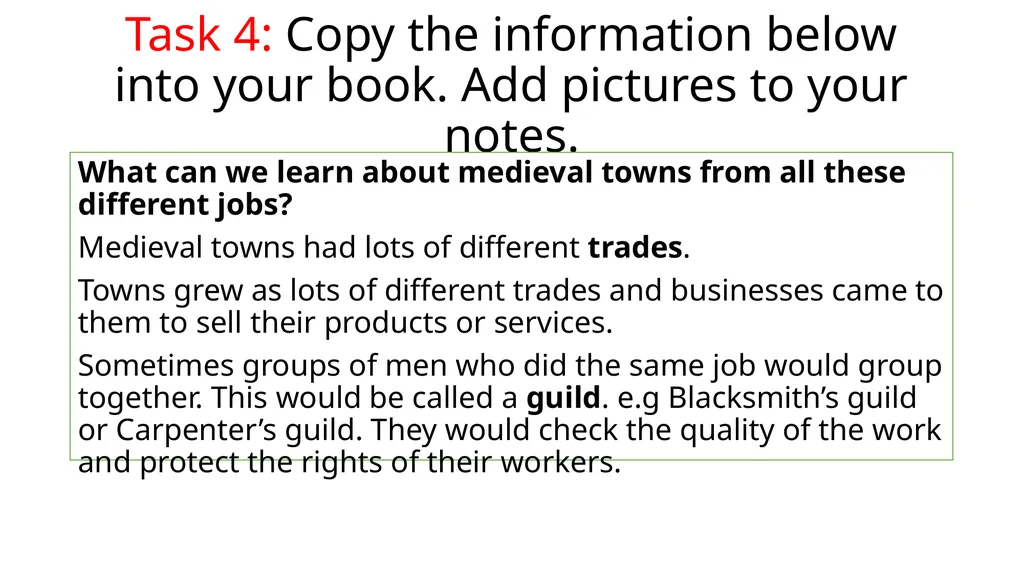
slide9. Task 4: Copy the information below into your book. Add pictures to your notes. What can we learn about medieval towns from all these different jobs?
Medieval towns had lots of different trades.
Towns grew as lots of different trades and businesses came to them to sell their products or services.
Sometimes groups of men who did the same job would group together. This would be called a guild. e.g Blacksmith’s guild or Carpenter’s guild. They would check the quality of the work and protect the rights of their workers.<br>
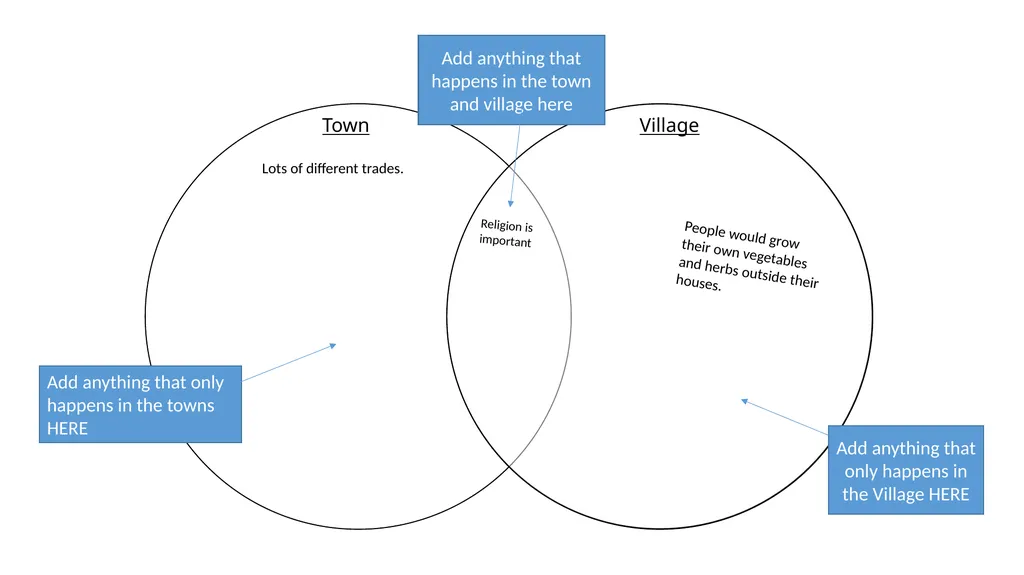
slide10. How were Medieval towns and villages similar and different? Task 5: Draw this diagram on the next slide into your book. It is comparing the similarities and differences between the towns and the villages. Can you add three more pieces of information to each part of the diagram? There are some clues on slide 10 to help you if you get stuck.<br>
slide11. Town Village Religion is important Lots of different trades. People would grow their own vegetables and herbs outside their houses. Add anything that only happens in the towns HERE Add anything that only happens in the Village HERE Add anything that happens in the town and village here<br>
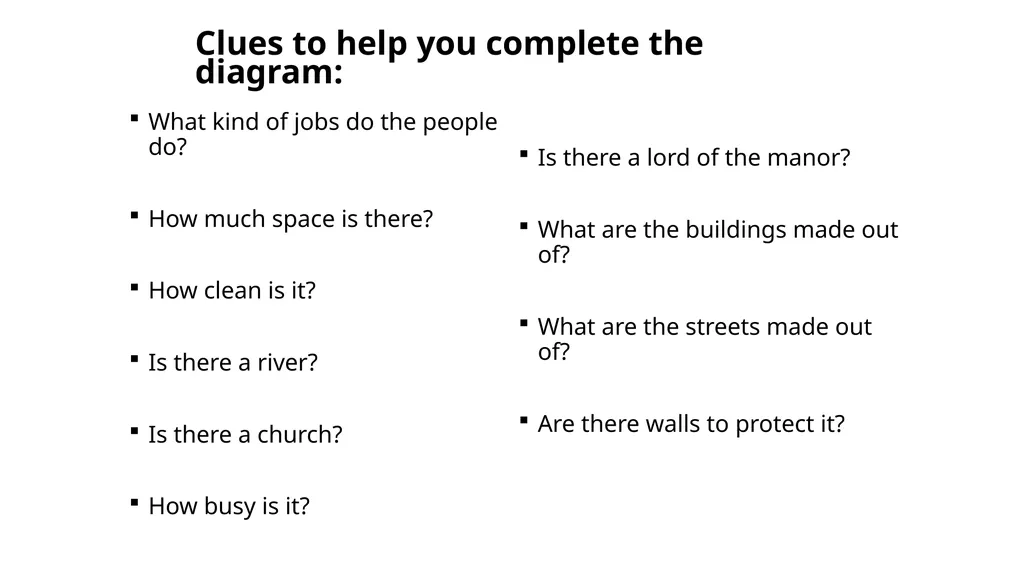
slide12. Clues to help you complete the diagram: What kind of jobs do the people do?
How much space is there?
How clean is it?
Is there a river?
Is there a church?
How busy is it?
Is there a lord of the manor?
What are the buildings made out of?
What are the streets made out of?
Are there walls to protect it?<br>
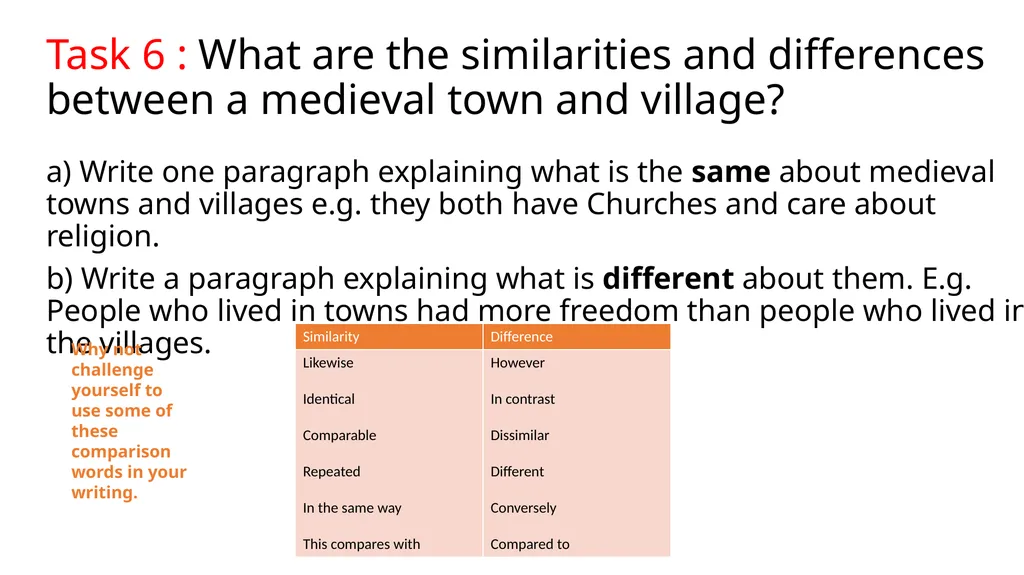
slide13. Task 6 : What are the similarities and differences between a medieval town and village? a) Write one paragraph explaining what is the same about medieval towns and villages e.g. they both have Churches and care about religion.
b) Write a paragraph explaining what is different about them. E.g. People who lived in towns had more freedom than people who lived in the villages. Why not challenge yourself to use some of these comparison words in your writing.<br>
slide14. Quick Quiz – CAN YOU REMEMBER? What was the most important building in the towns and the villages?
Can you name 3 jobs that townspeople did?
Can you describe how medieval towns and villages were different?
What happened to peasants who ran away to the towns and stayed for a year?
What was a guild?
Where would you have preferred to live, the Medieval town or the Medieval Village? Why?<br>
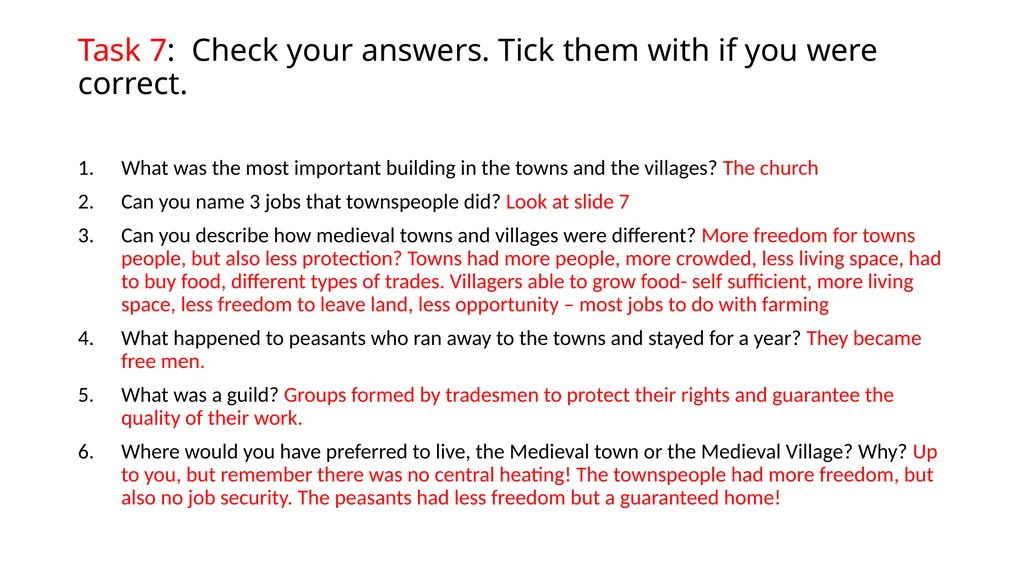
slide15. Task 7: Check your answers. Tick them with if you were correct. What was the most important building in the towns and the villages? The church
Can you name 3 jobs that townspeople did? Look at slide 7
Can you describe how medieval towns and villages were different? More freedom for towns people, but also less protection? Towns had more people, more crowded, less living space, had to buy food, different types of trades. Villagers able to grow food- self sufficient, more living space, less freedom to leave land, less opportunity – most jobs to do with farming
What happened to peasants who ran away to the towns and stayed for a year? They became free men.
What was a guild? Groups formed by tradesmen to protect their rights and guarantee the quality of their work.
Where would you have preferred to live, the Medieval town or the Medieval Village? Why? Up to you, but remember there was no central heating! The townspeople had more freedom, but also no job security. The peasants had less freedom but a guaranteed home!<br>
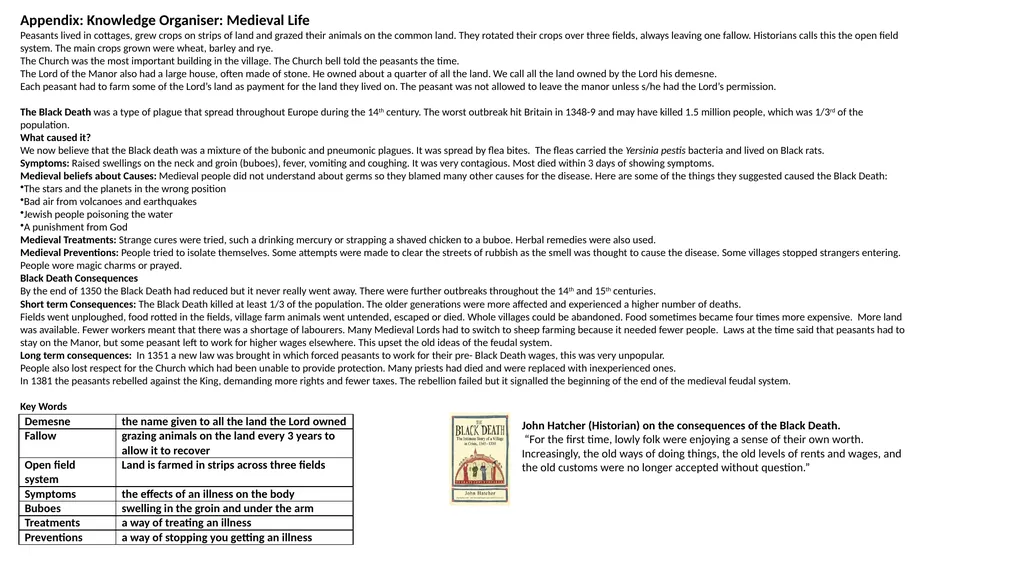
slide16. Appendix: Knowledge Organiser: Medieval Life
Peasants lived in cottages, grew crops on strips of land and grazed their animals on the common land. They rotated their crops over three fields, always leaving one fallow. Historians calls this the open field system. The main crops grown were wheat, barley and rye.
The Church was the most important building in the village. The Church bell told the peasants the time.
The Lord of the Manor also had a large house, often made of stone. He owned about a quarter of all the land. We call all the land owned by the Lord his demesne.
Each peasant had to farm some of the Lord’s land as payment for the land they lived on. The peasant was not allowed to leave the manor unless s/he had the Lord’s permission.
The Black Death was a type of plague that spread throughout Europe during the 14th century. The worst outbreak hit Britain in 1348-9 and may have killed 1.5 million people, which was 1/3rd of the population.
What caused it?
We now believe that the Black death was a mixture of the bubonic and pneumonic plagues. It was spread by flea bites. The fleas carried the Yersinia pestis bacteria and lived on Black rats.
Symptoms: Raised swellings on the neck and groin (buboes), fever, vomiting and coughing. It was very contagious. Most died within 3 days of showing symptoms.
Medieval beliefs about Causes: Medieval people did not understand about germs so they blamed many other causes for the disease. Here are some of the things they suggested caused the Black Death:
The stars and the planets in the wrong position
Bad air from volcanoes and earthquakes
Jewish people poisoning the water
A punishment from God
Medieval Treatments: Strange cures were tried, such a drinking mercury or strapping a shaved chicken to a buboe. Herbal remedies were also used.
Medieval Preventions: People tried to isolate themselves. Some attempts were made to clear the streets of rubbish as the smell was thought to cause the disease. Some villages stopped strangers entering. People wore magic charms or prayed.
Black Death Consequences
By the end of 1350 the Black Death had reduced but it never really went away. There were further outbreaks throughout the 14th and 15th centuries.
Short term Consequences: The Black Death killed at least 1/3 of the population. The older generations were more affected and experienced a higher number of deaths.
Fields went unploughed, food rotted in the fields, village farm animals went untended, escaped or died. Whole villages could be abandoned. Food sometimes became four times more expensive. More land was available. Fewer workers meant that there was a shortage of labourers. Many Medieval Lords had to switch to sheep farming because it needed fewer people. Laws at the time said that peasants had to stay on the Manor, but some peasant left to work for higher wages elsewhere. This upset the old ideas of the feudal system.
Long term consequences: In 1351 a new law was brought in which forced peasants to work for their pre- Black Death wages, this was very unpopular.
People also lost respect for the Church which had been unable to provide protection. Many priests had died and were replaced with inexperienced ones.
In 1381 the peasants rebelled against the King, demanding more rights and fewer taxes. The rebellion failed but it signalled the beginning of the end of the medieval feudal system.
Key Words John Hatcher (Historian) on the consequences of the Black Death.
“For the first time, lowly folk were enjoying a sense of their own worth. Increasingly, the old ways of doing things, the old levels of rents and wages, and the old customs were no longer accepted without question.”<br>
Work your way through the tasks on the power point.
Answer in full sentences in your book.
Each fortnight we will post a lesson that we expect to take about an hour and a half to work through. We will also give you a Meanwhile Elsewhere research homework which should take you another hour.
If you get stuck, re-read the task and see if you can work it out. Next ask an adult or a friend. If you are still stuck don’t panic. If you are really unsure and you have tried everything else then you can email your History teacher.
If you run out of work then continue to research your list of greatest Britons.<br>
slide3. Write the title and today’s date : What was life like in a medieval town? Insert an image of a medieval town here. I used:
https://www.johndclare.net/KS3/1-6-2.htmo.uk/pin/266838346646908439/<br>
slide4. Take a mental walk round this image by zooming in. What is different from the way we live today? Insert an image of a medieval town here, similar to the one at:
https://www.johndclare.net/KS3/1-6-2.htm
Remember to respect all IP rights when selecting images.<br>
slide5. Task 1: Write 50 words describing the medieval town. You could talk about: transport, housing, jobs, religion. Insert an image of a medieval town here, similar to the one at:
https://www.johndclare.net/KS3/1-6-2.htm
Remember to respect all IP rights when selecting images.<br>
slide6. Watch this : Medieval Towns - Timelines.tv History of Britain A03 - YouTube Task 2:
Answer the questions below in your book:
Towns like Ledbury formed around the Church. Why was this?
What did the town have to apply for in order to trade?
Who began to lease out the plots of land around the Church?
The trades people paid a rent of 12p rather than service. Why was this important?
What would happen if a peasant ran away to the town and stayed for a year?<br>
slide7. Now look back at the picture in slide 1 What jobs do you think they had in a Medieval town?
Task 3 : Use the slide on the next page to make a mind map. (Try doing it from memory if you can) Jobs in the Medieval Town<br>
slide8. Barber This person would cut hair. But they would also act as a dentist, surgeon or blood-letter. This person would weave together straw to make the thatched roofs that most medieval houses had. These people were the security of the town. They would keep watch from the town walls or castle. Thatcher Watchman Carpenter This was a skilled craftsman who made things out of wood. This could be lots of different things including furniture, roofing or materials for warfare. Somebody who made shoes. Cobbler Scribe One of the only people in the town to be able to read and write. They would often be religious people who would copy out important documents. Blacksmith This person worked with metal. They made and sharpened weapons, repaired armour and made shoes for horses’ hooves. This person would make leather out of animal skin. This could then be used for belts, bags and shoes. This person collected the waste from the cesspits and moved it outside of the town’s walls. Tanner Gongfarmer<br>
slide9. Task 4: Copy the information below into your book. Add pictures to your notes. What can we learn about medieval towns from all these different jobs?
Medieval towns had lots of different trades.
Towns grew as lots of different trades and businesses came to them to sell their products or services.
Sometimes groups of men who did the same job would group together. This would be called a guild. e.g Blacksmith’s guild or Carpenter’s guild. They would check the quality of the work and protect the rights of their workers.<br>
slide10. How were Medieval towns and villages similar and different? Task 5: Draw this diagram on the next slide into your book. It is comparing the similarities and differences between the towns and the villages. Can you add three more pieces of information to each part of the diagram? There are some clues on slide 10 to help you if you get stuck.<br>
slide11. Town Village Religion is important Lots of different trades. People would grow their own vegetables and herbs outside their houses. Add anything that only happens in the towns HERE Add anything that only happens in the Village HERE Add anything that happens in the town and village here<br>
slide12. Clues to help you complete the diagram: What kind of jobs do the people do?
How much space is there?
How clean is it?
Is there a river?
Is there a church?
How busy is it?
Is there a lord of the manor?
What are the buildings made out of?
What are the streets made out of?
Are there walls to protect it?<br>
slide13. Task 6 : What are the similarities and differences between a medieval town and village? a) Write one paragraph explaining what is the same about medieval towns and villages e.g. they both have Churches and care about religion.
b) Write a paragraph explaining what is different about them. E.g. People who lived in towns had more freedom than people who lived in the villages. Why not challenge yourself to use some of these comparison words in your writing.<br>
slide14. Quick Quiz – CAN YOU REMEMBER? What was the most important building in the towns and the villages?
Can you name 3 jobs that townspeople did?
Can you describe how medieval towns and villages were different?
What happened to peasants who ran away to the towns and stayed for a year?
What was a guild?
Where would you have preferred to live, the Medieval town or the Medieval Village? Why?<br>
slide15. Task 7: Check your answers. Tick them with if you were correct. What was the most important building in the towns and the villages? The church
Can you name 3 jobs that townspeople did? Look at slide 7
Can you describe how medieval towns and villages were different? More freedom for towns people, but also less protection? Towns had more people, more crowded, less living space, had to buy food, different types of trades. Villagers able to grow food- self sufficient, more living space, less freedom to leave land, less opportunity – most jobs to do with farming
What happened to peasants who ran away to the towns and stayed for a year? They became free men.
What was a guild? Groups formed by tradesmen to protect their rights and guarantee the quality of their work.
Where would you have preferred to live, the Medieval town or the Medieval Village? Why? Up to you, but remember there was no central heating! The townspeople had more freedom, but also no job security. The peasants had less freedom but a guaranteed home!<br>
slide16. Appendix: Knowledge Organiser: Medieval Life
Peasants lived in cottages, grew crops on strips of land and grazed their animals on the common land. They rotated their crops over three fields, always leaving one fallow. Historians calls this the open field system. The main crops grown were wheat, barley and rye.
The Church was the most important building in the village. The Church bell told the peasants the time.
The Lord of the Manor also had a large house, often made of stone. He owned about a quarter of all the land. We call all the land owned by the Lord his demesne.
Each peasant had to farm some of the Lord’s land as payment for the land they lived on. The peasant was not allowed to leave the manor unless s/he had the Lord’s permission.
The Black Death was a type of plague that spread throughout Europe during the 14th century. The worst outbreak hit Britain in 1348-9 and may have killed 1.5 million people, which was 1/3rd of the population.
What caused it?
We now believe that the Black death was a mixture of the bubonic and pneumonic plagues. It was spread by flea bites. The fleas carried the Yersinia pestis bacteria and lived on Black rats.
Symptoms: Raised swellings on the neck and groin (buboes), fever, vomiting and coughing. It was very contagious. Most died within 3 days of showing symptoms.
Medieval beliefs about Causes: Medieval people did not understand about germs so they blamed many other causes for the disease. Here are some of the things they suggested caused the Black Death:
The stars and the planets in the wrong position
Bad air from volcanoes and earthquakes
Jewish people poisoning the water
A punishment from God
Medieval Treatments: Strange cures were tried, such a drinking mercury or strapping a shaved chicken to a buboe. Herbal remedies were also used.
Medieval Preventions: People tried to isolate themselves. Some attempts were made to clear the streets of rubbish as the smell was thought to cause the disease. Some villages stopped strangers entering. People wore magic charms or prayed.
Black Death Consequences
By the end of 1350 the Black Death had reduced but it never really went away. There were further outbreaks throughout the 14th and 15th centuries.
Short term Consequences: The Black Death killed at least 1/3 of the population. The older generations were more affected and experienced a higher number of deaths.
Fields went unploughed, food rotted in the fields, village farm animals went untended, escaped or died. Whole villages could be abandoned. Food sometimes became four times more expensive. More land was available. Fewer workers meant that there was a shortage of labourers. Many Medieval Lords had to switch to sheep farming because it needed fewer people. Laws at the time said that peasants had to stay on the Manor, but some peasant left to work for higher wages elsewhere. This upset the old ideas of the feudal system.
Long term consequences: In 1351 a new law was brought in which forced peasants to work for their pre- Black Death wages, this was very unpopular.
People also lost respect for the Church which had been unable to provide protection. Many priests had died and were replaced with inexperienced ones.
In 1381 the peasants rebelled against the King, demanding more rights and fewer taxes. The rebellion failed but it signalled the beginning of the end of the medieval feudal system.
Key Words John Hatcher (Historian) on the consequences of the Black Death.
“For the first time, lowly folk were enjoying a sense of their own worth. Increasingly, the old ways of doing things, the old levels of rents and wages, and the old customs were no longer accepted without question.”<br>