
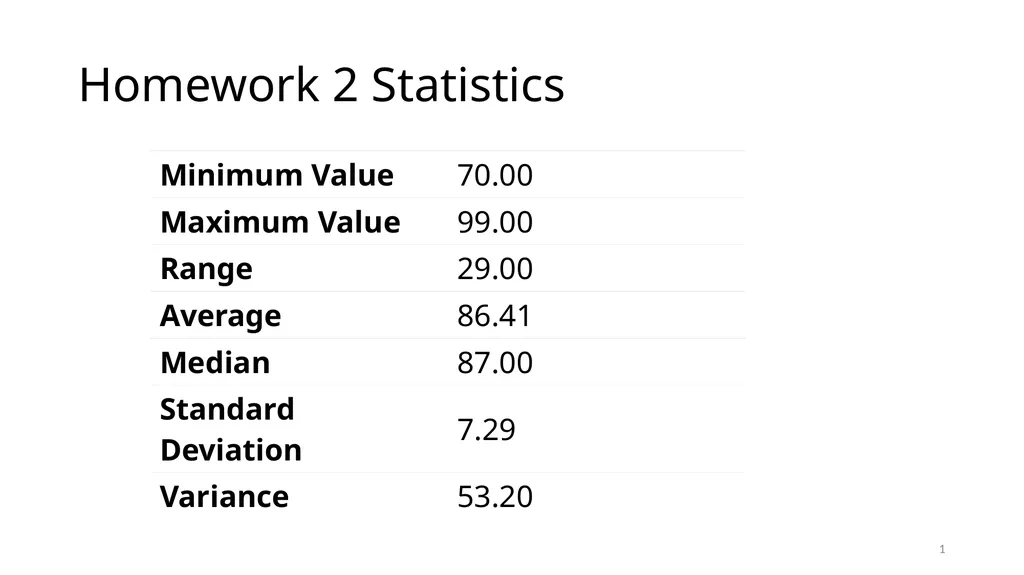
Homework 2 Statistics 1 Midterm Exam Date:
Description: Homework 2 Statistics 1 Midterm Exam Date: Tuesday, October 16th Time: 3PM-4:15PM (in class) Location: Lawson B134 (right here) Closed BookNo Calculator Note: Our TA (Duc Le) will proctor the midterm Content: Includes todays lecture
Related Topics
Download Presentation
"Homework 2 Statistics 1 Midterm Exam Date:" is the property of its rightful owner. Permission is granted to download and print the materials on this website for personal, non-commercial use only, and to display it on your personal computer provided you do not modify the materials and that you retain all copyright notices contained in the materials. By downloading content from our website, you accept the terms of this agreement.
Presentation Transcript
slide1. Homework 2 Statistics 1<br>
slide2. Midterm Exam Date: Tuesday, October 16th
Time: 3PM-4:15PM (in class)
Location: Lawson B134 (right here)
Closed Book/No Calculator
Note: Our TA (Duc Le) will proctor the midterm
Content: Includes today’s lecture (chapters 1-7)
Preparation:
You may prepare one 3x5 inch index card (double sides).
Take the practice final
Review homework solutions, book, lecture notes etc. 2<br>
slide3. Final Exam (Tentative) Date: Tuesday, December 11th (Subject to Change*)
Time: 8AM (Subject to Change*)
Location: LWSN B151 (Subject to Change*)
* Purdue will not reimburse you for flight re-booking fees 3<br>
slide4. CryptographyCS 555 Week 8:
One-Way Functions (Part 2) 4 Fall 2018<br>
slide5. Recap Corollary: If one-way functions exist then PRGs, PRFs and strong PRPs all exist.
Corollary: If one-way functions exist then there exist CCA-secure encryption schemes and secure MACs.
We saw how to build PRGs from One-Way-Permutations… 5<br>
slide6. PRFs from PRGs 6 k G0(k) G1(k) G0(G0(k)) G1(G0(k)) … … G0(G1(k)) G1(G1(k)) … … 0 0 0 0 … … … … 0 0 0 1 1 1 1 1 1 1 Fk(011)=G1(G1(G0(k))) G(x):= G0(x) || G1(x) n-bits n-bits<br>
slide7. PRFs from PRGs 7<br>
slide8. PRFs from PRGs 8<br>
slide9. PRFs from PRGs 9<br>
slide10. Hybrid H0 (Real Construction) 10 k G0(k) G1(k) G0(G0(k)) G1(G0(k)) … … G0(G1(k)) G1(G1(k)) … … 0 0 0 0 … … … … 0 0 0 1 1 1 1 1 1 1 Fk(011)=G1(G1(G0(k))) G(x):= G0(x) || G1(x) n-bits n-bits<br>
slide11. Hybrid H1 (Real Construction) 11 k r0 r1 G0(G0(k)) G1(G0(k)) … … G0(G1(k)) G1(G1(k)) … … 0 0 0 0 … … … … 0 0 0 1 1 1 1 1 1 1 Fk(011)=G1(G1(r0)) G(x):= G0(x) || G1(x) n-bits n-bits<br>
slide12. Hybrid H2 12 12 r r0 r1 r00 r01 … … r10 r11 … … 0 0 0 0 … … … … 0 0 0 1 1 1 1 1 1 1 Fk(011)=G1(r01) G(x):= G0(x) || G1(x) n-bits n-bits<br>
slide13. Hybrid Hn (truly random function!) 13 13 r r0 r1 r00 r01 r001 r000 r10 r11 r111 r110 0 0 0 0 r010 r011 r100 r101 0 0 0 1 1 1 1 1 1 1 Fk(011)=r011 G(x):= G0(x) || G1(x) n-bits n-bits<br>
slide14. Hybrid H1 vs H2 14<br>
slide15. Hybrid H2 vs H1 15 15 r r0 r1 r00 r01 … … r10 r11 … … 0 0 0 0 … … … … 0 0 0 1 1 1 1 1 1 1 G(r0) vs. r00 ||r01 G(x):= G0(x) || G1(x) n-bits n-bits x1 xt x2 Irrelevant: (Unexplored)<br>
slide16. Triangle Inequality 16<br>
slide17. From OWFs (Recap) 17<br>
slide18. From OWFs (Recap) Corollary: If one-way functions exist then PRGs, PRFs and strong PRPs all exist.
Corollary: If one-way functions exist then there exist CCA-secure encryption schemes and secure MACs. 18<br>
slide19. Are OWFs Necessary for Private Key Crypto Previous results show that OWFs are sufficient.
Can we build Private Key Crypto from weaker assumptions?
Short Answer: No, OWFs are also necessary for most private-key crypto primitives 19<br>
slide20. PRGs ïƒ OWFs 20<br>
slide21. PRGs ïƒ OWFs 21<br>
slide22. PRGs ïƒ OWFs 22<br>
slide23. PRGs ïƒ OWFs 23<br>
slide24. PRGs ïƒ OWFs 24<br>
slide25. What other assumptions imply OWFs? PRGs ïƒ OWFs
(Easy Extension) PRFs ïƒ PRGs ïƒ OWFs
Does secure crypto scheme imply OWFs?
CCA-secure? (Strongest)
CPA-Secure? (Weaker)
EAV-secure? (Weakest)
As long as the plaintext is longer than the secret key
Perfect Secrecy? X (Guarantee is information theoretic) 25<br>
slide26. EAV-Secure Crypto ïƒ OWFs Proposition 7.29: If there exists a EAV-secure private-key encryption scheme that encrypts messages twice as long as its key, then a one-way function exists.
Recap: EAV-secure.
Attacker picks two plaintexts m0,m1 and is given c=EncK(mb) for random bit b.
Attacker attempts to guess b.
No ability to request additional encryptions (chosen-plaintext attacks)
In fact, no ability to observe any additional encryptions 26<br>
slide27. EAV-Secure Crypto ïƒ OWFs 27<br>
slide28. EAV-Secure Crypto ïƒ OWFs 28<br>
slide29. MACsïƒ OWFs In particular, given a MAC that satisfies MAC security (Definition 4.2) against an attacker who sees an arbitrary (polynomial) number of message/tag pairs.
Conclusions: OWFs are necessary and sufficient for all (non-trivial) private key cryptography.
ïƒ OWFs are a minimal assumption for private-key crypto.
Public Key Crypto/Hashing?
OWFs are known to be necessary
Not known (or believed) to be sufficient. 29<br>
slide30. Computational Indistinguishability 30<br>
slide31. Computational Indistinguishability 31<br>
slide32. Computational Indistinguishability 32<br>
slide33. Computational Indistinguishability 33<br>
slide34. Practice Problems 34<br>
slide2. Midterm Exam Date: Tuesday, October 16th
Time: 3PM-4:15PM (in class)
Location: Lawson B134 (right here)
Closed Book/No Calculator
Note: Our TA (Duc Le) will proctor the midterm
Content: Includes today’s lecture (chapters 1-7)
Preparation:
You may prepare one 3x5 inch index card (double sides).
Take the practice final
Review homework solutions, book, lecture notes etc. 2<br>
slide3. Final Exam (Tentative) Date: Tuesday, December 11th (Subject to Change*)
Time: 8AM (Subject to Change*)
Location: LWSN B151 (Subject to Change*)
* Purdue will not reimburse you for flight re-booking fees 3<br>
slide4. CryptographyCS 555 Week 8:
One-Way Functions (Part 2) 4 Fall 2018<br>
slide5. Recap Corollary: If one-way functions exist then PRGs, PRFs and strong PRPs all exist.
Corollary: If one-way functions exist then there exist CCA-secure encryption schemes and secure MACs.
We saw how to build PRGs from One-Way-Permutations… 5<br>
slide6. PRFs from PRGs 6 k G0(k) G1(k) G0(G0(k)) G1(G0(k)) … … G0(G1(k)) G1(G1(k)) … … 0 0 0 0 … … … … 0 0 0 1 1 1 1 1 1 1 Fk(011)=G1(G1(G0(k))) G(x):= G0(x) || G1(x) n-bits n-bits<br>
slide7. PRFs from PRGs 7<br>
slide8. PRFs from PRGs 8<br>
slide9. PRFs from PRGs 9<br>
slide10. Hybrid H0 (Real Construction) 10 k G0(k) G1(k) G0(G0(k)) G1(G0(k)) … … G0(G1(k)) G1(G1(k)) … … 0 0 0 0 … … … … 0 0 0 1 1 1 1 1 1 1 Fk(011)=G1(G1(G0(k))) G(x):= G0(x) || G1(x) n-bits n-bits<br>
slide11. Hybrid H1 (Real Construction) 11 k r0 r1 G0(G0(k)) G1(G0(k)) … … G0(G1(k)) G1(G1(k)) … … 0 0 0 0 … … … … 0 0 0 1 1 1 1 1 1 1 Fk(011)=G1(G1(r0)) G(x):= G0(x) || G1(x) n-bits n-bits<br>
slide12. Hybrid H2 12 12 r r0 r1 r00 r01 … … r10 r11 … … 0 0 0 0 … … … … 0 0 0 1 1 1 1 1 1 1 Fk(011)=G1(r01) G(x):= G0(x) || G1(x) n-bits n-bits<br>
slide13. Hybrid Hn (truly random function!) 13 13 r r0 r1 r00 r01 r001 r000 r10 r11 r111 r110 0 0 0 0 r010 r011 r100 r101 0 0 0 1 1 1 1 1 1 1 Fk(011)=r011 G(x):= G0(x) || G1(x) n-bits n-bits<br>
slide14. Hybrid H1 vs H2 14<br>
slide15. Hybrid H2 vs H1 15 15 r r0 r1 r00 r01 … … r10 r11 … … 0 0 0 0 … … … … 0 0 0 1 1 1 1 1 1 1 G(r0) vs. r00 ||r01 G(x):= G0(x) || G1(x) n-bits n-bits x1 xt x2 Irrelevant: (Unexplored)<br>
slide16. Triangle Inequality 16<br>
slide17. From OWFs (Recap) 17<br>
slide18. From OWFs (Recap) Corollary: If one-way functions exist then PRGs, PRFs and strong PRPs all exist.
Corollary: If one-way functions exist then there exist CCA-secure encryption schemes and secure MACs. 18<br>
slide19. Are OWFs Necessary for Private Key Crypto Previous results show that OWFs are sufficient.
Can we build Private Key Crypto from weaker assumptions?
Short Answer: No, OWFs are also necessary for most private-key crypto primitives 19<br>
slide20. PRGs ïƒ OWFs 20<br>
slide21. PRGs ïƒ OWFs 21<br>
slide22. PRGs ïƒ OWFs 22<br>
slide23. PRGs ïƒ OWFs 23<br>
slide24. PRGs ïƒ OWFs 24<br>
slide25. What other assumptions imply OWFs? PRGs ïƒ OWFs
(Easy Extension) PRFs ïƒ PRGs ïƒ OWFs
Does secure crypto scheme imply OWFs?
CCA-secure? (Strongest)
CPA-Secure? (Weaker)
EAV-secure? (Weakest)
As long as the plaintext is longer than the secret key
Perfect Secrecy? X (Guarantee is information theoretic) 25<br>
slide26. EAV-Secure Crypto ïƒ OWFs Proposition 7.29: If there exists a EAV-secure private-key encryption scheme that encrypts messages twice as long as its key, then a one-way function exists.
Recap: EAV-secure.
Attacker picks two plaintexts m0,m1 and is given c=EncK(mb) for random bit b.
Attacker attempts to guess b.
No ability to request additional encryptions (chosen-plaintext attacks)
In fact, no ability to observe any additional encryptions 26<br>
slide27. EAV-Secure Crypto ïƒ OWFs 27<br>
slide28. EAV-Secure Crypto ïƒ OWFs 28<br>
slide29. MACsïƒ OWFs In particular, given a MAC that satisfies MAC security (Definition 4.2) against an attacker who sees an arbitrary (polynomial) number of message/tag pairs.
Conclusions: OWFs are necessary and sufficient for all (non-trivial) private key cryptography.
ïƒ OWFs are a minimal assumption for private-key crypto.
Public Key Crypto/Hashing?
OWFs are known to be necessary
Not known (or believed) to be sufficient. 29<br>
slide30. Computational Indistinguishability 30<br>
slide31. Computational Indistinguishability 31<br>
slide32. Computational Indistinguishability 32<br>
slide33. Computational Indistinguishability 33<br>
slide34. Practice Problems 34<br>