Horizontal variability of water and its relationship to cloud fraction near the tropical tropopause Using aircraft observations of water vapor to improve the representation of grid-scale cloud formation in GEOS-5 Henry Selkirk GESTARNASA
"Horizontal variability of water and its" is the property of its rightful owner. Permission is granted to
download and print the materials on this website for personal, non-commercial use only, and to display it
on your personal computer provided you do not modify the materials and that you retain all copyright
notices contained in the materials. By downloading content from our website, you accept the terms of this
agreement.
Presentation Transcript
01
Horizontal variability of water and its relationship to cloud fraction near the tropical tropopause Using aircraft observations of water vapor to improve the representation of grid-scale cloud formation in GEOS-5 Henry Selkirk
GESTAR/NASA GSFC Andrea Molod
GMAO/NASA GSFC Pacific Missions Meeting – 21 October 2014 with data from the DLH, Havard and JPL groups<br>
02
Talk topics The chronic water vapor problem in the GEOS-5
Two possible source and a potential remedy for one
Motivating science questions
Overview of cloud processes in GEOS-5
Methodology: estimating RHcrit from aircraft data
Initial results from TC4: DC-8 and WB-57
Summary, long-term goals and future work Pacific Missions Meeting – 21 October 2014<br>
03
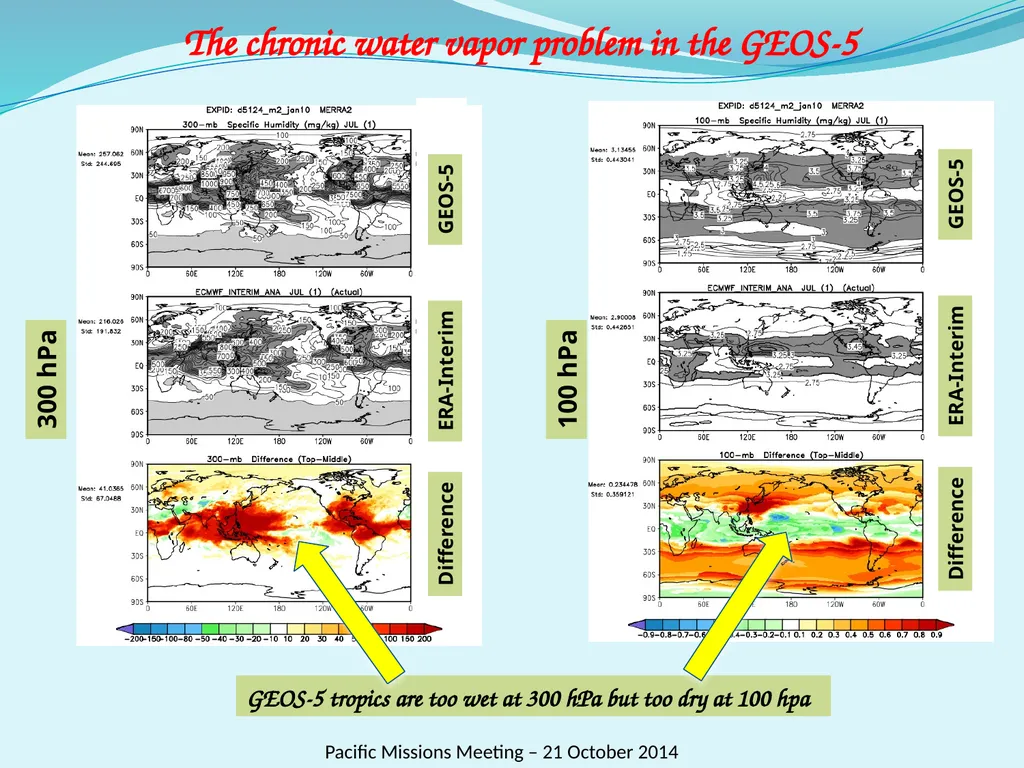
300 hPa 100 hPa GEOS-5 tropics are too wet at 300 hPa but too dry at 100 hpa Pacific Missions Meeting – 21 October 2014 The chronic water vapor problem in the GEOS-5<br>
04
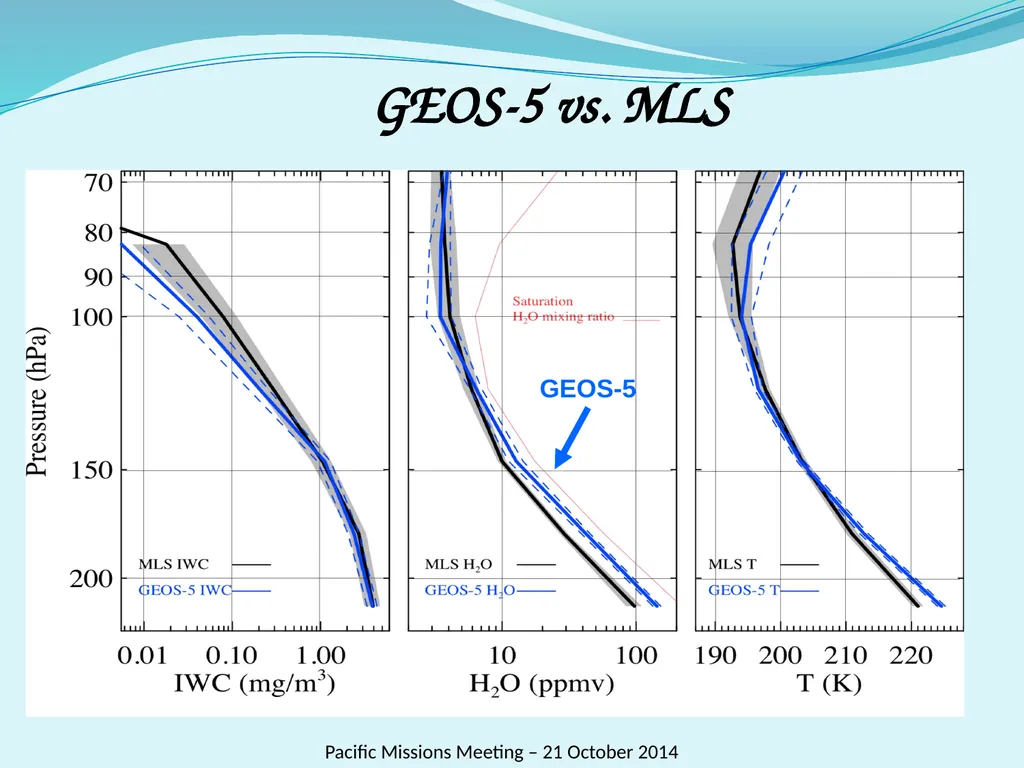
GEOS-5 vs. MLS GEOS-5 Pacific Missions Meeting – 21 October 2014<br>
05
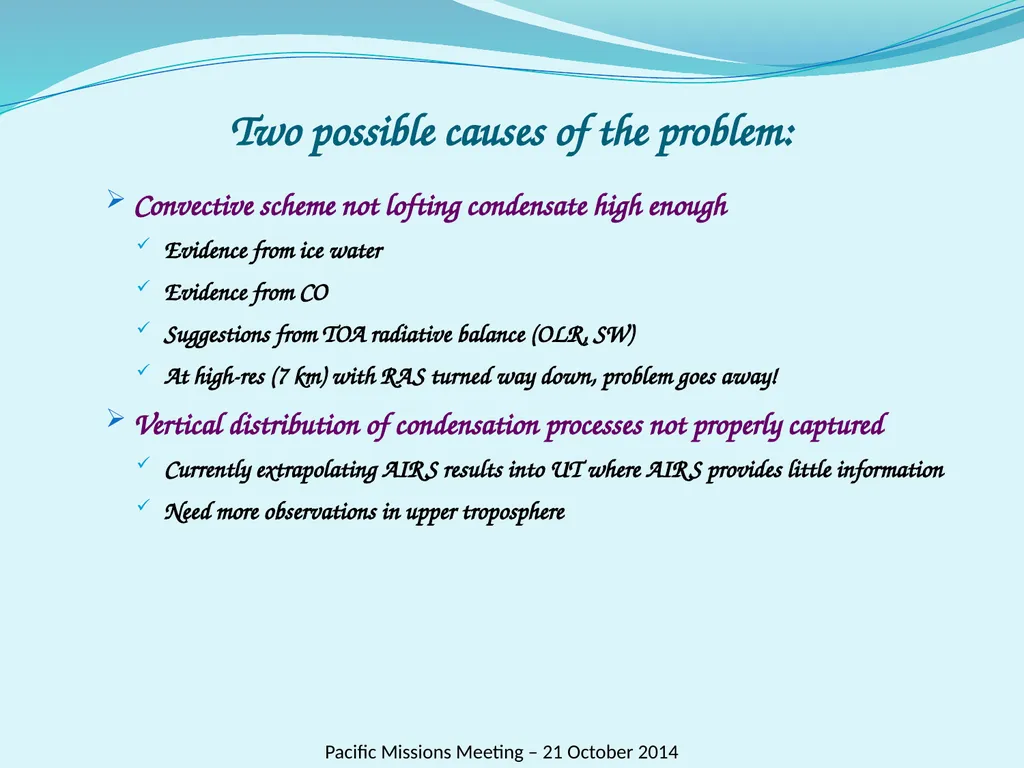
Two possible causes of the problem: Convective scheme not lofting condensate high enough
Evidence from ice water
Evidence from CO
Suggestions from TOA radiative balance (OLR, SW)
At high-res (7 km) with RAS turned way down, problem goes away!
Vertical distribution of condensation processes not properly captured
Currently extrapolating AIRS results into UT where AIRS provides little information
Need more observations in upper troposphere Pacific Missions Meeting – 21 October 2014<br>
06
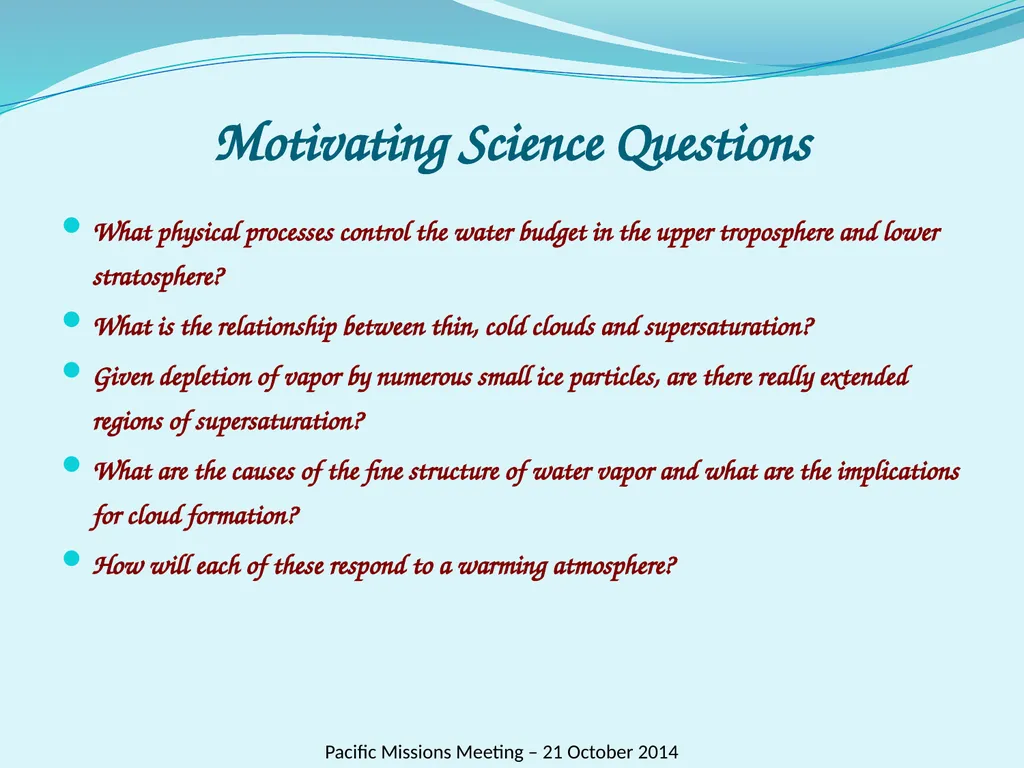
Motivating Science Questions What physical processes control the water budget in the upper troposphere and lower stratosphere?
What is the relationship between thin, cold clouds and supersaturation?
Given depletion of vapor by numerous small ice particles, are there really extended regions of supersaturation?
What are the causes of the fine structure of water vapor and what are the implications for cloud formation?
How will each of these respond to a warming atmosphere? Pacific Missions Meeting – 21 October 2014<br>
07
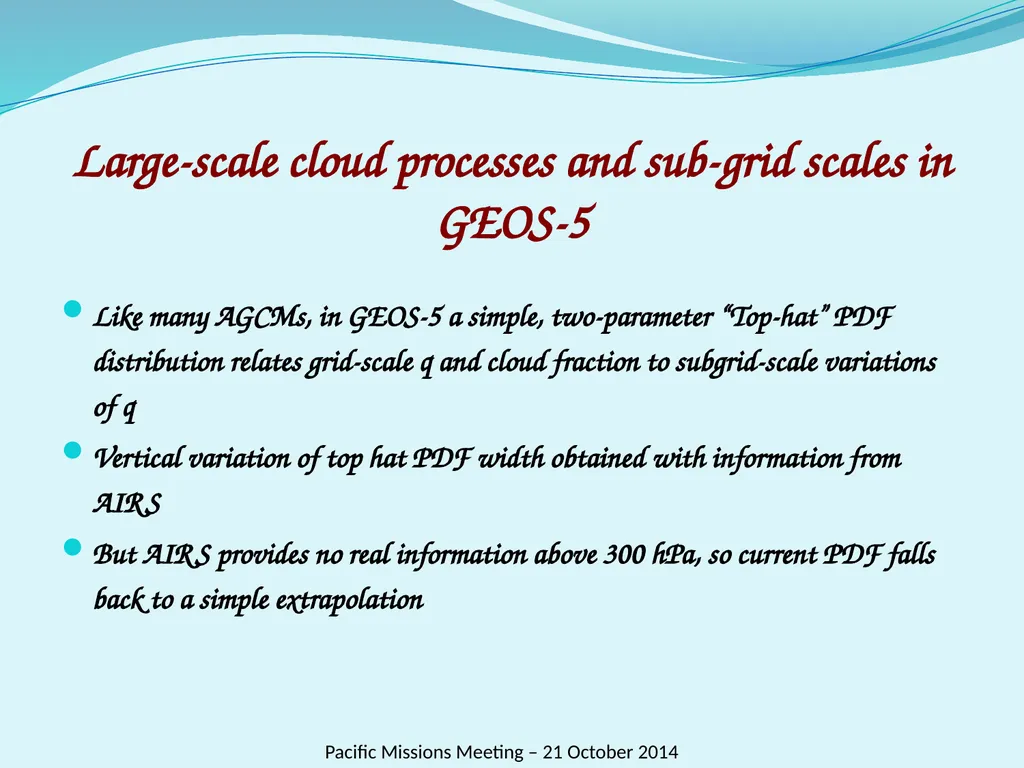
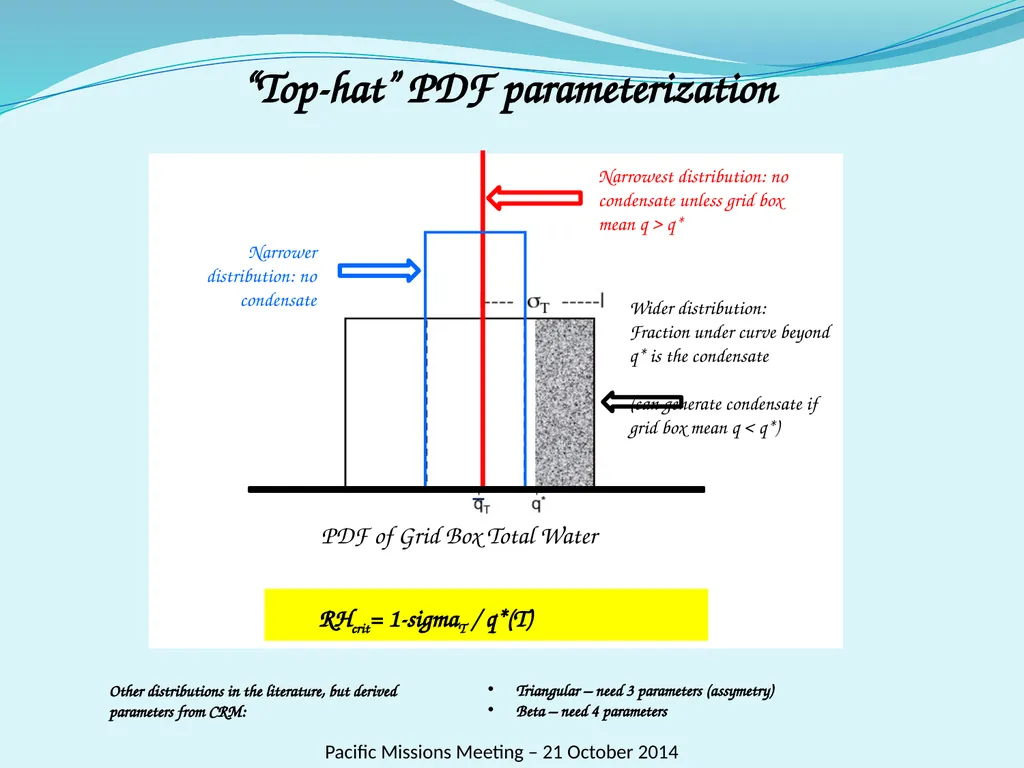
Large-scale cloud processes and sub-grid scales in GEOS-5 Like many AGCMs, in GEOS-5 a simple, two-parameter “Top-hat” PDF distribution relates grid-scale q and cloud fraction to subgrid-scale variations of q
Vertical variation of top hat PDF width obtained with information from AIRS
But AIRS provides no real information above 300 hPa, so current PDF falls back to a simple extrapolation Pacific Missions Meeting – 21 October 2014<br>
08
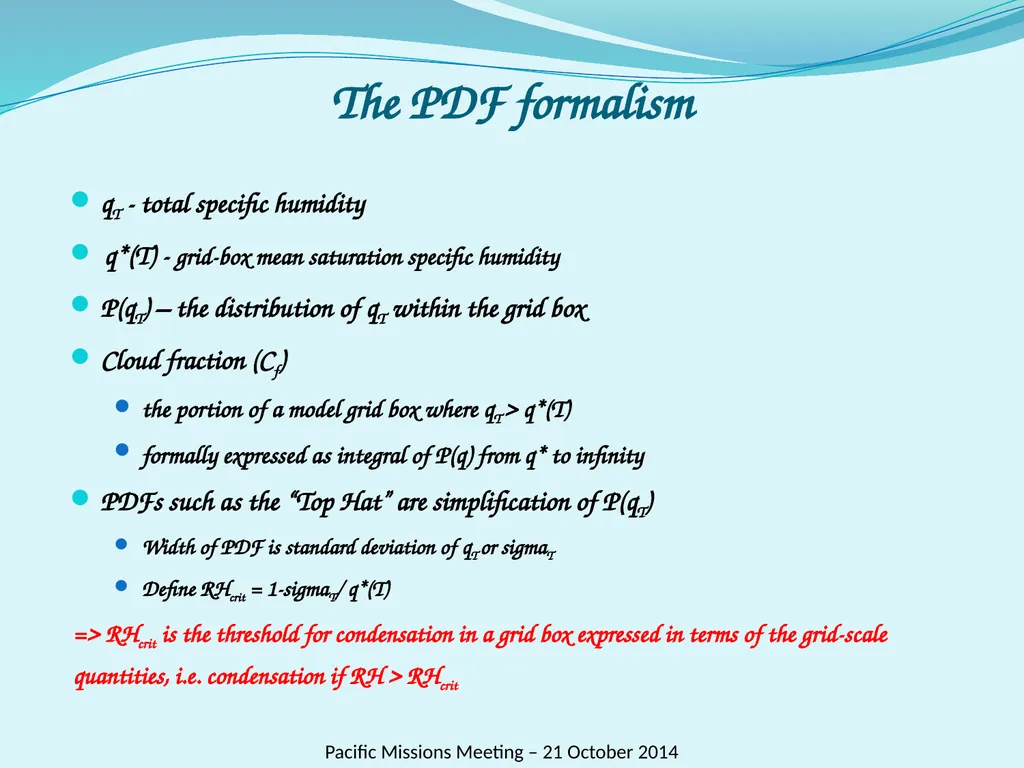
The PDF formalism qT - total specific humidity
q*(T) - grid-box mean saturation specific humidity
P(qT) – the distribution of qT within the grid box
Cloud fraction (Cf)
the portion of a model grid box where qT > q*(T)
formally expressed as integral of P(q) from q* to infinity
PDFs such as the “Top Hat” are simplification of P(qT)
Width of PDF is standard deviation of qT or sigmaT
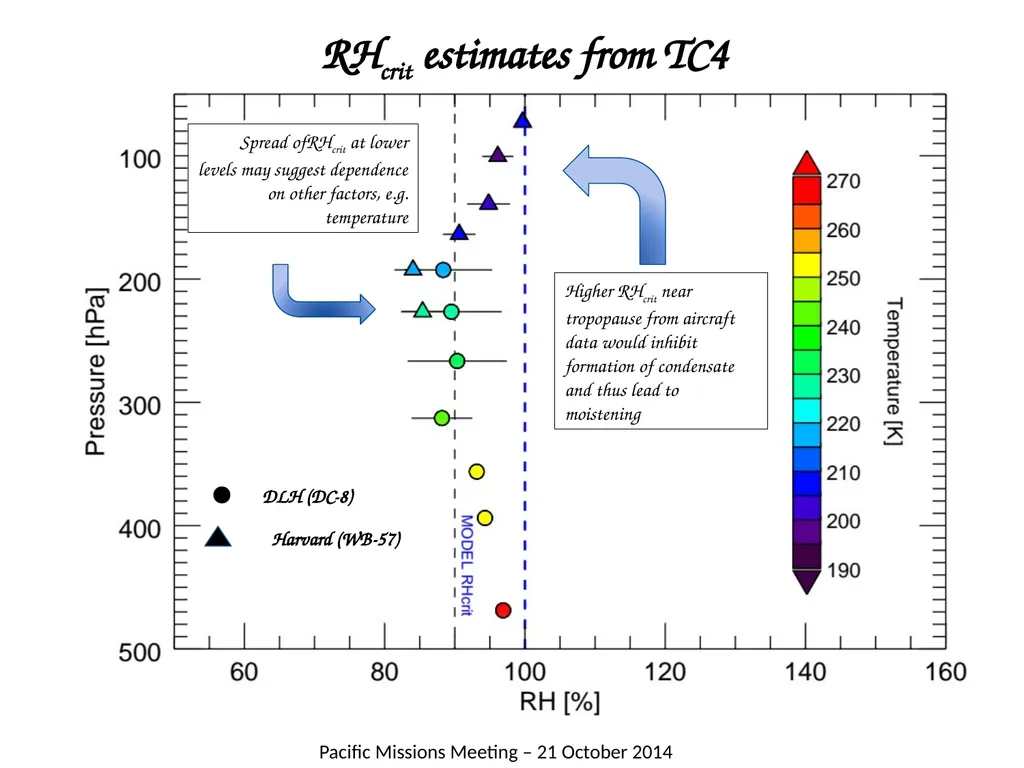
Define RHcrit = 1-sigmaT/ q*(T)
=> RHcrit is the threshold for condensation in a grid box expressed in terms of the grid-scale quantities, i.e. condensation if RH > RHcrit Pacific Missions Meeting – 21 October 2014<br>
09
“Top-hat” PDF parameterization Other distributions in the literature, but derived parameters from CRM: Triangular – need 3 parameters (assymetry)
Beta – need 4 parameters Pacific Missions Meeting – 21 October 2014 RHcrit= 1-sigmaT / q*(T)<br>
10
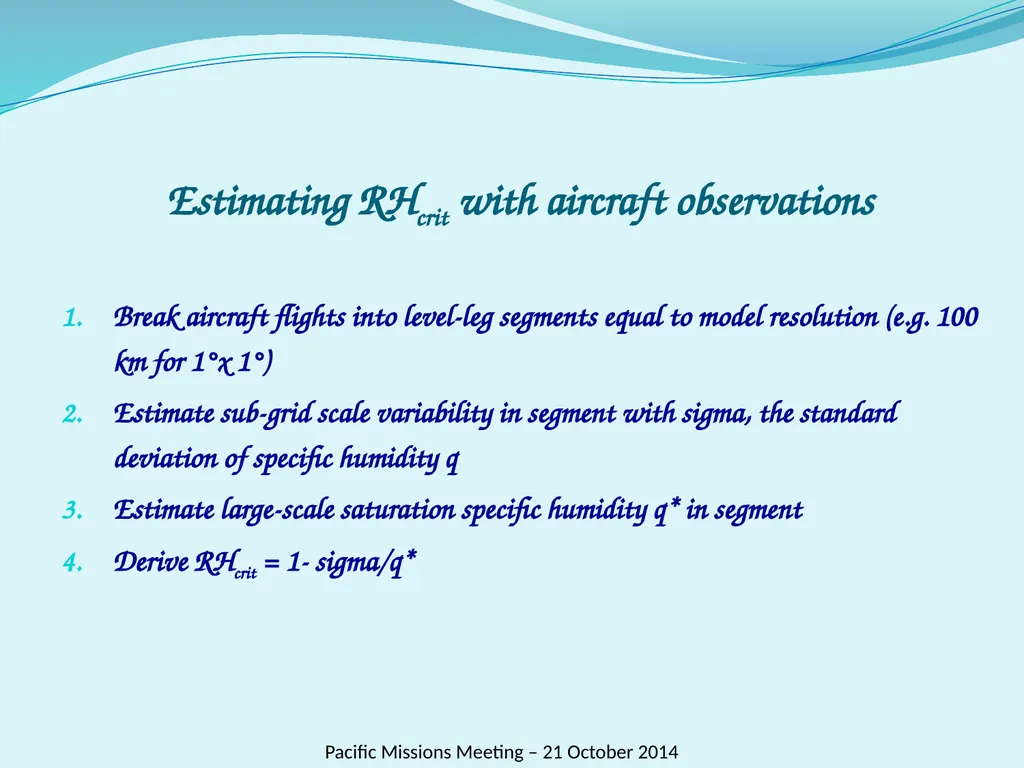
Estimating RHcrit with aircraft observations Break aircraft flights into level-leg segments equal to model resolution (e.g. 100 km for 1°x 1°)
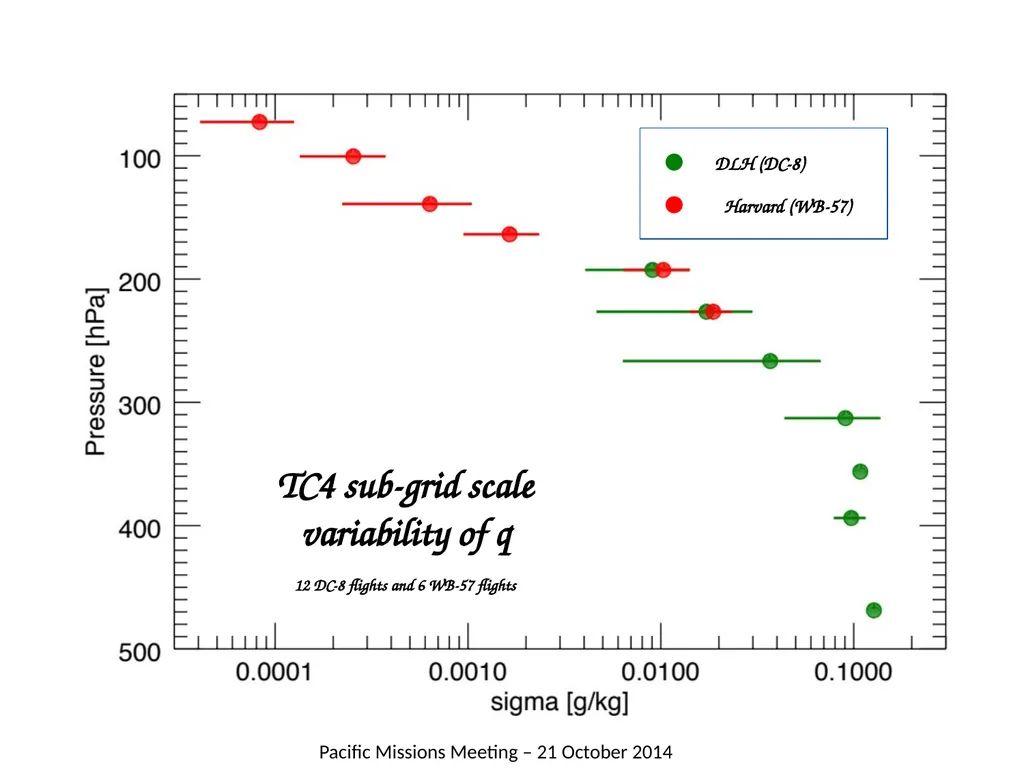
Estimate sub-grid scale variability in segment with sigma, the standard deviation of specific humidity q
Estimate large-scale saturation specific humidity q* in segment
Derive RHcrit = 1- sigma/q* Pacific Missions Meeting – 21 October 2014<br>
11
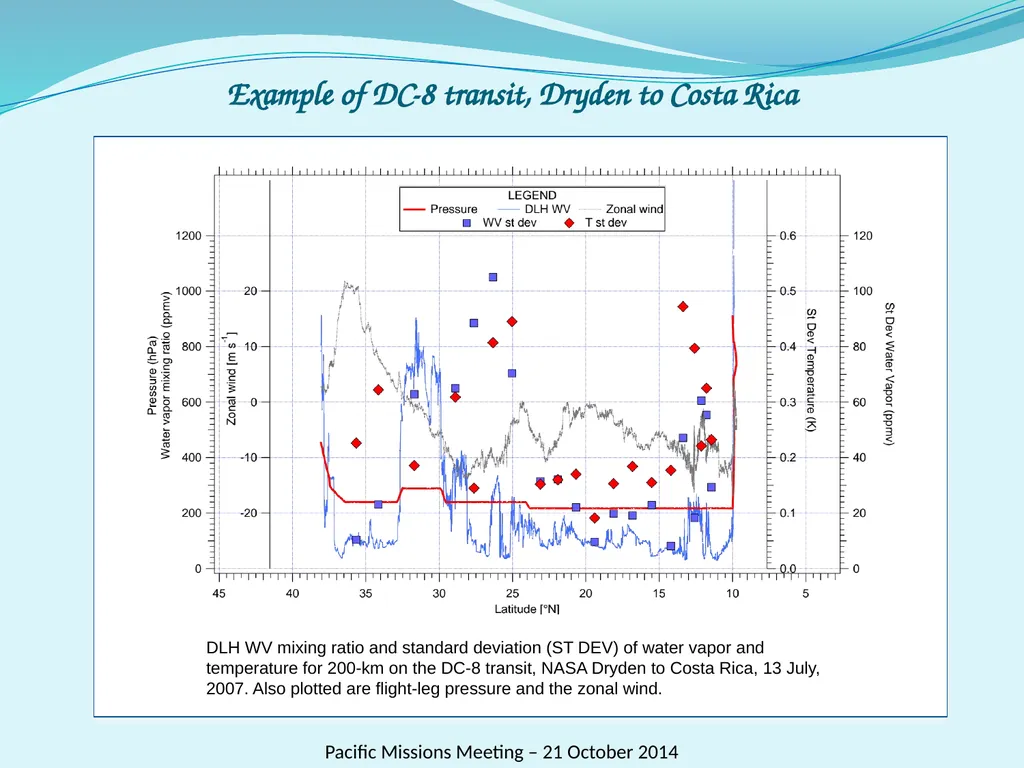
DLH WV mixing ratio and standard deviation (ST DEV) of water vapor and temperature for 200-km on the DC-8 transit, NASA Dryden to Costa Rica, 13 July, 2007. Also plotted are flight-leg pressure and the zonal wind. Example of DC-8 transit, Dryden to Costa Rica Pacific Missions Meeting – 21 October 2014<br>
12
“Top-hat” PDF parameterization Other distributions in the literature, but derived parameters from CRM: Triangular – need 3 parameters (assymetry)
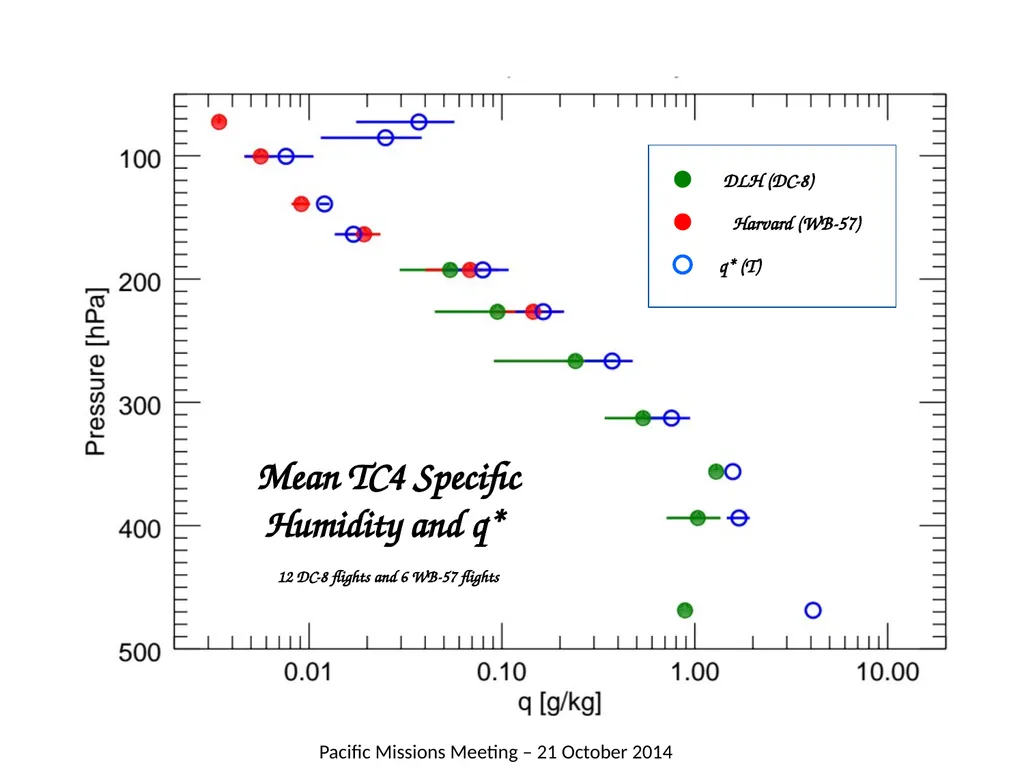
Beta – need 4 parameters Pacific Missions Meeting – 21 October 2014 DLH (DC-8) Harvard (WB-57) q* (T) Mean TC4 Specific Humidity and q*
12 DC-8 flights and 6 WB-57 flights Pacific Missions Meeting – 21 October 2014<br>
13
“Top-hat” PDF parameterization Other distributions in the literature, but derived parameters from CRM: Triangular – need 3 parameters (assymetry)
Beta – need 4 parameters Pacific Missions Meeting – 21 October 2014 TC4 sub-grid scale variability of q
12 DC-8 flights and 6 WB-57 flights Pacific Missions Meeting – 21 October 2014<br>
14
“Top-hat” PDF parameterization Other distributions in the literature, but derived parameters from CRM: Triangular – need 3 parameters (assymetry)
Beta – need 4 parameters Pacific Missions Meeting – 21 October 2014 DLH (DC-8) Harvard (WB-57) RHcrit estimates from TC4 Pacific Missions Meeting – 21 October 2014<br>
15
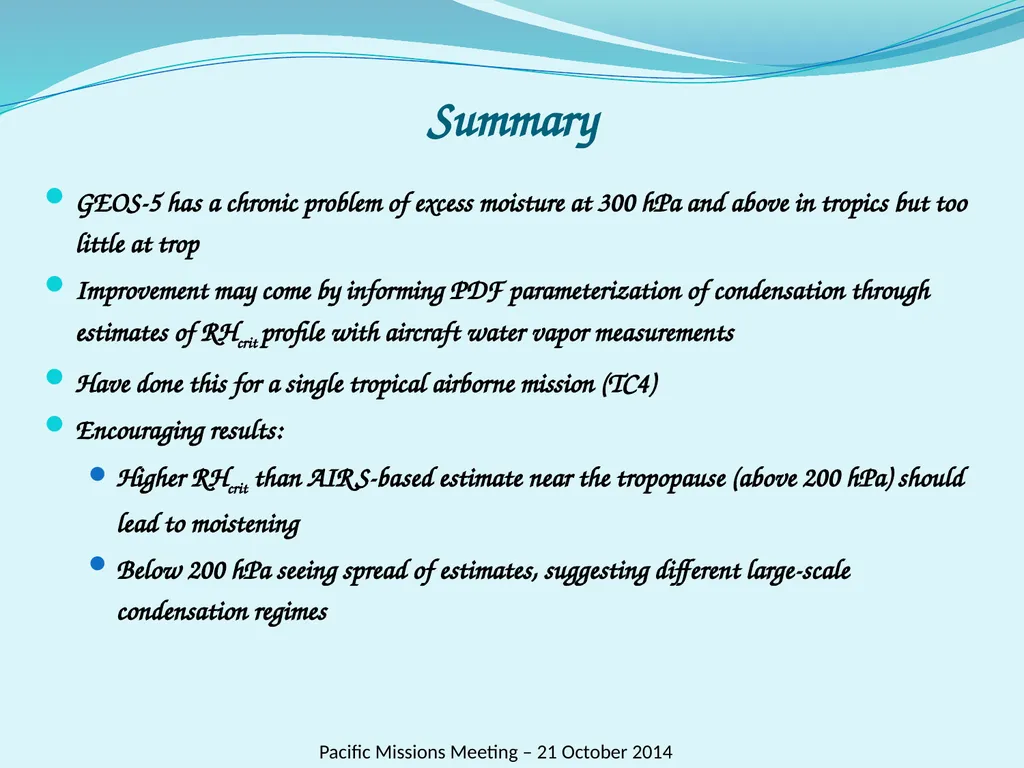
Summary GEOS-5 has a chronic problem of excess moisture at 300 hPa and above in tropics but too little at trop
Improvement may come by informing PDF parameterization of condensation through estimates of RHcrit profile with aircraft water vapor measurements
Have done this for a single tropical airborne mission (TC4)
Encouraging results:
Higher RHcrit than AIRS-based estimate near the tropopause (above 200 hPa) should lead to moistening
Below 200 hPa seeing spread of estimates, suggesting different large-scale condensation regimes Pacific Missions Meeting – 21 October 2014<br>
16
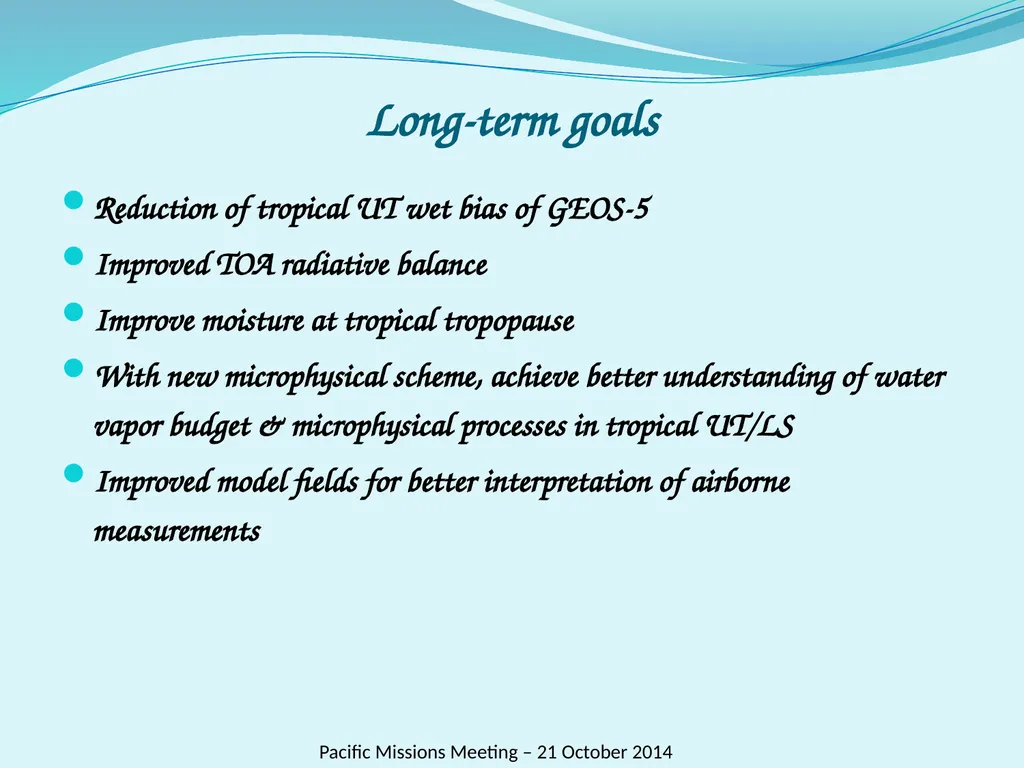
Long-term goals Reduction of tropical UT wet bias of GEOS-5
Improved TOA radiative balance
Improve moisture at tropical tropopause
With new microphysical scheme, achieve better understanding of water vapor budget & microphysical processes in tropical UT/LS
Improved model fields for better interpretation of airborne measurements Pacific Missions Meeting – 21 October 2014<br>
17
Carrying on… ATTREX/CONTRAST/CAST provide an extraordinarily rich database of water vapor measurements, particularly in the “gap” between the DC-8 and high-altitude platforms
Other missions, other environments & seasons: CR-AVE, MACPEX, SEAC4RS, HIPPO
Model runs and validation with observational data
Analysis of remote sensing data for sub-grid variability
CPL data
CALIPSO overpasses of opportunity
Develop state-dependent PDF parameterization for large-scale models (probably not a simple top-hat) Pacific Missions Meeting – 21 October 2014<br>