
Housing EBS Basic Training Agenda EBS Role
LO
Published · 46 slides · 0 views

1 / 1


Description
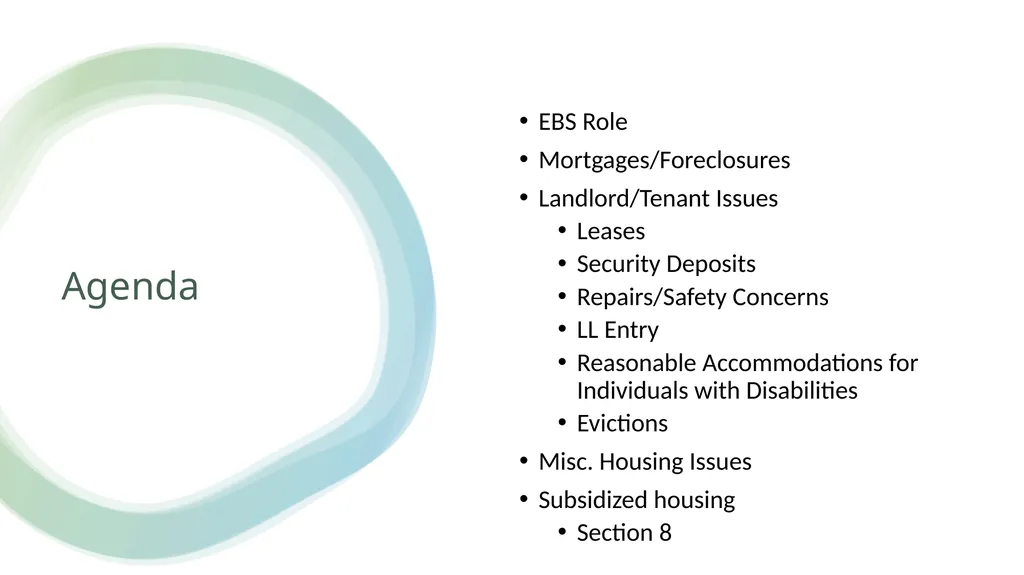
Housing EBS Basic Training Agenda EBS Role MortgagesForeclosures LandlordTenant Issues Leases Security Deposits RepairsSafety Concerns LL Entry Reasonable Accommodations for Individuals with Disabilities Evictions Misc. Housing Issues
Related Topics
Share
Embed code
Download this presentation From Below
"Housing EBS Basic Training Agenda EBS Role" is the property of its rightful owner. Permission is granted to download and print the materials on this website for personal, non-commercial use only, and to display it on your personal computer provided you do not modify the materials and that you retain all copyright notices contained in the materials. By downloading content from our website, you accept the terms of this agreement.
Presentation Transcript
01
Housing EBS Basic Training<br>
02
Agenda EBS Role
Mortgages/Foreclosures
Landlord/Tenant Issues
Leases
Security Deposits
Repairs/Safety Concerns
LL Entry
Reasonable Accommodations for Individuals with Disabilities
Evictions
Misc. Housing Issues
Subsidized housing
Section 8<br>
Mortgages/Foreclosures
Landlord/Tenant Issues
Leases
Security Deposits
Repairs/Safety Concerns
LL Entry
Reasonable Accommodations for Individuals with Disabilities
Evictions
Misc. Housing Issues
Subsidized housing
Section 8<br>
03
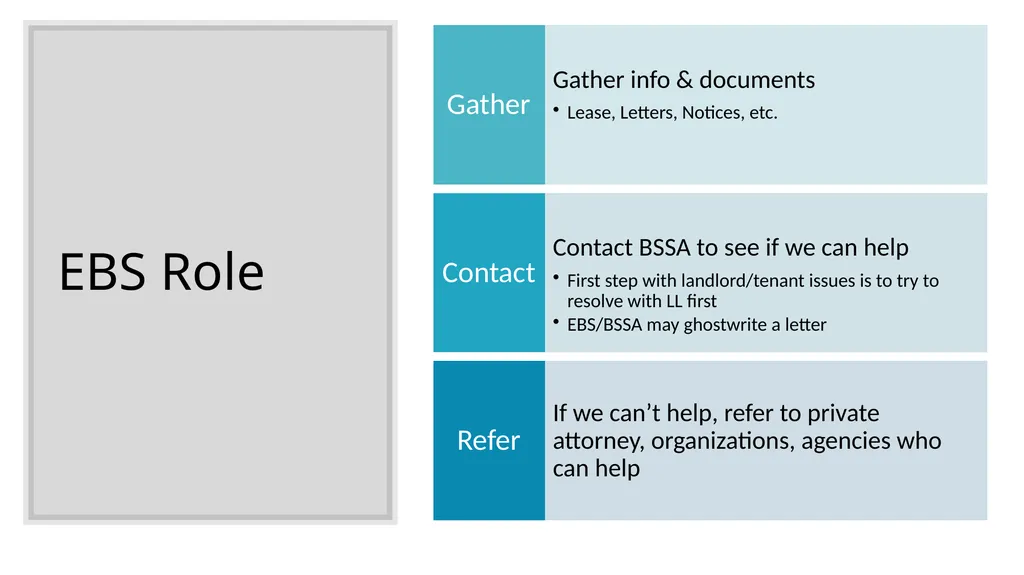
EBS Role<br>
04
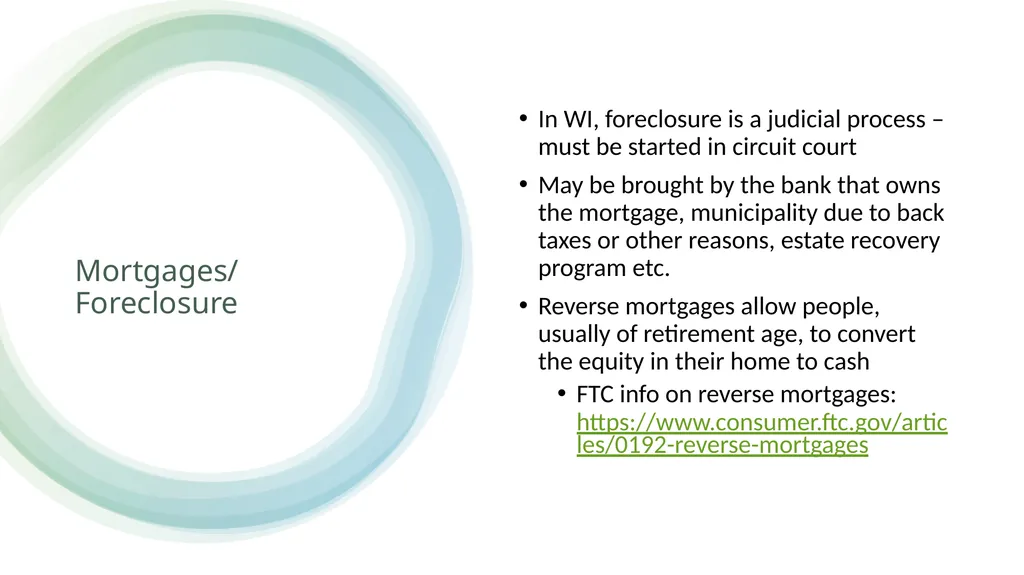
Mortgages/Foreclosure In WI, foreclosure is a judicial process – must be started in circuit court
May be brought by the bank that owns the mortgage, municipality due to back taxes or other reasons, estate recovery program etc.
Reverse mortgages allow people, usually of retirement age, to convert the equity in their home to cash
FTC info on reverse mortgages: https://www.consumer.ftc.gov/articles/0192-reverse-mortgages<br>
May be brought by the bank that owns the mortgage, municipality due to back taxes or other reasons, estate recovery program etc.
Reverse mortgages allow people, usually of retirement age, to convert the equity in their home to cash
FTC info on reverse mortgages: https://www.consumer.ftc.gov/articles/0192-reverse-mortgages<br>
05
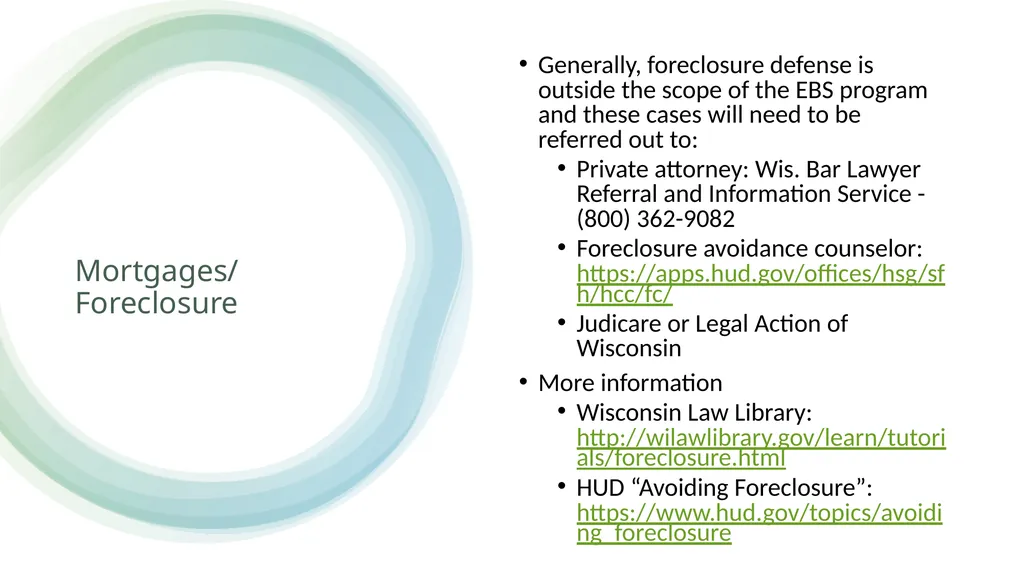
Mortgages/Foreclosure Generally, foreclosure defense is outside the scope of the EBS program and these cases will need to be referred out to:
Private attorney: Wis. Bar Lawyer Referral and Information Service - (800) 362-9082
Foreclosure avoidance counselor: https://apps.hud.gov/offices/hsg/sfh/hcc/fc/
Judicare or Legal Action of Wisconsin
More information
Wisconsin Law Library: http://wilawlibrary.gov/learn/tutorials/foreclosure.html
HUD “Avoiding Foreclosure”: https://www.hud.gov/topics/avoiding_foreclosure<br>
Private attorney: Wis. Bar Lawyer Referral and Information Service - (800) 362-9082
Foreclosure avoidance counselor: https://apps.hud.gov/offices/hsg/sfh/hcc/fc/
Judicare or Legal Action of Wisconsin
More information
Wisconsin Law Library: http://wilawlibrary.gov/learn/tutorials/foreclosure.html
HUD “Avoiding Foreclosure”: https://www.hud.gov/topics/avoiding_foreclosure<br>
06
Landlord/Tenant Issues “Law in action”
Important to remember that always an inherent imbalance in power relationship between landlord and tenant. I.e. landlord is most likely risking just unpaid rent; whereas, tenant is risking not having a place to live.
Law may provide protection to tenant but tenant may not want to risk enforcing a right. Important to lay out the pros and cons of enforcing a right and let the client decide.
E.g. client lives in a small town with few housing options. Wishes to file complaint against landlord with the housing authority.<br>
Important to remember that always an inherent imbalance in power relationship between landlord and tenant. I.e. landlord is most likely risking just unpaid rent; whereas, tenant is risking not having a place to live.
Law may provide protection to tenant but tenant may not want to risk enforcing a right. Important to lay out the pros and cons of enforcing a right and let the client decide.
E.g. client lives in a small town with few housing options. Wishes to file complaint against landlord with the housing authority.<br>
07
Landlord/Tenant Issues Wis. Stat. CHAPTER 704: https://docs.legis.wisconsin.gov/statutes/statutes/704/10/2
Chapter ATCP 134: https://docs.legis.wisconsin.gov/code/admin_code/atcp/090/134/06/1/a/1/
HUD: https://www.hud.gov/
Tenant Resource Center: https://www.tenantresourcecenter.org/
They also do statewide trainings that EBS sometimes attend<br>
Chapter ATCP 134: https://docs.legis.wisconsin.gov/code/admin_code/atcp/090/134/06/1/a/1/
HUD: https://www.hud.gov/
Tenant Resource Center: https://www.tenantresourcecenter.org/
They also do statewide trainings that EBS sometimes attend<br>
08
Landlord/Tenant Issues (Leases) For any landlord/tenant issue, first step is to get a copy of the lease
Most leases are for one year
LL/T may renew and sign a new lease each year, or
If lease expires it continues month-to-month
Same lease terms
Any NONSTANDARD RENTAL PROVISIONS must be on a separate piece of paper from the lease entitled "NONSTANDARD RENTAL PROVISIONS.“
Charging extra fees and allowing them to come out of security deposits, changing terms of LL entry, etc.<br>
Most leases are for one year
LL/T may renew and sign a new lease each year, or
If lease expires it continues month-to-month
Same lease terms
Any NONSTANDARD RENTAL PROVISIONS must be on a separate piece of paper from the lease entitled "NONSTANDARD RENTAL PROVISIONS.“
Charging extra fees and allowing them to come out of security deposits, changing terms of LL entry, etc.<br>
09
Landlord/Tenant Issues (Leases) 6 Ways to Get out of a Lease
Mutual Agreement to End: Agreement between landlord and tenant, should be in writing.
Constructive Eviction: If there is a serious health or safety issue and the landlord knows about it and has been given a reasonable time to fix it, or if it would cause an undue hardship on the tenant due to the timeline or nature of the repairs, a tenant may be able to move out and no longer be liable for lease responsibilities. See Wis. Stat. 704.07(4).
Servicemembers’ Civil Relief Act: Allows tenant to end a lease early if he/she enters into military service or receives military orders to change stations or deploy for 90 days or more.<br>
Mutual Agreement to End: Agreement between landlord and tenant, should be in writing.
Constructive Eviction: If there is a serious health or safety issue and the landlord knows about it and has been given a reasonable time to fix it, or if it would cause an undue hardship on the tenant due to the timeline or nature of the repairs, a tenant may be able to move out and no longer be liable for lease responsibilities. See Wis. Stat. 704.07(4).
Servicemembers’ Civil Relief Act: Allows tenant to end a lease early if he/she enters into military service or receives military orders to change stations or deploy for 90 days or more.<br>
10
Landlord/Tenant Issues (Leases) 6 Ways to Get out of a Lease (cont.)
Safe Housing Act: Victim of domestic violence, stalking, or child abuse can terminate lease if the victim feels imminent threat of physical harm by remaining on premises
Death of Tenant: lease is terminated 60 days after landlord has been informed of tenant’s death. The lease would still be valid for any remaining co-tenants (e.g., a living spouse who was named on the lease).
Illegal Lease Clauses: lease is considered void and unenforceable if it contains an illegal clause (e.g., a clause allowing for eviction without going through the court process)<br>
Safe Housing Act: Victim of domestic violence, stalking, or child abuse can terminate lease if the victim feels imminent threat of physical harm by remaining on premises
Death of Tenant: lease is terminated 60 days after landlord has been informed of tenant’s death. The lease would still be valid for any remaining co-tenants (e.g., a living spouse who was named on the lease).
Illegal Lease Clauses: lease is considered void and unenforceable if it contains an illegal clause (e.g., a clause allowing for eviction without going through the court process)<br>
11
Landlord/Tenant Issues (Leases) Breaking a Lease
Any tenant may break their lease but will be responsible for paying the rent through the end of the lease or until the apartment is re-rented, whichever is sooner
Tenant should send a letter to LL informing of their intent to break the lease and the date they will be moving out
LL has a duty to mitigate damages by taking reasonable steps to re-rent apartment<br>
Any tenant may break their lease but will be responsible for paying the rent through the end of the lease or until the apartment is re-rented, whichever is sooner
Tenant should send a letter to LL informing of their intent to break the lease and the date they will be moving out
LL has a duty to mitigate damages by taking reasonable steps to re-rent apartment<br>
12
Landlord/Tenant Issues (Security Deposits) Security Deposit “means the total of all payments and deposits given by a tenant to the landlord as security for the performance of the tenant's obligations, and includes all rent payments in excess of 1 month's prepaid rent.” ATCP 134.02(11)
Only thing LL can charge for at the time of lease that’s not considered security deposit or 1st month’s rent is actual cost of background/credit check (up to $25) and earnest money
Earnest money (sometimes called an application fee) must be returned if tenant is accepted and signs lease or if denied.
If accepted but tenant decides not to sign a lease, LL can deduct for actual cost of re-renting apartment<br>
Only thing LL can charge for at the time of lease that’s not considered security deposit or 1st month’s rent is actual cost of background/credit check (up to $25) and earnest money
Earnest money (sometimes called an application fee) must be returned if tenant is accepted and signs lease or if denied.
If accepted but tenant decides not to sign a lease, LL can deduct for actual cost of re-renting apartment<br>
13
Landlord/Tenant Issues (Security Deposits) Non-refundable fees or “deposits” are not allowed at the beginning of a lease
E.g. Non-refundable pet fee is not allowed but monthly pet rent is allowed
LL must return security deposit and/or itemized list of deductions within 21 days after lease end
LL can charge more above and beyond amount of security deposit (e.g. for extensive damages or several months back rent)
If not returned within 21 days, tenant may sue for double damages (usually small claims court)
But only double what the refund would be
Does not mean tenant entitled to full security deposit<br>
E.g. Non-refundable pet fee is not allowed but monthly pet rent is allowed
LL must return security deposit and/or itemized list of deductions within 21 days after lease end
LL can charge more above and beyond amount of security deposit (e.g. for extensive damages or several months back rent)
If not returned within 21 days, tenant may sue for double damages (usually small claims court)
But only double what the refund would be
Does not mean tenant entitled to full security deposit<br>
14
Landlord/Tenant Issues (Security Deposits) Deductions
LL CAN deduct for:
Unpaid rent
Unpaid utilities owed under the rental agreement, or for which the landlord becomes responsible
Damages caused by the tenant or their guests that go beyond "normal wear and tear"
Unpaid monthly municipal permit fees (mobile home parking fees)
Late fees and other types of costs ONLY if otherwise legal AND in NONSTANDARD RENTAL PROVISIONS in the lease
LL CANNOT deduct for normal wear and tear or carpet cleaning (unless beyond normal wear and tear)<br>
LL CAN deduct for:
Unpaid rent
Unpaid utilities owed under the rental agreement, or for which the landlord becomes responsible
Damages caused by the tenant or their guests that go beyond "normal wear and tear"
Unpaid monthly municipal permit fees (mobile home parking fees)
Late fees and other types of costs ONLY if otherwise legal AND in NONSTANDARD RENTAL PROVISIONS in the lease
LL CANNOT deduct for normal wear and tear or carpet cleaning (unless beyond normal wear and tear)<br>
15
Landlord/Tenant Issues (Repairs & Safety Concerns) Make a list to give to landlord, keep a paper trail of requests, and document the problem.
Repairs to fixtures, appliances, or other household items that came with rental unit, as well as common areas, are responsibility of landlord.
If landlord fails to make repairs, contact building inspector
List of building inspectors in WI (bottom of page): https://www.tenantresourcecenter.org/repairs_in_wisconsin<br>
Repairs to fixtures, appliances, or other household items that came with rental unit, as well as common areas, are responsibility of landlord.
If landlord fails to make repairs, contact building inspector
List of building inspectors in WI (bottom of page): https://www.tenantresourcecenter.org/repairs_in_wisconsin<br>
16
Landlord/Tenant Issues (Repairs & Safety Concerns) If apartment becomes uninhabitable because of fire, water, or other casualty or something impacts health or safety of tenant, tenant can:
Rent abatement
Partial rent credit/withholding when the landlord won't fix an issue that "materially affects the health or safety of the tenant" or "substantially affects the use or occupancy" of the unit.
Some municipalities have a formal process for this
Very risky because still risking eviction for non-payment of rent
Constructive eviction (tenant moves out and is no longer responsible for lease)
There must be a severe health or safety hazard; and
The tenant must give the landlord a reasonable amount of time to repair the problem; and
If it is not repaired (or the repair is so extreme that it will impose "undue hardship" on the tenant) the tenant may constructively evict.<br>
Rent abatement
Partial rent credit/withholding when the landlord won't fix an issue that "materially affects the health or safety of the tenant" or "substantially affects the use or occupancy" of the unit.
Some municipalities have a formal process for this
Very risky because still risking eviction for non-payment of rent
Constructive eviction (tenant moves out and is no longer responsible for lease)
There must be a severe health or safety hazard; and
The tenant must give the landlord a reasonable amount of time to repair the problem; and
If it is not repaired (or the repair is so extreme that it will impose "undue hardship" on the tenant) the tenant may constructively evict.<br>
17
Landlord/Tenant Issues (Landlord Entry) Tenant has "exclusive possession" (i.e. it's only theirs) except when the landlord gives advance notice to come in at "reasonable times" to "inspect the premises, make repairs and show the premises to prospective tenants or purchasers."
A landlord must give the tenant a 12 hour notice before entering
May be email, text, phone, in-person verbally etc.
Notice does not actually have to be received (e.g. notice slipped under door but tenant on vacation)<br>
A landlord must give the tenant a 12 hour notice before entering
May be email, text, phone, in-person verbally etc.
Notice does not actually have to be received (e.g. notice slipped under door but tenant on vacation)<br>
18
Landlord/Tenant Issues (Reasonable Accommodations for Individuals with Disabilities) Americans with Disabilities Act (ADA) - civil rights law put in place to protect people with disabilities in all areas of public and private life.
Fair Housing Act: Protects classes of people from housing discrimination based on race, color, disability, religion, sex, familial status, or national origin https://www.hud.gov/program_offices/fair_housing_equal_opp/fair_housing_act_overview
Requires LL make reasonable accommodations for people with disabilities (most common issue we see)
However, we will address other types of discrimination if they arise or refer to a private attorney<br>
Fair Housing Act: Protects classes of people from housing discrimination based on race, color, disability, religion, sex, familial status, or national origin https://www.hud.gov/program_offices/fair_housing_equal_opp/fair_housing_act_overview
Requires LL make reasonable accommodations for people with disabilities (most common issue we see)
However, we will address other types of discrimination if they arise or refer to a private attorney<br>
19
Landlord/Tenant Issues (Reasonable Accommodations for Individuals with Disabilities) Service animal vs. emotional support animal
Service animal
Trained to preform specific task
Protected under ADA
Dogs or Miniature horses (lil’ Sebastian)
Must be allowed in all common areas
Emotional support animal
May be a reasonable accommodation for a person with a disability if verified by health professional
Can be any type of animal
LL can restrict access to only that person’s unit (not allowed in common areas)
For both, Must be allowed even in buildings or units with policies against pets
For both, LL may not charge extra rent or fees, however, tenant may be responsible for ACTUAL damages caused by animal<br>
Service animal
Trained to preform specific task
Protected under ADA
Dogs or Miniature horses (lil’ Sebastian)
Must be allowed in all common areas
Emotional support animal
May be a reasonable accommodation for a person with a disability if verified by health professional
Can be any type of animal
LL can restrict access to only that person’s unit (not allowed in common areas)
For both, Must be allowed even in buildings or units with policies against pets
For both, LL may not charge extra rent or fees, however, tenant may be responsible for ACTUAL damages caused by animal<br>
20
Landlord/Tenant Issues (Reasonable Accommodations for Individuals with Disabilities) Other examples of reasonable accommodations
Installing grab bars in shower
Tenant must pay for the modification and also must pay to have the apartment restored back
Mail rent check instead of handing in
If on SSDI and check comes on the 3rd of each month, may be a reasonable accommodation to allow rent due on the 3rd instead of the 1st
If person has mobility issues, may request extended time to move out, even in an eviction case
Request a move to a unit on the 1st floor<br>
Installing grab bars in shower
Tenant must pay for the modification and also must pay to have the apartment restored back
Mail rent check instead of handing in
If on SSDI and check comes on the 3rd of each month, may be a reasonable accommodation to allow rent due on the 3rd instead of the 1st
If person has mobility issues, may request extended time to move out, even in an eviction case
Request a move to a unit on the 1st floor<br>
21
Landlord/Tenant Issues (Evictions) An eviction can be legal or illegal (a.k.a. “self-help” eviction)
For an eviction to be legal, the landlord must follow all the laws and procedures
Lease violation
Notice requirements
Small claims procedures (Wis. Stat. 799)<br>
For an eviction to be legal, the landlord must follow all the laws and procedures
Lease violation
Notice requirements
Small claims procedures (Wis. Stat. 799)<br>
22
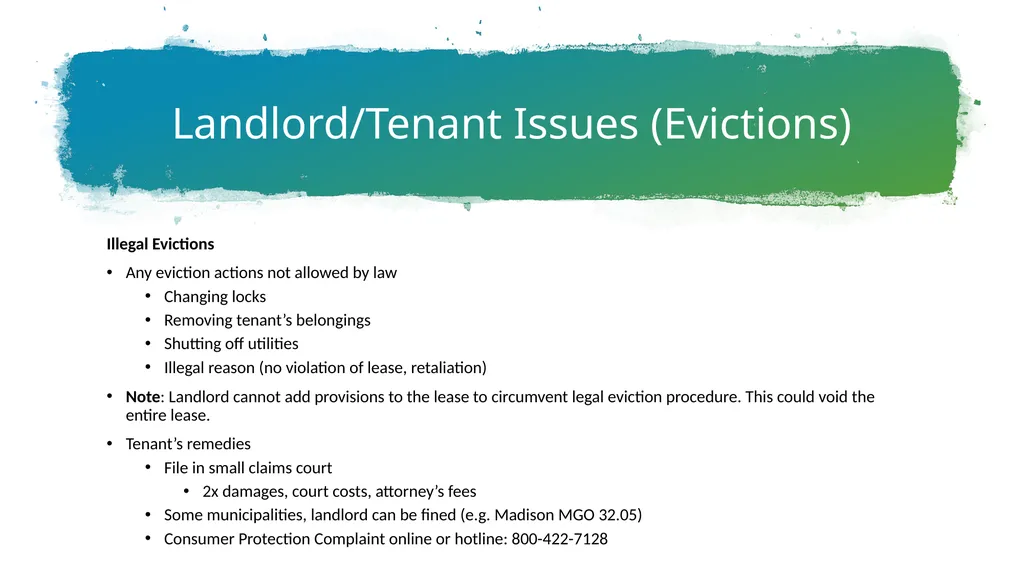
Landlord/Tenant Issues (Evictions) Illegal Evictions
Any eviction actions not allowed by law
Changing locks
Removing tenant’s belongings
Shutting off utilities
Illegal reason (no violation of lease, retaliation)
Note: Landlord cannot add provisions to the lease to circumvent legal eviction procedure. This could void the entire lease.
Tenant’s remedies
File in small claims court
2x damages, court costs, attorney’s fees
Some municipalities, landlord can be fined (e.g. Madison MGO 32.05)
Consumer Protection Complaint online or hotline: 800-422-7128<br>
Any eviction actions not allowed by law
Changing locks
Removing tenant’s belongings
Shutting off utilities
Illegal reason (no violation of lease, retaliation)
Note: Landlord cannot add provisions to the lease to circumvent legal eviction procedure. This could void the entire lease.
Tenant’s remedies
File in small claims court
2x damages, court costs, attorney’s fees
Some municipalities, landlord can be fined (e.g. Madison MGO 32.05)
Consumer Protection Complaint online or hotline: 800-422-7128<br>
23
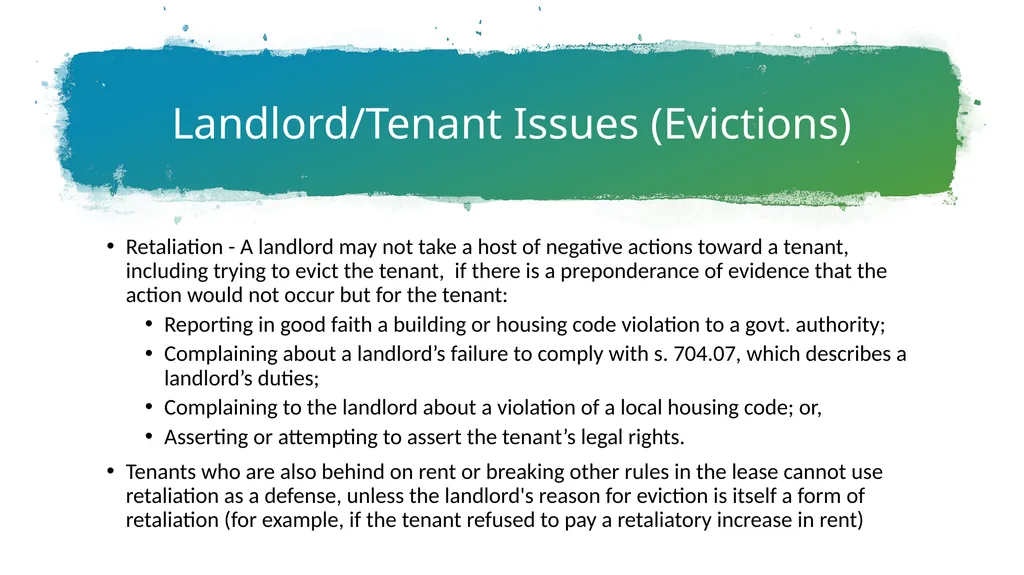
Landlord/Tenant Issues (Evictions) Retaliation - A landlord may not take a host of negative actions toward a tenant, including trying to evict the tenant, if there is a preponderance of evidence that the action would not occur but for the tenant:
Reporting in good faith a building or housing code violation to a govt. authority;
Complaining about a landlord’s failure to comply with s. 704.07, which describes a landlord’s duties;
Complaining to the landlord about a violation of a local housing code; or,
Asserting or attempting to assert the tenant’s legal rights.
Tenants who are also behind on rent or breaking other rules in the lease cannot use retaliation as a defense, unless the landlord's reason for eviction is itself a form of retaliation (for example, if the tenant refused to pay a retaliatory increase in rent)<br>
Reporting in good faith a building or housing code violation to a govt. authority;
Complaining about a landlord’s failure to comply with s. 704.07, which describes a landlord’s duties;
Complaining to the landlord about a violation of a local housing code; or,
Asserting or attempting to assert the tenant’s legal rights.
Tenants who are also behind on rent or breaking other rules in the lease cannot use retaliation as a defense, unless the landlord's reason for eviction is itself a form of retaliation (for example, if the tenant refused to pay a retaliatory increase in rent)<br>
24
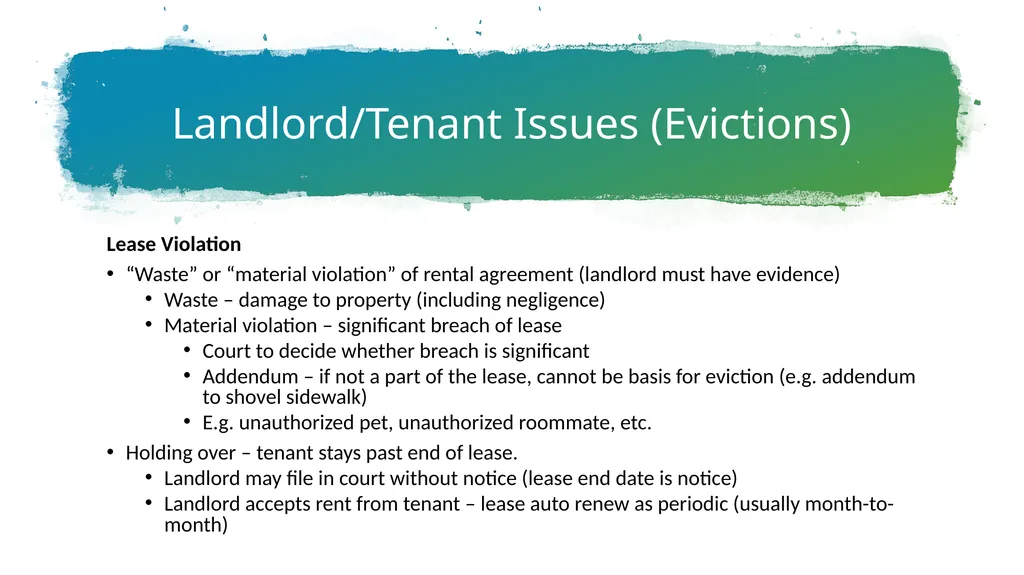
Landlord/Tenant Issues (Evictions) Lease Violation
“Waste” or “material violation” of rental agreement (landlord must have evidence)
Waste – damage to property (including negligence)
Material violation – significant breach of lease
Court to decide whether breach is significant
Addendum – if not a part of the lease, cannot be basis for eviction (e.g. addendum to shovel sidewalk)
E.g. unauthorized pet, unauthorized roommate, etc.
Holding over – tenant stays past end of lease.
Landlord may file in court without notice (lease end date is notice)
Landlord accepts rent from tenant – lease auto renew as periodic (usually month-to-month)<br>
“Waste” or “material violation” of rental agreement (landlord must have evidence)
Waste – damage to property (including negligence)
Material violation – significant breach of lease
Court to decide whether breach is significant
Addendum – if not a part of the lease, cannot be basis for eviction (e.g. addendum to shovel sidewalk)
E.g. unauthorized pet, unauthorized roommate, etc.
Holding over – tenant stays past end of lease.
Landlord may file in court without notice (lease end date is notice)
Landlord accepts rent from tenant – lease auto renew as periodic (usually month-to-month)<br>
25
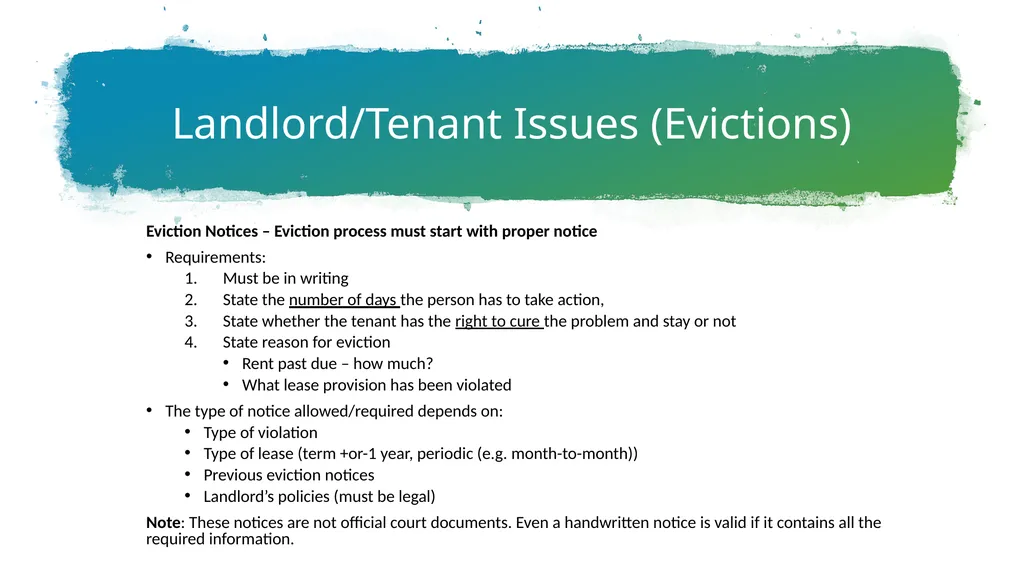
Landlord/Tenant Issues (Evictions) Eviction Notices – Eviction process must start with proper notice
Requirements:
Must be in writing
State the number of days the person has to take action,
State whether the tenant has the right to cure the problem and stay or not
State reason for eviction
Rent past due – how much?
What lease provision has been violated
The type of notice allowed/required depends on:
Type of violation
Type of lease (term +or-1 year, periodic (e.g. month-to-month))
Previous eviction notices
Landlord’s policies (must be legal)
Note: These notices are not official court documents. Even a handwritten notice is valid if it contains all the required information.<br>
Requirements:
Must be in writing
State the number of days the person has to take action,
State whether the tenant has the right to cure the problem and stay or not
State reason for eviction
Rent past due – how much?
What lease provision has been violated
The type of notice allowed/required depends on:
Type of violation
Type of lease (term +or-1 year, periodic (e.g. month-to-month))
Previous eviction notices
Landlord’s policies (must be legal)
Note: These notices are not official court documents. Even a handwritten notice is valid if it contains all the required information.<br>
26
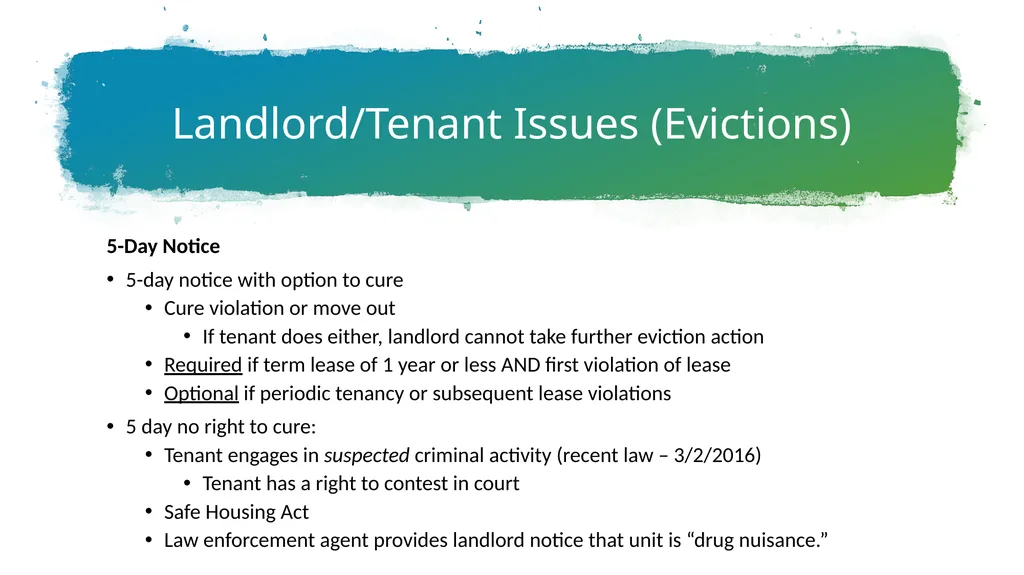
Landlord/Tenant Issues (Evictions) 5-Day Notice
5-day notice with option to cure
Cure violation or move out
If tenant does either, landlord cannot take further eviction action
Required if term lease of 1 year or less AND first violation of lease
Optional if periodic tenancy or subsequent lease violations
5 day no right to cure:
Tenant engages in suspected criminal activity (recent law – 3/2/2016)
Tenant has a right to contest in court
Safe Housing Act
Law enforcement agent provides landlord notice that unit is “drug nuisance.”<br>
5-day notice with option to cure
Cure violation or move out
If tenant does either, landlord cannot take further eviction action
Required if term lease of 1 year or less AND first violation of lease
Optional if periodic tenancy or subsequent lease violations
5 day no right to cure:
Tenant engages in suspected criminal activity (recent law – 3/2/2016)
Tenant has a right to contest in court
Safe Housing Act
Law enforcement agent provides landlord notice that unit is “drug nuisance.”<br>
27
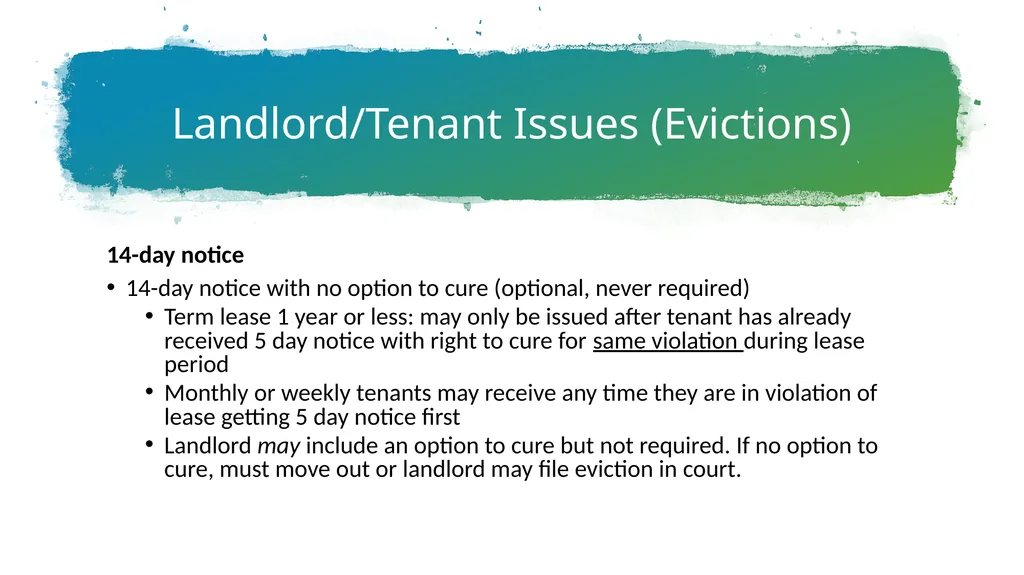
Landlord/Tenant Issues (Evictions) 14-day notice
14-day notice with no option to cure (optional, never required)
Term lease 1 year or less: may only be issued after tenant has already received 5 day notice with right to cure for same violation during lease period
Monthly or weekly tenants may receive any time they are in violation of lease getting 5 day notice first
Landlord may include an option to cure but not required. If no option to cure, must move out or landlord may file eviction in court.<br>
14-day notice with no option to cure (optional, never required)
Term lease 1 year or less: may only be issued after tenant has already received 5 day notice with right to cure for same violation during lease period
Monthly or weekly tenants may receive any time they are in violation of lease getting 5 day notice first
Landlord may include an option to cure but not required. If no option to cure, must move out or landlord may file eviction in court.<br>
28
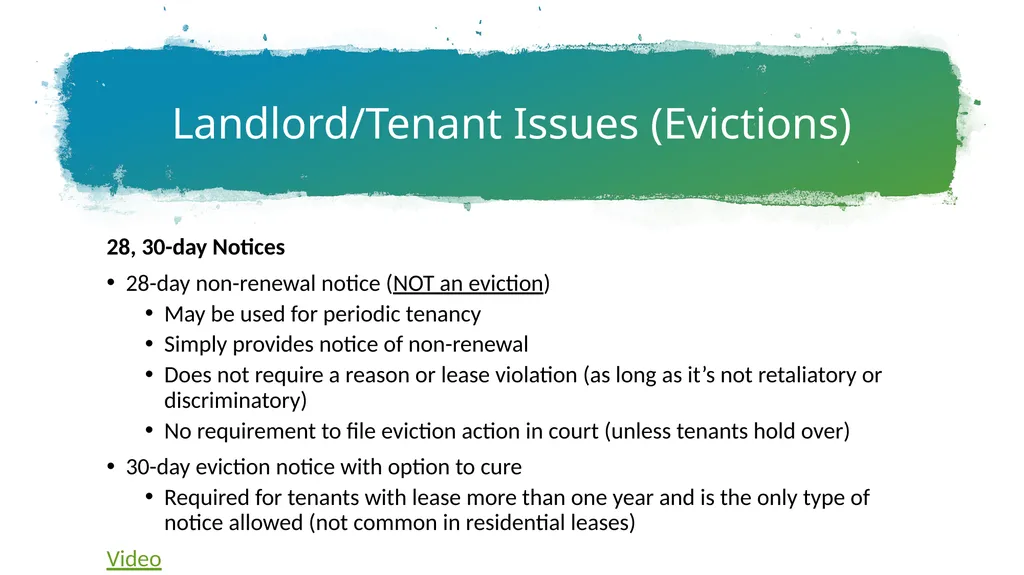
Landlord/Tenant Issues (Evictions) 28, 30-day Notices
28-day non-renewal notice (NOT an eviction)
May be used for periodic tenancy
Simply provides notice of non-renewal
Does not require a reason or lease violation (as long as it’s not retaliatory or discriminatory)
No requirement to file eviction action in court (unless tenants hold over)
30-day eviction notice with option to cure
Required for tenants with lease more than one year and is the only type of notice allowed (not common in residential leases)
Video<br>
28-day non-renewal notice (NOT an eviction)
May be used for periodic tenancy
Simply provides notice of non-renewal
Does not require a reason or lease violation (as long as it’s not retaliatory or discriminatory)
No requirement to file eviction action in court (unless tenants hold over)
30-day eviction notice with option to cure
Required for tenants with lease more than one year and is the only type of notice allowed (not common in residential leases)
Video<br>
29
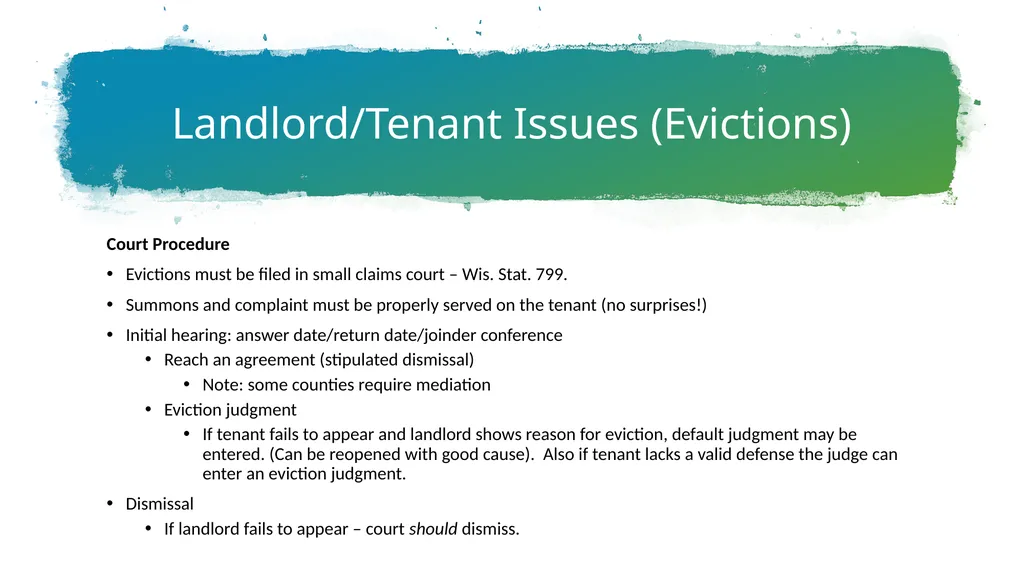
Landlord/Tenant Issues (Evictions) Court Procedure
Evictions must be filed in small claims court – Wis. Stat. 799.
Summons and complaint must be properly served on the tenant (no surprises!)
Initial hearing: answer date/return date/joinder conference
Reach an agreement (stipulated dismissal)
Note: some counties require mediation
Eviction judgment
If tenant fails to appear and landlord shows reason for eviction, default judgment may be entered. (Can be reopened with good cause). Also if tenant lacks a valid defense the judge can enter an eviction judgment.
Dismissal
If landlord fails to appear – court should dismiss.<br>
Evictions must be filed in small claims court – Wis. Stat. 799.
Summons and complaint must be properly served on the tenant (no surprises!)
Initial hearing: answer date/return date/joinder conference
Reach an agreement (stipulated dismissal)
Note: some counties require mediation
Eviction judgment
If tenant fails to appear and landlord shows reason for eviction, default judgment may be entered. (Can be reopened with good cause). Also if tenant lacks a valid defense the judge can enter an eviction judgment.
Dismissal
If landlord fails to appear – court should dismiss.<br>
30
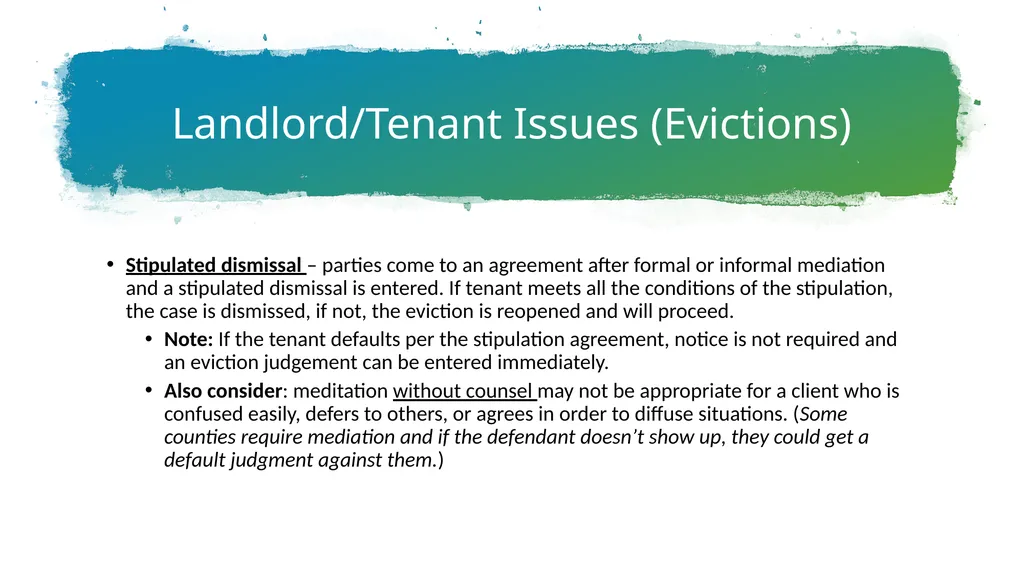
Landlord/Tenant Issues (Evictions) Stipulated dismissal – parties come to an agreement after formal or informal mediation and a stipulated dismissal is entered. If tenant meets all the conditions of the stipulation, the case is dismissed, if not, the eviction is reopened and will proceed.
Note: If the tenant defaults per the stipulation agreement, notice is not required and an eviction judgement can be entered immediately.
Also consider: meditation without counsel may not be appropriate for a client who is confused easily, defers to others, or agrees in order to diffuse situations. (Some counties require mediation and if the defendant doesn’t show up, they could get a default judgment against them.)<br>
Note: If the tenant defaults per the stipulation agreement, notice is not required and an eviction judgement can be entered immediately.
Also consider: meditation without counsel may not be appropriate for a client who is confused easily, defers to others, or agrees in order to diffuse situations. (Some counties require mediation and if the defendant doesn’t show up, they could get a default judgment against them.)<br>
31
Landlord/Tenant Issues (Evictions) Trial – if either party disagrees and raises a valid legal grounds for a trial at the initial hearing
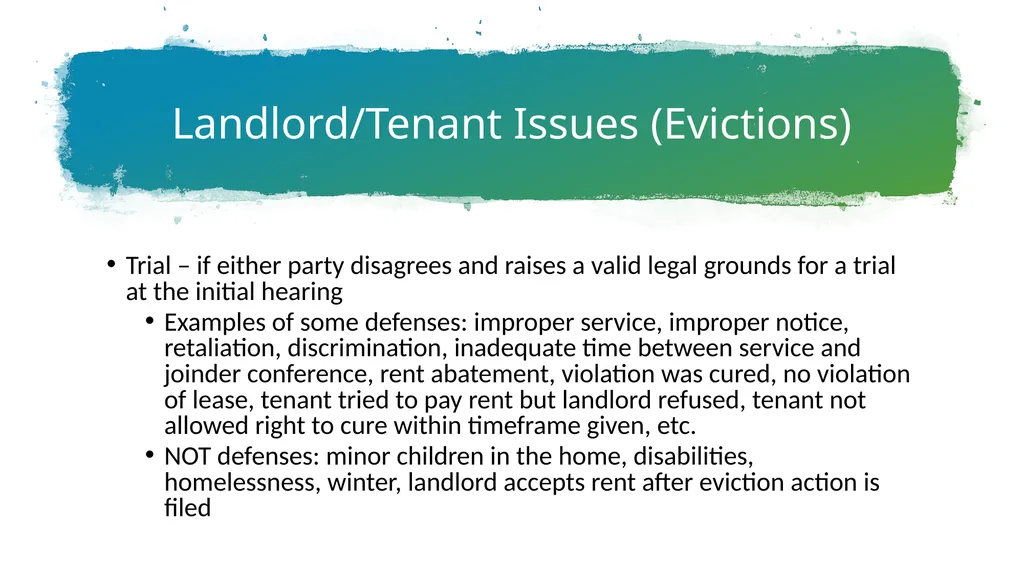
Examples of some defenses: improper service, improper notice, retaliation, discrimination, inadequate time between service and joinder conference, rent abatement, violation was cured, no violation of lease, tenant tried to pay rent but landlord refused, tenant not allowed right to cure within timeframe given, etc.
NOT defenses: minor children in the home, disabilities, homelessness, winter, landlord accepts rent after eviction action is filed<br>
Examples of some defenses: improper service, improper notice, retaliation, discrimination, inadequate time between service and joinder conference, rent abatement, violation was cured, no violation of lease, tenant tried to pay rent but landlord refused, tenant not allowed right to cure within timeframe given, etc.
NOT defenses: minor children in the home, disabilities, homelessness, winter, landlord accepts rent after eviction action is filed<br>
32
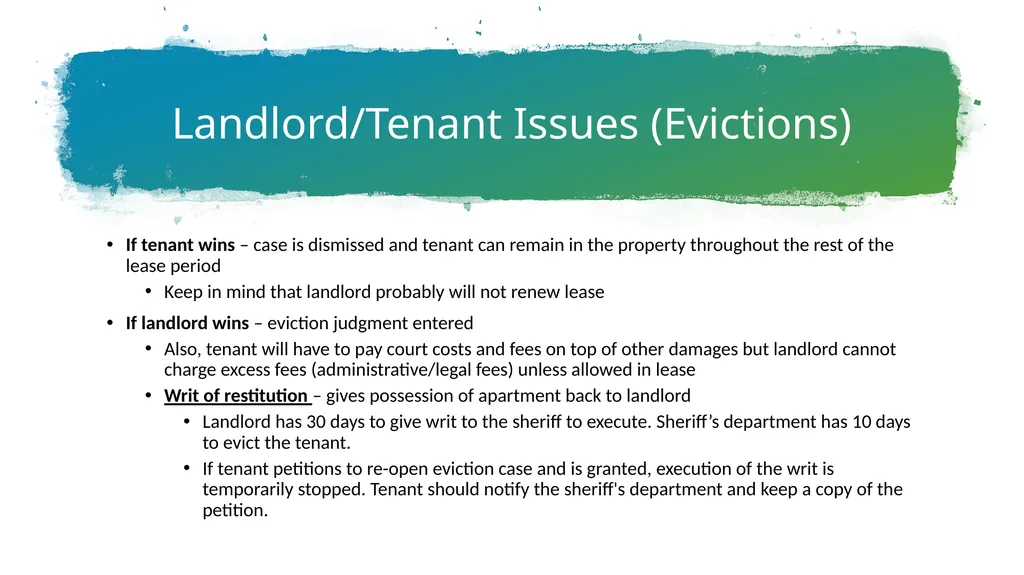
Landlord/Tenant Issues (Evictions) If tenant wins – case is dismissed and tenant can remain in the property throughout the rest of the lease period
Keep in mind that landlord probably will not renew lease
If landlord wins – eviction judgment entered
Also, tenant will have to pay court costs and fees on top of other damages but landlord cannot charge excess fees (administrative/legal fees) unless allowed in lease
Writ of restitution – gives possession of apartment back to landlord
Landlord has 30 days to give writ to the sheriff to execute. Sheriff’s department has 10 days to evict the tenant.
If tenant petitions to re-open eviction case and is granted, execution of the writ is temporarily stopped. Tenant should notify the sheriff's department and keep a copy of the petition.<br>
Keep in mind that landlord probably will not renew lease
If landlord wins – eviction judgment entered
Also, tenant will have to pay court costs and fees on top of other damages but landlord cannot charge excess fees (administrative/legal fees) unless allowed in lease
Writ of restitution – gives possession of apartment back to landlord
Landlord has 30 days to give writ to the sheriff to execute. Sheriff’s department has 10 days to evict the tenant.
If tenant petitions to re-open eviction case and is granted, execution of the writ is temporarily stopped. Tenant should notify the sheriff's department and keep a copy of the petition.<br>
33
Landlord/Tenant Issues (Evictions) Property left behind
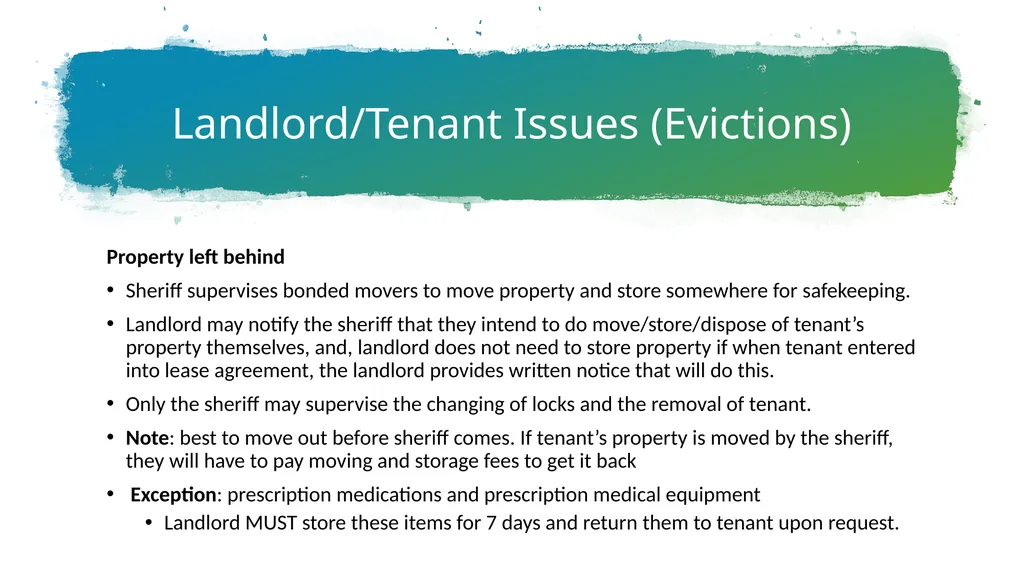
Sheriff supervises bonded movers to move property and store somewhere for safekeeping.
Landlord may notify the sheriff that they intend to do move/store/dispose of tenant’s property themselves, and, landlord does not need to store property if when tenant entered into lease agreement, the landlord provides written notice that will do this.
Only the sheriff may supervise the changing of locks and the removal of tenant.
Note: best to move out before sheriff comes. If tenant’s property is moved by the sheriff, they will have to pay moving and storage fees to get it back
Exception: prescription medications and prescription medical equipment
Landlord MUST store these items for 7 days and return them to tenant upon request.<br>
Sheriff supervises bonded movers to move property and store somewhere for safekeeping.
Landlord may notify the sheriff that they intend to do move/store/dispose of tenant’s property themselves, and, landlord does not need to store property if when tenant entered into lease agreement, the landlord provides written notice that will do this.
Only the sheriff may supervise the changing of locks and the removal of tenant.
Note: best to move out before sheriff comes. If tenant’s property is moved by the sheriff, they will have to pay moving and storage fees to get it back
Exception: prescription medications and prescription medical equipment
Landlord MUST store these items for 7 days and return them to tenant upon request.<br>
34
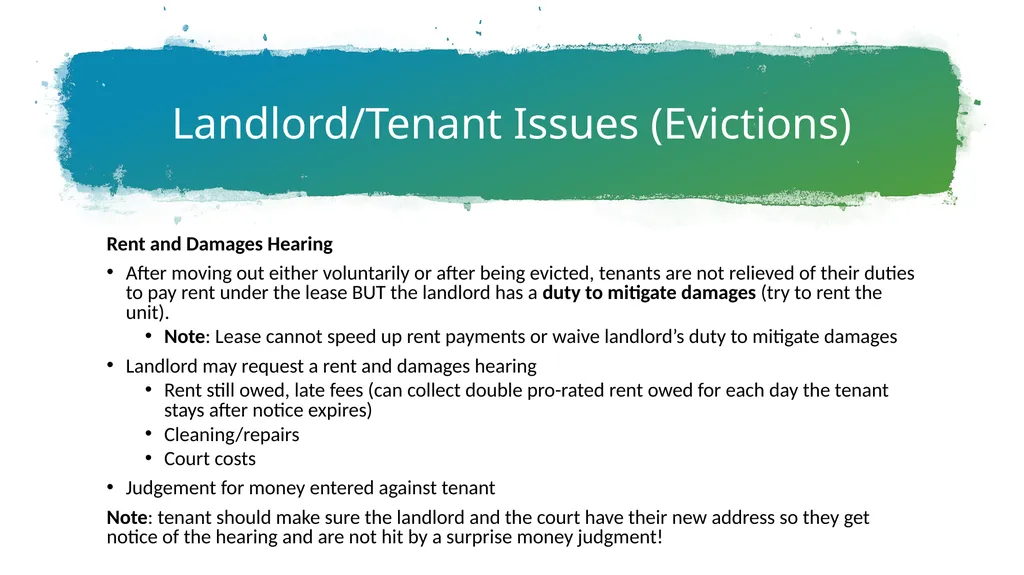
Landlord/Tenant Issues (Evictions) Rent and Damages Hearing
After moving out either voluntarily or after being evicted, tenants are not relieved of their duties to pay rent under the lease BUT the landlord has a duty to mitigate damages (try to rent the unit).
Note: Lease cannot speed up rent payments or waive landlord’s duty to mitigate damages
Landlord may request a rent and damages hearing
Rent still owed, late fees (can collect double pro-rated rent owed for each day the tenant stays after notice expires)
Cleaning/repairs
Court costs
Judgement for money entered against tenant
Note: tenant should make sure the landlord and the court have their new address so they get notice of the hearing and are not hit by a surprise money judgment!<br>
After moving out either voluntarily or after being evicted, tenants are not relieved of their duties to pay rent under the lease BUT the landlord has a duty to mitigate damages (try to rent the unit).
Note: Lease cannot speed up rent payments or waive landlord’s duty to mitigate damages
Landlord may request a rent and damages hearing
Rent still owed, late fees (can collect double pro-rated rent owed for each day the tenant stays after notice expires)
Cleaning/repairs
Court costs
Judgement for money entered against tenant
Note: tenant should make sure the landlord and the court have their new address so they get notice of the hearing and are not hit by a surprise money judgment!<br>
35
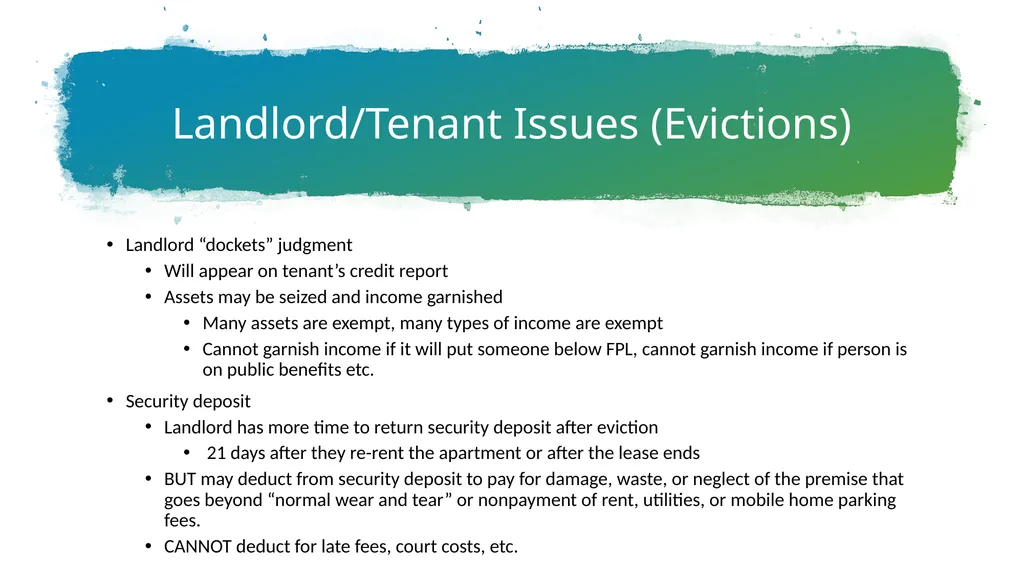
Landlord/Tenant Issues (Evictions) Landlord “dockets” judgment
Will appear on tenant’s credit report
Assets may be seized and income garnished
Many assets are exempt, many types of income are exempt
Cannot garnish income if it will put someone below FPL, cannot garnish income if person is on public benefits etc.
Security deposit
Landlord has more time to return security deposit after eviction
21 days after they re-rent the apartment or after the lease ends
BUT may deduct from security deposit to pay for damage, waste, or neglect of the premise that goes beyond “normal wear and tear” or nonpayment of rent, utilities, or mobile home parking fees.
CANNOT deduct for late fees, court costs, etc.<br>
Will appear on tenant’s credit report
Assets may be seized and income garnished
Many assets are exempt, many types of income are exempt
Cannot garnish income if it will put someone below FPL, cannot garnish income if person is on public benefits etc.
Security deposit
Landlord has more time to return security deposit after eviction
21 days after they re-rent the apartment or after the lease ends
BUT may deduct from security deposit to pay for damage, waste, or neglect of the premise that goes beyond “normal wear and tear” or nonpayment of rent, utilities, or mobile home parking fees.
CANNOT deduct for late fees, court costs, etc.<br>
36
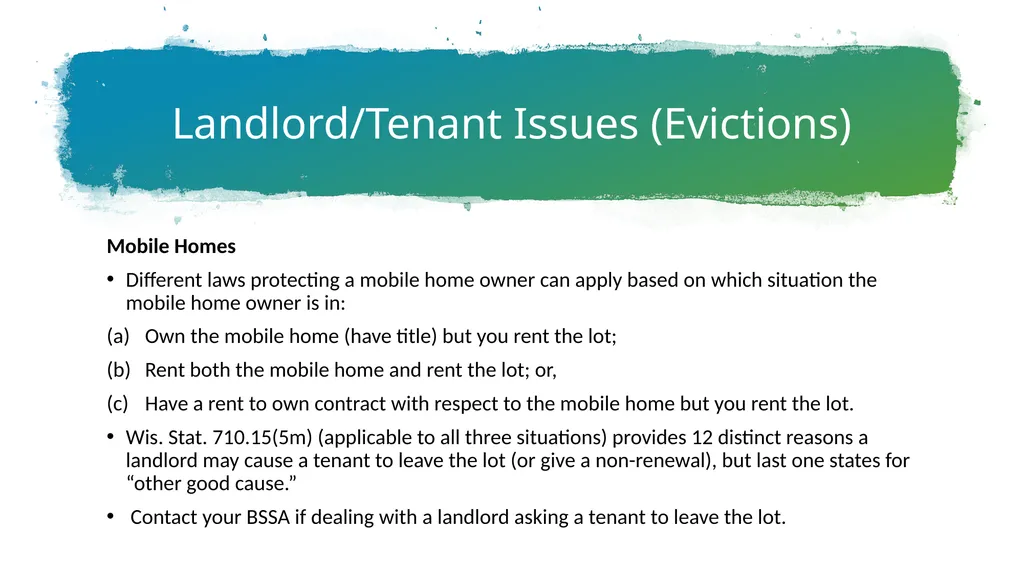
Landlord/Tenant Issues (Evictions) Mobile Homes
Different laws protecting a mobile home owner can apply based on which situation the mobile home owner is in:
Own the mobile home (have title) but you rent the lot;
Rent both the mobile home and rent the lot; or,
Have a rent to own contract with respect to the mobile home but you rent the lot.
Wis. Stat. 710.15(5m) (applicable to all three situations) provides 12 distinct reasons a landlord may cause a tenant to leave the lot (or give a non-renewal), but last one states for “other good cause.”
Contact your BSSA if dealing with a landlord asking a tenant to leave the lot.<br>
Different laws protecting a mobile home owner can apply based on which situation the mobile home owner is in:
Own the mobile home (have title) but you rent the lot;
Rent both the mobile home and rent the lot; or,
Have a rent to own contract with respect to the mobile home but you rent the lot.
Wis. Stat. 710.15(5m) (applicable to all three situations) provides 12 distinct reasons a landlord may cause a tenant to leave the lot (or give a non-renewal), but last one states for “other good cause.”
Contact your BSSA if dealing with a landlord asking a tenant to leave the lot.<br>
37
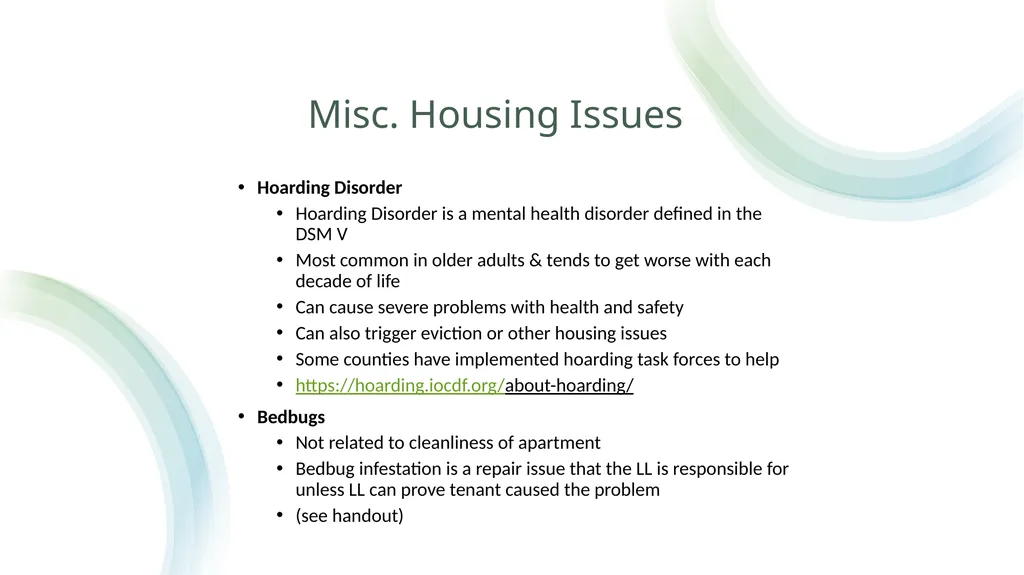
Misc. Housing Issues Hoarding Disorder
Hoarding Disorder is a mental health disorder defined in the DSM V
Most common in older adults & tends to get worse with each decade of life
Can cause severe problems with health and safety
Can also trigger eviction or other housing issues
Some counties have implemented hoarding task forces to help
https://hoarding.iocdf.org/about-hoarding/
Bedbugs
Not related to cleanliness of apartment
Bedbug infestation is a repair issue that the LL is responsible for unless LL can prove tenant caused the problem
(see handout)<br>
Hoarding Disorder is a mental health disorder defined in the DSM V
Most common in older adults & tends to get worse with each decade of life
Can cause severe problems with health and safety
Can also trigger eviction or other housing issues
Some counties have implemented hoarding task forces to help
https://hoarding.iocdf.org/about-hoarding/
Bedbugs
Not related to cleanliness of apartment
Bedbug infestation is a repair issue that the LL is responsible for unless LL can prove tenant caused the problem
(see handout)<br>
38
Subsidized Housing Public Housing
Affordable apartments for low-income families, elderly, and persons with disabilities
Housing Choice Voucher Program (Section 8)
Find your own place and use the voucher to pay for part of the rent
Privately Owned Subsidized Housing
HUD helps apartment owners offer reduced rent to low-income tenants<br>
Affordable apartments for low-income families, elderly, and persons with disabilities
Housing Choice Voucher Program (Section 8)
Find your own place and use the voucher to pay for part of the rent
Privately Owned Subsidized Housing
HUD helps apartment owners offer reduced rent to low-income tenants<br>
39
Subsidized Housing Section 8
Tenant-based rental assistance
Owners/Landlords must have their property inspected by local PHA to participate
Tenant will pay approximately 30-40% of their monthly income towards rent. Section 8 will subsidize the rest.
Vouchers are administered locally by PHA and WHEDA<br>
Tenant-based rental assistance
Owners/Landlords must have their property inspected by local PHA to participate
Tenant will pay approximately 30-40% of their monthly income towards rent. Section 8 will subsidize the rest.
Vouchers are administered locally by PHA and WHEDA<br>
40
Subsidized Housing Section 8
Determined locally by PHA based on gross income, family size and is limited to US citizens and specified categories of non-citizens
In general, family’s income may not exceed 50% of median income of locale. By law, PHA must provide 75% of its vouchers to applicants whose income does not exceed 30%
Limited number of vouchers – applicants may be placed on waitlists
HUD income data: http://www.huduser.org/portal/datasets/il/il2014/select_Geography.odn
Public Housing Authorities (PUA) in WI: https://www.hud.gov/states/wisconsin/renting/hawebsites<br>
Determined locally by PHA based on gross income, family size and is limited to US citizens and specified categories of non-citizens
In general, family’s income may not exceed 50% of median income of locale. By law, PHA must provide 75% of its vouchers to applicants whose income does not exceed 30%
Limited number of vouchers – applicants may be placed on waitlists
HUD income data: http://www.huduser.org/portal/datasets/il/il2014/select_Geography.odn
Public Housing Authorities (PUA) in WI: https://www.hud.gov/states/wisconsin/renting/hawebsites<br>
41
Subsidized Housing Section 8
Terminating Sec. 8 housing assistance occurs when a tenant is no longer eligible for subsidy or to enforce HUD program requirements.
Terminating assistance must be based only on a change in tenant’s eligibility or failure to fulfill specific responsibilities of the program (completing certain documentation or eviction).
Tenant may request a hearing to contest termination.
If housing assistance ended, tenant may remain in housing but must pay full rent.<br>
Terminating Sec. 8 housing assistance occurs when a tenant is no longer eligible for subsidy or to enforce HUD program requirements.
Terminating assistance must be based only on a change in tenant’s eligibility or failure to fulfill specific responsibilities of the program (completing certain documentation or eviction).
Tenant may request a hearing to contest termination.
If housing assistance ended, tenant may remain in housing but must pay full rent.<br>
42
Case Studies A 66-year-old woman comes to you with an eviction notice. She states that she has lived in her apartment for over 5 years and was never late with rent. However, 6 months ago, she was approved for the Section 8 voucher program. She was confused about how much she was to pay the LL vs. how much Section 8 was to pay and made checks out for the wrong amount. She tried correcting this issue with her LL but the LL never returned her phone calls. The late fees piled up and the LL gave her an eviction notice for non-payment of rent.
Does she have any defenses to the eviction?
Will she lose her Section 8 voucher?<br>
Does she have any defenses to the eviction?
Will she lose her Section 8 voucher?<br>
43
Case Studies An 88-year-old woman and her husband rented a duplex from a private landlord. When her husband died, she moved in to a nursing home. Her daughters helped her move out and took pictures of the apartment after professional cleaning. The LL never returned the client’s security deposit and never sent an itemized list of deductions. Via text, she told the client’s daughter that she wasn’t returning the security deposit because the carpet was dirty, the shelves were broken, and that the client “stole” a washer and dryer.
What additional information should you get from the client?
What are the client’s options?<br>
What additional information should you get from the client?
What are the client’s options?<br>
44
Case Studies A 70-year old couple comes to you stating that they have 2 dogs. They state that they had to pay a non-refundable pet fee/deposit at the beginning of their lease and that they have to pay $25/pet extra rent per month. They state that they are having a hard time affording this, but they cannot get rid of their dogs because the dogs are a source of comfort for the husband who suffers from PTSD and depression and for the wife who has anxiety/panic disorder.
What options do these clients have to reduce the monthly pet fees they’re charged?
What about the non-refundable pet fee/deposit?
What if the dogs cause damage to the apartment?<br>
What options do these clients have to reduce the monthly pet fees they’re charged?
What about the non-refundable pet fee/deposit?
What if the dogs cause damage to the apartment?<br>
45
Case Studies A 62-year-old man comes to you stating that he was denied an apartment application due to criminal record involving drugs that was over 11 years ago. He states that he has had no police contacts since this time.
Is there any additional information you should gather?
What if the apartment complex has a policy against renting to anyone with a drug conviction within the past 10 years?<br>
Is there any additional information you should gather?
What if the apartment complex has a policy against renting to anyone with a drug conviction within the past 10 years?<br>
46
The End Questions?<br>