How corporate governance affect esg and financial performance: evidence from russia Elena Makeeva Associate Professor of School of Finance NRU Higher School of Economics Konstantin Popov PhD, Doctoral School of Economics NRU Higher
"How corporate governance affect esg and financial" is the property of its rightful owner. Permission is granted to
download and print the materials on this website for personal, non-commercial use only, and to display it
on your personal computer provided you do not modify the materials and that you retain all copyright
notices contained in the materials. By downloading content from our website, you accept the terms of this
agreement.
Presentation Transcript
01
How corporate governance affect esg and financial performance: evidence from russia Elena Makeeva
Associate Professor of School of Finance
NRU “Higher School of Economics”
Konstantin Popov
PhD, Doctoral School of Economics
NRU “Higher School of Economics” 36th Eurasia Business and Economics Society Conference - Istanbul Istanbul, Moscow, 2021<br>
02
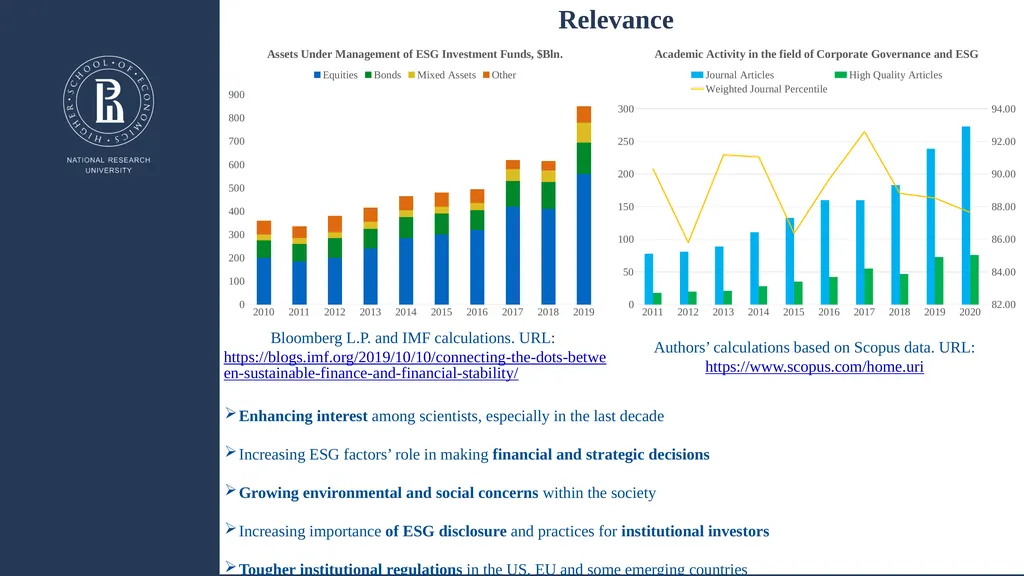
Relevance Enhancing interest among scientists, especially in the last decade
Increasing ESG factors’ role in making financial and strategic decisions
Growing environmental and social concerns within the society
Increasing importance of ESG disclosure and practices for institutional investors
Tougher institutional regulations in the US, EU and some emerging countries Bloomberg L.P. and IMF calculations. URL: https://blogs.imf.org/2019/10/10/connecting-the-dots-between-sustainable-finance-and-financial-stability/ Authors’ calculations based on Scopus data. URL: https://www.scopus.com/home.uri<br>
03
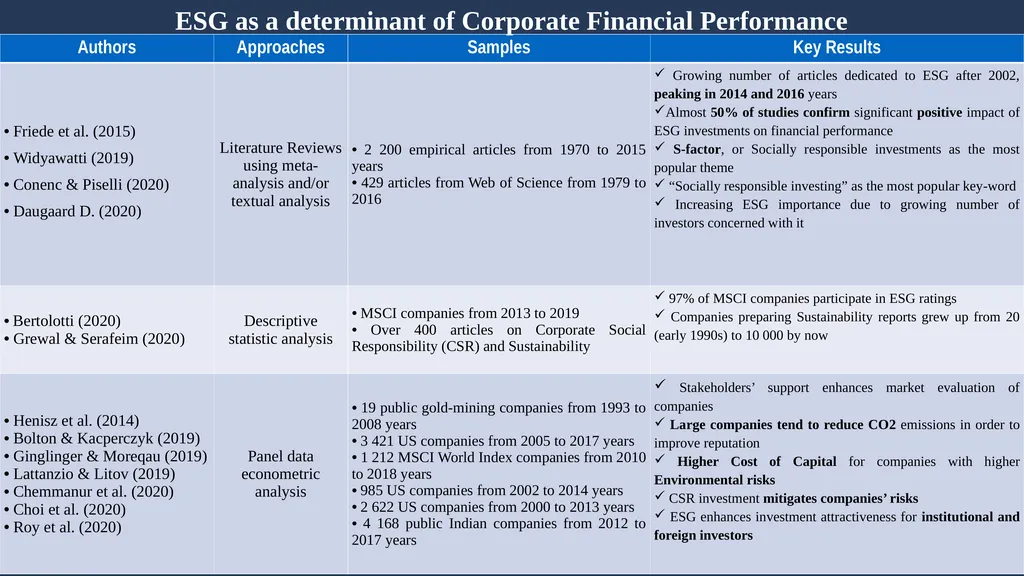
ESG as a determinant of Corporate Financial Performance<br>
04
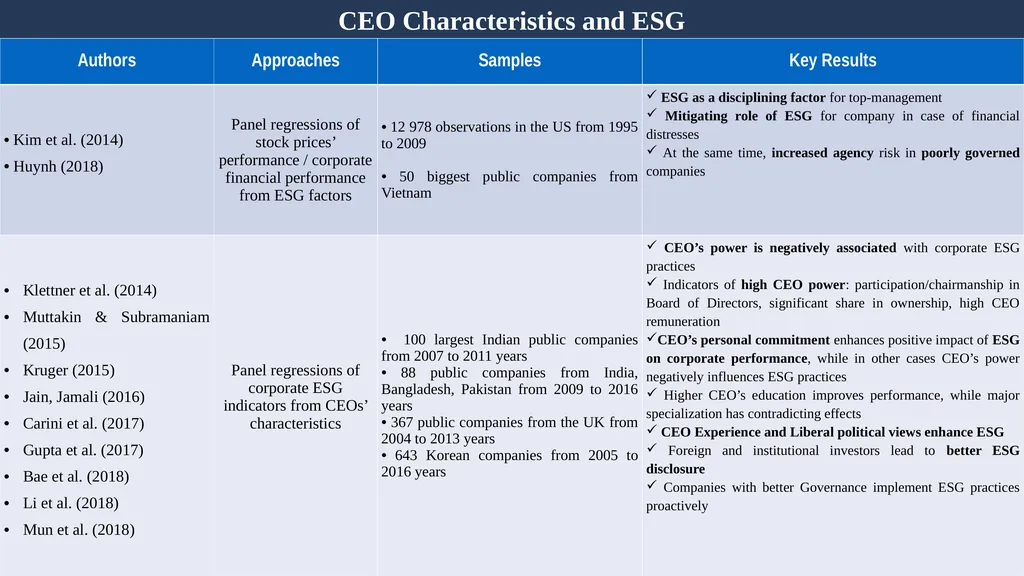
CEO Characteristics and ESG<br>
05
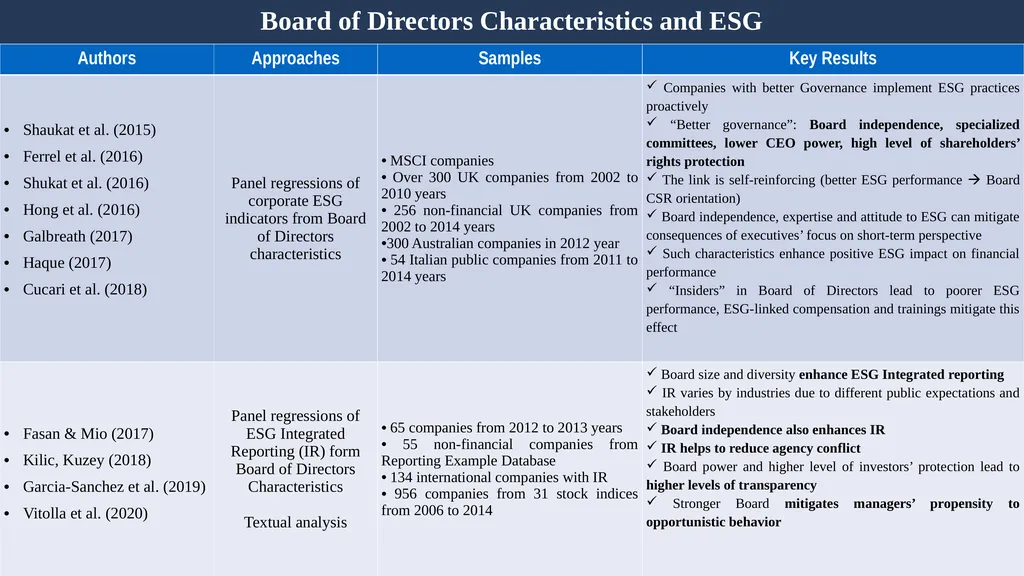
Board of Directors Characteristics and ESG<br>
06
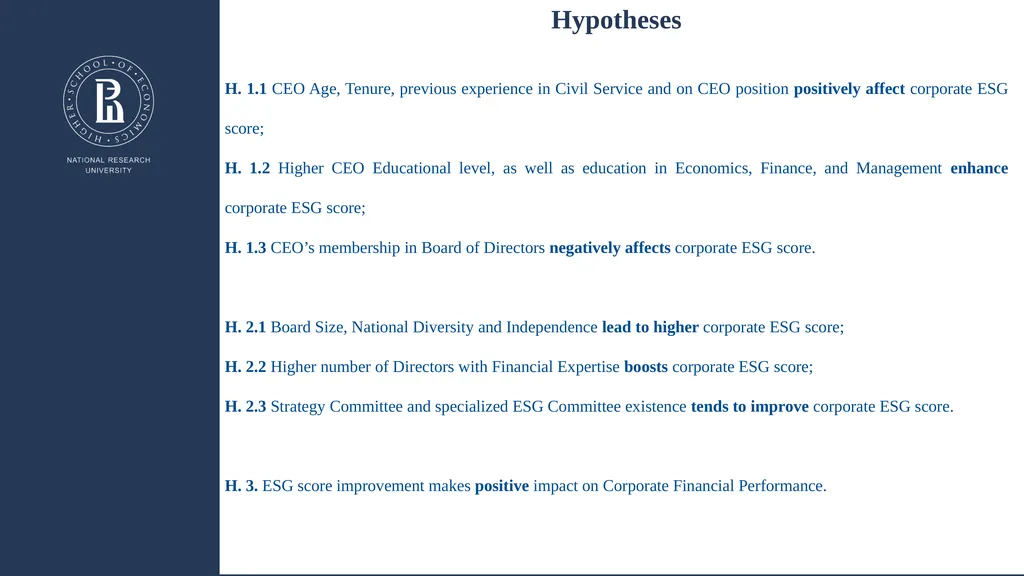
Hypotheses H. 1.1 CEO Age, Tenure, previous experience in Civil Service and on CEO position positively affect corporate ESG score;
H. 1.2 Higher CEO Educational level, as well as education in Economics, Finance, and Management enhance corporate ESG score;
H. 1.3 CEO’s membership in Board of Directors negatively affects corporate ESG score.
H. 2.1 Board Size, National Diversity and Independence lead to higher corporate ESG score;
H. 2.2 Higher number of Directors with Financial Expertise boosts corporate ESG score;
H. 2.3 Strategy Committee and specialized ESG Committee existence tends to improve corporate ESG score.
H. 3. ESG score improvement makes positive impact on Corporate Financial Performance.<br>
07
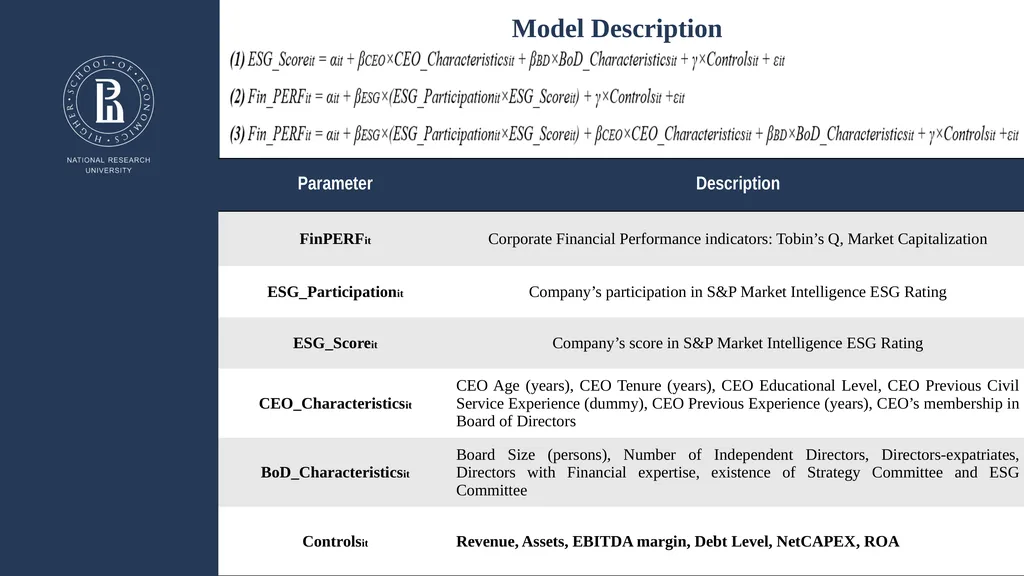
Model Description<br>
08
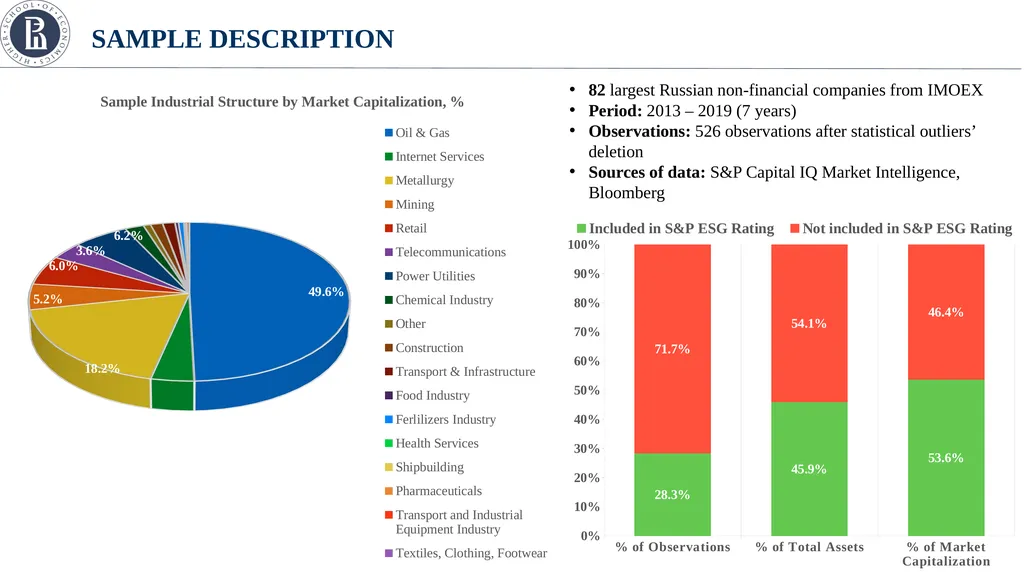
Sample Description 82 largest Russian non-financial companies from IMOEX
Period: 2013 – 2019 (7 years)
Observations: 526 observations after statistical outliers’ deletion
Sources of data: S&P Capital IQ Market Intelligence, Bloomberg<br>
09
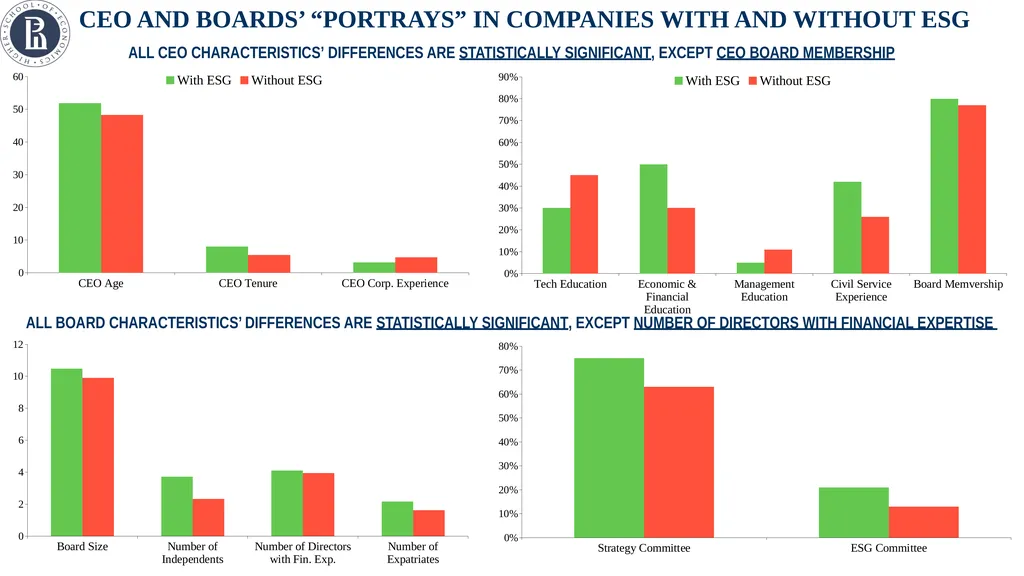
CEO and Boards’ “portrays” in companies with and Without ESG All CEO Characteristics’ Differences are statistically significant, EXCEPT CEO Board Membership All Board Characteristics’ differences are statistically significant, except number of directors with financial expertise<br>
10
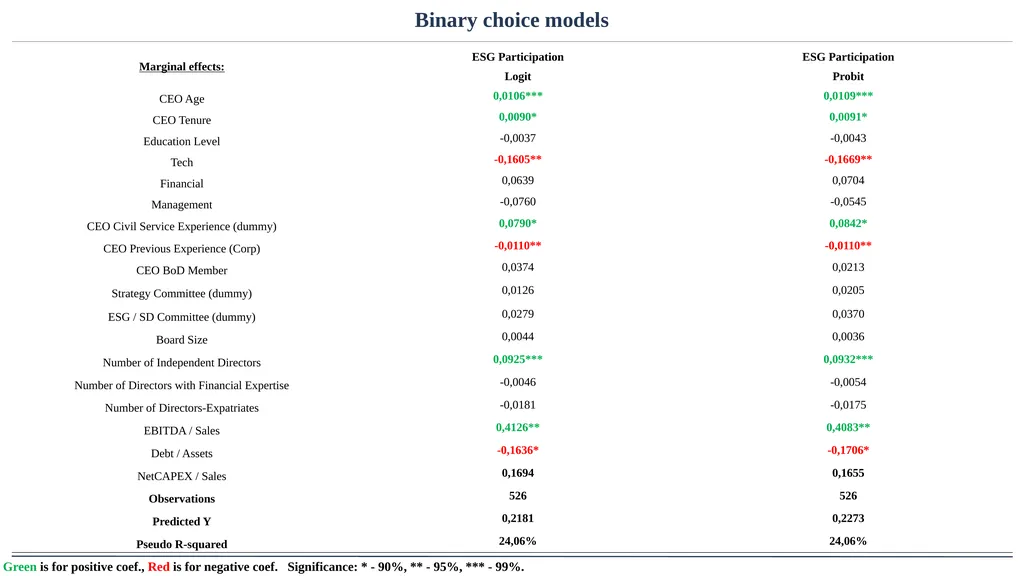
Binary choice models Green is for positive coef., Red is for negative coef. Significance: * - 90%, ** - 95%, *** - 99%.<br>
11
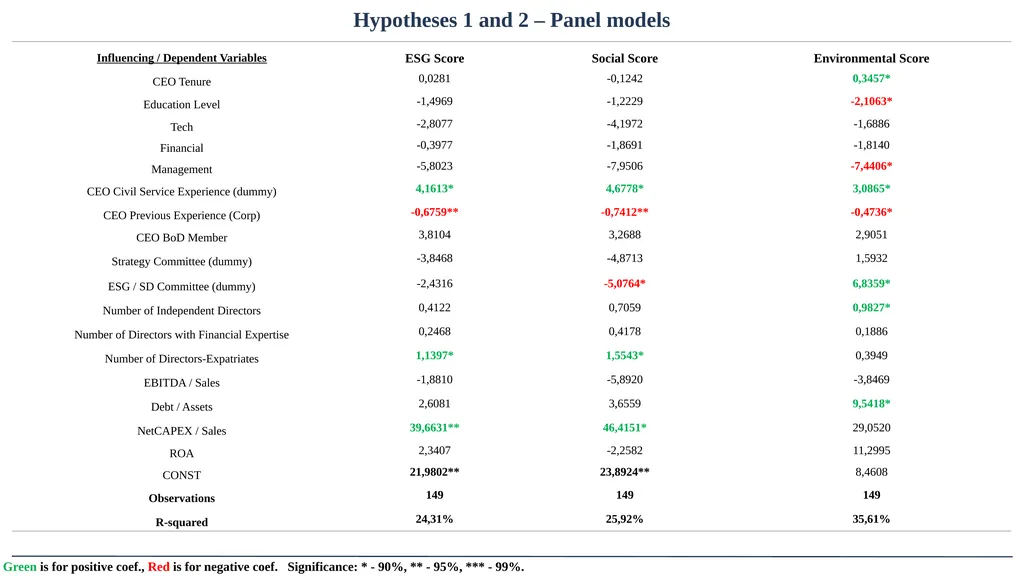
Hypotheses 1 and 2 – Panel models Green is for positive coef., Red is for negative coef. Significance: * - 90%, ** - 95%, *** - 99%.<br>
12
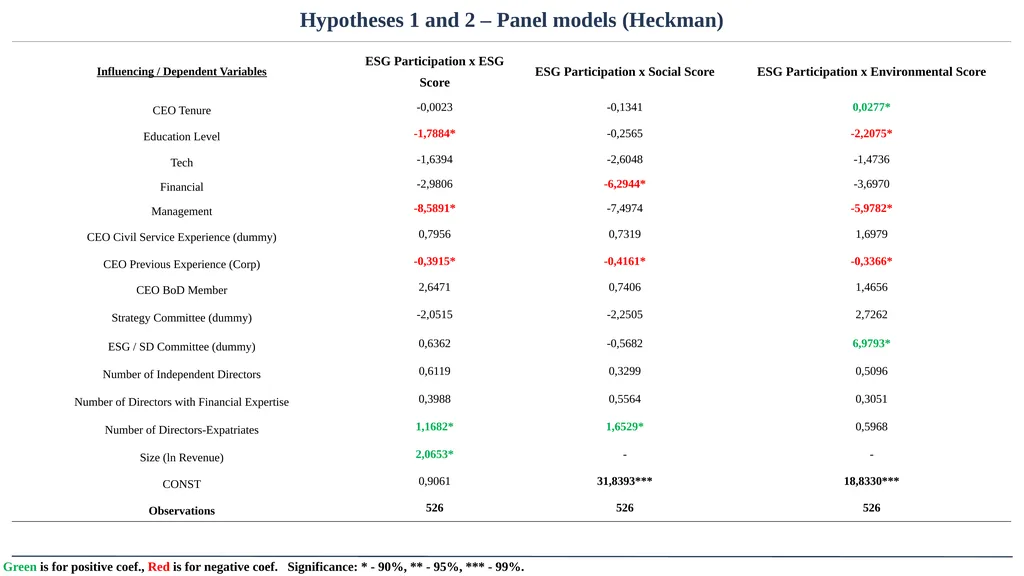
Hypotheses 1 and 2 – Panel models (Heckman) Green is for positive coef., Red is for negative coef. Significance: * - 90%, ** - 95%, *** - 99%.<br>
13
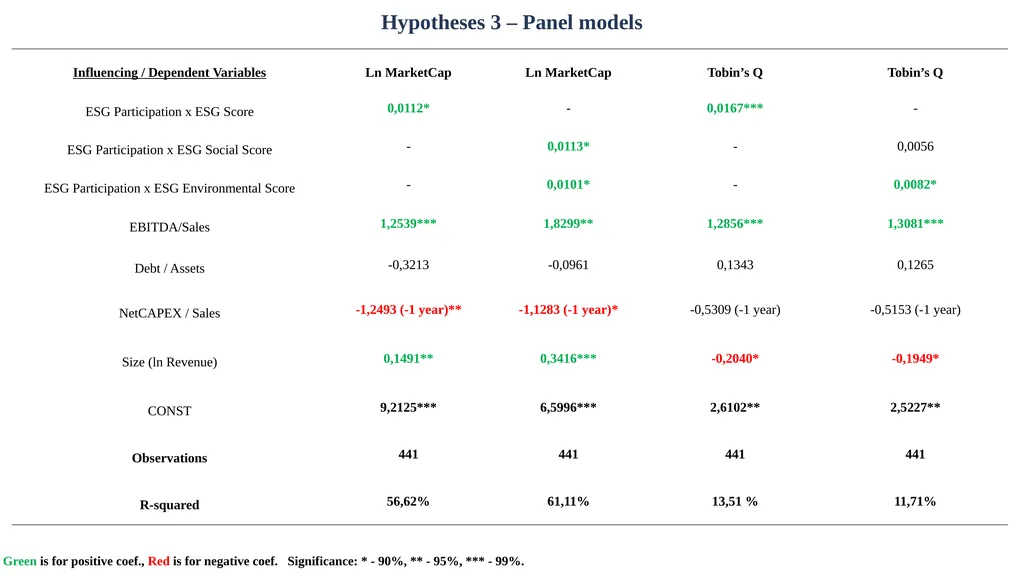
Hypotheses 3 – Panel models Green is for positive coef., Red is for negative coef. Significance: * - 90%, ** - 95%, *** - 99%.<br>
14
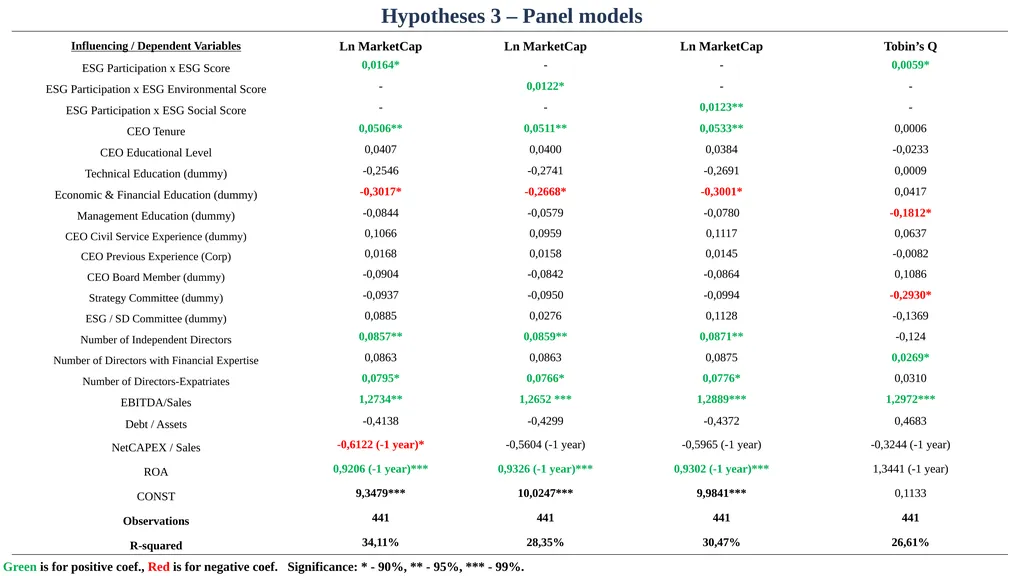
Hypotheses 3 – Panel models Green is for positive coef., Red is for negative coef. Significance: * - 90%, ** - 95%, *** - 99%.<br>
15
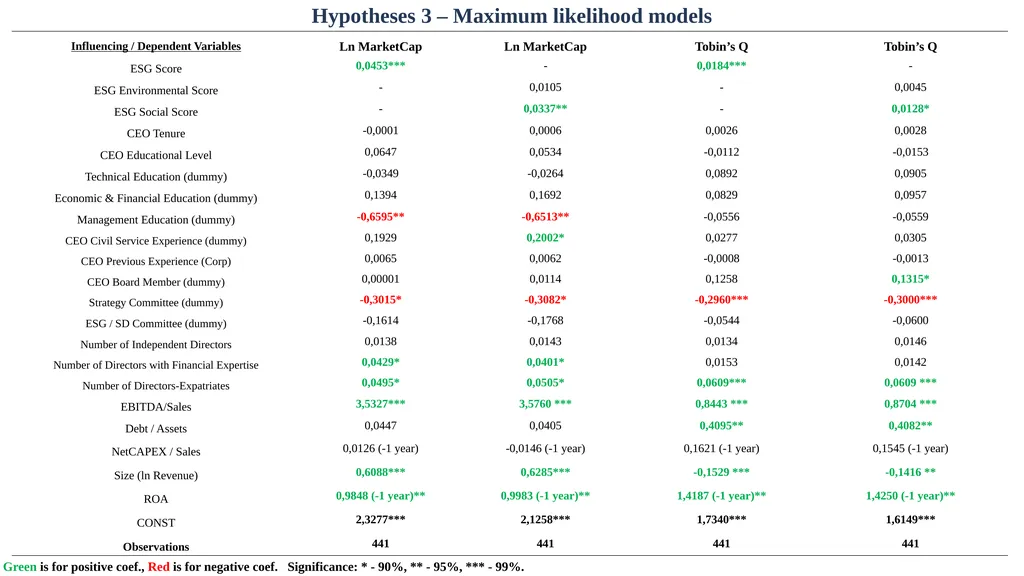
Hypotheses 3 – Maximum likelihood models Green is for positive coef., Red is for negative coef. Significance: * - 90%, ** - 95%, *** - 99%.<br>
16
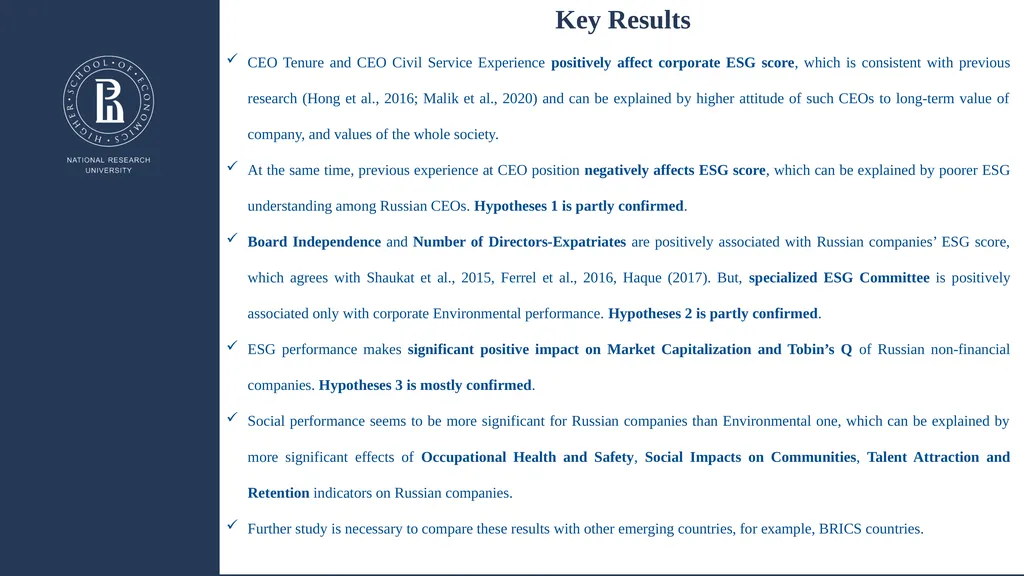
Key Results CEO Tenure and CEO Civil Service Experience positively affect corporate ESG score, which is consistent with previous research (Hong et al., 2016; Malik et al., 2020) and can be explained by higher attitude of such CEOs to long-term value of company, and values of the whole society.
At the same time, previous experience at CEO position negatively affects ESG score, which can be explained by poorer ESG understanding among Russian CEOs. Hypotheses 1 is partly confirmed.
Board Independence and Number of Directors-Expatriates are positively associated with Russian companies’ ESG score, which agrees with Shaukat et al., 2015, Ferrel et al., 2016, Haque (2017). But, specialized ESG Committee is positively associated only with corporate Environmental performance. Hypotheses 2 is partly confirmed.
ESG performance makes significant positive impact on Market Capitalization and Tobin’s Q of Russian non-financial companies. Hypotheses 3 is mostly confirmed.
Social performance seems to be more significant for Russian companies than Environmental one, which can be explained by more significant effects of Occupational Health and Safety, Social Impacts on Communities, Talent Attraction and Retention indicators on Russian companies.
Further study is necessary to compare these results with other emerging countries, for example, BRICS countries.<br>