01
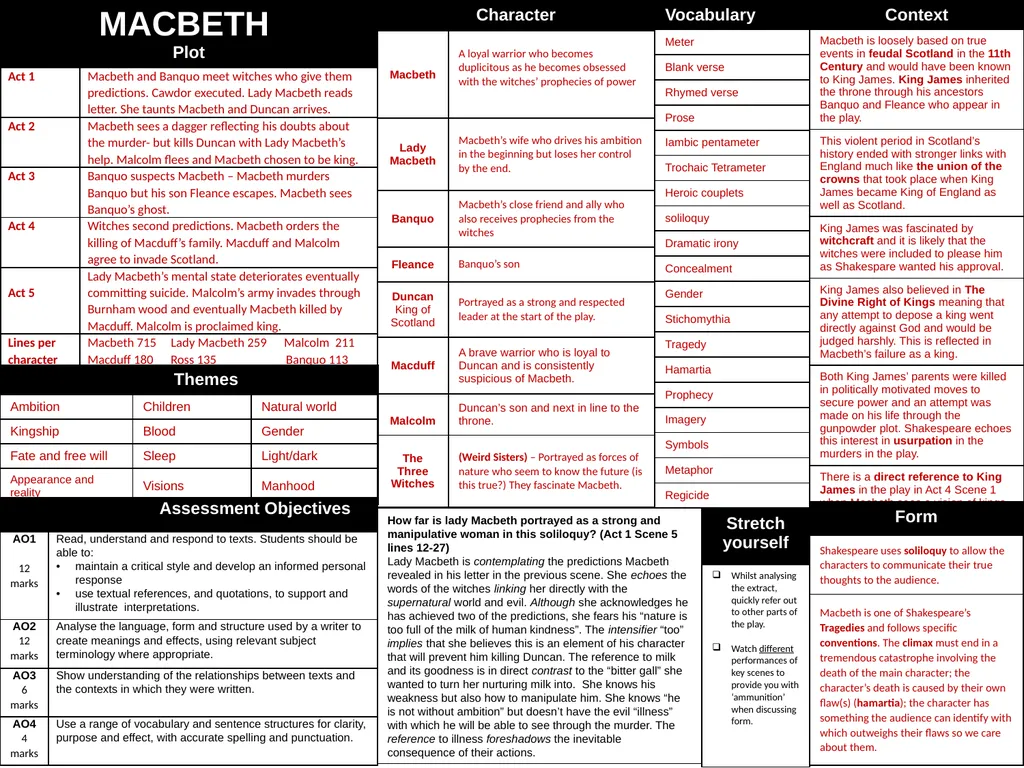
How far is lady Macbeth portrayed as a strong and manipulative woman in this soliloquy? (Act 1 Scene 5 lines 12-27)
Lady Macbeth is contemplating the predictions Macbeth revealed in his letter in the previous scene. She echoes the words of the witches linking her directly with the supernatural world and evil. Although she acknowledges he has achieved two of the predictions, she fears his “nature is too full of the milk of human kindness”. The intensifier “too” implies that she believes this is an element of his character that will prevent him killing Duncan. The reference to milk and its goodness is in direct contrast to the “bitter gall” she wanted to turn her nurturing milk into. She knows his weakness but also how to manipulate him. She knows “he is not without ambition” but doesn’t have the evil “illness” with which he will be able to see through the murder. The reference to illness foreshadows the inevitable consequence of their actions.<br>
02
Macbeth Sample Exam Question Exemplar response
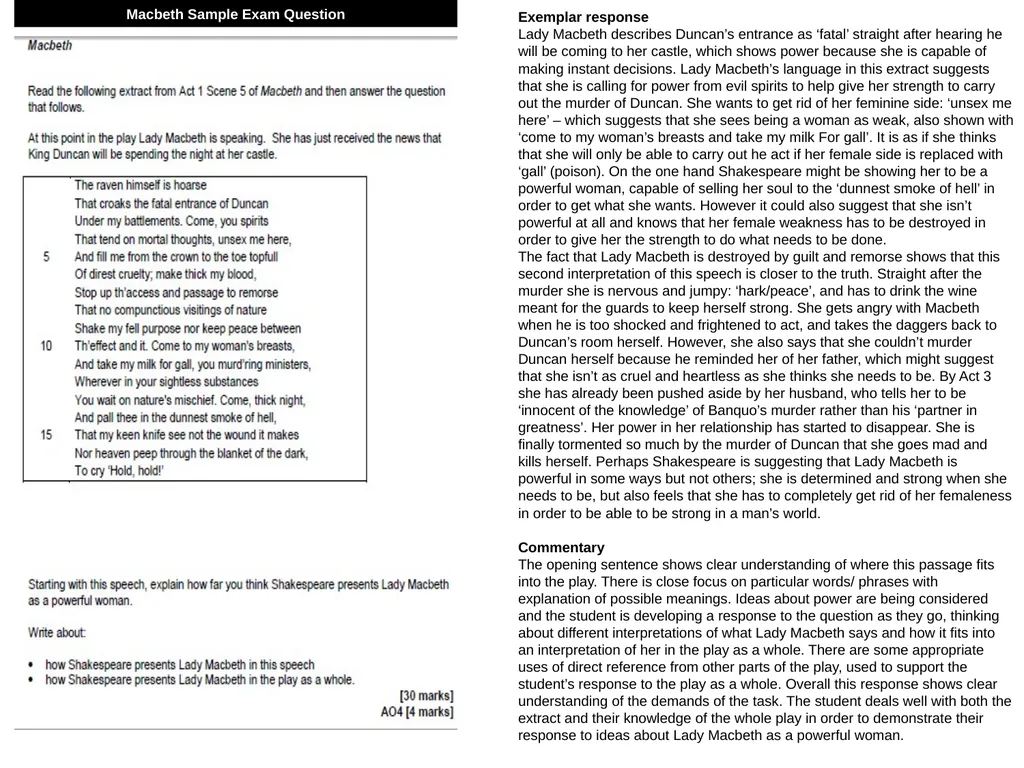
Lady Macbeth describes Duncan’s entrance as ‘fatal’ straight after hearing he will be coming to her castle, which shows power because she is capable of making instant decisions. Lady Macbeth’s language in this extract suggests that she is calling for power from evil spirits to help give her strength to carry out the murder of Duncan. She wants to get rid of her feminine side: ‘unsex me here’ – which suggests that she sees being a woman as weak, also shown with ‘come to my woman’s breasts and take my milk For gall’. It is as if she thinks that she will only be able to carry out he act if her female side is replaced with ‘gall’ (poison). On the one hand Shakespeare might be showing her to be a powerful woman, capable of selling her soul to the ‘dunnest smoke of hell’ in order to get what she wants. However it could also suggest that she isn’t powerful at all and knows that her female weakness has to be destroyed in order to give her the strength to do what needs to be done.
The fact that Lady Macbeth is destroyed by guilt and remorse shows that this second interpretation of this speech is closer to the truth. Straight after the murder she is nervous and jumpy: ‘hark/peace’, and has to drink the wine meant for the guards to keep herself strong. She gets angry with Macbeth when he is too shocked and frightened to act, and takes the daggers back to Duncan’s room herself. However, she also says that she couldn’t murder Duncan herself because he reminded her of her father, which might suggest that she isn’t as cruel and heartless as she thinks she needs to be. By Act 3 she has already been pushed aside by her husband, who tells her to be ‘innocent of the knowledge’ of Banquo’s murder rather than his ‘partner in greatness’. Her power in her relationship has started to disappear. She is finally tormented so much by the murder of Duncan that she goes mad and kills herself. Perhaps Shakespeare is suggesting that Lady Macbeth is powerful in some ways but not others; she is determined and strong when she needs to be, but also feels that she has to completely get rid of her femaleness in order to be able to be strong in a man’s world.
Commentary
The opening sentence shows clear understanding of where this passage fits into the play. There is close focus on particular words/ phrases with explanation of possible meanings. Ideas about power are being considered and the student is developing a response to the question as they go, thinking about different interpretations of what Lady Macbeth says and how it fits into an interpretation of her in the play as a whole. There are some appropriate uses of direct reference from other parts of the play, used to support the student’s response to the play as a whole. Overall this response shows clear understanding of the demands of the task. The student deals well with both the extract and their knowledge of the whole play in order to demonstrate their response to ideas about Lady Macbeth as a powerful woman.<br>