
How Practice questions Helpful sentence starters
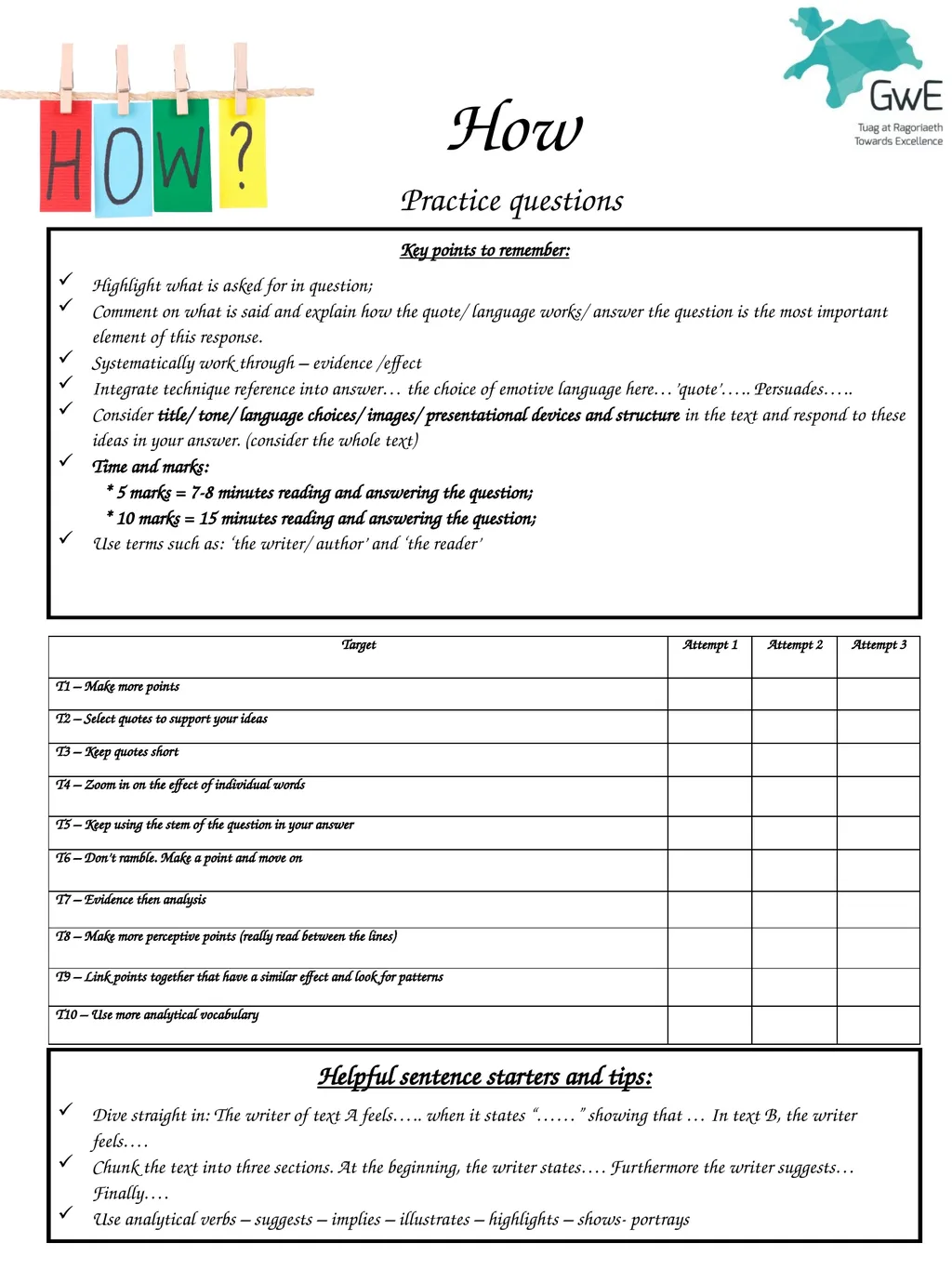
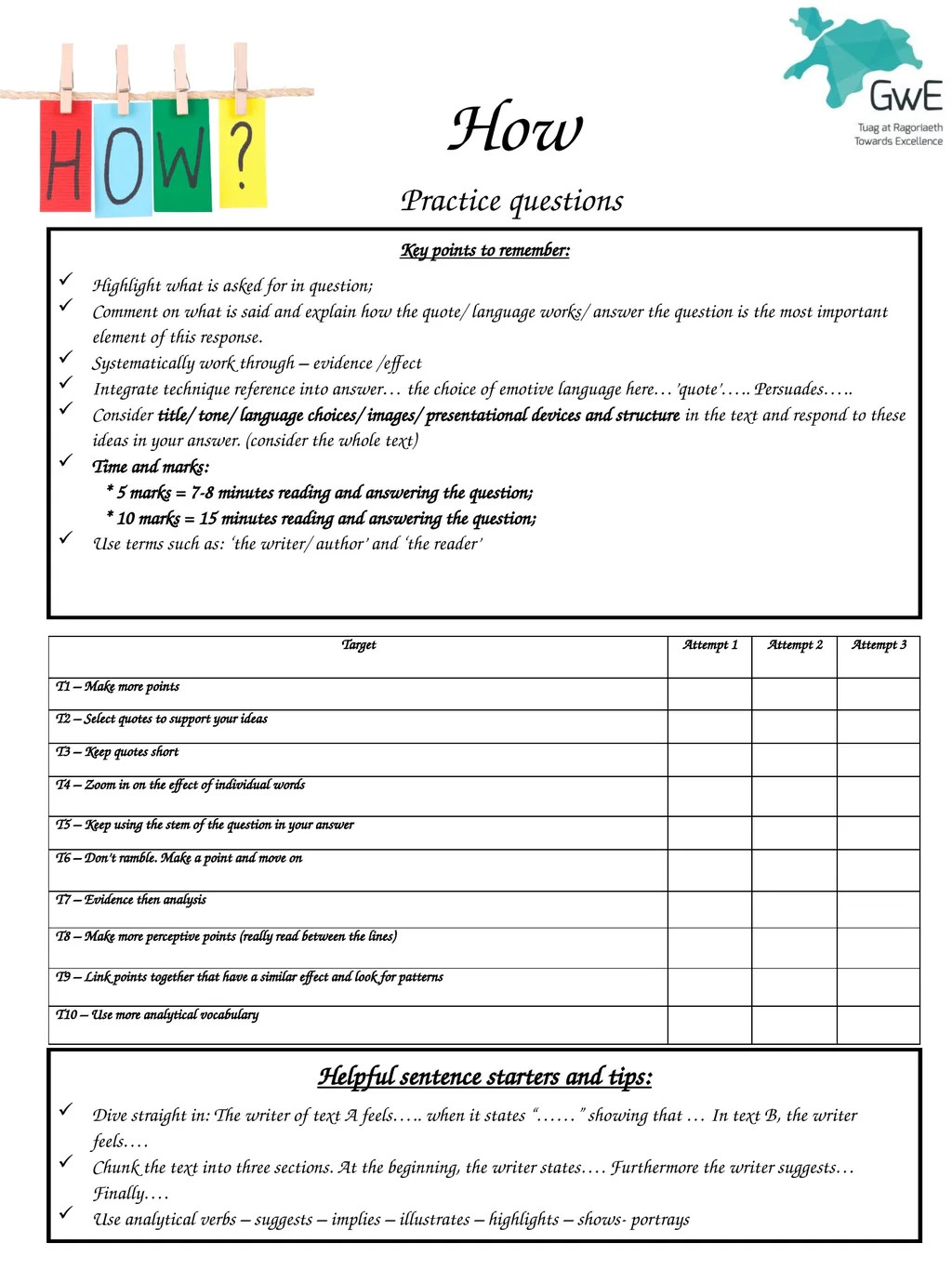
Description: How Practice questions Helpful sentence starters and tips: Dive straight in: The writer of text A feels.. when it states showing that In text B, the writer feels. Chunk the text into three sections. At the beginning, the writer
Related Topics
Download Presentation
"How Practice questions Helpful sentence starters" is the property of its rightful owner. Permission is granted to download and print the materials on this website for personal, non-commercial use only, and to display it on your personal computer provided you do not modify the materials and that you retain all copyright notices contained in the materials. By downloading content from our website, you accept the terms of this agreement.
Presentation Transcript
slide1. How Practice questions Helpful sentence starters and tips:
Dive straight in: The writer of text A feels….. when it states “……” showing that … In text B, the writer feels….
Chunk the text into three sections. At the beginning, the writer states…. Furthermore the writer suggests… Finally….
Use analytical verbs – suggests – implies – illustrates – highlights – shows- portrays Key points to remember:
Highlight what is asked for in question;
Comment on what is said and explain how the quote/ language works/ answer the question is the most important element of this response.
Systematically work through – evidence /effect
Integrate technique reference into answer… the choice of emotive language here…’quote’….. Persuades…..
Consider title/ tone/ language choices/ images/ presentational devices and structure in the text and respond to these ideas in your answer. (consider the whole text)
Time and marks:
* 5 marks = 7-8 minutes reading and answering the question;
* 10 marks = 15 minutes reading and answering the question;
Use terms such as: ‘the writer/ author’ and ‘the reader’<br>
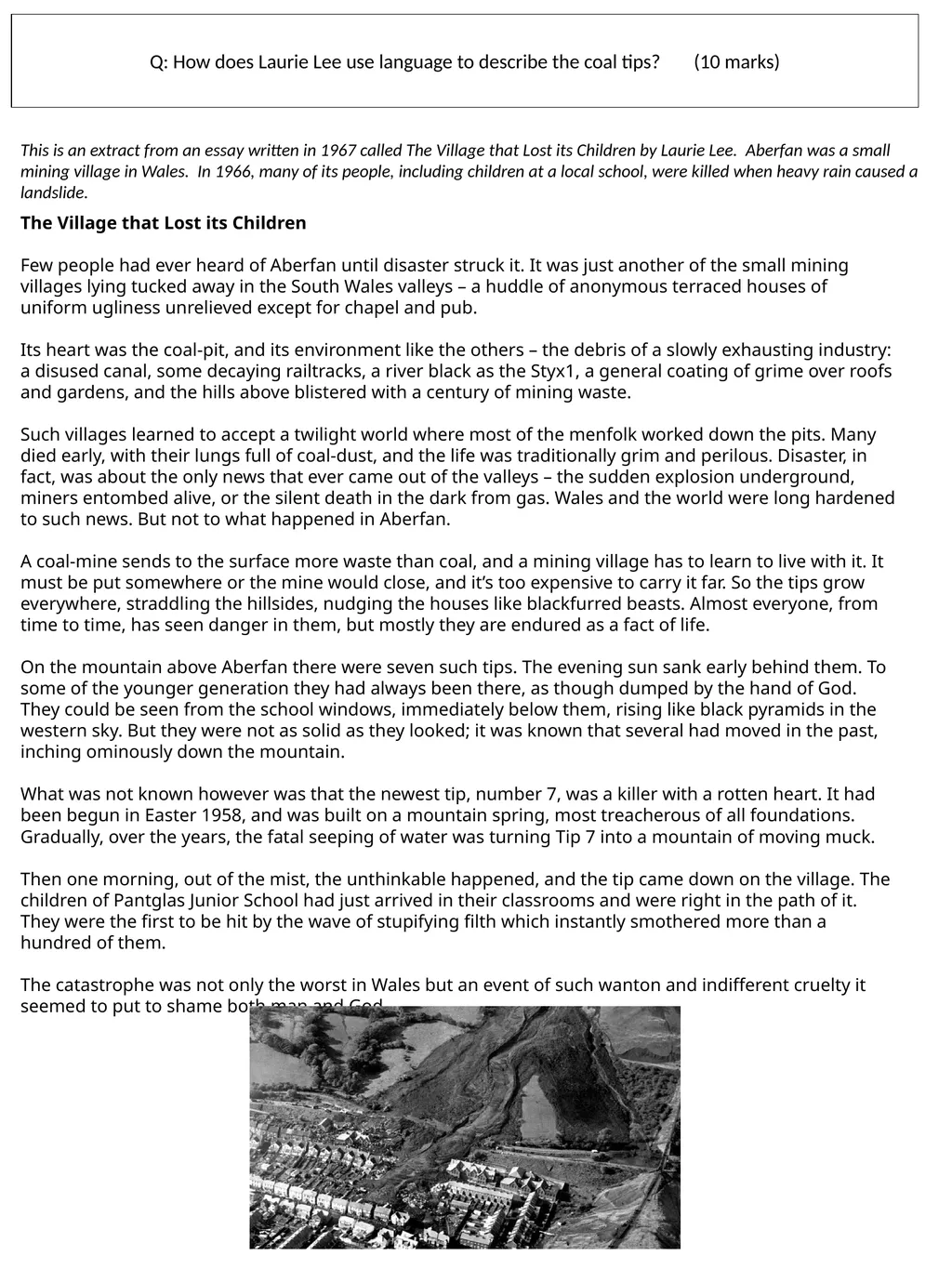
slide2. Q: How does Laurie Lee use language to describe the coal tips? (10 marks) This is an extract from an essay written in 1967 called The Village that Lost its Children by Laurie Lee. Aberfan was a small mining village in Wales. In 1966, many of its people, including children at a local school, were killed when heavy rain caused a landslide. The Village that Lost its Children
Few people had ever heard of Aberfan until disaster struck it. It was just another of the small mining villages lying tucked away in the South Wales valleys – a huddle of anonymous terraced houses of uniform ugliness unrelieved except for chapel and pub.
Its heart was the coal-pit, and its environment like the others – the debris of a slowly exhausting industry: a disused canal, some decaying railtracks, a river black as the Styx1, a general coating of grime over roofs and gardens, and the hills above blistered with a century of mining waste.
Such villages learned to accept a twilight world where most of the menfolk worked down the pits. Many died early, with their lungs full of coal-dust, and the life was traditionally grim and perilous. Disaster, in fact, was about the only news that ever came out of the valleys – the sudden explosion underground, miners entombed alive, or the silent death in the dark from gas. Wales and the world were long hardened to such news. But not to what happened in Aberfan.
A coal-mine sends to the surface more waste than coal, and a mining village has to learn to live with it. It must be put somewhere or the mine would close, and it’s too expensive to carry it far. So the tips grow everywhere, straddling the hillsides, nudging the houses like blackfurred beasts. Almost everyone, from time to time, has seen danger in them, but mostly they are endured as a fact of life.
On the mountain above Aberfan there were seven such tips. The evening sun sank early behind them. To some of the younger generation they had always been there, as though dumped by the hand of God. They could be seen from the school windows, immediately below them, rising like black pyramids in the western sky. But they were not as solid as they looked; it was known that several had moved in the past, inching ominously down the mountain.
What was not known however was that the newest tip, number 7, was a killer with a rotten heart. It had been begun in Easter 1958, and was built on a mountain spring, most treacherous of all foundations. Gradually, over the years, the fatal seeping of water was turning Tip 7 into a mountain of moving muck.
Then one morning, out of the mist, the unthinkable happened, and the tip came down on the village. The children of Pantglas Junior School had just arrived in their classrooms and were right in the path of it. They were the first to be hit by the wave of stupifying filth which instantly smothered more than a hundred of them.
The catastrophe was not only the worst in Wales but an event of such wanton and indifferent cruelty it seemed to put to shame both man and God.<br>
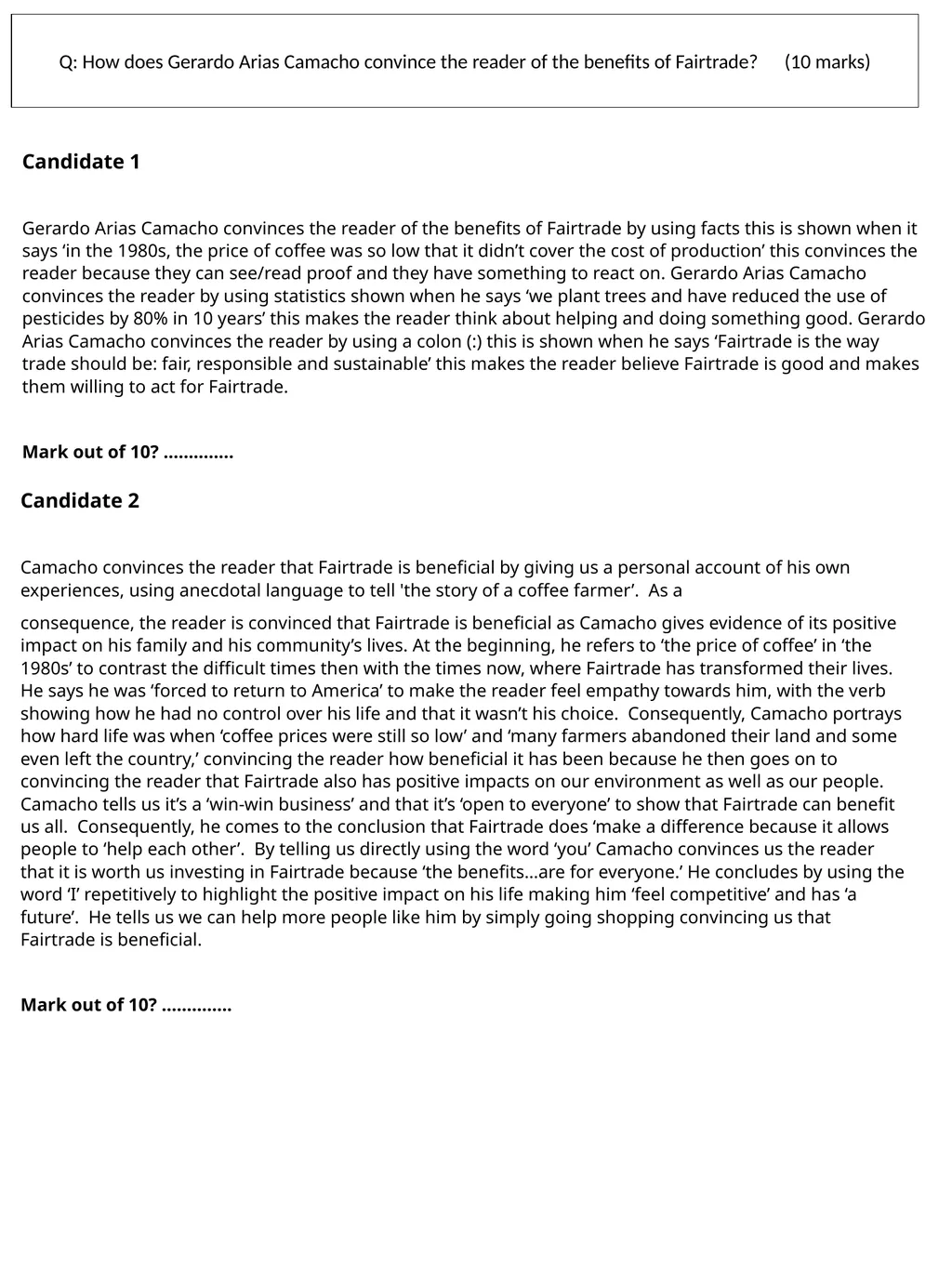
slide3. Q: How does Gerardo Arias Camacho convince the reader of the benefits of Fairtrade? (10 marks) Text D is taken from The Guardian newspaper
The story of a coffee farmer
Gerardo Arlas Camacho is a coffee farmer in Costa Rica. He is a board member on his village co-operative, which is a member of the Fairtrade consortium COOCAFE. He is married with three children.
In the 1980s, the price of coffee was so low that it didn’t cover the cost of production. Many farmers abandoned their land and some even left the country to find work. In the mid-90s, I went tot America to make money and support my family. After eight years, I had earned enough to buy the family farm so that my parents could retire. But coffee prices were still so low that I was forced to return to America for another two years.
Then the coffee business was unstable. We did not have a local school, good roads or bridges. Now that we are Fairtrade-certified, prices are stable and we receive a guaranteed amount for our coffee. We spent the money on education, environmental protection, roads and bridges, and improving the processing plant. We have a scholarship programme so that our kids can stay in school. I believe that my farm would be out of business if it wasn’t for Fairtrade. Free trade is not responsible trade. When prices go down, farmers produce more and prices drop further. Fairtrade is the way trade should be: fair, responsible and sustainable.
My oldest son is in college, my ten-year-old has already had as much education as me, and my little girl is in her second year at school. With the help of Fairtrade, they might all be able to go to university and get a degree. They won’t have to jump the border from Mexico to America, like me. They can decide what they want in life.
Since Fairtrade, our farms have become more environmentally-friendly. Our coffee is now produced in a sustainable way. We plant trees and have reduced the use of pesticides by 80% in 10 years. We used to cut 50 acres of forest down every year to fuel the ovens at our processing plant. Now we have a new oven which is fuelled by coffee waste products and the skins of macadamia nuts that we buy from farmers on the other side of Costa Rica. It is a win-win business.
Fairtrade is not a closed system. It is open to everyone but we need more and more people to buy Fairtrade so other farmers can become certified. We already educate other producers around us about market prices so that buyers have to offer them a competitive rate and this benefits the wider community. When there was a hurricane, the main road became blocked and he bridge came down. We could afford to open the road and fix the bridge.
When you are shopping, look for the Fairtrade label – you can be sure that the money is going straight to the producers. It will help us, and it will help people around the world, because the benefits of protecting the environment are for everyone. It’s a matter of helping each other.
As a Fairtrade farmer, I finally feel competitive. It has given me the knowledge so that I am more able to defend myself and my people. I feel there is a future in front of us because we can stay in our own country and make a living growing coffee. Fairtrade is not charity. Just by going shopping, you can make a difference.<br>
slide4. Candidate 1
Gerardo Arias Camacho convinces the reader of the benefits of Fairtrade by using facts this is shown when it says ‘in the 1980s, the price of coffee was so low that it didn’t cover the cost of production’ this convinces the reader because they can see/read proof and they have something to react on. Gerardo Arias Camacho convinces the reader by using statistics shown when he says ‘we plant trees and have reduced the use of pesticides by 80% in 10 years’ this makes the reader think about helping and doing something good. Gerardo Arias Camacho convinces the reader by using a colon (:) this is shown when he says ‘Fairtrade is the way trade should be: fair, responsible and sustainable’ this makes the reader believe Fairtrade is good and makes them willing to act for Fairtrade.
Mark out of 10? ………….. Candidate 2
Camacho convinces the reader that Fairtrade is beneficial by giving us a personal account of his own experiences, using anecdotal language to tell 'the story of a coffee farmer’. As a
consequence, the reader is convinced that Fairtrade is beneficial as Camacho gives evidence of its positive impact on his family and his community’s lives. At the beginning, he refers to ‘the price of coffee’ in ‘the 1980s’ to contrast the difficult times then with the times now, where Fairtrade has transformed their lives. He says he was ‘forced to return to America’ to make the reader feel empathy towards him, with the verb showing how he had no control over his life and that it wasn’t his choice. Consequently, Camacho portrays how hard life was when ‘coffee prices were still so low’ and ‘many farmers abandoned their land and some even left the country,’ convincing the reader how beneficial it has been because he then goes on to convincing the reader that Fairtrade also has positive impacts on our environment as well as our people. Camacho tells us it’s a ‘win-win business’ and that it’s ‘open to everyone’ to show that Fairtrade can benefit us all. Consequently, he comes to the conclusion that Fairtrade does ‘make a difference because it allows people to ‘help each other’. By telling us directly using the word ‘you’ Camacho convinces us the reader that it is worth us investing in Fairtrade because ‘the benefits…are for everyone.’ He concludes by using the word ‘I’ repetitively to highlight the positive impact on his life making him ‘feel competitive’ and has ‘a future’. He tells us we can help more people like him by simply going shopping convincing us that Fairtrade is beneficial.
Mark out of 10? ………….. Q: How does Gerardo Arias Camacho convince the reader of the benefits of Fairtrade? (10 marks)<br>
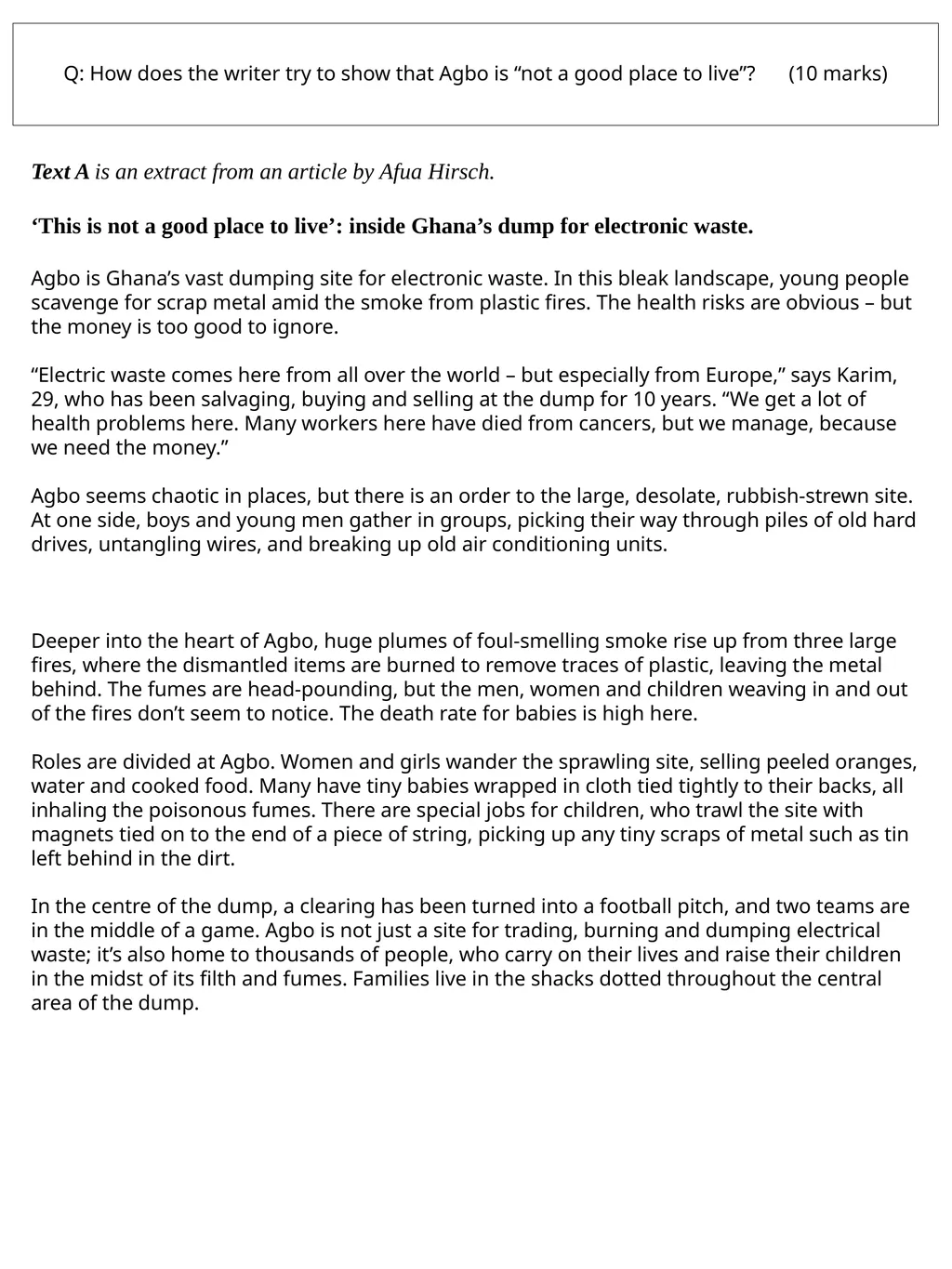
slide5. Q: How does the writer try to show that Agbo is “not a good place to live”? (10 marks) Text A is an extract from an article by Afua Hirsch.
‘This is not a good place to live’: inside Ghana’s dump for electronic waste.
Agbo is Ghana’s vast dumping site for electronic waste. In this bleak landscape, young people scavenge for scrap metal amid the smoke from plastic fires. The health risks are obvious – but the money is too good to ignore.
“Electric waste comes here from all over the world – but especially from Europe,” says Karim, 29, who has been salvaging, buying and selling at the dump for 10 years. “We get a lot of health problems here. Many workers here have died from cancers, but we manage, because we need the money.”
Agbo seems chaotic in places, but there is an order to the large, desolate, rubbish-strewn site. At one side, boys and young men gather in groups, picking their way through piles of old hard drives, untangling wires, and breaking up old air conditioning units.
Deeper into the heart of Agbo, huge plumes of foul-smelling smoke rise up from three large fires, where the dismantled items are burned to remove traces of plastic, leaving the metal behind. The fumes are head-pounding, but the men, women and children weaving in and out of the fires don’t seem to notice. The death rate for babies is high here.
Roles are divided at Agbo. Women and girls wander the sprawling site, selling peeled oranges, water and cooked food. Many have tiny babies wrapped in cloth tied tightly to their backs, all inhaling the poisonous fumes. There are special jobs for children, who trawl the site with magnets tied on to the end of a piece of string, picking up any tiny scraps of metal such as tin left behind in the dirt.
In the centre of the dump, a clearing has been turned into a football pitch, and two teams are in the middle of a game. Agbo is not just a site for trading, burning and dumping electrical waste; it’s also home to thousands of people, who carry on their lives and raise their children in the midst of its filth and fumes. Families live in the shacks dotted throughout the central area of the dump.<br>
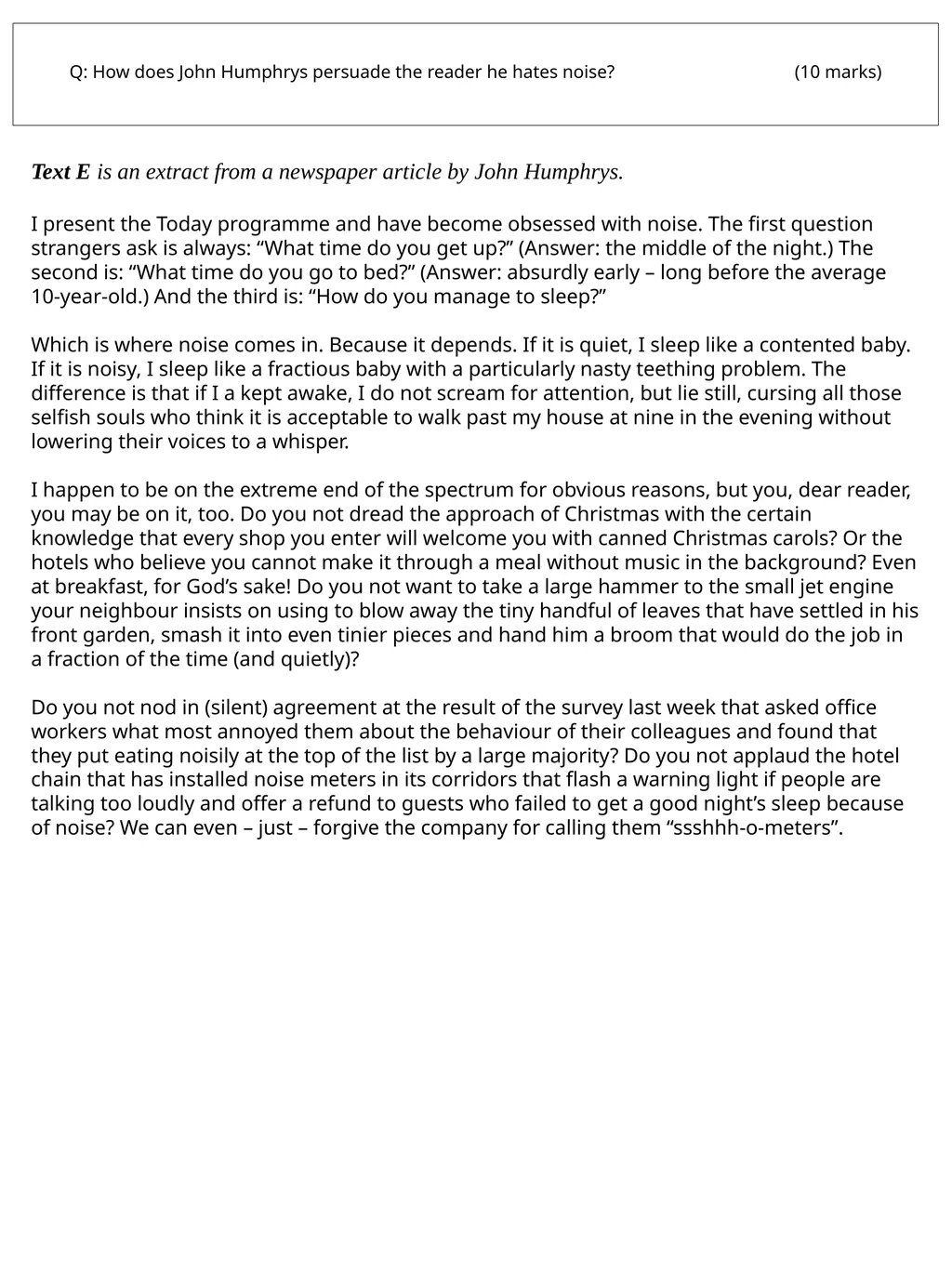
slide6. Q: How does John Humphrys persuade the reader he hates noise? (10 marks) Text E is an extract from a newspaper article by John Humphrys.
I present the Today programme and have become obsessed with noise. The first question strangers ask is always: “What time do you get up?” (Answer: the middle of the night.) The second is: “What time do you go to bed?” (Answer: absurdly early – long before the average 10-year-old.) And the third is: “How do you manage to sleep?”
Which is where noise comes in. Because it depends. If it is quiet, I sleep like a contented baby. If it is noisy, I sleep like a fractious baby with a particularly nasty teething problem. The difference is that if I a kept awake, I do not scream for attention, but lie still, cursing all those selfish souls who think it is acceptable to walk past my house at nine in the evening without lowering their voices to a whisper.
I happen to be on the extreme end of the spectrum for obvious reasons, but you, dear reader, you may be on it, too. Do you not dread the approach of Christmas with the certain knowledge that every shop you enter will welcome you with canned Christmas carols? Or the hotels who believe you cannot make it through a meal without music in the background? Even at breakfast, for God’s sake! Do you not want to take a large hammer to the small jet engine your neighbour insists on using to blow away the tiny handful of leaves that have settled in his front garden, smash it into even tinier pieces and hand him a broom that would do the job in a fraction of the time (and quietly)?
Do you not nod in (silent) agreement at the result of the survey last week that asked office workers what most annoyed them about the behaviour of their colleagues and found that they put eating noisily at the top of the list by a large majority? Do you not applaud the hotel chain that has installed noise meters in its corridors that flash a warning light if people are talking too loudly and offer a refund to guests who failed to get a good night’s sleep because of noise? We can even – just – forgive the company for calling them “ssshhh-o-meters”.<br>
slide7. Q: How does John Humphrys persuade the reader he hates noise? (10 marks) Text E is an extract from a newspaper article by John Humphrys.
I present the Today programme and have become obsessed with noise. The first question strangers ask is always: “What time do you get up?” (Answer: the middle of the night.) The second is: “What time do you go to bed?” (Answer: absurdly early – long before the average 10-year-old.) And the third is: “How do you manage to sleep?”
Which is where noise comes in. Because it depends. If it is quiet, I sleep like a contented baby. If it is noisy, I sleep like a fractious baby with a particularly nasty teething problem. The difference is that if I a kept awake, I do not scream for attention, but lie still, cursing all those selfish souls who think it is acceptable to walk past my house at nine in the evening without lowering their voices to a whisper.
I happen to be on the extreme end of the spectrum for obvious reasons, but you, dear reader, you may be on it, too. Do you not dread the approach of Christmas with the certain knowledge that every shop you enter will welcome you with canned Christmas carols? Or the hotels who believe you cannot make it through a meal without music in the background? Even at breakfast, for God’s sake! Do you not want to take a large hammer to the small jet engine your neighbour insists on using to blow away the tiny handful of leaves that have settled in his front garden, smash it into even tinier pieces and hand him a broom that would do the job in a fraction of the time (and quietly)?
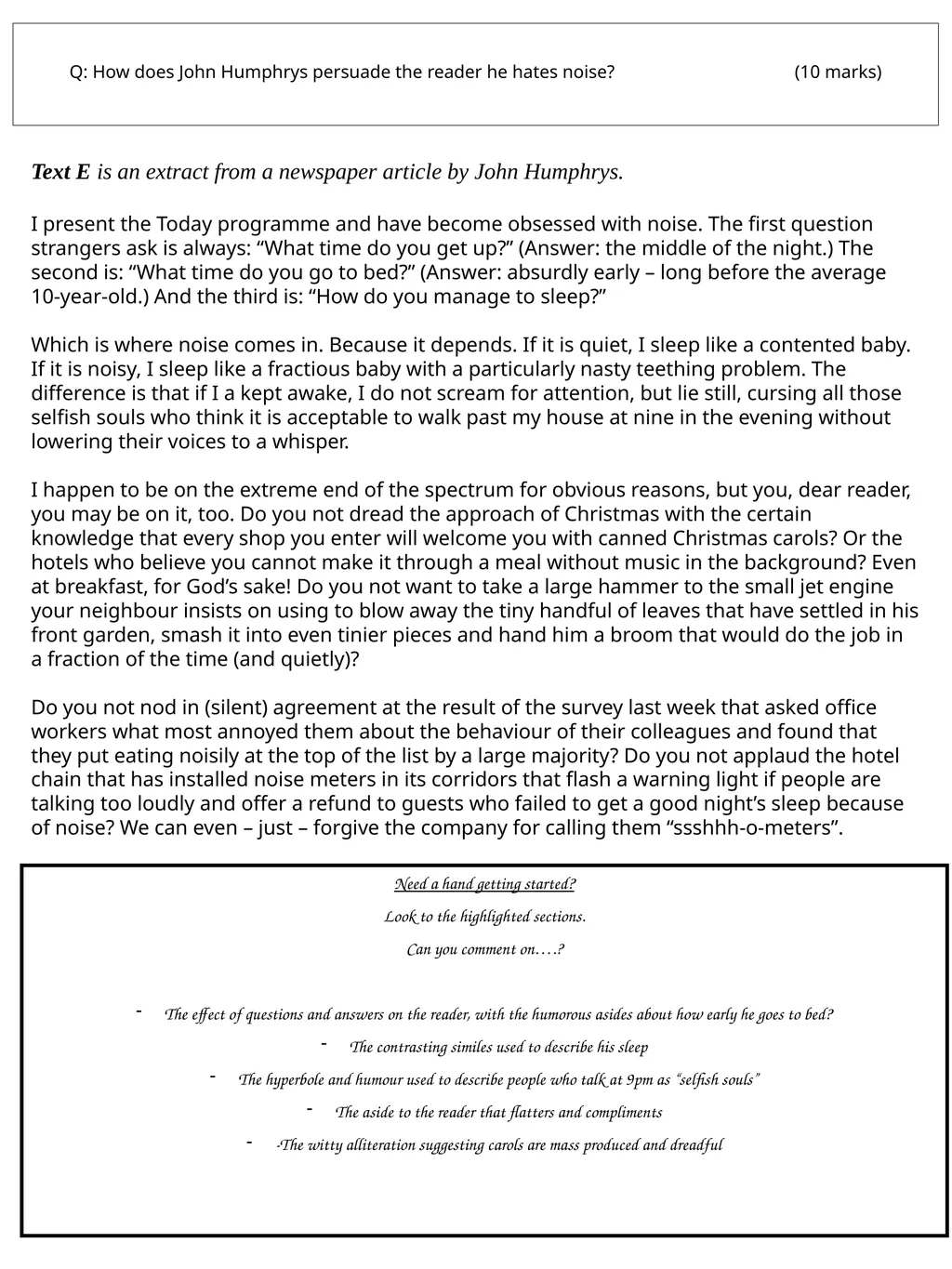
Do you not nod in (silent) agreement at the result of the survey last week that asked office workers what most annoyed them about the behaviour of their colleagues and found that they put eating noisily at the top of the list by a large majority? Do you not applaud the hotel chain that has installed noise meters in its corridors that flash a warning light if people are talking too loudly and offer a refund to guests who failed to get a good night’s sleep because of noise? We can even – just – forgive the company for calling them “ssshhh-o-meters”. Need a hand getting started?
Look to the highlighted sections.
Can you comment on….?
The effect of questions and answers on the reader, with the humorous asides about how early he goes to bed?
The contrasting similes used to describe his sleep
The hyperbole and humour used to describe people who talk at 9pm as “selfish souls”
The aside to the reader that flatters and compliments
-The witty alliteration suggesting carols are mass produced and dreadful<br>
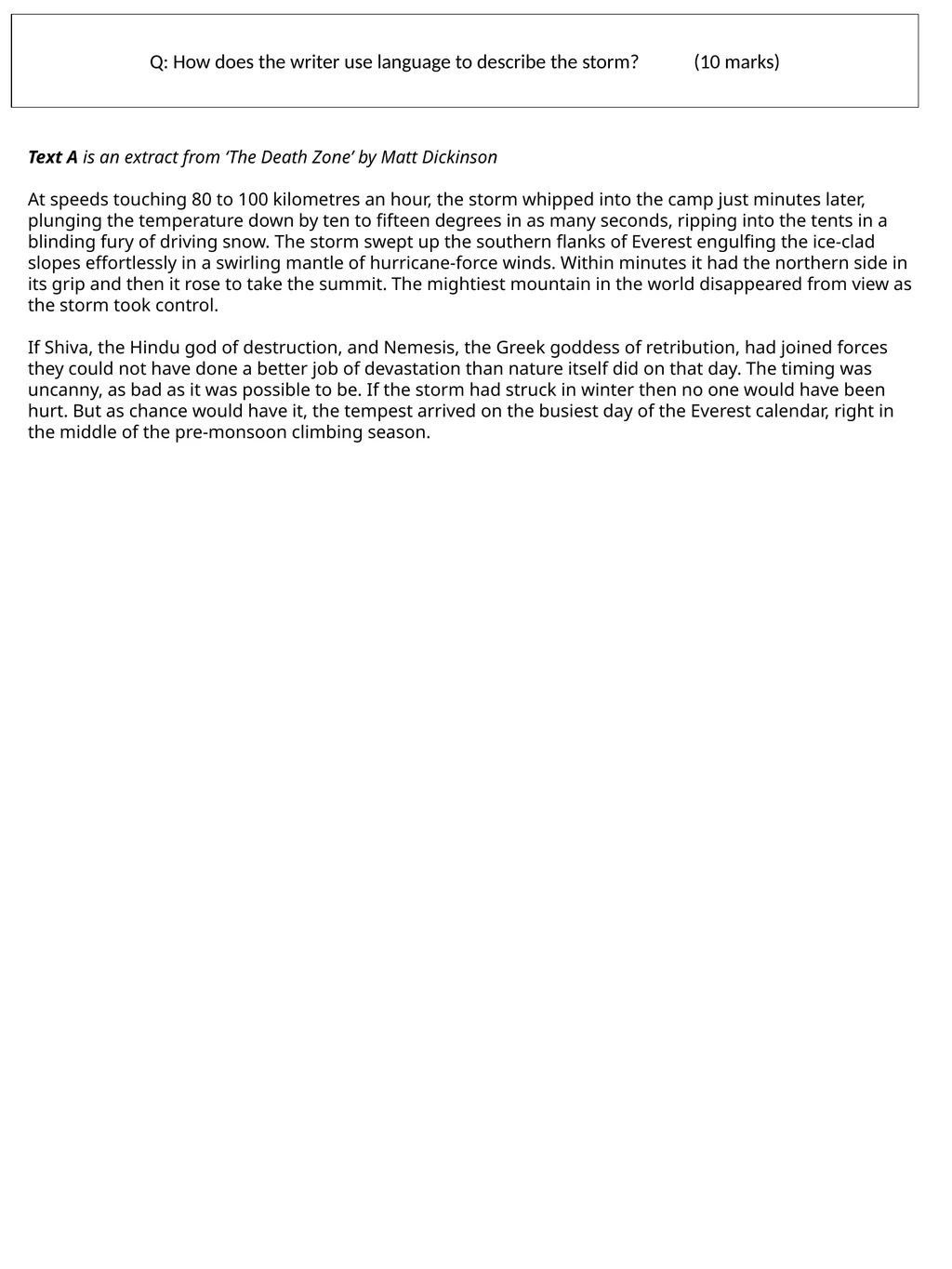
slide8. Q: How does the writer use language to describe the storm? (10 marks) Text A is an extract from ‘The Death Zone’ by Matt Dickinson
At speeds touching 80 to 100 kilometres an hour, the storm whipped into the camp just minutes later, plunging the temperature down by ten to fifteen degrees in as many seconds, ripping into the tents in a blinding fury of driving snow. The storm swept up the southern flanks of Everest engulfing the ice-clad slopes effortlessly in a swirling mantle of hurricane-force winds. Within minutes it had the northern side in its grip and then it rose to take the summit. The mightiest mountain in the world disappeared from view as the storm took control.
If Shiva, the Hindu god of destruction, and Nemesis, the Greek goddess of retribution, had joined forces they could not have done a better job of devastation than nature itself did on that day. The timing was uncanny, as bad as it was possible to be. If the storm had struck in winter then no one would have been hurt. But as chance would have it, the tempest arrived on the busiest day of the Everest calendar, right in the middle of the pre-monsoon climbing season.<br>
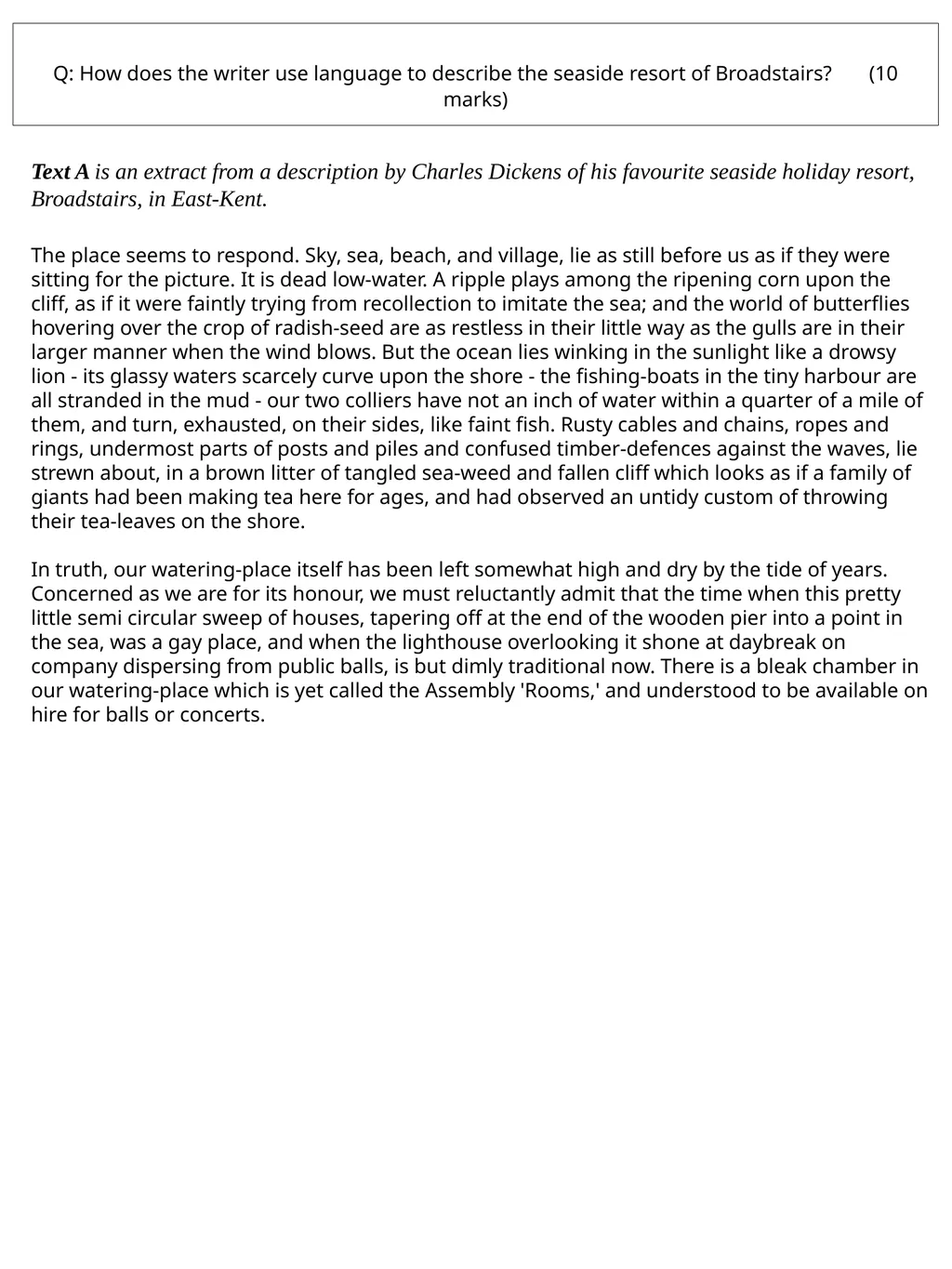
slide9. Q: How does the writer use language to describe the seaside resort of Broadstairs? (10 marks) Text A is an extract from a description by Charles Dickens of his favourite seaside holiday resort, Broadstairs, in East-Kent. The place seems to respond. Sky, sea, beach, and village, lie as still before us as if they were sitting for the picture. It is dead low-water. A ripple plays among the ripening corn upon the cliff, as if it were faintly trying from recollection to imitate the sea; and the world of butterflies hovering over the crop of radish-seed are as restless in their little way as the gulls are in their larger manner when the wind blows. But the ocean lies winking in the sunlight like a drowsy lion - its glassy waters scarcely curve upon the shore - the fishing-boats in the tiny harbour are all stranded in the mud - our two colliers have not an inch of water within a quarter of a mile of them, and turn, exhausted, on their sides, like faint fish. Rusty cables and chains, ropes and rings, undermost parts of posts and piles and confused timber-defences against the waves, lie strewn about, in a brown litter of tangled sea-weed and fallen cliff which looks as if a family of giants had been making tea here for ages, and had observed an untidy custom of throwing their tea-leaves on the shore.
In truth, our watering-place itself has been left somewhat high and dry by the tide of years. Concerned as we are for its honour, we must reluctantly admit that the time when this pretty little semi circular sweep of houses, tapering off at the end of the wooden pier into a point in the sea, was a gay place, and when the lighthouse overlooking it shone at daybreak on company dispersing from public balls, is but dimly traditional now. There is a bleak chamber in our watering-place which is yet called the Assembly 'Rooms,' and understood to be available on hire for balls or concerts.<br>
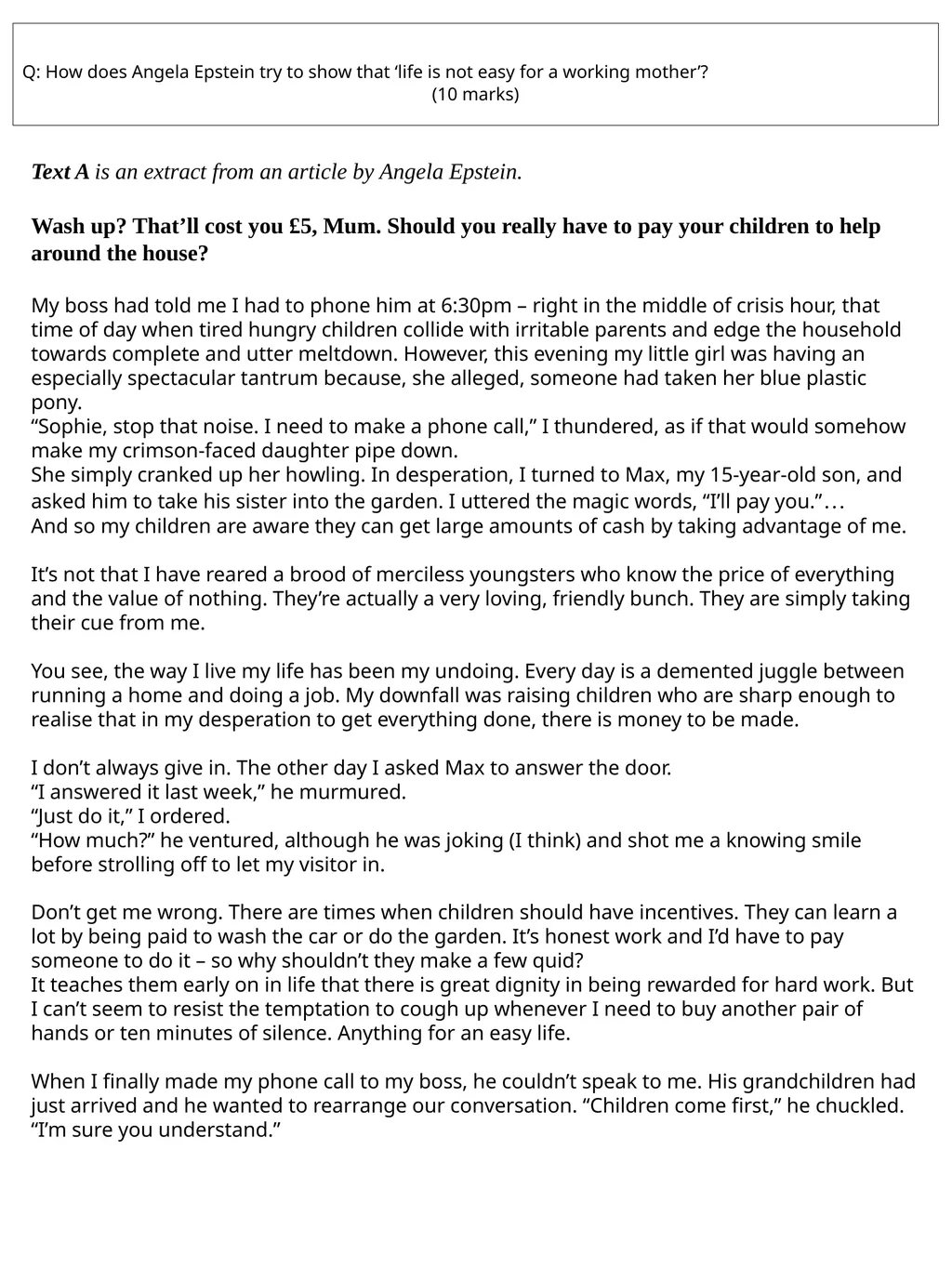
slide10. Q: How does Angela Epstein try to show that ‘life is not easy for a working mother’? (10 marks) Text A is an extract from an article by Angela Epstein.
Wash up? That’ll cost you £5, Mum. Should you really have to pay your children to help around the house?
My boss had told me I had to phone him at 6:30pm – right in the middle of crisis hour, that time of day when tired hungry children collide with irritable parents and edge the household towards complete and utter meltdown. However, this evening my little girl was having an especially spectacular tantrum because, she alleged, someone had taken her blue plastic pony.
“Sophie, stop that noise. I need to make a phone call,” I thundered, as if that would somehow make my crimson-faced daughter pipe down.
She simply cranked up her howling. In desperation, I turned to Max, my 15-year-old son, and asked him to take his sister into the garden. I uttered the magic words, “I’ll pay you.”…
And so my children are aware they can get large amounts of cash by taking advantage of me.
It’s not that I have reared a brood of merciless youngsters who know the price of everything and the value of nothing. They’re actually a very loving, friendly bunch. They are simply taking their cue from me.
You see, the way I live my life has been my undoing. Every day is a demented juggle between running a home and doing a job. My downfall was raising children who are sharp enough to realise that in my desperation to get everything done, there is money to be made.
I don’t always give in. The other day I asked Max to answer the door.
“I answered it last week,” he murmured.
“Just do it,” I ordered.
“How much?” he ventured, although he was joking (I think) and shot me a knowing smile before strolling off to let my visitor in.
Don’t get me wrong. There are times when children should have incentives. They can learn a lot by being paid to wash the car or do the garden. It’s honest work and I’d have to pay someone to do it – so why shouldn’t they make a few quid?
It teaches them early on in life that there is great dignity in being rewarded for hard work. But I can’t seem to resist the temptation to cough up whenever I need to buy another pair of hands or ten minutes of silence. Anything for an easy life.
When I finally made my phone call to my boss, he couldn’t speak to me. His grandchildren had just arrived and he wanted to rearrange our conversation. “Children come first,” he chuckled. “I’m sure you understand.”<br>
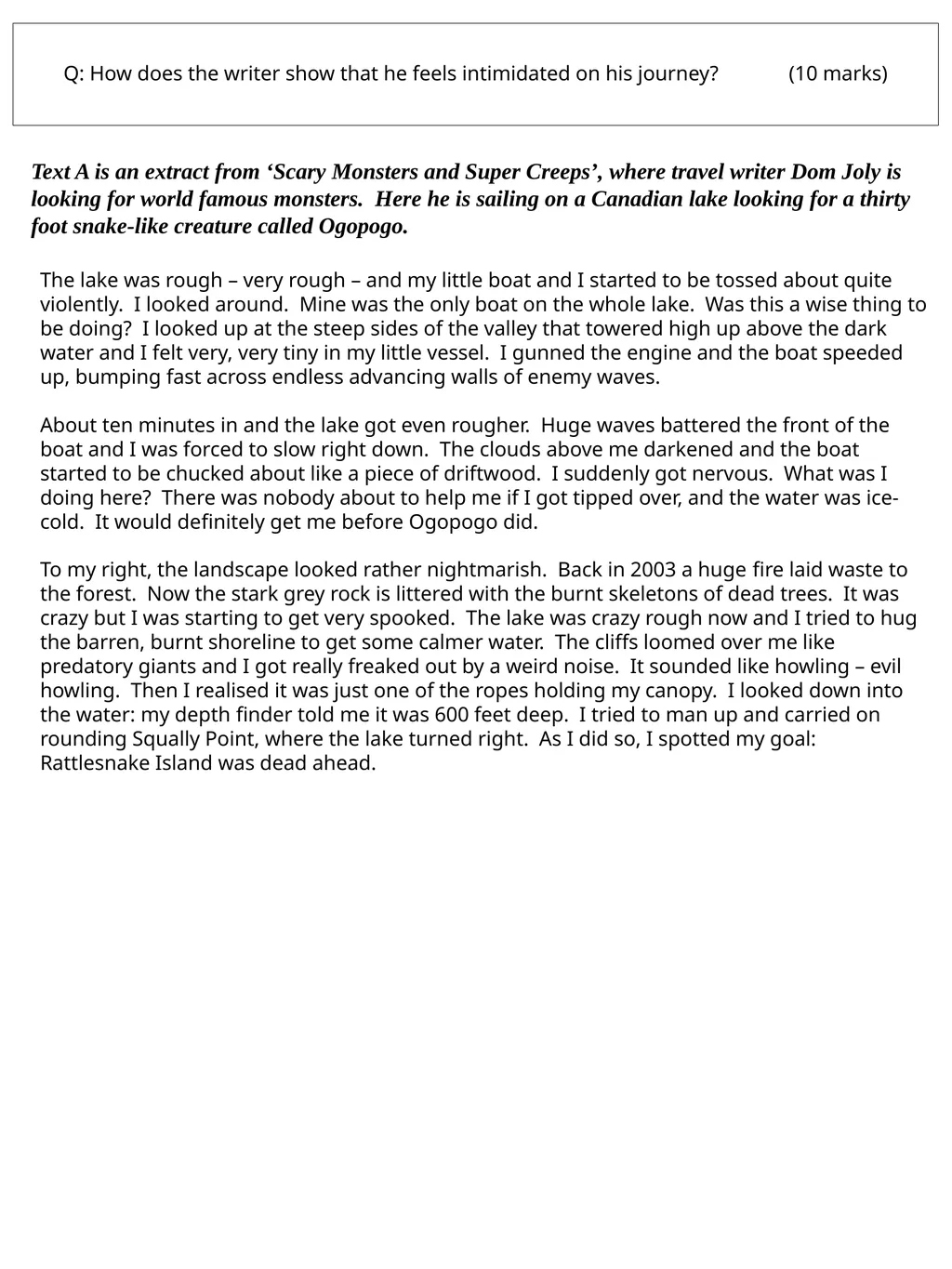
slide11. Q: How does the writer show that he feels intimidated on his journey? (10 marks) Text A is an extract from ‘Scary Monsters and Super Creeps’, where travel writer Dom Joly is looking for world famous monsters. Here he is sailing on a Canadian lake looking for a thirty foot snake-like creature called Ogopogo. The lake was rough – very rough – and my little boat and I started to be tossed about quite violently. I looked around. Mine was the only boat on the whole lake. Was this a wise thing to be doing? I looked up at the steep sides of the valley that towered high up above the dark water and I felt very, very tiny in my little vessel. I gunned the engine and the boat speeded up, bumping fast across endless advancing walls of enemy waves.
About ten minutes in and the lake got even rougher. Huge waves battered the front of the boat and I was forced to slow right down. The clouds above me darkened and the boat started to be chucked about like a piece of driftwood. I suddenly got nervous. What was I doing here? There was nobody about to help me if I got tipped over, and the water was ice-cold. It would definitely get me before Ogopogo did.
To my right, the landscape looked rather nightmarish. Back in 2003 a huge fire laid waste to the forest. Now the stark grey rock is littered with the burnt skeletons of dead trees. It was crazy but I was starting to get very spooked. The lake was crazy rough now and I tried to hug the barren, burnt shoreline to get some calmer water. The cliffs loomed over me like predatory giants and I got really freaked out by a weird noise. It sounded like howling – evil howling. Then I realised it was just one of the ropes holding my canopy. I looked down into the water: my depth finder told me it was 600 feet deep. I tried to man up and carried on rounding Squally Point, where the lake turned right. As I did so, I spotted my goal: Rattlesnake Island was dead ahead.<br>
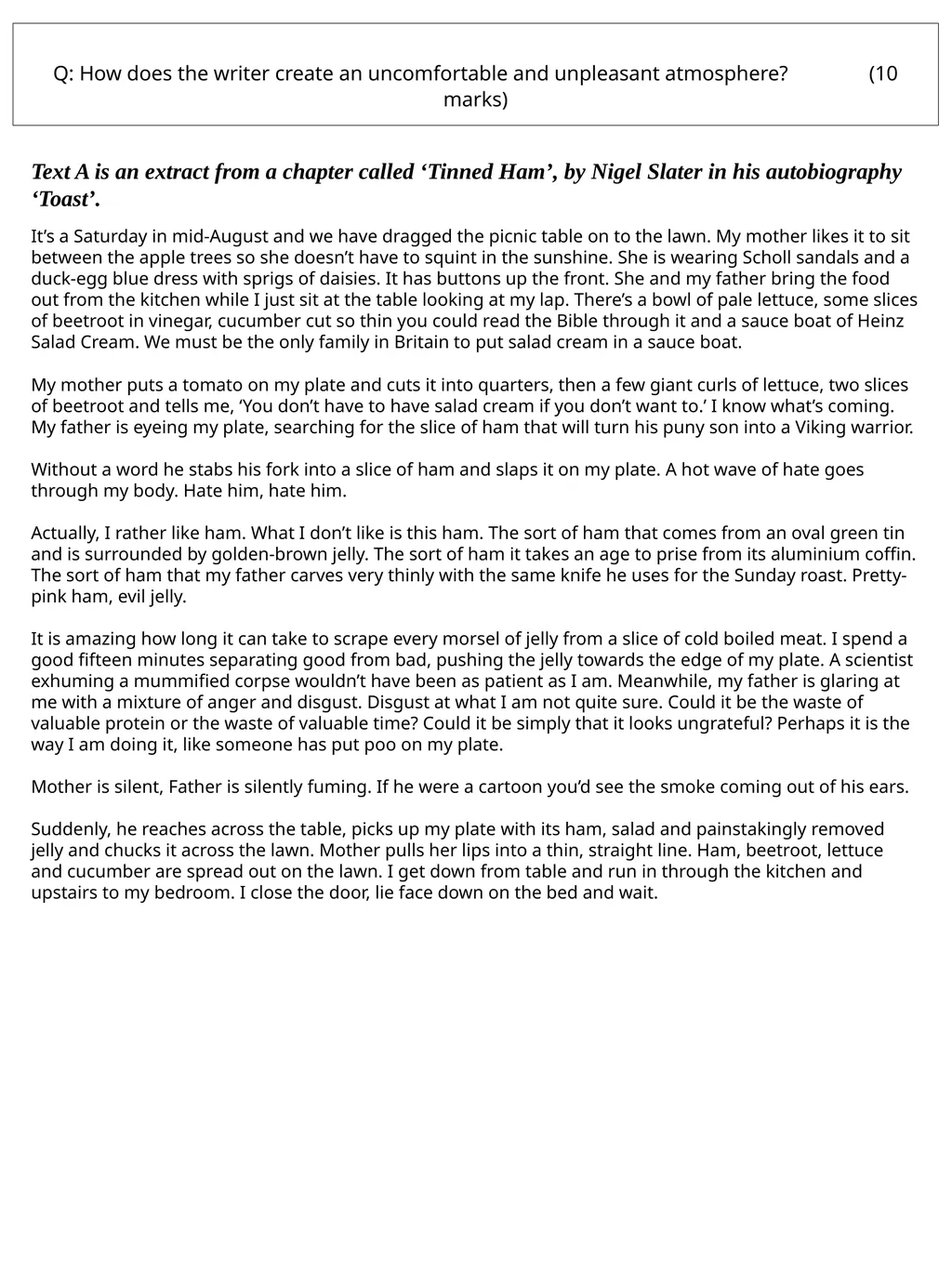
slide12. Q: How does the writer create an uncomfortable and unpleasant atmosphere? (10 marks) Text A is an extract from a chapter called ‘Tinned Ham’, by Nigel Slater in his autobiography ‘Toast’. It’s a Saturday in mid-August and we have dragged the picnic table on to the lawn. My mother likes it to sit between the apple trees so she doesn’t have to squint in the sunshine. She is wearing Scholl sandals and a duck-egg blue dress with sprigs of daisies. It has buttons up the front. She and my father bring the food out from the kitchen while I just sit at the table looking at my lap. There’s a bowl of pale lettuce, some slices of beetroot in vinegar, cucumber cut so thin you could read the Bible through it and a sauce boat of Heinz Salad Cream. We must be the only family in Britain to put salad cream in a sauce boat.
My mother puts a tomato on my plate and cuts it into quarters, then a few giant curls of lettuce, two slices of beetroot and tells me, ‘You don’t have to have salad cream if you don’t want to.’ I know what’s coming. My father is eyeing my plate, searching for the slice of ham that will turn his puny son into a Viking warrior.
Without a word he stabs his fork into a slice of ham and slaps it on my plate. A hot wave of hate goes through my body. Hate him, hate him.
Actually, I rather like ham. What I don’t like is this ham. The sort of ham that comes from an oval green tin and is surrounded by golden-brown jelly. The sort of ham it takes an age to prise from its aluminium coffin. The sort of ham that my father carves very thinly with the same knife he uses for the Sunday roast. Pretty-pink ham, evil jelly.
It is amazing how long it can take to scrape every morsel of jelly from a slice of cold boiled meat. I spend a good fifteen minutes separating good from bad, pushing the jelly towards the edge of my plate. A scientist exhuming a mummified corpse wouldn’t have been as patient as I am. Meanwhile, my father is glaring at me with a mixture of anger and disgust. Disgust at what I am not quite sure. Could it be the waste of valuable protein or the waste of valuable time? Could it be simply that it looks ungrateful? Perhaps it is the way I am doing it, like someone has put poo on my plate.
Mother is silent, Father is silently fuming. If he were a cartoon you’d see the smoke coming out of his ears.
Suddenly, he reaches across the table, picks up my plate with its ham, salad and painstakingly removed jelly and chucks it across the lawn. Mother pulls her lips into a thin, straight line. Ham, beetroot, lettuce and cucumber are spread out on the lawn. I get down from table and run in through the kitchen and upstairs to my bedroom. I close the door, lie face down on the bed and wait.<br>
Dive straight in: The writer of text A feels….. when it states “……” showing that … In text B, the writer feels….
Chunk the text into three sections. At the beginning, the writer states…. Furthermore the writer suggests… Finally….
Use analytical verbs – suggests – implies – illustrates – highlights – shows- portrays Key points to remember:
Highlight what is asked for in question;
Comment on what is said and explain how the quote/ language works/ answer the question is the most important element of this response.
Systematically work through – evidence /effect
Integrate technique reference into answer… the choice of emotive language here…’quote’….. Persuades…..
Consider title/ tone/ language choices/ images/ presentational devices and structure in the text and respond to these ideas in your answer. (consider the whole text)
Time and marks:
* 5 marks = 7-8 minutes reading and answering the question;
* 10 marks = 15 minutes reading and answering the question;
Use terms such as: ‘the writer/ author’ and ‘the reader’<br>
slide2. Q: How does Laurie Lee use language to describe the coal tips? (10 marks) This is an extract from an essay written in 1967 called The Village that Lost its Children by Laurie Lee. Aberfan was a small mining village in Wales. In 1966, many of its people, including children at a local school, were killed when heavy rain caused a landslide. The Village that Lost its Children
Few people had ever heard of Aberfan until disaster struck it. It was just another of the small mining villages lying tucked away in the South Wales valleys – a huddle of anonymous terraced houses of uniform ugliness unrelieved except for chapel and pub.
Its heart was the coal-pit, and its environment like the others – the debris of a slowly exhausting industry: a disused canal, some decaying railtracks, a river black as the Styx1, a general coating of grime over roofs and gardens, and the hills above blistered with a century of mining waste.
Such villages learned to accept a twilight world where most of the menfolk worked down the pits. Many died early, with their lungs full of coal-dust, and the life was traditionally grim and perilous. Disaster, in fact, was about the only news that ever came out of the valleys – the sudden explosion underground, miners entombed alive, or the silent death in the dark from gas. Wales and the world were long hardened to such news. But not to what happened in Aberfan.
A coal-mine sends to the surface more waste than coal, and a mining village has to learn to live with it. It must be put somewhere or the mine would close, and it’s too expensive to carry it far. So the tips grow everywhere, straddling the hillsides, nudging the houses like blackfurred beasts. Almost everyone, from time to time, has seen danger in them, but mostly they are endured as a fact of life.
On the mountain above Aberfan there were seven such tips. The evening sun sank early behind them. To some of the younger generation they had always been there, as though dumped by the hand of God. They could be seen from the school windows, immediately below them, rising like black pyramids in the western sky. But they were not as solid as they looked; it was known that several had moved in the past, inching ominously down the mountain.
What was not known however was that the newest tip, number 7, was a killer with a rotten heart. It had been begun in Easter 1958, and was built on a mountain spring, most treacherous of all foundations. Gradually, over the years, the fatal seeping of water was turning Tip 7 into a mountain of moving muck.
Then one morning, out of the mist, the unthinkable happened, and the tip came down on the village. The children of Pantglas Junior School had just arrived in their classrooms and were right in the path of it. They were the first to be hit by the wave of stupifying filth which instantly smothered more than a hundred of them.
The catastrophe was not only the worst in Wales but an event of such wanton and indifferent cruelty it seemed to put to shame both man and God.<br>
slide3. Q: How does Gerardo Arias Camacho convince the reader of the benefits of Fairtrade? (10 marks) Text D is taken from The Guardian newspaper
The story of a coffee farmer
Gerardo Arlas Camacho is a coffee farmer in Costa Rica. He is a board member on his village co-operative, which is a member of the Fairtrade consortium COOCAFE. He is married with three children.
In the 1980s, the price of coffee was so low that it didn’t cover the cost of production. Many farmers abandoned their land and some even left the country to find work. In the mid-90s, I went tot America to make money and support my family. After eight years, I had earned enough to buy the family farm so that my parents could retire. But coffee prices were still so low that I was forced to return to America for another two years.
Then the coffee business was unstable. We did not have a local school, good roads or bridges. Now that we are Fairtrade-certified, prices are stable and we receive a guaranteed amount for our coffee. We spent the money on education, environmental protection, roads and bridges, and improving the processing plant. We have a scholarship programme so that our kids can stay in school. I believe that my farm would be out of business if it wasn’t for Fairtrade. Free trade is not responsible trade. When prices go down, farmers produce more and prices drop further. Fairtrade is the way trade should be: fair, responsible and sustainable.
My oldest son is in college, my ten-year-old has already had as much education as me, and my little girl is in her second year at school. With the help of Fairtrade, they might all be able to go to university and get a degree. They won’t have to jump the border from Mexico to America, like me. They can decide what they want in life.
Since Fairtrade, our farms have become more environmentally-friendly. Our coffee is now produced in a sustainable way. We plant trees and have reduced the use of pesticides by 80% in 10 years. We used to cut 50 acres of forest down every year to fuel the ovens at our processing plant. Now we have a new oven which is fuelled by coffee waste products and the skins of macadamia nuts that we buy from farmers on the other side of Costa Rica. It is a win-win business.
Fairtrade is not a closed system. It is open to everyone but we need more and more people to buy Fairtrade so other farmers can become certified. We already educate other producers around us about market prices so that buyers have to offer them a competitive rate and this benefits the wider community. When there was a hurricane, the main road became blocked and he bridge came down. We could afford to open the road and fix the bridge.
When you are shopping, look for the Fairtrade label – you can be sure that the money is going straight to the producers. It will help us, and it will help people around the world, because the benefits of protecting the environment are for everyone. It’s a matter of helping each other.
As a Fairtrade farmer, I finally feel competitive. It has given me the knowledge so that I am more able to defend myself and my people. I feel there is a future in front of us because we can stay in our own country and make a living growing coffee. Fairtrade is not charity. Just by going shopping, you can make a difference.<br>
slide4. Candidate 1
Gerardo Arias Camacho convinces the reader of the benefits of Fairtrade by using facts this is shown when it says ‘in the 1980s, the price of coffee was so low that it didn’t cover the cost of production’ this convinces the reader because they can see/read proof and they have something to react on. Gerardo Arias Camacho convinces the reader by using statistics shown when he says ‘we plant trees and have reduced the use of pesticides by 80% in 10 years’ this makes the reader think about helping and doing something good. Gerardo Arias Camacho convinces the reader by using a colon (:) this is shown when he says ‘Fairtrade is the way trade should be: fair, responsible and sustainable’ this makes the reader believe Fairtrade is good and makes them willing to act for Fairtrade.
Mark out of 10? ………….. Candidate 2
Camacho convinces the reader that Fairtrade is beneficial by giving us a personal account of his own experiences, using anecdotal language to tell 'the story of a coffee farmer’. As a
consequence, the reader is convinced that Fairtrade is beneficial as Camacho gives evidence of its positive impact on his family and his community’s lives. At the beginning, he refers to ‘the price of coffee’ in ‘the 1980s’ to contrast the difficult times then with the times now, where Fairtrade has transformed their lives. He says he was ‘forced to return to America’ to make the reader feel empathy towards him, with the verb showing how he had no control over his life and that it wasn’t his choice. Consequently, Camacho portrays how hard life was when ‘coffee prices were still so low’ and ‘many farmers abandoned their land and some even left the country,’ convincing the reader how beneficial it has been because he then goes on to convincing the reader that Fairtrade also has positive impacts on our environment as well as our people. Camacho tells us it’s a ‘win-win business’ and that it’s ‘open to everyone’ to show that Fairtrade can benefit us all. Consequently, he comes to the conclusion that Fairtrade does ‘make a difference because it allows people to ‘help each other’. By telling us directly using the word ‘you’ Camacho convinces us the reader that it is worth us investing in Fairtrade because ‘the benefits…are for everyone.’ He concludes by using the word ‘I’ repetitively to highlight the positive impact on his life making him ‘feel competitive’ and has ‘a future’. He tells us we can help more people like him by simply going shopping convincing us that Fairtrade is beneficial.
Mark out of 10? ………….. Q: How does Gerardo Arias Camacho convince the reader of the benefits of Fairtrade? (10 marks)<br>
slide5. Q: How does the writer try to show that Agbo is “not a good place to live”? (10 marks) Text A is an extract from an article by Afua Hirsch.
‘This is not a good place to live’: inside Ghana’s dump for electronic waste.
Agbo is Ghana’s vast dumping site for electronic waste. In this bleak landscape, young people scavenge for scrap metal amid the smoke from plastic fires. The health risks are obvious – but the money is too good to ignore.
“Electric waste comes here from all over the world – but especially from Europe,” says Karim, 29, who has been salvaging, buying and selling at the dump for 10 years. “We get a lot of health problems here. Many workers here have died from cancers, but we manage, because we need the money.”
Agbo seems chaotic in places, but there is an order to the large, desolate, rubbish-strewn site. At one side, boys and young men gather in groups, picking their way through piles of old hard drives, untangling wires, and breaking up old air conditioning units.
Deeper into the heart of Agbo, huge plumes of foul-smelling smoke rise up from three large fires, where the dismantled items are burned to remove traces of plastic, leaving the metal behind. The fumes are head-pounding, but the men, women and children weaving in and out of the fires don’t seem to notice. The death rate for babies is high here.
Roles are divided at Agbo. Women and girls wander the sprawling site, selling peeled oranges, water and cooked food. Many have tiny babies wrapped in cloth tied tightly to their backs, all inhaling the poisonous fumes. There are special jobs for children, who trawl the site with magnets tied on to the end of a piece of string, picking up any tiny scraps of metal such as tin left behind in the dirt.
In the centre of the dump, a clearing has been turned into a football pitch, and two teams are in the middle of a game. Agbo is not just a site for trading, burning and dumping electrical waste; it’s also home to thousands of people, who carry on their lives and raise their children in the midst of its filth and fumes. Families live in the shacks dotted throughout the central area of the dump.<br>
slide6. Q: How does John Humphrys persuade the reader he hates noise? (10 marks) Text E is an extract from a newspaper article by John Humphrys.
I present the Today programme and have become obsessed with noise. The first question strangers ask is always: “What time do you get up?” (Answer: the middle of the night.) The second is: “What time do you go to bed?” (Answer: absurdly early – long before the average 10-year-old.) And the third is: “How do you manage to sleep?”
Which is where noise comes in. Because it depends. If it is quiet, I sleep like a contented baby. If it is noisy, I sleep like a fractious baby with a particularly nasty teething problem. The difference is that if I a kept awake, I do not scream for attention, but lie still, cursing all those selfish souls who think it is acceptable to walk past my house at nine in the evening without lowering their voices to a whisper.
I happen to be on the extreme end of the spectrum for obvious reasons, but you, dear reader, you may be on it, too. Do you not dread the approach of Christmas with the certain knowledge that every shop you enter will welcome you with canned Christmas carols? Or the hotels who believe you cannot make it through a meal without music in the background? Even at breakfast, for God’s sake! Do you not want to take a large hammer to the small jet engine your neighbour insists on using to blow away the tiny handful of leaves that have settled in his front garden, smash it into even tinier pieces and hand him a broom that would do the job in a fraction of the time (and quietly)?
Do you not nod in (silent) agreement at the result of the survey last week that asked office workers what most annoyed them about the behaviour of their colleagues and found that they put eating noisily at the top of the list by a large majority? Do you not applaud the hotel chain that has installed noise meters in its corridors that flash a warning light if people are talking too loudly and offer a refund to guests who failed to get a good night’s sleep because of noise? We can even – just – forgive the company for calling them “ssshhh-o-meters”.<br>
slide7. Q: How does John Humphrys persuade the reader he hates noise? (10 marks) Text E is an extract from a newspaper article by John Humphrys.
I present the Today programme and have become obsessed with noise. The first question strangers ask is always: “What time do you get up?” (Answer: the middle of the night.) The second is: “What time do you go to bed?” (Answer: absurdly early – long before the average 10-year-old.) And the third is: “How do you manage to sleep?”
Which is where noise comes in. Because it depends. If it is quiet, I sleep like a contented baby. If it is noisy, I sleep like a fractious baby with a particularly nasty teething problem. The difference is that if I a kept awake, I do not scream for attention, but lie still, cursing all those selfish souls who think it is acceptable to walk past my house at nine in the evening without lowering their voices to a whisper.
I happen to be on the extreme end of the spectrum for obvious reasons, but you, dear reader, you may be on it, too. Do you not dread the approach of Christmas with the certain knowledge that every shop you enter will welcome you with canned Christmas carols? Or the hotels who believe you cannot make it through a meal without music in the background? Even at breakfast, for God’s sake! Do you not want to take a large hammer to the small jet engine your neighbour insists on using to blow away the tiny handful of leaves that have settled in his front garden, smash it into even tinier pieces and hand him a broom that would do the job in a fraction of the time (and quietly)?
Do you not nod in (silent) agreement at the result of the survey last week that asked office workers what most annoyed them about the behaviour of their colleagues and found that they put eating noisily at the top of the list by a large majority? Do you not applaud the hotel chain that has installed noise meters in its corridors that flash a warning light if people are talking too loudly and offer a refund to guests who failed to get a good night’s sleep because of noise? We can even – just – forgive the company for calling them “ssshhh-o-meters”. Need a hand getting started?
Look to the highlighted sections.
Can you comment on….?
The effect of questions and answers on the reader, with the humorous asides about how early he goes to bed?
The contrasting similes used to describe his sleep
The hyperbole and humour used to describe people who talk at 9pm as “selfish souls”
The aside to the reader that flatters and compliments
-The witty alliteration suggesting carols are mass produced and dreadful<br>
slide8. Q: How does the writer use language to describe the storm? (10 marks) Text A is an extract from ‘The Death Zone’ by Matt Dickinson
At speeds touching 80 to 100 kilometres an hour, the storm whipped into the camp just minutes later, plunging the temperature down by ten to fifteen degrees in as many seconds, ripping into the tents in a blinding fury of driving snow. The storm swept up the southern flanks of Everest engulfing the ice-clad slopes effortlessly in a swirling mantle of hurricane-force winds. Within minutes it had the northern side in its grip and then it rose to take the summit. The mightiest mountain in the world disappeared from view as the storm took control.
If Shiva, the Hindu god of destruction, and Nemesis, the Greek goddess of retribution, had joined forces they could not have done a better job of devastation than nature itself did on that day. The timing was uncanny, as bad as it was possible to be. If the storm had struck in winter then no one would have been hurt. But as chance would have it, the tempest arrived on the busiest day of the Everest calendar, right in the middle of the pre-monsoon climbing season.<br>
slide9. Q: How does the writer use language to describe the seaside resort of Broadstairs? (10 marks) Text A is an extract from a description by Charles Dickens of his favourite seaside holiday resort, Broadstairs, in East-Kent. The place seems to respond. Sky, sea, beach, and village, lie as still before us as if they were sitting for the picture. It is dead low-water. A ripple plays among the ripening corn upon the cliff, as if it were faintly trying from recollection to imitate the sea; and the world of butterflies hovering over the crop of radish-seed are as restless in their little way as the gulls are in their larger manner when the wind blows. But the ocean lies winking in the sunlight like a drowsy lion - its glassy waters scarcely curve upon the shore - the fishing-boats in the tiny harbour are all stranded in the mud - our two colliers have not an inch of water within a quarter of a mile of them, and turn, exhausted, on their sides, like faint fish. Rusty cables and chains, ropes and rings, undermost parts of posts and piles and confused timber-defences against the waves, lie strewn about, in a brown litter of tangled sea-weed and fallen cliff which looks as if a family of giants had been making tea here for ages, and had observed an untidy custom of throwing their tea-leaves on the shore.
In truth, our watering-place itself has been left somewhat high and dry by the tide of years. Concerned as we are for its honour, we must reluctantly admit that the time when this pretty little semi circular sweep of houses, tapering off at the end of the wooden pier into a point in the sea, was a gay place, and when the lighthouse overlooking it shone at daybreak on company dispersing from public balls, is but dimly traditional now. There is a bleak chamber in our watering-place which is yet called the Assembly 'Rooms,' and understood to be available on hire for balls or concerts.<br>
slide10. Q: How does Angela Epstein try to show that ‘life is not easy for a working mother’? (10 marks) Text A is an extract from an article by Angela Epstein.
Wash up? That’ll cost you £5, Mum. Should you really have to pay your children to help around the house?
My boss had told me I had to phone him at 6:30pm – right in the middle of crisis hour, that time of day when tired hungry children collide with irritable parents and edge the household towards complete and utter meltdown. However, this evening my little girl was having an especially spectacular tantrum because, she alleged, someone had taken her blue plastic pony.
“Sophie, stop that noise. I need to make a phone call,” I thundered, as if that would somehow make my crimson-faced daughter pipe down.
She simply cranked up her howling. In desperation, I turned to Max, my 15-year-old son, and asked him to take his sister into the garden. I uttered the magic words, “I’ll pay you.”…
And so my children are aware they can get large amounts of cash by taking advantage of me.
It’s not that I have reared a brood of merciless youngsters who know the price of everything and the value of nothing. They’re actually a very loving, friendly bunch. They are simply taking their cue from me.
You see, the way I live my life has been my undoing. Every day is a demented juggle between running a home and doing a job. My downfall was raising children who are sharp enough to realise that in my desperation to get everything done, there is money to be made.
I don’t always give in. The other day I asked Max to answer the door.
“I answered it last week,” he murmured.
“Just do it,” I ordered.
“How much?” he ventured, although he was joking (I think) and shot me a knowing smile before strolling off to let my visitor in.
Don’t get me wrong. There are times when children should have incentives. They can learn a lot by being paid to wash the car or do the garden. It’s honest work and I’d have to pay someone to do it – so why shouldn’t they make a few quid?
It teaches them early on in life that there is great dignity in being rewarded for hard work. But I can’t seem to resist the temptation to cough up whenever I need to buy another pair of hands or ten minutes of silence. Anything for an easy life.
When I finally made my phone call to my boss, he couldn’t speak to me. His grandchildren had just arrived and he wanted to rearrange our conversation. “Children come first,” he chuckled. “I’m sure you understand.”<br>
slide11. Q: How does the writer show that he feels intimidated on his journey? (10 marks) Text A is an extract from ‘Scary Monsters and Super Creeps’, where travel writer Dom Joly is looking for world famous monsters. Here he is sailing on a Canadian lake looking for a thirty foot snake-like creature called Ogopogo. The lake was rough – very rough – and my little boat and I started to be tossed about quite violently. I looked around. Mine was the only boat on the whole lake. Was this a wise thing to be doing? I looked up at the steep sides of the valley that towered high up above the dark water and I felt very, very tiny in my little vessel. I gunned the engine and the boat speeded up, bumping fast across endless advancing walls of enemy waves.
About ten minutes in and the lake got even rougher. Huge waves battered the front of the boat and I was forced to slow right down. The clouds above me darkened and the boat started to be chucked about like a piece of driftwood. I suddenly got nervous. What was I doing here? There was nobody about to help me if I got tipped over, and the water was ice-cold. It would definitely get me before Ogopogo did.
To my right, the landscape looked rather nightmarish. Back in 2003 a huge fire laid waste to the forest. Now the stark grey rock is littered with the burnt skeletons of dead trees. It was crazy but I was starting to get very spooked. The lake was crazy rough now and I tried to hug the barren, burnt shoreline to get some calmer water. The cliffs loomed over me like predatory giants and I got really freaked out by a weird noise. It sounded like howling – evil howling. Then I realised it was just one of the ropes holding my canopy. I looked down into the water: my depth finder told me it was 600 feet deep. I tried to man up and carried on rounding Squally Point, where the lake turned right. As I did so, I spotted my goal: Rattlesnake Island was dead ahead.<br>
slide12. Q: How does the writer create an uncomfortable and unpleasant atmosphere? (10 marks) Text A is an extract from a chapter called ‘Tinned Ham’, by Nigel Slater in his autobiography ‘Toast’. It’s a Saturday in mid-August and we have dragged the picnic table on to the lawn. My mother likes it to sit between the apple trees so she doesn’t have to squint in the sunshine. She is wearing Scholl sandals and a duck-egg blue dress with sprigs of daisies. It has buttons up the front. She and my father bring the food out from the kitchen while I just sit at the table looking at my lap. There’s a bowl of pale lettuce, some slices of beetroot in vinegar, cucumber cut so thin you could read the Bible through it and a sauce boat of Heinz Salad Cream. We must be the only family in Britain to put salad cream in a sauce boat.
My mother puts a tomato on my plate and cuts it into quarters, then a few giant curls of lettuce, two slices of beetroot and tells me, ‘You don’t have to have salad cream if you don’t want to.’ I know what’s coming. My father is eyeing my plate, searching for the slice of ham that will turn his puny son into a Viking warrior.
Without a word he stabs his fork into a slice of ham and slaps it on my plate. A hot wave of hate goes through my body. Hate him, hate him.
Actually, I rather like ham. What I don’t like is this ham. The sort of ham that comes from an oval green tin and is surrounded by golden-brown jelly. The sort of ham it takes an age to prise from its aluminium coffin. The sort of ham that my father carves very thinly with the same knife he uses for the Sunday roast. Pretty-pink ham, evil jelly.
It is amazing how long it can take to scrape every morsel of jelly from a slice of cold boiled meat. I spend a good fifteen minutes separating good from bad, pushing the jelly towards the edge of my plate. A scientist exhuming a mummified corpse wouldn’t have been as patient as I am. Meanwhile, my father is glaring at me with a mixture of anger and disgust. Disgust at what I am not quite sure. Could it be the waste of valuable protein or the waste of valuable time? Could it be simply that it looks ungrateful? Perhaps it is the way I am doing it, like someone has put poo on my plate.
Mother is silent, Father is silently fuming. If he were a cartoon you’d see the smoke coming out of his ears.
Suddenly, he reaches across the table, picks up my plate with its ham, salad and painstakingly removed jelly and chucks it across the lawn. Mother pulls her lips into a thin, straight line. Ham, beetroot, lettuce and cucumber are spread out on the lawn. I get down from table and run in through the kitchen and upstairs to my bedroom. I close the door, lie face down on the bed and wait.<br>