How to Do Research! Tips Learn to read papers and develop your taste One of the most common ways to generate new ideas is by reading other papers and getting inspired Pay special attention to the relevant seminar classes where you begin to
"How to Do Research! Tips Learn to read papers and" is the property of its rightful owner. Permission is granted to
download and print the materials on this website for personal, non-commercial use only, and to display it
on your personal computer provided you do not modify the materials and that you retain all copyright
notices contained in the materials. By downloading content from our website, you accept the terms of this
agreement.
Presentation Transcript
01
How to Do Research!<br>
02
Tips Learn to read papers and develop your taste
One of the most common ways to generate new ideas is by reading other papers and getting inspired
Pay special attention to the relevant seminar classes where you begin to read a ton of papers
More importantly, find what types of papers interest you the most and ask yourself why. https://medium.com/digital-diplomacy/how-to-look-for-ideas-in-computer-science-research-7a3fa6f4696f<br>
03
Your first year(s) as a PhD Student A growing group
A lot of ideas are thrown at you
A well-established group where your advisor no longer gives students concrete ideas to work on
You have to come up with a research idea<br>
04
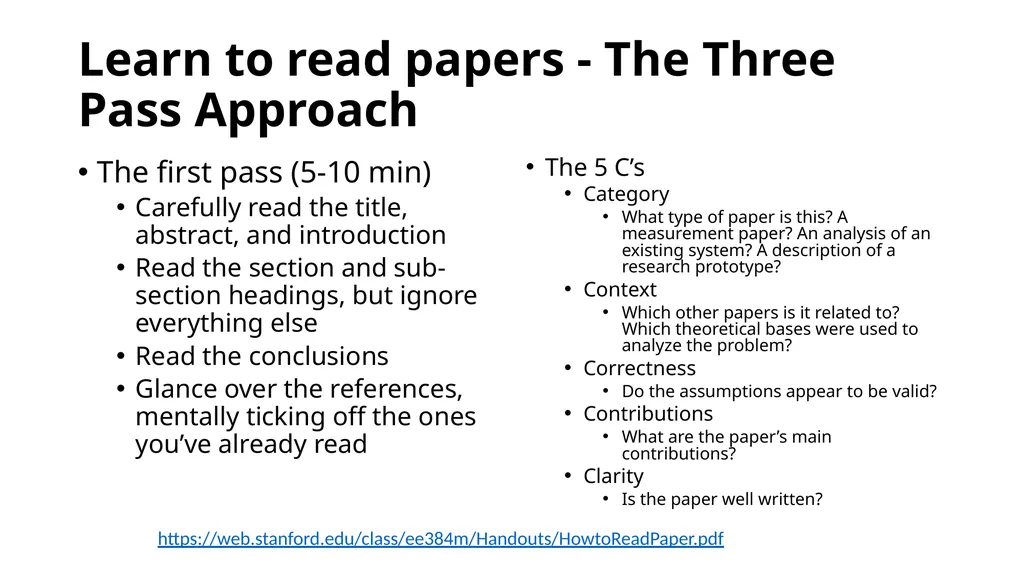
Learn to read papers - The Three Pass Approach The first pass (5-10 min)
Carefully read the title, abstract, and introduction
Read the section and sub-section headings, but ignore everything else
Read the conclusions
Glance over the references, mentally ticking off the ones you’ve already read The 5 C’s
Category
What type of paper is this? A measurement paper? An analysis of an existing system? A description of a research prototype?
Context
Which other papers is it related to? Which theoretical bases were used to analyze the problem?
Correctness
Do the assumptions appear to be valid?
Contributions
What are the paper’s main contributions?
Clarity
Is the paper well written? https://web.stanford.edu/class/ee384m/Handouts/HowtoReadPaper.pdf<br>
05
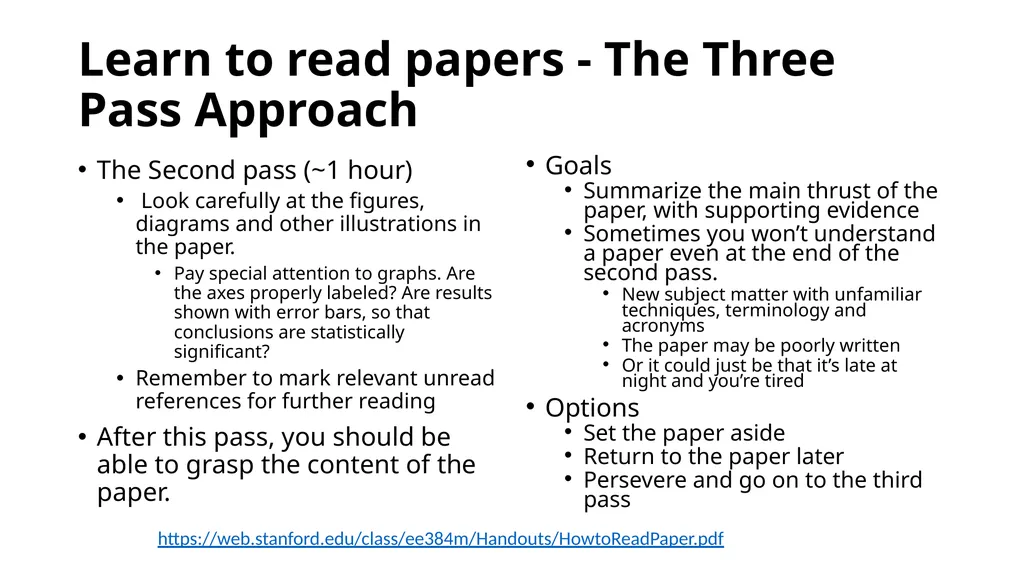
Learn to read papers - The Three Pass Approach The Second pass (~1 hour)
Look carefully at the figures, diagrams and other illustrations in the paper.
Pay special attention to graphs. Are the axes properly labeled? Are results shown with error bars, so that conclusions are statistically significant?
Remember to mark relevant unread references for further reading
After this pass, you should be able to grasp the content of the paper. Goals
Summarize the main thrust of the paper, with supporting evidence
Sometimes you won’t understand a paper even at the end of the second pass.
New subject matter with unfamiliar techniques, terminology and acronyms
The paper may be poorly written
Or it could just be that it’s late at night and you’re tired
Options
Set the paper aside
Return to the paper later
Persevere and go on to the third pass https://web.stanford.edu/class/ee384m/Handouts/HowtoReadPaper.pdf<br>
06
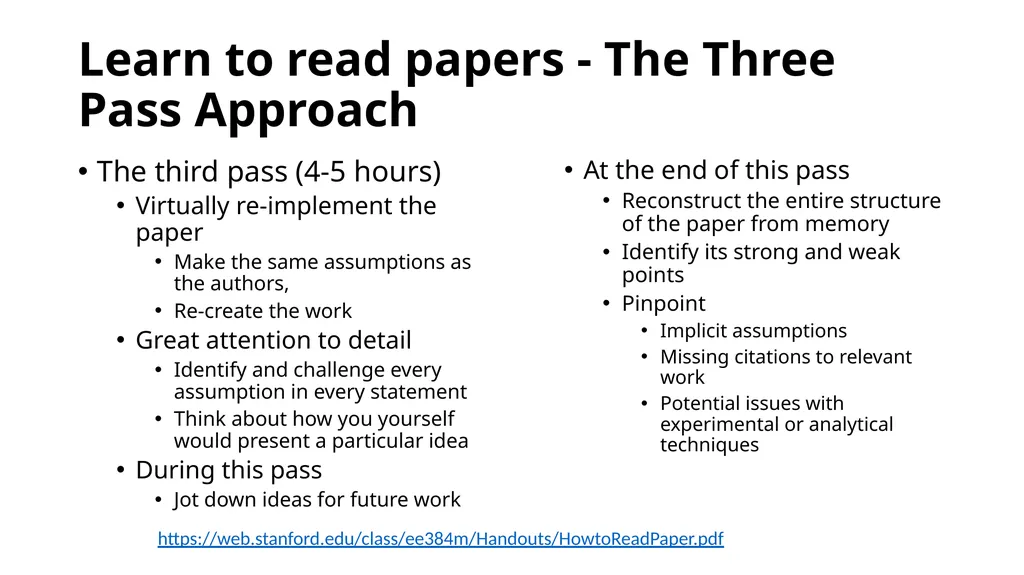
Learn to read papers - The Three Pass Approach The third pass (4-5 hours)
Virtually re-implement the paper
Make the same assumptions as the authors,
Re-create the work
Great attention to detail
Identify and challenge every assumption in every statement
Think about how you yourself would present a particular idea
During this pass
Jot down ideas for future work At the end of this pass
Reconstruct the entire structure of the paper from memory
Identify its strong and weak points
Pinpoint
Implicit assumptions
Missing citations to relevant work
Potential issues with experimental or analytical techniques https://web.stanford.edu/class/ee384m/Handouts/HowtoReadPaper.pdf<br>
07
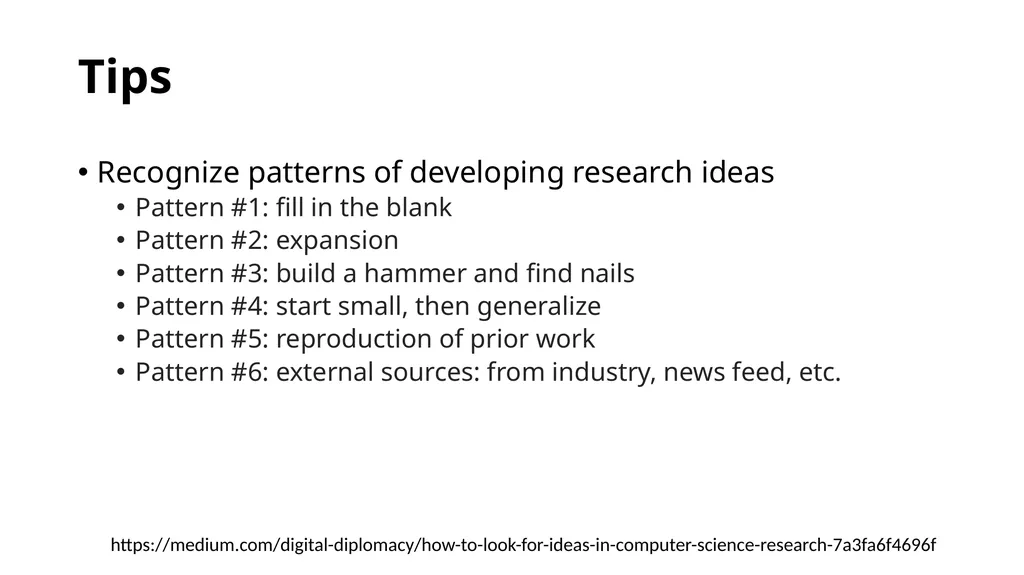
Tips Recognize patterns of developing research ideas
Pattern #1: fill in the blank
Pattern #2: expansion
Pattern #3: build a hammer and find nails
Pattern #4: start small, then generalize
Pattern #5: reproduction of prior work
Pattern #6: external sources: from industry, news feed, etc. https://medium.com/digital-diplomacy/how-to-look-for-ideas-in-computer-science-research-7a3fa6f4696f<br>
08
Tips Develop a good habit of thinking about research ideas
Realize that the execution of a project is fundamentally different from the generation and formulation of an idea.
Take paper reviews seriously.
Be curious and keep an open mind on what types of papers you might be interested in.
Attend reading groups and talks often and ask questions.
talk to your labmates often, get to know them personally, create a nice connection. https://medium.com/digital-diplomacy/how-to-look-for-ideas-in-computer-science-research-7a3fa6f4696f<br>
09
You and Your Advisor Listen to your advisor.
They won't always be right, but they have been doing research for (in some cases much) longer than you have
When your advisor tells you to do something, do it.
Ping your advisor
If your adviser hasn’t replied to an important email, remind them that you are waiting for their replyson and may not have seen your email or realized its importance.
Feedback
Make sure you obtain feedback from your advisor https://people.cs.umass.edu/~wallach/how_to_be_a_successful_phd_student.pdf<br>
10
Meetings with Your Advisor Meet regularly.
You should meet with your advisor regularly (e.g., weekly)
Regular meetings with your advisor ensure that you are being productive and enable your advisor to give you feedback
Make an agenda.
Make an agenda for every meeting with your advisor
Outline each of the topics that you'd like to cover
If you don’t know what you want to talk about, your advisor’s unlikely to know either
Bring results.
Try to bring results (e.g., graphs, tables, figures) to every meeting
Start with a summary.
Summarizing the previous meeting
Remind them what you agreed on as next steps, summarize what you've done (and haven’t done) https://people.cs.umass.edu/~wallach/how_to_be_a_successful_phd_student.pdf<br>
11
Picking a Research Topic Know the literature
Know the community
Think big
It takes time
Don’t make up problems that don’t exist
Coming up with a new problem is great, but make sure it’s real problem! https://people.cs.umass.edu/~wallach/how_to_be_a_successful_phd_student.pdf<br>
12
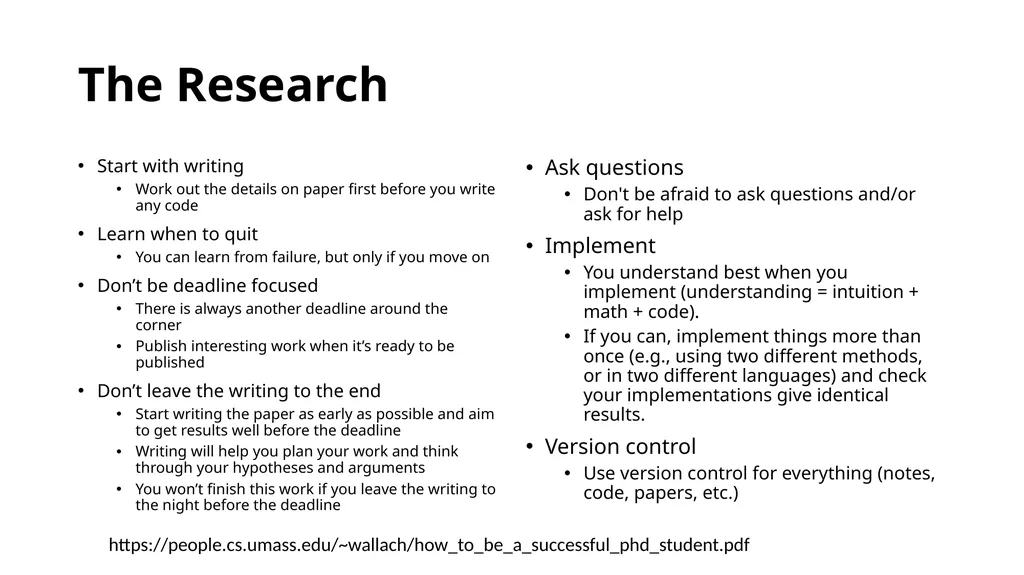
The Research Start with writing
Work out the details on paper first before you write any code
Learn when to quit
You can learn from failure, but only if you move on
Don’t be deadline focused
There is always another deadline around the corner
Publish interesting work when it’s ready to be published
Don’t leave the writing to the end
Start writing the paper as early as possible and aim to get results well before the deadline
Writing will help you plan your work and think through your hypotheses and arguments
You won’t finish this work if you leave the writing to the night before the deadline Ask questions
Don't be afraid to ask questions and/or ask for help
Implement
You understand best when you implement (understanding = intuition + math + code).
If you can, implement things more than once (e.g., using two different methods, or in two different languages) and check your implementations give identical results.
Version control
Use version control for everything (notes, code, papers, etc.) https://people.cs.umass.edu/~wallach/how_to_be_a_successful_phd_student.pdf<br>