
HOW TO READ AN ACADEMIC PAPER: Appraising the
PM
Published · 20 slides · 0 views

1 / 1


Description
HOW TO READ AN ACADEMIC PAPER: Appraising the evidence Chisale Mhango FRCOG Introduction Scholars write academic articles to share their ideas with their peers. Because they already share a highly specialized background, they often assume
Related Topics
Share
Embed code
Download this presentation From Below
"HOW TO READ AN ACADEMIC PAPER: Appraising the" is the property of its rightful owner. Permission is granted to download and print the materials on this website for personal, non-commercial use only, and to display it on your personal computer provided you do not modify the materials and that you retain all copyright notices contained in the materials. By downloading content from our website, you accept the terms of this agreement.
Presentation Transcript
01
HOW TO READ AN ACADEMIC PAPER: Appraising the evidence Chisale Mhango FRCOG<br>
02
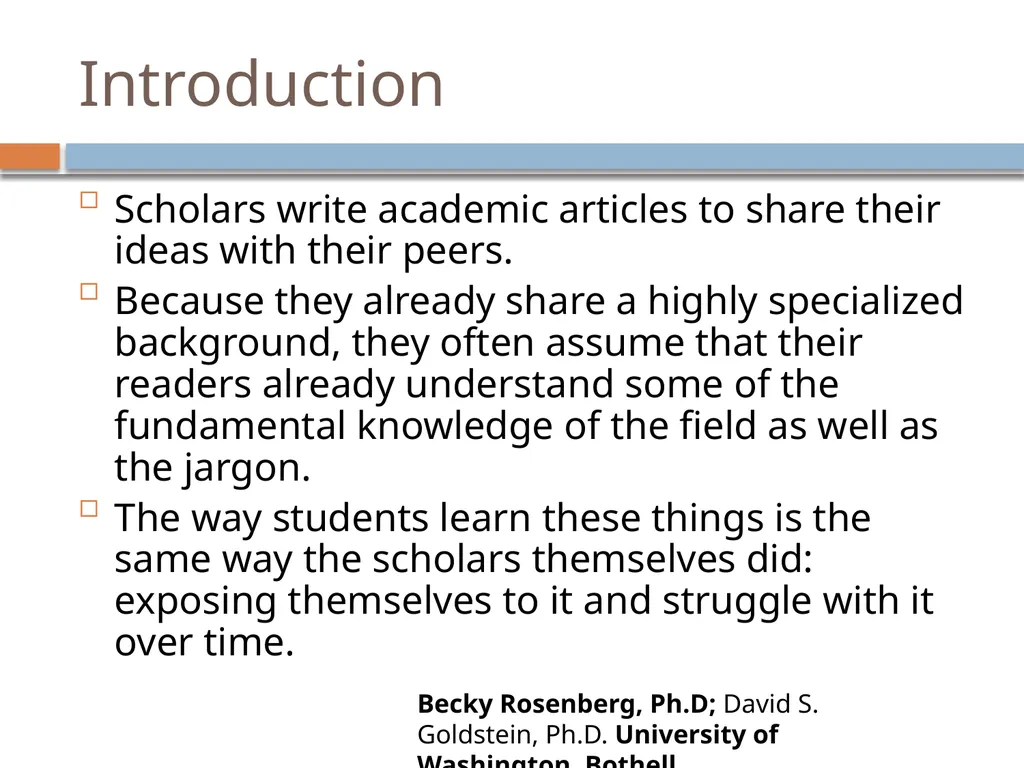
Introduction Scholars write academic articles to share their ideas with their peers.
Because they already share a highly specialized background, they often assume that their readers already understand some of the fundamental knowledge of the field as well as the jargon.
The way students learn these things is the same way the scholars themselves did: exposing themselves to it and struggle with it over time. Becky Rosenberg, Ph.D; David S. Goldstein, Ph.D. University of Washington, Bothell<br>
03
Workshop Practice We have selected readings that we feel will challenge you to grow intellectually.
You must do your best to understand the article as much as possible, so when you convene in plenary, you can contribute to the discussion. Becky Rosenberg, Ph.D; David S. Goldstein, Ph.D. University of Washington, Bothell<br>
You must do your best to understand the article as much as possible, so when you convene in plenary, you can contribute to the discussion. Becky Rosenberg, Ph.D; David S. Goldstein, Ph.D. University of Washington, Bothell<br>
04
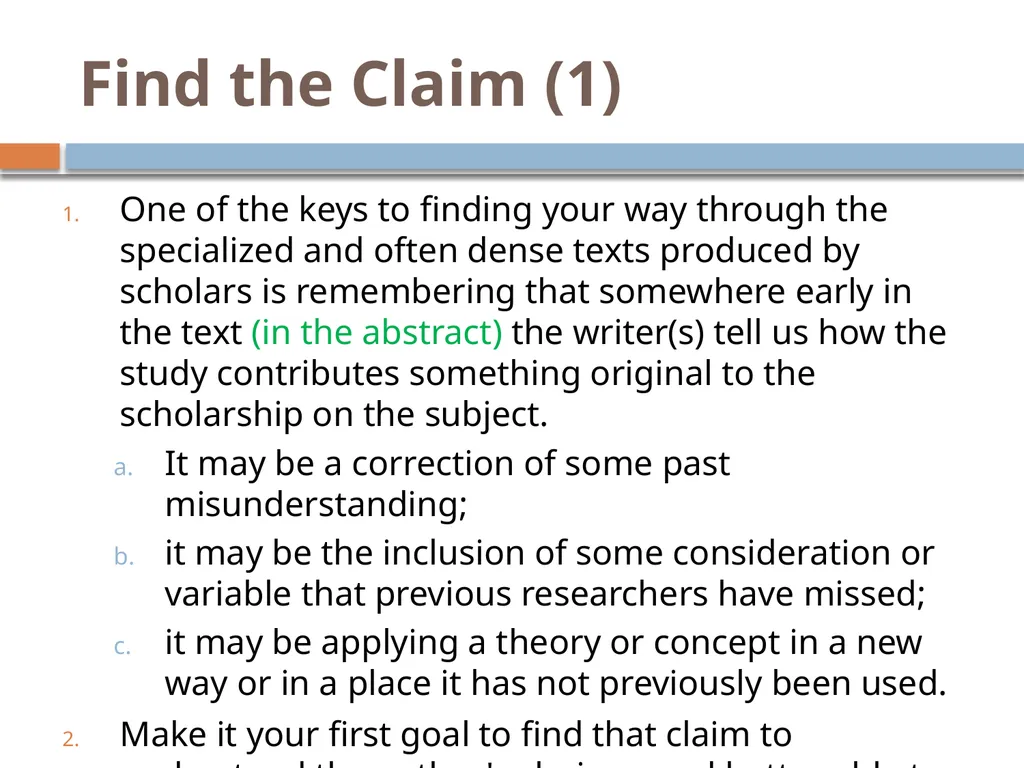
Find the Claim (1) One of the keys to finding your way through the specialized and often dense texts produced by scholars is remembering that somewhere early in the text (in the abstract) the writer(s) tell us how the study contributes something original to the scholarship on the subject.
It may be a correction of some past misunderstanding;
it may be the inclusion of some consideration or variable that previous researchers have missed;
it may be applying a theory or concept in a new way or in a place it has not previously been used.
Make it your first goal to find that claim to understand the author's choices, and better able to evaluate the effectiveness of the argument.<br>
05
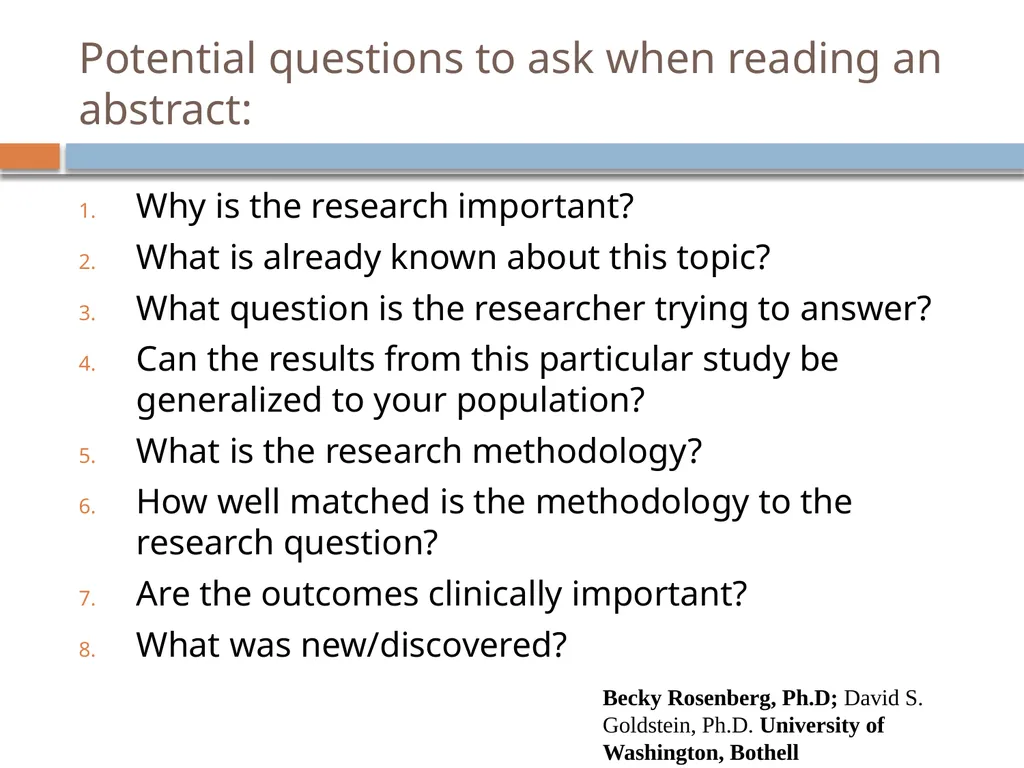
Potential questions to ask when reading an abstract: Why is the research important?
What is already known about this topic?
What question is the researcher trying to answer?
Can the results from this particular study be generalized to your population?
What is the research methodology?
How well matched is the methodology to the research question?
Are the outcomes clinically important?
What was new/discovered? Becky Rosenberg, Ph.D; David S. Goldstein, Ph.D. University of Washington, Bothell<br>
06
Becky Rosenberg, Ph.D; David S. Goldstein, Ph.D. University of Washington, Bothell<br>
07
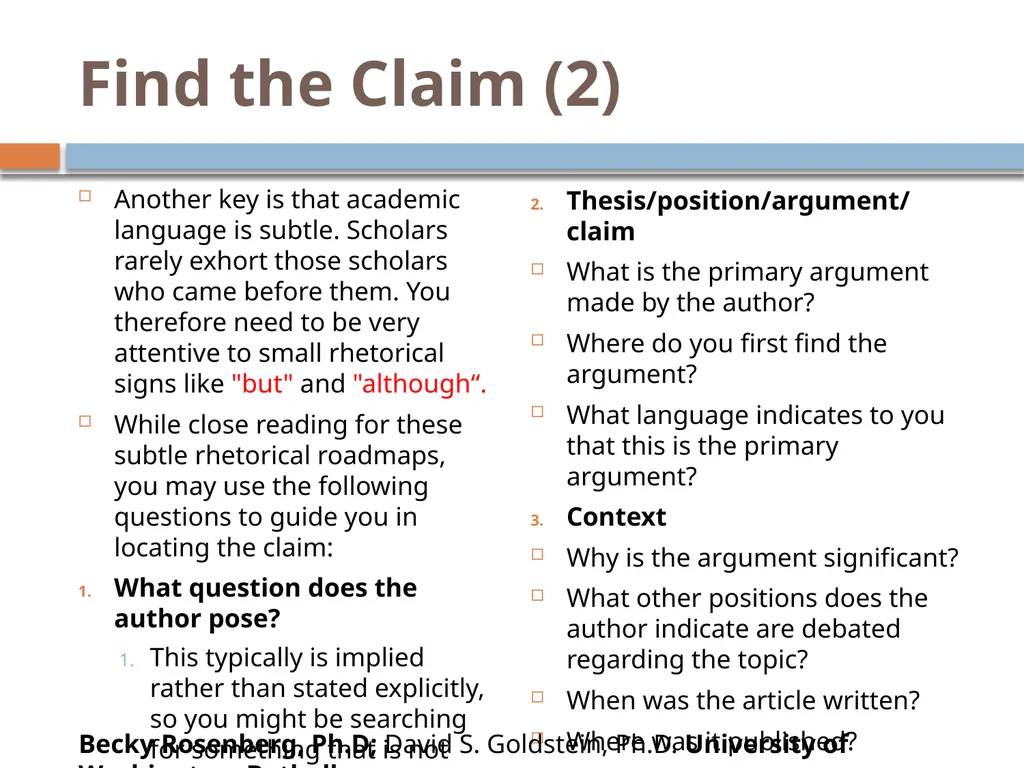
Find the Claim (2) Another key is that academic language is subtle. Scholars rarely exhort those scholars who came before them. You therefore need to be very attentive to small rhetorical signs like "but" and "although“.
While close reading for these subtle rhetorical roadmaps, you may use the following questions to guide you in locating the claim:
What question does the author pose?
This typically is implied rather than stated explicitly, so you might be searching for something that is not literally in the text. Thesis/position/argument/claim
What is the primary argument made by the author?
Where do you first find the argument?
What language indicates to you that this is the primary argument?
Context
Why is the argument significant?
What other positions does the author indicate are debated regarding the topic?
When was the article written?
Where was it published?
Who was the intended audience? Becky Rosenberg, Ph.D; David S. Goldstein, Ph.D. University of Washington, Bothell<br>
08
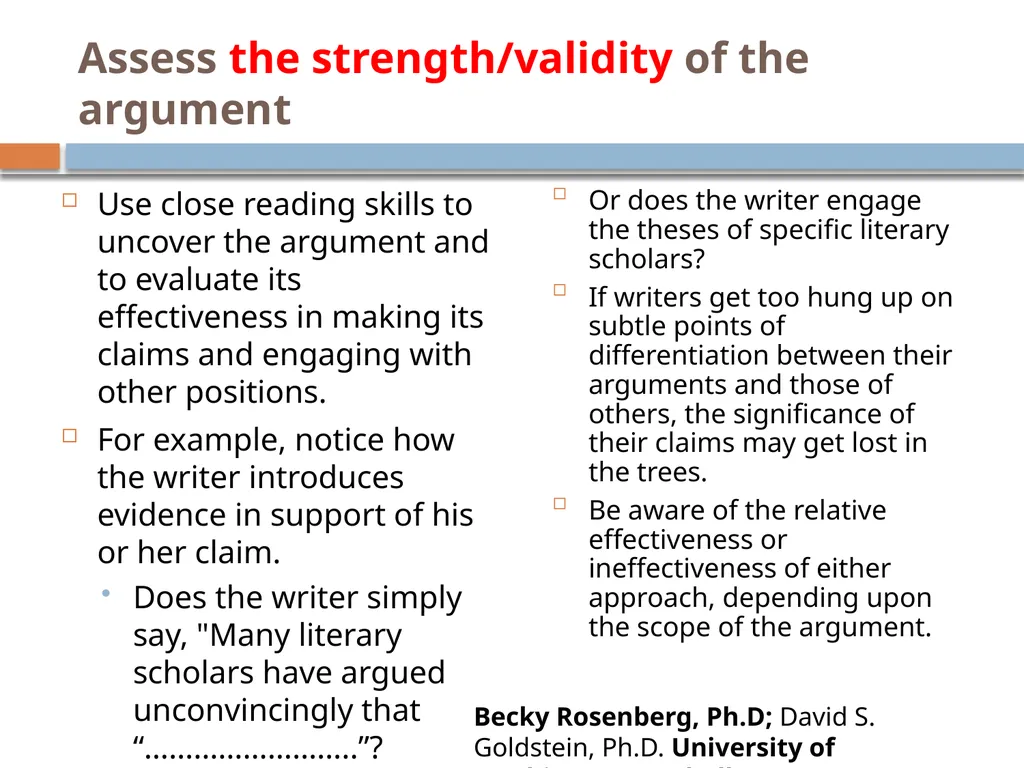
Assess the strength/validity of the argument Use close reading skills to uncover the argument and to evaluate its effectiveness in making its claims and engaging with other positions.
For example, notice how the writer introduces evidence in support of his or her claim.
Does the writer simply say, "Many literary scholars have argued unconvincingly that “……………………..”? Or does the writer engage the theses of specific literary scholars?
If writers get too hung up on subtle points of differentiation between their arguments and those of others, the significance of their claims may get lost in the trees.
Be aware of the relative effectiveness or ineffectiveness of either approach, depending upon the scope of the argument. Becky Rosenberg, Ph.D; David S. Goldstein, Ph.D. University of Washington, Bothell<br>
09
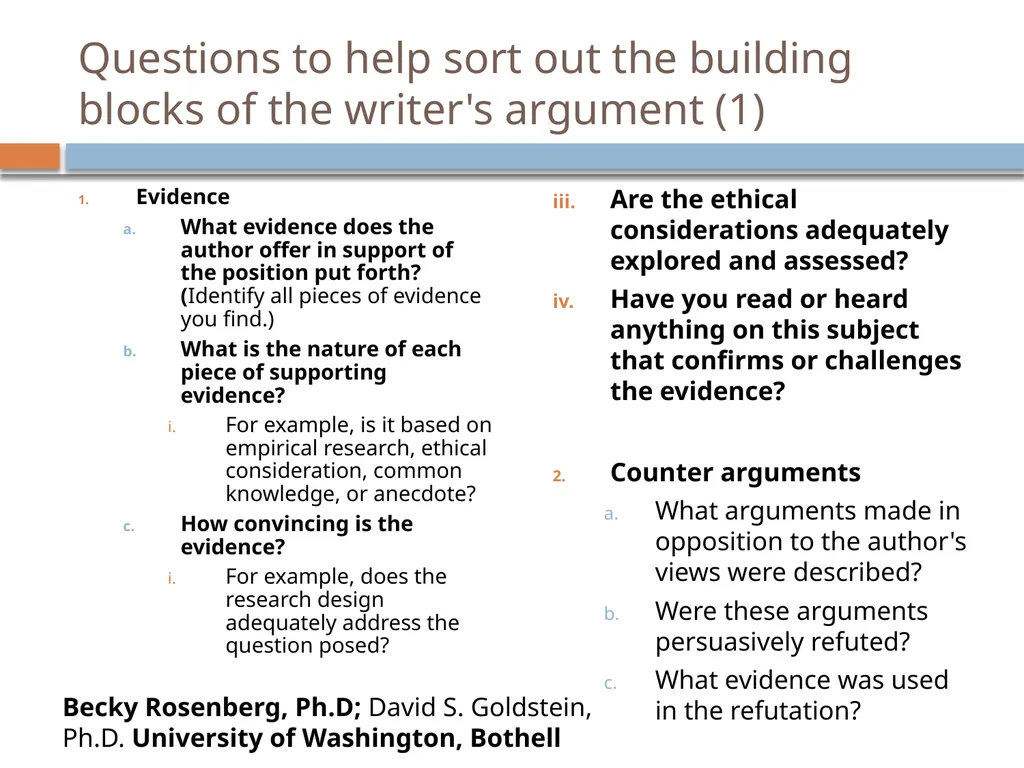
Questions to help sort out the building blocks of the writer's argument (1) Evidence
What evidence does the author offer in support of the position put forth? (Identify all pieces of evidence you find.)
What is the nature of each piece of supporting evidence?
For example, is it based on empirical research, ethical consideration, common knowledge, or anecdote?
How convincing is the evidence?
For example, does the research design adequately address the question posed? Are the ethical considerations adequately explored and assessed?
Have you read or heard anything on this subject that confirms or challenges the evidence?
Counter arguments
What arguments made in opposition to the author's views were described?
Were these arguments persuasively refuted?
What evidence was used in the refutation? Becky Rosenberg, Ph.D; David S. Goldstein, Ph.D. University of Washington, Bothell<br>
10
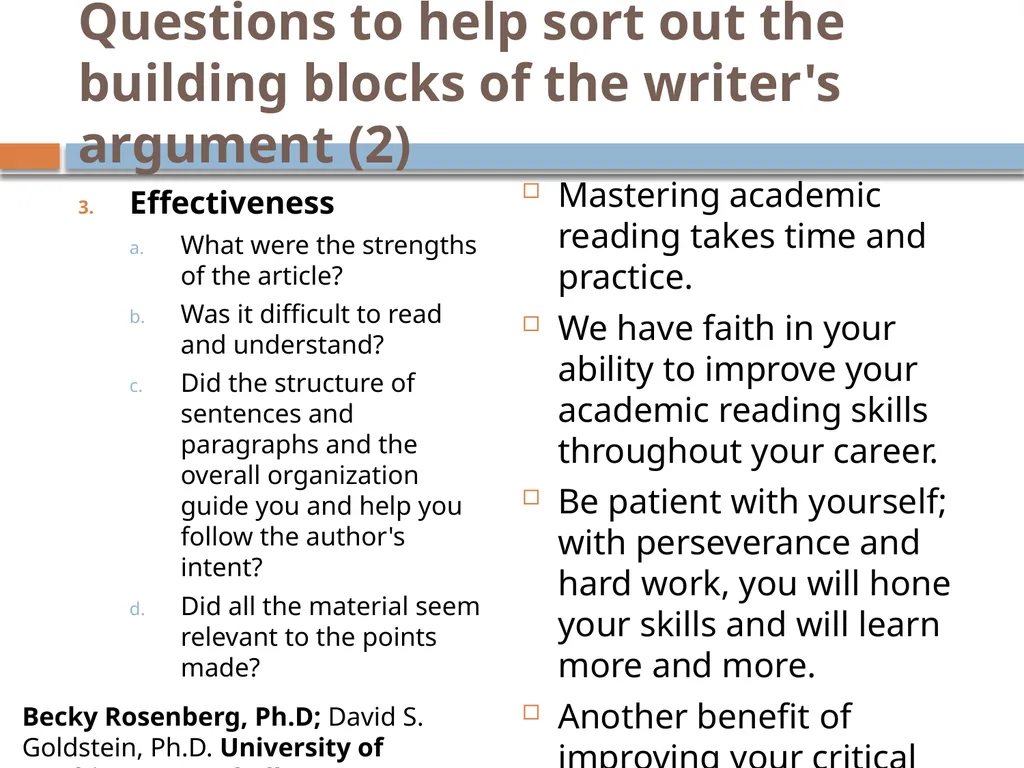
Questions to help sort out the building blocks of the writer's argument (2) Effectiveness
What were the strengths of the article?
Was it difficult to read and understand?
Did the structure of sentences and paragraphs and the overall organization guide you and help you follow the author's intent?
Did all the material seem relevant to the points made? Mastering academic reading takes time and practice.
We have faith in your ability to improve your academic reading skills throughout your career.
Be patient with yourself; with perseverance and hard work, you will hone your skills and will learn more and more.
Another benefit of improving your critical reading skills is that they will help you become a better writer. Becky Rosenberg, Ph.D; David S. Goldstein, Ph.D. University of Washington, Bothell<br>
11
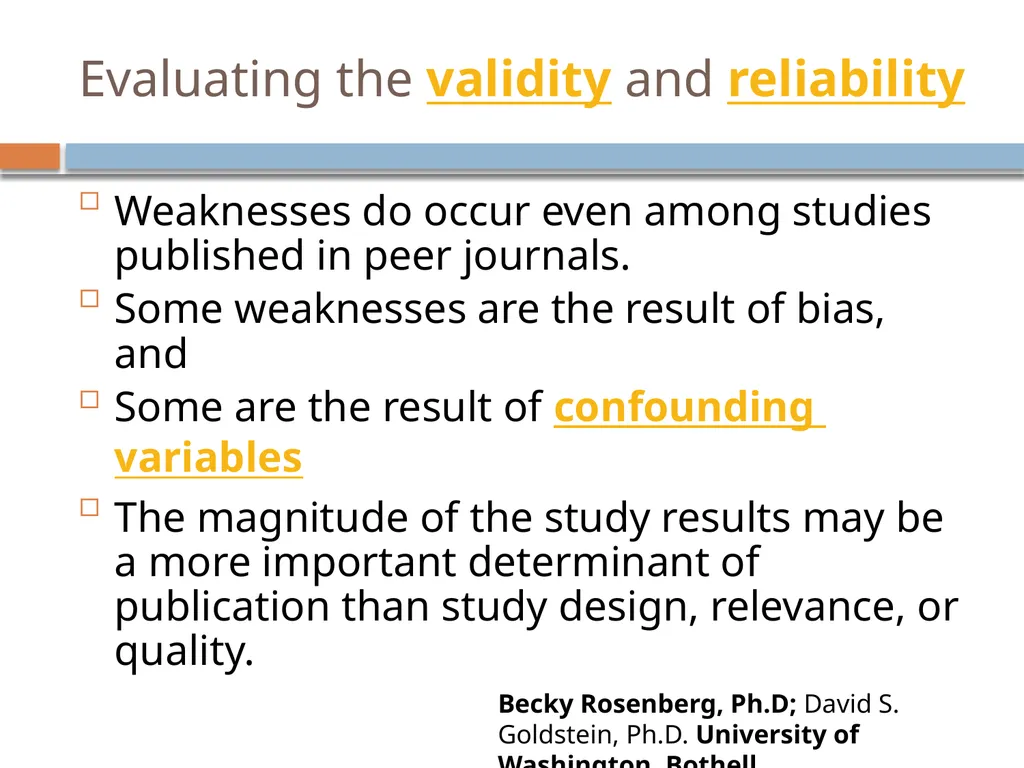
Evaluating the validity and reliability Weaknesses do occur even among studies published in peer journals.
Some weaknesses are the result of bias, and
Some are the result of confounding variables
The magnitude of the study results may be a more important determinant of publication than study design, relevance, or quality. Becky Rosenberg, Ph.D; David S. Goldstein, Ph.D. University of Washington, Bothell<br>
12
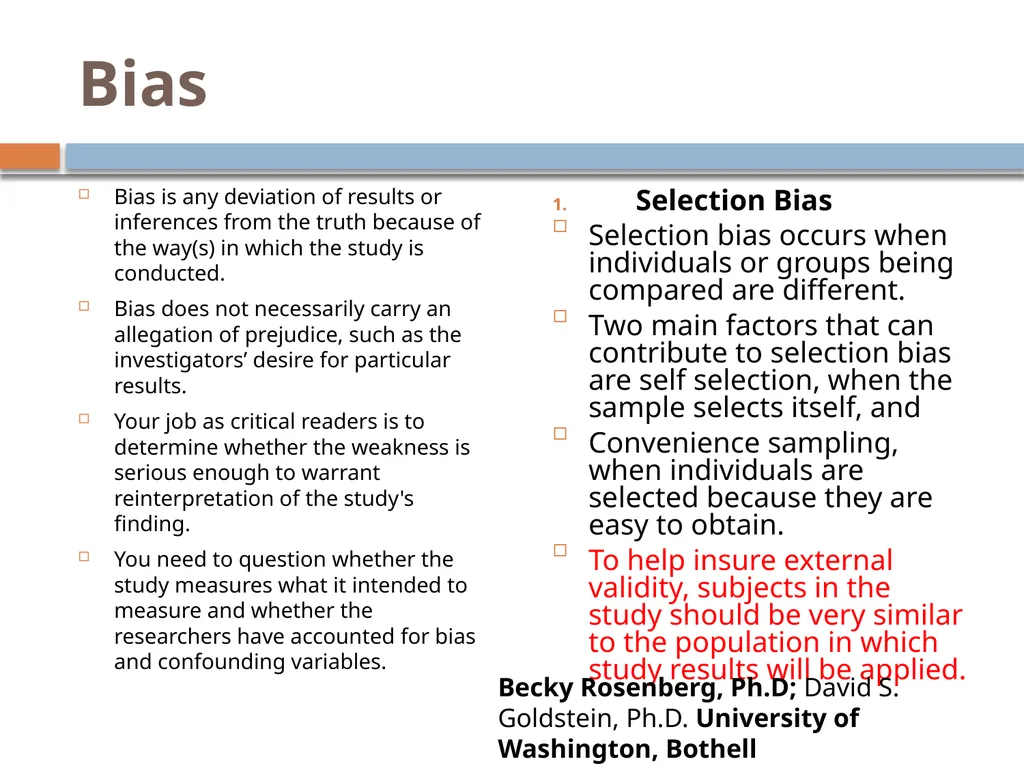
Bias Bias is any deviation of results or inferences from the truth because of the way(s) in which the study is conducted.
Bias does not necessarily carry an allegation of prejudice, such as the investigators’ desire for particular results.
Your job as critical readers is to determine whether the weakness is serious enough to warrant reinterpretation of the study's finding.
You need to question whether the study measures what it intended to measure and whether the researchers have accounted for bias and confounding variables. Selection Bias
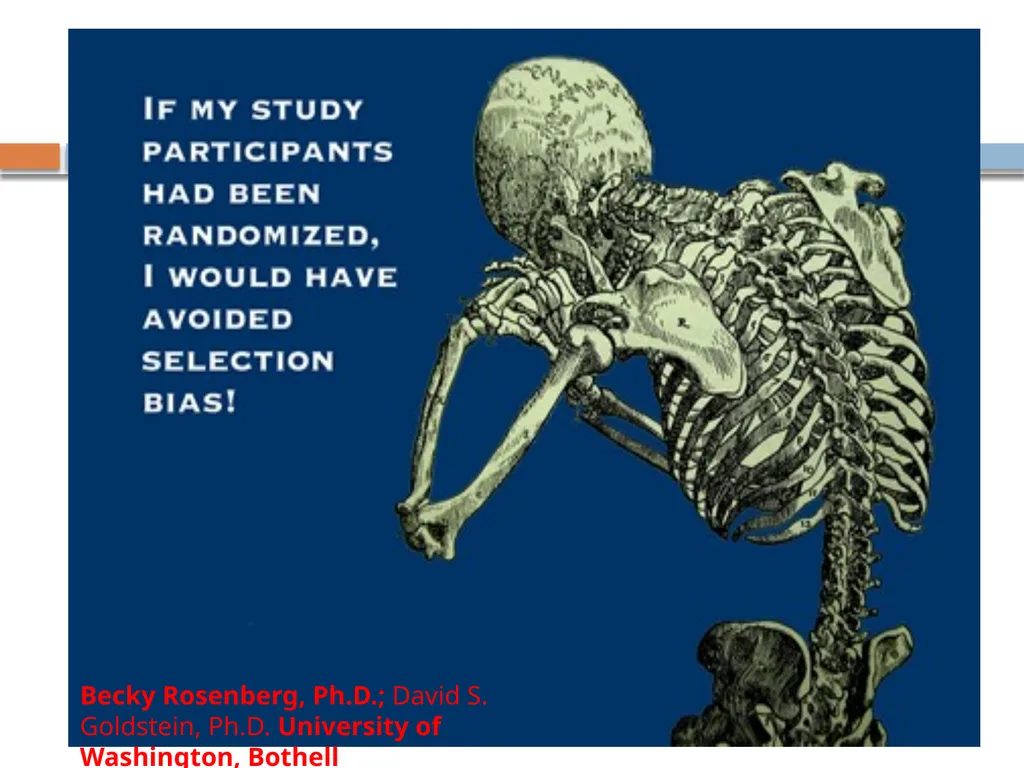
Selection bias occurs when individuals or groups being compared are different.
Two main factors that can contribute to selection bias are self selection, when the sample selects itself, and
Convenience sampling, when individuals are selected because they are easy to obtain.
To help insure external validity, subjects in the study should be very similar to the population in which study results will be applied. Becky Rosenberg, Ph.D; David S. Goldstein, Ph.D. University of Washington, Bothell<br>
13
Becky Rosenberg, Ph.D.; David S. Goldstein, Ph.D. University of Washington, Bothell<br>
14
Bias Measurement Bias
The research design should accurately and truthfully measure the research question.
Measurement bias occurs when the research design does not match the research question; for example, a questionnaire aims to assess the learning objectives of a training session but measures only the learner’s satisfaction with the session.
A diagnostic or measurement tool that is not accurate could cause instrument bias. For example, an unbalanced weighing scale would skew the results of a study. Interviewer Bias
The interviewer’s opinions, prejudices, and even non-verbal cues, when displayed during the interview process, can bias or influence study results.
Response Bias
Subjects may shape their responses in order to please the interviewer.
Subjects may also believe they know the expected findings and change behaviours to match.
Finally, subjects may believe they are the control or experimental group which is often called the placebo effect. Becky Rosenberg, Ph.D; David S. Goldstein, Ph.D. University of Washington, Bothell<br>
15
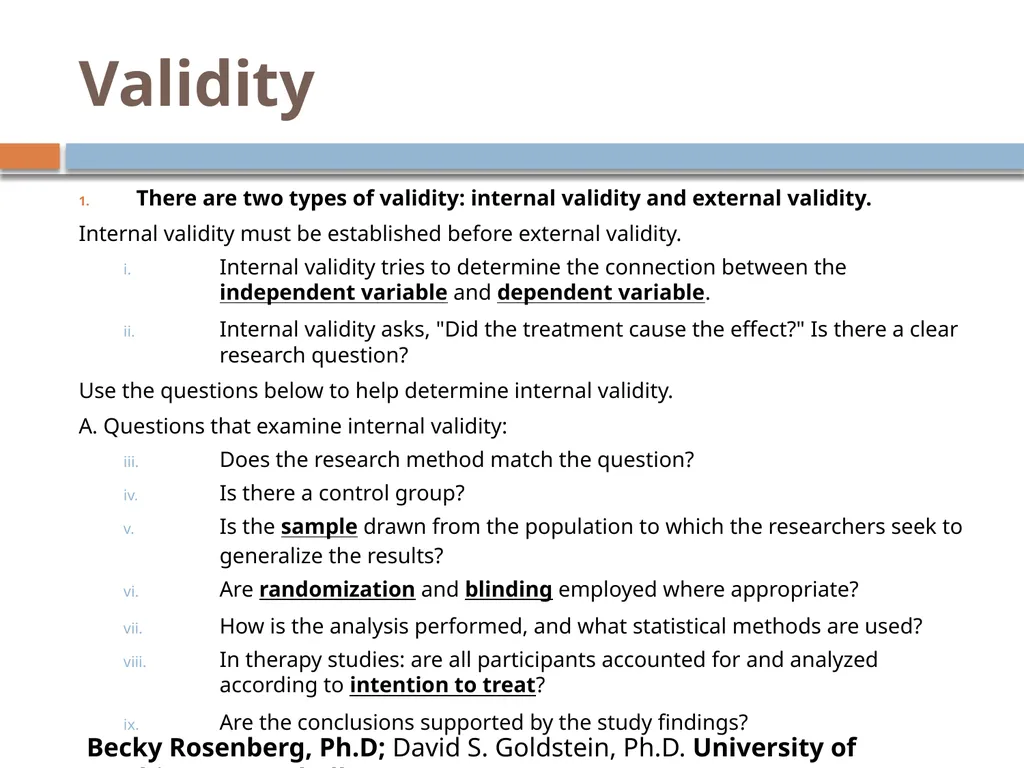
Validity There are two types of validity: internal validity and external validity.
Internal validity must be established before external validity.
Internal validity tries to determine the connection between the independent variable and dependent variable.
Internal validity asks, "Did the treatment cause the effect?" Is there a clear research question?
Use the questions below to help determine internal validity.
A. Questions that examine internal validity:
Does the research method match the question?
Is there a control group?
Is the sample drawn from the population to which the researchers seek to generalize the results?
Are randomization and blinding employed where appropriate?
How is the analysis performed, and what statistical methods are used?
In therapy studies: are all participants accounted for and analyzed according to intention to treat?
Are the conclusions supported by the study findings? Becky Rosenberg, Ph.D; David S. Goldstein, Ph.D. University of Washington, Bothell<br>
16
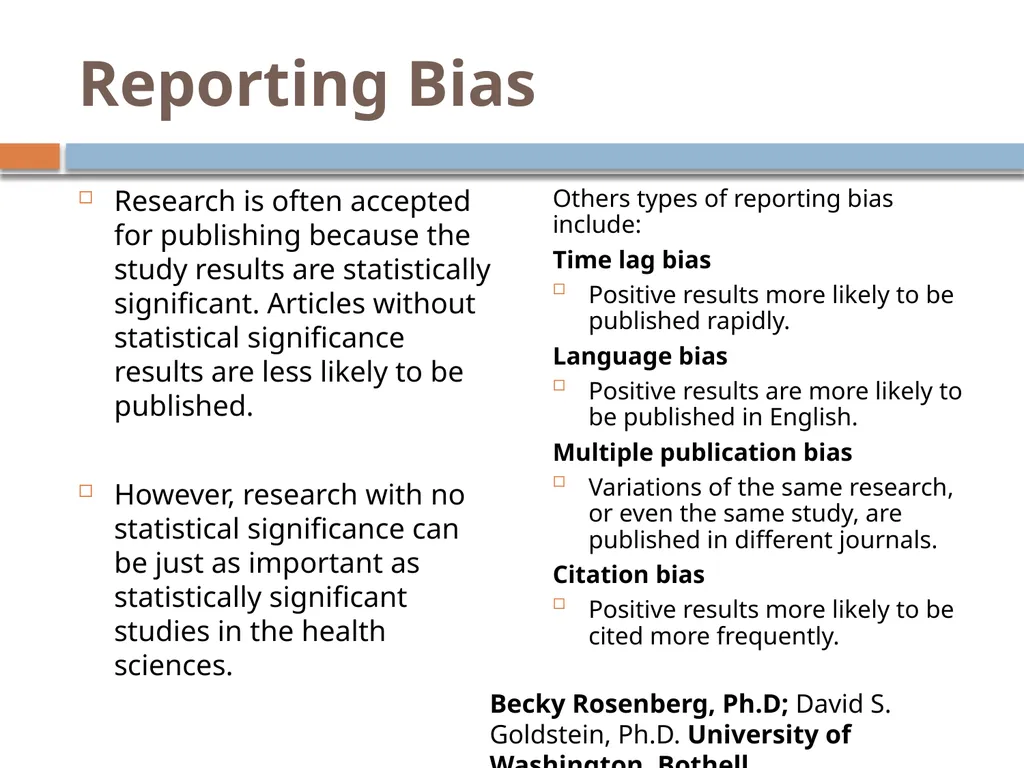
Reporting Bias Research is often accepted for publishing because the study results are statistically significant. Articles without statistical significance results are less likely to be published.
However, research with no statistical significance can be just as important as statistically significant studies in the health sciences. Others types of reporting bias include:
Time lag bias
Positive results more likely to be published rapidly.
Language bias
Positive results are more likely to be published in English.
Multiple publication bias
Variations of the same research, or even the same study, are published in different journals.
Citation bias
Positive results more likely to be cited more frequently. Becky Rosenberg, Ph.D; David S. Goldstein, Ph.D. University of Washington, Bothell<br>
17
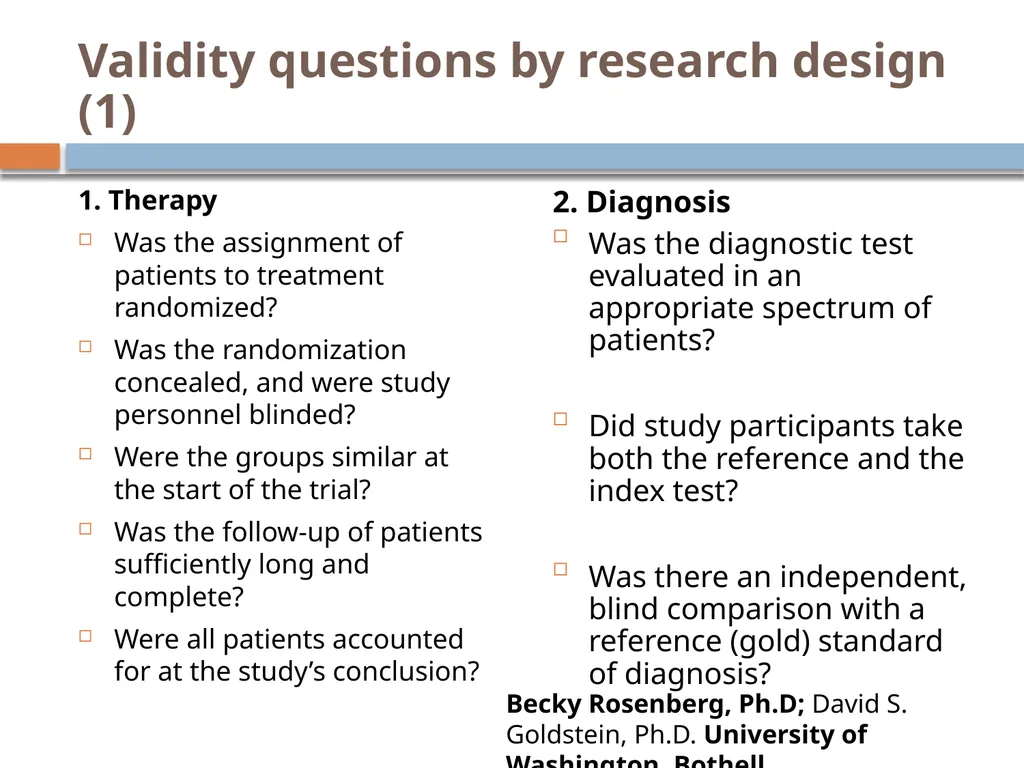
Validity questions by research design (1) 1. Therapy
Was the assignment of patients to treatment randomized?
Was the randomization concealed, and were study personnel blinded?
Were the groups similar at the start of the trial?
Was the follow-up of patients sufficiently long and complete?
Were all patients accounted for at the study’s conclusion? 2. Diagnosis
Was the diagnostic test evaluated in an appropriate spectrum of patients?
Did study participants take both the reference and the index test?
Was there an independent, blind comparison with a reference (gold) standard of diagnosis? Becky Rosenberg, Ph.D; David S. Goldstein, Ph.D. University of Washington, Bothell<br>
18
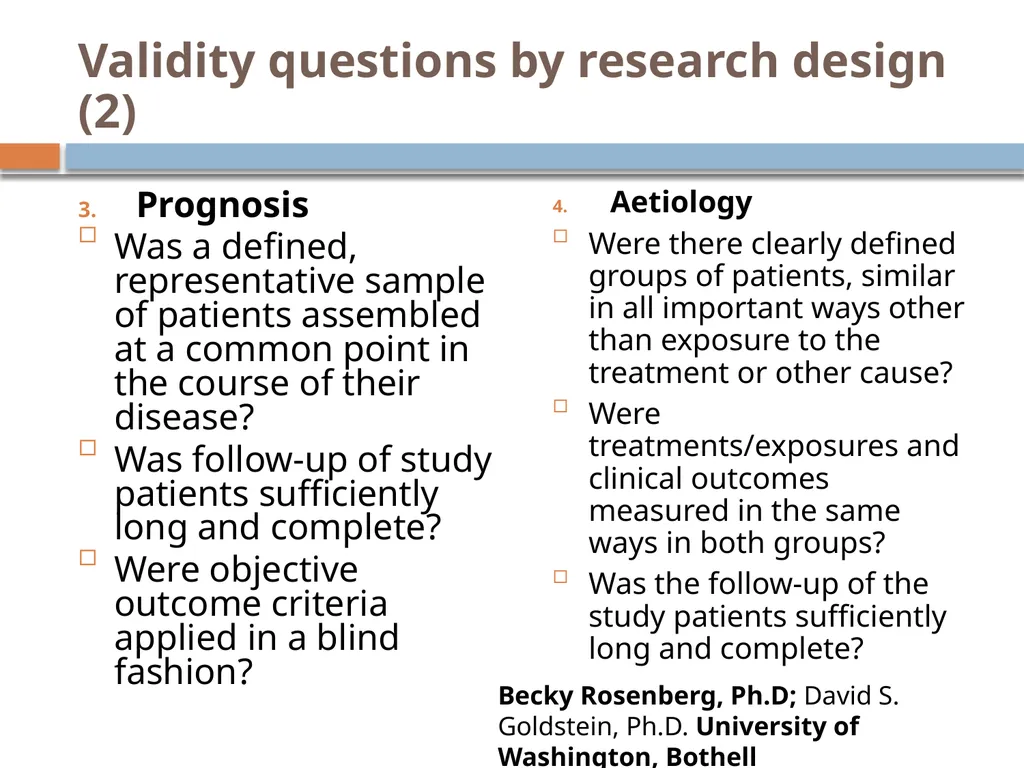
Validity questions by research design (2) Prognosis
Was a defined, representative sample of patients assembled at a common point in the course of their disease?
Was follow-up of study patients sufficiently long and complete?
Were objective outcome criteria applied in a blind fashion? Aetiology
Were there clearly defined groups of patients, similar in all important ways other than exposure to the treatment or other cause?
Were treatments/exposures and clinical outcomes measured in the same ways in both groups?
Was the follow-up of the study patients sufficiently long and complete? Becky Rosenberg, Ph.D; David S. Goldstein, Ph.D. University of Washington, Bothell<br>
19
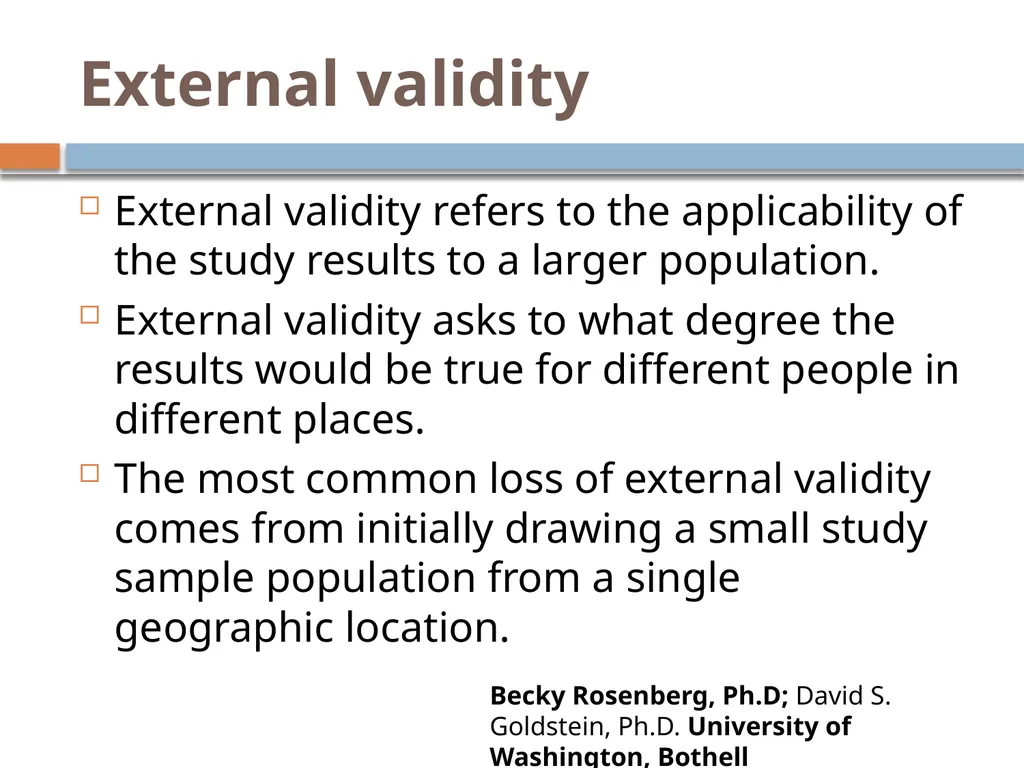
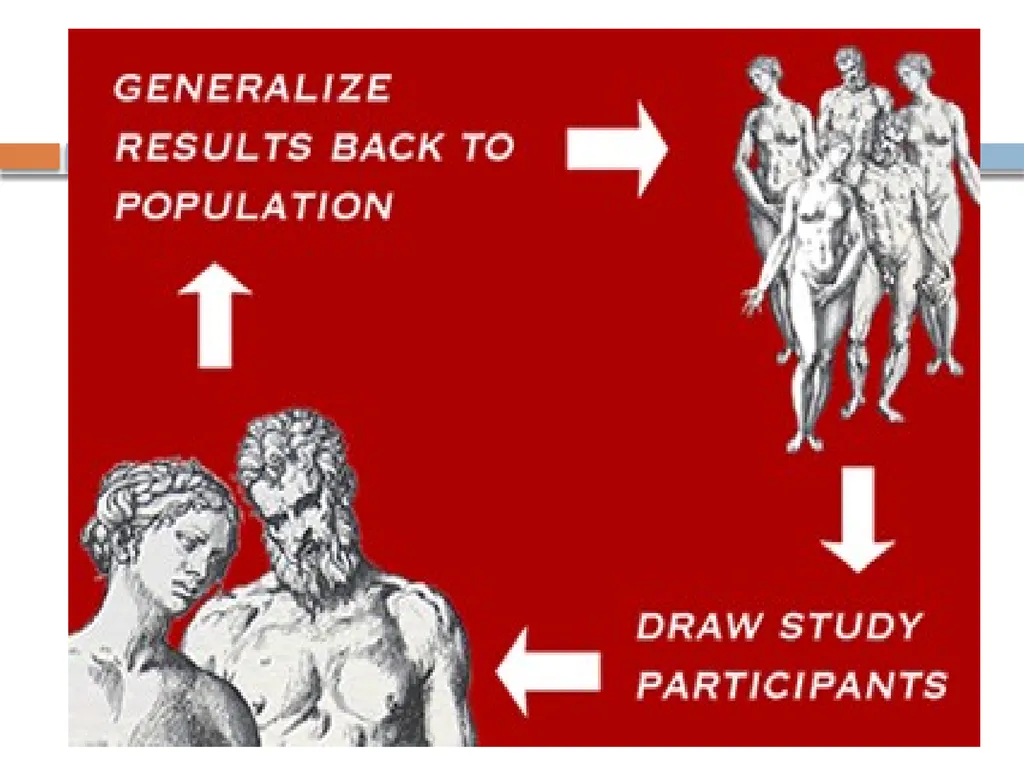
External validity External validity refers to the applicability of the study results to a larger population.
External validity asks to what degree the results would be true for different people in different places.
The most common loss of external validity comes from initially drawing a small study sample population from a single geographic location. Becky Rosenberg, Ph.D; David S. Goldstein, Ph.D. University of Washington, Bothell<br>
20
Questions to consider concerning external validity: How representative of the larger population are the study groups?
How large are the samples?
How diverse are the samples?
Do the demographics of the study samples match the demographics of the larger population? Becky Rosenberg, Ph.D; David S. Goldstein, Ph.D. University of Washington, Bothell<br>
How large are the samples?
How diverse are the samples?
Do the demographics of the study samples match the demographics of the larger population? Becky Rosenberg, Ph.D; David S. Goldstein, Ph.D. University of Washington, Bothell<br>