03
How to Study the Bible Begin with a general overview of the Bible!
Find a good, reliable translation – a word for word translation. �While “thought for thought”, balanced, and paraphrase have their place, for study you need a word for word �KJV, NKJV, ASV, NASB, ESV, etc.<br>
04
How to Study the Bible Begin with a general overview of the Bible!
Start by reading the Bible. �There is a difference between reading and studying.�You need a good general idea of the what the Bible teaches and is. READING helps you do this! �I can provide plans for Bible reading.
Learn the basic divisions of the Bible:� 2 Testaments – Old and New Testaments<br>
05
How to Study the Bible Begin with a general overview of the Bible! The basic divisions
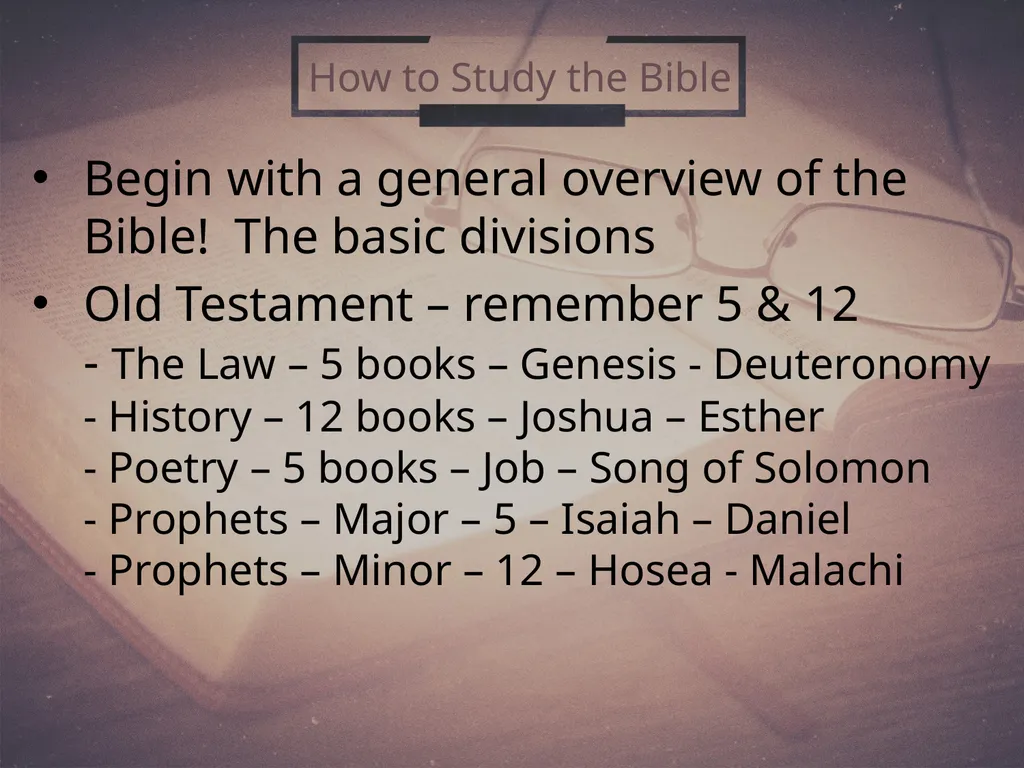
Old Testament – remember 5 & 12�- The Law – 5 books – Genesis - Deuteronomy�- History – 12 books – Joshua – Esther�- Poetry – 5 books – Job – Song of Solomon�- Prophets – Major – 5 – Isaiah – Daniel�- Prophets – Minor – 12 – Hosea - Malachi<br>
06
How to Study the Bible Begin with a general overview of the Bible! The basic divisions
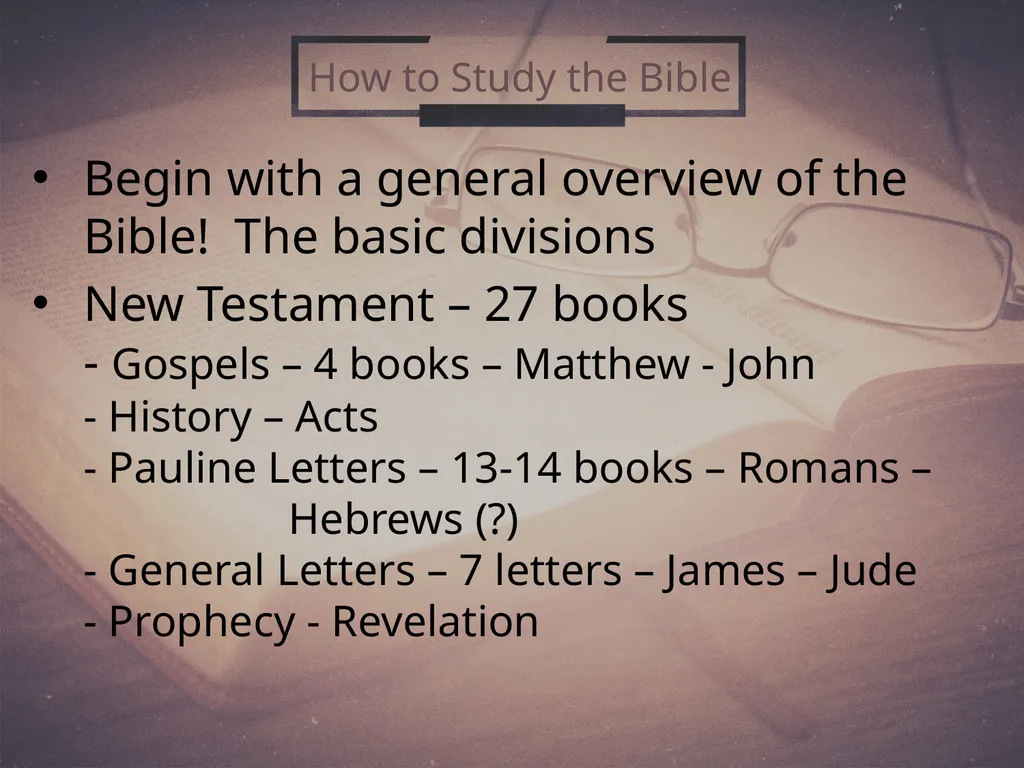
New Testament – 27 books�- Gospels – 4 books – Matthew - John�- History – Acts�- Pauline Letters – 13-14 books – Romans – Hebrews (?)�- General Letters – 7 letters – James – Jude�- Prophecy - Revelation<br>
07
How to Study the Bible Make preparation to study
Set aside a regular time (often) and place. As free of distractions as possible
Secure materials to take notes, a notebook, ruler (underlining), reference works (more later)
Formulate a plan – your goal is over time to study through the whole Bible, or substantial portions thereof. �And/or topical studies<br>
08
How to Study the Bible Remember prayer – before/after
James 1:5 – if anyone lacks wisdom…�This helps to keep you humble and focused on God<br>
09
How to Study the Bible CONTEXT, CONTEXT, CONTEXT!!!!!!
It is everything in understand the meaning of a text.
2 Timothy 2:15
It has been said you can prove anything with the Bible, if you are willing to twist it enough. Cf. 2 Peter 3:15-16�E.g. Romans 8:28<br>
10
How to Study the Bible CONTEXT, CONTEXT, CONTEXT!!!!!!
Find out what background you can!
Who, What, Where, When & Why
Different types of context –�- Immediate context�- Section context�- Book context�- The Bible as a whole<br>
11
How to Study the Bible Useful tools that can help you
A concordance – a book that gives you an alphabetical listing of words in the Bible, and every usage of that word�- They are language specific – either our language (English, Spanish) or original language (Hebrew, Greek)�- They are version specific – you search Bible words based on your version.<br>
12
How to Study the Bible Useful tools that can help you
A Bible dictionary/encyclopedia – defines words, places, people, ideas, etc. – based upon usage in the Bible.�Remember an English word can have several Greek/Hebrew words (e.g. love),�or a Greek/Hebrew word several English words�Different types of dictionaries – some focus on words, others are more specific (e.g. a Bible atlas, Dictionary of Bible names, etc.)�- Different levels of dictionaries – compact, one volume and multi-volume.<br>
13
How to Study the Bible Useful tools that can help you
Compare other versions – a very helpful way to understand a verse or word. �- This is one of my favorite ways to do a word study�- There are parallel Bibles<br>
14
How to Study the Bible Useful tools that can help you
Cross-references – most Bibles have notes, either center column, or at the bottom of the page. �These are very useful giving direct references, different interpretations of a word, and sometimes mss notes (differences in various mss).�- The Treasury of scripture knowledge
Study Bibles – can be helpful, but use with caution. Most have a specific focus in mind.<br>
15
How to Study the Bible Useful tools that can help you
Commentaries – An author or group of authors who seek to explain the meaning of the text. �WARNING! Commentaries are NOT inspired. �And there are several different types and levels of commentaries. �Use with caution, AND if you use these, I always recommend more than one!<br>
16
How to Study the Bible Useful tools that can help you
Bible software – in this age, all of these resources are available to use with your computer, mobile phone or tablet.�There is much FREE software out there and more detailed programs that can run into several thousand dollars. �These have a learning curve and some are better than others.<br>
17
How to Study the Bible Beginning your Bible study!
This can seem overwhelming – the Bible is a big book. But do NOT let that keep you from starting.
Just get started – and keep going! You cannot go wrong if you are doing something!
Where to start? You have to decide what you want to study? More in a moment!<br>
18
How to Study the Bible Beginning your Bible study!
Be patient – you will NOT learn it all overnight (or even in a lifetime)
What type of study do you want? �– textual – examining a book of the Bible (where I recommend you begin)�- topical study – examining what the Bible says about a specific topic.�- Each type has its own approach!<br>
19
How to Study the Bible Beginning your Bible study!
Textual study �- Gather materials together�- Where will you start – I can help you! �Start with a gospel! Then Acts. �Then some of the easier letters (Don’t start with Revelation or Romans)�- Read the entire book – slow enough to grasp the overall message. Don’t let difficult passages stop you here. Keep reading. You may need to read through the book 2-3 times. IF possible, in one sitting<br>
20
How to Study the Bible Beginning your Bible study!
Textual study �- THEN come back and begin a study section by section. Find the overall point of the section, then apply verses to that! �THIS is where your Bible tools become helpful!
Take notes that you can refer to later.�Underline texts (if you do that), and write notes in your Bible as appropriate (IN PENCIL)
Keep studying!<br>
21
How to Study the Bible Beginning your Bible study!
Topical studies (and word studies)�- Get your materials together�- Determine what topic you want to study. DON’T start with angels, the beasts of Revelation, the Holy Spirit, etc.�IF this is your first study – consider grace, faith, love, baptism, self-control, etc.�- a topical Bible is a useful tool here (e.g. Nave’s topical Bible, “Where to Find it in the Bible”, etc.)<br>
22
How to Study the Bible Beginning your Bible study!
Topical studies �- Read the various texts on that subject (include the immediate context)�- Take notes – write down the verses relevant to your study.�Definitions and other observations.�- Consider other words related to the word you are studying, including the antithesis.�Example: Love – study also – caring, kindness, etc. AND study hate.<br>
23
How to Study the Bible Beginning your Bible study!
With both types of study�- Pray about what you have learned. �- Seek to apply it! �- After you have taken notes, “meditate on these things” (Philippians 4:8)�- Do NOT read into the text what is not there!
Keep going! At first, it will be challenging (like anything in life), but as you keep at it, HOW to study gets easier AND more exciting!<br>
24
Are you growing in the grace and knowledge of our Lord?�(2 Peter 3:18)<br>