04
Objectives By the end of this tutorial you should be able to
Articulate what it means to synthesize an article or articles in your own work
Describe why that is important
Actually synthesize articles in your own writing Created by Alice Frye, Ph.D, Department of Psychology, University of Massachusetts, Lowell 4<br>
05
What does it mean to “Synthesize Articles” It means that in your literature review you examine a number of studies on a shared topic and note aspects that are of interest for your own work
It also may mean that you draw and state a conclusion about the similarities and differences in the studies you review Created by Alice Frye, Ph.D, Department of Psychology, University of Massachusetts, Lowell 5<br>
06
Why is synthesizing important? Synthesizing articles is a crucial skill in psychology writing
It is important for a number of reasons:
It is efficient—there is no reason for the reader to read all the articles you describe, since you are synthesizing them
It allows you to highlight what was important to you about those articles Created by Alice Frye, Ph.D, Department of Psychology, University of Massachusetts, Lowell 6<br>
07
How to synthesize articles? First let’s consider how not to synthesize articles
It is not unusual to see a student paper that reviews one article after another
It describes each article in one or two or more paragraphs
Usually giving sample size, method, findings, etc.
Often in some detail
This is not a synthesis Created by Alice Frye, Ph.D, Department of Psychology, University of Massachusetts, Lowell 7<br>
08
How not to synthesize articles Simply writing a detailed summary of one article after another is not a synthesis
Also it is often boring and confusing for the reader
A synthesis gives enough information about the study for the reader to imagine it
But really highlights what is important about the study for your paper
And notes what is similar and important across several studies
This helps orient your reader to what is important to you
And avoids boring your reader with a lot of unnecessary detail Created by Alice Frye, Ph.D, Department of Psychology, University of Massachusetts, Lowell 8<br>
09
How to Synthesize Articles It is possible to synthesize multiple articles in one paragraph
You note the shared issue across the articles that you want to call attention to
Note any important differences that are relevant to your study
And describe each article briefly in ways relevant to your study Created by Alice Frye, Ph.D, Department of Psychology, University of Massachusetts, Lowell 9<br>
10
How to Synthesize Articles: Example Suppose you are writing a paper about canine aggression
You read three articles about aggressive dogs
One thing you are interested in is how aggression in dogs has been assessed, and you want your reader to understand that there is variation in assessment
So you synthesize what you have read to reflect this focus Created by Alice Frye, Ph.D, Department of Psychology, University of Massachusetts, Lowell 10<br>
11
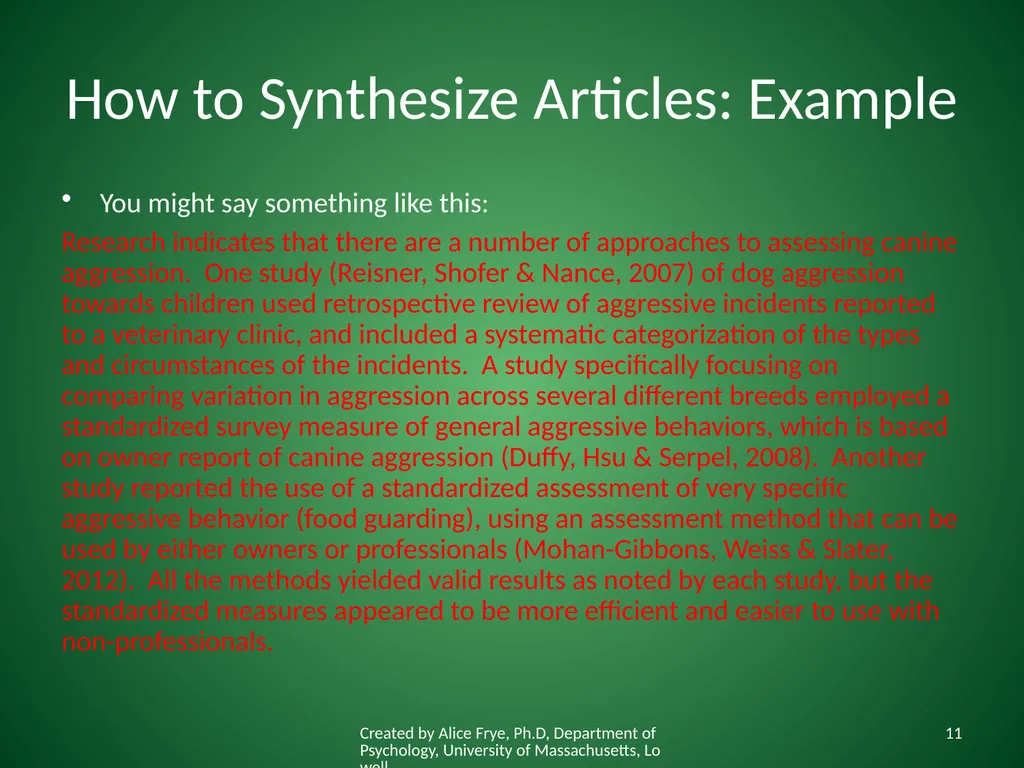
How to Synthesize Articles: Example You might say something like this:
Research indicates that there are a number of approaches to assessing canine aggression. One study (Reisner, Shofer & Nance, 2007) of dog aggression towards children used retrospective review of aggressive incidents reported to a veterinary clinic, and included a systematic categorization of the types and circumstances of the incidents. A study specifically focusing on comparing variation in aggression across several different breeds employed a standardized survey measure of general aggressive behaviors, which is based on owner report of canine aggression (Duffy, Hsu & Serpel, 2008). Another study reported the use of a standardized assessment of very specific aggressive behavior (food guarding), using an assessment method that can be used by either owners or professionals (Mohan-Gibbons, Weiss & Slater, 2012). All the methods yielded valid results as noted by each study, but the standardized measures appeared to be more efficient and easier to use with non-professionals. Created by Alice Frye, Ph.D, Department of Psychology, University of Massachusetts, Lowell 11<br>
12
Notes on the Example Not all the articles focused on assessing aggression
But they did include assessment
That was what you were interested in, so you focused on that aspect
You did not give many details about each study
You did not say, for example, exactly which breeds, or even exactly how many dogs were in each study
You did say something about each type of assessment
You also included a conclusion about how assessments were performed and what type of assessment might be more or less useful Created by Alice Frye, Ph.D, Department of Psychology, University of Massachusetts, Lowell 12<br>
13
How to Synthesize Articles- Comments Synthesizing takes practice
You need to know what you are focused on in your own study in order to synthesize articles for it
You need to know what parts of an article are of use to your own study, and what parts are not
You need to draw a conclusion for the reader, so the reader will know what is important about the studies you have summarized Created by Alice Frye, Ph.D, Department of Psychology, University of Massachusetts, Lowell 13<br>
14
Summary This tutorial focused on how to synthesize articles
It explained what this means
It explained why it is important in psychology writing
It discussed ways not to synthesize articles
It described how to do so correctly, and gave an example Created by Alice Frye, Ph.D, Department of Psychology, University of Massachusetts, Lowell 14<br>
15
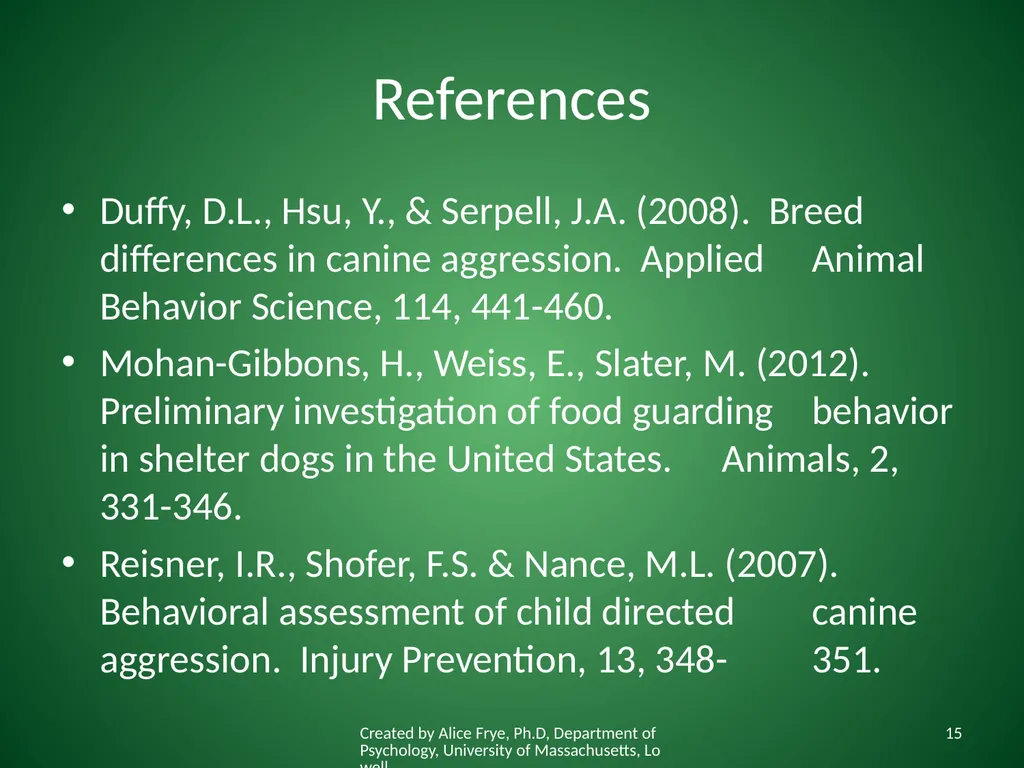
References Duffy, D.L., Hsu, Y., & Serpell, J.A. (2008). Breed differences in canine aggression. Applied Animal Behavior Science, 114, 441-460.
Mohan-Gibbons, H., Weiss, E., Slater, M. (2012). Preliminary investigation of food guarding behavior in shelter dogs in the United States. Animals, 2, 331-346.
Reisner, I.R., Shofer, F.S. & Nance, M.L. (2007). Behavioral assessment of child directed canine aggression. Injury Prevention, 13, 348- 351. Created by Alice Frye, Ph.D, Department of Psychology, University of Massachusetts, Lowell 15<br>