
How to use this resource NOTES FOR FACILITATOR.








Description: How to use this resource NOTES FOR FACILITATOR. REMOVE BEFORE SHARING. Suggested learning format: The modules are designed for peer-facilitated and interactive sessions. Each module can be completed in one session or can be divided across
Related Topics
Download Presentation
"How to use this resource NOTES FOR FACILITATOR." is the property of its rightful owner. Permission is granted to download and print the materials on this website for personal, non-commercial use only, and to display it on your personal computer provided you do not modify the materials and that you retain all copyright notices contained in the materials. By downloading content from our website, you accept the terms of this agreement.
Presentation Transcript
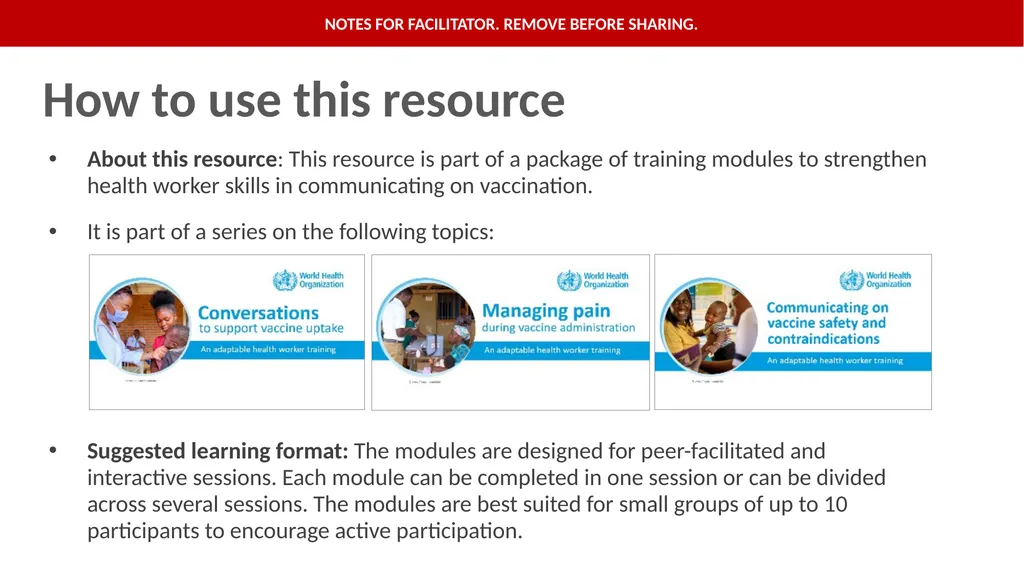
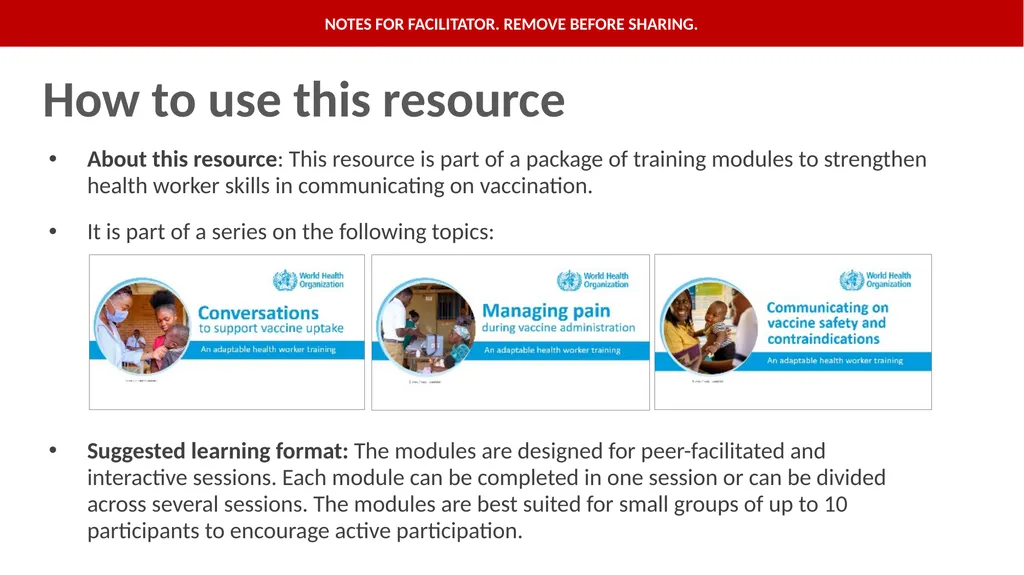
slide1. How to use this resource NOTES FOR FACILITATOR. REMOVE BEFORE SHARING. Suggested learning format: The modules are designed for peer-facilitated and interactive sessions. Each module can be completed in one session or can be divided across several sessions. The modules are best suited for small groups of up to 10 participants to encourage active participation. About this resource: This resource is part of a package of training modules to strengthen health worker skills in communicating on vaccination.
It is part of a series on the following topics:<br>
slide2. How to use this resource NOTES FOR FACILITATOR. REMOVE BEFORE SHARING. Adapt the modules for your local use. The contents of the modules are based on evidence and best practices. Please retain the main concepts as you make the deck your own. Customize this resource for your local needs by:
Modifying examples, sample conversations and visuals,
Translating to your local language,
Tailoring the suggested exercises.
Share your feedback. We would like to learn how you have been using these modules, what aspects have been helpful and in what ways we can improve the content and approach. After using the module, please fill out the online form linked below. Link to Microsoft Forms https://forms.microsoft.com/e/vJBakm3PCx<br>
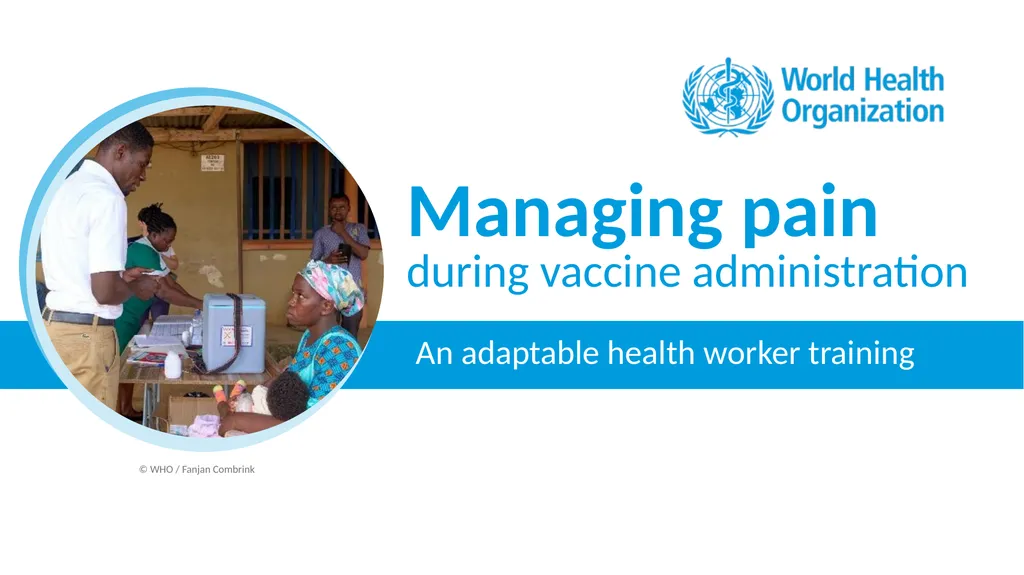
slide3. Lisa . Managing pain An adaptable health worker training during vaccine administration © WHO / Fanjan Combrink<br>
slide4. At the end of this training, you will be able to:
Understand the impact of pain at the time of immunization
Understand why it is important to manage pain well
Outline the role of health workers in managing pain during vaccination
Describe what health workers can say or do to reduce pain
Identify important considerations for pain management Training objectives<br>
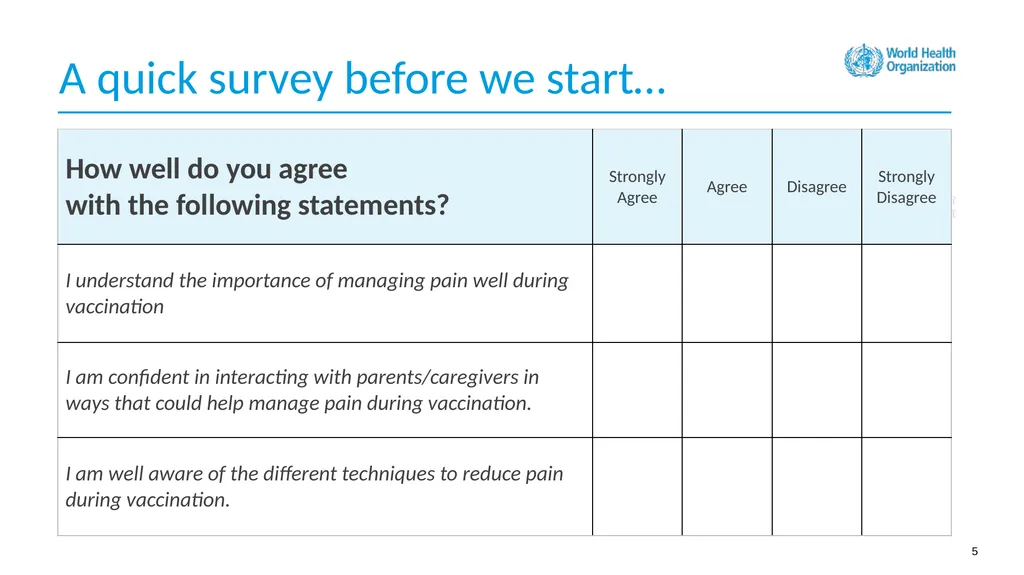
slide5. A quick survey before we start…<br>
slide6. Why manage pain?
Reducing pain during vaccination
Important considerations Outline<br>
slide7. Why manage pain?
Reducing pain during vaccination
Important considerations Outline<br>
slide8. Pain or fear of pain at the time of vaccination is common at any age and can become a barrier to uptake Why manage pain? Pain can be managed and reduced Health workers have a responsibility to minimize anxiety and pain during vaccination Sources:
McMurtry, C. et. al. (2015). Vaccine, 33(1), 18-26. Taddio, A., et. al. (2018). Canadian Medical Association Journal, 190(45), E1274-E1282.<br>
slide9. Pain at the time of vaccination Perception of pain varies from person to person
Children often perceive needles to be more painful than adults
Anticipation of pain can cause fear and tensing of muscles, and lead to further discomfort
Pain may be associated with other immunization stress-related responses including dizziness or fainting<br>
slide10. Minimizing and managing pain Promotes safer vaccination delivery by:
Encouraging a calm and stress-free immunization experience
Supporting individuals to prevent or manage fear of needles
Improves vaccine confidence by:
Helping individuals feel more comfortable with vaccination
Creating a positive and reassuring vaccination experience Source:
Immunization stress-related response. A manual for program managers and health professionals to prevent, identify and respond to stress related responses following immunization. Geneva: World Health Organization; 2019.<br>
slide11. Pain after vaccination Pain during vaccination is different from pain that develops after vaccination
Pain that develops after vaccination may be present with redness, tenderness and/or swelling at the injection site
Can vary per person and vaccine
Usually mild and not a serious cause of concern
In some rare cases, can be more severe (i.e., severe local reactions)<br>
slide12. Why manage pain?
Reducing pain during vaccination
Important considerations Outline<br>
slide13. A health worker
can reduce pain during vaccination Interaction with health worker Technique of vaccine administration Comfort during the visit These factors are modifiable by managing… What to say? What to do? How to act? © WHO / Fanjan Combrink<br>
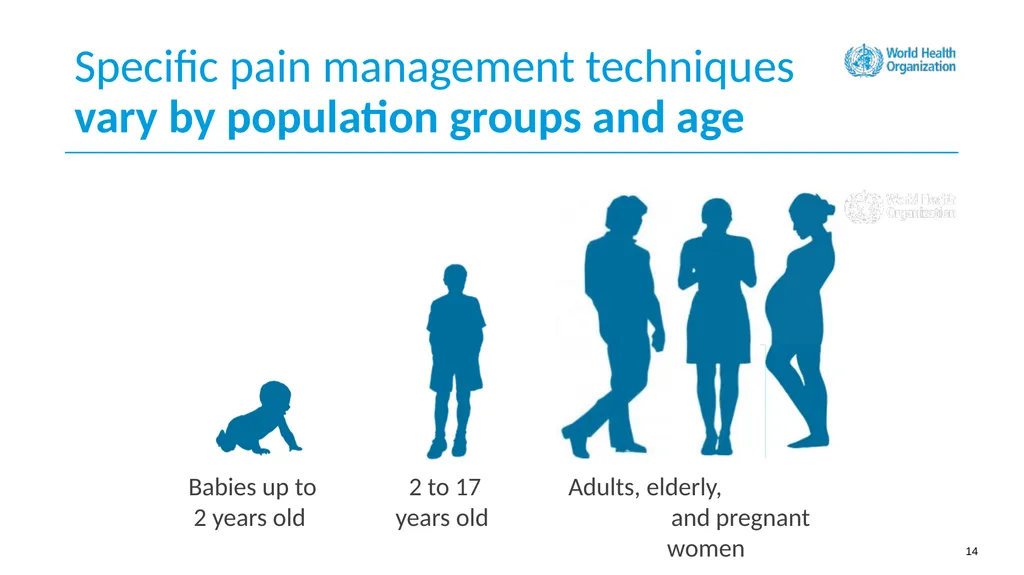
slide14. Specific pain management techniques vary by population groups and age Babies up to 2 years old 2 to 17 years old Adults, elderly, and pregnant women<br>
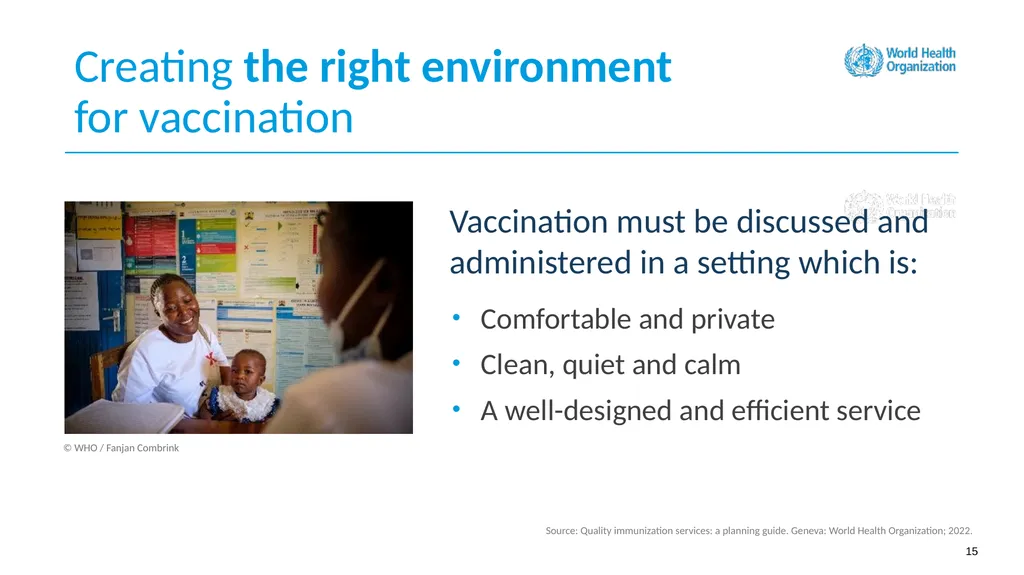
slide15. Comfortable and private
Clean, quiet and calm
A well-designed and efficient service Creating the right environment
for vaccination Source: Quality immunization services: a planning guide. Geneva: World Health Organization; 2022. Vaccination must be discussed and administered in a setting which is: © WHO / Fanjan Combrink<br>
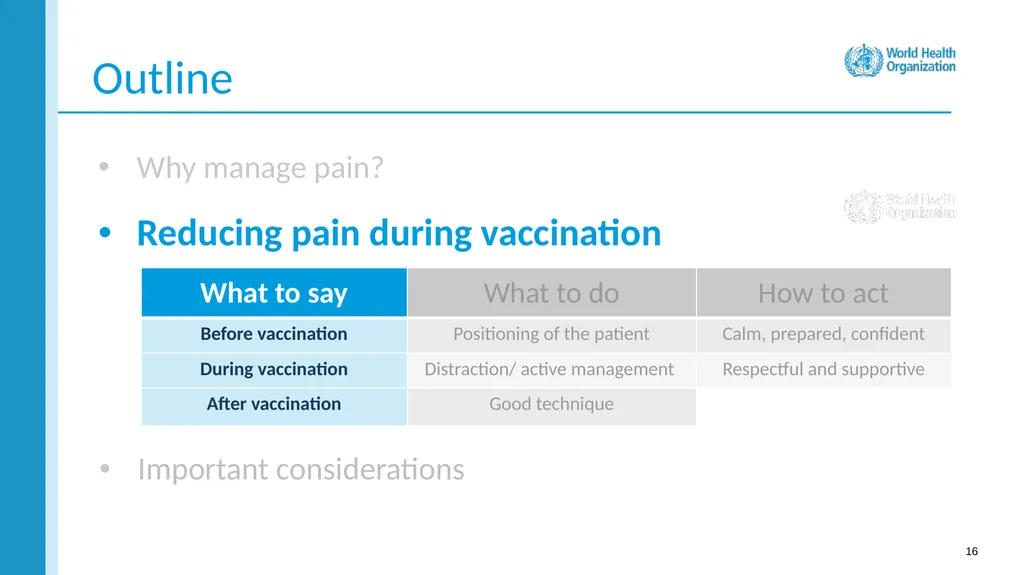
slide16. Why manage pain?
Reducing pain during vaccination Outline Important considerations<br>
slide17. What to say before vaccination Use language appropriate to the person’s level of understanding
If giving vaccines to a young child, ask the caregiver if and how much the child understands about vaccination
If they are nervous, acknowledge and normalize their feelings:
“It is normal to feel nervous before getting a needle.”<br>
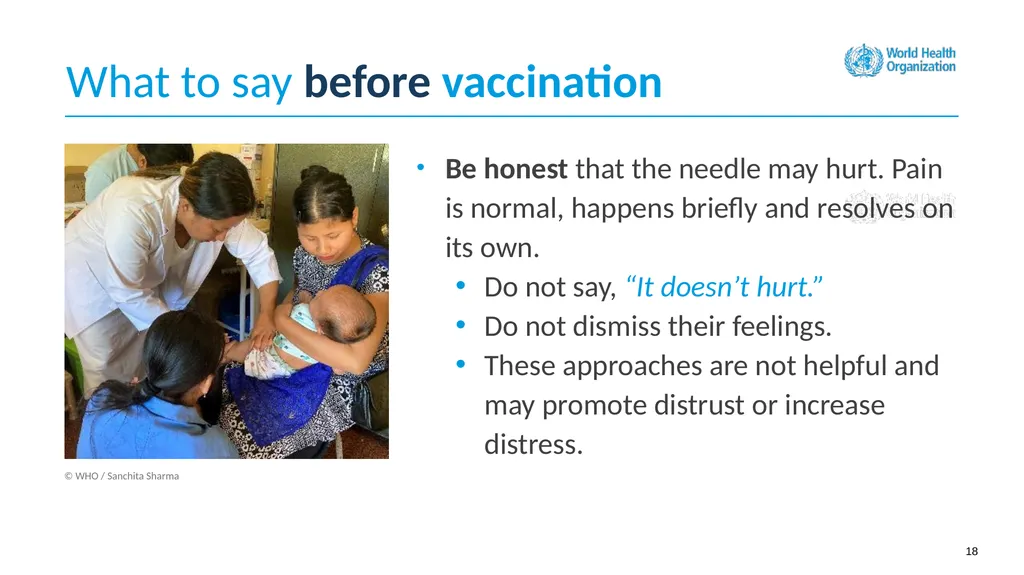
slide18. What to say before vaccination Be honest that the needle may hurt. Pain is normal, happens briefly and resolves on its own.
Do not say, “It doesn’t hurt.”
Do not dismiss their feelings.
These approaches are not helpful and may promote distrust or increase distress. © WHO / Sanchita Sharma<br>
slide19. What to say before vaccination Prepare the person/caregiver for vaccination by explaining what to expect:
What the vaccine(s) prevent against:
“These vaccines provide important protection against…”
Invite participation:
“Do you have some questions?”
Describe how the vaccination will feel using neutral language:
“Some people say they feel a poke or pinch and some pushing for a few seconds, and others say they do not feel much at all.”<br>
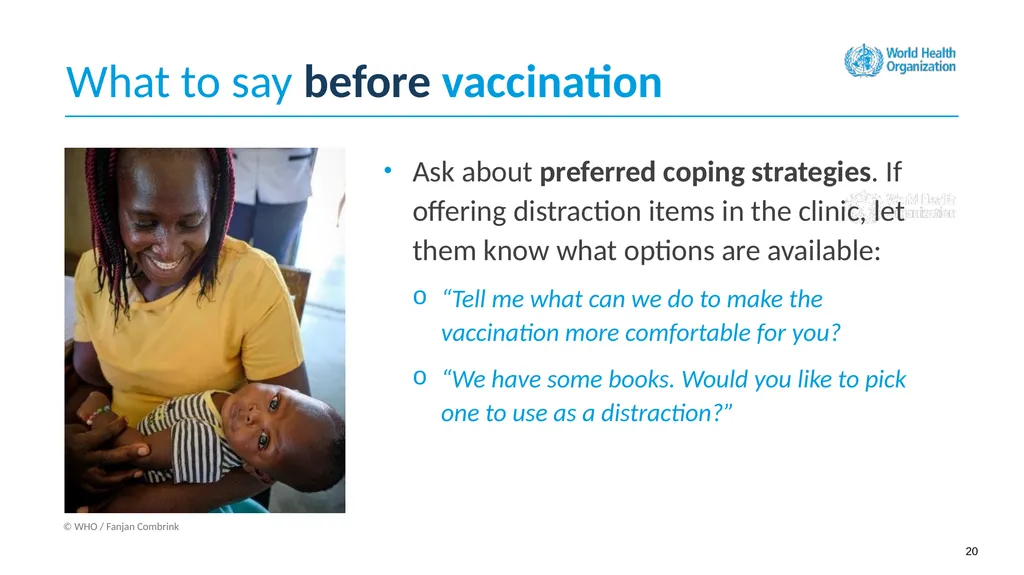
slide20. What to say before vaccination Ask about preferred coping strategies. If offering distraction items in the clinic, let them know what options are available:
“Tell me what can we do to make the vaccination more comfortable for you?
“We have some books. Would you like to pick one to use as a distraction?” © WHO / Fanjan Combrink<br>
slide21. What to say during vaccination Keep needles and frightening objects/equipment out of view
If vaccinating an infant, ask the caregiver to hold the infant in a position that is comfortable for both:
Ask the mother if they would like the baby to have some sucrose, which has been shown to minimize pain
Encourage breastfeeding at the time of vaccination (if appropriate) as it also helps with relaxation<br>
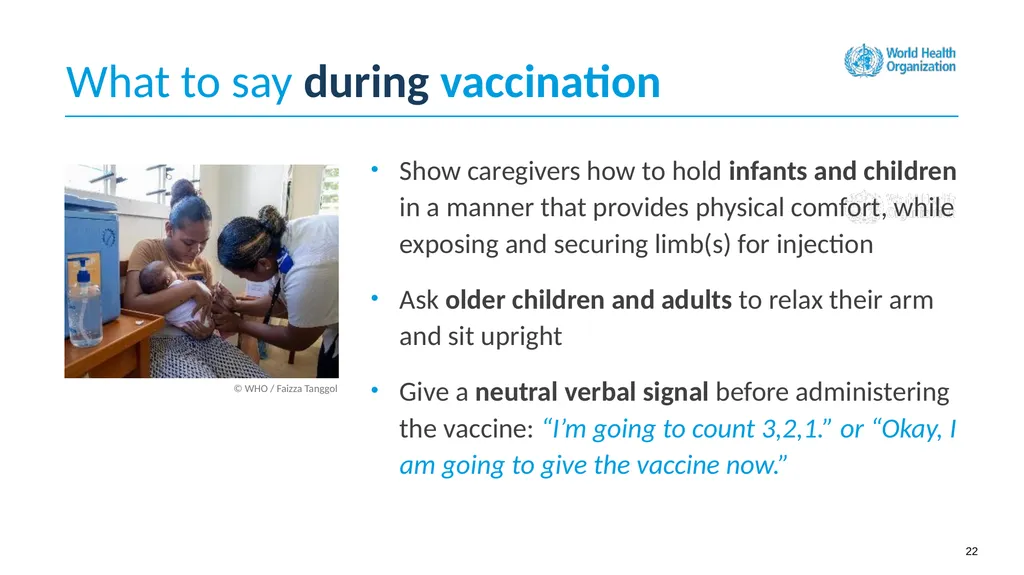
slide22. What to say during vaccination Show caregivers how to hold infants and children in a manner that provides physical comfort, while exposing and securing limb(s) for injection
Ask older children and adults to relax their arm and sit upright
Give a neutral verbal signal before administering the vaccine: “I’m going to count 3,2,1.” or “Okay, I am going to give the vaccine now.” © WHO / Faizza Tanggol<br>
slide23. What to say after vaccination Smile, encourage and praise them for their bravery:
“Well done, you read your book / stayed very still!”
Ask for feedback and use that to plan for next time:
“How did that feel?”
Provide instructions on aftercare:
“It is normal for your arm to feel sore. It shouldn’t prevent you from doing any activities that you normally do”<br>
slide24. What to say after vaccination Inform about signs and symptoms they should watch out for, i.e. adverse events following immunization (AEFI):
“It is normal to see some redness and swelling at the site of injection, and this should go away after a few days” © WHO / Fanjan Combrink<br>
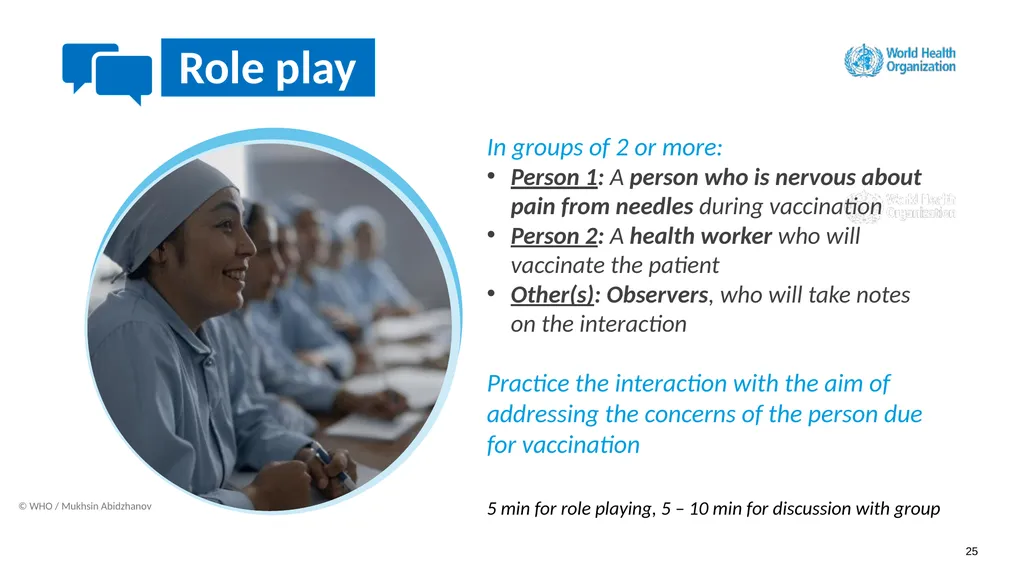
slide25. © WHO / Mukhsin Abidzhanov Role play 5 min for role playing, 5 – 10 min for discussion with group In groups of 2 or more:
Person 1: A person who is nervous about pain from needles during vaccination
Person 2: A health worker who will vaccinate the patient
Other(s): Observers, who will take notes on the interaction
Practice the interaction with the aim of
addressing the concerns of the person due for vaccination<br>
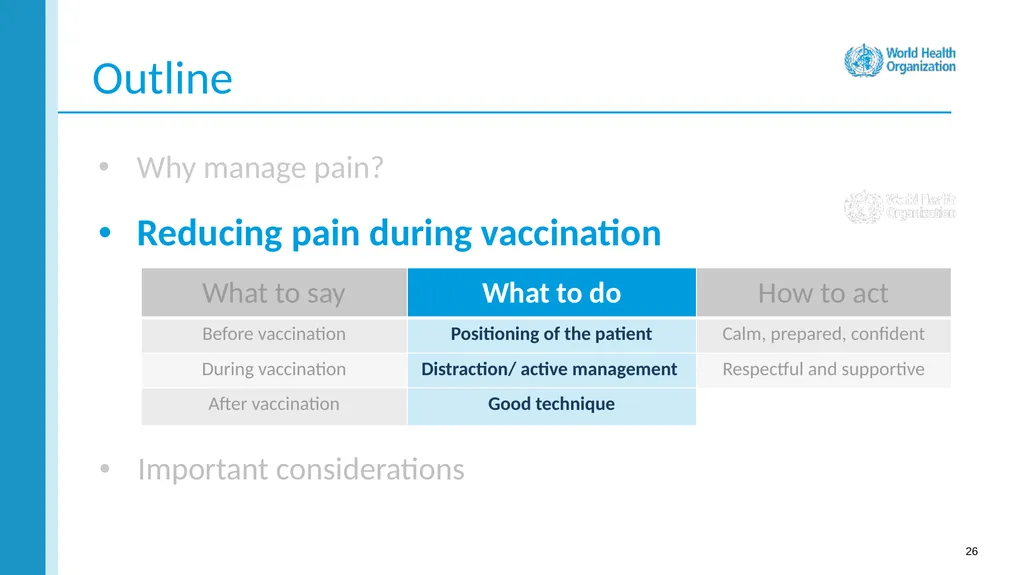
slide26. Why manage pain?
Reducing pain during vaccination Outline Important considerations<br>
slide27. A comfortable position reduces anxiety and allows for more control while administering vaccines. If the infant is held by the caregiver, it also helps the infant to feel secure and relaxed. Positioning for vaccination<br>
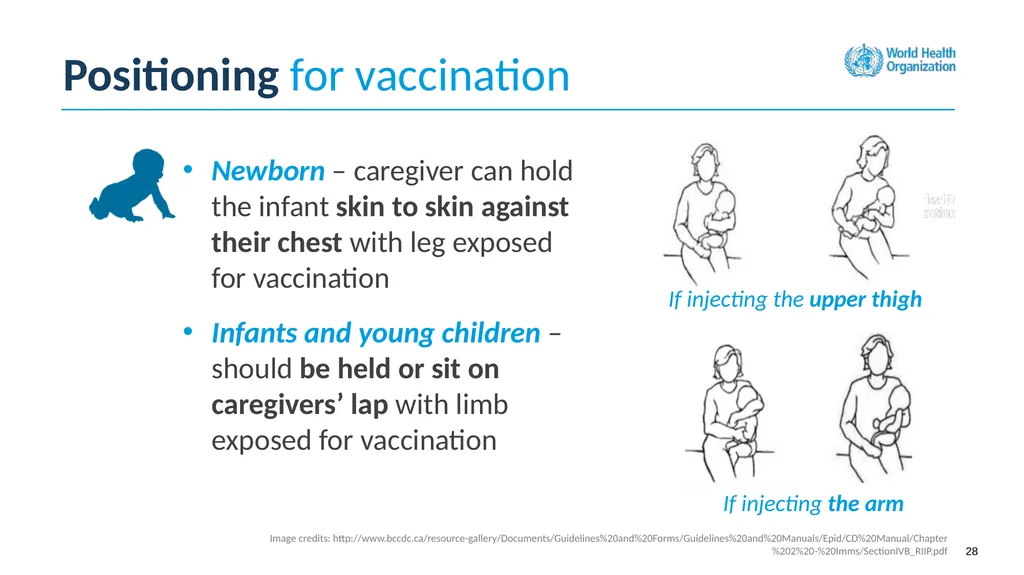
slide28. Positioning for vaccination If injecting the arm If injecting the upper thigh Newborn – caregiver can hold the infant skin to skin against their chest with leg exposed for vaccination
Infants and young children – should be held or sit on caregivers’ lap with limb exposed for vaccination Image credits: http://www.bccdc.ca/resource-gallery/Documents/Guidelines%20and%20Forms/Guidelines%20and%20Manuals/Epid/CD%20Manual/Chapter%202%20-%20Imms/SectionIVB_RIIP.pdf<br>
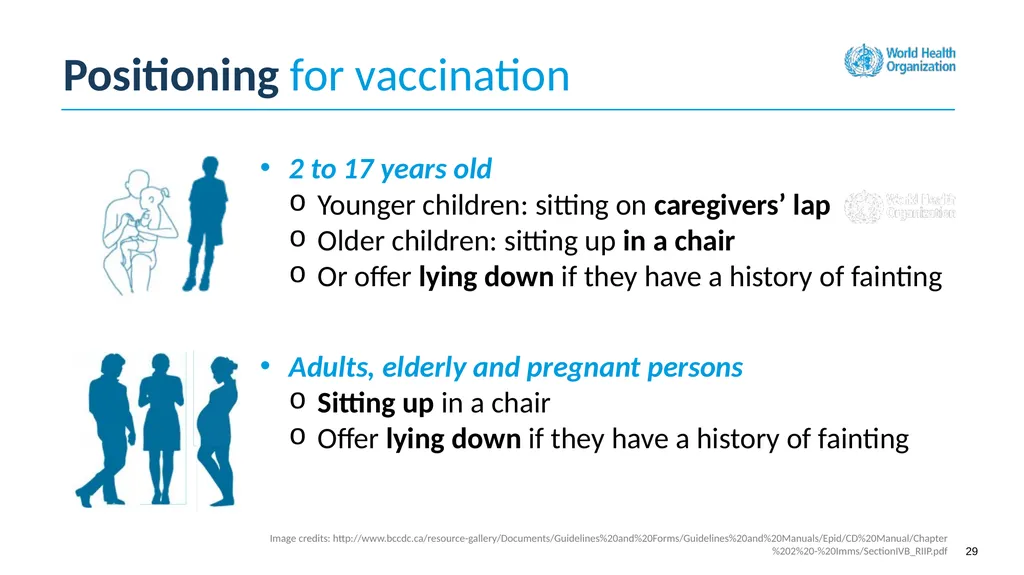
slide29. Positioning for vaccination 2 to 17 years old
Younger children: sitting on caregivers’ lap
Older children: sitting up in a chair
Or offer lying down if they have a history of fainting
Adults, elderly and pregnant persons
Sitting up in a chair
Offer lying down if they have a history of fainting Image credits: http://www.bccdc.ca/resource-gallery/Documents/Guidelines%20and%20Forms/Guidelines%20and%20Manuals/Epid/CD%20Manual/Chapter%202%20-%20Imms/SectionIVB_RIIP.pdf<br>
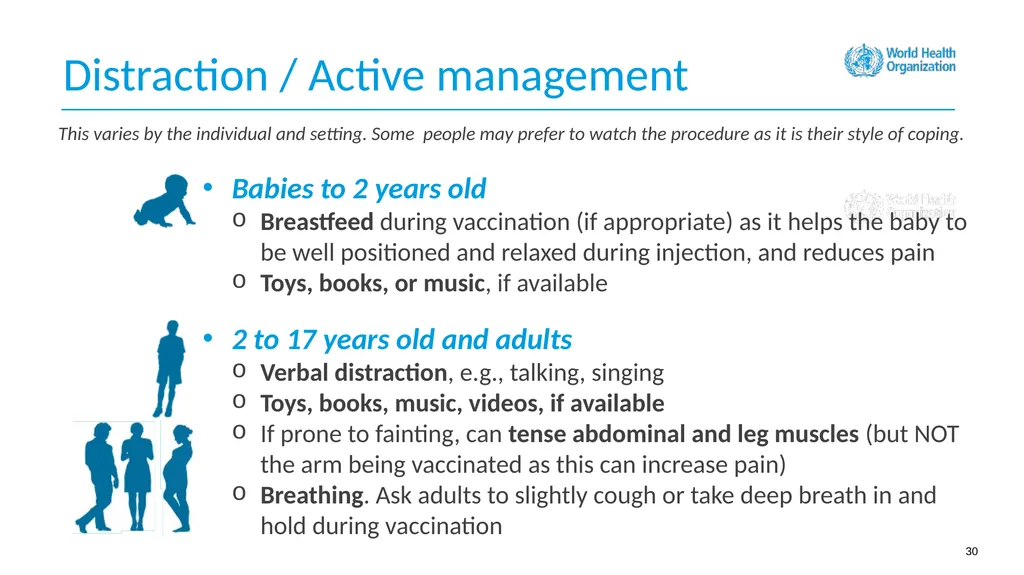
slide30. Distraction / Active management Babies to 2 years old
Breastfeed during vaccination (if appropriate) as it helps the baby to be well positioned and relaxed during injection, and reduces pain
Toys, books, or music, if available
2 to 17 years old and adults
Verbal distraction, e.g., talking, singing
Toys, books, music, videos, if available
If prone to fainting, can tense abdominal and leg muscles (but NOT the arm being vaccinated as this can increase pain)
Breathing. Ask adults to slightly cough or take deep breath in and hold during vaccination This varies by the individual and setting. Some people may prefer to watch the procedure as it is their style of coping.<br>
slide31. Proper vaccination technique Use landmarks on the body to determine the injection site.
Be safe but also quick when vaccinating.
Improper technique can lead to short- as well as long-term pain, and even nerve damage. Good technique helps minimize pain.<br>
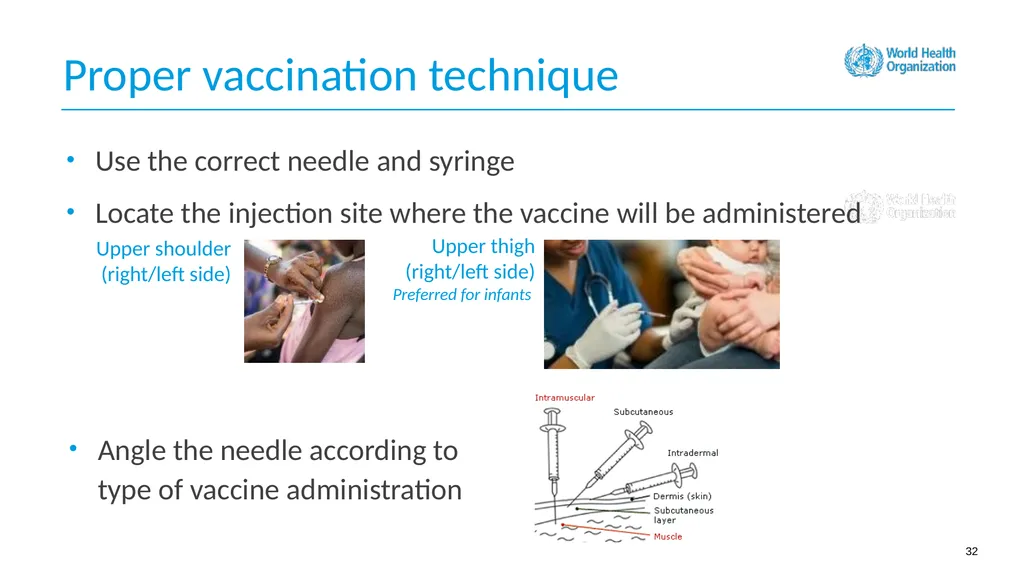
slide32. Proper vaccination technique Use the correct needle and syringe
Locate the injection site where the vaccine will be administered Angle the needle according to type of vaccine administration Upper thigh
(right/left side)
Preferred for infants Upper shoulder
(right/left side)<br>
slide33. Avoid moving the needle once it has penetrated the skin and muscle.
Do NOT aspirate, i.e. do not pull back on the syringe after inserting in the injection site as it increases the pain:
There are no large blood vessels at the recommended injection sites or injection into a large vessel, so no risk of major bleeding.
Very minor bleeding at the site after injection is not a concern. Proper vaccination technique<br>
slide34. Retain light pressure on skin around the injection site with thumb and index finger. Avoid excessive pressure or rubbing the injection site after injection, as this can increase pain.
Use landmarks on the body to determine the injection site
Insert vaccine quickly – i.e., less than 2 seconds. Proper vaccination technique<br>
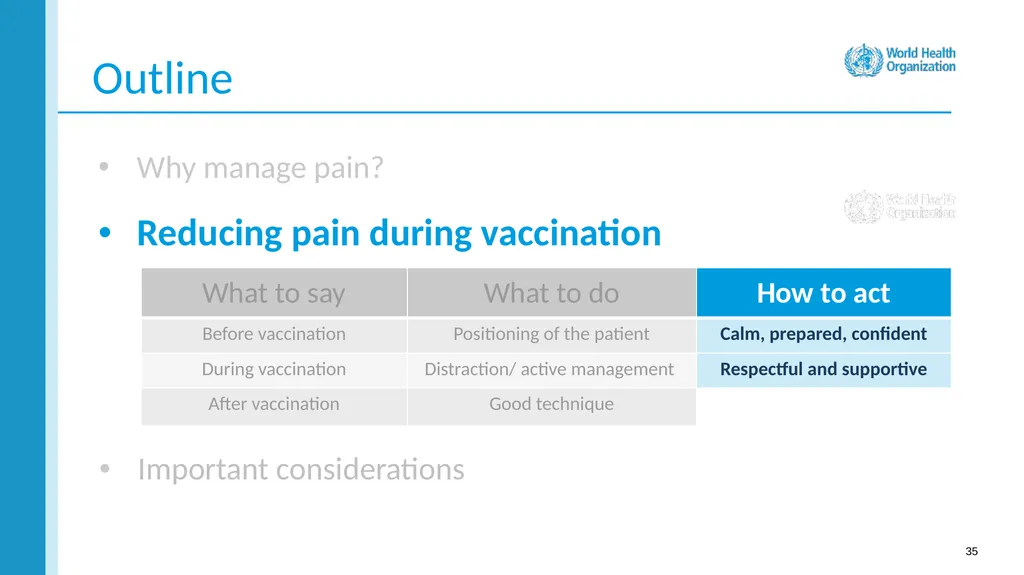
slide35. Why manage pain?
Reducing pain during vaccination Outline Important considerations<br>
slide36. Be calm, prepared and confident Do not preload syringes. It increases risk of contamination and error.
Keep supplies nearby but out of view so they do not act as fear cues and that doses can be prepared quickly.
Ensure correct timing of preparations so materials are maintained at the right temperature. Combined with skillful injection techniques, these strategies will allow you to feel and demonstrate confidence.<br>
slide37. Be calm, prepared and confident If giving multiple injections, administer the least painful vaccine first and the most painful last. If due for oral rotavirus vaccine and injectable vaccines, give the rotavirus vaccine first as it contains sweetening agents (e.g., sucrose) which can help to decrease pain from injectable vaccines.<br>
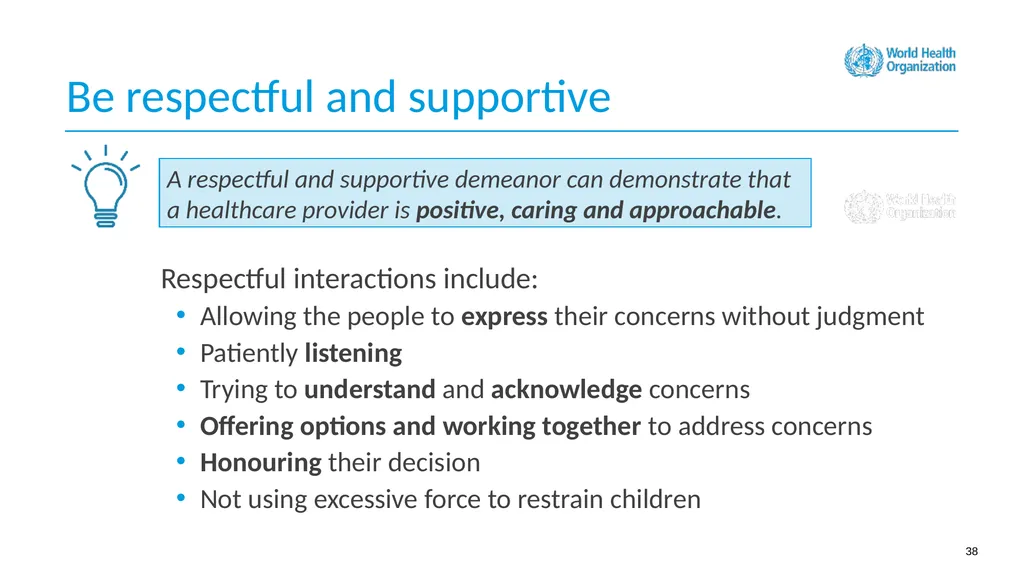
slide38. Respectful interactions include:
Allowing the people to express their concerns without judgment
Patiently listening
Trying to understand and acknowledge concerns
Offering options and working together to address concerns
Honouring their decision
Not using excessive force to restrain children Be respectful and supportive A respectful and supportive demeanor can demonstrate that a healthcare provider is positive, caring and approachable.<br>
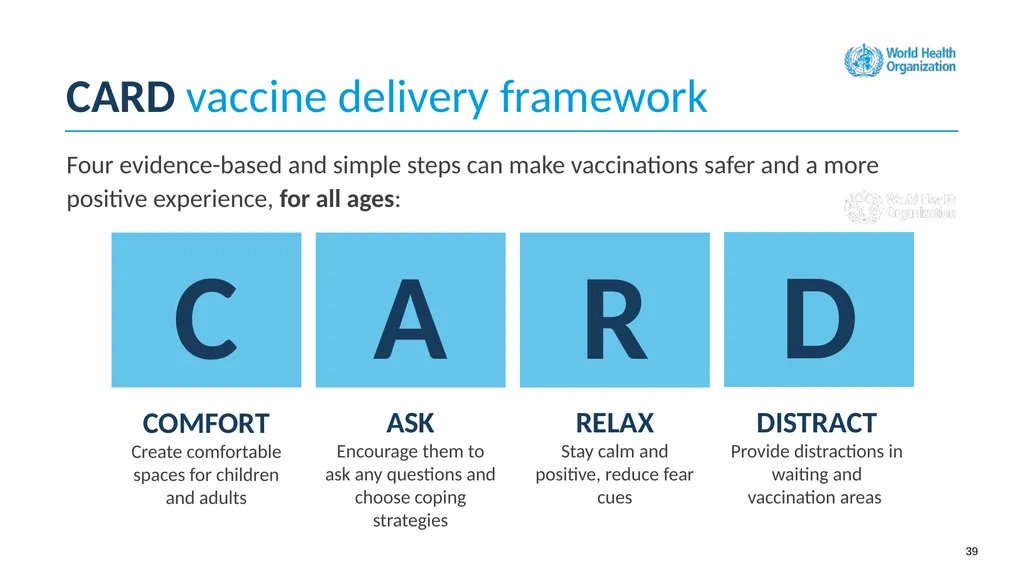
slide39. Four evidence-based and simple steps can make vaccinations safer and a more positive experience, for all ages: CARD vaccine delivery framework C A R D COMFORT
Create comfortable spaces for children and adults ASK
Encourage them to ask any questions and choose coping strategies RELAX
Stay calm and positive, reduce fear cues DISTRACT
Provide distractions in waiting and vaccination areas<br>
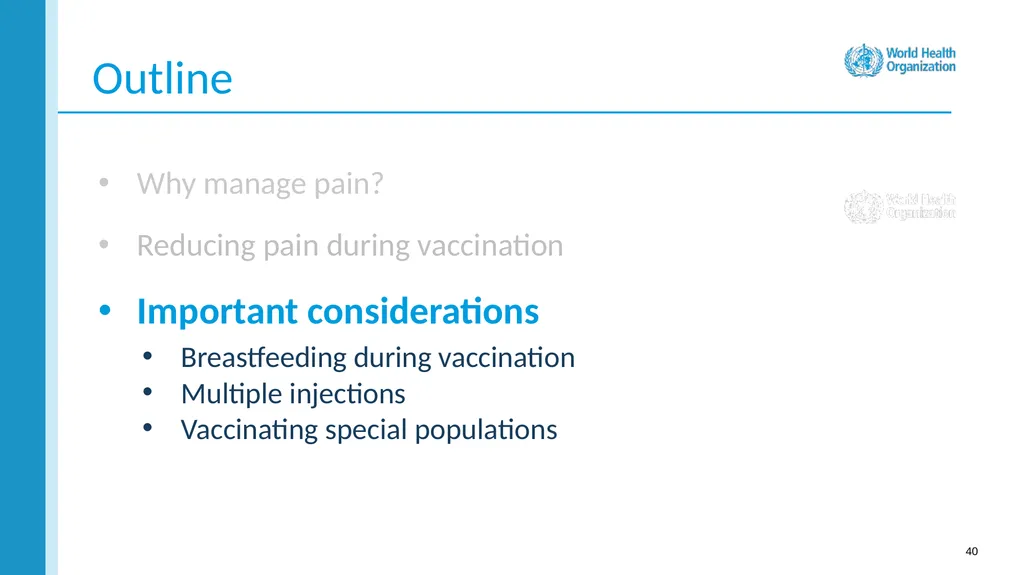
slide40. Why manage pain?
Reducing pain during vaccination
Important considerations Breastfeeding during vaccination
Multiple injections
Vaccinating special populations Outline<br>
slide41. Breastfeeding during vaccination If appropriate and feasible, encourage the breastfeeding mother to breastfeed before and during immunization
Try to ensure there is a good latch before proceeding with immunization for optimal effects
Vaccinating during breastfeeding does NOT increase the risk of aspiration<br>
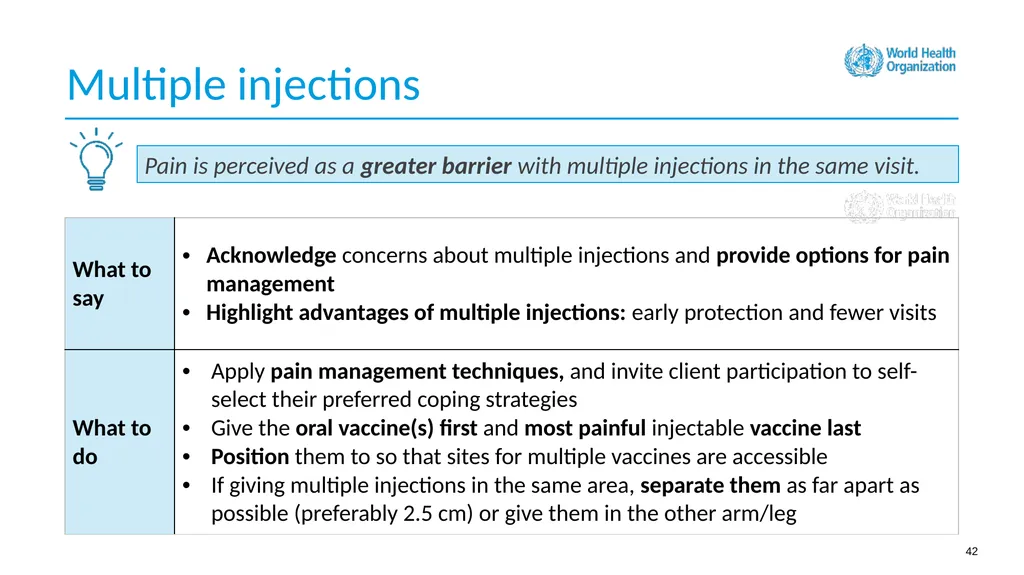
slide42. Multiple injections Pain is perceived as a greater barrier with multiple injections in the same visit.<br>
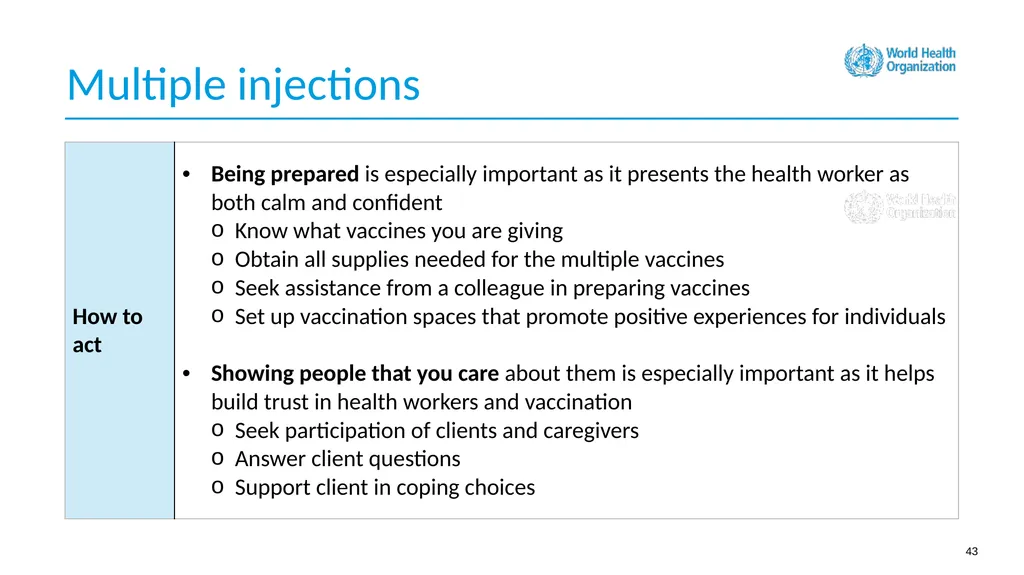
slide43. Multiple injections<br>
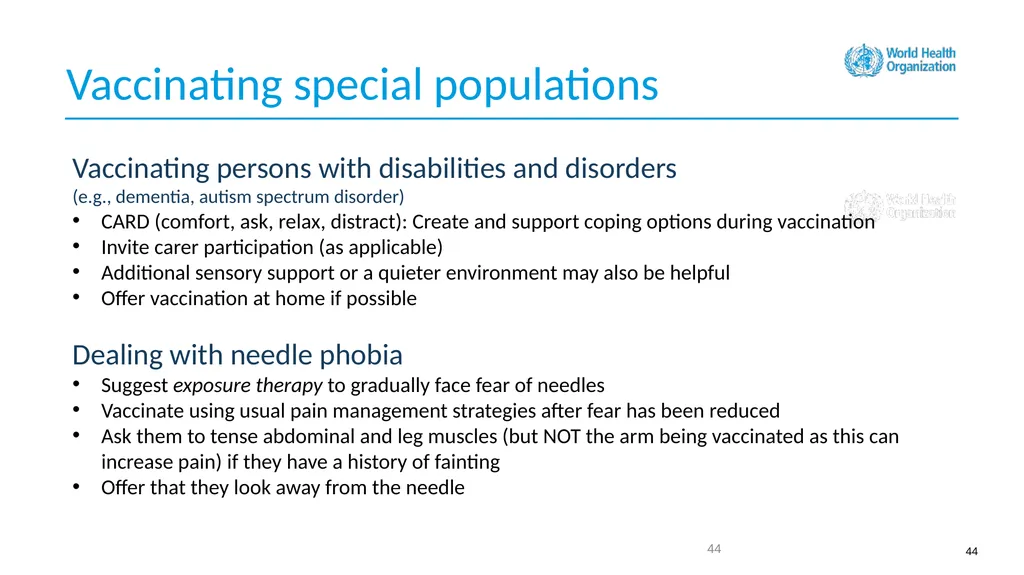
slide44. Vaccinating persons with disabilities and disorders
(e.g., dementia, autism spectrum disorder)
CARD (comfort, ask, relax, distract): Create and support coping options during vaccination
Invite carer participation (as applicable)
Additional sensory support or a quieter environment may also be helpful
Offer vaccination at home if possible
Dealing with needle phobia
Suggest exposure therapy to gradually face fear of needles
Vaccinate using usual pain management strategies after fear has been reduced
Ask them to tense abdominal and leg muscles (but NOT the arm being vaccinated as this can increase pain) if they have a history of fainting
Offer that they look away from the needle 44 Vaccinating special populations<br>
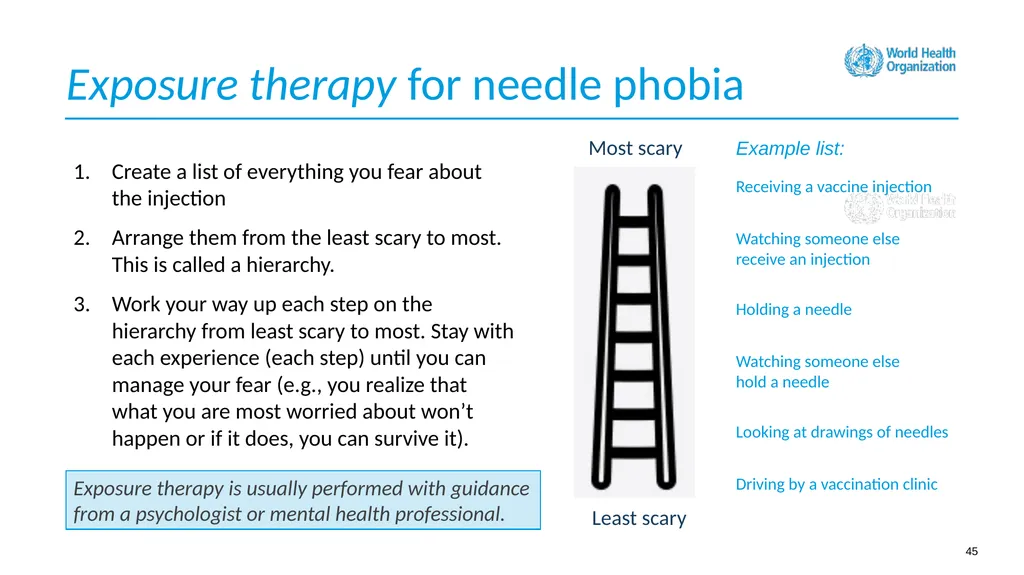
slide45. Create a list of everything you fear about the injection
Arrange them from the least scary to most. This is called a hierarchy.
Work your way up each step on the hierarchy from least scary to most. Stay with each experience (each step) until you can manage your fear (e.g., you realize that what you are most worried about won’t happen or if it does, you can survive it). Least scary Most scary Driving by a vaccination clinic Looking at drawings of needles Watching someone else hold a needle Holding a needle Watching someone else receive an injection Receiving a vaccine injection Example list: Exposure therapy for needle phobia Exposure therapy is usually performed with guidance from a psychologist or mental health professional.<br>
slide46. Pain at the time of vaccination can be a concern for some. If pain and related immunization stress-related responses are not managed, it can lead to vaccination hesitancy and refusal.
Health workers have an important role to play in ensuring a positive immunization experience and increasing confidence in vaccination.
Acknowledge the concerns regarding pain and respond to them without judgement.
CARD (comfort, ask, relax, distract) provides useful steps to build confidence and deliver vaccinations in a way that minimizes pain.
When vaccinating children, caregivers should be involved to assist with implementing pain minimisation and management strategies.
Special pain management considerations need to be made when administering multiple injections. Summary<br>
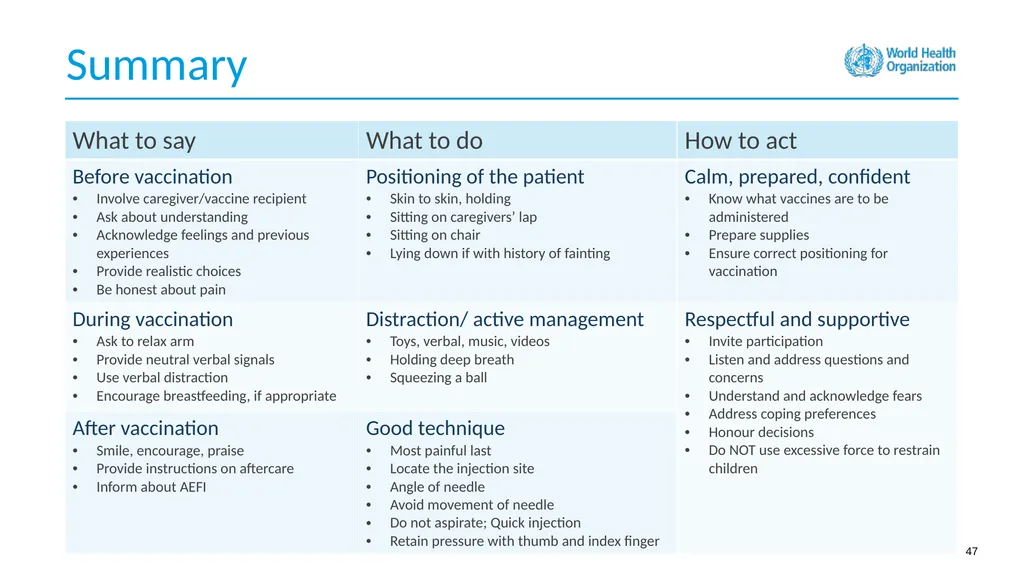
slide47. Summary<br>
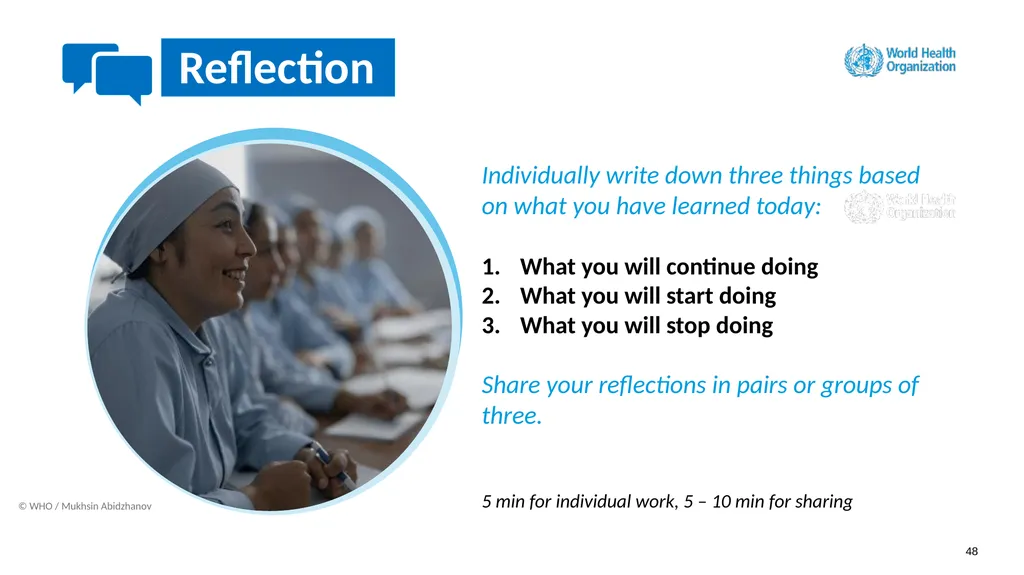
slide48. © WHO / Mukhsin Abidzhanov Reflection 5 min for individual work, 5 – 10 min for sharing Individually write down three things based on what you have learned today:
What you will continue doing
What you will start doing
What you will stop doing
Share your reflections in pairs or groups of three.<br>
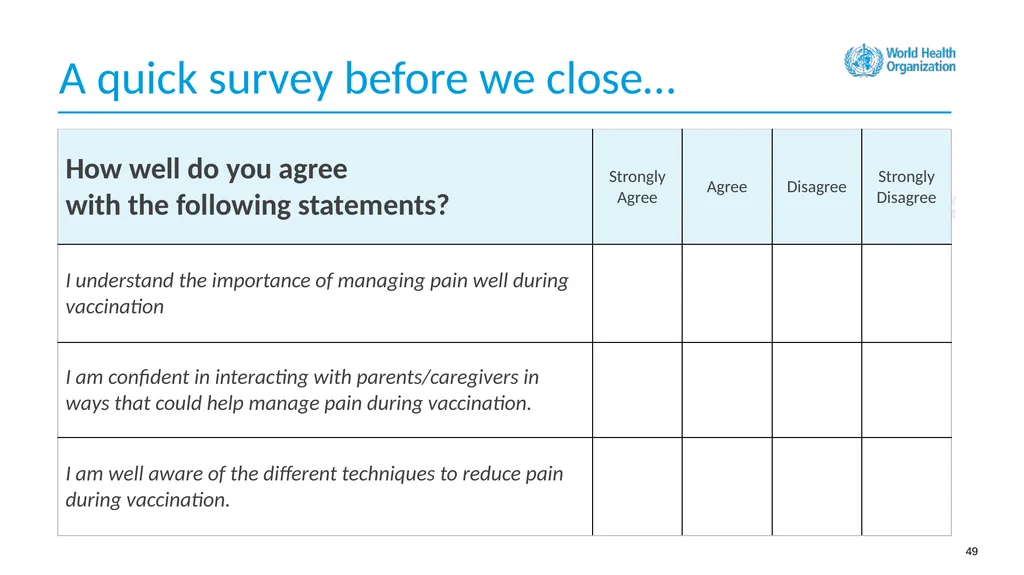
slide49. A quick survey before we close…<br>
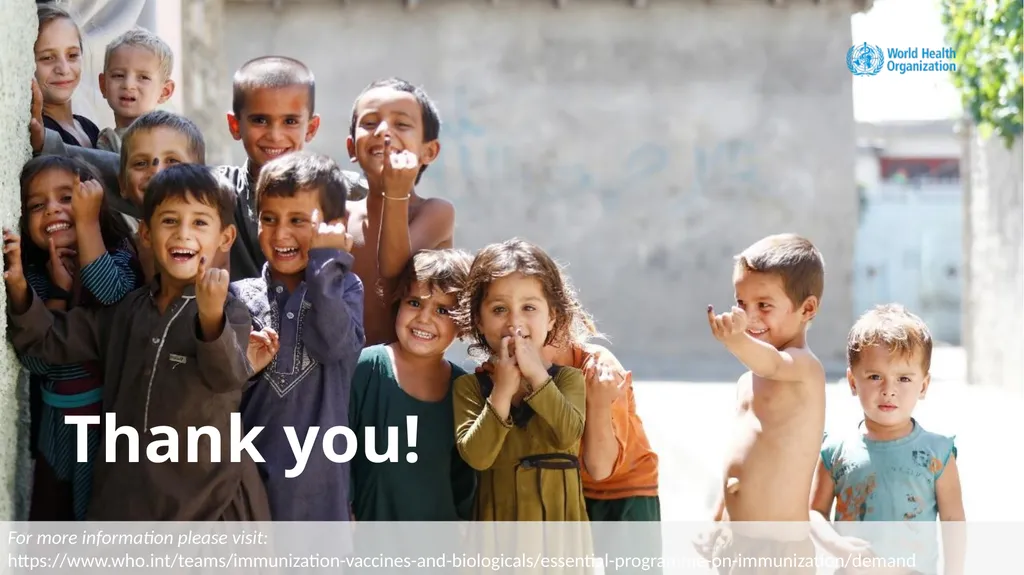
slide50. Thank you! 50 For more information please visit:
https://www.who.int/teams/immunization-vaccines-and-biologicals/essential-programme-on-immunization/demand<br>
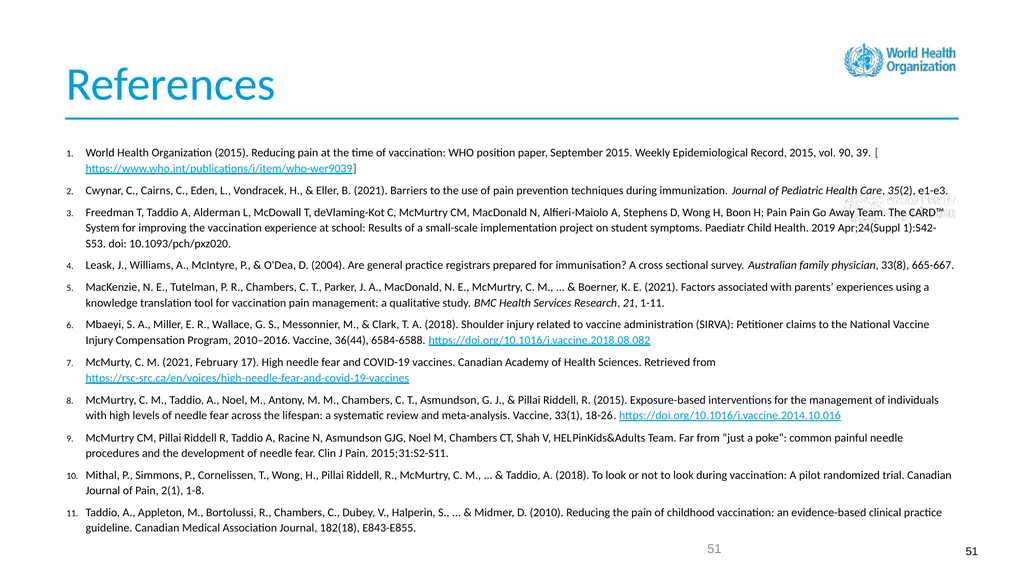
slide51. 51 References World Health Organization (2015). Reducing pain at the time of vaccination: WHO position paper, September 2015. Weekly Epidemiological Record, 2015, vol. 90, 39. [https://www.who.int/publications/i/item/who-wer9039]
Cwynar, C., Cairns, C., Eden, L., Vondracek, H., & Eller, B. (2021). Barriers to the use of pain prevention techniques during immunization. Journal of Pediatric Health Care, 35(2), e1-e3.
Freedman T, Taddio A, Alderman L, McDowall T, deVlaming-Kot C, McMurtry CM, MacDonald N, Alfieri-Maiolo A, Stephens D, Wong H, Boon H; Pain Pain Go Away Team. The CARD™ System for improving the vaccination experience at school: Results of a small-scale implementation project on student symptoms. Paediatr Child Health. 2019 Apr;24(Suppl 1):S42-S53. doi: 10.1093/pch/pxz020.
Leask, J., Williams, A., McIntyre, P., & O'Dea, D. (2004). Are general practice registrars prepared for immunisation? A cross sectional survey. Australian family physician, 33(8), 665-667.
MacKenzie, N. E., Tutelman, P. R., Chambers, C. T., Parker, J. A., MacDonald, N. E., McMurtry, C. M., ... & Boerner, K. E. (2021). Factors associated with parents’ experiences using a knowledge translation tool for vaccination pain management: a qualitative study. BMC Health Services Research, 21, 1-11.
Mbaeyi, S. A., Miller, E. R., Wallace, G. S., Messonnier, M., & Clark, T. A. (2018). Shoulder injury related to vaccine administration (SIRVA): Petitioner claims to the National Vaccine Injury Compensation Program, 2010–2016. Vaccine, 36(44), 6584-6588. https://doi.org/10.1016/j.vaccine.2018.08.082
McMurty, C. M. (2021, February 17). High needle fear and COVID-19 vaccines. Canadian Academy of Health Sciences. Retrieved from https://rsc-src.ca/en/voices/high-needle-fear-and-covid-19-vaccines
McMurtry, C. M., Taddio, A., Noel, M., Antony, M. M., Chambers, C. T., Asmundson, G. J., & Pillai Riddell, R. (2015). Exposure-based interventions for the management of individuals with high levels of needle fear across the lifespan: a systematic review and meta-analysis. Vaccine, 33(1), 18-26. https://doi.org/10.1016/j.vaccine.2014.10.016
McMurtry CM, Pillai Riddell R, Taddio A, Racine N, Asmundson GJG, Noel M, Chambers CT, Shah V, HELPinKids&Adults Team. Far from “just a poke”: common painful needle procedures and the development of needle fear. Clin J Pain. 2015;31:S2-S11.
Mithal, P., Simmons, P., Cornelissen, T., Wong, H., Pillai Riddell, R., McMurtry, C. M., ... & Taddio, A. (2018). To look or not to look during vaccination: A pilot randomized trial. Canadian Journal of Pain, 2(1), 1-8.
Taddio, A., Appleton, M., Bortolussi, R., Chambers, C., Dubey, V., Halperin, S., ... & Midmer, D. (2010). Reducing the pain of childhood vaccination: an evidence-based clinical practice guideline. Canadian Medical Association Journal, 182(18), E843-E855.<br>
slide52. 52 References Taddio, A., Gudzak, V., Jantzi, M., Logeman, C., Bucci, L. M., MacDonald, N. E., & Moineddin, R. (2022). Impact of the CARD (Comfort Ask Relax Distract) system on school-based vaccinations: a cluster randomized trial. Vaccine, 40(19), 2802-2809. https://doi.org/10.1016/j.vaccine.2022.02.069.
Taddio, A., McMurtry, C. M., Logeman, C., Gudzak, V., de Boer, A., Constantin, K., Lee, S., Moline, R., Uleryk, E., Chera, T., MacDonald, N. E., Pham, B. (2022). Prevalence of pain and fear as barriers to vaccination in children - systematic review and meta-analysis. Vaccine, 40(52), 7526-7537. https://dx.doi.org/10.1016/j.vaccine.2022.10.026
Taddio, A., McMurtry, C. M., Shah, V., Riddell, R. P., Chambers, C. T., Noel, M., MacDonald, N. E., Rogers, J., Bucci, L. M., Mousmanis, P., Lang, E., Halperin, S. A., Bowles, S., Halpert, C., & Ipp, M. (2018). Reducing pain during vaccine injections: clinical practice guideline. Canadian Medical Association Journal, 190(45), E1274-E1282. https://doi.org/10.1503/cmaj.171391
Taddio, A., Morrison, J., Gudzak, V., Logeman, C., McMurtry, C. M., Bucci, L. M., Shea, C., MacDonald, N. E., Yang, M. (2023). Integration of card (comfort ask relax distract) for covid-19 community pharmacy vaccination in children: effect on implementation outcomes. Canadian Pharmacists Journal, , 156(1 Suppl), 36S-47S. https://dx.doi.org/10.1177/17151635221139783
Taddio, A., Morrison, J., Gudzak, V., Logeman, C., McMurtry, C. M., Bucci, L. M., Shea, C., MacDonald, N. E., Yang, M. (2023). Card (comfort ask relax distract) for community pharmacy vaccinations in children: effect on immunization stress-related responses and satisfaction. Canadian Pharmacists Journal, , 156(1 Suppl), 27S-35S. https://dx.doi.org/10.1177/17151635221137682
Taddio, A., McGilton, K. S., Zheng, N., Yeung, L., Lafleur, B., Fung, J. S., ... & Verschoor, C. P. (2022). COVID-19 vaccination delivery in long-term-care using the CARD (Comfort Ask Relax Distract) system: Mixed methods study of implementation drivers. Canadian Journal of Pain, 6(1), 173-184.
Taddio, A., Ilersich, A. N., Bucci, L., McMurtry, C. M., Gudzak, V., Ipp, M., ... & MacDonald, N. (2022). Letting kids play their CARDs (Comfort, Ask, Relax, Distract) to help cope with needle-related fear and pain: Results from user testing. Vaccine, 40(52), 7667-7675.
Taddio A, Wong H, Welkovics B, Ilersich AL, Cole M, Goldbach M, Ipp M. A randomized trial of the effect of vaccine injection speed on acute pain in infants. Vaccine. 2016;34(39):4672-4677.
Tetui M, Grindrod K, Waite N, VanderDoes J, Taddio A. Integrating the CARD (Comfort Ask Relax Distract) system in a mass vaccination clinic to improve the experience of individuals during COVID-19 vaccination: a pre-post implementation study. Hum Vaccin Immunother. 2022 Jun 20:2089500. doi: 10.1080/21645515.2022.2089500.
World Health Organization. Immunization stress-related response. A manual for program managers and health professionals to prevent, identify and respond to stress related responses following immunization. Geneva: World Health Organization; 2019. Licence: CC BY-NC-SA 3.0 IGO.<br>
slide53. Acknowledgments This training module was developed with thanks to Shweta Dhawan, (Dalhousie University, Canada), with updates from the Demand and Behavioural Science Team, Department of Immunization, Vaccines and Biologicals, WHO Headquarters: Lisa Menning, Jun Ryan Orbina and Francine Ganter-Restrepo (former staff).
Appreciation also goes to the following reviewers, listed alphabetically: Professor Margie Danchin (University of Melbourne, Australia); Professor Julie Leask and Maria Christou-Ergos (University of Sydney, Australia); Professor Noni Macdonald (Dalhousie University, Canada) and Professor Anna Taddio (University of Toronto, Canada).<br>
It is part of a series on the following topics:<br>
slide2. How to use this resource NOTES FOR FACILITATOR. REMOVE BEFORE SHARING. Adapt the modules for your local use. The contents of the modules are based on evidence and best practices. Please retain the main concepts as you make the deck your own. Customize this resource for your local needs by:
Modifying examples, sample conversations and visuals,
Translating to your local language,
Tailoring the suggested exercises.
Share your feedback. We would like to learn how you have been using these modules, what aspects have been helpful and in what ways we can improve the content and approach. After using the module, please fill out the online form linked below. Link to Microsoft Forms https://forms.microsoft.com/e/vJBakm3PCx<br>
slide3. Lisa . Managing pain An adaptable health worker training during vaccine administration © WHO / Fanjan Combrink<br>
slide4. At the end of this training, you will be able to:
Understand the impact of pain at the time of immunization
Understand why it is important to manage pain well
Outline the role of health workers in managing pain during vaccination
Describe what health workers can say or do to reduce pain
Identify important considerations for pain management Training objectives<br>
slide5. A quick survey before we start…<br>
slide6. Why manage pain?
Reducing pain during vaccination
Important considerations Outline<br>
slide7. Why manage pain?
Reducing pain during vaccination
Important considerations Outline<br>
slide8. Pain or fear of pain at the time of vaccination is common at any age and can become a barrier to uptake Why manage pain? Pain can be managed and reduced Health workers have a responsibility to minimize anxiety and pain during vaccination Sources:
McMurtry, C. et. al. (2015). Vaccine, 33(1), 18-26. Taddio, A., et. al. (2018). Canadian Medical Association Journal, 190(45), E1274-E1282.<br>
slide9. Pain at the time of vaccination Perception of pain varies from person to person
Children often perceive needles to be more painful than adults
Anticipation of pain can cause fear and tensing of muscles, and lead to further discomfort
Pain may be associated with other immunization stress-related responses including dizziness or fainting<br>
slide10. Minimizing and managing pain Promotes safer vaccination delivery by:
Encouraging a calm and stress-free immunization experience
Supporting individuals to prevent or manage fear of needles
Improves vaccine confidence by:
Helping individuals feel more comfortable with vaccination
Creating a positive and reassuring vaccination experience Source:
Immunization stress-related response. A manual for program managers and health professionals to prevent, identify and respond to stress related responses following immunization. Geneva: World Health Organization; 2019.<br>
slide11. Pain after vaccination Pain during vaccination is different from pain that develops after vaccination
Pain that develops after vaccination may be present with redness, tenderness and/or swelling at the injection site
Can vary per person and vaccine
Usually mild and not a serious cause of concern
In some rare cases, can be more severe (i.e., severe local reactions)<br>
slide12. Why manage pain?
Reducing pain during vaccination
Important considerations Outline<br>
slide13. A health worker
can reduce pain during vaccination Interaction with health worker Technique of vaccine administration Comfort during the visit These factors are modifiable by managing… What to say? What to do? How to act? © WHO / Fanjan Combrink<br>
slide14. Specific pain management techniques vary by population groups and age Babies up to 2 years old 2 to 17 years old Adults, elderly, and pregnant women<br>
slide15. Comfortable and private
Clean, quiet and calm
A well-designed and efficient service Creating the right environment
for vaccination Source: Quality immunization services: a planning guide. Geneva: World Health Organization; 2022. Vaccination must be discussed and administered in a setting which is: © WHO / Fanjan Combrink<br>
slide16. Why manage pain?
Reducing pain during vaccination Outline Important considerations<br>
slide17. What to say before vaccination Use language appropriate to the person’s level of understanding
If giving vaccines to a young child, ask the caregiver if and how much the child understands about vaccination
If they are nervous, acknowledge and normalize their feelings:
“It is normal to feel nervous before getting a needle.”<br>
slide18. What to say before vaccination Be honest that the needle may hurt. Pain is normal, happens briefly and resolves on its own.
Do not say, “It doesn’t hurt.”
Do not dismiss their feelings.
These approaches are not helpful and may promote distrust or increase distress. © WHO / Sanchita Sharma<br>
slide19. What to say before vaccination Prepare the person/caregiver for vaccination by explaining what to expect:
What the vaccine(s) prevent against:
“These vaccines provide important protection against…”
Invite participation:
“Do you have some questions?”
Describe how the vaccination will feel using neutral language:
“Some people say they feel a poke or pinch and some pushing for a few seconds, and others say they do not feel much at all.”<br>
slide20. What to say before vaccination Ask about preferred coping strategies. If offering distraction items in the clinic, let them know what options are available:
“Tell me what can we do to make the vaccination more comfortable for you?
“We have some books. Would you like to pick one to use as a distraction?” © WHO / Fanjan Combrink<br>
slide21. What to say during vaccination Keep needles and frightening objects/equipment out of view
If vaccinating an infant, ask the caregiver to hold the infant in a position that is comfortable for both:
Ask the mother if they would like the baby to have some sucrose, which has been shown to minimize pain
Encourage breastfeeding at the time of vaccination (if appropriate) as it also helps with relaxation<br>
slide22. What to say during vaccination Show caregivers how to hold infants and children in a manner that provides physical comfort, while exposing and securing limb(s) for injection
Ask older children and adults to relax their arm and sit upright
Give a neutral verbal signal before administering the vaccine: “I’m going to count 3,2,1.” or “Okay, I am going to give the vaccine now.” © WHO / Faizza Tanggol<br>
slide23. What to say after vaccination Smile, encourage and praise them for their bravery:
“Well done, you read your book / stayed very still!”
Ask for feedback and use that to plan for next time:
“How did that feel?”
Provide instructions on aftercare:
“It is normal for your arm to feel sore. It shouldn’t prevent you from doing any activities that you normally do”<br>
slide24. What to say after vaccination Inform about signs and symptoms they should watch out for, i.e. adverse events following immunization (AEFI):
“It is normal to see some redness and swelling at the site of injection, and this should go away after a few days” © WHO / Fanjan Combrink<br>
slide25. © WHO / Mukhsin Abidzhanov Role play 5 min for role playing, 5 – 10 min for discussion with group In groups of 2 or more:
Person 1: A person who is nervous about pain from needles during vaccination
Person 2: A health worker who will vaccinate the patient
Other(s): Observers, who will take notes on the interaction
Practice the interaction with the aim of
addressing the concerns of the person due for vaccination<br>
slide26. Why manage pain?
Reducing pain during vaccination Outline Important considerations<br>
slide27. A comfortable position reduces anxiety and allows for more control while administering vaccines. If the infant is held by the caregiver, it also helps the infant to feel secure and relaxed. Positioning for vaccination<br>
slide28. Positioning for vaccination If injecting the arm If injecting the upper thigh Newborn – caregiver can hold the infant skin to skin against their chest with leg exposed for vaccination
Infants and young children – should be held or sit on caregivers’ lap with limb exposed for vaccination Image credits: http://www.bccdc.ca/resource-gallery/Documents/Guidelines%20and%20Forms/Guidelines%20and%20Manuals/Epid/CD%20Manual/Chapter%202%20-%20Imms/SectionIVB_RIIP.pdf<br>
slide29. Positioning for vaccination 2 to 17 years old
Younger children: sitting on caregivers’ lap
Older children: sitting up in a chair
Or offer lying down if they have a history of fainting
Adults, elderly and pregnant persons
Sitting up in a chair
Offer lying down if they have a history of fainting Image credits: http://www.bccdc.ca/resource-gallery/Documents/Guidelines%20and%20Forms/Guidelines%20and%20Manuals/Epid/CD%20Manual/Chapter%202%20-%20Imms/SectionIVB_RIIP.pdf<br>
slide30. Distraction / Active management Babies to 2 years old
Breastfeed during vaccination (if appropriate) as it helps the baby to be well positioned and relaxed during injection, and reduces pain
Toys, books, or music, if available
2 to 17 years old and adults
Verbal distraction, e.g., talking, singing
Toys, books, music, videos, if available
If prone to fainting, can tense abdominal and leg muscles (but NOT the arm being vaccinated as this can increase pain)
Breathing. Ask adults to slightly cough or take deep breath in and hold during vaccination This varies by the individual and setting. Some people may prefer to watch the procedure as it is their style of coping.<br>
slide31. Proper vaccination technique Use landmarks on the body to determine the injection site.
Be safe but also quick when vaccinating.
Improper technique can lead to short- as well as long-term pain, and even nerve damage. Good technique helps minimize pain.<br>
slide32. Proper vaccination technique Use the correct needle and syringe
Locate the injection site where the vaccine will be administered Angle the needle according to type of vaccine administration Upper thigh
(right/left side)
Preferred for infants Upper shoulder
(right/left side)<br>
slide33. Avoid moving the needle once it has penetrated the skin and muscle.
Do NOT aspirate, i.e. do not pull back on the syringe after inserting in the injection site as it increases the pain:
There are no large blood vessels at the recommended injection sites or injection into a large vessel, so no risk of major bleeding.
Very minor bleeding at the site after injection is not a concern. Proper vaccination technique<br>
slide34. Retain light pressure on skin around the injection site with thumb and index finger. Avoid excessive pressure or rubbing the injection site after injection, as this can increase pain.
Use landmarks on the body to determine the injection site
Insert vaccine quickly – i.e., less than 2 seconds. Proper vaccination technique<br>
slide35. Why manage pain?
Reducing pain during vaccination Outline Important considerations<br>
slide36. Be calm, prepared and confident Do not preload syringes. It increases risk of contamination and error.
Keep supplies nearby but out of view so they do not act as fear cues and that doses can be prepared quickly.
Ensure correct timing of preparations so materials are maintained at the right temperature. Combined with skillful injection techniques, these strategies will allow you to feel and demonstrate confidence.<br>
slide37. Be calm, prepared and confident If giving multiple injections, administer the least painful vaccine first and the most painful last. If due for oral rotavirus vaccine and injectable vaccines, give the rotavirus vaccine first as it contains sweetening agents (e.g., sucrose) which can help to decrease pain from injectable vaccines.<br>
slide38. Respectful interactions include:
Allowing the people to express their concerns without judgment
Patiently listening
Trying to understand and acknowledge concerns
Offering options and working together to address concerns
Honouring their decision
Not using excessive force to restrain children Be respectful and supportive A respectful and supportive demeanor can demonstrate that a healthcare provider is positive, caring and approachable.<br>
slide39. Four evidence-based and simple steps can make vaccinations safer and a more positive experience, for all ages: CARD vaccine delivery framework C A R D COMFORT
Create comfortable spaces for children and adults ASK
Encourage them to ask any questions and choose coping strategies RELAX
Stay calm and positive, reduce fear cues DISTRACT
Provide distractions in waiting and vaccination areas<br>
slide40. Why manage pain?
Reducing pain during vaccination
Important considerations Breastfeeding during vaccination
Multiple injections
Vaccinating special populations Outline<br>
slide41. Breastfeeding during vaccination If appropriate and feasible, encourage the breastfeeding mother to breastfeed before and during immunization
Try to ensure there is a good latch before proceeding with immunization for optimal effects
Vaccinating during breastfeeding does NOT increase the risk of aspiration<br>
slide42. Multiple injections Pain is perceived as a greater barrier with multiple injections in the same visit.<br>
slide43. Multiple injections<br>
slide44. Vaccinating persons with disabilities and disorders
(e.g., dementia, autism spectrum disorder)
CARD (comfort, ask, relax, distract): Create and support coping options during vaccination
Invite carer participation (as applicable)
Additional sensory support or a quieter environment may also be helpful
Offer vaccination at home if possible
Dealing with needle phobia
Suggest exposure therapy to gradually face fear of needles
Vaccinate using usual pain management strategies after fear has been reduced
Ask them to tense abdominal and leg muscles (but NOT the arm being vaccinated as this can increase pain) if they have a history of fainting
Offer that they look away from the needle 44 Vaccinating special populations<br>
slide45. Create a list of everything you fear about the injection
Arrange them from the least scary to most. This is called a hierarchy.
Work your way up each step on the hierarchy from least scary to most. Stay with each experience (each step) until you can manage your fear (e.g., you realize that what you are most worried about won’t happen or if it does, you can survive it). Least scary Most scary Driving by a vaccination clinic Looking at drawings of needles Watching someone else hold a needle Holding a needle Watching someone else receive an injection Receiving a vaccine injection Example list: Exposure therapy for needle phobia Exposure therapy is usually performed with guidance from a psychologist or mental health professional.<br>
slide46. Pain at the time of vaccination can be a concern for some. If pain and related immunization stress-related responses are not managed, it can lead to vaccination hesitancy and refusal.
Health workers have an important role to play in ensuring a positive immunization experience and increasing confidence in vaccination.
Acknowledge the concerns regarding pain and respond to them without judgement.
CARD (comfort, ask, relax, distract) provides useful steps to build confidence and deliver vaccinations in a way that minimizes pain.
When vaccinating children, caregivers should be involved to assist with implementing pain minimisation and management strategies.
Special pain management considerations need to be made when administering multiple injections. Summary<br>
slide47. Summary<br>
slide48. © WHO / Mukhsin Abidzhanov Reflection 5 min for individual work, 5 – 10 min for sharing Individually write down three things based on what you have learned today:
What you will continue doing
What you will start doing
What you will stop doing
Share your reflections in pairs or groups of three.<br>
slide49. A quick survey before we close…<br>
slide50. Thank you! 50 For more information please visit:
https://www.who.int/teams/immunization-vaccines-and-biologicals/essential-programme-on-immunization/demand<br>
slide51. 51 References World Health Organization (2015). Reducing pain at the time of vaccination: WHO position paper, September 2015. Weekly Epidemiological Record, 2015, vol. 90, 39. [https://www.who.int/publications/i/item/who-wer9039]
Cwynar, C., Cairns, C., Eden, L., Vondracek, H., & Eller, B. (2021). Barriers to the use of pain prevention techniques during immunization. Journal of Pediatric Health Care, 35(2), e1-e3.
Freedman T, Taddio A, Alderman L, McDowall T, deVlaming-Kot C, McMurtry CM, MacDonald N, Alfieri-Maiolo A, Stephens D, Wong H, Boon H; Pain Pain Go Away Team. The CARD™ System for improving the vaccination experience at school: Results of a small-scale implementation project on student symptoms. Paediatr Child Health. 2019 Apr;24(Suppl 1):S42-S53. doi: 10.1093/pch/pxz020.
Leask, J., Williams, A., McIntyre, P., & O'Dea, D. (2004). Are general practice registrars prepared for immunisation? A cross sectional survey. Australian family physician, 33(8), 665-667.
MacKenzie, N. E., Tutelman, P. R., Chambers, C. T., Parker, J. A., MacDonald, N. E., McMurtry, C. M., ... & Boerner, K. E. (2021). Factors associated with parents’ experiences using a knowledge translation tool for vaccination pain management: a qualitative study. BMC Health Services Research, 21, 1-11.
Mbaeyi, S. A., Miller, E. R., Wallace, G. S., Messonnier, M., & Clark, T. A. (2018). Shoulder injury related to vaccine administration (SIRVA): Petitioner claims to the National Vaccine Injury Compensation Program, 2010–2016. Vaccine, 36(44), 6584-6588. https://doi.org/10.1016/j.vaccine.2018.08.082
McMurty, C. M. (2021, February 17). High needle fear and COVID-19 vaccines. Canadian Academy of Health Sciences. Retrieved from https://rsc-src.ca/en/voices/high-needle-fear-and-covid-19-vaccines
McMurtry, C. M., Taddio, A., Noel, M., Antony, M. M., Chambers, C. T., Asmundson, G. J., & Pillai Riddell, R. (2015). Exposure-based interventions for the management of individuals with high levels of needle fear across the lifespan: a systematic review and meta-analysis. Vaccine, 33(1), 18-26. https://doi.org/10.1016/j.vaccine.2014.10.016
McMurtry CM, Pillai Riddell R, Taddio A, Racine N, Asmundson GJG, Noel M, Chambers CT, Shah V, HELPinKids&Adults Team. Far from “just a poke”: common painful needle procedures and the development of needle fear. Clin J Pain. 2015;31:S2-S11.
Mithal, P., Simmons, P., Cornelissen, T., Wong, H., Pillai Riddell, R., McMurtry, C. M., ... & Taddio, A. (2018). To look or not to look during vaccination: A pilot randomized trial. Canadian Journal of Pain, 2(1), 1-8.
Taddio, A., Appleton, M., Bortolussi, R., Chambers, C., Dubey, V., Halperin, S., ... & Midmer, D. (2010). Reducing the pain of childhood vaccination: an evidence-based clinical practice guideline. Canadian Medical Association Journal, 182(18), E843-E855.<br>
slide52. 52 References Taddio, A., Gudzak, V., Jantzi, M., Logeman, C., Bucci, L. M., MacDonald, N. E., & Moineddin, R. (2022). Impact of the CARD (Comfort Ask Relax Distract) system on school-based vaccinations: a cluster randomized trial. Vaccine, 40(19), 2802-2809. https://doi.org/10.1016/j.vaccine.2022.02.069.
Taddio, A., McMurtry, C. M., Logeman, C., Gudzak, V., de Boer, A., Constantin, K., Lee, S., Moline, R., Uleryk, E., Chera, T., MacDonald, N. E., Pham, B. (2022). Prevalence of pain and fear as barriers to vaccination in children - systematic review and meta-analysis. Vaccine, 40(52), 7526-7537. https://dx.doi.org/10.1016/j.vaccine.2022.10.026
Taddio, A., McMurtry, C. M., Shah, V., Riddell, R. P., Chambers, C. T., Noel, M., MacDonald, N. E., Rogers, J., Bucci, L. M., Mousmanis, P., Lang, E., Halperin, S. A., Bowles, S., Halpert, C., & Ipp, M. (2018). Reducing pain during vaccine injections: clinical practice guideline. Canadian Medical Association Journal, 190(45), E1274-E1282. https://doi.org/10.1503/cmaj.171391
Taddio, A., Morrison, J., Gudzak, V., Logeman, C., McMurtry, C. M., Bucci, L. M., Shea, C., MacDonald, N. E., Yang, M. (2023). Integration of card (comfort ask relax distract) for covid-19 community pharmacy vaccination in children: effect on implementation outcomes. Canadian Pharmacists Journal, , 156(1 Suppl), 36S-47S. https://dx.doi.org/10.1177/17151635221139783
Taddio, A., Morrison, J., Gudzak, V., Logeman, C., McMurtry, C. M., Bucci, L. M., Shea, C., MacDonald, N. E., Yang, M. (2023). Card (comfort ask relax distract) for community pharmacy vaccinations in children: effect on immunization stress-related responses and satisfaction. Canadian Pharmacists Journal, , 156(1 Suppl), 27S-35S. https://dx.doi.org/10.1177/17151635221137682
Taddio, A., McGilton, K. S., Zheng, N., Yeung, L., Lafleur, B., Fung, J. S., ... & Verschoor, C. P. (2022). COVID-19 vaccination delivery in long-term-care using the CARD (Comfort Ask Relax Distract) system: Mixed methods study of implementation drivers. Canadian Journal of Pain, 6(1), 173-184.
Taddio, A., Ilersich, A. N., Bucci, L., McMurtry, C. M., Gudzak, V., Ipp, M., ... & MacDonald, N. (2022). Letting kids play their CARDs (Comfort, Ask, Relax, Distract) to help cope with needle-related fear and pain: Results from user testing. Vaccine, 40(52), 7667-7675.
Taddio A, Wong H, Welkovics B, Ilersich AL, Cole M, Goldbach M, Ipp M. A randomized trial of the effect of vaccine injection speed on acute pain in infants. Vaccine. 2016;34(39):4672-4677.
Tetui M, Grindrod K, Waite N, VanderDoes J, Taddio A. Integrating the CARD (Comfort Ask Relax Distract) system in a mass vaccination clinic to improve the experience of individuals during COVID-19 vaccination: a pre-post implementation study. Hum Vaccin Immunother. 2022 Jun 20:2089500. doi: 10.1080/21645515.2022.2089500.
World Health Organization. Immunization stress-related response. A manual for program managers and health professionals to prevent, identify and respond to stress related responses following immunization. Geneva: World Health Organization; 2019. Licence: CC BY-NC-SA 3.0 IGO.<br>
slide53. Acknowledgments This training module was developed with thanks to Shweta Dhawan, (Dalhousie University, Canada), with updates from the Demand and Behavioural Science Team, Department of Immunization, Vaccines and Biologicals, WHO Headquarters: Lisa Menning, Jun Ryan Orbina and Francine Ganter-Restrepo (former staff).
Appreciation also goes to the following reviewers, listed alphabetically: Professor Margie Danchin (University of Melbourne, Australia); Professor Julie Leask and Maria Christou-Ergos (University of Sydney, Australia); Professor Noni Macdonald (Dalhousie University, Canada) and Professor Anna Taddio (University of Toronto, Canada).<br>