
How to Write a Research paper Slides Borrowed
YM
Published · 65 slides · 0 views
1 / 1



Description
How to Write a Research paper Slides Borrowed From: Simon Peyton Jones, Microsoft Research, Cambridge Writing papers is a skill Many papers are badly written Good writing is a skill you can learn Its a skill that is worth learning: More
Related Topics
Share
Embed code
Download this presentation From Below
"How to Write a Research paper Slides Borrowed" is the property of its rightful owner. Permission is granted to download and print the materials on this website for personal, non-commercial use only, and to display it on your personal computer provided you do not modify the materials and that you retain all copyright notices contained in the materials. By downloading content from our website, you accept the terms of this agreement.
Presentation Transcript
01
How to Write a Research paper Slides Borrowed From:
Simon Peyton Jones, Microsoft Research, Cambridge<br>
Simon Peyton Jones, Microsoft Research, Cambridge<br>
02
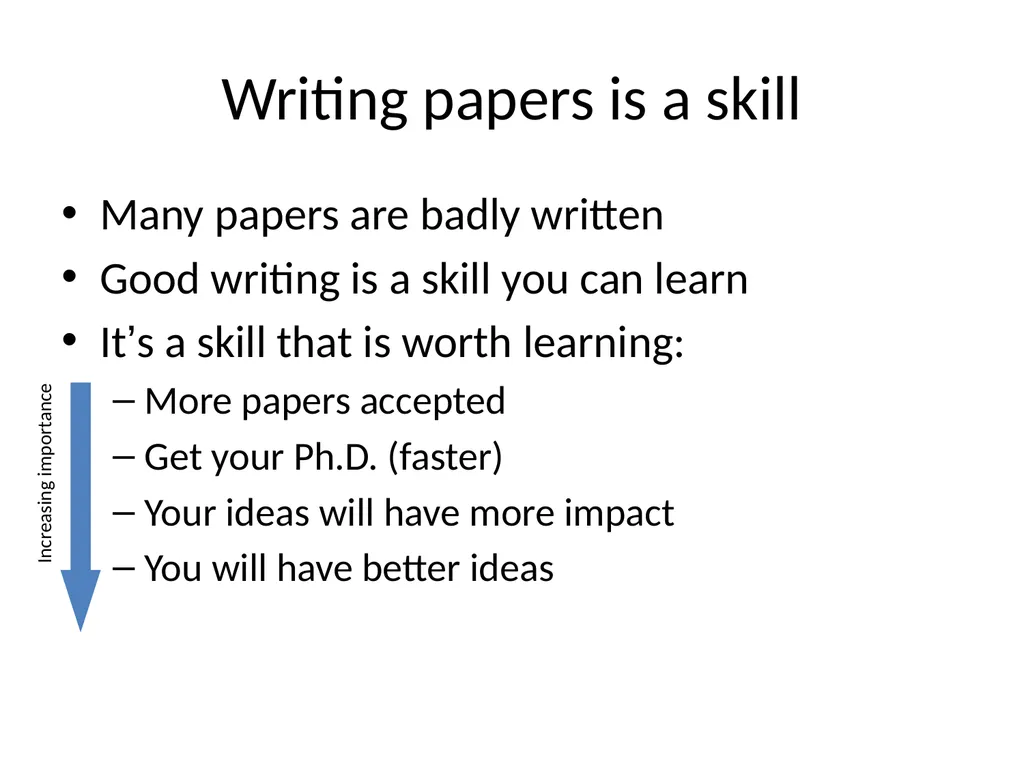
Writing papers is a skill Many papers are badly written
Good writing is a skill you can learn
It’s a skill that is worth learning:
More papers accepted
Get your Ph.D. (faster)
Your ideas will have more impact
You will have better ideas Increasing importance<br>
Good writing is a skill you can learn
It’s a skill that is worth learning:
More papers accepted
Get your Ph.D. (faster)
Your ideas will have more impact
You will have better ideas Increasing importance<br>
03
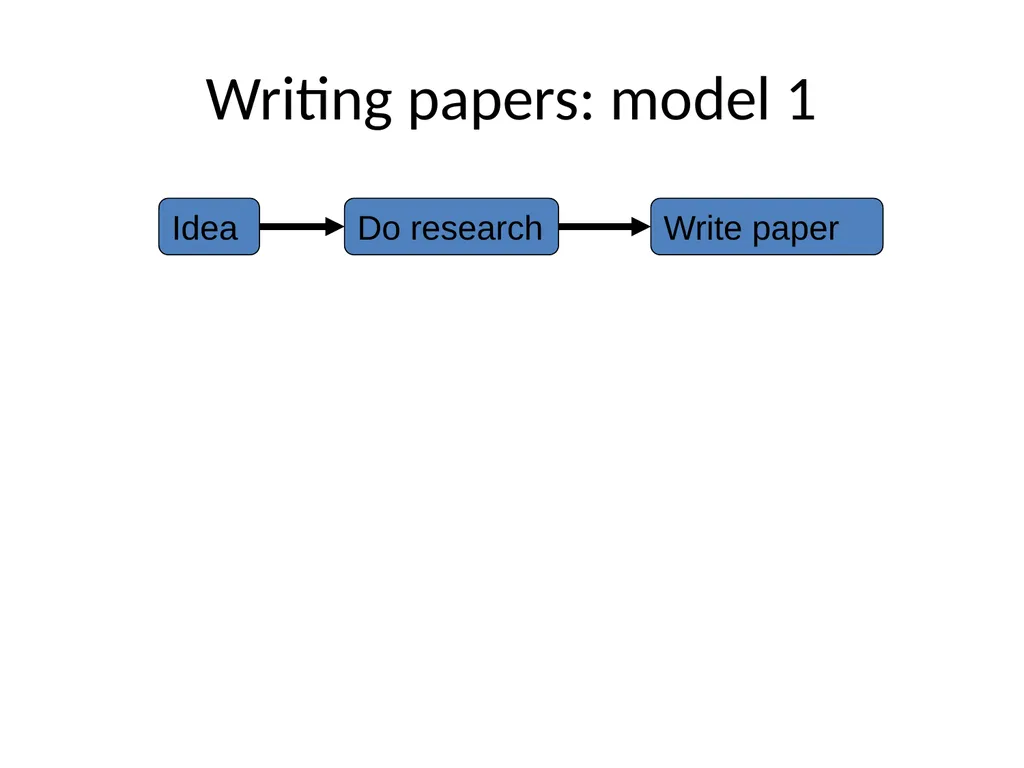
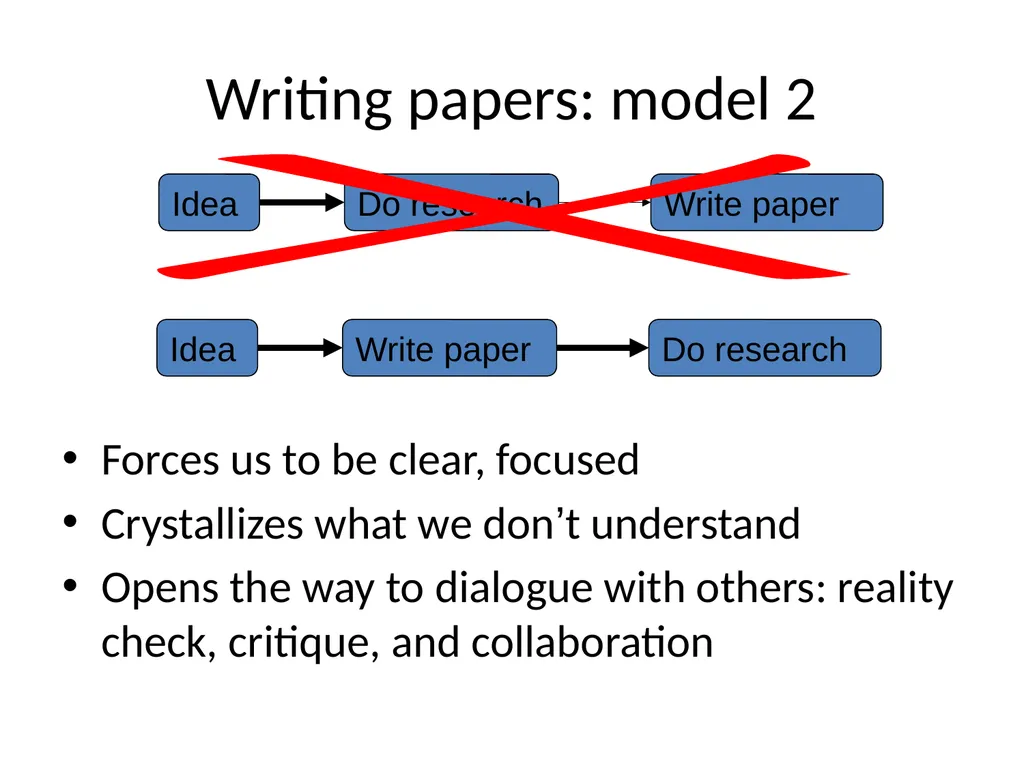
Writing papers: model 1 Idea Do research Write paper<br>
04
Writing papers: model 2 Idea Do research Write paper Idea Write paper Do research Forces us to be clear, focused
Crystallizes what we don’t understand
Opens the way to dialogue with others: reality check, critique, and collaboration<br>
Crystallizes what we don’t understand
Opens the way to dialogue with others: reality check, critique, and collaboration<br>
05
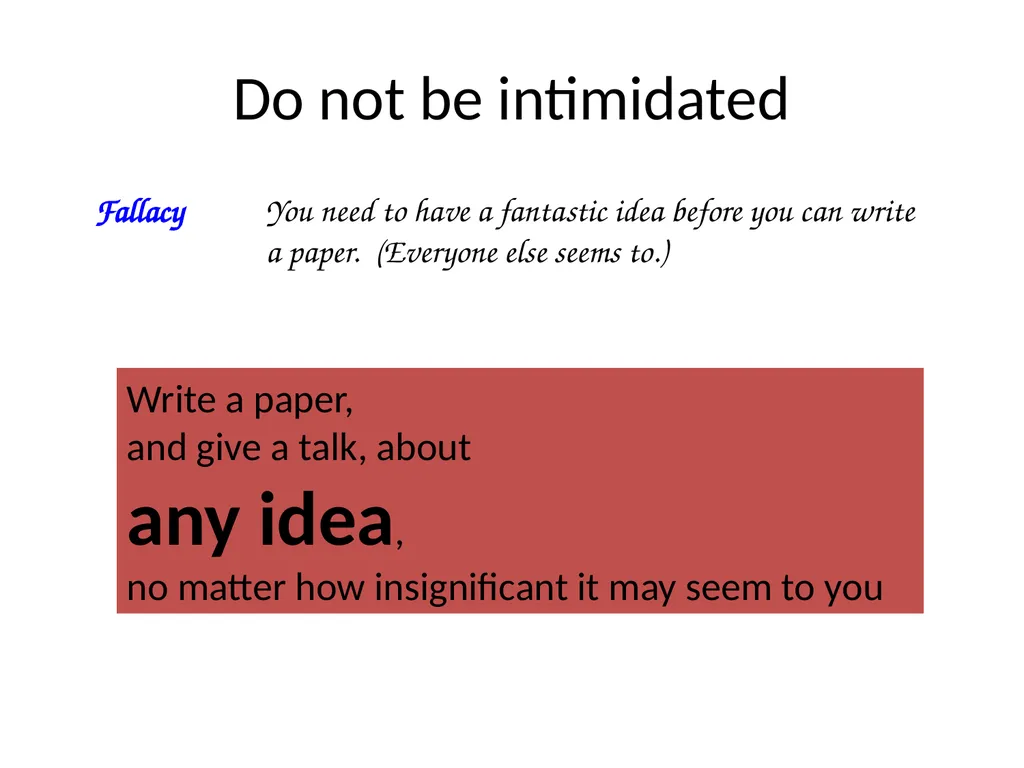
Do not be intimidated Write a paper,
and give a talk, about
any idea,
no matter how insignificant it may seem to you Fallacy You need to have a fantastic idea before you can write a paper. (Everyone else seems to.)<br>
06
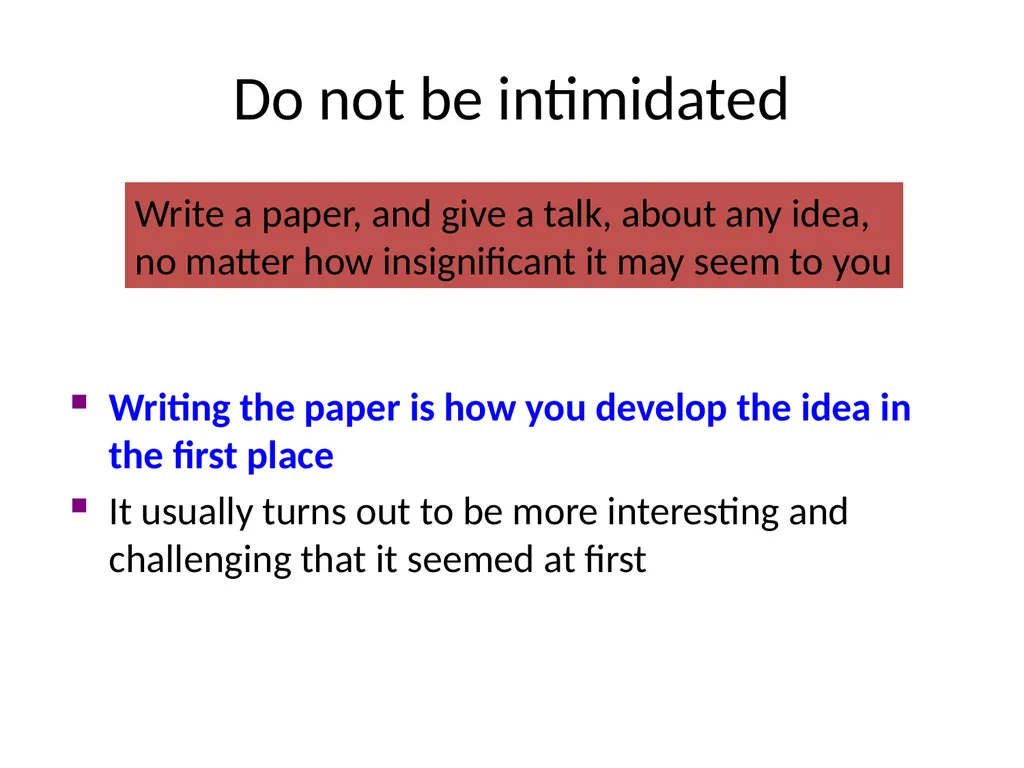
Do not be intimidated Write a paper, and give a talk, about any idea, no matter how insignificant it may seem to you Writing the paper is how you develop the idea in the first place
It usually turns out to be more interesting and challenging that it seemed at first<br>
It usually turns out to be more interesting and challenging that it seemed at first<br>
07
The purpose of your paper<br>
08
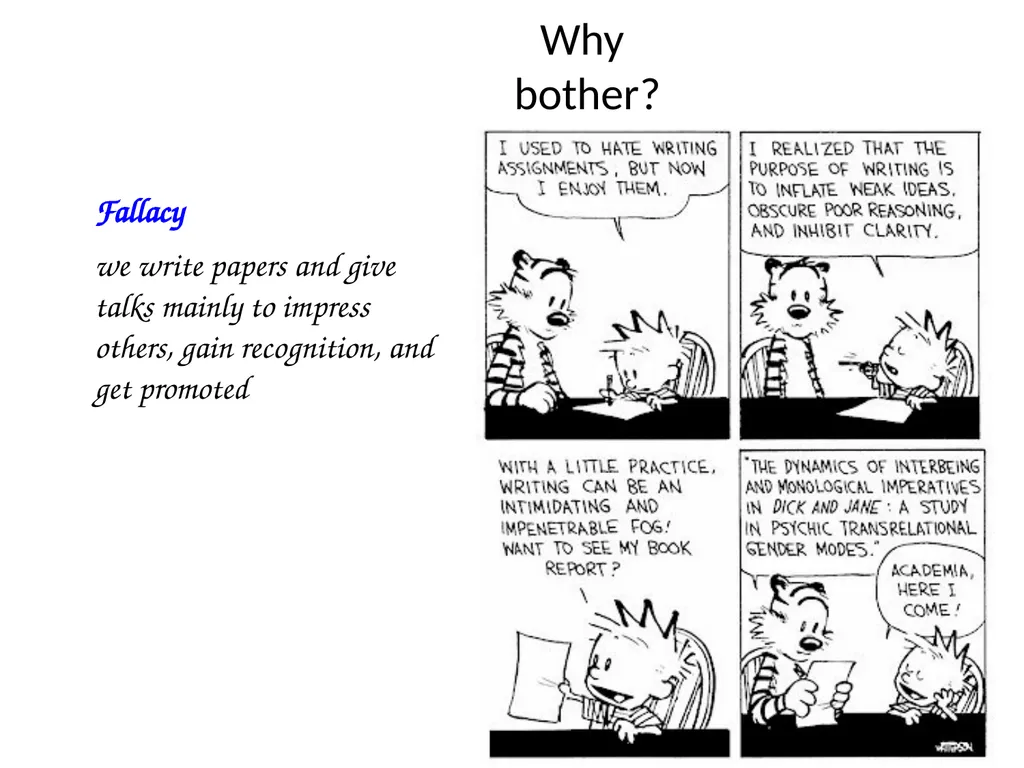
Why
bother? Good papers and talks are a fundamental part of research excellence Fallacy
we write papers and give talks mainly to impress others, gain recognition, and get promoted<br>
we write papers and give talks mainly to impress others, gain recognition, and get promoted<br>
09
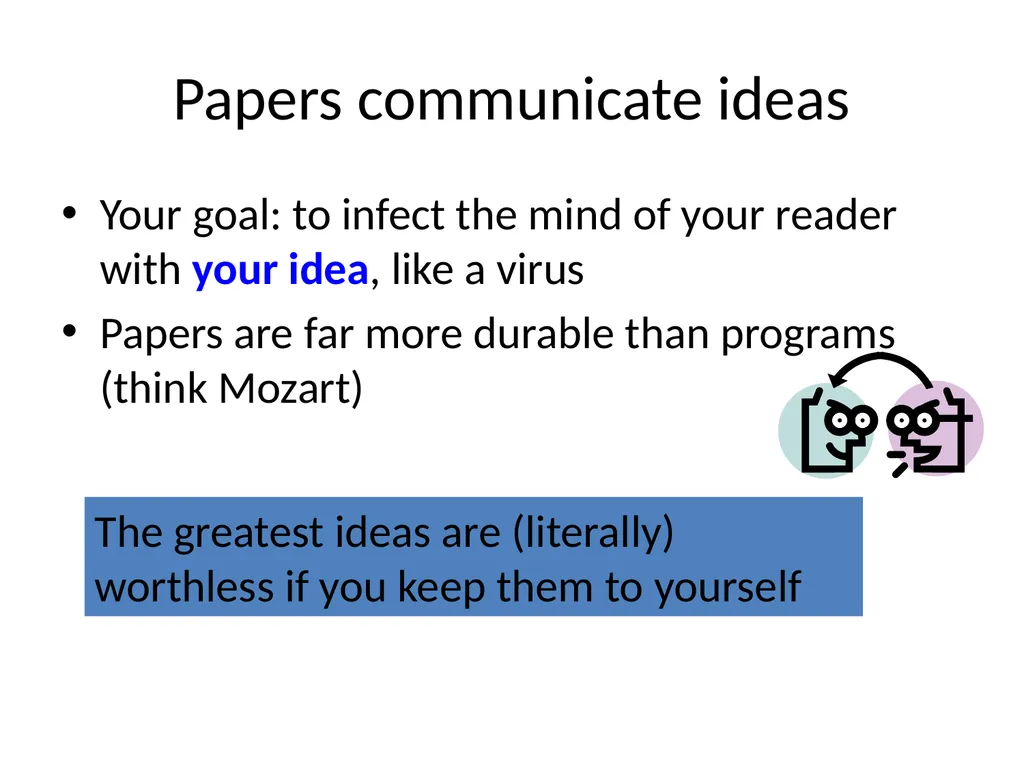
Papers communicate ideas Your goal: to infect the mind of your reader with your idea, like a virus
Papers are far more durable than programs (think Mozart) The greatest ideas are (literally) worthless if you keep them to yourself<br>
Papers are far more durable than programs (think Mozart) The greatest ideas are (literally) worthless if you keep them to yourself<br>
10
The Idea Figure out what your idea is
Make certain that the reader is in no doubt what the idea is. Be 100% explicit:
“The main idea of this paper is....”
“In this section we present the main contributions of the paper.”
Many papers contain good ideas, but do not distil what they are. Idea
A re-usable insight,
useful to the reader<br>
Make certain that the reader is in no doubt what the idea is. Be 100% explicit:
“The main idea of this paper is....”
“In this section we present the main contributions of the paper.”
Many papers contain good ideas, but do not distil what they are. Idea
A re-usable insight,
useful to the reader<br>
11
One ping Your paper should have just one “ping”: one clear, sharp idea
Read your paper again: can you hear the “ping”?
You may not know exactly what the ping is when you start writing; but you must know when you finish
If you have lots of ideas, write lots of papers<br>
Read your paper again: can you hear the “ping”?
You may not know exactly what the ping is when you start writing; but you must know when you finish
If you have lots of ideas, write lots of papers<br>
12
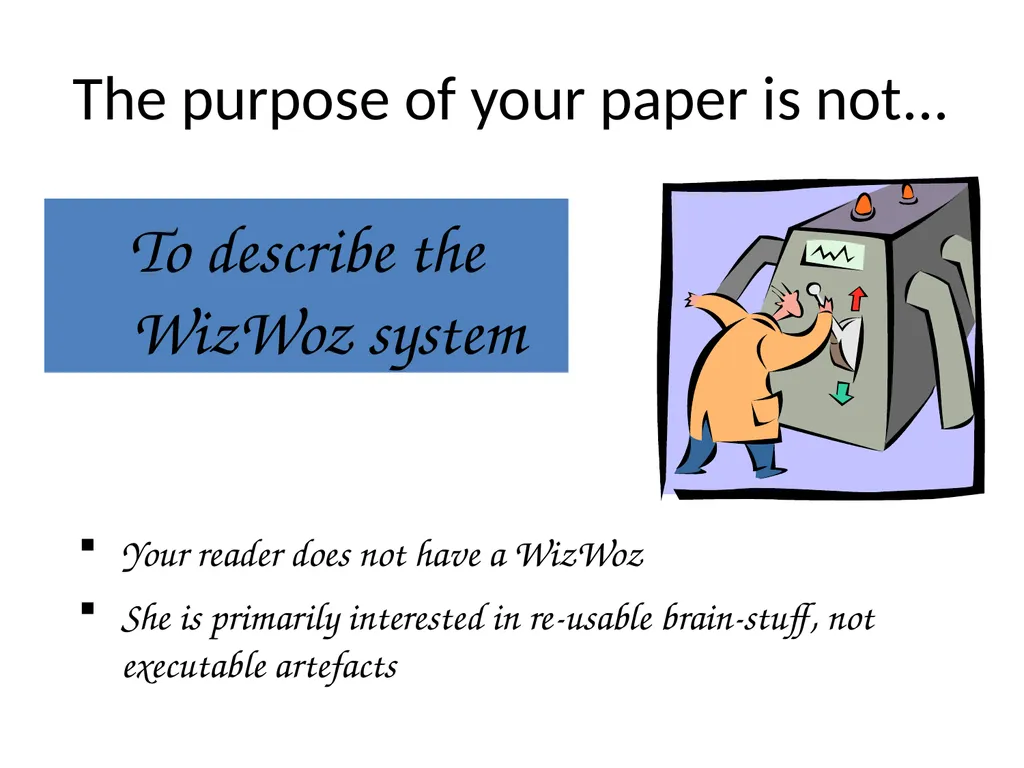
The purpose of your paper is not... To describe the WizWoz system Your reader does not have a WizWoz
She is primarily interested in re-usable brain-stuff, not executable artefacts<br>
She is primarily interested in re-usable brain-stuff, not executable artefacts<br>
13
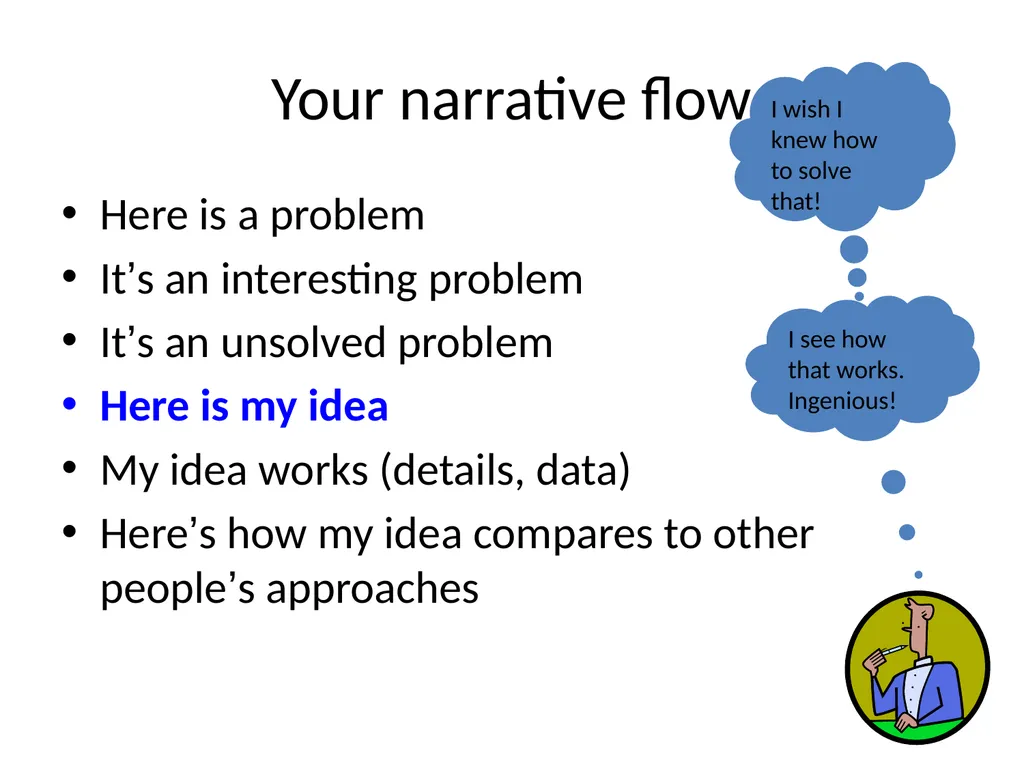
Your narrative flow Here is a problem
It’s an interesting problem
It’s an unsolved problem
Here is my idea
My idea works (details, data)
Here’s how my idea compares to other people’s approaches I wish I knew how to solve that! I see how that works. Ingenious!<br>
It’s an interesting problem
It’s an unsolved problem
Here is my idea
My idea works (details, data)
Here’s how my idea compares to other people’s approaches I wish I knew how to solve that! I see how that works. Ingenious!<br>
14
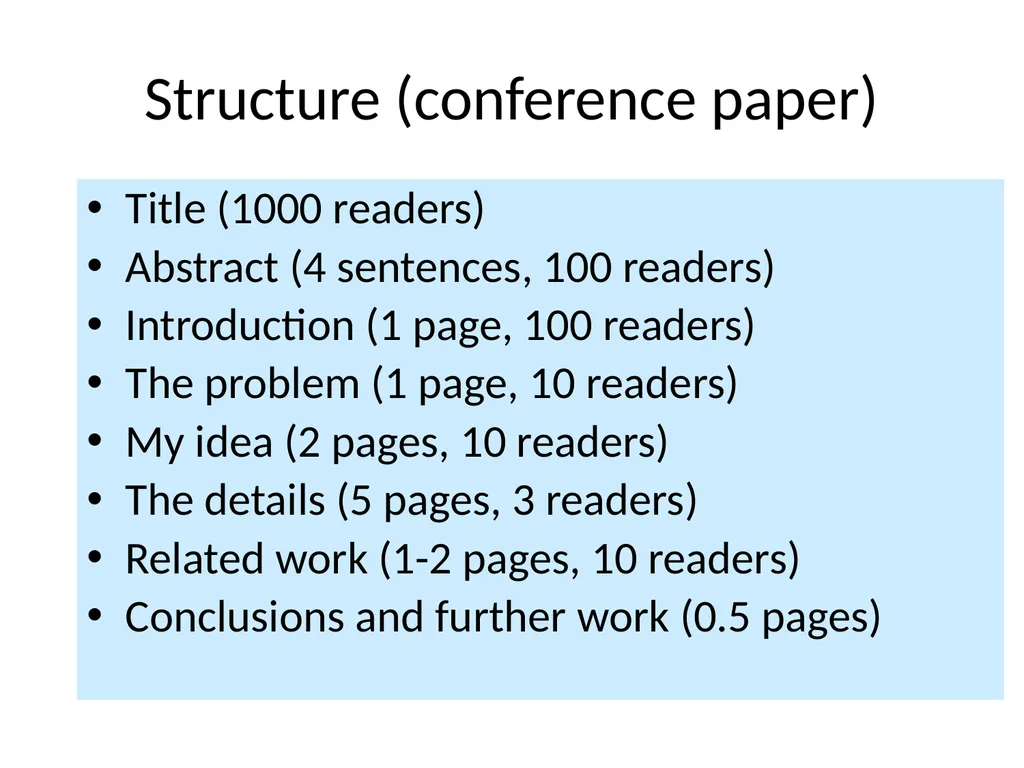
Structure (conference paper) Title (1000 readers)
Abstract (4 sentences, 100 readers)
Introduction (1 page, 100 readers)
The problem (1 page, 10 readers)
My idea (2 pages, 10 readers)
The details (5 pages, 3 readers)
Related work (1-2 pages, 10 readers)
Conclusions and further work (0.5 pages)<br>
Abstract (4 sentences, 100 readers)
Introduction (1 page, 100 readers)
The problem (1 page, 10 readers)
My idea (2 pages, 10 readers)
The details (5 pages, 3 readers)
Related work (1-2 pages, 10 readers)
Conclusions and further work (0.5 pages)<br>
15
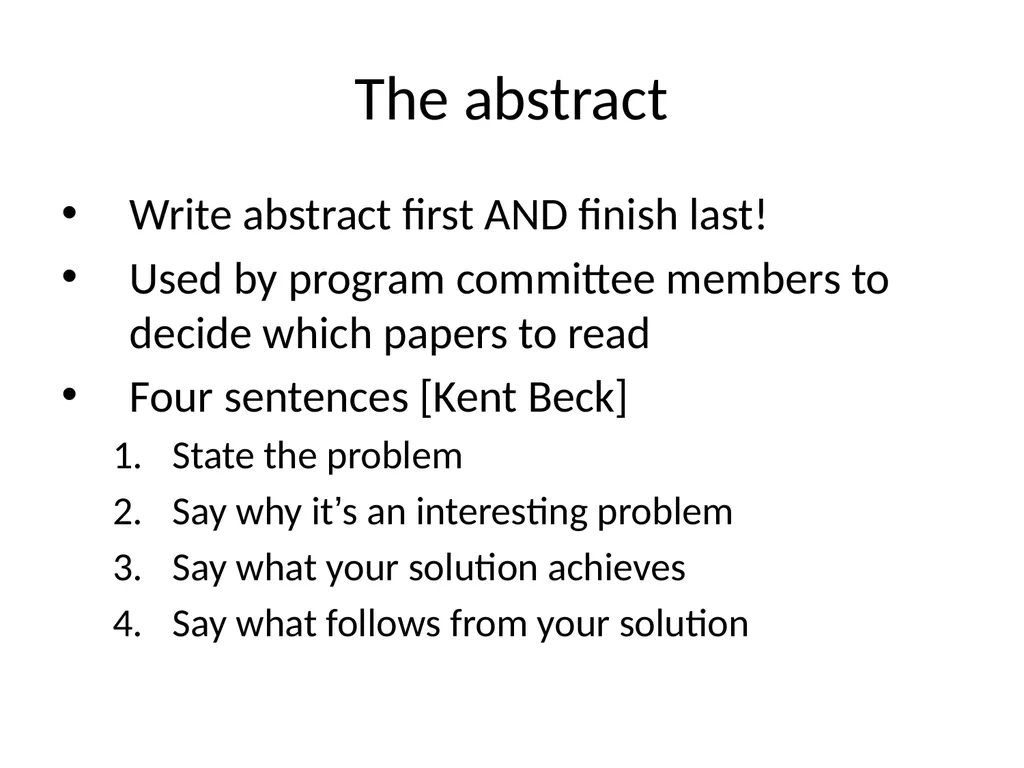
The abstract Write abstract first AND finish last!
Used by program committee members to decide which papers to read
Four sentences [Kent Beck]
State the problem
Say why it’s an interesting problem
Say what your solution achieves
Say what follows from your solution<br>
Used by program committee members to decide which papers to read
Four sentences [Kent Beck]
State the problem
Say why it’s an interesting problem
Say what your solution achieves
Say what follows from your solution<br>
16
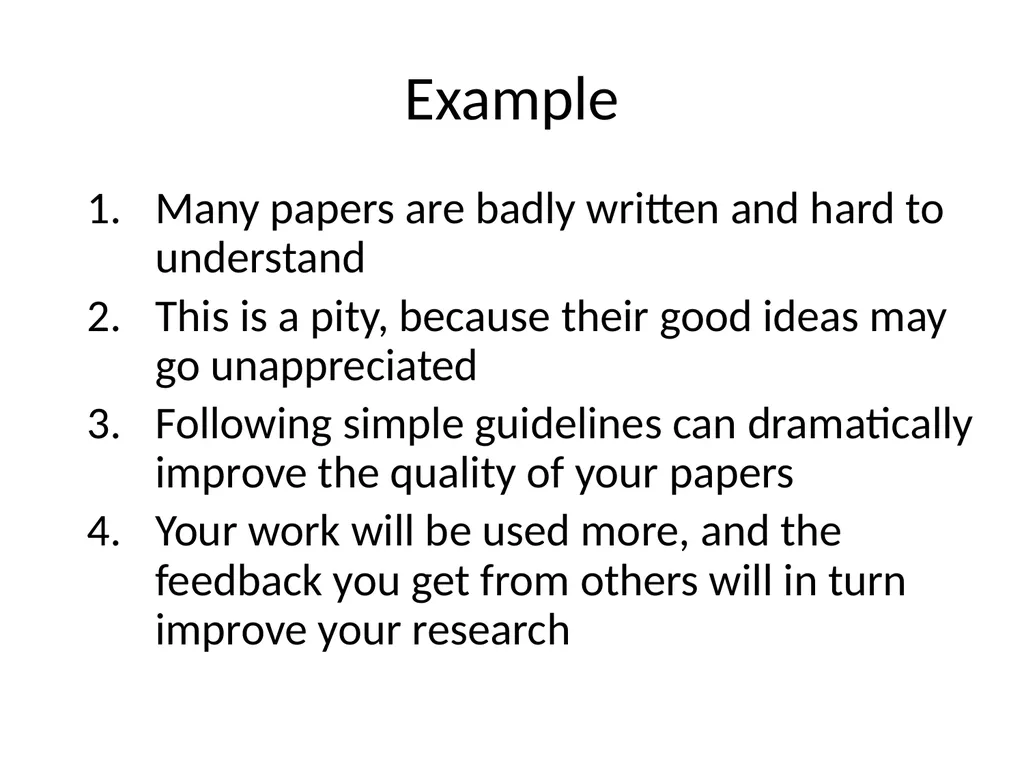
Example Many papers are badly written and hard to understand
This is a pity, because their good ideas may go unappreciated
Following simple guidelines can dramatically improve the quality of your papers
Your work will be used more, and the feedback you get from others will in turn improve your research<br>
This is a pity, because their good ideas may go unappreciated
Following simple guidelines can dramatically improve the quality of your papers
Your work will be used more, and the feedback you get from others will in turn improve your research<br>
17
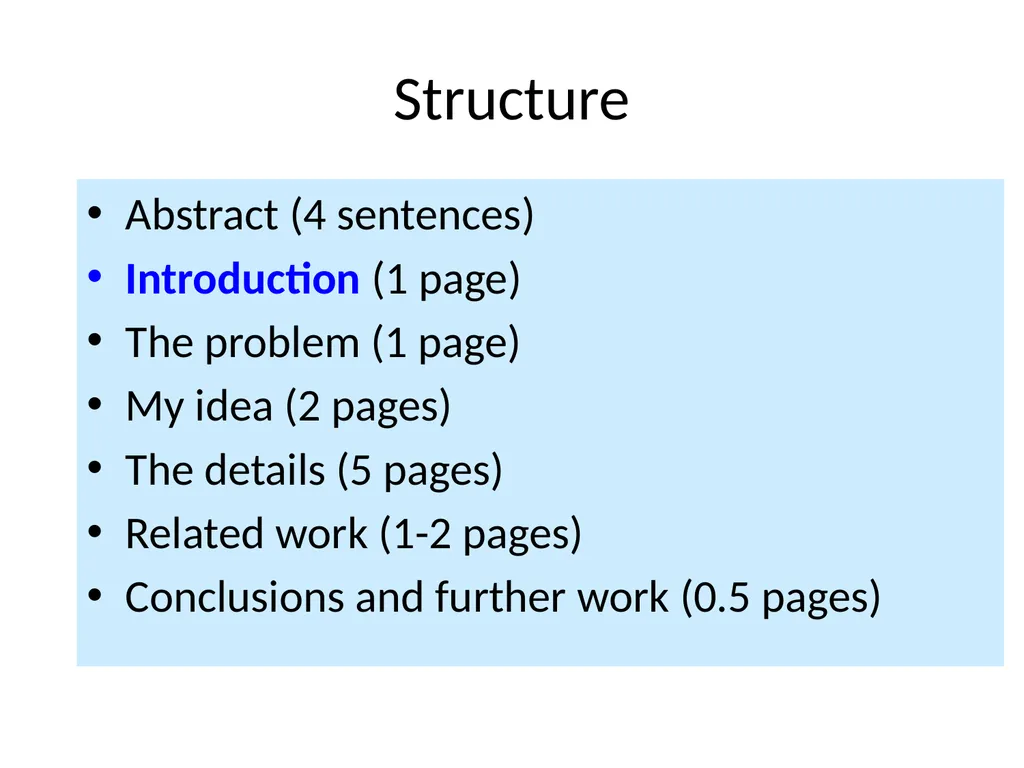
Structure Abstract (4 sentences)
Introduction (1 page)
The problem (1 page)
My idea (2 pages)
The details (5 pages)
Related work (1-2 pages)
Conclusions and further work (0.5 pages)<br>
Introduction (1 page)
The problem (1 page)
My idea (2 pages)
The details (5 pages)
Related work (1-2 pages)
Conclusions and further work (0.5 pages)<br>
18
The introduction (1 page) Describe the problem
State your contributions
...and that is all
ONE PAGE!<br>
State your contributions
...and that is all
ONE PAGE!<br>
19
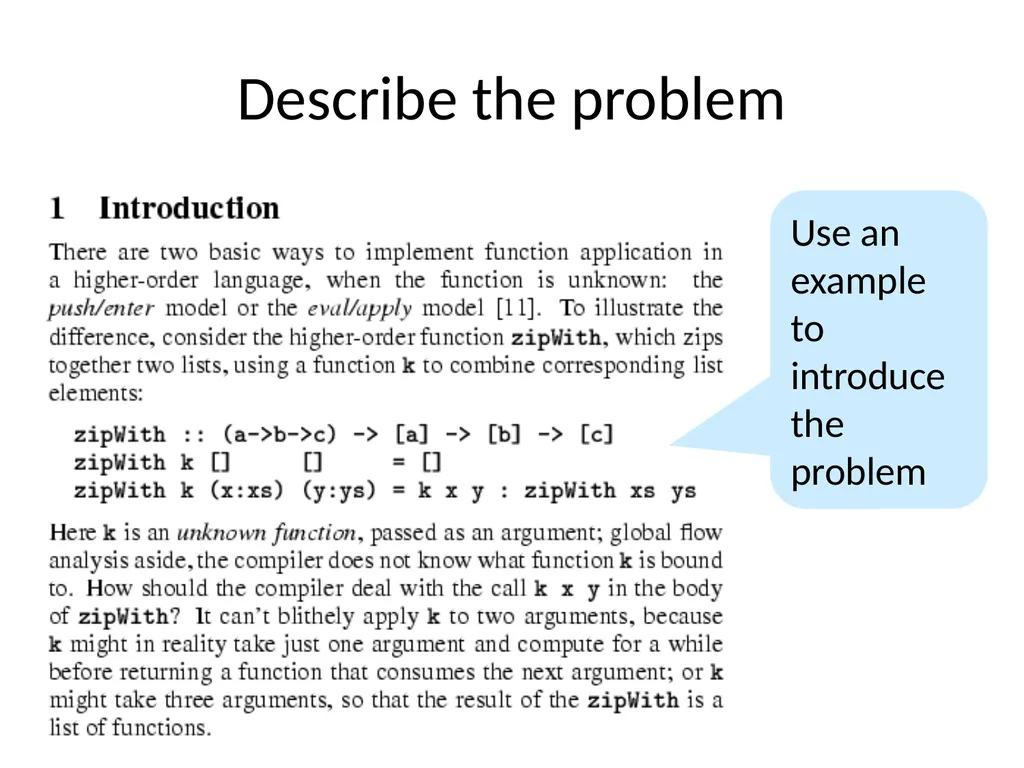
Describe the problem Use an example to introduce the problem<br>
20
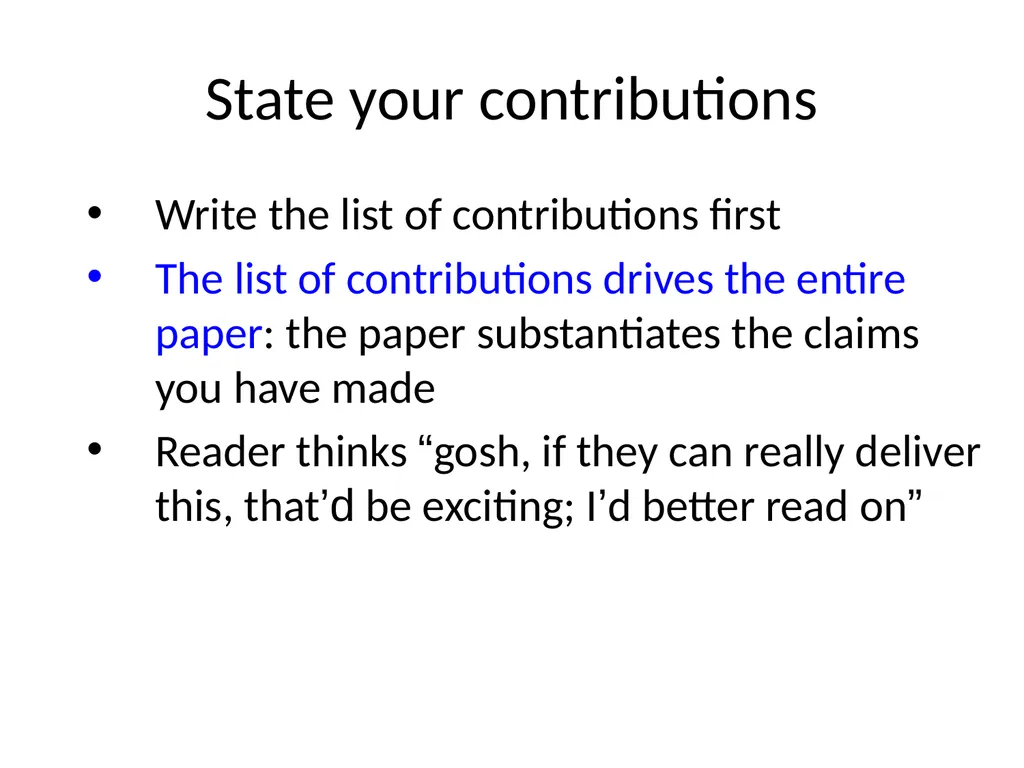
State your contributions Write the list of contributions first
The list of contributions drives the entire paper: the paper substantiates the claims you have made
Reader thinks “gosh, if they can really deliver this, that’d be exciting; I’d better read on”<br>
The list of contributions drives the entire paper: the paper substantiates the claims you have made
Reader thinks “gosh, if they can really deliver this, that’d be exciting; I’d better read on”<br>
21
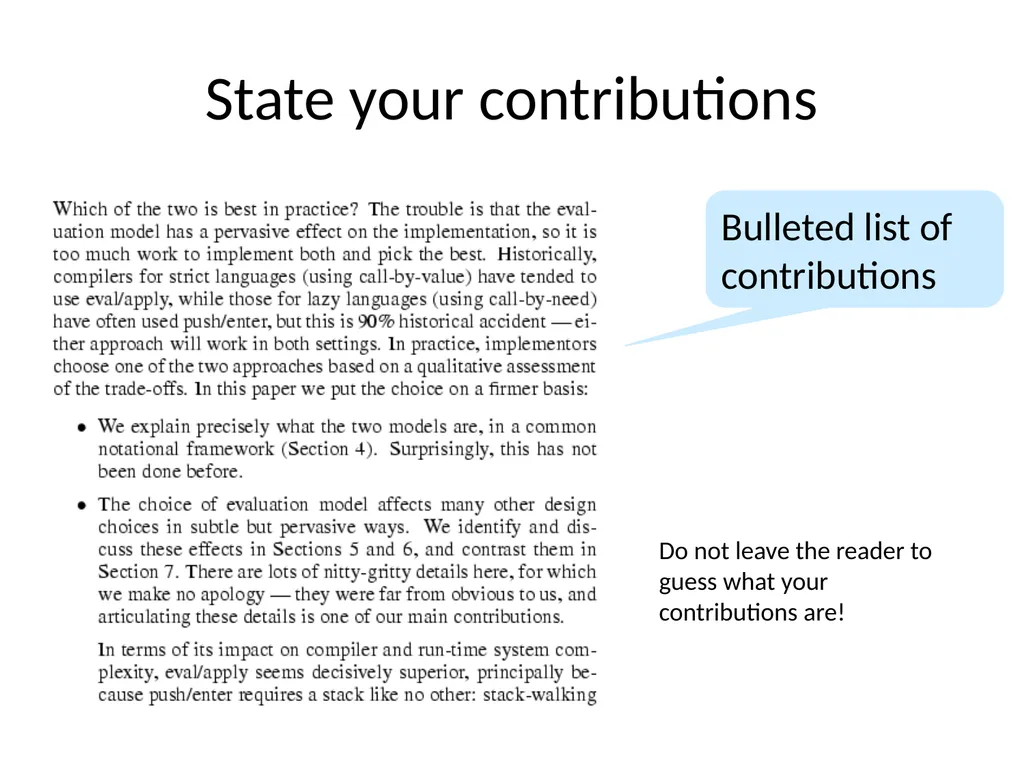
State your contributions Bulleted list of contributions Do not leave the reader to guess what your contributions are!<br>
22
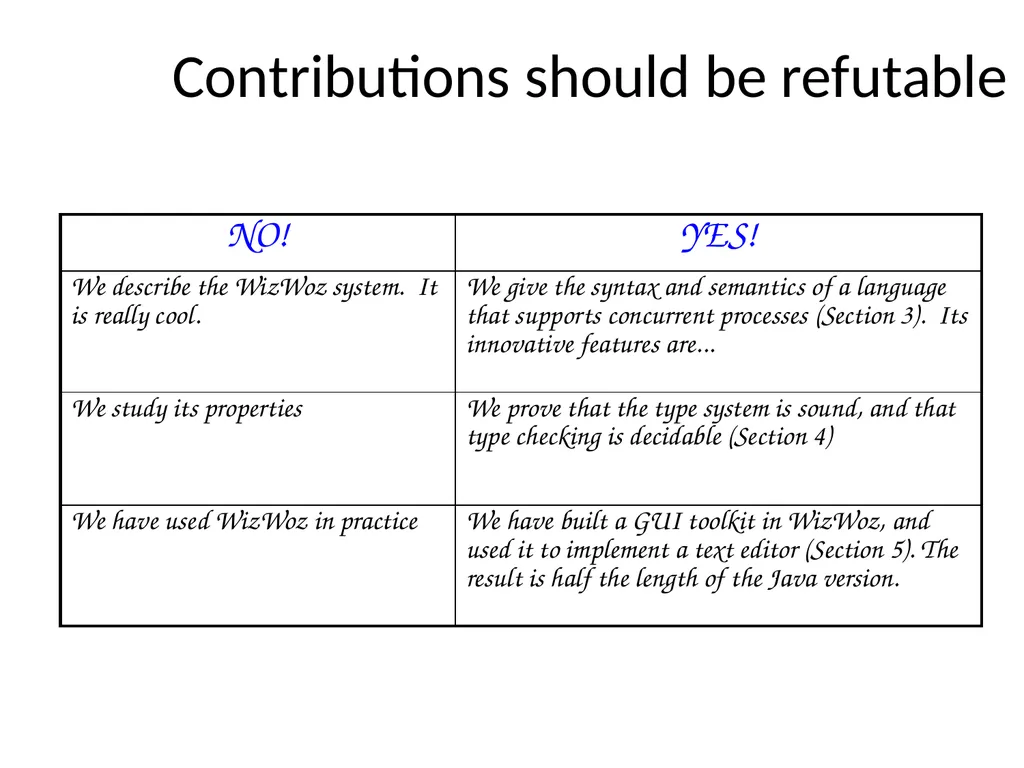
Contributions should be refutable<br>
23
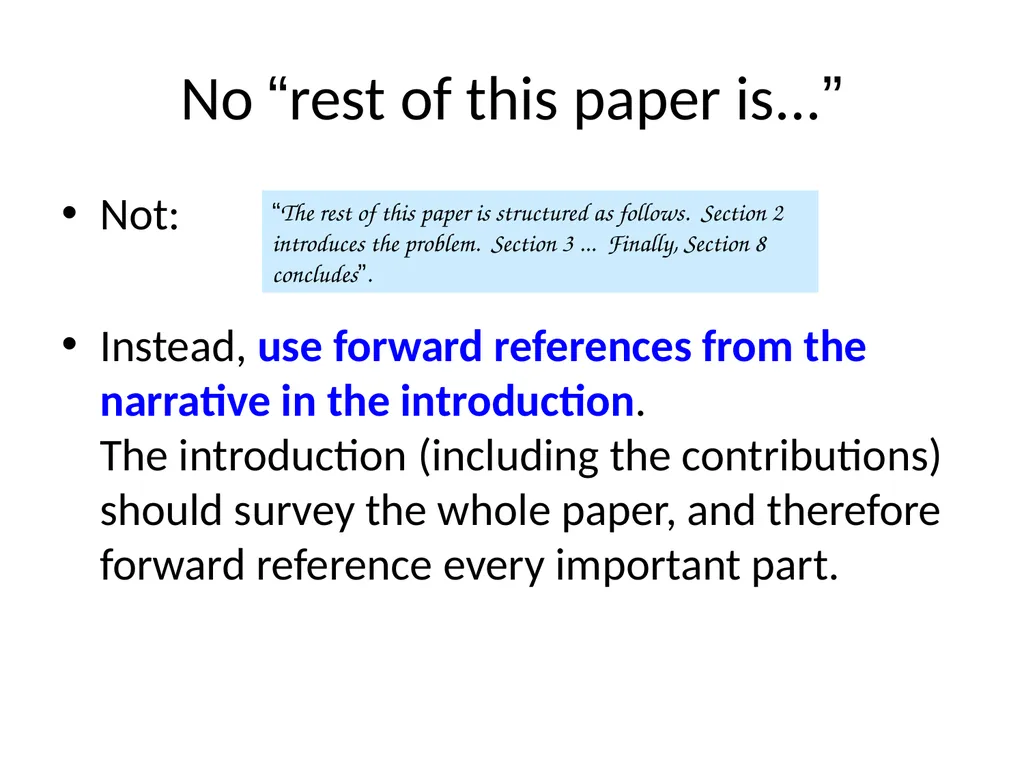
No “rest of this paper is...” Not:
Instead, use forward references from the narrative in the introduction. The introduction (including the contributions) should survey the whole paper, and therefore forward reference every important part. “The rest of this paper is structured as follows. Section 2 introduces the problem. Section 3 ... Finally, Section 8 concludes”.<br>
Instead, use forward references from the narrative in the introduction. The introduction (including the contributions) should survey the whole paper, and therefore forward reference every important part. “The rest of this paper is structured as follows. Section 2 introduces the problem. Section 3 ... Finally, Section 8 concludes”.<br>
24
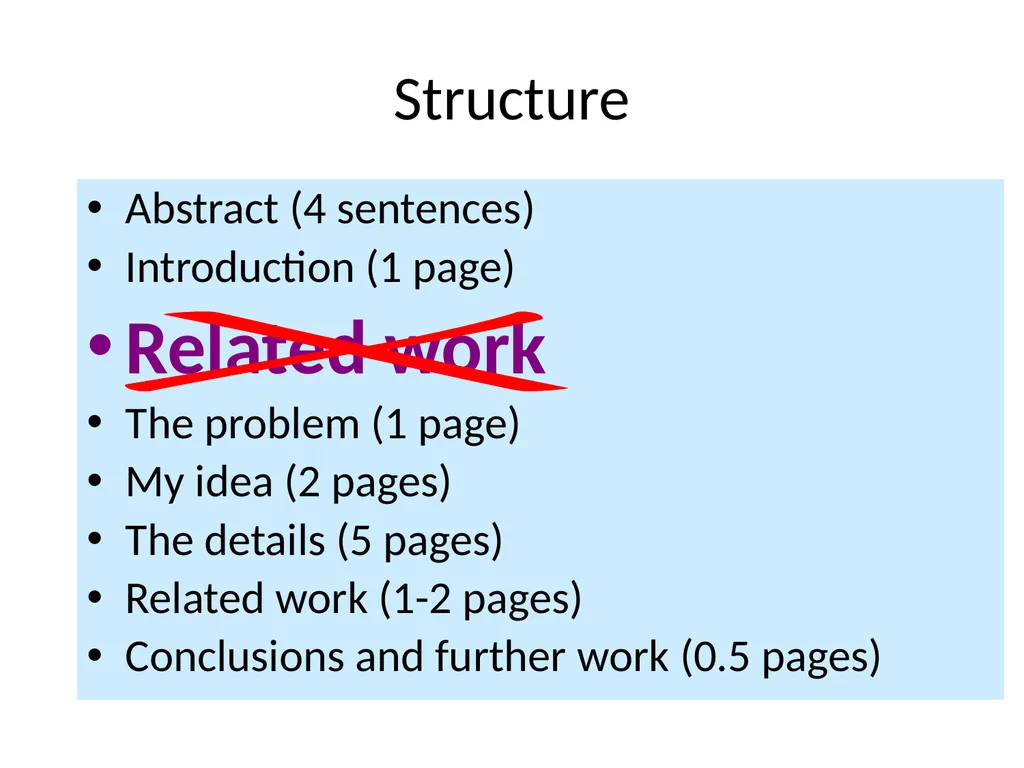
Structure Abstract (4 sentences)
Introduction (1 page)
Related work
The problem (1 page)
My idea (2 pages)
The details (5 pages)
Related work (1-2 pages)
Conclusions and further work (0.5 pages)<br>
Introduction (1 page)
Related work
The problem (1 page)
My idea (2 pages)
The details (5 pages)
Related work (1-2 pages)
Conclusions and further work (0.5 pages)<br>
25
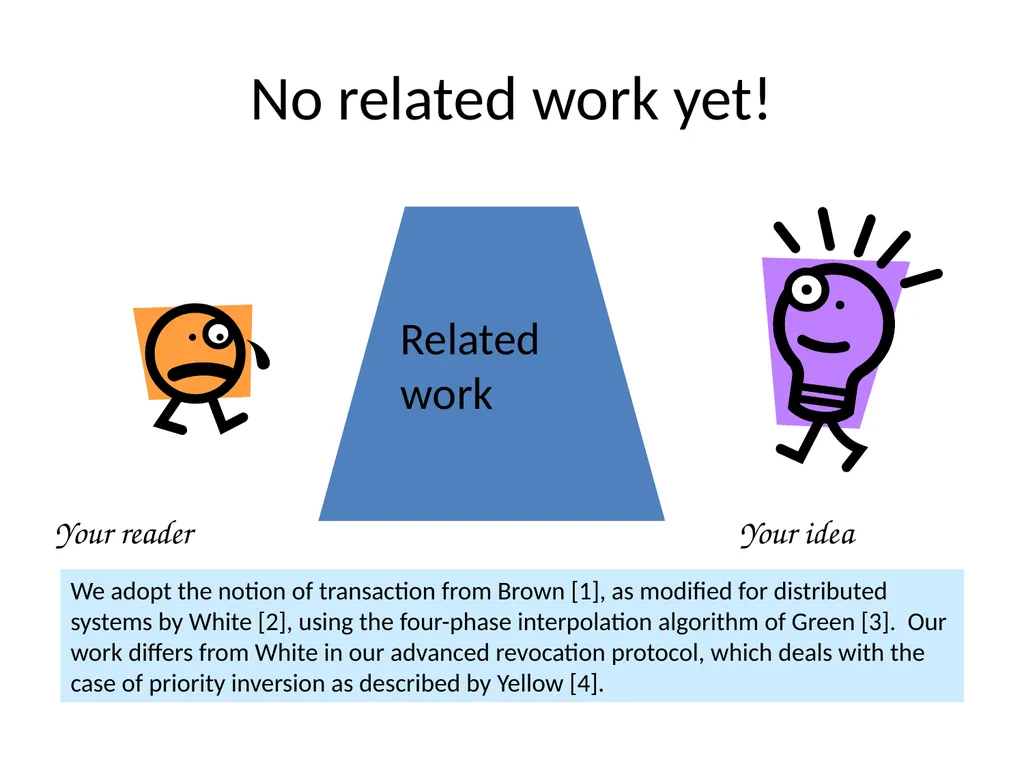
No related work yet! Related work Your reader Your idea We adopt the notion of transaction from Brown [1], as modified for distributed systems by White [2], using the four-phase interpolation algorithm of Green [3]. Our work differs from White in our advanced revocation protocol, which deals with the case of priority inversion as described by Yellow [4].<br>
26
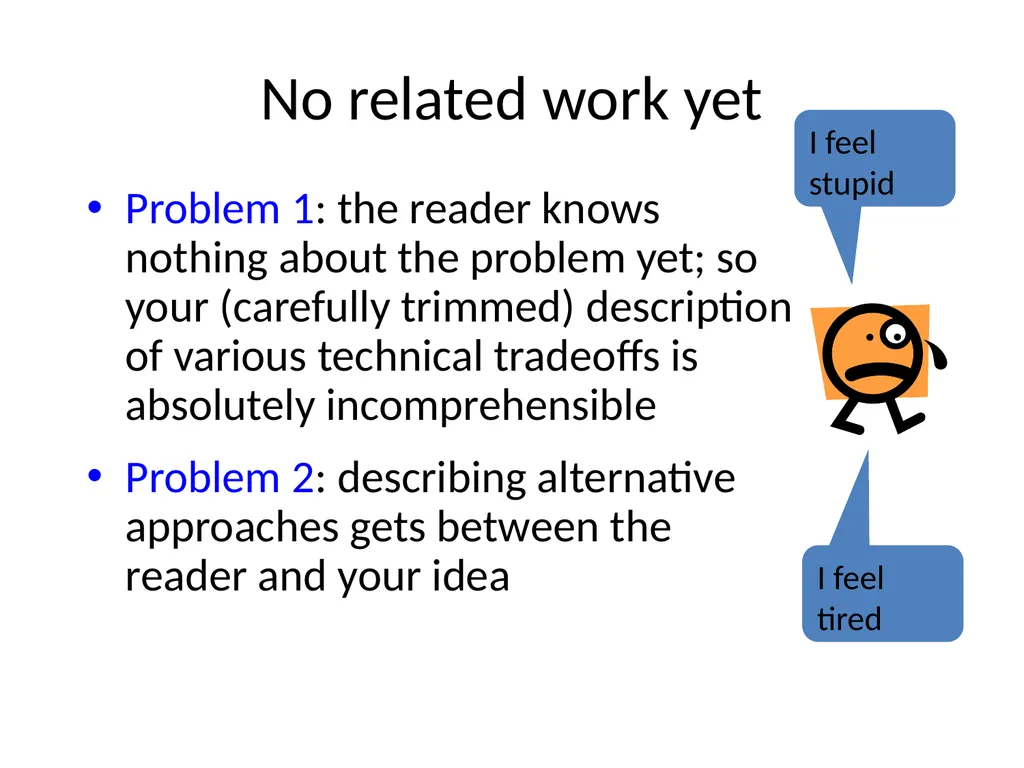
No related work yet Problem 1: the reader knows nothing about the problem yet; so your (carefully trimmed) description of various technical tradeoffs is absolutely incomprehensible
Problem 2: describing alternative approaches gets between the reader and your idea I feel tired I feel stupid<br>
Problem 2: describing alternative approaches gets between the reader and your idea I feel tired I feel stupid<br>
27
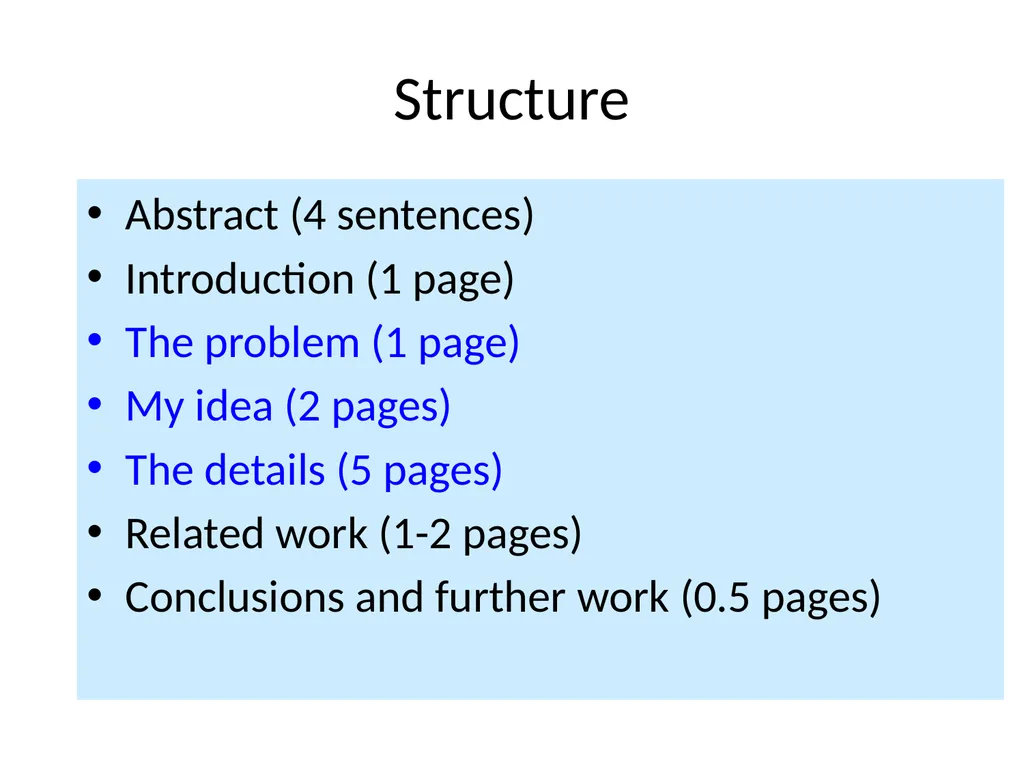
Structure Abstract (4 sentences)
Introduction (1 page)
The problem (1 page)
My idea (2 pages)
The details (5 pages)
Related work (1-2 pages)
Conclusions and further work (0.5 pages)<br>
Introduction (1 page)
The problem (1 page)
My idea (2 pages)
The details (5 pages)
Related work (1-2 pages)
Conclusions and further work (0.5 pages)<br>
28
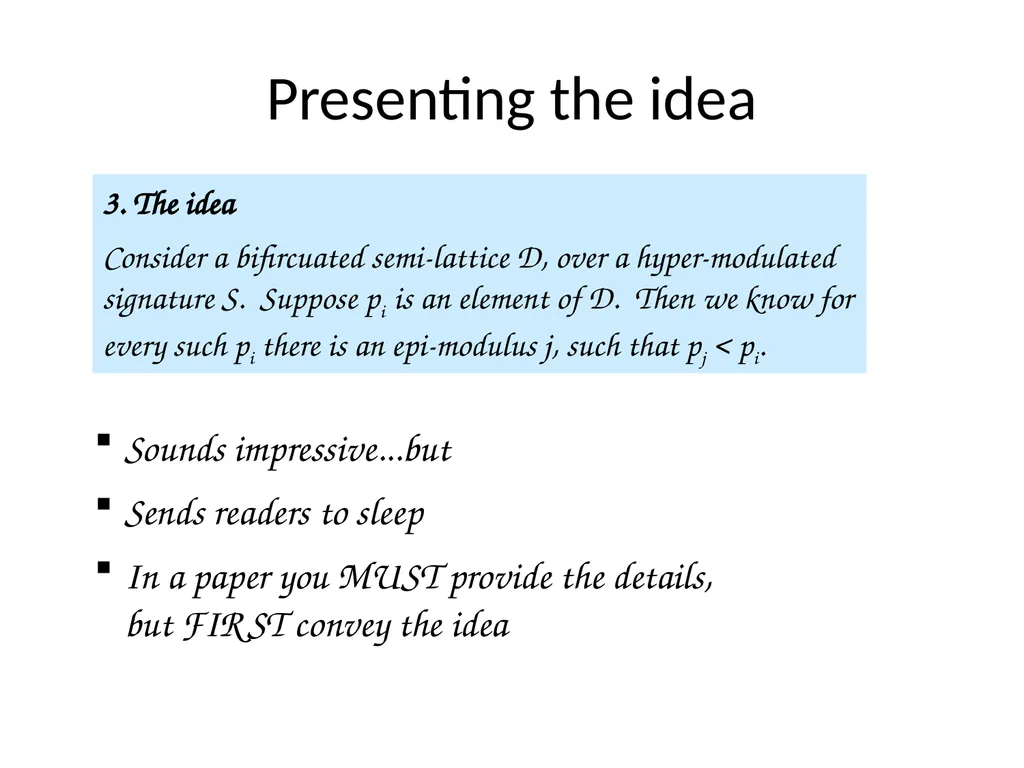
Presenting the idea 3. The idea
Consider a bifircuated semi-lattice D, over a hyper-modulated signature S. Suppose pi is an element of D. Then we know for every such pi there is an epi-modulus j, such that pj < pi. Sounds impressive...but
Sends readers to sleep
In a paper you MUST provide the details, but FIRST convey the idea<br>
Consider a bifircuated semi-lattice D, over a hyper-modulated signature S. Suppose pi is an element of D. Then we know for every such pi there is an epi-modulus j, such that pj < pi. Sounds impressive...but
Sends readers to sleep
In a paper you MUST provide the details, but FIRST convey the idea<br>
29
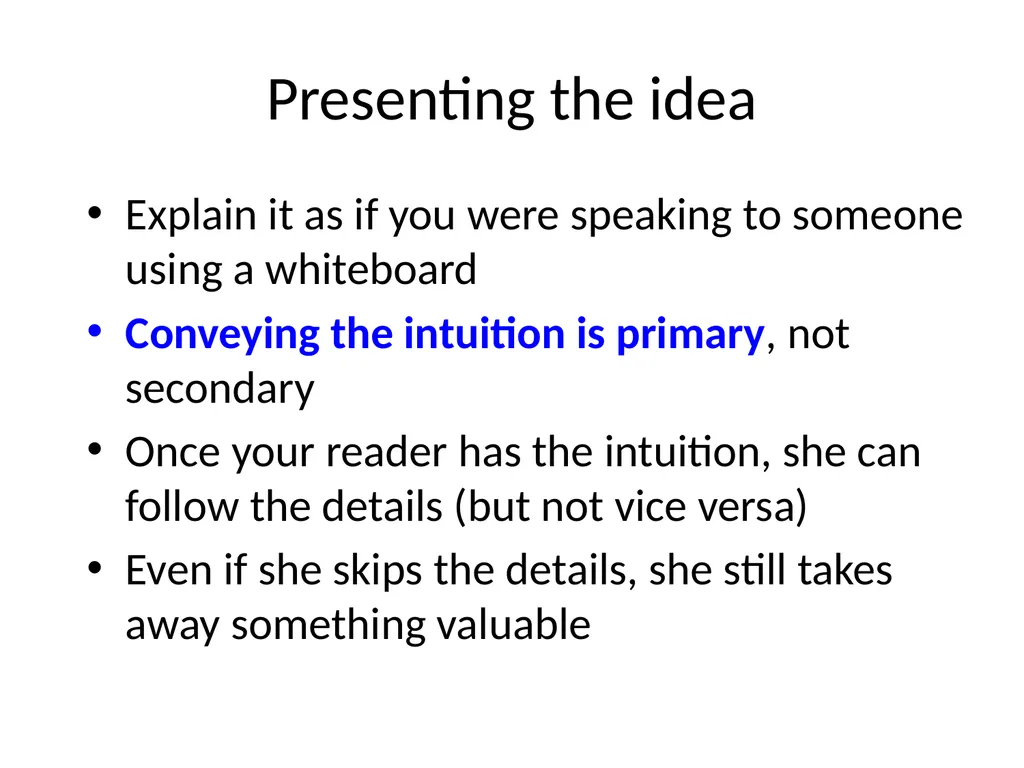
Presenting the idea Explain it as if you were speaking to someone using a whiteboard
Conveying the intuition is primary, not secondary
Once your reader has the intuition, she can follow the details (but not vice versa)
Even if she skips the details, she still takes away something valuable<br>
Conveying the intuition is primary, not secondary
Once your reader has the intuition, she can follow the details (but not vice versa)
Even if she skips the details, she still takes away something valuable<br>
30
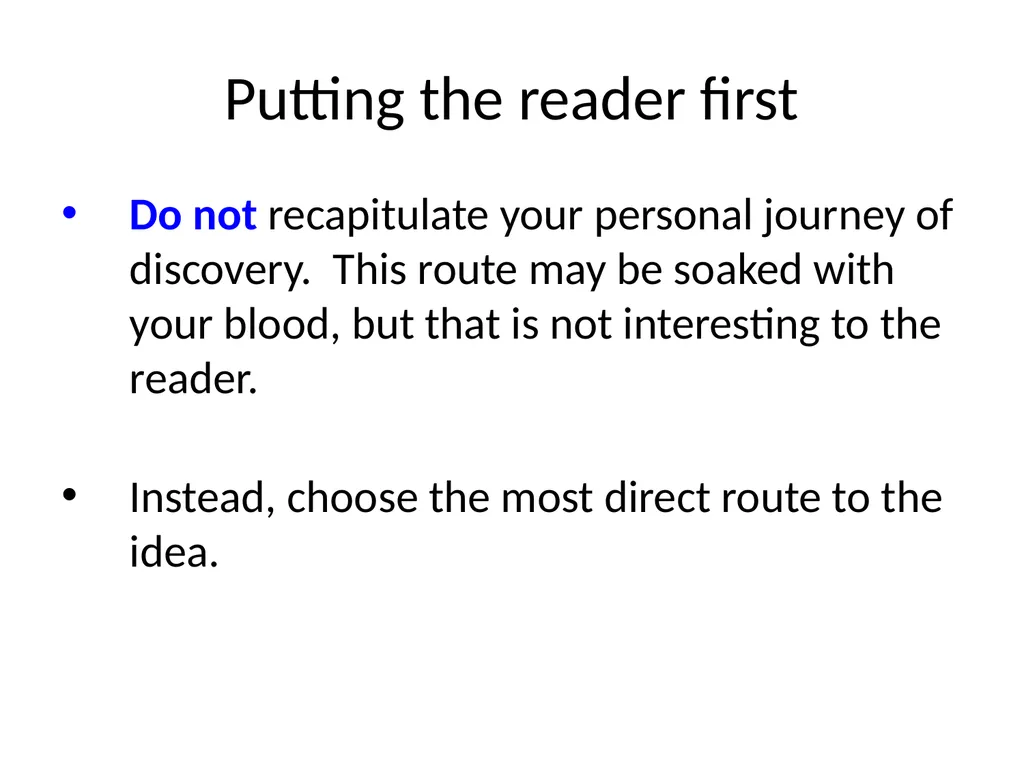
Putting the reader first Do not recapitulate your personal journey of discovery. This route may be soaked with your blood, but that is not interesting to the reader.
Instead, choose the most direct route to the idea.<br>
Instead, choose the most direct route to the idea.<br>
31
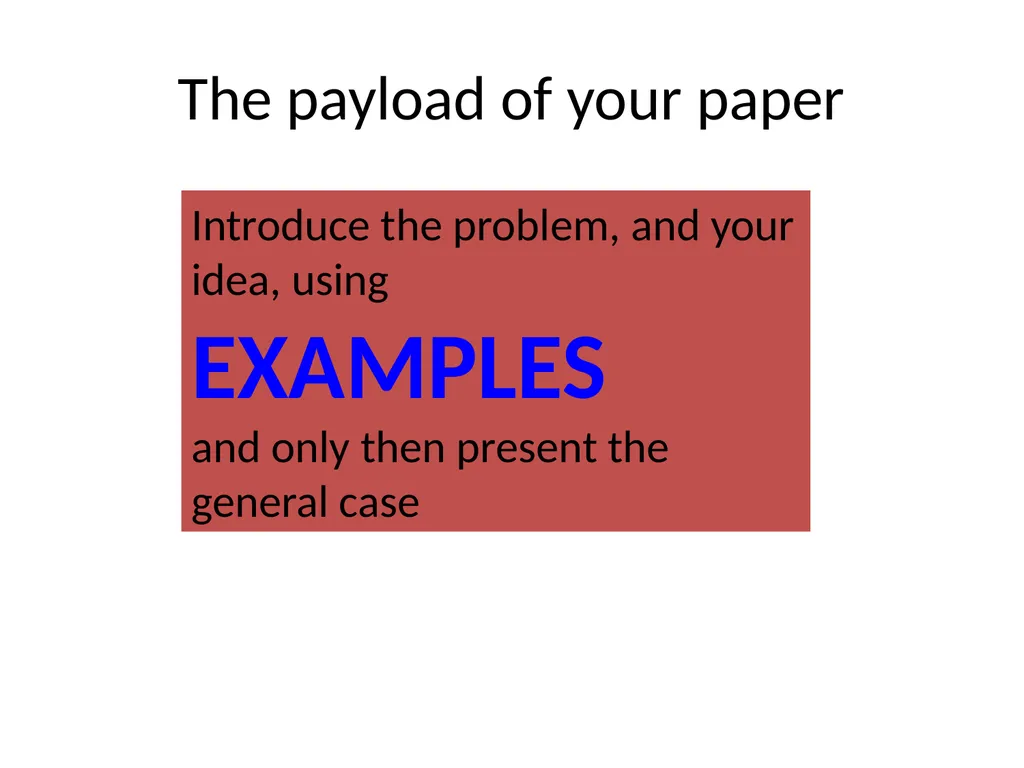
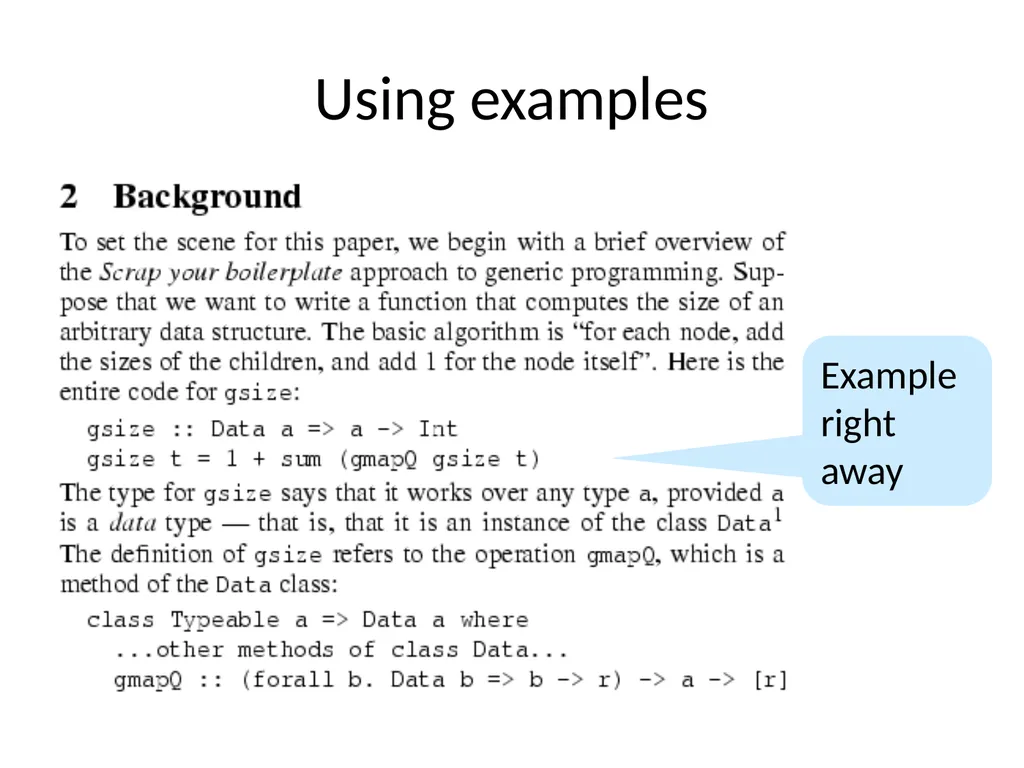
The payload of your paper Introduce the problem, and your idea, using
EXAMPLES
and only then present the general case<br>
EXAMPLES
and only then present the general case<br>
32
Using examples Example right away<br>
33
The details: evidence Your introduction makes claims
The body of the paper provides evidence to support each claim
Check each claim in the introduction, identify the evidence, and forward-reference it from the claim
Evidence can be: analysis and comparison, theorems, measurements, case studies<br>
The body of the paper provides evidence to support each claim
Check each claim in the introduction, identify the evidence, and forward-reference it from the claim
Evidence can be: analysis and comparison, theorems, measurements, case studies<br>
34
Structure Abstract (4 sentences)
Introduction (1 page)
The problem (1 page)
My idea (2 pages)
The details (5 pages)
Related work (1-2 pages)
Conclusions and further work (0.5 pages)<br>
Introduction (1 page)
The problem (1 page)
My idea (2 pages)
The details (5 pages)
Related work (1-2 pages)
Conclusions and further work (0.5 pages)<br>
35
Related work Fallacy To make my work look good, I have to make other people’s work look bad<br>
36
The truth: credit is not like money Giving credit to others does not diminish the credit you get from your paper Warmly acknowledge people who have helped you
Be generous to the competition. “In his inspiring paper [Foo98] Foogle shows.... We develop his foundation in the following ways...”
Acknowledge weaknesses in your approach<br>
Be generous to the competition. “In his inspiring paper [Foo98] Foogle shows.... We develop his foundation in the following ways...”
Acknowledge weaknesses in your approach<br>
37
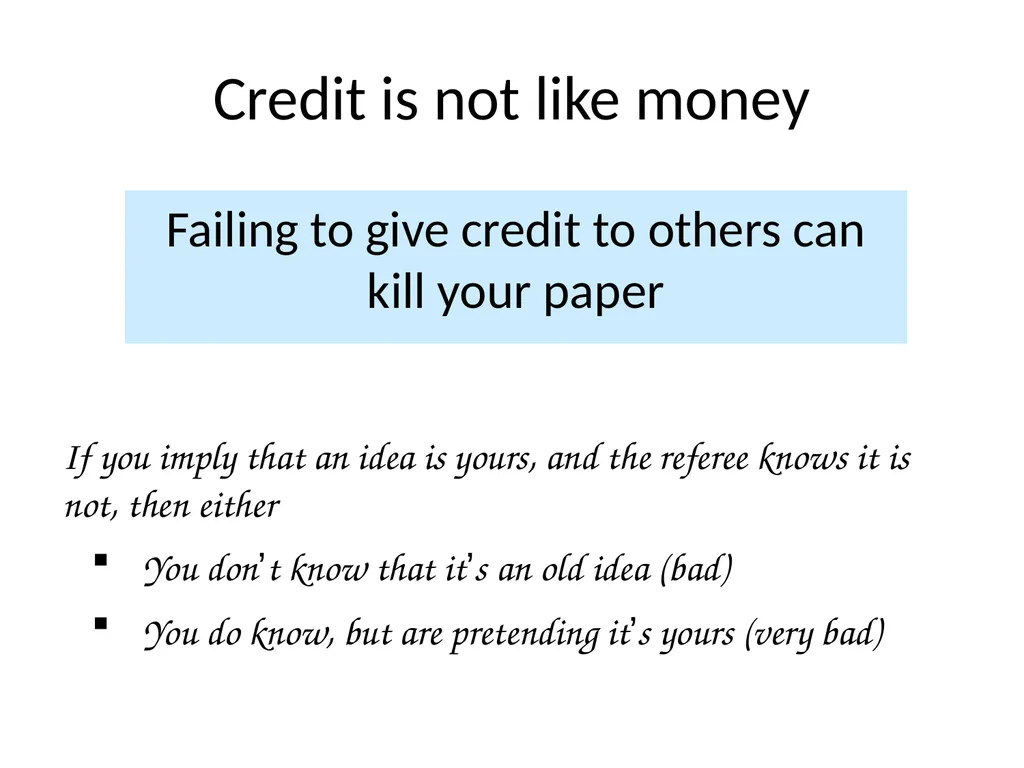
Credit is not like money Failing to give credit to others can kill your paper If you imply that an idea is yours, and the referee knows it is not, then either
You don’t know that it’s an old idea (bad)
You do know, but are pretending it’s yours (very bad)<br>
You don’t know that it’s an old idea (bad)
You do know, but are pretending it’s yours (very bad)<br>
38
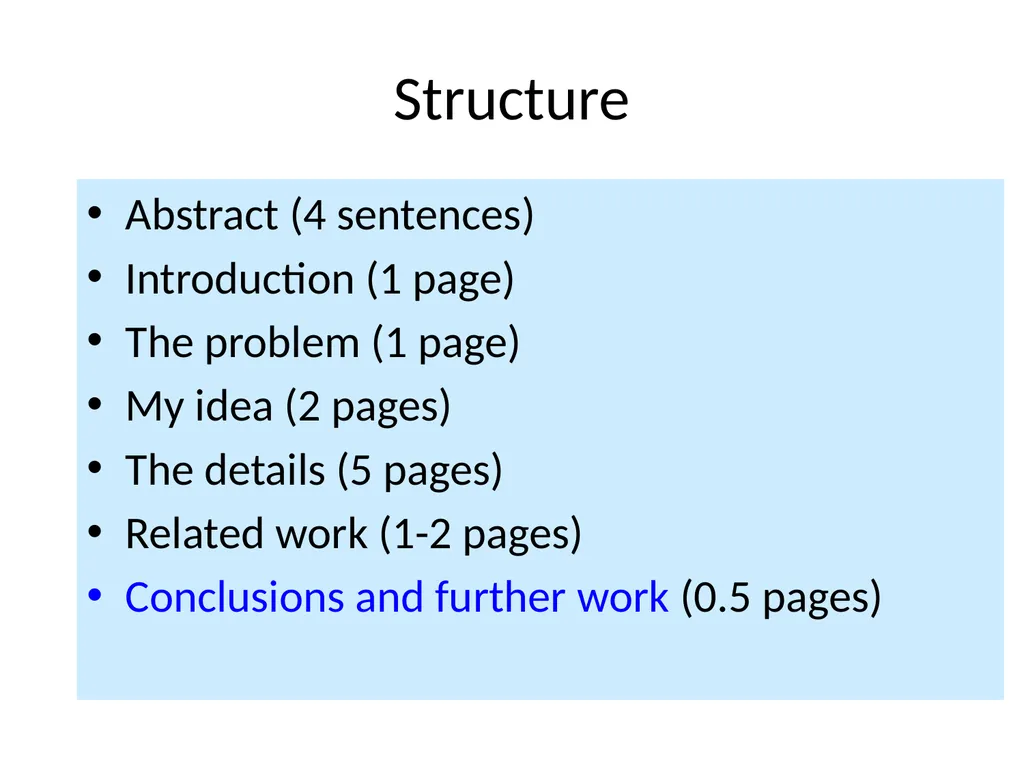
Structure Abstract (4 sentences)
Introduction (1 page)
The problem (1 page)
My idea (2 pages)
The details (5 pages)
Related work (1-2 pages)
Conclusions and further work (0.5 pages)<br>
Introduction (1 page)
The problem (1 page)
My idea (2 pages)
The details (5 pages)
Related work (1-2 pages)
Conclusions and further work (0.5 pages)<br>
39
Conclusions and further work Be brief.<br>
40
The process of writing<br>
41
The process Start early. Very early.
Hastily-written papers get rejected.
Papers are like wine: they need time to mature
Collaborate
Use CVS to support collaboration<br>
Hastily-written papers get rejected.
Papers are like wine: they need time to mature
Collaborate
Use CVS to support collaboration<br>
42
Getting help Experts are good
Non-experts are also very good
Each reader can only read your paper for the first time once! So use them carefully
Explain carefully what you want (“I got lost here” is much more important than “Jarva is mis-spelt”.) Get your paper read by as many friendly guinea pigs as possible<br>
Non-experts are also very good
Each reader can only read your paper for the first time once! So use them carefully
Explain carefully what you want (“I got lost here” is much more important than “Jarva is mis-spelt”.) Get your paper read by as many friendly guinea pigs as possible<br>
43
Getting expert help A good plan: when you think you are done, send the draft to the competition saying “could you help me ensure that I describe your work fairly?”.
Often they will respond with helpful critique (they are interested in the area)
They are likely to be your referees anyway, so getting their comments or criticism up front is Jolly Good.<br>
Often they will respond with helpful critique (they are interested in the area)
They are likely to be your referees anyway, so getting their comments or criticism up front is Jolly Good.<br>
44
Listening to your reviewers Treat every review like gold dust
Be (truly) grateful for criticism as well as praise This is really, really, really hard
But it’s really, really, really, really, really, really, really, really, really, really important<br>
Be (truly) grateful for criticism as well as praise This is really, really, really hard
But it’s really, really, really, really, really, really, really, really, really, really important<br>
45
Listening to your reviewers Read every criticism as a positive suggestion for something you could explain more clearly
DO NOT respond “you stupid person, I meant X”. Fix the paper so that X is apparent even to the stupidest reader.
Thank them warmly. They have given up their time for you.<br>
DO NOT respond “you stupid person, I meant X”. Fix the paper so that X is apparent even to the stupidest reader.
Thank them warmly. They have given up their time for you.<br>
46
Language and style<br>
47
Basic stuff Submit by the deadline
Keep to the length restrictions
Do not narrow the margins
Do not use 6pt font
On occasion, supply supporting evidence (e.g. experimental data, or a written-out proof) in an appendix
Always use a spell checker<br>
Keep to the length restrictions
Do not narrow the margins
Do not use 6pt font
On occasion, supply supporting evidence (e.g. experimental data, or a written-out proof) in an appendix
Always use a spell checker<br>
48
Visual structure Give strong visual structure to your paper using
sections and sub-sections
bullets
italics
laid-out code
Find out how to draw pictures, and use them<br>
sections and sub-sections
bullets
italics
laid-out code
Find out how to draw pictures, and use them<br>
49
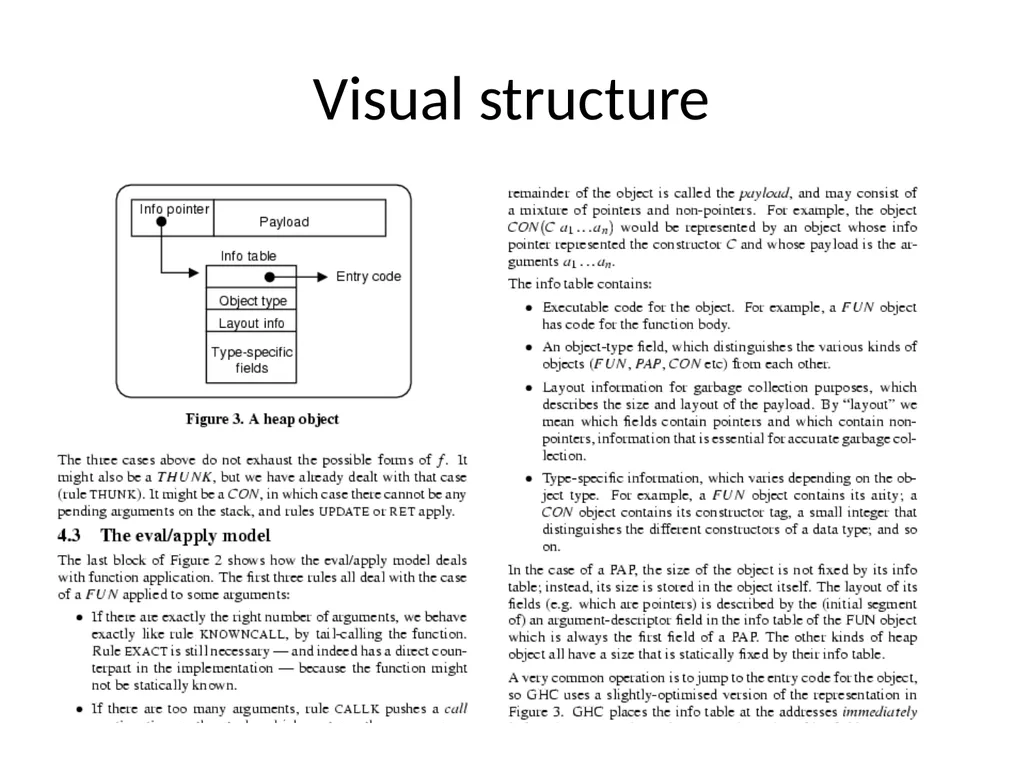
Visual structure<br>
50
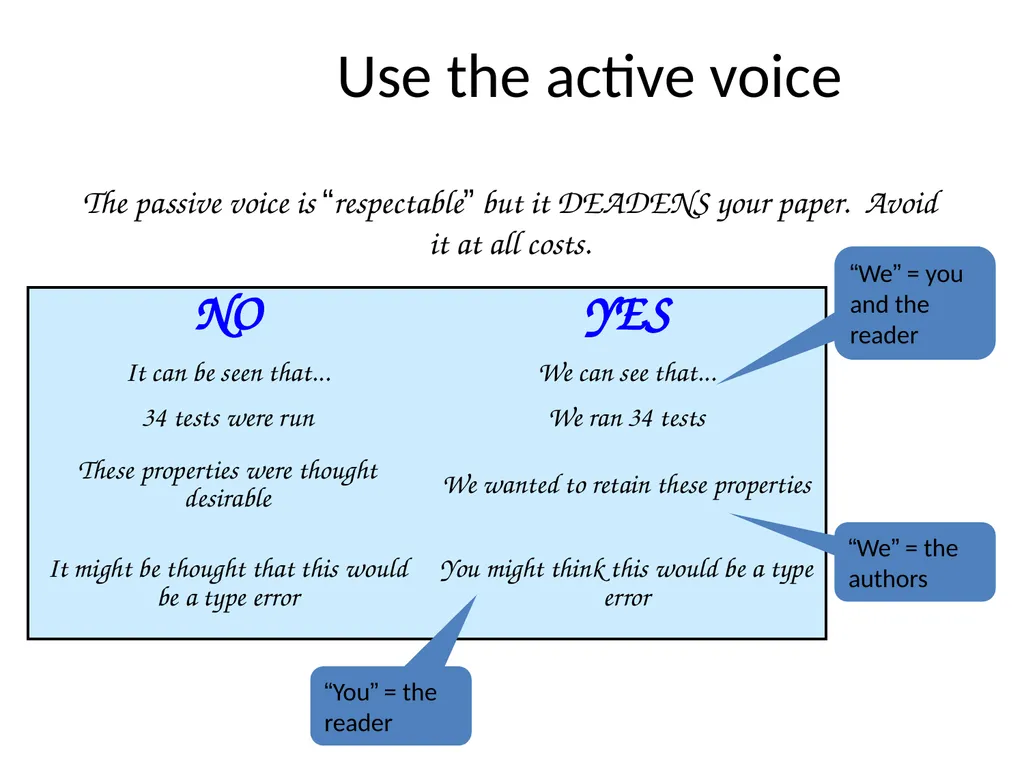
Use the active voice The passive voice is “respectable” but it DEADENS your paper. Avoid it at all costs. “We” = you and the reader “We” = the authors “You” = the reader<br>
51
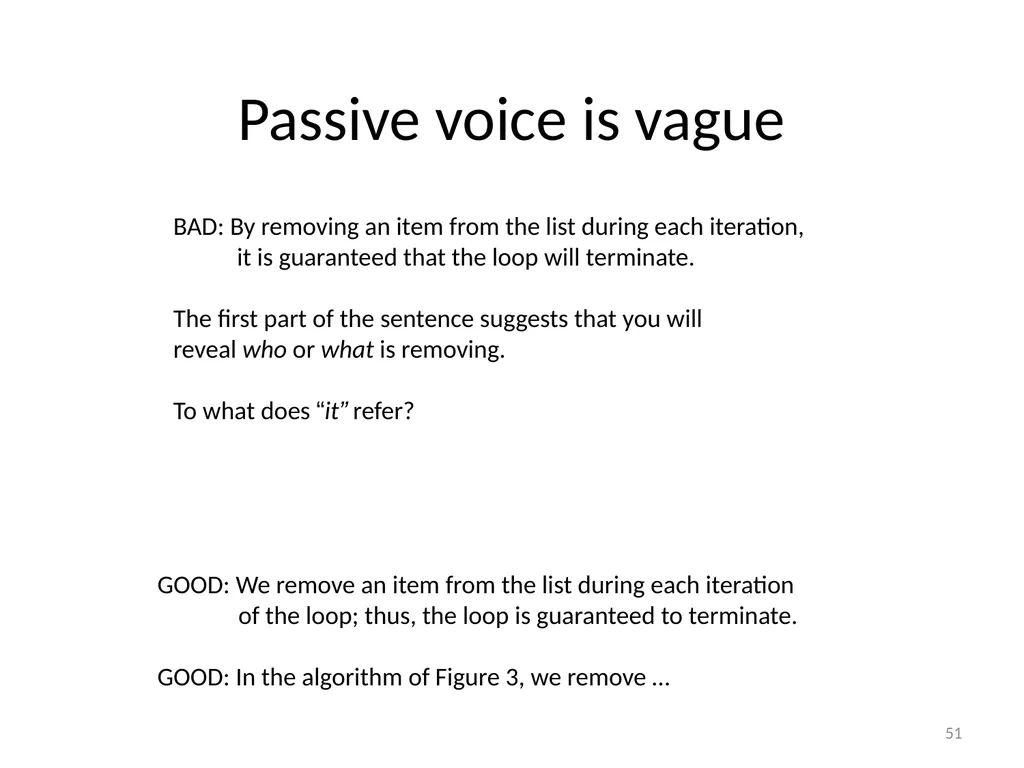
51 Passive voice is vague BAD: By removing an item from the list during each iteration,
it is guaranteed that the loop will terminate.
The first part of the sentence suggests that you will
reveal who or what is removing.
To what does “it” refer? GOOD: We remove an item from the list during each iteration
of the loop; thus, the loop is guaranteed to terminate.
GOOD: In the algorithm of Figure 3, we remove …<br>
it is guaranteed that the loop will terminate.
The first part of the sentence suggests that you will
reveal who or what is removing.
To what does “it” refer? GOOD: We remove an item from the list during each iteration
of the loop; thus, the loop is guaranteed to terminate.
GOOD: In the algorithm of Figure 3, we remove …<br>
52
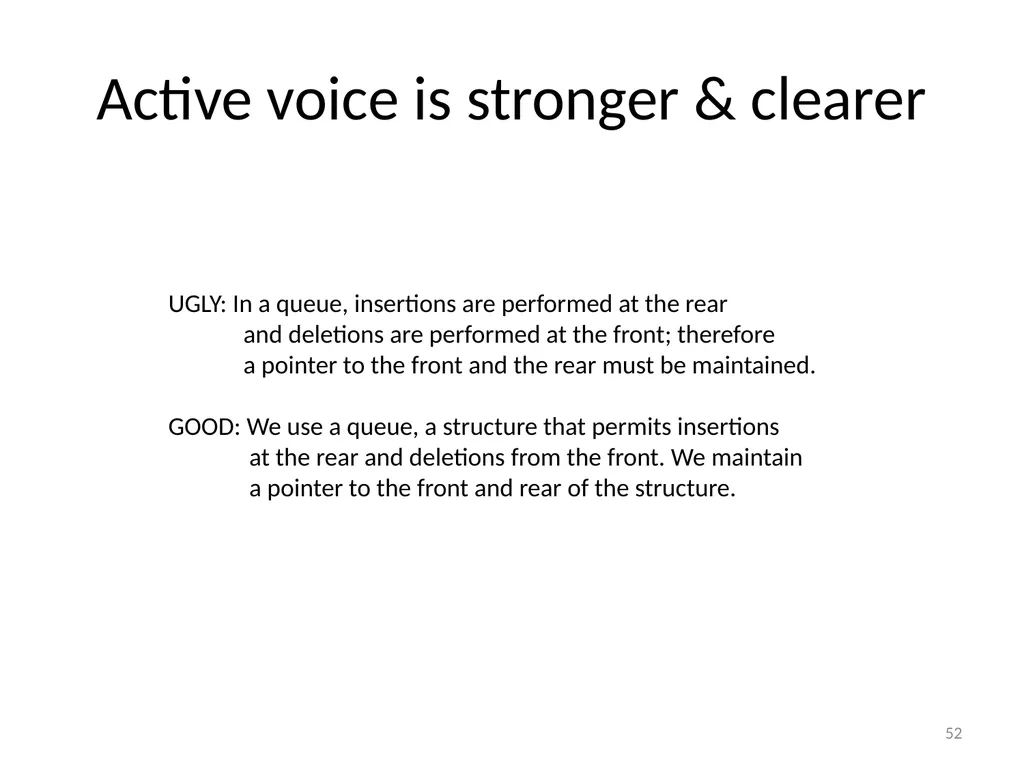
52 Active voice is stronger & clearer UGLY: In a queue, insertions are performed at the rear
and deletions are performed at the front; therefore
a pointer to the front and the rear must be maintained.
GOOD: We use a queue, a structure that permits insertions
at the rear and deletions from the front. We maintain
a pointer to the front and rear of the structure.<br>
and deletions are performed at the front; therefore
a pointer to the front and the rear must be maintained.
GOOD: We use a queue, a structure that permits insertions
at the rear and deletions from the front. We maintain
a pointer to the front and rear of the structure.<br>
53
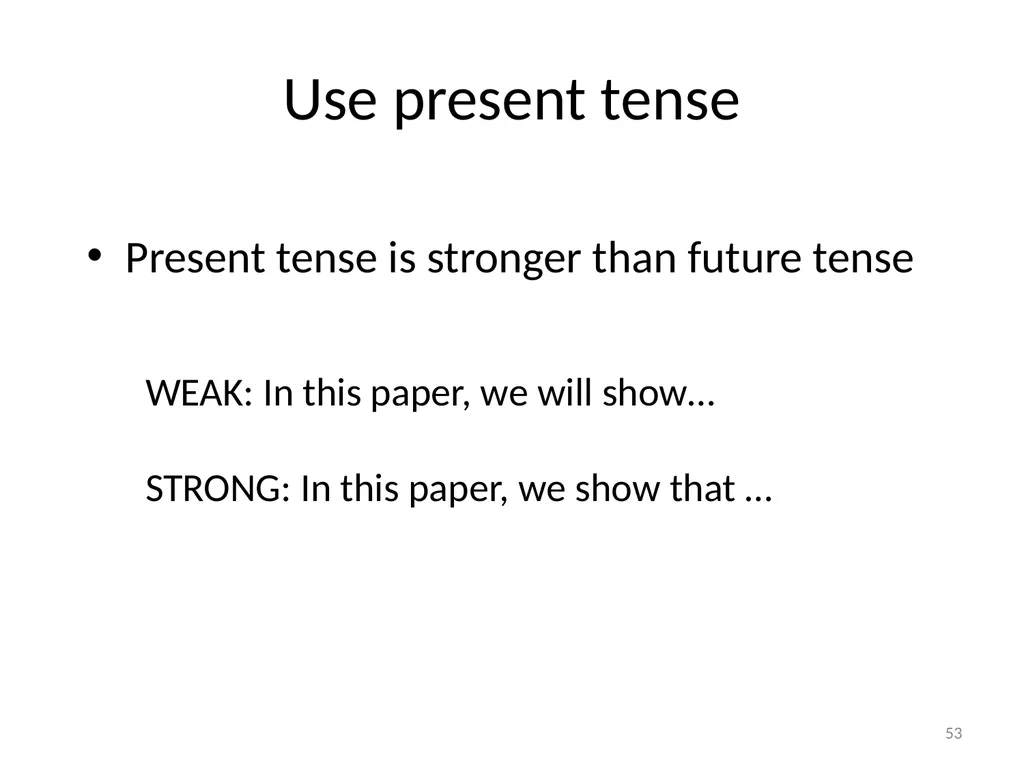
53 Use present tense Present tense is stronger than future tense WEAK: In this paper, we will show…
STRONG: In this paper, we show that …<br>
STRONG: In this paper, we show that …<br>
54
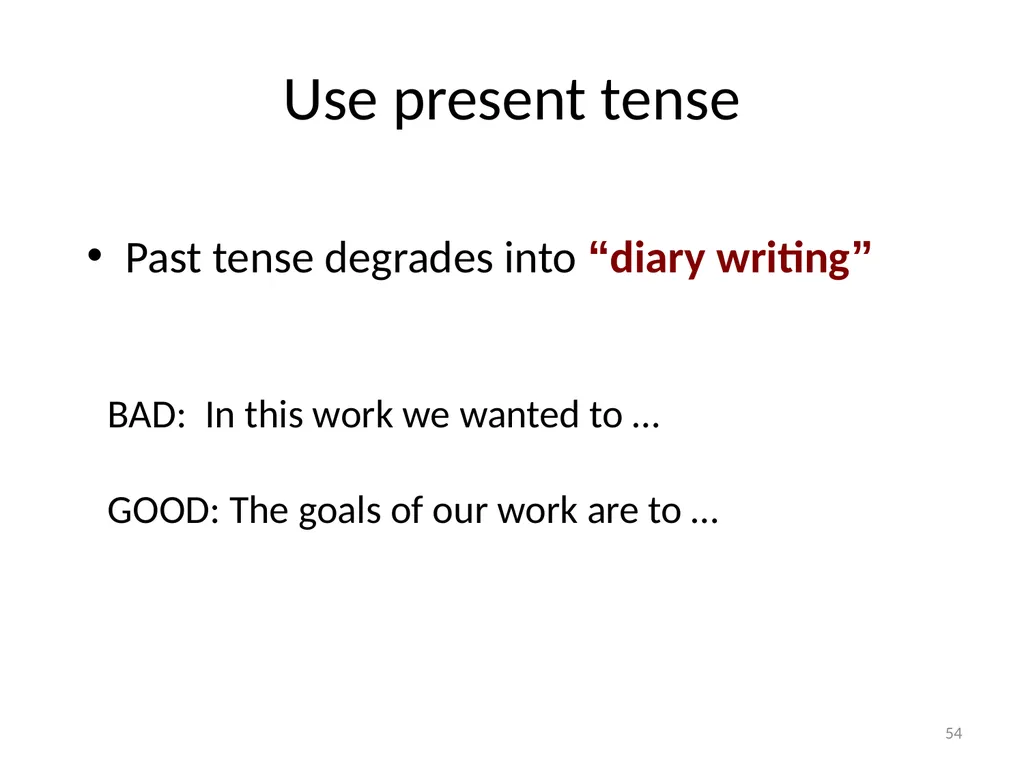
54 Use present tense Past tense degrades into “diary writing” BAD: In this work we wanted to …
GOOD: The goals of our work are to …<br>
GOOD: The goals of our work are to …<br>
55
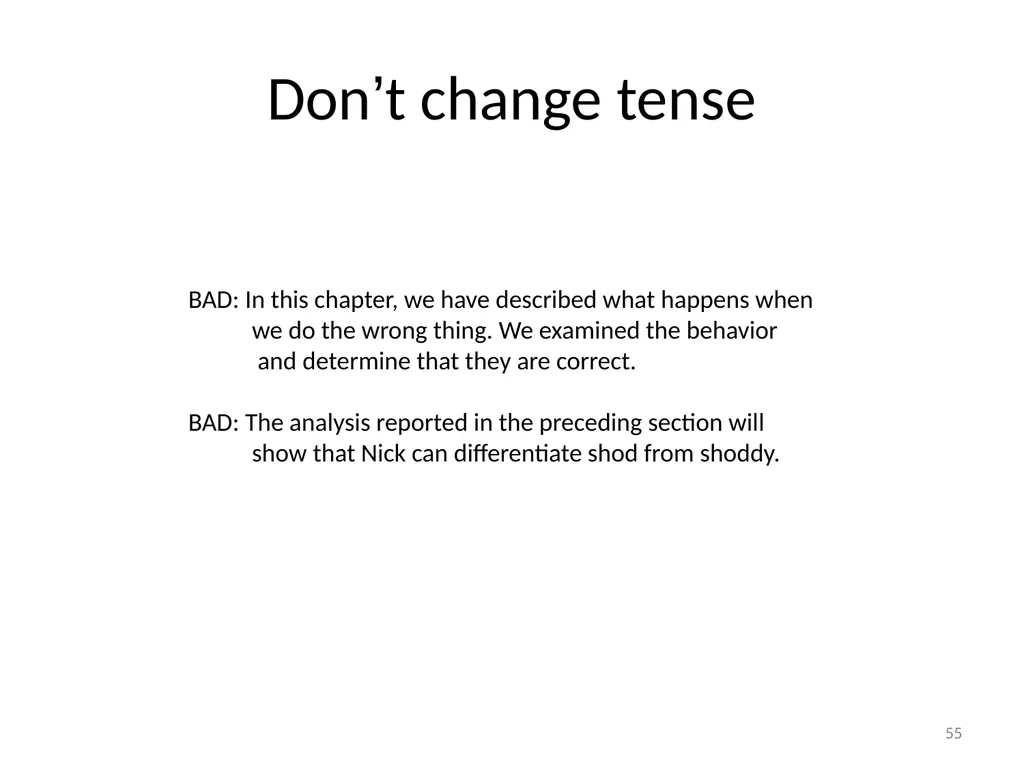
55 Don’t change tense BAD: In this chapter, we have described what happens when
we do the wrong thing. We examined the behavior
and determine that they are correct.
BAD: The analysis reported in the preceding section will
show that Nick can differentiate shod from shoddy.<br>
we do the wrong thing. We examined the behavior
and determine that they are correct.
BAD: The analysis reported in the preceding section will
show that Nick can differentiate shod from shoddy.<br>
56
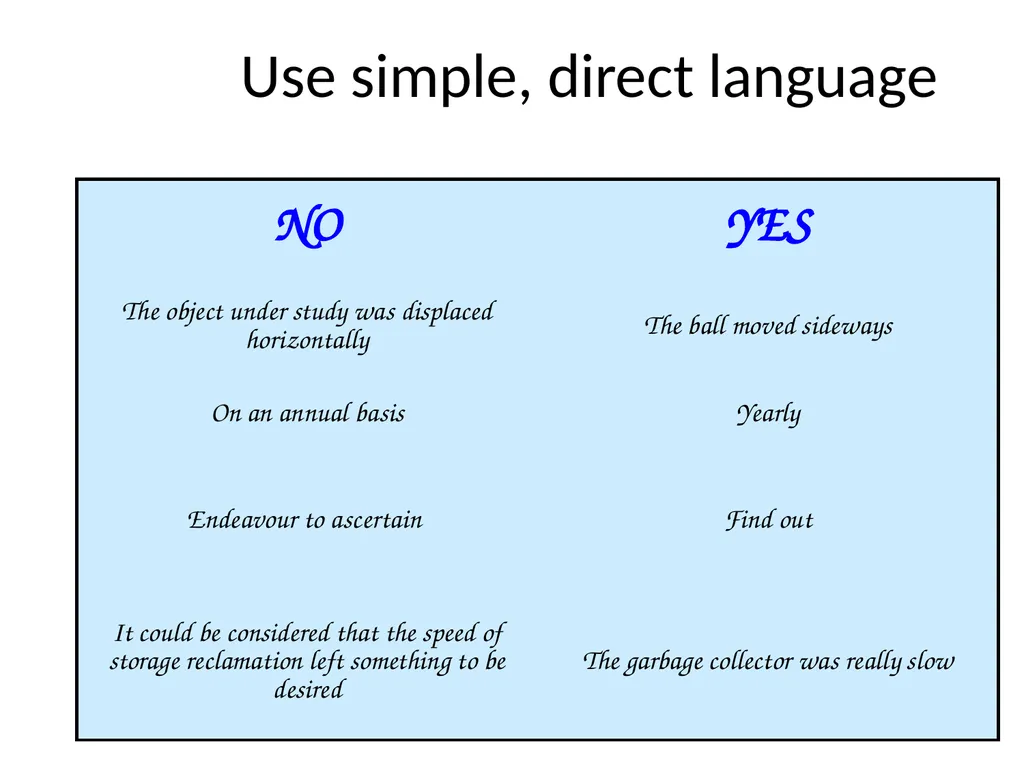
Use simple, direct language<br>
57
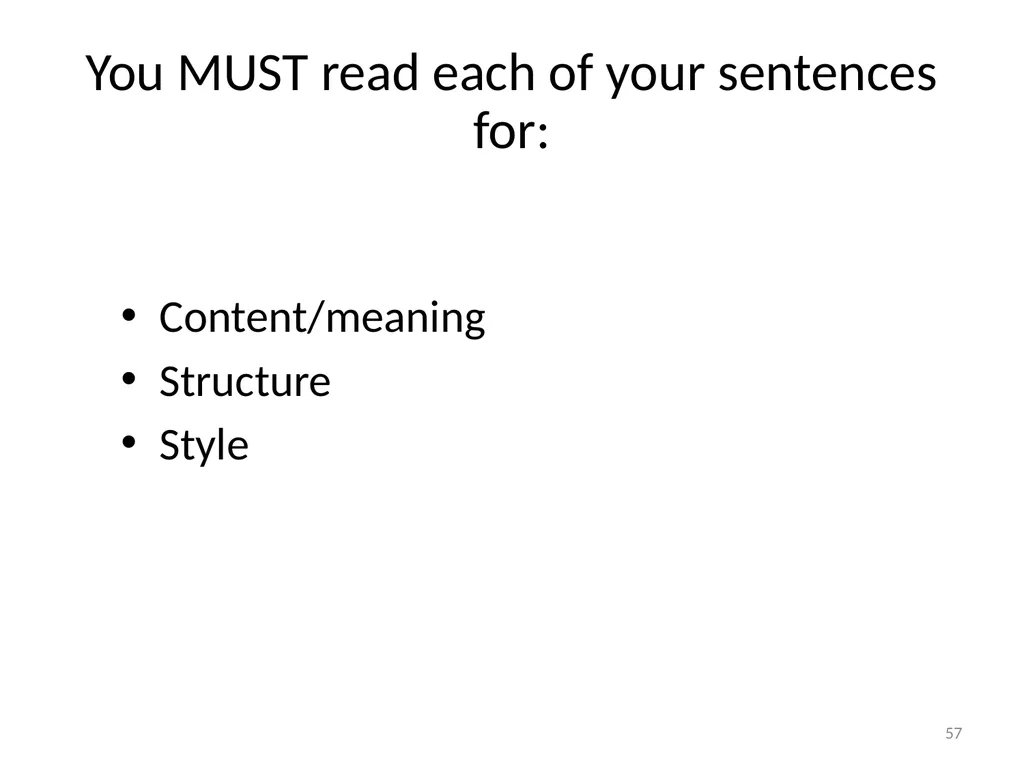
57 You MUST read each of your sentences for: Content/meaning
Structure
Style<br>
Structure
Style<br>
58
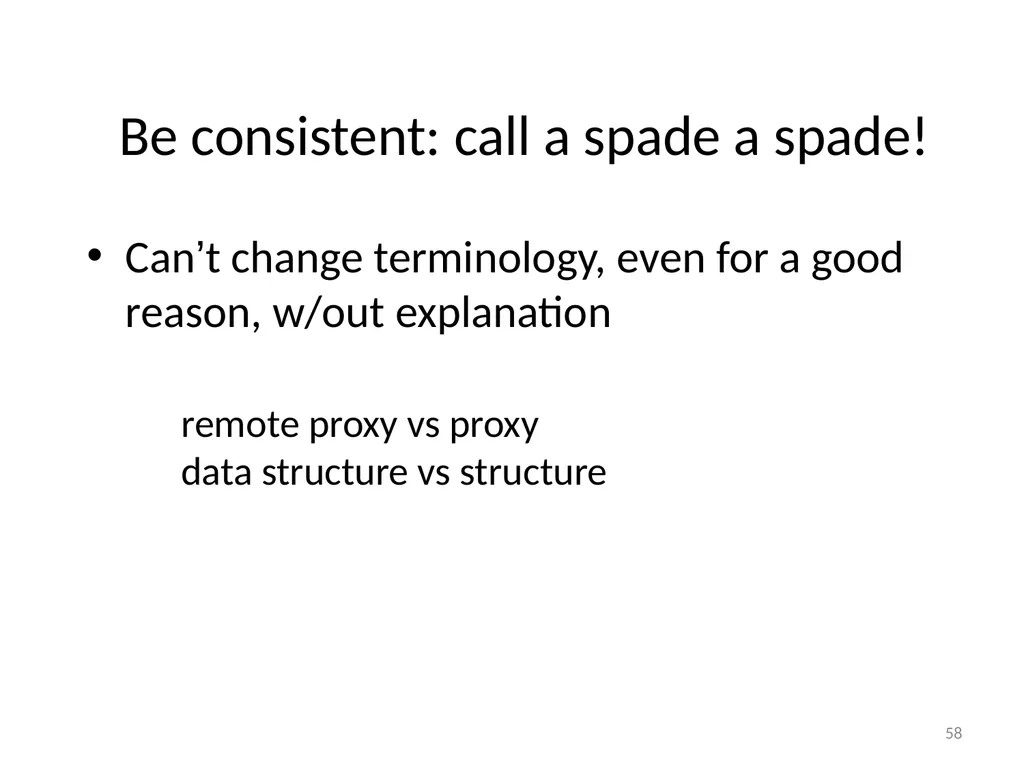
58 Be consistent: call a spade a spade! Can’t change terminology, even for a good reason, w/out explanation remote proxy vs proxy
data structure vs structure<br>
data structure vs structure<br>
59
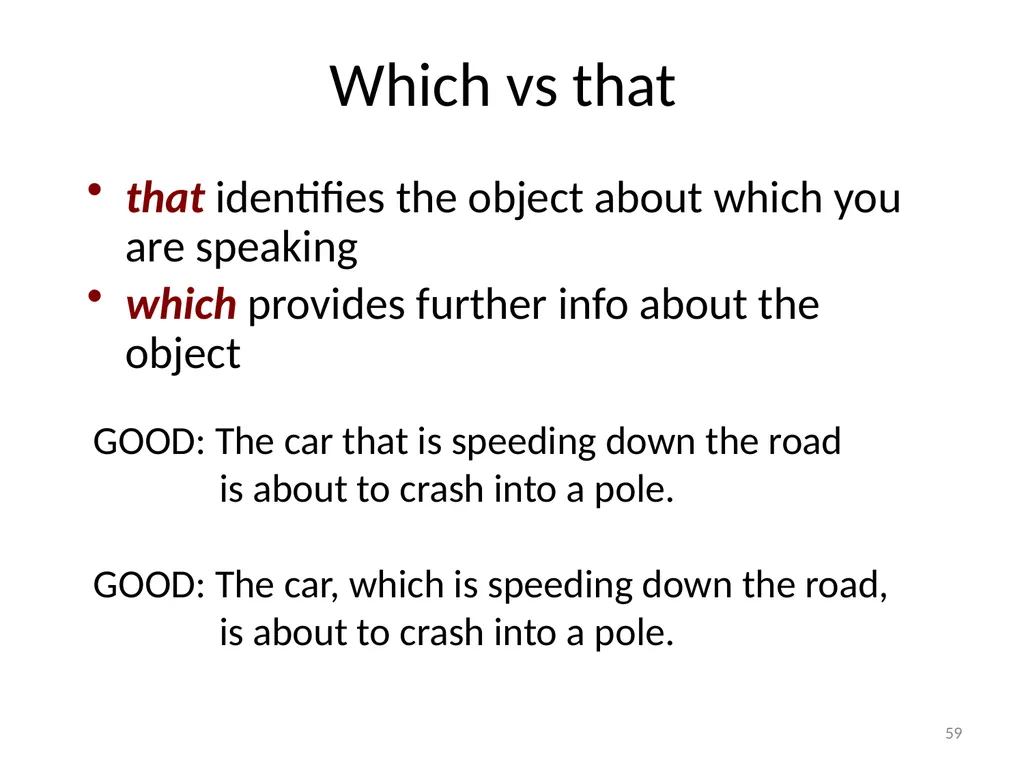
59 Which vs that that identifies the object about which you are speaking
which provides further info about the object GOOD: The car that is speeding down the road
is about to crash into a pole.
GOOD: The car, which is speeding down the road,
is about to crash into a pole.<br>
which provides further info about the object GOOD: The car that is speeding down the road
is about to crash into a pole.
GOOD: The car, which is speeding down the road,
is about to crash into a pole.<br>
60
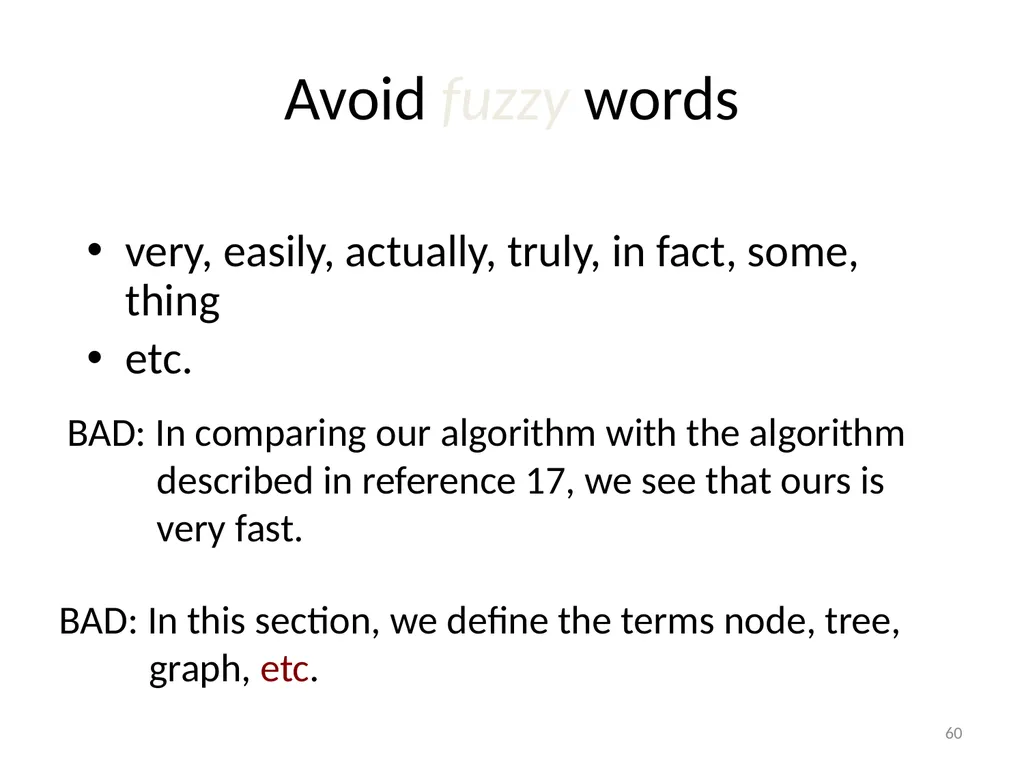
60 Avoid fuzzy words very, easily, actually, truly, in fact, some, thing
etc. BAD: In comparing our algorithm with the algorithm
described in reference 17, we see that ours is
very fast. BAD: In this section, we define the terms node, tree,
graph, etc.<br>
etc. BAD: In comparing our algorithm with the algorithm
described in reference 17, we see that ours is
very fast. BAD: In this section, we define the terms node, tree,
graph, etc.<br>
61
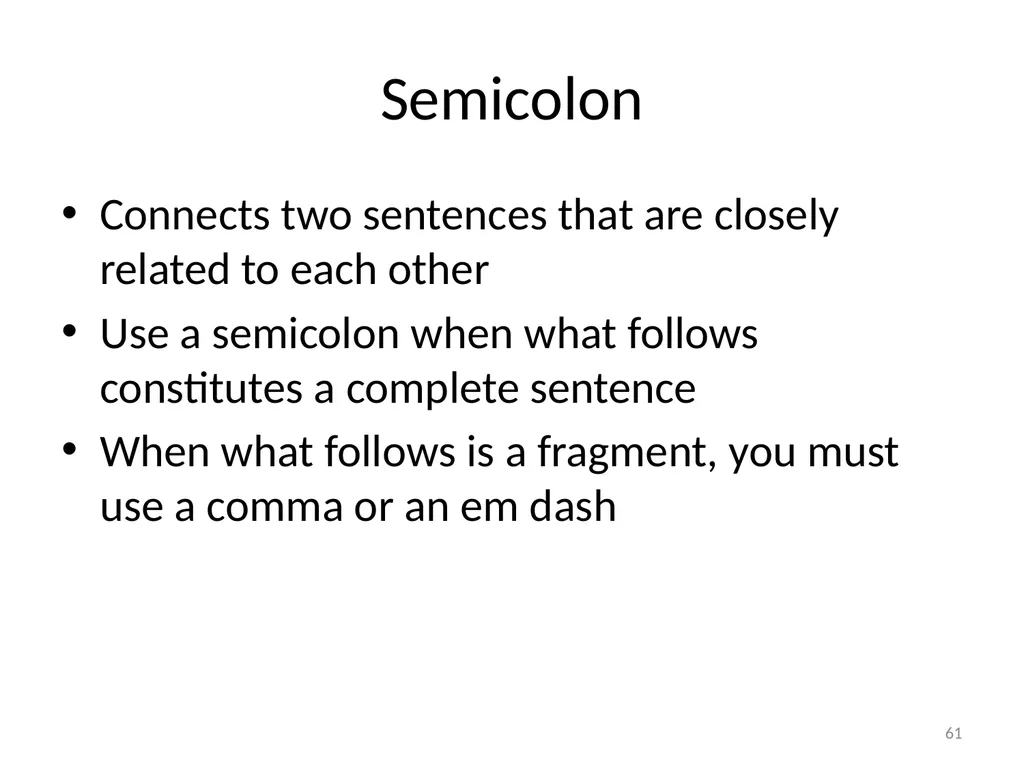
61 Semicolon Connects two sentences that are closely related to each other
Use a semicolon when what follows constitutes a complete sentence
When what follows is a fragment, you must use a comma or an em dash<br>
Use a semicolon when what follows constitutes a complete sentence
When what follows is a fragment, you must use a comma or an em dash<br>
62
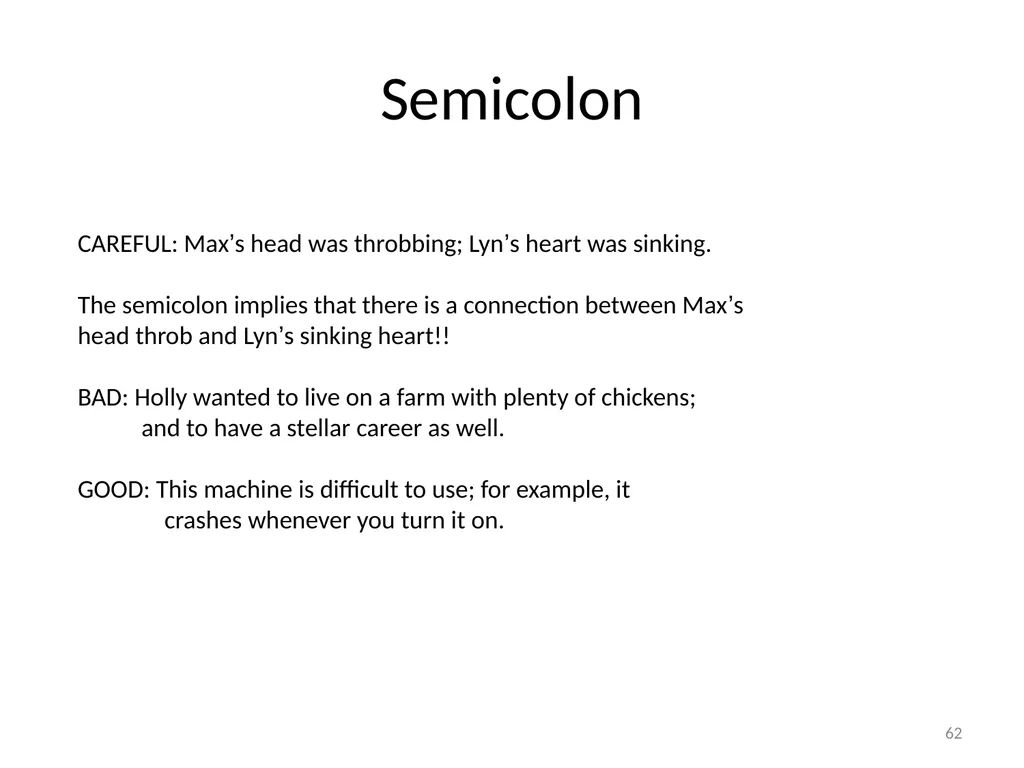
62 Semicolon CAREFUL: Max’s head was throbbing; Lyn’s heart was sinking.
The semicolon implies that there is a connection between Max’s
head throb and Lyn’s sinking heart!!
BAD: Holly wanted to live on a farm with plenty of chickens;
and to have a stellar career as well.
GOOD: This machine is difficult to use; for example, it
crashes whenever you turn it on.<br>
The semicolon implies that there is a connection between Max’s
head throb and Lyn’s sinking heart!!
BAD: Holly wanted to live on a farm with plenty of chickens;
and to have a stellar career as well.
GOOD: This machine is difficult to use; for example, it
crashes whenever you turn it on.<br>
63
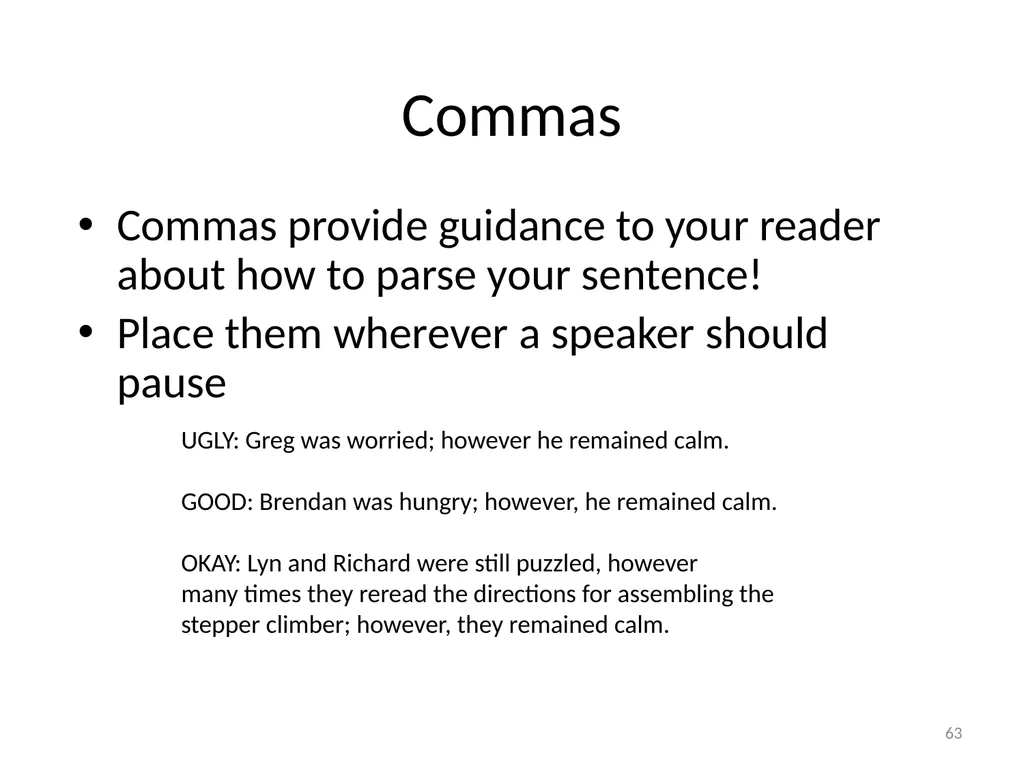
63 Commas Commas provide guidance to your reader about how to parse your sentence!
Place them wherever a speaker should pause UGLY: Greg was worried; however he remained calm.
GOOD: Brendan was hungry; however, he remained calm.
OKAY: Lyn and Richard were still puzzled, however
many times they reread the directions for assembling the
stepper climber; however, they remained calm.<br>
Place them wherever a speaker should pause UGLY: Greg was worried; however he remained calm.
GOOD: Brendan was hungry; however, he remained calm.
OKAY: Lyn and Richard were still puzzled, however
many times they reread the directions for assembling the
stepper climber; however, they remained calm.<br>
64
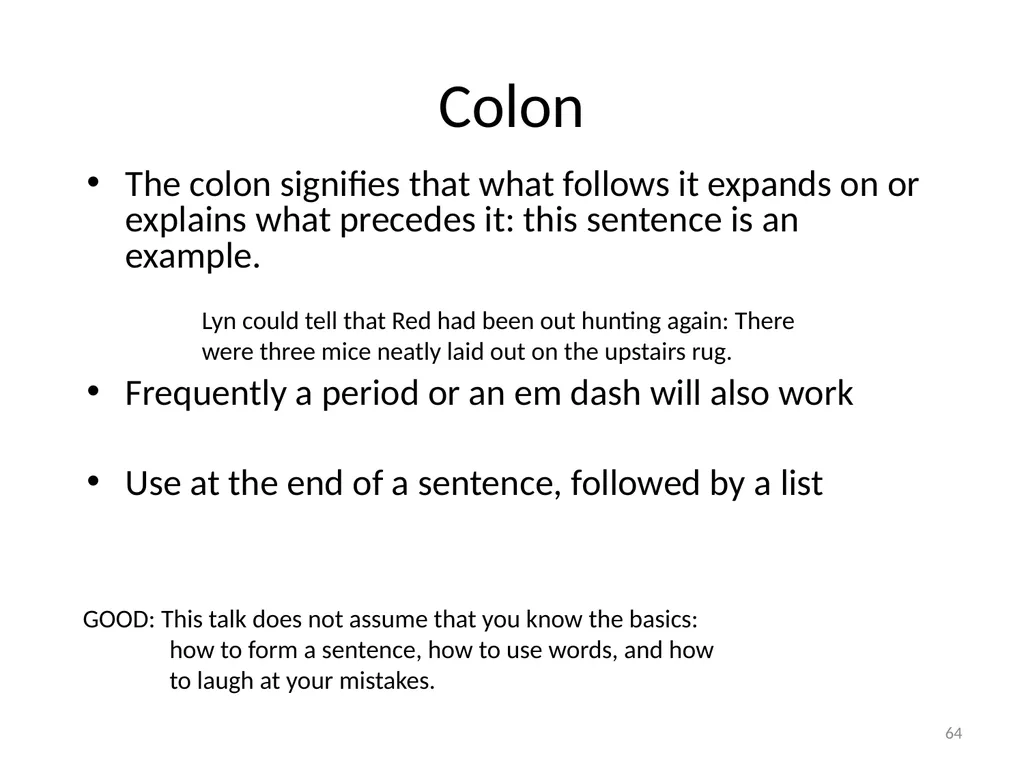
64 Colon The colon signifies that what follows it expands on or explains what precedes it: this sentence is an example.
Frequently a period or an em dash will also work
Use at the end of a sentence, followed by a list Lyn could tell that Red had been out hunting again: There
were three mice neatly laid out on the upstairs rug. GOOD: This talk does not assume that you know the basics:
how to form a sentence, how to use words, and how
to laugh at your mistakes.<br>
Frequently a period or an em dash will also work
Use at the end of a sentence, followed by a list Lyn could tell that Red had been out hunting again: There
were three mice neatly laid out on the upstairs rug. GOOD: This talk does not assume that you know the basics:
how to form a sentence, how to use words, and how
to laugh at your mistakes.<br>
65
65 Summary Every claim must be explained and substantiated
Everything that you state is a claim
Any decent reviewer will assume that “if you don’t state it, you didn’t do it and you can’t handle it!”
Get a “reader” to read your paper
Writing a well-written paper is a lot of work!<br>
Everything that you state is a claim
Any decent reviewer will assume that “if you don’t state it, you didn’t do it and you can’t handle it!”
Get a “reader” to read your paper
Writing a well-written paper is a lot of work!<br>